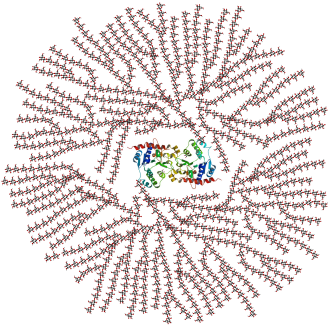
Bioluminescence is the emission of light during a chemiluminescence reaction by living organisms. Bioluminescence occurs in multifarious organisms ranging from marine vertebrates and invertebrates, as well as in some fungi, microorganisms including some bioluminescent bacteria, dinoflagellates and terrestrial arthropods such as fireflies. In some animals, the light is bacteriogenic, produced by symbiotic bacteria such as those from the genus Vibrio; in others, it is autogenic, produced by the animals themselves.
In most cases, the principal chemical reaction in bioluminescence involves the reaction of a substrate called luciferin and an enzyme, called luciferase. Because these are generic names, luciferins and luciferases are often distinguished by the species or group, e.g. firefly luciferin or cypridina luciferin. In all characterized cases, the enzyme catalyzes the oxidation of the luciferin resulting in excited state oxyluciferin, which is the light emitter of the reaction. Upon their decay to the ground state
they emit visible light. In all known cases of bioluminescence the
production of the excited state molecules involves the decomposition of organic peroxides.
In some species, the luciferase requires other cofactors, such as calcium or magnesium ions, and sometimes also the energy-carrying molecule adenosine triphosphate (ATP). In evolution, luciferins vary little: one in particular, coelenterazine, is found in 11 different animal phyla,
though in some of these, the animals obtain it through their diet.
Conversely, luciferases vary widely between different species.
Bioluminescence has arisen over 40 times in evolutionary history.
Both Aristotle and Pliny the Elder mentioned that damp wood sometimes gives off a glow. Many centuries later Robert Boyle
showed that oxygen was involved in the process, in wood, fish, and
glowworms. It was not until the late nineteenth century that
bioluminescence was properly investigated. The phenomenon is widely
distributed among animal groups, especially in marine environments. On
land it occurs in fungi, bacteria and some groups of invertebrates, including insects.
The uses of bioluminescence by animals include counterillumination camouflage, mimicry of other animals, for example to lure prey, and signaling
to other individuals of the same species, such as to attract mates. In
the laboratory, luciferase-based systems are used in genetic engineering
and biomedical research. Researchers are also investigating the
possibility of using bioluminescent systems for street and decorative
lighting, and a bioluminescent plant has been created.
History
Before the development of the safety lamp for use in coal mines, dried fish skins were used in Britain and Europe as a weak source of light. This experimental form of illumination avoided the necessity of using candles which risked sparking explosions of firedamp. In 1920, the American zoologist E. Newton Harvey published a monograph, The Nature of Animal Light, summarizing early work on bioluminescence. Harvey notes that Aristotle mentions light produced by dead fish and flesh, and that both Aristotle and Pliny the Elder (in his Natural History) mention light from damp wood. He records that Robert Boyle
experimented on these light sources, and showed that both they and the
glowworm require air for light to be produced. Harvey notes that in
1753, J. Baker identified the flagellate Noctiluca "as a luminous animal" "just visible to the naked eye", and in 1854 Johann Florian Heller (1813–1871) identified strands (hyphae) of fungi as the source of light in dead wood.
James Hingston Tuckey, in his posthumous 1818 Narrative of the Expedition to the Zaire,
described catching the animals responsible for luminescence. He
mentions pellucida, crustaceans (to which he ascribes the milky
whiteness of the water), and cancers (shrimps and crabs). Under the
microscope he described the "luminous property" to be in the brain,
resembling "a most brilliant amethyst about the size of a large pin's
head".
Charles Darwin noticed bioluminescence in the sea, describing it in his Journal:
While sailing in these latitudes on one very dark night,
the sea presented a wonderful and most beautiful spectacle. There was a
fresh breeze, and every part of the surface, which during the day is
seen as foam, now glowed with a pale light. The vessel drove before her
bows two billows of liquid phosphorus, and in her wake she was followed
by a milky train. As far as the eye reached, the crest of every wave was
bright, and the sky above the horizon, from the reflected glare of
these livid flames, was not so utterly obscure, as over the rest of the
heavens.
Darwin also observed a luminous "jelly-fish of the genus Dianaea", noting that: "When the waves scintillate with bright green sparks, I
believe it is generally owing to minute crustacea. But there can be no
doubt that very many other pelagic animals, when alive, are
phosphorescent." He guessed that "a disturbed electrical condition of the atmosphere" was probably responsible. Daniel Pauly comments that Darwin "was lucky with most of his guesses, but not here", noting that biochemistry was too little known, and that the complex
evolution of the marine animals involved "would have been too much for
comfort".
Bioluminescence attracted the attention of the United States Navy in the Cold War, since submarines in some waters can create a bright enough wake to be detected; a German submarine was sunk in the First World War,
having been detected in this way. The Navy was interested in predicting
when such detection would be possible, and hence guiding their own
submarines to avoid detection.
Among the anecdotes of navigation by bioluminescence is one recounted by the Apollo 13 astronaut Jim Lovell, who as a Navy pilot had found his way back to his aircraft carrier USS Shangri-La
when his navigation systems failed. Turning off his cabin lights, he
saw the glowing wake of the ship, and was able to fly to it and land
safely.
The French pharmacologist Raphaël Dubois carried out work on bioluminescence in the late nineteenth century. He studied click beetles (Pyrophorus) and the marine bivalve mollusc Pholas dactylus. He refuted the old idea that bioluminescence came from phosphorus, and demonstrated that the process was related to the oxidation of a specific compound, which he named luciferin, by an enzyme. He sent Harvey siphons
from the mollusc preserved in sugar. Harvey had become interested in
bioluminescence as a result of visiting the South Pacific and Japan and
observing phosphorescent organisms there. He studied the phenomenon for
many years. His research aimed to demonstrate that luciferin, and the
enzymes that act on it to produce light, were interchangeable between
species, showing that all bioluminescent organisms had a common
ancestor. However, he found this hypothesis to be false, with different
organisms having major differences in the composition of their
light-producing proteins. He spent the next 30 years purifying and
studying the components, but it fell to the young Japanese chemist Osamu Shimomura to be the first to obtain crystalline luciferin. He used the sea fireflyVargula hilgendorfii, but it was another ten years before he discovered the chemical's structure and published his 1957 paper Crystalline Cypridina Luciferin. Shimomura, Martin Chalfie, and Roger Y. Tsien won the 2008 Nobel Prize in Chemistry for their 1961 discovery and development of green fluorescent protein as a tool for biological research.
Harvey wrote a detailed historical account on all forms of luminescence in 1957. An updated book on bioluminescence covering also the twentieth and early twenty-first century was published recently.
Evolution
In 1932 E. N. Harvey was among the first to propose how bioluminescence could have evolved. In this early paper, he suggested that proto-bioluminescence could have
arisen from respiratory chain proteins that hold fluorescent groups.
This hypothesis has since been disproven, but it did lead to
considerable interest in the origins of the phenomenon. Today, the two
prevailing hypotheses (both concerning marine bioluminescence) are those
put forth by Howard Seliger in 1993 and Rees et al. in 1998.
Seliger's theory identifies luciferase enzymes as the catalyst
for the evolution of bioluminescent systems. It suggests that the
original purpose of luciferases was as mixed-function oxygenases. As the
early ancestors of many species moved into deeper and darker waters
natural selection favored the development of increased eye sensitivity
and enhanced visual signals. If selection were to favor a mutation in the oxygenase enzyme required
for the breakdown of pigment molecules (molecules often associated with
spots used to attract a mate or distract a predator) it could have
eventually resulted in external luminescence in tissues.
Rees et al. use evidence gathered from the marine luciferin
coelenterazine to suggest that selection acting on luciferins may have
arisen from pressures to protect oceanic organisms from potentially
deleterious reactive oxygen species (e.g. H2O2 and O2−
). The functional shift from antioxidation to bioluminescence probably
occurred when the strength of selection for antioxidation defense
decreased as early species moved further down the water column. At
greater depths exposure to ROS is significantly lower, as is the
endogenous production of ROS through metabolism.
While popular at first, Seliger's theory has been challenged,
particularly on the biochemical and genetic evidence that Rees examines.
What remains clear, however, is that bioluminescence has evolved
independently at least 40 times. Bioluminescence in fish began at least by the Cretaceous
period. About 1,500 fish species are known to be bioluminescent; the
capability evolved independently at least 27 times. Of these, 17
involved the taking up of bioluminous bacteria from the surrounding
water while in the others, the intrinsic light evolved through chemical
synthesis. These fish have become surprisingly diverse in the deep ocean
and control their light with the help of their nervous system, using it
not just to lure prey or hide from predators, but also for
communication.
All bioluminescent organisms have in common that the reaction of a
"luciferin" and oxygen is catalyzed by a luciferase to produce light. McElroy and Seliger proposed in 1962 that the bioluminescent reaction
evolved to detoxify oxygen, in parallel with photosynthesis.
Thuesen, Davis et al. showed in 2016 that bioluminescence has
evolved independently 27 times within 14 fish clades across ray-finned
fishes. The oldest of these appears to be Stomiiformes and Myctophidae. In sharks, bioluminescence has evolved only once. Genomic analysis of octocorals indicates that their ancestor was bioluminescent as long as 540 million years ago.
Bioluminescence is a form of chemiluminescence where light energy is released by a chemical reaction. This reaction involves a light-emitting pigment, the luciferin, and a luciferase, the enzyme component. Because of the diversity of luciferin/luciferase combinations, there
are very few commonalities in the chemical mechanism. From currently
studied systems, the only unifying mechanism is the role of molecular oxygen; often there is a concurrent release of carbon dioxide (CO2). For example, the firefly luciferin/luciferase reaction requires magnesium and ATP and produces CO2, adenosine monophosphate (AMP) and pyrophosphate (PP) as waste products. Other cofactors may be required, such as calcium (Ca2+) for the photoproteinaequorin, or magnesium (Mg2+) ions and ATP for the firefly luciferase. Generically, this reaction can be described as:
Instead of a luciferase, the jellyfish Aequorea victoria makes use of another type of protein called a photoprotein, in this case specifically aequorin. When calcium ions are added, rapid catalysis
creates a brief flash quite unlike the prolonged glow produced by
luciferase. In a second, much slower step, luciferin is regenerated from
the oxidized (oxyluciferin) form, allowing it to recombine with
aequorin, in preparation for a subsequent flash. Photoproteins are thus enzymes, but with unusual reaction kinetics. Furthermore, some of the blue light released by aequorin in contact with calcium ions is absorbed by a green fluorescent protein, which in turn releases green light in a process called resonant energy transfer.
Bioluminescence occurs widely among animals, especially in the open sea, including fish, jellyfish, comb jellies, crustaceans, and cephalopod molluscs; in some fungi and bacteria; and in various terrestrial invertebrates, nearly all of which are beetles.
In marine coastal habitats, about 2.5% of organisms are estimated to be
bioluminescent, whereas in pelagic habitats in the eastern Pacific,
about 76% of the main taxa of deep-sea animals have been found to be capable of producing light. More than 700 animal genera have been recorded with light-producing species. Most marine light-emission is in the blue and green light spectrum. However, some loose-jawed fish emit red and infrared light, and the genus Tomopteris emits yellow light.
The most frequently encountered bioluminescent organisms may be the dinoflagellates
in the surface layers of the sea, which are responsible for the
sparkling luminescence sometimes seen at night in disturbed water. At
least 18 genera of these phytoplankton exhibit luminosity. Luminescent dinoflagellate ecosystems are present in warm water lagoons and bays with narrow openings to the ocean. A different effect is the thousands of square miles of the ocean which
shine with the light produced by bioluminescent bacteria, known as mareel or the milky seas effect.
Pelagic zone
Bioluminescence
is abundant in the pelagic zone, with the most concentration at depths
devoid of light and surface waters at night. These organisms participate
in diurnal vertical migration from the dark depths to the surface at
night, dispersing the population of bioluminescent organisms across the
pelagic water column. The dispersal of bioluminescence across different
depths in the pelagic zone has been attributed to the selection
pressures imposed by predation and the lack of places to hide in the
open sea. In depths where sunlight never penetrates, often below 200m,
the significance of bioluminescent is evident in the retainment of
functional eyes for organisms to detect bioluminescence.
Bacterial symbioses
Organisms
often produce bioluminescence themselves, rarely do they generate it
from outside phenomena. However, there are occasions where
bioluminescence is produced by bacterial symbionts that have a symbiotic
relationship with the host organism. Although many luminous bacteria in
the marine environment are free-living, a majority are found in
symbiotic relationships that involve fish, squids, crustaceans etc. as
hosts. Most luminous bacteria inhabit the sea, dominated by Photobacterium and Vibrio.
In the symbiotic relationship, bacterium benefit from having a
source of nourishment and a refuge to grow. Hosts obtain these bacterial
symbionts either from the environment, spawning, or the luminous bacterium is evolving with their host. Coevolutionary interactions are suggested as host organisms' anatomical
adaptations have become specific to only certain luminous bacteria, to
suffice ecological dependence of bioluminescence.
Benthic zone
Bioluminescence is widely studied amongst species located in the mesopelagic zone, but the benthic zone
at mesopelagic depths has remained widely unknown. Benthic habitats at
depths beyond the mesopelagic are also poorly understood due to the same
constraints. Unlike the pelagic zone where the emission of light is
undisturbed in the open sea, the occurrence of bioluminescence in the
benthic zone is less common. It has been attributed to the blockage of
emitted light by a number of sources such as the sea floor, and
inorganic and organic structures. Visual signals and communication that
is prevalent in the pelagic zone such as counter-illumination may not be
functional or relevant in the benthic realm. Bioluminescence in bathyal
benthic species still remains poorly studied due to difficulties of the
collection of species at these depths.
Bioluminescence has several functions in different taxa. Steven Haddock
et al. (2010) list as more or less definite functions in marine
organisms the following: defensive functions of startle,
counterillumination (camouflage), misdirection (smoke screen),
distractive body parts, burglar alarm (making predators easier for
higher predators to see), and warning to deter settlers; offensive
functions of lure, stun or confuse prey, illuminate prey, and mate
attraction/recognition. It is much easier for researchers to detect that
a species is able to produce light than to analyze the chemical
mechanisms or to prove what function the light serves. In some cases the function is unknown, as with species in three families of earthworm (Oligochaeta), such as Diplocardia longa, where the coelomic fluid produces light when the animal moves. The following functions are reasonably well established in the named organisms.
Counterillumination camouflage
Principle of counterilluminationcamouflage in firefly squid, Watasenia scintillans.
When seen from below by a predator, the bioluminescence helps to match
the squid's brightness and color to the sea surface above.
In many animals of the deep sea, including several squid species, bacterial bioluminescence is used for camouflage by counterillumination, in which the animal matches the overhead environmental light as seen from below. In these animals, photoreceptors control the illumination to match the brightness of the background. These light organs are usually separate from the tissue containing the bioluminescent bacteria. However, in one species, Euprymna scolopes, the bacteria are an integral component of the animal's light organ.
Bioluminescence is used in a variety of ways and for different purposes. The cirrate octopod Stauroteuthis syrtensis uses emits bioluminescence from its sucker like structures. These structures are believed to have evolved from what are more
commonly known as octopus suckers. They do not have the same function as
the normal suckers because they no longer have any handling or
grappling ability due its evolution of photophores.
The placement of the photophores are within the animals oral reach,
which leads researchers to suggest that it uses it bioluminescence to
capture and lure prey.
Fireflies use light to attract mates.
Two systems are involved according to species; in one, females emit
light from their abdomens to attract males; in the other, flying males
emit signals to which the sometimes sedentary females respond. Click beetles
emit an orange light from the abdomen when flying and a green light
from the thorax when they are disturbed or moving about on the ground.
The former is probably a sexual attractant but the latter may be
defensive. Larvae of the click beetle Pyrophorus nyctophanus
live in the surface layers of termite mounds in Brazil. They light up
the mounds by emitting a bright greenish glow which attracts the flying
insects on which they feed.
In the marine environment, use of luminescence for mate attraction is chiefly known among ostracods, small shrimp-like crustaceans, especially in the family Cyprididae. Pheromones may be used for long-distance communication, with bioluminescence used at close range to enable mates to "home in". A polychaete worm, the Bermuda fireworm creates a brief display, a few nights after the full moon, when the female lights up to attract males.
Defense
Acanthephyra purpurea has photophores along its body which it uses in defense against predators.
The defense mechanisms for bioluminescent organisms can come in
multiple forms; startling prey, counter-illumination, smoke screen or
misdirection, distractive body parts, burglar alarm, sacrificial tag or
warning coloration. The shrimp family Oplophoridae Dana use their
bioluminescence as a way of startling the predator that is after them. Acanthephyra purpurea,
within the Oplophoridae family, uses its photophores to emit light, and
can secrete a bioluminescent substance when in the presence of a
predator. This secretory mechanism is common among prey fish.
Many cephalopods, including at least 70 genera of squid, are bioluminescent. Some squid and small crustaceans use bioluminescent chemical mixtures or bacterial slurries in the same way as many squid use ink.
A cloud of luminescent material is expelled, distracting or repelling a
potential predator, while the animal escapes to safety. The deep sea squid Octopoteuthis deletron may autotomize portions of its arms which are luminous and continue to twitch and flash, thus distracting a predator while the animal flees.
Dinoflagellates may use bioluminescence for defense against predators.
They shine when they detect a predator, possibly making the predator
itself more vulnerable by attracting the attention of predators from
higher trophic levels. Grazing copepods release any phytoplankton cells that flash, unharmed;
if they were eaten they would make the copepods glow, attracting
predators, so the phytoplankton's bioluminescence is defensive. The
problem of shining stomach contents is solved (and the explanation
corroborated) in predatory deep-sea fishes: their stomachs have a black
lining able to keep the light from any bioluminescent fish prey which
they have swallowed from attracting larger predators.
The sea-firefly
is a small crustacean living in sediment. At rest it emits a dull glow
but when disturbed it darts away leaving a cloud of shimmering blue
light to confuse the predator. During World War II it was gathered and
dried for use by the Japanese army as a source of light during
clandestine operations.
The larvae of railroad worms (Phrixothrix) have paired photic organs on each body segment, able to glow with green light; these are thought to have a defensive purpose. They also have organs on the head which produce red light; they are the only terrestrial organisms to emit light of this color.
Warning
Aposematism
is a widely used function of bioluminescence, providing a warning that
the creature concerned is unpalatable. It is suggested that many firefly
larvae glow to repel predators; some millipedes glow for the same purpose. Some marine organisms are believed to emit light for a similar reason. These include scale worms, jellyfish and brittle stars
but further research is needed to fully establish the function of the
luminescence. Such a mechanism would be of particular advantage to
soft-bodied cnidarians if they were able to deter predation in this way. The limpetLatia neritoides is the only known freshwater gastropod that emits light. It produces greenish luminescent mucus which may have an anti-predator function. The marine snail Hinea brasiliana
uses flashes of light, probably to deter predators. The blue-green
light is emitted through the translucent shell, which functions as an
efficient diffuser of light.
Communication
Pyrosoma, a colonial tunicate; each individual zooid in the colony flashes a blue-green light.
Communication in the form of quorum sensing
plays a role in the regulation of luminescence in many species of
bacteria. Small extracellularly secreted molecules stimulate the
bacteria to turn on genes for light production when cell density,
measured by concentration of the secreted molecules, is high.
Pyrosomes are colonial tunicates and each zooid
has a pair of luminescent organs on either side of the inlet siphon.
When stimulated by light, these turn on and off, causing rhythmic
flashing. No neural pathway runs between the zooids, but each responds
to the light produced by other individuals, and even to light from other
nearby colonies. Communication by light emission between the zooids enables coordination
of colony effort, for example in swimming where each zooid provides
part of the propulsive force.
Some bioluminous bacteria infect nematodes that parasitize Lepidoptera larvae. When these caterpillars die, their luminosity may attract predators to the dead insect thus assisting in the dispersal of both bacteria and nematodes. A similar reason may account for the many species of fungi that emit light. Species in the genera Armillaria, Mycena, Omphalotus, Panellus, Pleurotus and others do this, emitting usually greenish light from the mycelium, cap and gills. This may attract night-flying insects and aid in spore dispersal, but other functions may also be involved.
Quantula striata
is the only known bioluminescent terrestrial mollusk. Pulses of light
are emitted from a gland near the front of the foot and may have a
communicative function, although the adaptive significance is not fully
understood.
Bioluminescence is used by a variety of animals to mimic other species. Many species of deep sea fish such as the anglerfish and dragonfish make use of aggressive mimicry to attract prey. They have an appendage on their heads called an esca
that contains bioluminescent bacteria able to produce a long-lasting
glow which the fish can control. The glowing esca is dangled or waved
about to lure small animals to within striking distance of the fish.
The cookiecutter shark
uses bioluminescence to camouflage its underside by
counter-illumination, but a small patch near its pectoral fins remains
dark, appearing as a small fish to large predatory fish like tuna and mackerel swimming beneath it. When such fish approach the lure, they are bitten by the shark.
Female Photuris fireflies sometimes mimic the light pattern of another firefly, Photinus, to attract its males as prey. In this way they obtain both food and the defensive chemicals named lucibufagins, which Photuris cannot synthesize.
South American giant cockroaches of the genus Lucihormetica
were believed to be the first known example of defensive mimicry,
emitting light in imitation of bioluminescent, poisonous click beetles. However, doubt has been cast on this assertion, and there is no conclusive evidence that the cockroaches are bioluminescent.
Flashing of photophores of black dragonfish, Malacosteus niger, showing red fluorescence
Illumination
While most marine bioluminescence is green to blue, some deep sea barbeled dragonfishes in the genera Aristostomias, Pachystomias and Malacosteus
emit a red glow. This adaptation allows the fish to see red-pigmented
prey, which are normally invisible to other organisms in the deep ocean
environment where red light has been filtered out by the water column. These fish are able to utilize the longer wavelength to act as a spotlight for its prey that only they can see. The fish may also use this light to communicate with each other to find potential mates. The ability of the fish to see this light is explained by the presence of specialized rhodopsin pigment. The mechanism of light creation is through a suborbital photophore that
utilizes gland cells which produce exergonic chemical reactions that
produce light with a longer, red wavelength. The dragonfish species which produce the red light also produce blue light in photophore on the dorsal area. The main function of this is to alert the fish to the presence of its prey. The additional pigment is thought to be assimilated from chlorophyll derivatives found in the copepods which form part of its diet.
The angler siphonophore (Erenna) utilizes red bioluminescence in appendages to lure fish.
In vivo luminescence cell and animal imaging can sometimes use dyes and fluorescent proteins as chromophores through an energy transfer process known as BRET, which harnesses the light energy generated by the luminescent reaction to energize fluorescent proteins.
Light production
A "Firefly" petunia, genetically engineered to produce luciferase.
The structures of photophores, the light producing organs in bioluminescent organisms, are being investigated by industrial designers.
Engineered bioluminescence could perhaps one day be used to reduce the
need for street lighting, or for decorative purposes if it becomes
possible to produce light that is both bright enough and can be
sustained for long periods at a workable price. The gene that makes the tails of fireflies
glow has been added to mustard plants. The plants glow faintly for an
hour when touched, but a sensitive camera is needed to see the glow. University of Wisconsin–Madison is researching the use of genetically engineered bioluminescent E. coli bacteria, for use as bioluminescent bacteria in a light bulb. In 2011, Philips demonstrated a microbial system for ambience lighting in the home. An iGEM
team from Cambridge (England) has started to address the problem that
luciferin is consumed in the light-producing reaction by developing a
genetic biotechnology part that codes for a luciferin regenerating
enzyme from the North American firefly. In 2016, Glowee, a French company started selling bioluminescent lights for shop fronts and street signs, for use between 1 and 7 in the morning when the law forbids use of electricity for this purpose. They used the bioluminescent bacterium Aliivibrio fischeri, but the maximum lifetime of their product was three days. In April 2020, plants were genetically engineered to glow more brightly using genes from the bioluminescent mushroom Neonothopanus nambi to convert caffeic acid into luciferin. Another possible application is to replace chemiluminescence with
bioluminescent enzymes. A Canadian company, Lux Bio, is developing
long-duration bioluminescent enzymes for this purpose.
ATP bioluminescence
ATP
bioluminescence is the process in which ATP is used to generate
luminescence in an organism, in conjunction with other compounds such as
luciferin. It proves to be a very good biosensor to test for the presence of living microbes in water. Different types of microbial populations are determined through
different sets of ATP assays using other substrates and reagents. Renilla- and
Gaussia-based cell viability assays use the substrate coelenterazine.
From top, left to right: Banda Aceh, Indonesia, after the tsunami • Korean rescue workers recovering a body under debris • a man searching through rubble in Meulaboh • people running away from the tsunami • a tsunami memorial in Kerala, India
On 26 December 2004, at 07:58:53 local time (UTC+7), a Mw 9.2–9.3 earthquake struck with an epicenter off the west coast of Aceh in northern Sumatra, Indonesia. The underseamegathrust earthquake, known in the scientific community as the Sumatra–Andaman earthquake,was caused by a rupture along the fault between the Burma plate and the Indian plate, and reached a Mercalli intensity of IX in some areas.
The earthquake caused a massive tsunami with waves up to 30 m (100 ft) high, known as the Boxing Day Tsunami after the Boxing Day holiday, or as the Asian Tsunami, which devastated communities along the surrounding coasts of the Indian
Ocean, killing an estimated 227,898 people in 14 countries, especially
in Aceh (Indonesia), Sri Lanka, Tamil Nadu (India), and Khao Lak (Thailand).
The direct result was severe disruption to living conditions and
commerce in coastal provinces of these and other surrounding countries.
It is the deadliest tsunami in history, the deadliest natural disaster of the 21st century, and one of the deadliest natural disasters in recorded history. It is also the worst natural disaster in the history of Indonesia, the Maldives, Sri Lanka and Thailand.
The earthquake itself is the most powerful earthquake ever
recorded in Asia, the most powerful earthquake of the 21st century, and
the second or third most powerful earthquake ever recorded worldwide since modern seismography began in 1900. It had the longest fault rupture ever observed, between 1,200 and 1,300
kilometres (746 and 808 mi), and had the longest duration of faulting ever observed, at least ten minutes. It caused the entire planet to vibrate as much as 10 mm (0.4 in), and also remotely triggered earthquakes as far away as Alaska. Its epicentre was between Simeulue and mainland Sumatra. The plight of the affected people and countries prompted a worldwide humanitarian response, with donations totalling more than US$14 billion (equivalent to US$23 billion in 2024 currency).
The 2004 Indian Ocean earthquake was initially documented as having a moment magnitude of 8.8. The United States Geological Survey has its official estimate of Mw 9.1, but most recent studies suggest that the earthquake was Mw 9.2–9.3. Hiroo Kanamori of the California Institute of Technology estimates that Mw 9.2 is best representative of the earthquake's size. More recent studies estimate the magnitude to be Mw 9.3.A 2016 study estimated the magnitude to be Mw 9.25, while a 2021 study revised its 2007 estimate of Mw 9.1 to a new magnitude of Mw 9.2.
The hypocentre
of the main earthquake was approximately 160 km (100 mi) off the
western coast of northern Sumatra, in the Indian Ocean just north of Simeulue island at a depth of 30 km (19 mi) below mean sea level (initially reported as 10 km or 6.2 mi). The northern section of the Sunda megathrust ruptured over a length of 1,300 km (810 mi). The earthquake (followed by the tsunami) was felt in Bangladesh, India, Malaysia, Myanmar, Thailand, Sri Lanka and the Maldives. Splay faults, or secondary "pop up faults", caused long, narrow parts
of the seafloor to pop up in seconds. This quickly elevated the height
and increased the speed of waves, destroying the nearby Indonesian town
of Lhoknga.
Great earthquakes such as the 2004 Indian Ocean earthquake are generally associated with megathrust events in subduction zones. Their seismic moments
can account for a significant fraction of the global seismic moment
across century-scale periods. Of all the moment released by earthquakes
in the 100 years from 1906 through 2005, roughly one-eighth was due to
the 2004 Indian Ocean earthquake. This quake, together with the Great Alaskan earthquake (1964) and the Great Chilean earthquake (1960), account for almost half of the total moment.
Since 1900, the only earthquakes recorded with a greater
magnitude were the 1960 Chile earthquake (magnitude 9.5) and the 1964
Alaska earthquake in Prince William Sound (magnitude 9.2). The only other recorded earthquakes of magnitude 9.0 or greater were off Kamchatka, Russia, on 5 November 1952 (magnitude 9.0) and Tōhoku, Japan (magnitude 9.1) in March 2011.
Each of these megathrust earthquakes also spawned tsunamis in the
Pacific Ocean. In comparison to the 2004 Indian Ocean earthquake, the
death toll from these earthquakes and tsunamis was significantly lower,
primarily because of the lower population density along the coasts near
affected areas.
Comparisons with earlier earthquakes are difficult, as earthquake strength was not measured systematically until the 1930s. However, historical earthquake strength can sometimes be estimated by
examining historical descriptions of the damage caused, and the
geological records of the areas where they occurred. Some examples of significant historical megathrust earthquakes are the 1868 Arica earthquake in Peru and the 1700 Cascadia earthquake in western North America.
The 2004 Indian Ocean earthquake was unusually large in geographical and geological extent. An estimated 1,600 km (1,000 mi) of fault surface slipped (or ruptured) about 15 m (50 ft) along the subduction zone where the Indian plate
slides under (or subducts) the overriding Burma plate. The slip did not
happen instantaneously but took place in two phases over several
minutes: Seismographic and acoustic data indicate that the first phase
involved a rupture about 400 km (250 mi) long and 100 km (60 mi) wide,
30 km (19 mi) beneath the sea bed—the largest rupture ever known to have
been caused by an earthquake. The rupture proceeded at about 2.8 km/s
(1.74 mi/s; 10,100 km/h; 6,260 mph), beginning off the coast of Aceh
and proceeding north-westerly over about 100 seconds. After a pause of
about another 100 seconds, the rupture continued northwards towards the Andaman and Nicobar Islands.
The northern rupture occurred more slowly than in the south, at about
2.1 km/s (1.3 mi/s; 7,600 km/h; 4,700 mph), continuing north for another
five minutes to a plate boundary where the fault type changes from
subduction to strike-slip (the two plates slide past one another in opposite directions).
The Indian plate is part of the Indo-Australian plate, which underlies the Indian Ocean and Bay of Bengal, and is moving north-east at an average of 60 mm/a (0.075 in/Ms). The India Plate meets the Burma plate (which is considered a portion of the great Eurasian plate) at the Sunda Trench.
At this point, the India Plate subducts beneath the Burma plate, which
carries the Nicobar Islands, the Andaman Islands, and northern Sumatra.
The India Plate sinks deeper and deeper beneath the Burma plate until
the increasing temperature and pressure drive volatiles
out of the subducting plate. These volatiles rise into the overlying
plate, causing partial melting and the formation of magma. The rising
magma intrudes into the crust above and exits the Earth's crust through
volcanoes in the form of a volcanic arc. The volcanic activity that results as the Indo-Australian plate subducts the Eurasian plate has created the Sunda Arc.
As well as the sideways movement between the plates, the 2004
Indian Ocean earthquake resulted in a rise of the seafloor by several
metres, displacing an estimated 30 km3 (7.2 cu mi) of water
and triggering devastating tsunami waves. The waves radiated outwards
along the entire 1,600 km (1,000 mi) length of the rupture (acting as a line source).
This greatly increased the geographical area over which the waves were
observed, reaching as far as Mexico, Chile, and the Arctic. The raising
of the seafloor significantly reduced the capacity of the Indian Ocean,
producing a permanent rise in the global sea level by an estimated
0.1 mm (0.004 in).
Initial earthquake and aftershocks measuring greater than 4.0 Mw from 26 December 2004 to 10 January 2005
Numerous aftershocks were reported off the Andaman Islands, the Nicobar Islands and the region of the original epicentre in the hours and days that followed. The magnitude 8.6 2005 Nias–Simeulue earthquake, which originated off the coast of the Sumatran island of Nias, is not considered an aftershock, despite its proximity to the epicentre, and was most likely triggered by stress changes associated with the 2004 event. The earthquake produced its own aftershocks (some registering a magnitude of as high as 6.9.
Other aftershocks of up to magnitude 7.2 continued to shake the region daily for three or four months. As well as continuing aftershocks, the energy released by the original
earthquake continued to make its presence felt well after the event. A
week after the earthquake, its reverberations could still be measured,
providing valuable scientific data about the Earth's interior.
The 2004 Indian Ocean earthquake came just three days after a magnitude 8.1 earthquake in the sub-antarctic Auckland Islands, an uninhabited region west of New Zealand, and Macquarie Island to Australia's south. This is unusual since earthquakes of magnitude eight or more occur only about once per year on average. The U.S. Geological Survey sees no evidence of a causal relationship between these events.
The 2004 Indian Ocean earthquake is thought to have triggered activity in both Leuser Mountain and Mount Talang, volcanoes in Aceh along the same range of peaks, while the 2005 Nias–Simeulue earthquake sparked activity in Lake Toba, a massive caldera in Sumatra.
Energy released
Aftershocks of 2004 Indian Ocean earthquake
The energy released on the Earth's surface (Me, the energy magnitude, which is the seismic potential for damage) by the 2004 Indian Ocean earthquake was estimated at 1.1×10¹⁷joules.
The earthquake generated a seismic oscillation of the Earth's
surface of up to 200–300 mm (8–12 in), equivalent to the effect of the tidal forces caused by the Sun and Moon.[citation needed] The seismic waves of the earthquake were felt across the planet, as far away as the U.S. state of Oklahoma, where vertical movements of 3 mm (0.12 in) were recorded. By February 2005, the earthquake's effects were still detectable as a
20 μm (0.02 mm; 0.0008 in) complex harmonic oscillation of the Earth's
surface, which gradually diminished and merged with the incessant free
oscillation of the Earth more than four months after the earthquake.
Because of its enormous energy release and shallow rupture depth, the
earthquake generated remarkable seismic ground motions around the
globe, particularly due to huge Rayleigh (surface) elastic waves
that exceeded 10 mm (0.4 in) in vertical amplitude everywhere on Earth.
The record section plot displays vertical displacements of the Earth's
surface recorded by seismometers from the IRIS/USGS Global Seismographic
Network plotted with respect to time (since the earthquake initiation)
on the horizontal axis, and vertical displacements of the Earth on the
vertical axis (note the 1 cm scale bar at the bottom for scale). The
seismograms are arranged vertically by distance from the epicentre in
degrees. The earliest, lower amplitude signal is that of the
compressional (P) wave, which takes about 22 minutes to reach the other side of the planet (the antipode;
in this case near Ecuador). The largest amplitude signals are seismic
surface waves that reach the antipode after about 100 minutes. The
surface waves can be clearly seen to reinforce near the antipode (with
the closest seismic stations in Ecuador), and to subsequently encircle
the planet to return to the epicentral region after about 200 minutes. A
major aftershock (magnitude 7.1) can be seen at the closest stations
starting just after the 200-minute mark. The aftershock would be
considered a major earthquake under ordinary circumstances but is
dwarfed by the mainshock.
The shift of mass and the massive release of energy slightly
altered the Earth's rotation. Weeks after the earthquake, theoretical
models suggested the earthquake shortened the length of a day by 2.68 microseconds, due to a decrease in the oblateness of the Earth. It also caused the Earth to minutely "wobble" on its axis by up to 25 mm (1 in) in the direction of 145° east longitude, or perhaps by up to 50 or 60 mm (2.0 or 2.4 in). Because of tidal effects of the Moon, the length of a day increases at
an average of 15 microseconds per year, so any rotational change due to
the earthquake will be lost quickly. Similarly, the natural Chandler wobble of the Earth, which in some cases can be up to 15 m (50 ft), eventually offset the minor wobble produced by the earthquake.
There was 10 m (33 ft) movement laterally and 4–5 m (13–16 ft)
vertically along the fault line. Early speculation was that some of the
smaller islands south-west of Sumatra, which is on the Burma plate (the southern regions are on the Sunda plate),
might have moved south-west by up to 36 m (120 ft), but more accurate
data released more than a month after the earthquake found the movement
to be about 0.2 m (8 in). Since movement was vertical as well as lateral, some coastal areas may have been moved to below sea level. The Andaman and Nicobar Islands appear to have shifted south-west by around 1.25 m (4 ft 1 in) and to have sunk by 1 m (3 ft 3 in).
Seismic moment release of the largest earthquakes from 1906 to 2005
In February 2005, the Royal Navy vessel HMS Scott
surveyed the seabed around the earthquake zone, which varies in depth
between 1,000 and 5,000 m (550 and 2,730 fathoms; 3,300 and 16,400 ft).
The survey, conducted using a high-resolution, multi-beam sonar system,
revealed that the earthquake had made a considerable impact on the
topography of the seabed. 1,500-metre-high (5,000 ft) thrust ridges
created by previous geologic activity along the fault had collapsed,
generating landslides several kilometres wide. One such landslide
consisted of a single block of rock some 100 m (330 ft) high and 2 km
(1.2 mi) long. The momentum of the water displaced by tectonic uplift
had also dragged massive slabs of rock, each weighing millions of
tonnes, as far as 10 km (6 mi) across the seabed. An oceanic trench several kilometres wide was exposed in the earthquake zone.
The TOPEX/Poseidon and Jason-1 satellites happened to pass over the tsunami as it was crossing the ocean. These satellites carry radars that measure precisely the height of the
water surface; anomalies in the order of 500 mm (20 in) were measured.
Measurements from these satellites may prove invaluable for the
understanding of the earthquake and tsunami. Unlike data from tide gauges
installed on shores, measurements obtained in the middle of the ocean
can be used for computing the parameters of the source earthquake
without having to compensate for the complex ways in which proximity to
the coast changes the size and shape of a wave.
Assessment of potential earthquakes in the future
Before the 2004 quake there were three arguments against a large
earthquake occurring in the Sumatra region. After the quake it was
considered that earthquake hazard risk would need to be reassessed for
regions previously thought to have low risk based on these criteria:
The subducting plate at the location of the 2004 quake is older
and more dense. Before the 2004 earthquake it was thought that only the
subduction of young and buoyant crust could produce giant earthquakes.
Slow plate motion. Previously it was thought that the convergence rate had to be fast.
Before the 2004 quake it was thought that giant earthquakes only occurred in regions without back-arc basins.
Tsunami
The tsunami's propagation
took 5 hours to reach Western Australia, 7 hours to reach the Arabian
Peninsula, and did not reach the South African coast until nearly 11
hours after the earthquake
The sudden vertical rise of the seabed by several metres during the
earthquake displaced massive volumes of water, resulting in a tsunami
that struck the coasts of the Indian Ocean. A tsunami that causes damage
far away from its source is sometimes called a teletsunami and is much more likely to be produced by the vertical motion of the seabed than by horizontal motion.
The tsunami, like all the others, behaved differently in deep
water than in shallow water. In deep ocean water, tsunami waves form
only a low, broad hump, barely noticeable and harmless, which generally
travels at the high speed of 500 to 1,000 km/h (310 to 620 mph); in
shallow water near coastlines, a tsunami slows down to only tens of
kilometres per hour but, in doing so, forms large destructive waves.
Scientists investigating the damage in Aceh found evidence that the wave
reached a height of 24 m (80 ft) when coming ashore along large
stretches of the coastline, rising to 30 m (100 ft) in some areas when
travelling inland. Radar satellites recorded the heights of tsunami waves in deep water:
the maximum height was at 600 mm (2 ft) two hours after the earthquake,
the first such observations ever made.
According to Tad Murty, vice-president of the Tsunami Society, the total energy of the tsunami waves was equivalent to about 5 megatons of TNT (21 PJ),
which is more than twice the total explosive energy used during all of
World War II (including the two atomic bombs) but still a couple of orders of magnitude less than the energy released in the earthquake itself. In many places, the waves reached as far as 2 km (1.2 mi) inland.
Because the 1,600 km (1,000 mi) fault affected by the earthquake
was in a nearly north–south orientation, the greatest strength of the
tsunami waves was in an east–west direction. Bangladesh, which lies at the northern end of the Bay of Bengal,
had few casualties despite being a low-lying country relatively near
the epicentre. It also benefited from the fact that the earthquake
proceeded more slowly in the northern rupture zone, greatly reducing the
energy of the water displacements in that region.
Average height of the waves
Coasts that have a landmass between them and the tsunami's location
of origin are usually safe; however, tsunami waves can sometimes diffract around such landmasses. Thus, the state of Kerala
was hit by the tsunami despite being on the western coast of India, and
the western coast of Sri Lanka suffered substantial impacts. Distance
alone was no guarantee of safety, as Somalia was hit harder than
Bangladesh despite being much farther away.
Because of the distances involved, the tsunami took anywhere from fifteen minutes to seven hours to reach the coastlines. The northern regions of the Indonesian island of Sumatra were hit
quickly, while Sri Lanka and the east coast of India were hit roughly 90
minutes to two hours later. Thailand was struck about two hours later
despite being closer to the epicentre because the tsunami travelled more
slowly in the shallow Andaman Sea off its western coast.
The tsunami was noticed as far as Struisbaai
in South Africa, about 8,500 km (5,300 mi) away, where a 1.5-metre-high
(5 ft) tide surged on shore about 16 hours after the earthquake. It
took a relatively long time to reach Struisbaai at the southernmost
point of Africa, probably because of the broad continental shelf off
South Africa and because the tsunami would have followed the South
African coast from east to west. The tsunami also reached Antarctica,
where tidal gauges at Japan's Showa Base recorded oscillations of up to a metre (3 ft 3 in), with disturbances lasting a couple of days.
Some of the tsunami's energy escaped into the Pacific Ocean,
where it produced small but measurable tsunamis along the western coasts
of North and South America, typically around 200 to 400 mm (7.9 to
15.7 in). At Manzanillo, Mexico, a tsunami with a wave height of 89.3 centimetres (2.93 ft; 35.2 in) was measured. As well, the tsunami was large enough to be detected in Vancouver,
which puzzled many scientists, as the tsunamis measured in some parts
of South America were larger than those measured in some parts of the
Indian Ocean. It has been theorized that the tsunamis were focused and
directed at long ranges by the mid-ocean ridges which run along the margins of the continental plates.
Early signs and warnings
Maximum recession of tsunami waters at Kata Noi Beach at 10:25 a.m., prior to the third—and strongest—tsunami wave
Despite a delay of up to several hours between the earthquake and the
impact of the tsunami, nearly all of the victims were taken by
surprise. There were no tsunami warning systems in the Indian Ocean to detect tsunamis or to warn the general population living around the ocean. Tsunami detection is difficult because while a tsunami is in deep
water, it has little height and a network of sensors is needed to detect
it.
Tsunamis are more frequent in the Pacific Ocean than in other oceans because of earthquakes in the "Ring of Fire".
Although the extreme western edge of the Ring of Fire extends into the
Indian Ocean (the point where the earthquake struck), no warning system
existed in that ocean. Tsunamis there are relatively rare despite
earthquakes being relatively frequent in Indonesia. The last major
tsunami was caused by the 1883 eruption of Krakatoa.
Not every earthquake produces large tsunamis: on 28 March 2005, a
magnitude 8.7 earthquake hit roughly the same area of the Indian Ocean
but did not result in a major tsunami.
The first warning sign of a possible tsunami is the earthquake
itself. However, tsunamis can strike thousands of kilometres away where
the earthquake is felt only weakly or not at all. Also, in the minutes
preceding a tsunami strike, the sea sometimes recedes temporarily from
the coast, which was observed on the eastern earthquake rupture zone
such as the coastlines of Aceh, Phuket island and Khao Lak in Thailand, Penang island in Malaysia, and the Andaman and Nicobar islands.
This rare sight reportedly induced people, especially children, to
visit the coast to investigate and collect stranded fish on as much as
2.5 km (1.6 mi) of exposed beach, with fatal results. However, not all tsunamis cause this "disappearing sea" effect. In some
cases, there are no warning signs at all: the sea will suddenly swell
without retreating, surprising many people and giving them little time
to flee.
One of the few coastal areas to evacuate ahead of the tsunami was on the Indonesian island of Simeulue, close to the epicentre. Island folklore recounted an earthquake and tsunami in 1907,
and the islanders fled to inland hills after the initial shaking and
before the tsunami struck. These tales and oral folklore from previous
generations may have helped the survival of the inhabitants. On Maikhao Beach in north Phuket City, Thailand, a 10-year-old British tourist named Tilly Smith
had studied tsunamis in geography at school and recognised the warning
signs of the receding ocean and frothing bubbles. She and her parents
warned others on the beach, which was evacuated safely. John Chroston,
a biology teacher from Scotland, also recognised the signs at Kamala
Bay north of Phuket, taking a busload of vacationers and locals to
safety on higher ground.
Anthropologists had initially expected the aboriginal population of the Andaman Islands to be badly affected by the tsunami and even feared the already depopulated Onge tribe could have been wiped out. Many of the aboriginal tribes evacuated and suffered fewer casualties, however. Oral traditions developed from previous earthquakes helped the
aboriginal tribes escape the tsunami. For example, the folklore of the
Onges talks of "huge shaking of ground followed by high wall of water".
Almost all of the Onge people seemed to have survived the tsunami.
Indonesia
Aceh
Tsunami inundation height can be seen on a house in Banda Aceh
The tsunami devastated the coastline of Aceh province, about 20 minutes after the earthquake. Banda Aceh,
the closest major city, suffered severe casualties. The sea receded and
exposed the seabed, prompting locals to collect stranded fish and
explore the area. Local eyewitnesses described three large waves, with
the first wave rising gently to the foundation of the buildings,
followed minutes later by a sudden withdrawal of the sea near the port
of Ulèë Lheuë.
This was succeeded by the appearance of two large black-coloured steep
waves which then travelled inland into the capital city as a large
turbulent bore. Eyewitnesses described the tsunami as a "black giant",
"mountain" and a "wall of water". Video footage revealed torrents of
black water, surging by windows of a two-story residential area situated
about 3.2 km (2.0 mi) inland. Additionally, amateur footage recorded in
the middle of the city captured an approaching black surge flowing down
the city streets, full of debris, inundating them.
Apung 1,
a 2,600-ton vessel, was flung some 2 km (1.2 mi) to 3 km (1.9 mi)
inland. In the years following the disaster, it became a local tourist
attraction and has remained where it came to rest.
The level of destruction was extreme on the northwestern areas of the
city, immediately inland of the aquaculture ponds, and directly facing
the Indian Ocean. The tsunami height was reduced from 12 m (39 ft) at
Ulee Lheue to 6 m (20 ft) a further 8 km (5.0 mi) to the north-east. The
inundation was observed to extend 3–4 km (1.9–2.5 mi) inland throughout
the city. Within 2–3 km (1.2–1.9 mi) of the shoreline, houses, except
for strongly-built reinforced concrete ones with brick walls, which
seemed to have been partially damaged by the earthquake before the
tsunami attack, were swept away or destroyed by the tsunami. The area toward the sea was wiped clean of nearly every structure,
while closer to the river, dense construction in a commercial district
showed the effects of severe flooding. The flow depth at the city was
just at the level of the second floor, and there were large amounts of
debris piled along the streets and in the ground-floor storefronts. In
the seaside section of Ulee Lheue, the flow depths were over 9 m
(30 ft). Footage showed evidence of back-flowing of the Aceh River, carrying debris and people from destroyed villages at the coast and transporting them up to 40 km (25 mi) inland.
A group of small islands: Weh, Breueh, Nasi, Teunom, Bunta, Lumpat, and Batee lie just north of the capital city. The tsunami reached a run-up of 10–20 m (33–66 ft) on the western shorelines of Breueh Island and Nasi Island. Coastal villages were destroyed by the waves. On Weh Island, strong surges were experienced in the port of Sabang,
yet there was little damage with reported runup values of 3–5 m
(9.8–16.4 ft), most likely due to the island being sheltered from the
direct attack by the islands to the south-west.
Overturned cement carrier in Lhoknga
Lhoknga is a small coastal community about 13 km (8.1 mi) south-west of Banda Aceh, located on a flat coastal plain in between two rainforest-covered hills, overlooking a large bay
and famous for its large swathe of white sandy beach and surfing
activities. The locals reported 10 to 12 waves, with the second and
third being the highest and most destructive. Interviews with the locals
revealed that the sea temporarily receded and exposed coral reefs.
In the distant horizon, gigantic black waves about 30 m (98 ft) high
made explosion-like sounds as they broke and approached the shore. The
first wave came rapidly landward from the south-west as a turbulent bore
about 0.5–2.5 m (1.6–8.2 ft) high. The second and third waves were
15–30 m (49–98 ft) high at the coast and appeared like gigantic surfing
waves but "taller than the coconut trees and was like a mountain". The second wave was the largest; it came from the west-southwest within
five minutes of the first wave. The tsunami stranded cargo ships,
barges and destroyed a cement mining facility near the Lampuuk coast, where it reached the fourth level of the building.
Meulaboh,
a remote coastal city, was among the hardest hit by the tsunami. The
waves arrived after the sea receded about 500 m (1,600 ft), followed by
an advancing small tsunami. The second and third destructive waves
arrived later, which exceeded the height of the coconut trees. The
inundation distance is about 5 km (3.1 mi). Other towns on Aceh's west
coast hit by the disaster included Leupung, Lhokruet, Lamno, Patek, Calang, and Teunom. Affected or destroyed towns on the region's north and east coast were Pidie Regency, Samalanga, Panteraja, and Lhokseumawe.
The high fatality rate in the area was mainly due to lack of
preparation of the community towards a tsunami and limited knowledge and
education among the population regarding the natural phenomenon.
Helicopter surveys revealed entire settlements virtually destroyed, with
destruction extending miles inland. Only a few mosques remained
standing.
The greatest run-up height of the tsunami was measured at a hill between Lhoknga and Leupung, on the western coast of the northern tip of Sumatra, near Banda Aceh, and reached 51 m (167 ft).
The island country of Sri Lanka, located about 1,700 km (1,100 mi)
from Sumatra, was ravaged by the tsunami around two hours after the
earthquake. The tsunami first struck the eastern coastline and subsequently refracted around the southern point of Sri Lanka (Dondra Head).
The refracted tsunami waves then inundated the southwestern part of Sri
Lanka after some of its energy was reflected from impact with the
Maldives. Civilian casualties here were second only to those in Indonesia, with
approximately 35,000 killed. The eastern shores of the country were the
hardest hit since it faced the epicentre of the earthquake, while the
southwestern shores were hit later, but the death toll was just as
severe. The southwestern shores are a hotspot for tourists and fishing. The degradation of the natural environment in Sri Lanka contributed to the high death tolls. Approximately 90,000 buildings and many wooden houses were destroyed.[89]
The tsunami arrived on the island as a small
brown-orange-coloured flood. Moments later, the ocean floor was exposed
for as much as 1 km (0.62 mi) in places, which was followed by massive
second and third waves. Amateur video recorded at the city of Galle showed a large deluge flooding the city, carrying debris and sweeping away people while in the coastal resort town of Beruwala,
the tsunami appeared as a huge brown-orange-coloured bore which reached
the first level of a hotel, causing destruction and taking people
unaware. Other videos recorded showed that the tsunami appeared like a
flood raging inland. The construction of seawalls and breakwaters
reduced the power of waves at some locations.
The largest run-up measured was at 12.5 m (41 ft) with inundation distance of 390–1,500 m (1,280–4,920 ft) in Yala. In Hambantota,
run-ups measured 11 m (36 ft) with the greatest inundation distance of
2 km (1.2 mi). Run-up measurements along the Sri Lankan coasts are at
2.4–4.11 m (7 ft 10 in – 13 ft 6 in). Waves measured on the east coast ranged from 4.5–9 m (15–30 ft) at Pottuvill to Batticaloa at 2.6–5 m (8 ft 6 in – 16 ft 5 in) in the north-east around Trincomalee and 4–5 m (13–16 ft) in the west coast from Moratuwa to Ambalangoda.
A regular passenger train operating between Maradana and Matara with over 1,750 passengers was derailed and subsequently overturned by the tsunami, claiming at least 1,000 lives in the largest single rail disaster death toll in history. Estimates based on the state of the shoreline and a high-water mark on a
nearby building place the tsunami 7.5–9 m (25–30 ft) above sea level
and 2–3 m (6 ft 7 in – 9 ft 10 in) higher than the top of the train.
Thailand
The tsunami travelled eastward through the Andaman Sea and hit the south-western coasts of Thailand,
about 2 hours after the earthquake. Located about 500 km (310 mi) from
the epicentre, at the time, the region was popular with tourists because
of Christmas. Many of these tourists were caught off-guard by the
tsunami, as they had no prior warning. The tsunami hit during high tide. Major locations damaged included the western shores of Phuket island, the resort town of Khao Lak in Phang Nga Province, the coastal provinces of Krabi, Satun, Ranong and Trang and small offshore islands like Ko Racha Yai, the Phi Phi islands, the Surin Islands and the Similan archipelago. Approximately 8,000 people were killed.
Thailand experienced the second largest tsunami run-up. The tsunami heights recorded:
Thai Navy boat stranded almost 2 km (1.2 mi) inland
6–10 m (20–33 ft) in Khao Lak
3–6 m (9.8–19.7 ft) along the west coast of Phuket island
3 m (9.8 ft) along the south coast of Phuket island
2 m (6 ft 7 in) along the east coast of Phuket island
4–6 m (13–20 ft) on the Phi Phi Islands
19.6 m (64 ft) at Ban Thung Dap
5 m (16 ft) at Ramson
6.8 m (22 ft) at Ban Thale Nok
5 m (16 ft) at Hat Praphat (Ranong Coastal Resources Research Station)
The province of Phang Nga was the most affected area in Thailand. The quiet resort town of Khao Lak is located on a stretch of golden sandy beach, famed for its hotels overlooking the Andaman Sea and hilly rainforests.
A video, taken by a local restaurant manager from a hill adjacent to
the beach, showed that the tsunami's arrival was preceded by a sudden
retreat of the sea exposing the seafloor. Many tourists and locals can
be seen trying to gather fish. Moments later, the tsunami arrives as a
wall of foaming water that slams into the coast, washing away numerous
people who had no time to escape. Another amateur video, captured by a
German family at beach level, showed the tsunami appearing as a white
horizontal line in the distant horizon, gradually becoming bigger
(bore-like), engulfing a jet skier and lifting two police boats. A maximum inundation of approximately 2 km (1.2 mi) was measured, the
inundated depths were 4–7 m (13–23 ft) and there was evidence that the
tsunami reached the third floor of a resort hotel. The tsunami in Khao
Lak was bigger due to offshore coral reefs and shallow seafloor which
caused the tsunami to pile-up. This was similar to eyewitness accounts
of the tsunami at Banda Aceh.
Khao Lak also experienced the largest tsunami run-up height outside of Sumatra. The highest-recorded tsunami run-up was measured 19.6 m (64 ft) at Ban Thung Dap, on the south-west tip of Ko Phra Thong Island and the second-highest at 15.8 m (52 ft) at Ban Nam Kim. Moreover, the largest death toll occurred at Khao Lak, with about 5,000 people killed.
In addition, the tsunami inflicted damage to the popular resort town of Ao Nang
in Krabi Province. Video footage showed that the tsunami appeared as
multiple white surfs violently lifting up yachts, boats and crashing
onto beaches. Footage captured at Koh Lanta showed a wall of water swamping the beach, while another video taken at another location showed a large surfing
wave like tsunami approaching the shore, lifting up a yacht and
flooding the beach. At Koh Sriboya, the tsunami advanced inland as a
turbulent medium bore, while at Koh Phayam, Ranong Province, the tsunami appeared as a wall of water.
At Phuket Province, the island province's western beaches were struck by the tsunami. At Patong Beach,
a popular tourist destination, the tsunami first arrived as a small
flood, which swept away cars and surprised people. About 10 minutes
later, the sea receded for a while before the tsunami arrived again as a
large wall of water looming over the skyline and flooding the coast.
Another video from Kamala Beach showed the tsunami flooding the ground
floor of a restaurant sweeping away an elderly couple. On Karon Beach, Kamala Beach and Kata Beach,
the tsunami came in like a surging flood inland carrying people and
cars. On some locations, a coastal road was built which was higher than
the shore, protecting a hotel which was behind it. On the east coast of
Phuket Island, the tsunami height was about 2 m. In one river mouth,
many boats were damaged. The tsunami moved counter-clockwise around
Phuket Island, as was the case at Okushiri Island in the 1993 Hokkaido earthquake. According to interviews, the second wave was the largest. The tsunami heights were 5–6 m (16–20 ft) and the inundated depth was
about 2 m (6.6 ft). The tsunami surprised many tourists at Koh Racha
Yai, where it flooded the resorts. About 250 people perished directly in
the tsunami.
The Phi Phi Islands
are a group of small islands that were affected by the tsunami. The
north bay of Phi Phi Don Island opens to the north-west in the direction
of the tsunami. The measured tsunami height on this beach was 5.8 m
(19 ft). According to eyewitness accounts, the tsunami came from the
north and south. The ground level was about 2 m above sea level, where
there were many cottages and hotels. The south bay opens to the
south-east and faces in the opposite direction from the tsunami.
Furthermore, Phi Phi Le Island shields the port of Phi Phi Don Island.
The measured tsunami height was 4.6 m (15 ft) in the port. Amateur camcorder footage taken by Israeli tourists showed the tsunami
advancing inland suddenly as a small flood, gradually becoming more
powerful and engulfing the whole beach and resort, with the tsunami
carrying a yacht out to sea.
Moreover, the tsunami was detected by scuba divers around offshore islands like the Similan Islands and the Surin Islands.
The divers reported being caught in a violent, swirling current
suddenly while underwater. Local camcorder footage showed the tsunami
surging inland and flooding camping equipment at the Similan Islands
while the tsunami caught tourists unaware at the Surin Islands, and
dragging them out towards the sea.
India
Tree stumps and debris remain on Karaikal beach several years after the 2004 tsunami
The tsunami reached the states of Andhra Pradesh and Tamil Nadu
along the southeastern coastline of the Indian mainland about two hours
after the earthquake. At the same time, it arrived in the state of Kerala, on the southwestern coast. There were two to five tsunamis that coincided with the local high tide in some areas.
The tsunami runup height measured in mainland India by Ministry of Home Affairs includes:
3.4 m (11 ft) at Kerala, inundation distance of 0.5–1.5 km (0.31–0.93 mi) with 250 km (160 mi) of coastline affected
4.5 m (15 ft) at the southern coastline of Tamil Nadu, inundation
distance of 0.2–2 km (0.12–1.24 mi) with 100 km (62 mi) of coastline
affected
5 m (16 ft) at the eastern coastline of Tamil Nadu facing tsunami
source, inundation distance of 0.4–1.5 km (0.25–0.93 mi) with 800 km
(500 mi) of coastline affected
4 m (13 ft) at Pondicherry, inundation distance of 0.2–2 km (0.12–1.24 mi) with 25 km (16 mi) of coastline affected
2.2 m (7.2 ft) at Andhra Pradesh, inundation distance of 0.2–1 km (0.12–0.62 mi) with 985 km (612 mi) of coastline affected
Along the coast of Tamil Nadu, the 13 km (8.1 mi) Marina Beach in Chennai
was battered by the tsunami which swept across the beach taking morning
walkers unaware. Amateur video recorded at a resort beach showed the
tsunami arriving as a large wall of water as it approached the coast and
flooding it as it advanced inland. Besides that, a 10 m (33 ft) black
muddy tsunami ravaged the city of Karaikal,
where 492 people died. The city of Pondicherry, protected by seawalls
was relatively unscathed. Local video recorded that before the arrival
of the tsunami, people had swarmed the beach to investigate fish that
had been stranded on the sand. Furthermore, at the coastal town of Kanyakumari,
the seabed was exposed briefly before a large wall of water can be seen
on the horizon and subsequently flooding the town. Other footage showed
the tsunami dramatically crashed into the Vivekananda Rock Memorial. The worst affected area in Tamil Nadu was Nagapattinam district, with 6,051 fatalities caused by a 5 m (16 ft) tsunami, followed by Cuddalore district, with many villages destroyed. Most of the people killed were members of the fishing community. Velankanni, a coastal town with a Catholic Basilica
and a popular pilgrimage destination was also one of the worst hit by
the tsunami that struck at around 9.30 am on that Sunday, when pilgrims
who were mostly from Kerala among others were inside the church
attending the MalayalamMass. The rising sea water did not enter the shrine, but the receding waters swept away hundreds of pilgrims who were on the beach. The shrine's compound, nearby villages, hundreds of shops, homes and
pilgrims were washed away into the sea. About 600 pilgrims died. Rescue teams extricated more than 400 bodies from the sand and rocks in
the vicinity and large number of unidentified bodies were buried in
mass graves.
Kerala experienced tsunami-related damage in three southern densely populated districts, Ernakulam, Alappuzha, and Kollam, due to diffraction of the waves around Sri Lanka. The southernmost district of Thiruvananthapuram,
however, escaped damage, possibly due to the wide turn of the
diffracted waves at the peninsular tip. Major damage occurred in two
narrow strips of land bound on the west by the Arabian Sea and on the east by the Kerala backwaters. The waves receded before the first tsunami with the highest fatality reported from the densely populated Alappad panchayat (including the villages of Cheriazheekkal and Azheekal) at Kollam district, caused by a 4 m (13 ft) tsunami.
A Toyota Corolla deposited on top of a fence and various pieces of debris in Chennai
Many villages in Andhra Pradesh were destroyed. In the Krishna District, the tsunami created havoc in Manginapudi and on Machalipattanam Beach. The most affected was Prakasam District, recording 35 deaths, with maximum damage at Singarayakonda.
Given the enormous power of the tsunami, the fishing industry suffered
the greatest. Moreover, the cost of damage in the transport sector was
reported in the tens of thousands.
The tsunami run-up was only 1.6 m (5.2 ft) in areas of Tamil Nadu
shielded by the island of Sri Lanka but was 4–5 m (13–16 ft) in coastal
districts such as Nagapattinam in Tamil Nadu directly across from Sumatra. On the western coast, the runup elevations were 4.5 m (15 ft) at Kanyakumari District
in Tamil Nadu and 3.4 m (11 ft) each at Kollam and Ernakulam districts
in Kerala. The time between the waves ranged from about 15 minutes to 90
minutes.The tsunami varied in height from 2 m (6.6 ft) to 10 m (33 ft) based on
survivors' accounts. The tsunami travelled 2.5 km (1.6 mi) at its
maximum inland at Karaikal, Puducherry. The inundation
distance varied between 1,006–500 m (3,301–1,640 ft) in most areas,
except at river mouths, where it was more than 1 km (0.62 mi). Areas
with dense coconut groves or mangroves had much smaller inundation
distances, and those with river mouths or backwaters saw larger
inundation distances. Presence of seawalls at the Kerala and Tamil Nadu coasts reduced the
impact of the waves. However, when the seawalls were made of loose
stones, the stones were displaced and carried a few metres inland.
Andaman and Nicobar Islands
Due to close proximity to the earthquake, the tsunami took just minutes to devastate the Andaman and Nicobar Islands. The Andaman Islands were moderately affected while the island of Little Andaman and the Nicobar Islands were severely affected by the tsunami.
In South Andaman Island,
based on local eyewitnesses, there were three tsunami waves, with the
third being the most destructive. Flooding occurred at the coast and
low-lying areas inland, which were connected to open sea through creeks.
Inundation was observed, along the east coast of South Andaman Island,
restricted to Chidiyatapu, Burmanallah, Kodiaghat, Beadnabad, Corbyn's Cove and Marina Park/Aberdeen Jetty
areas. Several near-shore establishments and numerous infrastructures
such as seawalls and a 20 MW diesel-generated power plant at Bamboo Flat
were destroyed. At Port Blair, the water receded before the first wave, and the third wave was the tallest and caused the most damage.
Results of the tsunami survey in South Andaman along Chiriyatapu, Corbyn's Cove and Wandoor beaches:
5 m (16 ft) in maximum tsunami height with a run-up of 4.24 m (13.9 ft) at Chiriyatapu Beach
5.5 m (18 ft) in maximum tsunami height and run-up at Corbyn's Cove Beach
6.6 m (22 ft) in maximum tsunami height and run-up of 4.63 m (15.2 ft) at Wandoor Beach
Meanwhile, in the Little Andaman, tsunami waves impinged on the
eastern shore about 25 to 30 minutes after the earthquake in a four-wave
cycle of which the fourth tsunami was the most devastating with a wave
height of about 10 m (33 ft). The tsunami destroyed settlements at Hut Bay within a range of 1 km (0.62 mi) from the seashore. Run up level up to 3.8 m (12 ft) have been measured.
In Malacca, located on the island of Car Nicobar,
there were three tsunami waves. The sea was observed to rise suddenly
before the onset of the first wave. The first wave came 5 minutes after
the earthquake, preceded by a recession of the sea up to 600–700 m
(2,000–2,300 ft)..
The second and third waves came in 10 minutes intervals after the first
wave. The third wave was the strongest, with a maximum tsunami wave
height of 11 m (36 ft). Waves nearly three stories high devastated the Indian Air Force base, located just south of Malacca. The maximum tsunami wave height of 11 m (36 ft). Inundation limit was found to be up to 1.25 km (0.78 mi) inland. The
impact of the waves was so severe that four oil tankers were thrown
almost 800 m (2,600 ft) from the seashore near Malacca to the Air force
colony main gate. In Chuckchucha and Lapati, the tsunami arrived in a three-wave cycle with a maximum tsunami wave height of 12 m (39 ft).
In Campbell Bay of Great Nicobar
Island, the tsunami waves hit the area three times with an inundation
limit of 250–500 m (820–1,640 ft). A rise in sea level was observed
before the first wave came within 5 minutes of the earthquake. The
second and third waves came in 10-minute intervals after the first. The
second wave was the strongest. The tsunami waves wreaked havoc in the
densely populated Jogindar Nagar area, situated 13 km (8.1 mi) south of
Campbell Bay. According to local accounts, tsunami waves attacked the area three times. The first wave came five
minutes after the mainshock (0629 hrs.) with a marginal drop in sea
level. The second wave came 10 minutes after the first one with a
maximum height of 4.8 m (16 ft) to 8 m (26 ft) and caused the major
destruction. The third wave came within 15 minutes after the second with
lower wave height. The maximum inundation limit due to tsunami water
was about 500 m (1,600 ft).
The worst affected island in the Andaman and Nicobar chain is Katchall Island, with 303 people confirmed dead and 4,354 missing out of a total population of 5,312. The significant shielding of Port Blair and Campbell Bay by steep
mountainous outcrops contributed to the relatively low wave heights at
these locations, whereas the open terrain along the eastern coast at
Malacca and Hut Bay contributed to the great height of the tsunami waves.
Reports of tsunami wave height:
1.5 m (4 ft 11 in) at Diglipur and Rangat at North Andaman Island
10–12 m (33–39 ft) high at Malacca (in Car Nicobar Island) and at Hut Bay on Little Andaman Island
3 m (9.8 ft) high at Port Blair on South Andaman Island
Maldives
The tsunami severely affected the Maldives
at a distance of 2,500 km (1,600 mi) from the epicentre. Similar to Sri
Lanka, survivors reported three waves with the second wave being the
most powerful.[91]
Being rich in coral reefs, the Maldives provides an opportunity for
scientists to assess the impact of a tsunami on coral atolls. The
significantly lower tsunami impact on the Maldives compared to Sri Lanka
is mostly due to the topography and bathymetry
of the atoll chain with offshore coral reefs, deep channels separating
individual atolls and its arrival within low tide which decreased the
power of the tsunami. After the tsunami, there was some concern that the country might be
submerged entirely and become uninhabitable. However, this was proven
untrue.
The highest tsunami wave measured was 4 m (13 ft) at Vilufushi Island. The tsunami arrived approximately two hours after the earthquake. The greatest tsunami inundation occurred at North Male Atoll, Male Island at 250 m (820 ft) along the streets.
Local footage recorded showed the tsunami flooding the streets up
to knee level in town, while another video taken at the beach showed
the tsunami slowly flooding and gradually surging inland.
The Maldives tsunami wave analysis:
1.3–2.4 m (4 ft 3 in – 7 ft 10 in) at North Male Atoll, Male Island
In Myanmar,
the tsunami caused only moderate damage, which arrived between 2 and
5.5 hours after the earthquake. Although the country's western Andaman Sea
coastline lies at the proximity of the rupture zone, there were smaller
tsunamis than the neighbouring Thai coast, because the main tsunami
source did not extend to the Andaman Islands. Another factor is that
some coasts of Taninthayi Division were protected by the Myeik Archipelago. Based on scientific surveys from the Irrawaddy Delta
through Taninthayi Division, it was revealed that tsunami heights along
the Myanmar coast were between 0.4–2.9 m (1 ft 4 in – 9 ft 6 in).
Eyewitnesses compared the tsunami with the "rainy-season high tide";
although at most locations, the tsunami height was similar or smaller
than the "rainy-season high tide" level.
Tsunami survey heights:
0.6–2.3 m (2 ft 0 in – 7 ft 7 in) around the Irrawaddy delta
0.4–2.6 m (1 ft 4 in – 8 ft 6 in) around Kawthaung
Interviews with residents indicate that they did not feel the
earthquake in Taninthayi Division or the Irrawaddy Delta. The 71
casualties can be attributed to poor housing infrastructure and
additionally, the fact that the coastal residents in the surveyed areas
live on flat land along the coast, especially in the Irrawaddy Delta,
and that there is no higher ground to which to evacuate. The tsunami
heights from the earthquake were not more than 3 m (9.8 ft) along the
Myanmar coast, the amplitudes were slightly large off the Irrawaddy
Delta, probably because the shallow delta caused a concentration in
tsunami energy.
Somalia
The tsunami travelled 5,000 km (3,100 mi) west across the open ocean before striking the East African country of Somalia. Around 289 fatalities were reported in the Horn of Africa, drowned by four tsunami waves. The hardest-hit was a 650 km (400 mi) stretch of coastline between Garacad (Mudug region) and Hafun (Bari region), which forms part of Puntland province. Most of the victims were reported along the low-lying Xaafuun Peninsula. The Puntland coast in northern Somalia was by far the area hardest hit
by the waves to the west of the Indian subcontinent. The waves arrived
around noon local time.
Consequently, tsunami runup heights vary from 5 m (16 ft) to 9 m
(30 ft) with inundation distances varying from 44 m (144 ft) to 704 m
(2,310 ft). The maximum runup height of almost 9 m (30 ft) was recorded
in Bandarbeyla. An even higher runup point was measured on a cliff near the town of Eyl, solely on an eyewitness account.
The highest death toll was in Hafun, with 19 dead and 160 people
presumed missing out of its 5,000 inhabitants. This was the highest
number of casualties in a single African town and the largest tsunami
death toll in a single town to the west of the Indian subcontinent. Small drawbacks were observed before the third and most powerful tsunami wave flooded the town.
The tsunami also reached Malaysia, mainly on the northern states such as Kedah, Perak and Penang and on offshore islands such as Langkawi island. Peninsular Malaysia
was shielded by the full force of the tsunami due to the protection
offered by the island of Sumatra, which lies just off the western coast.
Bangladesh escaped major damage and deaths because the water displaced by the strike-slip fault was relatively little on the northern section of the rupture zone, which ruptured slowly. In Yemen, the tsunami killed two people with a maximum runup of 2 m (6.6 ft).
The tsunami was detected in the southern parts of east Africa,
where rough seas were reported, specifically on the eastern and southern
coasts that face the Indian Ocean. A few other African countries also
recorded fatalities; one in Kenya, three in Seychelles, ten in Tanzania, and South Africa, where two were killed as a direct result of the tsunami—the furthest from the epicentre.
Tidal surges also occurred along the Western Australian coast that lasted for several hours, resulting in boats losing their moorings and two people needing to be rescued.
According to the final report of the Tsunami Evaluation Coalition, a total of 227,898 people died. Another common total, as given by the UN Office of the Special Envoy for Tsunami Recovery, is 229,866 dead. Measured in lives lost, this is one of the ten worst earthquakes in recorded history,
as well as the single worst tsunami in history. Indonesia was the worst
affected area, with most death toll estimates at around 170,000. The death toll for Indonesia alone may be as high as 172,761 lives. An initial report by Siti Fadilah Supari,
the Indonesian Minister of Health at the time, estimated the death
total to be as high as 220,000 in Indonesia alone, giving a total of
280,000 fatalities. However, the estimated number of dead and missing in Indonesia were
later reduced by over 50,000. In their report, the Tsunami Evaluation
Coalition stated, "It should be remembered that all such data are
subject to error, as data on missing persons especially are not always
as good as one might wish". A much higher number of deaths has been suggested for Myanmar based on reports from Thailand.
The tsunami caused severe damage and deaths as far as the east
coast of Africa, with the furthest recorded fatality directly attributed
to the tsunami at Rooi-Els, close to Cape Town, 8,000 km (5,000 mi) from the epicentre.
Relief agencies reported that one third of the dead appeared to
be children. This was a result of the high proportion of children in the
populations of many of the affected regions and because children were
the least able to resist being overcome by the surging waters. Oxfam
went on to report that as many as four times more women than men were
killed in some regions because they were waiting on the beach for the
fishers to return and looking after their children in the houses.
States of emergency were declared in Sri Lanka, Indonesia, and
the Maldives. The United Nations estimated at the outset that the relief
operation would be the costliest in human history. Then-UN Secretary-GeneralKofi Annan
stated that reconstruction would probably take between five and ten
years. Governments and non-governmental organizations feared that the
final death toll might double as a result of diseases, prompting a
massive humanitarian response.
In addition to a large number of local residents, up to 9,000
foreign tourists (mostly Europeans) enjoying the peak holiday travel
season were among the dead or missing, especially people from the Nordic countries. Sweden was the European country most severely affected both in absolute
numbers, and by a wide margin when considered in relation to the
country's population, with a death toll of 543. France was close behind
with a death toll of 542 followed by Germany with 539 identified
victims.
Beyond the heavy toll on human lives, the Indian Ocean earthquake
caused an enormous environmental impact that affected the region for
many years. Severe damage was inflicted on ecosystems such as mangroves, coral reefs, forests, coastal wetlands, vegetation, sand dunes and rock formations, animal and plant biodiversity and groundwater. Also, the spread of solid and liquid waste and industrial chemicals, water pollution and the destruction of sewage
collectors and treatment plants threatened the environment even
further. The environmental impact took a long time and significant
resources to assess.
The main effect was caused by poisoning of the freshwater
supplies and of the soil by saltwater infiltration and a deposit of a
salt layer over arable land. In the Maldives, 16 to 17 coral reef atolls
that were overcome by sea waves are without fresh water and could be
rendered uninhabitable for decades. Uncountable wells that served
communities were invaded by sea, sand, and earth, and aquifers
were invaded through porous rock. On the island's east coast, the
tsunami contaminated wells on which many villagers relied for drinking
water.
The Colombo-based International Water Management Institute
monitored the effects of saltwater and concluded that the wells
recovered to pre-tsunami drinking water quality one-and-a-half years
after the event. The IWMI developed protocols for cleaning wells contaminated by saltwater; these were subsequently officially endorsed by the World Health Organization as part of its series of Emergency Guidelines.
Salted-over soil becomes sterile, and it is difficult and costly
to restore for agriculture. It also causes the death of plants and
important soil micro-organisms. Thousands of rice, mango, and banana
plantations in Sri Lanka were destroyed almost entirely and will take
years to recover.
In addition to other forms of aid, the Australian government sent ecological experts to help develop
strategies for reef-monitoring and rehabilitation of marine environments
and coral reefs in the Maldives, Seychelles and other areas. Scientists
had developed significant ecological expertise from work with the Great Barrier Reef, in Australia's northeastern waters.
In response to the unprecedented situation, the United Nations Environment Programme (UNEP) worked with governments in the region to determine the severity of the ecological impact and how to address it. UNEP established an emergency fund, set up a Task Force to respond to
requests for assistance from countries affected by the tsunami, and was
able to mobilize and distribute approximately US$9.3 million for
environmental recovery and disaster risk reduction between 2004 and
2007. Funding came from other international agencies and from countries
including Finland, Norway, Spain, Sweden and the United Kingdom.
Evidence suggested that the presence of mangroves
in coastal areas had provided some protection, when compared to areas
that had been cleared for aquaculture or development. As a result, mangrove restoration become a focus of a number of projects, with varied success. Such approaches to ecosystem-based disaster risk reduction
appear to be most successful when local communities are closely
involved as stakeholders throughout the process, and when careful
attention is paid to the physical conditions of chosen sites to ensure
that mangroves can thrive there.
The level of damage to the economy resulting from the tsunami depends
on the scale examined. While the overall impact on the national
economies was minor, local economies were devastated. The two main
occupations most affected by the tsunami were fishing and tourism. Some economists believe that damage to the affected national economies
will be minor because losses in the tourism and fishing industries are a
relatively small percentage of the GDP. However, others caution that
damage to infrastructure is an overriding factor. In some areas drinking
water supplies and farm fields may have been contaminated for years by
saltwater from the ocean.
The impact on coastal fishing communities and the people living
there, some of the poorest in the region, has been devastating with high
losses of income earners as well as boats and fishing gear. In Sri Lanka, artisanal fishery, in which the use of fish baskets,
fishing traps, and spears are commonly used, is an important source of
fish for local markets; industrial fishery is the major economic
activity, providing direct employment to about 250,000 people. In recent
years the fishery industry has emerged as a dynamic export-oriented
sector, generating substantial foreign exchange earnings. Preliminary
estimates indicated that 66% of the fishing fleet and industrial
infrastructure in coastal regions were destroyed by the wave surges.
While the tsunami destroyed many of the boats vital to Sri
Lanka's fishing industry, it also created a demand for
fibreglass-reinforced plastic catamarans in the boatyards of Tamil Nadu.
Given that over 51,000 vessels were lost to the tsunami, the industry
boomed. However, the huge demand has led to lower quality in the
process, and some important materials were sacrificed to cut prices for
those who were impoverished by the tsunami.
Even though only coastal regions were directly affected by the
waters of the tsunami, the indirect effects have spread to inland
provinces as well. Since the media coverage of the event was so
extensive, many tourists cancelled vacations and trips to that part of
the world, even though their travel destinations may not have been
affected. This ripple effect could especially be felt in the inland
provinces of Thailand, such as Krabi, which acted as a starting point
for many other tourist destinations in Thailand.
Countries in the region appealed to tourists to return, pointing
out that most tourist infrastructure is undamaged. However, tourists
were reluctant to do so for psychological reasons. Even beach resorts in
parts of Thailand which were untouched by the tsunami were hit by
cancellations.
Both the earthquake and the tsunami may have affected shipping in the Malacca Straits,
which separate Malaysia and the Indonesian island of Sumatra, by
changing the depth of the seabed and by disturbing navigational buoys
and old shipwrecks. In one area of the Strait, water depths were
previously up to 1,200 m (4,000 ft), and are now only 30 m (100 ft) in
some areas, making shipping impossible and dangerous. These problems
also made the delivery of relief aid more challenging. Compiling new
navigational charts may take months or years. Officials also hoped that
piracy in the region would drop off, since the tsunami had killed
pirates and destroyed their boats. Due to multiple factors, there was a 71.6% drop in the number of piracy
incidents between 2004 and 2005, from 60 to 17 incidents. Levels
remained relatively low for some years. However, between 2013 and 2014,
piracy incidents rose dramatically by 73.2% to exceed pre-tsunami
levels.
The last major tsunami in the Indian Ocean was about A.D. 1400.In 2008, a team of scientists working on Phra Thong, a barrier island
along the hard-hit west coast of Thailand, reported evidence of at least
three previous major tsunamis in the preceding 2,800 years, the most
recent from about 700 years ago. A second team found similar evidence of
previous tsunamis in Aceh, a province at the northern tip of Sumatra;
radiocarbon dating of bark fragments in the soil below the second sand
layer led the scientists to estimate that the most recent predecessor to
the 2004 tsunami probably occurred between A.D. 1300 and 1450.
The 2004 earthquake and tsunami combined is the world's deadliest natural disaster since the 1976 Tangshan earthquake.
The earthquake was the third-most-powerful earthquake recorded since
1900. The deadliest-known earthquake in history occurred in 1556 in Shaanxi, China, with an estimated death toll of 830,000, though figures from this period may not be as reliable.
Before 2004, the tsunami created in both Indian and Pacific Ocean waters by the 1883 eruption of Krakatoa,
thought to have resulted in anywhere from 36,000 to 120,000 deaths, had
probably been the deadliest in the region. In 1782, about 40,000 people
are thought to have been killed by a tsunami (or a cyclone) in the South China Sea. The deadliest tsunami before 2004 was Italy's 1908 Messina earthquake on the Mediterranean Sea where the earthquake and tsunami killed about 123,000.
Other effects
Tsunami aftermath in Aceh, Indonesia
Many health professionals and aid workers have reported widespread psychological trauma associated with the tsunami. Even 14 years afterwards, researchers find HPA axis dysregulation and "burnout" in survivors. Traditional beliefs in many of the affected regions state that a
relative of the family must bury the body of the dead, and in many
cases, no body remained to be buried.
The hardest-hit area, Aceh, is a religiously conservative Islamic society and has had no tourism nor any Western presence in recent years due to the insurgency between the Indonesian military and Free Aceh Movement
(GAM). Some believe that the tsunami was divine punishment for lay
Muslims shirking their daily prayers or following a materialistic
lifestyle. Others have said that Allah was angry that Muslims were
killing each other in an ongoing conflict. Saudi cleric Muhammad Al-Munajjid
attributed it to divine retribution against non-Muslim vacationers "who
used to sprawl all over the beaches and in pubs overflowing with wine"
during Christmas break.
The widespread devastation caused by the tsunami led GAM to
declare a cease-fire on 28 December 2004 followed by the Indonesian
government, and the two groups resumed long-stalled peace talks, which
resulted in a peace agreement signed 15 August 2005. The agreement
explicitly cites the tsunami as a justification.
In a poll conducted in 27 countries, 15% of respondents named the tsunami the most significant event of the year. Only the Iraq War was named by as many respondents. The extensive international media coverage of the tsunami, and the role
of mass media and journalists in reconstruction, were discussed by
editors of newspapers and broadcast media in tsunami-affected areas, in
special video-conferences set up by the Asia Pacific Journalism Centre.
The tsunami left both the people and government of India in a
state of heightened alert. On 30 December 2004, four days after the
tsunami, Terra Research notified the India government that its sensors
indicated there was a possibility of 7.9 to 8.1 magnitude tectonic shift
in the next 12 hours between Sumatra and New Zealand. In response, the Indian Minister of Home Affairs announced that a fresh onslaught of deadly tsunami was likely along the southern Indian coast and the Andaman and Nicobar Islands, even as there was no sign of turbulence in the region. The announcement generated panic in the Indian Ocean region and caused
thousands to flee their homes, which resulted in jammed roads. The announcement was a false alarm, and the Home Affairs minister withdrew their announcement. On further investigation, the India government learned that the
consulting company Terra Research was run from the home of a
self-described earthquake forecaster who had no telephone listing and maintained a website where he sold copies of his detection system.
Patong Beach in Thailand after the tsunami
The tsunami had a severe humanitarian and political impact in Sweden.
The hardest-hit country outside Asia, Sweden, lost 543 tourists, mainly
in Thailand. The Persson Cabinet was heavily criticized for its inaction.
Smith Dharmasaroja, a meteorologist who had predicted that an earthquake and tsunami "is going to occur for sure" in 1994, was assigned the development of the Thai tsunami warning system. The Indian Ocean Tsunami Warning System was formed in early 2005 to provide an early warning of tsunamis for inhabitants around the Indian Ocean coasts.
The changes in the distribution of masses inside the Earth due to the earthquake had several consequences. It displaced the North Pole
by 25 mm (0.98 in). It also slightly changed the shape of the Earth,
specifically by decreasing Earth's oblateness by about one part in 10
billion, consequentially increasing Earth's rotation a little and thus shortening the length of the day by 2.68 microseconds.
The Indian Ocean Tsunami Archives were added to the UNESCO Memory of the World register in 2017. The archive consists of video, audio, and photographs.
A great deal of humanitarian aid
was needed because of widespread damage to the infrastructure,
shortages of food and water, and economic damage. Epidemics were of
particular concern due to the high population density and tropical
climate of the affected areas. The main concern of humanitarian and
government agencies was to provide sanitation facilities and fresh
drinking water to contain the spread of diseases such as cholera, diphtheria, dysentery, typhoid and hepatitis A and hepatitis B.
There was also a great concern that the death toll could increase
as disease and hunger spread. However, because of the initial quick
response, this was minimized.
In the days following the tsunami, significant effort was spent
in burying bodies hurriedly due to fear of disease spreading. However,
the public health risks may have been exaggerated, and therefore this
may not have been the best way to allocate resources.The World Food Programme provided food aid to more than 1.3 million people affected by the tsunami.
Nations all over the world provided over US$14 billion in aid for damaged regions, with the governments of Australia pledging US$819.9 million (including a
US$760.6 million aid package for Indonesia), Germany offering US$660
million, Japan offering US$500 million, Canada offering US$343 million,
Norway and the Netherlands offering both US$183 million, the United
States offering US$35 million initially (increased to US$350 million),
and the World Bank
offering US$250 million. Also, Italy offered US$95 million, increased
later to US$113 million of which US$42 million was donated by the
population using the SMS system. Australia, India, Japan and the United States formed an ad-hoc corroborative group, and it was the origin of Quadrilateral Security Dialogue.
Memorial dedicated to victims of the tsunami in Batticaloa, Sri Lanka, written in Tamil
According to USAID,
the US has pledged additional funds in long-term U.S. support to help
the tsunami victims rebuild their lives. On 9 February 2005, President
Bush asked Congress to increase the U.S. commitment to a total of US$950
million. Officials estimated that billions of dollars would be needed.
Bush also asked his father, former president George H. W. Bush, and
former president Bill Clinton to lead a U.S. effort to provide private
aid to the tsunami victims.
In mid-March, the Asian Development Bank
reported that over US$4 billion in aid promised by governments was
behind schedule. Sri Lanka reported that it had received no foreign
government aid, while foreign individuals had been generous. Many charities were given considerable donations from the public. For
example, in the United Kingdom, the public donated roughly £330 million
sterling (nearly US$600 million). This considerably outweighed the
allocation by the government to disaster relief and reconstruction of
£75 million and came to an average of about £5.50 (US$10) donated by
every citizen.
In August 2006, fifteen local aid staff working on post-tsunami
rebuilding were found executed in north-east Sri Lanka after heavy
fighting between government troops and the Tamil Tiger rebels, the main
umbrella body for aid agencies in the country said.
In popular culture
Film and television
Children of Tsunami: No More Tears (2005), a 24-minute documentary
The Wave That Shook the World (2005), educational television series documentary about the tsunami
On the Island (2012), two people stranded on a Maldives uninhabited island are rescued because of the tsunami.
Music
"12/26" by Kimya Dawson, about the event and the humanitarian efforts, from the perspective of a victim whose family died in the disaster.
"Where the Wave Broke" by Burst, written in memory of Mieszko Talarczyk, frontman of Swedish grindcore band Nasum (whom Burst bassist Jesper Liveröd also performed with), who died in the disaster, which led to Nasum's subsequent disbandment.


![{\displaystyle {{}\mathrel {\xrightarrow[{\text{other cofactors}}]{\text{Luciferase}}} {}}}](https://wikimedia.org/api/rest_v1/media/math/render/svg/7fc548f6e38ad4d0d3e96ade1fcfb5a2008d5376)


_(20674653149).jpg)


.jpg)


.jpg)
.jpg)