In spacecraft propulsion, a Hall-effect thruster (HET, sometimes referred to as a Hall thruster or Hall-current thruster) is a type of ion thruster in which the propellant is accelerated by an electric field. Based on the discovery by Edwin Hall, Hall-effect thrusters use a magnetic field to limit the electrons' axial motion and then use them to ionize propellant, efficiently accelerate the ions to produce thrust, and neutralize the ions in the plume. The Hall-effect thruster is classed as a moderate specific impulse (1,600s) space propulsion technology and has benefited from considerable theoretical and experimental research since the 1960s.
Hall thrusters are able to accelerate their exhaust to speeds
between 10 and 80 km/s (1,000–8,000 s specific impulse), with most
models operating between 15 and 30 km/s. The thrust produced depends on
the power level. Devices operating at 1.35 kW produce about 83 mN of
thrust. High-power models have demonstrated up to 5.4 N in the
laboratory. Power levels up to 100 kW have been demonstrated for xenon Hall thrusters.
As of 2009, Hall-effect thrusters ranged in input power levels from 1.35 to 10 kilowatts and had exhaust velocities of 10–50 kilometers per second, with thrust of 40–600 millinewtons and efficiency in the range of 45–60 percent. The applications of Hall-effect thrusters include control of the orientation and position of orbiting satellites and use as a main propulsion engine for medium-size robotic space vehicles.
History
Hall thrusters were studied independently in the United States and the Soviet Union. They were first described publicly in the US in the early 1960s. However, the Hall thruster was first developed into an efficient
propulsion device in the Soviet Union. In the US, scientists focused on
developing gridded ion thrusters.
Soviet designs
Two types of Hall thrusters were developed in the Soviet Union:
thrusters with wide acceleration zone, SPT (Russian: СПД, стационарный плазменный двигатель; English: SPT, Stationary Plasma Thruster) at Design Bureau Fakel
The SPT design was largely the work of A. I. Morozov. The first SPT to operate in space, an SPT-50 aboard a Soviet Meteor spacecraft,
was launched December 1971. They were mainly used for satellite
stabilization in north–south and in east–west directions. Since then
until the late 1990s 118 SPT engines completed their mission and some 50
continued to be operated. Thrust of the first generation of SPT
engines, SPT-50 and SPT-60 was 20 and 30 mN respectively. In 1982, the
SPT-70 and SPT-100 were introduced, their thrusts being 40 and 83 mN, respectively. In the post-Soviet Russia high-power (a few kilowatts) SPT-140, SPT-160, SPT-200, T-160, and low-power (less than 500 W) SPT-35 were introduced.
Soviet and Russian TAL-type thrusters include the D-38, D-55, D-80, and D-100.
Non-Soviet designs
Soviet-built thrusters were introduced to the West in 1992 after a team of electric propulsion specialists from NASA's Jet Propulsion Laboratory, Glenn Research Center, and the Air Force Research Laboratory, under the support of the Ballistic Missile Defense Organization,
visited Russian laboratories and experimentally evaluated the SPT-100
(i.e., a 100 mm diameter SPT thruster). Hall thrusters continue to be
used on Russian spacecraft and have also flown on European and American
spacecraft. Space Systems/Loral, an American commercial satellite manufacturer, now flies Fakel SPT-100's on their GEO communications spacecraft.
Hall-effect thruster module with propellant tank and control unit visible.
The first use of Hall thrusters on lunar orbit was the European Space Agency (ESA) lunar mission SMART-1 in 2003.
Hall thrusters were first demonstrated on a western satellite on the Naval Research Laboratory (NRL) STEX spacecraft, which flew the Russian D-55. The first American Hall thruster to fly in space was the Busek BHT-200 on TacSat-2 technology demonstration spacecraft. The first flight of an American Hall thruster on an operational mission, was the Aerojet BPT-4000, which launched August 2010 on the military Advanced Extremely High Frequency
GEO communications satellite. At 4.5 kW, the BPT-4000 is also the
highest power Hall thruster ever flown in space. Besides the usual
stationkeeping tasks, the BPT-4000 is also providing orbit-raising
capability to the spacecraft. The X-37B has been used as a testbed for the Hall thruster for the AEHF satellite series. Several countries worldwide continue efforts to qualify Hall thruster technology for commercial uses. The SpaceXStarlink
constellation, the largest satellite constellation in the world, uses
Hall-effect thrusters. Starlink initially used krypton gas, but with its
V2 satellites swapped to argon due to its cheaper price and widespread
availability.
The first deployment of Hall thrusters beyond Earth's sphere of influence was the Psyche spacecraft, launched in 2023 towards the asteroid belt to explore 16 Psyche.
Indian designs
Research in India is carried out by both public and private research institutes and companies.
In 2010, ISRO used Hall-effect ion propulsion thrusters in GSAT-4 carried by GSLV-D3.
It had four xenon powered thrusters for north-south station keeping.
Two of them were Russian and the other two were Indian. The Indian
thrusters were rated at 13 mN. However, GSLV-D3 did not make it to
orbit.
The following year in 2014, ISRO was pursuing development of
75 mN & 250 mN SPT thrusters to be used in its future high power
communication satellites. The 75 mN thrusters were put to use aboard the
GSAT-9 communication satellite.
By 2021 development of a 300 mN thruster was complete. Alongside
it, RF-powered 10 kW plasma engines and krypton based low power electric
propulsion were being pursued.
With private firms entering the space domain, Bellatrix Aerospace became the first commercial firm to bring out commercial Hall-effect thrusters. The current model of the thruster uses xenon as fuel. Tests were carried out at the spacecraft propulsion research laboratory in the Indian Institute of Science, Bengaluru.
Heaterless cathode technology was used to increase the system's
lifespan and redundancy. Bellatrix Aerospace had previously developed
the first commercially available microwave electrothermal thruster, for which the company received an order from ISRO. The ARKA-series of HET was launched on PSLV-C55 mission. It was successfully tested on POEM-2.
Principle of operation
The essential working principle of the Hall thruster is that it uses an electrostatic potential
to accelerate ions up to high speeds. In a Hall thruster, the
attractive negative charge is provided by an electron plasma at the open
end of the thruster instead of a grid. A radial magnetic field of
about 100–300 G (10–30 mT)
is used to confine the electrons, where the combination of the radial
magnetic field and axial electric field cause the electrons to drift in
azimuth thus forming the Hall current from which the device gets its
name.
Hall thruster. Hall thrusters are largely axially symmetric. This is a cross-section containing that axis.
A schematic of a Hall thruster is shown in the adjacent image. An electric potential of between 150 and 800 volts is applied between the anode and cathode.
The central spike forms one pole of an electromagnet
and is surrounded by an annular space, and around that is the other
pole of the electromagnet, with a radial magnetic field in between.
The propellant, such as xenon
gas, is fed through the anode, which has numerous small holes in it to
act as a gas distributor. As the neutral xenon atoms diffuse into the
channel of the thruster, they are ionized by collisions with circulating
high-energy electrons (typically 10–40 eV, or about 10% of the
discharge voltage). Most of the xenon atoms are ionized to a net charge
of +1, but a noticeable fraction (c. 20%) have +2 net charge.
The xenon ions are then accelerated by the electric field
between the anode and the cathode. For discharge voltages of 300 V, the
ions reach speeds of around 15 km/s (9.3 mi/s) for a specific impulse
of 1,500 s (15 kN·s/kg). Upon exiting, however, the ions pull an equal
number of electrons with them, creating a plasma plume with no net charge.
The radial magnetic field is designed to be strong enough to
substantially deflect the low-mass electrons, but not the high-mass
ions, which have a much larger gyroradius
and are hardly impeded. The majority of electrons are thus stuck
orbiting in the region of high radial magnetic field near the thruster
exit plane, trapped in E×B (axial electric field and radial magnetic field). This orbital rotation of the electrons is a circulating Hall current,
and it is from this that the Hall thruster gets its name. Collisions
with other particles and walls, as well as plasma instabilities, allow
some of the electrons to be freed from the magnetic field, and they
drift towards the anode.
About 20–30% of the discharge current is an electron current,
which does not produce thrust, thus limiting the energetic efficiency of
the thruster; the other 70–80% of the current is in the ions. Because
the majority of electrons are trapped in the Hall current, they have a
long residence time inside the thruster and are able to ionize almost
all of the xenon propellant, allowing mass use of 90–99%. The mass use
efficiency of the thruster is thus around 90%, while the discharge
current efficiency is around 70%, for a combined thruster efficiency of
around 63% (= 90% × 70%). Modern Hall thrusters have achieved
efficiencies as high as 75% through advanced designs.
Compared to chemical rockets, the thrust is very small, on the
order of 83 mN for a typical thruster operating at 300 V and 1.5 kW. For
comparison, the weight of a coin like the U.S. quarter or a 20-cent euro coin is approximately 60 mN. As with all forms of electrically powered spacecraft propulsion, thrust is limited by available power, efficiency, and specific impulse.
However, Hall thrusters operate at the high specific impulses that are typical for electric propulsion. One particular advantage of Hall thrusters, as compared to a gridded ion thruster, is that the generation and acceleration of the ions takes place in a quasi-neutral plasma, so there is no Child-Langmuir charge (space charge) saturated current limitation on the thrust density. This allows much smaller thrusters compared to gridded ion thrusters.
Another advantage is that these thrusters can use a wider variety
of propellants supplied to the anode, even oxygen, although something
easily ionized is needed at the cathode.
Propellants
Xenon
Xenon has been the typical choice of propellant for many electric propulsion systems, including Hall thrusters. Xenon propellant is used because of its high atomic weight and low ionization potential.
Xenon is relatively easy to store, and as a gas at spacecraft operating
temperatures does not need to be vaporized before usage, unlike
metallic propellants such as bismuth. Xenon's high atomic weight means
that the ratio of energy expended for ionization per mass unit is low,
leading to a more efficient thruster.
Krypton
Krypton
is another choice of propellant for Hall thrusters. Xenon has an
ionization potential of 12.1298 eV, while krypton has an ionization
potential of 13.996 eV. This means that thrusters utilizing krypton need to expend a slightly
higher energy per mole to ionize, which reduces efficiency.
Additionally, krypton is a lighter ion, so the unit mass per ionization
energy is further reduced compared to xenon. However, xenon can be more
than ten times as expensive as krypton per kilogram, making krypton a more economical choice for building out satellite constellations like that of SpaceX's Starlink V1, whose original Hall thrusters were fueled with krypton.
Argon
SpaceX developed a new thruster that used argon as propellant for their Starlink V2 mini. The new thruster had 2.4 times the thrust and 1.5 times the specific impulse as SpaceX's previous thruster that used krypton. Argon is approximately 100 times less expensive than Krypton and 1000 times less expensive than Xenon.
As well as the Soviet SPT and TAL types mentioned above, there are:
Cylindrical Hall thrusters
An Exotrail ExoMG – nano (60 W) Hall Effect Thruster firing in a vacuum chamber
Although conventional (annular) Hall thrusters are efficient in the kilowatt
power regime, they become inefficient when scaled to small sizes. This
is due to the difficulties associated with holding the performance
scaling parameters constant while decreasing the channel size and
increasing the applied magnetic field
strength. This led to the design of the cylindrical Hall thruster. The
cylindrical Hall thruster can be more readily scaled to smaller sizes
due to its nonconventional discharge-chamber geometry and associated magnetic field profile. The cylindrical Hall thruster more readily lends itself to
miniaturization and low-power operation than a conventional (annular)
Hall thruster. The primary reason for cylindrical Hall thrusters is that
it is difficult to achieve a regular Hall thruster that operates over a
broad envelope from c.1 kW down to c. 100 W while maintaining an
efficiency of 45–55%.
External discharge Hall thruster
Sputtering
erosion of discharge channel walls and pole pieces that protect the
magnetic circuit causes failure of thruster operation. Therefore,
annular and cylindrical Hall thrusters have limited lifetime. Although
magnetic shielding has been shown to dramatically reduce discharge
channel wall erosion, pole piece erosion is still a concern. As an alternative, an unconventional Hall thruster design called
external discharge Hall thruster or external discharge plasma thruster
(XPT) has been introduced.The external discharge Hall thruster does not possess any discharge
channel walls or pole pieces. Plasma discharge is produced and sustained
completely in the open space outside the thruster structure, and thus
erosion-free operation is achieved.
Applications
An illustration of the Gateway in orbit around the Moon. The orbit of the Gateway will be maintained with Hall thrusters.
Hall thrusters have been flying in space since December 1971, when the Soviet Union launched an SPT-50 on a Meteor satellite. Over 240 thrusters have flown in space since that time, with a 100% success rate. Hall thrusters are now routinely flown on commercial LEO and GEO
communications satellites, where they are used for orbital insertion and
stationkeeping.
The first Hall thruster to fly on a western satellite was a Russian D-55 built by TsNIIMASH, on the NRO's STEX spacecraft, launched on 3 October 1998.
The solar electric propulsion system of the European Space Agency's SMART-1 spacecraft used a Snecma PPS-1350-G Hall thruster. SMART-1 was a technology demonstration mission that orbited the Moon. This use of the PPS-1350-G, starting on 28 September 2003, was the first use of a Hall thruster outside geosynchronous Earth orbit
(GEO). Like most Hall thruster propulsion systems used in commercial
applications, the Hall thruster on SMART-1 could be throttled over a
range of power, specific impulse, and thrust. It has a discharge power range of 0.46–1.19 kW, a specific impulse of 1,100–1,600 s and thrust of 30–70 mN.
Early small satellites of the SpaceXStarlink constellation used krypton-fueled Hall thrusters for position-keeping and deorbiting, while later Starlink satellites used argon-fueled Hall thrusters.
Tiangong space station is fitted with Hall-effect thrusters. Tianhe core module is propelled by both chemical thrusters and four ion thrusters, which are used to adjust and maintain the station's orbit. Hall-effect
thrusters are created with crewed mission safety in mind with effort to
prevent erosion and damage caused by the accelerated ion particles. A
magnetic field and specially designed ceramic shield was created to
repel damaging particles and maintain integrity of the thrusters.
According to the Chinese Academy of Sciences,
the ion drive used on Tiangong has burned continuously for 8,240 hours
without a glitch, indicating their suitability for the Chinese space
station's designated 15-year lifespan. This is the world's first Hall thruster on a human-rated mission.
The Jet Propulsion Laboratory (JPL) granted exclusive commercial licensing to Apollo Fusion, led by Mike Cassidy, for its Magnetically Shielded Miniature (MaSMi) Hall thruster technology. In January 2021, Apollo Fusion announced they had secured a contract
with York Space Systems for an order of its latest iteration named the
"Apollo Constellation Engine".
The NASA mission to the asteroid Psyche utilizes xenon gas Hall thrusters. The electricity comes from the craft's 75 square meter solar panels.
NASA's first Hall thrusters on a human-rated mission will be a combination of 6 kW Hall thrusters provided by Busek and NASA Advanced Electric Propulsion System (AEPS) 12.5 kW Hall thrusters manufactured by Aerojet Rocketdyne, an L3Harris Technologies company. They will serve as the primary propulsion on Maxar's Power and Propulsion Element (PPE) for the Lunar Gateway under NASA's Artemis program. The high specific impulse of Hall thrusters will allow for efficient
orbit raising and station keep for the Lunar Gateway's polar near-rectilinear halo orbit.
In development
The highest power Hall-effect thruster in development (as of 2021) is the University of Michigan's
100 kW X3 Nested Channel Hall Thruster. The thruster is approximately
80 cm in diameter and weighs 230 kg, and has demonstrated a thrust of
5.4 N.
Other high power thrusters include NASA's 40 kW Advanced Electric Propulsion System (AEPS), meant to propel large-scale science missions and cargo transportation in deep space.
Paranormal events are purported phenomena described in popular culture, folklore,
and other non-scientific bodies of knowledge, whose existence within
these contexts is described as being beyond the scope of normal
scientific understanding. Notable paranormal beliefs include those that pertain to extrasensory perceptions (for example, telepathy), and the pseudosciences of ghost hunting, cryptozoology, and ufology.
Proposals regarding the paranormal are different from scientific hypotheses or speculations extrapolated from scientific evidence because scientific ideas are grounded in empirical observations and experimental data gained through the scientific method.
In contrast, those who argue for the existence of the paranormal
explicitly do not base their arguments on empirical evidence but rather
on anecdote, testimony and suspicion. The standard scientific models
give the explanation that what appears to be paranormal phenomena is
usually a misinterpretation, misunderstanding or anomalous variation of natural phenomena.
Etymology
The term paranormal has existed in the English language since at least 1920. The word consists of two parts: para and normal. The definition implies that the scientific explanation of the world around us is normal and anything that is above, beyond, or contrary to that is para.
Paranormal subjects
On the classification of paranormal subjects, psychologist Terence Hines said in his book Pseudoscience and the Paranormal (2003):
The paranormal can best be thought of as a subset of pseudoscience.
What sets the paranormal apart from other pseudosciences is a reliance
on explanations for alleged phenomena that are well outside the bounds
of established science. Thus, paranormal phenomena include extrasensory
perception (ESP), telekinesis, ghosts, poltergeists, life after death,
reincarnation, faith healing, human auras, and so forth. The
explanations for these allied phenomena are phrased in vague terms of
"psychic forces", "human energy fields", and so on. This is in contrast
to many pseudoscientific explanations for other nonparanormal phenomena,
which, although very bad science, are still couched in acceptable
scientific terms.
Ghost hunting is the investigation of locations that are reportedly haunted by ghosts. Typically, a ghost-hunting team will attempt to collect evidence supporting the existence of paranormal activity.
In traditional ghostlore, and fiction featuring ghosts, a ghost is a manifestation of the spirit or soul of a person. Alternative theories expand on that idea and include belief in the
ghosts of deceased animals. Sometimes the term "ghost" is used
synonymously with any spirit or demon; however, in popular usage the term typically refers to the spirit of a deceased person.
The belief in ghosts as souls of the departed is closely tied to the concept of animism, an ancient belief that attributed souls to everything in nature. As the 19th-century anthropologistGeorge Frazer explained in his classic work, The Golden Bough (1890), souls were seen as the 'creature within' which animated the body. Although the human soul was sometimes symbolically or literally
depicted in ancient cultures as a bird or other animal, it was widely
held that the soul was an exact reproduction of the body in every
feature, even down to the clothing worn by the person. This is depicted
in artwork from various ancient cultures, including such works as the ancient EgyptianBook of the Dead (c. 1550 BCE), which shows deceased people in the afterlife appearing much as they did before death, including the style of dress.
The possibility of extraterrestrial life is not, in itself, a paranormal subject. Many scientists are actively engaged in the search for unicellular life within the Solar System, carrying out studies on the surface of Mars and examining meteors that have fallen to Earth. Projects such as SETI are conducting an astronomical search for radio activity that would show evidence of intelligent life outside the Solar System. Scientific theories of how life developed on Earth allow for the possibility that life also developed on other planets. The paranormal aspect of extraterrestrial life centers largely around the belief in unidentified flying objects (UFOs) and the phenomena said to be associated with them.
Early in the history of UFO culture, believers divided themselves
into two camps. The first held a rather conservative view of the
phenomena, interpreting them as unexplained occurrences that merited
serious study. They began calling themselves "ufologists" in the 1950s and felt that logical analysis of sighting reports would validate the notion of extraterrestrial visitation.
The second camp held a view that coupled ideas of
extraterrestrial visitation with beliefs from existing quasi-religious
movements. Typically, these individuals were enthusiasts of occultism and the paranormal. Many had backgrounds as active Theosophists or spiritualists, or were followers of other esoteric doctrines. In contemporary times, many of these beliefs have coalesced into New Age spiritual movements.
Both secular and spiritual believers describe UFOs as having abilities beyond what are considered possible according to known aerodynamic constraints and physical laws. The transitory events surrounding many UFO sightings preclude any opportunity for the repeat testing required by the scientific method. Acceptance of UFO theories by the larger scientific community is further hindered by the many possible hoaxes associated with UFO culture.
Cryptozoology is a pseudoscience and subculture that aims to prove the existence of entities from the folklore record, such as Bigfoot, chupacabras, or Mokele-mbembe. Cryptozoologists refer to these entities as cryptids, a term coined by the subculture.
Paranormal research
Approaching
the paranormal from a research perspective is often difficult because
of the lack of acceptable physical evidence from most of the purported
phenomena. By definition, the paranormal (or supernatural) does not
conform to conventional expectations of nature.
Therefore, a phenomenon cannot be confirmed as paranormal using the
scientific method because, if it could be, it would no longer fit the
definition. (However, confirmation would result in the phenomenon being
reclassified as part of science.) Despite this problem, studies on the
paranormal are periodically conducted by researchers from various
disciplines. Some researchers simply study the beliefs
in the paranormal regardless of whether the phenomena are considered to
objectively exist. This section deals with various approaches to the
paranormal: anecdotal, experimental, and participant-observer approaches and the skeptical investigation approach.
Anecdotal approach
Charles Fort, 1920. Fort is perhaps the most widely known collector of paranormal stories.
An anecdotal approach to the paranormal involves the collection of stories told about the paranormal.
Charles Fort
(1874–1932) is perhaps the best-known collector of paranormal
anecdotes. Fort is said to have compiled as many as 40,000 notes on
unexplained paranormal experiences,
though there were no doubt many more. These notes came from what he
called "the orthodox conventionality of Science", which were odd events
originally reported in magazines and newspapers such as The Times and scientific journals such as Scientific American, Nature and Science. From this research Fort wrote seven books, though only four survive: The Book of the Damned (1919), New Lands (1923), Lo! (1931) and Wild Talents (1932); one book was written between New Lands and Lo!, but it was abandoned and absorbed into Lo!
Reported events that he collected include teleportation (a term Fort is generally credited with coining); poltergeist events; falls of frogs, fishes, and inorganic materials of an amazing range; crop circles; unaccountable noises and explosions; spontaneous fires; levitation; ball lightning (a term explicitly used by Fort); unidentified flying objects;
mysterious appearances and disappearances; giant wheels of light in the
oceans; and animals found outside their normal ranges (see phantom cat). He offered many reports of OOPArts,
the abbreviation for "out of place" artifacts: strange items found in
unlikely locations. He is perhaps the first person to explain strange
human appearances and disappearances by the hypothesis of alien abduction and was an early proponent of the extraterrestrial hypothesis.
Fort is considered by many as the father of modern paranormalism, which is the study of the paranormal.
The magazine Fortean Times continues Charles Fort's approach, regularly reporting anecdotal accounts of the paranormal.
Such anecdotal collections, lacking the reproducibility of empirical evidence, are not amenable to scientific investigation.
The anecdotal approach is not a scientific approach to the paranormal
because it leaves verification dependent on the credibility of the party
presenting the evidence. Nevertheless, it is a common approach to
investigating paranormal phenomena.
Experimental investigation of the paranormal has been conducted by parapsychologists. J. B. Rhine
popularized the now famous methodology of using card-guessing and
dice-rolling experiments in a laboratory in the hopes of finding
evidence of extrasensory perception. However, it was revealed that Rhine's experiments contained methodological flaws and procedural errors.
In 1957, the Parapsychological Association was formed as the preeminent society for parapsychologists. In 1969, they became affiliated with the American Association for the Advancement of Science. Criticisms of the field were focused in the creation (in 1976) of the Committee for the Scientific Investigation of Claims of the Paranormal (now called the Committee for Skeptical Inquiry) and its periodical, the Skeptical Inquirer. Eventually, more mainstream scientists became critical of
parapsychology as an endeavor, and statements by the National Academies
of Science and the National Science Foundation cast a pall on the claims
of evidence for parapsychology. Today, many cite parapsychology as an
example of a pseudoscience. Parapsychology has been criticized for continuing investigation despite
being unable to provide convincing evidence for the existence of any
psychic phenomena after more than a century of research.
By the 2000s, the status of paranormal research in the United
States had greatly declined from its height in the 1970s, with the
majority of work being privately funded and only a small amount of
research being carried out in university laboratories. In 2007, Britain
had a number of privately funded laboratories in university psychology
departments. Publication remained limited to a small number of niche journals, and to date there have been no experimental results that have gained
wide acceptance in the scientific community as valid evidence of the
paranormal.
Participant-observer approach
A ghost hunter taking an EMF reading, which proponents claim may be connected to paranormal activity
While parapsychologists look for quantitative evidence of the paranormal in laboratories, a great number of people immerse themselves in qualitative research through participant-observer
approaches to the paranormal. Participant-observer methodologies have
overlaps with other essentially qualitative approaches, including phenomenological research that seeks largely to describe subjects as they are experienced, rather than to explain them.
Participant observation suggests that by immersing oneself in the
subject that is being studied, a researcher is presumed to gain
understanding of the subject. Criticisms of participant observation as a
data-gathering technique are similar to criticisms of other approaches
to the paranormal, but also include an increased threat to the scientific objectivity of the researcher, unsystematic gathering of data, reliance on subjective measurement, and possible observer effects (i.e. observation may distort the observed behavior). Specific data-gathering methods, such as recording EMF (electromagnetic field) readings at haunted locations, have their own criticisms beyond those attributed to the participant-observer approach itself.
Participant observation, as an approach to the paranormal, has gained increased visibility and popularity through reality television programs like Ghost Hunters,
and the formation of independent ghost hunting groups that advocate
immersive research at alleged paranormal locations. One popular website
for ghost hunting enthusiasts lists over 300 of these organizations
throughout the United States and the United Kingdom.
Skeptical scientific investigation
James Randi was a well-known investigator of paranormal claims.
Scientific skeptics
advocate critical investigation of claims of paranormal phenomena:
applying the scientific method to reach a rational, scientific
explanation of the phenomena to account for the paranormal claims,
taking into account that alleged paranormal abilities and occurrences
are sometimes hoaxes or misinterpretations of natural phenomena. A way
of summarizing this method is by the application of Occam's razor, which suggests that the simpler solution is usually the correct one.
The Committee for Skeptical Inquiry
(CSI), formerly the Committee for the Scientific Investigation of
Claims of the Paranormal (CSICOP), is an organization that aims to
publicize the scientific, skeptical approach. It carries out
investigations aimed at understanding paranormal reports in terms of
scientific understanding, and publishes its results in the Skeptical Inquirer magazine.
CSI's Richard Wiseman draws attention to possible alternative explanations for perceived paranormal activity in his article, The Haunted Brain.
While he recognizes that approximately 15% of people believe they have
experienced an encounter with a ghost, he reports that only 1% report
seeing a full-fledged ghost while the rest report strange sensory
stimuli, such as seeing fleeting shadows or wisps of smoke, or the
sensation of hearing footsteps or feeling a presence. Wiseman makes the
claim that, rather than experiencing paranormal activity, it is activity
within our own brains that creates these strange sensations.
Michael Persinger proposed that ghostly experiences could be explained by stimulating the brain with weak magnetic fields. Swedish psychologist Pehr Granqvist and his team, attempting to
replicate Persinger's research, determined that the paranormal
sensations experienced by Persinger's subjects were merely the result of
suggestion, and that brain stimulation with magnetic fields did not
result in ghostly experiences.
Oxford University Justin Barrett has theorized that
"agency"—being able to figure out why people do what they do—is so
important in everyday life, that it is natural for our brains to work
too hard at it, thereby detecting human or ghost-like behavior in
everyday meaningless stimuli.
James Randi, an investigator with a background in illusion,
felt that the simplest explanation for those claiming paranormal
abilities is often trickery, illustrated by demonstrating that the spoon bending abilities of psychic Uri Geller can easily be duplicated by trained stage magicians.He was also the founder of the James Randi Educational Foundation and its million dollar challenge that offered a prize of $1,000,000 to anyone who could demonstrate evidence of any paranormal, supernatural or occult power or event, under test conditions agreed to by both parties. Despite many declarations of supernatural ability, the prize was never claimed.
In "anomalistic psychology", paranormal phenomena have naturalistic explanations resulting from psychological and physical factors which have sometimes given the impression of paranormal activity to some people, in fact, where there have been none. The psychologist David Marks wrote that paranormal phenomena can be explained by magical thinking, mental imagery, subjective validation, coincidence, hidden causes, and fraud. According to studies some people tend to hold paranormal beliefs
because they possess psychological traits that make them more likely to
misattribute paranormal causation to normal experiences. Research has also discovered that cognitive bias is a factor underlying paranormal belief.
Chris French, founder of the Anomalistic Psychology Research Unit.
Many studies have found a link between personality and psychopathology variables correlating with paranormal belief. Some studies have also shown that fantasy proneness correlates positively with paranormal belief.
Bainbridge (1978) and Wuthnow (1976) found that the most
susceptible people to paranormal belief are those who are poorly
educated, unemployed or have roles that rank low among social values. The alienation of these people due to their status in society is said to encourage them to appeal to paranormal or magical beliefs.
Research has associated paranormal belief with low cognitive ability, low IQ and a lack of science education. Intelligent and highly educated participants involved in surveys have proven to have less paranormal belief. Tobacyk (1984) and Messer and Griggs (1989) discovered that college students with better grades have less belief in the paranormal.
In a case study (Gow, 2004) involving 167 participants the findings revealed that psychological absorption and dissociation were higher for believers in the paranormal. Another study involving 100 students had revealed a positive
correlation between paranormal belief and proneness to dissociation. A study (Williams et al. 2007) discovered that "neuroticism is fundamental to individual differences in paranormal belief, while paranormal belief is independent of extraversion and psychoticism". A correlation has been found between paranormal belief and irrational thinking.
In an experiment Wierzbicki (1985) reported a significant
correlation between paranormal belief and the number of errors made on a
syllogistic reasoning task, suggesting that believers in the paranormal have lower cognitive ability. A relationship between narcissistic personality and paranormal belief was discovered in a study involving the Australian Sheep-Goat Scale.
De Boer and Bierman wrote:
In his article 'Creative or
Defective' Radin (2005) asserts that many academics explain the belief
in the paranormal by using one of the three following hypotheses:
Ignorance, deprivation or deficiency. 'The ignorance hypothesis asserts
that people believe in the paranormal because they're uneducated or
stupid. The deprivation hypothesis proposes that these beliefs exist to
provide a way to cope in the face of psychological uncertainties and
physical stressors. The deficiency hypothesis asserts that such beliefs
arise because people are mentally defective in some way, ranging from
low intelligence or poor critical thinking ability to a full-blown
psychosis' (Radin). The deficiency hypothesis gets some support from the
fact that the belief in the paranormal is an aspect of a schizotypical
personality (Pizzagalli, Lehman and Brugger, 2001).
A psychological study involving 174 members of the Society for Psychical Research completed a delusional ideation questionnaire and a deductive reasoning
task. As predicted, the study showed that "individuals who reported a
strong belief in the paranormal made more errors and displayed more
delusional ideation
than skeptical individuals". There was also a reasoning bias which was
limited to people who reported a belief in, rather than experience of,
paranormal phenomena. The results suggested that reasoning abnormalities
may have a causal role in the formation of paranormal belief.
Research has shown that people reporting contact with aliens have higher levels of absorption, dissociativity, fantasy proneness and tendency to hallucinate.
Findings have shown in specific cases that paranormal belief acts
as a psychodynamic coping function and serves as a mechanism for coping
with stress. Survivors from childhood sexual abuse, violent and unsettled home environments have reported to have higher levels of paranormal belief. A study of a random sample of 502 adults revealed paranormal
experiences were common in the population which were linked to a history
of childhood trauma and dissociative symptoms. Research has also suggested that people who perceive themselves as
having little control over their lives may develop paranormal beliefs to
help provide an enhanced sense of control. The similarities between paranormal events and descriptions of trauma have also been noted.
Gender differences in surveys on paranormal belief have reported
women scoring higher than men overall and men having greater belief in UFOs and extraterrestrials. Surveys have also investigated the relationship between ethnicity and paranormal belief. In a sample of American university students (Tobacyk et al. 1988) it was found that people of African descent have a higher level of belief in superstitions and witchcraft while belief in extraterrestrial life forms was stronger among people of European descent. Otis and Kuo (1984) surveyed Singapore university students and found Chinese, Indian and Malay students to differ in their paranormal beliefs, with the Chinese students showing greater skepticism.
According to American surveys analysed by Bader et al. (2011) African Americans
have the highest belief in the paranormal and while the findings are
not uniform the "general trend is for whites to show lesser belief in
most paranormal subjects".
Polls show that about fifty percent of the United States population believe in the paranormal. Robert L. Park says a lot of people believe in it because they "want it to be so".
A 2013 study that utilized a biological motion perception task
discovered a "relation between illusory pattern perception and
supernatural and paranormal beliefs and suggest that paranormal beliefs
are strongly related to agency detection biases".
A 2014 study discovered that schizophrenic patients have more belief in psi than healthy adults.
Neuroscience
Some scientists have investigated possible neurocognitive processes underlying the formation of paranormal beliefs. In a study (Pizzagalli et al.
2000) data demonstrated that "subjects differing in their declared
belief in and experience with paranormal phenomena as well as in their
schizotypal ideation, as determined by a standardized instrument,
displayed differential brain electric activity during resting periods." Another study (Schulter and Papousek, 2008) wrote that paranormal
belief can be explained by patterns of functional hemispheric asymmetry
that may be related to perturbations during fetal development.
It was also realized that people with higher dopamine levels have
the ability to find patterns and meanings where there are none. This is
why scientists have connected high dopamine levels with paranormal
belief.
Criticism
Some scientists have criticized the media
for promoting paranormal claims. In a report by Singer and Benassi in
1981, they wrote that the media may account for much of the near
universality of paranormal belief, as the public are constantly exposed
to films, newspapers, documentaries and books endorsing paranormal
claims while critical coverage is largely absent. According to Paul Kurtz,
"In regard to the many talk shows that constantly deal with paranormal
topics, the skeptical viewpoint is rarely heard; and when it is
permitted to be expressed, it is usually sandbagged by the host or other
guests." Kurtz described the popularity of public belief in the
paranormal as a "quasi-religious phenomenon", a manifestation of a
transcendental temptation, a tendency for people to seek a transcendental reality that cannot be known by using the methods of science. Kurtz compared this to a primitive form of magical thinking.
Terence Hines
has written that on a personal level, paranormal claims could be
considered a form of consumer fraud as people are "being induced through
false claims to spend their money—often large sums—on paranormal claims
that do not deliver what they promise" and uncritical acceptance of
paranormal belief systems can be damaging to society.
Belief polls
While the existence of paranormal phenomena is controversial and
debated passionately by both proponents of the paranormal and by skeptics, surveys are useful in determining the beliefs
of people in regards to paranormal phenomena. These opinions, while not
constituting scientific evidence for or against, may give an indication
of the mindset of a certain portion of the population (at least among
those who answered the polls). The number of people worldwide who
believe in parapsychological powers has been estimated to be 3 to
4 billion.
A survey conducted in 2006 by researchers from Australia's Monash University sought to determine the types
of phenomena that people claim to have experienced and the effects
these experiences have had on their lives. The study was conducted as an
online survey with over 2,000 respondents from around the world
participating. The results revealed that around 70% of the respondents
believe to have had an unexplained paranormal event that changed their
life, mostly in a positive way. About 70% also claimed to have seen,
heard, or been touched by an animal or person that they knew was not
there; 80% have reported having a premonition, and almost 50% stated they recalled a previous life.
A survey by Jeffrey S. Levin, associate professor at Eastern Virginia Medical School, found that more than two thirds of the United States population reported having at least one mystical experience.
A 1996 Gallup poll estimated that 71% of the people in the U.S. believed that the government was covering up information about UFOs. A 2002 Roper poll conducted for the Sci Fi channel reported that 56% thought UFOs were real craft and 48% that aliens had visited the Earth.
A 2001 National Science Foundation survey found that 9% of people polled thought astrology was very scientific, and 31% thought it was somewhat scientific. About 32% of Americans surveyed stated that some numbers were lucky, while 46% of Europeans agreed with that claim. About 60% of all people polled believed in some form of Extra-sensory perception
and 30% thought that "some of the unidentified flying objects that have
been reported are really space vehicles from other civilizations."
In 2017 the Chapman University
Survey of American Fears asked about seven paranormal beliefs and found
that "the most common belief is that ancient advanced civilizations
such as Atlantis
once existed (55%). Next was that places can be haunted by spirits
(52%), aliens have visited Earth in our ancient past (35%), aliens have
come to Earth in modern times (26%), some people can move objects with
their minds (25%), fortune tellers and psychics can survey the future
(19%), and Bigfoot is a real creature. Only one-fourth of respondents didn't hold at least one of these beliefs."
In 1922, Scientific American offered two US$2,500 offers: (1) for the first authentic spirit photograph made under test conditions, and (2) for the first psychic to produce a "visible psychic manifestation". Harry Houdini was a member of the investigating committee. The first medium to be tested was George Valiantine,
who claimed that in his presence spirits would speak through a trumpet
that floated around a darkened room. For the test, Valiantine was placed
in a room, the lights were extinguished, but unbeknownst to him his
chair had been rigged to light a signal in an adjoining room if he ever
left his seat. Because the light signals were tripped during his
performance, Valiantine did not collect the award. The last to be examined by Scientific American was Mina Crandon in 1924.
Since then, many individuals and groups have offered similar
monetary awards for proof of the paranormal in an observed setting.
These prizes have a combined value of over $2.4 million.
The James Randi Educational Foundation
offered a prize of a million dollars to a person who could prove that
they had supernatural or paranormal abilities under appropriate test
conditions. Several other skeptic groups also offer a monied prize for
proof of the paranormal, including the largest group of paranormal
investigators, the Independent Investigations Group,
which has chapters in Hollywood; Atlanta; Denver; Washington, D.C.;
Alberta, B.C.; and San Francisco. The IIG offers a $100,000 prize and a
$5,000 finders fee if a claimant can prove a paranormal claim under 2
scientifically controlled tests. Founded in 2000 no claimant has passed
the first (and lower odds) of the test.
Electrodynamic tethers (EDTs) are long conducting wires, such as one deployed from a tether satellite, which can operate on electromagnetic principles as generators, by converting their kinetic energy to electrical energy, or as motors, converting electrical energy to kinetic energy. Electric potential is generated across a conductive tether by its motion through a planet's magnetic field.
A number of missions have demonstrated electrodynamic tethers in space, most notably the TSS-1, TSS-1R, and Plasma Motor Generator (PMG) experiments.
Tether propulsion
As part of a tether propulsion system, craft can use long, strong conductors (though not all tethers are conductive) to change the orbits of spacecraft. It has the potential to make space travel significantly cheaper. When direct current is applied to the tether, it exerts a Lorentz force
against the magnetic field, and the tether exerts a force on the
vehicle. It can be used either to accelerate or brake an orbiting
spacecraft.
Over the years, numerous applications for electrodynamic tethers have
been identified for potential use in industry, government, and
scientific exploration. The table below is a summary of some of the
potential applications proposed thus far. Some of these applications are
general concepts, while others are well-defined systems. Many of these
concepts overlap into other areas; however, they are simply placed under
the most appropriate heading for the purposes of this table. All of the
applications mentioned in the table are elaborated upon in the Tethers
Handbook. Three fundamental concepts that tethers possess, are gravity gradients,
momentum exchange, and electrodynamics. Potential tether applications
can be seen below:
ELECTRODYNAMICS
Electrodynamic power generation
Electrodynamic thrust generation
ULF/ELF/VLF communication antenna
Radiation belt remediation
SPACE STATION
Microgravity laboratory
Shuttle de-orbit from Space Station
Tethered Space Transfer Vehicle (STV) launch
Variable/low gravity laboratory
Attitude stabilization and control
ISS reboost
TRANSPORTATION
Generalized momentum scavenging spent stages
Internal forces for orbital modification
Satellite boost from orbiter
Tether Assisted Transportation System (TATS)
Tether re-boosting of decaying satellites
Upper stage boost from Orbiter
ISS reboost
EDT has been proposed to maintain the ISS orbit and save the expense of chemical propellant reboosts. It could improve the quality and duration of microgravity conditions.
Electrodynamic tether fundamentals
Illustration of the EDT concept
The choice of the metal conductor to be used in an electrodynamic tether is determined by a variety of factors. Primary factors usually include high electrical conductivity, and low density. Secondary factors, depending on the application, include cost, strength, and melting point.
Without loss of generality, it is assumed the tether system is in Earth orbit
and it moves relative to Earth's magnetic field. Similarly, if current
flows in the tether element, a force can be generated in accordance
with the Lorentz force equation
In self-powered mode (deorbit
mode), this EMF can be used by the tether system to drive the current
through the tether and other electrical loads (e.g. resistors,
batteries), emit electrons at the emitting end, or collect electrons at
the opposite. In boost mode, on-board power supplies must overcome this
motional EMF to drive current in the opposite direction, thus creating a
force in the opposite direction, as seen in below figure, and boosting
the system.
Take, for example, the NASA Propulsive Small Expendable Deployer System (ProSEDS) mission as seen in above figure. At 300 km altitude, the Earth's magnetic field, in the north-south direction, is approximately 0.18–0.32 gauss up to ~40° inclination, and the orbital velocity with respect to the local plasma is about 7500 m/s. This results in a Vemf
range of 35–250 V/km along the 5 km length of tether. This EMF
dictates the potential difference across the bare tether which controls
where electrons are collected and / or repelled. Here, the ProSEDS
de-boost tether system is configured to enable electron collection to
the positively biased higher altitude section of the bare tether, and
returned to the ionosphere at the lower altitude end. This flow of
electrons through the length of the tether in the presence of the
Earth's magnetic field creates a force that produces a drag thrust that
helps de-orbit the system, as given by the above equation.
The boost mode is similar to the de-orbit mode, except for the fact that
a High Voltage Power Supply (HVPS) is also inserted in series with the
tether system between the tether and the higher positive potential end.
The power supply voltage must be greater than the EMF and the polar
opposite. This drives the current in the opposite direction, which in
turn causes the higher altitude end to be negatively charged, while the
lower altitude end is positively charged(Assuming a standard east to
west orbit around Earth).
To further emphasize the de-boosting phenomenon, a schematic
sketch of a bare tether system with no insulation (all bare) can be seen
in below figure.
Current and Voltage plots vs. distance of a bare tether operating in generator (de-boost) mode
The top of the diagram, point A, represents the electron collection end. The bottom of the tether, point C, is the electron emission end. Similarly, and represent the potential difference from their respective tether ends to the plasma, and is the potential anywhere along the tether with respect to the plasma. Finally, point B is the point at which the potential of the tether is equal to the plasma. The location of point B will vary depending on the equilibrium state of the tether, which is determined by the solution of Kirchhoff's voltage law (KVL)
along the tether. Here , , and describe the current gain from point A to B, the current lost from point B to C, and the current lost at point C, respectively.
Since the current is continuously changing along the bare length
of the tether, the potential loss due to the resistive nature of the
wire is represented as . Along an infinitesimal section of tether, the resistance multiplied by the current traveling across that section is the resistive potential loss.
After evaluating KVL & KCL for the system, the results will
yield a current and potential profile along the tether, as seen in above
figure. This diagram shows that, from point A of the tether down to point B, there is a positive potential bias, which increases the collected current. Below that point, the
becomes negative and the collection of ion current begins. Since it
takes a much greater potential difference to collect an equivalent
amount of ion current (for a given area), the total current in the
tether is reduced by a smaller amount. Then, at point C, the remaining current in the system is drawn through the resistive load (), and emitted from an electron emissive device (), and finally across the plasma sheath (). The KVL voltage loop is then closed in the ionosphere where the potential difference is effectively zero.
Due to the nature of the bare EDTs, it is often not optional to
have the entire tether bare. In order to maximize the thrusting
capability of the system a significant portion of the bare tether should
be insulated. This insulation amount depends on a number of effects,
some of which are plasma density, the tether length and width, the
orbiting velocity, and the Earth's magnetic flux density.
A
space object, i.e. a satellite in Earth orbit, or any other space
object either natural or man made, is physically connected to the tether
system. The tether system comprises a deployer from which a conductive
tether having a bare segment extends upward from space object. The
positively biased anode end of tether collects electrons from the
ionosphere as space object moves in direction across the Earth's
magnetic field. These electrons flow through the conductive structure of
the tether to the power system interface, where it supplies power to an
associated load, not shown. The electrons then flow to the negatively
biased cathode where electrons are ejected into the space plasma, thus
completing the electric circuit. (source: U.S. Patent 6,116,544,
"Electrodynamic Tether And Method of Use".)
An electrodynamic tether is attached to an object, the tether being
oriented at an angle to the local vertical between the object and a
planet with a magnetic field. The tether's far end can be left bare,
making electrical contact with the ionosphere. When the tether intersects the planet's magnetic field,
it generates a current, and thereby converts some of the orbiting
body's kinetic energy to electrical energy. Functionally, electrons
flow from the space plasma into the conductive tether, are passed
through a resistive load in a control unit and are emitted into the
space plasma by an electron emitter as free electrons. As a result of
this process, an electrodynamic force acts on the tether and attached
object, slowing their orbital motion. In a loose sense, the process can
be likened to a conventional windmill- the drag force of a resistive
medium (air or, in this case, the magnetosphere) is used to convert the
kinetic energy of relative motion (wind, or the satellite's momentum)
into electricity. In principle, compact high-current tether power
generators are possible and, with basic hardware, tens, hundreds, and
thousands of kilowatts appears to be attainable.
NASA
has conducted several experiments with Plasma Motor Generator (PMG)
tethers in space. An early experiment used a 500-meter conducting
tether. In 1996, NASA conducted an experiment with a 20,000-meter
conducting tether. When the tether was fully deployed during this test,
the orbiting tether generated a potential of 3,500 volts. This
conducting single-line tether was severed after five hours of
deployment. It is believed that the failure was caused by an electric
arc generated by the conductive tether's movement through the Earth's
magnetic field.
When a tether is moved at a velocity (v) at right angles to the Earth's magnetic field (B), an electric field is observed in the tether's frame of reference. This can be stated as:
E = v * B = vB
The direction of the electric field (E) is at right angles to both the tether's velocity (v) and magnetic field (B).
If the tether is a conductor, then the electric field leads to the
displacement of charges along the tether. Note that the velocity used in
this equation is the orbital velocity of the tether. The rate of
rotation of the Earth, or of its core, is not relevant. In this regard,
see also homopolar generator.
With a long conducting wire of length L, an electric field E is generated in the wire. It produces a voltage V between the opposite ends of the wire. This can be expressed as:
where the angle τ is between the length vector (L) of the tether and the electric field vector (E), assumed to be in the vertical direction at right angles to the velocity vector (v) in plane and the magnetic field vector (B) is out of the plane.
Current in conductor
An electrodynamic tether can be described as a type of thermodynamically"open system".
Electrodynamic tether circuits cannot be completed by simply using
another wire, since another tether will develop a similar voltage.
Fortunately, the Earth's magnetosphere is not "empty", and, in
near-Earth regions (especially near the Earth's atmosphere) there exist
highly electrically conductive plasmas which are kept partially ionized by solar radiation or other radiant energy.
The electron and ion density varies according to various factors, such
as the location, altitude, season, sunspot cycle, and contamination
levels. It is known that a positively charged bare conductor
can readily remove free electrons out of the plasma. Thus, to complete
the electrical circuit, a sufficiently large area of uninsulated
conductor is needed at the upper, positively charged end of the tether,
thereby permitting current to flow through the tether.
However, it is more difficult for the opposite (negative) end of
the tether to eject free electrons or to collect positive ions from the
plasma. It is plausible that, by using a very large collection area at
one end of the tether, enough ions can be collected to permit
significant current through the plasma. This was demonstrated during the
Shuttle orbiter's TSS-1R mission, when the shuttle itself was used as a
large plasma contactor to provide over an ampere of current. Improved methods include creating an electron emitter, such as a thermionic cathode, plasma cathode, plasma contactor, or field electron emission
device. Since both ends of the tether are "open" to the surrounding
plasma, electrons can flow out of one end of the tether while a
corresponding flow of electrons enters the other end. In this fashion,
the voltage that is electromagnetically induced within the tether can
cause current to flow through the surrounding space environment, completing an electrical circuit through what appears to be, at first glance, an open circuit.
Tether current
The amount of current (I) flowing through a tether depends on various factors. One of these is the circuit's total resistance (R). The circuit's resistance consist of three components:
the effective resistance of the plasma,
the resistance of the tether, and
a control variable resistor.
In addition, a parasitic load
is needed. The load on the current may take the form of a charging
device which, in turn, charges reserve power sources such as batteries.
The batteries in return will be used to control power and communication
circuits, as well as drive the electron emitting devices at the negative
end of the tether. As such the tether can be completely self-powered,
besides the initial charge in the batteries to provide electrical power
for the deployment and startup procedure.
The charging battery load can be viewed as a resistor which
absorbs power, but stores this for later use (instead of immediately
dissipating heat). It is included as part of the "control resistor". The
charging battery load is not treated as a "base resistance" though, as
the charging circuit can be turned off at any time. When off, the
operations can be continued without interruption using the power stored
in the batteries.
Current collection / emission for an EDT system: theory and technology
Understanding
electron and ion current collection to and from the surrounding ambient
plasma is critical for most EDT systems. Any exposed conducting
section of the EDT system can passively ('passive' and 'active' emission
refers to the use of pre-stored energy in order to achieve the desired
effect) collect electron or ion current, depending on the electric
potential of the spacecraft body with respect to the ambient plasma. In
addition, the geometry of the conducting body plays an important role
in the size of the sheath and thus the total collection capability. As a
result, there are a number of theories for the varying collection
techniques.
The primary passive processes that control the electron and ion
collection on an EDT system are thermal current collection, ion ram
collection effects, electron photoemission, and possibly secondary
electron and ion emission. In addition, the collection along a thin
bare tether is described using orbital motion limited (OML) theory as
well as theoretical derivations from this model depending on the
physical size with respect to the plasma Debye length. These processes
take place all along the exposed conducting material of the entire
system. Environmental and orbital parameters can significantly
influence the amount collected current. Some important parameters
include plasma density, electron and ion temperature, ion molecular
weight, magnetic field strength and orbital velocity relative to the
surrounding plasma.
Then there are active collection and emission techniques involved
in an EDT system. This occurs through devices such as hollow cathode
plasma contactors, thermionic cathodes,
and field emitter arrays. The physical design of each of these
structures as well as the current emission capabilities are thoroughly
discussed.
Bare conductive tethers
The concept of current collection to a bare conducting tether was first formalized by Sanmartin and Martinez-Sanchez. They note that the most area efficient current collecting cylindrical surface is one that has an effective radius less than ~1 Debye length
where current collection physics is known as orbital motion limited
(OML) in a collisionless plasma. As the effective radius of the bare
conductive tether increases past this point then there are predictable
reductions in collection efficiency compared to OML theory. In addition
to this theory (which has been derived for a non-flowing plasma),
current collection in space occurs in a flowing plasma, which introduces
another collection effect. These issues are explored in greater detail
below.
Orbit motion limited (OML) theory
The electron Debye length is defined as the characteristic shielding distance in a plasma, and is described by the equation
This distance, where all electric fields in the plasma resulting from
the conductive body have fallen off by 1/e, can be calculated. OML
theory is defined with the assumption that the electron Debye length is equal
to or larger than the size of the object and the plasma is not flowing.
The OML regime occurs when the sheath becomes sufficiently thick such
that orbital effects become important in particle collection. This
theory accounts for and conserves particle energy and angular momentum.
As a result, not all particles that are incident onto the surface of
the thick sheath are collected. The voltage of the collecting structure
with respect to the ambient plasma, as well as the ambient plasma
density and temperature, determines the size of the sheath. This
accelerating (or decelerating) voltage combined with the energy and
momentum of the incoming particles determines the amount of current
collected across the plasma sheath.
The orbital-motion-limit regime is attained when the cylinder
radius is small enough such that all incoming particle trajectories that
are collected are terminated on the cylinder's surface are connected to
the background plasma, regardless of their initial angular momentum
(i.e., none are connected to another location on the probe's surface).
Since, in a quasi-neutral collisionless plasma, the distribution
function is conserved along particle orbits, having all “directions of
arrival” populated corresponds to an upper limit on the collected
current per unit area (not total current).
In an EDT system, the best performance for a given tether mass is
for a tether diameter chosen to be smaller than an electron Debye
length for typical ionospheric ambient conditions (Typical ionospheric
conditions in the from 200 to 2000 km altitude range, have a T_e ranging
from 0.1 eV to 0.35 eV, and n_e ranging from 10^10 m^-3 to 10^12 m^-3
), so it is therefore within the OML regime. Tether geometries outside
this dimension have been addressed.[16]
OML collection will be used as a baseline when comparing the current
collection results for various sample tether geometries and sizes.
In 1962 Gerald H. Rosen derived the equation that is now known as the OML theory of dust charging. According to Robert Merlino of the University of Iowa, Rosen seems to have arrived at the equation 30 years before anyone else.
Deviations from OML theory in a non-flowing plasma
For
a variety of practical reasons, current collection to a bare EDT does
not always satisfy the assumption of OML collection theory.
Understanding how the predicted performance deviates from theory is
important for these conditions. Two commonly proposed geometries for an
EDT involve the use of a cylindrical wire and a flat tape. As long as
the cylindrical tether is less than one Debye length in radius, it will
collect according to the OML theory. However, once the width exceeds
this distance, then the collection increasingly deviates from this
theory. If the tether geometry is a flat tape, then an approximation
can be used to convert the normalized tape width to an equivalent
cylinder radius. This was first done by Sanmartin and Estes and more recently using the 2-Dimensional Kinetic Plasma Solver (KiPS 2-D) by Choiniere et al.
Flowing plasma effect
There
is at present, no closed-form solution to account for the effects of
plasma flow relative to the bare tether. However, numerical simulation
has been recently developed by Choiniere et al. using KiPS-2D which can
simulate flowing cases for simple geometries at high bias potentials. This flowing plasma analysis as it applies to EDTs have been discussed. This phenomenon is presently being investigated through recent work, and is not fully understood.
Endbody collection
This
section discusses the plasma physics theory that explains passive
current collection to a large conductive body which will be applied at
the end of an ED tether. When the size of the sheath is much smaller
than the radius of the collecting body then depending on the polarity of
the difference between the potential of the tether and that of the
ambient plasma, (V – Vp), it is assumed that all of the incoming
electrons or ions that enter the plasma sheath are collected by the
conductive body. This 'thin sheath' theory involving non-flowing plasmas is discussed,
and then the modifications to this theory for flowing plasma is
presented. Other current collection mechanisms will then be discussed.
All of the theory presented is used towards developing a current
collection model to account for all conditions encountered during an EDT
mission.
Passive collection theory
In
a non-flowing quasi-neutral plasma with no magnetic field, it can be
assumed that a spherical conducting object will collect equally in all
directions. The electron and ion collection at the end-body is governed
by the thermal collection process, which is given by Ithe and Ithi.
Flowing plasma electron collection mode
The
next step in developing a more realistic model for current collection
is to include the magnetic field effects and plasma flow effects.
Assuming a collisionless plasma, electrons and ions gyrate around
magnetic field lines as they travel between the poles around the Earth
due to magnetic mirroring forces and gradient-curvature drift. They gyrate at a particular radius and frequency dependence upon their
mass, the magnetic field strength, and energy. These factors must be
considered in current collection models.
A
composite schematic of the complex array of physical effects and
characteristics observed in the near environment of the TSS satellite
Flowing plasma ion collection model
When
the conducting body is negatively biased with respect to the plasma and
traveling above the ion thermal velocity, there are additional
collection mechanisms at work. For typical Low Earth Orbits (LEOs),
between 200 km and 2000 km, the velocities in an inertial reference frame range from 7.8 km/s to
6.9 km/s for a circular orbit and the atmospheric molecular weights
range from 25.0 amu (O+, O2+, & NO+) to 1.2 amu (mostly H+),
respectively. Assuming that the electron and ion temperatures range from ~0.1 eV to
0.35 eV, the resulting ion velocity ranges from 875 m/s to 4.0 km/s from
200 km to 2000 km altitude, respectively. The electrons are traveling
at approximately 188 km/s throughout LEO. This means that the orbiting
body is traveling faster than the ions and slower than the electrons, or
at a mesosonic speed. This results in a unique phenomenon whereby the
orbiting body 'rams' through the surrounding ions in the plasma creating
a beam like effect in the reference frame of the orbiting body.
Porous endbodies
Porous
endbodies have been proposed as a way to reduce the drag of a
collecting endbody while ideally maintaining a similar current
collection. They are often modeled as solid endbodies, except they are a
small percentage of the solid spheres surface area. This is, however,
an extreme oversimplification of the concept. Much has to be learned
about the interactions between the sheath structure, the geometry of the
mesh, the size of the endbody, and its relation to current collection.
This technology also has the potential to resolve a number of issues
concerning EDTs. Diminishing returns with collection current and drag
area have set a limit that porous tethers might be able to overcome.
Work has been accomplished on current collection using porous spheres,
by Stone et al. and Khazanov et al.
It has been shown that the maximum current collected by a grid
sphere compared to the mass and drag reduction can be estimated. The
drag per unit of collected current for a grid sphere with a transparency
of 80 to 90% is approximately 1.2 – 1.4 times smaller than that of a
solid sphere of the same radius. The reduction in mass per unit volume,
for this same comparison, is 2.4 – 2.8 times.
Other current collection methods
In
addition to the electron thermal collection, other processes that could
influence the current collection in an EDT system are photoemission,
secondary electron emission, and secondary ion emission. These effects
pertain to all conducting surfaces on an EDT system, not just the
end-body.
Space charge limits across plasma sheaths
In
any application where electrons are emitted across a vacuum gap, there
is a maximum allowable current for a given bias due to the self
repulsion of the electron beam. This classical 1-D space charge limit
(SCL) is derived for charged particles of zero initial energy, and is
termed the Child-Langmuir Law. This limit depends on the emission surface area, the potential
difference across the plasma gap and the distance of that gap. Further
discussion of this topic can be found.
Electron emitters
There
are three active electron emission technologies usually considered for
EDT applications: hollow cathode plasma contactors (HCPCs), thermionic cathodes
(TCs), and field emission cathodes (FEC), often in the form of field
emitter arrays (FEAs). System level configurations will be presented
for each device, as well as the relative costs, benefits, and
validation.
Thermionic emission
is the flow of electrons from a heated charged metal or metal oxide
surface, caused by thermal vibrational energy overcoming the work function
(electrostatic forces holding electrons to the surface). The
thermionic emission current density, J, rises rapidly with increasing
temperature, releasing a significant number of electrons into the vacuum
near the surface. The quantitative relation is given in the equation
This equation is called the Richardson-Dushman or Richardson equation. (ф is approximately 4.54 eV and AR ~120 A/cm2 for tungsten).
Once the electrons are thermionically emitted from the TC surface
they require an acceleration potential to cross a gap, or in this case,
the plasma sheath. Electrons can attain this necessary energy to
escape the SCL of the plasma sheath if an accelerated grid, or electron
gun, is used. The equation
shows what potential is needed across the grid in order to emit a certain current entering the device.
Here, η is the electron gun assembly (EGA) efficiency (~0.97 in
TSS-1), ρ is the perveance of the EGA (7.2 micropervs in TSS-1), ΔVtc is the voltage across the accelerating grid of the EGA, and It is the emitted current. The perveance defines the space charge limited current that can be
emitted from a device. The figure below displays commercial examples of
thermionic emitters and electron guns produced at Heatwave Labs Inc.
Example of an electron emitting a) Thermionic Emitter and an electron accelerating b) Electron Gun Assembly
TC electron emission will occur in one of two different regimes:
temperature or space charge limited current flow. For temperature
limited flow every electron that obtains enough energy to escape from
the cathode surface is emitted, assuming the acceleration potential of
the electron gun is large enough. In this case, the emission current is
regulated by the thermionic emission process, given by the Richardson
Dushman equation. In SCL electron current flow there are so many
electrons emitted from the cathode that not all of them are accelerated
enough by the electron gun to escape the space charge. In this case,
the electron gun acceleration potential limits the emission current.
The below chart displays the temperature limiting currents and SCL
effects. As the beam energy of the electrons is increased, the total
escaping electrons can be seen to increase. The curves that become
horizontal are temperature limited cases.
Typical Electron Generator Assembly (EGA) current voltage characteristics as measured in a vacuum chamber
Field emission cathode (FEC)
Field Emission
In field electron emission, electrons tunnel through a potential barrier, rather than escaping over it as in thermionic emission or photoemission. For a metal at low temperature, the process can be understood in terms
of the figure below. The metal can be considered a potential box, filled
with electrons to the Fermi level (which lies below the vacuum level by
several electron volts). The vacuum level represents the potential
energy of an electron at rest outside the metal in the absence of an
external field. In the presence of a strong electric field, the
potential outside the metal will be deformed along the line AB, so that a
triangular barrier is formed, through which electrons can tunnel.
Electrons are extracted from the conduction band with a current density
given by the Fowler−Nordheim equation
Energy level scheme for field emission from a metal at absolute zero temperature
AFN and BFN are the constants determined by measurements of the FEA
with units of A/V2 and V/m, respectively. EFN is the electric field
that exists between the electron emissive tip and the positively biased
structure drawing the electrons out. Typical constants for Spindt type
cathodes include: AFN = 3.14 x 10⁻⁸ A/V2 and BFN = 771 V/m. (Stanford
Research Institute data sheet). An accelerating structure is typically
placed in close proximity with the emitting material as in the below
figure. Close (micrometer
scale) proximity between the emitter and gate, combined with natural or
artificial focusing structures, efficiently provide the high field
strengths required for emission with relatively low applied voltage and
power.
A carbon nanotube
field-emission cathode was successfully tested on the KITE
Electrodynamic tether experiment on the Japanese H-II Transfer Vehicle.
Field emission cathodes are often in the form of Field Emitter Arrays (FEAs), such as the cathode design by Spindt et al. The figure below displays close up visual images of a Spindt emitter.
Magnified
pictures of a field emitter array (SEM photograph of an SRI Ring
Cathode developed for the ARPA/NRL/NASA Vacuum Microelectronics
Initiative by Capp Spindt)
A variety of materials have been developed for field emitter arrays,
ranging from silicon to semiconductor fabricated molybdenum tips with
integrated gates to a plate of randomly distributed carbon nanotubes
with a separate gate structure suspended above. The advantages of field emission technologies over alternative electron emission methods are:
No requirement for a consumable (gas) and no resulting safety considerations for handling a pressurized vessel
A low-power capability
Having moderate power impacts due to space-charge limits in the emission of the electrons into the surrounding plasma.
One major issue to consider for field emitters is the effect of
contamination. In order to achieve electron emission at low voltages,
field emitter array tips are built on a micrometer-level scale sizes.
Their performance depends on the precise construction of these small
structures. They are also dependent on being constructed with a material
possessing a low work-function. These factors can render the device
extremely sensitive to contamination, especially from hydrocarbons and
other large, easily polymerized molecules. Techniques for avoiding, eliminating, or operating in the presence of
contaminations in ground testing and ionospheric (e.g. spacecraft
outgassing) environments are critical. Research at the University of
Michigan and elsewhere has focused on this outgassing issue. Protective
enclosures, electron cleaning, robust coatings, and other design
features are being developed as potential solutions. FEAs used for space applications still require the demonstration of
long term stability, repeatability, and reliability of operation at gate
potentials appropriate to the space applications.
Hollow cathode
Hollow cathodes
emit a dense cloud of plasma by first ionizing a gas. This creates a
high density plasma plume which makes contact with the surrounding
plasma. The region between the high density plume and the surrounding
plasma is termed a double sheath or double layer. This double layer is
essentially two adjacent layers of charge. The first layer is a
positive layer at the edge of the high potential plasma (the contactor
plasma cloud). The second layer is a negative layer at the edge of the
low potential plasma (the ambient plasma). Further investigation of the
double layer phenomenon has been conducted by several people. One type of hollow cathode consists of a metal tube lined with a
sintered barium oxide impregnated tungsten insert, capped at one end by a
plate with a small orifice, as shown in the below figure. Electrons are emitted from the barium oxide impregnated insert by
thermionic emission. A noble gas flows into the insert region of the HC
and is partially ionized by the emitted electrons that are accelerated
by an electric field near the orifice (Xenon is a common gas used for
HCs as it has a low specific ionization energy (ionization potential per
unit mass). For EDT purposes, a lower mass would be more beneficial
because the total system mass would be less. This gas is just used for
charge exchange and not propulsion.). Many of the ionized xenon atoms
are accelerated into the walls where their energy maintains the
thermionic emission temperature. The ionized xenon also exits out of the
orifice. Electrons are accelerated from the insert region, through the
orifice to the keeper, which is always at a more positive bias.
Schematic of a Hollow Cathode System
In electron emission mode, the ambient plasma is positively biased
with respect to the keeper. In the contactor plasma, the electron
density is approximately equal to the ion density. The higher energy
electrons stream through the slowly expanding ion cloud, while the lower
energy electrons are trapped within the cloud by the keeper potential. The high electron velocities lead to electron currents much greater
than xenon ion currents. Below the electron emission saturation limit
the contactor acts as a bipolar emissive probe. Each outgoing ion
generated by an electron allows a number of electrons to be emitted.
This number is approximately equal to the square root of the ratio of
the ion mass to the electron mass.
It can be seen in the below chart what a typical I-V curve looks
like for a hollow cathode in electron emission mode. Given a certain
keeper geometry (the ring in the figure above that the electrons exit
through), ion flow rate, and Vp, the I-V profile can be determined.
Typical I-V Characteristic curve for a Hollow Cathode
The operation of the HC in the electron collection mode is called the
plasma contacting (or ignited) operating mode. The “ignited mode” is
so termed because it indicates that multi-ampere current levels can be
achieved by using the voltage drop at the plasma contactor. This
accelerates space plasma electrons which ionize neutral expellant flow
from the contactor. If electron collection currents are high and/or
ambient electron densities are low, the sheath at which electron current
collection is sustained simply expands or shrinks until the required
current is collected.
In addition, the geometry affects the emission of the plasma from
the HC as seen in the below figure. Here it can be seen that,
depending on the diameter and thickness of the keeper and the distance
of it with respect to the orifice, the total emission percentage can be
affected.
Typical Schematic detailing the HC emission geometry
Plasma collection and emission summary
All
of the electron emission and collection techniques can be summarized in
the table following. For each method there is a description as to
whether the electrons or ions in the system increased or decreased based
on the potential of the spacecraft with respect to the plasma.
Electrons (e-) and ions (ions+) indicates that the number of electrons
or ions are being increased (↑) or reduced (↓). Also, for each method
some special conditions apply (see the respective sections in this
article for further clarification of when and where it applies).
Passive e− and ion emission/collection
V − Vp < 0
V − Vp > 0
Bare tether: OML
ions+ ↑
e− ↑
Ram collection
ions+ ↑
0
Thermal collection
ions+ ↑
e− ↑
Photoemmision
e− ↓
e− ↓,~0
Secondary electron emission
e− ↓
e− ↓
Secondary ion emission
ions+ ↓,~0
0
Retardation regieme
e− ↑
ions+ ↑, ~0
Active e− and ion emission
Potential does not matter
Thermionic emission
e− ↓
Field emitter arrays
e− ↓
Hollow cathodes
e− ↓
e− ↑
For use in EDT system modeling, each of the passive electron
collection and emission theory models has been verified by reproducing
previously published equations and results. These plots include:
orbital motion limited theory, Ram collection, and thermal collection, photoemission, secondary electron emission, and secondary ion emission.
Electrodynamic tether system fundamentals
In
order to integrate all the most recent electron emitters, collectors,
and theory into a single model, the EDT system must first be defined and
derived. Once this is accomplished it will be possible to apply this
theory toward determining optimizations of system attributes.
There are a number of derivations that solve for the potentials and currents involved in an EDT system numerically. The derivation and numerical methodology of a full EDT system that
includes a bare tether section, insulating conducting tether, electron
(and ion) endbody emitters, and passive electron collection is
described. This is followed by the simplified, all insulated tether
model. Special EDT phenomena and verification of the EDT system model
using experimental mission data will then be discussed.
Bare tether system derivation
An
important note concerning an EDT derivation pertains to the celestial
body which the tether system orbits. For practicality, Earth will be
used as the body that is orbited; however, this theory applies to any
celestial body with an ionosphere and a magnetic field.
The coordinates are the first thing that must be identified. For the purposes of this derivation, the x- and y-axis are defined as the east-west, and north-south directions with respect to the Earth's surface, respectively. The z-axis is defined as up-down from the Earth's center, as seen in the figure below. The parameters – magnetic field B, tether length L, and the orbital velocity vorb – are vectors that can be expressed in terms of this coordinate system, as in the following equations:
(the magnetic field vector),
(the tether position vector), and
(the orbital velocity vector).
The components of the magnetic field can be obtained directly from the International Geomagnetic Reference Field
(IGRF) model. This model is compiled from a collaborative effort
between magnetic field modelers and the institutes involved in
collecting and disseminating magnetic field data from satellites and
from observatories and surveys around the world. For this derivation,
it is assumed that the magnetic field lines are all the same angle
throughout the length of the tether, and that the tether is rigid.
Orbit velocity vector
Realistically, the transverse electrodynamic forces cause the tether
to bow and to swing away from the local vertical. Gravity gradient
forces then produce a restoring force that pulls the tether back towards
the local vertical; however, this results in a pendulum-like motion
(Gravity gradient forces also result in pendulous motions without ED
forces). The B direction changes as the tether orbits the Earth, and
thus the direction and magnitude of the ED forces also change. This
pendulum motion can develop into complex librations in both the in-plane
and out-of-plane directions. Then, due to coupling between the
in-plane motion and longitudinal elastic oscillations, as well as
coupling between in-plane and out-of-plane motions, an electrodynamic
tether operated at a constant current can continually add energy to the
libration motions. This effect then has a chance to cause the libration
amplitudes to grow and eventually cause wild oscillations, including
one such as the 'skip-rope effect', but that is beyond the scope of this derivation. In a non-rotating EDT system (A rotating system, called Momentum Exchange Electrodynamic Reboost [MXER]), the tether is predominantly in the z-direction due to the natural gravity gradient alignment with the Earth.
Derivations
The
following derivation will describe the exact solution to the system
accounting for all vector quantities involved, and then a second
solution with the nominal condition where the magnetic field, the
orbital velocity, and the tether orientation are all perpendicular to
one another. The final solution of the nominal case is solved for in
terms of just the electron density, n_e, the tether resistance per unit
length, R_t, and the power of the high voltage power supply, P_hvps.
The below figure describes a typical EDT system in a series bias
grounded gate configuration (further description of the various types of
configurations analyzed have been presented)
with a blow-up of an infinitesimal section of bare tether. This figure
is symmetrically set up so either end can be used as the anode. This
tether system is symmetrical because rotating tether systems will need
to use both ends as anodes and cathodes at some point in its rotation.
The V_hvps will only be used in the cathode end of the EDT system, and
is turned off otherwise.
(a)
A circuit diagram of a bare tether segment with (b) an equivalent EDT
system circuit model showing the series bias grounded gate configuration
In-plane and out-of-plane direction is determined by the orbital
velocity vector of the system. An in-plane force is in the direction of
travel. It will add or remove energy to the orbit, thereby increasing
the altitude by changing the orbit into an elliptical one. An
out-of-plane force is in the direction perpendicular to the plane of
travel, which causes a change in inclination. This will be explained in
the following section.
To calculate the in-plane and out-of-plane directions, the
components of the velocity and magnetic field vectors must be obtained
and the force values calculated. The component of the force in the
direction of travel will serve to enhance the orbit raising
capabilities, while the out-of-plane component of thrust will alter the
inclination. In the below figure, the magnetic field vector is solely
in the north (or y-axis) direction, and the resulting forces on an
orbit, with some inclination, can be seen. An orbit with no inclination
would have all the thrust in the in-plane direction.
There has been work conducted to stabilize the librations of the
tether system to prevent misalignment of the tether with the gravity
gradient. The below figure displays the drag effects an EDT system will
encounter for a typical orbit. The in-plane angle, α_ip, and
out-of-plane angle, α_op, can be reduced by increasing the endmass of
the system, or by employing feedback technology. Any deviations in the gravity alignment must be understood, and accounted for in the system design.
An application of the EDT system has been considered and researched
for interstellar travel by using the local interstellar medium of the Local Bubble.
It has been found to be feasible to use the EDT system to supply
on-board power given a crew of 50 with a requirement of 12 kilowatts per
person. Energy generation is achieved at the expense of kinetic energy
of the spacecraft. In reverse the EDT system could be used for
acceleration. However, this has been found to be ineffective. Thrustless
turning using the EDT system is possible to allow for course correction
and rendezvous in interstellar space. It will not, however, allow rapid
thrustless circling to allow a starship to re-enter a power beam or
make numerous solar passes due to an extremely large turning radius of
3.7*1013 km (~3.7 lightyears).


.jpg)


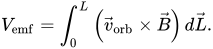
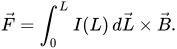






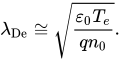


![{\displaystyle \Delta V_{tc}=\left[{\frac {\eta \cdot I_{t}}{\rho }}\right]^{2/3}}](https://wikimedia.org/api/rest_v1/media/math/render/svg/931b24458ba4aeea5700e8321ee49da84aa2315d)










