In biology, the taxon (back-formation from taxonomy; pl.: taxa)
is a group of one or more populations of an organism or organisms seen
by taxonomists to form a unit. Although neither is required, a taxon is
usually known by a particular name and given a particular ranking,
especially if and when it is accepted or becomes established. It is
very common, however, for taxonomists to remain at odds over what
belongs to a taxon and the criteria used for inclusion, especially in
the context of rank-based ("Linnaean") nomenclature (much less so under phylogenetic nomenclature). If a taxon is given a formal scientific name, its use is then governed by one of the nomenclature codes specifying which scientific name is correct for a particular grouping.
Initial attempts at classifying and ordering organisms (plants
and animals) were presumably set forth in prehistoric times by
hunter-gatherers, as suggested by the fairly sophisticated folk
taxonomies. Much later, Aristotle, and later still, European scientists,
like Magnol, Tournefort and Carl Linnaeus's system in Systema Naturae, 10th edition (1758),, as well as an unpublished work by Bernard and Antoine Laurent de Jussieu,
contributed to this field. The idea of a unit-based system of
biological classification was first made widely available in 1805 in the
introduction of Jean-Baptiste Lamarck's Flore françoise, and Augustin Pyramus de Candolle's Principes élémentaires de botanique. Lamarck set out a system for the "natural classification" of plants. Since then, systematists
continue to construct accurate classifications encompassing the
diversity of life; today, a "good" or "useful" taxon is commonly taken
to be one that reflects evolutionary relationships.
Many modern systematists, such as advocates of phylogenetic nomenclature, use cladistic methods that require taxa to be monophyletic (all descendants of some ancestor). Therefore, their basic unit, the clade,
is equivalent to the taxon, assuming that taxa should reflect
evolutionary relationships. Similarly, among those contemporary
taxonomists working with the traditional Linnean (binomial)
nomenclature, few propose taxa they know to be paraphyletic. An example of a long-established taxon that is not also a clade is the classReptilia,
the reptiles; birds and mammals are the descendants of animals
traditionally classed as reptiles, but neither is included in the
Reptilia (birds are traditionally placed in the class Aves, and mammals in the class Mammalia).
A taxonomic unit, whether named or not: i.e. a
population, or group of populations of organisms which are usually
inferred to be phylogenetically related and which have characters in
common which differentiate (q.v.) the unit (e.g. a geographic
population, a genus, a family, an order) from other such units. A taxon
encompasses all included taxa of lower rank (q.v.) and individual
organisms. [...]"
A taxon can be assigned a taxonomic rank, usually (but not necessarily) when it is given a formal name.
"Phylum" applies formally to any biological domain, but traditionally it was always used for animals, whereas "division" was traditionally often used for plants, fungi, etc.
A prefix is used to indicate a ranking of lesser importance. The prefix super- indicates a rank above, the prefix sub- indicates a rank below. In zoology, the prefix infra- indicates a rank below sub-. For instance, among the additional ranks of class are superclass, subclass and infraclass.
Rank is relative, and restricted to a particular systematic schema. For example, liverworts
have been grouped, in various systems of classification, as a family,
order, class, or division (phylum). The use of a narrow set of ranks is
challenged by users of cladistics; for example, the mere 10 ranks traditionally used between animal families (governed by the International Code of Zoological Nomenclature
(ICZN)) and animal phyla (usually the highest relevant rank in
taxonomic work) often cannot adequately represent the evolutionary
history as more about a lineage's phylogeny becomes known.
In addition, the class rank is quite often not an evolutionary but a phenetic or paraphyletic group and as opposed to those ranks governed by the ICZN (family-level, genus-level and species-level taxa), can usually not be made monophyletic by exchanging the taxa contained therein. This has given rise to phylogenetic taxonomy and the ongoing development of the PhyloCode, which has been proposed as a new alternative to replace Linnean classification and govern the application of names to clades. Many cladists do not see any need to depart from traditional nomenclature as governed by the ICZN, International Code of Nomenclature for algae, fungi, and plants, etc.
The term "minority group" has different meanings, depending on
the context. According to common usage, it can be defined simply as a
group in society with the lowest number of individuals, or less than
half of a population. Usually a minority group is disempowered relative to the majority, and that characteristic lends itself to different applications of the term minority.
In terms of sociology, economics, and politics, a demographic
that takes up the smallest fraction of the population is not necessarily
labelled the "minority" if it wields dominant power. In the academic
context, the terms "minority" and "majority" are used in terms of
hierarchical power structures. For example, in South Africa, during Apartheid,
white Europeans held virtually all social, economic, and political
power over black Africans. For this reason, black Africans are the
"minority group", despite the fact that they outnumber white Europeans
in South Africa. This is why academics more frequently use the term
"minority group" to refer to a category of people who experience relative disadvantage, as compared to members of a dominant social group. To address this ambiguity, Harris Mylonas
has proposed the term "non-core group", instead of "minority group", to
refer to any aggregation of individuals that is perceived as an
unassimilated ethnic group (on a linguistic, religious, physical, or
ideological basis) by the ruling political elite of a country" and reserves the term 'minority' only for groups that have been granted minority rights by their state of residence.
Minority group membership is typically based on differences in observable characteristics or practices, such as: ethnicity (ethnic minority), race (racial minority), religion (religious minority), sexual orientation (sexual minority), or disability. The framework of intersectionality
can be used to recognize that an individual may simultaneously hold
membership in multiple minority groups (e.g. both a racial and religious
minority). Likewise, individuals may also be part of a minority group in regard to
some characteristics, but part of a dominant group in regard to others.
The term "minority group" often occurs within the discourse of civil rights and collective rights, as members of minority groups are prone to differential treatment in the countries and societies in which they live. Minority group members often face discrimination in multiple areas of social life, including housing, employment, healthcare, and education, among others. While discrimination may be committed by individuals, it may also occur through structural inequalities, in which rights and opportunities are not equally accessible to all. Those in favour of minority rights
often pursue laws designed to protect minority groups from
discrimination and afford members of the minority group equal social
status and legal protections as held by members of the dominant group.
Definitions
In
the 19th century, the term "minority" primarily referred to political
parties in national legislatures. The term minority referred to a range
of groups, including the better-educated and better-off who were worried
of being swamped by broadening franchise (voting rights). As Jenifer
Hart put it, "those who have" felt threatened by "those who want";
the less-popular party in a two-party contest, who should not have
control or power but in many electoral systems is able to do so;
and a least-popular "third party" as workers, farmers and socialists
enter into electoral politics and receive substantial support, and
thereby should have representation but in many electoral systems do not.
This changed with the Paris Peace Conference (1919–1920),
when the term "minority" was applied to ethnic, national, linguistic
and religious groups who made up less than half of the population of a
state, "groups of
persons who differ in race, religion or language from the majority of
the inhabitants of the country." The Paris Conference has been attributed with coining the concept of minority rights and bringing prominence to it. The League of Nations Minorities Commission in 1919 defined members of a
minority as "nationals belonging to racial, religious, or linguistic
minorities". Protection of minority groups, such as through careful drawing of boundaries of states and proportional representation, was seen as integral in preventing causes of future wars.
Sociological
Louis Wirth
defined a minority group as "a group of people who, because of their
physical or cultural characteristics, are singled out from the others in
the society
in which they live for differential and unequal treatment, and who
therefore regard themselves as objects of collective discrimination". The definition includes both objective and subjective criteria: membership of a minority group is objectively ascribed
by society, based on an individual's physical or behavioral
characteristics; it is also subjectively applied by its members, who may
use their status as the basis of group identity or solidarity. Thus, minority group status is categorical: an individual who exhibits
the physical or behavioral characteristics of a given minority group is
accorded the status of that group and is subject to the same treatment
as other members of that group.
Joe Feagin,
states that a minority group has five characteristics: (1) suffering
discrimination and subordination, (2) physical and/or cultural traits
that set them apart, and which are disapproved by the dominant group,
(3) a shared sense of collective identity and common burdens, (4)
socially shared rules about who belongs and who does not determine
minority status, and (5) tendency to marry within the group.
Criticisms
There is a controversy with the use of the word minority, as it has a generic and an academic usage. Common usage of the term indicates a statistical minority; however,
academics refer to power differences among groups rather than
differences in population size among groups.
Such use of the term minority is based on the idea that a group
can be considered a minority even if it includes such a large number of
people that it is numerically not a minority in society.
Some sociologists have criticized the concept of
"minority/majority", arguing this language excludes or neglects changing
or unstable cultural identities, as well as cultural affiliations
across national boundaries. As such, the term historically excluded groups (HEGs) is often
similarly used to highlight the role of historical oppression and
domination, and how this results in the under-representation of
particular groups in various areas of social life.
Political
The term national minority is often used to discuss minority groups in international and national politics. All countries contain some degree of racial, ethnic, or linguistic diversity. In addition, minorities may also be immigrant, indigenous or landless nomadic communities. This often results in variations in language, culture, beliefs,
practices, that set some groups apart from the dominant group. As these
differences are usually perceived negatively, this results in loss of
social and political power for members of minority groups.
Sometimes, racist policies explicitly codified pseudo-scientific definitions of race: such as the United States' one-drop rule and blood quantum laws, South Africa's apartheid, and Nazi Germany Nuremberg race laws. Other times, race has been a matter of self-identification, with de facto racist policies implemented. In addition to governmental policy, racism may persist as social prejudice and discrimination.
There are also social groups that are usually identified through ethnicity. Like race, ethnicity is largely determined hereditarily. However, it can also be influenced by factors such as adoption, cultural assimilation, religious conversion, and language shift. As race and ethnicity often overlap, many ethnic minorities are also racial minorities. However, this is not
always the case, and some people are ethnic minorities while also being
classified as white, such as some Jews, Roma, and Sámi. In some cases, their ethnic identities have been seen as negating their whiteness, in both inter- and intra-group identification.
In some countries, such as the United Kingdom, there is a preference to categorise people by ethnicity instead of race. Ethnicity encompasses a mix of "long shared cultural experiences,
religious practices, traditions, ancestry, language, dialect or national
origins". The United Kingdom considers everyone but white British people to be an ethnic minority, including other white Europeans such as White Irish people (excluding in Northern Ireland).
National minorities
A
national minority is a social group within a state that differs from
the majority and/or dominant population in terms of ethnicity, language,
culture, or religion, but also it also tends to have a close link with a
specific territory from which the minority social group originates.
Involuntary minorities
Also
known as "castelike minorities", involuntary minorities are a term for
people who were originally brought into any society against their will.
In the United States, for instance, it includes but is not limited to
Native Americans, Native Hawaiians, Puerto Ricans, African Americans, and in the 1800s, native-born Hispanics.
Voluntary minorities
Immigrants
take on minority status in their new country, usually in hopes of a
better future economically, educationally, and politically than in their
homeland. Because of their focus on success, voluntary minorities are
more likely to do better in school than other migrating minorities. Adapting to a very different culture and language makes difficulties in
the early stages of life in the new country. Voluntary immigrants do
not experience a sense of divided identity as much as involuntary
minorities and are often rich in social capital because of their
educational ambitions. Major immigrant groups in the United States include Mexicans, Central
and South Americans, Cubans, Africans, East Asians, and South Asians.
The term sexual minority is frequently used by public health
researchers to recognize a wide variety of individuals who engage in
same-sex sexual behavior, including those who do not identify under the
LGBTQ+ umbrella. For example, men who have sex with men (MSM), but do
not identify as gay. In addition, the term gender minorities can include
many types of gender variant people, such as intersex people, transgender people,
or non-binary individuals. However, the terms sexual and gender
minority are often not preferred by LGBTQ+ people, as they represent
clinical categories rather than individual identity.
Though lesbian, gay, bisexual, transgender, and queer
(LGBTQ+) people have existed throughout human history, they represent a
numerical and social minority. They experience numerous social inequalities
stemming from their group membership as LGBTQ+ people. LGBTQ+ rights
movements across many western countries led to the recognition of LGBTQ+
people as members of a minority group. These inequalities include social discrimination and isolation, unequal access to healthcare, employment, and housing, and experience negative mental and physical health outcomes due to these experiences.
Disabled people
Leading up to the Human Rights Act 1998
in the UK, a rise in the awareness relating to how disabled people were
being treated began. Many started to believe that they were being
denied basic human rights. This act had a section that stated if
authorities did not protect people with learning disabilities from
others' actions, such as harm or neglect, then they could be prosecuted.
The disability rights movement
has contributed to an understanding of disabled people as a minority or
a coalition of minorities who are disadvantaged by society, not just as
people who are disadvantaged by their impairments. Advocates of
disability rights emphasize the difference in physical or psychological
functioning rather than inferiority. For example, some autistic people argue for acceptance of neurodiversity, much as opponents of racism argue for acceptance of ethnic diversity. The deaf community is often regarded as a linguistic and cultural minority rather than a group with disabilities, and some deaf
people do not see themselves as having a disability at all. Rather,
they are disadvantaged by technologies and social institutions designed
to cater to the dominant group. (See the Convention on the Rights of Persons with Disabilities.)
People belonging to religious minorities have a faith that is
different from that held by the majority. Most countries of the world
have religious minorities. It is now widely accepted in the West that people should have the freedom to choose their religion, including the right to convert from one religion to another, or not to have any religion (atheism and/or agnosticism). However, in many countries, this freedom is constricted. In Egypt, a new system of identity cards requires all citizens to state their religion—and the only choices are Islam, Christianity, or Judaism (See Egyptian identification card controversy).
Women as a disadvantaged group
In most societies, numbers of men and women are roughly equal. Though women are not considered to be a minority, the status of women, as a subordinate group, has led to many social scientists to refer to them as a disadvantaged group. Though women's legal rights and status vary widely across countries,
women often experience social inequalities, relative to men, in various
societies. Women are sometimes denied access to education and access to the same
opportunities as men, especially in under-developed countries.
Law and government
In the politics of some countries, a "minority" is an ethnic group recognized by law, and having specified rights. Speakers of a legally recognized minority language,
for instance, might have the right to education or communication with
the government in their mother tongue. Countries with special provisions for minorities include Canada, China, Ethiopia, Germany, India, the Netherlands, Poland, Romania, Russia, Croatia, and the United Kingdom.
The various minority groups in a country are often not given
equal treatment. Some groups are too small or indistinct to obtain
minority protections. For example, a member of a particularly small
ethnic group might be forced to check "Other" on a checklist of
different backgrounds and so might receive fewer privileges than a
member of a more defined group.
Many contemporary governments prefer to assume the people they
rule all belong to the same nationality rather than separate ones based
on ethnicity. The United States asks for race and ethnicity
on its official census forms, which thus breaks up and organizes its
population into sub-groups, primarily racial rather than national. Spain
does not divide its nationals by ethnic group or national minorities,
although it does maintain an official notion of minority languages, that
is one of the criteria for to determine a national minority, upon the Framework Convention for the Protection of National Minorities.
Some especially significant or powerful minorities receive
comprehensive protection and political representation. For example, the
former Yugoslav Republic of Bosnia and Herzegovina recognizes the three constitutive nations, none of which constitutes a numerical majority (see nations of Bosnia and Herzegovina). However, other minorities such as Roma and Jews,
are officially labelled "foreign" and are excluded from many of these
protections. For example, they may be excluded from political positions,
including the presidency.
There is debate over recognizing minority groups and their privileges. One view is that the application of special rights to minority groups may harm
some countries, such as new states in Africa or Latin America not
founded on the European nation-state
model, since minority recognition may interfere with establishing a
national identity. It may hamper the integration of the minority into
mainstream society, perhaps leading to separatism or supremacism. In Canada, some feel that the failure of the dominant English-speaking majority to integrate French Canadians has provoked Quebec separatism.
Others assert that minorities require specific protections to ensure that they are not marginalized: for example, bilingual education
may be needed to allow linguistic minorities to fully integrate into
the school system and compete equally in society. In this view, rights
for minorities strengthen the nation-building project, as members of
minorities see their interests well served, and willingly accept the
legitimacy of the nation and their integration (not assimilation) within
it.
Nature connectedness is the extent to which individuals include nature as part of their identity. It includes an understanding of nature and everything it is made up of, even the parts that are not pleasing. Characteristics of nature connectedness are similar to those of a
personality trait: nature connectedness is stable over time and across
various situations.
Schultz describes three components that make up the nature connectedness construct:
The cognitive component is the core of nature connectedness and refers to how integrated one feels with nature.
The affective component is an individual's sense of care for nature.
The behavioral component is an individual's commitment to protect the natural environment.
These three components make up nature connectedness and are required
for a healthy relationship with nature. If an individual feels connected
to nature (possibly by spending time in it), they may be more inclined to care about nature, and protect the environment. Recent research has found that nature exposure (and feeling connected
to nature at a trait level) provides many benefits to humans such as
well-being.
Other researchers describe the nature connectedness construct in a
simpler manner. For instance, nature connectedness can be thought of as
a love of nature (also referred to as emotional affinity toward
nature). Similarly, nature connectedness can be defined as how much a person
believes they are the same as nature (more specifically, a person's
connectivity with nature) or it can be thought of as simply feeling emotionally connected with nature. Nature connectedness (as a construct) is also known as nature
relatedness, connectivity with nature, emotional affinity toward nature,
or inclusion of nature in self.
Although nature relatedness is a stable individual trait, it can change based on one's experience with nature, meaning the more time an individual spends in nature, the more
connected they feel to nature and the more concern they may feel for
nature. Feeling connected to nature at a state level has many benefits as well such as more positive moods and less negative moods.
Even though humans derive many benefits from nature, our modern
lifestyles have created a disconnect from the natural environment
wherein we spend significantly more time indoors. Some researchers
estimate that humans spend up to 90% of their lives indoors. Particularly in developed countries and countries with a high rate of
urbanization, the level of connection to nature is significantly lower. This disconnection from nature can have a negative impact on humans
because we are missing out on the beneficial effects of nature. As a
result, we are less connected to nature and feel less responsibility to
protect this environment.
Theory and biophilia
Our relationship with the natural environment can be understood through the concept of biophilia and the biophilia hypothesis. This term is defined as humans' innate need to affiliate with other life such as plants and animals. This essentially means that humans have a desire to be near nature.
This built-in desire may be the result of spending the majority of our evolutionary history (over 99%) closely connected to nature. Biophilia is genetic, meaning those humans who were closely connected
to nature throughout history would, presumably, have had better access
to food and fresh water. For example, someone who lived close to water,
near vegetation, or with a pet as a protector (e.g. dog) would have had
survival advantages. Although evolutionary theory is difficult to test, the popularity of camping, hiking, and visiting the zoo, provide support for this theory.
In his 1997 book, Kellert proposed that biophilia (or being close
to nature) also provides us benefits such as an increase in well-being. Thus, being disconnected from the natural environment should have negative effects on humans' well-being.
The construct of nature connectedness is also related to a branch of psychology called ecopsychology. This branch seeks to examine how human well-being is related to the well-being of the natural environment. This theory is based on the idea that the needs of humans and nature
are interdependent, so human health will suffer if nature does as well.
Restoration
Human and plants
Many daily activities in contemporary society demand directed
attention. In order to sustain that demand, effort is required to gate
competing stimuli or thoughts so that one can pay attention. The
constant demand of the inhibitory control may cause that directed
attention to become depleted and result in attention fatigue.
Research in environmental psychology suggests that people's
desire for contact with nature serves an important adaptive function,
namely, psychological restoration. As yet, it remains to be empirically
demonstrated that physical and psychological problems of urban living
can arouse restoration needs that continuously maintain and reinforce
nature-oriented preferences. One of the important aspects that environment can lead to restoration is that it has the potential to generate fascination
to people; it is able to captivate so that the demand for involuntary
attention of the person is lowered and the restoration can be performed.
In addition to this, it should generate the feeling of being away as an escape from a certain environment or situation; extension,
referring to the connection properties and environmental accessibility
and compatibility between the characteristics of the environment with
the goals and preferences of the individual.
As a measurement tool
There are at least seventeen scales which measure how connected an individual feels to nature. The three most commonly used scales are Nature Relatedness, Nature Connectedness, and Inclusion of Nature in Self Scale.
The Nature Relatedness measure is a 21-item scale that measures how connected to nature participants
feel at a trait level. Participants indicate their agreement with each
statement using a Likert scale.
There are three subscales to this measure; NR-self, NR-perspective, and
NR- experience. NR-self measures how much individuals identify with
nature (e.g., "I feel very connected to all living things and the
earth"), NR-perspective measures how concerned individuals may feel
about the effect of human actions on the environment (e.g., "Humans have
the right to use natural resources any way we want"), and NR-experience
measures how comfortable individuals are in nature and their desire to
be involved with nature (e.g., "I enjoy being outdoors, even in
unpleasant weather"). This scale shows good reliability,
alpha = .87 and test-retest stability six months later, alpha = .85.
There is also a brief Nature Relatedness Scale made up of six items from
the original 21 items. The purpose of this scale is to measure how
connected an individual feels to nature but in a shorter way. This scale
shows good reliability, alpha = .87 and test-retest stability six months later, alpha = .88.
The Connectedness to Nature Scale (CNS). This scale measures how emotionally connected people feel to the
natural world, animals, and plants. It also assesses people's perceived
equality between nature and themselves. An example of an item is "I
recognize and appreciate the intelligence of other living organisms."
These items are rated on a Likert scale from 1 (strongly disagree) to 5
(strongly agree) where higher scores demonstrate a higher connection to
nature. This scale can be used both at the trait and state level. The
state version is 13 items and shows acceptable reliability (α = .91). The trait version is 14 items and also demonstrates good reliability (α = .82). This scale's validity is demonstrated by its positive associations with other environmental scales (such as the New Ecological Paradigm Scale) but is not associated with verbal ability or social desirability. See also Connectedness to nature scale.
Inclusion of Nature in Self Scale (INS) This single-item question was designed to measure the extent that
individuals include nature as part of their identity. This measure uses a
pair of circles with one circle labeled self and the other circle labeled nature.
Participants are asked to choose the pair of circles that best
describes their relationship with the natural environment. There are
seven pairs of circles that differ on the extent that they overlap.
Individuals who are very connected to nature choose the pair of circles
that completely overlap (scored as a 7) while individuals who are not
connected to nature choose circles that are non-overlapping (scored as a
1). This scale has been shown to correlate positively with the New
Ecological Paradigm Revised Scale, nature relatedness and simply walking
in nature. This scale can also be used to measure how connected to
nature people feel in the moment (or at a state level) by changing the
wording to "how interconnected are you with nature RIGHT NOW." Below is
the INS scale.
Other ways to measure an individual's connection to nature include the
Allo-Inclusive Scale and the Implicit Associates Test-Nature.
The Allo-Inclusive Scale is adapted from the Inclusion of Others in the Self
(IOS) Scale by Aron et al. (1992). The Allo-Inclusive Scale contains
seven pairs of Venn diagrams that range in how far apart the circles
are. In the first pair, there is no overlap, but as you get to the
second or third pair, the circles begin to overlap more and more. In the
last pair (the seventh pair), the circles completely overlap.
Participants respond to eight items by choosing the pair of circles that
best denotes their connection with that particular item. A sample item
is "The connection between you and a wild animal (such as a squirrel,
deer, or wolf)." There are also eight other items to this scale that
assess how connected participants feel to people. This scale shows
acceptable reliability (Cronbach's α
= 0.75) and validity (correlations with concern for environment). This
scale is not contaminated with social desirability biases. The NR scale,
the Allo-Inclusive scale, and the CN scale are highly correlated with
one another, suggesting they are all part of the nature-connectedness
construct.
Implicit Associates Test-Nature (IAT) seeks to measure participant's implicit attitudes towards the two targets of self and nature (although the IAT
can also measure other associations). This measure is completed on a
computer by working with 150 stimulus words. The stimulus words contain
25 insect names, 25 flower names, 25 musical instrument names, 25 weapon
names, 25 pleasant-meaning words, and 25 unpleasant-meaning words. The
participants are shown a set of words and then press a key in response
to the words. The participants' reaction times represent their
connection between themselves and nature (faster times mean higher
connection).
The Illustrated Inclusion of Nature in Self Scale (IINS) is a graphical extension of the Inclusion of Nature in Self Scale. As
with the original scale, it is a single-item question that measures
nature connectedness with seven circle pairs that overlap to varying
degrees. The IINS was developed to measure the nature connectedness of
young students or people with special cognitive needs.
For this purpose, the original circle pairs were extended by graphical
elements created on the basis of children's perception of nature. The
scale shows a high positive correlation with the Connectedness to Nature
Scale (CNS) and the Nature Relatedness Scale (NR).
As a personality trait
In personality psychology, researchers have generally agreed on a five-factor model of personality. The five factors are extraversion (i.e. social, outgoing), agreeableness (i.e. trusting, helpful), neuroticism (i.e. worried, anxious), openness to experience (i.e. imaginative, creative), and conscientiousness
(i.e. organized, careful). Nature relatedness (overall) is
significantly related to extraversion, agreeableness, conscientiousness,
and openness to experience. In addition, a subscale of nature relatedness (nature-relatedness
experience) is negatively related with neuroticism. These authors
describe the nature-relatedness person as someone who is more
adventurous, easygoing, and gregarious. It may also be that highly
nature-related people are more environmental friendly because of the
positive (albeit weak) relationship with conscientiousness. Evidence suggests that people vary in their subjective sense of
connectedness with nature much like any of the five factors listed
above. Supportive of these results, a recent study has found that environmental engagement (protecting the environment,
electricity conservation and environmental values) is related to
agreeableness, conscientiousness and openness to experience. Another
study found that nature connectedness accounted for (mediated) the
relationship between openness and pro-environmental behaviours.
Relationship with well-being
Nature
connectedness is related to subjective well-being and other indicators
of positive functioning such as solving a problem in one's life. Subjective well-being is defined as feeling pleasant emotions or having pleasant experiences. To assess well-being, participants complete measures of how often they
feel positive emotions (an affective measure), how often they feel
negative emotions (an affective measure), and how satisfied they are
with their lives (a cognitive measure). Individuals with higher levels of well-being typically indicate that
they are satisfied with their lives, feel more positive emotions, and
less negative emotions.
At a broad level, the construct of trait nature connectedness is associated with well-being. This means that individuals who are highly connected to nature also
report higher psychological well-being (i.e., greater acceptance of
self), and social well-being (i.e., socially integrated). Emotional
well-being (i.e., positive emotions and life satisfaction) is related to
nature connectedness but less consistently. However, psychological and social well-being are consistently related
to nature connectedness suggesting that feeling connected to nature is
related to participant's well-being in their personal and social lives. Trait nature relatedness is significantly correlated with psychological
well-being and its six dimensions: autonomy, environmental mastery,
positive relations with others, self-acceptance, purpose in life, and
personal growth. More specifically, nature relatedness relates to all six dimensions (in
a sample with undergraduate students), and relates with autonomy,
purpose in life, and personal growth (in a sample with businesspeople).
It also significantly relates to positive affect in both populations.
Finally, nature connectedness is associated with mindfulness. In recent years, a great deal of research has examined the benefits of
mindfulness such as increased self-awareness, self-esteem, resilience and reduced maladaptive rumination. The awareness subscale (of mindfulness) correlates
with nature connectedness, but the other subscale of mindfulness (the
acceptance subscale) does not consistently correlate. As the authors
state, this suggests that mindfulness is related to a person's awareness in
nature and their experiences in nature but not with whether they accept
these experiences or not.
There are also many benefits from feeling connected to nature at the state level. Simply walking in nature for fifteen minutes (in comparison to walking
in an urban environment) increases an individual's subjective
connectedness to nature, positive affect, attentional capacity (as
measured by the number of errors they made in a cognitive task) and
their ability to reflect on a life problem. A life problem could be
anything from finding enough time to study to resolving a fight
participants had with close friends, significant others, or family
members. These relationships were mediated
by state nature connectedness (not attentional capacity or
self-awareness as previously suggested). State nature connectedness has
also been found to relate to vitality. Vitality is defined as having
both physical and mental energy and it increases positive affect. In five studies, researchers found that nature exposure relates to vitality at a state level. Nature
exposure is also related to other indicators of positive functioning
such as aspirations and goals. Nature exposure increases intrinsic
aspirations (personal growth, intimacy, and community) and decreases
extrinsic aspirations (money, image, fame) at a state level. The achievement of intrinsic goals relates to well-being, whereas the
achievement of extrinsic aspirations relates to ill-being. Nature connectedness and autonomy were found to mediate the relation
between nature exposure and intrinsic/extrinsic aspirations. Nature
exposure also increased participants' generosity as measured by the
amount of money they chose to donate to another student. As
participants' immersion increased in the nature slides, their intrinsic
aspirations and generosity did as well. However, as participants'
immersion increased in the non-nature (or built) slides, their extrinsic
aspirations increased while their generosity decreased.
Finally, even subtle nature manipulations can increase well-being or other indicators of well-being. For instance, simply having plants in a lab can increase intrinsic
aspirations, decrease extrinsic aspirations, and encourage more generous
decision-making. These effects were also mediated by nature connectedness and autonomy.
Also, virtual nature has been found to provide some psychological
benefits (but not as much as real nature). These studies demonstrate the positive relationship between nature
exposure, feeling connected to nature, and subjective well-being.
Relationship with mental health
Person standing in front of Swiss AlpsNature exposure and mental health
refers to the association between an individual interacting with
natural environments and its effect on the individual's mental health.
Most studies consider any interaction with nature as exposure, such as a hike, being in a forest or a place with water (e.g. lake, beach), going on a walk in a park, etc. Currently there is extensive research on the impact of the exposure to
nature on people, which finds a beneficial association in various ways.
Studies show that the contact of human beings with nature has decreased
with the contemporary lifestyle of being most of the time indoors and
with increasing time spent on screens. However, the interaction with
nature has been considered to be a general health promoter thanks to the
many benefits it brings to mental health and cognition as well. As a consequence, therapists use nature in their treatments to improve
mental or physical health. These treatments and techniques are called ecotherapy.
Environmental relationship
Researchers believe that if humans feel a part of nature and are more connected to
nature, they will feel a responsibility to care for nature and protect
it. As Stephen Jay Gould said:
"We cannot win this battle to save species and environments
without forging an emotional bond between ourselves and nature as well –
for we will not fight to save what we do not love."
So far, research has provided support for the assertion that nature
connectedness (at a subjective level) is a reliable predictor of
environmental behaviors. For instance, nature relatedness was found to relate to concern for the
environment, as people who scored high on nature relatedness were also
more likely to belong to environmental organizations, and declare
themselves environmentalists. High nature-related people at the trait level (or individuals scoring
high on one of the subscales of nature relatedness) were also more
likely to self-report:
Research has shown that individuals who think ahead and consider future events (individuals with a high consideration of future consequences) are more environmentally friendly. These individuals also show more concern for the environment and are more critical of environmental damage.
More research has also found that trait nature connectedness is related to
Thus, the research mentioned suggests that feeling connected to
nature decreases the likelihood that people will harm it because harming
nature would be similar to harming oneself.
Nature experiences
A global review summarized the scarce data on a likely largely declining "experience
of nature" (EoN) and nature disconnection which prior studies suggest
have impacts on health and pro-environmental behavior. Eighteen included
studies measured temporal trends in EoN. Data on the presence of nature
in cultural products, such as movies or books, was used as well. As "an
initial proxy for understudied regions", data on locations where humans
live (away from the natural world, becoming more urban), and forest
cover in cities (decreasing) was used. The researchers conclude that
"existing evidence is insufficient to assess the magnitude and
generality of this phenomenon".
Another review concluded that "[w]ithin a generation, children's lives have largely moved indoors"
and that "research indicates that direct experiences of nature in
childhood contribute to care for nature across the life span."
Implications of feeling connected to nature
Although nature relatedness is a stable individual trait, it can change based on one's experience with nature, so that people feel more connected to nature (and are more concerned about nature) after exposure to nature. Spending time in nature (and feeling connected to nature) may be one way to motivate environmentally friendly behaviours. As these authors and Kaplan explain, motivating ecological behaviours by increasing the connection
to the natural environment may be more effective than establishing laws
and rules that people have to follow.
Feeling connected to nature may also be of benefit to the following people and organizations:
The benefits of nature and feeling connected to nature may be
beneficial to keep in mind when creating settings for patients at a
hospital, or in therapy sessions. Also, because virtual nature can provide benefits to people (but in a
less dramatic way), this may be one way for people who cannot get out in
nature to reap some of its benefits.
Increasing nature exposure and the accessibility to green space in
cities may increase the well-being and ecological behaviors of
individuals. This highlights the importance of green space for policymakers and city planners.
Promote programs that value nature and wildlife to get individuals more involved in with the environment. One way to accomplish this may be to encourage researchers,
practitioners, and government agencies to emphasize environmental
behaviours from a more intrinsic point of view. For instance, positively
framing environmental messages may be more effective than fearful
messages.
Through nature connectedness and relatedness, we may be able to further understand the destruction of our planet.
Nature connectedness could be used as a measurement tool to evaluate
whether architectural variables (windows, view of nature, plants in the
workplace) are effective for increasing human's connection to the
environment and motivating more pro-environmental behaviours.
Exposure to nature can have "humanizing effects, fostering greater
authenticity and connectedness and, in turn, other versus
self-orientations that enhance valuing of and generosity toward others".
Nature-based settings could enhance some aspects of the preparation and integration phases of psychedelic therapy, and the psychedelic sessions themselves. A positive association between psychedelic use and nature relatedness has been studied.
Contact with nature is associated with improved cognitive function,
blood pressure, brain activity, mental health, physical activity, and
sleep.
Limitations
Although the topic of nature connectedness is a flourishing area of research today, there are still limitations such as
Many of the studies referenced used correlational designs. Correlation does not mean causation,
so it is important to note that just because two variables are related,
this does not imply one causes another. A meta-analysis examining the
role of nature connectedness on pro-environmental behavior (such as
recycling) confirmed the strong correlation between the two measures;
however, it found nature connectedness had a weaker causal role on
pro-environmental behaviour than what was assumed from the correlational
evidence. Future research has yet to examine the causal role between nature connectedness and well-being.
Many of the environmental scales measure an individual's intent to
participate in environmental behaviours, which does not always translate
into behaviour. Studies may also use self-report measures that may or
may not fully represent their actual behaviours. Future research should examine how environmentally friendly intents
transfer into behaviours and further investigate the validity of
self-reports.
Much of the research has used an undergraduate population in their
studies which may or may not transfer to the general population.
In quantum mechanics, a Slater determinant is an expression that describes the wave function of a multi-fermionic system. It satisfies anti-symmetry requirements, and consequently the Pauli principle, by changing sign upon exchange of two fermions. Only a small subset of all possible many-body fermionic wave functions
can be written as a single Slater determinant, but those form an
important and useful subset because of their simplicity.
The Slater determinant arises from the consideration of a wave
function for a collection of electrons, each with a wave function known
as the spin-orbital, where
denotes the position and spin of a single electron. A Slater
determinant containing two electrons with the same spin orbital would
correspond to a wave function that is zero everywhere.
The Slater determinant is named for John C. Slater, who introduced the determinant in 1929 as a means of ensuring the antisymmetry of a many-electron wave function, although the wave function in the determinant form first appeared independently in Heisenberg's and Dirac's articles three years earlier.
Definition
Two-particle case
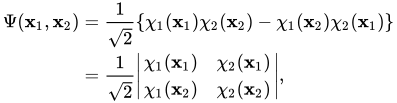
The simplest way to approximate the wave function of a many-particle system is to take the product of properly chosen orthogonal wave functions of the individual particles. For the two-particle case with coordinates and , we have
This expression is used in the Hartree method as an ansatz for the many-particle wave function and is known as a Hartree product. However, it is not satisfactory for fermions because the wave function above is not antisymmetric under exchange of any two of the fermions, as it must be according to the Pauli exclusion principle. An antisymmetric wave function can be mathematically described as follows:
This does not hold for the Hartree product, which therefore does not
satisfy the Pauli principle. This problem can be overcome by taking a linear combination of both Hartree products:
where the coefficient is the normalization factor.
This wave function is now antisymmetric and no longer distinguishes
between fermions (that is, one cannot indicate an ordinal number to a
specific particle, and the indices given are interchangeable). Moreover,
it also goes to zero if any two spin orbitals of two fermions are the
same. This is equivalent to satisfying the Pauli exclusion principle.
Multi-particle case
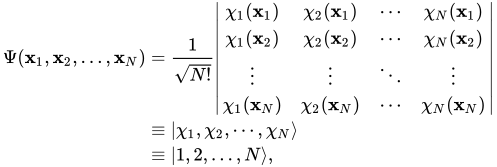
The expression can be generalised to any number of fermions by writing it as a determinant. For an N-electron system, the Slater determinant is defined as
where the last two expressions use a shorthand for Slater
determinants: The normalization constant is implied by noting the number
N, and only the one-particle wavefunctions (first shorthand) or the
indices for the fermion coordinates (second shorthand) are written down.
All skipped labels are implied to behave in ascending sequence. The
linear combination of Hartree products for the two-particle case is
identical with the Slater determinant for N = 2. The use of
Slater determinants ensures an antisymmetrized function at the outset.
In the same way, the use of Slater determinants ensures conformity to
the Pauli principle. Indeed, the Slater determinant vanishes if the set is linearly dependent.
In particular, this is the case when two (or more) spin orbitals are
the same. In chemistry one expresses this fact by stating that no two
electrons with the same spin can occupy the same spatial orbital.
Example: Matrix elements in a many electron problem
Many properties of the Slater determinant come to life with an example in a non-relativistic many electron problem.
The one particle terms of the Hamiltonian will contribute in
the same manner as for the simple Hartree product, namely the energy is
summed and the states are independent
The multi-particle terms of the Hamiltonian will introduce
exchange term to lower of the energy for the anti-symmetrized wave
function
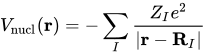
Starting from a molecular Hamiltonian:
where are the electrons and are the nuclei and
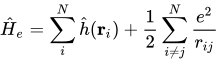
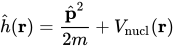
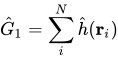
For simplicity we freeze the nuclei at equilibrium in one position and we remain with a simplified Hamiltonian
where
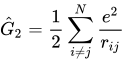
and where we will distinguish in the Hamiltonian between the first set of terms as (the "1" particle terms)
and the last term (the "2" particle term) which contains exchange term for a Slater determinant.
The two parts will behave differently when they have to interact with
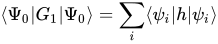
a Slater determinant wave function. We start to compute the expectation
values of one-particle terms
In the above expression, we can just select the identical permutation
in the determinant in the left part, since all the other N! − 1
permutations would give the same result as the selected one. We can thus
cancel N! at the denominator
Because of the orthonormality of spin-orbitals it is also evident
that only the identical permutation survives in the determinant on the
right part of the above matrix element
This result shows that the anti-symmetrization of the product does
not have any effect for the one particle terms and it behaves as it
would do in the case of the simple Hartree product.
And finally we remain with the trace over the one-particle Hamiltonians
Which tells us that to the extent of the one-particle terms the wave
functions of the electrons are independent of each other and the
expectation value of total system is given by the sum of expectation
value of the single particles.
For the two-particle terms instead
If we focus on the action of one term of , it will produce only the two terms
And finally
which instead is a mixing term. The first contribution is called
the "coulomb" term or "coulomb" integral and the second is the
"exchange" term or exchange integral. Sometimes different range of index
in the summation is used since the Coulomb and exchange contributions exactly cancel each other for .
It is important to notice explicitly that the exchange term, which is always positive for local spin-orbitals, is absent in the simple Hartree product. Hence the electron-electron repulsive energy
on the antisymmetrized product of spin-orbitals is always lower than
the electron-electron repulsive energy on the simple Hartree product of
the same spin-orbitals. Since exchange bielectronic integrals are
different from zero only for spin-orbitals with parallel spins, we link
the decrease in energy with the physical fact that electrons with
parallel spin are kept apart in real space in Slater determinant states.
As an approximation
Most
fermionic wavefunctions cannot be represented as a Slater determinant.
The best Slater approximation to a given fermionic wave function can be
defined to be the one that maximizes the overlap between the Slater determinant and the target wave function. The maximal overlap is a geometric measure of entanglement between the fermions.
A single Slater determinant is used as an approximation to the electronic wavefunction in Hartree–Fock theory. In more accurate theories (such as configuration interaction and MCSCF), a linear combination of Slater determinants is needed.
Discussion
The word "detor" was proposed by S. F. Boys to refer to a Slater determinant of orthonormal orbitals, but this term is rarely used.
Unlike fermions that are subject to the Pauli exclusion principle, two or more bosons can occupy the same single-particle quantum state. Wavefunctions describing systems of identical bosons are symmetric under the exchange of particles and can be expanded in terms of permanents.


.jpg)


_Scale.png)
















![{\displaystyle \langle \Psi _{0}|G_{2}|\Psi _{0}\rangle ={\frac {1}{2}}\sum _{i\neq j}\left[\langle \psi _{i}\psi _{j}|{\frac {e^{2}}{r_{ij}}}|\psi _{i}\psi _{j}\rangle -\langle \psi _{i}\psi _{j}|{\frac {e^{2}}{r_{ij}}}|\psi _{j}\psi _{i}\rangle \right]}](https://wikimedia.org/api/rest_v1/media/math/render/svg/37ac3e92b7411746dbe5372d59ae63ae4eb22428)


