Search This Blog

Tuesday, December 2, 2025

Mach's principle

From Wikipedia, the free encyclopedia

In theoretical physics, particularly in discussions of gravitation theories, Mach's principle (or Mach's conjecture) is the name given by Albert Einstein to an imprecise hypothesis often credited to the physicist and philosopher Ernst Mach. The hypothesis attempted to explain how rotating objects, such as gyroscopes and spinning celestial bodies, maintain a frame of reference.

The proposition is that the existence of absolute rotation (the distinction of local inertial frames vs. rotating reference frames) is determined by the large-scale distribution of matter, as exemplified by this anecdote:

You are standing in a field looking at the stars. Your arms are resting freely at your side, and you see that the distant stars are not moving. Now start spinning. The stars are whirling around you and your arms are pulled away from your body. Why should your arms be pulled away when the stars are whirling? Why should they be dangling freely when the stars don't move?

Mach's principle says that this is not a coincidence—that there is a physical law that relates the motion of the distant stars to the local inertial frame. If you see all the stars whirling around you, Mach suggests that there is some physical law which would make it so you would feel a centrifugal force. There are a number of rival formulations of the principle, often stated in vague ways like "mass out there influences inertia here". A very general statement of Mach's principle is "local physical laws are determined by the large-scale structure of the universe".

Mach's concept was a guiding factor in Einstein's development of the general theory of relativity. Einstein realized that the overall distribution of matter would determine the metric tensor which indicates which frame is stationary with respect to rotation. Frame-dragging and conservation of gravitational angular momentum makes this into a true statement in the general theory in certain solutions. But because the principle is so vague, many distinct statements have been made which would qualify as a Mach principle, some of which are false. The Gödel rotating universe is a solution of the field equations that is designed to disobey Mach's principle in the worst possible way. In this example, the distant stars seem to be revolving faster and faster as one moves further away. This example does not completely settle the question of the physical relevance of the principle because it has closed timelike curves.

History

Mach put forth the idea in his book The Science of Mechanics (1883 in German, 1893 in English). Before Mach's time, the basic idea also appears in the writings of George Berkeley. After Mach, the book Absolute or Relative Motion? (1896) by Benedict Friedlaender and his brother Immanuel contained ideas similar to Mach's principle.

Einstein's use of the principle

There is a fundamental issue in relativity theory: if all motion is relative, how can we measure the inertia of a body? We must measure the inertia with respect to something else. But what if we imagine a particle completely on its own in the universe? We might hope to still have some notion of its state of motion. Mach's principle is sometimes interpreted as the statement that such a particle's state of motion has no meaning in that case.

In Mach's words, the principle is embodied as follows:

[The] investigator must feel the need of... knowledge of the immediate connections, say, of the masses of the universe. There will hover before him as an ideal insight into the principles of the whole matter, from which accelerated and inertial motions will result in the same way.

Albert Einstein seemed to view Mach's principle as something along the lines of:

...inertia originates in a kind of interaction between bodies...

In this sense, at least some of Mach's principles are related to philosophical holism. Mach's suggestion can be taken as the injunction that gravitation theories should be relational theories. Einstein brought the principle into mainstream physics while working on general relativity. Indeed, it was Einstein who first coined the phrase Mach's principle. There is much debate as to whether Mach really intended to suggest a new physical law since he never states it explicitly.

The writing in which Einstein found inspiration was Mach's book The Science of Mechanics (1883, tr. 1893), where the philosopher criticized Newton's idea of absolute space, in particular the argument that Newton gave sustaining the existence of an advantaged reference system: what is commonly called "Newton's bucket argument".

In his Philosophiae Naturalis Principia Mathematica, Newton tried to demonstrate that one can always decide if one is rotating with respect to the absolute space, measuring the apparent forces that arise only when an absolute rotation is performed. If a bucket is filled with water, and made to rotate, initially the water remains still, but then, gradually, the walls of the vessel communicate their motion to the water, making it curve and climb up the borders of the bucket, because of the centrifugal forces produced by the rotation. This experiment demonstrates that the centrifugal forces arise only when the water is in rotation with respect to the absolute space (represented here by the earth's reference frame, or better, the distant stars) instead, when the bucket was rotating with respect to the water no centrifugal forces were produced, this indicating that the latter was still with respect to the absolute space.

Mach, in his book, says that the bucket experiment only demonstrates that when the water is in rotation with respect to the bucket no centrifugal forces are produced, and that we cannot know how the water would behave if in the experiment the bucket's walls were increased in depth and width until they became leagues big. In Mach's idea this concept of absolute motion should be substituted with a total relativism in which every motion, uniform or accelerated, has sense only in reference to other bodies (i.e., one cannot simply say that the water is rotating, but must specify if it's rotating with respect to the vessel or to the earth). In this view, the apparent forces that seem to permit discrimination between relative and "absolute" motions should only be considered as an effect of the particular asymmetry that there is in our reference system between the bodies which we consider in motion, that are small (like buckets), and the bodies that we believe are still (the earth and distant stars), that are overwhelmingly bigger and heavier than the former.

This same thought had been expressed by the philosopher George Berkeley in his De Motu. It is then not clear, in the passages from Mach just mentioned, if the philosopher intended to formulate a new kind of physical action between heavy bodies. This physical mechanism should determine the inertia of bodies, in a way that the heavy and distant bodies of our universe should contribute the most to the inertial forces. More likely, Mach only suggested a mere "redescription of motion in space as experiences that do not invoke the term space". What is certain is that Einstein interpreted Mach's passage in the former way, originating a long-lasting debate.

Most physicists believe Mach's principle was never developed into a quantitative physical theory that would explain a mechanism by which the stars can have such an effect. Mach himself never made his principle exactly clear. Although Einstein was intrigued and inspired by Mach's principle, Einstein's formulation of the principle is not a fundamental assumption of general relativity, although the principle of equivalence of gravitational and inertial mass is most certainly fundamental.

Mach's principle in general relativity

Because intuitive notions of distance and time no longer apply, what exactly is meant by "Mach's principle" in general relativity is even less clear than in Newtonian physics and at least 21 formulations of Mach's principle are possible, some being considered more strongly Machian than others. A relatively weak formulation is the assertion that the motion of matter in one place should affect which frames are inertial in another.

Einstein, before completing his development of the general theory of relativity, found an effect which he interpreted as being evidence of Mach's principle. We assume a fixed background for conceptual simplicity, construct a large spherical shell of mass, and set it spinning in that background. The reference frame in the interior of this shell will precess with respect to the fixed background. This effect is known as the Lense–Thirring effect. Einstein was so satisfied with this manifestation of Mach's principle that he wrote a letter to Mach expressing this:

it... turns out that inertia originates in a kind of interaction between bodies, quite in the sense of your considerations on Newton's pail experiment... If one rotates [a heavy shell of matter] relative to the fixed stars about an axis going through its center, a Coriolis force arises in the interior of the shell; that is, the plane of a Foucault pendulum is dragged around (with a practically unmeasurably small angular velocity).

The Lense–Thirring effect certainly satisfies the very basic and broad notion that "matter there influences inertia here". The plane of the pendulum would not be dragged around if the shell of matter were not present, or if it were not spinning. As for the statement that "inertia originates in a kind of interaction between bodies", this, too, could be interpreted as true in the context of the effect.

More fundamental to the problem, however, is the very existence of a fixed background, which Einstein describes as "the fixed stars". Modern relativists see the imprints of Mach's principle in the initial-value problem. Essentially, we humans seem to wish to separate spacetime into slices of constant time. When we do this, Einstein's equations can be decomposed into one set of equations, which must be satisfied on each slice, and another set, which describe how to move between slices. The equations for an individual slice are elliptic partial differential equations. In general, this means that only part of the geometry of the slice can be given by the scientist, while the geometry everywhere else will then be dictated by Einstein's equations on the slice.

In the context of an asymptotically flat spacetime, the boundary conditions are given at infinity. Heuristically, the boundary conditions for an asymptotically flat universe define a frame with respect to which inertia has meaning. By performing a Lorentz transformation on the distant universe, of course, this inertia can also be transformed.

A stronger form of Mach's principle applies in Wheeler–Mach–Einstein spacetimes, which require spacetime to be spatially compact and globally hyperbolic. In such universes Mach's principle can be stated as the distribution of matter and field energy-momentum (and possibly other information) at a particular moment in the universe determines the inertial frame at each point in the universe (where "a particular moment in the universe" refers to a chosen Cauchy surface).

There have been other attempts to formulate a theory that is more fully Machian, such as the Brans–Dicke theory and the Hoyle–Narlikar theory of gravity, but most physicists argue that none have been fully successful. At an exit poll of experts, held in Tübingen in 1993, when asked the question "Is general relativity perfectly Machian?", 3 respondents replied "yes", and 22 replied "no". To the question "Is general relativity with appropriate boundary conditions of closure of some kind very Machian?" the result was 14 "yes" and 7 "no".

However, Einstein was convinced that a valid theory of gravity would necessarily have to include the relativity of inertia:

So strongly did Einstein believe at that time in the relativity of inertia that in 1918 he stated as being on an equal footing three principles on which a satisfactory theory of gravitation should rest:

  1. The principle of relativity as expressed by general covariance.
  2. The principle of equivalence.
  3. Mach's principle (the first time this term entered the literature): … that the gµν are completely determined by the mass of bodies, more generally by Tµν.

In 1922, Einstein noted that others were satisfied to proceed without this [third] criterion and added, "This contentedness will appear incomprehensible to a later generation however."

It must be said that, as far as I can see, to this day, Mach's principle has not brought physics decisively farther. It must also be said that the origin of inertia is and remains the most obscure subject in the theory of particles and fields. Mach's principle may therefore have a future – but not without the quantum theory.

— Abraham Pais, in Subtle is the Lord: the Science and the Life of Albert Einstein (Oxford University Press, 2005), pp. 287–288.

Inertial induction

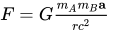
In 1953, in order to express Mach's Principle in quantitative terms, the Cambridge University physicist Dennis W. Sciama proposed the addition of an acceleration dependent term to the Newtonian gravitation equation. Sciama's acceleration dependent term was where r is the distance between the particles, G is the gravitational constant, a is the relative acceleration and c represents the speed of light in vacuum. Sciama referred to the effect of the acceleration dependent term as inertial induction.
Variations in the statement of the principle

The broad notion that "mass there influences inertia here" has been expressed in several forms.Hermann Bondi and Joseph Samuel have listed eleven distinct statements that can be called Mach principles, labelled Mach0 through Mach10 (taking inspiration from the Mach number). Though their list is not necessarily exhaustive, it does give a flavor for the variety possible.

  1. Newton's gravitational constant G is a dynamical field.
  2. An isolated body in otherwise empty space has no inertia.
  3. Local inertial frames are affected by the cosmic motion and distribution of matter.
  4. The universe is spatially closed.
  5. The total energy, angular and linear momentum of the universe are zero.
  6. Inertial mass is affected by the global distribution of matter.
  7. If you take away all matter, there is no more space.
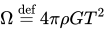
  8. is a definite number, of order unity, where is the mean density of matter in the universe, and is the Hubble time.
  9. The theory contains no absolute elements.
  10. Overall rigid rotations and translations of a system are unobservable.
  • The universe, as represented by the average motion of distant galaxies, does not appear to rotate relative to local inertial frames.
  • Religious cosmology

    From Wikipedia, the free encyclopedia
    God rests with his creation. Julius Schnorr von Carolsfeld 1860

    Religious cosmology is an explanation of the origin, evolution, and eventual fate of the universe from a religious perspective. This may include beliefs on origin in the form of a creation, subsequent evolution, current organizational form and nature, and eventual fate or destiny. There are various traditions in religion or religious mythology asserting how and why everything is the way it is and the significance of it all. Religious cosmologies describe the spatial lay-out of the universe in terms of the world in which people typically dwell as well as other dimensions, such as the seven dimensions of religion; these are ritual, experiential and emotional, narrative and mythical, doctrinal, ethical, social, and material.

    Religious mythologies may include descriptions of an act or process of creation by a creator deity or a larger pantheon of deities, explanations of the transformation of chaos into order, or the assertion that existence is a matter of endless cyclical transformations. Religious cosmology differs from a strictly scientific cosmology informed by contemporary astronomy, physics, and similar fields, and may differ in conceptualizations of the world's physical structure and place in the universe, its creation, and forecasts or predictions on its future.

    The scope of religious cosmology is more inclusive than a strictly scientific cosmology (physical cosmology and quantum cosmology) in that religious cosmology is not limited to experiential observation, testing of hypotheses, and proposals of theories; for example, religious cosmology may explain why everything is the way it is or seems to be the way it is and prescribing what humans should do in context. Variations in religious cosmology include Zoroastrian cosmology, those such as from India Buddhism, Hindu, and Jain; the religious beliefs of China, Chinese Buddhism, Taoism and Confucianism, Japan's Shintoisim and the beliefs of the Abrahamic faiths, such as Judaism, Christianity, and Islam. Religious cosmologies have often developed into the formal logics of metaphysical systems, such as Platonism, Neoplatonism, Gnosticism, Taoism, Kabbalah, Wuxing or the great chain of being.

    Zoroastrian

    In Zoroastrian cosmology, universe is the manifestation of a cosmic conflict between Existence and non-existence, Good and evil and light and darkness which spans over a period of 12000 years. It is subdivided into four equal periods of 3000 years each. The first period is known as Infinite Time. During this period the good and the evil remained in perfect balance in their respective spheres. For 3000 years Ahura Mazda dwelt in the region of light, while his opponent Ahirman or Angra Mainyu, the evil spirit, remained confined to the region of darkness. A great Void separated them both. At the end of the first period, Ahirman crossed the void and attacked Ahura Mazda. Knowing that the battle would continue forever, Ahura Mazda recited Ahuna Vairya, the most sacred hymn of Avesta and repelled him back. Having lost the battle, Angra Mainyu withdrew hastily into his dark world and remained there for another 3000 years. During this interlude, Ahura Mazda brings forth the entire creation. He creates the six Amesha Spentas or the Holy Immortals and several angel spirits or Yazatas. He brought forth the primeval Ox and the primeval man (Gayomart). Then he creates the material creation such as water, air, earth and the metals.

    Biblical cosmology and Abrahamic faiths

    The universe of the ancient Israelites was made up of a flat disc-shaped Earth floating on water, heaven above, underworld below. Humans inhabited Earth during life and the underworld after death, and the underworld was morally neutral; only in Hellenistic times (after c.330 BC) did Jews begin to adopt the Greek idea that it would be a place of punishment for misdeeds, and that the righteous would enjoy an afterlife in heaven. In this period too the older three-level cosmology was widely replaced by the Greek concept of a spherical Earth suspended in space at the centre of a number of concentric heavens. The belief that God created matter from nothing is called creatio ex nihilo (as opposed to creatio ex materia). It is the accepted orthodoxy of most denominations of Judaism and Christianity. Most denominations of Christianity and Judaism believe that a single, uncreated God was responsible for the creation of the cosmos.

    In his 2023 apostolic exhortation, Laudate Deum, Pope Francis outlines several ways in which the human relationship with the created cosmos might be understood:

    • the world that surrounds us can be treated as "an object of exploitation, unbridled use and unlimited ambition" or "a mere 'setting' in which we can develop our lives";
    • the human being is extraneous, a foreign element capable only of harming the environment;
    • human beings "are part of nature, included in it and thus in constant interaction with it". This is the interpretation he supports.
    Zakariya al-Qazwini says the Earth is flat and surrounded by mountains including Mount Qaf; it is supported by an ox standing on Bahamut in a cosmic ocean inside a bowl that sits on an angel or jinn.

    Islam teaches that God created the universe, including Earth's physical environment and human beings. The highest goal is to visualize the cosmos as a book of symbols for meditation and contemplation for spiritual upliftment or as a prison from which the human soul must escape to attain true freedom in the spiritual journey to God.

    Indian

    Buddhism

    In Buddhism, like other Indian religions, there is no ultimate beginning nor final end to the universe. It considers all existence as eternal, and believes there is no creator god. Buddhism views the universe as impermanent and always in flux. This cosmology is the foundation of its Samsara theory, that evolved over time the mechanistic details on how the wheel of mundane existence works over the endless cycles of rebirth and redeath. In early Buddhist traditions, Saṃsāra cosmology consisted of five realms through which wheel of existence recycled. This included hells (niraya), hungry ghosts (pretas), animals (tiryak), humans (manushya), and gods (devas, heavenly). In latter traditions, this list grew to a list of six realms of rebirth, adding demi-gods (asuras). The "hungry ghost, heavenly, hellish realms" respectively formulate the ritual, literary and moral spheres of many contemporary Buddhist traditions.

    According to Akira Sadakata, the Buddhist cosmology is far more complex and uses extraordinarily larger numbers than those found in Vedic and post-Vedic Hindu traditions. It also shares many ideas and concepts, such as those about Mount Meru. The Buddhist thought holds that the six cosmological realms are interconnected, and everyone cycles life after life, through these realms, because of a combination of ignorance, desires and purposeful karma, or ethical and unethical actions.

    Hindu

    The Hindu cosmology, like the Buddhist and Jain cosmology, considers all existence as cyclic. With its ancient roots, Hindu texts propose and discuss numerous cosmological theories. Hindu culture accepts this diversity in cosmological ideas and has lacked a single mandatory view point even in its oldest known Vedic scriptures, the Rigveda. Alternate theories include a universe cyclically created and destroyed by god, or goddess, or no creator at all, or a golden egg or womb (Hiranyagarbha), or self-created multitude of universes with enormous lengths and time scales. The Vedic literature includes a number of cosmology speculations, one of which questions the origin of the cosmos and is called the Nasadiya sukta:

    Neither being (sat) nor non-being was as yet. What was concealed?
    And where? And in whose protection? ... Who really knows?
    Who can declare it? Whence was it born, and whence came this creation?
    The devas (gods) were born later than this world's creation,
    so who knows from where it came into existence? None can know from where
    creation has arisen, and whether he has or has not produced it.
    He who surveys it in the highest heavens,
    He alone knows or perhaps He does not know.

    — Rig Veda 10. 129

    Time is conceptualized as a cyclic Yuga with trillions of years. In some models, Mount Meru plays a central role.

    Beyond its creation, Hindu cosmology posits divergent theories on the structure of the universe, from being 3 lokas to 12 lokas (worlds) which play a part in its theories about rebirth, samsara and karma.

    The complex cosmological speculations found in Hinduism and other Indian religions, states Bolton, is not unique and are also found in Greek, Roman, Irish and Babylonian mythologies, where each age becomes more sinful and of suffering.

    Jain

    Jain cosmology considers the loka, or universe, as an uncreated entity, existing since infinity, having no beginning or an end. Jain texts describe the shape of the universe as similar to a man standing with legs apart and arm resting on his waist. This Universe, according to Jainism, is narrow at the top, broad at the middle and once again becomes broad at the bottom.

    Mahāpurāṇa of Ācārya Jinasena is famous for this quote:

    Some foolish men declare that a creator made the world. The doctrine that the world was created is ill advised and should be rejected. If God created the world, where was he before the creation? If you say he was transcendent then and needed no support, where is he now? How could God have made this world without any raw material? If you say that he made this first, and then the world, you are faced with an endless regression.

    Chinese

    There is a "primordial universe" Wuji (philosophy), and Hongjun Laozu, water or qi. It transformed into Taiji then multiplied into everything known as the Wuxing. The Pangu legend tells a formless chaos coalesced into a cosmic egg. Pangu emerged (or woke up) and separated Yin from Yang with a swing of his giant axe, creating the Earth (murky Yin) and the Sky (clear Yang). To keep them separated, Pangu stood between them and pushed up the Sky. After Pangu died, he became everything.

    Gnosticism

    Gnostic teachings were contemporary with those of Neoplatonism. Gnosticism is an imprecise label, covering monistic as well as dualistic conceptions. Usually the higher worlds of Light, called the Pleroma or "fullness", are radically distinct from the lower world of Matter. The emanation of the Pleroma and its godheads (called Aeons) is described in detail in the various Gnostic tracts, as is the pre-creation crisis (a cosmic equivalent to the "fall" in Christian thought) from which the material world comes about, and the way that the divine spark can attain salvation.

    Serer religion

    Serer religion posits that, Roog, the creator deity, is the point of departure and conclusion. As farming people, trees play an important role in Serer religious cosmology and creation mythology. The Serer high priests and priestesses (the Saltigues) chart the star Sirius, known as "Yoonir" in the Serer language and some of the Cangin languages. This star enables them to give accurate information as to when Serer farmers should start planting seeds among other things relevant to Serer lives and Serer country. "Yoonir" is the symbol of the universe in Serer cosmology and creation mythology.

    A similar set of beliefs related also to Sirius has been observed among Dogon people of Mali.

    Evolution of morality

    From Wikipedia, the free encyclopedia

    The concept of the evolution of morality refers to the emergence of human moral behavior over the course of human evolution. Morality can be defined as a system of ideas about right and wrong conduct. In everyday life, morality is typically associated with human behavior rather than animal behavior. The emerging fields of evolutionary biology, and in particular evolutionary psychology, have argued that, despite the complexity of human social behaviors, the precursors of human morality can be traced to the behaviors of many other social animals. Sociobiological explanations of human behavior remain controversial. Social scientists have traditionally viewed morality as a construct, and thus as culturally relative, although others such as Sam Harris argue that there is an objective science of morality.

    Social animals, from eusocial insects like ants to empathetic mammals like elephants, develop complex cooperative behaviors—often involving self-restraint, altruism, or even reproductive sacrifice—because group living dramatically increases their chances of survival and reproductive success. Primate sociality, particularly among chimpanzees and bonobos, reveals evolutionary roots of human morality through shared traits like empathy, reciprocity, and fairness, suggesting that moral behavior developed to promote cooperation and cohesion in increasingly complex social groups.

    The social brain hypothesis suggests primates evolved larger brains primarily to handle complex social networks. Theory of mind enabled them to understand others’ mental states for navigating social interactions. Human altruism is seen as a unique, culturally influenced behavior shaped by both genetic and cultural evolution. Religion likely evolved by building on morality, introducing supernatural agents to encourage cooperation and restrain selfishness, which enhanced group survival. Additionally, emotions like disgust play a key evolutionary role in moral judgments by helping to avoid threats to health, reproduction, and social cohesion.

    Animal sociality

    Though other animals may not possess what humans may perceive as moral behavior, all social animals have had to modify or restrain their behaviors for group living to be worthwhile. Typical examples of behavioral modification can be found in the societies of ants, bees and termites. Ant colonies may possess millions of individuals. E. O. Wilson argues that the single most important factor that leads to the success of ant colonies is the existence of a sterile worker caste. This caste of females are subservient to the needs of their mother, the queen, and in so doing, have given up their own reproduction in order to raise brothers and sisters. The existence of sterile castes among these social insects significantly restricts the competition for mating and in the process fosters cooperation within a colony. Cooperation among ants is vital, because a solitary ant has an improbable chance of long-term survival and reproduction. However, as part of a group, colonies can thrive for decades. As a consequence, ants are one of the most successful families of species on the planet, accounting for a biomass that rivals that of the human species.

    The basic reason that social animals live in groups is that opportunities for survival and reproduction are much better in groups than living alone. The social behaviors of mammals are more familiar to humans. Highly social mammals such as primates and elephants have been known to exhibit traits that were once thought to be uniquely human, like empathy and altruism.

    Primate sociality

    Humanity's closest living relatives are common chimpanzees and bonobos. These primates share a common ancestor with humans who lived four to six million years ago. It is for this reason that chimpanzees and bonobos are viewed as the best available surrogate for this common ancestor. Barbara J. King argues that while primates may not possess morality in the human sense, they do exhibit some traits that would have been necessary for the evolution of morality. These traits include high intelligence, a capacity for symbolic communication, a sense of social norms, realization of "self", and a concept of continuity. Frans de Waal and Barbara King both view human morality as having grown out of primate sociality. Many social animals such as primates, dolphins, and whales have shown to exhibit what Michael Shermer refers to as premoral sentiments. According to Shermer, the following characteristics are shared by humans and other social animals, particularly the great apes:

    attachment and bonding, cooperation and mutual aid, sympathy and empathy, direct and indirect reciprocity, altruism and reciprocal altruism, conflict resolution and peacemaking, deception and deception detection, community concern and caring about what others think about you, and awareness of and response to the social rules of the group.

    Shermer argues that these premoral sentiments evolved in primate societies as a method of restraining individual selfishness and building more cooperative groups. For any social species, the benefits of being part of an altruistic group should outweigh the benefits of individualism. For example, lack of group cohesion could make individuals more vulnerable to attack from outsiders. Being part of a group may also improve the chances of finding food. This is evident among animals that hunt in packs to take down large or dangerous prey.

    Social evolution of humans
    Period years ago Society type Number of individuals
    6,000,000 Bands 10s
    100,000–10,000 Bands 10s–100s
    10,000–5,000 Tribes 100s–1,000s
    5,000–4,000 Chiefdoms 1,000s–10,000s
    4,000–3,000 States 10,000s–100,000s
    3,000–present Empires 100,000–1,000,000s

    All social animals have societies in which each member knows its own place.[citation needed] Social order is maintained by certain rules of expected behavior and dominant group members enforce order through punishment. However, higher order primates also have a sense of reciprocity. Chimpanzees remember who did them favors and who did them wrong. For example, chimpanzees are more likely to share food with individuals who have previously groomed them. Vampire bats also demonstrate a sense of reciprocity and altruism. They share blood by regurgitation, but do not share randomly. They are most likely to share with other bats who have shared with them in the past or who are in dire need of feeding.

    Animals such as Capuchin monkeys and dogs also display an understanding of fairness, refusing to co-operate when presented unequal rewards for the same behaviors.

    Chimpanzees live in fission-fusion groups that average 50 individuals. It is likely that early ancestors of humans lived in groups of similar size. Based on the size of extant hunter-gatherer societies, recent paleolithic hominids lived in bands of a few hundred individuals. As community size increased over the course of human evolution, greater enforcement to achieve group cohesion would have been required. Morality may have evolved in these bands of 100 to 200 people as a means of social control, conflict resolution and group solidarity. This numerical limit is theorized to be hard coded in our genes since even modern humans have difficulty maintaining stable social relationships with more than 100–200 people. According to Dr. de Waal, human morality has two extra levels of sophistication that are not found in other primate societies. Humans enforce their society's moral codes much more rigorously with rewards, punishments and reputation building. People also apply a degree of judgment and reason not seen in the animal kingdom.

    Recent frameworks

    A recent framework integrates game theory, evolution, and learning to explain human moral behaviors without invoking group selection or a priori philosophical justifications.

    Arguments against the possibility of moral progress have recently been argued to rely on narrow views of human nature and to fail because key moral traits like cosmopolitanism cannot be fully explained by evolution but instead arise from humans’ unique capacity to develop new moral norms.

    Evolution of social cognition and altruism

    The social brain hypothesis proposes that primates evolved large brains to manage complex social systems, showing a quantitative relationship between brain size and social group size, whereas in other mammals and birds, large brains are linked qualitatively to mating systems, with primates uniquely extending pairbonding cognitive processes to wider social bonds.

    Theory of mind, an evolved capacity to understand others’ mental states, likely developed in primates to navigate complex social interactions but can be selectively impaired in various psychiatric disorders, including autism and schizophrenia.

    Ernst Fehr and Urs Fischbacher argue that human altruism is a unique and powerful force influenced by individual variation and the interaction between altruistic and selfish behaviors, emphasizing the role of cultural evolution and gene–culture co-evolution in addition to genetic factors.

    Evolution of religion

    Psychologist Matt J. Rossano muses that religion emerged after morality and built upon morality by expanding the social scrutiny of individual behavior to include supernatural third-party agents. By including ever watchful ancestors, spirits and gods in the social realm, humans discovered an effective strategy for restraining selfishness and building more cooperative groups. The adaptive value of religion would have enhanced group survival.

    Wason selection task

    In an experiment where subjects must demonstrate abstract, complex reasoning, researchers have found that humans (as has been seen in other animals) have a strong innate ability to reason about social exchanges. This ability is believed to be intuitive, since the logical rules do not seem to be accessible to the individuals for use in situations without moral overtones.

    Emotion

    Disgust, one of the basic emotions, may have an important role in certain forms of morality. Disgust is argued to be a specific response to certain things or behaviors that are dangerous or undesirable from an evolutionary perspective. One example is things that increase the risk of an infectious disease such as spoiled foods, dead bodies, other forms of microbiological decomposition, a physical appearance suggesting sickness or poor hygiene, and various body fluids such as feces, vomit, phlegm, and blood. Another example is disgust against evolutionary disadvantageous mating such as incest (the incest taboo) or unwanted sexual advances. Still another example are behaviors that may threaten group cohesion or cooperation such as cheating, lying, and stealing. MRI studies have found that such situations activate areas in the brain associated with disgust.

    Solipsism

    From Wikipedia, the free encyclopedia

    Solipsism (/ˈsɒlɪpsɪzəm/ SOLL-ip-siz-əm; from Latin solus 'alone' and ipse 'self') is the philosophical idea that only one's mind is sure to exist. As an epistemological position, solipsism holds that knowledge of anything outside one's own mind is unsure; the external world and other minds cannot be known and might not exist outside the mind.

    Varieties

    There are varying degrees of solipsism that parallel the varying degrees of skepticism:

    Metaphysical

    Metaphysical solipsism is a variety of solipsism based on a philosophy of subjective idealism. Metaphysical solipsists maintain that the self is the only existing reality and that all other realities, including the external world and other persons, are representations of that self, having no independent existence. There are several versions of metaphysical solipsism, such as Caspar Hare's egocentric presentism (or perspectival realism), in which other people are conscious, but their experiences are simply not present.

    Epistemological

    Epistemological solipsism is the variety of idealism according to which only the directly accessible mental contents of the solipsistic philosopher can be known. The existence of an external world is regarded as an unresolvable question rather than actually false. Further, one cannot also be certain as to what extent the external world exists independently of one's mind. For instance, it may be that a God-like being controls the sensations received by the mind, making it appear as if there is an external world when most of it (excluding the God-like being and oneself) is false. However, the point remains that epistemological solipsists consider this an "unresolvable" question.

    Methodological

    Methodological solipsism is an agnostic variant of solipsism. It exists in opposition to the strict epistemological requirements for "knowledge" (e.g. the requirement that knowledge must be certain). It still entertains the points that any induction is fallible. Methodological solipsism sometimes goes even further to say that even what we perceive as the brain is actually part of the external world, for it is only through our senses that we can see or feel the mind. Only the existence of thoughts is known for certain.

    Methodological solipsists do not intend to conclude that the stronger forms of solipsism are actually true. They simply emphasize that justifications of an external world must be founded on indisputable facts about their own consciousness. The methodological solipsist believes that subjective impressions (empiricism) or innate knowledge (rationalism) are the sole possible or proper starting point for philosophical construction. Often methodological solipsism is not held as a belief system, but rather used as a thought experiment to assist skepticism (e.g. René Descartes' Cartesian skepticism).

    Main points

    Mere denial of material existence, in itself, does not necessarily constitute solipsism.

    Philosophers generally try to build knowledge on more than an inference or analogy. Well-known frameworks such as Descartes' epistemological enterprise brought to popularity the idea that all certain knowledge may go no further than "I think; therefore I exist." Descartes' view provides one key detail about the nature of the "I" that has been proven to exist, its relation to a God of positive attribution.

    The theory of solipsism also merits close examination because it relates to three widely held philosophical presuppositions, each itself fundamental and wide-ranging in importance:

    • One's most certain knowledge is the content of one's own mind—my thoughts, experiences, affects, etc.
    • There is no conceptual or logically necessary link between mental and physical—between, for example, the occurrence of certain conscious experience or mental states and the "possession" and behavioral dispositions of a "body" of a particular kind.
    • The experience of a given person is necessarily private to that person.

    To expand on the second point, the conceptual problem is that the previous point assumes mind or consciousness (which are attributes) can exist independent of some entity having this attribute (a capability in this case), i.e., that an attribute of an existent can exist apart from the existent itself. If one admits to the existence of an independent entity (e.g., the brain) having that attribute, the door is open to an independent reality. (See Brain in a vat)

    Some philosophers hold that, while it cannot be proven that anything independent of one's mind exists, the point that solipsism makes is irrelevant. This is because, whether the world as we perceive it exists independently or not, we cannot escape this perception, hence it is best to act assuming that the world is independent of our minds.

    History

    Origins of solipsist thought are found in Greece and later Enlightenment thinkers such as Thomas Hobbes and Descartes.

    Gorgias

    Solipsism was first recorded by the Greek presocratic sophist, Gorgias (c. 483–375 BC), who is quoted by the Roman sceptic Sextus Empiricus as having stated:

    • Nothing exists.
    • Even if something exists, nothing can be known about it.
    • Even if something could be known about it, knowledge about it cannot be communicated to others.

    Much of the point of the sophists was to show that objective knowledge was a literal impossibility.

    René Descartes

    The foundations of solipsism are in turn the foundations of the view that the individual's understanding of any and all psychological concepts (thinking, willing, perceiving, etc.) is accomplished by making an analogy with their own mental states; i.e., by abstraction from inner experience. And this view, or some variant of it, has been influential in philosophy since René Descartes elevated the search for incontrovertible certainty to the status of the primary goal of epistemology, whilst also elevating epistemology to "first philosophy".

    Berkeley

    Portrait of George Berkeley by John Smybert, 1727

    George Berkeley's arguments against materialism in favour of idealism provide the solipsist with a number of arguments not found in Descartes. While Descartes defends ontological dualism, thus accepting the existence of a material world (res extensa) as well as immaterial minds (res cogitans) and God, Berkeley denies the existence of matter but not minds, of which God is one.

    Relation to other ideas

    Idealism and materialism

    One of the most fundamental debates in philosophy concerns the "true" nature of the world—whether it is some ethereal plane of ideas or a reality of atomic particles and energy. Materialism posits a real "world out there", as well as in and through us, that can be sensed—seen, heard, tasted, touched and felt, sometimes with prosthetic technologies corresponding to human sensing organs. (Materialists do not claim that human senses or even their prosthetics can, even when collected, sense the totality of the universe; simply that they collectively cannot sense what cannot in any way be known to us.) Materialists do not find this a useful way of thinking about the ontology and ontogeny of ideas, but we might say that from a materialist perspective pushed to a logical extreme communicable to an idealist, ideas are ultimately reducible to a physically communicated, organically, socially and environmentally embedded 'brain state'. While reflexive existence is not considered by materialists to be experienced on the atomic level, the individual's physical and mental experiences are ultimately reducible to the unique tripartite combination of environmentally determined, genetically determined, and randomly determined interactions of firing neurons and atomic collisions.

    For materialists, ideas have no primary reality as essences separate from our physical existence. From a materialist perspective, ideas are social (rather than purely biological), and formed and transmitted and modified through the interactions between social organisms and their social and physical environments. This materialist perspective informs scientific methodology, insofar as that methodology assumes that humans have no access to omniscience and that therefore human knowledge is an ongoing, collective enterprise that is best produced via scientific and logical conventions adjusted specifically for material human capacities and limitations.

    Modern idealists believe that the mind and its thoughts are the only true things that exist. This is the reverse of what is sometimes called "classical idealism" or, somewhat confusingly, "Platonic idealism" due to the influence of Plato's theory of forms (εἶδος eidos or ἰδέα idea), which were not products of our thinking. The material world is ephemeral, but a perfect triangle or "beauty" is eternal. Religious thinking tends to be some form of idealism, as God usually becomes the highest ideal (such as neoplatonism). On this scale, solipsism can be classed as idealism. Thoughts and concepts are all that exist, and furthermore, only the solipsist's own thoughts and consciousness exist. The so-called "reality" is nothing more than an idea that the solipsist has (perhaps unconsciously) created.

    Cartesian dualism

    There is another option: the belief that both ideals and "reality" exist. Dualists commonly argue that the distinction between the mind (or 'ideas') and matter can be proven by employing Leibniz's principle of the identity of indiscernibles, which states that if two things share exactly the same qualities, then they must be identical, as in indistinguishable from each other and therefore one and the same thing. Dualists then attempt to identify attributes of mind that are lacked by matter (such as privacy or intentionality) or vice versa (such as having a certain temperature or electrical charge). One notable application of the identity of indiscernibles was by René Descartes in his Meditations on First Philosophy. Descartes concluded that he could not doubt the existence of himself (the famous cogito ergo sum argument), but that he could doubt the (separate) existence of his body. From this, he inferred that the person Descartes must not be identical to the Descartes body since one possessed a characteristic that the other did not: namely, it could be known to exist. Solipsism agrees with Descartes in this aspect, and goes further: only things that can be known to exist for sure should be considered to exist. The Descartes body could only exist as an idea in the mind of the person Descartes. Descartes and dualism aim to prove the actual existence of reality as opposed to a phantom existence (as well as the existence of God in Descartes' case), using the realm of ideas merely as a starting point, but solipsism usually finds those further arguments unconvincing. The solipsist instead proposes that their own unconscious is the author of all seemingly "external" events from "reality".

    Philosophy of Schopenhauer

    The World as Will and Representation is the central work of Arthur Schopenhauer. Schopenhauer saw the human will as our one window to the world behind the representation, the Kantian thing-in-itself. He believed, therefore, that we could gain knowledge about the thing-in-itself, something Kant said was impossible, since the rest of the relationship between representation and thing-in-itself could be understood by analogy as the relationship between human will and human body.

    Idealism

    The idealist philosopher George Berkeley argued that physical objects do not exist independently of the mind that perceives them. An item truly exists only as long as it is observed; otherwise, it is not only meaningless but simply nonexistent. Berkeley does attempt to show things can and do exist apart from the human mind and our perception, but only because there is an all-encompassing Mind in which all "ideas" are perceived – in other words, God, who observes all. Solipsism agrees that nothing exists outside of perception, but would argue that Berkeley falls prey to the egocentric predicament – he can only make his own observations, and thus cannot be truly sure that this God or other people exist to observe "reality". The solipsist would say it is better to disregard the unreliable observations of alleged other people and rely upon the immediate certainty of one's own perceptions.

    Rationalism

    Rationalism is the philosophical position that truth is best discovered by the use of reasoning and logic rather than by the use of the senses (see Plato's theory of forms). Solipsism is also skeptical of sense-data.

    Philosophical zombie

    The theory of solipsism crosses over with the theory of the philosophical zombie in that other seemingly conscious beings may actually lack true consciousness, instead they only display traits of consciousness to the observer, who may be the only conscious being there is.

    Philosophy of identity

    Some philosophers have connected solipsistic ideas with the philosophy of personal identity, as well as Hellie's vertiginous question. Christian List argues that there exists a "quadrilemma" in metaphysics caused by the issues raised by the problem of other minds and Hellie's vertiginous question. He argues that the four metaphysical claims of first-person realism, non-solipsism, non-fragmentation, and one-world cannot all be simultaneously true, and thus believing in both the existence of first-personal facts and a single, unified reality must imply that metaphysical solipsism is true. List has proposed a model he calls the "many-worlds theory of consciousness" as a possible alternative to solipsism.

    Caspar Hare has argued for a weak form of solipsism with the concept of egocentric presentism, in which other persons can be conscious, but their experiences are simply not present in the way one's own current experience is. A related concept is perspectival realism, in which things within perceptual awareness have a defining intrinsic property that exists absolutely and not relative to anything, of which several other philosophers have written reviews. Vincent Conitzer has argued for similar ideas on the basis of there being a connection between the A-theory of time and the nature of the self. He argues that one's current perspective could be "metaphysically privileged" on the basis of arguments for A-theory being stronger as arguments for both A-theory and a metaphysically privileged self, and arguments against A-theory are ineffective against this combined position.

    Philosophy of time

    In the paper The Personalized A-Theory of Time and Perspective, Vincent Conitzer connects A series and B series theories of time with the metaphysics of first-person perspectives. Conitzer argues that if A-theory is correct, and a given moment of time, i.e. the present, is metaphysically privileged, this implies that a given "I" is also metaphysically privileged in the same way. He argues that arguments for A-theory are more effective as arguments for the combined position of both A-theory and first-person realism, but that arguments for B-theory are ineffective against the combined position. Within Caspar Hare's theory of perspectival realism, Hare points out that arguments in favor of a certain first-person perspective being metaphysically privileged are similar to the arguments made in favor of presentism. According to presentism, if Event A is happening on [insert today's date], A is simply happening (right now), not relative to anything. It could be argued that this is similar to solipsism, in which Experience A is simply present, not relative to anything, as opposed to only being present to you.

    Falsifiability and testability

    According to Karl Popper, solipsism is not a falsifiable hypothesis: there does not seem to be an imaginable disproof. According to Popper: a hypothesis that cannot be falsified is not scientific, and a solipsist can observe "the success of sciences" (see also no miracles argument). One critical test is nevertheless to consider the induction from experience that the externally observable world does not seem, at first approach, to be directly manipulable purely by mental energies alone. One can indirectly manipulate the world through the medium of the physical body, but it seems impossible to do so through pure thought (psychokinesis). It might be argued that if the external world were merely a construct of a single consciousness, i.e. the self, it could then follow that the external world should be somehow directly manipulable by that consciousness, and if it is not, then solipsism is false. An argument against this states that this argument is circular and incoherent. It assumes at the beginning a "construct of a single consciousness" meaning something false, and then tries to manipulate the external world that it just assumed was false. Of course this is an impossible task, but it does not disprove solipsism. It is simply poor reasoning when considering pure idealized logic and that is why David Deutsch states that when other scientific methods are used also, (not only logic), solipsism is "indefensible", also when using the simplest explanations: "If, according to the simplest explanation, an entity is complex and autonomous, then that entity is real".

    The method of the typical scientist is naturalist: they first assume that the external world exists and can be known. But the scientific method, in the sense of a predict-observe-modify loop, does not require the assumption of an external world. A solipsist may perform a psychological test on themselves, to discern the nature of the reality in their mind – however Deutsch uses this fact to counter-argue: "outer parts" of solipsist, behave independently so they are independent for "narrowly" defined (conscious) self. A solipsist's investigations may not be proper science however, since it would not include the co-operative and communitarian aspects of scientific inquiry that normally serve to diminish bias.

    Minimalism

    Solipsism is a form of logical minimalism. Many people are intuitively unconvinced of the nonexistence of the external world from the basic arguments of solipsism, but a solid proof of its existence is not available at present. The central assertion of solipsism rests on the nonexistence of such a proof, and strong solipsism (as opposed to weak solipsism) asserts that no such proof can be made. In this sense, solipsism is logically related to agnosticism in religion: the distinction between believing you do not know, and believing you could not have known.

    However, minimality (or parsimony) is not the only logical virtue. A common misapprehension of Occam's razor has it that the simpler theory is always the best. In fact, the principle is that the simpler of two theories of equal explanatory power is to be preferred. In other words: additional "entities" can pay their way with enhanced explanatory power. So the naturalist can claim that, while their world view is more complex, it is more satisfying as an explanation.

    In infants

    Some developmental psychologists believe that infants are solipsistic, and that eventually children infer that others have experiences much like theirs and reject solipsism.

    Hinduism

    The earliest reference to solipsism is found in the ideas in Hindu philosophy in the Brihadaranyaka Upanishad, dated to early 1st millennium BC. The Upanishad holds the mind to be the only god and all actions in the universe are thought to be a result of the mind assuming infinite forms. After the development of distinct schools of Indian philosophy, Advaita Vedanta and Samkhya schools are thought to have originated concepts similar to solipsism.

    Advaita Vedanta

    Advaita is one of the six most known Hindu philosophical systems and literally means "non-duality". Its first great consolidator was Adi Shankaracharya, who continued the work of some of the Upanishadic teachers, and that of his teacher's teacher Gaudapada. By using various arguments, such as the analysis of the three states of experience—wakefulness, dream, and deep sleep, he established the singular reality of Brahman, in which Brahman, the universe and the Atman or the Self, were one and the same.

    One who sees everything as nothing but the Self, and the Self in everything one sees, such a seer withdraws from nothing. For the enlightened, all that exists is nothing but the Self, so how could any suffering or delusion continue for those who know this oneness?

    — Ishopanishad: sloka 6, 7

    The concept of the Self in the philosophy of Advaita could be interpreted as solipsism. However, the theological definition of the Self in Advaita protect it from true solipsism as found in the west. Similarly, the Vedantic text Yogavasistha, escapes charge of solipsism because the real "I" is thought to be nothing but the absolute whole looked at through a particular unique point of interest.

    It is mentioned in Yoga Vasistha that “…..according to them (we can safely assume that them are present Solipsists) this world is mental in nature. There is no reality other than the ideas of one’s own mind. This view is incorrect, because the world cannot be the content of an individual’s mind. If it were so, an individual would have created and destroyed the world according to his whims. This theory is called atma khyati – the pervasion of the little self (intellect). Yoga Vasistha - Nirvana Prakarana - Uttarardha (Volume - 6) Page 107 by Swami Jyotirmayananda

    Samkhya and Yoga

    Samkhya philosophy, which is sometimes seen as the basis of Yogic thought, adopts a view that matter exists independently of individual minds. Representation of an object in an individual mind is held to be a mental approximation of the object in the external world. Therefore, Samkhya chooses representational realism over epistemological solipsism. Having established this distinction between the external world and the mind, Samkhya posits the existence of two metaphysical realities Prakriti (matter) and Purusha (consciousness).

    Buddhism

    Some philosophical tenets of Buddhism assert that external reality is an illusion, and can be understood as metaphysical solipsism, but most tenets of Buddhist philosophy, generally hold that the mind and external phenomena are both transient, and that they arise from each other. The mind cannot exist without external phenomena, nor can external phenomena exist without the mind. This relation is known as "dependent arising" (pratityasamutpada).

    The Buddha stated, "Within this fathom-long body is the world, the origin of the world, the cessation of the world, and the path leading to the cessation of the world." Whilst not rejecting the occurrence of external phenomena, the Buddha focused on the illusion created within the mind of the perceiver by the process of ascribing permanence to impermanent phenomena, satisfaction to unsatisfying experiences, and a sense of reality to things that were effectively insubstantial.

    Mahāyāna Buddhism also challenges the illusion of the idea that one can experience an 'objective' reality independent of individual perceiving minds.

    From the standpoint of Prasangika (a branch of Madhyamaka thought), external objects do exist, but are devoid of any type of inherent identity: "Just as objects of mind do not exist [inherently], mind also does not exist [inherently]". In other words, even though a chair may physically exist, individuals can only experience it through the medium of their own mind, each with their own literal point of view. Therefore, an independent, purely 'objective' reality could never be experienced, and exist because of imputation of a name upon a phenomenon, though the phenomenon can function.

    The Yogacara (sometimes translated as "Mind only") school of Buddhist philosophy contends that all human experience is constructed by mind. Some later representatives of one Yogacara subschool (Prajñakaragupta, Ratnakīrti) propounded a form of idealism that has been interpreted as solipsism. A view of this sort is contained in the 11th-century treatise of Ratnakirti, "Refutation of the existence of other minds" (Santanantara dusana), which provides a philosophical refutation of external mind-streams from the Buddhist standpoint of ultimate truth (as distinct from the perspective of everyday reality).

    In addition to this, the Bardo Thodol, Tibet's famous book of the dead, repeatedly states that all of reality is a figment of one's perception, although this occurs within the "Bardo" realm (post-mortem). For instance, within the sixth part of the section titled "The Root Verses of the Six Bardos", there appears the following line: "May I recognize whatever appeareth as being mine own thought-forms"; there are many lines in similar ideal.

    Criticism

    Solipsism as radical subjective idealism has been criticized by well-known philosophers ("solipsism can only succeed in a madhouse" — A. Schopenhauer, "solipsism is madness" — M. Gardner.)

    Bertrand Russell wrote that it was "psychologically impossible" to believe, "I once received a letter from an eminent logician, Mrs. Christine Ladd-Franklin, saying that she was a solipsist, and was surprised that there were no others. Coming from a logician and a solipsist, her surprise surprised me". He also argues that the logic of solipsism compels you to believe in 'solipsism of the moment' where only the presently existing moment can be said to exist.

    John Stuart Mill wrote that one can know of others' minds because "First, they have bodies like me, which I know in my own case, to be the antecedent condition of feelings; and because, secondly, they exhibit the acts, and outward signs, which in my own case I know by experience to be caused by feelings".

    Epigenetics of anxiety and stress–related disorders

    From Wikipedia, the free encyclopedia https://en.wikipedia.org/wiki/Epigenetics_of_anxiety_and_st...