Helioseismology is the study of the structure and dynamics of the Sun
through its oscillations. These are principally caused by sound waves
that are continuously driven and damped by convection near the Sun's
surface. It is similar to geoseismology, or asteroseismology, which are respectively the studies of the Earth or stars
through their oscillations. While the Sun's oscillations were first
detected in the early 1960s, it was only in the mid-1970s that it was
realized that the oscillations propagated throughout the Sun and could
allow scientists to study the Sun's deep interior. The term was coined
by Douglas Gough in the 90s. The modern field is separated into global helioseismology, which studies the Sun's resonant modes directly, and local helioseismology, which studies the propagation of the component waves near the Sun's surface.
Helioseismology has contributed to a number of scientific
breakthroughs. The most notable was to show that the anomaly in the
predicted neutrino flux from the Sun could not be caused by flaws in
stellar models and must instead be a problem of particle physics. The so-called solar neutrino problem was ultimately resolved by neutrino oscillations. The experimental discovery of neutrino oscillations was recognized by the 2015 Nobel Prize for Physics. Helioseismology also allowed accurate measurements of the quadrupole
(and higher-order) moments of the Sun's gravitational potential, which are consistent with General Relativity.
The first helioseismic calculations of the Sun's internal rotation
profile showed a rough separation into a rigidly-rotating core and
differentially-rotating envelope. The boundary layer is now known as
the tachocline and is thought to be a key component for the solar dynamo. Although it roughly coincides with the base of the solar convection
zone — also inferred through helioseismology — it is conceptually
distinct, being a boundary layer in which there is a meridional flow
connected with the convection zone and driven by the interplay between
baroclinicity and Maxwell stresses.
Helioseismology benefits most from continuous monitoring of the
Sun, which began first with uninterrupted observations from near the South Pole over the austral summer. In addition, observations over multiple solar cycles have allowed
helioseismologists to study changes in the Sun's structure over decades.
These studies are made possible by global telescope networks like the Global Oscillations Network Group (GONG) and the Birmingham Solar Oscillations Network (BiSON), which have been operating for over several decades.
Types of solar oscillation
Illustration
of a solar pressure mode (p mode) with radial order n=14, angular
degree l=20 and azimuthal order m=16. The surface shows the
corresponding spherical harmonic. The interior shows the radial
displacement computed using a standard solar model. Note that the increase in the speed of sound as waves approach the
center of the Sun causes a corresponding increase in the acoustic
wavelength.
Solar oscillation modes are interpreted as resonant vibrations of a
roughly spherically symmetric self-gravitating fluid in hydrostatic
equilibrium. Each mode can then be represented approximately as the
product of a function of radius and a spherical harmonic , and consequently can be characterized by the three quantum numbers which label:
the number of nodal shells in radius, known as the radial order;
the total number of nodal circles on each spherical shell, known as the angular degree; and
the number of those nodal circles that are longitudinal, known as the azimuthal order.
It can be shown that the oscillations are separated into two
categories: interior oscillations and a special category of surface
oscillations. More specifically, there are:
Pressure modes (p modes)
Pressure
modes are in essence standing sound waves. The dominant restoring
force is the pressure (rather than buoyancy), hence the name. All the
solar oscillations that are used for inferences about the interior are p
modes, with frequencies between about 1 and 5 millihertz and angular
degrees ranging from zero (purely radial motion) to order .
Broadly speaking, their energy densities vary with radius inversely
proportional to the sound speed, so their resonant frequencies are
determined predominantly by the outer regions of the Sun. Consequently
it is difficult to infer from them the structure of the solar core.
A propagation diagram for a standard solar model showing where oscillations have a g-mode character (blue) or where
dipole modes have a p-mode character (orange). The dashed line shows
the acoustic cut-off frequency, computed from more precise modelling,
and above which modes are not trapped in the star, and roughly-speaking
do not resonate.
Gravity modes (g modes)
Gravity
modes are confined to convectively stable regions, either the radiative
interior or the atmosphere. The restoring force is predominantly
buoyancy, and thus indirectly gravity, from which they take their name.
They are evanescent
in the convection zone, and therefore interior modes have tiny
amplitudes at the surface and are extremely difficult to detect and
identify. It has long been recognized that measurement of even just a few g
modes could substantially increase our knowledge of the deep interior of
the Sun. However, no individual g mode has yet been unambiguously measured, although indirect detections have been both claimed and challenged. Additionally, there can be similar gravity modes confined to the convectively stable atmosphere.
Surface
gravity waves are analogous to waves in deep water, having the property
that the Lagrangian pressure perturbation is essentially zero. They
are of high degree , penetrating a characteristic distance , where is the solar radius. To good approximation, they obey the so-called deep-water-wave dispersion law: , irrespective of the stratification of the Sun, where is the angular frequency, is the surface gravity and is the horizontal wavenumber, and tend asymptotically to that relation as .
What seismology can reveal
The
oscillations that have been successfully utilized for seismology are
essentially adiabatic. Their dynamics is therefore the action of
pressure forces (plus putative Maxwell stresses) against matter with inertia density ,
which itself depends upon the relation between them under adiabatic
change, usually quantified via the (first) adiabatic exponent . The equilibrium values of the variables and (together with the dynamically small angular velocity and magnetic field ) are related by the constraint of hydrostatic support, which depends upon the total mass and radius of the Sun. Evidently, the oscillation frequencies depend only on the seismic variables , , and ,
or any independent set of functions of them. Consequently it is only
about these variables that information can be derived directly. The
square of the adiabatic sound speed, , is such commonly adopted function, because that is the quantity upon which acoustic propagation principally depends. Properties of other, non-seismic, quantities, such as helium abundance, , or main-sequence age , can be inferred only by supplementation with additional assumptions, which renders the outcome more uncertain.
Data analysis
Global helioseismology
Power spectrum of the Sun using data from instruments aboard the Solar and Heliospheric Observatory
on double-logarithmic axes. The three passbands of the VIRGO/SPM
instrument show nearly the same power spectrum. The line-of-sight
velocity observations from GOLF are less sensitive to the red noise
produced by granulation. All the datasets clearly show the oscillation modes around 3mHz.Power
spectrum of the Sun around where the modes have maximum power, using
data from the GOLF and VIRGO/SPM instruments aboard the Solar and
Heliospheric Observatory. The low-degree modes (l<4) show a clear
comb-like pattern with a regular spacing.Power spectrum of medium angular degree () solar oscillations, computed for 144 days of data from the MDI instrument aboard SOHO. The colour scale is logarithmic and saturated at one hundredth the
maximum power in the signal, to make the modes more visible. The
low-frequency region is dominated by the signal of granulation. As the
angular degree increases, the individual mode frequencies converge onto
clear ridges, each corresponding to a sequence of low-order modes.
The chief tool for analysing the raw seismic data is the Fourier transform. To good approximation, each mode is a damped harmonic oscillator, for which the power as a function of frequency is a Lorentz function.
Spatially resolved data are usually projected onto desired spherical
harmonics to obtain time series which are then Fourier transformed.
Helioseismologists typically combine the resulting one-dimensional power
spectra into a two-dimensional spectrum.
The lower frequency range of the oscillations is dominated by the variations caused by granulation.
This must first be filtered out before (or at the same time that) the
modes are analysed. Granular flows at the solar surface are mostly
horizontal, from the centres of the rising granules to the narrow
downdrafts between them. Relative to the oscillations, granulation
produces a stronger signal in intensity than line-of-sight velocity, so
the latter is preferred for helioseismic observatories.
Local helioseismology
Local helioseismology—a term coined by Charles Lindsey, Doug Braun and Stuart Jefferies in 1993—employs several different analysis methods to make inferences from the observational data.
The Fourier–Hankel spectral method was originally used to search for wave absorption by sunspots.
Ring-diagram analysis, first introduced by Frank Hill, is used to infer the speed and direction of horizontal flows below the
solar surface by observing the Doppler shifts of ambient acoustic waves
from power spectra of solar oscillations computed over patches of the
solar surface (typically 15° × 15°). Thus, ring-diagram analysis is a
generalization of global helioseismology applied to local areas on the
Sun (as opposed to half of the Sun). For example, the sound speed and adiabatic index can be compared within magnetically active and inactive (quiet Sun) regions.
Time-distance helioseismology aims to measure and interpret the travel times of solar waves between
any two locations on the solar surface. Inhomogeneities near the ray
path connecting the two locations perturb the travel time between those
two points. An inverse problem must then be solved to infer the local
structure and dynamics of the solar interior.
Helioseismic holography, introduced in detail by Charles Lindsey and Doug Braun for the purpose of far-side (magnetic) imaging, is a special case of phase-sensitive holography. The idea is to use the wavefield on the visible disk to learn about active regions
on the far side of the Sun. The basic idea in helioseismic holography
is that the wavefield, e.g., the line-of-sight Doppler velocity observed
at the solar surface, can be used to make an estimate of the wavefield
at any location in the solar interior at any instant in time. In this
sense, holography is much like seismic migration,
a technique in geophysics that has been in use since the 1940s. As
another example, this technique has been used to give a seismic image of
a solar flare.
In direct modelling, the idea is to estimate subsurface flows
from direct inversion of the frequency-wavenumber correlations seen in
the wavefield in the Fourier domain. Woodard demonstrated the ability of the technique to recover near-surface flows the f modes.
Inversion
Introduction
The
Sun's oscillation modes represent a discrete set of observations that
are sensitive to its continuous structure. This allows scientists to
formulate inverse problems
for the Sun's interior structure and dynamics. Given a reference model
of the Sun, the differences between its mode frequencies and those of
the Sun, if small, are weighted averages of the differences between the
Sun's structure and that of the reference model. The frequency
differences can then be used to infer those structural differences. The
weighting functions of these averages are known as kernels.
Structure
The first inversions of the Sun's structure were made using Duvall's law and later using Duvall's law linearized about a reference solar model. These results were subsequently supplemented by analyses that
linearize the full set of equations describing the stellar oscillations
about a theoretical reference model and are now a standard way to invert frequency data.The inversions demonstrated differences in solar models that were greatly reduced by implementing gravitational settling: the gradual separation of heavier elements towards the solar centre (and lighter elements to the surface to replace them).
Rotation
The internal rotation profile of the Sun inferred using data from the Helioseismic and Magnetic Imager aboard the Solar Dynamics Observatory.
The inner radius has been truncated where the measurements are less
certain than 1%, which happens around 3/4 of the way to the core. The
dashed line indicates the base of the solar convection zone, which
happens to coincide with the boundary at which the rotation profile
changes, known as the tachocline.
If the Sun were perfectly spherical, the modes with different azimuthal orders m would have the same frequencies. Rotation, however, breaks this degeneracy, and the modes frequencies differ by rotational splittings
that are weighted-averages of the angular velocity through the Sun.
Different modes are sensitive to different parts of the Sun and, given
enough data, these differences can be used to infer the rotation rate
throughout the Sun. For example, if the Sun were rotating uniformly throughout, all the p
modes would be split by approximately the same amount. Actually, the
angular velocity is not uniform, as can be seen at the surface, where
the equator rotates faster than the poles. The Sun rotates slowly enough that a spherical, non-rotating model is
close enough to reality for deriving the rotational kernels.
Helioseismology has shown that the Sun has a rotation profile with several features:
a rigidly-rotating radiative (i.e. non-convective) zone, though the rotation rate of the inner core is not well known;
a thin shear layer, known as the tachocline, which separates the rigidly-rotating interior and the differentially-rotating convective envelope;
a convective envelope in which the rotation rate varies both with depth and latitude; and
a final shear layer just beneath the surface, in which the rotation rate slows down towards the surface.
Helioseismology was born from analogy with geoseismology but several important differences remain. First, the Sun lacks a solid surface and therefore cannot support shear waves.
From the data analysis perspective, global helioseismology differs
from geoseismology by studying only normal modes. Local helioseismology
is thus somewhat closer in spirit to geoseismology in the sense that it
studies the complete wavefield.
Because the Sun is a star, helioseismology is closely related to the study of oscillations in other stars, known as asteroseismology.
Helioseismology is most closely related to the study of stars whose
oscillations are also driven and damped by their outer convection zones,
known as solar-like oscillators, but the underlying theory is broadly the same for other classes of variable star.
The principal difference is that oscillations in distant stars
cannot be resolved. Because the brighter and darker sectors of the
spherical harmonic cancel out, this restricts asteroseismology almost
entirely to the study of low degree modes (angular degree ). This makes inversion much more difficult but upper limits can still be achieved by making more restrictive assumptions.
History
Solar oscillations were first observed in the early 1960sas a quasi-periodic intensity and line-of-sight velocity variation with
a period of about 5 minutes. Scientists gradually realized that the
oscillations might be global modes of the Sun and predicted that the
modes would form clear ridges in two-dimensional power spectra. The ridges were subsequently confirmed in observations of high-degree modes in the mid 1970s, and mode multiplets of different radial orders were distinguished in whole-disc observations. At a similar time, Jørgen Christensen-Dalsgaard and Douglas Gough suggested the potential of using individual mode frequencies to infer the interior structure of the Sun. They calibrated solar models against the low-degree data finding two similarly good fits, one with low and a corresponding low neutrino production rate , the other with higher and ; earlier envelope calibrations against high-degree frequenciespreferred the latter, but the results were not wholly convincing. It was not until Tom Duvall and Jack Harvey connected the two extreme data sets by measuring modes of
intermediate degree to establish the quantum numbers associated with the
earlier observations that the higher-
model was established, thereby suggesting at that early stage that the
resolution of the neutrino problem must lie in nuclear or particle
physics.
New methods of inversion developed in the 1980s, allowing
researchers to infer the profiles sound speed and, less accurately,
density throughout most of the Sun, corroborating the conclusion that
residual errors in the inference of the solar structure is not the cause
of the neutrino problem. Towards the end of the decade, observations
also began to show that the oscillation mode frequencies vary with the Sun's magnetic activity cycle.
To overcome the problem of not being able to observe the Sun at
night, several groups had begun to assemble networks of telescopes (e.g.
the Birmingham Solar Oscillations Network, or BiSON,and the Global Oscillation Network Group)
from which the Sun would always be visible to at least one node. Long,
uninterrupted observations brought the field to maturity, and the state
of the field was summarized in a 1996 special issue of Science magazine. This coincided with the start of normal operations of the Solar and Heliospheric Observatory (SoHO), which began producing high-quality data for helioseismology.
The subsequent years saw the resolution of the solar neutrino
problem, and the long seismic observations began to allow analysis of
multiple solar activity cycles. The agreement between standard solar models and helioseismic inversions was disrupted by new measurements of the heavy element content of the
solar photosphere based on detailed three-dimensional models. Though the results later shifted back towards the traditional values used in the 1990s, the new abundances significantly worsened the agreement between the models and helioseismic inversions. The cause of the discrepancy remains unsolved and is known as the solar abundance problem.
Space-based observations by SoHO have continued and SoHO was joined in 2010 by the Solar Dynamics Observatory
(SDO), which has also been monitoring the Sun continuously since its
operations began. In addition, ground-based networks (notably BiSON and
GONG) continue to operate, providing nearly continuous data from the
ground too.
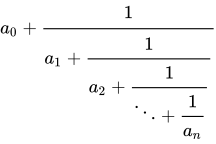
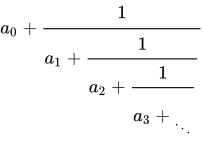
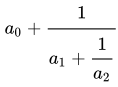
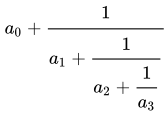
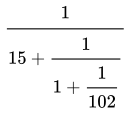
A simple or regular continued fraction is a continued fraction with numerators all equal to one, and denominators built from a sequence of integer numbers. The sequence can be finite or infinite, resulting in a finite (or terminated) continued fraction like
or an infinite continued fraction like
Typically, such a continued fraction is obtained through a recursive process which starts by representing a number as the sum of its integer part and its fractional part. The integer is recorded and the reciprocal of the fractional part is then recursively represented by another continued fraction. In the finite
case, the recursion is stopped after finitely many steps by using an
integer in lieu of another continued fraction. In contrast, an infinite continued fraction is an infinite expression. In either case, all integers in the sequence, other than the first, must be positive. The integers are called the coefficients or terms of the continued fraction.
Simple continued fractions have a number of remarkable properties related to the Euclidean algorithm for integers or real numbers. Every rational number/ has two closely related expressions as a finite continued fraction, whose coefficients ai can be determined by applying the Euclidean algorithm to . The numerical value of an infinite continued fraction is irrational; it is defined from its infinite sequence of integers as the limit
of a sequence of values for finite continued fractions. Each finite
continued fraction of the sequence is obtained by using a finite prefix of the infinite continued fraction's defining sequence of integers. Moreover, every irrational number is the value of a unique
infinite regular continued fraction, whose coefficients can be found
using the non-terminating version of the Euclidean algorithm applied to
the incommensurable values and 1. This way of expressing real numbers (rational and irrational) is called their continued fraction representation.
Motivation and notation
Consider, for example, the rational number415/93, which is around 4.4624. As a first approximation, start with 4, which is the integer part; 415/93 = 4 + 43/93. The fractional part is the reciprocal of 93/43 which is about 2.1628. Use the integer part, 2, as an approximation for the reciprocal to obtain a second approximation of 4 + 1/2 = 4.5. Now, 93/43 = 2 + 7/43;
the remaining fractional part, 7/43, is the reciprocal of 43/7, and 43/7 is around 6.1429. Use 6 as an approximation for this to obtain 2 + 1/6 as an approximation for 93/43 and 4 + 1/2 + 1/6, about 4.4615, as the third approximation. Further, 43/7 = 6 + 1/7. Finally, the fractional part, 1/7, is the reciprocal of 7, so its approximation in this scheme, 7, is exact (7/1 = 7 + 0/1) and produces the exact expression for 415/93.
That expression is called the continued fraction representation of 415/93. This can be represented by the abbreviated notation 415/93
= [4; 2, 6, 7]. It is customary to place a semicolon after the first
number to indicate that it is the whole part. Some older textbooks use
all commas in the (n + 1)-tuple, for example, [4, 2, 6, 7].
If the starting number is rational, then this process exactly parallels the Euclidean algorithm
applied to the numerator and denominator of the number. In particular,
it must terminate and produce a finite continued fraction representation
of the number. The sequence of integers that occur in this
representation is the sequence of successive quotients computed by the
Euclidean algorithm. If the starting number is irrational,
then the process continues indefinitely. This produces a sequence of
approximations, all of which are rational numbers, and these converge to
the starting number as a limit. This is the (infinite) continued
fraction representation of the number. Examples of continued fraction
representations of irrational numbers are:
√19 = [4;2,1,3,1,2,8,2,1,3,1,2,8,...] (sequence A010124 in the OEIS). The pattern repeats indefinitely with a period of 6.
e = [2;1,2,1,1,4,1,1,6,1,1,8,...] (sequence A003417 in the OEIS). The pattern repeats indefinitely with a period of 3 except that 2 is added to one of the terms in each cycle.
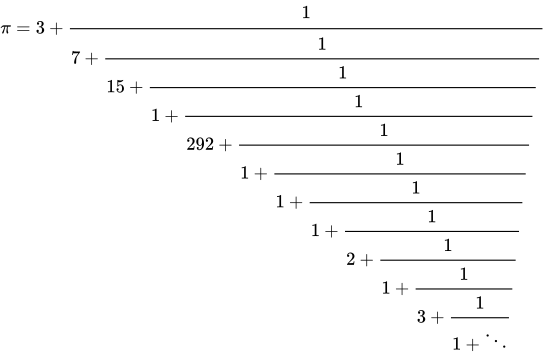
π = [3;7,15,1,292,1,1,1,2,1,3,1,...] (sequence A001203 in the OEIS). No pattern has ever been found in this representation.
γ = [0;1,1,2,1,2,1,4,3,13,5,1,...] (sequence A002852 in the OEIS). The Euler–Mascheroni constant, which is expected but not known to be irrational, and whose continued fraction has no apparent pattern.
Continued fractions are, in some ways, more "mathematically natural" representations of a real number than other representations such as decimal representations, and they have several desirable properties:
The continued fraction representation for a real number is
finite if and only if it is a rational number. In contrast, the decimal
representation of a rational number may be finite, for example 137/1600 = 0.085625, or infinite with a repeating cycle, for example 4/27 = 0.148148148148...
Every rational number has an essentially unique simple continued
fraction representation. Each rational can be represented in exactly two
ways, since [a0;a1,... an−1,an] = [a0;a1,... an−1,(an−1),1]. Usually the first, shorter one is chosen as the canonical representation.
The simple continued fraction representation of an irrational number
is unique. (However, additional representations are possible when using
generalized continued fractions; see below.)
The real numbers whose continued fraction eventually repeats are precisely the quadratic irrationals. For example, the repeating continued fraction [1;1,1,1,...] is the golden ratio, and the repeating continued fraction [1;2,2,2,...] is the square root of 2. In contrast, the decimal representations of quadratic irrationals are apparently random.
The square roots of all (positive) integers that are not perfect
squares are quadratic irrationals, and hence are unique periodic
continued fractions.
The successive approximations generated in finding the continued
fraction representation of a number, that is, by truncating the
continued fraction representation, are in a certain sense (described
below) the "best possible".
Formulation
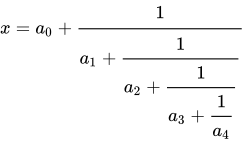
A continued fraction in canonical form is an expression of the form
where ai are integer numbers, called the coefficients or terms of the continued fraction.
When the expression contains finitely many terms, it is called a finite continued fraction.
When the expression contains infinitely many terms, it is called an infinite continued fraction. When the terms eventually repeat from some point onwards, the continued fraction is called periodic.
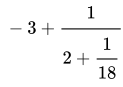
Thus, all of the following illustrate valid finite simple continued fractions:
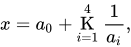
or in cases where the numerator is always 1, eliminated the fraction bars altogether, writing a list-style
Sometimes list-style notation uses angle brackets instead,
The semicolon in the square and angle bracket notations is sometimes replaced by a comma.
One may also define infinite simple continued fractions as limits:
This limit exists for any choice of and positive integers
Calculating continued fraction representations
Consider a real number .
Let and let .
When , the continued fraction representation of is
, where is the continued fraction representation of . When , then is the integer part of , and is the fractional part of .
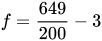
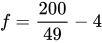
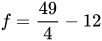
In order to calculate a continued fraction representation of a number , write down the floor of . Subtract this value from . If the difference is 0, stop; otherwise find the reciprocal of the difference and repeat. The procedure will halt if and only if is rational. This process can be efficiently implemented using the Euclidean algorithm when the number is rational.
The table below shows an implementation of this procedure for the number :
Step
Real Number
Integer part
Fractional part
Simplified
Reciprocal of f
1
2
3
4
STOP
The continued fraction for is thus or, expanded:
Finding
graphically the continued fraction of a number by repeatedly fitting
the largest possible square into an oblong of that aspect ratio
Reciprocals
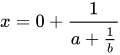
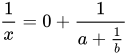
The continued fraction representations of a positive rational number and its reciprocal
are identical except for a shift one place left or right depending on
whether the number is less than or greater than one respectively. In
other words, the numbers represented by
and are reciprocals.
For instance if is an integer and then
and .
If then
and .
The last number that generates the remainder of the continued fraction is the same for both and its reciprocal.
For example,
and .
Finite continued fractions
Every finite continued fraction represents a rational number,
and every rational number can be represented in precisely two different
ways as a finite continued fraction, with the conditions that the first
coefficient is an integer and the other coefficients are positive
integers. These two representations agree except in their final terms.
In the longer representation the final term in the continued fraction is
1; the shorter representation drops the final 1, but increases the new
final term by 1. The final element in the short representation is
therefore always greater than 1, if present. In symbols:
[a0; a1, a2, ..., an − 1, an, 1] = [a0; a1, a2, ..., an − 1, an + 1].
Every infinite continued fraction is irrational, and every irrational number can be represented in precisely one way as an infinite continued fraction.
An infinite continued fraction representation for an irrational
number is useful because its initial segments provide rational
approximations to the number. These rational numbers are called the convergents of the continued fraction. The larger a term is in the continued fraction, the closer the
corresponding convergent is to the irrational number being approximated.
Numbers like π have occasional large terms in their continued fraction,
which makes them easy to approximate with rational numbers. Other
numbers like e have only small terms early in their continued fraction, which makes them more difficult to approximate rationally. The golden ratio
φ has terms equal to 1 everywhere—the smallest values possible—which
makes φ the most difficult number to approximate rationally. In this
sense, therefore, it is the "most irrational" of all irrational numbers.
Even-numbered convergents are smaller than the original number, while
odd-numbered ones are larger.
For a continued fraction [a0; a1, a2, ...], the first four convergents (numbered 0 through 3) are
The numerator of the third convergent is formed by multiplying the
numerator of the second convergent by the third coefficient, and adding
the numerator of the first convergent. The denominators are formed
similarly. Therefore, each convergent can be expressed explicitly in
terms of the continued fraction as the ratio of certain multivariate polynomials called continuants.
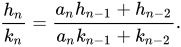
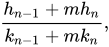
If successive convergents are found, with numerators h1, h2, ... and denominators k1, k2, ... then the relevant recursive relation is that of Gaussian brackets:
The successive convergents are given by the formula
Thus to incorporate a new term into a rational approximation, only
the two previous convergents are necessary. The initial "convergents"
(required for the first two terms) are 0⁄1 and 1⁄0. For example, here are the convergents for [0;1,5,2,2].
n
−2
−1
0
1
2
3
4
an
0
1
5
2
2
hn
0
1
0
1
5
11
27
kn
1
0
1
1
6
13
32
When using the Babylonian method
to generate successive approximations to the square root of an integer,
if one starts with the lowest integer as first approximant, the
rationals generated all appear in the list of convergents for the
continued fraction. Specifically, the approximants will appear on the
convergents list in positions 0, 1, 3, 7, 15, ... , 2k−1, ... For example, the continued fraction expansion for is [1; 1, 2, 1, 2, 1, 2, 1, 2, ...]. Comparing the convergents with the approximants derived from the Babylonian method:
n
−2
−1
0
1
2
3
4
5
6
7
an
1
1
2
1
2
1
2
1
hn
0
1
1
2
5
7
19
26
71
97
kn
1
0
1
1
3
4
11
15
41
56
x0 = 1 = 1/1
x1 = 1/2(1 + 3/1) = 2/1 = 2
x2 = 1/2(2 + 3/2) = 7/4
x3 = 1/2(7/4 + 3/7/4) = 97/56
Properties
The Baire space is a topological space on infinite sequences of natural numbers. The infinite continued fraction provides a homeomorphism from the Baire space to the space of irrational real numbers (with the subspace topology inherited from the usual topology on the reals). The infinite continued fraction also provides a map between the quadratic irrationals and the dyadic rationals, and from other irrationals to the set of infinite strings of binary numbers (i.e. the Cantor set); this map is called the Minkowski question-mark function. The mapping has interesting self-similar fractal properties; these are given by the modular group, which is the subgroup of Möbius transformations
having integer values in the transform. Roughly speaking, continued
fraction convergents can be taken to be Möbius transformations acting on
the (hyperbolic) upper half-plane; this is what leads to the fractal self-symmetry.
The limit probability distribution of the coefficients in the
continued fraction expansion of a random variable uniformly distributed
in (0, 1) is the Gauss–Kuzmin distribution.
Some useful theorems
If is an infinite sequence of positive integers, define the sequences and recursively:
Theorem 1. For any positive real number
Theorem 2. The convergents of are given by
or in matrix form,
Theorem 3. If the th convergent to a continued fraction is then
or equivalently
Corollary 1: Each convergent is in its lowest terms (for if and had a nontrivial common divisor it would divide which is impossible).
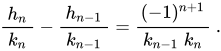
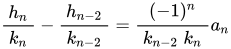
Corollary 2: The difference between successive convergents is a fraction whose numerator is unity:
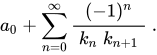
Corollary 3: The continued fraction is equivalent to a series of alternating terms:
Corollary 5: The matrix
has determinant , or equivalently,meaning that the odd terms monotonically decrease, while the even terms monotonically increase.
Corollary 6: The denominator sequence satisfies the recurrence relation , and grows at least as fast as the Fibonacci sequence, which itself grows like where is the golden ratio.
Theorem 4. Each (th) convergent is nearer to a subsequent (th) convergent than any preceding (th) convergent is. In symbols, if the th convergent is taken to be then
for all
Corollary 1: The even convergents (before the th) continually increase, but are always less than
Corollary 2: The odd convergents (before the th) continually decrease, but are always greater than
Theorem 5.
Corollary 1: A convergent is nearer to the limit of the
continued fraction than any fraction whose denominator is less than that
of the convergent.
Corollary 2: A convergent obtained by terminating the
continued fraction just before a large term is a close approximation to
the limit of the continued fraction.
Theorem 6: Consider the set of all open intervals with end-points . Denote it as . Any open subset of is a disjoint union of sets from .
Corollary: The infinite continued fraction provides a homeomorphism from the Baire space to .
Semiconvergents
If
are consecutive convergents, then any fractions of the form
where is an integer such that , are called semiconvergents, secondary convergents, or intermediate fractions. The -st semiconvergent equals the mediant of the -th one and the convergent . Sometimes the term is taken to mean that being a semiconvergent excludes the possibility of being a convergent (i.e., ), rather than that a convergent is a kind of semiconvergent.
It follows that semiconvergents represent a monotonic sequence of fractions between the convergents (corresponding to ) and (corresponding to ). The consecutive semiconvergents and satisfy the property .
If a rational approximation to a real number is such that the value is smaller than that of any approximation with a smaller denominator, then is a semiconvergent of the continued fraction expansion of . The converse is not true, however.
One can choose to define a best rational approximation to a real number x as a rational number n/d, d > 0, that is closer to x than any approximation with a smaller or equal denominator. The simple continued fraction for x can be used to generate all of the best rational approximations for x by applying these three rules:
Truncate the continued fraction, and reduce its last term by a chosen amount (possibly zero).
The reduced term cannot have less than half its original value.
If the final term is even, half its value is admissible only if the
corresponding semiconvergent is better than the previous convergent.
(See below.)
For example, 0.84375 has continued fraction [0;1,5,2,2]. Here are all of its best rational approximations.
Continued fraction
[0;1]
[0;1,3]
[0;1,4]
[0;1,5]
[0;1,5,2]
[0;1,5,2,1]
[0;1,5,2,2]
Rational approximation
1
3/4
4/5
5/6
11/13
16/19
27/32
Decimal equivalent
1
0.75
0.8
~0.83333
~0.84615
~0.84211
0.84375
Error
+18.519%
−11.111%
−5.1852%
−1.2346%
+0.28490%
−0.19493%
0%
Best rational approximants for π (green circle), e (blue diamond), φ
(pink oblong), (√3)/2 (grey hexagon), 1/√2 (red octagon) and 1/√3
(orange triangle) calculated from their continued fraction expansions,
plotted as slopes y/x with errors from their true values (black dashes)
The strictly monotonic increase in the denominators as additional
terms are included permits an algorithm to impose a limit, either on
size of denominator or closeness of approximation.
The "half rule" mentioned above requires that when ak is even, the halved term ak/2 is admissible if and only if |x − [a0 ; a1, ..., ak − 1]| > |x − [a0 ; a1, ..., ak − 1, ak/2]|. This is equivalent to:
[ak; ak − 1, ..., a1] > [ak; ak + 1, ...].
The convergents to x are "best approximations" in a much stronger sense than the one defined above. Namely, n/d is a convergent for x if and only if |dx − n| has the smallest value among the analogous expressions for all rational approximations m/c with c ≤ d; that is, we have |dx − n| < |cx − m| so long as c < d. (Note also that |dkx − nk| → 0 as k → ∞.)
Best rational within an interval
A rational that falls within the interval (x, y), for 0 < x < y, can be found with the continued fractions for x and y. When both x and y are irrational and
x = [a0; a1, a2, ..., ak − 1, ak, ak + 1, ...]
y = [a0; a1, a2, ..., ak − 1, bk, bk + 1, ...]
where x and y have identical continued fraction expansions up through ak−1, a rational that falls within the interval (x, y) is given by the finite continued fraction,
This rational will be best in the sense that no other rational in (x, y) will have a smaller numerator or a smaller denominator.
If x is rational, it will have two continued fraction representations that are finite, x1 and x2, and similarly a rational y will have two representations, y1 and y2. The coefficients beyond the last in any of these representations should be interpreted as +∞; and the best rational will be one of z(x1, y1), z(x1, y2), z(x2, y1), or z(x2, y2).
For example, the decimal representation 3.1416 could be rounded from any number in the interval [3.14155, 3.14165). The continued fraction representations of 3.14155 and 3.14165 are
Thus, 355/113
is the best rational number corresponding to the rounded decimal number
3.1416, in the sense that no other rational number that would be
rounded to 3.1416 will have a smaller numerator or a smaller
denominator.
Interval for a convergent
A rational number, which can be expressed as finite continued fraction in two ways,
z = [a0; a1, ..., ak − 1, ak, 1] = [a0; a1, ..., ak − 1, ak + 1] = pk/qk
will be one of the convergents for the continued fraction expansion
of a number, if and only if the number is strictly between (see this proof)
x = [a0; a1, ..., ak − 1, ak, 2] = 2pk - pk-1/2qk - qk-1 and
y = [a0; a1, ..., ak − 1, ak + 2] = pk + pk-1/qk + qk-1
The numbers x and y are formed by incrementing the last coefficient in the two representations for z. It is the case that x < y when k is even, and x > y when k is odd.
For example, the number 355/113 (Zu's fraction) has the continued fraction representations
355/113 = [3; 7, 15, 1] = [3; 7, 16]
and thus 355/113 is a convergent of any number strictly between
In his Essai sur la théorie des nombres (1798), Adrien-Marie Legendre
derives a necessary and sufficient condition for a rational number to
be a convergent of the continued fraction of a given real number. A consequence of this criterion, often called Legendre's theorem within the study of continued fractions, is as follows:
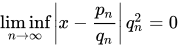
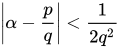
Theorem. If α is a real number and p, q are positive integers such that , then p/q is a convergent of the continued fraction of α.
Proof
This theorem forms the basis for Wiener's attack, a polynomial-time exploit of the RSA cryptographic protocol
that can occur for an injudicious choice of public and private keys
(specifically, this attack succeeds if the prime factors of the public
key n = pq satisfy p < q < 2p and the private key d is less than (1/3)n1/4).
Comparison
Consider x = [a0; a1, ...] and y = [b0; b1, ...]. If k is the smallest index for which ak is unequal to bk then x < y if (−1)k(ak − bk) < 0 and y < x otherwise.
If there is no such k, but one expansion is shorter than the other, say x = [a0; a1, ..., an] and y = [b0; b1, ..., bn, bn + 1, ...] with ai = bi for 0 ≤ i ≤ n, then x < y if n is even and y < x if n is odd.
Continued fraction expansion of π and its convergents
To calculate the convergents of π we may set a0 = ⌊π⌋ = 3, define u1 = 1/π − 3 ≈ 7.0625 and a1 = ⌊u1⌋ = 7, u2 = 1/u1 − 7 ≈ 15.9966 and a2 = ⌊u2⌋ = 15, u3 = 1/u2 − 15 ≈ 1.0034. Continuing like this, one can determine the infinite continued fraction of π as
[3;7,15,1,292,1,1,...] (sequence A001203 in the OEIS).
The fourth convergent of π is [3;7,15,1] = 355/113 = 3.14159292035..., sometimes called Milü, which is fairly close to the true value of π.
Let us suppose that the quotients found are, as above,
[3;7,15,1]. The following is a rule by which we can write down at once
the convergent fractions which result from these quotients without
developing the continued fraction.
The first quotient, supposed divided by unity, will give the first fraction, which will be too small, namely, 3/1.
Then, multiplying the numerator and denominator of this fraction by the
second quotient and adding unity to the numerator, we shall have the
second fraction, 22/7,
which will be too large. Multiplying in like manner the numerator and
denominator of this fraction by the third quotient, and adding to the
numerator the numerator of the preceding fraction, and to the
denominator the denominator of the preceding fraction, we shall have the
third fraction, which will be too small. Thus, the third quotient being
15, we have for our numerator (22 × 15 = 330) + 3 = 333, and for our denominator, (7 × 15 = 105) + 1 = 106. The third convergent, therefore, is 333/106.
We proceed in the same manner for the fourth convergent. The fourth
quotient being 1, we say 333 times 1 is 333, and this plus 22, the
numerator of the fraction preceding, is 355; similarly, 106 times 1 is
106, and this plus 7 is 113.
In this manner, by employing the four quotients [3;7,15,1], we obtain
the four fractions:
3/1, 22/7, 333/106, 355/113, ....
The following Maple code will generate continued fraction expansions of pi
To sum up, the pattern is
These convergents are alternately smaller and larger than the true value of π, and approach nearer and nearer to π. The difference between a given convergent and π
is less than the reciprocal of the product of the denominators of that
convergent and the next convergent. For example, the fraction 22/7 is greater than π, but 22/7 − π is less than 1/7 × 106 = 1/742 (in fact, 22/7 − π is just more than 1/791 = 1/7 × 113).
The demonstration of the foregoing properties is deduced from the
fact that if we seek the difference between one of the convergent
fractions and the next adjacent to it we shall obtain a fraction of
which the numerator is always unity and the denominator the product of
the two denominators. Thus the difference between 22/7 and 3/1 is 1/7, in excess; between 333/106 and 22/7, 1/742, in deficit; between 355/113 and 333/106, 1/11978,
in excess; and so on. The result being, that by employing this series
of differences we can express in another and very simple manner the
fractions with which we are here concerned, by means of a second series
of fractions of which the numerators are all unity and the denominators
successively be the product of every two adjacent denominators. Instead
of the fractions written above, we have thus the series:
The first term, as we see, is the first fraction; the first and second together give the second fraction, 22/7; the first, the second and the third give the third fraction 333/106, and so on with the rest; the result being that the series entire is equivalent to the original value.
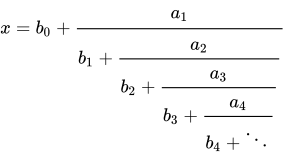
A non-simple continued fraction is an expression of the form
where the an (n > 0) are the partial numerators, the bn are the partial denominators, and the leading term b0 is called the integer part of the continued fraction.
To illustrate the use of non-simple continued fractions, consider
the following example. The sequence of partial denominators of the
simple continued fraction of π does not show any obvious pattern:
or
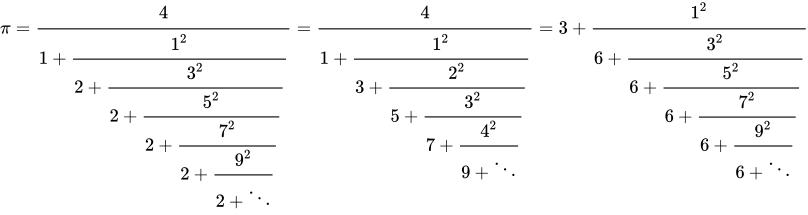
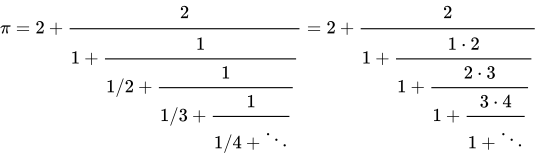
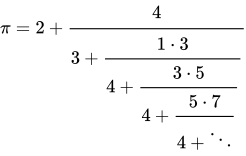
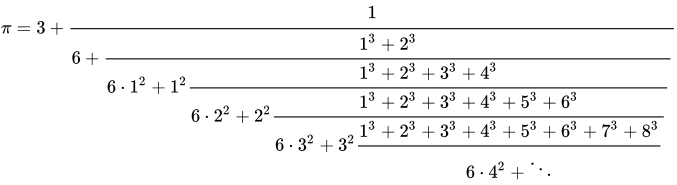
However, several non-simple continued fractions for π have a perfectly regular structure, such as:
The first two of these are special cases of the arctangent function with π = 4 arctan (1) and the fourth and fifth one can be derived using the Wallis product.
The continued fraction of above consisting of cubes uses the Nilakantha series and an exploit from Leonhard Euler.
The numbers with periodic continued fraction expansion are precisely the irrational solutions of quadratic equations
with rational coefficients; rational solutions have finite continued
fraction expansions as previously stated. The simplest examples are the golden ratio φ = [1;1,1,1,1,1,...] and √2 = [1;2,2,2,2,...], while √14 = [3;1,2,1,6,1,2,1,6...] and √42
= [6;2,12,2,12,2,12...]. All irrational square roots of integers have a
special form for the period; a symmetrical string, like the empty
string (for √2) or 1,2,1 (for √14), followed by the double of the leading integer.
A property of the golden ratio φ
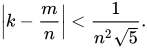
Because the continued fraction expansion for φ does not use any integers greater than 1, φ is one of the most "difficult" real numbers to approximate with rational numbers. Hurwitz's theorem states that any irrational number k can be approximated by infinitely many rational m/n with
While virtually all real numbers k will eventually have infinitely many convergents m/n whose distance from k is significantly smaller than this limit, the convergents for φ (i.e., the numbers 5/3, 8/5, 13/8, 21/13, etc.) consistently "toe the boundary", keeping a distance of almost exactly away from φ, thus never producing an approximation nearly as impressive as, for example, 355/113 for π. It can also be shown that every real number of the form a + bφ/c + dφ, where a, b, c, and d are integers such that ad − bc = ±1, shares this property with the golden ratio φ; and that all other real numbers can be more closely approximated.
Regular patterns in continued fractions
While there is no discernible pattern in the simple continued fraction expansion of π, there is one for e, the base of the natural logarithm:
which is a special case of this general expression for positive integer n:
Another, more complex pattern appears in this continued fraction expansion for positive odd n:
with a special case for n = 1:
Other continued fractions of this sort are
where n is a positive integer; also, for integer n:
with a special case for n = 1:
If In(x) is the modified, or hyperbolic, Bessel function of the first kind, we may define a function on the rationals p/q by
which is defined for all rational numbers, with p and q in lowest terms. Then for all nonnegative rationals, we have
with similar formulas for negative rationals; in particular we have
Most irrational numbers do not have any periodic or regular behavior in their continued fraction expansion. Nevertheless, for almost all numbers on the unit interval, they have the same limit behavior.
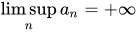
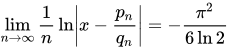
The arithmetic average diverges: , and so the coefficients grow arbitrarily large: . In particular, this implies that almost all numbers are well-approximable, in the sense thatKhinchin proved that the geometric mean of ai tends to a constant (known as Khinchin's constant):Paul Lévy proved that the nth root of the denominator of the nth convergent converges to Lévy's constantLochs' theorem states that the convergents converge exponentially at the rate of
Applications
Pell's equation
Continued fractions play an essential role in the solution of Pell's equation. For example, for positive integers p and q, and non-square n, it is true that if p2 − nq2 = ±1, then p/q is a convergent of the regular continued fraction for √n. The converse holds if the period of the regular continued fraction for √n is 1, and in general the period describes which convergents give solutions to Pell's equation.
The backwards shift operator for continued fractions is the map h(x) = 1/x − ⌊1/x⌋ called the Gauss map, which lops off digits of a continued fraction expansion: h([0; a1, a2, a3, ...]) = [0; a2, a3, ...]. The transfer operator of this map is called the Gauss–Kuzmin–Wirsing operator. The distribution of the digits in continued fractions is given by the zero'th eigenvector of this operator, and is called the Gauss–Kuzmin distribution.








![{\displaystyle {\begin{aligned}x=a_{0}+{\dfrac {1}{a_{1}}}{{} \atop +}\\[28mu]\ \end{aligned}}\!{\begin{aligned}{\dfrac {1}{a_{2}}}{{} \atop +}\\[2mu]\ \end{aligned}}\!{\begin{aligned}{\dfrac {1}{a_{3}}}{{} \atop +}\end{aligned}}\!{\begin{aligned}\\[2mu]{\dfrac {1}{a_{4}}},\end{aligned}}}](https://wikimedia.org/api/rest_v1/media/math/render/svg/039511be0bd9a0d2ea131234d4b5f0e84ee13a2b)



![{\displaystyle x=[a_{0};a_{1},a_{2},a_{3},a_{4}].}](https://wikimedia.org/api/rest_v1/media/math/render/svg/9a5812947e8c686698e0bb9b026f2586333d1c93)

![{\displaystyle [a_{0};a_{1},a_{2},a_{3},\,\ldots \,]=\lim _{n\to \infty }\,[a_{0};a_{1},a_{2},\,\ldots ,a_{n}].}](https://wikimedia.org/api/rest_v1/media/math/render/svg/cf80b82f0ab33bf81e98d6e776f3ed1689621cd8)


![{\displaystyle [i;a_{1},a_{2},\ldots ]}](https://wikimedia.org/api/rest_v1/media/math/render/svg/b07b4d8c246f2abcea1bd95ed28bdc2535c26d2d)
![{\displaystyle [a_{1};a_{2},\ldots ]}](https://wikimedia.org/api/rest_v1/media/math/render/svg/4c9e8939f732f72d1740b63e3b794712d12cb2ff)








![{\displaystyle [3;4,12,4],}](https://wikimedia.org/api/rest_v1/media/math/render/svg/04b5353f052c6af0495a58d3942ffb1760c0c2d1)


![{\displaystyle [a_{0};a_{1},a_{2},\ldots ,a_{n}]}](https://wikimedia.org/api/rest_v1/media/math/render/svg/71653aa3956cbe5900ac604c537ea47bb3c0c663)
![{\displaystyle [0;a_{0},a_{1},\ldots ,a_{n}]}](https://wikimedia.org/api/rest_v1/media/math/render/svg/9720f5fea78d62b863755765438517dbce260f01)





![{\displaystyle 2.25={\frac {9}{4}}=[2;4]}](https://wikimedia.org/api/rest_v1/media/math/render/svg/036681a2e2aeb96f756b8747415014be2408ffef)
![{\displaystyle {\frac {1}{2.25}}={\frac {4}{9}}=[0;2,4]}](https://wikimedia.org/api/rest_v1/media/math/render/svg/6018b6136e762f15bb9a9344904c10e9aa56b822)


![{\displaystyle {\begin{aligned}h_{n}&=a_{n}h_{n-1}+h_{n-2},\\[3mu]k_{n}&=a_{n}k_{n-1}+k_{n-2}.\end{aligned}}}](https://wikimedia.org/api/rest_v1/media/math/render/svg/9fe1234bce11282297be9a8ce2becb80696e7b7f)








![{\displaystyle \left[\ a_{0};\ a_{1},\ \dots ,a_{n-1},x\ \right]={\frac {x\ h_{n-1}+h_{n-2}}{\ x\ k_{n-1}+k_{n-2}\ }},\quad \left[\ a_{0};\ a_{1},\ \dots ,a_{n-1}+x\ \right]={\frac {h_{n-1}+xh_{n-2}}{\ k_{n-1}+xk_{n-2}\ }}}](https://wikimedia.org/api/rest_v1/media/math/render/svg/e97a1dad360f5a7faaacd6f7e99ec9fd53ba6125)

![{\displaystyle \ldots \ ]\ }](https://wikimedia.org/api/rest_v1/media/math/render/svg/f28bcc28d8f19cfd10ba8688e2dabc22dd3c7bcc)
![{\displaystyle \left[\ a_{0};\ a_{1},\ \dots ,a_{n}\ \right]={\frac {h_{n}}{\ k_{n}\ }}~.}](https://wikimedia.org/api/rest_v1/media/math/render/svg/ad872265234f8206c1a1b92676f2d01699ee1e3b)
















![{\displaystyle \ \left[\ a_{0};\ a_{1},\ \ldots ,\ a_{n}\ \right]=x_{n}\ ,}](https://wikimedia.org/api/rest_v1/media/math/render/svg/21fa0305affc343d457f54edf63f48b4e63aaa91)




![{\displaystyle [0;a_{1},\dots ,a_{n}],[0;a_{1},\dots ,a_{n}+1]}](https://wikimedia.org/api/rest_v1/media/math/render/svg/87df7a2f721a65fcca6d6cbc4929c7012c4e796b)

![{\displaystyle [0,1]\setminus \mathbb {Q} }](https://wikimedia.org/api/rest_v1/media/math/render/svg/453e5fbd42966fd76e8fa8e7a14406f2fad1587c)















![{\displaystyle \pi =[3;7,15,1,292,1,1,1,2,1,3,1,\ldots ]}](https://wikimedia.org/api/rest_v1/media/math/render/svg/6d065eed607055f87fe5077591dc4004ac46d27a)


![{\displaystyle e=e^{1}=[2;1,2,1,1,4,1,1,6,1,1,8,1,1,10,1,1,12,1,1,\dots ],}](https://wikimedia.org/api/rest_v1/media/math/render/svg/60b22c7e70b9a4b21ba2b70f9ccf4dbaeddc0bcb)
![{\displaystyle e^{1/n}=[1;n-1,1,1,3n-1,1,1,5n-1,1,1,7n-1,1,1,\dots ]\,\!.}](https://wikimedia.org/api/rest_v1/media/math/render/svg/361b5e0e5f76515b0d6ad7810c5eec23de8e95fd)
![{\displaystyle e^{2/n}=\left[1;{\frac {n-1}{2}},6n,{\frac {5n-1}{2}},1,1,{\frac {7n-1}{2}},18n,{\frac {11n-1}{2}},1,1,{\frac {13n-1}{2}},30n,{\frac {17n-1}{2}},1,1,\dots \right]\,\!,}](https://wikimedia.org/api/rest_v1/media/math/render/svg/07eb8d6c5d64d3683fe414862a766e97a6559971)
![{\displaystyle e^{2}=[7;2,1,1,3,18,5,1,1,6,30,8,1,1,9,42,11,1,1,12,54,14,1,1\dots ,3k,12k+6,3k+2,1,1\dots ]\,\!.}](https://wikimedia.org/api/rest_v1/media/math/render/svg/6165fcda38a93483d08d0d4a157819990e6ff894)
![{\displaystyle \tanh(1/n)=[0;n,3n,5n,7n,9n,11n,13n,15n,17n,19n,\dots ]}](https://wikimedia.org/api/rest_v1/media/math/render/svg/489bc2f0c0fce4a51a8d648c45aac36a0084eb5e)
![{\displaystyle \tan(1/n)=[0;n-1,1,3n-2,1,5n-2,1,7n-2,1,9n-2,1,\dots ]\,\!,}](https://wikimedia.org/api/rest_v1/media/math/render/svg/9b2a043635e6e94c9c5926c898da1c3e83c35389)
![{\displaystyle \tan(1)=[1;1,1,3,1,5,1,7,1,9,1,11,1,13,1,15,1,17,1,19,1,\dots ]\,\!.}](https://wikimedia.org/api/rest_v1/media/math/render/svg/1e34a7609c1049343f7f1cb8fb04eb6fcdea128b)

![{\displaystyle S(p/q)=[p+q;p+2q,p+3q,p+4q,\dots ],}](https://wikimedia.org/api/rest_v1/media/math/render/svg/c853ab378330b89a4cbb0fb81cb702cb5087d0df)
![{\displaystyle S(0)=S(0/1)=[1;2,3,4,5,6,7,\dots ].}](https://wikimedia.org/api/rest_v1/media/math/render/svg/917654658149e8bf1fdd990db7512fd73629009f)