Search This Blog

Tuesday, November 4, 2025

Philosophy of physics

From Wikipedia, the free encyclopedia

In philosophy, the philosophy of physics deals with conceptual and interpretational issues in physics, many of which overlap with research done by certain kinds of theoretical physicists. Historically, philosophers of physics have engaged with questions such as the nature of space, time, matter and the laws that govern their interactions, as well as the epistemological and ontological basis of the theories used by practicing physicists. The discipline draws upon insights from various areas of philosophy, including metaphysics, epistemology, and philosophy of science, while also engaging with the latest developments in theoretical and experimental physics.

Contemporary work focuses on issues at the foundations of the three pillars of modern physics:

Other areas of focus include the nature of physical laws, symmetries, and conservation principles; the role of mathematics; and philosophical implications of emerging fields like quantum gravity, quantum information, and complex systems. Philosophers of physics have argued that conceptual analysis clarifies foundations, interprets implications, and guides theory development in physics.

Philosophy of space and time

The existence and nature of space and time (or space-time) are central topics in the philosophy of physics. Issues include (1) whether space and time are fundamental or emergent, and (2) how space and time are operationally different from one another.

Time

Time, in many philosophies, is seen as change.

In classical mechanics, time is taken to be a fundamental quantity (that is, a quantity which cannot be defined in terms of other quantities). However, certain theories such as loop quantum gravity claim that spacetime is emergent. As Carlo Rovelli, one of the founders of loop quantum gravity, has said: "No more fields on spacetime: just fields on fields". Time is defined via measurement—by its standard time interval. Currently, the standard time interval (called "conventional second", or simply "second") is defined as 9,192,631,770 oscillations of a hyperfine transition in the 133 caesium atom. (ISO 31-1). What time is and how it works follows from the above definition. Time then can be combined mathematically with the fundamental quantities of space and mass to define concepts such as velocity, momentum, energy, and fields.

Both Isaac Newton and Galileo Galilei, as well as most people up until the 20th century, thought that time was the same for everyone everywhere. The modern conception of time is based on Albert Einstein's theory of relativity and Hermann Minkowski's spacetime, in which rates of time run differently in different inertial frames of reference, and space and time are merged into spacetime. Einstein's general relativity as well as the redshift of the light from receding distant galaxies indicate that the entire Universe and possibly space-time itself began about 13.8 billion years ago in the Big Bang. Einstein's theory of special relativity mostly (though not universally) made theories of time where there is something metaphysically special about the present seem much less plausible, as the reference-frame-dependence of time seems to not allow the idea of a privileged present moment.

Space

Space is one of the few fundamental quantities in physics, meaning that it cannot be defined via other quantities because there is nothing more fundamental known at present. Thus, similar to the definition of other fundamental quantities (like time and mass), space is defined via measurement. Currently, the standard space interval, called a standard metre or simply metre, is defined as the distance traveled by light in a vacuum during a time interval of 1/299792458 of a second (exact).

In classical physics, space is a three-dimensional Euclidean space where any position can be described using three coordinates and parameterised by time. Special and general relativity use four-dimensional spacetime rather than three-dimensional space; and currently there are many speculative theories which use more than three spatial dimensions.

Philosophy of quantum mechanics

Quantum mechanics is a large focus of contemporary philosophy of physics, specifically concerning the correct interpretation of quantum mechanics. Very broadly, much of the philosophical work that is done in quantum theory is trying to make sense of superposition states. Such a radical view turns many common sense metaphysical ideas on their head. Much of contemporary philosophy of quantum mechanics aims to make sense of what the very empirically successful formalism of quantum mechanics tells us about the physical world.

Uncertainty principle

The uncertainty principle is a mathematical relation asserting an upper limit to the accuracy of the simultaneous measurement of any pair of conjugate variables, e.g. position and momentum. In the formalism of operator notation, this limit is the evaluation of the commutator of the variables' corresponding operators.

The uncertainty principle arose as an answer to the question: How does one measure the location of an electron around a nucleus if an electron is a wave? When quantum mechanics was developed, it was seen to be a relation between the classical and quantum descriptions of a system using wave mechanics.

"Locality" and hidden variables

Bell's theorem is a term encompassing a number of closely related results in physics, all of which determine that quantum mechanics is incompatible with local hidden-variable theories given some basic assumptions about the nature of measurement. "Local" here refers to the principle of locality, the idea that a particle can only be influenced by its immediate surroundings, and that interactions mediated by physical fields cannot propagate faster than the speed of light. "Hidden variables" are putative properties of quantum particles that are not included in the theory but nevertheless affect the outcome of experiments. In the words of physicist John Stewart Bell, for whom this family of results is named, "If [a hidden-variable theory] is local it will not agree with quantum mechanics, and if it agrees with quantum mechanics it will not be local."

The term is broadly applied to a number of different derivations, the first of which was introduced by Bell in a 1964 paper titled "On the Einstein Podolsky Rosen Paradox". Bell's paper was a response to a 1935 thought experiment that Albert Einstein, Boris Podolsky and Nathan Rosen proposed, arguing that quantum physics is an "incomplete" theory. By 1935, it was already recognized that the predictions of quantum physics are probabilistic. Einstein, Podolsky and Rosen presented a scenario that involves preparing a pair of particles such that the quantum state of the pair is entangled, and then separating the particles to an arbitrarily large distance. The experimenter has a choice of possible measurements that can be performed on one of the particles. When they choose a measurement and obtain a result, the quantum state of the other particle apparently collapses instantaneously into a new state depending upon that result, no matter how far away the other particle is. This suggests that either the measurement of the first particle somehow also influenced the second particle faster than the speed of light, or that the entangled particles had some unmeasured property which pre-determined their final quantum states before they were separated. Therefore, assuming locality, quantum mechanics must be incomplete, as it cannot give a complete description of the particle's true physical characteristics. In other words, quantum particles, like electrons and photons, must carry some property or attributes not included in quantum theory, and the uncertainties in quantum theory's predictions would then be due to ignorance or unknowability of these properties, later termed "hidden variables".

Bell carried the analysis of quantum entanglement much further. He deduced that if measurements are performed independently on the two separated particles of an entangled pair, then the assumption that the outcomes depend upon hidden variables within each half implies a mathematical constraint on how the outcomes on the two measurements are correlated. This constraint would later be named the Bell inequality. Bell then showed that quantum physics predicts correlations that violate this inequality. Consequently, the only way that hidden variables could explain the predictions of quantum physics is if they are "nonlocal", which is to say that somehow the two particles can carry non-classical correlations no matter how widely they ever become separated.

Multiple variations on Bell's theorem were put forward in the following years, introducing other closely related conditions generally known as Bell (or "Bell-type") inequalities. The first rudimentary experiment designed to test Bell's theorem was performed in 1972 by John Clauser and Stuart Freedman. More advanced experiments, known collectively as Bell tests, have been performed many times since. To date, Bell tests have consistently found that physical systems obey quantum mechanics and violate Bell inequalities; which is to say that the results of these experiments are incompatible with any local hidden variable theory.

The exact nature of the assumptions required to prove a Bell-type constraint on correlations has been debated by physicists and by philosophers. While the significance of Bell's theorem is not in doubt, its full implications for the interpretation of quantum mechanics remain unresolved.

Interpretations of quantum mechanics

In March 1927, working in Niels Bohr's institute, Werner Heisenberg formulated the principle of uncertainty thereby laying the foundation of what became known as the Copenhagen interpretation of quantum mechanics. Heisenberg had been studying the papers of Paul Dirac and Pascual Jordan. He discovered a problem with measurement of basic variables in the equations. His analysis showed that uncertainties, or imprecisions, always turned up if one tried to measure the position and the momentum of a particle at the same time. Heisenberg concluded that these uncertainties or imprecisions in the measurements were not the fault of the experimenter, but fundamental in nature and are inherent mathematical properties of operators in quantum mechanics arising from definitions of these operators.

The Copenhagen interpretation is somewhat loosely defined, as many physicists and philosophers of physics have advanced similar but not identical views of quantum mechanics. It is principally associated with Heisenberg and Bohr, despite their philosophical differences. Features common to Copenhagen-type interpretations include the idea that quantum mechanics is intrinsically indeterministic, with probabilities calculated using the Born rule, and the principle of complementarity, which states that objects have certain pairs of complementary properties that cannot all be observed or measured simultaneously. Moreover, the act of "observing" or "measuring" an object is irreversible, and no truth can be attributed to an object, except according to the results of its measurement. Copenhagen-type interpretations hold that quantum descriptions are objective, in that they are independent of any arbitrary factors in the physicist's mind.

The many-worlds interpretation of quantum mechanics by Hugh Everett III claims that the wave-function of a quantum system is telling us claims about the reality of that physical system. It denies wavefunction collapse, and claims that superposition states should be interpreted literally as describing the reality of many-worlds where objects are located, and not simply indicating the indeterminacy of those variables. This is sometimes argued as a corollary of scientific realism, which states that scientific theories aim to give us literally true descriptions of the world.

One issue for the Everett interpretation is the role that probability plays on this account. The Everettian account is completely deterministic, whereas probability seems to play an ineliminable role in quantum mechanics. Contemporary Everettians have argued that one can get an account of probability that follows the Born rule through certain decision-theoretic proofs, but there is as yet no consensus about whether any of these proofs are successful.

Physicist Roland Omnès noted that it is impossible to experimentally differentiate between Everett's view, which says that as the wave-function decoheres into distinct worlds, each of which exists equally, and the more traditional view that says that a decoherent wave-function leaves only one unique real result. Hence, the dispute between the two views represents a great "chasm". "Every characteristic of reality has reappeared in its reconstruction by our theoretical model; every feature except one: the uniqueness of facts."

Philosophy of thermal and statistical physics

The philosophy of thermal and statistical physics is concerned with the foundational issues and conceptual implications of thermodynamics and statistical mechanics. These branches of physics deal with the macroscopic behavior of systems comprising a large number of microscopic entities, such as particles, and the nature of laws that emerge from these systems like irreversibility and entropy. Interest of philosophers in statistical mechanics first arose from the observation of an apparent conflict between the time-reversal symmetry of fundamental physical laws and the irreversibility observed in thermodynamic processes, known as the arrow of time problem. Philosophers have sought to understand how the asymmetric behavior of macroscopic systems, such as the tendency of heat to flow from hot to cold bodies, can be reconciled with the time-symmetric laws governing the motion of individual particles.

Another key issue is the interpretation of probability in statistical mechanics, which is primarily concerned with the question of whether probabilities in statistical mechanics are epistemic, reflecting our lack of knowledge about the precise microstate of a system, or ontic, representing an objective feature of the physical world. The epistemic interpretation, also known as the subjective or Bayesian view, holds that probabilities in statistical mechanics are a measure of our ignorance about the exact state of a system. According to this view, we resort to probabilistic descriptions only due to the practical impossibility of knowing the precise properties of all its micro-constituents, like the positions and momenta of particles. As such, the probabilities are not objective features of the world but rather arise from our ignorance. In contrast, the ontic interpretation, also called the objective or frequentist view, asserts that probabilities in statistical mechanics are real, physical properties of the system itself. Proponents of this view argue that the probabilistic nature of statistical mechanics is not merely a reflection of our ignorance but an intrinsic feature of the physical world, and that even if we had complete knowledge of the microstate of a system, the macroscopic behavior would still be best described by probabilistic laws.

History

Aristotelian physics

Aristotelian physics viewed the universe as a sphere with a center. Matter, composed of the classical elements: earth, water, air, and fire; sought to go down towards the center of the universe, the center of the Earth, or up, away from it. Things in the aether such as the Moon, the Sun, planets, or stars circled the center of the universe. Movement is defined as change in place, i.e. space.

Newtonian physics

The implicit axioms of Aristotelian physics with respect to movement of matter in space were superseded in Newtonian physics by Newton's first law of motion.

Every body perseveres in its state either of rest or of uniform motion in a straight line, except insofar as it is compelled to change its state by impressed forces.

"Every body" includes the Moon, and an apple; and includes all types of matter, air as well as water, stones, or even a flame. Nothing has a natural or inherent motion. Absolute space being three-dimensional Euclidean space, infinite and without a center. Being "at rest" means being at the same place in absolute space over time. The topology and affine structure of space must permit movement in a straight line at a uniform velocity; thus both space and time must have definite, stable dimensions.

Leibniz

Gottfried Wilhelm Leibniz, 1646–1716, was a contemporary of Newton. He contributed a fair amount to the statics and dynamics emerging around him, often disagreeing with Descartes and Newton. He devised a new theory of motion (dynamics) based on kinetic energy and potential energy, which posited space as relative, whereas Newton was thoroughly convinced that space was absolute. An important example of Leibniz's mature physical thinking is his Specimen Dynamicum of 1695.

Until the discovery of subatomic particles and the quantum mechanics governing them, many of Leibniz's speculative ideas about aspects of nature not reducible to statics and dynamics made little sense.

He anticipated Albert Einstein by arguing, against Newton, that space, time and motion are relative, not absolute: "As for my own opinion, I have said more than once, that I hold space to be something merely relative, as time is, that I hold it to be an order of coexistences, as time is an order of successions."

Copenhagen interpretation

From Wikipedia, the free encyclopedia

The Copenhagen interpretation is a collection of views about the meaning of quantum mechanics, stemming from the work of Niels Bohr, Werner Heisenberg, Max Born, and others. While "Copenhagen" refers to the city where Bohr and Heisenberg worked, the use as an "interpretation" was apparently coined by Heisenberg during the 1950s to refer to ideas developed in the 1925–1927 period, glossing over his disagreements with Bohr. Consequently, there is no definitive historical statement of what the interpretation entails.

Features common across versions of the Copenhagen interpretation include the idea that quantum mechanics is intrinsically indeterministic, with probabilities calculated using the Born rule, and the principle of complementarity, which states that objects have certain pairs of complementary properties that cannot all be observed or measured simultaneously. Moreover, the act of "observing" or "measuring" an object is irreversible, and no truth can be attributed to an object except according to the results of its measurement (that is, the Copenhagen interpretation rejects counterfactual definiteness). Copenhagen-type interpretations hold that quantum descriptions are objective, in that they are independent of physicists' personal beliefs and other arbitrary mental factors.

Over the years, there have been many objections to aspects of Copenhagen-type interpretations, including the discontinuous and stochastic nature of the "observation" or "measurement" process, the difficulty of defining what might count as a measuring device, and the seeming reliance upon classical physics in describing such devices. Still, including all the variations, the interpretation remains one of the most commonly taught.

Background

Starting in 1900, investigations into atomic and subatomic phenomena forced a revision to the basic concepts of classical physics. However, it was not until a quarter-century had elapsed that the revision reached the status of a coherent theory. During the intervening period, now known as the time of the "old quantum theory", physicists worked with approximations and heuristic corrections to classical physics. Notable results from this period include Max Planck's calculation of the blackbody radiation spectrum, Albert Einstein's explanation of the photoelectric effect, Einstein and Peter Debye's work on the specific heat of solids, Niels Bohr and Hendrika Johanna van Leeuwen's proof that classical physics cannot account for diamagnetism, Bohr's model of the hydrogen atom and Arnold Sommerfeld's extension of the Bohr model to include relativistic effects. From 1922 through 1925, this method of heuristic corrections encountered increasing difficulties; for example, the Bohr–Sommerfeld model could not be extended from hydrogen to the next simplest case, the helium atom.

The transition from the old quantum theory to full-fledged quantum physics began in 1925, when Werner Heisenberg presented a treatment of electron behavior based on discussing only "observable" quantities, meaning to Heisenberg the frequencies of light that atoms absorbed and emitted. Max Born then realized that in Heisenberg's theory, the classical variables of position and momentum would instead be represented by matrices, mathematical objects that can be multiplied together like numbers with the crucial difference that the order of multiplication matters. Erwin Schrödinger presented an equation that treated the electron as a wave, and Born discovered that the way to successfully interpret the wave function that appeared in the Schrödinger equation was as a tool for calculating probabilities.

Quantum mechanics cannot easily be reconciled with everyday language and observation, and has often seemed counter-intuitive to physicists, including its inventors. The ideas grouped together as the Copenhagen interpretation suggest a way to think about how the mathematics of quantum theory relates to physical reality.

Origin and use of the term

The Niels Bohr Institute in Copenhagen

The 'Copenhagen' part of the term refers to the city of Copenhagen in Denmark. During the mid-1920s, Heisenberg had been an assistant to Bohr at his institute in Copenhagen. Together they helped originate quantum mechanical theory. At the 1927 Solvay Conference, a dual talk by Max Born and Heisenberg declared "we consider quantum mechanics to be a closed theory, whose fundamental physical and mathematical assumptions are no longer susceptible of any modification." In 1929, Heisenberg gave a series of invited lectures at the University of Chicago explaining the new field of quantum mechanics. The lectures then served as the basis for his textbook, The Physical Principles of the Quantum Theory, published in 1930. In the book's preface, Heisenberg wrote:

On the whole, the book contains nothing that is not to be found in previous publications, particularly in the investigations of Bohr. The purpose of the book seems to me to be fulfilled if it contributes somewhat to the diffusion of that 'Kopenhagener Geist der Quantentheorie' [Copenhagen spirit of quantum theory] if I may so express myself, which has directed the entire development of modern atomic physics.

The term 'Copenhagen interpretation' suggests something more than just a spirit, such as some definite set of rules for interpreting the mathematical formalism of quantum mechanics, presumably dating back to the 1920s. However, no such text exists, and the writings of Bohr and Heisenberg contradict each other on several important issues. It appears that the particular term, with its more definite sense, was coined by Heisenberg around 1955, while criticizing alternative "interpretations" (e.g., David Bohm's) that had been developed. Lectures with the titles 'The Copenhagen Interpretation of Quantum Theory' and 'Criticisms and Counterproposals to the Copenhagen Interpretation', that Heisenberg delivered in 1955, are reprinted in the collection Physics and Philosophy. Before the book was released for sale, Heisenberg privately expressed regret for having used the term, due to its suggestion of the existence of other interpretations, that he considered to be "nonsense". In a 1960 review of Heisenberg's book, Bohr's close collaborator Léon Rosenfeld called the term an "ambiguous expression" and suggested it be discarded. However, this did not come to pass, and the term entered widespread use. Bohr's ideas in particular are distinct despite the use of his Copenhagen home in the name of the interpretation.

Principles

There is no uniquely definitive statement of the Copenhagen interpretation. The term encompasses the views developed by a number of scientists and philosophers during the second quarter of the 20th century. This lack of a single, authoritative source that establishes the Copenhagen interpretation is one difficulty with discussing it; another complication is that the philosophical background familiar to Einstein, Bohr, Heisenberg, and contemporaries is much less so to physicists and even philosophers of physics in more recent times. Bohr and Heisenberg never totally agreed on how to understand the mathematical formalism of quantum mechanics, and Bohr distanced himself from what he considered Heisenberg's more subjective interpretation. Bohr offered an interpretation that is independent of a subjective observer, or measurement, or collapse; instead, an "irreversible" or effectively irreversible process causes the decay of quantum coherence which imparts the classical behavior of "observation" or "measurement".

Different commentators and researchers have associated various ideas with the term. Asher Peres remarked that very different, sometimes opposite, views are presented as "the Copenhagen interpretation" by different authors. N. David Mermin coined the phrase "Shut up and calculate!" to summarize Copenhagen-type views, a saying often misattributed to Richard Feynman and which Mermin later found insufficiently nuanced. Mermin described the Copenhagen interpretation as coming in different "versions", "varieties", or "flavors".

Some basic principles generally accepted as part of the interpretation include the following:

  1. Quantum mechanics is intrinsically indeterministic.
  2. The correspondence principle: in the appropriate limit, quantum theory comes to resemble classical physics and reproduces the classical predictions.
  3. The Born rule: the wave function of a system yields probabilities for the outcomes of measurements upon that system.
  4. Complementarity: certain properties cannot be jointly defined for the same system at the same time. In order to talk about a specific property of a system, that system must be considered within the context of a specific laboratory arrangement. Observable quantities corresponding to mutually exclusive laboratory arrangements cannot be predicted together, but the consideration of multiple such mutually exclusive experiments is necessary to characterize a system.

Hans Primas and Roland Omnès give a more detailed breakdown that, in addition to the above, includes the following:

  1. Quantum physics applies to individual objects. The probabilities computed by the Born rule do not require an ensemble or collection of "identically prepared" systems to understand.
  2. The results provided by measuring devices are essentially classical, and should be described in ordinary language. This was particularly emphasized by Bohr, and was accepted by Heisenberg.
  3. Per the above point, the device used to observe a system must be described in classical language, while the system under observation is treated in quantum terms. This is a particularly subtle issue for which Bohr and Heisenberg came to differing conclusions. According to Heisenberg, the boundary between classical and quantum can be shifted in either direction at the observer's discretion. That is, the observer has the freedom to move what would become known as the "Heisenberg cut" without changing any physically meaningful predictions. On the other hand, Bohr argued both systems are quantum in principle, and the object-instrument distinction (the "cut") is dictated by the experimental arrangement. For Bohr, the "cut" was not a change in the dynamical laws that govern the systems in question, but a change in the language applied to them.
  4. During an observation, the system must interact with a laboratory device. When that device makes a measurement, the wave function of the system collapses, irreversibly reducing to an eigenstate of the observable that is registered. The result of this process is a tangible record of the event, made by a potentiality becoming an actuality.
  5. Statements about measurements that are not actually made do not have meaning. For example, there is no meaning to the statement that a photon traversed the upper path of a Mach–Zehnder interferometer unless the interferometer were actually built in such a way that the path taken by the photon is detected and registered.
  6. Wave functions are objective, in that they do not depend upon personal opinions of individual physicists or other such arbitrary influences.

There are some fundamental agreements and disagreements between the views of Bohr and Heisenberg. For example, Heisenberg emphasized a sharp "cut" between the observer (or the instrument) and the system being observed, while Bohr offered an interpretation that is independent of a subjective observer or measurement or collapse, which relies on an "irreversible" or effectively irreversible process, which could take place within the quantum system.

Another issue of importance where Bohr and Heisenberg disagreed is wave–particle duality. Bohr maintained that the distinction between a wave view and a particle view was defined by a distinction between experimental setups, whereas Heisenberg held that it was defined by the possibility of viewing the mathematical formulas as referring to waves or particles. Bohr thought that a particular experimental setup would display either a wave picture or a particle picture, but not both. Heisenberg thought that every mathematical formulation was capable of both wave and particle interpretations.[41][42]

Nature of the wave function

A wave function is a mathematical entity that describes the shape of a wave form. In the Copenhagen interpretation this wave form provides a probability distribution for the outcomes of each possible measurement on a system. Knowledge of the wave function together with the rules for the system's evolution in time exhausts all that can be predicted about the system's behavior. Generally, Copenhagen-type interpretations deny that the wave function provides a directly apprehensible image of an ordinary material body or a discernible component of some such, or anything more than a theoretical concept.

Probabilities via the Born rule

The Born rule is essential to the Copenhagen interpretation. Formulated by Max Born in 1926, it gives the probability that a measurement of a quantum system will yield a given result. In its simplest form, it states that the probability density of finding a particle at a given point, when measured, is proportional to the square of the magnitude of the particle's wave function at that point.

Collapse

The concept of wave function collapse postulates that the wave function of a system can change suddenly and discontinuously upon measurement. Prior to a measurement, a wave function involves the various probabilities for the different potential outcomes of that measurement. But when the apparatus registers one of those outcomes, no traces of the others linger. Since Bohr did not view the wavefunction as something physical, he never talks about "collapse". Nevertheless, many physicists and philosophers associate collapse with the Copenhagen interpretation.

Heisenberg spoke of the wave function as representing available knowledge of a system, and did not use the term "collapse", but instead termed it "reduction" of the wave function to a new state representing the change in available knowledge which occurs once a particular phenomenon is registered by the apparatus.

Role of the observer

Because they assert that the existence of an observed value depends upon the intercession of the observer, Copenhagen-type interpretations are sometimes called "subjective". All of the original Copenhagen protagonists considered the process of observation as mechanical and independent of the individuality of the observer. Wolfgang Pauli, for example, insisted that measurement results could be obtained and recorded by "objective registering apparatus". As Heisenberg wrote,

Of course the introduction of the observer must not be misunderstood to imply that some kind of subjective features are to be brought into the description of nature. The observer has, rather, only the function of registering decisions, i.e., processes in space and time, and it does not matter whether the observer is an apparatus or a human being; but the registration, i.e., the transition from the "possible" to the "actual," is absolutely necessary here and cannot be omitted from the interpretation of quantum theory.

In the 1970s and 1980s, the theory of decoherence helped to explain the appearance of quasi-classical realities emerging from quantum theory, but was insufficient to provide a technical explanation for the apparent wave function collapse.

Completion by hidden variables?

In metaphysical terms, the Copenhagen interpretation views quantum mechanics as providing knowledge of phenomena, but not as pointing to 'really existing objects', which it regards as residues of ordinary intuition. This makes it an epistemic theory. This may be contrasted with Einstein's view, that physics should look for 'really existing objects', making itself an ontic theory.

The metaphysical question is sometimes asked: "Could quantum mechanics be extended by adding so-called "hidden variables" to the mathematical formalism, to convert it from an epistemic to an ontic theory?" The Copenhagen interpretation answers this with a strong 'No'. It is sometimes alleged, for example by J.S. Bell, that Einstein opposed the Copenhagen interpretation because he believed that the answer to that question of "hidden variables" was "yes". By contrast, Max Jammer writes "Einstein never proposed a hidden variable theory." Einstein explored the possibility of a hidden variable theory, and wrote a paper describing his exploration, but withdrew it from publication because he felt it was faulty.

Acceptance among physicists

During the 1930s and 1940s, views about quantum mechanics attributed to Bohr and emphasizing complementarity became commonplace among physicists. Textbooks of the time generally maintained the principle that the numerical value of a physical quantity is not meaningful or does not exist until it is measured. Prominent physicists associated with Copenhagen-type interpretations have included Lev LandauWolfgang PauliRudolf PeierlsAsher PeresLéon Rosenfeld, and Ray Streater.

Throughout much of the 20th century, the Copenhagen tradition had overwhelming acceptance among physicists. According to a very informal poll (some people voted for multiple interpretations) conducted at a quantum mechanics conference in 1997, the Copenhagen interpretation remained the most widely accepted label that physicists applied to their own views. A similar result was found in polls conducted in 2011 and 2025.

Consequences

The nature of the Copenhagen interpretation is exposed by considering a number of experiments and paradoxes.

Schrödinger's cat

This thought experiment highlights the implications that accepting uncertainty at the microscopic level has on macroscopic objects. A cat is put in a sealed box, with its life or death made dependent on the state of a subatomic particle. Thus a description of the cat during the course of the experiment—having been entangled with the state of a subatomic particle—becomes a "blur" of "living and dead cat." But this cannot be accurate because it implies the cat is actually both dead and alive until the box is opened to check on it. But the cat, if it survives, will only remember being alive. Schrödinger resists "so naively accepting as valid a 'blurred model' for representing reality." How can the cat be both alive and dead?

In Copenhagen-type views, the wave function reflects our knowledge of the system. The wave function means that, once the cat is observed, there is a 50% chance it will be dead, and 50% chance it will be alive. (Some versions of the Copenhagen interpretation reject the idea that a wave function can be assigned to a physical system that meets the everyday definition of "cat"; in this view, the correct quantum-mechanical description of the cat-and-particle system must include a superselection rule.)

Wigner's friend

"Wigner's friend" is a thought experiment intended to make that of Schrödinger's cat more striking by involving two conscious beings, traditionally known as Wigner and his friend. (In more recent literature, they may also be known as Alice and Bob, per the convention of describing protocols in information theory.) Wigner puts his friend in with the cat. The external observer believes the system is in state . However, his friend is convinced that the cat is alive, i.e. for him, the cat is in the state . How can Wigner and his friend see different wave functions?

In a Heisenbergian view, the answer depends on the positioning of Heisenberg cut, which can be placed arbitrarily (at least according to Heisenberg, though not to Bohr). If Wigner's friend is positioned on the same side of the cut as the external observer, his measurements collapse the wave function for both observers. If he is positioned on the cat's side, his interaction with the cat is not considered a measurement. Different Copenhagen-type interpretations take different positions as to whether observers can be placed on the quantum side of the cut.

Double-slit experiment

In the basic version of this experiment, a light source, such as a laser beam, illuminates a plate pierced by two parallel slits, and the light passing through the slits is observed on a screen behind the plate. The wave nature of light causes the light waves passing through the two slits to interfere, producing bright and dark bands on the screen – a result that would not be expected if light consisted of classical particles. However, the light is always found to be absorbed at the screen at discrete points, as individual particles (not waves); the interference pattern appears via the varying density of these particle hits on the screen. Furthermore, versions of the experiment that include detectors at the slits find that each detected photon passes through one slit (as would a classical particle), and not through both slits (as would a wave). Such experiments demonstrate that particles do not form the interference pattern if one detects which slit they pass through.

According to Bohr's complementarity principle, light is neither a wave nor a stream of particles. A particular experiment can demonstrate particle behavior (passing through a definite slit) or wave behavior (interference), but not both at the same time.

The same experiment has been performed for light, electrons, atoms, and molecules. The extremely small de Broglie wavelength of objects with larger mass makes experiments increasingly difficult, but in general quantum mechanics considers all matter as possessing both particle and wave behaviors.

Einstein–Podolsky–Rosen paradox

This thought experiment involves a pair of particles prepared in what later authors would refer to as an entangled state. In a 1935 paper, Einstein, Boris Podolsky, and Nathan Rosen pointed out that, in this state, if the position of the first particle were measured, the result of measuring the position of the second particle could be predicted. If instead the momentum of the first particle were measured, then the result of measuring the momentum of the second particle could be predicted. They argued that no action taken on the first particle could instantaneously affect the other, since this would involve information being transmitted faster than light, which is forbidden by the theory of relativity. They invoked a principle, later known as the "Einstein–Podolsky–Rosen (EPR) criterion of reality", positing that, "If, without in any way disturbing a system, we can predict with certainty (i.e., with probability equal to unity) the value of a physical quantity, then there exists an element of reality corresponding to that quantity". From this, they inferred that the second particle must have a definite value of position and of momentum prior to either being measured.

Bohr's response to the EPR paper was published in the Physical Review later that same year. He argued that EPR had reasoned fallaciously. Because measurements of position and of momentum are complementary, making the choice to measure one excludes the possibility of measuring the other. Consequently, a fact deduced regarding one arrangement of laboratory apparatus could not be combined with a fact deduced by means of the other, and so, the inference of predetermined position and momentum values for the second particle was not valid. Bohr concluded that EPR's "arguments do not justify their conclusion that the quantum description turns out to be essentially incomplete."

Criticism

Incompleteness and indeterminism

Niels Bohr and Albert Einstein, pictured here at Paul Ehrenfest's home in Leiden (December 1925), had a long-running collegial dispute about what quantum mechanics implied for the nature of reality.

Einstein was an early and persistent supporter of objective reality. Bohr and Heisenberg advanced the position that no physical property could be understood without an act of measurement, while Einstein refused to accept this. Abraham Pais recalled a walk with Einstein when the two discussed quantum mechanics: "Einstein suddenly stopped, turned to me and asked whether I really believed that the moon exists only when I look at it." While Einstein did not doubt that quantum mechanics was a correct physical theory in that it gave correct predictions, he maintained that it could not be a complete theory. The most famous product of his efforts to argue the incompleteness of quantum theory is the Einstein–Podolsky–Rosen thought experiment, which was intended to show that physical properties like position and momentum have values even if not measured. The argument of EPR was not generally persuasive to other physicists.

Carl Friedrich von Weizsäcker, while participating in a colloquium at Cambridge, denied that the Copenhagen interpretation asserted "What cannot be observed does not exist". Instead, he suggested that the Copenhagen interpretation follows the principle "What is observed certainly exists; about what is not observed we are still free to make suitable assumptions. We use that freedom to avoid paradoxes."

Einstein was likewise dissatisfied with the indeterminism of quantum theory. Regarding the possibility of randomness in nature, Einstein said that he was "convinced that He [God] does not throw dice." Bohr, in response, reputedly said that "it cannot be for us to tell God, how he is to run the world".

The Heisenberg cut

Much criticism of Copenhagen-type interpretations has focused on the need for a classical domain where observers or measuring devices can reside, and the imprecision of how the boundary between quantum and classical might be defined. This boundary came to be termed the Heisenberg cut (while John Bell derisively called it the "shifty split"). As typically portrayed, Copenhagen-type interpretations involve two different kinds of time evolution for wave functions, the deterministic flow according to the Schrödinger equation and the probabilistic jump during measurement, without a clear criterion for when each kind applies. Why should these two different processes exist, when physicists and laboratory equipment are made of the same matter as the rest of the universe? And if there is somehow a split, where should it be placed? Steven Weinberg writes that the traditional presentation gives "no way to locate the boundary between the realms in which [...] quantum mechanics does or does not apply."

The problem of thinking in terms of classical measurements of a quantum system becomes particularly acute in the field of quantum cosmology, where the quantum system is the universe. How does an observer stand outside the universe in order to measure it, and who was there to observe the universe in its earliest stages? Advocates of Copenhagen-type interpretations have disputed the seriousness of these objections. Rudolf Peierls noted that "the observer does not have to be contemporaneous with the event"; for example, we study the early universe through the cosmic microwave background, and we can apply quantum mechanics to that just as well as to any electromagnetic field. Likewise, Asher Peres argued that physicists are, conceptually, outside those degrees of freedom that cosmology studies, and applying quantum mechanics to the radius of the universe while neglecting the physicists in it is no different from quantizing the electric current in a superconductor while neglecting the atomic-level details.

You may object that there is only one universe, but likewise there is only one SQUID in my laboratory.

Alternatives

A large number of alternative interpretations have appeared, sharing some aspects of the Copenhagen interpretation while providing alternatives to other aspects. The ensemble interpretation is similar; it offers an interpretation of the wave function, but not for single particles. The consistent histories interpretation advertises itself as "Copenhagen done right". More recently, interpretations inspired by quantum information theory like QBism and relational quantum mechanics have appeared. Experts on quantum foundational issues continue to favor the Copenhagen interpretation over other alternatives. Physicists who have suggested that the Copenhagen tradition needs to be built upon or extended include Rudolf Haag and Anton Zeilinger.

Under realism and determinism, if the wave function is regarded as ontologically real, and collapse is entirely rejected, a many-worlds interpretation results. If wave function collapse is regarded as ontologically real as well, an objective collapse theory is obtained. Bohmian mechanics shows that it is possible to reformulate quantum mechanics to make it deterministic, at the price of making it explicitly nonlocal. It attributes not only a wave function to a physical system, but in addition a real position, that evolves deterministically under a nonlocal guiding equation. The evolution of a physical system is given at all times by the Schrödinger equation together with the guiding equation; there is never a collapse of the wave function. The transactional interpretation is also explicitly nonlocal.

Some physicists espoused views in the "Copenhagen spirit" and then went on to advocate other interpretations. For example, David Bohm and Alfred Landé both wrote textbooks that put forth ideas in the Bohr–Heisenberg tradition, and later promoted nonlocal hidden variables and an ensemble interpretation respectively. John Archibald Wheeler began his career as an "apostle of Niels Bohr"; he then supervised the PhD thesis of Hugh Everett that proposed the many-worlds interpretation. After supporting Everett's work for several years, he began to distance himself from the many-worlds interpretation in the 1970s. Late in life, he wrote that while the Copenhagen interpretation might fairly be called "the fog from the north", it "remains the best interpretation of the quantum that we have".

Other physicists, while influenced by the Copenhagen tradition, have expressed frustration at how it took the mathematical formalism of quantum theory as given, rather than trying to understand how it might arise from something more fundamental. (E. T. Jaynes described the mathematical formalism of quantum physics as "a peculiar mixture describing in part realities of Nature, in part incomplete human information about Nature—all scrambled up together by Heisenberg and Bohr into an omelette that nobody has seen how to unscramble".) This dissatisfaction has motivated new interpretative variants as well as technical work in quantum foundations.


Spectral line

From Wikipedia, the free encyclopedia
Continuous spectrum
Continuous spectrum
 
Absorption lines
Absorption spectrum with absorption lines

A spectral line is a weaker or stronger region in an otherwise uniform and continuous spectrum. It may result from emission or absorption of light in a narrow frequency range, compared with the nearby frequencies. Spectral lines are often used to identify atoms and molecules. These "fingerprints" can be compared to the previously collected ones of atoms and molecules, and are thus used to identify the atomic and molecular components of stars and planets, which would otherwise be impossible.

Types of line spectra

Continuous spectrum of an incandescent lamp (mid) and discrete spectrum lines of a fluorescent lamp (bottom)

Spectral lines are the result of interaction between a quantum system (usually atoms, but sometimes molecules or atomic nuclei) and a single photon. When a photon has about the right amount of energy (which is connected to its frequency) to allow a change in the energy state of the system (in the case of an atom this is usually an electron changing orbitals), the photon is absorbed. Then the energy will be spontaneously re-emitted, either as one photon at the same frequency as the original one or in a cascade, where the sum of the energies of the photons emitted will be equal to the energy of the one absorbed (assuming the system returns to its original state).

A spectral line may be observed either as an emission line or an absorption line. Which type of line is observed depends on the type of material and its temperature relative to another emission source. An absorption line is produced when photons from a hot, broad spectrum source pass through a cooler material. The intensity of light, over a narrow frequency range, is reduced due to absorption by the material and re-emission in random directions. By contrast, a bright emission line is produced when photons from a hot material are detected, perhaps in the presence of a broad spectrum from a cooler source. The intensity of light, over a narrow frequency range, is increased due to emission by the hot material.

Spectral lines are highly atom-specific, and can be used to identify the chemical composition of any medium. Several elements, including helium, thallium, and caesium, were discovered by spectroscopic means. Spectral lines also depend on the temperature and density of the material, so they are widely used to determine the physical composition and condition of distant stars and other celestial bodies. Some of these data cannot be obtained or analyzed by other means, and so the field of spectroscopy has grown as astronomical and telescopic exploration has grown.

Depending on the material and its physical conditions, the energy of the involved photons can vary widely, with the spectral lines observed across the electromagnetic spectrum, from radio waves to gamma rays.

Nomenclature

Strong spectral lines in the visible part of the electromagnetic spectrum often have a unique Fraunhofer line designation, such as K for a line at 393.366 nm emerging from singly-ionized calcium atom, Ca+, though some of the Fraunhofer "lines" are blends of multiple lines from several different species.

In other cases, the lines are designated according to the level of ionization by adding a Roman numeral to the designation of the chemical element. Neutral atoms are denoted with the Roman numeral I, singly ionized atoms with II, and so on, so that, for example:

Cu II — copper ion with +1 charge, Cu1+

Fe III — iron ion with +2 charge, Fe2+

More detailed designations usually include the line wavelength and may include a multiplet number (for atomic lines) or band designation (for molecular lines). Many spectral lines of atomic hydrogen also have designations within their respective series, such as the Lyman series or Balmer series. Originally all spectral lines were classified into series: the principal series, sharp series, and diffuse series. These series exist across atoms of all elements, and the patterns for all atoms are well-predicted by the Rydberg-Ritz formula. These series were later associated with suborbitals.

Line broadening and shift

There are a number of effects which control spectral line shape. A spectral line extends over a tiny spectral band with a nonzero range of frequencies, not a single frequency (i.e., a nonzero spectral width). In addition, its center may be shifted from its nominal central wavelength. There are several reasons for this broadening and shift. These reasons may be divided into two general categories – broadening due to local conditions and broadening due to extended conditions. Broadening due to local conditions is due to effects which hold in a small region around the emitting element, usually small enough to assure local thermodynamic equilibrium. Broadening due to extended conditions may result from changes to the spectral distribution of the radiation as it traverses its path to the observer. It also may result from the combining of radiation from a number of regions which are far from each other.

Broadening due to local effects

Natural broadening

The lifetime of excited states results in natural broadening, also known as lifetime broadening. The uncertainty principle relates the lifetime of an excited state (due to spontaneous radiative decay or the Auger process) with the uncertainty of its energy. Some authors use the term "radiative broadening" to refer specifically to the part of natural broadening caused by the spontaneous radiative decay. A short lifetime will have a large energy uncertainty and a broad emission. This broadening effect results in an unshifted Lorentzian profile. The natural broadening can be experimentally altered only to the extent that decay rates can be artificially suppressed or enhanced.

Thermal Doppler broadening

The atoms in a gas which are emitting radiation will have a distribution of velocities. Each photon emitted will be "red"- or "blue"-shifted by the Doppler effect depending on the velocity of the atom relative to the observer. The higher the temperature of the gas, the wider the distribution of velocities in the gas. Since the spectral line is a combination of all of the emitted radiation, the higher the temperature of the gas, the broader the spectral line emitted from that gas. This broadening effect is described by a Gaussian profile and there is no associated shift.

Pressure broadening

The presence of nearby particles will affect the radiation emitted by an individual particle. There are two limiting cases by which this occurs:

  • Impact pressure broadening or collisional broadening: The collision of other particles with the light emitting particle interrupts the emission process, and by shortening the characteristic time for the process, increases the uncertainty in the energy emitted (as occurs in natural broadening). The duration of the collision is much shorter than the lifetime of the emission process. This effect depends on both the density and the temperature of the gas. The broadening effect is described by a Lorentzian profile and there may be an associated shift.
  • Quasistatic pressure broadening: The presence of other particles shifts the energy levels in the emitting particle (see spectral band), thereby altering the frequency of the emitted radiation. The duration of the influence is much longer than the lifetime of the emission process. This effect depends on the density of the gas, but is rather insensitive to temperature. The form of the line profile is determined by the functional form of the perturbing force with respect to distance from the perturbing particle. There may also be a shift in the line center. The general expression for the lineshape resulting from quasistatic pressure broadening is a 4-parameter generalization of the Gaussian distribution known as a stable distribution.

Pressure broadening may also be classified by the nature of the perturbing force as follows:

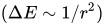
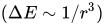
  • Linear Stark broadening occurs via the linear Stark effect, which results from the interaction of an emitter with an electric field of a charged particle at a distance , causing a shift in energy that is linear in the field strength.
  • Resonance broadening occurs when the perturbing particle is of the same type as the emitting particle, which introduces the possibility of an energy exchange process.
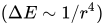
  • Quadratic Stark broadening occurs via the quadratic Stark effect, which results from the interaction of an emitter with an electric field, causing a shift in energy that is quadratic in the field strength.
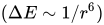
  • Van der Waals broadening occurs when the emitting particle is being perturbed by Van der Waals forces. For the quasistatic case, a Van der Waals profile is often useful in describing the profile. The energy shift as a function of distance between the interacting particles is given in the wings by e.g. the Lennard-Jones potential.

Inhomogeneous broadening

Inhomogeneous broadening is a general term for broadening because some emitting particles are in a different local environment from others, and therefore emit at a different frequency. This term is used especially for solids, where surfaces, grain boundaries, and stoichiometry variations can create a variety of local environments for a given atom to occupy. In liquids, the effects of inhomogeneous broadening is sometimes reduced by a process called motional narrowing.

Broadening due to non-local effects

Certain types of broadening are the result of conditions over a large region of space rather than simply upon conditions that are local to the emitting particle.

Opacity broadening

Opacity broadening is an example of a non-local broadening mechanism. Electromagnetic radiation emitted at a particular point in space can be reabsorbed as it travels through space. This absorption depends on wavelength. The line is broadened because the photons at the line center have a greater reabsorption probability than the photons at the line wings. Indeed, the reabsorption near the line center may be so great as to cause a self reversal in which the intensity at the center of the line is less than in the wings. This process is also sometimes called self-absorption.

Macroscopic Doppler broadening

Radiation emitted by a moving source is subject to Doppler shift due to a finite line-of-sight velocity projection. If different parts of the emitting body have different velocities (along the line of sight), the resulting line will be broadened, with the line width proportional to the width of the velocity distribution. For example, radiation emitted from a distant rotating body, such as a star, will be broadened due to the line-of-sight variations in velocity on opposite sides of the star (this effect usually referred to as rotational broadening). The greater the rate of rotation, the broader the line. Another example is an imploding plasma shell in a Z-pinch.

Combined effects

Each of these mechanisms can act in isolation or in combination with others. Assuming each effect is independent, the observed line profile is a convolution of the line profiles of each mechanism. For example, a combination of the thermal Doppler broadening and the impact pressure broadening yields a Voigt profile.

However, the different line broadening mechanisms are not always independent. For example, the collisional effects and the motional Doppler shifts can act in a coherent manner, resulting under some conditions even in a collisional narrowing, known as the Dicke effect.

Spectral lines of chemical elements

Absorption lines for air, under indirect illumination, so that the gas is not directly between source and detector. Here, Fraunhofer lines in sunlight and Rayleigh scattering of this sunlight is the "source." This is the spectrum of a blue sky somewhat close to the horizon, looking east with the sun to the west at around 3–4 pm on a clear day.

Bands

The phrase "spectral lines", when not qualified, usually refers to lines having wavelengths in the visible band of the full electromagnetic spectrum. Many spectral lines occur at wavelengths outside this range. At shorter wavelengths, which correspond to higher energies, ultraviolet spectral lines include the Lyman series of hydrogen. At the much shorter wavelengths of X-rays, the lines are known as characteristic X-rays because they remain largely unchanged for a given chemical element, independent of their chemical environment. Longer wavelengths correspond to lower energies, where the infrared spectral lines include the Paschen series of hydrogen. At even longer wavelengths, the radio spectrum includes the 21-cm line used to detect neutral hydrogen throughout the cosmos.

Epigenetics of anxiety and stress–related disorders

From Wikipedia, the free encyclopedia https://en.wikipedia.org/wiki/Epigenetics_of_anxiety_and_st...