Search This Blog

Thursday, November 13, 2025

Interplanetary dust cloud

From Wikipedia, the free encyclopedia
The interplanetary dust cloud illuminated and visible as zodiacal light, with its parts the false dawngegenschein and the rest of its band, which is visually crossed by the Milky Way, in this composite image of the night sky above the northern and southern hemisphere

The interplanetary dust cloud, or zodiacal cloud (as the source of the zodiacal light), consists of cosmic dust (small particles floating in outer space) that pervades the space between planets within planetary systems, such as the Solar System. This system of particles has been studied for many years in order to understand its nature, origin, and relationship to larger bodies. There are several methods to obtain space dust measurement.

In the Solar System, interplanetary dust particles have a role in scattering sunlight and in emitting thermal radiation, which is the most prominent feature of the night sky's radiation, with wavelengths ranging 5–50 μm. The particle sizes of grains characterizing the infrared emission near Earth's orbit typically range 10–100 μm. Microscopic impact craters on lunar rocks returned by the Apollo Program revealed the size distribution of cosmic dust particles bombarding the lunar surface. The ’’Grün’’ distribution of interplanetary dust at 1 AU, describes the flux of cosmic dust from nm to mm sizes at 1 AU.

The total mass of the interplanetary dust cloud is approximately 3.5×10¹⁶ kg, or the mass of an asteroid of radius 15 km (with density of about 2.5 g/cm3). Straddling the zodiac along the ecliptic, this dust cloud is visible as the zodiacal light in a moonless and naturally dark sky and is best seen sunward during astronomical twilight.

The Pioneer spacecraft observations in the 1970s linked the zodiacal light with the interplanetary dust cloud in the Solar System. Also, the VBSDC instrument on the New Horizons probe was designed to detect impacts of the dust from the zodiacal cloud in the Solar System.

Origin

Artist's concept of a view from an exoplanet, with light from an extrasolar interplanetary dust cloud

The sources of interplanetary dust particles (IDPs) include at least: asteroid collisions, cometary activity and collisions in the inner Solar System, Kuiper belt collisions, and interstellar medium grains (Backman, D., 1997). The origins of the zodiacal cloud have long been subject to one of the most heated controversies in the field of astronomy.

It was believed that IDPs had originated from comets or asteroids whose particles had dispersed throughout the extent of the cloud. However, further observations have suggested that Mars dust storms may be responsible for the zodiacal cloud's formation.

Life cycle of a particle

The main physical processes "affecting" (destruction or expulsion mechanisms) interplanetary dust particles are: expulsion by radiation pressure, inward Poynting-Robertson (PR) radiation drag, solar wind pressure (with significant electromagnetic effects), sublimation, mutual collisions, and the dynamical effects of planets (Backman, D., 1997).

The lifetimes of these dust particles are very short compared to the lifetime of the Solar System. If one finds grains around a star that is older than about 10,000,000 years, then the grains must have been from recently released fragments of larger objects, i.e. they cannot be leftover grains from the protoplanetary disk (Backman, private communication). Therefore, the grains would be "later-generation" dust. The zodiacal dust in the Solar System is 99.9% later-generation dust and 0.1% intruding interstellar medium dust. All primordial grains from the Solar System's formation were removed long ago.

Particles which are affected primarily by radiation pressure are known as "beta meteoroids". They are generally less than 1.4 × 10⁻¹² g and are pushed outward from the Sun into interstellar space.

Cloud structures

An image of a protoplanetary disk, comparable to images of simulations of the Solar System's interplanetary dust cloud, which has been suggested to be imaged from beyond it in the Outer Solar System.

The interplanetary dust cloud has a complex structure (Reach, W., 1997). Apart from a background density, this includes:

  • At least 8 dust trails—their source is thought to be short-period comets.
  • A number of dust bands, the sources of which are thought to be asteroid families in the main asteroid belt. The three strongest bands arise from the Themis family, the Koronis family, and the Eos family. Other source families include the Maria, Eunomia, and possibly the Vesta and/or Hygiea families (Reach et al. 1996).
  • At least 2 resonant dust rings are known (for example, the Earth-resonant dust ring, although every planet in the Solar System is thought to have a resonant ring with a "wake") (Jackson and Zook, 1988, 1992) (Dermott, S.F. et al., 1994, 1997)

Rings of dust

First ever panorama image of the dust ring of Venus's orbital space, imaged by Parker Solar Probe.

Interplanetary dust has been found to form rings of dust in the orbital space of Mercury and Venus. Venus's orbital dust ring is suspected to originate either from yet undetected Venus trailing asteroids, interplanetary dust migrating in waves from orbital space to orbital space, or from the remains of the Solar System's circumstellar disc, out of which its proto-planetary disc and then itself, the Solar planetary system, formed.

Dust collection on Earth

In 1951, Fred Whipple predicted that micrometeorites smaller than 100 micrometers in diameter might be decelerated on impact with the Earth's upper atmosphere without melting. The modern era of laboratory study of these particles began with the stratospheric collection flights of Donald E. Brownlee and collaborators in the 1970s using balloons and then U-2 aircraft.

Although some of the particles found were similar to the material in present-day meteorite collections, the nanoporous nature and unequilibrated cosmic-average composition of other particles suggested that they began as fine-grained aggregates of nonvolatile building blocks and cometary ice. The interplanetary nature of these particles was later verified by noble gas and solar flare track observations.

In that context a program for atmospheric collection and curation of these particles was developed at Johnson Space Center in Texas. This stratospheric micrometeorite collection, along with presolar grains from meteorites, are unique sources of extraterrestrial material (not to mention being small astronomical objects in their own right) available for study in laboratories today.

Experiments

Spacecraft that have carried dust detectors include Helios, Pioneer 10, Pioneer 11, Ulysses (heliocentric orbit out to the distance of Jupiter), Galileo (Jupiter Orbiter), Cassini (Saturn orbiter), and New Horizons (see Venetia Burney Student Dust Counter).

Obscuring effect

The Solar interplanetary dust cloud obscures the extragalactic background light, making observations of it from the Inner Solar System very limited.

Major Review Collections

Collections of review articles on various aspects of interplanetary dust and related fields appeared in the following books:

In 1978 Tony McDonnell edited the book Cosmic Dust which contained chapters on comets along with zodiacal light as indicator of interplanetary dust, meteors, interstellar dust, microparticle studies by sampling techniques, and microparticle studies by space instrumentation. Attention is also given to lunar and planetary impact erosion, aspects of particle dynamics, and acceleration techniques and high-velocity impact processes employed for the laboratory simulation of effects produced by micrometeoroids.

2001 Eberhard Grün, Bo Gustafson, Stan Dermott, and Hugo Fechtig published the book Interplanetary Dust. Topics covered are: historical perspectives; cometary dust; near-Earth environment; meteoroids and meteors; properties of interplanetary dust, information from collected samples; in situ measurements of cosmic dust; numerical modeling of the Zodiacal Cloud structure; synthesis of observations; instrumentation; physical processes; optical properties of interplanetary dust; orbital evolution of interplanetary dust; circumplanetary dust, observations and simple physics; interstellar dust and circumstellar dust disks.

2019 Rafael Rodrigo, Jürgen Blum, Hsiang-Wen Hsu, Detlef V. Koschny, Anny-Chantal Levasseur-Regourd, Jesús Martín-Pintado, Veerle J. Sterken, and Andrew Westphal collected reviews in the book Cosmic Dust from the Laboratory to the Stars. Included are discussions of dust in various environments: from planetary atmospheres and airless bodies over interplanetary dust, meteoroids, comet dust and emissions from active moons to interstellar dust and protoplanetary disks. Diverse research techniques and results, including in-situ measurement, remote observation, laboratory experiments and modelling, and analysis of returned samples are discussed.

Astroparticle physics

From Wikipedia, the free encyclopedia

Astroparticle physics, also called particle astrophysics, is a branch of particle physics that studies elementary particles of astrophysical origin and their relation to astrophysics and cosmology. It is a relatively new field of research emerging at the intersection of particle physics, astronomy, astrophysics, detector physics, relativity, solid state physics, and cosmology. Partly motivated by the discovery of neutrino oscillation, the field has undergone rapid development, both theoretically and experimentally, since the early 2000s.

History

The field of astroparticle physics is evolved out of optical astronomy. With the growth of detector technology came the more mature astrophysics, which involved multiple physics subtopics, such as mechanics, electrodynamics, thermodynamics, plasma physics, nuclear physics, relativity, and particle physics. Particle physicists found astrophysics necessary due to difficulty in producing particles with comparable energy to those found in space. For example, the cosmic ray spectrum contains particles with energies as high as 1020 eV, where a proton–proton collision at the Large Hadron Collider occurs at an energy of ~1012 eV.

The field can be said to have begun in 1910, when a German physicist named Theodor Wulf measured the ionization in the air, an indicator of gamma radiation, at the bottom and top of the Eiffel Tower. He found that there was far more ionization at the top than what was expected if only terrestrial sources were attributed for this radiation.

The Austrian physicist Victor Francis Hess hypothesized that some of the ionization was caused by radiation from the sky. In order to defend this hypothesis, Hess designed instruments capable of operating at high altitudes and performed observations on ionization up to an altitude of 5.3 km. From 1911 to 1913, Hess made ten flights to meticulously measure ionization levels. Through prior calculations, he did not expect there to be any ionization above an altitude of 500 m if terrestrial sources were the sole cause of radiation. His measurements however, revealed that although the ionization levels initially decreased with altitude, they began to sharply rise at some point. At the peaks of his flights, he found that the ionization levels were much greater than at the surface. Hess was then able to conclude that "a radiation of very high penetrating power enters our atmosphere from above". Furthermore, one of Hess's flights was during a near-total eclipse of the Sun. Since he did not observe a dip in ionization levels, Hess reasoned that the source had to be further away in space. For this discovery, Hess was one of the people awarded the Nobel Prize in Physics in 1936. In 1925, Robert Millikan confirmed Hess's findings and subsequently coined the term 'cosmic rays'.

Many physicists knowledgeable about the origins of the field of astroparticle physics prefer to attribute this 'discovery' of cosmic rays by Hess as the starting point for the field.

Topics of research

While it may be difficult to decide on a standard 'textbook' description of the field of astroparticle physics, the field can be characterized by the topics of research that are actively being pursued. The journal Astroparticle Physics accepts papers that are focused on new developments in the following areas:

  • High-energy cosmic-ray physics and astrophysics;
  • Particle cosmology;
  • Particle astrophysics;
  • Related astrophysics: supernova, active galactic nuclei, cosmic abundances, dark matter etc.;
  • High-energy, VHE and UHE gamma-ray astronomy;
  • High- and low-energy neutrino astronomy;
  • Instrumentation and detector developments related to the above-mentioned fields.

Open questions

One main task for the future of the field is simply to thoroughly define itself beyond working definitions and clearly differentiate itself from astrophysics and other related topics.

Current unsolved problems for the field of astroparticle physics include characterization of dark matter and dark energy. Observations of the orbital velocities of stars in the Milky Way and other galaxies starting with Walter Baade and Fritz Zwicky in the 1930s, along with observed velocities of galaxies in galactic clusters, found motion far exceeding the energy density of the visible matter needed to account for their dynamics. Since the early nineties some candidates have been found to partially explain some of the missing dark matter, but they are nowhere near sufficient to offer a full explanation. The finding of an accelerating universe suggests that a large part of the missing dark matter is stored as dark energy in a dynamical vacuum.

Another question for astroparticle physicists is why is there so much more matter than antimatter in the universe today. Baryogenesis is the term for the hypothetical processes that produced the unequal numbers of baryons and antibaryons in the early universe, which is why the universe is made of matter today, and not antimatter.

Experimental facilities

The rapid development of this field has led to the design of new types of infrastructure. In underground laboratories or with specially designed telescopes, antennas and satellite experiments, astroparticle physicists employ new detection methods to observe a wide range of cosmic particles including neutrinos, gamma rays and cosmic rays at the highest energies. They are also searching for dark matter and gravitational waves. Experimental particle physicists are limited by the technology of their terrestrial accelerators, which are only able to produce a small fraction of the energies found in nature.

The following is an incomplete list of laboratories and experiments in astroparticle physics.

Underground laboratories

These facilities are located deep underground, to shield very sensitive experiments from cosmic rays that would otherwise preclude the observation of very rare phenomena.

Neutrino detectors

Very large neutrino detectors are required to record the extremely rare interactions of neutrinos with atomic matter.

  • IceCube (Antarctica). The largest particle detector in the world, was completed in December 2010. The purpose of the detector is to investigate high energy neutrinos, search for dark matter, observe supernovae explosions, and search for exotic particles such as magnetic monopoles.
  • ANTARES (Toulon, France). A Neutrino detector 2.5 km under the Mediterranean Sea off the coast of Toulon, France. Designed to locate and observe neutrino flux in the direction of the southern hemisphere.
  • NESTOR Project (Pylos, Greece). The target of the international collaboration is the deployment of a neutrino telescope on the sea floor off of Pylos, Greece.
  • BOREXINO, a real-time detector, installed at LNGS, designed to detect neutrinos from the Sun with an organic liquid scintillator target.

Dark matter detectors

Experiments are dedicated to the direct detection of dark matter interactions with the detector target material.

Cosmic ray observatories

Interested in high-energy cosmic ray detection are:

  • Pierre Auger Observatory (Malargüe, Argentina) detects and investigates high energy cosmic rays using two techniques. One is to study the particles interactions with water placed in surface detector tanks. The other technique is to track the development of air showers through observation of ultraviolet light emitted high in the Earth's atmosphere.
  • Telescope Array Project (Delta, Utah), an experiment for the detection of ultra high energy cosmic rays (UHECRs) using a ground array and fluorescence techniques in the desert of west Utah.

Normal order

From Wikipedia, the free encyclopedia

In quantum field theory a product of quantum fields, or equivalently their creation and annihilation operators, is usually said to be normal ordered (also called Wick order) when all creation operators are to the left of all annihilation operators in the product. The process of putting a product into normal order is called normal ordering (also called Wick ordering). The terms antinormal order and antinormal ordering are analogously defined, where the annihilation operators are placed to the left of the creation operators.

Normal ordering of a product of quantum fields or creation and annihilation operators can also be defined in many other ways. Which definition is most appropriate depends on the expectation values needed for a given calculation. Most of this article uses the most common definition of normal ordering as given above, which is appropriate when taking expectation values using the vacuum state of the creation and annihilation operators.

The process of normal ordering is particularly important for a quantum mechanical Hamiltonian. When quantizing a classical Hamiltonian there is some freedom when choosing the operator order, and these choices lead to differences in the ground state energy. That's why the process can also be used to eliminate the infinite vacuum energy of a quantum field.

Notation

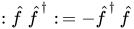
If denotes an arbitrary product of creation and/or annihilation operators (or equivalently, quantum fields), then the normal ordered form of is denoted by .

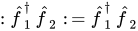
An alternative notation is .

Note that normal ordering is a concept that only makes sense for products of operators. Attempting to apply normal ordering to a sum of operators is not useful as normal ordering is not a linear operation.

Bosons

Bosons are particles which satisfy Bose–Einstein statistics. We will now examine the normal ordering of bosonic creation and annihilation operator products.

Single bosons

If we start with only one type of boson there are two operators of interest:

  • : the boson's creation operator.
  • : the boson's annihilation operator.

These satisfy the commutator relationship

where denotes the commutator. We may rewrite the last one as:

Examples

1. We'll consider the simplest case first. This is the normal ordering of :

The expression has not been changed because it is already in normal order - the creation operator is already to the left of the annihilation operator .

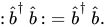
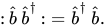
2. A more interesting example is the normal ordering of :

Here the normal ordering operation has reordered the terms by placing to the left of .

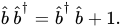
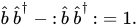
These two results can be combined with the commutation relation obeyed by and to get

or

This equation is used in defining the contractions used in Wick's theorem.

3. An example with multiple operators is:

4. A simple example shows that normal ordering cannot be extended by linearity from the monomials to all operators in a self-consistent way. Assume that we can apply the commutation relations to obtain:

Then, by linearity,

a contradiction.

The implication is that normal ordering is not a linear function on operators, but on the free algebra generated by the operators, i.e. the operators do not satisfy the canonical commutation relations while inside the normal ordering (or any other ordering operator like time-ordering, etc).

Multiple bosons

If we now consider different bosons there are operators:

  • : the boson's creation operator.
  • : the boson's annihilation operator.

Here .

These satisfy the commutation relations:

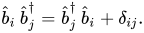
where and denotes the Kronecker delta.

These may be rewritten as:

Examples

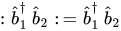
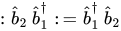
1. For two different bosons () we have

2. For three different bosons () we have

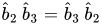
Notice that since (by the commutation relations) the order in which we write the annihilation operators does not matter.

Bosonic operator functions

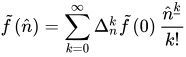
Normal ordering of bosonic operator functions , with occupation number operator , can be accomplished using (falling) factorial powers and Newton series instead of Taylor series: It is easy to show  that factorial powers are equal to normal-ordered (raw) powers and are therefore normal ordered by construction,

such that the Newton series expansion

of an operator function , with -th forward difference at , is always normal ordered. Here, the eigenvalue equation relates and .

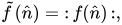
As a consequence, the normal-ordered Taylor series of an arbitrary function is equal to the Newton series of an associated function , fulfilling

if the series coefficients of the Taylor series of , with continuous , match the coefficients of the Newton series of , with integer ,

with -th partial derivative at . The functions and are related through the so-called normal-order transform according to

which can be expressed in terms of the Mellin transform , see for details.

Fermions

Fermions are particles which satisfy Fermi–Dirac statistics. We will now examine the normal ordering of fermionic creation and annihilation operator products.

Single fermions

For a single fermion there are two operators of interest:

  • : the fermion's creation operator.
  • : the fermion's annihilation operator.

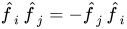
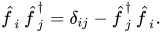
These satisfy the anticommutator relationships

where denotes the anticommutator. These may be rewritten as

To define the normal ordering of a product of fermionic creation and annihilation operators we must take into account the number of interchanges between neighbouring operators. We get a minus sign for each such interchange.

Examples

1. We again start with the simplest cases:

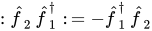
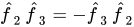
This expression is already in normal order so nothing is changed. In the reverse case, we introduce a minus sign because we have to change the order of two operators:

These can be combined, along with the anticommutation relations, to show

or

This equation, which is in the same form as the bosonic case above, is used in defining the contractions used in Wick's theorem.

2. The normal order of any more complicated cases gives zero because there will be at least one creation or annihilation operator appearing twice. For example:

Multiple fermions

For different fermions there are operators:

  • : the fermion's creation operator.
  • : the fermion's annihilation operator.

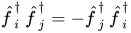
Here .

These satisfy the anti-commutation relations:

where and denotes the Kronecker delta.

These may be rewritten as:

When calculating the normal order of products of fermion operators we must take into account the number of interchanges of neighbouring operators required to rearrange the expression. It is as if we pretend the creation and annihilation operators anticommute and then we reorder the expression to ensure the creation operators are on the left and the annihilation operators are on the right - all the time taking account of the anticommutation relations.

Examples

1. For two different fermions () we have

Here the expression is already normal ordered so nothing changes.

Here we introduce a minus sign because we have interchanged the order of two operators.

Note that the order in which we write the operators here, unlike in the bosonic case, does matter.

2. For three different fermions () we have

Notice that since (by the anticommutation relations) the order in which we write the operators does matter in this case.

Similarly we have

Uses in quantum field theory

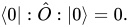
The vacuum expectation value of a normal ordered product of creation and annihilation operators is zero. This is because, denoting the vacuum state by , the creation and annihilation operators satisfy

(here and are creation and annihilation operators (either bosonic or fermionic)).

Let denote a non-empty product of creation and annihilation operators. Although this may satisfy

we have

Normal ordered operators are particularly useful when defining a quantum mechanical Hamiltonian. If the Hamiltonian of a theory is in normal order then the ground state energy will be zero: .

Free fields

With two free fields φ and χ,

where is again the vacuum state. Each of the two terms on the right hand side typically blows up in the limit as y approaches x but the difference between them has a well-defined limit. This allows us to define :φ(x)χ(x):.

Wick's theorem

Wick's theorem states the relationship between the time ordered product of fields and a sum of normal ordered products. This may be expressed for even as

where the summation is over all the distinct ways in which one may pair up fields. The result for odd looks the same except for the last line which reads

This theorem provides a simple method for computing vacuum expectation values of time ordered products of operators and was the motivation behind the introduction of normal ordering.

Alternative definitions

The most general definition of normal ordering involves splitting all quantum fields into two parts (for example see Evans and Steer 1996) . In a product of fields, the fields are split into the two parts and the parts are moved so as to be always to the left of all the parts. In the usual case considered in the rest of the article, the contains only creation operators, while the contains only annihilation operators. As this is a mathematical identity, one can split fields in any way one likes. However, for this to be a useful procedure one demands that the normal ordered product of any combination of fields has zero expectation value

It is also important for practical calculations that all the commutators (anti-commutator for fermionic fields) of all and are all c-numbers. These two properties means that we can apply Wick's theorem in the usual way, turning expectation values of time-ordered products of fields into products of c-number pairs, the contractions. In this generalised setting, the contraction is defined to be the difference between the time-ordered product and the normal ordered product of a pair of fields.

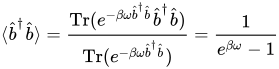
The simplest example is found in the context of thermal quantum field theory (Evans and Steer 1996). In this case the expectation values of interest are statistical ensembles, traces over all states weighted by . For instance, for a single bosonic quantum harmonic oscillator we have that the thermal expectation value of the number operator is simply the Bose–Einstein distribution

So here the number operator is normal ordered in the usual sense used in the rest of the article yet its thermal expectation values are non-zero. Applying Wick's theorem and doing calculation with the usual normal ordering in this thermal context is possible but computationally impractical. The solution is to define a different ordering, such that the and are linear combinations of the original annihilation and creations operators. The combinations are chosen to ensure that the thermal expectation values of normal ordered products are always zero so the split chosen will depend on the temperature.

Supramolecular chemistry

From Wikipedia, the free encyclopedia https://en.wikipedia.org/wiki/Sup...