The mathematics of general relativity is complicated. In Newton's theories of motion, an object's length and the rate at which time passes remain constant while the object accelerates, meaning that many problems in Newtonian mechanics may be solved by algebra alone. In relativity, however, an object's length and the rate at which time passes both change appreciably as the object's speed approaches the speed of light,
meaning that more variables and more complicated mathematics are
required to calculate the object's motion. As a result, relativity
requires the use of concepts such as vectors, tensors, pseudotensors and curvilinear coordinates.
In mathematics, physics, and engineering, a Euclidean vector (sometimes called a geometric vector or spatial vector, or – as here – simply a vector) is a geometric object that has both a magnitude (or length) and direction. A vector is what is needed to "carry" the point A to the point B; the Latin word vector means "one who carries". The magnitude of the vector is the distance between the two points and
the direction refers to the direction of displacement from A to B. Many algebraic operations on real numbers such as addition, subtraction, multiplication, and negation have close analogues for vectors, operations which obey the familiar algebraic laws of commutativity, associativity, and distributivity.
Tensors
Stress
is a second-order tensor that represents the response of a material to
force applied at an angle. The two directions of the tensor represent
the "normal" (at right angles to the surface) force, and "shear"
(parallel to the surface) force.
A tensor extends the concept of a vector to additional directions. A scalar,
that is, a simple number without a direction, would be shown on a graph
as a point, a zero-dimensional object. A vector, which has a magnitude
and direction, would appear on a graph as a line, which is a
one-dimensional object. A vector is a first-order tensor, since it holds
one direction.
A second-order tensor has two magnitudes and two directions, and would
appear on a graph as two lines similar to the hands of a clock. The
"order" of a tensor is the number of directions contained within, which
is separate from the dimensions of the individual directions. A
second-order tensor in two dimensions might be represented
mathematically by a 2-by-2 matrix, and in three dimensions by a 3-by-3
matrix, but in both cases the matrix is "square" for a second-order
tensor. A third-order tensor has three magnitudes and directions, and
would be represented by a cube of numbers, 3-by-3-by-3 for directions in
three dimensions, and so on.
Applications
Vectors
are fundamental in the physical sciences. They can be used to
represent any quantity that has both a magnitude and direction, such as velocity, the magnitude of which is speed. For example, the velocity 5 meters per second upward could be represented by the vector (0, 5) (in 2 dimensions with the positive y axis as 'up'). Another quantity represented by a vector is force, since it has a magnitude and direction. Vectors also describe many other physical quantities, such as displacement, acceleration, momentum, and angular momentum. Other physical vectors, such as the electric and magnetic field, are represented as a system of vectors at each point of a physical space; that is, a vector field.
Tensors also have extensive applications in physics:
Diffusion tensors, the basis of diffusion tensor imaging, represent rates of diffusion in biologic environments
Dimensions
In general relativity, four-dimensional vectors, or four-vectors,
are required. These four dimensions are length, height, width and time.
A "point" in this context would be an event, as it has both a location
and a time. Similar to vectors, tensors in relativity require four
dimensions. One example is the Riemann curvature tensor.
Coordinate transformation
A vector v, is shown with two coordinate grids, ex and er.
In space, there is no clear coordinate grid to use. This means that the
coordinate system changes based on the location and orientation of the
observer. Observer ex and er in this image are facing different directions.
Here we see that ex and er see the vector differently. The direction of the vector is the same. But to ex, the vector is moving to its left. To er, the vector is moving to its right.
In physics, as well as mathematics, a vector is often identified with a tuple, or list of numbers, which depend on a coordinate system or reference frame.
If the coordinates are transformed, such as by rotation or stretching
the coordinate system, the components of the vector also transform. The
vector itself does not change, but the reference frame does. This means
that the components of the vector have to change to compensate.
The vector is called covariant or contravariant depending on how the transformation of the vector's components is related to the transformation of coordinates.
Contravariant vectors have units of distance (such as a
displacement) or distance times some other unit (such as velocity or
acceleration) and transform in the opposite way as the coordinate
system. For example, in changing units from meters to millimeters the
coordinate units get smaller, but the numbers in a vector become larger:
1 m becomes 1000 mm.
Covariant vectors, on the other hand, have units of one-over-distance (as in a gradient)
and transform in the same way as the coordinate system. For example, in
changing from meters to millimeters, the coordinate units become
smaller and the number measuring a gradient will also become smaller:
1 Kelvin per m becomes 0.001 Kelvin per mm.
In Einstein notation, contravariant vectors and components of tensors are shown with superscripts, e.g. xi, and covariant vectors and components of tensors with subscripts, e.g. xi. Indices are "raised" or "lowered" by multiplication by an appropriate matrix, often the identity matrix.
Coordinate transformation is important because relativity states
that there is not one reference point (or perspective) in the universe
that is more favored than another. On earth, we use dimensions like
north, east, and elevation, which are used throughout the entire planet.
There is no such system for space. Without a clear reference grid, it
becomes more accurate to describe the four dimensions as towards/away,
left/right, up/down and past/future. As an example event, assume that
Earth is a motionless object, and consider the signing of the Declaration of Independence. To a modern observer on Mount Rainier
looking east, the event is ahead, to the right, below, and in the past.
However, to an observer in medieval England looking north, the event is
behind, to the left, neither up nor down, and in the future. The event
itself has not changed: the location of the observer has.
Oblique axes
An oblique coordinate system is one in which the axes are not necessarily orthogonal to each other; that is, they meet at angles other than right angles.
When using coordinate transformations as described above, the new
coordinate system will often appear to have oblique axes compared to the
old system.
A nontensor is a tensor-like quantity that behaves like a tensor in
the raising and lowering of indices, but that does not transform like a
tensor under a coordinate transformation. For example, Christoffel symbols cannot be tensors themselves if the coordinates do not change in a linear way.
In general relativity, one cannot describe the energy and
momentum of the gravitational field by an energy–momentum tensor.
Instead, one introduces objects that behave as tensors only with respect
to restricted coordinate transformations. Strictly speaking, such
objects are not tensors at all. A famous example of such a pseudotensor
is the Landau–Lifshitz pseudotensor.
Curvilinear coordinates and curved spacetime
High-precision test of general relativity by the Cassini space probe (artist's impression): radio signals sent between the Earth and the probe (green wave) are delayed by the warping of space and time (blue lines) due to the Sun's
mass. That is, the Sun's mass causes the regular grid coordinate system
(in blue) to distort and have curvature. The radio wave then follows
this curvature and moves toward the Sun.
Curvilinear coordinates
are coordinates in which the angles between axes can change from point
to point. This means that rather than having a grid of straight lines,
the grid instead has curvature.
A good example of this is the surface of the Earth. While maps
frequently portray north, south, east and west as a simple square grid,
that is not in fact the case. Instead, the longitude lines running north
and south are curved and meet at the north pole. This is because the
Earth is not flat, but instead round.
In general relativity, energy and mass have curvature effects on
the four dimensions of the universe (= spacetime). This curvature gives
rise to the gravitational force. A common analogy is placing a heavy
object on a stretched out rubber sheet, causing the sheet to bend
downward. This curves the coordinate system around the object, much like
an object in the universe curves the coordinate system it sits in. The
mathematics here are conceptually more complex than on Earth, as it
results in four dimensions of curved coordinates instead of three as used to describe a curved 2D surface.
Example: Parallel displacement along a circle of a three-dimensional ball embedded in two dimensions. The circle of radius r is embedded in a two-dimensional space characterized by the coordinates z1 and z2. The circle itself is characterized by coordinates y1 and y2 in the two-dimensional space. The circle itself is one-dimensional and can be characterized by its arc length x. The coordinate y is related to the coordinate x through the relation y1 = r cos x/r and y2 = r sin x/r. This gives ∂y1/∂x = −sin x/r and ∂y2/∂x = cos x/r In this case the metric is a scalar and is given by g = cos2x/r + sin2x/r = 1. The interval is then ds2 = g dx2 = dx2. The interval is just equal to the arc length as expected.
The interval in a high-dimensional space
In a Euclidean space,
the separation between two points is measured by the distance between
the two points. The distance is purely spatial, and is always positive.
In spacetime, the separation between two events is measured by the invariant interval
between the two events, which takes into account not only the spatial
separation between the events, but also their separation in time. The
interval, s2, between two events is defined as:
(spacetime interval),
where c is the speed of light, and Δr and Δt denote differences of the space and time coordinates, respectively, between the events. The choice of signs for s2 above follows the space-like convention (−+++). A notation like Δr2 means (Δr)2. The reason s2 and not s is called the interval is that s2 can be positive, zero or negative.
Spacetime intervals may be classified into three distinct types, based on whether the temporal separation (c2Δt2) or the spatial separation (Δr2) of the two events is greater: time-like, light-like or space-like.
Certain types of world lines are called geodesics
of the spacetime – straight lines in the case of flat Minkowski
spacetime and their closest equivalent in the curved spacetime of
general relativity. In the case of purely time-like paths, geodesics are
(locally) the paths of greatest separation (spacetime interval) as
measured along the path between two events, whereas in Euclidean space
and Riemannian manifolds, geodesics are paths of shortest distance
between two points. The concept of geodesics becomes central in general relativity, since geodesic motion may be thought of as "pure motion" (inertial motion) in spacetime, that is, free from any external influences.
The covariant derivative is a generalization of the directional
derivative from vector calculus. As with the directional derivative, the
covariant derivative is a rule, which takes as its inputs: (1) a
vector, u, (along which the derivative is taken) defined at a point P, and (2) a vector field, v, defined in a neighborhood of P. The output is a vector, also at the point P.
The primary difference from the usual directional derivative is that
the covariant derivative must, in a certain precise sense, be
independent of the manner in which it is expressed in a coordinate
system.
Parallel transport
Given the covariant derivative, one can define the parallel transport of a vector v at a point P along a curve γ starting at P. For each point x of γ, the parallel transport of v at x will be a function of x, and can be written as v(x), where v(0) = v. The function v is determined by the requirement that the covariant derivative of v(x) along γ is 0. This is similar to the fact that a constant function is one whose derivative is constantly 0.
The equation for the covariant derivative can be written in terms of
Christoffel symbols. The Christoffel symbols find frequent use in
Einstein's theory of general relativity, where spacetime is represented by a curved 4-dimensional Lorentz manifold with a Levi-Civita connection. The Einstein field equations – which determine the geometry of spacetime in the presence of matter – contain the Ricci tensor.
Since the Ricci tensor is derived from the Riemann curvature tensor,
which can be written in terms of Christoffel symbols, a calculation of
the Christoffel symbols is essential. Once the geometry is determined,
the paths of particles and light beams are calculated by solving the geodesic equations in which the Christoffel symbols explicitly appear.
In general relativity, a geodesic generalizes the notion of a "straight line" to curved spacetime. Importantly, the world line
of a particle free from all external, non-gravitational force, is a
particular type of geodesic. In other words, a freely moving or falling
particle always moves along a geodesic.
In general relativity, gravity can be regarded as not a force but
a consequence of a curved spacetime geometry where the source of
curvature is the stress–energy tensor
(representing matter, for instance). Thus, for example, the path of a
planet orbiting around a star is the projection of a geodesic of the
curved 4-dimensional spacetime geometry around the star onto
3-dimensional space.
The Riemann curvature tensorRρσμν tells us, mathematically, how much curvature there is in any given region of space. In flat space this tensor is zero.
Contracting the tensor produces 2 more mathematical objects:
The Ricci tensor: Rσν,
comes from the need in Einstein's theory for a curvature tensor with
only 2 indices. It is obtained by averaging certain portions of the
Riemann curvature tensor.
The scalar curvature: R,
the simplest measure of curvature, assigns a single scalar value to
each point in a space. It is obtained by averaging the Ricci tensor.
The Riemann curvature tensor can be expressed in terms of the covariant derivative.
Contravariant components of the stress–energy tensor
The stress–energy tensor (sometimes stress–energy–momentum tensor or energy–momentum tensor) is a tensor quantity in physics that describes the density and flux of energy and momentum in spacetime, generalizing the stress tensor of Newtonian physics. It is an attribute of matter, radiation, and non-gravitational force fields. The stress–energy tensor is the source of the gravitational field in the Einstein field equations of general relativity, just as mass density is the source of such a field in Newtonian gravity.
Because this tensor has 2 indices (see next section) the Riemann
curvature tensor has to be contracted into the Ricci tensor, also with 2
indices.
This implies that the curvature of space (represented by the
Einstein tensor) is directly connected to the presence of matter and
energy (represented by the stress–energy tensor).
In Einstein's theory of general relativity, the Schwarzschild metric (also Schwarzschild vacuum or Schwarzschild solution), is a solution to the Einstein field equations which describes the gravitational field outside a spherical mass, on the assumption that the electric charge of the mass, the angular momentum of the mass, and the universal cosmological constant are all zero. The solution is a useful approximation for describing slowly rotating astronomical objects such as many stars and planets, including Earth and the Sun. The solution is named after Karl Schwarzschild, who first published the solution in 1916, just before his death.
The term secular religion is often applied today to communal belief systems—as for example with the view of love as the postmodern secular religion. Paul Vitz applied the term to modern psychology in as much as it fosters a cult of the self, explicitly calling "the self-theory ethic ... this secular religion". Sport has also been considered as a new secular religion, particularly with respect to Olympism. For Pierre de Coubertin, founder of the modern Olympic Games, belief in them as a new secular religion was explicit and lifelong.
Political religion
The theory of political religion concerns governmental ideologies whose cultural and political backing is so strong that they are said to attain power equivalent to those of a state religion, with which they often exhibit significant similarities in both theory and practice. In addition to basic forms of politics, like parliament and elections, it also holds an aspect of "sacralization" related to the institutions contained within the regime and also
provides the inner measures traditionally considered to be religious
territory, such as ethics, values, symbols, myths, rituals, archetypes and for example a national liturgical calendar.
Political religious organizations, such as the National Socialist
and Communist Parties, adhered to the idealization of cultural and
political power over the country at large. The church body of the state
no longer held control over the practices of religious identity. Because
of this, National Socialism was countered by many political and
religious organizations as being a political religion, based on the
dominance which the National Socialist regime had (Gates and Steane). Political religions generally vie with existing traditional religions,
and may try to replace or eradicate them. The term was given new
attention by the political scientist Hans Maier.
The term is sometimes treated as synonymous with civil religion, but although some scholars use the terms equivalently, others see a
useful distinction, using "civil religion" as something weaker, which
functions more as a socially unifying and essentially conservative
force, whereas a political religion is radically transformational, even apocalyptic.
Overview
The term political religion
is based on the observation that sometimes political ideologies or
political systems display features more commonly associated with religion. Scholars who have studied these phenomena include William Connolly in political science, Christoph Deutschmann in sociology, Emilio Gentile in history, Oliver O'Donovan in theology and others in psychology.
A political religion often occupies the same ethical, psychological and
sociological space as a traditional religion, and as a result it often
displaces or co-opts existing religious organizations and beliefs. The
most central marker of a political religion involves the sacralization of politics, for example an overwhelming religious feeling when serving one's country, or the devotion towards the Founding Fathers of the United States.Although a political religion may co-opt existing religious structures or symbolism, it does not itself have any independent spiritual or theocratic
elements—it is essentially secular, using religious motifs and methods
for political purposes, if it does not reject religious faith outright. Typically, a political religion is considered to be secular, but more radical forms of it are also transcendental.
Origin of the theory
The 18th-century philosopher Jean-Jacques Rousseau
(1712–1778) argued that all societies need a religion to hold men
together. Because Christianity tended to pull men away from earthly
matters, Rousseau advocated a "civil religion" that would create the
links necessary for political unity around the state. The Swiss
Protestant theologian Adolf Keller (1872–1963) argued that Marxism in the Soviet Union had been transformed into a secular religion. Before emigrating to the United States, the German-born political philosopher Eric Voegelin wrote a book entitled The political religions. Other contributions on "political religion" (or associated terms such
as "secular religion", "lay religion" or "public religion") were made by
Luigi Sturzo (1871–1959), Paul Tillich (1886–1965), Gerhard Leibholz (1901–1982), Waldemar Gurian (1902–1954), Raymond Aron (1905–1983) and Walter Benjamin (1892–1940). Some saw such "religions" as a response to the existential void and nihilism caused by modernity, mass society
and the rise of a bureaucratic state, and in political religions "the
rebellion against the religion of God" reached its climax. They also described them as "pseudo-religions", "substitute religions",
"surrogate religions", "religions manipulated by man" and
"anti-religions". Yale political scientist Juan Linz
and others have noted that the secularization of the twentieth century
had created a void which could be filled by an ideology claiming a hold
on ethical and identical matters as well, making the political religions
based on totalitarianism, universalism and messianic missions (such as Manifest Destiny) possible.
Suppression of religious beliefs
Political religions sometimes compete with existing religions, and try, if possible, to replace or eradicate them. Loyalty to other entities, such as a church or a deity, are often
viewed as interfering with loyalty to the political religion. The
authority of religious leaders also presents a threat to the authority
of the political religion. As a result, some or all religious sects may
be suppressed or banned. An existing sect may be converted into a state religion, but dogma and personnel may be modified to suit the needs of the party or state.
Juan Linz has posited the friendly form of separation of church and state
as the counterpole of political religion but describes the hostile form
of separation of church and state as moving toward political religion
as found in totalitarianism.
Absolute loyalty
Loyalty
to the state or political party and acceptance of the government/party
ideology are paramount. Dissenters may be expelled, ostracized,
discriminated against, imprisoned, "re-educated", or killed. Loyalty oaths
or membership in a dominant (or sole) political party may be required
for employment, obtaining government services, or simply as routine.
Criticism of the government may be a serious crime. Enforcement can
range from ostracism by one's neighbours to execution. In a political
religion, you are either with the system or against it.
A political religion often elevates its leaders to near-godlike
status. Displays of leaders in the form of posters or statues may be
mandated in public areas and even private homes. Children may be
required to learn the state's version of the leaders' biographies in
school.
Myths of origin
Political religions often rely on a myth of origin
that may have some historical basis but is usually idealized and
sacralized. Current leaders may be venerated as descendants of the
original fathers. There may also be holy places or shrines that relate
to the myth of origin.
Revolutionary France was well noted for being the first state to reject religion altogether. Radicals intended to replace Christianity with a new state religion, or a deistic ideology. Maximilien Robespierre rejected atheistic ideologies and intended to create a new religion. Churches were closed, and Catholic Mass was forbidden. The Cult of the Supreme Being was well known for its derided festival, which led to the Thermidorian reaction and the fall of Robespierre.
According to Emilio Gentile, "Fascism was the first and prime instance of a modern political religion." "This religion sacralized the state and assigned it the primary
educational task of transforming the mentality, the character, and the
customs of Italians. The aim was to create a 'new man', a believer in and an observing member of the cult of Fascism."
"The argument [that fascism was a 'political religion'] tends to
involve three main claims: I) that fascism was characterized by a
religious form, particularly in terms of language and ritual; II) that
fascism was a sacralized form of totalitarianism, which legitimized
violence in defence of the nation and regeneration of a fascist 'new
man'; and III) that fascism took on many of the functions of religion
for a broad swathe of society."
"Among committed [Nazi] believers, a mythic world of eternally strong
heroes, demons, fire and sword—in a word, the fantasy world of the
nursery—displaced reality." Heinrich Himmler was fascinated by the occult, and sought to turn the SS into the basis of an official state cult.
In 1936 a Protestant priest referred explicitly to communism as a new secular religion. A couple of years later, on the eve of World War II, F. A. Voigt characterised both Marxism and National Socialism as secular religions, akin at a fundamental level in their authoritarianism and messianic beliefs as well as in their eschatological view of human History. Both, he considered, were waging religious war against the liberal enquiring mind of the European heritage.
After the war, the social philosopher Raymond Aron would expand on the exploration of communism in terms of a secular religion; while A. J. P. Taylor, for example, would characterise it as "a great secular religion....the Communist Manifesto must be counted as a holy book in the same class as the Bible".
Klaus-Georg Riegel argued that "Lenin's utopian design of a
revolutionary community of virtuosi as a typical political religion of
an intelligentsia longing for an inner-worldly salvation, a socialist
paradise without exploitation and alienation, to be implanted in the
Russian backward society at the outskirts of the industrialised and
modernised Western Europe."
Reconciliation of general relativity with the laws of quantum physics remains a problem, however, as no self-consistent theory of quantum gravity has been found. It is not yet known how gravity can be unified with the three non-gravitational interactions: strong, weak and electromagnetic.
Widely acknowledged as a theory of extraordinary beauty, general relativity has often been described as the most beautiful of all existing physical theories.
Henri Poincaré's
1905 theory of the dynamics of the electron was a relativistic theory
which he applied to all forces, including gravity. While others thought
that gravity was instantaneous or of electromagnetic origin, he
suggested that relativity was "something due to our methods of
measurement". In his theory, he showed that gravitational waves propagate at the speed of light. Soon afterwards, Einstein started thinking about how to incorporate gravity into his relativistic framework. In 1907, beginning with a simple thought experiment
involving an observer in free fall (FFO), he embarked on what would be
an eight-year search for a relativistic theory of gravity. After
numerous detours and false starts, his work culminated in the
presentation to the Prussian Academy of Science
in November 1915 of what are known as the Einstein field equations,
which form the core of Einstein's general theory of relativity. These equations specify how the geometry of space and time is influenced by whatever matter and radiation are present. A version of non-Euclidean geometry, called Riemannian geometry,
enabled Einstein to develop general relativity by providing the key
mathematical framework on which he fit his physical ideas of gravity. This idea was pointed out by mathematician Marcel Grossmann and published by Grossmann and Einstein in 1913.
The Einstein field equations are nonlinear
and are considered difficult to solve. Einstein used approximation
methods in working out initial predictions of the theory. But in 1916,
the astrophysicist Karl Schwarzschild found the first non-trivial exact solution to the Einstein field equations, the Schwarzschild metric.
This solution laid the groundwork for the description of the final
stages of gravitational collapse, and the objects known today as black
holes. In the same year, the first steps towards generalizing
Schwarzschild's solution to electrically charged objects were taken, eventually resulting in the Reissner–Nordström solution, which is associated with electrically charged black holes. In 1917, Einstein applied his theory to the universe
as a whole, initiating the field of relativistic cosmology. In line
with contemporary thinking, he assumed a static universe, adding a new
parameter to his original field equations—the cosmological constant—to match that observational presumption. By 1929, however, the work of Hubble
and others had shown that the universe is expanding. This is readily
described by the expanding cosmological solutions found by Friedmann in 1922, which do not require a cosmological constant. Lemaître used these solutions to formulate the earliest version of the Big Bang models, in which the universe has evolved from an extremely hot and dense earlier state. Einstein later declared the cosmological constant the biggest blunder of his life.
During that period, general relativity remained something of a curiosity among physical theories. It was clearly superior to Newtonian gravity,
being consistent with special relativity and accounting for several
effects unexplained by the Newtonian theory. Einstein showed in 1915 how
his theory explained the anomalous perihelion advance of the planet Mercury without any arbitrary parameters ("fudge factors"), and in 1919 an expedition led by Eddington confirmed general relativity's prediction for the deflection of starlight by the Sun during the total solar eclipse of 29 May 1919, instantly making Einstein famous. Yet the theory remained outside the mainstream of theoretical physics and astrophysics until developments between approximately 1960 and 1975 known as the golden age of general relativity. Physicists began to understand the concept of a black hole, and to identify quasars as one of these objects' astrophysical manifestations. Ever more precise solar system tests confirmed the theory's predictive power,[17] and relativistic cosmology also became amenable to direct observational tests.[18]
General relativity has acquired a reputation as a theory of extraordinary beauty.[2][19][20]Subrahmanyan Chandrasekhar has noted that at multiple levels, general relativity exhibits what Francis Bacon has termed a "strangeness in the proportion" (i.e. elements that excite wonderment and surprise). It juxtaposes fundamental concepts (space and time versus
matter and motion) which had previously been considered as entirely
independent. Chandrasekhar also noted that Einstein's only guides in his
search for an exact theory were the principle of equivalence and his
sense that a proper description of gravity should be geometrical at its
basis, so that there was an "element of revelation" in the manner in
which Einstein arrived at his theory. Other elements of beauty associated with the general theory of
relativity are its simplicity and symmetry, the manner in which it
incorporates invariance and unification, and its perfect logical
consistency.
In the preface to Relativity: The Special and the General Theory,
Einstein said "The present book is intended, as far as possible, to
give an exact insight into the theory of Relativity to those readers
who, from a general scientific and philosophical point of view, are
interested in the theory, but who are not conversant with the
mathematical apparatus of theoretical physics. The work presumes a
standard of education corresponding to that of a university
matriculation examination, and, despite the shortness of the book, a
fair amount of patience and force of will on the part of the reader. The
author has spared himself no pains in his endeavour to present the main
ideas in the simplest and most intelligible form, and on the whole, in
the sequence and connection in which they actually originated."
From classical mechanics to general relativity
General
relativity can be understood by examining its similarities with and
departures from classical physics. The first step is the realization
that classical mechanics and Newton's law of gravity admit a geometric
description. The combination of this description with the laws of
special relativity results in a heuristic derivation of general relativity.
Geometry of Newtonian gravity
According
to general relativity, objects in a gravitational field behave
similarly to objects within an accelerating enclosure. For example, an
observer will see a ball fall the same way in a rocket (left) as it does
on Earth (right), provided that the acceleration of the rocket is equal
to 9.8 m/s2 (the acceleration due to gravity on the surface of the Earth).
At the base of classical mechanics is the notion that a body's motion can be described as a combination of free (or inertial)
motion, and deviations from this free motion. Such deviations are
caused by external forces acting on a body in accordance with Newton's
second law of motion, which states that the net force acting on a body is equal to that body's (inertial) mass multiplied by its acceleration. The preferred inertial motions are related to the geometry of space and time: in the standard reference frames
of classical mechanics, objects in free motion move along straight
lines at constant speed. In modern parlance, their paths are geodesics, straight world lines in curved spacetime.
Conversely, one might expect that inertial motions, once
identified by observing the actual motions of bodies and making
allowances for the external forces (such as electromagnetism or friction), can be used to define the geometry of space, as well as a time coordinate.
However, there is an ambiguity once gravity comes into play. According
to Newton's law of gravity, and independently verified by experiments
such as that of Eötvös and its successors (see Eötvös experiment), there is a universality of free fall (also known as the weak equivalence principle, or the universal equality of inertial and passive-gravitational mass): the trajectory of a test body in free fall depends only on its position and initial speed, but not on any of its material properties. A simplified version of this is embodied in Einstein's elevator experiment,
illustrated in the figure on the right: for an observer in an enclosed
room, it is impossible to decide, by mapping the trajectory of bodies
such as a dropped ball, whether the room is stationary in a
gravitational field and the ball accelerating, or in free space aboard a
rocket that is accelerating at a rate equal to that of the
gravitational field versus the ball which upon release has nil
acceleration.
Given the universality of free fall, there is no observable
distinction between inertial motion and motion under the influence of
the gravitational force. This suggests the definition of a new class of
inertial motion, namely that of objects in free fall under the influence
of gravity. This new class of preferred motions, too, defines a
geometry of space and time—in mathematical terms, it is the geodesic
motion associated with a specific connection which depends on the gradient of the gravitational potential. Space, in this construction, still has the ordinary Euclidean geometry. However, spacetime
as a whole is more complicated. As can be shown using simple thought
experiments following the free-fall trajectories of different test
particles, the result of transporting spacetime vectors that can denote a
particle's velocity (time-like vectors) will vary with the particle's
trajectory; mathematically speaking, the Newtonian connection is not integrable. From this, one can deduce that spacetime is curved. The resulting Newton–Cartan theory is a geometric formulation of Newtonian gravity using only covariant concepts, i.e. a description which is valid in any desired coordinate system. In this geometric description, tidal effects—the
relative acceleration of bodies in free fall—are related to the
derivative of the connection, showing how the modified geometry is
caused by the presence of mass.
As intriguing as geometric Newtonian gravity may be, its basis, classical mechanics, is merely a limiting case of (special) relativistic mechanics. In the language of symmetry: where gravity can be neglected, physics is Lorentz invariant as in special relativity rather than Galilei invariant as in classical mechanics. (The defining symmetry of special relativity is the Poincaré group,
which includes translations, rotations, boosts and reflections.) The
differences between the two become significant when dealing with speeds
approaching the speed of light, and with high-energy phenomena.
With Lorentz symmetry, additional structures come into play. They
are defined by the set of light cones (see image). The light-cones
define a causal structure: for each eventA, there is a set of events that can, in principle, either influence or be influenced by A via signals or interactions that do not need to travel faster than light (such as event B in the image), and a set of events for which such an influence is impossible (such as event C in the image). These sets are observer-independent. In conjunction with the world-lines of freely falling particles, the
light-cones can be used to reconstruct the spacetime's semi-Riemannian
metric, at least up to a positive scalar factor. In mathematical terms,
this defines a conformal structure or conformal geometry.
Special relativity is defined in the absence of gravity. For
practical applications, it is a suitable model whenever gravity can be
neglected. Bringing gravity into play, and assuming the universality of
free fall motion, an analogous reasoning as in the previous section
applies: there are no global inertial frames.
Instead there are approximate inertial frames moving alongside freely
falling particles. Translated into the language of spacetime: the
straight time-like
lines that define a gravity-free inertial frame are deformed to lines
that are curved relative to each other, suggesting that the inclusion of
gravity necessitates a change in spacetime geometry.
A priori, it is not clear whether the new local frames in free
fall coincide with the reference frames in which the laws of special
relativity hold—that theory is based on the propagation of light, and
thus on electromagnetism, which could have a different set of preferred frames.
But using different assumptions about the special-relativistic frames
(such as their being earth-fixed, or in free fall), one can derive
different predictions for the gravitational redshift, that is, the way
in which the frequency of light shifts as the light propagates through a
gravitational field (cf. below).
The actual measurements show that free-falling frames are the ones in
which light propagates as it does in special relativity. The generalization of this statement, namely that the laws of special
relativity hold to good approximation in freely falling (and
non-rotating) reference frames, is known as the Einstein equivalence principle, a crucial guiding principle for generalizing special-relativistic physics to include gravity.
The same experimental data shows that time as measured by clocks in a gravitational field—proper time,
to give the technical term—does not follow the rules of special
relativity. In the language of spacetime geometry, it is not measured by
the Minkowski metric.
As in the Newtonian case, this is suggestive of a more general
geometry. At small scales, all reference frames that are in free fall
are equivalent, and approximately Minkowskian. Consequently, we are
dealing with a curved generalization of Minkowski space. The metric tensor
that defines the geometry—in particular, how lengths and angles are
measured—is not the Minkowski metric of special relativity, it is a
generalization known as a semi- or pseudo-Riemannian metric. Furthermore, each Riemannian metric is naturally associated with one particular kind of connection, the Levi-Civita connection,
and this is, in fact, the connection that satisfies the equivalence
principle and makes space locally Minkowskian (that is, in suitable locally inertial coordinates, the metric is Minkowskian, and its first partial derivatives and the connection coefficients vanish).
Having formulated the relativistic, geometric version of the effects
of gravity, the question of gravity's source remains. In Newtonian
gravity, the source is mass. In special relativity, mass turns out to be
part of a more general quantity called the stress–energy tensor, which includes both energy and momentum densities as well as stress: pressure and shear. Using the equivalence principle, this tensor is readily generalized to
curved spacetime. Drawing further upon the analogy with geometric
Newtonian gravity, it is natural to assume that the field equation for gravity relates this tensor and the Ricci tensor,
which describes a particular class of tidal effects: the change in
volume for a small cloud of test particles that are initially at rest,
and then fall freely. In special relativity, conservation of energy–momentum corresponds to the statement that the stress–energy tensor is divergence-free. This formula, too, is readily generalized to curved spacetime by replacing partial derivatives with their curved-manifold counterparts, covariant derivatives
studied in differential geometry. With this additional condition—the
covariant divergence of the stress–energy tensor, and hence of whatever
is on the other side of the equation, is zero—the simplest nontrivial
set of equations are what are called Einstein's (field) equations:
Einstein's field equations
On the left-hand side is the Einstein tensor, , which is symmetric and a specific divergence-free combination of the Ricci tensor and the metric. In particular,
is the curvature scalar. The Ricci tensor itself is related to the more general Riemann curvature tensor as
On the right-hand side, is a constant and is the stress–energy tensor. All tensors are written in abstract index notation. Matching the theory's prediction to observational results for planetaryorbits or, equivalently, assuring that the weak-gravity, low-speed limit is Newtonian mechanics, the proportionality constant is found to be , where is the Newtonian constant of gravitation and the speed of light in vacuum. When there is no matter present, so that the stress–energy tensor vanishes, the results are the vacuum Einstein equations,
In general relativity, the world line
of a particle free from all external, non-gravitational force is a
particular type of geodesic in curved spacetime. In other words, a
freely moving or falling particle always moves along a geodesic.
where is a scalar parameter of motion (e.g. the proper time), and are Christoffel symbols (sometimes called the affine connection coefficients or Levi-Civita connection coefficients) which is symmetric in the two lower indices. Greek indices may take the values: 0, 1, 2, 3 and the summation convention is used for repeated indices and . The quantity on the left-hand-side of this equation is the acceleration of a particle, and so this equation is analogous to Newton's laws of motion which likewise provide formulae for the acceleration of a particle. This equation of motion employs the Einstein notation,
meaning that repeated indices are summed (i.e. from zero to three). The
Christoffel symbols are functions of the four spacetime coordinates,
and so are independent of the velocity or acceleration or other
characteristics of a test particle whose motion is described by the geodesic equation.
where L is the angular momentum. The first term represents the force of Newtonian gravity, which is described by the inverse-square law. The second term represents the centrifugal force in the circular motion. The third term represents the relativistic effect.
The derivation outlined in the previous section contains all the
information needed to define general relativity, describe its key
properties, and address a question of crucial importance in physics,
namely how the theory can be used for model-building.
Definition and basic properties
General relativity is a metric theory of gravitation. At its core are Einstein's equations, which describe the relation between the geometry of a four-dimensional pseudo-Riemannian manifold representing spacetime, and the distribution of energy, momentum and stress contained in that spacetime. Phenomena that in classical mechanics are ascribed to the action of the force of gravity (such as free-fall, orbital motion, and spacecrafttrajectories),
correspond to inertial motion within a curved geometry of spacetime in
general relativity; there is no gravitational force deflecting objects
from their natural, straight paths. Instead, gravity corresponds to
changes in the properties of space and time, which in turn changes the
straightest-possible paths that objects will naturally follow. The curvature is, in turn, caused by the stress–energy of matter. Paraphrasing the relativist John Archibald Wheeler, spacetime tells matter how to move; matter tells spacetime how to curve.
While general relativity replaces the scalar gravitational potential of classical physics by a symmetric rank-two tensor, the latter reduces to the former in certain limiting cases. For weak gravitational fields and low speed relative to the speed of light, the theory's predictions converge on those of Newton's law of universal gravitation.
As it is constructed using tensors, general relativity exhibits general covariance: its laws—and further laws formulated within the general relativistic framework—take on the same form in all coordinate systems. Furthermore, the theory does not contain any invariant geometric background structures, i.e. it is background-independent. It thus satisfies a more stringent general principle of relativity, namely that the laws of physics are the same for all observers. Locally, as expressed in the equivalence principle, spacetime is Minkowskian, and the laws of physics exhibit local Lorentz invariance.
Model-building
The core concept of general-relativistic model-building is that of a solution of Einstein's equations.
Given both Einstein's equations and suitable equations for the
properties of matter, such a solution consists of a specific semi-Riemannian manifold
(usually defined by giving the metric in specific coordinates), and
specific matter fields defined on that manifold. Matter and geometry
must satisfy Einstein's equations, so in particular, the matter's
stress–energy tensor must be divergence-free. The matter must, of
course, also satisfy whatever additional equations were imposed on its
properties. In short, such a solution is a model universe that satisfies
the laws of general relativity, and possibly additional laws governing
whatever matter might be present.
Einstein's equations are nonlinear partial differential equations and, as such, difficult to solve exactly. Nevertheless, a number of exact solutions are known, although only a few have direct physical applications. The best-known exact solutions, and also those most interesting from a physics point of view, are the Schwarzschild solution, the Reissner–Nordström solution and the Kerr metric, each corresponding to a certain type of black hole in an otherwise empty universe, and the Friedmann–Lemaître–Robertson–Walker and de Sitter universes, each describing an expanding cosmos. Exact solutions of great theoretical interest include the Gödel universe (which opens up the intriguing possibility of time travel in curved spacetimes), the Taub–NUT solution (a model universe that is homogeneous, but anisotropic), and anti-de Sitter space (which has recently come to prominence in the context of what is called the Maldacena conjecture).
Given the difficulty of finding exact solutions, Einstein's field equations are also solved frequently by numerical integration on a computer, or by considering small perturbations of exact solutions. In the field of numerical relativity,
powerful computers are employed to simulate the geometry of spacetime
and to solve Einstein's equations for interesting situations such as two
colliding black holes. In principle, such methods may be applied to any system, given
sufficient computer resources, and may address fundamental questions
such as naked singularities. Approximate solutions may also be found by perturbation theories such as linearized gravity and its generalization, the post-Newtonian expansion,
both of which were developed by Einstein. The latter provides a
systematic approach to solving for the geometry of a spacetime that
contains a distribution of matter that moves slowly compared with the
speed of light. The expansion involves a series of terms; the first
terms represent Newtonian gravity, whereas the later terms represent
ever smaller corrections to Newton's theory due to general relativity. An extension of this expansion is the parametrized post-Newtonian (PPN)
formalism, which allows quantitative comparisons between the
predictions of general relativity and alternative theories.
Consequences of Einstein's theory
General
relativity has a number of physical consequences. Some follow directly
from the theory's axioms, whereas others have become clear only in the
course of many years of research that followed Einstein's initial
publication.
Schematic representation of the gravitational redshift of a light wave escaping from the surface of a massive body
Assuming that the equivalence principle holds, gravity influences the passage of time. Light sent down into a gravity well is blueshifted, whereas light sent in the opposite direction (i.e., climbing out of the gravity well) is redshifted;
collectively, these two effects are known as the gravitational
frequency shift. More generally, processes close to a massive body run
more slowly when compared with processes taking place farther away; this
effect is known as gravitational time dilation.
Gravitational redshift has been measured in the laboratory and using astronomical observations. Gravitational time dilation in the Earth's gravitational field has been measured numerous times using atomic clocks, while ongoing validation is provided as a side effect of the operation of the Global Positioning System (GPS). Tests in stronger gravitational fields are provided by the observation of binary pulsars. All results are in agreement with general relativity. However, at the existing level of accuracy, these observations cannot
distinguish between general relativity and other theories in which the
equivalence principle is valid.
Deflection of light (sent out from the location shown in blue) near a compact body (shown in gray)
General relativity predicts that the path of light will follow the
curvature of spacetime as it passes near a massive object. This effect
was initially confirmed by observing the light of stars or distant
quasars being deflected as it passes the Sun.
This and related predictions follow from the fact that light follows what is called a light-like or null geodesic—a
generalization of the straight lines along which light travels in
classical physics. Such geodesics are the generalization of the invariance of lightspeed in special relativity. As one examines suitable model spacetimes (either the exterior
Schwarzschild solution or, for more than a single mass, the
post-Newtonian expansion), several effects of gravity on light propagation emerge. Although the
bending of light can also be derived by extending the universality of
free fall to light, the angle of deflection resulting from such calculations is only half the value given by general relativity.
Closely related to light deflection is the Shapiro time delay,
the phenomenon that light signals take longer to move through a
gravitational field than they would in the absence of that field. There
have been numerous successful tests of this prediction. In the parameterized post-Newtonian formalism (PPN), measurements of both the deflection of light and the gravitational time delay determine a parameter called γ, which encodes the influence of gravity on the geometry of space.
Ring of test particles deformed by a passing (linearized, amplified for better visibility) gravitational wave
Predicted in 1916 by Albert Einstein, there are gravitational waves: ripples in the
metric of spacetime that propagate at the speed of light. These are one
of several analogies between weak-field gravity and electromagnetism in
that, they are analogous to electromagnetic waves. On 11 February 2016, the Advanced LIGO team announced that they had directly detected gravitational waves from a pair of black holes merging.
The simplest type of such a wave can be visualized by its action
on a ring of freely floating particles. A sine wave propagating through
such a ring towards the reader distorts the ring in a characteristic,
rhythmic fashion (animated image to the right). Since Einstein's equations are non-linear, arbitrarily strong gravitational waves do not obey linear superposition,
making their description difficult. However, linear approximations of
gravitational waves are sufficiently accurate to describe the
exceedingly weak waves that are expected to arrive here on Earth from
far-off cosmic events, which typically result in relative distances
increasing and decreasing by 10−21 or less. Data analysis methods routinely make use of the fact that these linearized waves can be Fourier decomposed.
Some exact solutions describe gravitational waves without any approximation, e.g., a wave train traveling through empty space or Gowdy universes, varieties of an expanding cosmos filled with gravitational waves. But for gravitational waves produced in astrophysically relevant
situations, such as the merger of two black holes, numerical methods are
the only way to construct appropriate models.
General relativity differs from classical mechanics in a number of
predictions concerning orbiting bodies. It predicts an overall rotation (precession)
of planetary orbits, as well as orbital decay caused by the emission of
gravitational waves and effects related to the relativity of direction.
Precession of apsides
Newtonian (red) vs. Einsteinian orbit (blue) of a lone planet orbiting a star. The influence of other planets is ignored.
In general relativity, the apsides of any orbit (the point of the orbiting body's closest approach to the system's center of mass) will precess; the orbit is not an ellipse, but akin to an ellipse that rotates on its focus, resulting in a rose curve-like
shape (see image). Einstein first derived this result by using an
approximate metric representing the Newtonian limit and treating the
orbiting body as a test particle.
For him, the fact that his theory gave a straightforward explanation of
Mercury's anomalous perihelion shift, discovered earlier by Urbain Le Verrier in 1859, was important evidence that he had at last identified the correct form of the gravitational field equations.
The effect can also be derived by using either the exact Schwarzschild metric (describing spacetime around a spherical mass) or the much more general post-Newtonian formalism. It is due to the influence of gravity on the geometry of space and to the contribution of self-energy to a body's gravity (encoded in the nonlinearity of Einstein's equations). Relativistic precession has been observed for all planets that allow
for accurate precession measurements (Mercury, Venus, and Earth), as well as in binary pulsar systems, where it is larger by five orders of magnitude.
In general relativity the perihelion shift , expressed in radians per revolution, is approximately given by:
Orbital decay for PSR J0737−3039: time shift, tracked over 16 years (2021).
According to general relativity, a binary system
will emit gravitational waves, thereby losing energy. Due to this loss,
the distance between the two orbiting bodies decreases, and so does
their orbital period. Within the Solar System or for ordinary double stars, the effect is too small to be observable. This is not the case for a close binary pulsar, a system of two orbiting neutron stars, one of which is a pulsar:
from the pulsar, observers on Earth receive a regular series of radio
pulses that can serve as a highly accurate clock, which allows precise
measurements of the orbital period. Because neutron stars are immensely
compact, significant amounts of energy are emitted in the form of
gravitational radiation.
The first observation of a decrease in orbital period due to the emission of gravitational waves was made by Hulse and Taylor, using the binary pulsar PSR1913+16
they had discovered in 1974. This was the first detection of
gravitational waves, albeit indirect, for which they were awarded the
1993 Nobel Prize in physics. Since then, several other binary pulsars have been found, in particular the double pulsar PSR J0737−3039, where both stars are pulsars and which was last reported to also be in agreement with general relativity in 2021 after 16 years of observations.
Several relativistic effects are directly related to the relativity of direction. One is geodetic precession: the axis direction of a gyroscope
in free fall in curved spacetime will change when compared, for
instance, with the direction of light received from distant stars—even
though such a gyroscope represents the way of keeping a direction as
stable as possible ("parallel transport"). For the Moon–Earth system, this effect has been measured with the help of lunar laser ranging. More recently, it has been measured for test masses aboard the satellite Gravity Probe B to a precision of better than 0.3%.
Near a rotating mass, there are gravitomagnetic or frame-dragging effects. A distant observer will determine that objects close to the mass get "dragged around". This is most extreme for rotating black holes where, for any object entering a zone known as the ergosphere, rotation is inevitable. Such effects can again be tested through their influence on the orientation of gyroscopes in free fall. Somewhat controversial tests have been performed using the LAGEOS satellites, confirming the relativistic prediction. Also the Mars Global Surveyor probe around Mars has been used.
Einstein cross: four images of the same astronomical object, produced by a gravitational lens
The deflection of light by gravity is responsible for a new class of
astronomical phenomena. If a massive object is situated between the
astronomer and a distant target object with appropriate mass and
relative distances, the astronomer will see multiple distorted images of
the target. Such effects are known as gravitational lensing. Depending on the configuration, scale, and mass distribution, there can be two or more images, a bright ring known as an Einstein ring, or partial rings called arcs. The earliest example was discovered in 1979; since then, more than a hundred gravitational lenses have been observed. Even if the multiple images are too close to each other to be resolved,
the effect can still be measured, e.g., as an overall brightening of
the target object; a number of such "microlensing events" have been observed.
Gravitational lensing has developed into a tool of observational astronomy. It is used to detect the presence and distribution of dark matter, provide a "natural telescope" for observing distant galaxies, and to obtain an independent estimate of the Hubble constant. Statistical evaluations of lensing data provide valuable insight into the structural evolution of galaxies.
Artist's impression of the space-borne gravitational wave detector LISA
Observations of binary pulsars provide strong indirect evidence for the existence of gravitational waves (see Orbital decay, above). Detection of these waves is a major goal of contemporary relativity-related research. Several land-based gravitational wave detectors are in operation, for example the interferometric detectorsGEO 600, LIGO (two detectors), TAMA 300 and VIRGO. Various pulsar timing arrays are using millisecond pulsars to detect gravitational waves in the 10−9 to 10−6hertz frequency range, which originate from binary supermassive blackholes. A European space-based detector, eLISA / NGO, is under development, with a precursor mission (LISA Pathfinder) having launched in December 2015.
Observations of gravitational waves promise to complement observations in the electromagnetic spectrum. They are expected to yield information about black holes and other
dense objects such as neutron stars and white dwarfs, about certain
kinds of supernova implosions, and about processes in the very early universe, including the signature of certain types of hypothetical cosmic string. In February 2016, the Advanced LIGO team announced that they had detected gravitational waves from a black hole merger.
Simulation
based on the equations of general relativity: a star collapsing to form
a black hole while emitting gravitational waves
Whenever the ratio of an object's mass to its radius becomes
sufficiently large, general relativity predicts the formation of a black
hole, a region of space from which nothing, not even light, can escape.
In the accepted models of stellar evolution, neutron stars of around 1.4 solar masses,
and stellar black holes with a few to a few dozen solar masses, are
thought to be the final state for the evolution of massive stars. Usually a galaxy has one supermassive black hole with a few million to a few billion solar masses in its center, and its presence is thought to have played an important role in the formation of the galaxy and larger cosmic structures.
Astronomically, the most important property of compact objects is
that they provide a supremely efficient mechanism for converting
gravitational energy into electromagnetic radiation. Accretion,
the falling of dust or gaseous matter onto stellar or supermassive
black holes, is thought to be responsible for some spectacularly
luminous astronomical objects, especially diverse kinds of active
galactic nuclei on galactic scales and stellar-size objects such as
microquasars. In particular, accretion can lead to relativistic jets, focused beams of highly energetic particles that are being flung into space at almost light speed. General relativity plays a central role in modelling all these phenomena, and observations provide strong evidence for the existence of black holes with the properties predicted by the theory.
Black holes are also sought-after targets in the search for gravitational waves (cf. section § Gravitational waves, above). Merging black hole binaries
should lead to some of the strongest gravitational wave signals
reaching detectors on Earth, and the phase directly before the merger
("chirp") could be used as a "standard candle" to deduce the distance to the merger events–and hence serve as a probe of cosmic expansion at large distances. The gravitational waves produced as a stellar black hole plunges into a
supermassive one should provide direct information about the
supermassive black hole's geometry.
This
blue horseshoe is a distant galaxy that has been magnified and warped
into a nearly complete ring by the strong gravitational pull of the
massive foreground luminous red galaxy.
The existing models of cosmology are based on Einstein's field equations, which include the cosmological constant since it has important influence on the large-scale dynamics of the cosmos,
where is the spacetime metric. Isotropic and homogeneous solutions of these enhanced equations, the Friedmann–Lemaître–Robertson–Walker solutions, allow physicists to model a universe that has evolved over the past 14 billion years from a hot, early Big Bang phase. Once a small number of parameters (for example the universe's mean matter density) have been fixed by astronomical observation, further observational data can be used to put the models to the test. Predictions, all successful, include the initial abundance of chemical elements formed in a period of primordial nucleosynthesis, the large-scale structure of the universe, and the existence and properties of a "thermal echo" from the early cosmos, the cosmic background radiation.
Astronomical observations of the cosmological expansion rate
allow the total amount of matter in the universe to be estimated,
although the nature of that matter remains mysterious in part. About 90%
of all matter appears to be dark matter, which has mass (or,
equivalently, gravitational influence), but does not interact
electromagnetically and, hence, cannot be observed directly. There is no generally accepted description of this new kind of matter, within the framework of known particle physics or otherwise. Observational evidence from redshift surveys of distant supernovae and
measurements of the cosmic background radiation also show that the
evolution of the universe is significantly influenced by a cosmological
constant resulting in an acceleration of cosmic expansion or,
equivalently, by a form of energy with an unusual equation of state, known as dark energy, the nature of which remains unclear.
An inflationary phase, an additional phase of strongly accelerated expansion at cosmic times of around 10−33
seconds, was hypothesized in 1980 to account for several puzzling
observations that were unexplained by classical cosmological models,
such as the nearly perfect homogeneity of the cosmic background
radiation. Recent measurements of the cosmic background radiation have resulted in the first evidence for this scenario. However, there are a bewildering variety of possible inflationary
scenarios, which cannot be restricted by existing observations. An even larger question is the physics of the earliest universe, prior
to the inflationary phase and close to where the classical models
predict the big bang singularity. An authoritative answer would require a complete theory of quantum gravity, which has not yet been developed (cf. the section on quantum gravity, below).
Exotic solutions: time travel, warp drives
Kurt Gödel showed that solutions to Einstein's equations exist that contain closed timelike curves
(CTCs), which allow for loops in time. The solutions require extreme
physical conditions unlikely ever to occur in practice, and it remains
an open question whether further laws of physics will eliminate them
completely. Since then, other—similarly impractical—GR solutions
containing CTCs have been found, such as the Tipler cylinder and traversable wormholes. Stephen Hawking introduced chronology protection conjecture, which is an assumption beyond those of standard general relativity to prevent time travel.
The spacetime symmetry group for special relativity is the Poincaré group,
which is a ten-dimensional group of three Lorentz boosts, three
rotations, and four spacetime translations. It is logical to ask what
symmetries, if any, might apply in General Relativity. A tractable case
might be to consider the symmetries of spacetime as seen by observers
located far away from all sources of the gravitational field. The naive
expectation for asymptotically flat spacetime symmetries might be simply
to extend and reproduce the symmetries of flat spacetime of special
relativity, viz., the Poincaré group.
In 1962 Hermann Bondi, M. G. van der Burg, A. W. Metzner and Rainer K. Sachs addressed this asymptotic symmetry problem in order to investigate the flow of energy at infinity due to propagating gravitational waves.
Their first step was to decide on some physically sensible boundary
conditions to place on the gravitational field at light-like infinity to
characterize what it means to say a metric is asymptotically flat,
making no a priori assumptions about the nature of the asymptotic
symmetry group—not even the assumption that such a group exists. Then
after designing what they considered to be the most sensible boundary
conditions, they investigated the nature of the resulting asymptotic
symmetry transformations that leave invariant the form of the boundary
conditions appropriate for asymptotically flat gravitational fields.
What they found was that the asymptotic symmetry transformations
actually do form a group and the structure of this group does not depend
on the particular gravitational field that happens to be present. This
means that, as expected, one can separate the kinematics of spacetime
from the dynamics of the gravitational field at least at spatial
infinity. The puzzling surprise in 1962 was their discovery of a rich
infinite-dimensional group (the so-called BMS group) as the asymptotic
symmetry group, instead of the finite-dimensional Poincaré group, which
is a subgroup of the BMS group. Not only are the Lorentz transformations
asymptotic symmetry transformations, there are also additional
transformations that are not Lorentz transformations but are asymptotic
symmetry transformations. In fact, they found an additional infinity of
transformation generators known as supertranslations. This implies the conclusion that General Relativity (GR) does not
reduce to special relativity in the case of weak fields at long
distances. It turns out that the BMS symmetry, suitably modified, could
be seen as a restatement of the universal soft graviton theorem in quantum field theory (QFT), which relates universal infrared (soft) QFT with GR asymptotic spacetime symmetries.
In general relativity, no material body can catch up with or overtake a light pulse. No influence from an event A can reach any other location X before light sent out at A to X. In consequence, an exploration of all light worldlines (null geodesics) yields key information about the spacetime's causal structure. This structure can be displayed using Penrose–Carter diagrams in which infinitely large regions of space and infinite time intervals are shrunk ("compactified") so as to fit onto a finite map, while light still travels along diagonals as in standard spacetime diagrams.
Aware of the importance of causal structure, Roger Penrose and others developed what is known as global geometry.
In global geometry, the object of study is not one particular solution
(or family of solutions) to Einstein's equations. Rather, relations that
hold true for all geodesics, such as the Raychaudhuri equation, and additional non-specific assumptions about the nature of matter (usually in the form of energy conditions) are used to derive general results.
Using global geometry, some spacetimes can be shown to contain boundaries called horizons,
which demarcate one region from the rest of spacetime. The best-known
examples are black holes: if mass is compressed into a sufficiently
compact region of space (as specified in the hoop conjecture, the relevant length scale is the Schwarzschild radius),
no light from inside can escape to the outside. Since no object can
overtake a light pulse, all interior matter is imprisoned as well.
Passage from the exterior to the interior is still possible, showing
that the boundary, the black hole's horizon, is not a physical barrier.
The ergosphere of a rotating black hole, which plays a key role when it comes to extracting energy from such a black hole
Early studies of black holes relied on explicit solutions of
Einstein's equations, notably the spherically symmetric Schwarzschild
solution (used to describe a static black hole) and the axisymmetric Kerr solution (used to describe a rotating, stationary
black hole, and introducing interesting features such as the
ergosphere). Using global geometry, later studies have revealed more
general properties of black holes. With time they become rather simple
objects characterized by eleven parameters specifying: electric charge,
mass–energy, linear momentum, angular momentum, and location at a specified time. This is stated by the black hole uniqueness theorem:
"black holes have no hair", that is, no distinguishing marks like the
hairstyles of humans. Irrespective of the complexity of a gravitating
object collapsing to form a black hole, the object that results (having
emitted gravitational waves) is very simple.
Even more remarkably, there is a general set of laws known as black hole mechanics, which is analogous to the laws of thermodynamics.
For instance, by the second law of black hole mechanics, the area of
the event horizon of a general black hole will never decrease with time,
analogous to the entropy
of a thermodynamic system. This limits the energy that can be extracted
by classical means from a rotating black hole (e.g. by the Penrose process). There is strong evidence that the laws of black hole mechanics are, in
fact, a subset of the laws of thermodynamics, and that the black hole
area is proportional to its entropy. This leads to a modification of the original laws of black hole
mechanics: for instance, as the second law of black hole mechanics
becomes part of the second law of thermodynamics, it is possible for the
black hole area to decrease as long as other processes ensure that
entropy increases overall. As thermodynamical objects with nonzero
temperature, black holes should emit thermal radiation. Semiclassical calculations indicate that indeed they do, with the surface gravity playing the role of temperature in Planck's law. This radiation is known as Hawking radiation (cf. the quantum theory section, below).
There are many other types of horizons. In an expanding universe,
an observer may find that some regions of the past cannot be observed
("particle horizon"), and some regions of the future cannot be influenced (event horizon). Even in flat Minkowski space, when described by an accelerated observer (Rindler space), there will be horizons associated with a semiclassical radiation known as Unruh radiation.
Another general feature of general relativity is the appearance of
spacetime boundaries known as singularities. Spacetime can be explored
by following up on timelike and lightlike geodesics—all possible ways
that light and particles in free fall can travel. But some solutions of
Einstein's equations have "ragged edges"—regions known as spacetime singularities,
where the paths of light and falling particles come to an abrupt end,
and geometry becomes ill-defined. In the more interesting cases, these
are "curvature singularities", where geometrical quantities
characterizing spacetime curvature, such as the Ricci scalar, take on infinite values. Well-known examples of spacetimes with future singularities—where
worldlines end—are the Schwarzschild solution, which describes a
singularity inside an eternal static black hole, or the Kerr solution with its ring-shaped singularity inside an eternal rotating black hole. The Friedmann–Lemaître–Robertson–Walker solutions and other spacetimes
describing universes have past singularities on which worldlines begin,
namely Big Bang singularities, and some have future singularities (Big Crunch) as well.
Given that these examples are all highly symmetric—and thus
simplified—it is tempting to conclude that the occurrence of
singularities is an artifact of idealization. The famous singularity theorems,
proved using the methods of global geometry, say otherwise:
singularities are a generic feature of general relativity, and
unavoidable once the collapse of an object with realistic matter
properties has proceeded beyond a certain stage and also at the beginning of a wide class of expanding universes. However, the theorems say little about the properties of singularities,
and much of current research is devoted to characterizing these
entities' generic structure (hypothesized e.g. by the BKL conjecture). The cosmic censorship hypothesis
states that all realistic future singularities (no perfect symmetries,
matter with realistic properties) are safely hidden away behind a
horizon, and thus invisible to all distant observers. While no formal
proof yet exists, numerical simulations offer supporting evidence of its
validity.
Each solution of Einstein's equation encompasses the whole history of
a universe—it is not just some snapshot of how things are, but a whole,
possibly matter-filled, spacetime. It describes the state of matter and
geometry everywhere and at every moment in that particular universe.
Due to its general covariance, Einstein's theory is not sufficient by
itself to determine the time evolution of the metric tensor. It must be combined with a coordinate condition, which is analogous to gauge fixing in other field theories.
To understand Einstein's equations as partial differential
equations, it is helpful to formulate them in a way that describes the
evolution of the universe over time. This is done in "3+1" formulations,
where spacetime is split into three space dimensions and one time
dimension. The best-known example is the ADM formalism. These decompositions show that the spacetime evolution equations of general relativity are well-behaved: solutions always exist, and are uniquely defined, once suitable initial conditions have been specified. Such formulations of Einstein's field equations are the basis of numerical relativity.
The notion of evolution equations is intimately tied in with another
aspect of general relativistic physics. In Einstein's theory, it turns
out to be impossible to find a general definition for a seemingly simple
property such as a system's total mass (or energy). The main reason is
that the gravitational field—like any physical field—must be ascribed a
certain energy, but that it proves to be fundamentally impossible to
localize that energy.
Nevertheless, there are possibilities to define a system's total
mass, either using a hypothetical "infinitely distant observer" (ADM mass) or suitable symmetries (Komar mass). If one excludes from the system's total mass the energy being carried
away to infinity by gravitational waves, the result is the Bondi mass at null infinity. Just as in classical physics, it can be shown that these masses are positive. Corresponding global definitions exist for momentum and angular momentum. There have also been a number of attempts to define quasi-local
quantities, such as the mass of an isolated system formulated using
only quantities defined within a finite region of space containing that
system. The hope is to obtain a quantity useful for general statements
about isolated systems, such as a more precise formulation of the hoop conjecture.
Relationship with quantum theory
If
general relativity were considered to be one of the two pillars of
modern physics, then quantum theory, the basis of understanding matter
from elementary particles to solid-state physics, would be the other. However, how to reconcile quantum theory with general relativity is still an open question.
Ordinary quantum field theories,
which form the basis of modern elementary particle physics, are defined
in flat Minkowski space, which is an excellent approximation when it
comes to describing the behavior of microscopic particles in weak
gravitational fields like those found on Earth. In order to describe situations in which gravity is strong enough to
influence (quantum) matter, yet not strong enough to require
quantization itself, physicists have formulated quantum field theories
in curved spacetime. These theories rely on general relativity to
describe a curved background spacetime, and define a generalized quantum
field theory to describe the behavior of quantum matter within that
spacetime. Using this formalism, it can be shown that black holes emit a blackbody spectrum of particles known as Hawking radiation leading to the possibility that they evaporate over time. As briefly mentioned above, this radiation plays an important role for the thermodynamics of black holes.
The demand for consistency between a quantum description of matter and a geometric description of spacetime, as well as the appearance of singularities (where curvature length
scales become microscopic), indicate the need for a full theory of
quantum gravity: for an adequate description of the interior of black
holes, and of the very early universe, a theory is required in which
gravity and the associated geometry of spacetime are described in the
language of quantum physics. Despite major efforts, no complete and consistent theory of quantum
gravity is currently known, even though a number of candidates exist.
Attempts to generalize ordinary quantum field theories, used in
elementary particle physics to describe fundamental interactions, so as
to include gravity have led to serious problems. Some have argued that at low energies, this approach proves successful, in that it results in an acceptable effective (quantum) field theory of gravity. At very high energies, however, the perturbative results are badly
divergent and lead to models devoid of predictive power ("perturbative non-renormalizability").
Simple spin network of the type used in loop quantum gravity
One attempt to overcome these limitations is string theory, a quantum theory not of point particles, but of minute one-dimensional extended objects. The theory promises to be a unified description of all particles and interactions, including gravity; the price to pay is unusual features such as six extra dimensions of space in addition to the usual three. In what is called the second superstring revolution, it was conjectured that both string theory and a unification of general relativity and supersymmetry known as supergravity form part of a hypothesized eleven-dimensional model known as M-theory, which would constitute a uniquely defined and consistent theory of quantum gravity.
Another approach starts with the canonical quantization procedures of quantum theory. Using the initial-value-formulation of general relativity (cf. evolution equations above), the result is the Wheeler–deWitt equation (an analogue of the Schrödinger equation) which turns out to be ill-defined without a proper ultraviolet (lattice) cutoff. However, with the introduction of what are now known as Ashtekar variables, this leads to a model known as loop quantum gravity. Space is represented by a web-like structure called a spin network, evolving over time in discrete steps.
Depending on which features of general relativity and quantum
theory are accepted unchanged, and on what level changes are introduced, there are numerous other attempts to arrive at a viable theory of
quantum gravity, some examples being the lattice theory of gravity based
on the Feynman Path Integral approach and Regge calculus, dynamical triangulations, causal sets, twistor models or the path integral based models of quantum cosmology.
Observation of gravitational waves from binary black hole merger GW150914
All candidate theories still have major formal and conceptual
problems to overcome. They also face the common problem that, as yet,
there is no way to put quantum gravity predictions to experimental tests
(and thus to decide between the candidates where their predictions
vary), although there is hope for this to change as future data from
cosmological observations and particle physics experiments becomes
available.
Current status
General
relativity has emerged as a highly successful model of gravitation and
cosmology, which has so far unambiguously fitted observational and
experimental data. However, there are strong theoretical reasons to
consider the theory to be incomplete. The problem of quantum gravity and the question of the reality of spacetime singularities remain open. Observational data that is taken as evidence for dark energy and dark matter could also indicate the need to consider alternatives or modifications of general relativity.
Even taken as is, general relativity provides many possibilities
for further exploration. Mathematical relativists seek to understand the
nature of singularities and the fundamental properties of Einstein's
equations, while numerical relativists run increasingly powerful computer simulations, such as those describing merging black holes. In February 2016, it was announced that gravitational waves were
directly detected by the Advanced LIGO team on 14 September 2015. A century after its introduction, general relativity remains a highly active area of research.


 A vector v, is shown with two coordinate grids, ex and er. In space, there is no clear coordinate grid to use. This means that the coordinate system changes based on the location and orientation of the observer. Observer ex and er in this image are facing different directions.
 Here we see that ex and er see the vector differently. The direction of the vector is the same. But to ex, the vector is moving to its left. To er, the vector is moving to its right.





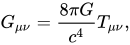





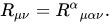


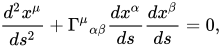






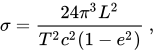


.jpg)





