Search This Blog

Tuesday, December 2, 2025

Directed panspermia

From Wikipedia, the free encyclopedia

Directed panspermia is a type of panspermia that implies the deliberate transport of microorganisms into space to be used as introduced species on other astronomical objects.

Shklovskii and Sagan (1966) and Crick and Orgel (1973) hypothesized that life on the Earth may have been seeded deliberately by other civilizations. Conversely, Mautner and Matloff (1979) and Mautner (1995, 1997) proposed that humanity should seed other planetary systems, protoplanetary discs or star-forming clouds with microorganisms. Motivations for directed panspermia often stem from panbiotic ethics and as a last resort existential risk mitigation strategy. However, more recently directed panspermia has also been heavily criticised from the perspectives of contamination and interference with indigenous life, wild animal welfare concerns, and procreative ethics, highlighting in particular, concerns about its irreversibility in the context of its uncertain ethical consequences.

Directed panspermia is becoming possible due to developments in solar sails, precise astrometry, the discovery of extrasolar planets, extremophiles and microbial genetic engineering.

History and motivation

An early example of the idea of directed panspermia dates to the early science fiction work Last and First Men by Olaf Stapledon, first published in 1930. It details the manner in which the last humans, upon discovering that the Solar System will soon be destroyed, send microscopic "seeds of a new humanity" towards potentially habitable areas of the universe.

In 1966, Shklovskii and Sagan speculated that life on Earth may have been seeded through directed panspermia by other civilisations, and, in 1973, Crick and Orgel also discussed the concept. In the controversial 2008 documentary Expelled: No Intelligence Allowed starring Ben Stein, Richard Dawkins mentioned directed panspermia as a possible scenario and that scientists may find evidence of it hidden in human biological chemistry and molecular biology. Conversely, Mautner and Matloff proposed in 1979, and Mautner examined in detail in 1995 and 1997 the technology and motivation to secure and expand organic gene/protein life-form by directed panspermia missions to other planetary systems, protoplanetary discs and star-forming clouds. Technological aspects include propulsion by solar sails, deceleration by radiation pressure or viscous drag at the target, and capture of the colonizing micro-organisms by planets. A possible objection is potential interference with local life at the targets, but targeting young planetary systems where local life, especially advanced life, could not have started yet, avoids this problem.

Directed panspermia may be motivated by the desire to perpetuate the common genetic heritage of all terrestrial life. This motivation was formulated as biotic ethics that value the common gene/protein patterns of self propagation, and as panbiotic ethics that aim to secure and expand life in the universe.

Strategies and targets

Directed panspermia may be aimed at nearby young planetary systems such as Alpha PsA (25 ly (light-years) away) and Beta Pictoris (63.4 ly), both of which show accretion discs and signs of comets and planets. More suitable targets may be identified by space telescopes such as the Kepler mission that will identify nearby star systems with habitable astronomical objects. Alternatively, directed panspermia may aim at star-forming interstellar clouds such as Rho Ophiuchi cloud complex (427 ly), that contains clusters of new stars too young to originate local life (425 infrared-emitting young stars aged 100,000 to a million years). Such clouds contain zones with various densities (diffuse cloud < dark fragment < dense core < protostellar condensation < accretion disc) that could selectively capture panspermia capsules of various sizes.

Habitable astronomical objects or habitable zones about nearby stars may be targeted by large (10 kg) missions where microbial capsules are bundled and shielded. Upon arrival, microbial capsules in the payload may be dispersed in orbit for capture by planets. Alternatively, small microbial capsules may be sent in large swarms to habitable planets, protoplanetary discs, or zones of various density in interstellar clouds. The microbial swarm provides minimal shielding but does not require high precision targeting, especially when aiming at large interstellar clouds.

Propulsion and launch

Panspermia missions should deliver microorganisms that can grow in the new habitats. They may be sent in 10−10 kg, 60 μm diameter capsules that allow intact atmospheric entry at the target planets, each containing 100,000 diverse microorganisms suited to various environments. Both for bundled large mass missions and microbial capsule swarms, solar sails may provide the most simple propulsion for interstellar transit. Spherical sails will avoid orientation control both at launch and at deceleration at the targets.

For bundled shielded missions to nearby star systems, solar sails with thicknesses of 10−7 m and areal densities of 0.0001 kg/m2 seem feasible, and sail/payload mass ratios of 10:1 will allow exit velocities near the maximum possible for such sails. Sails with about 540 m radius and area of 106 m2 can impart 10 kg payloads with interstellar cruise velocities of 0.0005 c (1.5×10⁵ m/s) when launched from 1 au (astronomical unit). At this speed, voyage to the Alpha PsA star will last 50,000 y, and to the Rho Opiuchus cloud, 824,000 years.

At the targets, the microbial payload would decompose into 1011 (100 billion) 30 μm capsules to increase the probability of capture. In the swarm strategy to protoplanetary discs and interstellar clouds, 1 mm radius, 4.2×10⁻⁶ kg microbial capsules are launched from 1 au using sails of 4.2×10⁻⁵ kg with radius of 0.37 m and area of 0.42 m2 to achieve cruising speeds of 0.0005 c. At the target, each capsule decomposes into 4,000 delivery microcapsules of 10−10 kg and of 30 micrometer radius that allow intact entry to planetary atmospheres.

For missions that do not encounter dense gas zones, such as interstellar transit to mature planets or to habitable zones about stars, the microcapsules can be launched directly from 1 au using 10−9 kg sails of 1.8 mm radius to achieve velocities of 0.0005 c to be decelerated by radiation pressure for capture at the targets. The 1 mm and 30 micrometer radius vehicles and payloads are needed in large numbers for both the bundled and swarm missions. These capsules and the miniature sails for swarm missions can be mass manufactured readily.

Astrometry and targeting

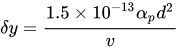
The panspermia vehicles would be aimed at moving targets whose locations at the time of arrival must be predicted. This can be calculated using their measured proper motions, their distances, and the cruising speeds of the vehicles. The positional uncertainty and size of the target object then allow estimating the probability that the panspermia vehicles will arrive at their targets. The positional uncertainty (m) of the target at arrival time is given by the following equation, where is the resolution of proper motion of the target object (arcsec/year), d is the distance from the Earth (m) and is the velocity of the vehicle (m s−1).

Given the positional uncertainty, the vehicles may be launched with a scatter in a circle about the predicted position of the target. The probability for a capsule to hit the target area with radius (m) is given by the ratio of the targeting scatter and the target area.

To apply these equations, the precision of astrometry of star proper motion of 0.00001 arcsec/year, and the solar sail vehicle velocity of 0.0005 c (1.5 × 105 m s−1) may be expected within a few decades. For a chosen planetary system, the area may be the width of the habitable zone, while for interstellar clouds, it may be the sizes of the various density zones of the cloud.

Deceleration and capture

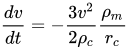
Solar sail missions to Sun-like stars can decelerate by radiation pressure in reverse dynamics of the launch. The sails must be properly oriented at arrival, but orientation control may be avoided using spherical sails. The vehicles must approach the target Sun-like stars at radial distances similar to the launch, about 1 au. After the vehicles are captured in orbit, the microbial capsules may be dispersed in a ring orbiting the star, some within the gravitational capture zone of planets. Missions to accretion discs of planets and to star-forming clouds will decelerate by viscous drag at the rate as determined by the following equation, where is the velocity, the radius of the spherical capsule, is density of the capsule and is the density of the medium.

A vehicle entering the cloud with a velocity of 0.0005 c (1.5 × 105 m s−1) will be captured when decelerated to 2,000 m s−1, the typical speed of grains in the cloud. The size of the capsules can be designed to stop at zones with various densities in the interstellar cloud. Simulations show that a 35 μm radius capsule will be captured in a dense core, and a 1 mm radius capsule in a protostellar condensation in the cloud. As for approach to accretion discs about stars, a millimetre size capsule entering the 1000 km thick disc face at 0.0005 c will be captured at 100 km into the disc. Therefore, 1 mm sized objects may be the best for seeding protoplanetary discs about new stars and protostellar condensations in interstellar clouds.

The captured panspermia capsules will mix with dust. A fraction of the dust and a proportional fraction of the captured capsules will be delivered to astronomical objects. Dispersing the payload into delivery microcapsules will increase the chance that some will be delivered to habitable objects. Particles of 0.6 – 60 μm radius can remain cold enough to preserve organic matter during atmospheric entry to planets or moons. Accordingly, each 1 mm, 4.2 × 10−6 kg capsule captured in the viscous medium can be dispersed into 42,000 delivery microcapsules of 30 μm radius, each weighing 10−10 kg and containing 100,000 microbes. These objects will not be ejected from the dust cloud by radiation pressure from the star, and will remain mixed with the dust. A fraction of the dust, containing the captured microbial capsules, will be captured by planets or moons, or captured in comets and delivered by them later to planets. The probability of capture, , can be estimated from similar processes, such as the capture of interplanetary dust particles by planets and moons in the Solar System, where 10−5 of the Zodiacal cloud maintained by comet ablation, and also a similar fraction of asteroid fragments, is collected by the Earth. The probability of capture of an initially launched capsule by a planet (or astronomical object) is given by the equation below, where is the probability that the capsule reaches the target accretion disc or cloud zone, and is the probability of capture from this zone by a planet.

The probability depends on the mixing ratio of the capsules with the dust and on the fraction of the dust delivered to planets. These variables can be estimated for capture in planetary accretion discs or in various zones in the interstellar cloud.

Biomass requirements

After determining the composition of chosen meteorites, astroecologists performed laboratory experiments that suggest that many colonizing microorganisms and some plants could obtain most of their chemical nutrients from asteroid and cometary materials. However, the scientists noted that phosphate (PO4) and nitrate (NO3–N) critically limit nutrition to many terrestrial lifeforms. For successful missions, enough biomass must be launched and captured for a reasonable chance to initiate life at the target astronomical object. An optimistic requirement is the capture by the planet of 100 capsules with 100,000 microorganisms each, for a total of 10 million organisms with a total biomass of 10−8 kg.

The required biomass to launch for a successful mission is given by following equation. mbiomass (kg) = 10−8 / Pplanet Using the above equations for Ptarget with transit velocities of 0.0005 c, the known distances to the targets, and the masses of the dust in the target regions then allows calculating the biomass that needs to be launched for probable success. With these parameters, as little as 1 gram of biomass (1012 microorganisms) could seed Alpha PsA and 4.5 gram could seed Beta Pictoris. More biomass needs to be launched to the Rho Ophiuchi cloud complex, mainly because of its larger distance. A biomass on the order of 300 tons would need to be launched to seed a protostellar condensation or an accretion disc, but two hundred kilograms would be sufficient to seed a young stellar object in the Rho Ophiuchi cloud complex.

Consequently, as long as the required physical range of tolerance are met (e.g.: growth temperature, cosmic radiation shielding, atmosphere and gravity), lifeforms viable on Earth may be chemically nourished by watery asteroid and planetary materials in this and other planetary systems.

Biological payload

The seeding organisms need to survive and multiply in the target environments and establish a viable biosphere. Some of the new branches of life may develop intelligent beings who will further expand life in the galaxy. The messenger microorganisms may find diverse environments, requiring extremophile microorganisms with a range of tolerances, including thermophile (high temperature), psychrophile (low temperature), acidophile (high acidity), halophile (high salinity), oligotroph (low nutrient concentration), xerophile (dry environments) and radioresistant (high radiation tolerance) microorganisms. Genetic engineering may produce polyextremophile microorganisms with several tolerances. The target atmospheres will probably lack oxygen, so the colonizers should include anaerobic microorganisms. Colonizing anaerobic cyanobacteria may later establish atmospheric oxygen that is needed for higher evolution, as it happened on Earth. Aerobic organisms in the biological payload may be delivered to the astronomical objects later when the conditions are right, by comets that captured and preserved the capsules.

The development of eukaryote microorganisms was a major bottleneck to higher evolution on Earth. Including eukaryote microorganisms in the payload can bypass this barrier. Multicellular organisms are even more desirable, but being much heavier than bacteria, fewer can be sent. Hardy tardigrades (water-bears) may be suitable but they are similar to arthropods and would lead to insects. The body-plan of rotifers could lead to higher animals, if the rotifers can be hardened to survive interstellar transit.

Microorganisms or capsules captured in the accretion disc can be captured along with the dust into asteroids. During aqueous alteration the asteroids contain water, inorganic salts and organics, and astroecology experiments with meteorites showed that algae, bacteria, fungi and plant cultures can grow in the asteroids in these media. Microorganisms can then spread in the accreting solar nebula, and will be delivered to planets in comets and in asteroids. The microorganisms can grow on nutrients in the carrier comets and asteroids in the aqueous planetary environments, until they adapt to the local environments and nutrients on the planets.

Signal in the genome

A number of publications since 1979 have proposed the idea that directed panspermia could be demonstrated to be the origin of all life on Earth if a distinctive 'signature' message were found, deliberately implanted into either the genome or the genetic code of the first microorganisms by our hypothetical progenitor. In 2013 a team of physicists claimed that they had found mathematical and semiotic patterns in the genetic code which, they believe, is evidence for such a signature. This claim has not been substantiated by further study, or accepted by the wider scientific community. One outspoken critic is biologist PZ Myers who said, writing in Pharyngula:

Unfortunately, what they’ve so honestly described is good old honest garbage ... Their methods failed to recognize a well-known functional association in the genetic code; they did not rule out the operation of natural law before rushing to falsely infer design ... We certainly don’t need to invoke panspermia. Nothing in the genetic code requires design, and the authors haven’t demonstrated otherwise.

In a later peer-reviewed article, the authors address the operation of natural law in an extensive statistical test, and draw the same conclusion as in the previous article. In special sections they also discuss methodological concerns raised by PZ Myers and some others.

Concept missions

Significantly, panspermia missions can be launched by present or near-future technologies. However, more advanced technologies may be also used when these become available. The biological aspects of directed panspermia may be improved by genetic engineering to produce hardy polyextremophile microorganisms and multicellular organisms, suitable to diverse astronomical objects environments. Hardy polyextremophile anaerobic multicellular eukaryotes with high radiation resistance, that can form a self-sustaining ecosystem with cyanobacteria, would combine ideally the features needed for survival and higher evolution.

For advanced missions, ion thrusters or solar sails using beam-powered propulsion accelerated by Earth-based lasers can achieve speeds up to 0.01 c (3×10⁶ m/s). Robots may provide in-course navigation, may control the reviving of the frozen microbes periodically during transit to repair radiation damage, and may also choose suitable targets. These propulsion methods and robotics are under development.

Microbial payloads may be also planted on hyperbolic comets bound for interstellar space. This strategy follows the mechanisms of natural panspermia by comets, as suggested by Hoyle and Wikramasinghe. The microorganisms would be frozen in the comets at interstellar temperatures of a few kelvins and protected from radiation for eons. It is unlikely that an ejected comet will be captured in another planetary system, but the probability can be increased by allowing the microbes to multiply during warm perihelion approach to the Sun, then fragmenting the comet. A 1 km radius comet would yield 4.2×10¹² one-kg seeded fragments, and rotating the comet would eject these shielded icy objects in random directions into the galaxy. This increases a trillion-fold the probability of capture in another planetary system, compared with transport by a single comet. Such manipulation of comets is a speculative long-term prospect.

The German physicist Claudius Gros has proposed that the technology developed by the Breakthrough Starshot initiative may be utilized in a second step to establish a biosphere of unicellular microbes on otherwise only transiently habitable astronomical objects. The aim of this initiative, the Genesis project, would be to fast forward evolution to a stage equivalent of the precambrian period on Earth. Gros argues that the Genesis project would be realizable within 50–100 years, using low-mass probes equipped with a miniaturized gene laboratory for the in situ cell synthesis of the microbes. The Genesis project extends directed panspermia to eukaryotic life, arguing that it is more likely that complex life is rare, and not bacterial life. In 2020, the theoretical physicist Avi Loeb wrote about a similar 3-D printer that can manufacture seeds of life in the Scientific American.

Motivation

Directed panspermia aims to secure and expand the family of organic gene/protein life. It may be motivated by the desire to perpetuate the common genetic heritage of all terrestrial life. This motivation was formulated as biotic ethics, that value the common gene/protein patterns of organic life, and as panbiotic ethics that aim to secure and expand life in the universe.

Molecular biology shows complex patterns common to all cellular life, a common genetic code and a common mechanism to translate it into proteins, which in turn help to reproduce the DNA code. Also, shared are the basic mechanisms of energy use and material transport. These self-propagating patterns and processes are the core of organic gene/protein life. Life is unique because of this complexity, and because of the exact coincidence of the laws of physics that allow life to exist. Also unique to life is the pursuit of self-propagation, which implies a human purpose to secure and expand life. These objectives are best secured in space, suggesting a panbiotic ethics aimed to secure this future.

Objections and counterarguments

Directed panspermia may interfere with local life at the targets. The colonizing microorganisms may out-compete local life for resources, or infect and harm local organisms. However, this probability can be minimized by targeting newly forming planetary systems, accretion discs and star-forming clouds, where local life, and especially advanced life, could not have emerged yet. If there is local life that is fundamentally different, the colonizing microorganisms may not harm it. If there is local organic gene/protein life, it may exchange genes with the colonizing microorganisms, increasing galactic biodiversity.

Another objection is that space should be left pristine for scientific studies, a reason for planetary quarantine. However, directed panspermia may reach only a few, at most a few hundred new stars, still leaving a hundred billion pristine for local life and for research. A technical objection is the uncertain survival of the messenger organisms during long interstellar transit. Research by simulations, and the development on hardy colonizers is needed to address these questions.

A third argument against engaging in directed panspermia derives from the view that wild animals do not — on the average — have lives worth living, and thus spreading life would be morally wrong. Yew-Kwang Ng supports this view. Unlike the above two objections, which can be minimized by attention to detail, there is no currently-known way to influence from a distance how evolution would progress on a world seeded with life. O'Brien argues that the large amount of suffering among wild animals on this planet is probably a result of the way evolution by natural selection operates, and that evolutionary processes are therefore likely to result, in due time, in similar suffering wherever life evolves. Sivula discusses all sides of the issue and concludes that "... the risk of suffering objection constitutes a serious ethical problem – planetary seeding may be extremely good or it might be a moral disaster – depending on one's moral theory. Until we have identified a satisfying resolution of this predicament, humanity should abstain from any acts of cosmic preservation." Additionally, there is no guarantee that the future biospheres created will not suffer more than life has done on Earth.

The discovery of an ancient directed panspermia effort is the central theme of "The Chase," a 1993 episode of Star Trek: The Next Generation. In the story, Captain Picard must work to complete the penultimate research of his late archaeology professor's career. That professor, Galen, had discovered that DNA fragments seeded into the primordial genetic material of 19 worlds could be rearranged to assemble a computer algorithm. Amid competition (and, later, with begrudging cooperation) from Cardassian, Klingon and Romulan expeditions also exploring Galen's research clues, the Enterprise crew discovers that an alien progenitor race had indeed, 4 billion years prior, seeded genetic material across many star systems, thus directing the evolution of many humanoid species.

Some variation of directed panspermia was also included in the plot of anime Neon Genesis Evangelion and Ridley Scott's 2012 science fiction film Prometheus.

Rotational spectroscopy

From Wikipedia, the free encyclopedia
 
Part of the rotational spectrum of trifluoroiodomethane, CF
3
I
. Each rotational transition is labeled with the quantum numbers, J, of the final and initial states, and is extensively split by the effects of nuclear quadrupole coupling with the 127I nucleus.

Rotational spectroscopy is concerned with the measurement of the energies of transitions between quantized rotational states of molecules in the gas phase. The rotational spectrum (power spectral density vs. rotational frequency) of polar molecules can be measured in absorption or emission by microwave spectroscopy or by far infrared spectroscopy. The rotational spectra of non-polar molecules cannot be observed by those methods, but can be observed and measured by Raman spectroscopy. Rotational spectroscopy is sometimes referred to as pure rotational spectroscopy to distinguish it from rotational-vibrational spectroscopy where changes in rotational energy occur together with changes in vibrational energy, and also from ro-vibronic spectroscopy (or just vibronic spectroscopy) where rotational, vibrational and electronic energy changes occur simultaneously.

For rotational spectroscopy, molecules are classified according to symmetry into spherical tops, linear molecules, and symmetric tops; analytical expressions can be derived for the rotational energy terms of these molecules. Analytical expressions can be derived for the fourth category, asymmetric top, for rotational levels up to J=3, but higher energy levels need to be determined using numerical methods. The rotational energies are derived theoretically by considering the molecules to be rigid rotors and then applying extra terms to account for centrifugal distortion, fine structure, hyperfine structure and Coriolis coupling. Fitting the spectra to the theoretical expressions gives numerical values of the angular moments of inertia from which very precise values of molecular bond lengths and angles can be derived in favorable cases. In the presence of an electrostatic field there is Stark splitting which allows molecular electric dipole moments to be determined.

An important application of rotational spectroscopy is in exploration of the chemical composition of the interstellar medium using radio telescopes.

Applications

Rotational spectroscopy has primarily been used to investigate fundamental aspects of molecular physics. It is a uniquely precise tool for the determination of molecular structure in gas-phase molecules. It can be used to establish barriers to internal rotation such as that associated with the rotation of the CH
3
group relative to the C
6
H
4
Cl
group in chlorotoluene (C
7
H
7
Cl
). When fine or hyperfine structure can be observed, the technique also provides information on the electronic structures of molecules. Much of current understanding of the nature of weak molecular interactions such as van der Waals, hydrogen and halogen bonds has been established through rotational spectroscopy. In connection with radio astronomy, the technique has a key role in exploration of the chemical composition of the interstellar medium. Microwave transitions are measured in the laboratory and matched to emissions from the interstellar medium using a radio telescope. NH
3
was the first stable polyatomic molecule to be identified in the interstellar medium. The measurement of chlorine monoxide is important for atmospheric chemistry. Current projects in astrochemistry involve both laboratory microwave spectroscopy and observations made using modern radiotelescopes such as the Atacama Large Millimeter/submillimeter Array (ALMA).

Overview

A molecule in the gas phase is free to rotate relative to a set of mutually orthogonal axes of fixed orientation in space, centered on the center of mass of the molecule. Free rotation is not possible for molecules in liquid or solid phases due to the presence of intermolecular forces. Rotation about each unique axis is associated with a set of quantized energy levels dependent on the moment of inertia about that axis and a quantum number. Thus, for linear molecules the energy levels are described by a single moment of inertia and a single quantum number, , which defines the magnitude of the rotational angular momentum.

For nonlinear molecules which are symmetric rotors (or symmetric tops - see next section), there are two moments of inertia and the energy also depends on a second rotational quantum number, , which defines the vector component of rotational angular momentum along the principal symmetry axis. Analysis of spectroscopic data with the expressions detailed below results in quantitative determination of the value(s) of the moment(s) of inertia. From these precise values of the molecular structure and dimensions may be obtained.

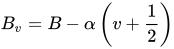
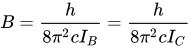
For a linear molecule, analysis of the rotational spectrum provides values for the rotational constant and the moment of inertia of the molecule, and, knowing the atomic masses, can be used to determine the bond length directly. For diatomic molecules this process is straightforward. For linear molecules with more than two atoms it is necessary to measure the spectra of two or more isotopologues, such as 16O12C32S and 16O12C34S. This allows a set of simultaneous equations to be set up and solved for the bond lengths). A bond length obtained in this way is slightly different from the equilibrium bond length. This is because there is zero-point energy in the vibrational ground state, to which the rotational states refer, whereas the equilibrium bond length is at the minimum in the potential energy curve. The relation between the rotational constants is given by

where v is a vibrational quantum number and α is a vibration-rotation interaction constant which can be calculated if the B values for two different vibrational states can be found.

For other molecules, if the spectra can be resolved and individual transitions assigned both bond lengths and bond angles can be deduced. When this is not possible, as with most asymmetric tops, all that can be done is to fit the spectra to three moments of inertia calculated from an assumed molecular structure. By varying the molecular structure the fit can be improved, giving a qualitative estimate of the structure. Isotopic substitution is invaluable when using this approach to the determination of molecular structure.

Classification of molecular rotors

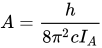
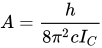
In quantum mechanics the free rotation of a molecule is quantized, so that the rotational energy and the angular momentum can take only certain fixed values, which are related simply to the moment of inertia, , of the molecule. For any molecule, there are three moments of inertia: , and about three mutually orthogonal axes A, B, and C with the origin at the center of mass of the system. The general convention, used in this article, is to define the axes such that , with axis corresponding to the smallest moment of inertia. Some authors, however, define the axis as the molecular rotation axis of highest order.

The particular pattern of energy levels (and, hence, of transitions in the rotational spectrum) for a molecule is determined by its symmetry. A convenient way to look at the molecules is to divide them into four different classes, based on the symmetry of their structure. These are

Spherical tops (spherical rotors)
All three moments of inertia are equal to each other: . Examples of spherical tops include phosphorus tetramer (P
4
)
, carbon tetrachloride (CCl
4
)
and other tetrahalides, methane (CH
4
)
, silane, (SiH
4
)
, sulfur hexafluoride (SF
6
)
and other hexahalides. The molecules all belong to the cubic point groups Td or Oh.
Linear molecules
For a linear molecule the moments of inertia are related by . For most purposes, can be taken to be zero. Examples of linear molecules include dioxygen (O
2
)
, dinitrogen (N
2
)
, carbon monoxide (CO), hydroxy radical (OH), carbon dioxide (CO2), hydrogen cyanide (HCN), carbonyl sulfide (OCS), acetylene (ethyne (HC≡CH) and dihaloethynes. These molecules belong to the point groups C∞v or D∞h.
Symmetric tops (symmetric rotors)
A symmetric top is a molecule in which two moments of inertia are the same, or . By definition a symmetric top must have a 3-fold or higher order rotation axis. As a matter of convenience, spectroscopists divide molecules into two classes of symmetric tops, Oblate symmetric tops (saucer or disc shaped) with and Prolate symmetric tops (rugby football, or cigar shaped) with . The spectra look rather different, and are instantly recognizable. Examples of symmetric tops include
Oblate
Benzene, C
6
H
6
; ammonia, NH
3
; xenon tetrafluoride, XeF
4
Prolate
Chloromethane, CH
3
Cl
, propyne, CH
3
C≡CH
As a detailed example, ammonia has a moment of inertia IC = 4.4128 × 10−47 kg m2 about the 3-fold rotation axis, and moments IA = IB = 2.8059 × 10−47 kg m2 about any axis perpendicular to the C3 axis. Since the unique moment of inertia is larger than the other two, the molecule is an oblate symmetric top.
Asymmetric tops (asymmetric rotors)
The three moments of inertia have different values. Examples of small molecules that are asymmetric tops include water, H
2
O
and nitrogen dioxide, NO
2
whose symmetry axis of highest order is a 2-fold rotation axis. Most large molecules are asymmetric tops.

Selection rules

Microwave and far-infrared spectra

Transitions between rotational states can be observed in molecules with a permanent electric dipole moment. A consequence of this rule is that no microwave spectrum can be observed for centrosymmetric linear molecules such as N
2
(dinitrogen) or HCCH (ethyne), which are non-polar. Tetrahedral molecules such as CH
4
(methane), which have both a zero dipole moment and isotropic polarizability, would not have a pure rotation spectrum but for the effect of centrifugal distortion; when the molecule rotates about a 3-fold symmetry axis a small dipole moment is created, allowing a weak rotation spectrum to be observed by microwave spectroscopy.

With symmetric tops, the selection rule for electric-dipole-allowed pure rotation transitions is ΔK = 0, ΔJ = ±1. Since these transitions are due to absorption (or emission) of a single photon with a spin of one, conservation of angular momentum implies that the molecular angular momentum can change by at most one unit. Moreover, the quantum number K is limited to have values between and including +J to -J.

Raman spectra

For Raman spectra the molecules undergo transitions in which an incident photon is absorbed and another scattered photon is emitted. The general selection rule for such a transition to be allowed is that the molecular polarizability must be anisotropic, which means that it is not the same in all directions. Polarizability is a 3-dimensional tensor that can be represented as an ellipsoid. The polarizability ellipsoid of spherical top molecules is in fact spherical so those molecules show no rotational Raman spectrum. For all other molecules both Stokes and anti-Stokes lines can be observed and they have similar intensities due to the fact that many rotational states are thermally populated. The selection rule for linear molecules is ΔJ = 0, ±2. The reason for the values ±2 is that the polarizability returns to the same value twice during a rotation.[14] The value ΔJ = 0 does not correspond to a molecular transition but rather to Rayleigh scattering in which the incident photon merely changes direction.

The selection rule for symmetric top molecules is

ΔK = 0
If K = 0, then ΔJ = ±2
If K ≠ 0, then ΔJ = 0, ±1, ±2

Transitions with ΔJ = +1 are said to belong to the R series, whereas transitions with ΔJ = +2 belong to an S series. Since Raman transitions involve two photons, it is possible for the molecular angular momentum to change by two units.

Units

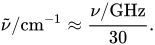
The units used for rotational constants depend on the type of measurement. With infrared spectra in the wavenumber scale (), the unit is usually the inverse centimeter, written as cm−1, which is literally the number of waves in one centimeter, or the reciprocal of the wavelength in centimeters (). On the other hand, for microwave spectra in the frequency scale (), the unit is usually the gigahertz. The relationship between these two units is derived from the expression

where ν is a frequency, λ is a wavelength and c is the velocity of light. It follows that

As 1 GHz = 109 Hz, the numerical conversion can be expressed as

Effect of vibration on rotation

The population of vibrationally excited states follows a Boltzmann distribution, so low-frequency vibrational states are appreciably populated even at room temperatures. As the moment of inertia is higher when a vibration is excited, the rotational constants (B) decrease. Consequently, the rotation frequencies in each vibration state are different from each other. This can give rise to "satellite" lines in the rotational spectrum. An example is provided by cyanodiacetylene, H−C≡C−C≡C−C≡N.

Further, there is a fictitious force, Coriolis coupling, between the vibrational motion of the nuclei in the rotating (non-inertial) frame. However, as long as the vibrational quantum number does not change (i.e., the molecule is in only one state of vibration), the effect of vibration on rotation is not important, because the time for vibration is much shorter than the time required for rotation. The Coriolis coupling is often negligible, too, if one is interested in low vibrational and rotational quantum numbers only.

Effect of rotation on vibrational spectra

Historically, the theory of rotational energy levels was developed to account for observations of vibration-rotation spectra of gases in infrared spectroscopy, which was used before microwave spectroscopy had become practical. To a first approximation, the rotation and vibration can be treated as separable, so the energy of rotation is added to the energy of vibration. For example, the rotational energy levels for linear molecules (in the rigid-rotor approximation) are

In this approximation, the vibration-rotation wavenumbers of transitions are

where and are rotational constants for the upper and lower vibrational state respectively, while and are the rotational quantum numbers of the upper and lower levels. In reality, this expression has to be modified for the effects of anharmonicity of the vibrations, for centrifugal distortion and for Coriolis coupling.

For the so-called R branch of the spectrum, so that there is simultaneous excitation of both vibration and rotation. For the P branch, so that a quantum of rotational energy is lost while a quantum of vibrational energy is gained. The purely vibrational transition, , gives rise to the Q branch of the spectrum. Because of the thermal population of the rotational states the P branch is slightly less intense than the R branch.

Rotational constants obtained from infrared measurements are in good accord with those obtained by microwave spectroscopy, while the latter usually offers greater precision.

Structure of rotational spectra

Spherical top

Spherical top molecules have no net dipole moment. A pure rotational spectrum cannot be observed by absorption or emission spectroscopy because there is no permanent dipole moment whose rotation can be accelerated by the electric field of an incident photon. Also the polarizability is isotropic, so that pure rotational transitions cannot be observed by Raman spectroscopy either. Nevertheless, rotational constants can be obtained by ro–vibrational spectroscopy. This occurs when a molecule is polar in the vibrationally excited state. For example, the molecule methane is a spherical top but the asymmetric C-H stretching band shows rotational fine structure in the infrared spectrum, illustrated in rovibrational coupling. This spectrum is also interesting because it shows clear evidence of Coriolis coupling in the asymmetric structure of the band.

Linear molecules

Energy levels and line positions calculated in the rigid rotor approximation

The rigid rotor is a good starting point from which to construct a model of a rotating molecule. It is assumed that component atoms are point masses connected by rigid bonds. A linear molecule lies on a single axis and each atom moves on the surface of a sphere around the centre of mass. The two degrees of rotational freedom correspond to the spherical coordinates θ and φ which describe the direction of the molecular axis, and the quantum state is determined by two quantum numbers J and M. J defines the magnitude of the rotational angular momentum, and M its component about an axis fixed in space, such as an external electric or magnetic field. In the absence of external fields, the energy depends only on J. Under the rigid rotor model, the rotational energy levels, F(J), of the molecule can be expressed as,

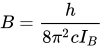
where is the rotational constant of the molecule and is related to the moment of inertia of the molecule. In a linear molecule the moment of inertia about an axis perpendicular to the molecular axis is unique, that is, , so

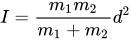
For a diatomic molecule

where m1 and m2 are the masses of the atoms and d is the distance between them.

Selection rules dictate that during emission or absorption the rotational quantum number has to change by unity; i.e., . Thus, the locations of the lines in a rotational spectrum will be given by

where denotes the lower level and denotes the upper level involved in the transition.

The diagram illustrates rotational transitions that obey the =1 selection rule. The dashed lines show how these transitions map onto features that can be observed experimentally. Adjacent transitions are separated by 2B in the observed spectrum. Frequency or wavenumber units can also be used for the x axis of this plot.

Rotational line intensities

Rotational level populations with Bhc/kT = 0.05. J is the quantum number of the lower rotational state.

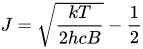
The probability of a transition taking place is the most important factor influencing the intensity of an observed rotational line. This probability is proportional to the population of the initial state involved in the transition. The population of a rotational state depends on two factors. The number of molecules in an excited state with quantum number J, relative to the number of molecules in the ground state, NJ/N0 is given by the Boltzmann distribution as

,

where k is the Boltzmann constant and T the absolute temperature. This factor decreases as J increases. The second factor is the degeneracy of the rotational state, which is equal to 2J + 1. This factor increases as J increases. Combining the two factors

The maximum relative intensity occurs at

The diagram at the right shows an intensity pattern roughly corresponding to the spectrum above it.

Centrifugal distortion

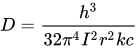
When a molecule rotates, the centrifugal force pulls the atoms apart. As a result, the moment of inertia of the molecule increases, thus decreasing the value of , when it is calculated using the expression for the rigid rotor. To account for this a centrifugal distortion correction term is added to the rotational energy levels of the diatomic molecule.[20]

where is the centrifugal distortion constant.

Therefore, the line positions for the rotational mode change to

In consequence, the spacing between lines is not constant, as in the rigid rotor approximation, but decreases with increasing rotational quantum number.

An assumption underlying these expressions is that the molecular vibration follows simple harmonic motion. In the harmonic approximation the centrifugal constant can be derived as

where k is the vibrational force constant. The relationship between and

where is the harmonic vibration frequency, follows. If anharmonicity is to be taken into account, terms in higher powers of J should be added to the expressions for the energy levels and line positions. A striking example concerns the rotational spectrum of hydrogen fluoride which was fitted to terms up to [J(J+1)]5.

Oxygen

The electric dipole moment of the dioxygen molecule, O
2
is zero, but the molecule is paramagnetic with two unpaired electrons so that there are magnetic-dipole allowed transitions which can be observed by microwave spectroscopy. The unit electron spin has three spatial orientations with respect to the given molecular rotational angular momentum vector, K, so that each rotational level is split into three states, J = K + 1, K, and K - 1, each J state of this so-called p-type triplet arising from a different orientation of the spin with respect to the rotational motion of the molecule. The energy difference between successive J terms in any of these triplets is about 2 cm−1 (60 GHz), with the single exception of J = 1←0 difference which is about 4 cm−1. Selection rules for magnetic dipole transitions allow transitions between successive members of the triplet (ΔJ = ±1) so that for each value of the rotational angular momentum quantum number K there are two allowed transitions. The 16O nucleus has zero nuclear spin angular momentum, so that symmetry considerations demand that K have only odd values.

Symmetric top

For symmetric rotors a quantum number J is associated with the total angular momentum of the molecule. For a given value of J, there is a 2J+1- fold degeneracy with the quantum number, M taking the values +J ...0 ... -J. The third quantum number, K is associated with rotation about the principal rotation axis of the molecule. In the absence of an external electrical field, the rotational energy of a symmetric top is a function of only J and K and, in the rigid rotor approximation, the energy of each rotational state is given by

where and for a prolate symmetric top molecule or for an oblate molecule.

This gives the transition wavenumbers as

which is the same as in the case of a linear molecule. With a first order correction for centrifugal distortion the transition wavenumbers become

The term in DJK has the effect of removing degeneracy present in the rigid rotor approximation, with different K values.

Asymmetric top

Pure rotation spectrum of atmospheric water vapour measured at Mauna Kea (33 cm−1 to 100 cm−1)

The quantum number J refers to the total angular momentum, as before. Since there are three independent moments of inertia, there are two other independent quantum numbers to consider, but the term values for an asymmetric rotor cannot be derived in closed form. They are obtained by individual matrix diagonalization for each J value. Formulae are available for molecules whose shape approximates to that of a symmetric top.

The water molecule is an important example of an asymmetric top. It has an intense pure rotation spectrum in the far infrared region, below about 200 cm−1. For this reason far infrared spectrometers have to be freed of atmospheric water vapour either by purging with a dry gas or by evacuation. The spectrum has been analyzed in detail.

Quadrupole splitting

When a nucleus has a spin quantum number, I, greater than 1/2 it has a quadrupole moment. In that case, coupling of nuclear spin angular momentum with rotational angular momentum causes splitting of the rotational energy levels. If the quantum number J of a rotational level is greater than I, 2I + 1 levels are produced; but if J is less than I, 2J + 1 levels result. The effect is one type of hyperfine splitting. For example, with 14N (I = 1) in HCN, all levels with J > 0 are split into 3. The energies of the sub-levels are proportional to the nuclear quadrupole moment and a function of F and J. where F = J + I, J + I − 1, …, |JI|. Thus, observation of nuclear quadrupole splitting permits the magnitude of the nuclear quadrupole moment to be determined. This is an alternative method to the use of nuclear quadrupole resonance spectroscopy. The selection rule for rotational transitions becomes

Stark and Zeeman effects

In the presence of a static external electric field the 2J + 1 degeneracy of each rotational state is partly removed, an instance of a Stark effect. For example, in linear molecules each energy level is split into J + 1 components. The extent of splitting depends on the square of the electric field strength and the square of the dipole moment of the molecule. In principle this provides a means to determine the value of the molecular dipole moment with high precision. Examples include carbonyl sulfide, OCS, with μ = 0.71521 ± 0.00020 debye. However, because the splitting depends on μ2, the orientation of the dipole must be deduced from quantum mechanical considerations.

A similar removal of degeneracy will occur when a paramagnetic molecule is placed in a magnetic field, an instance of the Zeeman effect. Most species which can be observed in the gaseous state are diamagnetic . Exceptions are odd-electron molecules such as nitric oxide, NO, nitrogen dioxide, NO
2
, some chlorine oxides and the hydroxyl radical. The Zeeman effect has been observed with dioxygen, O
2

Rotational Raman spectroscopy

Molecular rotational transitions can also be observed by Raman spectroscopy. Rotational transitions are Raman-allowed for any molecule with an anisotropic polarizability which includes all molecules except for spherical tops. This means that rotational transitions of molecules with no permanent dipole moment, which cannot be observed in absorption or emission, can be observed, by scattering, in Raman spectroscopy. Very high resolution Raman spectra can be obtained by adapting a Fourier Transform Infrared Spectrometer. An example is the spectrum of 15
N
2
. It shows the effect of nuclear spin, resulting in intensities variation of 3:1 in adjacent lines. A bond length of 109.9985 ± 0.0010 pm was deduced from the data.

Instruments and methods

The great majority of contemporary spectrometers use a mixture of commercially available and bespoke components which users integrate according to their particular needs. Instruments can be broadly categorised according to their general operating principles. Although rotational transitions can be found across a very broad region of the electromagnetic spectrum, fundamental physical constraints exist on the operational bandwidth of instrument components. It is often impractical and costly to switch to measurements within an entirely different frequency region. The instruments and operating principals described below are generally appropriate to microwave spectroscopy experiments conducted at frequencies between 6 and 24 GHz.

Absorption cells and Stark modulation

A microwave spectrometer can be most simply constructed using a source of microwave radiation, an absorption cell into which sample gas can be introduced and a detector such as a superheterodyne receiver. A spectrum can be obtained by sweeping the frequency of the source while detecting the intensity of transmitted radiation. A simple section of waveguide can serve as an absorption cell. An important variation of the technique in which an alternating current is applied across electrodes within the absorption cell results in a modulation of the frequencies of rotational transitions. This is referred to as Stark modulation and allows the use of phase-sensitive detection methods offering improved sensitivity. Absorption spectroscopy allows the study of samples that are thermodynamically stable at room temperature. The first study of the microwave spectrum of a molecule (NH
3
) was performed by Cleeton & Williams in 1934. Subsequent experiments exploited powerful sources of microwaves such as the klystron, many of which were developed for radar during the Second World War. The number of experiments in microwave spectroscopy surged immediately after the war. By 1948, Walter Gordy was able to prepare a review of the results contained in approximately 100 research papers. Commercial versions of microwave absorption spectrometer were developed by Hewlett-Packard in the 1970s and were once widely used for fundamental research. Most research laboratories now exploit either Balle-Flygare or chirped-pulse Fourier transform microwave (FTMW) spectrometers.

Fourier transform microwave (FTMW) spectroscopy

The theoretical framework underpinning FTMW spectroscopy is analogous to that used to describe FT-NMR spectroscopy. The behaviour of the evolving system is described by optical Bloch equations. First, a short (typically 0-3 microsecond duration) microwave pulse is introduced on resonance with a rotational transition. Those molecules that absorb the energy from this pulse are induced to rotate coherently in phase with the incident radiation. De-activation of the polarisation pulse is followed by microwave emission that accompanies decoherence of the molecular ensemble. This free induction decay occurs on a timescale of 1-100 microseconds depending on instrument settings. Following pioneering work by Dicke and co-workers in the 1950s, the first FTMW spectrometer was constructed by Ekkers and Flygare in 1975.

Balle–Flygare FTMW spectrometer

Balle, Campbell, Keenan and Flygare demonstrated that the FTMW technique can be applied within a "free space cell" comprising an evacuated chamber containing a Fabry-Perot cavity. This technique allows a sample to be probed only milliseconds after it undergoes rapid cooling to only a few kelvins in the throat of an expanding gas jet. This was a revolutionary development because (i) cooling molecules to low temperatures concentrates the available population in the lowest rotational energy levels. Coupled with benefits conferred by the use of a Fabry-Perot cavity, this brought a great enhancement in the sensitivity and resolution of spectrometers along with a reduction in the complexity of observed spectra; (ii) it became possible to isolate and study molecules that are very weakly bound because there is insufficient energy available for them to undergo fragmentation or chemical reaction at such low temperatures. William Klemperer was a pioneer in using this instrument for the exploration of weakly bound interactions. While the Fabry-Perot cavity of a Balle-Flygare FTMW spectrometer can typically be tuned into resonance at any frequency between 6 and 18 GHz, the bandwidth of individual measurements is restricted to about 1 MHz. An animation illustrates the operation of this instrument which is currently the most widely used tool for microwave spectroscopy.

Chirped-Pulse FTMW spectrometer

Noting that digitisers and related electronics technology had significantly progressed since the inception of FTMW spectroscopy, B.H. Pate at the University of Virginia designed a spectrometer which retains many advantages of the Balle-Flygare FT-MW spectrometer while innovating in (i) the use of a high speed (>4 GS/s) arbitrary waveform generator to generate a "chirped" microwave polarisation pulse that sweeps up to 12 GHz in frequency in less than a microsecond and (ii) the use of a high speed (>40 GS/s) oscilloscope to digitise and Fourier transform the molecular free induction decay. The result is an instrument that allows the study of weakly bound molecules but which is able to exploit a measurement bandwidth (12 GHz) that is greatly enhanced compared with the Balle-Flygare FTMW spectrometer. Modified versions of the original CP-FTMW spectrometer have been constructed by a number of groups in the United States, Canada and Europe. The instrument offers a broadband capability that is highly complementary to the high sensitivity and resolution offered by the Balle-Flygare design.

Logical reasoning

From Wikipedia, the free encyclopedia https://en.wikipedia.org/wiki/Logical_reasoning   Logical reasoni...