The term is closely associated with the work of the mathematician and meteorologist Edward Norton Lorenz. He noted that the butterfly effect is derived from the example of the details of a tornado (the exact time of formation, the exact path taken) being influenced by minor perturbations such as a distant butterfly
flapping its wings several weeks earlier. Lorenz originally used a
seagull causing a storm but was persuaded to make it more poetic with
the use of a butterfly and tornado by 1972.He discovered the effect when he observed runs of his weather model
with initial condition data that were rounded in a seemingly
inconsequential manner. He noted that the weather model would fail to
reproduce the results of runs with the unrounded initial condition data.
A very small change in initial conditions had created a significantly
different outcome.
The idea that small causes may have large effects in weather was earlier acknowledged by the French mathematician and physicist Henri Poincaré. The American mathematician and philosopher Norbert Wiener also contributed to this theory. Lorenz's work placed the concept of instability of the Earth's atmosphere
onto a quantitative base and linked the concept of instability to the
properties of large classes of dynamic systems which are undergoing nonlinear dynamics and deterministic chaos.
The concept of the butterfly effect has since been used outside
the context of weather science as a broad term for any situation where a
small change is supposed to be the cause of larger consequences.
In The Vocation of Man (1800), Johann Gottlieb Fichte
says "you could not remove a single grain of sand from its place
without thereby ... changing something throughout all parts of the
immeasurable whole".
Chaos theory
and the sensitive dependence on initial conditions were described in
numerous forms of literature. This is evidenced by the case of the three-body problem by Poincaré in 1890. He later proposed that such phenomena could be common, for example, in meteorology.
In 1898, Jacques Hadamard noted general divergence of trajectories in spaces of negative curvature. Pierre Duhem discussed the possible general significance of this in 1908.
In 1950, Alan Turing
noted: "The displacement of a single electron by a billionth of a
centimetre at one moment might make the difference between a man being
killed by an avalanche a year later, or escaping."
The idea that the death of one butterfly could eventually have a far-reaching ripple effect on subsequent historical events made its earliest known appearance in "A Sound of Thunder", a 1952 short story by Ray Bradbury in which a time traveller alters the future by inadvertently treading on a butterfly in the past.
More precisely, though, almost the exact idea and the exact
phrasing —of a tiny insect's wing affecting the entire atmosphere's
winds— was published in a children's book which became extremely
successful and well-known globally in 1962, the year before Lorenz
published:
"...whatever we do affects everything and everyone else, if even in
the tiniest way. Why, when a housefly flaps his wings, a breeze goes
round the world."
In 1961, Lorenz was running a numerical computer model to redo a
weather prediction from the middle of the previous run as a shortcut. He
entered the initial condition 0.506 from the printout instead of
entering the full precision 0.506127 value. The result was a completely
different weather scenario.
Lorenz wrote:
At one point I decided to repeat some of the computations in order to
examine what was happening in greater detail. I stopped the computer,
typed in a line of numbers that it had printed out a while earlier, and
set it running again. I went down the hall for a cup of coffee and
returned after about an hour, during which time the computer had
simulated about two months of weather. The numbers being printed were
nothing like the old ones. I immediately suspected a weak vacuum tube
or some other computer trouble, which was not uncommon, but before
calling for service I decided to see just where the mistake had
occurred, knowing that this could speed up the servicing process.
Instead of a sudden break, I found that the new values at first repeated
the old ones, but soon afterward differed by one and then several units
in the last [decimal] place, and then began to differ in the next to
the last place and then in the place before that. In fact, the
differences more or less steadily doubled in size every four days or so,
until all resemblance with the original output disappeared somewhere in
the second month. This was enough to tell me what had happened: the
numbers that I had typed in were not the exact original numbers, but
were the rounded-off values that had appeared in the original printout.
The initial round-off errors were the culprits; they were steadily
amplifying until they dominated the solution.
— E. N. Lorenz, The Essence of Chaos, University of Washington Press, Seattle (1993), page 134
In 1963, Lorenz published a theoretical study of this effect in a highly cited, seminal paper called Deterministic Nonperiodic Flow (the calculations were performed on a Royal McBeeLGP-30 computer). Elsewhere he stated:
One meteorologist remarked that if the theory were correct, one flap of a sea gull's
wings would be enough to alter the course of the weather forever. The
controversy has not yet been settled, but the most recent evidence seems
to favor the sea gulls.
Following proposals from colleagues, in later speeches and papers, Lorenz used the more poetic butterfly. According to Lorenz, when he failed to provide a title for a talk he was to present at the 139th meeting of the American Association for the Advancement of Science in 1972, Philip Merilees concocted Does the flap of a butterfly's wings in Brazil set off a tornado in Texas? as a title. Although a butterfly flapping its wings has remained constant in the
expression of this concept, the location of the butterfly, the
consequences, and the location of the consequences have varied widely.
The phrase refers to the effect of a butterfly's wings creating tiny changes in the atmosphere that may ultimately alter the path of a tornado
or delay, accelerate, or even prevent the occurrence of a tornado in
another location. The butterfly does not power or directly create the
tornado, but the term is intended to imply that the flap of the
butterfly's wings can cause the tornado: in the sense that the
flap of the wings is a part of the initial conditions of an
interconnected complex web; one set of conditions leads to a tornado,
while the other set of conditions doesn't. The flapping wing creates a
small change in the initial condition of the system, which cascades to
large-scale alterations of events (compare: domino effect). Had the butterfly not flapped its wings, the trajectory
of the system might have been vastly different—but it's also equally
possible that the set of conditions without the butterfly flapping its
wings is the set that leads to a tornado.
The butterfly effect presents an obvious challenge to prediction,
since initial conditions for a system such as the weather can never be
known to complete accuracy. This problem motivated the development of ensemble forecasting, in which a number of forecasts are made from perturbed initial conditions.
Some scientists have since argued that the weather system is not as sensitive to initial conditions as previously believed. David Orrell
argues that the major contributor to weather forecast error is model
error, with sensitivity to initial conditions playing a relatively small
role.Stephen Wolfram also notes that the Lorenz equations
are highly simplified and do not contain terms that represent viscous
effects; he believes that these terms would tend to damp out small
perturbations. Recent studies using generalized Lorenz models
that included additional dissipative terms and nonlinearity suggested
that a larger heating parameter is required for the onset of chaos.
While the "butterfly effect" is often explained as being
synonymous with sensitive dependence on initial conditions of the kind
described by Lorenz in his 1963 paper (and previously observed by
Poincaré), the butterfly metaphor was originally applied to work he published in 1969 which took the idea a step further. Lorenz proposed a mathematical
model for how tiny motions in the atmosphere scale up to affect larger
systems. He found that the systems in that model could only be predicted
up to a specific point in the future, and beyond that, reducing the
error in the initial conditions would not increase the predictability
(as long as the error is not zero). This demonstrated that a
deterministic system could be "observationally indistinguishable" from a
non-deterministic one in terms of predictability. Recent
re-examinations of this paper suggest that it offered a significant
challenge to the idea that our universe is deterministic, comparable to
the challenges offered by quantum physics.
In the book entitled The Essence of Chaos published in 1993, Lorenz defined butterfly effect as: "The phenomenon that a small
alteration in the state of a dynamical system will cause subsequent
states to differ greatly from the states that would have followed
without the alteration." This feature is the same as sensitive
dependence of solutions on initial conditions (SDIC) in. In the same book, Lorenz applied the activity of skiing and developed
an idealized skiing model for revealing the sensitivity of time-varying
paths to initial positions. A predictability horizon is determined
before the onset of SDIC.
These figures show two segments of the three-dimensional
evolution of two trajectories (one in blue, and the other in yellow)
for the same period of time in the Lorenz attractor starting at two
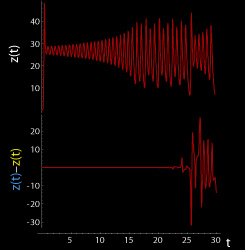
initial points that differ by only 10−5 in the x-coordinate. Initially, the two trajectories seem coincident, as indicated by the small difference between the z coordinate of the blue and yellow trajectories, but for t > 23
the difference is as large as the value of the trajectory. The final
position of the cones indicates that the two trajectories are no longer
coincident at t = 30.
A plot of Lorenz' strange attractor for values ρ=28, σ = 10, β = 8/3. The butterfly effect or sensitive dependence on initial conditions is the property of a dynamical system that, starting from any of various arbitrarily close alternative initial conditions on the attractor, the iterated points will become arbitrarily spread out from each other.
Recurrence,
the approximate return of a system toward its initial conditions,
together with sensitive dependence on initial conditions, are the two
main ingredients for chaotic motion. They have the practical consequence
of making complex systems, such as the weather,
difficult to predict past a certain time range (approximately a week in
the case of weather) since it is impossible to measure the starting
atmospheric conditions completely accurately.
A dynamical system
displays sensitive dependence on initial conditions if points
arbitrarily close together separate over time at an exponential rate.
The definition is not topological, but essentially metrical. Lorenz defined sensitive dependence as follows:
The property characterizing an orbit (i.e., a solution) if
most other orbits that pass close to it at some point do not remain
close to it as time advances.
If M is the state space for the map , then displays sensitive dependence to initial conditions if for any x in M and any δ > 0, there are y in M, with distance d(. , .) such that and such that
for some positive parameter a. The definition does not require that all points from a neighborhood separate from the base point x, but it requires one positive Lyapunov exponent. In addition to a positive Lyapunov exponent, boundedness is another major feature within chaotic systems.
The simplest mathematical framework exhibiting sensitive
dependence on initial conditions is provided by a particular
parametrization of the logistic map:
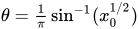
where the initial condition parameter is given by . For rational , after a finite number of iterations maps into a periodic sequence. But almost all are irrational, and, for irrational ,
never repeats itself – it is non-periodic. This solution equation
clearly demonstrates the two key features of chaos – stretching and
folding: the factor 2n shows the exponential growth of
stretching, which results in sensitive dependence on initial conditions
(the butterfly effect), while the squared sine function keeps folded within the range [0, 1].
In physical systems
In weather
Overview
The butterfly effect is most familiar in terms of weather; it can
easily be demonstrated in standard weather prediction models, for
example. The climate scientists James Annan and William Connolley
explain that chaos is important in the development of weather prediction
methods; models are sensitive to initial conditions. They add the
caveat: "Of course the existence of an unknown butterfly flapping its
wings has no direct bearing on weather forecasts, since it will take far
too long for such a small perturbation to grow to a significant size,
and we have many more immediate uncertainties to worry about. So the
direct impact of this phenomenon on weather prediction is often somewhat
wrong."
Differentiating types of butterfly effects
The concept of the butterfly effect encompasses several phenomena.
The two kinds of butterfly effects, including the sensitive dependence
on initial conditions, and the ability of a tiny perturbation to create an organized circulation at large distances, are not exactly the same. In Palmer et al., a new type of butterfly effect is introduced, highlighting the
potential impact of small-scale processes on finite predictability
within the Lorenz 1969 model. Additionally, the identification of
ill-conditioned aspects of the Lorenz 1969 model points to a practical
form of finite predictability. These two distinct mechanisms suggesting finite predictability in the
Lorenz 1969 model are collectively referred to as the third kind of
butterfly effect. The authors in have considered Palmer et al.'s suggestions and have aimed to present their perspective without raising specific contentions.
The third kind of butterfly effect with finite predictability, as discussed in, was primarily proposed based on a convergent geometric series, known as
Lorenz's and Lilly's formulas. Ongoing discussions are addressing the
validity of these two formulas for estimating predictability limits in.
A comparison of the two kinds of butterfly effects and the third kind of butterfly effect has been documented. In recent studies, it was reported that both meteorological and non-meteorological linear
models have shown that instability plays a role in producing a butterfly
effect, which is characterized by brief but significant exponential
growth resulting from a small disturbance.
Recent debates on butterfly effects
The first kind of butterfly effect (BE1), known as SDIC (Sensitive
Dependence on Initial Conditions), is widely recognized and demonstrated
through idealized chaotic models. However, opinions differ regarding
the second kind of butterfly effect, specifically the impact of a
butterfly flapping its wings on tornado formation, as indicated in two
2024 articles. In more recent discussions published by Physics Today, it is acknowledged that the second kind of butterfly effect (BE2) has
never been rigorously verified using a realistic weather model. While
the studies suggest that BE2 is unlikely in the real atmosphere,its invalidity in this context does not negate the applicability of BE1 in other areas, such as pandemics or historical events.
For the third kind of butterfly effect, the limited
predictability within the Lorenz 1969 model is explained by scale
interactions in one article and by system ill-conditioning in another more recent study.
Finite predictability in chaotic systems
According to Lighthill (1986), the presence of SDIC (commonly known as the butterfly effect) implies
that chaotic systems have a finite predictability limit. In a literature
review, it was found that Lorenz's perspective on the predictability limit can be condensed into the following statement:
(A). The Lorenz 1963 model qualitatively revealed the essence of
a finite predictability within a chaotic system such as the atmosphere.
However, it did not determine a precise limit for the predictability of
the atmosphere.
(B). In the 1960s, the two-week predictability limit was originally
estimated based on a doubling time of five days in real-world models.
Since then, this finding has been documented in Charney et al. (1966) and has become a consensus.
Recently, a short video has been created to present Lorenz's perspective on predictability limit.
A recent study refers to the two-week predictability limit,
initially calculated in the 1960s with the Mintz-Arakawa model's
five-day doubling time, as the "Predictability Limit Hypothesis." Inspired by Moore's Law, this term acknowledges the collaborative
contributions of Lorenz, Mintz, and Arakawa under Charney's leadership.
The hypothesis supports the investigation into extended-range
predictions using both partial differential equation (PDE)-based physics
methods and Artificial Intelligence (AI) techniques.
In quantum mechanics
The potential for sensitive dependence on initial conditions (the butterfly effect) has been studied in a number of cases in semiclassical and quantum physics, including atoms in strong fields and the anisotropic Kepler problem. Some authors have argued that extreme (exponential) dependence on
initial conditions is not expected in pure quantum treatments; however, the sensitive dependence on initial conditions demonstrated in
classical motion is included in the semiclassical treatments developed
by Martin Gutzwiller and John B. Delos and co-workers. The random matrix theory and simulations with quantum computers prove
that some versions of the butterfly effect in quantum mechanics do not
exist.
Other authors suggest that the butterfly effect can be observed
in quantum systems. Zbyszek P. Karkuszewski et al. consider the time
evolution of quantum systems which have slightly different Hamiltonians. They investigate the level of sensitivity of quantum systems to small changes in their given Hamiltonians. David Poulin et al. presented a quantum algorithm to measure fidelity
decay, which "measures the rate at which identical initial states
diverge when subjected to slightly different dynamics". They consider
fidelity decay to be "the closest quantum analog to the (purely
classical) butterfly effect". Whereas the classical butterfly effect considers the effect of a small
change in the position and/or velocity of an object in a given Hamiltonian system,
the quantum butterfly effect considers the effect of a small change in
the Hamiltonian system with a given initial position and velocity. This quantum butterfly effect has been demonstrated experimentally. Quantum and semiclassical treatments of system sensitivity to initial conditions are known as quantum chaos.
The butterfly effect has appeared across media such as literature (for instance, A Sound of Thunder), films and television (such as The Simpsons), video games (such as Life Is Strange), webcomics (such as Homestuck), musical references (such as "Butterfly Effect" by Travis Scott), AI-driven expansive language models, and more.
In the late 18th and 19th centuries, the philosophy of humanism was a cornerstone of the Enlightenment. Human history was seen as a product of human thought and action, to be understood through the categories of "consciousness", "agency", "choice", "responsibility", "moral values". Human beings were viewed as possessing common essential features. From the belief in a universal moral core of humanity, it followed that all persons were inherently free and equal. For liberal humanists such as Immanuel Kant, the universal law of reason was a guide towards total emancipation from any kind of tyranny.
Criticism of humanism as over-idealistic began in the 19th century. For Friedrich Nietzsche, humanism was nothing more than an empty figure of speech – a secular version of theism. Max Stirner expressed a similar position in his book The Ego and Its Own, published several decades before Nietzsche's work. Nietzsche argues in Genealogy of Morals that human rights
exist as a means for the weak to constrain the strong; as such, they do
not facilitate the emancipation of life, but instead deny it.
The young Karl Marx is sometimes considered an antihumanist, as he rejected the idea of human rights as a symptom of the very dehumanization they were intended to oppose. Given that capitalism
forces individuals to behave in an egoistic manner, they are in
constant conflict with one another, and are thus in need of rights to
protect themselves. True emancipation, he asserted, could only come
through the establishment of communism, which abolishes private property. According to many anti-humanists, such as Louis Althusser,
mature Marx sees the idea of "humanity" as an unreal abstraction that
masks conflicts between antagonistic classes; since human rights are
abstract, the justice and equality they protect is also abstract,
permitting extreme inequalities in reality.
In the 20th century, the view of humans as rationally autonomous was challenged by Sigmund Freud, who believed humans to be largely driven by unconscious irrational desires.
Martin Heidegger
viewed humanism as a metaphysical philosophy that ascribes to humanity a
universal essence and privileges it above all other forms of existence.
For Heidegger, humanism takes consciousness as the paradigm of philosophy, leading it to a subjectivism and idealism that must be avoided. Like Hegel before him, Heidegger rejected the Kantian notion of autonomy,
pointing out that humans were social and historical beings, as well as
rejecting Kant's notion of a constituting consciousness. In Heidegger's
philosophy, Being (Sein) and human Being (Dasein) are a
primary unity. Dualisms of subject and object, consciousness and being,
humanity and nature are inauthentic derivations from this. In the Letter on Humanism (1947), Heidegger distances himself from both humanism and existentialism.
He argues that existentialism does not overcome metaphysics, as it
merely reverses the basic metaphysical tenet that essence precedes
existence. These metaphysical categories must instead be dismantled.
Positivism and scientism
Positivism is a philosophy of science based on the view that in the social as well as natural sciences, information derived from sensory experience, and logical and mathematical treatments of such data, are together the exclusive source of all authoritative knowledge. Positivism assumes that there is valid knowledge (truth) only in scientific knowledge. Obtaining and verifying data that can be received from the senses is known as empirical evidence. This view holds that society operates according to general laws that
dictate the existence and interaction of ontologically real objects in
the physical world. Introspective and intuitional attempts to gain
knowledge are rejected. Though the positivist approach has been a
recurrent theme in the history of Western thought, the concept was developed in the modern sense in the early 19th century by the philosopher and founding sociologist, Auguste Comte (1798-1857). Comte argued that society operates according to its own quasi-absolute
laws, much as the physical world operates according to gravity and other
absolute laws of nature.
Humanist thinker Tzvetan Todorov (1939-2017) identified within modernity a trend of thought which emphasizes science and within it tends towards a deterministic view of the world. He clearly identifies positivist theorist Auguste Comte as an important proponent of this view. For Todorov,
"Scientism
does not eliminate the will but decides that since the results of
science are valid for everyone, this will must be something shared, not
individual. In practice, the individual must submit to the collectivity,
which 'knows' better than he does. The autonomy of the will is
maintained, but it is the will of the group, not the person
[…] scientism has flourished in two very different political contexts
[…] The first variant of scientism was put into practice by totalitarian regimes."
A similar approach emerges in the work associated with the Frankfurt School of social research. Antipositivism would be further facilitated by rejections of scientism; or science as ideology. Jürgen Habermas argues, in his On the Logic of the Social Sciences (1967), that
"the positivist thesis of unified
science, which assimilates all the sciences to a natural-scientific
model, fails because of the intimate relationship between the social
sciences and history, and the fact that they are based on a
situation-specific understanding of meaning that can be explicated only hermeneutically ... access to a symbolically prestructured reality cannot be gained by observation alone."
Structuralism
Structuralism was developed in post-war Paris as a response to the perceived contradiction between the free subject of philosophy and the determined subject of the human sciences. It drew on the systematic linguistics of Ferdinand de Saussure for a view of language and culture as a conventional system of signs preceding the individual subject's entry into them. In the study of linguistics the structuralists saw an objectivity and
scientificity that contrasted with the humanist emphasis on creativity,
freedom and purpose.
Saussure held that individual units of linguistic signification -
signs - only enjoy their individuality and their power to signify by
virtue of their contrasts or oppositions with other units in the same
symbolic system. For Saussure, the sign is a mysterious unification of a
sound and a thought. Nothing links the two: each sound and thought is
in principle exchangeable for other sounds or concepts. A sign is only
significant as a result of the total system in which it functions. To communicate by particular forms of speech and action (parole) is itself to presuppose a general body of rules (langue).
The concrete piece of behaviour and the system that enables it to mean
something mutually entail each other. The very act of identifying what
they say already implies structures. Signs are thus not at the service
of a subject; they do not pre-exist the relations of difference between
them. We cannot seek an exit from this purely relational system. The
individual is always subordinate to the code. Linguistic study must
abstract from the subjective physical, physiological and psychological
aspects of language to concentrate on langue as a self-contained whole.
The structuralist anthropologistClaude Levi-Strauss proclaimed that the goal of the human sciences was "not to constitute, but to dissolve man". He systematised a structuralist analysis of culture that incorporated
ideas and methods from Saussure's model of language as a system of
signifiers and signifieds. His work employed Saussurean technical terms
such as langue and parole, as well as the distinction
between synchronic analysis (abstracting a system as if it were
timeless) and diachronic analysis (where temporal duration is factored
in). He paid little attention to the individual and instead concentrated
on systems of signs as they operated in primitive societies. For
Levi-Strauss, cultural choice was always pre-constrained by a signifying
convention. Everything in experience was matter for communication codes. The
structure of this system was not devised by anyone and was not present
in the minds of its users, but nonetheless could be discerned by a
scientific observer.
The semiological work of Roland Barthes (1977) decried the cult of the author and indeed proclaimed his death.
Jacques Lacan's reformulation of psychoanalysis
based on linguistics inevitably led to a similar diminishment of the
concept of the autonomous individual: "man with a discourse on freedom
which must certainly be called delusional...produced as it is by an
animal at the mercy of language". According to Lacan, an individual is not born human but only becomes so
through incorporation into a cultural order that Lacan terms The Symbolic. Access to this order proceeds by way of a "mirror stage", where a child models itself upon its own reflection in a mirror. Language allows us to impose order on our desires at this "Imaginary" stage of development. The unconscious,
which exists prior to this Symbolic Order, must submit to the Symbolic
Law. Since the unconscious is only accessible to the psychoanalyst in
language, the most he or she can do is decode the conscious statements
of the patient. This decoding can only take place within a signifying
chain; the signified of unconscious discourse remains unattainable. It
resides in a pre-signified dimension inaccessible to language that Lacan
calls "The Real". From this, it follows that it is impossible to express subjectivity. Conscious discourse is the effect of a meaning beyond the reach of a speaking subject. The ego is a fiction that covers over a series of effects arrived at independently of the mind itself.
Taking a lead from Brecht's twin attack on bourgeoisand socialist humanism, structural MarxistLouis Althusser used the term "antihumanism" in an attack against Marxist humanists, whose position he considered a revisionist movement. He believed humanism to be a bourgeois individualist philosophy that posits a "human essence" through which there is potential for authenticity and common human purpose. This essence does not exist: it is a formal structure of thought whose
content is determined by the dominant interests of each historical
epoch. Socialist humanism is similarly an ethical and thus ideological
phenomenon. Since its argument rests on a moral and ethical basis, it
reflects the reality of exploitation and discrimination that gives rise
to it but never truly grasps this reality in thought. Marxist theory
must go beyond this to a scientific analysis that directs to underlying
forces such as economic relations and social institutions.
Althusser considered "structure" and "social relations" to have primacy over individual consciousness, opposing the philosophy of the subject. For Althusser, individuals are not constitutive of the social process, but are instead its supports or effects. Society constructs the individual in its own image through its ideologies:
the beliefs, desires, preferences and judgements of the human
individual are the effects of social practices. Where Marxist humanists
such as Georg Lukács believed revolution was contingent on the development of the class consciousness of an historical subject - the proletariat - Althusser's antihumanism removed the role of human agency; history was a process without a subject.
Post-structuralism
Post-structuralistJacques Derrida
continued structuralism's focus on language as key to understanding all
aspects of individual and social being, as well as its problematization
of the human subject, but rejected its commitment to scientific
objectivity. Derrida argued that if signs of language are only significant by virtue
of their relations of difference with all other signs in the same
system, then meaning is based purely on the play of differences, and is
never truly present. He claimed that the fundamentally ambiguous nature of language makes
human intention unknowable, attacked Enlightenment perfectionism, and
condemned as futile the existentialist quest for authenticity in the
face of the all-embracing network of signs. The world itself is text; a
reference to a pure meaning prior to language cannot be expressed in it. As he stressed, "the subject is not some meta-linguistic substance or identity, some pure cogito of self-presence; it is always inscribed in language".
Michel Foucault challenged the foundational aspects of Enlightenment humanism. He rejected absolute categories of epistemology
(truth or certainty) and philosophical anthropology (the subject,
influence, tradition, class consciousness), in a manner not unlike
Nietzsche's earlier dismissal of the categories of reason, morality,
spirit, ego, motivation as philosophical substitutes for God. Foucault argued that modern values either produced counter-emancipatory
results directly, or matched increased "freedom" with increased and
disciplinary normatization. His anti-humanist skepticism extended to attempts to ground theory in
human feeling, as much as in human reason, maintaining that both were
historically contingent constructs, rather than the universals humanism
maintained. In The Archaeology of Knowledge,
Foucault dismissed history as "humanist anthropology". The methodology
of his work focused not on the reality that lies behind the categories
of "insanity", "criminality", "delinquency" and "sexuality", but on how
these ideas were constructed by discourses.
Cultural examples
The heroine of the novel Nice Work
begins by defining herself as a semiotic materialist, "a subject
position in an infinite web of discourses – the discourses of power,
sex, family, science, religion, poetry, etc." Charged with taking a bleak deterministic view, she retorts,
"antihumanist, yes; inhuman, no...the truly determined subject is he who
is not aware of the discursive formations that determine him". However, with greater life-experience, she comes closer to accepting
that post-structuralism is an intriguing philosophical game, but
probably meaningless to those who have not yet even gained awareness of
humanism itself.
Universal basic income (UBI) is a social welfare proposal in which all members of a given population regularly receive a minimum income in the form of an unconditional transfer payment, i.e., without a means test or need to perform work. In contrast, a guaranteed minimum income (GMI)
is paid only to those who do not already receive an income that is
enough to live on. A UBI would be received independently of any other
income. If the level is sufficient to meet a person's basic needs (i.e.,
at or above the poverty line), it is considered a full basic income; if it is less than that amount, it is called a partial basic income. As of 2025, no country has implemented a full UBI system, but two countries—Mongolia and Iran—have had a partial UBI in the past. There have been numerous pilot projects, and the idea is discussed in many countries. Some have labelled UBI as utopian due to its historical origin.
There are several welfare arrangements that can be considered
similar to basic income, although they are not unconditional. Many
countries have a system of child benefit, which is essentially a basic income for guardians of children. A pension
may be a basic income for retired persons. There are also quasi-basic
income programs that are limited to certain population groups or time
periods, like Bolsa Familia in Brazil, which is concentrated on the poor, or the Thamarat Program in Sudan, which was introduced by the transitional government to ease the effects of the economic crisis inherited from the Bashir regime. Likewise, the economic impact of the COVID-19 pandemic prompted some countries to send direct payments to its citizens. The Alaska Permanent Fund is a fund for all residents of the U.S. state of Alaska
which averages $1,600 annually (in 2019 currency), and is sometimes
described as the only example of a real basic income in practice. A negative income tax
(NIT) can be viewed as a basic income for certain income groups in
which citizens receive less and less money until this effect is reversed
the more a person earns.
Critics claim that a basic income at an appropriate level for all
citizens is not financially feasible, fear that the introduction of a
basic income would lead to fewer people working, and consider it
socially unjust that everyone should receive the same amount of money
regardless of their individual needs. Proponents say it is indeed
financeable, arguing that such a system, instead of many individual
means-tested social benefits, would eliminate more expensive social
administration and bureaucratic efforts, and expect that unattractive
jobs would have to be better paid and their working conditions improved
because there would have to be an incentive to do them when already
receiving an income, which would increase the willingness to work.
Advocates also argue that a basic income is fair because it ensures that
everyone has a sufficient financial basis to build on and less
financial pressure, thus allowing people to find work that suits their
interests and strengths.
Early examples of unconditional payments to citizens date back to
antiquity, and the first proposals to introduce a regular
unconditionally paid income for all citizens were developed and
disseminated between the 16th and 18th centuries. After the Industrial Revolution,
public awareness and support for the concept increased. At least since
the mid-20th century, basic income has repeatedly been the subject of
political debates. In the 21st century, several discussions are related
to the debate about basic income, including those concerning the automation of large parts of the human workforce through artificial intelligence (AI), and associated questions regarding the future of the necessity of work. A key issue in these debates is whether automation and AI will significantly reduce the number of available jobs
and whether a basic income could help prevent or alleviate such
problems by allowing everyone to benefit from a society's wealth, as
well as whether a UBI could be a stepping stone to a resource-based or post-scarcity economy.
Ancient Egypt had a strong, unified theocratic state that owned key parts of the Egyptian economy, including granaries that dispensed grain to the public during hard times.
In a 46 BC triumph, Roman general and dictator Julius Caesar gave each common Roman citizen 100 denarii. Following his assassination in 44 BC, Caesar's will left 300 sestertii (or 75 denarii) to each citizen. Trajan, emperor of Rome from 98 to 117 AD, personally gave 650 denarii (equivalent to perhaps US$430 in 2023) to all common Roman citizens who applied.
16th century
In his Utopia (1516), English statesman and philosopher Thomas More depicts a society in which every person receives a guaranteed income. In this book, basic income is proposed as an answer to the statement
"No penalty on earth will stop people from stealing, if it's their only
way of getting food", stating:
instead of inflicting these horrible punishments, it
would be far more to the point to provide everyone with some means of
livelihood, so that nobody's under the frightful necessity of becoming
first a thief, and then a corpse.
Spanish scholar Johannes Ludovicus Vives
(1492–1540) proposed that the municipal government should be
responsible for securing a subsistence minimum to all its residents "not
on the grounds of justice but for the sake of a more effective exercise
of morally required charity." Vives also argued that to qualify for
poor relief, the recipient must "deserve the help he or she gets by
proving his or her willingness to work."
18th century
English-born American philosopher Thomas Paine authored Common Sense (1776) and The American Crisis (1776–1783), the two most influential pamphlets at the start of the American Revolution. His essay, Agrarian Justice, was published in 1797. In it, he proposed concrete reforms to abolish
poverty. In particular, he proposed a universal social insurance system
comprising old-age pensions and disability support, and universal
stakeholder grants for young adults, funded by a 10% inheritance tax
focused on land, it is also considered one of the earliest proposals for
a social security
system. Thomas Paine summarized his view by stating that "Men did not
make the earth. It is the value of the improvements only, and not the
earth itself, that is individual property. Every proprietor owes to the
community a ground rent for the land which he holds." Paine saw
inheritance as being partly a common fund and wanted to supplement the
citizen's dividend in a tax on inheritance transfers.
In 1797, English RadicalThomas Spence published The Rights of Infants as a response to Thomas Paine's Agrarian Justice.
In this essay Spence proposes the introduction of an unconditional
basic income to all members of the community. Such allowance would be
financed through the socialization
of land and the benefits of the rents received by each municipality. A
part of everyone's earnings would be seized by the State, and given to
others.
19th century
Henry George
proposed to create a pension and disability system, and a broad social
support system from a single tax on land and natural resource value.
Social support would be distributed to residents "as a right" instead of
as charity. George mentioned, but did not stress, the possibility of
direct cash distribution of land rent. His ideas gave rise to the
economic philosophy now known as Georgism or the "single tax movement", which is an economic ideology holding that, although people should own the value they produce themselves, the economic rent derived from land—including from all natural resources, the commons, and urban locations—should belong equally to all members of society. Some Georgists refer to unconditional basic income funded by the single tax as a citizen's dividend in reference to Thomas Paine's proposal from the 19th century.
Early 20th century
Around 1920, support for basic income started growing, primarily in England.
Bertrand Russell
(1872–1970) argued for a new social model that combined the advantages
of socialism and anarchism, and that basic income should be a vital
component in that new society. In his 1918 book Roads to Freedom,
Russell wrote "... the plan we are advocating amounts essentially to
this: that a certain small income, sufficient for necessaries, should be
secured to all, whether they work or not, and that a larger income – as
much larger as might be warranted by the total amount of commodities
produced – should be given to those who are willing to engage in some
work which the community recognizes as useful..."
In the United Kingdom at the end of World War I, Dennis and Mabel
Milner, a Quaker married couple of the Labour Party, published a short
pamphlet entitled "Scheme for a State Bonus" (1918) that argued for the
"introduction of an income paid unconditionally on a weekly basis to all
citizens of the United Kingdom." They considered it a moral right for
everyone to have the means to subsistence, and thus it should not be
conditional on work or willingness to work.
C. H. Douglas
was an engineer who became concerned that most British citizens could
not afford to buy the goods that were produced, despite the rising
productivity in British industry. His solution to this paradox was a new
social system he called social credit, a combination of monetary reform and basic income.
In 1944 and 1945, the Beveridge Committee, led by the British economist William Beveridge,
developed a proposal for a comprehensive new welfare system of social
insurance, means-tested benefits, and unconditional allowances for
children. Committee member Lady Rhys-Williams
argued that the incomes for adults should be more like a basic income.
She was also the first to develop the negative income tax model. Her son Sir Brandon Rhys-Williams
proposed a basic income to a parliamentary committee in 1982, and soon
after that in 1984, the Basic Income Research Group, now the Citizen's
Basic Income Trust, began to conduct and disseminate research on basic
income.
Late 20th century
Milton Friedman proposed a negative income tax (NIT), which effectively sanctioned a basic income for all, in his 1962 book Capitalism and Freedom. In his 1964 State of the Union address, U.S. President Lyndon B. Johnson declared an "unconditional war on poverty," implemented in coming years with sweeping legislation. Johnson broadened the agenda to the Great Society, including education, civil rights, health care, and support for the arts. In this political climate, the idea of a guaranteed income for every American also took root. Notably, a 1968 document, signed by 1200 economists, called for a guaranteed income for every American. Four ambitious basic income experiments started on the related concept of negative income tax. President Richard Nixon explained the Family Assistance Plan's purpose as to provide both a safety net for the poor and a financial incentive for welfare recipients to work. Congress eventually approved a guaranteed minimum income for the elderly and the disabled.
In the mid-1970s, the main competitor to basic income and negative income tax, the Earned income tax credit (EITC) and its advocates won over enough legislators for the US Congress to pass laws on that policy. In 1986, the Basic Income European Network (later renamed the Basic Income Earth Network (BIEN)) was founded, with academic conferences every second year. Other advocates included the green political movement, other activists, and some groups of unemployed people.
In the late 20th century, discussions were held around automatization and jobless growth, the possibility of combining economic growth with ecologically
sustainable development, and how to reform the welfare state
bureaucracy. Basic income was interwoven in these and many other debates. During the BIEN academic conferences, scholars published papers about basic income from a wide variety of perspectives.
In recent years, the idea has come to the forefront more than before. The Swiss referendum about basic income in 2016 was covered in media worldwide, despite its rejection. Famous business people like Elon Musk, Pierre Omidyar, and Andrew Yang have lent their support, as have high-profile politicians like Jeremy Corbyn and Tulsi Gabbard. The Institute for Public Policy Research predicted that 59% of tasks
currently done by humans could be affected by AI in the next three to
five years. Universal basic Income could help fill the gap left by this
"jobs apocalypse."
In 2019-2021, in Stockton, California, then-Mayor Michael Tubbs
initiated a 24-month pilot program of guaranteed income for 125
residents as part of the privately funded S.E.E.D. project there.
In the 2020 Democratic Party primaries, political newcomer Andrew
Yang touted basic income as his core policy. His policy, referred to as
a "Freedom Dividend", would have provided adult American citizens US$1,000 a month independent of employment status.
On 21 January 2021, in California, the two-year donor-funded Compton Pledge began distributing monthly guaranteed income payments to a "pre-verified" pool of low-income residents, in a program gauged for a maximum of 800 recipients, at which point it
would be one of the larger among 25 U.S. cities exploring this approach
to community economics.
Beginning in December 2021, Tacoma, Washington,
piloted "Growing Resilience in Tacoma" (GRIT), a guaranteed income
initiative that provided $500 a month to 110 families. GRIT is part of
the University of Pennsylvania's Center for Guaranteed Income Research larger study. A report on the results of the GRIT experiment was published in 2024.
Response to COVID-19
As a response to the COVID-19 pandemic and its economic impact, universal basic income and similar proposals such as helicopter money and cash transfers were increasingly discussed across the world. Most countries implemented forms of partial unemployment schemes, which
effectively subsidized workers' incomes without a work requirement.
Around ninety countries and regions including the United States, Spain,
Hong Kong, and Japan introduced temporary direct cash transfer programs
to their citizens.
In Europe, a petition calling for an "emergency basic income" gathered more than 200,000 signatures, and polls suggested widespread support in public opinion for it. Unlike the various stimulus packages of the US administration, the EU's
stimulus plans did not include any form of income-support policies.
Two
ways of looking at basic income when combined with a flat income tax,
both of which result in the same net income (orange line): 1. (red)
stipend with conventional tax for income above the stipend. 2. (blue)
negative tax for low-income people and conventional tax for high-income
people.
The associated diagram shows a basic income/negative tax system combined with flat income tax (the same percentage in tax for every income level). Axis y is here the pre-tax salary given by the employer and y' is the net income.
Negative income tax
For low earnings, there is no income tax in the negative income
tax system. They receive money, in the form of a negative income tax,
but they do not pay any tax. Then, as their labour income increases,
this benefit, this money from the state, gradually decreases. That
decrease is to be seen as a mechanism for the poor, instead of the poor
paying tax.
Basic income
That is, however, not the case in the corresponding basic income
system in the diagram at right. There, everyone typically pays income
taxes. But on the other hand, everyone also gets the same amount of
basic income.
But the net income is the same
But, as the orange line in the diagram shows, the net income is
anyway the same. No matter how much or how little one earns, the amount
of money received is the same, regardless of which of these two systems
are used.
Basic income and negative income tax are generally seen to be similar in economic net effects, but there are some differences:
Psychological. Philip Harvey accepts that "both systems
would have the same redistributive effect and tax earned income at the
same marginal rate" but does not agree that "the two systems would be
perceived by taxpayers as costing the same".
Tax profile. Tony Atkinson made a distinction based on whether the tax profile was flat (for basic income) or variable (for NIT).
Timing. Philippe Van Parijs
states that "the economic equivalence between the two programs should
not hide the fact that they have different effects on recipients because
of the different timing of payments: ex-ante in Basic Income, ex-post in Negative Income Tax".
Perspectives and arguments
Automation
There is a prevailing opinion that we are in an era of technological
unemployment – that technology is increasingly making skilled workers
obsolete.
Prof. Mark MacCarthy (2014)
One central rationale for basic income is the belief that automation and robotisation could result in technological unemployment, leading to a world with fewer paid jobs.
A key question in this context is whether a basic income could help
prevent or alleviate such problems by allowing everyone to benefit from a
society's wealth, as well as whether a UBI could be a stepping stone to
a resource-based or post-scarcity economy.
U.S. presidential candidate and nonprofit founder Andrew Yang has stated that automation caused the loss of 4 million manufacturing jobs and advocated for a UBI (which he calls a Freedom Dividend) of $1,000/month rather than worker retraining programs. Yang has stated that he is influenced by Martin Ford.
Ford believes that the emerging technologies will fail to deliver much
employment; on the contrary, because the new industries will "rarely, if
ever, be highly labor-intensive". Similar ideas have been debated before in history—that "the machines
will take the jobs". What is new is the existence of several academic
studies that forecast a future with substantially less employment, in
the decades to come. Additionally, US President Barack Obama
stated that he believes that the growth of artificial intelligence will
lead to an increased discussion around the idea of "unconditional free
money for everyone".
Some proponents of UBI have argued that basic income could increase
economic growth because it would sustain people while they invest in
education to get higher-skilled and well-paid jobs.However, there is also a discussion of basic income within the degrowth movement, which argues against economic growth.
Advocates contend that the guaranteed financial security of a UBI will increase the population's willingness to take risks, which would create a culture of inventiveness and strengthen entrepreneurial spirit.
The cost of a basic income is one of the biggest questions in the
public debate as well as in the research and depends on many things. It
first and foremost depends on the level of the basic income as such,
and it also depends on many technical points regarding exactly how it is
constructed.
While opponents claim that a basic income at an adequate level
for all citizens cannot be financed, their supporters propose that it
could indeed be financed, with some advocating a strong redistribution and restructuring of bureaucracy and administration for this purpose.
According to statements of American Enterprise Institute-affiliated Libertarian/conservative scholar Charles Murray, recalled and sanctioned in 2016 by the George Gibbs Chair in Political Economy and Senior Research Fellow at the Mercatus Center at George Mason University and nationally syndicated columnist Veronique de Rugy, as of 2014, the annual cost of a UBI in the US would
have been about $200 billion less expensive than the US social
safety-net system put in place at that date. By 2020, it would have been nearly a trillion dollars less expensive.
American economist Karl Widerquist
argues that simply multiplying the amount of the grant by the
population would be a naive calculation, as this is the gross costs of
UBI and does not take into account that UBI is a system where people pay
taxes on a regular basis and receive the grant at the same time.
According to Swiss economist Thomas Straubhaar,
the concept of UBI is basically financeable without any problems. He
describes it as "at its core, nothing more than a fundamental tax
reform" that "bundles all social policy measures into a single
instrument, the basic income paid out unconditionally." He also considers a universal basic income to be socially just, arguing
that although all citizens would receive the same amount in the form of
the basic income at the beginning of the month, the rich would have
lost significantly more money through taxes at the end of the month than
they would have received through the basic income, while the opposite
is the case for poorer people, similar to the concept of a negative
income tax.
Recent theoretical work has introduced alternative mathematical
approaches to the allocation of basic income. One such example is the Boltzmann fair division model, which applies the Boltzmann distribution from statistical mechanics to resource or income allocation. In this framework, each individual's share is assigned
probabilistically according to an exponential function of a specified
attribute (such as need or contribution), providing a flexible mechanism
to balance fairness and efficiency in basic income distribution.
Inflation of labor and rental costs
One of the most common arguments against UBI stems from the upward
pressure on prices, in particular for labor and housing rents, which
would likely cause inflation. Public policy choices such as rent controls or land value taxation
would likely affect the inflationary potential of universal basic
income.
Work
Many critics of basic income argue that people, in general, will work
less, which in turn means less tax revenue and less money for the state
and local governments. Studies include:
In negative income tax experiments in the United States in 1970,
there was a five percent decline in the hours worked. The work
reduction was largest for second earners in two-earner households and
weakest for primary earners. The reduction in hours was higher when the
benefit was higher.
In the Mincome
experiment in rural Dauphin, Manitoba, also in the 1970s, there were
slight reductions in hours worked during the experiment. However, the
only two groups who worked significantly less were new mothers, and
teenagers working to support their families. New mothers spent this time
with their infant children, and working teenagers put significant
additional time into their schooling.
A 2024 study investigated the impact of $1,000/month UBI over a
period of 3 years for 1,000 randomized low-income participants in two
U.S. states, which represented an around 40% increase in household
income. The study found an income effect
with a decrease of non-UBI income by $1,500/year, a decrease in non-UBI
household income by 21% of the UBI transfer, a 2% decrease in labor
market participation, no significant change in time spent on childcare,
no self-reported decrease in barriers to employment, a null result
for changes in job quality, an increase in entrepreneurial orientation
but no significant change in entrepreneurial activity, while enrollment
in tertiary education showed a slight increase for participants below 30 years of age.
Although it is difficult to know for sure what will happen if a whole
country introduces basic income, there are nevertheless some studies
that have attempted to look at this question:
A study from 2017 showed no evidence that people worked less because of the Iranian subsidy reform (a basic income reform).
Regarding the question of basic income vs jobs, there is also the aspect of so-called welfare traps.
Proponents of basic income often argue that with a basic income,
unattractive jobs would necessarily have to be better paid and their
working conditions improved, so that people still do them without need,
reducing these traps.
By definition, universal basic income does not make a distinction
between "deserving" and "undeserving" individuals when making payments.
Opponents argue that this lack of discrimination is unfair: "Those who
genuinely choose idleness or unproductive activities cannot expect those
who have committed to doing productive work to subsidize their
livelihood. Responsibility is central to fairness."
Proponents usually view UBI as a fundamental human right that enables an adequate standard of living which every citizen should have access to in modern society. It would be a kind of foundation guaranteed for everyone, on which one could build and never fall below that subsistence level.
It is also argued that this lack of discrimination between those
who supposedly deserve it and those who do not is a way to reduce social stigma.
In addition, proponents of UBI may argue that the "deserving" and
"undeserving" categories are a superficial classification, as people
who are not in regular gainful employment also contribute to society,
e.g. by raising children, caring for people, or doing other
value-creating activities which are not institutionalized. UBI would
provide a balance here and thus overcomes a concept of work that is
reduced to pure gainful employment and disregards sideline activities
too much.
The
first comprehensive systematic review of the health impact of basic
income (or rather unconditional cash transfers in general) in low- and
middle-income countries, a study that included 21 studies of which 16
were randomized controlled trials, found a clinically meaningful
reduction in the likelihood of being sick by an estimated 27%.
Unconditional cash transfers, according to the study, may also improve
food security and dietary diversity. Children in recipient families are
also more likely to attend school and the cash transfers may increase
money spent on health care. A 2022 update of this review confirmed these findings based on a body of evidence (35 studies, the majority being large randomized controlled trials) and additionally found that unconditional cash transfers also reduce the likelihood of living in extreme poverty.
The Canadian Medical Association passed a motion in 2015 in support of basic income and for basic income trials in Canada.
Omitara, one of the two poor villages in Namibia where a local basic income was tested in 2008–2009
Since the 1960s, but in particular since the late 2000s, several
pilot programs and experiments on basic income have been conducted
around the world. Some examples include:
1960s−1970s
Experiments with negative income tax in the United States and Canada in the 1960s and 1970s.
The province of Manitoba, Canada experimented with Mincome, a basic guaranteed income, in the 1970s. In the town of Dauphin,
Manitoba, labor decreased by 13%, less than expected. This program was
ended after issues with the cost becoming unsustainable started to
arise.
2000−2009
The basic income grant in Namibia launched in 2008 and ended in 2009.
An independent pilot implemented in São Paulo, Brazil launched in 2009.
2010−2019
Basic income trials ran in 2011–2012 in several villages in India, whose government has proposed a guaranteed basic income for all citizens. It was found that basic income in the region raised the education rate of young people by 25%.
Iran became the first country to introduce a system of UBI in December 2010. It was paid to all citizens and replaced the gasoline subsidies, electricity, and some food, that the country applied for years to reduce inequalities and poverty.
The sum corresponded in 2012 to approximately US$40 per person per
month, US$480 per year for a single person, and US$2,300 for a family of
five people.
In Spain, the ingreso mínimo vital, the income guarantee system, is an economic benefit guaranteed by the social security in Spain, but in 2016 was considered in need of reform.
In South Korea the Youth Allowance Program was started in 2016 in the City of Seongnam, which would give every 24-year-old citizen 250,000 won
(~US$215) every quarter in the form of a "local currency" that could
only be used in local businesses. This program was later expanded to the
entire province of Gyeonggi in 2018.
The GiveDirectly experiment in a disadvantaged village of Nairobi, Kenya,
benefitting over 20,000 people living in rural Kenya, was the
longest-running basic income pilot as of November 2017, which is set to
run for 12 years.
A project called Eight in a village in Fort Portal, Uganda, was launched by a nonprofit organization in January 2017, providing income for 56 adults and 88 children through mobile money.
A two-year pilot the Finnish government began in January 2017 involved 2,000 subjects. In April 2018, the Finnish government rejected a request for funds to extend and expand the program from Kela (Finland's social security agency).
An experiment in the city of Utrecht, Netherlands launched in early 2017, that is testing different rates of aid.
A three-year basic income pilot that the Ontario provincial government, Canada, launched in the cities of Hamilton, Thunder Bay and Lindsay in July 2017. Although called basic income, it was only made available to those with a
low income and funding would be removed if they obtained employment, making it more related to the current welfare system than true basic
income. The pilot project was canceled on 31 July 2018 by the newly
elected Progressive Conservative government under Ontario PremierDoug Ford.
In Israel, in 2018 a non-profit initiative GoodDollar started with
an objective to build a global economic framework for providing
universal, sustainable, and scalable basic income through the new
digital asset technology of blockchain.
The non-profit aims to launch a peer-to-peer money transfer network in
which money can be distributed to those most in need, regardless of
their location, based on the principles of UBI. The project raised
US$1 million from a financial company.
The Rythu Bandhu scheme is a welfare scheme started in the state of Telangana, India, in May 2018, aimed at helping farmers. Each farm owner receives 4,000 INR per acre twice a year for rabi and kharif
harvests. To finance the program a budget allocation of 120 billion INR
(US$1.55 Billion as of May 2022) was made in the 2018–2019 state
budget.
2020−present
Swiss non-profit Social Income started paying out basic incomes in the form of mobile money in 2020 to people in need in Sierra Leone. Contributions finance the international initiative from people worldwide, who donate 1% of their monthly paychecks.
In May 2020, Spain introduced a minimum basic income, reaching about
2% of the population, in response to COVID-19 in order to "fight a
spike in poverty due to the coronavirus pandemic". It was expected to
cost state coffers three billion euros ($3.5 billion) a year."
In August 2020, a project in Germany started that gives a €1,200 monthly basic income in a lottery system to citizens who applied online. The crowdsourced project lasted three years and be compared against 1,380 people who do not receive basic income. When the project was finished in August 2023, Mein Grundeinkommen
calculated that a tax-financed universal basic income of €1,200 per
month could be financed for every adult in Germany that would make 80%
of adults better off.
In October 2020, HudsonUP was launched in Hudson, New York, by The Spark of Hudson and Humanity Forward Foundation to give $500 monthly basic income to 25 residents. It will last five
years and be compared against 50 people who are not receiving basic
income.
In May 2021, the government of Wales,
which has devolved powers in matters of Social Welfare within the UK,
announced the trialling of a universal basic income scheme to "see
whether the promises that basic income holds out are genuinely
delivered". From July 2022 over 500 people leaving care in Wales were offered £1600
per month in a 3-year £20 million pilot scheme, to evaluate the effect
on the lives of those involved in the hope of providing independence and
security to people.
In July 2022, Chicago
began a year-long guaranteed income program by sending $500 a month to
5,000 households for one year in a lottery system to citizens who
applied online. A similar program was launched in late 2022 by Cook County, Illinois
(which encompasses the entirety of Chicago as well as several suburbs)
which sent monthly $500 payments to 3,250 residents with a household
income at or below 250% of the federal poverty level for two years.
In June 2023, The Guardian reported that a universal basic income of £1,600 a month is to be trialled in two places in England – Jarrow and East Finchley.
In February 2025, South Korea announced a "farmers' opportunity
income" plan to be integrated into their basic income for farmers, and
deployed in 24 cities and counties of the Gyeonggi Province. An estimated 210,000 selected farmers and fishermen will receive either 1.8 million won annually or 50,000 won monthly.
In March 2025, the Government of Delhi in India approved the "Mahila Samridhi Yojana" plan, under which eligible women would receive a monthly allowance of ₹2,500, based on financial status for women below the poverty line.
In November 2025, the government of Marshall Islands
introduced a national universal basic income scheme under which every
resident citizen receives quarterly payments of about US$200. It is
financed by a trust fund created under an agreement with the United States, which in part aims to compensate the Marshall Islands for nuclear testing there. The fund holds more than $1.3bn in assets, with the USA committing a further $500m through to 2027.
The Permanent Fund of Alaska in the United States provides a kind of
yearly basic income based on the oil and gas revenues of the state to
nearly all state residents. More precisely the fund resembles a sovereign wealth fund, investing resource revenues into bonds, stocks,
and other conservative investment options with the intent to generate
renewable revenue for future generations. The fund has had a noticeable
yet diminishing effect on reducing poverty among rural Alaska Indigenous
people, notably in the elderly population. However, the payment is not high enough to cover basic expenses, averaging $1,600 annually per resident in 2019 currency (As of 2019
it has never exceeded $2,100), and is not a fixed, guaranteed amount.
For these reasons, it is not always considered a basic income. However,
some consider it to be the only example of a real basic income.
Macau's
Wealth Partaking Scheme provides some annual basic income to permanent
residents, funded by revenues from the city's casinos. However, the
amount disbursed is not sufficient to cover basic living expenses, so it
is not considered a basic income.
Bolsa Família is a large social welfare program in Brazil that
provides money to many low-income families in the country. The system is
related to basic income, but has more conditions, like asking the
recipients to keep their children in school until graduation. As of
March 2020, the program covers 13.8 million families, and pays an
average of $34 per month, in a country where the minimum wage is $190 per month.
Eastern Band of Cherokee Indians
The Eastern Band of Cherokee Indians (ECBI) opened Harrah's Cherokee
Casino in 1997 and it has generated jobs and revenue for the tribe,
providing money that the EBCI applies to its people's education, welfare
and culture. Each member of the tribe is paid an annual income that
started at $500 and has increased to $10,000 as of 2015.
Other welfare programs
Pension: A payment that in some countries is guaranteed to all
citizens above a certain age. The difference from true basic income is
that it is restricted to people over a certain age.
Child benefit: A program similar to pensions but restricted to parents of children, usually allocated based on the number of children.
Conditional cash transfer:
A regular payment given to families, but only to the poor. It is
usually dependent on basic conditions such as sending their children to
school or having them vaccinated. Programs include Bolsa Família in Brazil and Programa Prospera in Mexico.
2008: An official petition for basic income was launched in Germany by Susanne Wiest. The petition was accepted, and Susanne Wiest was invited for a hearing
at the German parliament's Commission of Petitions. After the hearing,
the petition was closed as "unrealizable".
2015: A citizen's initiative in Spain received 185,000 signatures,
short of the required number to mandate that the Spanish parliament
discuss the proposal.
2016: The world's first universal basic income referendum in Switzerland on 5 June 2016 was rejected with a 76.9% majority. Also in 2016, a poll showed that 58% of the EU's population were aware
of basic income, and 64% would have voted in favour of the idea.
2017: Politico/Morning Consult asked 1,994 Americans about
their opinions on several political issues including national basic
income; 43% either "strongly supported" or "somewhat supported" the
idea.
2018: The results of a poll by Gallup conducted last year between September and October were published. 48% of respondents supported universal basic income.
2019: In November, an Austrian initiative received approximately
70,000 signatures but failed to reach the 100,000 signatures needed for a
parliamentary discussion. The initiative was started by Peter Hofer.
His proposal suggested a basic income sourced from a financial
transaction tax, of €1,200, for every Austrian citizen.
2020: A study by Oxford University
found that 71% of Europeans were in favour of basic income. The study
was conducted in March, with 12,000 respondents and in 27 EU-member
states and the UK. A YouGov poll likewise found a majority for universal basic income in United Kingdom and a poll by University of Chicago found that 51% of Americans aged 18–36 supported a monthly basic income of $1,000. In the UK there was also a letter, signed by over 170 MPs and Lords from multiple political parties, calling on the government to introduce a universal basic income during the COVID-19 pandemic.
2020: A Pew Research Center
survey, conducted online in August 2020, of 11,000 U.S. adults found
that a majority (54%) opposed the federal government providing a
guaranteed income of $1,000 per month to all adults, while 45% supported
it.
2020: In a poll by Hill-HarrisX, 55% of Americans voted in favour of UBI in August, up from 49% in September 2019 and 43% in February 2019.
2020: The results of an online survey of 2,031 participants
conducted in 2018 in Germany were published: 51% were either "very much
in favor" or "in favor" of UBI being introduced.
2020: An October survey of 1,026 Australians by YouGov found a 58% support for universal basic income.
2021: A Change.org petition calling for monthly stimulus checks in the amount of $2,000 per adult and $1,000 per child for the remainder of the COVID-19 pandemic had received almost 3 million signatures.
.JPG)