Search This Blog

Thursday, February 19, 2026

Correlation does not imply causation

From Wikipedia, the free encyclopedia

The phrase "correlation does not imply causation" refers to the inability to legitimately deduce a cause-and-effect relationship between two events or variables solely on the basis of an observed association or correlation between them. The idea that "correlation implies causation" is an example of a questionable-cause logical fallacy, in which two events occurring together are taken to have established a cause-and-effect relationship. This fallacy is also known by the Latin phrase cum hoc ergo propter hoc ("with this, therefore because of this"). This differs from the fallacy known as post hoc ergo propter hoc ("after this, therefore because of this"), in which an event following another is seen as a necessary consequence of the former event, and from conflation, the errant merging of two events, ideas, databases, etc., into one.

As with any logical fallacy, identifying that the reasoning behind an argument is flawed does not necessarily imply that the resulting conclusion is false. Statistical methods have been proposed that use correlation as the basis for hypothesis tests for causality, including the Granger causality test and convergent cross mapping. The Bradford Hill criteria, also known as Hill's criteria for causation, are a group of nine principles that can be useful in considering the epidemiologic evidence of a causal relationship. Ultimately, assumptions are always required to draw causal conclusions, and modern causal inference frameworks focus on interrogating the strength of these assumptions.

Usage and meaning of terms

"Imply"

In casual use, the word "implies" loosely means suggests, rather than requires. However, in logic, the technical use of the word "implies" means "is a sufficient condition for." That is the meaning intended by statisticians when they say causation is not certain. Indeed, p implies q has the technical meaning of the material conditional: if p then q symbolized as p → q. That is, "if circumstance p is true, then q follows." In that sense, it is always correct to say "Correlation does not imply causation."

"Cause"

The word "cause" (or "causation") has multiple meanings in English. In philosophical terminology, "cause" can refer to necessary, sufficient, or contributing causes. In examining correlation, "cause" is most often used to mean "one contributing cause" (but not necessarily the only contributing cause).

Dinosaur illiteracy and extinction may be correlated, but that would not mean the variables had a causal relationship.

Causal analysis

Causal analysis is the field of experimental design and statistics pertaining to establishing cause and effect. Typically it involves establishing four elements: correlation, sequence in time (that is, causes must occur before their proposed effect), a plausible physical or information-theoretical mechanism for an observed effect to follow from a possible cause, and eliminating the possibility of common and alternative ("special") causes. Such analysis usually involves one or more controlled or natural experiments.

Causal inference

Causal inference is the process of determining the independent, actual effect of a particular phenomenon that is a component of a larger system. The main difference between causal inference and inference of association is that causal inference analyzes the response of an effect variable when a cause of the effect variable is changed.

The study of why things occur is called etiology, and can be described using the language of scientific causal notation. Causal inference is said to provide the evidence of causality theorized by causal reasoning. Causal inference is widely studied across all sciences. Several innovations in the development and implementation of methodology designed to determine causality have proliferated in recent decades. Causal inference remains especially difficult where experimentation is difficult or impossible, which is common throughout most sciences.

The approaches to causal inference are broadly applicable across all types of scientific disciplines, and many methods of causal inference that were designed for certain disciplines have found use in other disciplines. This article outlines the basic process behind causal inference and details some of the more conventional tests used across different disciplines; however, this should not be mistaken as a suggestion that these methods apply only to those disciplines, merely that they are the most commonly used in that discipline.

Causal inference is difficult to perform and there is significant debate amongst scientists about the proper way to determine causality. Despite other innovations, there remain concerns of misattribution by scientists of correlative results as causal, of the usage of incorrect methodologies by scientists, and of deliberate manipulation by scientists of analytical results in order to obtain statistically significant estimates. Particular concern is raised in the use of regression models, especially linear regression models.

Examples of illogically inferring causation from correlation

B causes A (reverse causation or reverse causality)

Reverse causation or reverse causality or wrong direction is an informal fallacy of questionable cause where cause and effect are reversed. The cause is said to be the effect and vice versa.

Example 1
The faster that windmills are observed to rotate, the more wind is observed.
Therefore, wind is caused by the rotation of windmills. (Or, simply put: windmills, as their name indicates, are machines used to produce wind.)

In this example, the correlation (simultaneity) between windmill activity and wind velocity does not imply that wind is caused by windmills. It is rather the other way around, as suggested by the fact that wind does not need windmills to exist, while windmills need wind to rotate. Wind can be observed in places where there are no windmills or non-rotating windmills—and there are good reasons to believe that wind existed before the invention of windmills.

Example 2
Low cholesterol is associated with an increase in mortality.
Therefore, low cholesterol increases your risk of mortality.

Causality is actually the other way around, since some diseases, such as cancer, cause low cholesterol due to a myriad of factors, such as weight loss, and they also cause an increase in mortality. This can also be seen in alcoholics. As alcoholics become diagnosed with cirrhosis of the liver, many quit drinking. However, they also experience an increased risk of mortality. In these instances, it is the diseases that cause an increased risk of mortality, but the increased mortality is attributed to the beneficial effects that follow the diagnosis, making healthy changes look unhealthy.

Example 3

In other cases it may simply be unclear which is the cause and which is the effect. For example:

Children that watch a lot of TV are the most violent. Clearly, TV makes children more violent.

This could easily be the other way round; that is, violent children like watching more TV than less violent ones.

Example 4

A correlation between recreational drug use and psychiatric disorders might be either way around: perhaps the drugs cause the disorders, or perhaps people use drugs to self medicate for preexisting conditions. Gateway drug theory may argue that marijuana usage leads to usage of harder drugs, but hard drug usage may lead to marijuana usage (see also confusion of the inverse). Indeed, in the social sciences where controlled experiments often cannot be used to discern the direction of causation, this fallacy can fuel long-standing scientific arguments. One such example can be found in education economics, between the screening/signaling and human capital models: it could either be that having innate ability enables one to complete an education, or that completing an education builds one's ability.

Example 5

A historical example of this is that Europeans in the Middle Ages believed that lice were beneficial to health since there would rarely be any lice on sick people. The reasoning was that the people got sick because the lice left. The real reason however is that lice are extremely sensitive to body temperature. A small increase of body temperature, such as in a fever, makes the lice look for another host. The medical thermometer had not yet been invented and so that increase in temperature was rarely noticed. Noticeable symptoms came later, which gave the impression that the lice had left before the person became sick.

In other cases, two phenomena can each be a partial cause of the other; consider poverty and lack of education, or procrastination and poor self-esteem. One making an argument based on these two phenomena must however be careful to avoid the fallacy of circular cause and consequence. Poverty is a cause of lack of education, but it is not the sole cause, and vice versa.

Third factor C (the common-causal variable) causes both A and B

The third-cause fallacy (also known as ignoring a common cause or questionable cause) is a logical fallacy in which a spurious relationship is confused for causation. It asserts that X causes Y when in reality, both X and Y are caused by Z. It is a variation on the post hoc ergo propter hoc fallacy and a member of the questionable cause group of fallacies.

All of those examples deal with a lurking variable, which is simply a hidden third variable that affects both of the variables observed to be correlated. That third variable is also known as a confounding variable, with the slight difference that confounding variables need not be hidden and may thus be corrected for in an analysis. Note that the Wikipedia link to lurking variable redirects to confounding. A difficulty often also arises where the third factor, though fundamentally different from A and B, is so closely related to A and/or B as to be confused with them or very difficult to scientifically disentangle from them (see Example 4).

Example 1
Sleeping with one's shoes on is strongly correlated with waking up with a headache.
Therefore, sleeping with one's shoes on causes headache.

The above example commits the correlation-implies-causation fallacy, as it prematurely concludes that sleeping with one's shoes on causes headache. A more plausible explanation is that both are caused by a third factor, in this case going to bed drunk, which thereby gives rise to a correlation. So the conclusion is false.

Example 2
Young children who sleep with the light on are much more likely to develop myopia in later life.
Therefore, sleeping with the light on causes myopia.

This is a scientific example that resulted from a study at the University of Pennsylvania Medical Center. Published in the May 13, 1999, issue of Nature, the study received much coverage at the time in the popular press. However, a later study at Ohio State University did not find that infants sleeping with the light on caused the development of myopia. It did find a strong link between parental myopia and the development of child myopia, also noting that myopic parents were more likely to leave a light on in their children's bedroom. In this case, the cause of both conditions is parental myopia, and the above-stated conclusion is false.

Example 3
As ice cream sales increase, the rate of drowning deaths increases sharply.
Therefore, ice cream consumption causes drowning.

This example fails to recognize the importance of time of year and temperature to ice cream sales. Ice cream is sold during the hot summer months at a much greater rate than during colder times, and it is during these hot summer months that people are more likely to engage in activities involving water, such as swimming. The increased drowning deaths are simply caused by more exposure to water-based activities, not ice cream. The stated conclusion is false.

Example 4
A hypothetical study shows a relationship between test anxiety scores and shyness scores, with a statistical r value (strength of correlation) of +.59.
Therefore, it may be simply concluded that shyness, in some part, causally influences test anxiety.

However, as encountered in many psychological studies, another variable, a "self-consciousness score", is discovered that has a sharper correlation (+.73) with shyness. This suggests a possible "third variable" problem, however, when three such closely related measures are found, it further suggests that each may have bidirectional tendencies (see "bidirectional variable", above), being a cluster of correlated values each influencing one another to some extent. Therefore, the simple conclusion above may be false.

Example 5
Since the 1950s, both the atmospheric CO2 level and obesity levels have increased sharply.
Hence, atmospheric CO2 causes obesity.

Richer populations tend to eat more food and produce more CO2.

Example 6
HDL ("good") cholesterol is negatively correlated with incidence of heart attack.
Therefore, taking medication to raise HDL decreases the chance of having a heart attack.

Further research has called this conclusion into question. Instead, it may be that other underlying factors, like genes, diet and exercise, affect both HDL levels and the likelihood of having a heart attack; it is possible that medicines may affect the directly measurable factor, HDL levels, without affecting the chance of heart attack.

Bidirectional causation: A causes B, and B causes A

Causality is not necessarily one-way;[dubiousdiscuss] in a predator-prey relationship, predator numbers affect prey numbers, but prey numbers, i.e. food supply, also affect predator numbers. Another well-known example is that cyclists have a lower Body Mass Index than people who do not cycle. This is often explained by assuming that cycling increases physical activity levels and therefore decreases BMI. Because results from prospective studies on people who increase their bicycle use show a smaller effect on BMI than cross-sectional studies, there may be some reverse causality as well. For example, people with a lower BMI may be more likely to want to cycle in the first place.

The relationship between A and B is coincidental

The two variables are not related at all, but correlate by chance. The more things are examined, the more likely it is that two unrelated variables will appear to be related. For example:

Use of correlation as scientific evidence

Much of scientific evidence is based upon a correlation of variables, which are observed to occur together. Scientists are careful to point out that correlation does not necessarily mean causation. The assumption that A causes B simply because A correlates with B is not accepted as a legitimate form of argument; however, sometimes people commit the opposite fallacy of dismissing correlation entirely. That would dismiss a large swath of important scientific evidence.

Since it may be difficult or ethically impossible to run controlled double-blind studies to address certain questions, correlational evidence from several different angles may be useful for prediction despite failing to provide evidence for causation. For example, social workers might be interested in knowing how child abuse relates to academic performance. Although it would be unethical to perform an experiment in which children are randomly assigned to receive or not receive abuse, researchers can look at existing groups using a non-experimental correlational design. If in fact a negative correlation exists between abuse and academic performance, researchers could potentially use this knowledge of a statistical correlation to make predictions about children outside the study who experience abuse even though the study failed to provide causal evidence that abuse decreases academic performance.

The combination of limited available methodologies with the dismissing correlation fallacy has on occasion been used to counter a scientific finding. For example, the tobacco industry has historically relied on a dismissal of correlational evidence to reject a link between tobacco smoke and lung cancer, as did biologist and statistician Ronald Fisher (frequently on the industry's behalf). Correlation is a valuable type of scientific evidence in fields such as medicine, psychology, and sociology. Correlations must first be confirmed as real, and every possible causative relationship must then be systematically explored. In the end, correlation alone cannot be used as evidence for a cause-and-effect relationship between a treatment and benefit, a risk factor and a disease, or a social or economic factor and various outcomes. It is one of the most abused types of evidence because it is easy and even tempting to come to premature conclusions based upon the preliminary appearance of a correlation.

Einstein–Podolsky–Rosen paradox

Albert Einstein

The Einstein–Podolsky–Rosen (EPR) paradox is a thought experiment proposed by physicists Albert Einstein, Boris Podolsky and Nathan Rosen, which argues that the description of physical reality provided by quantum mechanics is incomplete. In a 1935 paper titled "Can Quantum-Mechanical Description of Physical Reality be Considered Complete?", they argued for the existence of "elements of reality" that were not part of quantum theory, and speculated that it should be possible to construct a theory containing these hidden variables. Resolutions of the paradox have important implications for the interpretation of quantum mechanics.

The thought experiment involves a pair of particles prepared in what would later become known as an entangled state. Einstein, Podolsky, and Rosen pointed out that, in this state, if the position of the first particle were measured, the result of measuring the position of the second particle could be predicted. If instead the momentum of the first particle were measured, then the result of measuring the momentum of the second particle could be predicted. They argued that no action taken on the first particle could instantaneously affect the other, since this would involve information being transmitted faster than light, which is impossible according to the theory of relativity. They invoked a principle, later known as the "EPR criterion of reality", which posited that: "If, without in any way disturbing a system, we can predict with certainty (i.e., with probability equal to unity) the value of a physical quantity, then there exists an element of reality corresponding to that quantity." From this, they inferred that the second particle must have a definite value of both position and of momentum prior to either quantity being measured. But quantum mechanics considers these two observables incompatible and thus does not associate simultaneous values for both to any system. Einstein, Podolsky, and Rosen therefore concluded that quantum theory does not provide a complete description of reality.

The "Paradox" paper

The term "Einstein–Podolsky–Rosen paradox" or "EPR" arose from a paper written in 1934 after Einstein joined the Institute for Advanced Study, having fled the rise of Nazi Germany. The original paper purports to describe what must happen to "two systems I and II, which we permit to interact", and after some time "we suppose that there is no longer any interaction between the two parts." The EPR description involves "two particles, A and B, [which] interact briefly and then move off in opposite directions." According to Heisenberg's uncertainty principle, it is impossible to measure both the momentum and the position of particle B exactly; however, it is possible to measure the exact position of particle A. By calculation, therefore, with the exact position of particle A known, the exact position of particle B can be known. Alternatively, the exact momentum of particle A can be measured, so the exact momentum of particle B can be worked out. As Manjit Kumar writes, "EPR argued that they had proved that ... [particle] B can have simultaneously exact values of position and momentum. ... Particle B has a position that is real and a momentum that is real. EPR appeared to have contrived a means to establish the exact values of either the momentum or the position of B due to measurements made on particle A, without the slightest possibility of particle B being physically disturbed."

EPR tried to set up a paradox, “a seemingly absurd or self contradictory statement or proposition that may in fact be true", to question the range of true application of quantum mechanics: quantum theory predicts that both values cannot be known for a particle, and yet the EPR thought experiment purports to show that they must both have determinate values. The EPR paper says: "We are thus forced to conclude that the quantum-mechanical description of physical reality given by wave functions is not complete." The EPR paper ends by saying: "While we have thus shown that the wave function does not provide a complete description of the physical reality, we left open the question of whether or not such a description exists. We believe, however, that such a theory is possible." The 1935 EPR paper condensed the philosophical discussion into a physical argument. The authors claim that given a specific experiment, in which the outcome of a measurement is known before the measurement takes place, there must exist something in the real world, an "element of reality", that determines the measurement outcome. They postulate that these elements of reality are, in modern terminology, local, in the sense that each belongs to a certain point in spacetime. Each element may, again in modern terminology, only be influenced by events that are located in the backward light cone of its point in spacetime (i.e. in the past). These claims are thus founded on assumptions about nature that constitute what is now known as local realism.

Article headline regarding the EPR paradox paper in the May 4, 1935, issue of The New York Times

Though the EPR paper has often been taken as an exact expression of Einstein's views, it was primarily authored by Podolsky, based on discussions at the Institute for Advanced Study with Einstein and Rosen. Einstein later expressed to Erwin Schrödinger that, "it did not come out as well as I had originally wanted; rather, the essential thing was, so to speak, smothered by the formalism." Einstein would later go on to present an individual account of his local realist ideas. Shortly before the EPR paper appeared in the Physical Review, The New York Times ran a news story about it, under the headline "Einstein Attacks Quantum Theory". The story, which quoted Podolsky, irritated Einstein, who wrote to the Times, "Any information upon which the article 'Einstein Attacks Quantum Theory' in your issue of May 4 is based was given to you without authority. It is my invariable practice to discuss scientific matters only in the appropriate forum and I deprecate advance publication of any announcement in regard to such matters in the secular press."

The Times story also sought out comment from physicist Edward Condon, who said, "Of course, a great deal of the argument hinges on just what meaning is to be attached to the word 'reality' in physics." The physicist and historian Max Jammer later noted, "[I]t remains a historical fact that the earliest criticism of the EPR paper – moreover, a criticism that correctly saw in Einstein's conception of physical reality the key problem of the whole issue – appeared in a daily newspaper prior to the publication of the criticized paper itself." The term "paradox" was associated with the paper already in 1935 by Schrodinger and notably again later by David Bohm, Yakir Aharonov and John Stewart Bell.

Bohr's reply

The publication of the paper prompted a response by Niels Bohr, which he published in the same journal (Physical Review), in the same year, using the same title. (This exchange was only one chapter in a prolonged debate between Bohr and Einstein about the nature of quantum reality.) He argued that EPR had reasoned fallaciously. Bohr said measurements of position and of momentum are complementary, meaning the choice to measure one excludes the possibility of measuring the other. Consequently, a fact deduced regarding one arrangement of laboratory apparatus could not be combined with a fact deduced by means of the other, and so, the inference of predetermined position and momentum values for the second particle was not valid. Bohr concluded that EPR's "arguments do not justify their conclusion that the quantum description turns out to be essentially incomplete".

Einstein's own argument

In his own publications and correspondence, Einstein indicated that he was not satisfied with the EPR paper and that Podolsky had authored most of it. He later used a different argument to insist that quantum mechanics is an incomplete theory. He explicitly de-emphasized EPR's attribution of "elements of reality" to the position and momentum of particle B, saying that "I couldn't care less" whether the resulting states of particle B allowed one to predict the position and momentum with certainty.

For Einstein, the crucial part of the argument was the demonstration of nonlocality, that the choice of measurement done in particle A, either position or momentum, would lead to two different quantum states of particle B. He argued that, because of locality, the real state of particle B could not depend on which kind of measurement was done in A and that the quantum states therefore cannot be in one-to-one correspondence with the real states. Einstein struggled unsuccessfully for the rest of his life to find a theory that could better comply with his idea of locality.

Later developments

Bohm's variant

In 1951, David Bohm proposed a variant of the EPR thought experiment in which the measurements have discrete ranges of possible outcomes, unlike the position and momentum measurements considered by EPR. The EPR–Bohm thought experiment can be explained using electron–positron pairs. Suppose we have a source that emits electron–positron pairs, with the electron sent to destination A, where there is an observer named Alice, and the positron sent to destination B, where there is an observer named Bob. According to quantum mechanics, we can arrange our source so that each emitted pair occupies a quantum state called a spin singlet. The particles are thus said to be entangled. This can be viewed as a quantum superposition of two states, which we call state I and state II. In state I, the electron has spin pointing upward along the z-axis (+z) and the positron has spin pointing downward along the z-axis (−z). In state II, the electron has spin −z and the positron has spin +z. Because it is in a superposition of states, it is impossible without measuring to know the definite state of spin of either particle in the spin singlet.

The EPR thought experiment, performed with electron–positron pairs. A source (center) sends particles toward two observers, electrons to Alice (left) and positrons to Bob (right), who can perform spin measurements.

Alice now measures the spin along the z-axis. She can obtain one of two possible outcomes: +z or −z. Suppose she gets +z. Informally speaking, the quantum state of the system collapses into state I. The quantum state determines the probable outcomes of any measurement performed on the system. In this case, if Bob subsequently measures spin along the z-axis, there is 100% probability that he will obtain −z. Similarly, if Alice gets −z, Bob will get +z. There is nothing special about choosing the z-axis: according to quantum mechanics the spin singlet state may equally well be expressed as a superposition of spin states pointing in the x direction.

Whatever axis their spins are measured along, they are always found to be opposite. In quantum mechanics, the x-spin and z-spin are "incompatible observables", meaning the Heisenberg uncertainty principle applies to alternating measurements of them: a quantum state cannot possess a definite value for both of these variables. Suppose Alice measures the z-spin and obtains +z, so that the quantum state collapses into state I. Now, instead of measuring the z-spin as well, Bob measures the x-spin. According to quantum mechanics, when the system is in state I, Bob's x-spin measurement will have a 50% probability of producing +x and a 50% probability of -x. It is impossible to predict which outcome will appear until Bob actually performs the measurement. Therefore, Bob's positron will have a definite spin when measured along the same axis as Alice's electron, but when measured in the perpendicular axis its spin will be uniformly random. It seems as if information has propagated (faster than light) from Alice's apparatus to make Bob's positron assume a definite spin in the appropriate axis.

Bell's theorem

In 1964, John Stewart Bell published a paper investigating the puzzling situation at that time: on one hand, the EPR paradox purportedly showed that quantum mechanics was nonlocal, and suggested that a hidden-variable theory could heal this nonlocality. On the other hand, David Bohm had recently developed the first successful hidden-variable theory, but it had a grossly nonlocal character. Bell set out to investigate whether it was indeed possible to solve the nonlocality problem with hidden variables, and found out that first, the correlations shown in both EPR's and Bohm's versions of the paradox could indeed be explained in a local way with hidden variables, and second, that the correlations shown in his own variant of the paradox couldn't be explained by any local hidden-variable theory. This second result became known as the Bell theorem.

To understand the first result, consider the following toy hidden-variable theory introduced later by J.J. Sakurai: in it, quantum spin-singlet states emitted by the source are actually approximate descriptions for "true" physical states possessing definite values for the z-spin and x-spin. In these "true" states, the positron going to Bob always has spin values opposite to the electron going to Alice, but the values are otherwise completely random. For example, the first pair emitted by the source might be "(+z, −x) to Alice and (−z, +x) to Bob", the next pair "(−z, −x) to Alice and (+z, +x) to Bob", and so forth. Therefore, if Bob's measurement axis is aligned with Alice's, he will necessarily get the opposite of whatever Alice gets; if it is perpendicular, he will get "+" and "−" with equal probability.

Bell showed, however, that such models can only reproduce the singlet correlations when Alice and Bob make measurements on the same axis or on perpendicular axes. As soon as other angles between their axes are allowed, local hidden-variable theories become unable to reproduce the quantum mechanical correlations. This difference, expressed using inequalities known as "Bell inequalities", is in principle experimentally testable. After the publication of Bell's paper, a variety of experiments to test Bell inequalities were carried out, notably by the group of Alain Aspect in the 1980s; all experiments conducted to date have found behavior in line with the predictions of quantum mechanics. The present view of the situation is that quantum mechanics flatly contradicts Einstein's philosophical postulate that any acceptable physical theory must fulfill "local realism". The fact that quantum mechanics violates Bell inequalities indicates that any hidden-variable theory underlying quantum mechanics must be non-local; whether this should be taken to imply that quantum mechanics itself is non-local is a matter of continuing debate.

Steering

Inspired by Schrödinger's treatment of the EPR paradox back in 1935, Howard M. Wiseman et al. formalised it in 2007 as the phenomenon of quantum steering. They defined steering as the situation where Alice's measurements on a part of an entangled state steer Bob's part of the state. That is, Bob's observations cannot be explained by a local hidden state model, where Bob would have a fixed quantum state in his side, which is classically correlated but otherwise independent of Alice's.

Locality

Locality has several different meanings in physics. EPR describe the principle of locality as asserting that physical processes occurring at one place should have no immediate effect on the elements of reality at another location. At first sight, this appears to be a reasonable assumption to make, as it seems to be a consequence of special relativity, which states that energy can never be transmitted faster than the speed of light without violating causality; however, it turns out that the usual rules for combining quantum mechanical and classical descriptions violate EPR's principle of locality without violating special relativity or causality. Causality is preserved because there is no way for Alice to transmit messages (i.e., information) to Bob by manipulating her measurement axis. Whichever axis she uses, she has a 50% probability of obtaining "+" and 50% probability of obtaining "−", completely at random; according to quantum mechanics, it is fundamentally impossible for her to influence what result she gets. Furthermore, Bob is able to perform his measurement only once: there is a fundamental property of quantum mechanics, the no-cloning theorem, which makes it impossible for him to make an arbitrary number of copies of the electron he receives, perform a spin measurement on each, and look at the statistical distribution of the results. Therefore, in the one measurement he is allowed to make, there is a 50% probability of getting "+" and 50% of getting "−", regardless of whether or not his axis is aligned with Alice's.

As a summary, the results of the EPR thought experiment do not contradict the predictions of special relativity. Neither the EPR paradox nor any quantum experiment demonstrates that superluminal signaling is possible; however, the principle of locality appeals powerfully to physical intuition, and Einstein, Podolsky and Rosen were unwilling to abandon it. Einstein derided the quantum mechanical predictions as "spooky action at a distance". The conclusion they drew was that quantum mechanics is not a complete theory.

Mathematical formulation

Bohm's variant of the EPR paradox can be expressed mathematically using the quantum mechanical formulation of spin. Each spin degree of freedom for an electron is associated with a two-dimensional complex vector space V, with each quantum state corresponding to a vector in that space. The operators corresponding to the spin along the x, y, and z direction, denoted Sx, Sy, and Sz respectively, can be represented using the Pauli matrices:   where is the reduced Planck constant (or the Planck constant divided by 2π).

The eigenstates of Sz are represented as and the eigenstates of Sx are represented as

The vector space of the electron-positron pair is , the tensor product of the electron's and positron's vector spaces. The spin singlet state is where the two terms on the right hand side are what we have referred to as state I and state II above.

From the above equations, it can be shown that the spin singlet can also be written as where the terms on the right hand side are what we have referred to as state Ia and state IIa.

To illustrate the paradox, we need to show that after Alice's measurement of Sz (or Sx), Bob's value of Sz (or Sx) is uniquely determined and Bob's value of Sx (or Sz) is uniformly random. This follows from the principles of measurement in quantum mechanics. When Sz is measured, the system state collapses into an eigenvector of Sz. If the measurement result is +z, this means that immediately after measurement the system state collapses to

Similarly, if Alice's measurement result is −z, the state collapses to The left hand side of both equations show that the measurement of Sz on Bob's positron is now determined, it will be −z in the first case or +z in the second case. The right hand side of the equations show that the measurement of Sx on Bob's positron will return, in both cases, +x or −x with probability 1/2 each.

Wednesday, February 18, 2026

Action at a distance

From Wikipedia, the free encyclopedia
https://en.wikipedia.org/wiki/Action_at_a_distance

Action at a distance is the concept in physics that an object's motion can be affected by another object without the two being in physical contact; that is, it is the concept of the non-local interaction of objects that are separated in space. Coulomb's law and Newton's law of universal gravitation are based on action at a distance.

Historically, action at a distance was the earliest scientific model for gravity and electricity and it continues to be useful in many practical cases. In the 19th and 20th centuries, field models arose to explain these phenomena with more precision. The discovery of electrons and of special relativity led to new action at a distance models providing alternative to field theories. Under our modern understanding, the four fundamental interactions (gravity, electromagnetism, the strong interaction and the weak interaction) in all of physics are not described by action at a distance.

Categories of action

In the study of mechanics, action at a distance is one of three fundamental actions on matter that cause motion. The other two are direct impact (elastic or inelastic collisions) and actions in a continuous medium as in fluid mechanics or solid mechanics. Historically, physical explanations for particular phenomena have moved between these three categories over time as new models were developed.

Action-at-a-distance and actions in a continuous medium may be easily distinguished when the medium dynamics are visible, like waves in water or in an elastic solid. In the case of electricity or gravity, no medium is required. In the nineteenth century, criteria like the effect of actions on intervening matter, the observation of a time delay, the apparent storage of energy, or even the possibility of a plausible mechanical model for action transmission were all accepted as evidence against action at a distance. Aether theories were alternative proposals to replace apparent action-at-a-distance in gravity and electromagnetism, in terms of continuous action inside an (invisible) medium called "aether".

Direct impact of macroscopic objects seems visually distinguishable from action at a distance. If however the objects are constructed of atoms, and the volume of those atoms is not defined and atoms interact by electric and magnetic forces, the distinction is less clear.

Roles

The concept of action at a distance acts in multiple roles in physics and it can co-exist with other models according to the needs of each physical problem.

One role is as a summary of physical phenomena, independent of any understanding of the cause of such an action. For example, astronomical tables of planetary positions can be compactly summarized using Newton's law of universal gravitation, which assumes the planets interact without contact or an intervening medium. As a summary of data, the concept does not need to be evaluated as a plausible physical model.

Action at a distance also acts as a model explaining physical phenomena even in the presence of other models. Again in the case of gravity, hypothesizing an instantaneous force between masses allows the return time of comets to be predicted as well as predicting the existence of previously unknown planets, like Neptune. These triumphs of physics predated the alternative more accurate model for gravity based on general relativity by many decades.

Introductory physics textbooks discuss central forces, like gravity, by models based on action-at-distance without discussing the cause of such forces or issues with it until the topics of relativity and fields are discussed. For example, see The Feynman Lectures on Physics on gravity.

History

Early inquiries into motion

Action-at-a-distance as a physical concept requires identifying objects, distances, and their motion. In antiquity, ideas about the natural world were not organized in these terms. Objects in motion were modeled as living beings. Around 1600, the scientific method began to take root. René Descartes held a more fundamental view, developing ideas of matter and action independent of theology. Galileo Galilei wrote about experimental measurements of falling and rolling objects. Johannes Kepler's laws of planetary motion summarized Tycho Brahe's astronomical observations. Many experiments with electrical and magnetic materials led to new ideas about forces. These efforts set the stage for Newton's work on forces and gravity.

Newtonian gravity

In 1687 Isaac Newton published his Principia which combined his laws of motion with a new mathematical analysis able to reproduce Kepler's empirical results. His explanation was in the form of a law of universal gravitation: any two bodies are attracted by a force proportional to their mass and inversely proportional to the square of the distance between them. Thus the motions of planets were predicted by assuming forces working over great distances.

This mathematical expression of the force did not imply a cause. Newton considered action-at-a-distance to be an inadequate model for gravity. Newton, in his words, considered action at a distance to be:

so great an Absurdity that I believe no Man who has in philosophical Matters a competent Faculty of thinking can ever fall into it.

— Isaac Newton, Letters to Bentley, 1692/3

Metaphysical scientists of the early 1700s strongly objected to the unexplained action-at-a-distance in Newton's theory. Gottfried Wilhelm Leibniz complained that the mechanism of gravity was "invisible, intangible, and not mechanical". Moreover, initial comparisons with astronomical data were not favorable. As mathematical techniques improved throughout the 1700s, the theory showed increasing success, predicting the date of the return of Halley's Comet and aiding the discovery of planet Neptune in 1846. These successes and the increasingly empirical focus of science towards the 19th century led to acceptance of Newton's theory of gravity despite distaste for action-at-a-distance.

Electrical action at a distance

Jean-Antoine Nollet reproducing Stephan Gray's "electric boy" experiment, in which a boy hanging from insulating silk ropes is given an electric charge. A group are gathered around. A woman is encouraged to bend forward and poke the boy's nose, to get an electric shock.

Electrical and magnetic phenomena also began to be explored systematically in the early 1600s. In William Gilbert's early theory of "electric effluvia," a kind of electric atmosphere, he rules out action-at-a-distance on the grounds that "no action can be performed by matter save by contact". However subsequent experiments, especially those by Stephen Gray showed electrical effects over distance. Gray developed an experiment call the "electric boy" demonstrating electric transfer without direct contact. Franz Aepinus was the first to show, in 1759, that a theory of action at a distance for electricity provides a simpler replacement for the electric effluvia theory. Despite this success, Aepinus himself considered the nature of the forces to be unexplained: he did "not approve of the doctrine which assumes the possibility of action at a distance", setting the stage for a shift to theories based on aether.

By 1785 Charles-Augustin de Coulomb showed that two electric charges at rest experience a force inversely proportional to the square of the distance between them, a result now called Coulomb's law. The striking similarity to gravity strengthened the case for action at a distance, at least as a mathematical model.

As mathematical methods improved, especially through the work of Pierre-Simon Laplace, Joseph-Louis Lagrange, and Siméon Denis Poisson, more sophisticated mathematical methods began to influence the thinking of scientists. The concept of potential energy applied to small test particles led to the concept of a scalar field, a mathematical model representing the forces throughout space. While this mathematical model is not a mechanical medium, the mental picture of such a field resembles a medium.

Fields as an alternative

Glazed frame, containing "Delineation of Lines of Magnetic Force by Iron filings" prepared by Michael Faraday

Michael Faraday was the first who suggested that action at a distance was inadequate as an account of electric and magnetic forces, even in the form of a (mathematical) potential field. Faraday, an empirical experimentalist, cited three reasons in support of some medium transmitting electrical force: 1) electrostatic induction across an insulator depends on the nature of the insulator, 2) cutting a charged insulator causes opposite charges to appear on each half, and 3) electric discharge sparks are curved at an insulator. From these reasons he concluded that the particles of an insulator must be polarized, with each particle contributing to continuous action. He also experimented with magnets, demonstrating lines of force made visible by iron filings. However, in both cases his field-like model depends on particles that interact through an action-at-a-distance: his mechanical field-like model has no more fundamental physical cause than the long-range central field model.

Faraday's observations, as well as others, led James Clerk Maxwell to a breakthrough formulation in 1865, a set of equations that combined electricity and magnetism, both static and dynamic, and which included electromagnetic radiation – light. Maxwell started with elaborate mechanical models but ultimately produced a purely mathematical treatment using dynamical vector fields. The sense that these fields must be set to vibrate to propagate light set off a search of a medium of propagation; the medium was called the luminiferous aether or the aether.

In 1873 Maxwell addressed action at a distance explicitly. He reviews Faraday's lines of force, carefully pointing out that Faraday himself did not provide a mechanical model of these lines in terms of a medium. Nevertheless the many properties of these lines of force imply these "lines must not be regarded as mere mathematical abstractions". Faraday himself viewed these lines of force as a model, a "valuable aid" to the experimentalist, a means to suggest further experiments.

In distinguishing between different kinds of action Faraday suggested three criteria: 1) do additional material objects alter the action?, 2) does the action take time, and 3) does it depend upon the receiving end? For electricity, Faraday knew that all three criteria were met for electric action, but gravity was thought to only meet the third one. After Maxwell's time a fourth criteria, the transmission of energy, was added, thought to also apply to electricity but not gravity. With the advent of new theories of gravity, the modern account would give gravity all of the criteria except dependence on additional objects.

Fields fade into spacetime

The success of Maxwell's field equations led to numerous efforts in the later decades of the 19th century to represent electrical, magnetic, and gravitational fields, primarily with mechanical models. No model emerged that explained the existing phenomena. In particular no good model for stellar aberration, the shift in the position of stars with the Earth's relative velocity. The best models required the ether to be stationary while the Earth moved, but experimental efforts to measure the effect of Earth's motion through the aether found no effect.

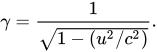
In 1892 Hendrik Lorentz proposed a modified aether based on the emerging microscopic molecular model rather than the strictly macroscopic continuous theory of Maxwell. Lorentz investigated the mutual interaction of a moving solitary electrons within a stationary aether. He rederived Maxwell's equations in this way but, critically, in the process he changed them to represent the wave in the coordinates moving electrons. He showed that the wave equations had the same form if they were transformed using a particular scaling factor, where is the velocity of the moving electrons and is the speed of light. Lorentz noted that if this factor were applied as a length contraction to moving matter in a stationary ether, it would eliminate any effect of motion through the ether, in agreement with experiment.

In 1899, Henri Poincaré questioned the existence of an aether, showing that the principle of relativity prohibits the absolute motion assumed by proponents of the aether model. He named the transformation used by Lorentz the Lorentz transformation but interpreted it as a transformation between two inertial frames with relative velocity . This transformation makes the electromagnetic equations look the same in every uniformly moving inertial frame. Then, in 1905, Albert Einstein demonstrated that the principle of relativity, applied to the simultaneity of time and the constant speed of light, precisely predicts the Lorentz transformation. This theory of special relativity quickly became the modern concept of spacetime.

Thus the aether model, initially so very different from action at a distance, slowly changed to resemble simple empty space.

In 1905, Poincaré proposed gravitational waves, emanating from a body and propagating at the speed of light, as being required by the Lorentz transformations and suggested that, in analogy to an accelerating electrical charge producing electromagnetic waves, accelerated masses in a relativistic field theory of gravity should produce gravitational waves. However, until 1915 gravity stood apart as a force still described by action-at-a-distance. In that year, Einstein showed that a field theory of spacetime, general relativity, consistent with relativity can explain gravity. New effects resulting from this theory were dramatic for cosmology but minor for planetary motion and physics on Earth. Einstein himself noted Newton's "enormous practical success".

Modern action at a distance

In the early decades of the 20th century, Karl SchwarzschildHugo Tetrode, and Adriaan Fokker independently developed non-instantaneous models for action at a distance consistent with special relativity. In 1949 John Archibald Wheeler and Richard Feynman built on these models to develop a new field-free theory of electromagnetism. While Maxwell's field equations are generally successful, the Lorentz model of a moving electron interacting with the field encounters mathematical difficulties: the self-energy of the moving point charge within the field is infinite. The Wheeler–Feynman absorber theory of electromagnetism avoids the self-energy issue. They interpret Abraham–Lorentz force, the apparent force resisting electron acceleration, as a real force returning from all the other existing charges in the universe.

The Wheeler–Feynman theory has inspired new thinking about the arrow of time and about the nature of quantum non-locality. The theory has implications for cosmology; it has been extended to quantum mechanics. A similar approach has been applied to develop an alternative theory of gravity consistent with general relativity. John G. Cramer has extended the Wheeler–Feynman ideas to create the transactional interpretation of quantum mechanics.

"Spooky action at a distance"

Though Albert Einstein played a pivotal role in the development of quantum mechanics, he himself never fully accepted the theory. While he recognized that it made correct predictions, he believed a more fundamental description of nature must be possible. Over the years he presented multiple arguments to this effect, but the one he preferred most dated to a debate with Bohr in 1930. Einstein suggested a thought experiment in which two objects are allowed to interact and then moved apart a great distance from each other. The quantum-mechanical description of the two objects is a mathematical entity known as a wavefunction. If the wavefunction that describes the two objects before their interaction is given, then the Schrödinger equation provides the wavefunction that describes them after their interaction. But because of what would later be called quantum entanglement, measuring one object would lead to an instantaneous change of the wavefunction describing the other object, no matter how far away it is. Moreover, the choice of which measurement to perform upon the first object would affect what wavefunction could result for the second object. Einstein reasoned that no influence could propagate from the first object to the second instantaneously fast. Indeed, he argued, physics depends on being able to tell one thing apart from another, and such instantaneous influences would call that into question. Because the true "physical condition" of the second object could not be immediately altered by an action done to the first, Einstein concluded, the wavefunction could not be that true physical condition, only an incomplete description of it.

In 1947, Einstein expressed his dissatisfaction with quantum theory in a letter to Max Born. "I cannot seriously believe in" quantum mechanics, he wrote, "because the theory cannot be reconciled with the idea that physics should represent a reality in time and space, free from spooky actions at a distance."

In 1964, John Stewart Bell carried the analysis of quantum entanglement much further by proving the first version of Bell's theorem. In the context of Bell's theorem, "local" refers to the principle of locality, the idea that a particle can only be influenced by its immediate surroundings, and that interactions mediated by physical fields cannot propagate faster than the speed of light. "Hidden variables" are supposed properties of quantum particles that are not included in quantum theory but nevertheless affect the outcome of experiments. In the words of Bell, "If [a hidden-variable theory] is local it will not agree with quantum mechanics, and if it agrees with quantum mechanics it will not be local."

In his original paper, Bell deduced that if measurements are performed independently on the two separated particles of an entangled pair, then the assumption that the outcomes depend upon hidden variables within each half implies a mathematical constraint on how the outcomes on the two measurements are correlated. Such a constraint would later be named a Bell inequality. Bell then showed that quantum physics predicts correlations that violate this inequality. Multiple variations on Bell's theorem were put forward in the years following his original paper, using different assumptions and obtaining different Bell (or "Bell-type") inequalities.

The phrase "spooky action at a distance" has been adopted to describe the violation of Bell inequalities. Whether these phenomena involve real action at a distance, or in other words whether the need for nonlocality in hidden-variable models implies true nonlocality in nature, is a subject of debate.

Force in quantum field theory

Quantum field theory does not need action at a distance. At the most fundamental level, only four forces are needed. Each force is described as resulting from the exchange of specific bosons. Two are short range: the strong interaction mediated by mesons and the weak interaction mediated by the weak boson; two are long range: electromagnetism mediated by the photon and gravity hypothesized to be mediated by the graviton. However, the entire concept of force is of secondary concern in advanced modern particle physics. Energy forms the basis of physical models and the word action has shifted away from implying a force to a specific technical meaning, an integral over the difference between potential energy and kinetic energy.

Anti-environmentalism

From Wikipedia, the free encyclopedia https://en.wikipedia.org/wiki/Anti-environmentalism   ...