Search This Blog

Wednesday, February 18, 2026

Action at a distance

From Wikipedia, the free encyclopedia
https://en.wikipedia.org/wiki/Action_at_a_distance

Action at a distance is the concept in physics that an object's motion can be affected by another object without the two being in physical contact; that is, it is the concept of the non-local interaction of objects that are separated in space. Coulomb's law and Newton's law of universal gravitation are based on action at a distance.

Historically, action at a distance was the earliest scientific model for gravity and electricity and it continues to be useful in many practical cases. In the 19th and 20th centuries, field models arose to explain these phenomena with more precision. The discovery of electrons and of special relativity led to new action at a distance models providing alternative to field theories. Under our modern understanding, the four fundamental interactions (gravity, electromagnetism, the strong interaction and the weak interaction) in all of physics are not described by action at a distance.

Categories of action

In the study of mechanics, action at a distance is one of three fundamental actions on matter that cause motion. The other two are direct impact (elastic or inelastic collisions) and actions in a continuous medium as in fluid mechanics or solid mechanics. Historically, physical explanations for particular phenomena have moved between these three categories over time as new models were developed.

Action-at-a-distance and actions in a continuous medium may be easily distinguished when the medium dynamics are visible, like waves in water or in an elastic solid. In the case of electricity or gravity, no medium is required. In the nineteenth century, criteria like the effect of actions on intervening matter, the observation of a time delay, the apparent storage of energy, or even the possibility of a plausible mechanical model for action transmission were all accepted as evidence against action at a distance. Aether theories were alternative proposals to replace apparent action-at-a-distance in gravity and electromagnetism, in terms of continuous action inside an (invisible) medium called "aether".

Direct impact of macroscopic objects seems visually distinguishable from action at a distance. If however the objects are constructed of atoms, and the volume of those atoms is not defined and atoms interact by electric and magnetic forces, the distinction is less clear.

Roles

The concept of action at a distance acts in multiple roles in physics and it can co-exist with other models according to the needs of each physical problem.

One role is as a summary of physical phenomena, independent of any understanding of the cause of such an action. For example, astronomical tables of planetary positions can be compactly summarized using Newton's law of universal gravitation, which assumes the planets interact without contact or an intervening medium. As a summary of data, the concept does not need to be evaluated as a plausible physical model.

Action at a distance also acts as a model explaining physical phenomena even in the presence of other models. Again in the case of gravity, hypothesizing an instantaneous force between masses allows the return time of comets to be predicted as well as predicting the existence of previously unknown planets, like Neptune. These triumphs of physics predated the alternative more accurate model for gravity based on general relativity by many decades.

Introductory physics textbooks discuss central forces, like gravity, by models based on action-at-distance without discussing the cause of such forces or issues with it until the topics of relativity and fields are discussed. For example, see The Feynman Lectures on Physics on gravity.

History

Early inquiries into motion

Action-at-a-distance as a physical concept requires identifying objects, distances, and their motion. In antiquity, ideas about the natural world were not organized in these terms. Objects in motion were modeled as living beings. Around 1600, the scientific method began to take root. René Descartes held a more fundamental view, developing ideas of matter and action independent of theology. Galileo Galilei wrote about experimental measurements of falling and rolling objects. Johannes Kepler's laws of planetary motion summarized Tycho Brahe's astronomical observations. Many experiments with electrical and magnetic materials led to new ideas about forces. These efforts set the stage for Newton's work on forces and gravity.

Newtonian gravity

In 1687 Isaac Newton published his Principia which combined his laws of motion with a new mathematical analysis able to reproduce Kepler's empirical results. His explanation was in the form of a law of universal gravitation: any two bodies are attracted by a force proportional to their mass and inversely proportional to the square of the distance between them. Thus the motions of planets were predicted by assuming forces working over great distances.

This mathematical expression of the force did not imply a cause. Newton considered action-at-a-distance to be an inadequate model for gravity. Newton, in his words, considered action at a distance to be:

so great an Absurdity that I believe no Man who has in philosophical Matters a competent Faculty of thinking can ever fall into it.

— Isaac Newton, Letters to Bentley, 1692/3

Metaphysical scientists of the early 1700s strongly objected to the unexplained action-at-a-distance in Newton's theory. Gottfried Wilhelm Leibniz complained that the mechanism of gravity was "invisible, intangible, and not mechanical". Moreover, initial comparisons with astronomical data were not favorable. As mathematical techniques improved throughout the 1700s, the theory showed increasing success, predicting the date of the return of Halley's Comet and aiding the discovery of planet Neptune in 1846. These successes and the increasingly empirical focus of science towards the 19th century led to acceptance of Newton's theory of gravity despite distaste for action-at-a-distance.

Electrical action at a distance

Jean-Antoine Nollet reproducing Stephan Gray's "electric boy" experiment, in which a boy hanging from insulating silk ropes is given an electric charge. A group are gathered around. A woman is encouraged to bend forward and poke the boy's nose, to get an electric shock.

Electrical and magnetic phenomena also began to be explored systematically in the early 1600s. In William Gilbert's early theory of "electric effluvia," a kind of electric atmosphere, he rules out action-at-a-distance on the grounds that "no action can be performed by matter save by contact". However subsequent experiments, especially those by Stephen Gray showed electrical effects over distance. Gray developed an experiment call the "electric boy" demonstrating electric transfer without direct contact. Franz Aepinus was the first to show, in 1759, that a theory of action at a distance for electricity provides a simpler replacement for the electric effluvia theory. Despite this success, Aepinus himself considered the nature of the forces to be unexplained: he did "not approve of the doctrine which assumes the possibility of action at a distance", setting the stage for a shift to theories based on aether.

By 1785 Charles-Augustin de Coulomb showed that two electric charges at rest experience a force inversely proportional to the square of the distance between them, a result now called Coulomb's law. The striking similarity to gravity strengthened the case for action at a distance, at least as a mathematical model.

As mathematical methods improved, especially through the work of Pierre-Simon Laplace, Joseph-Louis Lagrange, and Siméon Denis Poisson, more sophisticated mathematical methods began to influence the thinking of scientists. The concept of potential energy applied to small test particles led to the concept of a scalar field, a mathematical model representing the forces throughout space. While this mathematical model is not a mechanical medium, the mental picture of such a field resembles a medium.

Fields as an alternative

Glazed frame, containing "Delineation of Lines of Magnetic Force by Iron filings" prepared by Michael Faraday

Michael Faraday was the first who suggested that action at a distance was inadequate as an account of electric and magnetic forces, even in the form of a (mathematical) potential field. Faraday, an empirical experimentalist, cited three reasons in support of some medium transmitting electrical force: 1) electrostatic induction across an insulator depends on the nature of the insulator, 2) cutting a charged insulator causes opposite charges to appear on each half, and 3) electric discharge sparks are curved at an insulator. From these reasons he concluded that the particles of an insulator must be polarized, with each particle contributing to continuous action. He also experimented with magnets, demonstrating lines of force made visible by iron filings. However, in both cases his field-like model depends on particles that interact through an action-at-a-distance: his mechanical field-like model has no more fundamental physical cause than the long-range central field model.

Faraday's observations, as well as others, led James Clerk Maxwell to a breakthrough formulation in 1865, a set of equations that combined electricity and magnetism, both static and dynamic, and which included electromagnetic radiation – light. Maxwell started with elaborate mechanical models but ultimately produced a purely mathematical treatment using dynamical vector fields. The sense that these fields must be set to vibrate to propagate light set off a search of a medium of propagation; the medium was called the luminiferous aether or the aether.

In 1873 Maxwell addressed action at a distance explicitly. He reviews Faraday's lines of force, carefully pointing out that Faraday himself did not provide a mechanical model of these lines in terms of a medium. Nevertheless the many properties of these lines of force imply these "lines must not be regarded as mere mathematical abstractions". Faraday himself viewed these lines of force as a model, a "valuable aid" to the experimentalist, a means to suggest further experiments.

In distinguishing between different kinds of action Faraday suggested three criteria: 1) do additional material objects alter the action?, 2) does the action take time, and 3) does it depend upon the receiving end? For electricity, Faraday knew that all three criteria were met for electric action, but gravity was thought to only meet the third one. After Maxwell's time a fourth criteria, the transmission of energy, was added, thought to also apply to electricity but not gravity. With the advent of new theories of gravity, the modern account would give gravity all of the criteria except dependence on additional objects.

Fields fade into spacetime

The success of Maxwell's field equations led to numerous efforts in the later decades of the 19th century to represent electrical, magnetic, and gravitational fields, primarily with mechanical models. No model emerged that explained the existing phenomena. In particular no good model for stellar aberration, the shift in the position of stars with the Earth's relative velocity. The best models required the ether to be stationary while the Earth moved, but experimental efforts to measure the effect of Earth's motion through the aether found no effect.

In 1892 Hendrik Lorentz proposed a modified aether based on the emerging microscopic molecular model rather than the strictly macroscopic continuous theory of Maxwell. Lorentz investigated the mutual interaction of a moving solitary electrons within a stationary aether. He rederived Maxwell's equations in this way but, critically, in the process he changed them to represent the wave in the coordinates moving electrons. He showed that the wave equations had the same form if they were transformed using a particular scaling factor, where is the velocity of the moving electrons and is the speed of light. Lorentz noted that if this factor were applied as a length contraction to moving matter in a stationary ether, it would eliminate any effect of motion through the ether, in agreement with experiment.
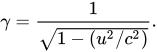
In 1899, Henri Poincaré questioned the existence of an aether, showing that the principle of relativity prohibits the absolute motion assumed by proponents of the aether model. He named the transformation used by Lorentz the Lorentz transformation but interpreted it as a transformation between two inertial frames with relative velocity . This transformation makes the electromagnetic equations look the same in every uniformly moving inertial frame. Then, in 1905, Albert Einstein demonstrated that the principle of relativity, applied to the simultaneity of time and the constant speed of light, precisely predicts the Lorentz transformation. This theory of special relativity quickly became the modern concept of spacetime.

Thus the aether model, initially so very different from action at a distance, slowly changed to resemble simple empty space.

In 1905, Poincaré proposed gravitational waves, emanating from a body and propagating at the speed of light, as being required by the Lorentz transformations and suggested that, in analogy to an accelerating electrical charge producing electromagnetic waves, accelerated masses in a relativistic field theory of gravity should produce gravitational waves. However, until 1915 gravity stood apart as a force still described by action-at-a-distance. In that year, Einstein showed that a field theory of spacetime, general relativity, consistent with relativity can explain gravity. New effects resulting from this theory were dramatic for cosmology but minor for planetary motion and physics on Earth. Einstein himself noted Newton's "enormous practical success".

Modern action at a distance

In the early decades of the 20th century, Karl SchwarzschildHugo Tetrode, and Adriaan Fokker independently developed non-instantaneous models for action at a distance consistent with special relativity. In 1949 John Archibald Wheeler and Richard Feynman built on these models to develop a new field-free theory of electromagnetism. While Maxwell's field equations are generally successful, the Lorentz model of a moving electron interacting with the field encounters mathematical difficulties: the self-energy of the moving point charge within the field is infinite. The Wheeler–Feynman absorber theory of electromagnetism avoids the self-energy issue. They interpret Abraham–Lorentz force, the apparent force resisting electron acceleration, as a real force returning from all the other existing charges in the universe.

The Wheeler–Feynman theory has inspired new thinking about the arrow of time and about the nature of quantum non-locality. The theory has implications for cosmology; it has been extended to quantum mechanics. A similar approach has been applied to develop an alternative theory of gravity consistent with general relativity. John G. Cramer has extended the Wheeler–Feynman ideas to create the transactional interpretation of quantum mechanics.

"Spooky action at a distance"

Though Albert Einstein played a pivotal role in the development of quantum mechanics, he himself never fully accepted the theory. While he recognized that it made correct predictions, he believed a more fundamental description of nature must be possible. Over the years he presented multiple arguments to this effect, but the one he preferred most dated to a debate with Bohr in 1930. Einstein suggested a thought experiment in which two objects are allowed to interact and then moved apart a great distance from each other. The quantum-mechanical description of the two objects is a mathematical entity known as a wavefunction. If the wavefunction that describes the two objects before their interaction is given, then the Schrödinger equation provides the wavefunction that describes them after their interaction. But because of what would later be called quantum entanglement, measuring one object would lead to an instantaneous change of the wavefunction describing the other object, no matter how far away it is. Moreover, the choice of which measurement to perform upon the first object would affect what wavefunction could result for the second object. Einstein reasoned that no influence could propagate from the first object to the second instantaneously fast. Indeed, he argued, physics depends on being able to tell one thing apart from another, and such instantaneous influences would call that into question. Because the true "physical condition" of the second object could not be immediately altered by an action done to the first, Einstein concluded, the wavefunction could not be that true physical condition, only an incomplete description of it.

In 1947, Einstein expressed his dissatisfaction with quantum theory in a letter to Max Born. "I cannot seriously believe in" quantum mechanics, he wrote, "because the theory cannot be reconciled with the idea that physics should represent a reality in time and space, free from spooky actions at a distance."

In 1964, John Stewart Bell carried the analysis of quantum entanglement much further by proving the first version of Bell's theorem. In the context of Bell's theorem, "local" refers to the principle of locality, the idea that a particle can only be influenced by its immediate surroundings, and that interactions mediated by physical fields cannot propagate faster than the speed of light. "Hidden variables" are supposed properties of quantum particles that are not included in quantum theory but nevertheless affect the outcome of experiments. In the words of Bell, "If [a hidden-variable theory] is local it will not agree with quantum mechanics, and if it agrees with quantum mechanics it will not be local."

In his original paper, Bell deduced that if measurements are performed independently on the two separated particles of an entangled pair, then the assumption that the outcomes depend upon hidden variables within each half implies a mathematical constraint on how the outcomes on the two measurements are correlated. Such a constraint would later be named a Bell inequality. Bell then showed that quantum physics predicts correlations that violate this inequality. Multiple variations on Bell's theorem were put forward in the years following his original paper, using different assumptions and obtaining different Bell (or "Bell-type") inequalities.

The phrase "spooky action at a distance" has been adopted to describe the violation of Bell inequalities. Whether these phenomena involve real action at a distance, or in other words whether the need for nonlocality in hidden-variable models implies true nonlocality in nature, is a subject of debate.

Force in quantum field theory

Quantum field theory does not need action at a distance. At the most fundamental level, only four forces are needed. Each force is described as resulting from the exchange of specific bosons. Two are short range: the strong interaction mediated by mesons and the weak interaction mediated by the weak boson; two are long range: electromagnetism mediated by the photon and gravity hypothesized to be mediated by the graviton. However, the entire concept of force is of secondary concern in advanced modern particle physics. Energy forms the basis of physical models and the word action has shifted away from implying a force to a specific technical meaning, an integral over the difference between potential energy and kinetic energy.

Quantum foundations

From Wikipedia, the free encyclopedia
https://en.wikipedia.org/wiki/Quantum_foundations

Quantum foundations is a discipline of science and philosophy of physics that seeks to understand the most counter-intuitive aspects of quantum theory, reformulate it and even propose new generalizations thereof. Contrary to other physical theories, such as general relativity, the defining axioms of quantum theory are quite ad hoc, with no obvious physical intuition. While they lead to the right experimental predictions, they do not come with a mental picture of the world where they fit.

There exist different approaches to resolve this conceptual gap:

  • First, one can put quantum physics in contraposition with classical physics: by identifying scenarios, such as Bell experiments, where quantum theory radically deviates from classical predictions, one hopes to gain physical insights on the structure of quantum physics.
  • Second, one can attempt to find a re-derivation of the quantum formalism in terms of operational axioms.
  • Third, one can search for a full correspondence between the mathematical elements of the quantum framework and physical phenomena: any such correspondence is called an interpretation.
  • Fourth, one can renounce quantum theory altogether and propose a different model of the world.

Research in quantum foundations is structured along these roads.

Non-classical features of quantum theory

Quantum nonlocality

Two or more separate parties conducting measurements over a quantum state can observe correlations which cannot be explained with any local hidden variable theory. Whether this should be regarded as proving that the physical world itself is "nonlocal" is a topic of debate, but the terminology of "quantum nonlocality" is commonplace. Nonlocality research efforts in quantum foundations focus on determining the exact limits that classical or quantum physics enforces on the correlations observed in a Bell experiment or more complex causal scenarios. This research program has so far provided a generalization of Bell's theorem that allows falsifying all classical theories with a superluminal, yet finite, hidden influence.

Quantum contextuality

Nonlocality can be understood as an instance of quantum contextuality. A situation is contextual when the value of an observable depends on the context in which it is measured (namely, on which other observables are being measured as well). The original definition of measurement contextuality can be extended to state preparations and even general physical transformations.

Epistemic models for the quantum wavefunction

A physical property is epistemic when it represents our knowledge or beliefs on the value of a second, more fundamental feature. The probability of an event to occur is an example of an epistemic property. In contrast, a non-epistemic or ontic variable captures the notion of a "real" property of the system under consideration.

There is ongoing debate on whether the wavefunction represents the epistemic state of a yet to be discovered ontic variable or, on the contrary, it is a fundamental entity. Under some physical assumptions, the Pusey–Barrett–Rudolph (PBR) theorem demonstrates the inconsistency of quantum states as epistemic states, in the sense above. Note that, in QBism and Copenhagen-type views, quantum states are still regarded as epistemic, not with respect to some ontic variable, but to one's expectations about future experimental outcomes. The PBR theorem does not exclude such epistemic views on quantum states.

Axiomatic reconstructions

Some of the counter-intuitive aspects of quantum theory, as well as the difficulty to extend it, follow from the fact that its defining axioms lack a physical motivation. An active area of research in quantum foundations is therefore to find alternative formulations of quantum theory which rely on physically compelling principles. Those efforts come in two flavors, depending on the desired level of description of the theory: the so-called Generalized Probabilistic Theories approach and the Black boxes approach.

The framework of generalized probabilistic theories

Generalized Probabilistic Theories (GPTs) are a general framework to describe the operational features of arbitrary physical theories. Essentially, they provide a statistical description of any experiment combining state preparations, transformations and measurements. The framework of GPTs can accommodate classical and quantum physics, as well as hypothetical non-quantum physical theories which nonetheless possess quantum theory's most remarkable features, such as entanglement or teleportation. Notably, a small set of physically motivated axioms is enough to single out the GPT representation of quantum theory.

L. Hardy introduced the concept of GPT in 2001, in an attempt to re-derive quantum theory from basic physical principles. Although Hardy's work was very influential (see the follow-ups below), one of his axioms was regarded as unsatisfactory: it stipulated that, of all the physical theories compatible with the rest of the axioms, one should choose the simplest one. The work of Dakic and Brukner eliminated this "axiom of simplicity" and provided a reconstruction of quantum theory based on three physical principles. This was followed by the more rigorous reconstruction of Masanes and Müller.

Axioms common to these three reconstructions are:

  • The subspace axiom: systems which can store the same amount of information are physically equivalent.
  • Local tomography: to characterize the state of a composite system it is enough to conduct measurements at each part.
  • Reversibility: for any two extremal states [i.e., states which are not statistical mixtures of other states], there exists a reversible physical transformation that maps one into the other.

An alternative GPT reconstruction proposed by Chiribella, D'Ariano and Perinotti around the same time is also based on the

  • Purification axiom: for any state of a physical system , there exists a bipartite physical system and an extremal state (or purification) such that is the restriction of to system . In addition, any two such purifications of can be mapped into one another via a reversible physical transformation on system .

The use of purification to characterize quantum theory has been criticized on the grounds that it also applies in the Spekkens toy model.

To the success of the GPT approach, it can be countered that all such works just recover finite dimensional quantum theory. In addition, none of the previous axioms can be experimentally falsified unless the measurement apparatuses are assumed to be tomographically complete.

Categorical quantum mechanics or process theories

Categorical Quantum Mechanics (CQM) or Process Theories are a general framework to describe physical theories, with an emphasis on processes and their compositions. It was pioneered by Samson Abramsky and Bob Coecke. Besides its influence in quantum foundations, most notably the use of a diagrammatic formalism, CQM also plays an important role in quantum technologies, most notably in the form of ZX-calculus. It also has been used to model theories outside of physics, for example the DisCoCat compositional natural language meaning model.

The framework of black boxes

In the black box or device-independent framework, an experiment is regarded as a black box where the experimentalist introduces an input (the type of experiment) and obtains an output (the outcome of the experiment). Experiments conducted by two or more parties in separate labs are hence described by their statistical correlations alone.

From Bell's theorem, we know that classical and quantum physics predict different sets of allowed correlations. It is expected, therefore, that far-from-quantum physical theories should predict correlations beyond the quantum set. In fact, there exist instances of theoretical non-quantum correlations which, a priori, do not seem physically implausible. The aim of device-independent reconstructions is to show that all such supra-quantum examples are precluded by a reasonable physical principle.

The physical principles proposed so far include no-signalling, Non-Trivial Communication Complexity, No-Advantage for Nonlocal computation, Information Causality, Macroscopic Locality, and Local Orthogonality. All these principles limit the set of possible correlations in non-trivial ways. Moreover, they are all device-independent: this means that they can be falsified under the assumption that we can decide if two or more events are space-like separated. The drawback of the device-independent approach is that, even when taken together, all the afore-mentioned physical principles do not suffice to single out the set of quantum correlations. In other words: all such reconstructions are partial.

Interpretations of quantum theory

An interpretation of quantum theory is a correspondence between the elements of its mathematical formalism and physical phenomena. For instance, in the pilot wave theory, the quantum wave function is interpreted as a field that guides the particle trajectory and evolves with it via a system of coupled differential equations. Most interpretations of quantum theory stem from the desire to solve the quantum measurement problem.

Extensions of quantum theory

In an attempt to reconcile quantum and classical physics, or to identify non-classical models with a dynamical causal structure, some modifications of quantum theory have been proposed.

Collapse models

Collapse models posit the existence of natural processes which periodically localize the wave-function. Such theories provide an explanation to the nonexistence of superpositions of macroscopic objects, at the cost of abandoning unitarity and exact energy conservation.

Quantum measure theory

In Sorkin's quantum measure theory (QMT), physical systems are not modeled via unitary rays and Hermitian operators, but through a single matrix-like object, the decoherence functional. The entries of the decoherence functional determine the feasibility to experimentally discriminate between two or more different sets of classical histories, as well as the probabilities of each experimental outcome. In some models of QMT the decoherence functional is further constrained to be positive semidefinite (strong positivity). Even under the assumption of strong positivity, there exist models of QMT which generate stronger-than-quantum Bell correlations.

Acausal quantum processes

The formalism of process matrices starts from the observation that, given the structure of quantum states, the set of feasible quantum operations follows from positivity considerations. Namely, for any linear map from states to probabilities one can find a physical system where this map corresponds to a physical measurement. Likewise, any linear transformation that maps composite states to states corresponds to a valid operation in some physical system. In view of this trend, it is reasonable to postulate that any high-order map from quantum instruments (namely, measurement processes) to probabilities should also be physically realizable. Any such map is termed a process matrix. As shown by Oreshkov et al., some process matrices describe situations where the notion of global causality breaks.

The starting point of this claim is the following mental experiment: two parties, Alice and Bob, enter a building and end up in separate rooms. The rooms have ingoing and outgoing channels from which a quantum system periodically enters and leaves the room. While those systems are in the lab, Alice and Bob are able to interact with them in any way; in particular, they can measure some of their properties.

Since Alice and Bob's interactions can be modeled by quantum instruments, the statistics they observe when they apply one instrument or another are given by a process matrix. As it turns out, there exist process matrices which would guarantee that the measurement statistics collected by Alice and Bob is incompatible with Alice interacting with her system at the same time, before or after Bob, or any convex combination of these three situations. Such processes are called acausal.

Interpretations of quantum mechanics

An interpretation of quantum mechanics is an attempt to explain how the mathematical theory of quantum mechanics might correspond to experienced reality. Quantum mechanics has held up to rigorous and extremely precise tests in an extraordinarily broad range of experiments. However, there exist a number of contending schools of thought over their interpretation. These views on interpretation differ on such fundamental questions as whether quantum mechanics is deterministic or stochastic, local or non-local, which elements of quantum mechanics can be considered real, and what the nature of measurement is, among other matters.

While some variation of the Copenhagen interpretation is commonly presented in textbooks, many other interpretations have been developed. Despite a century of debate and experiment, no consensus has been reached among physicists and philosophers of physics concerning which interpretation best "represents" reality.

History

Influential figures in the interpretation of quantum mechanics
 

The definition of quantum theorists' terms, such as wave function and matrix mechanics, progressed through many stages. For instance, Erwin Schrödinger originally viewed the electron's wave function as its charge density smeared across space, but Max Born reinterpreted the absolute square value of the wave function as the electron's probability density distributed across space; the Born rule, as it is now called, matched experiment, whereas Schrödinger's charge density view did not.

The views of several early pioneers of quantum mechanics, such as Niels Bohr and Werner Heisenberg, are often grouped together as the "Copenhagen interpretation", though physicists and historians of physics have argued that this terminology obscures differences between the views so designated. Copenhagen-type ideas were never universally embraced, and challenges to a perceived Copenhagen orthodoxy gained increasing attention in the 1950s with the pilot-wave interpretation of David Bohm and the many-worlds interpretation of Hugh Everett III.

The physicist N. David Mermin once quipped, "New interpretations appear every year. None ever disappear." (Mermin also coined the saying "Shut up and calculate" to describe many physicists' attitude to quantum theory, a remark which is often misattributed to Richard Feynman.) As a rough guide to development of the mainstream view during the 1990s and 2000s, a "snapshot" of opinions was collected in a poll by Schlosshauer et al. at the "Quantum Physics and the Nature of Reality" conference of July 2011. The authors reference a similarly informal poll carried out by Max Tegmark at the "Fundamental Problems in Quantum Theory" conference in August 1997. The main conclusion of the authors is that "the Copenhagen interpretation still reigns supreme", receiving the most votes in their poll (42%), besides the rise to mainstream notability of the many-worlds interpretations: "The Copenhagen interpretation still reigns supreme here, especially if we lump it together with intellectual offsprings such as information-based interpretations and the QBism interpretation. In Tegmark's poll, the Everett interpretation received 17% of the vote, which is similar to the number of votes (18%) in our poll."

Some concepts originating from studies of interpretations have found more practical application in quantum information science.

Interpretive challenges

  1. Abstract, mathematical nature of quantum field theories: the mathematical structure of quantum mechanics is abstract and does not result in a single, clear interpretation of its quantities.
  2. Apparent indeterministic and irreversible processes: in classical field theory, a physical property at a given location in the field is readily derived. In most mathematical formulations of quantum mechanics, measurement (understood as an interaction with a given state) has a special role in the theory, as it is the sole process that can cause a nonunitary, irreversible evolution of the state.
  3. Role of the observer in determining outcomes. Copenhagen-type interpretations imply that the wavefunction is a calculational tool, and represents reality only immediately after a measurement performed by an observer. Everettian interpretations grant that all possible outcomes are real, and that measurement-type interactions cause a branching process in which each possibility is realised.
  4. Classically unexpected correlations between remote objects: entangled quantum systems, as illustrated in the EPR paradox, obey statistics that seem to violate principles of local causality by action at a distance.
  5. Complementarity of proffered descriptions: complementarity holds that no set of classical physical concepts can simultaneously refer to all properties of a quantum system. For instance, wave description A and particulate description B can each describe quantum system S, but not simultaneously. This implies the composition of physical properties of S does not obey the rules of classical propositional logic when using propositional connectives (see "Quantum logic"). Like contextuality, the "origin of complementarity lies in the non-commutativity of operators" that describe quantum objects.
  6. Contextual behaviour of systems locally: Quantum contextuality demonstrates that classical intuitions, in which properties of a system hold definite values independent of the manner of their measurement, fail even for local systems. Also, physical principles such as Leibniz's Principle of the identity of indiscernibles no longer apply in the quantum domain, signaling that most classical intuitions may be incorrect about the quantum world.

Influential interpretations

Copenhagen interpretation

The Copenhagen interpretation is a collection of views about the meaning of quantum mechanics principally attributed to Niels Bohr and Werner Heisenberg. It is one of the oldest attitudes towards quantum mechanics, as features of it date to the development of quantum mechanics during 1925–1927, and it remains one of the most commonly taught. There is no definitive historical statement of what is the Copenhagen interpretation, and there were in particular fundamental disagreements between the views of Bohr and Heisenberg. For example, Heisenberg emphasized a sharp "cut" between the observer (or the instrument) and the system being observed, while Bohr offered an interpretation that is independent of a subjective observer or measurement or collapse, which relies on an "irreversible" or effectively irreversible process that imparts the classical behavior of "observation" or "measurement".

Features common to Copenhagen-type interpretations include the idea that quantum mechanics is intrinsically indeterministic, with probabilities calculated using the Born rule, and the principle of complementarity, which states certain pairs of complementary properties cannot all be observed or measured simultaneously. Moreover, properties only result from the act of "observing" or "measuring"; the theory avoids assuming definite values from unperformed experiments. Copenhagen-type interpretations hold that quantum descriptions are objective, in that they are independent of physicists' mental arbitrariness. The statistical interpretation of wavefunctions due to Max Born differs sharply from Schrödinger's original intent, which was to have a theory with continuous time evolution and in which wavefunctions directly described physical reality.

Many worlds

The many-worlds interpretation is an interpretation of quantum mechanics in which a universal wavefunction obeys the same deterministic, reversible laws at all times; in particular there is no (indeterministic and irreversible) wavefunction collapse associated with measurement. The phenomena associated with measurement are claimed to be explained by decoherence, which occurs when states interact with the environment. More precisely, the parts of the wavefunction describing observers become increasingly entangled with the parts of the wavefunction describing their experiments. Although all possible outcomes of experiments continue to lie in the wavefunction's support, the times at which they become correlated with observers effectively "split" the universe into mutually unobservable alternate histories.

Quantum information theories

Quantum informational approaches have attracted growing support. They subdivide into two kinds.

  • Information ontologies, such as J. A. Wheeler's "it from bit". These approaches have been described as a revival of immaterialism.
  • Interpretations where quantum mechanics is said to describe an observer's knowledge of the world, rather than the world itself. This approach has some similarity with Bohr's thinking. Collapse (also known as reduction) is often interpreted as an observer acquiring information from a measurement, rather than as an objective event. James Hartle writes,

The state is not an objective property of an individual system but is that information, obtained from a knowledge of how a system was prepared, which can be used for making predictions about future measurements. ... A quantum mechanical state being a summary of the observer's information about an individual physical system changes both by dynamical laws, and whenever the observer acquires new information about the system through the process of measurement. The existence of two laws for the evolution of the state vector ... becomes problematical only if it is believed that the state vector is an objective property of the system ... The "reduction of the wavepacket" does take place in the consciousness of the observer, not because of any unique physical process which takes place there, but only because the state is a construct of the observer and not an objective property of the physical system.

Relational quantum mechanics

The essential idea behind relational quantum mechanics, following the precedent of special relativity, is that different observers may give different accounts of the same series of events: for example, to one observer at a given point in time, a system may be in a single, "collapsed" eigenstate, while to another observer at the same time, it may be in a superposition of two or more states. Consequently, if quantum mechanics is to be a complete theory, relational quantum mechanics argues that the notion of "state" describes not the observed system itself, but the relationship, or correlation, between the system and its observer(s). The state vector of conventional quantum mechanics becomes a description of the correlation of some degrees of freedom in the observer, with respect to the observed system. However, it is held by relational quantum mechanics that this applies to all physical objects, whether or not they are conscious or macroscopic. Any "measurement event" is seen simply as an ordinary physical interaction, an establishment of the sort of correlation discussed above. Thus the physical content of the theory has to do not with objects themselves, but the relations between them.

QBism

QBism, which originally stood for "quantum Bayesianism", is an interpretation of quantum mechanics that takes an agent's actions and experiences as the central concerns of the theory. This interpretation is distinguished by its use of a subjective Bayesian account of probabilities to understand the quantum mechanical Born rule as a normative addition to good decision-making. QBism draws from the fields of quantum information and Bayesian probability and aims to eliminate the interpretational conundrums that have beset quantum theory.

QBism deals with common questions in the interpretation of quantum theory about the nature of wavefunction superposition, quantum measurement, and entanglement. According to QBism, many, but not all, aspects of the quantum formalism are subjective in nature. For example, in this interpretation, a quantum state is not an element of reality—instead it represents the degrees of belief an agent has about the possible outcomes of measurements. For this reason, some philosophers of science have deemed QBism a form of anti-realism. The originators of the interpretation disagree with this characterization, proposing instead that the theory more properly aligns with a kind of realism they call "participatory realism", wherein reality consists of more than can be captured by any putative third-person account of it.

Consistent histories

The consistent histories interpretation generalizes the conventional Copenhagen interpretation and attempts to provide a natural interpretation of quantum cosmology. The theory is based on a consistency criterion that allows the history of a system to be described so that the probabilities for each history obey the additive rules of classical probability. It is claimed to be consistent with the Schrödinger equation.

According to this interpretation, the purpose of a quantum-mechanical theory is to predict the relative probabilities of various alternative histories (for example, of a particle).

Ensemble interpretation

The ensemble interpretation, also called the statistical interpretation, can be viewed as a minimalist interpretation. That is, it claims to make the fewest assumptions associated with the standard mathematics. It takes the statistical interpretation of Born to the fullest extent. The interpretation states that the wave function does not apply to an individual system – for example, a single particle – but is an abstract statistical quantity that only applies to an ensemble (a vast multitude) of similarly prepared systems or particles. In the words of Einstein:

The attempt to conceive the quantum-theoretical description as the complete description of the individual systems leads to unnatural theoretical interpretations, which become immediately unnecessary if one accepts the interpretation that the description refers to ensembles of systems and not to individual systems.

— Einstein in Albert Einstein: Philosopher-Scientist, ed. P.A. Schilpp (Harper & Row, New York)

The most prominent current advocate of the ensemble interpretation is Leslie E. Ballentine, professor at Simon Fraser University, author of the text book Quantum Mechanics, A Modern Development.

De Broglie–Bohm theory

The de Broglie–Bohm theory of quantum mechanics (also known as the pilot wave theory) is a theory by Louis de Broglie and extended later by David Bohm to include measurements. Particles, which always have positions, are guided by the wavefunction. The wavefunction evolves according to the Schrödinger wave equation, and the wavefunction never collapses. The theory takes place in a single spacetime, is non-local, and is deterministic. The simultaneous determination of a particle's position and velocity is subject to the usual uncertainty principle constraint. The theory is considered to be a hidden-variable theory, and by embracing non-locality it satisfies Bell's inequality. The measurement problem is resolved, since the particles have definite positions at all times. Collapse is explained as phenomenological.

Transactional interpretation

The transactional interpretation of quantum mechanics (TIQM) by John G. Cramer is an interpretation of quantum mechanics inspired by the Wheeler–Feynman absorber theory. It describes the collapse of the wave function as resulting from a time-symmetric transaction between a possibility wave from the source to the receiver (the wave function) and a possibility wave from the receiver to source (the complex conjugate of the wave function). This interpretation of quantum mechanics is unique in that it not only views the wave function as a real entity, but the complex conjugate of the wave function, which appears in the Born rule for calculating the expected value for an observable, as also real.

Consciousness causes collapse

Eugene Wigner argued that human experimenter consciousness (or maybe even animal consciousness) was critical for the collapse of the wavefunction, but he later abandoned this interpretation after learning about quantum decoherence. Some specific proposals for consciousness caused wave-function collapse have been shown to be unfalsifiable and more broadly reasonable assumption about consciousness lead to the same conclusion.

Quantum logic

Quantum logic can be regarded as a kind of propositional logic suitable for understanding the apparent anomalies regarding quantum measurement, most notably those concerning composition of measurement operations of complementary variables. This research area and its name originated in the 1936 paper by Garrett Birkhoff and John von Neumann, who attempted to reconcile some of the apparent inconsistencies of classical Boolean logic with the facts related to measurement and observation in quantum mechanics.

Modal interpretations of quantum mechanics were first conceived of in 1972 by Bas van Fraassen, in his paper "A formal approach to the philosophy of science". Van Fraassen introduced a distinction between a dynamical state, which describes what might be true about a system and which always evolves according to the Schrödinger equation, and a value state, which indicates what is actually true about a system at a given time. The term "modal interpretation" now is used to describe a larger set of models that grew out of this approach. The Stanford Encyclopedia of Philosophy describes several versions, including proposals by Kochen, Dieks, Clifton, Dickson, and Bub. According to Michel Bitbol, Schrödinger's views on how to interpret quantum mechanics progressed through as many as four stages, ending with a non-collapse view that in respects resembles the interpretations of Everett and van Fraassen. Because Schrödinger subscribed to a kind of post-Machian neutral monism, in which "matter" and "mind" are only different aspects or arrangements of the same common elements, treating the wavefunction as ontic and treating it as epistemic became interchangeable.

Time-symmetric theories

Time-symmetric interpretations of quantum mechanics were first suggested by Walter Schottky in 1921. Several theories have been proposed that modify the equations of quantum mechanics to be symmetric with respect to time reversal. (See Wheeler–Feynman time-symmetric theory.) This creates retrocausality: events in the future can affect ones in the past, exactly as events in the past can affect ones in the future. In these theories, a single measurement cannot fully determine the state of a system (making them a type of hidden-variables theory), but given two measurements performed at different times, it is possible to calculate the exact state of the system at all intermediate times. The collapse of the wavefunction is therefore not a physical change to the system, just a change in our knowledge of it due to the second measurement. Similarly, they explain entanglement as not being a true physical state but just an illusion created by ignoring retrocausality. The point where two particles appear to "become entangled" is simply a point where each particle is being influenced by events that occur to the other particle in the future.

Not all advocates of time-symmetric causality favour modifying the unitary dynamics of standard quantum mechanics. Thus a leading exponent of the two-state vector formalism, Lev Vaidman, states that the two-state vector formalism dovetails well with Hugh Everett's many-worlds interpretation.

Other interpretations

As well as the mainstream interpretations discussed above, a number of other interpretations have been proposed that have not made a significant scientific impact for whatever reason. These range from proposals by mainstream physicists to the more occult ideas of quantum mysticism.

Some ideas are discussed in the context of interpreting quantum mechanics but are not necessarily regarded as interpretations themselves.

Quantum Darwinism

Quantum Darwinism is a theory meant to explain the emergence of the classical world from the quantum world as due to a process of Darwinian natural selection induced by the environment interacting with the quantum system; where the many possible quantum states are selected against in favor of a stable pointer state. It was proposed in 2003 by Wojciech Zurek and a group of collaborators including Ollivier, Poulin, Paz and Blume-Kohout. The development of the theory is due to the integration of a number of Zurek's research topics pursued over the course of twenty-five years including pointer states, einselection and decoherence.

Objective-collapse theories

Objective-collapse theories differ from the Copenhagen interpretation by regarding both the wave function and the process of collapse as ontologically objective (meaning these exist and occur independent of the observer). In objective theories, collapse occurs either randomly ("spontaneous localization") or when some physical threshold is reached, with observers having no special role. Thus, objective-collapse theories are realistic, indeterministic, no-hidden-variables theories. Standard quantum mechanics does not specify any mechanism of collapse; quantum mechanics would need to be extended if objective collapse is correct. The requirement for an extension means that objective-collapse theories are alternatives to quantum mechanics rather than interpretations of it. Examples include

Comparisons

The most common interpretations are summarized in the table below. The values shown in the cells of the table are not without controversy, for the precise meanings of some of the concepts involved are unclear and, in fact, are themselves at the center of the controversy surrounding the given interpretation. For another table comparing interpretations of quantum theory, see reference.

No experimental evidence exists that distinguishes among these interpretations. To that extent, the physical theory stands, and is consistent with itself and with reality. Nevertheless, designing experiments that would test the various interpretations is the subject of active research.

Most of these interpretations have variants. For example, it is difficult to get a precise definition of the Copenhagen interpretation as it was developed and argued by many people.

Interpre­tation Year pub­lished Author(s) Determ­inistic? Ontic wave­function? Unique
history?
Hidden
variables
?
Collapsing
wave­functions
?
Observer
role?
Local
dyna­mics
?
Counter­factually
definite
?
Extant
universal
wave­function
?
Ensemble interpretation 1926 Max Born Agnostic No Yes Agnostic No No No No No
Copenhagen interpretation 1927 Niels Bohr, Werner Heisenberg No Some Yes No Some No Yes No No
De Broglie–Bohm theory 1927–
1952
Louis de Broglie, David Bohm Yes Yes Yes Yes Phenomen­ological No No Yes Yes
Quantum logic 1936 Garrett Birkhoff Agnostic Agnostic Yes No No Interpre­tational Agnostic No No
Time-
symmetric theories
1955 Satosi Watanabe Yes No Yes Yes No No No No Yes
Many-worlds interpretation 1957 Hugh Everett Yes Yes No No No No Yes Ill-posed Yes
Consciousness causes collapse 1961–
1993
Eugene Wigner, Henry Stapp No Yes Yes No Yes Causal No No Yes
Many-minds interpretation 1970 H. Dieter Zeh Yes Yes No No No Interpre­tational Yes Ill-posed Yes
Consistent histories 1984 Robert B. Griffiths No No No No No No Yes No Yes
Transactional interpretation 1986 John G. Cramer No Yes Yes No Yes No No Yes No
Objective-collapse theories 1986–
1989
Giancarlo Ghirardi, Alberto Rimini, Tullio Weber, Roger Penrose No Yes Yes No Yes No No No No
Relational interpretation 1994 Carlo Rovelli No No Agnostic No Yes Intrinsic Possibly No No
QBism 2010 Christopher Fuchs, Rüdiger Schack No No Agnostic No Yes Intrinsic Yes No No
  1. Both particle AND guiding wavefunction are real.
  2. Unique particle history, but multiple wave histories.
  3. But quantum logic is more limited in applicability than Coherent Histories.
  4. Quantum mechanics is regarded as a way of predicting observations, or a theory of measurement.
  5. Observers separate the universal wavefunction into orthogonal sets of experiences.
  6. In the consistent histories interpretation the collapse is a legitimate calculational procedure when describing the preparation of a quantum system, but it amounts to nothing more than a convenient way of calculating conditional probabilities.
  7. In the consistent histories interpretation, observers are necessary to select a specific family of consistent histories (i.e., a framework), thus enabling the calculation of probabilities of physical events. Observers, however, play a purely passive role, similar to a photographer choosing a particular framing when taking a picture.
  8. In the TI the collapse of the state vector is interpreted as the completion of the transaction between emitter and absorber.
  9. The transactional interpretation is explicitly non-local.
  10. Comparing histories between systems in this interpretation has no well-defined meaning.
  11. Any physical interaction is treated as a collapse event relative to the systems involved, not just macroscopic or conscious observers.
  12. The state of the system is observer-dependent, i.e., the state is specific to the reference frame of the observer.
  13. The interpretation was originally presented as local, but whether locality is well-posed in RQM has been disputed.
  14. A wavefunction merely encodes an agent’s expectations for future experiences. It is no more real than a probability distribution is in subjective Bayesianism.
  15. Quantum theory is a tool any agent may use to help manage their expectations. The past comes into play only insofar as an agent’s individual experiences and temperament influence their priors.
  16. Although QBism would eschew this terminology. A change in the wavefunction that an agent ascribes to a system as a result of having an experience represents a change in his or her beliefs about further experiences they may have. See Doxastic logic.
  17. Observers, or more properly, participants, are as essential to the formalism as the systems they interact with.

The silent approach

Although interpretational opinions are openly and widely discussed today, that was not always the case. A notable exponent of a tendency of silence was Paul Dirac who once wrote: "The interpretation of quantum mechanics has been dealt with by many authors, and I do not want to discuss it here. I want to deal with more fundamental things." This position is not uncommon among practitioners of quantum mechanics. Similarly Richard Feynman wrote many popularizations of quantum mechanics without ever publishing about interpretation issues like quantum measurement. Others, like Nico van Kampen and Willis Lamb, have openly criticized non-orthodox interpretations of quantum mechanics.

Evolution of sexual reproduction

From Wikipedia, the free encyclopedia https://en.wikipedia.org/wiki/Evolution_of_sexual_reproduction   ...