Search This Blog

Saturday, September 20, 2025

Cartesian coordinate system

From Wikipedia, the free encyclopedia
Illustration of a Cartesian coordinate plane. Four points are marked and labeled with their coordinates: (2, 3) in green, (−3, 1) in red, (−1.5, −2.5) in blue, and the origin (0, 0) in purple.

In geometry, a Cartesian coordinate system (UK: /kɑːrˈtzjən/, US: /kɑːrˈtʒən/) in a plane is a coordinate system that specifies each point uniquely by a pair of real numbers called coordinates, which are the signed distances to the point from two fixed perpendicular oriented lines, called coordinate lines, coordinate axes or just axes (plural of axis) of the system. The point where the axes meet is called the origin and has (0, 0) as coordinates. The axes directions represent an orthogonal basis. The combination of origin and basis forms a coordinate frame called the Cartesian frame.

Similarly, the position of any point in three-dimensional space can be specified by three Cartesian coordinates, which are the signed distances from the point to three mutually perpendicular planes. More generally, n Cartesian coordinates specify the point in an n-dimensional Euclidean space for any dimension n. These coordinates are the signed distances from the point to n mutually perpendicular fixed hyperplanes.

Cartesian coordinate system with a circle of radius 2 centered at the origin marked in red. The equation of a circle is (xa)2 + (yb)2 = r2 where a and b are the coordinates of the center (a, b) and r is the radius.

Cartesian coordinates are named for René Descartes, whose invention of them in the 17th century revolutionized mathematics by allowing the expression of problems of geometry in terms of algebra and calculus. Using the Cartesian coordinate system, geometric shapes (such as curves) can be described by equations involving the coordinates of points of the shape. For example, a circle of radius 2, centered at the origin of the plane, may be described as the set of all points whose coordinates x and y satisfy the equation x2 + y2 = 4; the area, the perimeter and the tangent line at any point can be computed from this equation by using integrals and derivatives, in a way that can be applied to any curve.

Cartesian coordinates are the foundation of analytic geometry, and provide enlightening geometric interpretations for many other branches of mathematics, such as linear algebra, complex analysis, differential geometry, multivariate calculus, group theory and more. A familiar example is the concept of the graph of a function. Cartesian coordinates are also essential tools for most applied disciplines that deal with geometry, including astronomy, physics, engineering and many more. They are the most common coordinate system used in computer graphics, computer-aided geometric design and other geometry-related data processing.

History

The adjective Cartesian refers to the French mathematician and philosopher René Descartes, who published this idea in 1637 while he was resident in the Netherlands. It was independently discovered by Pierre de Fermat, who also worked in three dimensions, although Fermat did not publish the discovery. The French cleric Nicole Oresme used constructions similar to Cartesian coordinates well before the time of Descartes and Fermat.

Both Descartes and Fermat used a single axis in their treatments and have a variable length measured in reference to this axis. The concept of using a pair of axes was introduced later, after Descartes' La Géométrie was translated into Latin in 1649 by Frans van Schooten and his students. These commentators introduced several concepts while trying to clarify the ideas contained in Descartes's work.

The development of the Cartesian coordinate system would play a fundamental role in the development of the calculus by Isaac Newton and Gottfried Wilhelm Leibniz. The two-coordinate description of the plane was later generalized into the concept of vector spaces.

Many other coordinate systems have been developed since Descartes, such as the polar coordinates for the plane, and the spherical and cylindrical coordinates for three-dimensional space.

Description

One dimension

An affine line with a chosen Cartesian coordinate system is called a number line. Every point on the line has a real-number coordinate, and every real number represents some point on the line.

There are two degrees of freedom in the choice of Cartesian coordinate system for a line, which can be specified by choosing two distinct points along the line and assigning them to two distinct real numbers (most commonly zero and one). Other points can then be uniquely assigned to numbers by linear interpolation. Equivalently, one point can be assigned to a specific real number, for instance an origin point corresponding to zero, and an oriented length along the line can be chosen as a unit, with the orientation indicating the correspondence between directions along the line and positive or negative numbers. Each point corresponds to its signed distance from the origin (a number with an absolute value equal to the distance and a + or sign chosen based on direction).

A geometric transformation of the line can be represented by a function of a real variable, for example translation of the line corresponds to addition, and scaling the line corresponds to multiplication. Any two Cartesian coordinate systems on the line can be related to each-other by a linear function (function of the form ) taking a specific point's coordinate in one system to its coordinate in the other system. Choosing a coordinate system for each of two different lines establishes an affine map from one line to the other taking each point on one line to the point on the other line with the same coordinate.

Two dimensions

A Cartesian coordinate system in two dimensions (also called a rectangular coordinate system or an orthogonal coordinate system) is defined by an ordered pair of perpendicular lines (axes), a single unit of length for both axes, and an orientation for each axis. The point where the axes meet is taken as the origin for both, thus turning each axis into a number line. For any point P, a line is drawn through P perpendicular to each axis, and the position where it meets the axis is interpreted as a number. The two numbers, in that chosen order, are the Cartesian coordinates of P. The reverse construction allows one to determine the point P given its coordinates.

The first and second coordinates are called the abscissa and the ordinate of P, respectively; and the point where the axes meet is called the origin of the coordinate system. The coordinates are usually written as two numbers in parentheses, in that order, separated by a comma, as in (3, −10.5). Thus the origin has coordinates (0, 0), and the points on the positive half-axes, one unit away from the origin, have coordinates (1, 0) and (0, 1).

In mathematics, physics, and engineering, the first axis is usually defined or depicted as horizontal and oriented to the right, and the second axis is vertical and oriented upwards. (However, in some computer graphics contexts, the ordinate axis may be oriented downwards.) The origin is often labeled O, and the two coordinates are often denoted by the letters X and Y, or x and y. The axes may then be referred to as the X-axis and Y-axis. The choices of letters come from the original convention, which is to use the latter part of the alphabet to indicate unknown values. The first part of the alphabet was used to designate known values.

A Euclidean plane with a chosen Cartesian coordinate system is called a Cartesian plane. In a Cartesian plane, one can define canonical representatives of certain geometric figures, such as the unit circle (with radius equal to the length unit, and center at the origin), the unit square (whose diagonal has endpoints at (0, 0) and (1, 1)), the unit hyperbola, and so on.

The two axes divide the plane into four right angles, called quadrants. The quadrants may be named or numbered in various ways, but the quadrant where all coordinates are positive is usually called the first quadrant.

If the coordinates of a point are (x, y), then its distances from the X-axis and from the Y-axis are |y| and |x|, respectively; where | · | denotes the absolute value of a number.

Three dimensions

A three dimensional Cartesian coordinate system, with origin O and axis lines X, Y and Z, oriented as shown by the arrows. The tick marks on the axes are one length unit apart. The black dot shows the point with coordinates x = 2, y = 3, and z = 4, or (2, 3, 4).

A Cartesian coordinate system for a three-dimensional space consists of an ordered triplet of lines (the axes) that go through a common point (the origin), and are pair-wise perpendicular; an orientation for each axis; and a single unit of length for all three axes. As in the two-dimensional case, each axis becomes a number line. For any point P of space, one considers a plane through P perpendicular to each coordinate axis, and interprets the point where that plane cuts the axis as a number. The Cartesian coordinates of P are those three numbers, in the chosen order. The reverse construction determines the point P given its three coordinates.

Alternatively, each coordinate of a point P can be taken as the distance from P to the plane defined by the other two axes, with the sign determined by the orientation of the corresponding axis.

Each pair of axes defines a coordinate plane. These planes divide space into eight octants. The octants are:

The coordinates are usually written as three numbers (or algebraic formulas) surrounded by parentheses and separated by commas, as in (3, −2.5, 1) or (t, u + v, π/2). Thus, the origin has coordinates (0, 0, 0), and the unit points on the three axes are (1, 0, 0), (0, 1, 0), and (0, 0, 1).

Standard names for the coordinates in the three axes are abscissa, ordinate and applicate. The coordinates are often denoted by the letters x, y, and z. The axes may then be referred to as the x-axis, y-axis, and z-axis, respectively. Then the coordinate planes can be referred to as the xy-plane, yz-plane, and xz-plane.

In mathematics, physics, and engineering contexts, the first two axes are often defined or depicted as horizontal, with the third axis pointing up. In that case the third coordinate may be called height or altitude. The orientation is usually chosen so that the 90-degree angle from the first axis to the second axis looks counter-clockwise when seen from the point (0, 0, 1); a convention that is commonly called the right-hand rule.

The coordinate surfaces of the Cartesian coordinates (x, y, z). The z-axis is vertical and the x-axis is highlighted in green. Thus, the red plane shows the points with x = 1, the blue plane shows the points with z = 1, and the yellow plane shows the points with y = −1. The three surfaces intersect at the point P (shown as a black sphere) with the Cartesian coordinates (1, −1, 1).

Higher dimensions

Since Cartesian coordinates are unique and non-ambiguous, the points of a Cartesian plane can be identified with pairs of real numbers; that is, with the Cartesian product , where is the set of all real numbers. In the same way, the points in any Euclidean space of dimension n be identified with the tuples (lists) of n real numbers; that is, with the Cartesian product .

Generalizations

The concept of Cartesian coordinates generalizes to allow axes that are not perpendicular to each other, and/or different units along each axis. In that case, each coordinate is obtained by projecting the point onto one axis along a direction that is parallel to the other axis (or, in general, to the hyperplane defined by all the other axes). In such an oblique coordinate system the computations of distances and angles must be modified from that in standard Cartesian systems, and many standard formulas (such as the Pythagorean formula for the distance) do not hold (see affine plane).

Notations and conventions

The Cartesian coordinates of a point are usually written in parentheses and separated by commas, as in (10, 5) or (3, 5, 7). The origin is often labelled with the capital letter O. In analytic geometry, unknown or generic coordinates are often denoted by the letters (x, y) in the plane, and (x, y, z) in three-dimensional space. This custom comes from a convention of algebra, which uses letters near the end of the alphabet for unknown values (such as the coordinates of points in many geometric problems), and letters near the beginning for given quantities.

These conventional names are often used in other domains, such as physics and engineering, although other letters may be used. For example, in a graph showing how a pressure varies with time, the graph coordinates may be denoted p and t. Each axis is usually named after the coordinate which is measured along it; so one says the x-axis, the y-axis, the t-axis, etc.

Another common convention for coordinate naming is to use subscripts, as (x1, x2, ..., xn) for the n coordinates in an n-dimensional space, especially when n is greater than 3 or unspecified. Some authors prefer the numbering (x0, x1, ..., xn−1). These notations are especially advantageous in computer programming: by storing the coordinates of a point as an array, instead of a record, the subscript can serve to index the coordinates.

In mathematical illustrations of two-dimensional Cartesian systems, the first coordinate (traditionally called the abscissa) is measured along a horizontal axis, oriented from left to right. The second coordinate (the ordinate) is then measured along a vertical axis, usually oriented from bottom to top. Young children learning the Cartesian system, commonly learn the order to read the values before cementing the x-, y-, and z-axis concepts, by starting with 2D mnemonics (for example, 'Walk along the hall then up the stairs' akin to straight across the x-axis then up vertically along the y-axis).

Computer graphics and image processing, however, often use a coordinate system with the y-axis oriented downwards on the computer display. This convention developed in the 1960s (or earlier) from the way that images were originally stored in display buffers.

For three-dimensional systems, a convention is to portray the xy-plane horizontally, with the z-axis added to represent height (positive up). Furthermore, there is a convention to orient the x-axis toward the viewer, biased either to the right or left. If a diagram (3D projection or 2D perspective drawing) shows the x- and y-axis horizontally and vertically, respectively, then the z-axis should be shown pointing "out of the page" towards the viewer or camera. In such a 2D diagram of a 3D coordinate system, the z-axis would appear as a line or ray pointing down and to the left or down and to the right, depending on the presumed viewer or camera perspective. In any diagram or display, the orientation of the three axes, as a whole, is arbitrary. However, the orientation of the axes relative to each other should always comply with the right-hand rule, unless specifically stated otherwise. All laws of physics and math assume this right-handedness, which ensures consistency.

For 3D diagrams, the names "abscissa" and "ordinate" are rarely used for x and y, respectively. When they are, the z-coordinate is sometimes called the applicate. The words abscissa, ordinate and applicate are sometimes used to refer to coordinate axes rather than the coordinate values.

Quadrants and octants

The four quadrants of a Cartesian coordinate system

The axes of a two-dimensional Cartesian system divide the plane into four infinite regions, called quadrants, each bounded by two half-axes. These are often numbered from 1st to 4th and denoted by Roman numerals: I (where the coordinates both have positive signs), II (where the abscissa is negative − and the ordinate is positive +), III (where both the abscissa and the ordinate are −), and IV (abscissa +, ordinate −). When the axes are drawn according to the mathematical custom, the numbering goes counter-clockwise starting from the upper right ("north-east") quadrant.

Similarly, a three-dimensional Cartesian system defines a division of space into eight regions or octants, according to the signs of the coordinates of the points. The convention used for naming a specific octant is to list its signs; for example, (+ + +) or (− + −). The generalization of the quadrant and octant to an arbitrary number of dimensions is the orthant, and a similar naming system applies.

Cartesian formulae for the plane

Distance between two points

The Euclidean distance between two points of the plane with Cartesian coordinates and is

This is the Cartesian version of Pythagoras's theorem. In three-dimensional space, the distance between points and is

which can be obtained by two consecutive applications of Pythagoras' theorem.

Euclidean transformations

The Euclidean transformations or Euclidean motions are the (bijective) mappings of points of the Euclidean plane to themselves which preserve distances between points. There are four types of these mappings (also called isometries): translations, rotations, reflections and glide reflections.

Translation

Translating a set of points of the plane, preserving the distances and directions between them, is equivalent to adding a fixed pair of numbers (a, b) to the Cartesian coordinates of every point in the set. That is, if the original coordinates of a point are (x, y), after the translation they will be

Rotation

To rotate a figure counterclockwise around the origin by some angle is equivalent to replacing every point with coordinates (x,y) by the point with coordinates (x',y'), where

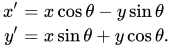
Thus:

Reflection

If (x, y) are the Cartesian coordinates of a point, then (−x, y) are the coordinates of its reflection across the second coordinate axis (the y-axis), as if that line were a mirror. Likewise, (x, −y) are the coordinates of its reflection across the first coordinate axis (the x-axis). In more generality, reflection across a line through the origin making an angle with the x-axis, is equivalent to replacing every point with coordinates (x, y) by the point with coordinates (x′,y′), where
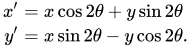
Thus:

Glide reflection

A glide reflection is the composition of a reflection across a line followed by a translation in the direction of that line. It can be seen that the order of these operations does not matter (the translation can come first, followed by the reflection).

General matrix form of the transformations

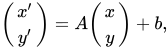
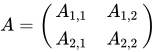
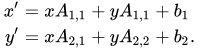
All affine transformations of the plane can be described in a uniform way by using matrices. For this purpose, the coordinates of a point are commonly represented as the column matrix The result of applying an affine transformation to a point is given by the formula where is a 2×2 matrix and is a column matrix. That is,

Among the affine transformations, the Euclidean transformations are characterized by the fact that the matrix is orthogonal; that is, its columns are orthogonal vectors of Euclidean norm one, or, explicitly, and


This is equivalent to saying that A times its transpose is the identity matrix. If these conditions do not hold, the formula describes a more general affine transformation.

The transformation is a translation if and only if A is the identity matrix. The transformation is a rotation around some point if and only if A is a rotation matrix, meaning that it is orthogonal and

A reflection or glide reflection is obtained when,

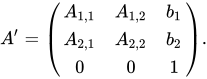
Assuming that translations are not used (that is, ) transformations can be composed by simply multiplying the associated transformation matrices. In the general case, it is useful to use the augmented matrix of the transformation; that is, to rewrite the transformation formula where With this trick, the composition of affine transformations is obtained by multiplying the augmented matrices.

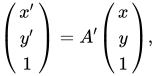
Affine transformation

Effect of applying various 2D affine transformation matrices on a unit square (reflections are special cases of scaling)

Affine transformations of the Euclidean plane are transformations that map lines to lines, but may change distances and angles. As said in the preceding section, they can be represented with augmented matrices:
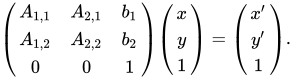
The Euclidean transformations are the affine transformations such that the 2×2 matrix of the is orthogonal.

The augmented matrix that represents the composition of two affine transformations is obtained by multiplying their augmented matrices.

Some affine transformations that are not Euclidean transformations have received specific names.

Scaling

An example of an affine transformation which is not Euclidean is given by scaling. To make a figure larger or smaller is equivalent to multiplying the Cartesian coordinates of every point by the same positive number m. If (x, y) are the coordinates of a point on the original figure, the corresponding point on the scaled figure has coordinates

If m is greater than 1, the figure becomes larger; if m is between 0 and 1, it becomes smaller.

Shearing

A shearing transformation will push the top of a square sideways to form a parallelogram. Horizontal shearing is defined by:

Shearing can also be applied vertically:

Orientation and handedness

In two dimensions

The right-hand rule

Fixing or choosing the x-axis determines the y-axis up to direction. Namely, the y-axis is necessarily the perpendicular to the x-axis through the point marked 0 on the x-axis. But there is a choice of which of the two half lines on the perpendicular to designate as positive and which as negative. Each of these two choices determines a different orientation (also called handedness) of the Cartesian plane.

The usual way of orienting the plane, with the positive x-axis pointing right and the positive y-axis pointing up (and the x-axis being the "first" and the y-axis the "second" axis), is considered the positive or standard orientation, also called the right-handed orientation.

A commonly used mnemonic for defining the positive orientation is the right-hand rule. Placing a somewhat closed right hand on the plane with the thumb pointing up, the fingers point from the x-axis to the y-axis, in a positively oriented coordinate system.

The other way of orienting the plane is following the left-hand rule, placing the left hand on the plane with the thumb pointing up.

When pointing the thumb away from the origin along an axis towards positive, the curvature of the fingers indicates a positive rotation along that axis.

Regardless of the rule used to orient the plane, rotating the coordinate system will preserve the orientation. Switching any one axis will reverse the orientation, but switching both will leave the orientation unchanged.

In three dimensions

Fig. 7 – The left-handed orientation is shown on the left, and the right-handed on the right.
Fig. 8 – The right-handed Cartesian coordinate system indicating the coordinate planes

Once the x- and y-axes are specified, they determine the line along which the z-axis should lie, but there are two possible orientations for this line. The two possible coordinate systems which result are called 'right-handed' and 'left-handed'. The standard orientation, where the xy-plane is horizontal and the z-axis points up (and the x- and the y-axis form a positively oriented two-dimensional coordinate system in the xy-plane if observed from above the xy-plane) is called right-handed or positive.

3D Cartesian coordinate handedness

The name derives from the right-hand rule. If the index finger of the right hand is pointed forward, the middle finger bent inward at a right angle to it, and the thumb placed at a right angle to both, the three fingers indicate the relative orientation of the x-, y-, and z-axes in a right-handed system. The thumb indicates the x-axis, the index finger the y-axis and the middle finger the z-axis. Conversely, if the same is done with the left hand, a left-handed system results.

Figure 7 depicts a left and a right-handed coordinate system. Because a three-dimensional object is represented on the two-dimensional screen, distortion and ambiguity result. The axis pointing downward (and to the right) is also meant to point towards the observer, whereas the "middle"-axis is meant to point away from the observer. The red circle is parallel to the horizontal xy-plane and indicates rotation from the x-axis to the y-axis (in both cases). Hence the red arrow passes in front of the z-axis.

Figure 8 is another attempt at depicting a right-handed coordinate system. Again, there is an ambiguity caused by projecting the three-dimensional coordinate system into the plane. Many observers see Figure 8 as "flipping in and out" between a convex cube and a concave "corner". This corresponds to the two possible orientations of the space. Seeing the figure as convex gives a left-handed coordinate system. Thus the "correct" way to view Figure 8 is to imagine the x-axis as pointing towards the observer and thus seeing a concave corner.

Representing a vector in the standard basis

A point in space in a Cartesian coordinate system may also be represented by a position vector, which can be thought of as an arrow pointing from the origin of the coordinate system to the point. If the coordinates represent spatial positions (displacements), it is common to represent the vector from the origin to the point of interest as . In two dimensions, the vector from the origin to the point with Cartesian coordinates (x, y) can be written as:

where and are unit vectors in the direction of the x-axis and y-axis respectively, generally referred to as the standard basis (in some application areas these may also be referred to as versors). Similarly, in three dimensions, the vector from the origin to the point with Cartesian coordinates can be written as: 

where and

There is no natural interpretation of multiplying vectors to obtain another vector that works in all dimensions, however there is a way to use complex numbers to provide such a multiplication. In a two-dimensional cartesian plane, identify the point with coordinates (x, y) with the complex number z = x + iy. Here, i is the imaginary unit and is identified with the point with coordinates (0, 1), so it is not the unit vector in the direction of the x-axis. Since the complex numbers can be multiplied giving another complex number, this identification provides a means to "multiply" vectors. In a three-dimensional cartesian space a similar identification can be made with a subset of the quaternions.

Mechanical aptitude

From Wikipedia, the free encyclopedia

According to Paul Muchinsky in his textbook Psychology Applied to Work, "mechanical aptitude tests require a person to recognize which mechanical principle is suggested by a test item." The underlying concepts measured by these items include sounds and heat conduction, velocity, gravity, and force.

A number of tests of mechanical comprehension and mechanical aptitude have been developed and are predictive of performance in manufacturing/production and technical type jobs, for instance.

Background information

Military information

Aptitude tests have been used for military purposes since World War I to screen recruits for military service. The Army Alpha and Army Beta tests were developed in 1917-1918 so ability of personnel could be measured by commanders. The Army Alpha was a test that assessed verbal ability, numerical ability, ability to follow directions, and general knowledge of specific information. The Army Beta was its non-verbal counterpart used to evaluate the aptitude of illiterate, unschooled, or non-English speaking draftees or volunteers.

During World War II, the Army Alpha and Beta tests were replaced by The Army General Classification Test (AGCT) and Navy General Classification Test (NGCT). The AGCT was described as a test of general learning ability, and was used by the Army and Marine Corps to assign recruits to military jobs. About 12 million recruits were tested using the AGCT during World War II, the NGCT was used by the Navy to assign recruits to military jobs sailors were tested using the NGCT during World War II.

Additional classification tests were developed early in World War II to supplement the AGCT and the NGCT. These included:

Mechanical aptitude and spatial relations

Mechanical aptitude tests are often coupled together with spatial relations tests. Mechanical aptitude is a complex function and is the sum of several different capacities, one of which is the ability to perceive spatial relations. Some research has shown that spatial ability is the most important part of mechanical aptitude for certain jobs. Because of this, spatial relations tests are often given separately, or in part with mechanical aptitude tests.

Gender differences

There is no evidence that states there is a general intelligence difference between men and women. However, studies have found that those with lower spatial ability usually do worse on mechanical reasoning. One study suggests that pre-natal androgens such as testosterone positively affect performance in both spatial and mechanical abilities.

Uses

Sample question from a Mechanical Aptitude test

The major uses for mechanical aptitude testing are:

  • Identify candidates with good spatial perception and mechanical reasoning ability
  • Assess a candidate's working knowledge of basic mechanical operations and physical laws
  • Recognize an aptitude for learning mechanical processes and tasks
  • Predict employee success and appropriately align your workforce

These tests are used mostly for industries involving:

  • Manufacturing/Production
  • Energy/Utilities

The major occupations that these tests are relevant to are:

Types of tests

US Department of Defense Test of Mechanical Aptitude

The mechanical comprehension subtest of the Armed Services Vocational Aptitude Battery (ASVAB), is one of the most widely used mechanical aptitude tests in the world. The test consists of ten subject-specific tests that measure your knowledge of and ability to perform in different areas, and provides an indication of your level of academic ability. The military would ask that all recruits take this exam to help them be placed in the correct job while enrolled in the military. In the beginning, World War I, the U.S. Army developed the Army Alpha and Beta Tests, which grouped the draftees and recruits for military service. The Army Alpha test measured recruits' knowledge, verbal and numerical ability, and ability to follow directions using 212 multiple-choice questions.

However, during World War II, the U.S. Army replaced the tests with a newer and improved one called the Army General Classification Test. The test had many different versions until they improved it enough to be used regularly. The current tests consist of three different versions, two of which are on paper and pencil and the other is taken on the computer. The scores from each different version are linked together, so each score has the same meaning no matter which exam you take. Some people find that they score higher on the computer version of the test than the other two versions, an explanation of this is due to the fact that the computer based exam is tailored to their demonstrated ability level. These tests are beneficial because they help measure your potential; it gives you a good indicator of where your talents are. By viewing your scores, you can make intelligent career decisions. The higher score you have, the more job opportunities that are available to you.

Wiesen Test of Mechanical Aptitude

The Wiesen Test of Mechanical Aptitude is a measure of a person's mechanical aptitude, which is referred to as the ability use machinery properly and maintain the equipment in best working order. The test is 30 minutes and has 60 items that can help predict performance for specific occupations involving the operation, maintenance, and servicing of tools, equipment, and machinery. Occupations in these areas require and are facilitated by mechanical aptitude. The Wiesen Test of Mechanical Aptitude was designed with the intent to create an evolution of previous tests that helps to improve the shortcomings of these earlier mechanical aptitude tests, such as the Bennett Test of Mechanical Comprehension. This test was reorganized in order to lessen certain gender and racial biases. The reading level that is required for the Wiesen Test of Mechanical Aptitude has been estimated to be at a sixth-grade level, and it is also available in a Spanish-language version for Spanish-speaking mechanical workers. Overall, this mechanical aptitude test has been shown to have less of an adverse impact than previous mechanical aptitude tests.

There are two scores given to each individual taking the test, a raw score and a percentile ranking. The raw score is a measure of how many questions (out of the 60 total) the individual answered correctly, and the percentile ranking is a relative performance score that indicates how the individual's score rates in relation to the scores of other people who have taken this particular mechanical aptitude test.

Average test scores for the Wiesen Test of Mechanical Aptitude were determined by giving the test to a sample of 1,817 workers aged 18 and older working in specific industrial occupations that were mentioned previously. Using this sample of workers, it was determined that the Wiesen Test of Mechanical Aptitude has very high reliability (statistics) (.97) in determining mechanical aptitude in relation to performance of mechanical occupations.

Bennett Test of Mechanical Comprehension

The Bennett Mechanical Comprehension Test (BMCT) is an assessment tool for measuring a candidate's ability to perceive and understand the relationship of physical forces and mechanical elements in practical situations. This aptitude is important in jobs and training programs that require the understanding and application of mechanical principles. The current BMCT Forms, S and T, have been used to predict performance in a variety of vocational and technical training settings and have been popular selection tools for mechanical, technical, engineering, and similar occupations for many years.

The BMCT is composed of 68 items, 30-minute time limited test, that are illustrations of simple, encountered mechanisms used in many different mechanisms. It is not considered a speeded time test, but a timed power test and the cut scores will provide the different job requirements for employers. The reading and exercise level of concentration for this test is below or at a sixth-grade reading level.

In current studies of internal consistency reliability, the range of estimates were compared from previous studies and found out the range was from .84 to .92. So this shows a high reliable consistency when taking and measuring the BMCT. Muchinsky (1993) evaluated the relationships between the BMCT, a general mental ability test, and an aptitude classification test focused on mechanics, and supervisory ratings of overall performance for 192 manufacturing employees. Of the three tests, he found the BMCT to be the best single predictor of job performance (r = .38, p < .01). He also found that the incremental gain in predictability from the other tests was not significant.

From a current employer standpoint, these people are typically using cognitive ability tests, aptitude tests, personality tests etc. And the BMCT has been used for positions such as electrical and mechanical positions. Also companies will use these tests for computer operators and operators in manufacturing. This test can also help eliminate any issues or variables to employers about who may need further training and instruction or not. This test will help show employers who is a master of the trade they are applying for, and will also highlight the applicants who still have some "catching up" to do.

Stenquist Test of Mechanical Aptitude

The Stenquist Test consist of a series of problems presented in the form of pictures, where each respondent would try to determine which picture assimilates better with another group of pictures. The pictures are mostly common mechanical objects which do not have an affiliation with a particular trade or profession, nor does the visuals require any prior experience or knowledge. Other variations of the test are used to examine a person's keen perception of mechanical objects and their ability to reason out a mechanical problem. For example, The Stenquist Mechanical Assemblying Test Series III, which was created for young males, consisted of physical mechanical parts for the boys to individually construct items with.

Greed

From Wikipedia, the free encyclopedia
https://en.wikipedia.org/wiki/Greed
1909 painting The Worship of Mammon, the New Testament representation and personification of material greed, by Evelyn De Morgan
Greed (or avarice, Latin: avaritia) is an insatiable desire for material gain (be it food, money, land, or animate/inanimate possessions) or social value, such as status or power.

Nature of greed

The initial motivation for (or purpose of) greed and actions associated with it may be the promotion of personal or family survival. It may at the same time be an intent to deny or obstruct competitors from potential means (for basic survival and comfort) or future opportunities; therefore being insidious or tyrannical and having a negative connotation. Alternately, the purpose could be defense or counteractive response to such obstructions being threatened by others.

Modern economic thought frequently distinguishes greed from self-interest, even in its earliest works, and spends considerable effort distinguishing the line between the two. By the mid-19th century – affected by the phenomenological ideas of Hegeleconomic and political thinkers began to define greed inherent to the structure of society as a negative and inhibitor to the development of societies. Keynes wrote, "The world is not so governed from above that private and social interest always coincide. It is not so managed here below that in practice they coincide." Both views continue to pose fundamental questions in today's economic thinking.

Weber posited that the spirit of capitalism integrated a philosophy of avarice coloured with utilitarianism. Weber also says that, according to Protestant ethic, "Wealth is thus bad ethically only in so far as it is a temptation to idleness and sinful enjoyment of life, and its acquisition is bad only when it is with the purpose of later living merrily and without care."

As a secular psychological concept, greed is an inordinate desire to acquire or possess more than one needs. The degree of inordinance is related to the inability to control the reformulation of "wants" once desired "needs" are eliminated. It is characterized by an insatiable desire for more, but also a dissatisfaction with what one currently has. Erich Fromm described greed as "a bottomless pit which exhausts the person in an endless effort to satisfy the need without ever reaching satisfaction". An individual's tendency to be greedy can be seen as a personality trait that can be measured. With measures like these, greed has been found to be related to financial behavior (both positive in earning and negative in borrowing/saving less), to unethical behavior, and to negatively relate to well-being.

Views of greed

In animals

Animal examples of greed in literary observations are frequently the attribution of human motivations to other species. The dog-in-the-manger, or piggish behaviours are typical examples. Characterizations of the wolverine (whose scientific name (Gulo gulo) means "glutton") remark both on its outsized appetite, and its penchant for spoiling food remaining after it has gorged.

Ancient views

Ancient views of greed abound in nearly every culture. In Classical Greek thought; pleonexy (an unjust desire for tangible/intangible worth attaining to others) is discussed in the works of Plato and Aristotle. Pan-Hellenic disapprobation of greed is seen by the mythic punishment meted to Tantalus, from whom ever-present food and water is eternally withheld. Late-Republican and Imperial politicians and historical writers fixed blame for the demise of the Roman Republic on greed for wealth and power, from Sallust and Plutarch to the Gracchi and Cicero. The Persian Empires had the three-headed Zoroastrian demon Aži Dahāka (representing unslaked desire) as a fixed part of their folklore. In the Sanskrit Dharmashastras the "root of all immorality is lobha (greed).", as stated in the Laws of Manu (7:49). In early China, both the Shai jan jing and the Zuo zhuan texts count the greedy Taotie among the malevolent Four Perils besetting gods and men. North American Indian tales often cast bears as proponents of greed (considered a major threat in a communal society). Greed is also personified by the fox in early allegoric literature of many lands.

Greed (as a cultural quality) was often imputed as a racial pejorative by the ancient Greeks and Romans; as such it was used against Egyptians, Punics, or other Oriental peoples; and generally to any enemies or people whose customs were considered strange. By the late Middle Ages the insult was widely directed towards Jews.

In the Books of Moses, the Ten Commandments of the sole deity are written in the book of Exodus (20:2-17), and again in Deuteronomy (5:6-21); two of these particularly deal directly with greed, prohibiting theft and covetousness. These commandments are moral foundations of not only Judaism, but also of Christianity, Islam, Unitarian Universalism, and the Baháʼí Faith among others. The Quran advises do not spend wastefully, indeed, the wasteful are brothers of the devils..., but it also says do not make your hand [as though] chained to your neck..." The Christian Gospels quote Jesus as saying, ""Watch out! Be on your guard against all kinds of greed; a man's life does not consist in the abundance of his possessions", and "For everything in the world—the lust of the flesh, the lust of the eyes, and the pride of life—comes not from the Father but from the world.".

Aristophanes

In the Aristophanes satire Plutus, an Athenian and his slave say to Plutus, the god of wealth, that while men may become weary of greed for love, music, figs, and other pleasures, they will never tire of greed for wealth:

If a man has thirteen talents, he has all the greater ardour to possess sixteen; if that wish is achieved, he will want forty or will complain that he knows not how to make both ends meet.

Lucretius

The Roman poet Lucretius thought that the fear of dying and poverty were major drivers of greed, with dangerous consequences for morality and order:

And greed, again, and the blind lust of honours
     Which force poor wretches past the bounds of law,
     And, oft allies and ministers of crime,
     To push through nights and days with hugest toil
     To rise untrammelled to the peaks of power—
     These wounds of life in no mean part are kept
     Festering and open by this fright of death.

Epictetus

The Roman Stoic Epictetus also saw the dangerous moral consequences of greed, and so advised the greedy to instead take pride in letting go of the desire for wealth, rather than be like the man with a fever who cannot drink his fill:

Nay, what a price the rich themselves, and those who hold office, and who live with beautiful wives, would give to despise wealth and office and the very women whom they love and win! Do you not know what the thirst of a man in a fever is like, how different from the thirst of a man in health? The healthy man drinks and his thirst is gone: the other is delighted for a moment and then grows giddy, the water turns to gall, and he vomits and has colic, and is more exceeding thirsty. Such is the condition of the man who is haunted by desire in wealth or in office, and in wedlock with a lovely woman: jealousy clings to him, fear of loss, shameful words, shameful thoughts, unseemly deeds.

Jacques Callot, Greed, probably after 1621

St. Ambrose

In his exegesis on Naboth (De Nabute, 389) Ambrose of Milan writes "omnium est terra, non diuitam, sed pauciores qui non utuntur suo quam qui utuntur", translated by Pope Paul VI as " The earth belongs to everyone, not only to the rich." His belief is that our concern for one another is the force which creates society and holds it together; and that avarice destroys this bond."

Ancient China

Laozi, the semi-legendary founder of Taoism, was critical of the desire for profit over social good. In the Tao Te Ching, Laozi observes that "the more implements to add to their profit that the people have, the greater disorder is there in the state and clan."

Xunzi believed that selfishness and greed were fundamental aspects of human nature and that society must endeavor to suppress these negative tendencies through strict laws. This belief was the basis of legalism, a philosophy that would become the prevailing ideology of the Qin dynasty and continues to be influential in China today.

Conversely, the philosopher Yang Zhu was known for his embrace of total self-interest. However, the school of Yangism did not specifically endorse greed; rather, it emphasized a form of hedonism where individual well-being takes precedence over all else.

Mencius was convinced of the innate goodness of human nature, but nevertheless warned against the excessive drive towards greed. Like Laozi, he was worried about the destabilizing and destructive effects of greed: "In a case where the lord of a state of ten thousand chariots is murdered, it must be by a family with a thousand chariots. In a case where the lord of a state of a thousand chariots is murdered, it must be by a family with a hundred chariots. One thousand out of ten thousand, or one hundred out of a thousand, cannot be considered to not be a lot. But if righteousness is put behind and profit is put ahead, one will not be satisfied without grasping [from others]."

Medieval Europe

Augustine

In the fifth century, St. Augustine wrote:

Greed is not a defect in the gold that is desired but in the man who loves it perversely by falling from justice which he ought to esteem as incomparably superior to gold [...]

Aquinas

St. Thomas Aquinas states greed "is a sin against God, just as all mortal sins, in as much as man condemns things eternal for the sake of temporal things." He also wrote that greed can be "a sin directly against one's neighbor, since one man cannot over-abound (superabundare) in external riches, without another man lacking them, for temporal goods cannot be possessed by many at the same time."

Dante

Dante's 14th century epic poem Inferno assigns those committed to the deadly sin of greed to punishment in the fourth of the nine circles of Hell. The inhabitants are misers, hoarders, and spendthrifts; they must constantly battle one another. The guiding spirit, Virgil, tells the poet these souls have lost their personality in their disorder, and are no longer recognizable: "That ignoble life, Which made them vile before, now makes them dark, And to all knowledge indiscernible." In Dante's Purgatory, avaricious penitents were bound and laid face down on the ground for having concentrated too much on earthly thoughts.

Chaucer

Dante's near-contemporary, Geoffrey Chaucer, wrote of greed in his Prologue to The Pardoner's Tale these words: "Radix malorum est Cupiditas" (or "the root of all evil is greed"); however the Pardoner himself serves us as a caricature of churchly greed.

Early modern Europe

Luther

Martin Luther especially condemned the greed of the usurer:

Therefore, is there, on this earth, no greater enemy of man (after the devil) than a gripe-money, and usurer, for he wants to be God over all men. Turks, soldiers, and tyrants are also bad men, yet must they let the people live, and confess that they are bad, and enemies, and do, nay, must, now and then show pity to some. But a usurer and money-glutton, such a one would have the whole world perish of hunger and thirst, misery and want, so far as in him lies, so that he may have all to himself, and everyone may receive from him as from a God, and be his serf forever. To wear fine cloaks, golden chains, rings, to wipe his mouth, to be deemed and taken for a worthy, pious man .... Usury is a great huge monster, like a werewolf, who lays waste all, more than any Cacus, Gerion or Antus. And yet decks himself out, and would be thought pious, so that people may not see where the oxen have gone, that he drags backward into his den.

Montaigne

Michel de Montaigne thought that 'it is not want, but rather abundance, that creates avarice', that 'All moneyed men I conclude to be covetous', and that:

'tis the greatest folly imaginable to expect that fortune should ever sufficiently arm us against herself; 'tis with our own arms that we are to fight her; accidental ones will betray us in the pinch of the business. If I lay up, 'tis for some near and contemplated purpose; not to purchase lands, of which I have no need, but to purchase pleasure:

"Non esse cupidum, pecunia est; non esse emacem, vertigal est."

["Not to be covetous, is money; not to be acquisitive, is revenue." —Cicero, Paradox., vi. 3.]

I neither am in any great apprehension of wanting, nor in desire of any more:

"Divinarum fructus est in copia; copiam declarat satietas."

["The fruit of riches is in abundance; satiety declares abundance." —Idem, ibid., vi. 2.]

And I am very well pleased that this reformation in me has fallen out in an age naturally inclined to avarice, and that I see myself cleared of a folly so common to old men, and the most ridiculous of all human follies.

Spinoza

Baruch Spinoza thought that the masses were concerned with money-making more than any other activity, since, he believed, it seemed to them like spending money was prerequisite for enjoying any goods and services. Yet he did not consider this preoccupation to be necessarily a form of greed, and felt that the ethics of the situation were nuanced:

This result is the fault only of those, who seek money, not from poverty or to supply their necessary wants, but because they have learned the arts of gain, wherewith they bring themselves to great splendour. Certainly, they nourish their bodies, according to custom, but scantily, believing that they lose as much of their wealth as they spend on the preservation of their body. But they who know the true use of money, and who fix the measure of wealth solely with regard to their actual needs, live content with little.

Locke

John Locke claims that unused property is wasteful and an offence against nature, because "as anyone can make use of to any advantage of life before it spoils; so much he may by his labour fix a property in. Whatever is beyond this, is more than his share, and belongs to others."

Laurence Sterne

In the Laurence Sterne novel Tristram Shandy, the titular character describes his uncle's greed for knowledge about fortifications, saying that the 'desire of knowledge, like the thirst of riches, increases ever with the acquisition of it', that 'The more my uncle Toby pored over his map, the more he took a liking to it', and that 'The more my uncle Toby drank of this sweet fountain of science, the greater was the heat and impatience of his thirst'.

Rousseau

The Swiss philosophe Jean-Jacques Rousseau compared man in the state of nature, who has no need of greed since he can find food anywhere, with man in the state of society:

for whom first necessaries have to be provided, and then superfluities; delicacies follow next, then immense wealth, then subjects, and then slaves. He enjoys not a moment's relaxation; and what is yet stranger, the less natural and pressing his wants, the more headstrong are his passions, and, still worse, the more he has it in his power to gratify them; so that after a long course of prosperity, after having swallowed up treasures and ruined multitudes, the hero ends up by cutting every throat till he finds himself, at last, sole master of the world. Such is in miniature the moral picture, if not of human life, at least of the secret pretensions of the heart of civilised man.

Adam Smith

Political economist Adam Smith thought the greed for food to be limited, but the greed for other goods to be limitless:

The rich man consumes no more food than his poor neighbour. In quality it may be very different, and to select and prepare it may require more labour and art; but in quantity it is very nearly the same. But compare the spacious palace and great wardrobe of the one, with the hovel and the few rags of the other, and you will be sensible that the difference between their clothing, lodging, and household furniture, is almost as great in quantity as it is in quality. The desire of food is limited in every man by the narrow capacity of the human stomach; but the desire of the conveniencies and ornaments of building, dress, equipage, and household furniture, seems to have no limit or certain boundary. "It is not from the benevolence of the butcher, the brewer, or the baker, that we expect our dinner, but from their regard to their own interest."

Edward Gibbon

In his account of the Sack of Rome, historian Edward Gibbon remarks that:

avarice is an insatiate and universal passion; since the enjoyment of almost every object that can afford pleasure to the different tastes and tempers of mankind may be procured by the possession of wealth. In the pillage of Rome, a just preference was given to gold and jewels, which contain the greatest value in the smallest compass and weight: but, after these portable riches had been removed by the more diligent robbers, the palaces of Rome were rudely stripped of their splendid and costly furniture.

Modern period

John Stuart Mill

In his essay Utilitarianism, John Stuart Mill writes about greed for money that:

the love of money is not only one of the strongest moving forces of human life, but money is, in many cases, desired in and for itself; the desire to possess it is often stronger than the desire to use it, and goes on increasing when all the desires which point to ends beyond it, to be compassed by it, are falling off. It may be then said truly, that money is desired not for the sake of an end, but as part of the end. From being a means to happiness, it has come to be itself a principal ingredient of the individual's conception of happiness. The same may be said of the majority of the great objects of human life—power, for example, or fame; except that to each of these there is a certain amount of immediate pleasure annexed, which has at least the semblance of being naturally inherent in them; a thing which cannot be said of money.

Goethe

Frontispiece to a 1620 printing of Doctor Faustus showing Faustus conjuring Mephistophilis

In Johann Wolfgang von Goethe's tragic play Faust, Mephistopheles, disguised as a starving man, comes to Plutus, Faust in disguise, to recite a cautionary tale about avariciously living beyond your means:

Starveling. Away from me, ye odious crew!
    Welcome, I know, I never am to you.
    When hearth and home were women's zone,
    As Avaritia I was known.
    Then did our household thrive throughout,
    For much came in and naught went out!
    Zealous was I for chest and bin;
    'Twas even said my zeal was sin.
    But since in years most recent and depraving
    Woman is wont no longer to be saving
    And, like each tardy payer, collars
    Far more desires than she has dollars,
    The husband now has much to bore him;
    Wherever he looks, debts loom before him.
    Her spinning-money is turned over
    To grace her body or her lover;
    Better she feasts and drinks still more
    With all her wretched lover-corps.
    Gold charms me all the more for this:
    Male's now my gender, I am Avarice!
  Leader of the Women.
    With dragons be the dragon avaricious,
    It's naught but lies, deceiving stuff!
    To stir up men he comes, malicious,
    Whereas men now are troublesome enough.

Near the end of the play, Faust confesses to Mephistopheles:

That's the worst suffering can bring,
Being rich, to feel we lack something.

Marx

Karl Marx thought that 'avarice and the desire to get rich are the ruling passions' in the heart of every burgeoning capitalist, who later develops a 'Faustian conflict' in his heart 'between the passion for accumulation, and the desire for enjoyment' of his wealth. He also stated that 'With the possibility of holding and storing up exchange-value in the shape of a particular commodity, arises also the greed for gold' and that 'Hard work, saving, and avarice are, therefore, [the hoarder's] three cardinal virtues, and to sell much and buy little the sum of his political economy.' Marx discussed what he saw as the specific nature of the greed of capitalists thusly:

Use-values must therefore never be looked upon as the real aim of the capitalist; neither must the profit on any single transaction. The restless never-ending process of profit-making alone is what he aims at. This boundless greed after riches, this passionate chase after exchange-value, is common to the capitalist and the miser; but while the miser is merely a capitalist gone mad, the capitalist is a rational miser. The never-ending augmentation of exchange value, which the miser strives after, by seeking to save his money from circulation, is attained by the more acute capitalist, by constantly throwing it afresh into circulation.

Meher Baba

Meher Baba dictated that "Greed is a state of restlessness of the heart, and it consists mainly of craving for power and possessions. Possessions and power are sought for the fulfillment of desires. Man is only partially satisfied in his attempt to have the fulfillment of his desires, and this partial satisfaction fans and increases the flame of craving instead of extinguishing it. Thus, greed always finds an endless field of conquest and leaves the man endlessly dissatisfied. The chief expressions of greed are related to the emotional part of man."

Paul VI / John Paul II

In 1967, Pope Paul VI issued the encyclical Populorum progressio which called for "a joint effort for the development of the human race as a whole." He warned that "the exclusive pursuit of material possessions prevents man's growth as a human being and stands in opposition to his true grandeur. Avarice, in individuals and in nations, is the most obvious form of stultified moral development." Twenty years later, in the last days of 1987, Pope John Paul II published the encyclical Sollicitudo rei socialis. Among the pronouncements was this: "Among the actions and attitudes opposed to God’s will two are very typical: greed and the thirst for power. Not only individuals sin in that way; so do nations and world-blocs."

Ivan Boesky

American Ivan Boesky famously defended greed in an 18 May 1986 commencement address at the UC Berkeley's School of Business Administration, in which he said, "Greed is all right, by the way. I want you to know that. I think greed is healthy. You can be greedy and still feel good about yourself". This speech inspired the 1987 film Wall Street, which features the famous line spoken by Gordon Gekko: "Greed, for lack of a better word, is good. Greed is right, greed works. Greed clarifies, cuts through, and captures the essence of the evolutionary spirit. Greed, in all of its forms; greed for life, for money, for love, knowledge has marked the upward surge of mankind."

David Klemm

The theologian David Klemm summarized Augustine to stress his view that a need-love for earthly things was dangerous: "Most people... become attached to their objects of desire, and in this way are in fact possessed by them", needing and dependent. It is, Klemm says elsewhere, "a window-shopping of the soul in which I lose myself in desires for shallow and untrue goods". But "those who use their private property for the sake of enjoying God become detached from their goods and thereby possess them well".

Inspirations

Scavenging and hoarding of materials or objects, theft and robbery, especially by means of violence, trickery, or manipulation of authority are all actions that may be inspired by greed. Such misdeeds can include simony, where one profits from soliciting goods within the actual confines of a church. A well-known example of greed is the pirate Hendrick Lucifer, who fought for hours to acquire Cuban gold, becoming mortally wounded in the process. He died of his wounds in 1627, hours after having transferred the booty to his ship.

Genetics

Some research suggests there is a genetic basis for greed. It is possible people who have a shorter version of the ruthlessness gene (AVPR1a) may behave more selfishly.

Art

In 1558, Pieter van der Heyden personified greed in his engraved image after drawings by Pieter Bruegel the Elder. More recently, artists like Umberto Romano (1950), Michael Craig-Martin (2008) and Diddo (2012) have devoted works of art to greed.

Speciesism

From Wikipedia, the free encyclopedia https://en.wikipedia.org/wiki/Speciesism     The differential treat...