Simple model of a feed forward neural network. For a deep learning network, increase the number of hidden layers.
Quantum neural networks are computational neural network models which are based on the principles of quantum mechanics. The first ideas on quantum neural computation were published independently in 1995 by Subhash Kak and Ron Chrisley, engaging with the theory of quantum mind,
which posits that quantum effects play a role in cognitive function.
However, typical research in quantum neural networks involves combining
classical artificial neural network models (which are widely used in machine learning for the important task of pattern recognition) with the advantages of quantum information in order to develop more efficient algorithms.One important motivation for these investigations is the difficulty to train classical neural networks, especially in big data applications. The hope is that features of quantum computing such as quantum parallelism or the effects of interference and entanglement
can be used as resources. Since the technological implementation of a
quantum computer is still in a premature stage, such quantum neural
network models are mostly theoretical proposals that await their full
implementation in physical experiments.
Most Quantum neural networks are developed as feed-forward
networks. Similar to their classical counterparts, this structure
intakes input from one layer of qubits, and passes that input onto
another layer of qubits. This layer of qubits evaluates this information
and passes on the output to the next layer. Eventually the path leads
to the final layer of qubits. The layers do not have to be of the same width, meaning they don't have
to have the same number of qubits as the layer before or after it. This
structure is trained on which path to take similar to classical artificial neural networks.
This is discussed in a lower section. Quantum neural networks refer to
three different categories: Quantum computer with classical data,
classical computer with quantum data, and quantum computer with quantum
data.
Examples
Quantum
neural network research is still in its infancy, and a conglomeration
of proposals and ideas of varying scope and mathematical rigor have been
put forward. Most of them are based on the idea of replacing classical
binary or McCulloch-Pitts neurons with a qubit (which can be called a "quron"), resulting in neural units that can be in a superposition of the state 'firing' and 'resting'.
Quantum perceptrons
A lot of proposals attempt to find a quantum equivalent for the perceptron
unit from which neural nets are constructed. A problem is that
nonlinear activation functions do not immediately correspond to the
mathematical structure of quantum theory, since a quantum evolution is
described by linear operations and leads to probabilistic observation.
Ideas to imitate the perceptron activation function with a quantum
mechanical formalism reach from special measurements to postulating non-linear quantum operators (a mathematical framework that is disputed). A direct implementation of the activation function using the circuit-based model of quantum computation has recently been proposed by Schuld, Sinayskiy and Petruccione based on the quantum phase estimation algorithm.
Quantum networks
At
a larger scale, researchers have attempted to generalize neural
networks to the quantum setting. One way of constructing a quantum
neuron is to first generalise classical neurons and then generalising
them further to make unitary gates. Interactions between neurons can be
controlled quantumly, with unitarygates, or classically, via measurement
of the network states. This high-level theoretical technique can be
applied broadly, by taking different types of networks and different
implementations of quantum neurons, such as photonically implemented neurons and quantum reservoir processor (quantum version of reservoir computing). Most learning algorithms follow the classical model of training an
artificial neural network to learn the input-output function of a given training set
and use classical feedback loops to update parameters of the quantum
system until they converge to an optimal configuration. Learning as a
parameter optimisation problem has also been approached by adiabatic
models of quantum computing.
Quantum neural networks can be applied to algorithmic design: given qubits with tunable mutual interactions, one can attempt to learn interactions following the classical backpropagation rule from a training set of desired input-output relations, taken to be the desired output algorithm's behavior.The quantum network thus 'learns' an algorithm.
Quantum associative memory
The first quantum associative memory algorithm was introduced by Dan Ventura and Tony Martinez in 1999. The authors do not attempt to translate the structure of artificial
neural network models into quantum theory, but propose an algorithm for a
circuit-based quantum computer that simulates associative memory. The memory states (in Hopfield neural networks saved in the weights of the neural connections) are written into a superposition, and a Grover-like quantum search algorithm
retrieves the memory state closest to a given input. As such, this is
not a fully content-addressable memory, since only incomplete patterns
can be retrieved.
The first truly content-addressable quantum memory, which can
retrieve patterns also from corrupted inputs, was proposed by Carlo A.
Trugenberger. Both memories can store an exponential (in terms of n qubits) number of
patterns but can be used only once due to the no-cloning theorem and
their destruction upon measurement.
Trugenberger, however, has shown that his probabilistic model of quantum associative
memory can be efficiently implemented and re-used multiples times for
any polynomial number of stored patterns, a large advantage with respect
to classical associative memories.
Classical neural networks inspired by quantum theory
A
substantial amount of interest has been given to a "quantum-inspired"
model that uses ideas from quantum theory to implement a neural network
based on fuzzy logic.
Training
Quantum
Neural Networks can be theoretically trained similarly to training
classical/artificial neural networks. A key difference lies in
communication between the layers of a neural networks. For classical
neural networks, at the end of a given operation, the current perceptron
copies its output to the next layer of perceptron(s) in the network.
However, in a quantum neural network, where each perceptron is a qubit,
this would violate the no-cloning theorem. A proposed generalized solution to this is to replace the classical fan-out method with an arbitrary unitary that spreads out, but does not copy, the output of one qubit to the next layer of qubits. Using this fan-out Unitary () with a dummy state qubit in a known state (Ex. in the computational basis), also known as an Ancilla bit, the information from the qubit can be transferred to the next layer of qubits. This process adheres to the quantum operation requirement of reversibility.
Using this quantum feed-forward network, deep neural networks can
be executed and trained efficiently. A deep neural network is
essentially a network with many hidden-layers, as seen in the sample
model neural network above. Since the Quantum neural network being
discussed uses fan-out Unitary operators, and each operator only acts on
its respective input, only two layers are used at any given time. In other words, no Unitary operator is acting on the entire network at
any given time, meaning the number of qubits required for a given step
depends on the number of inputs in a given layer. Since Quantum
Computers are notorious for their ability to run multiple iterations in a
short period of time, the efficiency of a quantum neural network is
solely dependent on the number of qubits in any given layer, and not on
the depth of the network.
Cost functions
To
determine the effectiveness of a neural network, a cost function is
used, which essentially measures the proximity of the network's output
to the expected or desired output. In a Classical Neural Network, the
weights () and biases () at each step determine the outcome of the cost function . When training a Classical Neural network, the weights and biases are
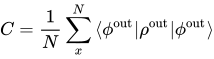
adjusted after each iteration, and given equation 1 below, where is the desired output and is the actual output, the cost function is optimized when = 0. For a quantum neural network, the cost function is determined by measuring the fidelity of the outcome state () with the desired outcome state (),
seen in Equation 2 below. In this case, the Unitary operators are
adjusted after each iteration, and the cost function is optimized when C
= 1.
Equation 1
Equation 2
Barren plateaus
Barren plateaus of VQA Figure shows the Barren Plateau problem becomes increasingly serious as the VQA expands.
Gradient descent is widely used and successful in classical
algorithms. However, although the simplified structure is very similar
to neural networks such as CNNs, QNNs perform much worse.
Since the quantum space exponentially expands as the q-bit grows,
the observations will concentrate around the mean value at an
exponential rate, where also have exponentially small gradients.
This situation is known as Barren Plateaus, because most of the
initial parameters are trapped on a "plateau" of almost zero gradient,
which approximates random wandering rather than gradient descent. This makes the model untrainable.
In fact, not only QNN, but almost all deeper VQA algorithms have this problem. In the present NISQ era,
this is one of the problems that have to be solved if more applications
are to be made of the various VQA algorithms, including QNN.
Theorists differ in how they relate consciousness to electromagnetism. Electromagnetic field theories (or "EM field theories") of consciousness propose that consciousness results when a brain produces an electromagnetic field with specific characteristics. Susan Pockett and Johnjoe McFadden have proposed EM field theories; William Uttal has criticized McFadden's and other field theories.
In general, quantum mind theories do not treat consciousness as an electromagnetic phenomenon, with a few exceptions.
AR Liboff has proposed that "incorporating EM field-mediated
communication into models of brain function has the potential to reframe
discussions surrounding consciousness".
Also related are E. Roy John's work and Andrew and Alexander
Fingelkurts theory "Operational Architectonics framework of brain-mind
functioning".
Cemi theory
The starting point for McFadden and Pockett's theory is the fact that every time a neuron fires to generate an action potential, and a postsynaptic potential in the next neuron down the line, it also generates a disturbance in the surrounding electromagnetic field.
McFadden has proposed that the brain's electromagnetic field creates a
representation of the information in the neurons. Studies undertaken
towards the end of the 20th century are argued to have shown that
conscious experience correlates not with the number of neurons firing,
but with the synchrony of that firing. McFadden views the brain's electromagnetic field as arising from the
induced EM field of neurons. The synchronous firing of neurons is, in
this theory, argued to amplify the influence of the brain's EM field
fluctuations to a much greater extent than would be possible with the
unsynchronized firing of neurons.
McFadden thinks that the EM field could influence the brain in a
number of ways. Redistribution of ions could modulate neuronal activity,
given that voltage-gated ion channels are a key element in the progress of axon
spikes. Neuronal firing is argued to be sensitive to the variation of
as little as one millivolt across the cell membrane, or the involvement
of a single extra ion channel. Transcranial magnetic stimulation is similarly argued to have demonstrated that weak EM fields can influence brain activity.
McFadden proposes that the digital information from neurons is
integrated to form a conscious electromagnetic information (cemi) field
in the brain. Consciousness
is suggested to be the component of this field that is transmitted back
to neurons, and communicates its state externally. Thoughts are viewed
as electromagnetic representations of neuronal information, and the
experience of free will in our choice of actions is argued to be our subjective experience of the cemi field acting on our neurons.
McFadden's view of free will is deterministic. Neurons generate
patterns in the EM field, which in turn modulate the firing of
particular neurons. There is only conscious agency in the sense that the
field or its download to neurons is conscious, but the processes of the
brain themselves are driven by deterministic electromagnetic
interactions. The feel of subjective experience or qualia corresponds to
a particular configuration of the cemi field. This field representation
is in this theory argued to integrate parts into a whole that has
meaning, so a face is not seen as a random collection of features, but
as somebody's face. The integration of information in the field is also
suggested to resolve the binding/combination problem.
In 2013, McFadden published two updates to the theory. In the first, 'The CEMI Field Theory: Closing the Loop' McFadden cites recent experiments in the laboratories of Christof Koch and David McCormick which demonstrate that external EM fields, that simulate the brain's
endogenous EM fields, influence neuronal firing patterns within brain
slices. The findings are consistent with a prediction of the cemi field
theory that the brain's endogenous EM field - consciousness - influences
brain function. In the second, 'The CEMI Field Theory Gestalt
Information and the Meaning of Meaning', McFadden claims that the cemi field theory provides a solution to the binding problem
of how complex information is unified within ideas to provide meaning:
the brain's EM field unifies the information encoded in millions of
disparate neurons.
Susan Pockett has advanced a theory, which has a similar physical basis to McFadden's, with consciousness seen as identical to certain spatiotemporal patterns
of the EM field. However, whereas McFadden argues that his
deterministic interpretation of the EM field is not out-of-line with
mainstream thinking, Pockett suggests that the EM field comprises a
universal consciousness that experiences the sensations, perceptions,
thoughts and emotions of every conscious being in the universe. However,
while McFadden thinks that the field is causal for actions, albeit
deterministically, Pockett does not see the field as causal for our
actions.
The concepts underlying this theory derive from the physicists, Hiroomi Umezawa and Herbert Fröhlich in the 1960s. More recently, their ideas have been elaborated by Mari Jibu and Kunio Yasue. Water comprises 70% of the brain, and quantum brain dynamics
(QBD) proposes that the electric dipoles of the water molecules
constitute a quantum field, referred to as the cortical field, with
corticons as the quanta of the field. This cortical field is postulated
to interact with quantum coherent waves generated by the biomolecules in
neurons, which are suggested to propagate along the neuronal network.
The idea of quantum coherent waves in the neuronal network derives from
Fröhlich. He viewed these waves as a means by which order could be
maintained in living systems, and argued that the neuronal network could
support long-range correlation of dipoles. This theory suggests that
the cortical field not only interacts with the neuronal network, but
also to a good extent controls it.
The proponents of QBD differ somewhat as to the way in which
consciousness arises in this system. Jibu and Yasue suggest that the
interaction between the energy quanta (corticons) of the quantum field
and the biomolecular waves of the neuronal network produces
consciousness. However, another theorist, Giuseppe Vitiello, proposes
that the quantum states produce two poles, a subjective representation
of the external world and also the internal self.
Advantages
Locating consciousness in the brain's EM field, rather than the neurons,
has the advantage of neatly accounting for how information located in
millions of neurons scattered through the brain can be unified into a
single conscious experience (called the binding problem): the
information is unified in the EM field. In this way, EM field consciousness can be considered to be "joined-up
information". This theory accounts for several otherwise puzzling facts,
such as the finding that attention and awareness
tend to be correlated with the synchronous firing of multiple neurons
rather than the firing of individual neurons. When neurons fire
together, their EM fields generate stronger EM field disturbances; so synchronous neuron firing will tend to have a larger impact on the
brain's EM field (and thereby consciousness) than the firing of
individual neurons. However their generation by synchronous firing is
not the only important characteristic of conscious electromagnetic
fields—in Pockett's original theory, spatial pattern is the defining
feature of a conscious (as opposed to a non-conscious) field.
Objections
In a circa-2002 publication of The Journal of Consciousness Studies, the electromagnetic theory of consciousness faced an uphill battle for acceptance among cognitive scientists.
"No serious researcher I know believes in an electromagnetic theory of consciousness", Bernard Baars wrote in an e-mail. Baars is a neurobiologist and co-editor of Consciousness and Cognition, another scientific journal in the field. "It's not really worth talking about scientifically", he was quoted as saying.
McFadden acknowledges that his theory, which he calls the "cemi
field theory", is far from proven but he argues that it is certainly a
legitimate line of scientific inquiry. His article underwent peer review
before publication.
The field theories of consciousness do not appear to have been as
widely discussed as other quantum consciousness theories, such as those
of Penrose, Stapp or Bohm. However, David Chalmers argues against quantum consciousness. He instead discusses how quantum mechanics may relate to dualistic consciousness. Chalmers is skeptical that any new physics can resolve the hard problem of consciousness. He argues that quantum theories of consciousness suffer from the same
weakness as more conventional theories. Just as he argues that there is
no particular reason why particular macroscopic physical features in the
brain should give rise to consciousness, he also thinks that there is
no particular reason why a particular quantum feature, such as the EM
field in the brain, should give rise to consciousness either. Despite the existence of transcranial magnetic stimulation with medical purposes, Y. H. Sohn, A. Kaelin-Lang and M. Hallett have denied it, and later Jeffrey Gray states in his book Consciousness: Creeping up on the Hard Problem, that tests looking for the influence of electromagnetic fields on brain function have been universally negative in their result. However, a number of studies have found clear neural effects from EM stimulation.
Dobson, et al. (2000): 1.8 millitesla = 18,000 mG
Thomas, et al. (2007): 400 microtesla = 4000 milligauss
Huesser, et al. (1997): 0.1 millitesla = 1000 mG
Bell, et al. (2007) 0.78 Gauss = 780 mG
Marino, et al. (2004): 1 Gauss = 1000 mG
Carrubba, et al. (2008): 1 Gauss = 1000 mG
Jacobson (1994): 5 picotesla = 0.00005 mG
Sandyk (1999): Picotesla range
In April 2022, the results of two related experiments at the University of Alberta and Princeton University were announced at The Science of Consciousness conference, providing further evidence to support quantum processes operating within microtubules. In a study Stuart Hameroff was part of, Jack Tuszyński of the University of Alberta demonstrated that anesthetics hasten the duration of a process called delayed luminescence, in which microtubules and tubulins re-emit trapped light. Tuszyński suspects that the phenomenon has a quantum origin, with superradiance being investigated as one possibility. In the second experiment, Gregory D. Scholes and Aarat Kalra of Princeton University
used lasers to excite molecules within tubulins, causing a prolonged
excitation to diffuse through microtubules further than expected, which
did not occur when repeated under anesthesia.However, diffusion results have to be interpreted carefully, since even
classical diffusion can be very complex due to the wide range of length
scales in the fluid filled extracellular space. Nevertheless, University of Oxford quantum physicist Vlatko Vedral told that this connection with consciousness is a really long shot. In addition, the tests were performed on microtubules in tubo
in a UV-Vis apparatus, with chemicals added that altered the electrical
properties of the microtubules, without critical microtubule-associated
proteins like ferritin that quench microtubule fluorescence, and with a
number of other major substantive issues that render the tests
inapplicable to neurons.
Also in 2022, a group of Italian physicists conducted several
experiments that failed to provide evidence in support of a
gravity-related quantum collapse model of consciousness, weakening the
possibility of a quantum explanation for consciousness.
Influence on brain function
The
different EM field theories disagree as to the role of the proposed
conscious EM field on brain function. In McFadden's cemi field theory,
as well as in Drs Fingelkurts' Brain-Mind Operational Architectonics
theory, the brain's global EM field modifies the electric charges across
neural membranes, and thereby influences the probability that
particular neurons will fire, providing a feed-back loop that drives free will.
However, in the theories of Susan Pockett and E. Roy John, there is no
necessary causal link between the conscious EM field and our consciously
willed actions.
References to "Mag Lag" also known as the subtle effect on
cognitive processes of MRI machine operators who sometimes have to go
into the scanner room to check the patients and deal with issues that
occur during the scan could suggest a link between magnetic fields and
consciousness. Memory loss and delays in information processing have
been reported, in some cases several hours after exposure.
One hypothesis is that magnetic fields in the 0.5-9 Tesla range
can affect the ion permeability of neural membranes, in fact this could
account for a lot of the issues seen as this would affect many different
brain functions. It is also noted that the bioelectric and biomagnetic
properties of ferritin are influenced by both magnetic and electric
fields. Endogenous ferritin provides magnetic resonance imaging contrast in the substantia nigra and red nucleus, the zona incerta and the subthalamic nucleus, and other nuclei, and could provide a signaling mechanism that is modulated by magnetic fields. Endogenous ferritin also releases iron when stimulated with RF energy, which results in calcium signaling in neurons. It is thus possible that there are a number of quantum biological
effects that contribute to consciousness, and it is too early to dismiss
quantum biology
as many have done. Instead, what is needed is further investigation.
As noted by Nobel Laureate Albert Szent-Györgyi, "[a] discovery must be,
by definition, at variance with existing knowledge." Too many scientists are quick to dismiss or ignore evidence of
discoveries that are at variance with existing knowledge (even the
proponents of the various quantum biology hypotheses that relate to
consciousness that are different from their own).
Implications for artificial intelligence
If true, the theory has major implications for efforts to design consciousness into artificial intelligence machines; current microprocessor
technology is designed to transmit information linearly along
electrical channels, and more general electromagnetic effects are seen
as a nuisance and damped
out; if this theory is right, however, this is directly
counterproductive to creating an artificially conscious computer, which
on some versions of the theory would instead have electromagnetic fields
that synchronized its outputs—or in the original version of the theory
would have spatially patterned electromagnetic fields.
Apostasy (/əˈpɒstəsi/; Ancient Greek: ἀποστασία, romanized: apostasía, lit.'defection, revolt') is the formal disaffiliation from, abandonment of, or renunciation of a religion
by a person. It can also be defined within the broader context of
embracing an opinion that is contrary to one's previous religious beliefs. One who undertakes apostasy is known as an apostate. Undertaking apostasy is called apostatizing (or apostasizing – also spelled apostacizing). The term apostasy is used by sociologists to mean the renunciation and criticism of, or opposition to, a person's former religion, in a technical sense, with no pejorative connotation.
Apostasy is generally not a self-definition: few former believers
call themselves apostates due to the term's negative connotation.
Many religious groups and some states punish apostates; this may
be the official policy of a particular religious group or it may simply
be the voluntary action of its members. Such punishments may include shunning, excommunication, verbal abuse, physical violence, or even execution.
Sociological definitions
The American sociologist Lewis A. Coser (following the German philosopher and sociologist Max Scheler)
defines an apostate as not just a person who experienced a dramatic
change in conviction but "a man who, even in his new state of belief, is
spiritually living not primarily in the content of that faith, in the
pursuit of goals appropriate to it, but only in the struggle against the
old faith and for the sake of its negation."
Apostate role: defined as one that occurs in a highly
polarized situation in which an organization member undertakes a total
change of loyalties by allying with one or more elements of an
oppositional coalition without the consent or control of the
organization. The narrative documents the quintessentially evil essence
of the apostate's former organization chronicled through the apostate's
personal experience of capture and ultimate escape/rescue.
Defector role: an organizational participant negotiates exit
primarily with organizational authorities, who grant permission for role
relinquishment, control the exit process and facilitate role
transmission. The jointly constructed narrative assigns primary moral
responsibility for role performance problems to the departing member and
interprets organizational permission as commitment to extraordinary
moral standards and preservation of public trust.
Whistle-blower role: defined here as when an organization
member forms an alliance with an external regulatory agency through
personal testimony concerning specific, contested organizational
practices that the external unit uses to sanction the organization. The
narrative constructed jointly by the whistle blower and regulatory
agency depicts the whistle-blower as motivated by personal conscience,
and the organization by defense of the public interest.
Stuart A. Wright,
an American sociologist and author, asserts that apostasy is a unique
phenomenon and a distinct type of religious defection in which the
apostate is a defector "who is aligned with an oppositional coalition in
an effort to broaden the dispute, and embraces public claims-making
activities to attack his or her former group."
The Committee observes that the
freedom to 'have or to adopt' a religion or belief necessarily entails
the freedom to choose a religion or belief, including the right to
replace one's current religion or belief with another or to adopt
atheistic views ... Article 18.2 bars coercion that would impair the right to have or adopt a religion
or belief, including the use of threat of physical force or penal
sanctions to compel believers or non-believers to adhere to their
religious beliefs and congregations, to recant their religion or belief
or to convert.
History
As early as the 3rd century AD, apostasy against the Zoroastrian faith in the Sasanian Empire was criminalized. The high priest, Kidir, instigated pogroms against Jews, Christians, Buddhists, and others in an effort to solidify the hold of the state religion.
As the Roman Empire adopted Christianity as its state religion, apostasy became formally criminalized in the Theodosian Code, followed by the Corpus Juris Civilis (the Justinian Code). The Justinian Code went on to form the basis of law in most of Western
Europe during the Middle Ages and so apostasy was similarly persecuted
to varying degrees in Europe throughout this period and into the early
modern period. Eastern Europe similarly inherited many of its legal
traditions regarding apostasy from the Romans, but not from the
Justinian Code. Medieval sects deemed heretical such as the Waldensians were considered apostates by the Church.
Atrocity story
The term atrocity story, also referred to as an atrocity tale, as it is defined by the American sociologistsDavid G. Bromley and Anson D. Shupe
refers to the symbolic presentation of action or events (real or
imaginary) in such a context that they are made flagrantly to violate
the (presumably) shared premises upon which a given set of social
relationships should be conducted. The recounting of such tales is
intended as a means of reaffirming normative boundaries. By sharing the
reporter's disapproval or horror, an audience reasserts normative
prescription and clearly locates the violator beyond the limits of public morality. The term was coined in 1979 by Bromley, Shupe, and Joseph Ventimiglia.
Bromley and others define an atrocity as an event that is
perceived as a flagrant violation of a fundamental value. It contains
the following three elements:
moral outrage or indignation;
authorization of punitive measures;
mobilization of control efforts against the apparent perpetrators.
The term "atrocity story" is controversial as it relates to the
differing views amongst scholars about the credibility of the accounts
of former members.
Bryan R. Wilson,
Reader Emeritus of Sociology of the University of Oxford, says
apostates of new religious movements are generally in need of
self-justification, seeking to reconstruct their past and to excuse
their former affiliations, while blaming those who were formerly their
closest associates. Wilson, thus, challenges the reliability of the
apostate's testimony by saying that the apostate
must always be seen as one whose
personal history predisposes him to bias with respect to both his
previous religious commitment and affiliations
and
the suspicion must arise that he
acts from a personal motivation to vindicate himself and to regain his
self-esteem, by showing himself to have been first a victim but
subsequently to have become a redeemed crusader.
Wilson also asserts that some apostates or defectors from religious
organisations rehearse atrocity stories to explain how, by manipulation,
coercion or deceit, they were recruited to groups that they now
condemn.
Jean Duhaime of the Université de Montréal
writes, referring to Wilson, based on his analysis of three books by
apostates of new religious movements, that stories of apostates cannot
be dismissed only because they are subjective.
Danny Jorgensen, Professor at the Department of Religious Studies of the University of Florida, in his book The Social Construction and Interpretation of Deviance: Jonestown and the Mass Media argues that the role of the media
in constructing and reflecting reality is particularly apparent in its
coverage of cults. He asserts that this complicity exists partly because
apostates with an atrocity story to tell make themselves readily
available to reporters and partly because new religious movements have
learned to be suspicious of the media and, therefore, have not been open
to investigative reporters writing stories on their movement from an
insider's perspective. Besides this lack of information about the
experiences of people within new religious movements, the media is
attracted to sensational
stories featuring accusations of food and sleep deprivation, sexual and
physical abuse, and excesses of spiritual and emotional authority by
the charismatic leader.
Michael Langone
argues that some will accept uncritically the positive reports of
current members without calling such reports, for example, "benevolence
tales" or "personal growth tales". He asserts that only the critical
reports of ex-members are called "tales", which he considers to be a
term that clearly implies falsehood or fiction. He states that it wasn't
until 1996 that a researcher conducted a study to assess the extent to which so called "atrocity tales" might be based on fact.
Apostasy is a criminal offence in the following countries:
Afghanistan – criminalized under Article 1 of the Afghan Penal Code, may be punishable by death.
Brunei – criminalized under Section 112(1) of the Bruneian Syariah Penal Code, punishable by death. However, Brunei has a moratorium on the death penalty.
Iran –
while there are no provisions that criminalize apostasy in Iran,
apostasy may be punishable by death under Iranian Sharia law, in
accordance with Article 167 of the Iranian Constitution.
Malaysia – while not criminalized on a federal level, apostasy is criminalized in six out of thirteen states: Kelantan, Malacca, Pahang, Penang, Sabah and Terengganu. In Kelantan and Terengganu, apostasy is punishable by death, but this is unenforceable due to restriction in federal law.
Maldives – criminalized under Section 1205 of the Maldivian Penal Code, may be punishable by death.
Mauritania
– criminalized under Article 306 of the Mauritanian Penal Code,
punishable by death. When discovered, secret apostasy requires capital
punishment, irrespective of repentance.
Qatar – criminalized under Article 1 of the Qatari Penal Code, may be punishable by death.
Saudi Arabia – while there is no penal code in Saudi Arabia, apostasy may be punishable by death under Saudi Sharia law.
United Arab Emirates – criminalized under Article 158 of the Emirati Penal Code, may be punishable by death.
Yemen – criminalized under Article 259 of the Yemeni Penal Code, punishable by death.
From 1985 to 2006, the United States Commission on International Religious Freedom
listed a total of four cases of execution for apostasy in the Muslim
world: one in Sudan (1985), two in Iran (1989, 1998), and one in Saudi
Arabia (1992).
Both marginal and apostate Baháʼís have existed in the Baháʼí Faith community who are known as nāqeżīn.
Muslims often regard adherents of the Baháʼí Faith as apostates
from Islam, and there have been cases in some Muslim countries where
Baháʼís have been harassed and persecuted.
Christianity
Judas betrays Jesus with a kiss. Judas Iscariot, one of the Twelve Disciples, became an apostate.
"Apostasy is the antonym of conversion; it is deconversion." B. J. Oropeza
states that apostasy is a "phenomenon that occurs when a religious
follower or group of followers turn away from or otherwise repudiate the
central beliefs and practices they once embraced in a respective
religious community." The Ancient Greek noun ἀποστασία apostasia ("rebellion, abandonment, state of apostasy, defection") is found only twice in the New Testament (Acts 21:21; 2 Thessalonians 2:3). However, "the concept of apostasy is found throughout Scripture." The Dictionary of Biblical Imagery
states that "There are at least four distinct images in Scripture of
the concept of apostasy. All connote an intentional defection from the
faith." These images are: Rebellion; Turning Away; Falling Away; Adultery.
Rebellion: "In classical literature apostasia was used to denote
a coup or defection. By extension the Septuagint always uses it to
portray a rebellion against God (Joshua 22:22; 2 Chronicles 29:19)."
Turning away: "Apostasy is also pictured as the heart turning away
from God (Jeremiah 17:5–6) and righteousness (Ezekiel 3:20). In the OT
it centers on Israel's breaking covenant
relationship with God through disobedience to the law (Jeremiah 2:19),
especially following other gods (Judges 2:19) and practicing their
immorality (Daniel 9:9–11) ... Following the Lord or journeying with him
is one of the chief images of faithfulness in the Scriptures ...
The ... Hebrew root (swr) is used to picture those who have
turned away and ceased to follow God ('I am grieved that I have made
Saul king, because he has turned away from me,' 1 Samuel 15:11) ... The
image of turning away from the Lord, who is the rightful leader, and
following behind false gods is the dominant image for apostasy in the
OT."
Falling away: "The image of falling, with the sense of going to
eternal destruction, is particularly evident in the New Testament ... In
his [Christ's] parable of the wise and foolish builder, in which the
house built on sand falls with a crash in the midst of a storm (Matthew
7:24–27) ... he painted a highly memorable image of the dangers of
falling spiritually."
Adultery: One of the most common images for apostasy in the Old Testament is adultery. "Apostasy is symbolized as Israel the faithless spouse turning away
from Yahweh her marriage partner to pursue the advances of other gods
(Jeremiah 2:1–3; Ezekiel 16) ... 'Your children have forsaken me and
sworn by gods that are not gods. I supplied all their needs, yet they
committed adultery and thronged to the houses of prostitutes' (Jeremiah
5:7, NIV). Adultery is used most often to describe the horror of the
betrayal and covenant breaking involved in idolatry. Like literal
adultery it does include the idea of someone blinded by infatuation, in
this case for an idol: 'How I have been grieved by their adulterous
hearts ... which have lusted after their idols' (Ezekiel 6:9)."
Speaking with specific regard to apostasy in Christianity, Michael Fink writes:
Apostasy is certainly a biblical concept, but the implications of the teaching have been hotly debated. The debate has centered on the issue of apostasy and salvation. Based
on the concept of God's sovereign grace, some hold that, though true
believers may stray, they never totally fall away. Others affirm that
any who fall away were never really saved. Though they may have
"believed" for a while, they never experienced regeneration. Still
others argue that the biblical warnings against apostasy are real and
that believers maintain the freedom, at least potentially, to reject
God's salvation.
In the recent past, in the Roman Catholic Church the word was also applied to the renunciation of monastic vows (apostasis a monachatu), and to the abandonment of the clerical profession for the life of the world (apostasis a clericatu) without necessarily amounting to a rejection of Christianity.
Penalties
Apostasy
was one of the sins for which the early church imposed perpetual
penance and excommunication. Christianity rejected the removal of
heretics and apostates by force, leaving the final punishment to God. As a result, the first millennium saw only one single official execution of a heretic, the Priscillian case. Classical canon law viewed apostasy as distinct from heresy and schism. Apostasy a fide,
defined as total repudiation of the Christian faith, was considered as
different from a theological standpoint and from heresy, but subject to
the same penalty of death by fire by decretist jurists. The influential 13th-century theologian Hostiensis
recognized three types of apostasy. The first was conversion to another
faith, which was considered traitorous and could bring confiscation of
property or even the death penalty. The second and third, which was
punishable by expulsion from home and imprisonment, consisted of
breaking major commandments and breaking the vows of religious orders,
respectively.
A decretal by Boniface VIII (pope between 1294-1303) classified apostates together with heretics with respect to the penalties incurred. Although it mentioned only apostate Jews explicitly, it was applied to all apostates, and the Spanish Inquisition used it to persecute both the Marrano Jews, who had been converted to Christianity by force, and to the Moriscos who had professed to convert to Christianity from Islam under pressure.
Temporal penalties for Christian apostates have fallen into disuse in the modern era.
Jehovah's Witness publications define apostasy
as the abandonment of the worship and service of God, constituting
rebellion against God, or rejecting "Jehovah's organization". They apply the term to a range of conduct, including open dissent with
the denomination's doctrines, celebration of "false religious holidays"
(including Christmas and Easter), and participation in activities and
worship of other religions. A member of the denomination who is accused of apostasy is typically
required to appear before a committee of elders that decides whether the
individual is to be shunned by all congregants including immediate
family members not living in the same home. Baptized individuals who leave the organization because they disagree
with the denomination's teachings are also regarded as apostates and are
shunned.
Watch Tower Society literature describes apostates as "mentally diseased" individuals who can "infect others with their disloyal teachings". Former members who are defined as apostates are said to have become part of the antichrist and are regarded as more reprehensible than non-Witnesses.
Latter-day Saints (Mormonism)
Members of the Church of Jesus Christ of Latter-day Saints
(LDS Church) are considered by church leadership to engage in apostasy
when they publicly teach or espouse opinions and doctrines contrary to
the teachings of the church, or act in clear and deliberate public
opposition to the LDS Church, its doctrines and policies, or its
leaders. This includes advocating for or practicing doctrines like those
followed in apostate sects, such as plural marriage, more commonly
known as polygamy. In such circumstances the church will frequently subject the non-conforming member to a church membership council
which may result in membership restrictions (a temporary loss of church
participation privileges) or membership withdrawal (a loss of church
membership).
Hinduism
Hinduism does not have a "unified system of belief encoded in a declaration of faith or a creed", but is rather an umbrella term comprising the plurality of religious
phenomena of India. In general Hinduism is more tolerant to apostasy
than other faiths based on a scripture or commandments with a lower
emphasis on orthodoxy and has a more open view on how a person chooses
their faith. Some Hindu sects believe that ethical conversion, without force or reward is completely acceptable, though deserting ones clan guru is considered sinful (Guru droham).
The Vashistha Dharmasastra, the Apastamba Dharmasutra and Yajnavalkya state that a son of an apostate is also considered an apostate. Smr̥ticandrikā lists apostates as one group of people upon touching whom, one should take a bath. Kātyāyana condemns a Brahmin who has apostatised to banishment while a Vaishya or a Shudra to serve the king as a slave.Nāradasmṛti and Parasara-samhita states that a wife can remarry if her husband becomes an apostate. The saint Parashara commented that religious rites are disturbed if an apostate witnesses them. He also comments that those who forgo the Rig Veda, Samaveda and Yajurveda are "nagna" (naked) or an apostate.
Apostasy is generally not acknowledged in orthodox Buddhism. People are free to leave Buddhism and renounce the religion without any consequence enacted by the Buddhist community.
Despite this marked tolerance, some Buddhist circles hold to a notion of heresy (外道, pinyin: Wàidào; romaji: gedō;
lit. "outside path") and teach that one who renounces the Buddha's
teachings has the potential of inflicting suffering on themselves.
Many Buddhists take the view that there is no absolute basis for anything. The ideas from some of the Tathāgata schools has been referred to as "hypostasising an absolute", meaning specifically not apostasy (losing belief); hypostasy in that context means "falling into belief".
A 1978 fatwa (nonbinding legal opinion) issued by the Fatawa Council at Al-Azhar, the chief centre of Islamic and Arabic learning in the world. The fatwa was issued in response to a query about an Egyptian Muslim
man marrying a German Christian woman and then converting to
Christianity. The council ruled that the man committed the crime of
apostasy, and should be given a chance to repent and return to Islam. If
he refuses, he is to be killed. The same conclusion was given for his
children once they reach the age of puberty.
In Islamic literature, apostasy is called irtidād or ridda; an apostate is called murtadd, which literally means 'one who turns back' from Islam. Someone born to a Muslim parent, or who has previously converted to Islam, becomes a murtadd if he or she verbally denies any principle of belief prescribed by the Quran or a Hadith, deviates from approved Islamic belief (ilhad), or if he or she commits an action such as treating a copy of the Qurʾan with disrespect. A person born to a Muslim parent who later rejects Islam is called a murtad fitri, and a person who converted to Islam and later rejects the religion is called a murtad milli.
Origin
There are multiple verses in the Quran that condemn apostasy. In addition, there are multiple verses in the Hadith that condemn apostasy. Example quote from the Quran:
They wish you would disbelieve as
they disbelieved so you would be alike. So do not take from among them
allies until they emigrate for the cause of Allāh. But if they turn away
[i.e., refuse], then seize them and kill them [for their betrayal]
wherever you find them and take not from among them any ally or helper
The concept and punishment of Apostasy has been extensively covered in Islamic literature since the 7th century. A person is considered apostate if he or she converts from Islam to another religion. A person is an apostate even if he or she believes in most of Islam,
but denies one or more of its principles or precepts, both verbally or
in writing.
Sunan an-Nasa'i »The Book of Fighting [The Prohibition of
Bloodshed] – كتاب تحريم الدم (14) Chapter: The Ruling on Apostates
(14)باب الْحُكْمِ فِي الْمُرْتَدِّ Ibn 'Abbas said: "The Messenger of
Allah [SAW] said: 'Whoever changes his religion, kill him.'"Grade: Sahih
(Darussalam) Reference : Sunan an-Nasa'i 4059 In-book reference : Book
37, Hadith 94 English translation Vol. 5, Book 37, Hadith 4064.
Muslim historians recognize 632 AD as the year when the first
regional apostasy from Islam emerged, immediately after the death of
Muhammed. The civil wars that followed are now called the Riddah wars (Wars of Islamic Apostasy).
Doubting the existence of Allah,
making offerings to and worshipping an idol, a stupa or any other image
of God, confessing a belief in the rebirth or incarnation of God,
disrespecting the Quran or Islam's Prophets are all considered
sufficient evidence of apostasy.
According to some scholars,
if a Muslim consciously and without coercion declares their rejection
of Islam and does not change their mind after the time allocated by a
judge for research, then the penalty for apostasy is; for males, death,
and for females, life imprisonment. However, a Federal Sharia court judge in Pakistan stated
"...persecuting any citizen of an Islamic State – whether he is a
Muslim, or a dhimmi** – is construed as waging a war against Allah and
His Messenger."
Public opinion
According to the Ahmadiyya Muslim sect, there is no punishment for apostasy, neither in the Quran nor as it was taught by Muhammad. The Ahmadiyya Muslim sect's position is not widely accepted by clerics
in other sects of Islam, and the Ahmadiyya sect of Islam acknowledges
that major sects have a different interpretation and definition of
apostasy in Islam. Ulama of major sects of Islam consider the Ahmadi Muslim sect as kafirs (infidels) and apostates.
Apostasy laws
Apostasy is subject to the death penalty in some countries, such as Iran and Saudi Arabia, although executions for apostasy are rare. Apostasy is legal in secular Muslim countries such as Turkey. In numerous Islamic majority countries, many individuals have been
arrested and punished for the crime of apostasy without any associated
capital crimes.
In an effort to circumvent the United Nations Commission on Human
Rights's ruling on an individual's right to conversion from and
denunciation of a religion, some offenders of the ruling have argued
that their "obligations to Islam are irreconcilable with international
law." United Nations Special Rapporteur Heiner Bielefeldt
recommended to the United Nations Human Rights Council on the issues of
freedom of religion or belief that "States should repeal any criminal
law provisions that penalize apostasy, blasphemy and proselytism
as they may prevent persons belonging to religious or belief minorities
from fully enjoying their freedom of religion or belief."
Many Muslims consider the Islamic law on apostasy and the punishment for it to be one of the immutable laws under Islam. It is a hudud crime,which means it is a crime against God, and the punishment has been fixed by God. The punishment for apostasy includes state enforced annulment of his or her marriage, seizure of the
person's children and property with automatic assignment to guardians
and heirs, and death for the apostate.
Public opinion
According
to a Pew Research study up to 15% of Muslims in Bosnia-Herzegovina,
Russia, Kosovo, Albania, Kyrgyzstan, and Kazakhstan were in favor of a
death penalty for converts, 15–30% in Turkey, Thailand, Tajikistan, and
Tunisia, 30–50% in Bangladesh, Lebanon, and Iraq, and 50–86% in
Pakistan, Afghanistan, Palestine, Jordan, and Egypt. The study included percentages only for Muslims in favor of sharia law
and did not include Azerbaijan because it had a small sample size. A similar survey of the Muslim population in the United Kingdom, in
2007, found nearly a third of 16 to 24-year-old faithful believed that
Muslims who convert to another religion should be executed, while less
than a fifth of those over 55 believed the same. There is disagreement among contemporary Islamic scholars about whether
the death penalty is an appropriate punishment for apostasy in the 21st
century. A belief among more liberal Islamic scholars is that the apostasy laws
were created and are still implemented as a means to consolidate
"religio-political" power.
The term apostasy is derived from Ancient Greek ἀποστασία from ἀποστάτης, meaning "political rebel", as applied to rebellion against God, its law and the faith of Israel (in Hebrew מרד) in the Hebrew Bible. Other expressions for apostate as used by rabbinical scholars are mumar (מומר, literally "the one that is changed") and poshea yisrael (פושע ישראל, literally, "transgressor of Israel"), or simply kofer (כופר, literally "denier" and heretic).
If your brother, the son of your
mother, your son or your daughter, the wife of your bosom, or your
friend who is as your own soul, secretly entices you, saying, 'Let us go
and serve other gods,' which you have not known, neither you nor your
fathers, of the gods of the people which are all around you, near to you
or far off from you, from one end of the earth to the other end of the
earth, you shall not consent to him or listen to him, nor shall your eye
pity him, nor shall you spare him or conceal him; but you shall surely
kill him; your hand shall be first against him to put him to death, and
afterward the hand of all the people. And you shall stone him with
stones until he dies, because he sought to entice you away from the Lord
your God, who brought you out of the land of Egypt, from the house of
bondage.
In 1 Kings, King Solomon is warned in a dream which "darkly portray[s] the ruin that would be caused by departure from God":
If you or your sons at all turn
from following Me, and do not keep My commandments and My statutes which
I have set before you, but go and serve other gods and worship them,
then I will cut off Israel from the land which I have given them; and
this house which I have consecrated for My name I will cast out of My
sight. Israel will be a proverb and a byword among all peoples.
The prophetic writings of Isaiah and Jeremiah
provide many examples of defections of faith found among the Israelites
(e.g., Isaiah 1:2–4 or Jeremiah 2:19), as do the writings of the
prophet Ezekiel
(e.g., Ezekiel 16 or 18). Israelite kings were often guilty of
apostasy, examples including Ahab (I Kings 16:30–33), Ahaziah (I Kings
22:51–53), Jehoram (2 Chronicles 21:6, 10), Ahaz (2 Chronicles 28:1–4),
or Amon (2 Chronicles 33:21–23) among others. Amon's father Manasseh was
also apostate for many years of his long reign, although towards the
end of his life he renounced his apostasy (cf. 2 Chronicles 33:1–19).
During the Spanish Inquisition, a systematic conversion of Jews to Christianity took place to avoid expulsion from the crowns of Castille and Aragon as had been the case previously elsewhere in medieval Europe. Although the vast majority of conversos
simply assimilated into the Catholic dominant culture, a minority
continued to practice Judaism in secret, gradually migrated throughout
Europe, North Africa, and the Ottoman Empire, mainly to areas where
Sephardic communities were already present as a result of the Alhambra Decree.
Tens of thousands of Jews were baptised in the three months before the
deadline for expulsion, some 40,000 if one accepts the totals given by
Kamen, most of these undoubtedly to avoid expulsion, rather than as a sincere change of faith. These conversos
were the principal concern of the Inquisition; being suspected of
continuing to practice Judaism put them at risk of denunciation and
trial.
Several notorious Inquisitors, such as Tomás de Torquemada, and Don Francisco the archbishop of Coria,
were descendants of apostate Jews. Other apostates who made their mark
in history by attempting the conversion of other Jews in the 14th
century include Juan de Valladolid and Astruc Remoch.
Abraham Isaac Kook, first Chief Rabbi of the Jewish community in Palestine, held that
atheists were not actually denying God: rather, they were denying one of
man's many images of God. Since any man-made image of God can be
considered an idol, Kook held that, in practice, one could consider
atheists as helping true religion burn away false images of god, thus in
the end serving the purpose of true monotheism.
Medieval Judaism was more lenient toward apostasy than the other monotheistic religions. According to Maimonides,
converts to other faiths were to be regarded as sinners, but still
Jewish. Forced converts were subject to special prayers and Rashi admonished those who rebuked or humiliated them.
There is no punishment today for leaving Judaism, other than
being excluded from participating in the rituals of the Jewish community
– including leading worship, Jewish marriage or divorce, being called
to the Torah and being buried in a Jewish cemetery.
Patit is a term in Sikhism for a Sikh who violates the Sikh Code of Conduct. The term is sometimes translated as apostate. Persecution of apostates is prohibited in Sikhism. An apostate can re-initiate into Sikhism by being tankhata (chastised) followed by re-going through the process of Amrit Sanskar.
In Section Six of the Sikh Rehat Maryada (Code of Conduct), it states the four transgressions (kurahit) which lead to a Sikh becoming a patit.
Dishonouring, shaving, cutting or trimming the hair;
Eating the meat of an animal slaughtered by the Kutha method;
Cohabiting with a person other than one's spouse;
Using intoxicants (such as smoking, drinking alcohol, using recreational drugs or tobacco)
These four transgressions which lead to apostasy were first listed by Guru Gobind Singh, the final human guru of Sikhs.
Other religious movements
Controversies over new religious movements
(NRMs) have often involved apostates, some of whom join organizations
or web sites opposed to their former religions. A number of scholars
have debated the reliability of apostates and their stories, often
called "apostate narratives".
The role of former members, or "apostates", has been widely
studied by social scientists. At times, these individuals become
outspoken public critics of the groups they leave. Their motivations,
the roles they play in the anti-cult movement, the validity of their testimony, and the kinds of narratives they construct, are controversial. Some scholars like David G. Bromley, Anson Shupe, and Brian R. Wilson have challenged the validity of the testimonies presented by critical former members. Wilson discusses the use of the atrocity story that is rehearsed by the apostate to explain how, by manipulation, coercion, or deceit, he was recruited to a group that he now condemns.
Sociologist Stuart A. Wright
explores the distinction between the apostate narrative and the role of
the apostate, asserting that the former follows a predictable pattern,
in which the apostate uses a "captivity narrative"
that emphasizes manipulation, entrapment and being victims of "sinister
cult practices". These narratives provide a rationale for a
"hostage-rescue" motif, in which cults are likened to POW camps and deprogramming
as heroic hostage rescue efforts. He also makes a distinction between
"leavetakers" and "apostates", asserting that despite the popular
literature and lurid media accounts of stories of "rescued or recovering
'ex-cultists'", empirical studies of defectors from NRMs "generally
indicate favorable, sympathetic or at the very least mixed responses
toward their former group".
Some scholars have attempted to classify apostates of NRMs. James T. Richardson proposes a theory related to a logical relationship between apostates and whistleblowers, using Bromley's definitions, in which the former predates the latter. A person becomes an apostate
and then seeks the role of whistleblower, which is then rewarded for
playing that role by groups that are in conflict with the original group
of membership such as anti-cult organizations. These organizations
further cultivate the apostate, seeking to turn him or her into a
whistleblower. He also describes how in this context, apostates'
accusations of "brainwashing"
are designed to attract perceptions of threats against the well-being
of young adults on the part of their families to further establish their
newfound role as whistleblowers. Armand L. Mauss,
defines true apostates as those exiters that have access to
oppositional organizations that sponsor their careers as such, and
validate the retrospective accounts of their past and their outrageous
experiences in new religions – making a distinction between these and
whistleblowers or defectors in this context. Donald Richter, a current member of the Fundamentalist Church of Jesus Christ of Latter Day Saints (FLDS) writes that this can explain the writings of Carolyn Jessop and Flora Jessop, former members of the FLDS church who consistently sided with authorities when children of the YFZ ranch were removed over charges of child abuse.
Ronald Burks, a psychology assistant at the Wellspring Retreat and Resource Center,
in a study comparing Group Psychological Abuse Scale (GPA) and
Neurological Impairment Scale (NIS) scores in 132 former members of
cults and cultic relationships, found a positive correlation between
intensity of reform environment as measured by the GPA and cognitive
impairment as measured by the NIS. Additional findings were a reduced
earning potential in view of the education level that corroborates
earlier studies of cult critics (Martin 1993; Singer & Ofshe, 1990;
West & Martin, 1994) and significant levels of depression and
dissociation agreeing with Conway & Siegelman, (1982), Lewis &
Bromley, (1987) and Martin, et al. (1992). Sociologists Bromley and Hadden note a lack of empirical support for
claimed consequences of having been a member of a "cult" or "sect", and
substantial empirical evidence against it. These include the fact that
the overwhelming proportion of people who get involved in NRMs leave,
most short of two years; the overwhelming proportion of people who leave
do so of their own volition; and that two-thirds (67%) felt "wiser for
the experience".
According to F. Derks and psychologist of religion Jan van der Lans, there is no uniform post-cult trauma.
While psychological and social problems upon resignation are not
uncommon, their character and intensity are greatly dependent on the
personal history and on the traits of the ex-member, and on the reasons
for and way of resignation.
Examples
Historical persons
Julian the Apostate (331/332 – 363 CE), the Roman emperor, given a Christian education by those who assassinated his family, rejected his upbringing and declared his belief in Neoplatonism once it was safe to do so.
Mindaugas, the first and only Christian king of Lithuania, accepted Christianity in 1251 but rejected it in 1261 to return to his pagan ways. It is believed that accepting Christianity was a political move on his part and thus after the victory at the battle of Durbe, the king's nephew Treniota convinced him to reject Christianity.
Maria Monk (1816–1849), sometimes considered an apostate of the Catholic Church, though there is little evidence that she ever was a Catholic.
Lord George Gordon, initially a zealous Protestant and instigator of the Gordon riots of 1780, finally renounced Christianity and converted to Judaism, for which he was ostracized.
In 2011, Youcef Nadarkhani,
an Iranian pastor who converted from Islam to Christianity at the age
of 19, was convicted for apostasy and was sentenced to death, but later
acquitted.
In 2013, Raif Badawi, a Saudi Arabian blogger, was found guilty of apostasy by the high court, which has a penalty of death. However he was not executed, but was imprisoned and punished by 600 lashes instead.
In 2014, Meriam Yehya Ibrahim Ishag
(a.k.a. Adraf Al-Hadi Mohammed Abdullah), a pregnant Sudanese woman,
was convicted of apostasy for converting to Christianity from Islam. The
government ruled that her father was Muslim, a female child takes the
father's religion under Sudan's Islamic law. By converting to Christianity, she had committed apostasy, a crime
punishable by death. Mrs Ibrahim Ishag was sentenced to death. She was
also convicted of adultery on the grounds that her marriage to a
Christian man from South Sudan was void under Sudan's version of Islamic
law, which says Muslim women cannot marry non-Muslims. The death sentence was not carried out, and she left Sudan in secret.
Ashraf Fayadh (born 1980), a Saudi Arabian poet, was imprisoned and lashed for apostasy.
Tasleema Nasreen from Bangladesh, the author of Lajja,
has been declared apostate – "an apostate appointed by imperialist
forces to vilify Islam" – by several clerics and other Muslims in Dhaka.
By 2019, atrocities by ISIL have driven many Muslim families in Syria to convert to Christianity, while others chose to become atheists and agnostics.