Search This Blog

Saturday, December 20, 2025

Quantum state

From Wikipedia, the free encyclopedia
https://en.wikipedia.org/wiki/Quantum_state

In quantum physics, a quantum state is a mathematical entity that represents a physical system. Quantum mechanics specifies the construction, evolution, and measurement of a quantum state. Knowledge of the quantum state, and the rules for the system's evolution in time, exhausts all that can be known about a quantum system.

Quantum states are either pure or mixed, and have several possible representations. Pure quantum states are commonly represented as a vector in a Hilbert space. Mixed states are statistical mixtures of pure states and cannot be represented as vectors on that Hilbert space, and instead are commonly represented as density matrices.

Common examples of quantum states are the wave functions describing position and momentum, finite-dimensional vectors describing spin such as the singlet, and states describing many-body quantum systems in a Fock space.

From the states of classical mechanics

As a tool for physics, quantum states grew out of states in classical mechanics. A classical dynamical state consists of a set of dynamical variables with well-defined real values at each instant of time. For example, the state of a cannon ball would consist of its position and velocity. The state values evolve under equations of motion and thus remain strictly determined. If we know the position of a cannon and the exit velocity of its projectiles, then we can use equations containing the force of gravity to predict the trajectory of a cannon ball precisely.

Similarly, quantum states consist of sets of dynamical variables that evolve under equations of motion. However, the values derived from quantum states are complex numbers, quantized, limited by uncertainty relations, and only provide a probability distribution for the outcomes for a system. These constraints alter the nature of quantum dynamic variables. For example, the quantum state of an electron in a double-slit experiment would consist of complex values over the detection region and, when squared, only predict the probability distribution of electron counts across the detector.

Role in quantum mechanics

The process of describing a quantum system with quantum mechanics begins with identifying a set of variables defining the quantum state of the system. The set will contain compatible and incompatible variables. Simultaneous measurement of a complete set of compatible variables prepares the system in a unique state. The state then evolves deterministically according to the equations of motion. Subsequent measurement of the state produces a sample from a probability distribution predicted by the quantum mechanical operator corresponding to the measurement.

The fundamentally statistical or probabilisitic nature of quantum measurements changes the role of quantum states in quantum mechanics compared to classical states in classical mechanics. In classical mechanics, the initial state of one or more bodies is measured; the state evolves according to the equations of motion; measurements of the final state are compared to predictions. In quantum mechanics, ensembles of identically prepared quantum states evolve according to the equations of motion and many repeated measurements are compared to predicted probability distributions.

Measurements

Measurements, macroscopic operations on quantum states, filter the state. Whatever the input quantum state might be, repeated identical measurements give consistent values. For this reason, measurements 'prepare' quantum states for experiments, placing the system in a partially defined state. Subsequent measurements may either further prepare the system – these are compatible measurements – or it may alter the state, redefining it – these are called incompatible or complementary measurements. For example, we may measure the momentum of a state along the axis any number of times and get the same result, but if we measure the position after once measuring the momentum, subsequent measurements of momentum are changed. The quantum state appears unavoidably altered by incompatible measurements. This is known as the uncertainty principle.

Eigenstates and pure states

The quantum state after a measurement is in an eigenstate corresponding to that measurement and the value measured. Other aspects of the state may be unknown. Repeating the measurement will not alter the state. In some cases, compatible measurements can further refine the state, causing it to be an eigenstate corresponding to all these measurements. A full set of compatible measurements produces a pure state. Any state that is not pure is called a mixed state as discussed in more depth below

The eigenstate solutions to the Schrödinger equation can be formed into pure states. Experiments rarely produce pure states. Therefore statistical mixtures of solutions must be compared to experiments.

Representations

The same physical quantum state can be expressed mathematically in different ways called representations. The position wave function is one representation often seen first in introductions to quantum mechanics. The equivalent momentum wave function is another wave function based representation. Representations are analogous to coordinate systems or similar mathematical devices like parametric equations. Selecting a representation will make some aspects of a problem easier at the cost of making other things difficult.

In formal quantum mechanics (see § Formalism in quantum physics below) the theory develops in terms of abstract 'vector space', avoiding any particular representation. This allows many elegant concepts of quantum mechanics to be expressed and to be applied even in cases where no classical analog exists.

Wave function representations

Wave functions represent quantum states, particularly when they are functions of position or of momentum. Historically, definitions of quantum states used wavefunctions before the more formal methods were developed. The wave function is a complex-valued function of any complete set of commuting or compatible degrees of freedom. For example, one set could be the spatial coordinates of an electron. Preparing a system by measuring the complete set of compatible observables produces a pure quantum state. More common, incomplete preparation produces a mixed quantum state. Wave function solutions of Schrödinger's equations of motion for operators corresponding to measurements can readily be expressed as pure states; they must be combined with statistical weights matching experimental preparation to compute the expected probability distribution.

Pure states of wave functions

Probability densities for the electron of a hydrogen atom in different quantum states.

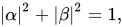
Numerical or analytic solutions in quantum mechanics can be expressed as pure states. These solution states, called eigenstates, are labeled with quantized values, typically quantum numbers. For example, when dealing with the energy spectrum of the electron in a hydrogen atom, the relevant pure states are identified by the principal quantum number n, the angular momentum quantum number , the magnetic quantum number m, and the spin z-component sz. For another example, if the spin of an electron is measured in any direction, e.g. with a Stern–Gerlach experiment, there are two possible results: up or down. A pure state here is represented by a two-dimensional complex vector , with a length of one; that is, with where and are the absolute values of and .

The postulates of quantum mechanics state that pure states, at a given time t, correspond to vectors in a separable complex Hilbert space, while each measurable physical quantity (such as the energy or momentum of a particle) is associated with a mathematical operator called the observable. The operator serves as a linear function that acts on the states of the system. The eigenvalues of the operator correspond to the possible values of the observable. For example, it is possible to observe a particle with a momentum of 1 kg⋅m/s if and only if one of the eigenvalues of the momentum operator is 1 kg⋅m/s. The corresponding eigenvector (which physicists call an eigenstate) with eigenvalue 1 kg⋅m/s would be a quantum state with a definite, well-defined value of momentum of 1 kg⋅m/s, with no quantum uncertainty. If its momentum were measured, the result is guaranteed to be 1 kg⋅m/s.

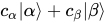
On the other hand, a pure state described as a superposition of multiple different eigenstates does in general have quantum uncertainty for the given observable. Using bra–ket notation, this linear combination of eigenstates can be represented as:[5]: 22, 171, 172  The coefficient that corresponds to a particular state in the linear combination is a complex number, thus allowing interference effects between states. The coefficients are time dependent. How a quantum state changes in time is governed by the time evolution operator.
Mixed states of wave functions

A mixed quantum state corresponds to a probabilistic mixture of pure states; however, different distributions of pure states can generate equivalent (i.e., physically indistinguishable) mixed states. A mixture of quantum states is again a quantum state.

A mixed state for electron spins, in the density-matrix formulation, has the structure of a matrix that is Hermitian and positive semi-definite, and has trace 1. A more complicated case is given (in bra–ket notation) by the singlet state, which exemplifies quantum entanglement: which involves superposition of joint spin states for two particles with spin 1/2. The singlet state satisfies the property that if the particles' spins are measured along the same direction then either the spin of the first particle is observed up and the spin of the second particle is observed down, or the first one is observed down and the second one is observed up, both possibilities occurring with equal probability.

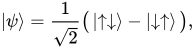
A pure quantum state can be represented by a ray, an element of a projective Hilbert space over the complex numbers, while mixed states are represented by density matrices, which are positive semidefinite operators that act on Hilbert spaces. The Schrödinger–HJW theorem classifies the multitude of ways to write a given mixed state as a convex combination of pure states. Before a particular measurement is performed on a quantum system, the theory gives only a probability distribution for the outcome, and the form that this distribution takes is completely determined by the quantum state and the linear operators describing the measurement. Probability distributions for different measurements exhibit tradeoffs exemplified by the uncertainty principle: a state that implies a narrow spread of possible outcomes for one experiment necessarily implies a wide spread of possible outcomes for another.

Statistical mixtures of states are a different type of linear combination. A statistical mixture of states is a statistical ensemble of independent systems. Statistical mixtures represent the degree of knowledge whilst the uncertainty within quantum mechanics is fundamental. Mathematically, a statistical mixture is not a combination using complex coefficients, but rather a combination using real-valued, positive probabilities of different states . A number represents the probability of a randomly selected system being in the state . Unlike the linear combination case each system is in a definite eigenstate.

The expectation value of an observable A is a statistical mean of measured values of the observable. It is this mean, and the distribution of probabilities, that is predicted by physical theories.

There is no state that is simultaneously an eigenstate for all observables. For example, we cannot prepare a state such that both the position measurement Q(t) and the momentum measurement P(t) (at the same time t) are known exactly; at least one of them will have a range of possible values. This is the content of the Heisenberg uncertainty relation.

Moreover, in contrast to classical mechanics, it is unavoidable that performing a measurement on the system generally changes its state. More precisely: After measuring an observable A, the system will be in an eigenstate of A; thus the state has changed, unless the system was already in that eigenstate. This expresses a kind of logical consistency: If we measure A twice in the same run of the experiment, the measurements being directly consecutive in time, then they will produce the same results. This has some strange consequences, however, as follows.

Consider two incompatible observables, A and B, where A corresponds to a measurement earlier in time than B.[c] Suppose that the system is in an eigenstate of B at the experiment's beginning. If we measure only B, all runs of the experiment will yield the same result. If we measure first A and then B in the same run of the experiment, the system will transfer to an eigenstate of A after the first measurement, and we will generally notice that the results of B are statistical. Thus: Quantum mechanical measurements influence one another, and the order in which they are performed is important.

Another feature of quantum states becomes relevant if we consider a physical system that consists of multiple subsystems; for example, an experiment with two particles rather than one. Quantum physics allows for certain states, called entangled states, that show certain statistical correlations between measurements on the two particles which cannot be explained by classical theory. For details, see Quantum entanglement. These entangled states lead to experimentally testable properties (Bell's theorem) that allow us to distinguish between quantum theory and alternative classical (non-quantum) models.

Schrödinger picture vs. Heisenberg picture

One can take the observables to be dependent on time, while the state σ was fixed once at the beginning of the experiment. This approach is called the Heisenberg picture. (This approach was taken in the later part of the discussion above, with time-varying observables P(t), Q(t).) One can, equivalently, treat the observables as fixed, while the state of the system depends on time; that is known as the Schrödinger picture. (This approach was taken in the earlier part of the discussion above, with a time-varying state .) Conceptually (and mathematically), the two approaches are equivalent; choosing one of them is a matter of convention.

Both viewpoints are used in quantum theory. While non-relativistic quantum mechanics is usually formulated in terms of the Schrödinger picture, the Heisenberg picture is often preferred in a relativistic context, that is, for quantum field theory. Compare with Dirac picture.

Formalism in quantum physics

Pure states as rays in a complex Hilbert space

Quantum physics is most commonly formulated in terms of linear algebra, as follows. Any given system is identified with some finite- or infinite-dimensional Hilbert space. The pure states correspond to vectors of norm 1. Thus the set of all pure states corresponds to the unit sphere in the Hilbert space, because the unit sphere is defined as the set of all vectors with norm 1.

Multiplying a pure state by a scalar is physically inconsequential (as long as the state is considered by itself). If a vector in a complex Hilbert space can be obtained from another vector by multiplying by some non-zero complex number, the two vectors in are said to correspond to the same ray in the projective Hilbert space of . Note that although the word ray is used, properly speaking, a point in the projective Hilbert space corresponds to a line passing through the origin of the Hilbert space, rather than a half-line, or ray in the geometrical sense.

Spin

The angular momentum has the same dimension (M·L2·T−1) as the Planck constant and, at quantum scale, behaves as a discrete degree of freedom of a quantum system. Most particles possess a kind of intrinsic angular momentum that does not appear at all in classical mechanics and arises from Dirac's relativistic generalization of the theory. Mathematically it is described with spinors. In non-relativistic quantum mechanics the group representations of the Lie group SU(2) are used to describe this additional freedom. For a given particle, the choice of representation (and hence the range of possible values of the spin observable) is specified by a non-negative number S that, in units of the reduced Planck constant ħ, is either an integer (0, 1, 2, ...) or a half-integer (1/2, 3/2, 5/2, ...). For a massive particle with spin S, its spin quantum number m always assumes one of the 2S + 1 possible values in the set

As a consequence, the quantum state of a particle with spin is described by a vector-valued wave function with values in C2S+1. Equivalently, it is represented by a complex-valued function of four variables: one discrete quantum number variable (for the spin) is added to the usual three continuous variables (for the position in space).

Many-body states and particle statistics

The quantum state of a system of N particles, each potentially with spin, is described by a complex-valued function with four variables per particle, corresponding to 3 spatial coordinates and spin, e.g.

Here, the spin variables mν assume values from the set where is the spin of νth particle. for a particle that does not exhibit spin.

The treatment of identical particles is very different for bosons (particles with integer spin) versus fermions (particles with half-integer spin). The above N-particle function must either be symmetrized (in the bosonic case) or anti-symmetrized (in the fermionic case) with respect to the particle numbers. If not all N particles are identical, but some of them are, then the function must be (anti)symmetrized separately over the variables corresponding to each group of identical variables, according to its statistics (bosonic or fermionic).

Electrons are fermions with S = 1/2, photons (quanta of light) are bosons with S = 1 (although in the vacuum they are massless and can't be described with Schrödinger mechanics).

When symmetrization or anti-symmetrization is unnecessary, N-particle spaces of states can be obtained simply by tensor products of one-particle spaces, to which we will return later.

Basis states of one-particle systems

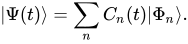
A state belonging to a separable complex Hilbert space can always be expressed uniquely as a linear combination of elements of an orthonormal basis of . Using bra–ket notation, this means any state can be written as with complex coefficients and basis elements . In this case, the normalization condition translates to In physical terms, has been expressed as a quantum superposition of the "basis states" , i.e., the eigenstates of an observable. In particular, if said observable is measured on the normalized state , then is the probability that the result of the measurement is .

In general, the expression for probability always consist of a relation between the quantum state and a portion of the spectrum of the dynamical variable (i.e. random variable) being observed.[15]: 98 [16]: 53  For example, the situation above describes the discrete case as eigenvalues belong to the point spectrum. Likewise, the wave function is just the eigenfunction of the Hamiltonian operator with corresponding eigenvalue(s) ; the energy of the system.

An example of the continuous case is given by the position operator. The probability measure for a system in state is given by:  where is the probability density function for finding a particle at a given position. These examples emphasize the distinction in charactertistics between the state and the observable. That is, whereas is a pure state belonging to , the (generalized) eigenvectors of the position operator do not.

Pure states vs. bound states

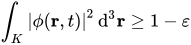
Though closely related, pure states are not the same as bound states belonging to the pure point spectrum of an observable with no quantum uncertainty. A particle is said to be in a bound state if it remains localized in a bounded region of space for all times. A pure state is called a bound state if and only if for every there is a compact set such that for all . The integral represents the probability that a particle is found in a bounded region at any time . If the probability remains arbitrarily close to then the particle is said to remain in .

For example, non-normalizable solutions of the free Schrödinger equation can be expressed as functions that are normalizable, using wave packets. These wave packets belong to the pure point spectrum of a corresponding projection operator which, mathematically speaking, constitutes an observable. However, they are not bound states.

Superposition of pure states

As mentioned above, quantum states may be superposed. If and are two kets corresponding to quantum states, the ket is also a quantum state of the same system. Both and can be complex numbers; their relative amplitude and relative phase will influence the resulting quantum state.

Writing the superposed state using and defining the norm of the state as: and extracting the common factors gives: The overall phase factor in front has no physical effect. Only the relative phase affects the physical nature of the superposition.

One example of superposition is the double-slit experiment, in which superposition leads to quantum interference. Another example of the importance of relative phase is Rabi oscillations, where the relative phase of two states varies in time due to the Schrödinger equation. The resulting superposition ends up oscillating back and forth between two different states.

Mixed states

A pure quantum state is a state which can be described by a single ket vector, as described above. A mixed quantum state is a statistical ensemble of pure states.

Mixed states arise in quantum mechanics in two different situations: first, when the preparation of the system is not fully known, and thus one must deal with a statistical ensemble of possible preparations; and second, when one wants to describe a physical system which is entangled with another, as its state cannot be described by a pure state. In the first case, there could theoretically be another person who knows the full history of the system, and therefore describe the same system as a pure state; in this case, the density matrix is simply used to represent the limited knowledge of a quantum state. In the second case, however, the existence of quantum entanglement theoretically prevents the existence of complete knowledge about the subsystem, and it's impossible for any person to describe the subsystem of an entangled pair as a pure state.

Mixed states inevitably arise from pure states when, for a composite quantum system with an entangled state on it, the part is inaccessible to the observer. The state of the part is expressed then as the partial trace over .

A mixed state cannot be described with a single ket vector. Instead, it is described by its associated density matrix (or density operator), usually denoted ρ. Density matrices can describe both mixed and pure states, treating them on the same footing. Moreover, a mixed quantum state on a given quantum system described by a Hilbert space can be always represented as the partial trace of a pure quantum state (called a purification) on a larger bipartite system for a sufficiently large Hilbert space .

The density matrix describing a mixed state is defined to be an operator of the form where ps is the fraction of the ensemble in each pure state The density matrix can be thought of as a way of using the one-particle formalism to describe the behavior of many similar particles by giving a probability distribution (or ensemble) of states that these particles can be found in.
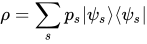
A simple criterion for checking whether a density matrix is describing a pure or mixed state is that the trace of ρ2 is equal to 1 if the state is pure, and less than 1 if the state is mixed. Another, equivalent, criterion is that the von Neumann entropy is 0 for a pure state, and strictly positive for a mixed state.

The rules for measurement in quantum mechanics are particularly simple to state in terms of density matrices. For example, the ensemble average (expectation value) of a measurement corresponding to an observable A is given by where and are eigenkets and eigenvalues, respectively, for the operator A, and "tr" denotes trace. It is important to note that two types of averaging are occurring, one (over ) being the usual expected value of the observable when the quantum is in state , and the other (over ) being a statistical (said incoherent) average with the probabilities ps that the quantum is in those states.

Mathematical generalizations

States can be formulated in terms of observables, rather than as vectors in a vector space. These are positive normalized linear functionals on a C*-algebra, or sometimes other classes of algebras of observables. See State on a C*-algebra and Gelfand–Naimark–Segal construction for more details.

Introduction to quantum mechanics

Quantum mechanics is the study of matter and matter's interactions with energy on the scale of atomic and subatomic particles. By contrast, classical physics explains matter and energy only on a scale familiar to human experience, including the behavior of astronomical bodies such as the Moon. Classical physics is still used in much of modern science and technology. However, towards the end of the 19th century, scientists discovered phenomena in both the large (macro) and the small (micro) worlds that classical physics could not explain. The desire to resolve inconsistencies between observed phenomena and classical theory led to a revolution in physics, a shift in the original scientific paradigm: the development of quantum mechanics.

Many aspects of quantum mechanics yield unexpected results, defying expectations and deemed counterintuitive. These aspects can seem paradoxical as they map behaviors quite differently from those seen at larger scales. In the words of quantum physicist Richard Feynman, quantum mechanics deals with "nature as She is—absurd". Features of quantum mechanics often defy simple explanations in everyday language. One example of this is the uncertainty principle: precise measurements of position cannot be combined with precise measurements of velocity. Another example is entanglement: a measurement made on one particle (such as an electron that is measured to have spin 'up') will correlate with a measurement on a second particle (an electron will be found to have spin 'down') if the two particles have a shared history. This will apply even if it is impossible for the result of the first measurement to have been transmitted to the second particle before the second measurement takes place.

Quantum mechanics helps people understand chemistry, because it explains how atoms interact with each other and form molecules. Many remarkable phenomena can be explained using quantum mechanics, like superfluidity. For example, if liquid helium cooled to a temperature near absolute zero is placed in a container, it spontaneously flows up and over the rim of its container; this is an effect which cannot be explained by classical physics.

History

James C. Maxwell's unification of the equations governing electricity, magnetism, and light in the late 19th century led to experiments on the interaction of light and matter. Some of these experiments had aspects which could not be explained until quantum mechanics emerged in the early part of the 20th century.

Evidence of quanta from the photoelectric effect

The seeds of the quantum revolution appear in the discovery by J.J. Thomson in 1897 that cathode rays were not continuous but "corpuscles" (electrons). Electrons had been named just six years earlier as part of the emerging theory of atoms. In 1900, Max Planck, unconvinced by the atomic theory, discovered that he needed discrete entities like atoms or electrons to explain black-body radiation.

Black-body radiation intensity vs color and temperature. The rainbow bar represents visible light; 5000 K objects are "white hot" by mixing differing colors of visible light. To the right is the invisible infrared. Classical theory (black curve for 5000 K) fails to predict the colors; the other curves are correctly predicted by quantum theories.

Very hot – red hot or white hot – objects look similar when heated to the same temperature. This look results from a common curve of light intensity at different frequencies (colors), which is called black-body radiation. White hot objects have intensity across many colors in the visible range. The lowest frequencies above visible colors are infrared light, which also give off heat. Continuous wave theories of light and matter cannot explain the black-body radiation curve. Planck spread the heat energy among individual "oscillators" of an undefined character but with discrete energy capacity; this model explained black-body radiation.

At the time, electrons, atoms, and discrete oscillators were all exotic ideas to explain exotic phenomena. But in 1905 Albert Einstein proposed that light was also corpuscular, consisting of "energy quanta", in contradiction to the established science of light as a continuous wave, stretching back a hundred years to Thomas Young's work on diffraction.

Einstein's revolutionary proposal started by reanalyzing Planck's black-body theory, arriving at the same conclusions by using the new "energy quanta". Einstein then showed how energy quanta connected to Thomson's electron. In 1902, Philipp Lenard directed light from an arc lamp onto freshly cleaned metal plates housed in an evacuated glass tube. He measured the electric current coming off the metal plate, at higher and lower intensities of light and for different metals. Lenard showed that amount of current – the number of electrons – depended on the intensity of the light, but that the velocity of these electrons did not depend on intensity. This is the photoelectric effect. The continuous wave theories of the time predicted that more light intensity would accelerate the same amount of current to higher velocity, contrary to this experiment. Einstein's energy quanta explained the volume increase: one electron is ejected for each quantum: more quanta mean more electrons.

Einstein then predicted that the electron velocity would increase in direct proportion to the light frequency above a fixed value that depended upon the metal. Here the idea is that energy in energy-quanta depends upon the light frequency; the energy transferred to the electron comes in proportion to the light frequency. The type of metal gives a barrier, the fixed value, that the electrons must climb over to exit their atoms, to be emitted from the metal surface and be measured.

Ten years elapsed before Millikan's definitive experiment verified Einstein's prediction. During that time many scientists rejected the revolutionary idea of quanta. But Planck's and Einstein's concept was in the air and soon began to affect other physics and quantum theories.

Quantization of bound electrons in atoms

Experiments with light and matter in the late 1800s uncovered a reproducible but puzzling regularity. When light was shown through purified gases, certain frequencies (colors) did not pass. These dark absorption 'lines' followed a distinctive pattern: the gaps between the lines decreased steadily. By 1889, the Rydberg formula predicted the lines for hydrogen gas using only a constant number and the integers to index the lines. The origin of this regularity was unknown. Solving this mystery would eventually become the first major step toward quantum mechanics.

Throughout the 19th century evidence grew for the atomic nature of matter. With Thomson's discovery of the electron in 1897, scientists began the search for a model of the interior of the atom. Thomson proposed negative electrons swimming in a pool of positive charge. Between 1908 and 1911, Rutherford showed that the positive part was only 1/3000th of the diameter of the atom.

Models of "planetary" electrons orbiting a nuclear "Sun" were proposed, but cannot explain why the electron does not simply fall into the positive charge. In 1913 Niels Bohr and Ernest Rutherford connected the new atom models to the mystery of the Rydberg formula: the orbital radius of the electrons were constrained and the resulting energy differences matched the energy differences in the absorption lines. This meant that absorption and emission of light from atoms was energy quantized: only specific energies that matched the difference in orbital energy would be emitted or absorbed.

Trading one mystery – the regular pattern of the Rydberg formula – for another mystery – constraints on electron orbits – might not seem like a big advance, but the new atom model summarized many other experimental findings. The quantization of the photoelectric effect and now the quantization of the electron orbits set the stage for the final revolution.

Throughout the first and the modern era of quantum mechanics the concept that classical mechanics must be valid macroscopically constrained possible quantum models. This concept was formalized by Bohr in 1923 as the correspondence principle. It requires quantum theory to converge to classical limits. A related concept is Ehrenfest's theorem, which shows that the average values obtained from quantum mechanics (e.g. position and momentum) obey classical laws.

Quantization of spin

Stern–Gerlach experiment: Silver atoms travelling through an inhomogeneous magnetic field, and being deflected up or down depending on their spin; (1) furnace, (2) beam of silver atoms, (3) inhomogeneous magnetic field, (4) classically expected result, (5) observed result

In 1922 Otto Stern and Walther Gerlach demonstrated that the magnetic properties of silver atoms defy classical explanation, the work contributing to Stern’s 1943 Nobel Prize in Physics. They fired a beam of silver atoms through a magnetic field. According to classical physics, the atoms should have emerged in a spray, with a continuous range of directions. Instead, the beam separated into two, and only two, diverging streams of atoms. Unlike the other quantum effects known at the time, this striking result involves the state of a single atom. In 1927, Thomas Erwin Phipps and John Bellamy Taylor (de) obtained a similar, but less pronounced effect using hydrogen atoms in their ground state, thereby eliminating any doubts that may have been caused by the use of silver atoms.

In 1924, Wolfgang Pauli called it "two-valuedness not describable classically" and associated it with electrons in the outermost shell. The experiments lead to formulation of its theory described to arise from spin of the electron in 1925, by Samuel Goudsmit and George Uhlenbeck, under the advice of Paul Ehrenfest.

Quantization of matter

In 1924 Louis de Broglie proposed that electrons in an atom are constrained not in "orbits" but as standing waves. In detail his solution did not work, but his hypothesis – that the electron "corpuscle" moves in the atom as a wave – spurred Erwin Schrödinger to develop a wave equation for electrons; when applied to hydrogen the Rydberg formula was accurately reproduced.

Example original electron diffraction photograph from the laboratory of G. P. Thomson, recorded 1925–1927

Max Born's 1924 paper "Zur Quantenmechanik" was the first use of the words "quantum mechanics" in print. His later work included developing quantum collision models; in a footnote to a 1926 paper he proposed the Born rule connecting theoretical models to experiment.

In 1927 at Bell Labs, Clinton Davisson and Lester Germer fired slow-moving electrons at a crystalline nickel target which showed a diffraction pattern indicating wave nature of electron whose theory was fully explained by Hans Bethe. A similar experiment by George Paget Thomson and Alexander Reid, firing electrons at thin celluloid foils and later metal films, observing rings, independently discovered matter wave nature of electrons.

Further developments

In 1928 Paul Dirac published his relativistic wave equation simultaneously incorporating relativity, predicting anti-matter, and providing a complete theory for the Stern–Gerlach result. These successes launched a new fundamental understanding of our world at small scale: quantum mechanics.

Planck and Einstein started the revolution with quanta that broke down the continuous models of matter and light. Twenty years later "corpuscles" like electrons came to be modeled as continuous waves. This result came to be called wave-particle duality, one iconic idea along with the uncertainty principle that sets quantum mechanics apart from older models of physics.

Quantum radiation, quantum fields

In 1923 Compton demonstrated that the Planck-Einstein energy quanta from light also had momentum; three years later the "energy quanta" got a new name "photon". Despite its role in almost all stages of the quantum revolution, no explicit model for light quanta existed until 1927 when Paul Dirac began work on a quantum theory of radiation that became quantum electrodynamics. Over the following decades this work evolved into quantum field theory, the basis for modern quantum optics and particle physics.

Wave–particle duality

The concept of wave–particle duality says that neither the classical concept of "particle" nor of "wave" can fully describe the behavior of quantum-scale objects, either photons or matter. Wave–particle duality is an example of the principle of complementarity in quantum physics. An elegant example of wave-particle duality is the double-slit experiment.

The diffraction pattern produced when light is shone through one slit (top) and the interference pattern produced by two slits (bottom). Both patterns show oscillations due to the wave nature of light. The double slit pattern is more dramatic.

In the double-slit experiment, as originally performed by Thomas Young in 1803, and then Augustin Fresnel a decade later, a beam of light is directed through two narrow, closely spaced slits, producing an interference pattern of light and dark bands on a screen. The same behavior can be demonstrated in water waves: the double-slit experiment was seen as a demonstration of the wave nature of light.

Variations of the double-slit experiment have been performed using electrons, atoms, and even large molecules, and the same type of interference pattern is seen. Thus it has been demonstrated that all matter possesses wave characteristics.

If the source intensity is turned down, the same interference pattern will slowly build up, one "count" or particle (e.g. photon or electron) at a time. The quantum system acts as a wave when passing through the double slits, but as a particle when it is detected. This is a typical feature of quantum complementarity: a quantum system acts as a wave in an experiment to measure its wave-like properties, and like a particle in an experiment to measure its particle-like properties. The point on the detector screen where any individual particle shows up is the result of a random process. However, the distribution pattern of many individual particles mimics the diffraction pattern produced by waves.

Uncertainty principle

Werner Heisenberg at the age of 26. Heisenberg won the Nobel Prize in Physics in 1932 for the work he did in the late 1920s.

Suppose it is desired to measure the position and speed of an object—for example, a car going through a radar speed trap. It can be assumed that the car has a definite position and speed at a particular moment in time. How accurately these values can be measured depends on the quality of the measuring equipment. If the precision of the measuring equipment is improved, it provides a result closer to the true value. It might be assumed that the speed of the car and its position could be operationally defined and measured simultaneously, as precisely as might be desired.

In 1927, Heisenberg proved that this last assumption is not correct. Quantum mechanics shows that certain pairs of physical properties, for example, position and speed, cannot be simultaneously measured, nor defined in operational terms, to arbitrary precision: the more precisely one property is measured, or defined in operational terms, the less precisely can the other be thus treated. This statement is known as the uncertainty principle. The uncertainty principle is not only a statement about the accuracy of our measuring equipment but, more deeply, is about the conceptual nature of the measured quantities—the assumption that the car had simultaneously defined position and speed does not work in quantum mechanics. On a scale of cars and people, these uncertainties are negligible, but when dealing with atoms and electrons they become critical.

Heisenberg gave, as an illustration, the measurement of the position and momentum of an electron using a photon of light. In measuring the electron's position, the higher the frequency of the photon, the more accurate is the measurement of the position of the impact of the photon with the electron, but the greater is the disturbance of the electron. This is because from the impact with the photon, the electron absorbs a random amount of energy, rendering the measurement obtained of its momentum increasingly uncertain, for one is necessarily measuring its post-impact disturbed momentum from the collision products and not its original momentum (momentum which should be simultaneously measured with position). With a photon of lower frequency, the disturbance (and hence uncertainty) in the momentum is less, but so is the accuracy of the measurement of the position of the impact.

At the heart of the uncertainty principle is a fact that for any mathematical analysis in the position and velocity domains, achieving a sharper (more precise) curve in the position domain can only be done at the expense of a more gradual (less precise) curve in the speed domain, and vice versa. More sharpness in the position domain requires contributions from more frequencies in the speed domain to create the narrower curve, and vice versa. It is a fundamental tradeoff inherent in any such related or complementary measurements, but is only really noticeable at the smallest (Planck) scale, near the size of elementary particles.

The uncertainty principle shows mathematically that the product of the uncertainty in the position and momentum of a particle (momentum is velocity multiplied by mass) could never be less than a certain value, and that this value is related to the Planck constant.

Wave function collapse

Wave function collapse means that a measurement has forced or converted a quantum (probabilistic or potential) state into a definite measured value. This phenomenon is only seen in quantum mechanics rather than classical mechanics.

For example, before a photon actually "shows up" on a detection screen it can be described only with a set of probabilities for where it might show up. When it does appear, for instance in the CCD of an electronic camera, the time and space where it interacted with the device are known within very tight limits. However, the photon has disappeared in the process of being captured (measured), and its quantum wave function has disappeared with it. In its place, some macroscopic physical change in the detection screen has appeared, e.g., an exposed spot in a sheet of photographic film, or a change in electric potential in some cell of a CCD.

Eigenstates and eigenvalues

Because of the uncertainty principle, statements about both the position and momentum of particles can assign only a probability that the position or momentum has some numerical value. Therefore, it is necessary to formulate clearly the difference between the state of something indeterminate, such as an electron in a probability cloud, and the state of something having a definite value. When an object can definitely be "pinned-down" in some respect, it is said to possess an eigenstate.

In the Stern–Gerlach experiment discussed above, the quantum model predicts two possible values of spin for the atom compared to the magnetic axis. These two eigenstates are named arbitrarily 'up' and 'down'. The quantum model predicts these states will be measured with equal probability, but no intermediate values will be seen. This is what the Stern–Gerlach experiment shows.

The eigenstates of spin about the vertical axis are not simultaneously eigenstates of spin about the horizontal axis, so this atom has an equal probability of being found to have either value of spin about the horizontal axis. As described in the section above, measuring the spin about the horizontal axis can allow an atom that was spun up to spin down: measuring its spin about the horizontal axis collapses its wave function into one of the eigenstates of this measurement, which means it is no longer in an eigenstate of spin about the vertical axis, so can take either value.

The Pauli exclusion principle

Wolfgang Pauli

In 1924, Wolfgang Pauli proposed a new quantum degree of freedom (or quantum number), with two possible values, to resolve inconsistencies between observed molecular spectra and the predictions of quantum mechanics. In particular, the spectrum of atomic hydrogen had a doublet, or pair of lines differing by a small amount, where only one line was expected. Pauli formulated his exclusion principle, stating, "There cannot exist an atom in such a quantum state that two electrons within [it] have the same set of quantum numbers."

A year later, Uhlenbeck and Goudsmit identified Pauli's new degree of freedom with the property called spin whose effects were observed in the Stern–Gerlach experiment.

Dirac wave equation

Paul Dirac (1902–1984)

In 1928, Paul Dirac extended the Pauli equation, which described spinning electrons, to account for special relativity. The result was a theory that dealt properly with events, such as the speed at which an electron orbits the nucleus, occurring at a substantial fraction of the speed of light. By using the simplest electromagnetic interaction, Dirac was able to predict the value of the magnetic moment associated with the electron's spin and found the experimentally observed value, which was too large to be that of a spinning charged sphere governed by classical physics. He was able to solve for the spectral lines of the hydrogen atom and to reproduce from physical first principles Sommerfeld's successful formula for the fine structure of the hydrogen spectrum.

Dirac's equations sometimes yielded a negative value for energy, for which he proposed a novel solution: he posited the existence of an antielectron and a dynamical vacuum. This led to the many-particle quantum field theory.

Quantum entanglement

In quantum physics, a group of particles can interact or be created together in such a way that the quantum state of each particle of the group cannot be described independently of the state of the others, including when the particles are separated by a large distance. This is known as quantum entanglement.

An early landmark in the study of entanglement was the Einstein–Podolsky–Rosen (EPR) paradox, a thought experiment proposed by Albert Einstein, Boris Podolsky and Nathan Rosen which argues that the description of physical reality provided by quantum mechanics is incomplete. In a 1935 paper titled "Can Quantum-Mechanical Description of Physical Reality be Considered Complete?", they argued for the existence of "elements of reality" that were not part of quantum theory, and speculated that it should be possible to construct a theory containing these hidden variables.

The thought experiment involves a pair of particles prepared in what would later become known as an entangled state. Einstein, Podolsky, and Rosen pointed out that, in this state, if the position of the first particle were measured, the result of measuring the position of the second particle could be predicted. If instead the momentum of the first particle were measured, then the result of measuring the momentum of the second particle could be predicted. They argued that no action taken on the first particle could instantaneously affect the other, since this would involve information being transmitted faster than light, which is forbidden by the theory of relativity. They invoked a principle, later known as the "EPR criterion of reality", positing that: "If, without in any way disturbing a system, we can predict with certainty (i.e., with probability equal to unity) the value of a physical quantity, then there exists an element of reality corresponding to that quantity." From this, they inferred that the second particle must have a definite value of both position and of momentum prior to either quantity being measured. But quantum mechanics considers these two observables incompatible and thus does not associate simultaneous values for both to any system. Einstein, Podolsky, and Rosen therefore concluded that quantum theory does not provide a complete description of reality. In the same year, Erwin Schrödinger used the word "entanglement" and declared: "I would not call that one but rather the characteristic trait of quantum mechanics."

The Irish physicist John Stewart Bell carried the analysis of quantum entanglement much further. He deduced that if measurements are performed independently on the two separated particles of an entangled pair, then the assumption that the outcomes depend upon hidden variables within each half implies a mathematical constraint on how the outcomes on the two measurements are correlated. This constraint would later be named the Bell inequality. Bell then showed that quantum physics predicts correlations that violate this inequality. Consequently, the only way that hidden variables could explain the predictions of quantum physics is if they are "nonlocal", which is to say that somehow the two particles are able to interact instantaneously no matter how widely they ever become separated.Performing experiments like those that Bell suggested, physicists have found that nature obeys quantum mechanics and violates Bell inequalities. In other words, the results of these experiments are incompatible with any local hidden variable theory.

Quantum field theory

The idea of quantum field theory began in the late 1920s with British physicist Paul Dirac, when he attempted to quantize the energy of the electromagnetic field; just as in quantum mechanics the energy of an electron in the hydrogen atom was quantized. Quantization is a procedure for constructing a quantum theory starting from a classical theory.

Merriam-Webster defines a field in physics as "a region or space in which a given effect (such as magnetism) exists". Other effects that manifest themselves as fields are gravitation and static electricity. In 2008, physicist Richard Hammond wrote:

Sometimes we distinguish between quantum mechanics (QM) and quantum field theory (QFT). QM refers to a system in which the number of particles is fixed, and the fields (such as the electromechanical field) are continuous classical entities. QFT ... goes a step further and allows for the creation and annihilation of particles ...

He added, however, that quantum mechanics is often used to refer to "the entire notion of quantum view".

In 1931, Dirac proposed the existence of particles that later became known as antimatter. Dirac shared the Nobel Prize in Physics for 1933 with Schrödinger "for the discovery of new productive forms of atomic theory".

Quantum electrodynamics

Quantum electrodynamics (QED) is the name of the quantum theory of the electromagnetic force. Understanding QED begins with understanding electromagnetism. Electromagnetism can be called "electrodynamics" because it is a dynamic interaction between electrical and magnetic forces. Electromagnetism begins with the electric charge.

Electric charges are the sources of and create, electric fields. An electric field is a field that exerts a force on any particles that carry electric charges, at any point in space. This includes the electron, proton, and even quarks, among others. As a force is exerted, electric charges move, a current flows, and a magnetic field is produced. The changing magnetic field, in turn, causes electric current (often moving electrons). The physical description of interacting charged particles, electrical currents, electrical fields, and magnetic fields is called electromagnetism.

In 1928 Paul Dirac produced a relativistic quantum theory of electromagnetism. This was the progenitor to modern quantum electrodynamics, in that it had essential ingredients of the modern theory. However, the problem of unsolvable infinities developed in this relativistic quantum theory. Years later, renormalization largely solved this problem. Initially viewed as a provisional, suspect procedure by some of its originators, renormalization eventually was embraced as an important and self-consistent tool in QED and other fields of physics. Also, in the late 1940s Feynman diagrams provided a way to make predictions with QED by finding a probability amplitude for each possible way that an interaction could occur. The diagrams showed in particular that the electromagnetic force is the exchange of photons between interacting particles.

The Lamb shift is an example of a quantum electrodynamics prediction that has been experimentally verified. It is an effect whereby the quantum nature of the electromagnetic field makes the energy levels in an atom or ion deviate slightly from what they would otherwise be. As a result, spectral lines may shift or split.

Similarly, within a freely propagating electromagnetic wave, the current can also be just an abstract displacement current, instead of involving charge carriers. In QED, its full description makes essential use of short-lived virtual particles. There, QED again validates an earlier, rather mysterious concept.

Standard Model

The Standard Model of particle physics is the quantum field theory that describes three of the four known fundamental forces (electromagnetic, weak and strong interactions – excluding gravity) in the universe and classifies all known elementary particles. It was developed in stages throughout the latter half of the 20th century, through the work of many scientists worldwide, with the current formulation being finalized in the mid-1970s upon experimental confirmation of the existence of quarks. Since then, proof of the top quark (1995), the tau neutrino (2000), and the Higgs boson (2012) have added further credence to the Standard Model. In addition, the Standard Model has predicted various properties of weak neutral currents and the W and Z bosons with great accuracy.

Although the Standard Model is believed to be theoretically self-consistent and has demonstrated success in providing experimental predictions, it leaves some physical phenomena unexplained and so falls short of being a complete theory of fundamental interactions. For example, it does not fully explain baryon asymmetry, incorporate the full theory of gravitation as described by general relativity, or account for the universe's accelerating expansion as possibly described by dark energy. The model does not contain any viable dark matter particle that possesses all of the required properties deduced from observational cosmology. It also does not incorporate neutrino oscillations and their non-zero masses. Accordingly, it is used as a basis for building more exotic models that incorporate hypothetical particles, extra dimensions, and elaborate symmetries (such as supersymmetry) to explain experimental results at variance with the Standard Model, such as the existence of dark matter and neutrino oscillations.

Interpretations

The physical measurements, equations, and predictions pertinent to quantum mechanics are all consistent and hold a very high level of confirmation. However, the question of what these abstract models say about the underlying nature of the real world has received competing answers. These interpretations are widely varying and sometimes somewhat abstract. For instance, the Copenhagen interpretation states that before a measurement, statements about a particle's properties are completely meaningless, while the many-worlds interpretation describes the existence of a multiverse made up of every possible universe.

Light behaves in some aspects like particles and in other aspects like waves. Matter—the "stuff" of the universe consisting of particles such as electrons and atoms—exhibits wavelike behavior too. Some light sources, such as neon lights, give off only certain specific frequencies of light, a small set of distinct pure colors determined by neon's atomic structure. Quantum mechanics shows that light, along with all other forms of electromagnetic radiation, comes in discrete units, called photons, and predicts its spectral energies (corresponding to pure colors), and the intensities of its light beams. A single photon is a quantum, or smallest observable particle, of the electromagnetic field. A partial photon is never experimentally observed. More broadly, quantum mechanics shows that many properties of objects, such as position, speed, and angular momentum, that appeared continuous in the zoomed-out view of classical mechanics, turn out to be (in the very tiny, zoomed-in scale of quantum mechanics) quantized. Such properties of elementary particles are required to take on one of a set of small, discrete allowable values, and since the gap between these values is also small, the discontinuities are only apparent at very tiny (atomic) scales.

Applications

Everyday applications

The relationship between the frequency of electromagnetic radiation and the energy of each photon is why ultraviolet light can cause sunburn, but visible or infrared light cannot. A photon of ultraviolet light delivers a high amount of energy—enough to contribute to cellular damage such as occurs in a sunburn. A photon of infrared light delivers less energy—only enough to warm one's skin. So, an infrared lamp can warm a large surface, perhaps large enough to keep people comfortable in a cold room, but it cannot give anyone a sunburn.

Technological applications

Applications of quantum mechanics include the laser, the transistor, the electron microscope, and magnetic resonance imaging. A special class of quantum mechanical applications is related to macroscopic quantum phenomena such as superfluid helium and superconductors. The study of semiconductors led to the invention of the diode and the transistor, which are indispensable for modern electronics.

In even a simple light switch, quantum tunneling is absolutely vital, as otherwise the electrons in the electric current could not penetrate the potential barrier made up of a layer of oxide. Flash memory chips found in USB drives also use quantum tunneling, to erase their memory cells.

Relationship between science and religion

From Wikipedia, the free encyclopedia "Science and Religion" redirects here. For the 1991 book by John Hedley Brooke, see  Science...