Entropy is produced in irreversible processes. The importance of avoiding irreversible processes (hence reducing the entropy production) was recognized as early as 1824 by Carnot. In 1865 Rudolf Clausius expanded his previous work from 1854 on the concept of "unkompensierte Verwandlungen" (uncompensated
transformations), which, in our modern nomenclature, would be called the
entropy production. In the same article in which he introduced the name
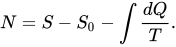
entropy, Clausius gives the expression for the entropy production for a cyclical process in a closed system, which he denotes by N, in equation (71) which reads
Here S is the entropy in the final state and S0 the entropy in the initial state; S0-S
is the entropy difference for the backwards part of the process. The
integral is to be taken from the initial state to the final state,
giving the entropy difference for the forwards part of the process. From
the context, it is clear that N = 0 if the process is reversible and N > 0 in case of an irreversible process.
First and second law
Fig. 1 General representation of an inhomogeneous system that consists
of a number of subsystems. The interaction of the system with the
surroundings is through exchange of heat and other forms of energy, flow
of matter, and changes of shape. The internal interactions between the
various subsystems are of a similar nature and lead to entropy
production.
The laws of thermodynamics apply to well-defined systems. Fig. 1 is a general representation of a thermodynamic system.
We consider systems which, in general, are inhomogeneous. Heat and mass
are transferred across the boundaries (nonadiabatic, open systems), and
the boundaries are moving (usually through pistons). In our formulation
we assume that heat and mass transfer and volume changes take place
only separately at well-defined regions of the system boundary. The
expression, given here, are not the most general formulations of the
first and second law. E.g. kinetic energy and potential energy terms are missing and exchange of matter by diffusion is excluded.
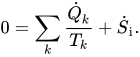
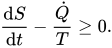
The rate of entropy production, denoted by , is a key element of the second law of thermodynamics for open inhomogeneous systems which reads
Here S is the entropy of the system; Tk is the temperature at which the heat enters the system at heat flow rate ; represents the entropy flow into the system at position k, due to matter flowing into the system ( are the molar flow rate and mass flow rate and Smk and sk are the molar entropy (i.e. entropy per unit amount of substance) and specific entropy (i.e. entropy per unit mass) of the matter, flowing into the system, respectively); represents the entropy production rates due to internal processes. The subscript 'i' in
refers to the fact that the entropy is produced due to irreversible
processes. The entropy-production rate of every process in nature is
always positive or zero. This is an essential aspect of the second law.
The Σ's indicate the algebraic sum of the respective
contributions if there are more heat flows, matter flows, and internal
processes.
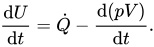
In order to demonstrate the impact of the second law, and the
role of entropy production, it has to be combined with the first law
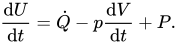
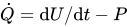
which reads
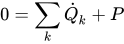
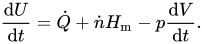
with U the internal energy of the system; the enthalpy flows into the system due to the matter that flows into the system (Hmk its molar enthalpy, hk the specific enthalpy (i.e. enthalpy per unit mass)), and dVk/dt are the rates of change of the volume of the system due to a moving boundary at position k while pk is the pressure behind that boundary; P represents all other forms of power application (such as electrical).
The first and second law have been formulated in terms of time derivatives of U and S rather than in terms of total differentials dU and dS where it is tacitly assumed that dt
> 0. So, the formulation in terms of time derivatives is more
elegant. An even bigger advantage of this formulation is, however, that
it emphasizes that heat flow rate and power are the basic
thermodynamic properties and that heat and work are derived quantities
being the time integrals of the heat flow rate and the power
respectively.
Examples of irreversible processes
Entropy is produced in irreversible processes. Some important irreversible processes are:
The expression for the rate of entropy production in the first two cases will be derived in separate sections.
Fig.2 a: Schematic diagram of a heat engine. A heating power enters the engine at the high temperature TH, and is released at ambient temperature Ta. A power P is produced and the entropy production rate is . b: Schematic diagram of a refrigerator. is the cooling power at the low temperature TL, and is released at ambient temperature. The power P is supplied and
is the entropy production rate. The arrows define the positive
directions of the flows of heat and power in the two cases. They are
positive under normal operating conditions.
Performance of heat engines and refrigerators
Most heat engines and refrigerators are closed cyclic machines. In the steady state the internal energy and the entropy of the machines
after one cycle are the same as at the start of the cycle. Hence, on
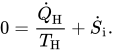
average, dU/dt = 0 and dS/dt = 0 since U and S are functions of state. Furthermore, they are closed systems () and the volume is fixed (dV/dt = 0). This leads to a significant simplification of the first and second law:
and
The summation is over the (two) places where heat is added or removed.
Engines
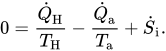
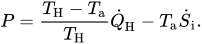
For a heat engine (Fig. 2a) the first and second law obtain the form
and
Here is the heat supplied at the high temperature TH, is the heat removed at ambient temperature Ta, and P is the power delivered by the engine. Eliminating gives
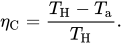
The efficiency is defined by
If the performance of the engine is at its maximum and the efficiency is equal to the Carnot efficiency
Refrigerators
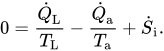
For refrigerators (Fig. 2b) holds
and
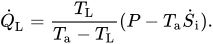
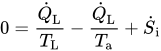
Here P is the power, supplied to produce the cooling power at the low temperature TL. Eliminating now gives
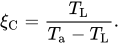
If the performance of the cooler is at its maximum. The COP is then given by the Carnot coefficient of performance
Power dissipation
In both cases we find a contribution which reduces the system performance. This product of ambient temperature and the (average) entropy production rate is called the dissipated power.
Equivalence with other formulations
It is interesting to investigate how the above mathematical
formulation of the second law relates with other well-known formulations
of the second law.
We first look at a heat engine, assuming that . In other words: the heat flow rate is completely converted into power. In this case the second law would reduce to
Since and this would result in which violates the condition that the entropy production is always positive. Hence: No
process is possible in which the sole result is the absorption of heat
from a reservoir and its complete conversion into work. This is the Kelvin statement of the second law.
Now look at the case of the refrigerator and assume that the
input power is zero. In other words: heat is transported from a low
temperature to a high temperature without doing work on the system. The
first law with P = 0 would give
and the second law then yields
or
Since and this would result in which again violates the condition that the entropy production is always positive. Hence: No
process is possible whose sole result is the transfer of heat from a
body of lower temperature to a body of higher temperature. This is the Clausius statement of the second law.
Expressions for the entropy production
Heat flow
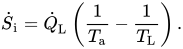
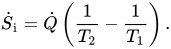
In case of a heat flow rate from T1 to T2 (with ) the rate of entropy production is given by
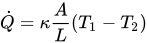
If the heat flow is in a bar with length L, cross-sectional area A, and thermal conductivity κ, and the temperature difference is small
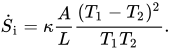
the entropy production rate is
Flow of mass
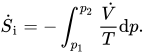
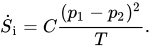
In case of a volume flow rate from a pressure p1 to p2
For small pressure drops and defining the flow conductance C by we get
The dependences of on T1 − T2 and on p1 − p2 are quadratic.
This is typical for expressions of the entropy production rates
in general. They guarantee that the entropy production is positive.
Entropy of mixing
In this Section we will calculate the entropy of mixing when two ideal gases diffuse into each other. Consider a volume Vt divided in two volumes Va and Vb so that Vt = Va + Vb. The volume Va contains amount of substancena of an ideal gas a and Vb contains amount of substance nb of gas b. The total amount of substance is nt = na + nb. The temperature and pressure in the two volumes is the same. The entropy at the start is given by
When the division between the two gases is removed the two gases
expand, comparable to a Joule–Thomson expansion. In the final state the
temperature is the same as initially but the two gases now both take the
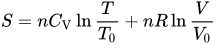
volume Vt. The relation of the entropy of an amount of substance n of an ideal gas is
where CV is the molar heat capacity at constant volume and R is the molar gas constant.
The system is an adiabatic closed system, so the entropy increase during
the mixing of the two gases is equal to the entropy production. It is
given by
As the initial and final temperature are the same, the temperature terms cancel, leaving only the volume terms. The result is
Introducing the concentration x = na/nt = Va/Vt we arrive at the well-known expression
Joule expansion
The Joule expansion
is similar to the mixing described above. It takes place in an
adiabatic system consisting of a gas and two rigid vessels a and b of
equal volume, connected by a valve. Initially, the valve is closed.
Vessel a contains the gas while the other vessel b is empty. When the
valve is opened, the gas flows from vessel a into b until the pressures
in the two vessels are equal. The volume, taken by the gas, is doubled
while the internal energy of the system is constant (adiabatic and no
work done). Assuming that the gas is ideal, the molar internal energy is
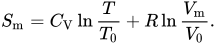
given by Um = CVT. As CV is constant, constant U means constant T. The molar entropy of an ideal gas, as function of the molar volume Vm and T, is given by
The system consisting of the two vessels and the gas is closed and
adiabatic, so the entropy production during the process is equal to the
increase of the entropy of the gas. So, doubling the volume with T constant gives that the molar entropy produced is
Microscopic interpretation
The Joule expansion provides an opportunity to explain the entropy
production in statistical mechanical (i.e., microscopic) terms. At the
expansion, the volume that the gas can occupy is doubled. This means
that, for every molecule there are now two possibilities: it can be
placed in container a or b. If the gas has amount of substance n, the number of molecules is equal to n⋅NA, where NA is the Avogadro constant.
The number of microscopic possibilities increases by a factor of 2 per
molecule due to the doubling of volume, so in total the factor is 2n⋅NA. Using the well-known Boltzmann expression for the entropy
where k is the Boltzmann constant and Ω is the number of microscopic possibilities to realize the macroscopic state. This gives change in molar entropy of
So, in an irreversible process, the number of microscopic
possibilities to realize the macroscopic state is increased by a certain
factor.
Basic inequalities and stability conditions
In this section we derive the basic inequalities and stability
conditions for closed systems. For closed systems the first law reduces
to
The second law we write as
For adiabatic systems so dS/dt ≥ 0.
In other words: the entropy of adiabatic systems cannot decrease. In
equilibrium the entropy is at its maximum. Isolated systems are a
special case of adiabatic systems, so this statement is also valid for
isolated systems.
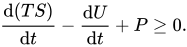
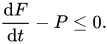
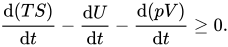
Now consider systems with constant temperature and volume. In most cases T is the temperature of the surroundings with which the system is in good thermal contact. Since V is constant the first law gives . Substitution in the second law, and using that T is constant, gives
If P = 0 this is the mathematical formulation of the general
property that the free energy of systems with fixed temperature and
volume tends to a minimum. The expression can be integrated from the
initial state i to the final state f resulting in
where WS is the work done by the system. If
the process inside the system is completely reversible the equality sign
holds. Hence the maximum work, that can be extracted from the system,
is equal to the free energy of the initial state minus the free energy
of the final state.
Finally we consider systems with constant temperature and pressure and take P = 0. As p is constant the first laws gives
Combining with the second law, and using that T is constant, gives
With the Gibbs free energy, defined as
we get
Homogeneous systems
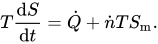
In homogeneous systems the temperature and pressure are well-defined and all internal processes are reversible. Hence . As a result, the second law, multiplied by T, reduces to
Since physical processes can be described by stochastic processes,
such as Markov chains and diffusion processes, entropy production can be
defined mathematically in such processes.
For a continuous-time Markov chain with instantaneous probability distribution and transition rate , the instantaneous entropy production rate is
The long-time behavior of entropy production is kept after a proper
lifting of the process. This approach provides a dynamic explanation for
the Kelvin statement and the Clausius statement of the second law of
thermodynamics.
Entropy production in diffusive-reactive system has also been
studied, with interesting results emerging from diffusion, cross
diffusion and reactions.
For a continuous-time Gauss-Markov process, a multivariate Ornstein-Uhlenbeck process is a diffusion process defined by coupled linear Langevin equations of the form
, i.e., in vector and matrix notations,
The are Gaussian white noises such that
i.e.,
The stationary covariance matrix reads
We can parametrize the matrices , , and by setting
Finally, the entropy production reads
A recent application of this formula is demonstrated in neuroscience,
where it has been shown that entropy production of multivariate
Ornstein-Uhlenbeck processes correlates with consciousness levels in the
human brain.
Science, technology, engineering, and mathematics (STEM) is an umbrella term used to group together the related technical disciplines of science, technology, engineering, and mathematics.
It represents a broad and interconnected set of fields that are crucial
for innovation and technological advancement. These disciplines are
often grouped together because they share a common emphasis on critical thinking, problem-solving, and analytical skills. The term is typically used in the context of education policy or curriculum
choices in schools. It has implications for workforce development,
national security concerns (as a shortage of STEM-educated citizens can
reduce effectiveness in this area), and immigration policy, with regard
to admitting foreign students and tech workers.
There is no universal agreement on which disciplines are included in STEM; in particular, whether or not the science in STEM includes social sciences, such as psychology, sociology, economics, and political science. In the United States, these are typically included by the National Science Foundation (NSF), the Department of Labor's O*Net online database for job seekers, and the Department of Homeland Security. In the United Kingdom, the social sciences are categorized separately and are instead grouped with humanities and arts to form another counterpart acronym HASS (humanities, arts, and social sciences), rebranded in 2020 as SHAPE (social sciences, humanities and the arts for people and the economy). Some sources also use HEAL (health, education, administration, and literacy) as the counterpart of STEM.
Terminology
History
In the early 1990s the acronym STEM was used by a variety of
educators. Beverly P. Schwartz developed a STEM mentoring program in the
Capital District of New York State, and was using the acronym as early
as November, 1991. Charles E. Vela was the founder and director of the Center for the
Advancement of Hispanics in Science and Engineering Education (CAHSEE) and started a summer program for talented under-represented students in
the Washington, D.C. area called the STEM Institute. Based on the
program's recognized success and his expertise in STEM education, Charles Vela was asked to serve on numerous NSF and Congressional panels in science, mathematics, and engineering education. Previously referred to as SMET by the NSF, it is through this manner that NSF was first introduced to the acronym
STEM. One of the first NSF projects to use the acronym was STEMTEC, the
Science, Technology, Engineering, and Math Teacher Education
Collaborative at the University of Massachusetts Amherst, which was founded in 1998. In 2001, at the urging of Dr. Peter Faletra, the Director of Workforce
Development for Teachers and Scientists at the Office of Science, the
acronym was adopted by Rita Colwell and other science administrators in the National Science Foundation (NSF). The Office of Science was also an early adopter of the STEM acronym.
Other variations
eSTEM (environmental STEM)
GEMS (girls in engineering, math, and science); used for programs to encourage women to enter these fields.
MINT (mathematics, informatics, natural sciences, and technology)
SHTEAM (science, humanities, technology, engineering, arts, and mathematics)
SMET (science, mathematics, engineering, and technology); previous name
STEAM (science, technology, engineering, arts, and mathematics)
STEAM (science, technology, engineering, agriculture, and mathematics); add agriculture
STEAM (science, technology, engineering, and applied mathematics); has more focus on applied mathematics
STEEM (science, technology, engineering, economics, and mathematics); adds economics as a field
STEMIE (science, technology, engineering, mathematics, invention,
and entrepreneurship); adds inventing and entrepreneurship as a means to
apply STEM to real-world problem-solving and markets.
STEMM (science, technology, engineering, mathematics, and medicine)
STM (scientific, technical, and mathematics or science, technology, and medicine)
STREAM (science, technology, robotics, engineering, arts, and mathematics); adds robotics and arts as fields
STREAM (science, technology, reading, engineering, arts, and mathematics); adds reading and arts
STREAM (science, technology, recreation, engineering, arts, and mathematics); adds recreation and arts
By the mid-2000s, China surpassed the United States in the number of
PhDs awarded and is expected to produce 77,000 PhDs in 2025, compared to
40,000 in the US.
By country
Australia
The Australian Curriculum, Assessment, and Reporting Authority 2015 report entitled, National STEM School Education Strategy,
stated that "A renewed national focus on STEM in school education is
critical to ensuring that all young Australians are equipped with the
necessary STEM skills and knowledge that they must need to succeed." Its goals were to:
"Ensure all students finish school with strong foundational knowledge in STEM and related skills"
"Ensure that students are inspired to take on more challenging STEM subjects"
Events and programs meant to help develop STEM in Australian schools include the Victorian Model Solar Vehicle Challenge, the Maths Challenge (Australian Mathematics Trust), Go Girl Go Global and the Australian Informatics Olympiad.
Canada
Canada ranks 12th out of 16 peer countries in the percentage of its
graduates who studied in STEM programs, with 21.2%, a number higher than
the United States, but lower than France, Germany, and Austria. The peer country with the greatest proportion of STEM graduates, Finland, has over 30% of its university graduates coming from science, mathematics, computer science, and engineering programs.
SHAD is an annual Canadian summer enrichment program for high-achieving high school students in July. The program focuses on academic learning, particularly in STEAM fields.
Scouts Canada has taken similar measures to their American counterpart to promote STEM fields to youth. Their STEM program began in 2015.
In 2011 Canadian entrepreneur and philanthropist Seymour Schulich established the Schulich Leader Scholarships,
$100 million in $60,000 scholarships for students beginning their
university education in a STEM program at 20 institutions across Canada.
Each year 40 Canadian students would be selected to receive the award,
two at each institution, with the goal of attracting gifted youth into
the STEM fields. The program also supplies STEM scholarships to five participating universities in Israel.
Middle school chemistry on a blackboard in Beijing, China, 2011
To promote STEM in China, the Chinese government issued a guideline
in 2016 on national innovation-driven development strategy, "instructing
that by 2020, China should become an innovative country; by 2030, it
should be at the forefront of innovative countries; and by 2050, it
should become a technology innovation power."
"[I]n May 2018, the launching ceremony and press conference for
the 2029 Action Plan for China's STEM Education was held in Beijing,
China. This plan aims to allow as many students to benefit from STEM
education as possible and equip all students with scientific thinking
and the ability to innovate." "In response to encouraging policies by
the government, schools in both public and private sectors around the
country have begun to carry out STEM education programs."
"However, to effectively implement STEM curricula, full-time
teachers specializing in STEM education and relevant content to be
taught are needed." Currently, "China lacks qualified STEM teachers and a
training system is yet to be established."
Several Chinese cities have made programming a mandatory subject
for elementary and middle school students. This is the case of the city
of Chongqing. However, most students from small and medium-sized cities have not been
exposed to the concept of STEM until they enter college.
Several European projects have promoted STEM education and careers in Europe. For instance, Scientix is a European cooperation of STEM teachers, education scientists, and policymakers. The SciChallenge project used a social media contest and student-generated content to
increase the motivation of pre-university students for STEM education
and careers. The Erasmus programme project AutoSTEM used automata to introduce STEM subjects to very young children.
Finland
The LUMA Center is the leading advocate for STEM-oriented education.
Its aim is to promote the instruction and research of natural sciences,
mathematics, computer science, and technology across all educational
levels in the country. In the native tongue luma stands for "luonnontieteellis-matemaattinen" (lit. adj. "scientific-mathematical"). The short is more or less a direct translation of STEM, with engineering fields included by association. However, unlike STEM, the term is also a portmanteau from lu and ma.
To address the decline in interest in learning the areas of science,
the Finnish National Board of Education launched the LUMA scientific
education development program. The project's main goal was to raise the
level of Finnish education and to enhance students' competencies,
improve educational practices, and foster interest in science. The
initiative led to the establishment of 13 LUMA centers at universities
across Finland supervised by LUMA Center.
France
The name of STEM in France is industrial engineering sciences
(sciences industrielles or sciences de l'ingénieur). The STEM
organization in France is the association UPSTI.
Hong Kong
STEM education has not been promoted among the local schools in Hong
Kong until recent years. In November 2015, the Education Bureau of Hong
Kong released a document titled Promotion of STEM Education, which proposes strategies and recommendations for promoting STEM education.
India is next only to China with STEM graduates per population of 1
to 52. The total number of fresh STEM graduates was 2.6 million in 2016. STEM graduates have been contributing to the Indian economy with
well-paid salaries locally and abroad for the past two decades. The
turnaround of the Indian economy with comfortable foreign exchange
reserves is mainly attributed to the skills of its STEM graduates. In
India, women make up an impressive 43% of STEM graduates, the highest
percentage worldwide. However, they hold only 14% of STEM-related jobs.
Additionally, among the 280,000 scientists and engineers working in
research and development institutes in the country, women represent a
mere 14%
In India, OMOTEC is providing an innovative curriculum based on
STEM, and their students are also performing and developing products to
solve the new age problems. Two students also won the Microsoft Imagine Cup for developing a
non-invasive method to screen for skin cancer using artificial
intelligence.
Nigeria
In Nigeria, the Association of Professional Women Engineers Of
Nigeria (APWEN) has involved girls between the ages of 12 and 19 in
science-based courses in order for them to pursue science-based courses
in higher institutions of learning. The National Science Foundation
(NSF) In Nigeria has made conscious efforts to encourage girls to
innovate, invent, and build through the "invent it, build it" program
sponsored by NNPC.
Pakistan
STEM subjects are taught in Pakistan as part of electives taken in the 9th and 10th grades, culminating in Matriculation
exams. These electives are pure sciences (Physics, Chemistry, Biology),
mathematics (Physics, Chemistry, Maths), and computer science (Physics,
Chemistry, Computer Science). STEM subjects are also offered as
electives taken in the 11th and 12th grades, more commonly referred to
as first and second year, culminating in Intermediate exams. These electives are FSc pre-medical (Physics, Chemistry, Biology), FSc pre-engineering
(Physics, Chemistry, Maths), and ICS (Physics/Statistics, Computer
Science, Maths). These electives are intended to aid students in
pursuing STEM-related careers in the future by preparing them for the
study of these courses at university.
A STEM education project has been approved by the government to establish STEM labs in public schools. The Ministry of Information Technology and Telecommunication has collaborated with Google to launch Pakistan's first grassroots-level Coding Skills Development Program, based on Google's CS First Program, a global initiative aimed at
developing coding skills in children. The program aims to develop
applied coding skills using gamification techniques for children between
the ages of 9 and 14.
The KPITBs Early Age Programming initiative, established in the province of Khyber Pakhtunkhwa,
has been successfully introduced in 225 Elementary and Secondary
Schools. Many private organizations are working in Pakistan to introduce
STEM education in schools.
Philippines
In the Philippines, STEM is a two-year program and strand that is used for Senior High School (Grades 11 and 12), assigned by the Department of Education or DepEd. The STEM strand is under the Academic Track, which also includes other strands like ABM, HUMSS, and GAS. The purpose of the STEM strand is to educate students in the field of
science, technology, engineering, and mathematics, in an
interdisciplinary and applied approach, and to give students advanced
knowledge and application in the field. After completing the program,
the students will earn a Diploma in Science, Technology, Engineering,
and Mathematics. In some colleges and universities, they require
students applying for STEM degrees (like medicine, engineering, computer
studies, etc.) to be a graduate of STEM, if not, they will need to
enter a bridging program.
Qatar
In Qatar, AL-Bairaq
is an outreach program to high-school students with a curriculum that
focuses on STEM, run by the Center for Advanced Materials (CAM) at Qatar University. Each year around 946 students, from about 40 high schools, participate in AL-Bairaq competitions. AL-Bairaq makes use of project-based learning, encourages students to
solve authentic problems, and inquires them to work with each other as a
team to build real solutions. Research has so far shown positive results for the program.
Singapore
STEM is part of the Applied Learning Programme (ALP) that the
Singapore Ministry of Education (MOE) has been promoting since 2013, and
currently, all secondary schools have such a program. It is expected
that by 2023, all primary schools in Singapore will have an ALP. There
are no tests or exams for ALPs. The emphasis is for students to learn
through experimentation – they try, fail, try, learn from it, and try
again. The MOE actively supports schools with ALPs to further enhance
and strengthen their capabilities and programs that nurture innovation
and creativity.
The Singapore Science Centre established a STEM unit in January
2014, dedicated to igniting students' passion for STEM. To further
enrich students' learning experiences, their Industrial Partnership
Programme (IPP) creates opportunities for students to get early exposure
to real-world STEM industries and careers. Curriculum specialists and
STEM educators from the Science Centre will work hand-in-hand with
teachers to co-develop STEM lessons, provide training to teachers, and
co-teach such lessons to provide students with early exposure and
develop their interest in STEM.
Thailand
In 2017, Thai Education Minister Teerakiat Jareonsettasin said after
the 49th Southeast Asia Ministers of Education Organisation (SEAMEO)
Council Conference in Jakarta that the meeting approved the
establishment of two new SEAMEO regional centers in Thailand. One would
be the STEM Education Centre, while the other would be a Sufficient
Economy Learning Centre.
Teerakiat said that the Thai government had already allocated
Bt250 million over five years for the new STEM center. The center will
be the regional institution responsible for STEM education promotion. It
will not only set up policies to improve STEM education, but it will
also be the center for information and experience sharing among the
member countries and education experts. According to him, "This is the
first SEAMEO regional center for STEM education, as the existing science
education center in Malaysia only focuses on the academic perspective.
Our STEM education center will also prioritize the implementation and
adaptation of science and technology."
The Institute for the Promotion of Teaching Science and
Technology has initiated a STEM Education Network. Its goals are to
promote integrated learning
activities improve student creativity and application of knowledge, and
establish a network of organations and personnel for the promotion of
STEM education in the country.
Turkey
Turkish STEM Education Task Force (or FeTeMM—Fen Bilimleri,
Teknoloji, Mühendislik ve Matematik) is a coalition of academicians and
teachers who show an effort to increase the quality of education in STEM
fields rather than focussing on increasing the number of STEM
graduates.
United States
A high school student explains her engineering project to a judge in Sacramento, California, in 2015.
In the United States, the acronym began to be used in education and
immigration debates in initiatives to begin to address the perceived
lack of qualified candidates for high-tech jobs. It also addresses
concern that the subjects are often taught in isolation, instead of as
an integrated curriculum. Maintaining a citizenry that is well-versed in the STEM fields is a key portion of the public education agenda of the United States. The acronym has been widely used in the immigration debate regarding access to United States work visas for immigrants
who are skilled in these fields. It has also become commonplace in
education discussions as a reference to the shortage of skilled workers
and inadequate education in these areas. The term tends not to refer to the non-professional and less visible
sectors of the fields, such as electronics assembly line work.
National Science Foundation
Many organizations in the United States follow the guidelines of the National Science Foundation on what constitutes a STEM field. The NSF uses a broad definition of STEM subjects that includes subjects in the fields of chemistry, computer and information technology science, engineering, geoscience, life sciences, mathematical sciences, physics and astronomy, social sciences (anthropology, economics, psychology, and sociology), and STEM education and learning research. The NSF is the only American federal agency whose mission includes
support for all fields of fundamental science and engineering, except
for medical sciences. Its disciplinary program areas include scholarships, grants, and
fellowships in fields such as biological sciences, computer and information science
and engineering, education and human resources, engineering,
environmental research and education, geoscience, international science
and engineering, mathematical and physical sciences, social, behavioral
and economic sciences, cyberinfrastructure, and polar programs.
Immigration policy
Although many organizations in the United States follow the guidelines of the National Science Foundation on what constitutes a STEM field, the United States Department of Homeland Security (DHS) has its own functional definition used for immigration policy. In 2012, DHS or ICE announced an expanded list of STEM-designated
degree programs that qualify eligible graduates on student visas for an
optional practical training (OPT) extension. Under the OPT program,
international students who graduate from colleges and universities in
the United States can stay in the country and receive up to twelve
months of training through work experience. Students who graduate from a
designated STEM degree program can stay for an additional seventeen
months on an OPT STEM extension.
As of 2023, the U.S. faces a shortage of high-skilled workers in
STEM, and foreign talents must navigate difficult hurdles to immigrate.
Meanwhile, some other countries, such as Australia, Canada, and the
United Kingdom, have introduced programs to attract talent at the
expense of the United States. In the case of China, the United States risks losing its edge over a strategic rival.
By cultivating an interest in the natural and social sciences in
preschool or immediately following school entry, the chances of STEM
success in high school can be greatly improved.
STEM supports broadening the study of engineering
within each of the other subjects and beginning engineering at younger
grades, even elementary school. It also brings STEM education to all
students rather than only the gifted programs. In his 2012 budget,
President Barack Obama renamed and broadened the "Mathematics and Science Partnership (MSP)" to award block grants to states for improving teacher education in those subjects.
Healthcare
and STEM, especially computer science, grew in popularity while the
liberal arts and social studies, especially history, have declined due
to market forces.
In the 2015 run of the international assessment test the Program for
International Student Assessment (PISA), American students came out 35th
in mathematics, 24th in reading, and 25th in science, out of 109
countries. The United States also ranked 29th in the percentage of
24-year-olds with science or mathematics degrees.
STEM education often uses new technologies such as 3D printers to encourage interest in STEM fields. STEM education can also leverage the combination of new technologies, such as photovoltaics and environmental sensors, with old technologies such as composting systems and irrigation within land lab environments.
In 2006 the United States National Academies
expressed their concern about the declining state of STEM education in
the United States. Its Committee on Science, Engineering, and Public
Policy developed a list of 10 actions. Their top three recommendations
were to:
Increase America's talent pool by improving K–12 science and mathematics education
Strengthen the skills of teachers through additional training in science, mathematics, and technology
Enlarge the pipeline of students prepared to enter college and graduate with STEM degrees
The National Aeronautics and Space Administration
also has implemented programs and curricula to advance STEM education
to replenish the pool of scientists, engineers, and mathematicians who
will lead space exploration in the 21st century.
Individual states, such as California,
have run pilot after-school STEM programs to learn what the most
promising practices are and how to implement them to increase the chance
of student success. Another state to invest in STEM education is Florida, where Florida Polytechnic University, Florida's first public university for engineering and technology
dedicated to science, technology, engineering, and mathematics (STEM),
was established. During school, STEM programs have been established for many districts throughout the U.S. Some states include New Jersey, Arizona, Virginia, North Carolina, Texas, and Ohio.
Continuing STEM education has expanded to the post-secondary
level through masters programs such as the University of Maryland's STEM
Program as well as the University of Cincinnati.
Significant race or sex differences exist in the completion of Algebra I.
In the United States, the National Science Foundation found that the
average science score on the 2011 National Assessment of Educational
Progress was lower for black and Hispanic students than for white,
Asian, and Pacific Islanders. In 2011, eleven percent of the U.S. workforce was black, while only six percent of STEM workers were black. Though STEM in the U.S. has typically been dominated by white males,
there have been considerable efforts to create initiatives to make STEM a
more racially and gender-diverse field. Some evidence suggests that all students, including black and Hispanic
students, have a better chance of earning a STEM degree if they attend a
college or university at which their entering academic credentials are
at least as high as the average student's.
Gender gaps in STEM
Although women make up 47% of the workforce in the U.S., they hold only 24% of STEM jobs. Research suggests that
exposing girls to female inventors at a young age has the potential to
reduce the gender gap in technical STEM fields by half. Campaigns from organizations like the National Inventors Hall of Fame aimed to achieve a 50/50 gender balance in their youth STEM programs by 2020. The gender gap in Zimbabwe's STEM fields is also significant, with only 28.79% of women holding STEM degrees compared to 71.21% of men.
Intersectionality in STEM
STEM fields have been recognized as areas where underrepresentation
and exclusion of marginalized groups are prevalent. STEM poses unique
challenges related to intersectionality due to rigid norms and stereotypes, both in higher education and professional settings. These norms often prioritize objectivity and meritocracy
while overlooking structural inequities, creating environments where
individuals with intersecting marginalized identities face compounded
barriers.
For instance, individuals from traditionally underrepresented
groups may experience a phenomenon known as "chilly climates" which
refers to incidents of sexism, isolation, and pressure to prove themselves to peers and high level academics. For minority populations in STEM, loneliness is experienced due to lack of belonging and social isolation.
American Competitiveness Initiative
In the State of the Union Address on January 31, 2006, President George W. Bush announced the American Competitiveness Initiative.
Bush proposed the initiative to address shortfalls in federal
government support of educational development and progress at all
academic levels in the STEM fields. In detail, the initiative called for
significant increases in federal funding for advanced R&D programs (including a doubling of federal funding support for advanced research in the physical sciences through DOE) and an increase in U.S. higher education graduates within STEM disciplines.
The NASA Means Business competition, sponsored by the
Texas Space Grant Consortium, furthers that goal. College students
compete to develop promotional plans to encourage students in middle and
high school to study STEM subjects and to inspire professors in STEM
fields to involve their students in outreach activities that support
STEM education.
The National Science Foundation
has numerous programs in STEM education, including some for K–12
students such as the ITEST Program that supports The Global Challenge
Award ITEST Program. STEM programs have been implemented in some Arizona
schools. They implement higher cognitive skills for students and enable
them to inquire and use techniques used by professionals in the STEM
fields.
Project Lead The Way
(PLTW) is a provider of STEM education curricular programs to middle
and high schools in the United States. Programs include a high school
engineering curriculum called Pathway To Engineering, a high school biomedical sciences program, and a middle school engineering and technology program called Gateway To Technology. PLTW programs have been endorsed by President Barack Obama and United States Secretary of EducationArne Duncan as well as various state, national, and business leaders.
STEM Education Coalition
The Science, Technology, Engineering, and Mathematics (STEM) Education Coalition works to support STEM programs for teachers and students at the U.S. Department of Education, the National Science Foundation,
and other agencies that offer STEM-related programs. Activity of the
STEM Coalition seems to have slowed since September 2008.
Founded in 2001, STEM.org
Educational Research™ is a private organization that operates a global
trustmark framework for STEM education. Its credentialing system, which
includes distinctions for educational programs, products, and
professionals, is used to verify STEM authenticity and quality in over
80 countries.
Scouting
In 2012, the Boy Scouts of America
began handing out awards, titled NOVA and SUPERNOVA, for completing
specific requirements appropriate to the scouts' program level in each
of the four main STEM areas. The Girl Scouts of the USA
has similarly incorporated STEM into their program through the
introduction of merit badges such as "Naturalist" and "Digital Art".
SAE
is an international organization, and provider specializing in
supporting education, award, and scholarship programs for STEM matters,
from pre-K to college degrees. It also promotes scientific and technological innovation.
Department of Defense programs
eCybermission
is a free, web-based science, mathematics, and technology competition
for students in grades six through nine sponsored by the U.S. Army. Each
webinar
is focused on a different step of the scientific method and is
presented by an experienced eCybermission CyberGuide. CyberGuides are
military and civilian volunteers with a strong background in STEM and
STEM education, who can provide insight into science, technology,
engineering, and mathematics to students and team advisers.
STARBASE
is an educational program, sponsored by the Office of the Assistant
Secretary of Defense for Reserve Affairs. Students interact with
military personnel to explore careers and make connections with the
"real world". The program provides students with 20–25 hours of
experience at the National Guard, Navy, Marines, Air Force Reserve, and Air Force bases across the nation.
SeaPerch
is an underwater robotics program that trains teachers to teach their
students how to build an underwater remotely operated vehicle (ROV) in
an in-school or out-of-school setting. Students build the ROV from a kit
composed of low-cost, easily accessible parts, following a curriculum
that teaches basic engineering and science concepts with a marine
engineering theme.
NASAStem is a program of the U.S. space agencyNASA to increase diversity within its ranks, including age, disability, and gender as well as race/ethnicity.
Legislation
The America COMPETES Act
(P.L. 110–69) became law on August 9, 2007. It is intended to increase
the nation's investment in science and engineering research and in STEM
education from kindergarten to graduate school and postdoctoral
education. The act authorizes funding increases for the National Science Foundation, National Institute of Standards and Technology laboratories, and the Department of Energy (DOE) Office of Science over FY2008–FY2010. Robert Gabrys, Director of Education at NASA's Goddard Space Flight Center,
articulated success as increased student achievement, early expression
of student interest in STEM subjects, and student preparedness to enter
the workforce.
The Department of Commerce
notes STEM fields careers are some of the best-paying and have the
greatest potential for job growth in the early 21st century. The report
also notes that STEM workers play a key role in the sustained growth and
stability of the U.S. economy, and training in STEM fields generally
results in higher wages, whether or not they work in a STEM field.
In 2015, there were around 9.0 million STEM jobs in the United
States, representing 6.1% of American employment. STEM jobs were
increasing by around 9% percent per year. Brookings Institution found that the demand for competent technology
graduates will surpass the number of capable applicants by at least one
million individuals.
According to Pew Research Center, a typical STEM worker earns two-thirds more than those employed in other fields.
Recent progress
According to the 2014 US census "74 percent of those who have a
bachelor's degree in science, technology, engineering and math —
commonly referred to as STEM — are not employed in STEM occupations."
In September 2017, several large American technology firms
collectively pledged to donate $300 million for computer science
education in the U.S.
PEW findings revealed in 2018 that Americans identified several
issues that hound STEM education which included unconcerned parents,
disinterested students, obsolete curriculum materials, and too much
focus on state parameters. 57 percent of survey respondents pointed out
that one main problem of STEM is the lack of students' concentration in
learning.
The recent National Assessment of Educational Progress (NAEP) report card made public technology as well as engineering literacy scores which
determines whether students can apply technology and engineering
proficiency to real-life scenarios. The report showed a gap of 28 points
between low-income students and their high-income counterparts. The
same report also indicated a 38-point difference between white and black
students.
The Smithsonian Science Education Center (SSEC) announced the
release of a five-year strategic plan by the Committee on STEM Education
of the National Science and Technology Council on December 4, 2018. The
plan is entitled "Charting a Course for Success: America's Strategy for
STEM Education." The objective is to propose a federal strategy anchored on a vision for
the future so that all Americans are given permanent access to
premium-quality education in Science, Technology, Engineering, and
Mathematics. In the end, the United States can emerge as a world leader
in STEM mastery, employment, and innovation. The goals of this plan are
building foundations for STEM literacy; enhancing diversity, equality,
and inclusion in STEM; and preparing the STEM workforce for the future.
The 2019 fiscal budget proposal of the White House supported the
funding plan in President Donald Trump's Memorandum on STEM Education
which allocated around $200 million (grant funding) for STEM education
every year. This budget also supports STEM through a grant program worth
$20 million for career as well as technical education programs.
Events and programs to help develop STEM in US schools
In Vietnam, beginning in 2012 many private education organizations have STEM education initiatives.
In 2015, the Ministry of Science and Technology and Liên minh
STEM organized the first National STEM Day, followed by many similar
events across the country.
in 2015, the Ministry of Education and Training included STEM as
an area that needed to be encouraged in the national school year
program.
In May 2017, the Prime Minister signed a Directive No. 16 stating: "Dramatically change the policies, contents, education and
vocational training methods to create a human resource capable of
receiving new production technology trends, with a focus on promoting
training in science, technology, engineering and mathematics (STEM),
foreign languages, information technology in general education; " and
asking "Ministry of Education and Training (to): Promote the deployment
of science, technology, engineering and mathematics (STEM) education in
general education program; Pilot organize in some high schools from 2017
to 2018.
Women constitute 47% of the U.S. workforce and perform 24% of STEM-related jobs. In the UK women perform 13% of STEM-related jobs (2014). In the U.S. women with STEM degrees are more likely to work in
education or healthcare rather than STEM fields compared with their male
counterparts.
Image of participants of NASA Goddard's STEM Girls Night in 2018
The gender ratio depends on the field of study. For example, in the European Union
in 2012 women made up 47.3% of the total, 51% of the social sciences,
business, and law, 42% of the science, mathematics, and computing, 28%
of engineering, manufacturing, and construction, and 59% of PhD
graduates in Health and Welfare.
In a study from 2019, it was shown that part of the success of
women in STEM depends on the way women in STEM are viewed. In a study
that researched grants given based primarily on a project versus
primarily based on the project lead there was almost no difference in
the evaluation between projects from men or women when evaluated on the
project, but those evaluated mainly on the project leader showed that
projects headed by women were given grants four percent less often.
Improving the experiences of women in STEM is a major component
of increasing the number of women in STEM. One part of this includes the
need for role models and mentors who are women in STEM. Along with
this, having good resources for information and networking opportunities
can improve women's ability to flourish in STEM fields.
A 2018 study suggested the propensity for women to pursue college
degrees in STEM fields declines consistently as countries become more
wealthy and egalitarian. However, a 2019 correction to the study outlined that the authors had
created a previously undisclosed and unvalidated method to measure
"propensity" of women and men to attain a higher degree in STEM, as
opposed to the originally claimed measurement of "women's share of STEM
degrees." Harvard researchers were unable to recreate the results of the study,
thus highlighting problems with the interpretation of the data in the
original paper.
People identifying within the group LGBTQ+ have faced discrimination
in STEM fields throughout history. Few were openly queer in STEM;
however, a couple of well-known people are Alan Turing, the father of computer science, and Sara Josephine Baker, an American physician and public-health leader.
Despite recent changes in attitudes towards LGBTQ+ people, discrimination still permeates throughout STEM fields. A recent study has shown that sexual minority students were less likely to have completed a bachelor's degree in a STEM field, having opted to switch their major. Those that remained in a STEM field
were however more likely to participate in undergraduate research
programs. According to the study sexual minorities did show higher
overall retention rates within STEM related fields as compared to
heterosexual women. Another study concluded that queer people are more likely to experience
exclusion, harassment, and other negative impacts while in a STEM
career while also having fewer opportunities and resources available to
them.
Multiple programs and institutions are working towards increasing
the inclusion and acceptance of LGBTQ+ people in STEM. In the US, the
National Organization of Gay and Lesbian Scientists and Technical
Professionals (NOGLSTP) has organized people to address homophobia since
the 1980s and now promotes activism and support for queer scientists. Other programs, including 500 Queer Scientists and Pride in STEM,
function as visibility campaigns for LGBTQ+ people in STEM worldwide.
Criticism
The focus on increasing participation in STEM fields has attracted
criticism. In the 2014 article "The Myth of the Science and Engineering
Shortage" in The Atlantic, demographer Michael S. Teitelbaum
criticized the efforts of the U.S. government to increase the number of
STEM graduates, saying that, among studies on the subject, "No one has
been able to find any evidence indicating current widespread labor
market shortages or hiring difficulties in science and engineering
occupations that require bachelor's degrees or higher", and that "Most
studies report that real wages in many—but not all—science and
engineering occupations have been flat or slow-growing, and unemployment
as high or higher than in many comparably-skilled occupations."
Teitelbaum also wrote that the then-current national fixation on
increasing STEM participation paralleled previous U.S. government
efforts since World War II
to increase the number of scientists and engineers, all of which he
stated ultimately ended up in "mass layoffs, hiring freezes, and funding
cuts"; including one driven by the Space Race of the late 1950s and 1960s, which he wrote led to "a bust of serious magnitude in the 1970s."
According to the U.S. Bureau of Labor Statistics, various STEM occupational outlooks have shown slowing growth or declines for several years.
IEEE Spectrum
contributing editor Robert N. Charette echoed these sentiments in the
2013 article "The STEM Crisis Is a Myth", also noting that there was a
"mismatch between earning a STEM degree and having a STEM job" in the
United States, with only around 1⁄4 of STEM graduates working in STEM fields, while less than half of workers in STEM fields have a STEM degree.
Economics writer Ben Casselman, in a 2014 study of post-graduation earnings in the United States for FiveThirtyEight,
wrote that, based on the data, science should not be grouped with the
other three STEM categories, because, while the other three generally
result in high-paying jobs, "many sciences, particularly the life sciences, pay below the overall median for recent college graduates."
A 2017 article from the University of Leicester
concluded, that
"maintaining accounts of a 'crisis' in the supply of STEM workers has
usually been in the interests of industry, the education
sector and government, as well as the lobby groups that represent them.
Concerns about a shortage have meant the allocation of significant
additional resources to the sector whose representatives have, in turn,
become powerful voices in advocating for further funds and further
investment."
A 2022 report from Rutgers University
stated:
"In the United States, the STEM crisis theme is a perennial policy
favorite, appearing every few years as an urgent concern in the nation's
competition with whatever other nation is ascendant, or as the cause of
whatever problem is ailing the domestic economy. And the solution is
always the same: increase the supply of STEM workers through expanding
STEM education. Time and again, serious and empirically grounded studies
find little evidence of any systemic failures or an inability of market
responses to address whatever supply is required to meet workforce
needs."
A study of the UK job market, published in 2022, found similar
problems, which have been reported for the USA earlier: "It is not clear
that having a degree in the sciences, rather than in other subjects,
provides any sort of advantage in terms of short- or long-term
employability... While only a minority of STEM graduates ever work in
highly-skilled STEM jobs, we identified three particular characteristics
of the STEM labour market that may present challenges for employers:
STEM employment appears to be predicated on early
entry to the sector; a large proportion of STEM graduates are likely to
never work in the sector; and there may be more movement out of HS STEM
positions by older workers than in other sectors... "



























![{\displaystyle S_{\Delta }=-n_{\text{t}}R[x\ln x+(1-x)\ln(1-x)].}](https://wikimedia.org/api/rest_v1/media/math/render/svg/8a3a4288d9f96e1474dd1bb6403427576cdc2145)













![{\displaystyle e_{p}(t)={\frac {1}{2}}\sum _{i,j}[p_{i}(t)q_{ij}-p_{j}(t)q_{ji}]\log {\frac {p_{i}(t)q_{ij}}{p_{j}(t)q_{ji}}}.}](https://wikimedia.org/api/rest_v1/media/math/render/svg/0d0ef3f06192b588d3109969a982faf1dee3a966)










.png)


.jpg)

.jpg)

.png)


