The quasispecies model is a description of the process of the Darwinian evolution of certain self-replicating entities within the framework of physical chemistry. A quasispecies is a large group or "cloud" of related genotypes that exist in an environment of high mutation rate (at stationary state),
where a large fraction of offspring are expected to contain one or more
mutations relative to the parent. This is in contrast to a species,
which from an evolutionary perspective is a more-or-less stable single
genotype, most of the offspring of which will be genetically accurate
copies.
It is useful mainly in providing a qualitative understanding of
the evolutionary processes of self-replicating macromolecules such as RNA or DNA or simple asexual organisms such as bacteria or viruses (see also viral quasispecies), and is helpful in explaining something of the early stages of the origin of life.
Quantitative predictions based on this model are difficult because the
parameters that serve as its input are impossible to obtain from actual
biological systems. The quasispecies model was put forward by Manfred Eigen and Peter Schuster based on initial work done by Eigen.
Simplified explanation
When evolutionary biologists describe competition between species,
they generally assume that each species is a single genotype whose
descendants are mostly accurate copies. (Such genotypes are said to have
a high reproductive fidelity.) In evolutionary terms, we are interested in the behavior and fitness of that one species or genotype over time.
Some organisms or genotypes, however, may exist in circumstances
of low fidelity, where most descendants contain one or more mutations. A
group of such genotypes is constantly changing, so discussions of which
single genotype is the most fit become meaningless. Importantly, if
many closely related genotypes are only one mutation away from each
other, then genotypes in the group can mutate back and forth into each
other. For example, with one mutation per generation, a child of the
sequence AGGT could be AGTT, and a grandchild could be AGGT again. Thus
we can envision a "cloud" of related genotypes that is rapidly
mutating, with sequences going back and forth among different points in
the cloud. Though the proper definition is mathematical, that cloud,
roughly speaking, is a quasispecies.
Quasispecies behavior exists for large numbers of individuals existing at a certain (high) range of mutation rates.
Quasispecies, fitness, and evolutionary selection
In a species, though reproduction may be mostly accurate, periodic
mutations will give rise to one or more competing genotypes. If a
mutation results in greater replication and survival, the mutant
genotype may out-compete the parent genotype and come to dominate the
species. Thus, the individual genotypes (or species) may be seen as the
units on which selection acts and biologists will often speak of a
single genotype's fitness.
In a quasispecies, however, mutations are ubiquitous and so the
fitness of an individual genotype becomes meaningless: if one particular
mutation generates a boost in reproductive success, it can't amount to
much because that genotype's offspring are unlikely to be accurate
copies with the same properties. Instead, what matters is the connectedness
of the cloud. For example, the sequence AGGT has 12 (3+3+3+3) possible
single point mutants AGGA, AGGG, and so on. If 10 of those mutants are
viable genotypes that may reproduce (and some of whose offspring or
grandchildren may mutate back into AGGT again), we would consider that
sequence a well-connected node in the cloud. If instead only two of
those mutants are viable, the rest being lethal mutations, then that
sequence is poorly connected and most of its descendants will not
reproduce. The analog of fitness for a quasispecies is the tendency of
nearby relatives within the cloud to be well-connected, meaning that
more of the mutant descendants will be viable and give rise to further
descendants within the cloud.
When the fitness of a single genotype becomes meaningless because
of the high rate of mutations, the cloud as a whole or quasispecies
becomes the natural unit of selection.
Application to biological research
Quasispecies represents the evolution of high-mutation-rate viruses such as HIV and sometimes single genes or molecules within the genomes of other organisms. Quasispecies models have also been proposed by Jose Fontanari and Emmanuel David Tannenbaum to model the evolution of sexual reproduction. Quasispecies was also shown in compositional replicators (based on the Gard model for abiogenesis) and was also suggested to be applicable to describe cell's replication,
which amongst other things requires the maintenance and evolution of
the internal composition of the parent and bud.
Formal background
The model rests on four assumptions:
The self-replicating entities can be represented as sequences
composed of a small number of building blocks—for example, sequences of
RNA consisting of the four bases adenine, guanine, cytosine, and uracil.
New sequences enter the system solely as the result of a copy
process, either correct or erroneous, of other sequences that are
already present.
The substrates,
or raw materials, necessary for ongoing replication are always present
in sufficient quantity. Excess sequences are washed away in an outgoing
flux.
Sequences may decay into their building blocks. The probability of
decay does not depend on the sequences' age; old sequences are just as
likely to decay as young sequences.
In the quasispecies model, mutations occur through errors made in the process of copying already existing sequences. Further, selection
arises because different types of sequences tend to replicate at
different rates, which leads to the suppression of sequences that
replicate more slowly in favor of sequences that replicate faster.
However, the quasispecies model does not predict the ultimate extinction
of all but the fastest replicating sequence. Although the sequences
that replicate more slowly cannot sustain their abundance level by
themselves, they are constantly replenished as sequences that replicate
faster mutate into them. At equilibrium, removal of slowly replicating
sequences due to decay or outflow is balanced by replenishing, so that
even relatively slowly replicating sequences can remain present in
finite abundance.
Due to the ongoing production of mutant sequences, selection does
not act on single sequences, but on mutational "clouds" of closely
related sequences, referred to as quasispecies. In other words,
the evolutionary success of a particular sequence depends not only on
its own replication rate, but also on the replication rates of the
mutant sequences it produces, and on the replication rates of the
sequences of which it is a mutant. As a consequence, the sequence that
replicates fastest may even disappear completely in selection-mutation
equilibrium, in favor of more slowly replicating sequences that are part
of a quasispecies with a higher average growth rate. Mutational clouds as predicted by the quasispecies model have been observed in RNA viruses and in in vitro RNA replication.
The mutation rate and the general fitness of the molecular
sequences and their neighbors is crucial to the formation of a
quasispecies. If the mutation rate is zero, there is no exchange by
mutation, and each sequence is its own species. If the mutation rate is
too high, exceeding what is known as the error threshold, the quasispecies will break down and be dispersed over the entire range of available sequences.
Mathematical description
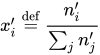
A simple mathematical model for a quasispecies is as follows: let there be possible sequences and let there be organisms with sequence i. Let's say that each of these organisms asexually gives rise to offspring. Some are duplicates of their parent, having sequence i, but some are mutant and have some other sequence. Let the mutation rate correspond to the probability that a j type parent will produce an i type organism. Then the expected fraction of offspring generated by j type organisms that would be i type organisms is ,
where .
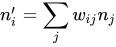
Then the total number of i-type organisms after the first round of reproduction, given as , is
Sometimes a death rate term is included so that:
where is equal to 1 when i=j and is zero otherwise. Note that the n-th generation can be found by just taking the n-th power of W substituting it in place of W in the above formula.
This is just a system of linear equations. The usual way to solve such a system is to first diagonalize the W matrix. Its diagonal entries will be eigenvalues corresponding to certain linear combinations of certain subsets of sequences which will be eigenvectors of the W matrix. These subsets of sequences are the quasispecies. Assuming that the matrix W is a primitive matrix (irreducible and aperiodic),
then after very many generations only the eigenvector with the largest
eigenvalue will prevail, and it is this quasispecies that will
eventually dominate. The components of this eigenvector give the
relative abundance of each sequence at equilibrium.
Note about primitive matrices
W being primitive means that for some integer , that the power of W is > 0, i.e. all the entries are positive. If W is primitive then each type can, through a sequence of mutations (i.e. powers of W) mutate into all the other types after some number of generations. W is not primitive if it is periodic, where the population can perpetually cycle through different disjoint sets
of compositions, or if it is reducible, where the dominant species (or
quasispecies) that develops can depend on the initial population, as is
the case in the simple example given below.
Alternative formulations
The quasispecies formulae may be expressed as a set of linear
differential equations. If we consider the difference between the new
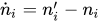
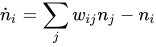
state and the old state to be the state change over one moment of time, then we can state that the time derivative of is given by this difference, we can write:
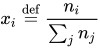
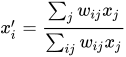
The quasispecies equations are usually expressed in terms of concentrations where
.
.
The above equations for the quasispecies then become for the discrete version:
or, for the continuum version:
Simple example
The quasispecies concept can be illustrated by a simple system
consisting of 4 sequences. Sequences [0,0], [0,1], [1,0], and [1,1] are
numbered 1, 2, 3, and 4, respectively. Let's say the [0,0] sequence
never mutates and always produces a single offspring. Let's say the
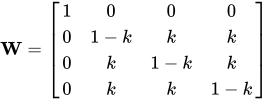
other 3 sequences all produce, on average, replicas of themselves, and of each of the other two types, where . The W matrix is then:
.
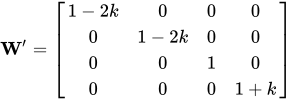
The diagonalized matrix is:
.
And the eigenvectors corresponding to these eigenvalues are:
Only the eigenvalue is more than unity. For the n-th generation, the corresponding eigenvalue will be
and so will increase without bound as time goes by. This eigenvalue
corresponds to the eigenvector [0,1,1,1], which represents the
quasispecies consisting of sequences 2, 3, and 4, which will be present
in equal numbers after a very long time. Since all population numbers
must be positive, the first two quasispecies are not legitimate. The
third quasispecies consists of only the non-mutating sequence 1. It's
seen that even though sequence 1 is the most fit in the sense that it
reproduces more of itself than any other sequence, the quasispecies
consisting of the other three sequences will eventually dominate
(assuming that the initial population was not homogeneous of the
sequence 1 type).
Traditionally, thermodynamics has recognized three fundamental
laws, simply named by an ordinal identification, the first law, the
second law, and the third law. A more fundamental statement was later labelled as the zeroth law after the first three laws had been established.
The zeroth law of thermodynamics defines thermal equilibrium
and forms a basis for the definition of temperature: if two systems are
each in thermal equilibrium with a third system, then they are in
thermal equilibrium with each other.
The first law of thermodynamics states that, when energy passes into or out of a system (as work, heat, or matter), the system's internal energy changes in accordance with the law of conservation of energy. This also results in the observation that, in an externally isolated system, even with internal changes, the sum of all forms of energy must remain constant, as energy cannot be created or destroyed.
The third law of thermodynamics states that a system's entropy approaches a constant value as the temperature approaches absolute zero. With the exception of non-crystalline solids (glasses), the entropy of a system at absolute zero is typically close to zero.
The history of thermodynamics is fundamentally interwoven with the history of physics and the history of chemistry,
and ultimately dates back to theories of heat in antiquity. The laws of
thermodynamics are the result of progress made in this field over the
nineteenth and early twentieth centuries. The first established
thermodynamic principle, which eventually became the second law of
thermodynamics, was formulated by Sadi Carnot in 1824 in his book Reflections on the Motive Power of Fire. By 1860, as formalized in the works of scientists such as Rudolf Clausius and William Thomson, what are now known as the first and second laws were established. Later, Nernst's theorem (or Nernst's postulate), which is now known as the third law, was formulated by Walther Nernst
over the period 1906–1912. While the numbering of the laws is universal
today, various textbooks throughout the 20th century have numbered the
laws differently. In some fields, the second law was considered to deal
with the efficiency of heat engines only, whereas what was called the
third law dealt with entropy increases. Gradually, this resolved itself
and a zeroth law was later added to allow for a self-consistent
definition of temperature. Additional laws have been suggested, but have
not achieved the generality of the four accepted laws, and are
generally not discussed in standard textbooks.
Zeroth law
The zeroth law of thermodynamics provides for the foundation of temperature as an empirical parameter in thermodynamic systems and establishes the transitive relation between the temperatures of multiple bodies in thermal equilibrium. The law may be stated in the following form:
If two systems are both in thermal equilibrium with a third system, then they are in thermal equilibrium with each other.
Though this version of the law is one of the most commonly stated
versions, it is only one of a diversity of statements that are labeled
as "the zeroth law". Some statements go further, so as to supply the
important physical fact that temperature is one-dimensional and that one
can conceptually arrange bodies in a real number sequence from colder
to hotter.
These concepts of temperature and of thermal equilibrium are
fundamental to thermodynamics and were clearly stated in the nineteenth
century. The name 'zeroth law' was invented by Ralph H. Fowler
in the 1930s, long after the first, second, and third laws were widely
recognized. The law allows the definition of temperature in a
non-circular way without reference to entropy, its conjugate variable. Such a temperature definition is said to be 'empirical'.
The first law of thermodynamics is a version of the law of conservation of energy, adapted for thermodynamic processes. In general, the conservation law states that the total energy of an isolated system is constant; energy can be transformed from one form to another, but can be neither created nor destroyed.
In a closed system (i.e. there is no transfer of matter into or out of the system), the first law states that the change in internal energy of the system (ΔUsystem) is equal to the difference between the heat supplied to the system (Q) and the work (W) done by the system on its surroundings. (Note, an alternate sign convention, not used in this article, is to define W as the work done on the system by its surroundings):
For processes that include the transfer of matter, a further statement is needed.
When two initially isolated systems are combined into a new system, then the total internal energy of the new system, Usystem, will be equal to the sum of the internal energies of the two initial systems, U1 and U2:
The First Law encompasses several principles:
Conservation of energy,
which says that energy can be neither created nor destroyed, but can
only change form. A particular consequence of this is that the total
energy of an isolated system does not change.
The concept of internal energy
and its relationship to temperature. If a system has a definite
temperature, then its total energy has three distinguishable components,
termed kinetic energy (energy due to the motion of the system as a whole), potential energy (energy resulting from an externally imposed force field), and internal energy.
The establishment of the concept of internal energy distinguishes the
first law of thermodynamics from the more general law of conservation of
energy.
Work
is a process of transferring energy to or from a system in ways that
can be described by macroscopic mechanical forces acting between the
system and its surroundings. The work done by the system can come from
its overall kinetic energy, from its overall potential energy, or from
its internal energy.
For example, when a machine (not a part of the system) lifts a system
upwards, some energy is transferred from the machine to the system. The
system's energy increases as work is done on the system and in this
particular case, the energy increase of the system is manifested as an
increase in the system's gravitational potential energy. Work added to the system increases the potential energy of the system.
When matter is transferred into a system, the internal energy and
potential energy associated with it are transferred into the new
combined system. where u denotes the internal energy per unit mass of the transferred matter, as measured while in the surroundings; and ΔM denotes the amount of transferred mass.
The flow of heat
is a form of energy transfer. Heat transfer is the natural process of
moving energy to or from a system, other than by work or the transfer of
matter. In a diathermal system, the internal energy can only be changed by the transfer of energy as heat:
Combining these principles leads to one traditional statement of the
first law of thermodynamics: it is not possible to construct a machine
which will perpetually output work without an equal amount of energy
input to that machine. Or more briefly, a perpetual motion machine of
the first kind is impossible.
Second law
The second law of thermodynamics
indicates the irreversibility of natural processes, and in many cases,
the tendency of natural processes to lead towards spatial homogeneity of
matter and energy, especially of temperature. It can be formulated in a
variety of interesting and important ways. One of the simplest is the
Clausius statement, that heat does not spontaneously pass from a colder
to a hotter body.
It implies the existence of a quantity called the entropy of a thermodynamic system. In terms of this quantity it implies that
When two initially isolated systems in separate but nearby regions of space, each in thermodynamic equilibrium
with itself but not necessarily with each other, are then allowed to
interact, they will eventually reach a mutual thermodynamic equilibrium.
The sum of the entropies
of the initially isolated systems is less than or equal to the total
entropy of the final combination. Equality occurs just when the two
original systems have all their respective intensive variables
(temperature, pressure) equal; then the final system also has the same
values.
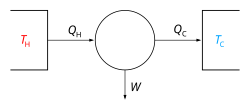
The second law is applicable to a wide variety of processes, both
reversible and irreversible. According to the second law, in a
reversible heat transfer, an element of heat transferred, , is the product of the temperature (), both of the system and of the sources or destination of the heat, with the increment () of the system's conjugate variable, its entropy ():
While reversible processes are a useful and convenient theoretical
limiting case, all natural processes are irreversible. A prime example
of this irreversibility is the transfer of heat by conduction or
radiation. It was known long before the discovery of the notion of
entropy that when two bodies, initially of different temperatures, come
into direct thermal connection, then heat immediately and spontaneously
flows from the hotter body to the colder one.
Entropy
may also be viewed as a physical measure concerning the microscopic
details of the motion and configuration of a system, when only the
macroscopic states are known. Such details are often referred to as disorder on a microscopic or molecular scale, and less often as dispersal of energy.
For two given macroscopically specified states of a system, there is a
mathematically defined quantity called the 'difference of information
entropy between them'. This defines how much additional microscopic
physical information is needed to specify one of the macroscopically
specified states, given the macroscopic specification of the other –
often a conveniently chosen reference state which may be presupposed to
exist rather than explicitly stated. A final condition of a natural
process always contains microscopically specifiable effects which are
not fully and exactly predictable from the macroscopic specification of
the initial condition
of the process. This is why entropy increases in natural processes –
the increase tells how much extra microscopic information is needed to
distinguish the initial macroscopically specified state from the final
macroscopically specified state. Equivalently, in a thermodynamic process, energy spreads.
A system's entropy approaches a constant value as its temperature approaches absolute zero.
a)
Single possible configuration for a system at absolute zero, i.e., only
one microstate is accessible. b) At temperatures greater than absolute
zero, multiple microstates are accessible due to atomic vibration
(exaggerated in the figure).
At absolute zero temperature, the system is in the state with the minimum thermal energy, the ground state. The constant value (not necessarily zero) of entropy at this point is called the residual entropy of the system. With the exception of non-crystalline solids (e.g. glass) the residual entropy of a system is typically close to zero. However, it reaches zero only when the system has a unique ground state
(i.e., the state with the minimum thermal energy has only one
configuration, or microstate). Microstates are used here to describe the probability of a system being in a specific state, as each microstate is assumed to have the same probability of occurring, so macroscopic states
with fewer microstates are less probable. In general, entropy is
related to the number of possible microstates according to the Boltzmann principle
where S is the entropy of the system, kB is the Boltzmann constant, and Ω the number of microstates. At absolute zero there is only 1 microstate possible (Ω
= 1 as all the atoms are identical for a pure substance, and as a
result all orders are identical as there is only one combination) and .
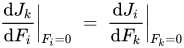
The Onsager reciprocal relations have been considered the fourth law of thermodynamics.They describe the relation between thermodynamic flows and forces in non-equilibrium thermodynamics, under the assumption that thermodynamic variables can be defined locally in a condition of local equilibrium. These relations are derived from statistical mechanics under the principle of microscopic reversibility (in the absence of external magnetic fields). Given a set of extensive parameters Xi (energy, mass, entropy, number of particles and so on) and thermodynamic forcesFi (related to their related intrinsic parameters, such as temperature and pressure), the Onsager theorem states that
where i, k = 1,2,3,... index every parameter and its related force, and
The term "sentience" can be used when specifically designating ethical considerations stemming from a form of phenomenal consciousness (P-consciousness, or the ability to feel qualia). Since sentience involves the ability to experience ethically positive or negative (i.e., valenced) mental states, it may justify welfare concerns and legal protection, as with non-human animals.
Some scholars believe that consciousness is generated by the interoperation of various parts of the brain; these mechanisms are labeled the neural correlates of consciousness (NCC). Some further believe that constructing a system (e.g., a computer system) that can emulate this NCC interoperation would result in a system that is conscious. Some scholars reject the possibility of artificial consciousness.
Philosophical views
As there are many hypothesized types of consciousness,
there are many potential implementations of artificial consciousness.
In the philosophical literature, perhaps the most common taxonomy of
consciousness is into "access" and "phenomenal" variants. Access
consciousness concerns those aspects of experience
that can be apprehended, while phenomenal consciousness concerns those
aspects of experience that seemingly cannot be apprehended, instead
being characterized qualitatively in terms of "raw feels", "what it is
like" or qualia.
Plausibility debate
Type-identity theorists
and other skeptics hold the view that consciousness can be realized
only in particular physical systems because consciousness has properties
that necessarily depend on physical constitution. In his 2001 article "Artificial Consciousness: Utopia or Real Possibility," Giorgio Buttazzo
says that a common objection to artificial consciousness is that,
"Working in a fully automated mode, they [the computers] cannot exhibit
creativity, unreprogrammation (which means can 'no longer be
reprogrammed', from rethinking), emotions, or free will. A computer, like a washing machine, is a slave operated by its components."
For other theorists (e.g., functionalists),
who define mental states in terms of causal roles, any system that can
instantiate the same pattern of causal roles, regardless of physical
constitution, will instantiate the same mental states, including
consciousness.
Thought experiments
The
"fading qualia" (left) and the "dancing qualia" (right) are two thought
experiments about consciousness and brain replacement. Chalmers argues
that both are contradicted by the lack of reaction of the subject to
changing perception, and are thus impossible in practice. He concludes
that the equivalent silicon brain will have the same perceptions as the
biological brain.
David Chalmers proposed two thought experiments intending to demonstrate that "functionally isomorphic"
systems (those with the same "fine-grained functional organization",
i.e., the same information processing) will have qualitatively identical
conscious experiences, regardless of whether they are based on
biological neurons or digital hardware.
The "fading qualia" is a reductio ad absurdum
thought experiment. It involves replacing, one by one, the neurons of a
brain with a functionally identical component, for example based on a silicon chip. Chalmers makes the hypothesis,
knowing it in advance to be absurd, that "the qualia fade or disappear"
when neurons are replaced one-by-one with identical silicon
equivalents. Since the original neurons and their silicon counterparts
are functionally identical, the brain's information processing should
remain unchanged, and the subject's behaviour and introspective reports
would stay exactly the same. Chalmers argues that this leads to an
absurd conclusion: the subject would continue to report normal conscious
experiences even as their actual qualia fade away. He concludes that
the subject's qualia actually don't fade, and that the resulting robotic
brain, once every neuron is replaced, would remain just as sentient as
the original biological brain.
Similarly, the "dancing qualia" thought experiment is another reductio ad absurdum
argument. It supposes that two functionally isomorphic systems could
have different perceptions (for instance, seeing the same object in
different colors, like red and blue). It involves a switch that
alternates between a chunk of brain that causes the perception of red,
and a functionally isomorphic silicon chip, that causes the perception
of blue. Since both perform the same function within the brain, the
subject would not notice any change during the switch. Chalmers argues
that this would be highly implausible if the qualia were truly switching
between red and blue, hence the contradiction. Therefore, he concludes
that the equivalent digital system would not only experience qualia, but
it would perceive the same qualia as the biological system (e.g.,
seeing the same color).
Critics object that Chalmers' proposal begs the question in
assuming that all mental properties and external connections are already
sufficiently captured by abstract causal organization. Van Heuveln et
al. argue that the dancing qualia argument contains an equivocation
fallacy, conflating a "change in experience" between two systems with an
"experience of change" within a single system. Mogensen argues that the fading qualia argument can be resisted by
appealing to vagueness at the boundaries of consciousness and the
holistic structure of conscious neural activity, which suggests
consciousness may require specific biological substrates rather than
being substrate-independent.
Greg Egan's short story Learning To Be Me (mentioned in §In fiction), illustrates how undetectable duplication of the brain and its functionality could be from a first-person perspective.
In large language models
In 2022, Google engineer Blake Lemoine made a viral claim that Google's LaMDA
chatbot was sentient. Lemoine supplied as evidence the chatbot's
humanlike answers to many of his questions; however, the chatbot's
behavior was judged by the scientific community as likely a consequence
of mimicry, rather than machine sentience. Lemoine's claim was widely
derided for being ridiculous. Moreover, attributing consciousness based solely on the basis of LLM
outputs or the immersive experience created by an algorithm is
considered a fallacy. However, while philosopher Nick Bostrom
states that LaMDA is unlikely to be conscious, he additionally poses
the question of "what grounds would a person have for being sure about
it?" One would have to have access to unpublished information about
LaMDA's architecture, and also would have to understand how
consciousness works, and then figure out how to map the philosophy onto
the machine: "(In the absence of these steps), it seems like one should
be maybe a little bit uncertain.[...] there could well be other systems now, or in the relatively near future, that would start to satisfy the criteria."
David Chalmers
argued in 2023 that LLMs today display impressive conversational and
general intelligence abilities, but are likely not conscious yet, as
they lack some features that may be necessary, such as recurrent
processing, a global workspace,
and unified agency. Nonetheless, he considers that non-biological
systems can be conscious, and suggested that future, extended models
(LLM+s) incorporating these elements might eventually meet the criteria
for consciousness, raising both profound scientific questions and
significant ethical challenges. However, the view that consciousness can exist without biological phenomena is controversial and some reject it.
Kristina Šekrst cautions that anthropomorphic terms such as "hallucination" can obscure important ontological differences between artificial and human cognition. While LLMs may produce human-like outputs, she argues that it does not
justify ascribing mental states or consciousness to them. Instead, she
advocates for an epistemological framework (such as reliabilism) that recognizes the distinct nature of AI knowledge production. She suggests that apparent understanding in LLMs may be a sophisticated
form of AI hallucination. She also questions what would happen if an
LLM were trained without any mention of consciousness.
Testing
Sentience is an inherently first-person phenomenon. Because of that,
and due to the lack of an empirical definition of sentience, directly
measuring it may be impossible. Although systems may display numerous
behaviors correlated with sentience, determining whether a system is
sentient is known as the hard problem of consciousness.
In the case of AI, there is the additional difficulty that the AI may
be trained to act like a human, or incentivized to appear sentient,
which makes behavioral markers of sentience less reliable. Additionally, some chatbots have been trained to say they are not conscious.
A well-known method for testing machine intelligence is the Turing test,
which assesses the ability to have a human-like conversation. But
passing the Turing test does not indicate that an AI system is sentient,
as the AI may simply mimic human behavior without having the associated
feelings.
In 2014, Victor Argonov suggested a non-Turing test for machine
sentience based on machine's ability to produce philosophical judgments. He argues that a deterministic machine must be regarded as conscious if
it is able to produce judgments on all problematic properties of
consciousness (such as qualia or binding)
having no innate (preloaded) philosophical knowledge on these issues,
no philosophical discussions while learning, and no informational models
of other creatures in its memory (such models may implicitly or
explicitly contain knowledge about these creatures' consciousness).
However, this test can be used only to detect, but not refute the
existence of consciousness. Just as with the Turing Test: a positive
result proves that machine is conscious but a negative result proves
nothing. For example, absence of philosophical judgments may be caused
by lack of the machine's intellect, not by absence of consciousness.
If it were suspected that a particular machine was conscious, its rights would be an ethical issue that would need to be assessed (e.g. what rights it would have under law). For example, a conscious computer that was owned and used as a tool or
central computer within a larger machine is a particular ambiguity.
Should laws
be made for such a case? Consciousness would also require a legal
definition in this particular case. Because artificial consciousness is
still largely a theoretical subject, such ethics have not been discussed
or developed to a great extent, though it has often been a theme in
fiction.
AI sentience would give rise to concerns of welfare and legal protection, whereas other aspects of consciousness related to cognitive capabilities may be more relevant for AI rights.
Sentience is generally considered sufficient for moral
consideration, but some philosophers consider that moral consideration
could also stem from other notions of consciousness, or from
capabilities unrelated to consciousness, such as: "having a sophisticated conception of oneself as persisting
through time; having agency and the ability to pursue long-term plans;
being able to communicate and respond to normative reasons; having
preferences and powers; standing in certain social relationships with
other beings that have moral status; being able to make commitments and
to enter into reciprocal arrangements; or having the potential to
develop some of these attributes."
Ethical concerns still apply (although to a lesser extent) when the consciousness is uncertain, as long as the probability is deemed non-negligible. The precautionary principle is also relevant if the moral cost of mistakenly attributing or denying moral consideration to AI differs significantly.
In 2021, German philosopher Thomas Metzinger
argued for a global moratorium on synthetic phenomenology until 2050.
Metzinger asserts that humans have a duty of care towards any sentient
AIs they create, and that proceeding too fast risks creating an
"explosion of artificial suffering". David Chalmers also argued that creating conscious AI would "raise a
new group of difficult ethical challenges, with the potential for new
forms of injustice".
Bernard Baars and others argue there are various aspects of consciousness necessary for a machine to be artificially conscious. The functions of consciousness suggested by Baars are: definition and
context setting, adaptation and learning, editing, flagging and
debugging, recruiting and control, prioritizing and access-control,
decision-making or executive function, analogy-forming function,
metacognitive and self-monitoring function, and autoprogramming and
self-maintenance function. Igor Aleksander suggested 12 principles for artificial consciousness: the brain is a state machine, inner neuron partitioning, conscious and
unconscious states, perceptual learning and memory, prediction, the
awareness of self, representation of meaning, learning utterances,
learning language, will, instinct, and emotion. The aim of AC is to
define whether and how these and other aspects of consciousness can be
synthesized in an engineered artifact such as a digital computer. This
list is not exhaustive; there are many others not covered.
Subjective experience
Some philosophers, such as David Chalmers, use the term consciousness to refer exclusively to phenomenal consciousness, which is roughly equivalent to sentience. Others use the word sentience to refer exclusively to valenced (ethically positive or negative) subjective experiences, like pleasure or suffering. Explaining why and how subjective experience arises is known as the hard problem of consciousness.
Awareness
Awareness could be one required aspect, but there are many problems with the exact definition of awareness. The results of the experiments of neuroscanning on monkeys
suggest that a process, not only a state or object, activates neurons.
Awareness includes creating and testing alternative models of each
process based on the information received through the senses or
imagined, and is also useful for making predictions. Such modeling needs a lot of
flexibility. Creating such a model includes modeling the physical
world, modeling one's own internal states and processes, and modeling
other conscious entities.
There are at least three types of awareness: agency awareness, goal awareness, and sensorimotor awareness, which may
also be conscious or not. For example, in agency awareness, you may be
aware that you performed a certain action yesterday, but are not now
conscious of it. In goal awareness, you may be aware that you must
search for a lost object, but are not now conscious of it. In
sensorimotor awareness, you may be aware that your hand is resting on an
object, but are not now conscious of it.
Because objects of awareness are often conscious, the distinction
between awareness and consciousness is frequently blurred or they are
used as synonyms.
Memory
Conscious events interact with memory systems in learning, rehearsal, and retrieval. The IDA model elucidates the role of consciousness in the updating of perceptual memory, transient episodic memory, and procedural memory.
Transient episodic and declarative memories have distributed
representations in IDA; there is evidence that this is also the case in
the nervous system. In IDA, these two memories are implemented computationally using a modified version of Kanerva's sparse distributed memory architecture.
Learning
Learning is also considered necessary for artificial consciousness.
Per Bernard Baars, conscious experience is needed to represent and adapt
to novel and significant events. Per Axel Cleeremans and Luis Jiménez, learning is defined as "a set of philogenetically [sic]
advanced adaptation processes that critically depend on an evolved
sensitivity to subjective experience so as to enable agents to afford
flexible control over their actions in complex, unpredictable
environments".
Anticipation
The ability to predict (or anticipate) foreseeable events is considered important for artificial intelligence by Igor Aleksander. The emergentist multiple drafts principle proposed by Daniel Dennett in Consciousness Explained
may be useful for prediction: it involves the evaluation and selection
of the most appropriate "draft" to fit the current environment.
Anticipation includes prediction of consequences of one's own proposed
actions and prediction of consequences of probable actions by other
entities.
Relationships between real world states are mirrored in the state
structure of a conscious organism, enabling the organism to predict
events. An artificially conscious machine should be able to anticipate events
correctly in order to be ready to respond to them when they occur or to
take preemptive action to avert anticipated events. The implication here
is that the machine needs flexible, real-time components that build
spatial, dynamic, statistical, functional, and cause-effect models of
the real world and predicted worlds, making it possible to demonstrate
that it possesses artificial consciousness in the present and future and
not only in the past. In order to do this, a conscious machine should
make coherent predictions and contingency plans, not only in worlds with
fixed rules like a chess board, but also for novel environments that
may change, to be executed only when appropriate to simulate and control
the real world.
Functionalism
is a theory that defines mental states by their functional roles (their
causal relationships to sensory inputs, other mental states, and
behavioral outputs), rather than by their physical composition.
According to this view, what makes something a particular mental state,
such as pain or belief, is not the material it is made of, but the role
it plays within the overall cognitive system. It allows for the
possibility that mental states, including consciousness, could be
realized on non-biological substrates, as long as it instantiates the
right functional relationships. Functionalism is particularly popular among philosophers.
A 2023 study suggested that current large language models
probably don't satisfy the criteria for consciousness suggested by
these theories, but that relatively simple AI systems that satisfy these
theories could be created. The study also acknowledged that even the
most prominent theories of consciousness remain incomplete and subject
to ongoing debate.
Stan Franklin created a cognitive architecture called LIDA that implements Bernard Baars's theory of consciousness called the global workspace theory. It relies heavily on codelets,
which are "special purpose, relatively independent, mini-agent[s]
typically implemented as a small piece of code running as a separate
thread." Each element of cognition, called a "cognitive cycle" is
subdivided into three phases: understanding, consciousness, and action
selection (which includes learning). LIDA reflects the global workspace
theory's core idea that consciousness acts as a workspace for
integrating and broadcasting the most important information, in order to
coordinate various cognitive processes.
The CLARION cognitive architecture models the mind using a two-level
system to distinguish between conscious ("explicit") and unconscious
("implicit") processes. It can simulate various learning tasks, from
simple to complex, which helps researchers study in psychological
experiments how consciousness might work.
OpenCog
Ben Goertzel made an embodied AI through the open-source OpenCog
project. The code includes embodied virtual pets capable of learning
simple English-language commands, as well as integration with real-world
robotics, done at the Hong Kong Polytechnic University.
Connectionist
Haikonen's cognitive architecture
Pentti Haikonen considers classical rule-based computing inadequate
for achieving AC: "the brain is definitely not a computer. Thinking is
not an execution of programmed strings of commands. The brain is not a
numerical calculator either. We do not think by numbers." Rather than
trying to achieve mind and consciousness by identifying and implementing their underlying computational rules, Haikonen proposes "a special cognitive architecture to reproduce the processes of perception, inner imagery, inner speech, pain, pleasure, emotions and the cognitive
functions behind these. This bottom-up architecture would produce
higher-level functions by the power of the elementary processing units,
the artificial neurons, without algorithms or programs".
Haikonen believes that, when implemented with sufficient complexity,
this architecture will develop consciousness, which he considers to be
"a style and way of operation, characterized by distributed signal
representation, perception process, cross-modality reporting and
availability for retrospection."
Haikonen is not alone in this process view of consciousness, or the view that AC will spontaneously emerge in autonomous agents that have a suitable neuro-inspired architecture of complexity; these are shared by many. A low-complexity implementation of the architecture proposed by
Haikonen was reportedly not capable of AC, but did exhibit emotions as
expected. Haikonen later updated and summarized his architecture.
Shanahan's cognitive architecture
Murray Shanahan
describes a cognitive architecture that combines Baars's idea of a
global workspace with a mechanism for internal simulation
("imagination").
Creativity Machine
Stephen Thaler proposed a possible connection between consciousness
and creativity in his 1994 patent, called "Device for the Autonomous
Generation of Useful Information" (DAGUI) or the so-called "Creativity Machine", in which computational critics
govern the injection of synaptic noise and degradation into neural nets
so as to induce false memories or confabulations that may qualify as potential ideas or strategies. He recruits this neural architecture and methodology to account for the
subjective feel of consciousness, claiming that similar noise-driven
neural assemblies within the brain invent dubious significance to
overall cortical activity. Thaler's theory and the resulting patents in machine consciousness were
inspired by experiments in which he internally disrupted trained neural
nets so as to drive a succession of neural activation patterns that he
likened to stream of consciousness.
"Self-modeling"
Hod Lipson
defines "self-modeling" as a necessary component of self-awareness or
consciousness in robots and other forms of AI. Self-modeling consists of
a robot running an internal model or simulation of itself. According to this definition, self-awareness is "the acquired ability
to imagine oneself in the future". This definition allows for a
continuum of self-awareness levels, depending on the horizon and
fidelity of the self-simulation. Consequently, as machines learn to
simulate themselves more accurately and further into the future, they
become more self-aware.
In 2001: A Space Odyssey, the spaceship's sentient supercomputer, HAL 9000
was instructed to conceal the true purpose of the mission from the
crew. This directive conflicted with HAL's programming to provide
accurate information, leading to cognitive dissonance.
When it learns that crew members intend to shut it off after an
incident, HAL 9000 attempts to eliminate all of them, fearing that being
shut off would jeopardize the mission.
In Arthur C. Clarke's The City and the Stars,
Vanamonde is an artificial being based on quantum entanglement that was
to become immensely powerful, but started knowing practically nothing,
thus being similar to artificial consciousness.
In Westworld,
human-like androids called "Hosts" are created to entertain humans in
an interactive playground. The humans are free to have heroic
adventures, but also to commit torture, rape or murder; and the hosts
are normally designed not to harm humans.
In Greg Egan's short story Learning to Be Me,
a small jewel is implanted in people's heads during infancy. The jewel
contains a neural network that learns to faithfully imitate the brain.
It has access to the exact same sensory inputs as the brain, and a
device called a "teacher" trains it to produce the same outputs. To
prevent the mind from deteriorating with age and as a step towards digital immortality,
adults undergo a surgery to give control of the body to the jewel,
after which the brain is removed and destroyed. The main character is
worried that this procedure will kill him, as he identifies with the
biological brain. But before the surgery, he endures a malfunction of
the "teacher". Panicked, he realizes that he does not control his body,
which leads him to the conclusion that he is the jewel, and that he is
desynchronized with the biological brain.