In psychoanalysis and other psychological theories, the unconscious mind (or the unconscious) is the part of the psyche that is not available to introspection. Although these processes exist beneath the surface of conscious awareness, they are thought to exert an effect on conscious thought processes and behavior. The term was coined by the 18th-century German Romantic philosopherFriedrich Schelling and later introduced into English by the poet and essayist Samuel Taylor Coleridge.
The emergence of the concept of the unconscious in psychology and
general culture was mainly due to the work of Austrian neurologist and
psychoanalyst Sigmund Freud. In psychoanalytic theory, the unconscious mind consists of ideas and drives that have been subject to the mechanism of repression:
anxiety-producing impulses in childhood are barred from consciousness,
but do not cease to exist, and exert a constant pressure in the
direction of consciousness. However, the content of the unconscious is
only knowable to consciousness through its representation in a disguised
or distorted form, by way of dreams and neurotic symptoms, as well as in slips of the tongue and jokes. The psychoanalyst seeks to interpret these conscious manifestations in order to understand the nature of the repressed.
The unconscious mind can be seen as the source of dreams and
automatic thoughts (those that appear without any apparent cause), the
repository of forgotten memories (that may still be accessible to
consciousness at some later time), and the locus of implicit knowledge
(the things that we have learned so well that we do them without
thinking). Phenomena related to semi-consciousness include awakening, implicit memory, subliminal messages, trances, hypnagogia and hypnosis. While sleep, sleepwalking, dreaming, delirium and comas may signal the presence of unconscious processes, these processes are seen as symptoms rather than the unconscious mind itself.
Some critics have doubted the existence of the unconscious altogether.
Historical overview
German
The term "unconscious" (German: unbewusst) was coined by the 18th-century German Romantic philosopher Friedrich Schelling (in his System of Transcendental Idealism, ch. 6, § 3) and later introduced into English by the poet and essayist Samuel Taylor Coleridge (in his Biographia Literaria). Some rare earlier instances of the term "unconsciousness" (Unbewußtseyn) can be found in the work of the 18th-century German physician and philosopher Ernst Platner.
Vedas
Influences
on thinking that originate from outside an individual's consciousness
were reflected in the ancient ideas of temptation, divine inspiration,
and the predominant role of the gods in affecting motives and actions.
The idea of internalised unconscious processes in the mind was present
in antiquity, and has been explored across a wide variety of cultures.
Unconscious aspects of mentality were referred to between 2,500 and 600
BC in the Hindu texts known as the Vedas, found today in Ayurvedic medicine.
Paracelsus
Paracelsus is credited as the first to make mention of an unconscious aspect of cognition in his work Von den Krankheiten
(translates as "About illnesses", 1567), and his clinical methodology
created a cogent system that is regarded by some as the beginning of
modern scientific psychology.
Shakespeare
William Shakespeare explored the role of the unconscious in many of his plays, without naming it as such.
Philosophy
In his work Anthropology, philosopher Immanuel Kant was one of the first to discuss the subject of unconscious ideas.
In 1880 at the Sorbonne, Edmond Colsenet defended a philosophy thesis (PhD) on the unconscious. Elie Rabier and Alfred Fouillee performed syntheses of the unconscious "at a time when Freud was not interested in the concept".
Psychology
Nineteenth century
According
to historian of psychology Mark Altschule, "It is difficult—or perhaps
impossible—to find a nineteenth-century psychologist or psychiatrist who
did not recognize unconscious cerebration as not only real but of the
highest importance." In 1890, when psychoanalysis was still unheard of, William James, in his monumental treatise on psychology (The Principles of Psychology), examined the way Schopenhauer, von Hartmann, Janet, Binet and others had used the term 'unconscious' and 'subconscious.'" German psychologists, Gustav Fechner and Wilhelm Wundt, had begun to use the term in their experimental psychology, in the context of manifold, jumbled sense data that the mind organizes at an unconscious level before revealing it as a cogent totality in conscious form." Eduard von Hartmann published a book dedicated to the topic, Philosophy of the Unconscious, in 1869.
Freud
The
iceberg metaphor proposed by G. T. Fechner is often used to provide a
visual representation of Freud's theory that most of the human mind
operates unconsciously.
Sigmund Freud
and his followers developed an account of the unconscious mind. He
worked with the unconscious mind to develop an explanation for mental
illness.
For Freud, the unconscious is not merely that which is not conscious. He refers to that as the descriptive unconscious
and it is only the starting postulate for real investigation into the
psyche. He further distinguishes the unconscious from the pre-conscious:
the pre-conscious is merely latent – thoughts, memories, etc. that are
not present to consciousness but are capable of becoming so; the unconscious consists of psychic material that is made completely inaccessible to consciousness by the act of repression.
The distinctions and inter-relationships between these three regions of
the psyche—the conscious, the pre-conscious, and the unconscious—form
what Freud calls the topographical model of the psyche. He later sought to respond to the perceived ambiguity of the term "unconscious" by developing what he called the structural model of the psyche, in which unconscious processes were described in terms of the id and the superego in their relation to the ego.
In the psychoanalytic view, unconscious mental processes can only
be recognized through analysis of their effects in consciousness.
Unconscious thoughts are not directly accessible to ordinary
introspection, but they are capable of partially evading the censorship
mechanism of repression in a disguised form, manifesting, for example,
as dream elements or neurotic symptoms. Such symptoms are supposed to be capable of being "interpreted" during psychoanalysis, with the help of methods such as free association, dream analysis, and analysis of verbal slips and other unintentional manifestations in conscious life.
Carl Gustav Jung agreed with Freud that the unconscious is a
determinant of personality, but he proposed that the unconscious be
divided into two layers: the personal unconscious and the collective unconscious.
The personal unconscious is a reservoir of material that was once
conscious but has been forgotten or suppressed, much like Freud's
notion. The collective unconscious, however, is the deepest level of the
psyche, containing the accumulation of inherited psychic structures and
archetypal
experiences. Archetypes are not memories but energy centers or
psychological functions that are apparent in the culture's use of
symbols. The collective unconscious is therefore said to be inherited
and contain material of an entire species rather than of an individual. The collective unconscious is, according to Jung, "[the] whole
spiritual heritage of mankind's evolution, born anew in the brain
structure of every individual".
In addition to the structure of the unconscious, Jung differed from Freud in that he did not believe that sexuality was at the base of all unconscious thoughts.
Dreams
Freud
The
purpose of dreams, according to Freud, is to fulfill repressed wishes
while simultaneously allowing the dreamer to remain asleep. The dream is
a disguised fulfillment of the wish because the unconscious
desire in its raw form would disturb the sleeper and can only avoid
censorship by associating itself with elements that are not subject to
repression. Thus Freud distinguished between the manifest content and latent content
of the dream. The manifest content consists of the plot and elements of
a dream as they appear to consciousness, particularly upon waking, as
the dream is recalled. The latent content refers to the hidden or disguised meaning of the
events and elements of the dream. It represents the unconscious psychic
realities of the dreamer's current issues and childhood conflicts, the
nature of which the analyst is seeking to understand through
interpretation of the manifest content.
In Freud's theory, dreams are instigated by the events and
thoughts of everyday life. In what he called the "dream-work", these
events and thoughts, governed by the rules of language and the reality principle, become subject to the "primary process" of unconscious thought, which is governed by the pleasure principle,
wish gratification and the repressed sexual scenarios of childhood. The
dream-work involves a process of disguising these unconscious desires
in order to preserve sleep. This process occurs primarily by means of
what Freud called condensation and displacement.
Condensation is the focusing of the energy of several ideas into one,
and displacement is the surrender of one idea's energy to another more
trivial representative. The manifest content is thus thought to be a
highly significant simplification of the latent content, capable of
being deciphered in the analytic process, potentially allowing conscious
insight into unconscious mental activity.
Neurobiological theory of dreams
Allan Hobson and colleagues developed what they called the activation-synthesis hypothesis which proposes that dreams are simply the side effects of the neural activity in the brain that produces beta brain waves during REM sleep
that are associated with wakefulness. According to this hypothesis,
neurons fire periodically during sleep in the lower brain levels and
thus send random signals to the cortex.
The cortex then synthesizes a dream in reaction to these signals in
order to try to make sense of why the brain is sending them. However,
the hypothesis does not state that dreams are meaningless, it just
downplays the role that emotional factors play in determining dreams.
Contemporary cognitive psychology
Research
There is an extensive body of research in contemporary cognitive psychology
devoted to mental activity that is not mediated by conscious awareness.
Most of this research on unconscious processes has been done in the
academic tradition of the information processing paradigm. The cognitive
tradition of research into unconscious processes does not rely on the
clinical observations and theoretical bases of the psychoanalytic
tradition; instead it is mostly data driven. Cognitive research reveals
that individuals automatically register and acquire more information
than they are consciously aware of or can consciously remember and
report.
Much research has focused on the differences between conscious
and unconscious perception. There is evidence that whether something is
consciously perceived depends both on the incoming stimulus (bottom up
strength) and on top-down mechanisms like attention. Recent research indicates that some unconsciously perceived information
can become consciously accessible if there is cumulative evidence.
Similarly, content that would normally be conscious can become
unconscious through inattention (e.g. in the attentional blink) or through distracting stimuli like visual masking.
Unconscious processing of information about frequency
An extensive line of research conducted by Hasher and Zacks has demonstrated that individuals register information about the
frequency of events automatically (outside conscious awareness and
without engaging conscious information processing resources). Moreover,
perceivers do this unintentionally, truly "automatically", regardless of
the instructions they receive, and regardless of the information
processing goals they have. The ability to unconsciously and relatively
accurately tally the frequency of events appears to have little or no
relation to the individual's age, education, intelligence, or personality. Thus it may represent one of
the fundamental building blocks of human orientation in the environment
and possibly the acquisition of procedural knowledge and experience, in general.
Criticism of the Freudian concept
The notion that the unconscious mind exists at all has been disputed.
Jean-Paul Sartre offers a critique of Freud's theory of the unconscious in Being and Nothingness,
based on the claim that consciousness is essentially self-conscious.
Sartre also argues that Freud's theory of repression is internally
flawed. Philosopher Thomas Baldwin argues that Sartre's argument is based on a misunderstanding of Freud.
Erich Fromm
contends that "The term 'the unconscious' is actually a mystification
(even though one might use it for reasons of convenience, as I am guilty
of doing in these pages). There is no such thing as the unconscious; there are only experiences of which we are aware, and others of which we are not aware, that is, of which we are unconscious.
If I hate a man because I am afraid of him, and if I am aware of my
hate but not of my fear, we may say that my hate is conscious and that
my fear is unconscious; still my fear does not lie in that mysterious
place: 'the' unconscious."
John Searle
has offered a critique of the Freudian unconscious. He argues that the
Freudian cases of shallow, consciously held mental states would be best
characterized as 'repressed consciousness,' while the idea of more
deeply unconscious mental states is more problematic. He contends that
the very notion of a collection of "thoughts" that exist in a privileged
region of the mind such that they are in principle never accessible
to conscious awareness, is incoherent. This is not to imply that there
are not "nonconscious" processes that form the basis of much of
conscious life. Rather, Searle simply claims that to posit the existence
of something that is like a "thought" in every way except for the fact
that no one can ever be aware of it (can never, indeed, "think" it) is
an incoherent concept. To speak of "something" as a "thought" either
implies that it is being thought by a thinker or that it could be
thought by a thinker. Processes that are not causally related to the
phenomenon called thinking are more appropriately called the
nonconscious processes of the brain.
Some scientific researchers proposed the existence of unconscious
mechanisms that are very different from the Freudian ones. They speak
of a "cognitive unconscious" (John Kihlstrom), an "adaptive unconscious" (Timothy Wilson), or a "dumb unconscious" (Loftus and Klinger), which executes automatic processes but lacks the complex mechanisms of
repression and symbolic return of the repressed, and the "deep
unconscious system" of Robert Langs.
In modern cognitive psychology,
many researchers have sought to strip the notion of the unconscious
from its Freudian heritage, and alternative terms such as "implicit" or
"automatic" have been used. These traditions emphasize the degree to
which cognitive processing happens outside the scope of cognitive
awareness, and show that things we are unaware of can nonetheless
influence other cognitive processes as well as behavior. Active research traditions related to the unconscious include implicit memory (for example, priming), and Pawel Lewicki's nonconscious acquisition of knowledge.
In the psychology subfield of oneirology, a lucid dream is a type of dream
wherein the dreamer realizes that they are dreaming during their dream.
The capacity to have and sustain lucid dreams is a trainable cognitive skill.During a lucid dream, the dreamer may gain some amount of volitional control over the dream characters, narrative, or environment, although this control of dream content is not the salient feature of lucid dreaming. An important distinction is that lucid dreaming is a distinct type of dream from other types of dreams such as prelucid dreams
and vivid dreams, although prelucid dreams are a precursor to lucid
dreams, and lucid dreams are often accompanied with enhanced dream
vividness. Lucid dreams are also a distinct state from other lucid
boundary sleep states such as lucid hypnagogia or lucid hypnopompia.
In formal psychology, lucid dreaming has been studied and
reported for many years. Prominent figures from ancient to modern times
have been fascinated by lucid dreams and have sought ways to better
understand their causes and purpose. Many different theories have
emerged as a result of scientific research on the subject. Further developments in psychological research have pointed to ways in which this form of dreaming may be utilized as a therapeutic technique.
The term lucid dream was coined by Dutch author and psychiatristFrederik van Eeden in his 1913 article A Study of Dreams, though descriptions of dreamers being aware that they are dreaming predate the article. Psychologist Stephen LaBerge is widely considered the progenitor and leading pioneer of modern lucid dreaming research. He is the founder of the Lucidity Institute at Stanford University.
Definition
Paul Tholey laid the epistemological
basis for the research of lucid dreams, proposing seven different
conditions of clarity that a dream must fulfill to be defined as a lucid
dream:
Awareness of the dream state (orientation)
Awareness of the capacity to make decisions
Awareness of memory functions
Awareness of self
Awareness of the dream environment
Awareness of the meaning of the dream
Awareness of concentration and focus (the subjective clarity of that state)
Later, in 1992, a study by Deirdre Barrett examined whether lucid dreams contained four "corollaries" of lucidity:
The dreamer is aware that they are dreaming
They are aware that actions will not carry over after waking
Physical laws need not apply in the dream
The dreamer has a clear memory of the waking world
Barrett found that less than a quarter of lucidity accounts exhibited all four.
Subsequently, Stephen LaBerge
studied the prevalence among lucid dreams of the ability to control the
dream scenario, and found that while dream control and dream awareness
are correlated, neither requires the other. LaBerge found dreams that
exhibit one clearly without the capacity for the other. He also found
dreams where, although the dreamer is lucid and aware they could
exercise control, they choose simply to observe.
History
Eastern
The practice of lucid dreaming is central to both the ancient Indian Hindu practice of Yoga nidra and the Tibetan Buddhist practice of dream Yoga. The cultivation of such awareness was a common practice among early Buddhists.
Western
Early references to the phenomenon are also found in ancient Greek writing. For example, the philosopher Aristotle
wrote: "often when one is asleep, there is something in consciousness
which declares that what then presents itself is but a dream." Meanwhile, the physician Galen of Pergamon used lucid dreams as a form of therapy. In addition, a letter written by Saint Augustine of Hippo in AD 415 tells the story of a dreamer, Doctor Gennadius, and refers to lucid dreaming.
Philosopher and physician Sir Thomas Browne (1605–1682) was fascinated by dreams and described his own ability to lucid dream in his Religio Medici,
stating: "...yet in one dream I can compose a whole Comedy, behold the
action, apprehend the jests and laugh my self awake at the conceits
thereof."
Samuel Pepys,
in his diary entry for 15 August 1665, records a dream, stating: "I had
my Lady Castlemayne in my arms and was admitted to use all the
dalliance I desired with her, and then dreamt that this could not be
awake, but that it was only a dream."
In 1867, the French sinologist Marie-Jean-Léon, Marquis d'Hervey de Saint Denys anonymously published Les Rêves et Les Moyens de Les Diriger; Observations Pratiques
("Dreams and the ways to direct them; practical observations"), in
which he describes his own experiences of lucid dreaming, and proposes
that it is possible for anyone to learn to dream consciously.
In 1913, Dutch psychiatrist and writer Frederik (Willem) van Eeden (1860–1932) coined the term "lucid dream" in an article entitled "A Study of Dreams".
Some have suggested that the term is a misnomer because Van Eeden
was referring to a phenomenon more specific than a lucid dream. Van Eeden intended the term lucid to denote "having insight", as in the phrase a lucid interval applied to someone in temporary remission from a psychosis, rather than as a reference to the perceptual quality of the experience, which may or may not be clear and vivid.
Skill mastery
Clinical psychologist, Kristen LaMarca outlined four stages towards mastering the skill of using lucid dreaming:
Lucid Dreaming Skill Levels
Stage
Title
Description
Rarity
1
Beginner
The practitioner may have no recollection
of ever having a lucid dream, and perhaps has at most experienced only
brief moments of lucidity.
Common
2
Experienced
An experienced lucid dreaming practitioner
wields an increased ability of dream control and capacity to execute
pre-intended actions. However, there are still aspects of lucid dream
practice about employing lucidity productively that are yet to be honed.
One's understanding of accessing and maintaining dream lucidity deepen
as one has more lucid dreams.
Less common
3
Proficient
A proficient lucid dreamer is marked by a
deliberate ability to accomplish intended actions in lucid dreams, along
with knowledge of the best actions for given dream scenarios. The
proficient lucid dream practitioner's practice is well-planned, drawing
upon a broad skill set facilitating flexible oneironautic exploration,
which can include contemplative practices or athletic motor skill training. This level of skill adequacy is not necessary to develop a fulfilling lucid dream practice.
Uncommon
4
Expert
Expertise in lucid dream skill is
accompanied by normalization of greater intensity of lucidity during
lucid dreams. LaMarca writes that the expert's practice is
"characterized by at least a decade of intense dedication, long training
hours, and mentorship by other more advanced experts." Spiritual
figures, such Tibetan Buddhist masters, tend to display the highest order of mastery.
Extremely rare
Progression along the skill levels is akin to a maturity in the
development of the practitioner's discipline, methodology and
application.
Cognitive science
In 1968, Celia Green
analyzed the main characteristics of such dreams, reviewing previously
published literature on the subject and incorporating new data from
participants of her own. She concluded that lucid dreams were a category
of experience quite distinct from ordinary dreams and said they were
associated with rapid eye movement sleep (REM sleep). Green was also the first to link lucid dreams to the phenomenon of false awakenings, which has since been corroborated by more recent studies.
In 1973, the National Institute of Mental Health reported that
researchers at the University of California, San Francisco, were able to
train sleeping subjects to recognize they were in REM dreaming and
indicate this by pressing micro switches on their thumbs. Using tones
and mild shocks as cues, the experiments showed that the subjects were
able to signal knowledge of their various sleep stages, including
dreaming.
In 1975, Dr. Keith Hearne had the idea to exploit the nature of
rapid eye movements (REM) to allow a dreamer to send a message directly
from dreams to the waking world. Working with an experienced lucid
dreamer (Alan Worsley), he eventually succeeded in recording (via the
use of an electrooculogram
or EOG) a pre-defined set of eye movements signaled from within
Worsley's lucid dream. This occurred at around 8 am on the morning of
April 12, 1975. Hearne's EOG experiment was formally recognized through
publication in the journal for The Society for Psychical Research. Lucid
dreaming was subsequently researched by asking dreamers to perform
pre-determined physical responses while experiencing a dream, including
eye movement signals.
In 1980, Stephen LaBerge at Stanford University developed such techniques as part of his doctoral dissertation. In 1985, LaBerge performed a pilot study that showed that time perception
while counting during a lucid dream is about the same as during waking
life. Lucid dreamers counted out ten seconds while dreaming, signaling
the start and the end of the count with a pre-arranged eye signal
measured with electrooculogram recording. LaBerge's results were confirmed by German researchers D. Erlacher and M. Schredl in 2004.
In a further study by Stephen LaBerge, four subjects were
compared, either singing or counting while dreaming. LaBerge found that
the right hemisphere was more active during singing and the left
hemisphere was more active during counting.
NeuroscientistJ. Allan Hobson
has hypothesized what might be occurring in the brain while lucid. The
first step to lucid dreaming is recognizing that one is dreaming. This
recognition might occur in the dorsolateral prefrontal cortex, which is one of the few areas deactivated during REM sleep and where working memory
occurs. Once this area is activated and the recognition of dreaming
occurs, the dreamer must be cautious to let the dream continue, but be
conscious enough to remember that it is a dream. While maintaining this
balance, the amygdala and parahippocampal cortex might be less intensely activated. To continue the intensity of the dream hallucinations, it is expected the pons and the parieto-occipital junction stay active.
Using electroencephalography
(EEG) and other polysomnographical measurements, LaBerge and others
have shown that lucid dreams begin in the rapid eye movement (REM) stage
of sleep.LaBerge also proposes that there are higher amounts of beta-1 frequency
band (13–19 Hz) brain wave activity experienced by lucid dreamers,
hence there is an increased amount of activity in the parietal lobes making lucid dreaming a conscious process.
Paul Tholey, a German Gestalt psychologist and a professor of psychology and sports science,
originally studied dreams in order to resolve the question of whether
one dreams in colour or black and white. In his phenomenological
research, he outlined an epistemological frame using critical realism. Tholey instructed his subjects to continuously suspect waking life to
be a dream, in order that such a habit would manifest itself during
dreams. He called this technique for inducing lucid dreams the Reflexionstechnik (reflection technique). Subjects learned to have such lucid dreams; they observed their dream
content and reported it soon after awakening. Tholey could examine the
cognitive abilities of dream figures. Nine trained lucid dreamers were directed to set other dream figures
arithmetic and verbal tasks during lucid dreaming. Dream figures who
agreed to perform the tasks proved more successful in verbal than in
arithmetic tasks. Tholey discussed his scientific results with Stephen
LaBerge, who has a similar approach.
A study was conducted by Stephen LaBerge and other scientists to
see if it were possible to attain the ability to lucid dream through a
drug. In 2018, galantamine
was given to 121 patients in a double-blind, placebo-controlled trial,
the only one of its kind. Some participants found as much as a 42
percent increase in their ability to lucid dream, compared to
self-reports from the past six months, and ten people experienced a
lucid dream for the first time. It is theorized that galantamine allows acetylcholine to build up, leading to greater recollection and awareness during dreaming.
Two-way communication
Graphical abstract of "Real-time dialogue between experimenters and dreamers during REM sleep"
Teams of cognitive scientists have established real-time two-way
communication with people undergoing a lucid dream. During dreaming,
they were able to consciously communicate with experimenters via eye
movements or facial muscle signals, were able to comprehend complex questions and
use working memory. Such interactive lucid dreaming could be a new
approach for the scientific exploration of the dream state and could
have applications for learning and creativity.
Alternative theories
Other researchers suggest that lucid dreaming is not a state of sleep, but of brief wakefulness, or "micro-awakening". Experiments by Stephen LaBerge used "perception of the outside world" as a criterion for wakefulness while studying lucid dreamers, and their sleep state was corroborated with physiological measurements. LaBerge's subjects experienced their lucid dream while in a state of
REM, which critics felt may mean that the subjects are fully awake. J.
Allen Hobson responded that lucid dreaming must be a state of both
waking and dreaming.
Philosopher Norman Malcolm was a proponent of dream skepticism. He has argued against the possibility of checking the accuracy of dream
reports, pointing out that "the only criterion of the truth of a
statement that someone has had a certain dream is, essentially, his
saying so." Yet dream reports are not the only evidence that some inner drama is being played out during REM sleep. Electromyography on speech and body muscles has demonstrated the sleeping body covertly walking, gesturing and talking while in REM.
Prevalence and frequency
In 2016, a meta-analytic study by David Saunders and colleagues on 34 lucid dreaming studies, taken from a period of 50 years,
demonstrated that 55% of a pooled sample of 24,282 people claimed to
have experienced lucid dreams at least once or more in their lifetime.
Furthermore, for those that stated they did experience lucid dreams,
approximately 23% reported to experience them on a regular basis, as
often as once a month or more. In a 2004 study on lucid dream frequency
and personality, a moderate correlation between nightmare frequency and
frequency of lucid dreaming was demonstrated. Some lucid dreamers also
reported that nightmares are a trigger for dream lucidity. Previous studies have reported that lucid dreaming is more common among adolescents than adults.
A 2015 study by Julian Mutz and Amir-Homayoun Javadi showed that
people who had practiced meditation for a long time tended to have more
lucid dreams. The authors claimed that "Lucid dreaming is a hybrid state
of consciousness with features of both waking and dreaming" in a review
they published in Neuroscience of Consciousness in 2017.
Mutz and Javadi found that during lucid dreaming, there is an increase in activity of the dorsolateral prefrontal cortex, the bilateral frontopolar prefrontal cortex, the precuneus, the inferior parietal lobules, and the supramarginal gyrus.
All are brain functions related to higher cognitive functions,
including working memory, planning, and self-consciousness. The
researchers also found that during a lucid dream, "levels of
self-determination" were similar to those that people experienced during
states of wakefulness. They also found that lucid dreamers can only
control limited aspects of their dream at once.
Mutz and Javadi also have stated that by studying lucid dreaming
further, scientists could learn more about various types of
consciousness, which happen to be less easy to separate and research at
other times.
Suggested applications
Treating nightmares
It has been suggested that those who suffer from nightmares could benefit from the ability to be aware they are indeed dreaming. A pilot study performed in 2006 showed that lucid dreaming therapy
treatment was successful in reducing nightmare frequency. This treatment
consisted of exposure to the idea, mastery of the technique, and
lucidity exercises. It was not clear what aspects of the treatment were
responsible for the success of overcoming nightmares, though the
treatment as a whole was said to be successful.
Australian psychologist Milan Colic has explored the application of principles from narrative therapy
to clients' lucid dreams, to reduce the impact not only of nightmares
during sleep but also depression, self-mutilation, and other problems in
waking life. Colic found that therapeutic conversations could reduce the distressing
content of dreams, while understandings about life—and even
characters—from lucid dreams could be applied to their lives with marked
therapeutic benefits.
Psychotherapists have applied lucid dreaming as a part of
therapy. Studies have shown that, by inducing a lucid dream, recurrent
nightmares can be alleviated. It is unclear whether this alleviation is
due to lucidity or the ability to alter the dream itself. A 2006 study
performed by Victor Spoormaker and Van den Bout evaluated the validity
of lucid dreaming treatment (LDT) in chronic nightmare sufferers. LDT is composed of exposure, mastery and lucidity exercises. Results of
lucid dreaming treatment revealed that the nightmare frequency of the
treatment groups had decreased. In another study, Spoormaker, Van den
Bout, and Meijer (2003) investigated lucid dreaming treatment for
nightmares by testing eight subjects who received a one-hour individual
session, which consisted of lucid dreaming exercises. The results of the study revealed that the nightmare frequency had decreased and the sleep quality had slightly increased.
Holzinger, Klösch, and Saletu managed a psychotherapy study under
the working name of 'Cognition during dreaming—a therapeutic
intervention in nightmares', which included 40 subjects, men and women,
18–50 years old, whose life quality was significantly altered by
nightmares. The test subjects were administered Gestalt group therapy, and 24 of
them were also taught to enter the state of lucid dreaming by Holzinger.
This was purposefully taught in order to change the course of their
nightmares. The subjects then reported the diminishment of their
nightmare prevalence from 2–3 times a week to 2–3 times per month.
Creativity
In her book The Committee of Sleep, Deirdre Barrett
describes how some experienced lucid dreamers have learned to remember
specific practical goals such as artists looking for inspiration seeking
a show of their own work once they become lucid or computer programmers
looking for a screen with their desired code. However, most of these
dreamers had many experiences of failing to recall waking objectives
before gaining this level of control.
Exploring the World of Lucid Dreaming by Stephen LaBerge and Howard Rheingold
(1990) discusses creativity within dreams and lucid dreams, including
testimonials from a number of people who claim they have used the
practice of lucid dreaming to help them solve a number of creative
issues, from an aspiring parent thinking of potential baby names to a
surgeon practicing surgical techniques. The authors discuss how
creativity in dreams could stem from "conscious access to the contents
of our unconscious minds"; access to "tacit knowledge"—the things we
know but can't explain, or things we know but are unaware that we know.
The Dreams Behind the Music book by Craig Webb (2016)
details lucid dreams of a number of musical artists, including how they
are able not just to hear, but also compose, mix, arrange, practice, and
perform music while conscious within their dreams.
Risks
Though
lucid dreaming can be beneficial to a number of aspects of life, some
risks have been suggested. Those struggling with certain mental
illnesses could find it hard to tell the difference between reality and
the lucid dream (psychosis).
A very small percentage of people may experience sleep paralysis,
which can sometimes be confused with lucid dreaming. Although from the
outside, both seem to be quite similar, there are a few distinct
differences that can help differentiate them. A person usually
experiences sleep paralysis when they partially wake up in REM atonia,
a state in which said person is partially paralyzed and cannot move
their limbs. When in sleep paralysis, people may also experience
hallucinations. Although said hallucinations cannot cause physical
damage, they may still be frightening. There are three common types of
hallucinations: an intruder in the same room, a crushing feeling on one's chest or
back, and a feeling of flying or levitating. About 7.6% of the general
population have experienced sleep paralysis at least once. Exiting sleep paralysis to a waking state can be achieved by intently
focusing on a part of the body, such as a finger, and wiggling it, then
continuing the action of moving to the hand, the arm, and so on, until
the person is fully awake.
Long-term risks with lucid dreaming have not been extensively studied, although many people have reported lucid dreaming for many years
without any adverse effects. In 2018, researchers at the Wisconsin
Institute for Sleep and Consciousness conducted a study that concluded
individuals who lucid dream more frequently have a more active and
well-connected prefrontal cortex.
The ancient symbol Ouroboros, a dragon that continually consumes itself, denotes self-reference.
Self-reference is a concept that involves referring to oneself or one's own attributes, characteristics, or actions. It can occur in language, logic, mathematics, philosophy, and other fields.
In natural or formal languages, self-reference occurs when a sentence, idea or formula
refers to itself. The reference may be expressed either
directly—through some intermediate sentence or formula—or by means of
some encoding.
In philosophy, self-reference also refers to the ability of a
subject to speak of or refer to itself, that is, to have the kind of
thought expressed by the first person nominative singular pronoun "I" in English.
In classical philosophy, paradoxes were created by self-referential concepts such as the omnipotence paradox of asking if it was possible for a being to exist so powerful that it could create a stone that it could not lift. The Epimenides paradox,
'All Cretans are liars' when uttered by an ancient Greek Cretan was one
of the first recorded versions. Contemporary philosophy sometimes
employs the same technique to demonstrate that a supposed concept is
meaningless or ill-defined.
In mathematics and computability theory, self-reference (also known as impredicativity) is the key concept in proving limitations of many systems. Gödel's theorem uses it to show that no formal consistent
system of mathematics can ever contain all possible mathematical
truths, because it cannot prove some truths about its own structure. The halting problem
equivalent, in computation theory, shows that there is always some task
that a computer cannot perform, namely reasoning about itself. These
proofs relate to a long tradition of mathematical paradoxes such as Russell's paradox and Berry's paradox, and ultimately to classical philosophical paradoxes.
In game theory,
undefined behaviors can occur where two players must model each other's
mental states and behaviors, leading to infinite regress.
In computer programming, self-reference occurs in reflection, where a program can read or modify its own instructions like any other data. Numerous programming languages support reflection to some extent with
varying degrees of expressiveness. Additionally, self-reference is seen
in recursion (related to the mathematical recurrence relation) in functional programming, where a code structure refers back to itself during computation. 'Taming' self-reference from potentially paradoxical concepts into
well-behaved recursions has been one of the great successes of computer science, and is now used routinely in, for example, writing compilers using the 'meta-language' ML. Using a compiler to compile itself is known as bootstrapping. Self-modifying code is possible to write (programs which operate on themselves), both with assembler and with functional languages such as Lisp, but is generally discouraged in real-world programming. Computing hardware makes fundamental use of self-reference in flip-flops,
the basic units of digital memory, which convert potentially
paradoxical logical self-relations into memory by expanding their terms
over time. Thinking in terms of self-reference is a pervasive part of
programmer culture, with many programs and acronyms named
self-referentially as a form of humor, such as GNU ('GNU's not Unix') and PINE ('Pine is not Elm'). The GNU Hurd is named for a pair of mutually self-referential acronyms.
Drawloom,
with drawboy above to control the harnesses, woven as a repeating
pattern in an early-1800s piece of Japanese silk. The silk illustrates
the means by which it was produced.A self-referencing work of graffiti apologizing for its own existenceSelf-referential graffiti. The painter drawn on a wall erases his own graffiti, and may be erased himself by the next facade cleaner.
Self-reference in art is closely related to the concepts of breaking the fourth wall and meta-reference, which often involve self-reference. The short stories of Jorge Luis Borges play with self-reference and related paradoxes in many ways. Samuel Beckett's Krapp's Last Tape
consists entirely of the protagonist listening to and making recordings
of himself, mostly about other recordings. During the 1990s and 2000s
filmic self-reference was a popular part of the rubber reality movement, notably in Charlie Kaufman's films Being John Malkovich and Adaptation, the latter pushing the concept arguably to its breaking point as it attempts to portray its own creation, in a dramatized version of the Droste effect.
Various creation myths invoke self-reference to solve the problem of what created the creator. For example, the Egyptian creation myth has a god swallowing his own semen to create himself. The Ouroboros is a mythical dragon which eats itself.
The Quran includes numerous instances of self-referentiality.
The surrealist painter René Magritte is famous for his self-referential works. His painting The Treachery of Images, includes the words "this is not a pipe", the truth of which depends entirely on whether the word ceci (in English, "this") refers to the pipe depicted—or to the painting or the word or sentence itself. M.C. Escher's art also contains many self-referential concepts such as hands drawing themselves.
In language
A word that describes itself is called an autological word (or autonym). This generally applies to adjectives, for example sesquipedalian (i.e. "sesquipedalian" is a sesquipedalian word), but can also apply to other parts of speech, such as TLA, as a three-letter abbreviation for "three-letter abbreviation".
A sentence which inventories its own letters and punctuation marks is called an autogram.
There is a special case of meta-sentence in which the content of
the sentence in the metalanguage and the content of the sentence in the
object language are the same. Such a sentence is referring to itself.
However some meta-sentences of this type can lead to paradoxes. "This is
a sentence." can be considered to be a self-referential meta-sentence
which is obviously true. However "This sentence is false" is a
meta-sentence which leads to a self-referential paradox.
Such sentences can lead to problems, for example, in law, where
statements bringing laws into existence can contradict one another or
themselves. Kurt Gödel claimed to have found such a loophole in the United States Constitution at his citizenship ceremony.
Self-reference occasionally occurs in the media when it is required to write about itself, for example the BBC
reporting on job cuts at the BBC. Notable encyclopedias may be required
to feature articles about themselves, such as Wikipedia's article on Wikipedia.
Fumblerules
are a list of rules of good grammar and writing, demonstrated through
sentences that violate those very rules, such as "Avoid cliches like the
plague" and "Don't use no double negatives". The term was coined in a
published list of such rules by William Safire.
Circular definition
is a type of self-reference in which the definition of a term or
concept includes the term or concept itself, either explicitly or
implicitly. Circular definitions are considered fallacious because they only define a term in terms of itself. This type of self-reference may be useful in argumentation, but can result in a lack of clarity in communication.
The adverb "hereby" is used in a self-referential way, for example in the statement "I hereby declare you husband and wife."
In popular culture
Douglas Hofstadter's books, especially Metamagical Themas and Gödel, Escher, Bach,
play with many self-referential concepts and were highly influential in
bringing them into mainstream intellectual culture during the 1980s. Hofstadter's law, which specifies that "It always takes longer than you expect, even when you take into account Hofstadter's Law" is an example of a self-referencing adage. Hofstadter also suggested
the concept of a 'Reviews of this book', a book containing only reviews
of itself, which has since been implemented using wikis and other technologies. Hofstadter's 'strange loop' metaphysics attempts to map consciousness onto self-reference, but is a minority position in philosophy of mind.
An inverse problem in science is the process of calculating from a set of observations the causal factors that produced them: for example, calculating an image in X-ray computed tomography, source reconstruction in acoustics, or calculating the density of the Earth from measurements of its gravity field.
It is called an inverse problem because it starts with the effects and
then calculates the causes. It is the inverse of a forward problem,
which starts with the causes and then calculates the effects.
Starting
with the effects to discover the causes has concerned physicists for
centuries. A historical example is the calculations of Adams and Le Verrier which led to the discovery of Neptune from the perturbed trajectory of Uranus. However, a formal study of inverse problems was not initiated until the 20th century.
One of the earliest examples of a solution to an inverse problem was discovered by Hermann Weyl and published in 1911, describing the asymptotic behavior of eigenvalues of the Laplace–Beltrami operator. Today known as Weyl's law, it is perhaps most easily understood as an answer to the question of whether it is possible to hear the shape of a drum.
Weyl conjectured that the eigenfrequencies of a drum would be related
to the area and perimeter of the drum by a particular equation, a result
improved upon by later mathematicians.
While still a student, Ambartsumian thoroughly studied the theory of atomic structure, the formation of energy levels, and the Schrödinger equation and its properties, and when he mastered the theory of eigenvalues of differential equations,
he pointed out the apparent analogy between discrete energy levels and
the eigenvalues of differential equations. He then asked: given a family
of eigenvalues, is it possible to find the form of the equations whose
eigenvalues they are? Essentially Ambartsumian was examining the inverse
Sturm–Liouville problem,
which dealt with determining the equations of a vibrating string. This
paper was published in 1929 in the German physics journal Zeitschrift für Physik
and remained in obscurity for a rather long time. Describing this
situation after many decades, Ambartsumian said, "If an astronomer
publishes an article with a mathematical content in a physics journal,
then the most likely thing that will happen to it is oblivion."
Nonetheless, toward the end of the Second World War, this
article, written by the 20-year-old Ambartsumian, was found by Swedish
mathematicians and formed the starting point for a whole area of
research on inverse problems, becoming the foundation of an entire
discipline.
Then important efforts have been devoted to a "direct solution" of the inverse scattering problem especially by Gelfand and Levitan in the Soviet Union. They proposed an analytic constructive method for determining the
solution. When computers became available, some authors have
investigated the possibility of applying their approach to similar
problems such as the inverse problem in the 1D wave equation. But it
rapidly turned out that the inversion is an unstable process: noise and
errors can be tremendously amplified making a direct solution hardly
practicable.
Then, around the seventies, the least-squares and probabilistic
approaches came in and turned out to be very helpful for the
determination of parameters involved in various physical systems. This
approach met a lot of success. Nowadays inverse problems are also
investigated in fields outside physics, such as chemistry, economics,
and computer science. Eventually, as numerical models become prevalent
in many parts of society, we may expect an inverse problem associated
with each of these numerical models.
Conceptual understanding
Since Newton, scientists have extensively attempted to model the world. In particular, when a mathematical model
is available (for instance, Newton's gravitational law or Coulomb's
equation for electrostatics), we can foresee, given some parameters that
describe a physical system (such as a distribution of mass or a
distribution of electric charges), the behavior of the system. This
approach is known as mathematical modeling and the above-mentioned
physical parameters are called the model parameters or simply the model. To be precise, we introduce the notion of state of the physical system: it is the solution of the mathematical model's equation. In optimal control theory, these equations are referred to as the state equations.
In many situations we are not truly interested in knowing the physical
state but just its effects on some objects (for instance, the effects
the gravitational field has on a specific planet). Hence we have to
introduce another operator, called the observation operator,
which converts the state of the physical system (here the predicted
gravitational field) into what we want to observe (here the movements of
the considered planet). We can now introduce the so-called forward problem, which consists of two steps:
determination of the state of the system from the physical parameters that describe it
application of the observation operator to the estimated state of
the system so as to predict the behavior of what we want to observe.
This leads to introduce another operator (F stands for "forward") which maps model parameters into , the data that model predicts that is the result of this two-step procedure. Operator is called forward operator or forward map.
In this approach we basically attempt at predicting the effects knowing the causes.
The table below shows, the Earth being considered as the physical
system and for different physical phenomena, the model parameters that
describe the system, the physical quantity that describes the state of
the physical system and observations commonly made on the state of the
system.
Diffusing material concentration as a function of space and time
Monitoring of this concentration measured at different locations
In the inverse problem approach we, roughly speaking, try to know the causes given the effects.
General statement of the inverse problem
The
inverse problem is the "inverse" of the forward problem: instead of
determining the data produced by particular model parameters, we want to
determine the model parameters that produce the data that is the observation we have recorded (the subscript obs stands for observed).
Our goal, in other words, is to determine the model parameters such that (at least approximately)
where is the forward map. We denote by the (possibly infinite) number of model parameters, and by the number of recorded data.
We introduce some useful concepts and the associated notations that will be used below:
The space of models denoted by : the vector space spanned by model parameters; it has dimensions;
The space of data denoted by : if we organize the measured samples in a vector with components (if our measurements consist of functions, is a vector space with infinite dimensions);
: the response of model; it consists of the data predicted by model;
: the image of by the forward map, it is a subset of (but not a subspace unless is linear) made of responses of all models;
: the data misfits (or residuals) associated with model : they can be arranged as a vector, an element of .
The concept of residuals is very important: in the scope of finding a model that matches the data, their analysis reveals if the considered model can be considered as realistic or not.
Systematic unrealistic discrepancies between the data and the model
responses also reveals that the forward map is inadequate and may give
insights about an improved forward map.
When operator is linear, the inverse problem is linear. Otherwise, that is most often, the inverse problem is nonlinear.
Also, models cannot always be described by a finite number of parameters. It is the case when we look for distributed parameters
(a distribution of wave-speeds for instance): in such cases the goal of
the inverse problem is to retrieve one or several functions. Such
inverse problems are inverse problems with infinite dimension.
Linear inverse problems
In
the case of a linear forward map and when we deal with a finite number
of model parameters, the forward map can be written as a linear system
where is the matrix
that characterizes the forward map. The linear system can be
systematically solved by means of both regularization and Bayesian
methods.
An elementary example: Earth's gravitational field
Only
a few physical systems are actually linear with respect to the model
parameters. One such system from geophysics is that of the Earth's gravitational field. The Earth's gravitational field is determined by the density distribution of the Earth in the subsurface. Because the lithology
of the Earth changes quite significantly, we are able to observe minute
differences in the Earth's gravitational field on the surface of the
Earth. From our understanding of gravity (Newton's Law of Gravitation),
we know that the mathematical expression for gravity is:
here is a measure of the local gravitational acceleration, is the universal gravitational constant, is the local mass (which is related to density) of the rock in the subsurface and is the distance from the mass to the observation point.
By discretizing the above expression, we are able to relate the
discrete data observations on the surface of the Earth to the discrete
model parameters (density) in the subsurface that we wish to know more
about. For example, consider the case where we have measurements carried
out at 5 locations on the surface of the Earth. In this case, our data
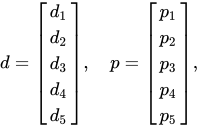
vector, is a column vector of dimension (5×1): its -th component is associated with the -th observation location. We also know that we only have five unknown masses in the subsurface (unrealistic but used to demonstrate the concept) with known location: we denote by the distance between the -th observation location and the -th mass. Thus, we can construct the linear system relating the five unknown masses to the five data points as follows:
To solve for the model parameters that fit our data, we might be able to invert the matrix to directly convert the measurements into our model parameters. For example:
A system with five equations and five unknowns is a very specific
situation: our example was designed to end up with this specificity. In
general, the numbers of data and unknowns are different so that matrix is not square.
However, even a square matrix can have no inverse: matrix can be rank deficient (i.e. has zero eigenvalues) and the solution of the system
is not unique. Then the solution of the inverse problem will be
undetermined. This is a first difficulty. Over-determined systems (more
equations than unknowns) have other issues.
Also noise may corrupt our observations making possibly outside the space of possible responses to model parameters so that solution of the system may not exist. This is another difficulty.
Tools to overcome the first difficulty
The
first difficulty reflects a crucial problem: Our observations do not
contain enough information and additional data are required. Additional
data can come from physical prior information on the parameter
values, on their spatial distribution or, more generally, on their
mutual dependence. It can also come from other experiments: For
instance, we may think of integrating data recorded by gravimeters and
seismographs for a better estimation of densities.
The integration of this additional information is basically a problem of
statistics.
This discipline is the one that can answer the question: How to mix
quantities of different nature? We will be more precise in the section
"Bayesian approach" below.
Concerning distributed parameters, prior information about their
spatial distribution often consists of information about some
derivatives of these distributed parameters. Also, it is common
practice, although somewhat artificial, to look for the "simplest" model
that reasonably matches the data. This is usually achieved by penalizing the norm of the gradient (or the total variation)
of the parameters (this approach is also referred to as the
maximization of the entropy). One can also make the model simple through
a parametrization that introduces degrees of freedom only when
necessary.
Additional information may also be integrated through inequality
constraints on the model parameters or some functions of them. Such
constraints are important to avoid unrealistic values for the parameters
(negative values for instance). In this case, the space spanned by
model parameters will no longer be a vector space but a subset of admissible models denoted by in the sequel.
Tools to overcome the second difficulty
As
mentioned above, noise may be such that our measurements are not the
image of any model, so that we cannot look for a model that produces the
data but rather look for the best (or optimal) model: that is, the one that best matches the data. This leads us to minimize an objective function, namely a functional
that quantifies how big the residuals are or how far the predicted
data are from the observed data. Of course, when we have perfect data
(i.e. no noise) then the recovered model should fit the observed data
perfectly. A standard objective function, , is of the form:
where is the Euclidean norm (it will be the norm when the measurements are functions instead of samples) of the residuals. This approach amounts to making use of ordinary least squares,
an approach widely used in statistics. However, the Euclidean norm is
known to be very sensitive to outliers: to avoid this difficulty we may
think of using other distances, for instance the norm, in replacement of the norm.
Bayesian approach
Very
similar to the least-squares approach is the probabilistic approach: If
we know the statistics of the noise that contaminates the data, we can
think of seeking the most likely model m, which is the model that
matches the maximum likelihood criterion. If the noise is Gaussian,
the maximum likelihood criterion appears as a least-squares criterion,
the Euclidean scalar product in data space being replaced by a scalar
product involving the co-variance of the noise. Also, should prior information on model parameters be available, we could think of using Bayesian inference to formulate the solution of the inverse problem. This approach is described in detail in Tarantola's book.
Numerical solution of our elementary example
Here
we make use of the Euclidean norm to quantify the data misfits. As we
deal with a linear inverse problem, the objective function is quadratic.
For its minimization, it is classical to compute its gradient using the
same rationale (as we would to minimize a function of only one
variable). At the optimal model , this gradient vanishes which can be written as:
where FT denotes the matrix transpose of F. This equation simplifies to:
This expression is known as the normal equation and gives us a possible solution to the inverse problem.
In our example matrix
turns out to be generally full rank so that the equation above makes
sense and determines uniquely the model parameters: we do not need
integrating additional information for ending up with a unique solution.
Mathematical and computational aspects
Inverse problems are typically ill-posed, as opposed to the well-posed problems usually met in mathematical modeling. Of the three conditions for a well-posed problem suggested by Jacques Hadamard
(existence, uniqueness, and stability of the solution or solutions) the
condition of stability is most often violated. In the sense of functional analysis, the inverse problem is represented by a mapping between metric spaces.
While inverse problems are often formulated in infinite dimensional
spaces, limitations to a finite number of measurements, and the
practical consideration of recovering only a finite number of unknown
parameters, may lead to the problems being recast in discrete form. In
this case the inverse problem will typically be ill-conditioned. In these cases, regularization may be used to introduce mild assumptions on the solution and prevent overfitting. Many instances of regularized inverse problems can be interpreted as special cases of Bayesian inference.
Numerical solution of the optimization problem
Some inverse problems have a very simple solution, for instance, when one has a set of unisolvent functions, meaning a set of functions such that evaluating them at distinct points yields a set of linearly independent
vectors. This means that given a linear combination of these functions,
the coefficients can be computed by arranging the vectors as the
columns of a matrix and then inverting this matrix. The simplest example
of unisolvent functions is polynomials constructed, using the unisolvence theorem, so as to be unisolvent. Concretely, this is done by inverting the Vandermonde matrix. But this a very specific situation.
In general, the solution of an inverse problem requires
sophisticated optimization algorithms. When the model is described by a
large number of parameters (the number of unknowns involved in some
diffraction tomography applications can reach one billion), solving the
linear system associated with the normal equations can be cumbersome.
The numerical method to be used for solving the optimization problem
depends in particular on the cost required for computing the solution
of the forward problem. Once chosen the appropriate algorithm for
solving the forward problem (a straightforward matrix-vector
multiplication may be not adequate when matrix
is huge), the appropriate algorithm for carrying out the minimization
can be found in textbooks dealing with numerical methods for the
solution of linear systems and for the minimization of quadratic
functions (see for instance Ciarlet or Nocedal).
Also, the user may wish to add physical constraints to the models: In this case, they have to be familiar with constrained optimization methods,
a subject in itself. In all cases, computing the gradient of the
objective function often is a key element for the solution of the
optimization problem. As mentioned above, information about the spatial
distribution of a distributed parameter can be introduced through the
parametrization. One can also think of adapting this parametrization
during the optimization.
Should the objective function be based on a norm other than the
Euclidean norm, we have to leave the area of quadratic optimization. As a
result, the optimization problem becomes more difficult. In particular,
when the
norm is used for quantifying the data misfit the objective function is
no longer differentiable: its gradient does not make sense any longer.
Dedicated methods (see for instance Lemaréchal) from non differentiable optimization come in.
Once the optimal model is computed we have to address the
question: "Can we trust this model?" The question can be formulated as
follows: How large is the set of models that match the data "nearly as
well" as this model? In the case of quadratic objective functions, this
set is contained in a hyper-ellipsoid, a subset of (
is the number of unknowns), whose size depends on what we mean with
"nearly as well", that is on the noise level. The direction of the
largest axis of this ellipsoid (eigenvector associated with the smallest eigenvalue of matrix )
is the direction of poorly determined components: if we follow this
direction, we can bring a strong perturbation to the model without
changing significantly the value of the objective function and thus end
up with a significantly different quasi-optimal model. We clearly see
that the answer to the question "can we trust this model" is governed by
the noise level and by the eigenvalues of the Hessian of the objective function or equivalently, in the case where no regularization has been integrated, by the singular values of matrix .
Of course, the use of regularization (or other kinds of prior
information) reduces the size of the set of almost optimal solutions
and, in turn, increases the confidence we can put in the computed
solution.
Stability, regularization and model discretization in infinite dimension
We
focus here on the recovery of a distributed parameter.
When looking for distributed parameters we have to discretize these
unknown functions. Doing so, we reduce the dimension of the problem to
something finite. But now, the question is: is there any link between
the solution we compute and that of the initial problem? Then another
question: what do we mean with the solution of the initial problem?
Since a finite number of data does not allow the determination of an
infinity of unknowns, the original data misfit functional has to be
regularized to ensure the uniqueness of the solution. Many times,
reducing the unknowns to a finite-dimensional space will provide an
adequate regularization: the computed solution will look like a discrete
version of the solution we were looking for. For example, a naïve
discretization will often work for solving the deconvolution
problem: it will work as long as we do not allow missing frequencies to
show up in the numerical solution. But many times, regularization has
to be integrated explicitly in the objective function.
In order to understand what may happen, we have to keep in mind
that solving such a linear inverse problem amount to solving a Fredholm
integral equation of the first kind:
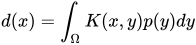
where is the kernel, and are vectors of , and is a domain in . This holds for a 2D application. For a 3D application, we consider . Note that here the model parameters consist of a function and that the response of a model also consists of a function denoted by . This equation is an extension to infinite dimension of the matrix equation given in the case of discrete problems.
For sufficiently smooth the operator defined above is compact on reasonable Banach spaces such as the . F. Riesz theory
states that the set of singular values of such an operator contains
zero (hence the existence of a null-space), is finite or at most
countable, and, in the latter case, they constitute a sequence that goes
to zero. In the case of a symmetric kernel, we have an infinity of
eigenvalues and the associated eigenvectors constitute a hilbertian
basis of .
Thus any solution of this equation is determined up to an additive
function in the null-space and, in the case of infinity of singular
values, the solution (which involves the reciprocal of arbitrary small
eigenvalues) is unstable: two ingredients that make the solution of this
integral equation a typical ill-posed problem! However, we can define a
solution through the pseudo-inverse of the forward map (again up to an arbitrary additive function). When the forward map is compact, the classical Tikhonov regularization will work if we use it for integrating prior information stating that the
norm of the solution should be as small as possible: this will make the
inverse problem well-posed. Yet, as in the finite dimension case, we
have to question the confidence we can put in the computed solution.
Again, basically, the information lies in the eigenvalues of the Hessian
operator. Should subspaces containing eigenvectors associated with
small eigenvalues be explored for computing the solution, then the
solution can hardly be trusted: some of its components will be poorly
determined. The smallest eigenvalue is equal to the weight introduced in
Tikhonov regularization.
Irregular kernels may yield a forward map which is not compact and even unbounded if we naively equip the space of models with the
norm. In such cases, the Hessian is not a bounded operator and the
notion of eigenvalue does not make sense any longer. A mathematical
analysis is required to make it a bounded operator and design a well-posed problem: an illustration can be found in. Again, we have to question the confidence we can put in the computed
solution and we have to generalize the notion of eigenvalue to get the
answer.
Analysis of the spectrum of the Hessian operator is thus a key
element to determine how reliable the computed solution is. However,
such an analysis is usually a very heavy task. This has led several
authors to investigate alternative approaches in the case where we are
not interested in all the components of the unknown function but only in
sub-unknowns that are the images of the unknown function by a linear
operator. These approaches are referred to as the " Backus and Gilbert
method", Lions's sentinels approach, and the SOLA method: these approaches turned out to be strongly related with one another as explained in Chavent Finally, the concept of limited resolution,
often invoked by physicists, is nothing but a specific view of the fact
that some poorly determined components may corrupt the solution. But,
generally speaking, these poorly determined components of the model are
not necessarily associated with high frequencies.
Some classical linear inverse problems for the recovery of distributed parameters
The
problems mentioned below correspond to different versions of the
Fredholm integral: each of these is associated with a specific kernel .
Deconvolution
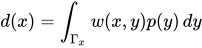
The goal of deconvolution is to reconstruct the original image or signal which appears as noisy and blurred on the data . From a mathematical point of view, the kernel here only depends on the difference between and .
Tomographic methods
In
these methods we attempt at recovering a distributed parameter, the
observation consisting in the measurement of the integrals of this
parameter carried out along a family of lines. We denote by the line in this family associated with measurement point . The observation at can thus be written as:
where is the arc-length along and a known weighting function. Comparing this equation with the Fredholm integral above, we notice that the kernel is kind of a delta function that peaks on line . With such a kernel, the forward map is not compact.
Computed tomography
In X-ray computed tomography the lines on which the parameter is integrated are straight lines: the tomographic reconstruction of the parameter distribution is based on the inversion of the Radon transform.
Although from a theoretical point of view many linear inverse problems
are well understood, problems involving the Radon transform and its
generalisations still present many practical challenges, such as with of
sufficiency of data. Such problems include incomplete data for the
x-ray transform in three dimensions and problems involving the
generalisation of the x-ray transform to tensor fields. Solutions
explored include Algebraic Reconstruction Technique, filtered backprojection, and as computing power has increased, iterative reconstruction methods such as iterative Sparse Asymptotic Minimum Variance.
Diffraction tomography
Diffraction
tomography is a classical linear inverse problem in exploration
seismology: the amplitude recorded at one time for a given
source-receiver pair is the sum of contributions arising from points
such that the sum of the distances, measured in traveltimes, from the
source and the receiver, respectively, is equal to the corresponding
recording time. In 3D the parameter is not integrated along lines but
over surfaces. Should the propagation velocity be constant, such points
are distributed on an ellipsoid. The inverse problems consists in
retrieving the distribution of diffracting points from the seismograms
recorded along the survey, the velocity distribution being known. A
direct solution has been originally proposed by Beylkin and Lambaré et al.: these works were the starting points of approaches known as amplitude preserved migration (see Beylkinand Bleistein). Should geometrical optics techniques (i.e. rays)
be used for the solving the wave equation, these methods turn out to
be closely related to the so-called least-squares migration methods derived from the least-squares approach (see Lailly, Tarantola).
Doppler tomography (astrophysics)
If
we consider a rotating stellar object, the spectral lines we can
observe on a spectral profile will be shifted due to Doppler effect.
Doppler tomography aims at converting the information contained in
spectral monitoring of the object into a 2D image of the emission (as a
function of the radial velocity and of the phase in the periodic
rotation movement) of the stellar atmosphere. As explained by Tom Marsh this linear inverse problem is tomography like: we have to recover a
distributed parameter which has been integrated along lines to produce
its effects in the recordings.
Inverse heat conduction
Early
publications on inverse heat conduction arose from determining surface
heat flux during atmospheric re-entry from buried temperature sensors. Other applications where surface heat flux is needed but surface sensors
are not practical include: inside reciprocating engines, inside rocket
engines; and, testing of nuclear reactor components. A variety of numerical techniques have been developed to address the
ill-posedness and sensitivity to measurement error caused by damping and
lagging in the temperature signal.
Non-linear inverse problems
Non-linear inverse problems constitute an inherently more difficult family of inverse problems. Here the forward map
is a non-linear operator. Modeling of physical phenomena often relies
on the solution of a partial differential equation (see table above
except for gravity law): although these partial differential equations
are often linear, the physical parameters that appear in these equations
depend in a non-linear way of the state of the system and therefore on
the observations we make on it.
Some classical non-linear inverse problems
Inverse scattering problems
Whereas linear inverse problems were completely solved from the theoretical point of view at the end of the nineteenth century , only one class of nonlinear inverse problems was so before 1970, that of inverse spectral and (one space dimension) inverse scattering problems, after the seminal work of the Russian mathematical school (Krein, Gelfand, Levitan, Marchenko).
A large review of the results has been given by Chadan and Sabatier in
their book "Inverse Problems of Quantum Scattering Theory" (two editions
in English, one in Russian).
In this kind of problem, data are properties of the spectrum of a
linear operator which describe the scattering. The spectrum is made of eigenvalues and eigenfunctions,
forming together the "discrete spectrum", and generalizations, called
the continuous spectrum. The very remarkable physical point is that
scattering experiments give information only on the continuous spectrum,
and that knowing its full spectrum is both necessary and sufficient in
recovering the scattering operator. Hence we have invisible parameters,
much more interesting than the null space which has a similar property
in linear inverse problems. In addition, there are physical motions in
which the spectrum of such an operator is conserved as a consequence of
such motion. This phenomenon is governed by special nonlinear partial
differential evolution equations, for example the Korteweg–de Vries equation.
If the spectrum of the operator is reduced to one single eigenvalue,
its corresponding motion is that of a single bump that propagates at
constant velocity and without deformation, a solitary wave called a "soliton".
A perfect signal and its generalizations for the Korteweg–de
Vries equation or other integrable nonlinear partial differential
equations are of great interest, with many possible applications. This
area has been studied as a branch of mathematical physics since the
1970s. Nonlinear inverse problems are also currently studied in many
fields of applied science (acoustics, mechanics, quantum mechanics,
electromagnetic scattering - in particular radar soundings, seismic
soundings, and nearly all imaging modalities).
A final example related to the Riemann hypothesis was given by Wu and Sprung, the idea is that in the semiclassicalold quantum theory the inverse of the potential inside the Hamiltonian is proportional to the half-derivative of the eigenvalues (energies) counting function n(x).
Permeability matching in oil and gas reservoirs
The goal is to recover the diffusion coefficient in the parabolic partial differential equation
that models single phase fluid flows in porous media. This problem has
been the object of many studies since a pioneering work carried out in
the early seventies. Concerning two-phase flows an important problem is to estimate the relative permeabilities and the capillary pressures.
Inverse problems in the wave equations
The goal is to recover the wave-speeds (P and S waves) and the density distributions from seismograms. Such inverse problems are of prime interest in seismology and exploration geophysics.
We can basically consider two mathematical models:
The acoustic wave equation (in which S waves are ignored when the space dimensions are 2 or 3)
The solution of the inverse problem in the 1D wave equation has
been the object of many studies. It is one of the very few non-linear
inverse problems for which we can prove the uniqueness of the solution. The analysis of the stability of the solution was another challenge. Practical applications, using the least-squares approach, were developed. Extension to 2D or 3D problems and to the elastodynamics equations was
attempted since the 80's but turned out to be very difficult ! This
problem often referred to as Full Waveform Inversion (FWI), is not yet
completely solved: among the main difficulties are the existence of
non-Gaussian noise into the seismograms, cycle-skipping issues (also
known as phase ambiguity), and the chaotic behavior of the data misfit
function. Some authors have investigated the possibility of reformulating the
inverse problem so as to make the objective function less chaotic than
the data misfit function.
Travel-time tomography
Realizing
how difficult is the inverse problem in the wave equation,
seismologists investigated a simplified approach making use of
geometrical optics. In particular they aimed at inverting for the
propagation velocity distribution, knowing the arrival times of
wave-fronts observed on seismograms. These wave-fronts can be associated
with direct arrivals or with reflections associated with reflectors
whose geometry is to be determined, jointly with the velocity
distribution.
The arrival time distribution ( is a point in physical space) of a wave-front issued from a point source, satisfies the Eikonal equation:
where denotes the slowness (reciprocal of the velocity) distribution. The presence of makes this equation nonlinear. It is classically solved by shooting rays (trajectories about which the arrival time is stationary) from the point source.
This problem is tomography like: the measured arrival times are
the integral along the ray-path of the slowness. But this tomography
like problem is nonlinear, mainly because the unknown ray-path geometry
depends upon the velocity (or slowness) distribution. In spite of its
nonlinear character, travel-time tomography turned out to be very
effective for determining the propagation velocity in the Earth or in
the subsurface, the latter aspect being a key element for seismic
imaging, in particular using methods mentioned in Section "Diffraction
tomography".
Mathematical aspects: Hadamard's questions
The
questions concern well-posedness: Does the least-squares problem have a
unique solution which depends continuously on the data (stability
problem)? It is the first question, but it is also a difficult one
because of the non-linearity of .
In order to see where the difficulties arise from, Chavent proposed to conceptually split the minimization of the data misfit function into two consecutive steps ( is the subset of admissible models):
projection step: given find a projection on (nearest point on according to the distance involved in the definition of the objective function)
given this projection find one pre-image that is a model whose image by operator is this projection.
Difficulties can - and usually will - arise in both steps:
operator is not likely to be one-to-one, therefore there can be more than one pre-image,
even when is one-to-one, its inverse may not be continuous over ,
the projection on may not exist, should this set be not closed,
the projection on can be non-unique and not continuous as this can be non-convex due to the non-linearity of .
We refer to Chavent for a mathematical analysis of these points.
Computational aspects
A non-convex data misfit function
The
forward map being nonlinear, the data misfit function is likely to be
non-convex, making local minimization techniques inefficient. Several
approaches have been investigated to overcome this difficulty:
use of global optimization techniques such as sampling of the posterior density function and Metropolis algorithm in the inverse problem probabilistic framework, genetic algorithms (alone or in combination with Metropolis algorithm: see for an application to the determination of permeabilities that match
the existing permeability data), neural networks, regularization
techniques including multi scale analysis;
reformulation of the least-squares objective function so as to make it smoother (see for the inverse problem in the wave equations.)
Computation of the gradient of the objective function
Inverse
problems, especially in infinite dimension, may be large size, thus
requiring important computing time. When the forward map is nonlinear,
the computational difficulties increase and minimizing the objective
function can be difficult. Contrary to the linear situation, an explicit
use of the Hessian matrix for solving the normal equations does not
make sense here: the Hessian matrix varies with models. Much more
effective is the evaluation of the gradient of the objective function
for some models. Important computational effort can be saved when we can
avoid the very heavy computation of the Jacobian (often called "Fréchet derivatives"): the adjoint state method, proposed by Chavent and Lions, is aimed to avoid this very heavy computation. It is now very widely used.
An inversion algorithm (published Under a Creative Commons license, CC BY-NC-ND by Elsevier)
Applications
Inverse problem theory is used extensively in weather predictions, oceanography, hydrology, neuroscience, and petroleum engineering. Another application is inversion of elastic waves for non-destructive characterization of engineering structures.
Inverse problems are also found in the field of heat transfer, where a surface heat flux is estimated outgoing from temperature data measured inside a rigid
body; and, in understanding the controls on plant-matter decay. The linear inverse problem is also the fundamental of spectral estimation and direction-of-arrival (DOA) estimation in signal processing.