Search This Blog

Monday, December 22, 2025

Vibronic spectroscopy

From Wikipedia, the free encyclopedia
https://en.wikipedia.org/wiki/Vibronic_spectroscopy

Vibronic spectroscopy is a branch of molecular spectroscopy concerned with vibronic transitions: the simultaneous changes in electronic and vibrational energy levels of a molecule due to the absorption or emission of a photon of the appropriate energy. In the gas phase, vibronic transitions are also accompanied by changes in rotational energy.

Vibronic spectra of diatomic molecules have been analysed in detail; emission spectra are more complicated than absorption spectra. The intensity of allowed vibronic transitions is governed by the Franck–Condon principle. Vibronic spectroscopy may provide information, such as bond length, on electronic excited states of stable molecules. It has also been applied to the study of unstable molecules such as dicarbon (C2) in discharges, flames and astronomical objects.

Principles

Electronic transitions are typically observed in the visible and ultraviolet regions, in the wavelength range approximately 200–700 nm (50,000–14,000 cm−1), whereas fundamental vibrations are observed below about 4000 cm−1. When the electronic and vibrational energy changes are so different, vibronic coupling (mixing of electronic and vibrational wave functions) can be neglected and the energy of a vibronic level can be taken as the sum of the electronic and vibrational (and rotational) energies; that is, the Born–Oppenheimer approximation applies. The overall molecular energy depends not only on the electronic state but also on vibrational and rotational quantum numbers, denoted v and J respectively for diatomic molecules. It is conventional to add a double prime (v″, J″) for levels of the electronic ground state and a single prime (v′, J′) for electronically excited states.

Each electronic transition may show vibrational coarse structure, and for molecules in the gas phase, rotational fine structure. This is true even when the molecule has a zero dipole moment and therefore has no vibration-rotation infrared spectrum or pure rotational microwave spectrum.

It is necessary to distinguish between absorption and emission spectra. With absorption the molecule starts in the ground electronic state, and usually also in the vibrational ground state v″ = 0 because at ordinary temperatures the energy necessary for vibrational excitation is large compared to the average thermal energy. The molecule is excited to another electronic state and to many possible vibrational states v' = 0, 1, 2, 3, .... With emission, the molecule can start in various populated vibrational states, and finishes in the electronic ground state in one of many populated vibrational levels. The emission spectrum is more complicated than the absorption spectrum of the same molecule because there are more changes in vibrational energy level.

The Morse potential (blue) and harmonic oscillator potential (green). The potential at infinite internuclear distance is the dissociation energy for pure vibrational spectra. For vibronic spectra there are two potential curves (see Figure at right), and the dissociation limit is the upper state energy at infinite distance.
Energy level diagram illustrating the Franck–Condon principle. Transitions between v″ = 0 and v′ = 2 are favored.

For absorption spectra, the vibrational coarse structure for a given electronic transition forms a single progression, or series of transitions with a common level, here the lower level v″ = 0. There are no selection rules for vibrational quantum numbers, which are zero in the ground vibrational level of the initial electronic ground state, but can take any integer values in the final electronic excited state. The term values G(v) for a harmonic oscillator are given by where v is a vibrational quantum number, and ωe is the harmonic wavenumber. In the next approximation the term values are given by where χe is an anharmonicity constant. This is, in effect, a better approximation to the Morse potential near the potential minimum. The spacing between adjacent vibrational lines decreases with increasing quantum number because of anharmonicity in the vibration. Eventually the separation decreases to zero when the molecule photo-dissociates into a continuum of states. The second formula is adequate for small values of the vibrational quantum number. For higher values further anharmonicity terms are needed as the molecule approaches the dissociation limit, at the energy corresponding to the upper (final state) potential curve at infinite internuclear distance.

The intensity of allowed vibronic transitions is governed by the Franck–Condon principle. The intensity distribution within a progression is governed by the difference in the equilibrium bond lengths of the initial electronic ground state and the final electronic excited state of the molecule. In accordance with the Born-Oppenheimer approximation, where electronic motion is near instantaneous compared to nuclear motion, transitions between vibrational levels happen with essentially no change in nuclear coordinates between the ground and excited electronic states. These nuclear coordinates are referred to as classical "turning points", where the equilibrium bond lengths of the initial and final electronic states are equal. These transitions can be represented as vertical lines between the various vibrational levels within electronic states on an energy level diagram.

It is generally true that the greater the changes to the bond length of a molecule upon excitation, the greater the contribution of vibrational states to a progression. The width of this progression itself is dependent on the range of transition energies available for internuclear distances close to the turning points of the initial vibration state. As the "well" of the potential energy curve of the final electronic state grows steeper, there are more final vibrational states available for transitions, and thus more energy levels to yield a wider spectrum.

Emission spectra are complicated due to the variety of processes through which electronically excited molecules can spontaneously return to lower energy states. There is a tendency for molecules to undergo vibrational energy relaxation, where energy is lost non-radiatively from the Franck–Condon state (the vibrational state achieved after a vertical transition) to surroundings or to internal processes. The molecules can settle in the ground vibrational level of the excited electronic state, where they can continue to decay to various vibrational levels in the ground electronic state, before ultimately returning to the lowest vibrational level of the ground state.

Image of fluorimeter used to obtain emission spectra, courtesy of NYU.

If emission occurs before vibrational relaxation can occur, then the resulting fluorescence is referred to as resonance fluorescence. In this case, the emission spectrum is identical to the absorbance spectrum. Resonance fluorescence, however, is not very common and is mainly observed in small molecules (such as diatomics) in the gas phase. This lack of prevalence is due to short radiative lifetimes of the excited state, during which energy can be lost. Emission from the ground vibrational level of the excited state after vibrational relaxation is much more prevalent, referred to as relaxed fluorescence. Emission peaks for a molecule exhibiting relaxed fluorescence are found at longer wavelengths than the corresponding absorption spectra, with the difference being the Stokes shift of the molecule.

Vibronic spectra of diatomic molecules in the gas phase have been analyzed in detail. Vibrational coarse structure can sometimes be observed in the spectra of molecules in liquid or solid phases and of molecules in solution. Related phenomena including photoelectron spectroscopy, resonance Raman spectroscopy, luminescence, and fluorescence are not discussed in this article, though they also involve vibronic transitions.

Diatomic molecules

The vibronic spectra of diatomic molecules in the gas phase also show rotational fine structure. Each line in a vibrational progression will show P- and R-branches. For some electronic transitions there will also be a Q-branch. The transition energies, expressed in wavenumbers, of the lines for a particular vibronic transition are given, in the rigid rotor approximation, that is, ignoring centrifugal distortion, by  Here B are rotational constants and J are rotational quantum numbers. (For B also, a double prime indicates the ground state and a single prime an electronically excited state.) The values of the rotational constants may differ appreciably because the bond length in the electronic excited state may be quite different from the bond length in the ground state, because of the operation of the Franck-Condon principle. The rotational constant is inversely proportional to the square of the bond length. Usually B′ < B as is true when an electron is promoted from a bonding orbital to an antibonding orbital, causing bond lengthening. But this is not always the case; if an electron is promoted from a non-bonding or antibonding orbital to a bonding orbital, there will be bond-shortening and B′ > B.

Fortrat diagram created with B′ = 0.8, B″ = 1, showing displacement of rotational lines from the vibrational line position (at 0 cm−1). Centrifugal distortion is ignored in this diagram.

The treatment of rotational fine structure of vibronic transitions is similar to the treatment of rotation-vibration transitions and differs principally in the fact that the ground and excited states correspond to two different electronic states as well as to two different vibrational levels. For the P-branch J′ = J″ – 1, so that

Similarly for the R-branch J″ = J′ – 1, and

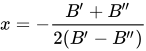
Thus, the wavenumbers of transitions in both P- and R-branches are given, to a first approximation, by the single formula  Here positive m values refer to the R-branch (with m = +J′ = J″ + 1) and negative values refer to the P-branch (with m = –J). The wavenumbers of the lines in the P-branch, on the low wavenumber side of the band origin at increase with m. In the R-branch, for the usual case that B′ < B, as J increases the wavenumbers at first lie increasingly on the high wavenumber side of the band origin but then start to decrease, eventually lying on the low wavenumber side. The Fortrat diagram illustrates this effect. In the rigid rotor approximation the line wavenumbers lie on a parabola which has a maximum at

The line of highest wavenumber in the R-branch is known as the band head. It occurs at the value of m which is equal to the integer part of x, or of (x + 1).

When a Q-branch is allowed for a particular electronic transition, the lines of the Q-branch correspond to the case J = 0, J′ = J and wavenumbers are given by  The Q-branch then consists of a series of lines with increasing separation between adjacent lines as J increases. When B′ < B the Q-branch lies to lower wavenumbers relative to the vibrational line.

Predissociation

The phenomenon of predissociation occurs when an electronic transition results in dissociation of the molecule at an excitation energy less than the normal dissociation limit of the upper state. This can occur when the potential energy curve of the upper state crosses the curve for a repulsive state, so that the two states have equal energy at some internuclear distance. This allows the possibility of a radiationless transition to the repulsive state whose energy levels form a continuum, so that there is blurring of the particular vibrational band in the vibrational progression.

Applications

Spectrum of the blue flame from a butane torch showing excited molecular radical band emission and Swan bands due to C2.

The analysis of vibronic spectra of diatomic molecules provides information concerning both the ground electronic state and the excited electronic state. Data for the ground state can also be obtained by vibrational or pure rotational spectroscopy, but data for the excited state can only be obtained from the analysis of vibronic spectra. For example, the bond length in the excited state may be derived from the value of the rotational constant B′. In addition to stable diatomic molecules, vibronic spectroscopy has been used to study unstable species, including CH, NH, hydroxyl radical, OH, and cyano radical, CN. The Swan bands in hydrocarbon flame spectra are a progression in the C–C stretching vibration of the dicarbon radical, C2 for the electronic transition. Vibronic bands for 9 other electronic transitions of C2 have been observed in the infrared and ultraviolet regions.
Polyatomic molecules and ions

Formaldehyde

For polyatomic molecules, progressions are most often observed when the change in bond lengths upon electronic excitation coincides with the change due to a ″totally symmetric″ vibration. This is the same process that occurs in resonance Raman spectroscopy. For example, in formaldehyde (methanal), H2CO, the n → π* transition involves excitation of an electron from a non-bonding orbital to an antibonding pi orbital which weakens and lengthens the C–O bond. This produces a long progression in the C–O stretching vibration. Another example is furnished by benzene, C6H6. In both gas and liquid phase the band around 250 nm shows a progression in the symmetric ring-breathing vibration.

Absorption spectrum of an aqueous solution of potassium permanganate

As an example from inorganic chemistry the permanganate ion, MnO
4
, in aqueous solution has an intense purple colour due to an O → Mn ligand-to-metal charge transfer band (LMCT) in much of the visible region. This band shows a progression in the symmetric Mn–O stretching vibration. The individual lines overlap each other extensively, giving rise to a broad overall profile with some coarse structure.

Progressions in vibrations which are not totally symmetric may also be observed.

dd electronic transitions in atoms in a centrosymmetric environment are electric-dipole forbidden by the Laporte rule. This will apply to octahedral coordination compounds of the transition metals. The spectra of many of these complexes have some vibronic character. The same rule also applies to ff transitions in centrosymmetric complexes of lanthanides and actinides. In the case of the octahedral actinide chloro-complex of uranium(IV), UCl62− the observed electronic spectrum is entirely vibronic. At the temperature of liquid helium, 4 K, the vibronic structure was completely resolved, with zero intensity for the purely electronic transition, and three side-lines corresponding to the asymmetric U–Cl stretching vibration and two asymmetric Cl–U–Cl bending modes. Later studies on the same anion were also able to account for vibronic transitions involving low-frequency lattice vibrations.

Anthropocentrism

From Wikipedia, the free encyclopedia

Anthropocentrism (//  from Ancient Greek ἄνθρωπος (ánthrōpos) 'human' and κέντρον (kéntron) 'center') is the belief that human beings are the central or most important entity on the planet. The term can be used interchangeably with humanocentrism, and some refer to the concept as human supremacy or human exceptionalism. From an anthropocentric perspective, humankind is seen as separate from nature and superior to it, and other entities (animals, plants, minerals, etc.) are viewed as resources for humans to use.

It is possible to distinguish between at least three types of anthropocentrism: perceptual anthropocentrism (which "characterizes paradigms informed by sense-data from human sensory organs"); descriptive anthropocentrism (which "characterizes paradigms that begin from, center upon, or are ordered around Homo sapiens / 'the human'"); and normative anthropocentrism (which "characterizes paradigms that make assumptions or assertions about the superiority of Homo sapiens, its capacities, the primacy of its values, [or] its position in the universe").

Anthropocentrism tends to interpret the world in terms of human values and experiences. It is considered to be profoundly embedded in many modern human cultures and conscious acts. It is a major concept in the field of environmental ethics and environmental philosophy, where it is often considered to be the root cause of problems created by human action within the ecosphere. However, many proponents of anthropocentrism state that this is not necessarily the case: they argue that a sound long-term view acknowledges that the global environment must be made continually suitable for humans and that the real issue is shallow anthropocentrism.

Environmental philosophy

Some environmental philosophers have argued that anthropocentrism is a core part of a perceived human drive to dominate or "master" the Earth. Anthropocentrism is believed by some to be the central problematic concept in environmental philosophy, where it is used to draw attention to claims of a systematic bias in traditional Western attitudes to the non-human world that shapes humans' sense of self and identities. Val Plumwood argued that anthropocentrism plays an analogous role in green theory to androcentrism in feminist theory and ethnocentrism in anti-racist theory. Plumwood called human-centredness "anthrocentrism" to emphasise this parallel.

One of the first extended philosophical essays addressing environmental ethics, John Passmore's Man's Responsibility for Nature, has been criticised by defenders of deep ecology because of its anthropocentrism, often claimed to be constitutive of traditional Western moral thought. Indeed, defenders of anthropocentrism concerned with the ecological crisis contend that the maintenance of a healthy, sustainable environment is necessary for human well-being as opposed to for its own sake. According to William Grey, the problem with a "shallow" viewpoint is not that it is human-centred: "What's wrong with shallow views is not their concern about the well-being of humans, but that they do not really consider enough in what that well-being consists. According to this view, we need to develop an enriched, fortified anthropocentric notion of human interest to replace the dominant short-term, sectional and self-regarding conception." In turn, Plumwood in Environmental Culture: The Ecological Crisis of Reason argued that Grey's anthropocentrism is inadequate.

Many devoted environmentalists encompass a somewhat anthropocentric-based philosophical view supporting the fact that they will argue in favor of saving the environment for the sake of human populations. Grey writes: "We should be concerned to promote a rich, diverse, and vibrant biosphere. Human flourishing may certainly be included as a legitimate part of such a flourishing." Such a concern for human flourishing amidst the flourishing of life as a whole, however, is said to be indistinguishable from that of deep ecology and biocentrism, which has been proposed as both an antithesis of anthropocentrism and as a generalised form of anthropocentrism.

Cognitive psychology

In cognitive psychology, the term anthropocentric thinking has been defined as "the tendency to reason about unfamiliar biological species or processes by analogy to humans." Reasoning by analogy is an attractive thinking strategy, and it can be tempting to apply one's own experience of being human to other biological systems. For example, because death is commonly felt to be undesirable, it may be tempting to form the misconception that death at a cellular level or elsewhere in nature is similarly undesirable (whereas in reality programmed cell death is an essential physiological phenomenon, and ecosystems also rely on death). Conversely, anthropocentric thinking can also lead people to underattribute human characteristics to other organisms. For instance, it may be tempting to wrongly assume that an animal that is very different from humans, such as an insect, will not share particular biological characteristics, such as reproduction or blood circulation.

Anthropocentric thinking has predominantly been studied in young children (mostly up to the age of 10) by developmental psychologists interested in its relevance to biology education. Children as young as 6 have been found to attribute human characteristics to species unfamiliar to them (in Japan), such as rabbits, grasshoppers or tulips. Although relatively little is known about its persistence at a later age, evidence exists that this pattern of human exceptionalist thinking can continue through young adulthood at least, even among students who have been increasingly educated in biology.

The notion that anthropocentric thinking is an innate human characteristic has been challenged by study of American children raised in urban environments, among whom it appears to emerge between the ages of 3 and 5 years as an acquired perspective. Children's recourse to anthropocentric thinking seems to vary with their experience of nature, and cultural assumptions about the place of humans in the natural world. For example, whereas young children who kept goldfish were found to think of frogs as being more goldfish-like, other children tended to think of frogs in terms of humans. More generally, children raised in rural environments appear to use anthropocentric thinking less than their urban counterparts because of their greater familiarity with different species of animals and plants. Studies involving children from some of the indigenous peoples of the Americas have found little use of anthropocentric thinking. Study of children among the Wichí people in South America showed a tendency to think of living organisms in terms of their perceived taxonomic similarities, ecological considerations, and animistic traditions, resulting in a much less anthropocentric view of the natural world than is experienced by many children in Western societies.

Abrahamic traditions

In the 1985 CBC series "A Planet For the Taking", David Suzuki explored the Old Testament roots of anthropocentrism and how it shaped human views of non-human animals. Some Christian proponents of anthropocentrism base their belief on the Bible, such as the verse 1:26 in the Book of Genesis:

And God said, Let us make man in our image, after our likeness: and let them have dominion over the fish of the sea, and over the fowl of the air, and over the cattle, and over all the earth, and over every creeping thing that creepeth upon the earth.

The use of the word "dominion" in the Genesis has been used to justify an anthropocentric worldview, but recently some have found it controversial, viewing it as possibly a mistranslation from the Hebrew. However an argument can be made that the Bible actually places all the importance on God as creator, and humans as merely another part of creation.

Jewish opposition to anthropocentrism

Moses Maimonides, a Torah scholar who lived in the twelfth century AD, was renowned for his staunch opposition to anthropocentrism. He referred to humans as "just a drop in the bucket" and asserted that "humans are not the axis of the world". He also claimed that anthropocentric thinking is what leads humans to believe in the existence of evil things in nature. According to Rabbi Norman Lamm, Moses Maimonides "refuted the exaggerated ideas about the importance of man and urged us to abandon these fantasies.

Catholicism

Catholic social teaching sees the pre-eminence of human beings over the rest of creation in terms of service rather than domination. Pope Francis, in his 2015 encyclical letter Laudato si', notes that "an obsession with denying any pre-eminence to the human person" endangers the concern which should be shown to protecting and upholding the welfare of all people, which he argues should rank alongside the "care for our common home" which is the subject of his letter. In the same text he acknowledges that "a mistaken understanding" of Christian belief "has at times led us to justify mistreating nature, to exercise tyranny over creation": in such actions, Christian believers have "not [been] faithful to the treasures of wisdom which we have been called to protect and preserve. In his follow-up exhortation, Laudate Deum (2023) he refers to a preferable understanding of "the unique and central value of the human being amid the marvellous concert of all God's creatures" as a "situated anthropocentrism".

Human rights

Anthropocentrism is the grounding for some naturalistic concepts of specifically human rights as opposed to animal rights extended to include the human species. Apologists of anthropocentrism argue that it is the necessary fundamental premise to defend universal human rights, since what matters morally is simply being human. For example, noted philosopher Mortimer J. Adler wrote, "Those who oppose injurious discrimination on the moral ground that all human beings, being equal in their humanity, should be treated equally in all those respects that concern their common humanity, would have no solid basis in fact to support their normative principle." Adler is stating here that denying what is now called human exceptionalism could lead to tyranny, writing that if humans ever came to believe that they do not possess a unique moral status, the intellectual foundation of their liberties collapses: "Why, then, should not groups of superior men be able to justify their enslavement, exploitation, or even genocide of inferior human groups on factual and moral grounds akin to those we now rely on to justify our treatment of the animals we harness as beasts of burden, that we butcher for food and clothing, or that we destroy as disease-bearing pests or as dangerous predators?"

Author and anthropocentrism apologist Wesley J. Smith from the Discovery Institute has written that human exceptionalism is what gives rise to human duties to each other, the natural world, and to treat animals humanely. Writing in A Rat is a Pig is a Dog is a Boy, a critique of animal rights ideology, "Because we are unquestionably a unique species—the only species capable of even contemplating ethical issues and assuming responsibilities—we uniquely are capable of apprehending the difference between right and wrong, good and evil, proper and improper conduct toward animals. Or to put it more succinctly, if being human isn't what requires us to treat animals humanely, what in the world does?"

Moral status of animals

Anthropocentrism is closely related to the notion of speciesism, defined by Richard D. Ryder as a "a prejudice or attitude of bias in favour of the interests of members of one's own species and against those of members of other species".

Early critiques

One of the earliest critics of anthropocentrism was Edward Payson Evans in his book Evolutional Ethics and Animal Psychology (1897), where he challenges the idea that humans are fundamentally distinct from other sentient beings. He argues that anthropocentric psychology and ethics persist, treating humans as superior and denying mental or moral connections to other species. Evans suggests these beliefs stem from human self-importance, which overlooks the shared qualities of sentience across species and questions the ethical implications of such a view.

Later, J. Howard Moore, in The Universal Kinship (1906), expanded on this critique, asserting that Charles Darwin's On the Origin of Species (1859) "sealed the doom" of anthropocentrism. Moore argued that the doctrine of organic evolution, which established the common genesis of all animals, fundamentally altered humanity's view of its place in the natural world. Before the publication of The Origin of Species, humans may have been seen as distinct from other creatures, but with the advent of evolutionary theory, all species were recognized as sharing a common ancestry. Moore considered this shift one of the most significant intellectual developments, comparable to the groundbreaking insights of Galileo and Copernicus.

Challenging human exceptionalism

While humans cognition is relatively advanced, many traits traditionally used to justify humanity exceptionalism (such as rationality, emotional complexity and social bonds) are not unique to humans. Research in ethology has shown that non-human animals, such as primates, elephants, and cetaceans, also demonstrate complex social structures, emotional depth, and problem-solving abilities. This challenges the claim that humans possess qualities absent in other animals, and which would justify denying moral status to them.

Animal welfare perspectives

Animal welfare proponents attribute moral consideration to all sentient animals, proportional to their ability to have positive or negative mental experiences. It is notably associated with the ethical theory of utilitarianism, which aims to maximize well-being. It is notably defended by Peter Singer. According to David Pearce, "other things being equal, equally strong interests should count equally." Jeremy Bentham is also known for raising early the issue of animal welfare, arguing that "the question is not, Can they reason? nor, Can they talk? but, Can they suffer?". Animal welfare proponents can in theory accept animal exploitation if the benefits outweigh the harms. But in practice, they generally consider that intensive animal farming causes a massive amount of suffering that outweighs the relatively minor benefit that humans get from consuming animals.

Animal rights perspectives

Animal rights proponents argue that all animals have inherent rights, similar to human rights, and should not be used as means to human ends. Unlike animal welfare advocates, who focus on minimizing suffering, animal rights supporters often call for the total abolition of practices that exploit animals, such as intensive animal farming, animal testing, and hunting. Prominent figures like Tom Regan argue that animals are "subjects of a life" with inherent value, deserving moral consideration regardless of the potential benefits humans may derive from using them.

In fiction from all eras and societies, there is fiction depicting the actions of humans to ride, eat, milk, and otherwise treat (non-human) animals as inferior. There are occasional fictional exceptions, such as talking animals as aberrations to the rule distinguishing people from animals.

In science fiction, humanocentrism is the idea that humans, as both beings and as a species, are the superior sentients. Essentially the equivalent of racial supremacy on a galactic scale, it entails intolerant discrimination against sentient non-humans, much like race supremacists discriminate against those not of their race. A prime example of this concept is utilized as a story element for the Mass Effect series. After humanity's first contact results in a brief war, many humans in the series develop suspicious or even hostile attitudes towards the game's various alien races. By the time of the first game, which takes place several decades after the war, many humans still retain such sentiments in addition to forming 'pro-human' organizations.

This idea is countered by anti-humanism. At times, this ideal also includes fear of and superiority over strong AIs and cyborgs, downplaying the ideas of integration, cybernetic revolts, machine rule and Tilden's Laws of Robotics.

Mark Twain mocked the belief in human supremacy in Letters from the Earth (written c. 1909, published 1962).

The Planet of the Apes franchise focuses on the analogy of apes becoming the dominant species in society and the fall of humans (see also human extinction). In the 1968 film, Taylor, a human states "take your stinking paws off me, you damn dirty ape!". In the 2001 film, this is contrasted with Attar (a gorilla)'s quote "take your stinking hands off me, you damn dirty human!". This links in with allusions that in becoming the dominant species apes are becoming more like humans (anthropomorphism). In the film Battle for the Planet of the Apes, Virgil, an orangutan states "ape has never killed ape, let alone an ape child. Aldo has killed an ape child. The branch did not break. It was cut with a sword." in reference to planned murder; a stereotypical human concept. Additionally, in Dawn of the Planet of the Apes, Caesar states "I always think...ape better than human. I see now...how much like them we are."

In George Orwell's novel Animal Farm, this theme of anthropocentrism is also present. Whereas originally the animals planned for liberation from humans and animal equality, as evident from the "seven commandments" such as "whatever goes upon two legs is an enemy", "Whatever goes upon four legs, or has wings, is a friend", "All animals are equal"; the pigs would later amend the commandments with statements such as "All animals are equal, but some animals are more equal than others", and "Four legs good, two legs better."

The 2012 documentary The Superior Human? systematically analyzes anthropocentrism and concludes that value is fundamentally an opinion, and since life forms naturally value their own traits, most humans are misled to believe that they are actually more valuable than other species. This natural bias, according to the film, combined with a received sense of comfort and an excuse for exploitation of non-humans cause anthropocentrism to remain in society.

In his 2009 book Eating Animals, Jonathan Foer describes anthropocentrism as "The conviction that humans are the pinnacle of evolution, the appropriate yardstick by which to measure the lives of other animals, and the rightful owners of everything that lives."

Adaptive unconscious

From Wikipedia, the free encyclopedia

The adaptive unconscious, first coined by social psychologist Daniel Wegner in 2002, is described as a set of mental processes that is able to affect judgement and decision-making, but is out of reach of the conscious mind. It is thought to be adaptive as it helps to keep the organism alive. Architecturally, the adaptive unconscious is said to be unreachable because it is buried in an unknown part of the brain. This type of thinking evolved earlier than the conscious mind, enabling the mind to transform information and think in ways that enhance an organism's survival. It can be described as a quick sizing up of the world which interprets information and decides how to act very quickly and outside the conscious view. The adaptive unconscious is active in everyday activities such as learning new material, detecting patterns, and filtering information. It is also characterized by being unconscious, unintentional, uncontrollable, and efficient without requiring cognitive tools. Lacking the need for cognitive tools does not make the adaptive unconscious any less useful than the conscious mind as the adaptive unconscious allows for processes like memory formation, physical balancing, language, learning, and some emotional and personalities processes that includes judgement, decision making, impression formation, evaluations, and goal pursuing. Despite being useful, the series of processes of the adaptive unconscious will not always result in accurate or correct decisions by the organism. The adaptive unconscious is affected by things like emotional reaction, estimations, and experience and is thus inclined to stereotyping and schema which can lead to inaccuracy in decision making. The adaptive conscious does however help decision making to eliminate cognitive biases such as prejudice because of its lack of cognitive tools.

Overview

The adaptive unconscious is defined as different from conscious processing in a number of ways. It is faster, effortless, more focused on the present, and less flexible. It is thought to be adaptive as it helps to keep us alive. Processing information without us even realising then feeding any we do need to know to our conscious brain.

In other theories of the mind, the unconscious is limited to "low-level" activities, such as carrying out goals which have been decided consciously. In contrast, the adaptive unconscious is now thought to also be involved in "high-level" cognition such as goal-setting.

The theory of the adaptive unconscious was influenced by some of Sigmund Freud and Carl Jung's views on the unconscious mind. According to Freud, the unconscious mind stored a lot of mental content which needs to be repressed; however, the term adaptive unconscious reflects the idea that much of what the unconscious does is actually beneficial to the organism, in closer accordance with Jung's thought. For example, its various processes have been streamlined through evolution to quickly evaluate and respond to patterns in an organism's environment.

Intuition

Canadian journalist and author Malcolm Gladwell described intuition, not as an emotional reaction, but a very quick thinking. He said that if an individual realized that a truck is about to hit him, there would be no time to think through all of his options and, to survive, he must rely on this kind of decision-making apparatus, which is capable of making very quick judgments based on little information. Gladwell also cited another example in the case of a kouros acquired by the J. Paul Getty Museum in Los Angeles. A team of scientists vouched for its authenticity but some historians, such as Thomas Hoving, instantly knew otherwise - that they felt an "intuitive repulsion" for the piece, which was eventually proved as fake.

Intuition comes from tapping into the adaptive unconscious. The adaptive unconscious is that liminal zone between dreams and reality, what might be called a reciprocal of experiences, memories, and dreams. Working within the adaptive unconscious involves browsing through a series of sense impressions and making comparisons regarding a situation and using past experiences to dissolve sensory boundaries which then results in intuition. There is also a study that cited intuition as a result of the way our brain stores, processes and uses the information of our subconscious. It becomes useful when reasoning and rationality provide no rapid answer.

The introspection illusion

The debate over the existence of introspection began in the late 19th century with experiments involving placing people in different stimuli contexts and them thinking about their thoughts and feelings after. Similar experiments have continued since, all relying on asking the participant to think about how they feel and their thoughts. These research efforts have however been hampered by the fact it is currently impossible to know if they are actually accessing their unconscious as they do this, or if the information is just coming from their conscious mind. This fundamental flaw makes experiments in this area less reliable in creating the debate over introspection.

More recent research suggests that many of our preferences, attitudes, and ideas come from the adaptive unconscious. However, subjects themselves do not realize this, and they are "unaware of their own unawareness". People wrongly think they have direct insight into the origins of their mental states. A subject is likely to give explanations for their behavior (i.e. their preferences, attitudes, and ideas), but the subject tends to be inaccurate in this "insight." The false explanations of their own behavior is what psychologists call the introspection illusion.

In some experiments, subjects provide explanations that are fabricated, distorted, or misinterpreted memories, but not lies – a phenomenon called confabulation. This suggests that introspection is instead an indirect, unreliable process of inference. It has been argued that this "introspection illusion" underlies a number of perceived differences between the self and other people, because people trust these unreliable introspections when forming attitudes about themselves but not about others.

However, this theory of the limits of introspection has been highly controversial, and it has been difficult to test unambiguously how much information individuals get from introspection. The difficulties in understanding the introspective method resulted in a lack of theoretical development of the mind and more into behaviourism. The difficulties of finding a method that worked (i.e. not self-reporting by the patient) mean there was a halt in this area of research until the cognitive revolution. Due to this the need to understand the unconscious mind increased. Psychologists started to focus on the limits of the conscious mind and more stimuli and learning paradigm focused experiments for the unconscious mind. This helps understand the limitations of introspection or the lack of as some would argue.

Implicit-explicit relationships

The theory of introspection is highly controversial. This is due to research showing inconsistencies between our introspective reports and factors affecting our stimuli. This issue lead to a new way to study introspective access by using the adaptive unconsciousness. This is done by looking at the implicit-explicit relationship, specifically the differences between the two. Explicit processes involve cognitive resources and are done with awareness. On the other hand, implicit processes require at least one of the following: lack of intention; lack of management; reduced awareness of where the responses came from; and finally, high efficiency of processing. This shows the differences that occur between the two processes and the contention around the differences as they cannot be pinned down to one specific thing. These differences between implicit and explicit factors is argued to be able to be used as evidence for introspection existence. If implicit processes become weaker than explicit processes then it can result in larger differences between the two. This results in consequences for future information processing and the well-being of the person. However, if this occurs in the right conditions it can allow for implicit processing output to enter the conscious mind. This leads to a small self-insight into the adaptive unconscious allowing us to understand it more.

Arguably, this argument of the independence of introspection existence based on the implicit-explicit relationship may actually be more conditional than originally thought. This view coincides with the idea that access to our unconsciousness is dependent on the competition between processes and their surrounding contexts. These contexts provide the association our stimuli have with certain aspects of society. For example, if you found pleasure in running, when running your cognitive processes either implicit or explicit would tell your unconscious you are feeling joy without you realising this was occurring. This could then be translated into the conscious mind.

Adaptive unconscious versus conscious thinking

Many used to think most of our behaviours, thoughts, feelings all came from our conscious brain. However, as our understanding has grown it is obvious our adaptive unconscious does much more than we originally thought. Once we thought the creation of goals and self-reflection occurred consciously but now we realise its all in our unconscious. Our unconscious and conscious minds do have to work together though for us to continue efficiently functioning. We need to understand the dual system our brain uses between our adaptive unconscious and our conscious mind more. Analysing information, attitudes and feelings in the unconscious mind first which then contributes and creates our conscious versions of this. The debate is no longer whether the adaptive unconscious exists but more which is more important in our everyday decision making? The adaptive unconscious or the conscious mind. Some would say it is becoming more and more apparent that our unconscious seems to be much more important than we originally thought especially compared to our conscious brain. The low-level processing we used to think our adaptive unconscious did we now realise may actually be the job of our conscious mind. Our adaptive unconscious may actually be the power house in our brain making the important decisions and holding the important information. It does this all without us even realising.

Relationship between science and religion

From Wikipedia, the free encyclopedia "Science and Religion" redirects here. For the 1991 book by John Hedley Brooke, see  Science...