Search This Blog

Saturday, February 21, 2026

Colonization of Venus

From Wikipedia, the free encyclopedia
Artist's rendering of a crewed floating outpost on Venus of NASA's High Altitude Venus Operational Concept (HAVOC)

The colonization of Venus is the proposed process of establishing human settlements on the planet Venus. Due to the planet's extremely hostile surface environment, proposals for settling Venus focus on habitats floating in the upper-middle atmosphere or on settlement of the surface contingent on first terraforming the planet.

The colonization of Venus has been a subject of many works of science fiction since before the dawn of spaceflight, and is still discussed from both a fictional and a scientific standpoint.

Background

Space colonization is a step beyond space exploration, and implies the permanent or long-term presence of humans in an environment outside Earth. Colonization of space was claimed by Stephen Hawking to be the best way to ensure the survival of humans as a species. Other reasons for colonizing space include economic interests, long-term scientific research best carried out by humans as opposed to robotic probes, and sheer curiosity. Venus is the second largest terrestrial planet and Earth's closest neighbor, which makes it a potential target.

Advantages

Scale representations of Venus and the Earth shown next to each other. Venus is only slightly smaller.

Venus has certain similarities to Earth which, if not for the hostile conditions, might make colonization easier in many respects in comparison with other possible destinations like the Moon or Mars. These similarities, and its proximity, have led Venus to be called Earth's "sister planet".

At present it has not been established whether the gravity of Mars, 0.38 times that of the Earth, would be sufficient to avoid bone decalcification and loss of muscle tone experienced by astronauts living in a micro-gravity environment. In contrast, Venus is close in size and mass to the Earth, resulting in a similar surface gravity (0.904 g) that would likely be sufficient to prevent the health problems associated with weightlessness. Most other space exploration and colonization plans face concerns about the damaging effect of long-term exposure to fractional g or zero gravity on the human musculoskeletal system.

Venus's relative proximity makes transportation and communications easier than for most other locations in the Solar System. With current propulsion systems, launch windows to Venus occur every 584 days, compared to the 780 days for Mars. Flight time is also somewhat shorter; the Venus Express probe that arrived at Venus in April 2006 spent slightly over five months en route, compared to nearly six months for Mars Express. This is because at closest approach, Venus is 40 million km (25 million mi) from Earth (approximated by perihelion of Earth minus aphelion of Venus) compared to 55 million km (34 million mi) for Mars (approximated by perihelion of Mars minus aphelion of Earth) making Venus the closest planet to Earth.

Venus's atmosphere consists mostly of carbon dioxide. Because nitrogen and oxygen are lighter than carbon dioxide, breathable-air-filled balloons will float at a height of about 50 km (31 mi). At this height, the temperature is a manageable 75 °C (348 K; 167 °F). At 5 km (3.1 mi) higher, it is a temperate 27 °C (300 K; 81 °F) (see Atmosphere of Venus § Troposphere).

Additionally, the upper atmosphere could provide protection from harmful solar radiation comparable to the protection provided by Earth's atmosphere. The atmosphere of Mars, as well as the Moon provide little such protection.

Difficulties

Air pressure on Venus, beginning at a pressure on the surface 90 times that of Earth and reaching a single bar by 50 kilometers

Venus also presents several significant challenges to human colonization. Surface conditions on Venus are difficult to deal with: the temperature averages around 464 °C (737 K; 867 °F), higher than the melting point of lead, which is 327 °C (600 K; 621 °F). The atmospheric pressure on the surface is also at least ninety times greater than on Earth, which is equivalent to the pressure experienced under a kilometer of water on Earth. These conditions have caused missions to the surface to be extremely brief: the Soviet Venera 5 and Venera 6 probes were crushed by high pressure while still 18 km above the surface. Following landers such as Venera 7 and Venera 8 succeeded in transmitting data after reaching the surface, but these missions were brief as well, surviving no more than an hour on the surface.

The surface of Venus is completely covered by clouds which prevent most heat from escaping.

Furthermore, water, in any form, is almost entirely absent from Venus. The atmosphere is devoid of molecular oxygen and is primarily carbon dioxide. In addition, the visible clouds are composed of corrosive sulfuric acid and sulfur dioxide vapor.

Exploration and research

Over 20 successful space missions have visited Venus since 1962. The last European probe was ESA's Venus Express, which was in polar orbit around the planet from 2006 to 2014. A Japanese probe, Akatsuki, failed in its first attempt to orbit Venus, but successfully reinserted itself into orbit on 7 December 2015. Other low-cost missions have been proposed to further explore the planet's atmosphere, as the area 50 km (31 mi) above the surface where gas pressure is at the same level as Earth, has not yet been thoroughly explored.

Aerostat habitats and floating cities

Hypothetical floating outpost studying habitation of Venus around 50 km above the surface supported by a torus full of hydrogen

At least as early as 1971 Soviet scientists had suggested that rather than attempting to settle Venus's hostile surface, humans might attempt to settle the Venusian atmosphere. Geoffrey A. Landis of NASA's Glenn Research Center has summarized the perceived difficulties in colonizing Venus as being merely from the assumption that a colony would need to be based on the surface of a planet:

However, viewed in a different way, the problem with Venus is merely that the ground level is too far below the one atmosphere level. At cloud-top level, Venus is the paradise planet.

Landis has proposed aerostat habitats followed by floating cities, based on the concept that breathable air (21:79 oxygen/nitrogen mixture) is a lifting gas in the dense carbon dioxide atmosphere, with over 60% of the lifting power that helium has on Earth. In effect, a balloon full of human-breathable air would sustain itself and extra weight (such as a colony) in midair. At an altitude of 50 kilometres (31 mi) above the Venusian surface, the environment is the most Earth-like in the Solar System beyond Earth itself – a pressure of approximately 1 atm or 1000 hPa and temperatures in the 0 to 50 °C (273 to 323 K; 32 to 122 °F) range. Protection against cosmic radiation would be provided by the atmosphere above, with shielding mass equivalent to Earth's.

At the top of the clouds, the wind speed on Venus reaches up to 95 m/s (340 km/h; 210 mph), circling the planet approximately every four Earth days in a phenomenon known as "super-rotation". Compared to the Venusian solar day of 118 Earth days, colonies freely floating in this region could therefore have a much shorter day-night cycle. Allowing a colony to move freely would also reduce structural stress from the wind that they would experience if tethered to the ground.

At its most extreme, the entirety of Venus could be covered in aerostats, forming an artificial planetary surface. This would be supported by the atmosphere compressed beneath it.

Advantages

Because there is not a significant pressure difference between the inside and the outside of the breathable-air balloon, any rips or tears would cause gases to diffuse at normal atmospheric mixing rates rather than an explosive decompression, giving time to repair such damages. In addition, humans would not require pressurized suits when outside, merely air to breathe, protection from the acidic rain and on some occasions low level protection against heat. Alternatively, two-part domes could contain a lifting gas like hydrogen or helium (extractable from the atmosphere) to allow a higher mass density. Therefore, putting on or taking off suits for working outside would be easier. Working outside the vehicle in non-pressurized suits would also be easier.

Remaining problems

Structural and industrial materials would be hard to retrieve from the surface and expensive to bring from Earth or from asteroids. The sulfuric acid poses a further challenge in that the colony would need to be constructed of or coated in materials resistant to corrosion by the acid, such as PTFE (a compound consisting wholly of carbon and fluorine).

Studies

In 2015, NASA developed the High Altitude Venus Operational Concept (HAVOC) for exploring the possibility of an atmospheric crewed mission. They also planned a hypothetical float sky station with key supplies and communication.

Terraforming

Artist's conception of a terraformed Venus. The cloud formations are depicted assuming the planet's rotation has not been sped up.

Venus has been the subject of a number of terraforming proposals. The proposals seek to remove or convert the dense carbon dioxide atmosphere, reduce Venus's 450 °C (723 K; 842 °F) surface temperature, and establish a day/night light cycle closer to that of Earth.

Many proposals involve deployment of a solar shade or a system of orbital mirrors, for the purpose of reducing insolation and providing light to the dark side of Venus. Another common thread in most proposals involves some introduction of large quantities of hydrogen or water. Proposals also involve either freezing most of Venus's atmospheric CO2, or converting it to carbonatesurea or other forms.

Subgiant

From Wikipedia, the free encyclopedia

A subgiant is a star that is brighter than a normal main-sequence star of the same spectral class, but not as bright as giant stars. The term subgiant is applied both to a particular spectral luminosity class and to a stage in the evolution of a star.

Yerkes luminosity class IV

The term subgiant was first used in 1930 for class G and early K stars with absolute magnitudes between +2.5 and +4. These were noted as being part of a continuum of stars between obvious main-sequence stars such as the Sun and obvious giant stars such as Aldebaran, although less numerous than either the main sequence or the giant stars.

The Yerkes spectral classification system is a two-dimensional scheme that uses a letter and number combination to denote the temperature of a star (e.g. A5 or M1) and a Roman numeral to indicate the luminosity relative to other stars of the same temperature. Luminosity class IV stars are the subgiants, located between main-sequence stars (luminosity class V) and red giants (luminosity class III).

Rather than defining absolute features, a typical approach to determining a spectral luminosity class is to compare similar spectra against standard stars. Many line ratios and profiles are sensitive to gravity, and therefore make useful luminosity indicators, but some of the most useful spectral features for each spectral class are:

Morgan and Keenan listed examples of stars in luminosity class IV when they established the two-dimensional classification scheme:

Later analysis showed that some of these were blended spectra from double stars and some were variable, and the standards have been expanded to many more stars, but many of the original stars are still considered standards of the subgiant luminosity class. O-class stars and stars cooler than K1 are rarely given subgiant luminosity classes.

Subgiant branch

Stellar evolutionary tracks:
  • the 5 M track shows a hook and a subgiant branch crossing the Hertzsprung gap
  • the 2 M track shows a hook and pronounced subgiant branch
  • lower-mass tracks show very short long-lasting subgiant branches

The subgiant branch is a stage in the evolution of low to intermediate mass stars. Stars with a subgiant spectral type are not always on the evolutionary subgiant branch, and vice versa. For example, the stars FK Com and 31 Com both lie in the Hertzsprung Gap and are likely evolutionary subgiants, but both are often assigned giant luminosity classes. The spectral classification can be influenced by metallicity, rotation, unusual chemical peculiarities, etc. The initial stages of the subgiant branch in a star like the sun are prolonged with little external indication of the internal changes. One approach to identifying evolutionary subgiants include chemical abundances such as Lithium which is depleted in subgiants, and coronal emission strength.

As the fraction of hydrogen remaining in the core of a main sequence star decreases, the core temperature increases and so the rate of fusion increases. This causes stars to evolve slowly to higher luminosities as they age and broadens the main sequence band in the Hertzsprung–Russell diagram.

Once a main sequence star ceases to fuse hydrogen in its core, the core begins to collapse under its own gravity. This causes it to increase in temperature and hydrogen fuses in a shell outside the core, which provides more energy than core hydrogen burning. Low- and intermediate-mass stars expand and cool until at about 5,000 K they begin to increase in luminosity in a stage known as the red-giant branch. The transition from the main sequence to the red giant branch is known as the subgiant branch. The shape and duration of the subgiant branch varies for stars of different masses, due to differences in the internal configuration of the star.

Very-low-mass stars

Stars less massive than about 0.4 M are convective throughout most of the star. These stars continue to fuse hydrogen in their cores until essentially the entire star has been converted to helium, and they do not develop into subgiants. Stars of this mass have main-sequence lifetimes many times longer than the current age of the Universe.

0.4 to 0.9

H–R diagram for globular cluster M5, showing a short but densely-populated subgiant branch of stars slightly less massive than the Sun

Stars with 40 percent the mass of the Sun and larger have non-convective cores with a strong temperature gradient from the centre outwards. When they exhaust hydrogen at the core of the star, the shell of hydrogen surrounding the central core continues to fuse without interruption. The star is considered to be a subgiant at this point although there is little change visible from the exterior. As the fusing hydrogen shell converts its mass into helium the convective effect separates the helium towards the core where it very slowly increases the mass of the non-fusing core of nearly pure helium plasma. As this takes place the fusing hydrogen shell gradually expands outward which increases the size of the outer shell of the star up to the subgiant size from two to ten times the original radius of the star when it was on the main sequence. The expansion of the outer layers of the star into the subgiant size nearly balances the increase energy generated by the hydrogen shell fusion causing the star to nearly maintain its surface temperature. This causes the spectral class of the star to change very little in the lower end of this range of star mass. The subgiant surface area radiating the energy is so much larger the potential circumstellar habitable zone where planetary orbits will be in the range to form liquid water is shifted much further out into any planetary system. The surface area of a sphere is found as 4πr2 so a sphere with a radius of 2 R will release 400% as much energy at the surface and a sphere with a 10 R will release 10000% as much energy.

The helium core mass is below the Schönberg–Chandrasekhar limit and it remains in thermal equilibrium with the fusing hydrogen shell. Its mass continues to increase and the star very slowly expands as the hydrogen shell migrates outwards. Any increase in energy output from the shell goes into expanding the envelope of the star and the luminosity stays approximately constant. The subgiant branch for these stars is short, horizontal, and heavily populated, as visible in very old clusters.

After one to eight billion years, the helium core becomes too massive to support its own weight and becomes degenerate. Its temperature increases, the rate of fusion in the hydrogen shell increases, the outer layers become strongly convective, and the luminosity increases at approximately the same effective temperature. The star is now on the Red-giant branch.

Mass 1 to 8

Stars as massive and larger than the Sun have a convective core on the main sequence. They develop a more massive helium core, taking up a larger fraction of the star, before they exhaust the hydrogen in the entire convective region. Fusion in the star ceases entirely and the core begins to contract and increase in temperature. The entire star contracts and increases in temperature, with the radiated luminosity actually increasing despite the lack of fusion. This continues for several million years before the core becomes hot enough to ignite hydrogen in a shell, which reverses the temperature and luminosity increase and the star starts to expand and cool. This hook is generally defined as the end of the main sequence and the start of the subgiant branch in these stars.

The core of stars below about 2 M is still below the Schönberg–Chandrasekhar limit, but hydrogen shell fusion quickly increases the mass of the core beyond that limit. More-massive stars already have cores above the Schönberg–Chandrasekhar mass when they leave the main sequence. The exact initial mass at which stars will show a hook and at which they will leave the main sequence with cores above the Schönberg–Chandrasekhar limit depend on the metallicity and the degree of overshooting in the convective core. Low metallicity causes the central part of even low mass cores to be convectively unstable, and overshooting causes the core to be larger when hydrogen becomes exhausted.

Once the core exceeds the C–R limit, it can no longer remain in thermal equilibrium with the hydrogen shell. It contracts and the outer layers of the star expand and cool. The energy to expand the outer envelope causes the radiated luminosity to decrease. When the outer layers cool sufficiently, they become opaque and force convection to begin outside the fusing shell. The expansion stops and the radiated luminosity begins to increase, which is defined as the start of the red giant branch for these stars. Stars with an initial mass approximately 1–2 M can develop a degenerate helium core before this point and that will cause the star to enter the red giant branch as for lower mass stars.

The core contraction and envelope expansion is very rapid, taking only a few million years. In this time the temperature of the star will cool from its main sequence value of 6,000–30,000 K to around 5,000 K. Relatively few stars are seen in this stage of their evolution and there is an apparent lack in the H–R diagram known as the Hertzsprung gap. It is most obvious in clusters from a few hundred million to a few billion years old.

Massive stars

Beyond about 8–12 M, depending on metallicity, stars have hot massive convective cores on the main sequence due to CNO cycle fusion. Hydrogen shell fusion and subsequent core helium fusion begin soon after core hydrogen exhaustion, before the star could reach the red giant branch. Such stars, for example early B main sequence stars, experience a brief and shortened subgiant branch before becoming supergiants. They may also be assigned a giant spectral luminosity class during this transition.

In very massive O-class main sequence stars, the transition from main sequence to giant to supergiant occurs over a very narrow range of temperature and luminosity, sometimes even before core hydrogen fusion has ended, and the subgiant class is rarely used. Values for the surface gravity, log(g), of O-class stars are around 3.6 cgs for giants and 3.9 for dwarfs. For comparison, typical log(g) values for K class stars are 1.59 (Aldebaran) and 4.37 (α Centauri B), leaving plenty of scope to classify subgiants such as η Cephei with log(g) of 3.47. Examples of massive subgiant stars include θ2 Orionis A and the primary star of the δ Circini system, both class O stars with masses of over 20 M.

Properties

This table shows the typical lifetimes on the main sequence (MS) and subgiant branch (SB), as well as any hook duration between core hydrogen exhaustion and the onset of shell burning, for stars with different initial masses, all at solar metallicity (Z = 0.02). Also shown are the helium core mass, surface effective temperature, radius, and luminosity at the start and end of the subgiant branch for each star. The end of the subgiant branch is defined to be when the core becomes degenerate or when the luminosity starts to increase.

Mass
(M)
MS (GYrs) Hook (MYrs) SB
(MYrs)
Start End Example
He Core (M) Teff (K) Radius (R) Luminosity (L) He Core (M) Teff (K) Radius (R) Luminosity (L)
0.6 58.8 N/A 5,100 0.047 4,763 0.9 0.3 0.10 4,634 1.2 0.6 Lacaille 8760
1.0 9.3 N/A 2,600 0.025 5,766 1.2 1.5 0.13 5,034 2.0 2.2 The Sun
2.0 1.2 10 22 0.240 7,490 3.6 36.6 0.25 5,220 5.4 19.6 Sirius
5.0 0.1 0.4 15 0.806 14,544 6.3 1,571.4 0.83 4,737 43.8 866.0 Alkaid

In general, stars with lower metallicity are smaller and hotter than stars with higher metallicity. For subgiants, this is complicated by different ages and core masses at the main sequence turnoff. Low metallicity stars develop a larger helium core before leaving the main sequence, hence lower mass stars show a hook at the start of the subgiant branch. The helium core mass of a Z=0.001 (extreme population II) 1 M star at the end of the main sequence is nearly double that of a Z=0.02 (population I) star. The low metallicity star is also over 1,000 K hotter and over twice as luminous at the start of the subgiant branch. The difference in temperature is less pronounced at the end of the subgiant branch, but the low metallicity star is larger and nearly four times as luminous. Similar differences exist in the evolution of stars with other masses, and key values such as the mass of a star that will become a supergiant instead of reaching the red giant branch are lower at low metallicity.

Subgiants in the H–R diagram

H–R diagram of the entire Hipparcos catalog

A Hertzsprung–Russell (H–R) diagram is a scatter plot of stars with temperature or spectral type on the x-axis and absolute magnitude or luminosity on the y-axis. H–R diagrams of all stars, show a clear diagonal main sequence band containing the majority of stars, a significant number of red giants (and white dwarfs if sufficiently faint stars are observed), with relatively few stars in other parts of the diagram.

Subgiants occupy a region above (i.e. more luminous than) the main sequence stars and below the giant stars. There are relatively few on most H–R diagrams because the time spent as a subgiant is much less than the time spent on the main sequence or as a giant star. Hot, class B, subgiants are barely distinguishable from the main sequence stars, while cooler subgiants fill a relatively large gap between cool main sequence stars and the red giants. Below approximately spectral type K3 the region between the main sequence and red giants is entirely empty, with no subgiants.

Old open clusters showing a subgiant branch between the main sequence turnoff and the red giant branch, with a hook at the younger M67 turnoff

Stellar evolutionary tracks can be plotted on an H–R diagram. For a particular mass, these trace the position of a star throughout its life, and show a track from the initial main sequence position, along the subgiant branch, to the giant branch. When an H–R diagram is plotted for a group of stars which all have the same age, such as a cluster, the subgiant branch may be visible as a band of stars between the main sequence turnoff point and the red giant branch. The subgiant branch is only visible if the cluster is sufficiently old that 1–8 M stars have evolved away from the main sequence, which requires several billion years. Globular clusters such as ω Centauri and old open clusters such as M67 are sufficiently old that they show a pronounced subgiant branch in their color–magnitude diagrams. ω Centauri actually shows several separate subgiant branches for reasons that are still not fully understood, but appear to represent stellar populations of different ages within the cluster.

Variability

Several types of variable star include subgiants:

Subgiants more massive than the sun cross the Cepheid instability strip, called the first crossing since they may cross the strip again later on a blue loop. In the 2 – 3 M range, this includes Delta Scuti variables such as β Cas. At higher masses the stars would pulsate as Classical Cepheid variables while crossing the instability strip, but massive subgiant evolution is very rapid and it is difficult to detect examples. SV Vulpeculae has been proposed as a subgiant on its first crossing but was subsequently determined to be on its second crossing.

Planets

Planets in orbit around subgiant stars include Kepler-36 b and c, TOI-4603 b and HD 224693 b.

Supercritical adsorption

From Wikipedia, the free encyclopedia

Supercritical adsorption also referred to as the adsorption of supercritical fluids, is the adsorption at above-critical temperatures. There are different tacit understandings of supercritical fluids. For example, “a fluid is considered to be ‘supercritical’ when its temperature and pressure exceed the temperature and pressure at the critical point”. In the studies of supercritical extraction, however, “supercritical fluid” is applied for a narrow temperature region of 1-1.2 or to +10 K, which is called the supercritical region. ( is the critical temperature)

History

Observations of supercritical adsorption reported before 1930 was covered in studies by McBain and Britton. All of the important articles on this subject published between 1930 and 1966 have been reviewed by Menon. During the last 20 years, a growing interest in supercritical adsorption research under the impetus of the quest for clean alternative fuels has been observed. Considerable progress has been made in both adsorption measurement techniques and molecular simulation of adsorption on computers, rendering new insights into the nature of supercritical adsorption.

Properties

According to the adsorption behavior, the adsorption of gases on solids can be classified into three temperature ranges relative to :

1.Subcritical region (T<)

2.Near-critical region (<T<+10)

3. The region T>+10

Isotherms in the first region will show the feature of subcritical adsorption. Isotherms in the second region will show the feature of mechanism transition. Isotherms in the third region will show the feature of supercritical adsorption. The transition will take a continuous way if the isotherms in both sides of the critical temperature belong to the same type, such as adsorption on microporous activated carbon. However, discontinuous transition could be observed on isotherms in the second region if there is a transformation of isotherm types, such as adsorption on mesoporous silica gel. The decisive factor in such a classification of adsorption is merely temperature, irrespective of pressure. This is because a fluid cannot undergo a transition to a liquid phase at above-critical temperature, regardless of the pressure applied. This fundamental law determines the different adsorption mechanism for the subcritical and supercritical regions. For the subcritical region, the highest equilibrium pressure of adsorption is the saturation pressure of adsorbate. Beyond condensation happens. Adsorbate in the adsorbed phase is largely in liquid state, based on which different adsorption and thermodynamic theories as well as their applications were developed. For supercritical region, condensation cannot happen, no matter how great the pressure is.

Acquisition of supercritical adsorption isotherms

An adsorption isotherm depicts the relation between the quantity adsorbate and the bulk phase pressure (or density) at equilibrium for a constant temperature. It is a dataset of specified adsorption equilibrium. Such equilibrium data are required for optimal design of process relying on adsorption and are considered fundamental information for theoretical studies.

Measurement of gas-solid adsorption equilibria

Volumetric method

Figure 1 Schematic structure of a volumetric setup

Volumetric method was used in the early days of adsorption studies by Langmuir, Dubinin and others. It basically comprises a gas expansion process from a storage vessel (reference cell) to an adsorption chamber including adsorbent (adsorption cell) through a controlling valve C, as schematically shown in Figure 1. The reference cell with volume is kept at a constant temperature . The value of includes the volume of the tube between the reference cell and valve C. The adsorption cell is kept at the specified equilibrium temperature . The volume of the connecting tube between the adsorption cell and valve is divided into two parts: one part with volume with same temperature as the reference cell. The other part is buried in an atmosphere of temperature . Its volume is added to the volume of adsorption cell .

Figure 2 Adsorption/desorption isotherms of on activated carbon
Figure 3 Adsorption isotherms of on activated carbon
Figure 4 Adsorption isotherms of on activated carbon
Figure 5 Adsorption isotherms of on silica gel on activated carbon
Figure 6 Adsorption isotherms of on silica gel on activated carbon

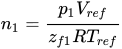
The amount adsorbed can be calculated from the pressure readings before and after opening valve C based on the p-V-T relationship of real gases. A dry and degassed adsorbent sample of known weight was enclosed in the adsorption cell. An amount of gas is let into to maintain a pressure . The moles of gas confined in are calculated as:

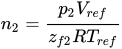
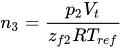
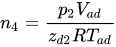
The pressure drops to after opening valve C. The amount of gas maintained in , , and are respectively:

The amount adsorbed or the excess adsorption N is then obtained:

where and are the moles of the gas remaining in and before opening valve C. All of the compressibility factor values are calculated by a proper equation of state, which can generate appropriate z values for temperatures not close to the critical zone.

The main advantages of this method are simplicity in procedure, commercial availability of instruments, and the large ranges of pressure and temperature in which this method can be realized. The disadvantage of volumetric measurements is the considerable amount of adsorbent sample needed to overcome adsorption effects on the walls of the vessels. However, this may be a positive aspect if the sample is adequate. A larger amount of sample results in considerable adsorption and usually provides a larger void space in the adsorption cell, rendering the effect of uncertainty in “dead space” to a minimum.

Gravimetric method

In gravimetric method, the weight change of the adsorbent sample in the gravity field due to adsorption from the gas phase is recorded. Various types of sensitive microbalance have been developed for this purpose. A continuous-flow gravimetric technique coupled with wavelet rectification allows for higher precision, especially in the near-critical region.

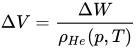
Major advantages of gravimetric method include sensitivity, accuracy, and the possibility of checking the state of activation of an adsorbent sample. However, consideration must be given to buoyancy correction in gravimetric measurement. A counterpart is used for this purpose. The solid sample is placed in a sample holder on one arm of the microbalance while the counterpart is loaded on the other arm. Care must be taken to keep the volume of the sample and the counterpart as close as possible to reduce the buoyancy effect. The system is vacuumed and the balance is zeroed before starting experiments. Buoyancy is measured by introducing helium and pressurizing up to the highest pressure of the experiment. It is assumed that helium does not adsorb and any weight change (ΔW) is due to buoyancy. Knowing the density of helium (), one can determine the difference in volume (ΔV) between the sample and the counterpart:

The measured weight can be corrected for the buoyancy effect at a specified temperature and pressure:

is the weight reading before correction.

Generating isotherms by molecular simulation of adsorption

Monte Carlo and molecular dynamic approaches became useful tools for theoretical calculations aiming at predictions of adsorption equilibria and diffusivities in small pores of various simple geometries. The interactions between adsorbate molecules are represented by the Lenard-Jones potential:

where r is the interparticle distance, is the point at which the potential is zero, and is the well depth.

Experimental isotherms of the supercritical region

Li Zhou and coworkers used a volumetric apparatus to measure the adsorption equilibria of hydrogen and methane on activated carbon (Figure 2, 3). They also measure the adsorption equilibria of nitrogen on microporous activated carbon (Figure 4) and on a mesoporous silica gel (Figure 5) for both subcritical and supercritical region. Figure 6 shows the isotherms of methane on silica gel.

Future problems

Adsorption of fluid at above-critical temperatures and elevated pressures is a field growing importance in both science and engineering. It is the physicochemical basis of many engineering processes and potential industrial applications. For example, separation or purification of light hydrocarbons, storage of fuel gases in microporous solids, adsorption from supercritical gases in extraction processes and chromatography. Besides, knowledge of gas/solid interface phenomenon at high pressures is fundamental to heterogeneous catalysis. However, the limited number of reliable high-pressure adsorption data hampered the progress of the theoretical study.

At least two problems have to be solved before a consistent system of theories for supercritical adsorption becomes sophisticated: first, how to set up a thermodynamically standard state for the supercritical adsorbed phase, so that the adsorption potential for supercritical adsorption can be evaluated? Second, how to determine the total amount in the adsorbed phase based on experimentally measured equilibrium data. Determination of the absolute adsorption is needed for establishing thermodynamic theory because as a reflection of statistical behavior of molecules, thermodynamic rules must rely on the total, not part of, material confined in the system studied.

From recent studies of supercritical adsorption, there seems to be an end in the high-pressure direction for supercritical adsorption. However, adsorbed-phase density is the decisive factor for the existence of this end. The state of adsorbate at the “end” provides the standard state of the supercritical adsorbed phase just like the saturated liquid, which is the end state of adsorbate in the subcritical adsorption. So the “end state” has to be precisely defined. To establish a definite relationship for the adsorbed phase density at the end state, abundant and reliable experimental data are still required.

Nanoinformatics

From Wikipedia, the free encyclopedia https://en.wikipedia.org/wiki/Nanoinformatics   ...