Biomining refers to any process that uses living organisms to extract metals from ores and other solid materials. Typically these processes involve prokaryotes, however fungi and plants (phytoextraction also known as phytomining) may also be used. Biomining is one of several applications within biohydrometallurgy with applications in ore refinement, precious metal recovery, and bioremediation. The largest application currently being used is the treatment of mining waste containing iron, copper, zinc, and gold
allowing for salvation of any discarded minerals. It may also be useful
in maximizing the yields of increasingly low grade ore deposits. Biomining has been proposed as a relatively environmentally friendly alternative and/or supplementation to traditional mining. Current methods of biomining are modified leach mining processes. These aptly named bioleaching processes most commonly includes the inoculation of extracted rock with bacteria and acidic solution, with the leachate salvaged and processed for the metals of value. Biomining has many applications outside of metal recovery, most notably is bioremediation which has already been used to clean up coastlines after oil spills. There are also many promising future applications, like space
biomining, fungal bioleaching and biomining with hybrid biomaterials.
History of biomining
The possibility of using microorganisms in biomining applications was
realized after the 1951 paper by Kenneth Temple and Arthur Colmer. In the paper the authors presented evidence that the bacteria Acidithiobacillus ferrooxidans (basonym Thiobacillus ferrooxidans) is an iron oxidizer that thrive in iron, copper and magnesium-rich environments. In the experiment, A. ferrooxidans
was inoculated into media containing between 2,000 and 26,000 ppm
ferrous iron, finding that the bacteria grew faster and were more motile
in the high iron concentrations. The byproducts of the bacterial growth caused the media to turn very acidic, in which the microorganisms still thrived. Following this experiment, the potential to use fungi to leach metals from their environment and use microorganisms to take up radioactive elements like uranium and thorium have also been explored.
While the 1960s was when industrial biomining got its start,
humans have been unknowingly using biomining practices for hundreds of
years. In western Europe the practice of extracting copper from metallic iron
by placing it into drainage streams, used to be considered an act of alchemy. However, today we know that it is a fairly simple chemical reaction.
Cu2+ + Fe0 → Cu0 + Fe2+
In the Middle Ages in Portugal, Spain and Wales, miners
unknowingly used this reaction to their advantage when they discovered
that when flooding deep mine shafts for a period with some leftover iron
they were able to obtain copper.
In China, the use of biomining techniques has been documented as early as 6th-7th century BC. The relationship between water and ore to produce copper was well documented, and during the Tang dynasty and Song dynasty copper was produced using hydrometallurgical techniques. Though the mechanism of oxidation via bacteria was not understood, the
unintended use of biomining allowed copper production in China to reach
1000 Tons per year.
Biological pre-treatment utilizes the natural oxidation abilities of microorganisms to remove unwanted minerals that interfere with the extraction of the target metals. This is not always necessary but is widely used in the removal of arsenopyrite and pyrite from gold (Au). Adidithiobacillus spp. release the gold by the following reaction.
Stirred tank bioreactors are used for the biooxidation of gold. While stirred tanks have been used to bioleach cobalt for copper mine tailings, these are costly systems that can reach sizes of >1300m3 meaning that they are almost exclusively used for very high value minerals like gold.
Illustration
of the process of uranium heap leaching. In bioleaching, the heap would
have been inoculated with the process specific microbe.
Bioleaching (bioprocessing)
Dump bioleaching
Dump Bioleaching was one of the first widely used applications of
biomining. In dump bioleaching, waste rock is piled into mounds
(>100m tall) and saturated with sulfuric acid to encourage mineral oxidation from native bacteria. Inoculation of the rock with bacteria is often not performed in dump
bioleaching which instead relies on the bacteria already present in the
rock.
Heap bioleaching
Heap bioleaching is a newer take on dump leaching. The process includes more processing in which the rocks are ground into a finer grain size. This finer grain is then stacked only 2 – 10 m high and is well
irrigated allowing for plenty of oxygen and carbon dioxide to reach the
bacteria. The mounds are also often inoculated with bacteria. The liquid coming out at the bottom of the pile, called leachate, is
rich in the processed mineral. The heaps reside on large non-porous
platforms which are used to catch the leachate for processing. Once collected the leachate is transported to a precipitation plant
where the metal is reprecipitated and purified. The waste liquid, now
void of the valuable minerals, can be pumped back to the top of the pile
and the cycle is repeated.
The temperature inside the leach dump often rises spontaneously as a result of microbial activities. Thus, thermophilic iron-oxidizing chemolithotrophs such as thermophilic Acidithiobacillus species and Leptospirillum and at even higher temperatures the thermoacidophilic archaeon Sulfolobus (Metallosphaera sedula) may become important in the leaching process above 40 °C.
In situ copper biomining of and electro-winning for recovery from Kupferschiefer deposits
In situ biomining
In situ biomining involves the flooding and inoculation of fractured ore bodies that have yet to be removed from the ground. Once the bacteria are introduced to the ore deposits, they begin
leaching the precious metals, which can then be extracted as leachate
with a recovery well. In-situ mining also shows promise for applications in cost-effective deep subsurface extraction of metals.
In situ biomining, is the one current method utilizing
bioleaching that serves as an effective and viable replacement for
traditional mining. Because in-situ
biomining, negates the need for the extraction of the ore bodies, this
method stops the need for any hauling or smelting of the ore. This would mean there would be no waste rocks or mineral tailings that contaminate the surface. However, in-situ biomining also has the most environmental concerns of all of the leaching methods, as there is the potential for the contamination of ground water. These concerns however can be careful managed, especially because most of this mining would occur below the water table.
This method was used in Canada in the 1970s to extract additional uranium out of exploited mines. Similarly to copper, Acidithiobacillus ferrooxidans can oxidize U4+ to U6+ with O2
as electron acceptor. However, it is likely that the uranium leaching
process depends more on the chemical oxidation of uranium by Fe3+, with At. ferrooxidans contributing mainly through the reoxidation of Fe2+ to Fe3+.
UO2 + Fe(SO4)3 → UO2SO4 + 2 FeSO4
Applications
A simplified scheme illustrating how to obtain copper by using bioleaching of chalcopyrite
One of the largest applications of these leaching methods is in the mining of copper Acidithiobacillus ferrooxidans has the ability to solubilize copper by oxidizing the reduced form of iron (Fe2+) with sulfur electrons and carbon dioxide. This process results in ferric ions (Fe3+) and H+ in a series of cyclical reactions.
CuFeS2+4H++O2 → Cu2++Fe2++2S0+2H2O,
4Fe2++4H++O2 4Fe3++2H2O,
2S0+3O2+2H2O→2SO2−4+4H+,
CuFeS2+4Fe3+→Cu2++2S0+5Fe2+,
The copper metal is then recovered by using scrap iron:
Fe0 + Cu2+ → Cu0 + Fe2+
Using bacteria such as A. ferrooxidans to leach copper from mine tailings
has improved recovery rates and reduced operating costs. Moreover, it
permits extraction from low grade ores – an important consideration in
the face of the depletion of high grade ores.
Economic feasibility and potential drawbacks
It has been well established that bioleaching allows of the cheaper
processing of low-grade ore when the bacteria are given the correct
growth conditions. This allows for economic extraction of low-grade ore and increases mining reserves in a sustainable way.
Like any process of mineral recovery there are concerns about the
ability to scale biomining to the size the industry would need. The
biggest potential drawbacks of biomining are the relatively slow
leaching and extraction times and need for expensive specialized
equipment. Biomining techniques only show economic viability as a complementary
process to mining, not as a replacement. Biomining may make traditional
mining more environmentally and economically friendly, by re-processing
fresh or abandoned mine tailings and the detoxification of copper
production concentrates to generate economically valuable
copper-enriched liquors. There is great economic feasibility for in-situ biomining to replace
traditional mining in a cheaper and more environmentally friendly way,
however it has yet to be adopted on any large scale.
Gold
Gold is frequently found in nature associated with arsenopyrite and pyrite. In the microbial leaching process Acidithiobacillus ferrooxidans etc. dissolve the iron minerals, exposing trapped gold (Au):
Biohydrometallurgy is an emerging trend in biomining in which commercial mining plants operate continuously stirred tank reactor
(STR) and the airlift reactor (ALR) or pneumatic reactor (PR) of the
Pachuca type to extract the low concentration mineral resources
efficiently.
The development of industrial mineral processing using
microorganisms has been established in South Africa, Brazil and
Australia. Iron-and sulfur-oxidizing microorganisms are used to release
copper, gold, and uranium from minerals. Electrons are pulled off of
sulfur metal through oxidation and then put onto iron, producing
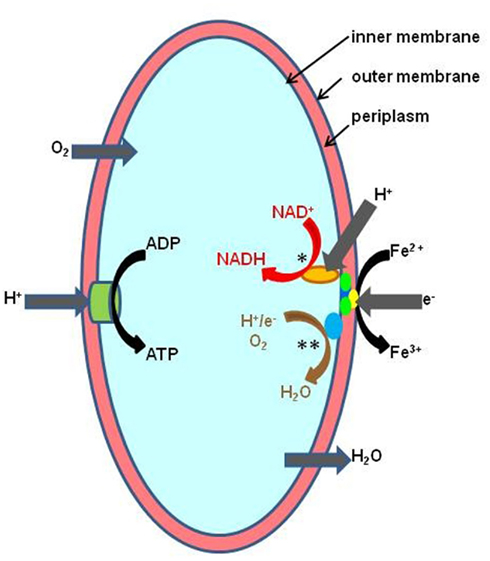
reducing equivalents in the cell in the process. This is shown in this figure. These reducing equivalents then go on to produce adenosine triphosphate in the cell through the electron transport chain.
Most industrial plants for biooxidation of gold-bearing concentrates
have been operated at 40 °C with mixed cultures of mesophilic bacteria
of the genera Acidithiobacillus or Leptospirillum ferrooxidans. In other studies the iron-reducing archaea Pyrococcus furiosus were shown to produce hydrogen gas which can then be used as fuel. Using Bacteria such as Acidithiobacillus ferrooxidans to leach copper
from mine tailings has improved recovery rates and reduced operating
costs. Moreover, it permits extraction from low grade ores – an
important consideration in the face of the depletion of high grade ores.
The acidophilic archaea Sulfolobus metallicus and Metallosphaera sedula
can tolerate up to 4% of copper and have been exploited for mineral
biomining. Between 40 and 60% copper extraction was achieved in primary
reactors and more than 90% extraction in secondary reactors with overall
residence times of about 6 days. All of these microbes are gaining
energy by oxidizing these metals. Oxidation means increasing the number
of bonds between an atom to oxygen. Microbes will oxidize sulfur. The
resulting electrons will reduce iron, releasing energy that can be used
by the cell.
Bioremediation
Bioremediation
is the process of using microbial systems to restore the environment to
a healthy state by detoxifying and degrading environmental
contaminants.
When dealing with mine waste and metal toxic contamination of the
environment, bioremediation can be used to lessen the mobility of the
metals through the ecosystem. Common mine and metal wastes include arsenic, cadmium, chromium,
copper, lead, mercury, nickel and zinc which can make its way into the
environment through rain and waterways where it can be moved long
distances. These metals pose potential toxicology risks to wild animals and plates as well as humans. When the right microbes are introduced to mines or areas with mining
contamination and toxicity, they can alter the structure of the metals
to make it less bioavailable and lessening its mobility in the
ecosystem. It is important to note however, that certain microbes may increase the
amount of metals that get dissolved into the environment. This is why scientific studies and testing must be conducted to find the most beneficial bacteria for the situation.
Image from the shorelines affected by the Exxon Valdez oil spill of 1998
Bioremediation is not specific to metals. In 1989 an Exxon Valdez oil tanker spilled 42 million liters of crude oil into Prince William Sound. The oil was washed ashore by tides and covered 778 km of the shoreline of the sound, but also spread to covered 1309 km of the gulf of Alaska. In attempts to rejuvenate the coast after the oil spill, Exxon and the EPA began testing bioremediation strategies, which were later implemented on the coast line. They introduced fertilizer to the environment that promoted the growth of naturally occurring hydrocarbon degrading microorganisms. After the applications, microbial assemblages were determined to be
made up of 40% oil degrading bacteria, and one year later that number
had fallen back to its baseline of around 1%. Two years after the spill, the region of contaminated shoreline spanned 10.2 km. This case indicated that microbial bioremediation may work as a modern
technique for restoring natural systems by removing toxins from the
environment.
Future prospects
Additional capabilities, of current bioleaching technologies include
the bioleaching of metals from sulfide ores, phosphate ores, and
concentrating of metals from solution. One project recently under investigation is the use of biological
methods for the reduction of sulfur in coal-cleaning applications.
Biomining in space
Theoretical map of space biomining/bioleaching based biological life support system (BLSS)
The concept of space biomining is creating a new field in the world of space exploration. The main space agencies believe that space biomining may provided an
approach to the extraction of metals, minerals, nutrients, water, oxygen
and volatiles from extraterrestrial regolith.Bioleaching in space also shows promise for application in building biological life support systems (BLSS). BLSS do not usually contain biological component, however, the use of
microorganisms to breakdown waste and regolith, while being able to
capture their byproducts like nitrates and methane would theoretically
allow for a cyclical system of regenerative life support.
Fungi in biomining
Species of filamentous fungi, specifically those in the genera of Aspergillus and Penicillium have been shown as effective bioleaching agents. Fungi have the ability to solubilize metals through acidolysis, redoxolysis and chelation reactions. Like bacteria, fungi have been studied for their ability to extract
rare earth elements and to process low grade ore. But their most
promising and studied usage is in the breakdown of E-waste and the
recovery of valuable metals from it, like gold. Despite the promise of fungal bioleaching, there has been no industrial
applications of it as it does not out compete its bacterial
counterparts.
Hybrid biomaterials
Hybrid Biomaterials are created by attaching peptides to magnetic nanoparticles. The peptides attached are specific proteins that have the capacity to bind to organic/inorganic materials with high affinity. This allows for highly specific custom hybrid molecules to be developed, that bind to molecules of interest. The magnetic nanoparticles that these proteins are bound to, allow for
the separation of the biomaterial and the bound molecules from an
aqueous solution. There has already been successful development of these hybrid
biomaterials for eluting gold and molybdenite from solution, and this
technique shows great promise for cleaning up tailing ponds.
Research missions focused on asteroid sample return, including Hayabusa, Hayabusa2, OSIRIS-REx, and Tianwen-2,
illustrate the challenges of collecting ore from space using current
technology. As of 2024, around 127 grams of asteroid material have been
successfully brought to Earth from space. Asteroid research missions are complex endeavors that yield a tiny amount of material: less than 100 milligrams for Hayabusa, 5.4 grams for Hayabusa2, and approximately 121.6 grams for OSIRIS-REx, with Tianwen-2 mission currently ongoing.
These figures are comparatively negligible when considering the
substantial investments and resources allocated to these projects ($300
million for Hayabusa, $800 million for Hayabusa2, $1.16 billion for OSIRIS-REx and $70 million for Tianwen-2).
Notable asteroid mining challenges include the high cost of spaceflight,
unreliable identification of asteroids that are suitable for mining,
and the challenges of extracting usable material in a space environment.
History
Prior to 1970
Before 1970, asteroid mining existed largely within the realm of science fiction. Publications such as Worlds of If, Scavengers in Space, and Miners in the Sky told stories about the conceived dangers, motives, and experiences of
mining asteroids. At the same time, many researchers in academia
speculated about the profits that could be gained from asteroid mining,
but they lacked the technology to seriously pursue the idea.
The 1970s
In 1969, the Apollo 11
Moon Landing spurred a wave of scientific interest in human space
activity far beyond the Earth's orbit. As the decade continued,
increasing academic interest surrounded the topic of asteroid mining. A
sizeable portion of serious academic consideration was aimed at mining
asteroids located closer to Earth than the main asteroid belt. In
particular, the asteroid groups Apollo and Amor were considered. These groups were chosen not only because of their proximity to Earth
but also because many at the time thought they were rich in raw
materials that could be refined.
Despite the wave of interest, many in the space science community
were aware of how little was known about asteroids and encouraged a
more gradual and systematic approach to asteroid mining.
The 1980s
Academic interest in asteroid mining continued into the 1980s. The
idea of targeting the Apollo and Amor asteroid groups still had some
popularity. However, by the late 1980s, the interest in the Apollo and Amor
asteroid groups was being replaced with interest in the moons of Mars,
Phobos and Deimos.
Governmental organizations and space agencies, such as NASA, begin to formulate ideas of how to process materials in space and what to do with the materials that are hypothetically gathered from space.
The 1990s
New reasons emerged for pursuing asteroid mining. These reasons
tended to revolve around environmental concerns, such as fears over
humans over-consuming the Earth's natural resources and trying to capture energy from the Sun in space.
In the same decade, NASA was trying to establish what materials
in asteroids could be valuable for extraction. These materials included
free metals, volatiles, and bulk dirt.
The 2010s
After a burst of interest in the 2010s, asteroid mining ambitions
shifted to more distant long-term goals, and some 'asteroid mining'
companies pivoted to more general-purpose propulsion technology.
On 24 April 2012, at the Seattle, Washington Museum of Flight, a plan was announced by billionaire entrepreneurs to mine asteroids for their resources. The company was called Planetary Resources, and its founders included aerospace entrepreneurs Eric Anderson and Peter Diamandis. The company announced plans to create a propellant depot in space by
2020, aiming to develop the process of splitting water from asteroids
into hydrogen and oxygen to replenish satellites and spacecraft.
Advisers included film director and explorer James Cameron; investors included Google's chief executive Larry Page, and its executive chairman was Eric Schmidt. Telescope technology proposed to identify and examine candidate
asteroids lead to development of the Arkyd family of spacecraft; two
prototypes of which were flown in 2015 and 2018. Shortly after, all plans for the Arkyd space telescope technology were
abandoned; the company was wound down, its hardware auctioned off, and remaining assets acquired by ConsenSys, a blockchain company.
A year after the appearance of Planetary Resources, similar asteroid mining plans were announced in 2013 by Deep Space Industries; a company established by David Gump, Rick Tumlinson, and others. The initial goal was to visit asteroids with prospecting and sample return spacecraft in 2015 and 2016; and begin mining within ten years. Deep Space Industries later pivoted to developing & selling the
propulsion systems that would enable its envisioned asteroid operations,
including a successful line of water-propellant thrusters in 2018; and in 2019 was acquired by Bradford Space, a company with a portfolio of earth orbit systems and space flight components.
The 2020s
The 2020s have brought a resurgence of interest, with companies from
the United States, Europe, and China renewing their efforts in this
ambitious venture. This revival is fueled by a new era of commercial
space exploration, significantly driven by SpaceX.
SpaceX's development of reusable rocket boosters has substantially
lowered the cost of space access, reigniting interest and investment in
asteroid mining. A US congressional committee acknowledged this renewed
interest by holding a hearing on the topic in December 2023. There are also endeavors to make first-time landings on M-type asteroids to mine metals like iridium
which sells for many thousands of dollars per ounce. Private company
driven efforts have also given rise to a new culture of secrecy
obfuscating which asteroids are identified and targeted for mining
missions, whereas previously government-led asteroid research and
exploration operated with more transparency.
Minerals in space
The asteroids of the inner Solar System and Jupiter: The belt is located between the orbits of Jupiter and Mars.
As resource depletion on Earth becomes more of a concern, the idea of extracting valuable elements from asteroids and transporting them to Earth for profit, or using space-based resources to build solar-power satellites and space habitats, becomes more attractive. Hypothetically, water processed from ice could refuel orbiting propellant depots.
Although asteroids and Earth accreted from the same starting materials, Earth's relatively stronger gravity pulled all heavy siderophilic (iron-loving) elements into its core during its molten youth more than four billion years ago. This left the crust depleted of such valuable elements until a rain of
asteroid impacts re-infused the depleted crust with metals like gold, cobalt, iron, manganese, molybdenum, nickel, osmium, palladium, platinum, rhenium, rhodium, ruthenium and tungsten (some flow from core to surface does occur, e.g. at the Bushveld Igneous Complex, a famously rich source of platinum-group metals).Today, these metals are mined from Earth's crust, and they are
essential for economic and technological progress. Hence, the geologic
history of Earth may very well set the stage for a future of asteroid
mining.
In 2006, the Keck Observatory announced that the binary Jupiter trojan617 Patroclus, and possibly large numbers of other Jupiter trojans, are likely extinct comets and consist largely of water ice. Similarly, Jupiter-family comets, and possibly near-Earth asteroids that are extinct comets, might also provide water. The process of in-situ resource utilization—using
materials native to space for propellant, thermal management, tankage,
radiation shielding, and other high-mass components of space infrastructure—could lead to radical reductions in its cost. Although whether these cost reductions could be achieved, and if
achieved would offset the enormous infrastructure investment required,
is unknown.
From the astrobiological perspective, asteroid prospecting could provide scientific data for the search for extraterrestrial intelligence (SETI).
Some astrophysicists have suggested that if advanced extraterrestrial
civilizations employed asteroid mining long ago, the hallmarks of these
activities might be detectable.
An important factor to consider in target selection is orbital economics, in particular the change in velocity (Δv) and travel time to and from the target. More of the extracted native material must be expended as propellant in higher Δv trajectories, thus less returned as payload. Direct Hohmann trajectories are faster than Hohmann trajectories assisted by planetary and/or lunar flybys, which in turn are faster than those of the Interplanetary Transport Network, but the reduction in transfer time comes at the cost of increased Δv requirements.
The Easily Recoverable Object (ERO) subclass of Near-Earth asteroids
are considered likely candidates for early mining activity. Their low Δv
makes them suitable for use in extracting construction materials for
near-Earth space-based facilities, greatly reducing the economic cost of
transporting supplies into Earth orbit.
The table above shows a comparison of Δv requirements
for various missions. In terms of propulsion energy requirements, a
mission to a near-Earth asteroid compares favorably to alternative
mining missions.
An example of a potential target for an early asteroid mining expedition is 4660 Nereus, expected to be mainly enstatite. This body has a very low Δv
compared to lifting materials from the surface of the Moon. However, it
would require a much longer round-trip to return the material.
Multiple types of asteroids have been identified but the three
main types would include the C-type, S-type, and M-type asteroids:
C-type asteroids
have a high abundance of water which is not currently of use for
mining, but could be used in an exploration effort beyond the asteroid.
Mission costs could be reduced by using the available water from the
asteroid. C-type asteroids also have high amounts of organic carbon, phosphorus, and other key ingredients for fertilizer which could be used to grow food.
S-type asteroids
carry little water but are more attractive because they contain
numerous metals, including nickel, cobalt, and more valuable metals,
such as gold, platinum, and rhodium. A small 10-meter S-type asteroid
contains about 650,000 kg (1,433,000 lb) of metal with 50 kg (110 lb) in
the form of rare metals like platinum and gold.
M-type asteroids are rare but contain up to 10 times more metal than S-types.
A class of "easily retrievable objects" (EROs) was identified by a
group of researchers in 2013. Twelve asteroids made up the initially
identified group, all of which could be potentially mined with
present-day rocket technology. Of 9,000 asteroids searched in the NEO database, these twelve could all be brought into an Earth-accessible orbit by changing their velocity
by less than 500 meters per second (1,800 km/h; 1,100 mph). The dozen
asteroids range in size from 2 to 20 meters (10 to 70 ft).
Process asteroidal material on-site to bring back only processed materials, and perhaps produce propellant for the return trip.
Transport the asteroid to a safe orbit around the Moon or Earth or to a space station. This can hypothetically allow for most materials to be used and not wasted.
Processing in situ for the purpose of extracting high-value
minerals will reduce the energy requirements for transporting the
materials, although the processing facilities must first be transported
to the mining site. In situ mining will involve drilling
boreholes and injecting hot fluid/gas and allow the useful material to
react or melt with the solvent and extract the solute. Due to the weak
gravitational fields of asteroids, any activities, like drilling, will
cause large disturbances and form dust clouds. These might be confined
by some dome or bubble barrier. Or else some means of rapidly
dissipating any dust could be provided.
Mining operations require special equipment to handle the extraction and processing of ore in outer space. The machinery will need to be anchored to the body, but once in place, the ore can be moved about more readily due to the
lack of gravity. However, no techniques for refining ore in zero gravity
currently exist. Docking with an asteroid might be performed using a
harpoon-like process, where a projectile would penetrate the surface to
serve as an anchor; then an attached cable would be used to winch the
vehicle to the surface, if the asteroid is both penetrable and rigid
enough for a harpoon to be effective.
Due to the distance from Earth to an asteroid selected for
mining, the round-trip time for communications will be several minutes
or more, except during occasional close approaches to Earth by
near-Earth asteroids. Thus any mining equipment will either need to be
highly automated, or a human presence will be needed nearby. Humans would also be useful for troubleshooting problems and for
maintaining the equipment. On the other hand, multi-minute
communications delays have not prevented the success of robotic exploration of Mars, and automated systems would be much less expensive to build and deploy.
Economics
Currently, the quality of the ore
and the consequent cost and mass of equipment required to extract it
are unknown and can only be speculated on. Some economic analyses
indicate that the cost of returning asteroidal materials to Earth far
outweighs their market value, and that asteroid mining will not attract
private investment at current commodity prices and space transportation
costs. Other studies suggest large profit by using solar power.Potential markets for materials can be identified and profit generated
if extraction cost is brought down. For example, the delivery of
multiple tonnes of water to low Earth orbit for rocket fuel preparation for space tourism could generate significant profit if space tourism itself proves profitable.
In 1997, it was speculated that a relatively small metallic
asteroid with a diameter of 1.6 km (1 mi) contains more than US$20
trillion worth of industrial and precious metals. A comparatively small M-type asteroid with a mean diameter of 1 km (0.62 mi) could contain more than two billion metric tons of iron–nickel ore, or two to three times the world production of 2004. The asteroid 16 Psyche is believed to contain 1.7×10¹⁹ kg
of nickel–iron, which could supply the world production requirement for
several million years. A small portion of the extracted material would
also be precious metals.
Not all mined materials from asteroids would be cost-effective,
especially for the potential return of economic amounts of material to
Earth. For potential return to Earth, platinum
is considered very rare in terrestrial geologic formations and
therefore is potentially worth bringing some quantity for terrestrial
use. Nickel, on the other hand, is quite abundant on Earth and being
mined in many terrestrial locations, so the high cost of asteroid mining
may not make it economically viable.
Although Planetary Resources indicated in 2012 that the platinum from a 30-meter-long (98 ft) asteroid could be worth US$25–50 billion, an economist remarked any outside source of precious metals could lower
prices sufficiently to possibly doom the venture by rapidly increasing
the available supply of such metals.
Development of an infrastructure for altering asteroid orbits could offer a large return on investment.
Scarcity is a fundamental economic problem of humans having seemingly unlimited wants in a world of limited resources.
Since Earth's resources are finite, the relative abundance of
asteroidal ore gives asteroid mining the potential to provide nearly
unlimited resources, which could essentially eliminate scarcity for those materials.
The idea of exhausting resources is not new. In 1798, Thomas Malthus wrote, because resources are ultimately limited, the exponential growth in a population would result in falls in income per capita until poverty and starvation would result as a constricting factor on population. Malthus posited this 228 years ago, and no sign has yet emerged of the Malthus effect regarding raw materials.
Proven reserves
are deposits of mineral resources that are already discovered and known
to be economically extractable under present or similar demand, price
and other economic and technological conditions.
Conditional reserves are discovered deposits that are not yet economically viable.
Indicated reserves are less intensively measured deposits whose data
is derived from surveys and geological projections. Hypothetical
reserves and speculative resources make up this group of reserves.
Inferred reserves are deposits that have been located but not yet exploited.
Continued development in asteroid mining techniques and technology may help to increase mineral discoveries. As the cost of extracting mineral resources, especially platinum group
metals, on Earth rises, the cost of extracting the same resources from
celestial bodies declines due to technological innovations around space
exploration.
Asteroid tracking catalogs such as Asterank estimate about 700 known asteroids with a value exceeding US$100 trillion each.
Financial feasibility
Space ventures are high-risk, with long lead times and heavy capital
investment, and that is no different for asteroid-mining projects. These
types of ventures could be funded through private investment or through
government investment. For a commercial venture, it can be profitable
as long as the revenue earned is greater than total costs (costs for
extraction and costs for marketing). The costs involving an asteroid-mining venture were estimated to be around US$100 billion in 1996.
There are six categories of cost considered for an asteroid mining venture:
Research and development costs
Exploration and prospecting costs
Construction and infrastructure development costs
Operational and engineering costs
Environmental costs
Time cost
Determining financial feasibility is best represented through net present value. One requirement needed for financial feasibility is a high return on investment estimating around 30%. Example calculation assumes for simplicity that the only valuable
material on asteroids is platinum. On 16 August 2016, platinum was
valued at $1157 per ounce
or $37,000 per kilogram. At a price of $1,340, for a 10% return on
investment, 173,400 kg (5,575,000 ozt) of platinum would have to be
extracted for every 1,155,000 tons of asteroid ore. For a 50% return on
investment 1,703,000 kg (54,750,000 ozt) of platinum would have to be
extracted for every 11,350,000 tons of asteroid ore. This analysis
assumes that doubling the supply of platinum to the market (5.13 million
ounces in 2014) would have no effect on the price of platinum. An
economics-based assessment would conclude increasing the supply of
platinum without an obvious increase in demand will drive prices
downward.
The financial feasibility of asteroid mining with regards to different technical parameters has been presented by Sonter and more recently by Hein et al. They have specifically explored the
case where platinum is brought from space to Earth and estimate that
economically viable asteroid mining for this specific case would be
rather challenging.
Decreases in the price of space access matter. The start of operational use of the low-cost-per-kilogram-in-orbit SpacexFalcon Heavy
launch vehicle in 2018 is projected by astronomer Martin Elvis to have
increased the extent of economically minable near-Earth asteroids from
hundreds to thousands. With the increased availability of several
kilometers per second of delta-v that Falcon Heavy provides, it increases the number of NEAs accessible from 3 percent to around 45 percent.
Precedent for joint investment by multiple parties into a
long-term venture to mine commodities may be found in the legal concept
of a mining partnership, which exists in the state laws of multiple US
states including California. In a mining partnership, "[Each] member of a
mining partnership shares in the profits and losses thereof in the
proportion which the interest or share he or she owns in the mine bears
to the whole partnership capital or whole number of shares."
Since Mars is much closer to the asteroid belt than Earth is, it would take less Delta-v to get to the asteroid belt and return minerals to Mars. One hypothesis is that the origin of the Moons of Mars (Phobos and Deimos) are actually asteroid captures from the asteroid belt. 16 Psyche in the main belt could have over $10,000 QuadrillionUnited States dollar worth of minerals. NASA is planning a mission for 10 October 2023 for the Psyche orbiter to launch and get to the asteroid by August 2029 to study. 511 Davida could have $27 quadrillion worth of minerals and resources. Using the moon Phobos to launch spacecraft is energetically favorable
and a useful location from which to dispatch missions to main belt
asteroids. Mining the asteroid belt from Mars and its moons could help in the Colonization of Mars.
Phobos is synchronously orbiting Mars, where the same face stays facing the planet at ~6,028 km above the Martian surface. A space elevator could extend from Phobos to Mars 6,000 km, about 28 kilometers from the surface, and just out of the atmosphere of Mars. A similar space elevator cable could extend out 6,000 km the opposite direction that would counterbalance Phobos. In total the space elevator would extend over 12,000 km which would be below Areostationary orbit
of Mars (17,032 km). A rocket launch would be needed to get the rocket
and cargo to the beginning of the space elevator 28 km above the
surface. The surface of Mars is rotating at 0.25 km/s at the equator and the bottom of the space elevator would be rotating around Mars at 0.77 km/s, so only 0.52 km/s of Delta-v
would be needed to get to the space elevator. Phobos orbits at
2.15 km/s and the outer most part of the space elevator would rotate
around Mars at 3.52 km/s.
Regulation and safety
Space law involves a specific set of international treaties, along with national statutory laws. The system and framework for international and domestic laws have emerged in part through the United Nations Office for Outer Space Affairs. The rules, terms and agreements that space law authorities consider to
be part of the active body of international space law are the five
international space treaties and five UN declarations. Approximately 100
nations and institutions were involved in negotiations. The space
treaties cover many major issues such as arms control, non-appropriation
of space, freedom of exploration, liability for damages, safety and
rescue of astronauts and spacecraft, prevention of harmful interference
with space activities and the environment, notification and registration
of space activities, and the settlement of disputes. In exchange for
assurances from the space power, the nonspacefaring nations acquiesced
to U.S. and Soviet proposals to treat outer space as a commons (res
communis) territory which belonged to no one state.
Asteroid mining in particular is covered by both international treaties—for example, the Outer Space Treaty—and national statutory laws—for example, specific legislative acts in the United States and Luxembourg.
Varying degrees of criticism exist regarding international space
law. Some critics accept the Outer Space Treaty, but reject the Moon
Agreement. The Outer Space Treaty allows private property rights for
outer space natural resources once removed from the surface, subsurface
or subsoil of the Moon and other celestial bodies in outer space. Thus, international space law is capable of managing newly emerging
space mining activities, private space transportation, commercial
spaceports and commercial space stations, habitats and settlements.
Space mining involving the extraction and removal of natural resources
from their natural location is allowable under the Outer Space Treaty. Once removed, those natural resources can be reduced to possession,
sold, traded and explored or used for scientific purposes. International
space law allows space mining, specifically the extraction of natural
resources. It is generally understood within the space law authorities
that extracting space resources is allowable, even by private companies
for profit. However, international space law prohibits property rights over territories and outer space land.
Astrophysicists Carl Sagan and Steven J. Ostro raised the concern altering the trajectories of asteroids
near Earth might pose a collision hazard threat. They concluded that
orbit engineering has both opportunities and dangers: if controls
instituted on orbit-manipulation technology were too tight, future
spacefaring could be hampered, but if they were too loose, human
civilization would be at risk.
After ten years of negotiations between nearly 100 nations, the Outer
Space Treaty opened for signature on 27 January 1966. It entered into
force as the constitution for outer space on 10 October 1967. The Outer
Space Treaty was well received; it was ratified by ninety-six nations
and signed by an additional twenty-seven states. The outcome has been
that the basic foundation of international space law consists of five
(arguably four) international space treaties, along with various written
resolutions and declarations. The main international treaty is the
Outer Space Treaty of 1967; it is generally viewed as the "Constitution"
for outer space. By ratifying the Outer Space Treaty of 1967,
ninety-eight nations agreed that outer space would belong to the
"province of mankind", that all nations would have the freedom to "use"
and "explore" outer space, and that both these provisions must be done
in a way to "benefit all mankind".
The province of mankind principle and the other key terms have not yet been specifically defined. Critics have complained that the Outer Space Treaty is vague. Yet,
international space law has worked well and has served space commercial
industries and interests for many decades. The taking away and
extraction of Moon rocks, for example, has been treated as being legally
permissible.
The framers of Outer Space Treaty initially focused on
solidifying broad terms first, with the intent to create more specific
legal provisions later (Griffin, 1981: 733–734). This is why the members of the COPUOS later expanded the Outer Space
Treaty norms by articulating more specific understandings which are
found in the "three supplemental agreements" – the Rescue and Return
Agreement of 1968, the Liability Convention of 1973, and the Registration Convention of 1976.
Hobe (2007) explains that the Outer Space Treaty "explicitly and
implicitly prohibits only the acquisition of territorial property
rights" but extracting space resources is allowable. It is generally
understood within the space law authorities that extracting space
resources is allowable, even by private companies for profit. However,
international space law prohibits property rights over territories and
outer space land. Hobe further explains that there is no mention of "the
question of the extraction of natural resources which means that such
use is allowed under the Outer Space Treaty" (2007: 211). He also points
out that there is an unsettled question regarding the division of
benefits from outer space resources in accordance with Article,
paragraph 1 of the Outer Space Treaty.
The Moon Agreement was signed on 18 December 1979, as part of the United Nations Charter
and it entered into force in 1984 after a five state ratification
consensus procedure, agreed upon by the members of the United Nations
Committee on Peaceful Uses of Outer Space (COPUOS). As of September 2019, only 18 nations have signed or ratified the treaty. The other three outer space treaties experienced a high level of
international cooperation in terms of signage and ratification, but the
Moon Treaty went further than them, by defining the Common Heritage
concept in more detail and by imposing specific obligations on the
parties engaged in the exploration and/or exploitation of outer space.
The Moon Treaty explicitly designates the Moon and its natural resources
as part of the Common Heritage of Mankind.
The Article 11 establishes that lunar resources are "not subject
to national appropriation by claim of sovereignty, by means of use or
occupation, or by any other means". However, exploitation of resources is suggested to be allowed if it is
"governed by an international regime" (Article 11.5), but the rules of
such regime have not yet been established. S. Neil Hosenball, the NASA General Counsel and chief US negotiator for
the Moon Treaty, cautioned in 2018 that negotiation of the rules of the
international regime should be delayed until the feasibility of
exploitation of lunar resources has been established.
The objection to the treaty by the spacefaring nations is held to
be the requirement that extracted resources (and the technology used to
that end) must be shared with other nations. The similar regime in the United Nations Convention on the Law of the Sea is believed to impede the development of such industries on the seabed.
The United States, the Russian Federation, and the People's
Republic of China (PRC) have neither signed, acceded to, nor ratified
the Moon Agreement.
Legal regimes of some countries
Luxembourg
In February 2016, the Government of Luxembourg
said that it would attempt to "jump-start an industrial sector to mine
asteroid resources in space" by, among other things, creating a "legal
framework" and regulatory incentives for companies involved in the
industry. By June 2016, it announced that it would "invest more than US$200 million in research, technology demonstration, and in the direct purchase of equity in companies relocating to Luxembourg". In 2017, it became the "first European country to pass a law
conferring to companies the ownership of any resources they extract
from space", and remained active in advancing space resource public policy in 2018.
In 2017, Japan, Portugal, and the UAE entered into cooperation agreements with Luxembourg for mining operations in celestial bodies.
In 2018, the Luxembourg Space Agency was created. It provides private companies and organizations working on asteroid mining with financial support.
United States
Some nations are beginning to promulgate legal regimes for
extraterrestrial resource extraction. For example, the United States "SPACE Act of 2015"—facilitating private development of space resources consistent with US international treaty obligations—passed the US House of Representatives in July 2015. In November 2015 it passed the United States Senate. On 25 November U.S. President Barack Obama signed the H.R.2262 – U.S. Commercial Space Launch Competitiveness Act into law. The law recognizes the right of U.S. citizens to own space resources
they obtain and encourages the commercial exploration and use of
resources from asteroids. According to the article § 51303 of the law:
A United States citizen engaged in
commercial recovery of an asteroid resource or a space resource under
this chapter shall be entitled to any asteroid resource or space
resource obtained, including to possess, own, transport, use, and sell
the asteroid resource or space resource obtained in accordance with
applicable law, including the international obligations of the United
States
On 6 April 2020 U.S. President Donald Trump
signed the Executive Order on Encouraging International Support for the
Recovery and Use of Space Resources. According to the Order:
Americans should have the right to engage in commercial exploration, recovery, and use of resources in outer space
the US does not view space as a "global commons"
the US opposes the Moon Agreement
Environmental impact
A positive impact of asteroid mining has been conjectured as being an
enabler of transferring industrial activities into space, such as
energy generation. A quantitative analysis of the potential environmental benefits of
water and platinum mining in space has been developed, where potentially
large benefits could materialize, depending on the ratio of material
mined in space and mass launched into space.
Asteroid mining, or off-Earth Mining (OEM), is occasionally promoted as a sustainable alternative to terrestrial extraction, with the potential to reduce ecological degradation on Earth. Metals such as platinum and palladium, which are comparatively scarce on Earth but more abundant in some near-Earth asteroids (NEAs) such as 16 Psyche are likely to be primary targets for future resource return missions.
However, growing academic and environmental scrutiny suggests this
narrative may oversimplify the complex, and often negative,
environmental implications of OEM.
Space debris
Mining on asteroids is expected to generate large amounts of dust due to the fine-grained nature of regolith
on these bodies. This dust is not only abrasive, due to a high glass
content, but can also be sticky, clinging to equipment and spacesuits. Previous missions, such as all 6 Apollo
missions (11, 12, 14, 15, 16, and 17) reported serious issues with
lunar dust (similar dust can occur on asteroids) interfering with
mechanical systems, visibility, and even posing health risks to
astronauts. Similar challenges are anticipated during asteroid mining, where dust may travel significant distances and impact nearby operations. Managing this risk will be crucial for
the environmental and technical success of future OEM activities.
Asteroid mining has the potential to worsen the existing issue of space debris,
particularly if large-scale operations are introduced without adequate
regulation. These missions are likely to involve multiple spacecraft,
automated mining systems, and transportation vehicles, all of which
carry the risk of contributing additional debris to orbit. Fragments of rock, dust, or equipment failures during extraction or
transit phases could increase congestion in already crowded orbital
pathways. This would heighten the risk of in-orbit collisions,
contributing to what is known as the Kessler syndrome,
a scenario where debris collisions generate more debris, leading to a
self-perpetuating cascade effect. Kessler's Syndrome poses serious risks
to satellite functionality, potentially disrupting essential services
and utilities and significantly impacting global stability. According to the European Space Agency over 36,000 objects larger than 10 cm are currently being tracked in
Earth's orbit, and so if mitigation strategies are not put in place,
asteroid mining could significantly impact the long-term safety and
sustainability of space activities.
Contamination of celestial bodies
Although OEM will differ in many ways from operations on Earth, the
risk of contamination from spills or accidents remains an important
concern. On Earth, spills from mining and processing have caused
long-term environmental damage that has often been difficult to reverse. It's crucial that similar risks are taken seriously in space, with
strong safeguards and contingency plans in place from the outset.
Rare earth mining on Earth has severe health and environmental consequences, including radioactive contamination of waterways, increased rates of cancer in affected communities, arsenic poisoning,
and long-term degradation of soil and water systems. While these
impacts are terrestrial, the same extractive logic based on
environmental sacrifice and regulatory avoidance, could be extended to
off-Earth contexts. If left unregulated, OEM could lead to similar
disregard for the integrity of planetary bodies, treating them as
consequence-free zones for contamination.
Several asteroids are thought to be relatively untouched since
the early formation of the solar system, making them valuable targets
for scientific research. These bodies may contain important clues about
the distribution of water, the presence of organic compounds, and the conditions under which planets formed.
Planetary protection
is a set of international guidelines designed to prevent harmful
contamination of celestial bodies. For example, although most asteroids
are not expected to support life, the accidental introduction of
Earth-based microbes or substances could still compromise their natural
state. The Committee on Space Research
(COSPAR) also outlines procedures to minimise biological contamination,
but enforcement may become increasingly difficult as commercial
missions expand into deep space.
Unsustainable mining techniques
Mining techniques, such as surface excavation, thermal extraction and
electrostatic separation could permanently disturb their physical and
chemical makeup, limiting future opportunities for scientific study.
I. Pneumatic excavation is considered one of the least
sustainable techniques due to its high energy requirements and potential
to generate hazardous debris in microgravity environments.
II. Thermal and chemical extraction can be extremely
energy-intensive and may leave behind harmful by-products, raising
concerns about long-term environmental impacts.
III. Electrostatic separation,
while effective in theory, poses sustainability challenges in space due
to its significant power demands and sensitivity to environmental
conditions.
Landscape changes
The geology and geomorphology
of celestial bodies offer important insights into the history of the
Solar System and the formation of asteroids, moons and terrestrial
planets. Changes to these features because of OEM could be detrimental
to scientific research. Without flowing water, landscapes on bodies such
as the Moon change very slowly, shaped mainly by meteorite impacts.
This means that any anthropogenic changes could be effectively permanent
or at least, long-term.
The scale of OEM proposals varies; some may involve extensive
regolith excavation, potentially altering key geomorphological features,
while others may have minimal impact. Effects on geological formations
such as layers, hollows and caverns should be considered.
On Earth, mining often leads to temporary or permanent landscape
changes, and sites suitable for OEM may also be targeted for future
human settlement. Irreversible alterations could reduce the habitability
of these areas. Therefore, OEM planning should consider how landscape changes might be
minimised, reversed, or adapted to support post-mining uses.
Carbon emissions and atmospheric impact
Although asteroid mining takes place beyond Earth's atmosphere, it
still carries significant environmental consequences here on Earth,
particularly in relation to carbon emissions. The process relies heavily on regular rocket launches, which currently emit pollutants such as black carbon, water vapour, and nitrogen oxides into the stratosphere. These particles can disrupt atmospheric chemistry and contribute to ozone layer depletion and radiative forcing, both of which are linked to climate change. Unlike emissions released at lower altitudes, pollutants in the upper
atmosphere remain for longer periods due to the lack of rain. As demand for space-based operations grows, including those related to
asteroid mining, the environmental burden of launch emissions could
become increasingly significant. Unregulated growth in the space sector
may lead to measurable impacts on Earth's climate systems over time.
Missions demonstrating technological capacity and capability are
precursors enabling the complex solutions necessary for
extra-terrestrial resource exploitation and mining.
Space mission firsts by country
Technological "stepping stones" comprise capabilities including
flying by the object, orbiting the object, landing on the object, roving
on the surface of the object, and returning a sample from an
exterrestrial object. Here are the list of "first" successful missions
by country:
Hayabusa2 (completed) – JAXA asteroid sample return mission (arrived at the target in 2018, returned sample in 2020)
OSIRIS-REx (completed) – NASA asteroid sample return mission (launched on 8 September 2016, arrived at target 2020, returned sample on 24 September 2023)
Tianwen-2 (ongoing) – ongoing CNSA asteroid sample return mission (will arrive at the target in 2026, will return sample in 2027)
Proposed Missions
Many missions have been initiated by both sovereign and commercial
players to advance technologies necessary to support extra-planetary
resource exploitation, including mining, as shown in the table below.
For purposes of tracking technology development, this table includes
missions with lunar, asteroid, planetary, and comet mission targets.
develop technologies & spacecraft for prospecting, mining, and refining platinum from near-earth asteroids
TBD
Other precursor activities
Asteroid cataloging
To support the cataloging of potentially dangerous asteroids, NASA
announced in September 2019 that a space-based infrared telescope will
be developed and launched. NASA/JPL is developing the NEO Surveyor mission with budget from NASA's Planetary Defense Coordination Office, within the Planetary Science Division. Launch is planned for June 2028.
Private organizations including the B612 Foundation
have conducted related research to help detect asteroids that could one
day strike Earth, and find the technological means to divert their path
to avoid such collisions. Plans have included a design and build a
privately financed asteroid-finding space telescope, Sentinel
in 2013. When private fundraising did not achieve goals, the program
was canceled and the Foundation pursued alternate approaches using a
constellation of much smaller spacecraft. In August 2023, the Asteroid Institute, a program of the B612
foundation, announced the availability of the Asteroid Discovery
Analysis and Mapping (ADAM) platform to enable ready public access to
asteroid orbit data and related resources.
In fiction
An astronaut mining an asteroid in the video game Space Engineers
The first mention of asteroid mining in science fiction is regarded to be Garrett P. Serviss' story Edison's Conquest of Mars, published in the New York Evening Journal in 1898. Several science-fiction video games include asteroid mining.
.jpg)