Search This Blog

Wednesday, April 1, 2026

Wormhole

From Wikipedia, the free encyclopedia
A wormhole visualized as a two-dimensional surface. Route (a) is the shortest path through normal space between points 1 and 2; route (b) is a shorter path through a wormhole.

A wormhole is a hypothetical structure that connects disparate points in spacetime. It can be visualized as a tunnel with two ends at separate points in spacetime (i.e., different locations, different points in time, or both). Wormholes are based on a special solution of the Einstein field equations. Wormholes are consistent with the general theory of relativity, but whether they actually exist is unknown. Many physicists postulate that wormholes are merely projections of a fourth spatial dimension, analogous to how a two-dimensional (2D) being could experience only part of a three-dimensional (3D) object.

In 1995, Matt Visser suggested there may be many wormholes in the universe if cosmic strings with negative mass were generated in the early universe. Some physicists, such as Kip Thorne, have suggested how to create wormholes artificially.

Terminology

In 1928, German mathematician, philosopher and theoretical physicist Hermann Weyl proposed a wormhole hypothesis of matter in connection with mass analysis of electromagnetic field energy;however, he did not use the term "wormhole" (he spoke of "one-dimensional tubes" instead).

The term "worm-holes" appears in British astronomer Arthur Eddington's 1928 popular exposition The Nature of the Physical World, in which he uses it metaphorically for "worm-holes" (material particles) crossing the "grain" of spacetime, rather than for a spacetime shortcut.

American theoretical physicist John Archibald Wheeler (inspired by Weyl's work) used the term "wormhole". In a 1957 paper that he wrote with Charles W. Misner, they write:

This analysis forces one to consider situations ... where there is a net flux of lines of force, through what topologists would call "a handle" of the multiply-connected space, and what physicists might perhaps be excused for more vividly terming a "wormhole".

— Charles Misner and John Wheeler in Annals of Physics

Modern definitions

Wormholes have been defined both geometrically and topologically. From a topological point of view, an intra-universe wormhole (a wormhole between two points in the same universe) is a compact region of spacetime whose boundary is topologically trivial, but whose interior is not simply connected. Formalizing this idea leads to definitions such as the following, taken from Matt Visser's Lorentzian Wormholes (1996).

If a Minkowski spacetime contains a compact region , and if the topology of is of the form , where is a three-manifold of the nontrivial topology, whose boundary has the topology of the form , and if, furthermore, the hypersurfaces are all spacelike, then the region contains a quasi-permanent intrauniverse wormhole.

Geometrically, wormholes can be described as regions of spacetime that constrain the incremental deformation of closed surfaces. For example, in Enrico Rodrigo's The Physics of Stargates, a wormhole is defined informally as:

a region of spacetime containing a "world tube" (the time evolution of a closed surface) that cannot be continuously deformed (shrunk) to a world line (the time evolution of a point or observer).

Development

"Embedding diagram" of a Schwarzschild wormhole

Schwarzschild wormholes

The first type of wormhole solution discovered was the Schwarzschild wormhole, which would be present in the Schwarzschild metric describing an eternal black hole, but it was found that it would collapse too quickly for anything to cross from one end to the other. Wormholes that could be crossed in both directions, known as traversable wormholes, were thought to be possible only if exotic matter with negative energy density could be used to stabilize them. Later, physicists reported that microscopic traversable wormholes may be possible and not require any exotic matter, instead requiring only electrically charged fermionic matter with small enough mass that it cannot collapse into a charged black hole. While such wormholes, if possible, may be limited to transfers of information, humanly traversable wormholes may exist if reality can broadly be described by the Randall–Sundrum model 2, a brane-based theory consistent with string theory.

Einstein–Rosen bridges

Einstein–Rosen bridges (or ER bridges), named after Albert Einstein and Nathan Rosen, are connections between areas of space that can be modeled as vacuum solutions to the Einstein field equations, and that are now understood to be intrinsic parts of the maximally extended version of the Schwarzschild metric describing an eternal black hole with no charge and no rotation. Here, "maximally extended" refers to the idea that the spacetime should not have any "edges": it should be possible to continue this path arbitrarily far into the particle's future or past for any possible trajectory of a free-falling particle (following a geodesic in the spacetime).

In order to satisfy this requirement, it turns out that in addition to the black hole interior region that particles enter when they fall through the event horizon from the outside, there must be a separate white hole interior region that allows us to extrapolate the trajectories of particles that an outside observer sees rising up away from the event horizon. And just as there are two separate interior regions of the maximally extended spacetime, there are also two separate exterior regions, sometimes called two different "universes", with the second universe allowing us to extrapolate some possible particle trajectories in the two interior regions. This means that the interior black hole region can contain a mix of particles that fell in from either universe (and thus an observer who fell in from one universe might be able to see the light that fell in from the other one), and likewise particles from the interior white hole region can escape into either universe. All four regions can be seen in a spacetime diagram that uses Kruskal–Szekeres coordinates.

In this spacetime, it is possible to come up with coordinate systems such that if a hypersurface of constant time (a set of points that all have the same time coordinate, such that every point on the surface has a space-like separation, giving what is called a 'space-like surface') is picked and an "embedding diagram" drawn depicting the curvature of space at that time, the embedding diagram will look like a tube connecting the two exterior regions, known as an "Einstein–Rosen bridge". The Schwarzschild metric describes an idealized black hole that exists eternally from the perspective of external observers; a more realistic black hole that forms at some particular time from a collapsing star would require a different metric. When the infalling stellar matter is added to a diagram of a black hole's geography, it removes the part of the diagram corresponding to the white hole interior region, along with the part of the diagram corresponding to the other universe.

The Einstein–Rosen bridge was discovered by Ludwig Flamm in 1916, a few months after Schwarzschild published his solution, and was rediscovered by Albert Einstein and his colleague Nathan Rosen, who published their result in 1935. In 1962, John Archibald Wheeler and Robert W. Fuller published a paper showing that this type of wormhole is unstable if it connects two parts of the same universe, and that it will pinch off too quickly for light (or any particle moving slower than light) that falls in from one exterior region to make it to the other exterior region.

According to general relativity, the gravitational collapse of a sufficiently compact mass forms a singular Schwarzschild black hole. In the Einstein–Cartan–Sciama–Kibble theory of gravity, however, it forms a regular Einstein–Rosen bridge. This theory extends general relativity by removing a constraint of the symmetry of the affine connection and regarding its antisymmetric part, the torsion tensor, as a dynamic variable. Torsion naturally accounts for the quantum-mechanical, intrinsic angular momentum (spin) of matter. The minimal coupling between torsion and Dirac spinors generates a repulsive spin–spin interaction that is significant in fermionic matter at extremely high densities. Such an interaction prevents the formation of a gravitational singularity (e.g. a black hole). Instead, the collapsing matter reaches an enormous but finite density and rebounds, forming the other side of the bridge.

Although Schwarzschild wormholes are not traversable in both directions, their existence inspired Kip Thorne to imagine traversable wormholes created by holding the "throat" of a Schwarzschild wormhole open with exotic matter (material that has negative mass/energy).

Other non-traversable wormholes include Lorentzian wormholes (first proposed by John Archibald Wheeler in 1957), wormholes creating a spacetime foam in a general relativistic spacetime manifold depicted by a Lorentzian manifold, and Euclidean wormholes (named after Euclidean manifold, a structure of Riemannian manifold).

Traversable wormholes

The Casimir effect shows that quantum field theory allows the energy density in certain regions of space to be negative relative to the ordinary matter vacuum energy, but it has been shown theoretically that quantum field theory disallows states where energy can be arbitrarily negative for an arbitrary length of time. Some physicists, such as Stephen HawkingKip Thorne, and others, argued that such effects might make it possible to stabilize a traversable wormhole. The only known natural process that is theoretically predicted to form a wormhole in the context of general relativity and quantum mechanics was put forth by Juan Maldacena and Leonard Susskind in their ER = EPR conjecture. The quantum foam hypothesis is sometimes used to suggest that tiny wormholes might appear and disappear spontaneously at the Planck scale, and stable versions of such wormholes have been suggested as dark matter candidates. It has also been proposed that, if a tiny wormhole held open by a negative mass cosmic string had appeared around the time of the Big Bang, it could have been inflated to macroscopic size by cosmic inflation.

Image of a simulated traversable wormhole that connects the square in front of the physical institutes of University of Tübingen with the sand dunes near Boulogne-sur-Mer in the north of France. The image is calculated with 4D raytracing in a Morris–Thorne wormhole metric, but the gravitational effects on the wavelength of light have not been simulated.

Lorentzian traversable wormholes would allow travel in both directions from one part of the universe to another part of that same universe very quickly or would allow travel from one universe to another. The possibility of traversable wormholes in general relativity was first demonstrated in a 1973 paper by Homer Ellis and independently in a 1973 paper by K. A. Bronnikov. Ellis analyzed the topology and the geodesics of the Ellis drainhole, showing it to be geodesically complete, horizonless, singularity-free, and fully traversable in both directions. The drainhole is a solution manifold of Einstein's field equations for a vacuum spacetime, modified by inclusion of a scalar field minimally coupled to the Ricci tensor with antiorthodox polarity (negative instead of positive). (Ellis specifically rejected referring to the scalar field as 'exotic' because of the antiorthodox coupling, finding arguments for doing so unpersuasive.) The solution depends on two parameters: m, which fixes the strength of its gravitational field, and n, which determines the curvature of its spatial cross sections. When m is set equal to 0, the drainhole's gravitational field vanishes. What is left is the Ellis wormhole, a nongravitating, purely geometric, traversable wormhole.

Kip Thorne and his graduate student Mike Morris independently discovered in 1988 the Ellis wormhole and argued for its use as a tool for teaching general relativity. For this reason, the type of traversable wormhole they proposed, held open by a spherical shell of exotic matter, is also known as a Morris–Thorne wormhole.

Later, other types of traversable wormholes were discovered as allowable solutions to the equations of general relativity, including a variety analyzed in a 1989 paper by Matt Visser, in which a path through the wormhole can be made where the traversing path does not pass through a region of exotic matter. In the pure Gauss–Bonnet gravity (a modification to general relativity involving extra spatial dimensions that is sometimes studied in the context of brane cosmology), however, exotic matter is not needed in order for wormholes to exist—they can exist even with no matter. A type held open by negative mass cosmic strings was put forth by Visser in collaboration with Cramer et al., in which it was proposed that such wormholes could have been naturally created in the early universe.

Wormholes connect two points in spacetime, which means that they would in principle allow travel in time, as well as in space. In 1988, Morris, Thorne and Yurtsever worked out how to convert a wormhole traversing space into one traversing time by accelerating one of its two mouths. According to general relativity, however, it would not be possible to use a wormhole to travel back to a time earlier than when the wormhole was first converted into a time "machine". Until this time it could not have been noticed or have been used.

Raychaudhuri's theorem and exotic matter

To see why exotic matter is required, consider an incoming light front traveling along geodesics, which then crosses the wormhole and re-expands on the other side. The expansion goes from negative to positive. As the wormhole neck is of finite size, we would not expect caustics to develop, at least within the vicinity of the neck. According to the optical Raychaudhuri's theorem, this requires a violation of the averaged null energy condition. Quantum effects such as the Casimir effect cannot violate the averaged null energy condition in any neighborhood of space with zero curvature, but calculations in semiclassical gravity suggest that quantum effects may be able to violate this condition in curved spacetime. Although it was hoped recently that quantum effects could not violate an achronal version of the averaged null energy condition, violations have nevertheless been found, so it remains an open possibility that quantum effects might be used to support a wormhole.

Modified general relativity

In some hypotheses where general relativity is modified, it is possible to have a wormhole that does not collapse without having to resort to exotic matter. For example, this is possible with R2 gravity, a form of f(R) gravity.

Faster-than-light travel

Wormhole travel as envisioned by Les Bossinas for NASA Digital art by Les Bossinas (Cortez III Service Corp.), 1998
Wormhole travel as envisioned by Les Bossinas for NASA, c. 1998

The impossibility of faster-than-light relative speed applies only locally. Wormholes might allow effective superluminal (faster-than-light) travel by ensuring that the speed of light is not exceeded locally at any time. While traveling through a wormhole, subluminal (slower-than-light) speeds are used. If two points are connected by a wormhole whose length is shorter than the distance between them outside the wormhole, the time taken to traverse it could be less than the time it would take a light beam to make the journey if it took a path through the space outside the wormhole. A light beam traveling through the same wormhole would still beat the traveler.

Time travel

If traversable wormholes exist, they might allow time travel. A proposed time-travel machine using a traversable wormhole might hypothetically work in the following way: One end of the wormhole is accelerated to some significant fraction of the speed of light, perhaps with some advanced propulsion system, and then brought back to the point of origin. Alternatively, another way is to take one entrance of the wormhole and move it to within the gravitational field of an object that has higher gravity than the other entrance, and then return it to a position near the other entrance. For both these methods, time dilation causes the end of the wormhole that has been moved to have aged less, or become "younger", than the stationary end as seen by an external observer; time connects differently through the wormhole than outside it, however, so that synchronized clocks at either end of the wormhole will always remain synchronized as seen by an observer passing through the wormhole, no matter how the two ends move around. This means that an observer entering the "younger" end would exit the "older" end at a time when it was the same age as the "younger" end, effectively going back in time as seen by an observer from the outside. One significant limitation of such a time machine is that it is only possible to go as far back in time as the initial creation of the machine; it is more of a path through time rather than it is a device that itself moves through time, and it would not allow the technology itself to be moved backward in time.

According to current theories on the nature of wormholes, construction of a traversable wormhole would require the existence of a substance with negative energy, often referred to as "exotic matter". More technically, the wormhole spacetime requires a distribution of energy that violates various energy conditions, such as the null energy condition along with the weak, strong, and dominant energy conditions. It is known that quantum effects can lead to small measurable violations of the null energy condition and many physicists believe that the required negative energy may actually be possible due to the Casimir effect in quantum physics. Although early calculations suggested a very large amount of negative energy would be required, later calculations showed that the amount of negative energy can be made arbitrarily small.

In 1993, Matt Visser argued that the two mouths of a wormhole with such an induced clock difference could not be brought together without inducing quantum field and gravitational effects that would either make the wormhole collapse or the two mouths repel each other, or otherwise prevent information from passing through the wormhole. Because of this, the two mouths could not be brought close enough for causality violation to take place. In a 1997 paper, however, Visser hypothesized that a complex "Roman ring" (named after Tom Roman) configuration of an N number of wormholes arranged in a symmetric polygon could still act as a time machine, although he concludes that this is more likely a flaw in classical quantum gravity theory rather than proof that causality violation is possible.

Interuniversal travel

A possible resolution to the paradoxes resulting from wormhole-enabled time travel rests on the many-worlds interpretation of quantum mechanics.

In 1991 David Deutsch showed that quantum theory is fully consistent (in the sense that the so-called density matrix can be made free of discontinuities) in spacetimes with closed timelike curves. Later, it was shown that such a model of closed timelike curves can have internal inconsistencies as it will lead to strange phenomena like distinguishing non-orthogonal quantum states and distinguishing proper and improper mixture. Accordingly, the destructive positive feedback loop of virtual particles circulating through a wormhole time machine, a result indicated by semi-classical calculations, is averted. A particle returning from the future does not return to its universe of origination but to a parallel universe. This suggests that a wormhole time machine with an exceedingly short time jump is a theoretical bridge between contemporaneous parallel universes.

Because a wormhole time-machine introduces a type of nonlinearity into quantum theory, this sort of communication between parallel universes is consistent with Joseph Polchinski's proposal of an Everett phone (named after Hugh Everett) in Steven Weinberg's formulation of nonlinear quantum mechanics.

The possibility of communication between parallel universes has been dubbed interuniversal travel.

Wormholes can also be depicted in a Penrose diagram of a Schwarzschild black hole. In the Penrose diagram, an object traveling faster than light will cross the black hole and will emerge from another end into a different space, time or universe. This will be an inter-universal wormhole.

Metrics

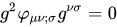
Theories of wormhole metrics describe the spacetime geometry of a wormhole and serve as theoretical models for time travel. An example of a (traversable) wormhole metric is the following:

first presented by Ellis (see Ellis wormhole) as a special case of the Ellis drainhole.

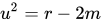
One type of non-traversable wormhole metric is the Schwarzschild solution (see the first diagram):

The original Einstein–Rosen bridge was described in an article published in July 1935.

For the Schwarzschild spherically symmetric static solution

where is the proper time and .

If one replaces with according to

The four-dimensional space is described mathematically by two congruent parts or "sheets", corresponding to and , which are joined by a hyperplane or in which vanishes. We call such a connection between the two sheets a "bridge".

— A. Einstein, N. Rosen, "The Particle Problem in the General Theory of Relativity"

For the combined field, gravity and electricity, Einstein and Rosen derived the following Schwarzschild static spherically symmetric solution

where is the electric charge.

The field equations without denominators in the case when can be written


In order to eliminate singularities, if one replaces by according to the equation:
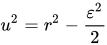
and with one obtains

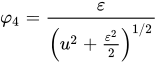
and

The solution is free from singularities for all finite points in the space of the two sheets

— A. Einstein, N. Rosen, "The Particle Problem in the General Theory of Relativity"

In fiction

Wormholes are a common element in science fiction because they allow interstellar, intergalactic, and sometimes even interuniversal travel within human lifetime scales. In fiction, wormholes have also served as a method for time travel.

Warp portals and higher-dimensional shortcuts

In theoretical physics and science fiction, the concept of a warp or warp portal is frequently used to describe shortcuts through space that are only possible by accessing a higher spatial dimension. Just as a two-dimensional space would require a third spatial dimension to bend or fold its plane in order to bring two distant points together, a three-dimensional space must be embedded within a fourth spatial dimension to allow similar manipulation. This analogy underlies many depictions of warp portals, which function by bending or folding three-dimensional space through the fourth spatial axis, allowing distant regions to become adjacent.

The existence of such a mechanism would imply that the universe possesses, or is embedded within, a four-dimensional spatial framework, even if that dimension is not directly observable. The geometry of these constructs is often modeled using solutions to Einstein's field equations, such as wormholes, and the Alcubierre warp bubble, both of which rely on higher-dimensional curvature.

Embryology

From Wikipedia, the free encyclopedia
1 - morula, 2 - blastula
1 - blastula, 2 - gastrula with blastopore; orange - ectoderm, red - endoderm

Embryology (from Greek ἔμβρυον, embryon, 'the unborn, embryo'; and -λογία, -logia) is the branch of zoology that studies the prenatal development of gametes sex cells, fertilization and development of embryos and fetuses. Embryology includes teratology, the study of congenital disorders that occur before birth.

Early embryology, put forward by Marcello Malpighi, was preformationist in concept: based on the idea that organisms develop from pre-existing miniature versions of themselves. The theory now accepted, epigenesis, is the idea that organisms develop from seed or egg in a sequence of steps. This concept was proposed in antiquity by Aristotle. Modern embryology developed from the work of Karl Ernst von Baer, though accurate observations had been made in Italy by anatomists such as Aldrovandi and Leonardo da Vinci in the Renaissance.

Comparative embryology

Preformationism and epigenesis

A tiny person (a homunculus) inside a sperm, as drawn by Nicolaas Hartsoeker in 1695

As recently as the 18th century, the prevailing notion in western human embryology was preformation: the idea that a sperm cell itself contains an embryo—a preformed, miniature infant, or homunculus—which simply becomes larger as it develops.

The competing explanation of embryonic development was epigenesis, originally proposed 2,000 years earlier by Aristotle. Much early embryology came from the work of the Italian anatomists Aldrovandi, Aranzio, Leonardo da Vinci, Marcello Malpighi, Gabriele Falloppio, Girolamo Cardano, Emilio Parisano, Fortunio Liceti, Stefano Lorenzini, Spallanzani, Enrico Sertoli, and Mauro Ruscóni. According to epigenesis, the form of an animal emerges gradually from a relatively formless egg. As microscopy improved during the 19th century, biologists could see that embryos took shape in a series of progressive steps, and epigenesis displaced preformation as the favored explanation among embryologists.

Cleavage

The cleavage phase of embryonic development is the series of several mitotic cell divisions that occurs immediately after the egg is fertilized by the sperm, producing the blastula (in mammals the blastocyst). The blastula is a single sheet of cells; in most phyla it then undergoes gastrulation. The resulting gastrula has in some species two, in most three, cell layers. The distinctive feature of cleavage, as a type of cell division, is that the cell divides without increase of cytoplasmic mass. The daughter cells share it, each having roughly half.

Overall, the cleavage phase of any species takes one of several forms. These forms are characteristic of different types of bilateral animal. (In the basal phyla cleavage is radial.)

Holoblastic

Holoblastic cleavage is cleavage of all the cells derived from the original zygote. The division furrow crosses the entire cell cluster; the whole cell cluster eventually becomes the embryo. (In meroblastic cleavage some cells will become the yolk sac.) Different types of animal differ in the geometry of the division furrow: cleavage is radial, spiral, bilateral or rotational.

Meroblastic

Meroblastic cleavage is the division of some but not all cells, as the division furrow does not protrude into the yolky region. The cells there impede formation of the associated membrane and only the other cells separate. Meroblastic cleavage is bilateral, discoidal or centrolecithal.

Basal phyla

Animals that belong to the basal phyla have holoblastic radial cleavage which results in radial symmetry (see: Symmetry in biology). During cleavage, there is a central axis that all divisions rotate about. The basal phyla also have only one to two embryonic cell layers, compared to the three in bilateral animals.

Bilaterians

In the bilateral animals cleavage can be either holoblastic or meroblastic. The subsequent gastrulation occurs in one of two ways, and this contrast divides the whole animal kingdom into two major groups (see: Embryological origins of the mouth and anus). In protostomes the first pore of the blastula (the blastopore) becomes the mouth of the animal; in deuterostomes the mouth derives from a later pore and the blastopore becomes the anus. The protostomes include most invertebrate animals, such as insects, worms and molluscs, while the deuterostomes include a few invertebrates such as the echinoderms (starfish and relatives) and all the vertebrates.

The bilaterian gastrula then develops three distinct layers of cells (the germ layers, endoderm, mesoderm and ectoderm); from them all the bodily organs and tissues subsequently arise.

Germ layers

  • The innermost layer, or endoderm, gives rise to the digestive organs, the gills, lungs or swim bladder if present, and kidneys or nephrites.
  • The middle layer, or mesoderm, gives rise to the muscles, skeleton if any, and blood system.
  • The outer layer of cells, or ectoderm, gives rise to the nervous system, including the brain, and skin or carapace, and hair, bristles or scales.

Drosophila melanogaster (fruit fly)

Drosophila have been used as a developmental model for many years. These studies have discovered many useful aspects of development that apply to other species. Outlined below is the process that leads to cell and tissue differentiation.

  1. Maternal-effect genes help to define the anterior-posterior axis using the bicoid and nanos genes.
  2. Gap genes establish three 'broad segments' of the embryo.
  3. Pair-rule genes define seven segments of the embryo within the second of those 'broad' segments.
  4. Segment-polarity genes divide each of those pre-existing seven segments into anterior and posterior halves (thus defining another seven segments), using a gradient of Hedgehog and Wnt signal proteins.
  5. Homeotic (Hox) genes use the 14 segments as pinpoints for specific types of cell differentiation and the histological developments that correspond to each cell type.

Humans

Humans are bilateral animals that have holoblastic rotational cleavage. Humans are also deuterostomes. In regard to humans, the term embryo refers to the ball of dividing cells from the moment the zygote implants itself in the uterus wall until the end of the eighth week after conception. Beyond the eighth week after conception (tenth week of pregnancy), the developing human is then called a fetus.

Evolutionary embryology

Evolutionary embryology is the expansion of comparative embryology by the ideas of Charles Darwin. Similarly to Karl Ernst von Baer's principles that explained why many species often appear similar to one another in early developmental stages, Darwin argued that the relationship between groups can be determined based upon common embryonic and larval structures.

Von Baer's principles

  1. The general features appear earlier in development than do the specialized features.
  2. More specialized characters develop from the more general ones.
  3. The embryo of a given species never resembles the adult form of a lower one.
  4. The embryo of a given species does resemble the embryonic form of a lower one.

Using Darwin's theory, evolutionary embryologists have since been able to distinguish between homologous and analogous structures appearing in different species. Homologous structures are those whose similarities derive from a common ancestor, such as the human arm and bat wings. Analogous structures are those that seem similar despite lacking common ancestral derivation.

Origins of modern embryology

Until the birth of modern embryology through observation of the mammalian ovum by Karl Ernst von Baer in 1827, there was no clear scientific understanding of embryology, although later discussions in this article show that some cultures had a fairly refined understanding of some of the principles. Only in the late 1950s when ultrasound was first used for uterine scanning, was the true developmental chronology of human fetus available. Karl Ernst von Baer along with Heinz Christian Pander, also proposed the germ layer theory of development which helped to explain how the embryo developed in progressive steps. Part of this explanation explored why embryos in many species often appear similar to one another in early developmental stages using his four principles.

Modern embryology research

Embryology is central to evolutionary developmental biology ("evo-devo"), which studies the genetic control of the development process (e.g. morphogens), its link to cell signalling, its roles in certain diseases and mutations, and its links to stem cell research. Embryology is the key to gestational surrogacy, which is when the sperm of the intended father and egg of intended mother are fused in a lab forming an embryo. This embryo is then put into the surrogate who carries the child to term.

Medical embryology

Medical embryology is used widely to detect abnormalities before birth. 2–5% of babies are born with an observable abnormality, and medical embryology explores the different ways and stages that these abnormalities appear. Genetically derived abnormalities are referred to as malformations. When there are multiple malformations, this is considered a syndrome. When abnormalities appear due to outside contributors, these are disruptions. The outside contributors causing disruptions are known as teratogens. Common teratogens are alcohol, retinoic acid, ionizing radiation or hyperthermic stress.

Vertebrate and invertebrate embryology

Many principles of embryology apply to invertebrates as well as to vertebrates. Therefore, the study of invertebrate embryology has advanced the study of vertebrate embryology. However, there are many differences as well. For example, numerous invertebrate species release a larva before development is complete; at the end of the larval period, an animal for the first time comes to resemble an adult similar to its parent or parents. Although invertebrate embryology is similar in some ways for different invertebrate animals, there are also countless variations. For instance, while spiders proceed directly from egg to adult form, many insects develop through at least one larval stage. For decades, a number of so-called normal staging tables were produced for the embryology of particular species, mainly focussing on external developmental characters. As variation in developmental progress makes comparison among species difficult, a character-based Standard Event System was developed, which documents these differences and allows for phylogenetic comparisons among species.

Origin of developmental biology

After the 1950s, with the DNA helical structure being unraveled and the increasing knowledge in the field of molecular biology, developmental biology emerged as a field of study which attempts to correlate the genes with morphological change, and so tries to determine which genes are responsible for each morphological change that takes place in an embryo, and how these genes are regulated.

As of today, human embryology is taught as a cornerstone subject in medical schools, as well as in biology and zoology programs at both an undergraduate and graduate level.

History

Ancient Egypt

Knowledge of the placenta goes back at least to ancient Egypt, where it was viewed as the seat of the soul. There was an Egyptian official with the title Opener of the Kings Placenta. An Egyptian text from the time of Akhenaten said that a human originates from the egg that grows in women.

Ancient Asia

Various interpretations of embryology have existed in Asia throughout history. Included in the ancient Indian tradition of Ayurveda is garbhasharir or the study of embryology, which refers to conceptions of embryology from antiquity. Descriptions of the amniotic sac appear in the Bhagavad Gita, Bhagavata Purana, and the Sushruta Samhita. One of the Upanishads known as the Garbhopanisaḍ states that the embryo is "like water in the first night, in seven nights it is like a bubble, at the end of half a month it becomes a ball. At the end of a month it is hardened, in two months the head is formed". In Indian literature, the start of consciousness in an embryo is not clearly defined. Some scriptures state that it is active at conception, while others suggest that consciousness begins in the seventh to ninth month of fetal development. Many South Asian traditions, including some Tibetan traditions, believe that the fetus has conscious experiences towards the end of its development.

The development of the human embryo is mentioned in the ancient Buddhist text of Garbhāvakrāntisūtra (1st–4th century CE). It mentions the human gestation period of 38 days. The text describes embryonic development in first three weeks as a liquid part of yogurt and the differentiation of body parts such as arms, leg, feet and head in the third month.

Ancient Greece

Pre-Socratic philosophers

Many pre-Socratic philosophers are recorded as having opinions on different aspects of embryology, although there is some bias in the description of their views in later authors such as Aristotle. According to Empedocles (whose views are described by Plutarch in the 1st century AD), who lived in the 5th century BC, the embryo derives and receives its blood from four vessels in all; two arteries and two veins. He also held sinews as originating from equal mixtures of earth and air. He further said men begin to form within the first month and are finished within fifty days. Asclepiades agreed that men are formed within fifty days, but he believed that women took a full two months to be fully knit. One observation, variously attributed to either Anaxagoras of Clazomenae or Alcmaeon of Croton, says that the milk produced by mammals is analogous to the white of fowl egg. Diogenes of Apollonia said that a mass of flesh forms first, only then followed by the development of bone and nerves. Diogenes recognized that the placenta was a nutritional source for the growing fetus. He also said that the development of males took four months, but that the development of females took five months. He did not think the embryo was alive. Alcmaeon also made some contributions, and is the first person reported to have practiced dissection. One idea, first stated by Parmenides, was that there was a connection between the right side of the body and the male embryo, and between the left side of the body and the female embryo. According to Democritus and Epicurus, the fetus is nourished at the mouth inside the mother and there are comparable teats that supply this nourishment within the mother's body to the fetus. Discussion on various views regarding how long it takes for specific parts of the embryo to form appear in an anonymous document known as the Nutriment.

Ancient Greeks discussed whether only the male had a seed which developed into the embryo within the female womb, or both the male and the female each had a seed that made a contribution to the developing embryo. The difficulty that one-seed theorists confronted was to explain the maternal resemblance of the progeny. One issue that two-seed theorists confronted was why the female seed was needed if the male already had a seed. One common solution to this problem was to assert that the female seed was either inferior or inactive. Another question was the origin of the seed. The encephalomyelogenic theory stated that the seed originated from the brain or and/or bone marrow. Later came pangenesis, which asserted the seed was drawn from the whole body in order to explain the general resemblance in the body of the offspring. Later on, hematogenous theory developed, which asserted that the seed was drawn from the blood. A third question was how or in what form the progeny existed in the seed prior to developing into an embryo and a fetus. According to preformationists, the body of the progeny already existed in a pre-existing but undeveloped form in the seed. Three variants of preformationism were homoiomerous preformationism, anhomoiomerous preformationism, and homuncular preformationism. According to the first, the homoiomerous parts of the body (e.g. humors, bone) already exist pre-formed in the seed. The second held that it was the anhomoiomerous parts that were pre-formed. Finally, the third view held that the whole was already a unified organic thing. Preformationism was not the only view. According to epigenesists, parts of the embryo successively form after conception takes place.

Hippocrates

Some of the most well-known early ideas on embryology come from Hippocrates and the Hippocratic Corpus, where discussion on the embryo is usually given in the context of discussing obstetrics (pregnancy and childbirth). Some of the most relevant Hippocratic texts on embryology include the Regimen on Acute Diseases, On Semen, and On the Development of the Child. Hippocrates claimed that the development of the embryo is put into motion by fire and that nourishment comes from food and breath introduced into the mother. An outer layer of the embryo solidifies, and the fire within consumes humidity which makes way for development of bone and nerve. The fire in the innermost part becomes the belly and air channels are developed in order to route nourishment to it. The enclosed fire also helps form veins and allows for circulation. In this description, Hippocrates aims at describing the causes of development rather than describing what develops. Hippocrates also develops views similar to preformationism, where he claims that all parts of the embryo simultaneously develop. Hippocrates also believed that maternal blood nourishes the embryo. This blood flows and coagulates to help form the flesh of the fetus. This idea was derived from the observation that menstrual blood ceases during pregnancy, which Hippocrates took to imply that it was being redirected to fetal development. Hippocrates also claimed that the flesh differentiates into different organs of the body, and Hippocrates saw as analogous an experiment where a mixture of substances placed into water will differentiate into different layers. Comparing the seed to the embryo, Hippocrates further compared the stalk to the umbilical cord.

Aristotle

Some embryological discussion appears in the writings of Aristotle's predecessor Plato, especially in his Timaeus. One of his views were that the bone marrow acted as the seedbed, and that the soul itself was the seed out of which the embryo developed, though he did not explain how this development proceeded. Scholars also continue to debate the views he held on various other aspects of embryology. However, a much more voluminous discussion on the subject comes from the writings of Aristotle, especially as appears in his On the Generation of Animals. Some ideas related to embryology also appear in his History of Animals, On the Parts of Animals, On Respiration, and On the Motion of Animals. Means by which we know Aristotle studied embryology, and most likely his predecessors as well, was through studying developing embryos taken out from animals as well as aborted and miscarried human embryos. Aristotle believed that the female supplied the matter for the development of the embryo formed from the menstrual blood, whereas the semen that comes from the male shapes that matter. Aristotle's belief that both the male and female made a contribution to the actual fetus goes against some prior beliefs. According to Aeschylus and some Egyptian traditions, the fetus solely develops from the male contribution and that the female womb simply nourishes this growing fetus. On the other hand, the Melanesians held that the fetus is solely a product of the female contribution. Aristotle did not believe there were any external influences on the development of the embryo. Against Hippocrates, Aristotle believed that new parts of the body developed over time rather than all forming immediately and developing from then on. He also considered whether each new part derives from a previously formed part or develops independently of any previously formed part. On the basis that different parts of the body do not resemble each other, he decided in favor of the latter view. He also described development of fetal parts in terms of mechanical and automatic processes. In terms of the development of the embryo, he says it begins in a liquid-like state as the material secreted by the female combines with the semen of the male, and then the surface begins to solidify as it interacts with processes of heating and cooling. The first part of the body to differentiate is the heart, which Aristotle and many of his contemporaries believed was the location of reason and thinking. Aristotle claimed that vessels join to the uterus in order to supply nourishment to the developing fetus. Some of the most solid parts of the fetus cool and, as they lose moisture to heat, turn into nails, horns, hoofs, beaks, etc. Internal heat dries away moisture and forms sinews and bones and the skin results from drying of the flesh. Aristotle also describes the development of birds in eggs at length. He further described embryonic development in dolphins, some sharks, and many other animals. Aristotle singularly wrote more on embryology than any other pre-modern author, and his influence on the subsequent discussion on the subject for many centuries was immense, introducing into the subject forms of classification, a comparative method from various animals, discussion of the development of sexual characteristics, compared the development of the embryo to mechanistic processes, and so forth.

Later Greek embryology

Reportedly, some Stoics claimed that most parts of the body formed at once during embryological development. Some Epicureans claimed that the fetus is nourished by either the amniotic fluid or the blood, and that both male and female supply material to the development of the fetus. According to the writings of Tertullian, Herophilus in the 5th century BC described the ovaries and fallopian tubes (but not past what was already described by Aristotle) and also dissected some embryos. One advance Herophilus made, against the conceptions of other individuals such as Aristotle, was that the brain was the center of intellect rather than the heart. Though not a part of Greek tradition, in Job 10, the formation of the embryo is likened to the curdling of milk into cheese, as described by Aristotle. Whereas Needham sees this statement in Job as part of the Aristotelian tradition, others see it as evidence that the milk analogy predates the Aristotelian Greek tradition and originates in Jewish circles. In addition, the Wisdom of Solomon (7:2) also has the embryo formed from menstrual blood. Soranus of Ephesus also wrote texts on embryology which went into use for a long time. Some rabbinic texts discuss the embryology of a female Greek writer named Cleopatra, a contemporary of Galen and Soranus, who was said to have claimed that the male fetus is complete in 41 days whereas the female fetus is complete in 81 days. Various other texts of less importance also appear and describe various aspects of embryology, though without making much progress from Aristotle. Plutarch has a chapter in one of his works titled "Whether was before, the hen or egg?" Discussion on embryological tradition also appears in many Neoplatonic traditions.

Next to Aristotle, the most impactful and important Greek writer on biology was Galen of Pergamum, and his works were transmitted throughout the Middle Ages. Galen discusses his understanding of embryology in two of his texts, those being his On the Natural Faculties and his On the Formation of the Foetus. There is an additional text spuriously attributed to Galen known as On the Question of whether the Embryo is an Animal. Galen described embryological development in four stages. In the first stage, the semen predominates. In the second stage, the embryo is filled with blood. In the third stage, the main outlines of the organs have developed but various other parts remain undeveloped. In the fourth stage, formation is complete and has reached a stage where we can call it a child. Galen described processes that played a role in furthering development of the embryo such as warming, drying, cooling, and combinations thereof. As this development plays out, the form of life of the embryo also moves from that like a plant to that of an animal (where the analogy between the root and umbilical cord is made). Galen claimed that the embryo forms from menstrual blood, by which his experimental analogy was that when you cut the vein of an animal and allow blood to flow out and into some mildly heated water, a sort of coagulation can be observed. He gave detailed descriptions of the position of the umbilical cord relative to other veins.

Patristics

The question of embryology is discussed among a number of early Christian writers, largely in terms of theological questions such as whether the fetus has value and/or when it begins to have value. (Although a number of Christian authors continued the classical discussions on the description of the development of the embryo, such as Jacob of Serugh. Passing reference to the embryo also appears in the eighth hymn of Ephrem the Syrian's Paradise Hymns.) Many patristic treatments of embryology continued in the stream of Greek tradition. The earlier Greek and Roman view that it was not was reversed and all pre-natal infanticide was condemned. Tertullian held that the soul was present from the moment of conception. The Quinisext Council concluded that "we pay no attention to the subtle division as to whether the foetus is formed or unformed". In this time, then, the Roman practice of child exposure came to an end, where unwanted yet birthed children, usually females, were discarded by the parents to die. Other more liberal traditions followed Augustine, who instead viewed that the animation of life began on the 40th day in males and the 80th day in females but not prior. Before the 40th day for men and 80th day for women, the embryo was referred to as the embryo informatus, and after this period was reached, it was referred to as the embryo formatus. The notion originating from the Greeks that the male embryo developed faster remained in various authors until it was experimentally disproven by Andreas Ottomar Goelicke in 1723.

Various patristic literature from backgrounds ranging from Nestorian, Miaphysite and Chalcedonian discuss and choose between three different conceptions on the relation between the soul and the embryo. According to one view, the soul pre-exists and enters the embryo at the moment of conception (prohyparxis). According to a second view, the soul enters into existence at the moment of conception (synhyparxis). In a third view, the soul enters into the body after it has been formed (methyparxis). The first option was proposed by Origen, but was increasingly rejected after the fourth century. On the other hand, the other two options were equally accepted after this point. The second position appears to have been proposed as a response to Origen's notion of a pre-existing soul. After the sixth century, the second position was also increasingly seen as Origenist and so rejected on those grounds. The writings of Origen were condemned during the Second Origenist Crises in 553. Those defending prohyparxis usually appealed to the Platonic notion of an eternally moving soul. Those defending the second position also appealed to Plato but rejected his notion on the eternality of the soul. Finally, those appealing to the third position appealed both to Aristotle and scripture. Aristotelian notions included the progression of the development of the soul, from an initial plant-like soul, to a sensitive soul found in animals and allows for movement and perception, and finally the formation of a rational soul which can only be found in the fully-formed human. Furthermore, some scriptural texts were seen as implying the formation of the soul temporally after the formation of the body (namely Genesis 2:7; Exodus 21:22–23; Zachariah 12:1). In the De hominis opificio of Gregory of Nyssa, Aristotle's triparitate notion of the soul was accepted. Gregory also held that the rational soul was present at conception. Theodoret argued based on Genesis 2:7 and Exodus 21:22 that the embryo is only ensouled after the body is fully formed. Based on Exodus 21:22 and Zachariah 12:1, Philoxenus of Mabbug claimed that the soul was created in the body forty days after conception. In his De opificio mundi, the Christian philosopher John Philoponus claimed that the soul is formed after the body. Later still, the author Leontius held that the body and soul were created simultaneously, though it is also possible he held that the soul pre-existed the body.[27]

Some Miaphysites and Chalcedonians seemed to have been compelled into accepting synhyparxis in the case of Jesus because of their view that the incarnation of Christ resulted in both one hypostasis and one nature, whereas some Nestorians claimed that Christ, like us, must have had his soul formed after the formation of his body because, per Hebrews 4:15, Christ was like us in all ways but sin. (On the other hand, Leontinus dismissed the relevance of Hebrews 4:15 on the basis that Christ differed from us not only in sinfulness but also conception without semen, making synhyparxis another of Christ's supernatural feats.) They felt comfortable holding this view, under their belief that the human nature of Jesus was separate from the divine hypostasis. Some Nestorians still wondered, however, if the body united with the soul in the moment the soul was created or whether it came with it only later. The Syriac author Babai argued for the former on the basis that the latter was hardly better than adoptionism. Maximus the Confessor ridiculed the Aristotelian notion of the development of the soul on the basis that it would make humans parents of both plants and animals. He held to synhyparxis and regarded the other two positions both as incorrect extremes. After the 7th century, Chalcedonian discussion on embryology is slight and the few works that touch on the topic support synhyparxis. But debate among other groups remains lively, still divided on similar sectarian grounds. The patriarch Timothy I argued that the Word first united with the body, and only later with the soul. He cited John 1:1, claiming on its basis that the Word became flesh first, not a human being first. Then, Jacob of Edessa rejected prohyparxis because Origen had defended it and methyparxis because he believed that it made the soul ontologically inferior and as only being made for the body. Then, Moses Bar Kepha claimed, for Christological reasons as a Miaphysite, that only synhyparxis was acceptable. He claimed that Genesis 2:7 has no temporal sequence and that Exodus 21:22 regards the formation of the body and not the soul and so is not relevant. To argue against methyparxis, he reasoned that body and soul are both present at death and, because what is at the end must correspond to what is also at the beginning, conception must also have body and soul together.

Embryology in Jewish tradition

Many Jewish authors also discussed notions of embryology, especially as they appear in the Talmud. Much of the embryological data in the Talmud is part of discussions related to the impurity of the mother after childbirth. The embryo was described as the peri habbetten (fruit of the body) and it developed through various stages: (1) golem (formless and rolled-up) (2) shefir meruqqam (embroidered foetus) (3) ubbar (something carried) (4) walad (child) (5) walad shel qayama (viable child) (6) ben she-kallu khadashaw (child whose months have been completed).

Some mystical notions regarding embryology appear in the Sefer Yetzirah. The text in the Book of Job relating to the fetus forming by analogy to the curdling of milk into cheese was cited in the Babylonian Talmud and in even greater detail in the Midrash: "When the womb of the woman is full of retained blood which then comes forth to the area of her menstruation, by the will of the Lord comes a drop of white-matter which falls into it: at once the embryo is created. [This can be] compared to milk being put in a vessel: if you add to it some lab-ferment [drug or herb], it coagulates and stands still; if not, the milk remains liquid." The Talmud sages held that there were two seeds that participated in the formation of the embryo, one from the male and one from the female, and that their relative proportions determine whether that develops into a male or a female.

In the Tractate Nidda, the mother was said to provide a "red-seed" which allows for the development of skin, flesh, hair, and the black part of the eye (pupil), whereas the father provides the "white-seed" which forms the bones, nerves, brain, and the white part of the eye. And finally, God himself was thought to provide the spirit and soul, facial expressions, capacity for hearing and vision, movement, comprehension, and intelligence. Not all strands of Jewish tradition accepted that both the male and female contributed parts to the formation of the fetus.

The 13th century medieval commentator Nachmanides, for example, rejected the female contribution. In Tractate Hullin in the Talmud, whether the organs of the child resemble more closely those of the mother or father is said to depend on which one contribute more matter to the embryo depending on the child. Rabbi Ishmael and other sages are said to have disagreed on one matter: they agreed that the male embryo developed on the 41st day, but disagreed on whether this was the case for the female embryo. Some believed that the female embryo was complete later, whereas others held that they were finished at the same time. The only ancient Jewish authors who associated abortion with homicide were Josephus and Philo of Alexandria in the 1st century. In the Talmud, a child is granted humanness at birth, while other rabbinical texts place it at the 13th postnatal day.

Some Talmudic texts discuss magical influences on the development of the embryo, such as one text which claims that if one sleeps on a bed that is pointed to the north–south will have a male child. According to Nachmanides, a child born of a cold drop of semen will be foolish, one born from a warm drop of semen will be passionate and irascible, and one born from a semen drop of medium temperature will be clever and level-headed. Some Talmudic discussions follow from Hippocratic claims that a child born on the eighth month could not survive, whereas others follow Aristotle in claiming that they sometimes could survive. One text even says that survival is possible on the seventh month, but not the eighth. Talmudic embryology, in various aspects, follows Greek discourses especially from Hippocrates and Aristotle, but in other areas, makes novel statements on the subject.

Judaism allows assisted reproduction, such as in vitro fertilization (IVF) embryo transfer and maternal surrogacy, when the spermatozoon and oocyte originate from the respective husband and wife.

Embryology in the Islamic tradition

A passing reference to embryological notions also appears in the Qur'an (22:5), where the development of the embryo proceeds in four stages from drop, to a clinging clot, to a partially developed stage, to a fully developed child. The notion of clay turning into flesh is seen by some as analogous to a text by Theodoret that describes the same process. The four stages of development in the Qur'an are similar to the four stages of embryological development as described by Galen. In the early 6th century, Sergius of Reshaina devoted himself to the translation of Greek medical texts into Syriac and became the most important figure in this process. Included in his translations were the relevant embryological texts of Galen. Anurshirvan founded a medical school in the southern Mesopotamian city of Gundeshapur, known as the Academy of Gondishapur, which also acted as a medium for the transmission, reception, and development of notions from Greek medicine. These factors helped the transmission of Greek notions on embryology, such as found in Galen, to enter into the Arabian milieu. Very similar embryonic descriptions also appear in the Syriac Jacob of Serugh's letter to the Archdeacon Mar Julian.

Embryological discussions also appear in the Islamic legal tradition.

Wormhole

From Wikipedia, the free encyclopedia https://en.wikipedia.org/wiki/Wormhole...