Search This Blog

Wednesday, August 2, 2023

Modal realism

From Wikipedia, the free encyclopedia
https://en.wikipedia.org/wiki/Modal_realism

Modal realism is the view propounded by philosopher David Lewis that all possible worlds are real in the same way as is the actual world: they are "of a kind with this world of ours." It is based on four tenets: possible worlds exist, possible worlds are not different in kind from the actual world, possible worlds are irreducible entities, and the term actual in actual world is indexical, i.e. any subject can declare their world to be the actual one, much as they label the place they are "here" and the time they are "now".

Extended modal realism is a form of modal realism that involves ontological commitments not just to possible worlds but also to impossible worlds. Objects are conceived as being spread out in the modal dimension, i.e. as having not just spatial and temporal parts but also modal parts. This contrasts with Lewis' modal realism according to which each object only inhabits one possible world.

Common arguments for modal realism refer to their theoretical usefulness for modal reasoning and to commonly accepted expressions in natural language that seem to imply ontological commitments to possible worlds. A common objection to modal realism is that it leads to an inflated ontology, which some think to run counter to Occam's razor. Critics of modal realism have also pointed out that it is counterintuitive to allow possible objects the same ontological status as actual objects. This line of thought has been further developed in the argument from morality by showing how an equal treatment of actual and non-actual persons would lead to highly implausible consequences for morality, culminating in the moral principle that every choice is equally permissible.

The term possible world

The term goes back to Leibniz's theory of possible worlds, used to analyse necessity, possibility, and similar modal notions. In short: the actual world is regarded as merely one among an infinite set of logically possible worlds, some "nearer" to the actual world and some more remote. A proposition is necessary if it is true in all possible worlds, and possible if it is true in at least one.

Main tenets

At the heart of David Lewis's modal realism are six central doctrines about possible worlds:

  1. Possible worlds exist – they are just as real as our world;
  2. Possible worlds are the same sort of things as our world – they differ in content, not in kind;
  3. Possible worlds cannot be reduced to something more basic – they are irreducible entities in their own right.
  4. Actuality is indexical. When we distinguish our world from other possible worlds by claiming that it alone is actual, we mean only that it is our world.
  5. Possible worlds are unified by the spatiotemporal interrelations of their parts; every world is spatiotemporally isolated from every other world.
  6. Possible worlds are causally isolated from each other.

Details and alternatives

In philosophy possible worlds are usually regarded as real but abstract possibilities (i.e. platonism), or sometimes as a mere metaphor, abbreviation, or as mathematical devices, or a mere combination of propositions.

Lewis himself not only claimed to take modal realism seriously (although he did regret his choice of the expression modal realism), he also insisted that his claims should be taken literally:

By what right do we call possible worlds and their inhabitants disreputable entities, unfit for philosophical services unless they can beg redemption from philosophy of language? I know of no accusation against possibles that cannot be made with equal justice against sets. Yet few philosophical consciences scruple at set theory. Sets and possibles alike make for a crowded ontology. Sets and possibles alike raise questions we have no way to answer. [...] I propose to be equally undisturbed by these equally mysterious mysteries.

How many [possible worlds] are there? In what respects do they vary, and what is common to them all? Do they obey a nontrivial law of identity of indiscernibles? Here I am at a disadvantage compared to someone who pretends as a figure of speech to believe in possible worlds, but really does not. If worlds were creatures of my imagination, I could imagine them to be any way I liked, and I could tell you all you wished to hear simply by carrying on my imaginative creation. But as I believe that there really are other worlds, I am entitled to confess that there is much about them that I do not know, and that I do not know how to find out.

Extended modal realism

Extended modal realism, as developed by Takashi Yagisawa, differs from other versions of modal realism, such as David Lewis' views, in several important aspects. Possible worlds are conceived as points or indices of the modal dimension rather than as isolated space-time structures. Regular objects are extended not only in the spatial and the temporal dimensions but also in the modal dimension: some of their parts are modal parts, i.e. belong to non-actual worlds. The concept of modal parts is best explained in analogy to spatial and temporal parts. My hand is a spatial part of myself just as my childhood is a temporal part of myself, according to four-dimensionalism. These intuitions can be extended to the modal dimension by considering possible versions of myself which took different choices in life than I actually did. According to extended modal realism, these other selves are inhabitants of different possible worlds and are also parts of myself: modal parts.

Another difference to the Lewisian form of modal realism is that among non-actual worlds within the modal dimension are not just possible worlds but also impossible worlds. Yagisawa holds that while the notion of a world is simple, being a modal index, the notion of a possible world is composite: it is a world that is possible. Possibility can be understood in various ways: there is logical possibility, metaphysical possibility, physical possibility, etc. A world is possible if it doesn't violate the laws of the corresponding type of possibility. For example, a world is logically possible if it obeys the laws of logic or physically possible if it obeys the laws of nature. Worlds that don't obey these laws are impossible worlds. But impossible worlds and their inhabitants are just as real as possible or actual entities.

Arguments for modal realism

Reasons given by Lewis

Lewis backs modal realism for a variety of reasons. First, there doesn't seem to be a reason not to. Many abstract mathematical entities are held to exist simply because they are useful. For example, sets are useful, abstract mathematical constructs that were only conceived in the 19th century. Sets are now considered to be objects in their own right, and while this is a philosophically unintuitive idea, its usefulness in understanding the workings of mathematics makes belief in it worthwhile. The same should go for possible worlds. Since these constructs have helped us make sense of key philosophical concepts in epistemology, metaphysics, philosophy of mind, etc., their existence should be accepted on pragmatic grounds.

Lewis believes that the concept of alethic modality can be reduced to talk of real possible worlds. For example, to say "x is possible" is to say that there exists a possible world where x is true. To say "x is necessary" is to say that in all possible worlds x is true. The appeal to possible worlds provides a sort of economy with the least number of undefined primitives/axioms in our ontology.

Taking this latter point one step further, Lewis argues that modality cannot be made sense of without such a reduction. He maintains that we cannot determine that x is possible without a conception of what a real world where x holds would look like. In deciding whether it is possible for basketballs to be inside of atoms we do not simply make a linguistic determination of whether the proposition is grammatically coherent, we actually think about whether a real world would be able to sustain such a state of affairs. Thus we require a brand of modal realism if we are to use modality at all.

Argument from ways

Possible worlds are often regarded with suspicion, which is why their proponents have struggled to find arguments in their favor. An often-cited argument is called the argument from ways. It defines possible worlds as "ways how things could have been" and relies for its premises and inferences on assumptions from natural language, for example:

(1) Hillary Clinton could have won the 2016 US election.
(2) So there are other ways how things could have been.
(3) Possible worlds are ways how things could have been.
(4) So there are other possible worlds.

The central step of this argument happens at (2) where the plausible (1) is interpreted in a way that involves quantification over "ways". Many philosophers, following Willard Van Orman Quine, hold that quantification entails ontological commitments, in this case, a commitment to the existence of possible worlds. Quine himself restricted his method to scientific theories, but others have applied it also to natural language, for example, Amie L. Thomasson in her easy approach to ontology. The strength of the argument from ways depends on these assumptions and may be challenged by casting doubt on the quantifier-method of ontology or on the reliability of natural language as a guide to ontology.

Criticisms

A number of philosophers, including Lewis himself, have produced criticisms of (what some call) "extreme realism" about possible worlds.

Lewis's own critique

Lewis's own extended presentation of the theory (On the Plurality of Worlds, 1986) raises and then counters several lines of argument against it. That work introduces not only the theory, but its reception among philosophers. The many objections that continue to be published are typically variations on one or other of the lines that Lewis has already canvassed.

Here are some of the major categories of objection:

  • Catastrophic counterintuitiveness. The theory does not accord with our deepest intuitions about reality. This is sometimes called "the incredulous stare", since it lacks argumentative content, and is merely an expression of the affront that the theory represents to "common sense" philosophical and pre-philosophical orthodoxy. Lewis is concerned to support the deliverances of common sense in general: "Common sense is a settled body of theory — unsystematic folk theory — which at any rate we do believe; and I presume that we are reasonable to believe it. (Most of it.)" (1986, p. 134). But most of it is not all of it (otherwise there would be no place for philosophy at all), and Lewis finds that reasonable argument and the weight of such considerations as theoretical efficiency compel us to accept modal realism. The alternatives, he argues at length, can themselves be shown to yield conclusions offensive to our modal intuitions.
  • Inflated ontology. Some object that modal realism postulates vastly too many entities, compared with other theories. It is therefore, they argue, vulnerable to Occam's razor, according to which we should prefer, all things being equal, those theories that postulate the smallest number of entities. Lewis's reply is that all things are not equal, and in particular competing accounts of possible worlds themselves postulate more classes of entities, since there must be not only one real "concrete" world (the actual world), but many worlds of a different class altogether ("abstract" in some way or other).
  • Too many worlds. This is perhaps a variant of the previous category, but it relies on appeals to mathematical propriety rather than Occamist principles. Some argue that Lewis's principles of "worldmaking" (means by which we might establish the existence of further worlds by recombination of parts of worlds we already think exist) are too permissive. So permissive are they, in fact, that the total number of worlds must exceed what is mathematically coherent. Lewis allows that there are difficulties and subtleties to address on this front (1986, pp. 89–90). Daniel Nolan ("Recombination unbound", Philosophical Studies, 1996, vol. 84, pp. 239–262) mounts a sustained argument against certain forms of the objection; but variations on it continue to appear.
  • Island universes. On the version of his theory that Lewis strongly favours, each world is distinct from every other world by being spatially and temporally isolated from it. Some have objected that a world in which spatio-temporally isolated universes ("island universes") coexist is therefore not possible, by Lewis's theory (see for example Bigelow, John, and Pargetter, Robert, "Beyond the blank stare", Theoria, 1987, Vol. 53, pp. 97–114). Lewis's awareness of this difficulty discomforted him; but he could have replied that other means of distinguishing worlds may be available, or alternatively that sometimes there will inevitably be further surprising and counterintuitive consequences — beyond what we had thought we would be committed to at the start of our investigation. But this fact in itself is hardly surprising. Plantinga also wonders why we would think that possibility is grounded in some other multi-verse counterpart to me if we were to discover other universes. If not, then why think the same would apply to possible worlds as a whole?

Finally, some of these objections can be combined. For example, one can think that modal realism is unnecessary because multiverse theory can do all the modal work (e.g. many "worlds" interpretation of quantum mechanics).

A pervasive theme in Lewis's replies to the critics of modal realism is the use of tu quoque argument: your account would fail in just the same way that you claim mine would. A major heuristic virtue of Lewis's theory is that it is sufficiently definite for objections to gain some foothold; but these objections, once clearly articulated, can then be turned equally against other theories of the ontology and epistemology of possible worlds.

Stalnaker's response

Robert Stalnaker, while he finds some merit in Lewis's account of possible worlds, finds the position to be ultimately untenable. He himself advances a more "moderate" realism about possible worlds, which he terms actualism (since it holds that all that exists is in fact actual, and that there are no "merely possible" entities). In particular, Stalnaker does not accept Lewis's attempt to argue on the basis of a supposed analogy with the epistemological objection to mathematical Platonism that believing in possible worlds as Lewis imagines them is no less reasonable than believing in mathematical entities such as sets or functions.

Kripke's response

Saul Kripke described modal realism as "totally misguided", "wrong", and "objectionable". Kripke argued that possible worlds were not like distant countries out there to be discovered; rather, we stipulate what is true according to them. Kripke also criticized modal realism for its reliance on counterpart theory, which he regarded as untenable. Specifically, Kripke states that Lewis' modal realism implies that when we refer to possibilities regarding persons like you or me, we're not referring to you or me. Instead, we're referring to counterparts who are similar to us but not identical. This seems problematic because it seems like when, for example, we say that, 'Humphrey could have become President', we are talking about Humphrey (and we're not talking about a person that is like Humphrey). Lewis responds by saying this objection (i.e. The Humphrey Objection) wouldn't apply to modal realists who believe that the identity of persons can "overlap" in multiple worlds, even though Lewis thinks that view is problematic. Secondly, Lewis doesn't seem to share the intuition that there is any problem, as evidenced by the fact that he calls it an "alleged" intuition.

Argument from morality

The argument from morality, as initially formulated by Robert Merrihew Adams, criticizes modal realism on the grounds that modal realism has very implausible consequences for morality and should therefore be rejected. This can be seen by considering the principle of plenitude: the thesis that there is a possible world for every way things could be. The consequence of this principle is that the nature of the pluriverse, i.e. of reality in the widest sense, is fixed. This means that whatever choices human agents make, they have no impact on reality as a whole. For example, assume that during a stroll at a lake you spot a drowning child not far from the shore. You have a choice to save the child or not to. If you choose to save the child then a counterpart of you at another possible world chooses to let it drown. If you choose to let it drown then the counterpart of you at this other possible world chooses to save it. Either way, the result for these two possible worlds is the same: one child drowns and the other is saved. The only impact of your choice is to relocate a death from the actual world to another possible world. But since, according to modal realism, there is no important difference between the actual world and other possible worlds, this shouldn't matter. The consequence would be that there is no moral obligation to save the child, which is drastically at odds with common-sense morality. Worse still, this argument can be generalized to any decision, so whatever you choose in any decision would be morally permissible.

David Lewis defends moral realism against this argument by pointing out that morality, as commonly conceived, is only interested in the actual world, specifically, that the actual agent doesn't do evil. So the argument from morality would only be problematic for an odd version of utilitarianism aiming at maximizing the "sum total of good throughout the plurality of worlds". But, as Mark Heller points out, this reply doesn't explain why we are justified in morally privileging the actual world, as modal realism seems to be precisely against such a form of unequal treatment. This is not just a problem for utilitarians but for any moral theory that is sensitive to how other people are affected by one's actions in the widest sense, causally or otherwise: "the modal realist has to consider more people in moral decision making than we ordinarily do consider". Bob Fischer, speaking on Lewis' behalf, concedes that, from a modally unrestricted point of view of morality, there is no obligation to save the child from drowning. Common-sense morality, on the other hand, assumes a modally restricted point of view. This disagreement with common-sense is a cost of modal realism to be considered in an overall cost-benefit calculation, but it is no knockdown argument.

Tests of special relativity

From Wikipedia, the free encyclopedia

Special relativity is a physical theory that plays a fundamental role in the description of all physical phenomena, as long as gravitation is not significant. Many experiments played (and still play) an important role in its development and justification. The strength of the theory lies in its unique ability to correctly predict to high precision the outcome of an extremely diverse range of experiments. Repeats of many of those experiments are still being conducted with steadily increased precision, with modern experiments focusing on effects such as at the Planck scale and in the neutrino sector. Their results are consistent with the predictions of special relativity. Collections of various tests were given by Jakob Laub, Zhang, Mattingly, Clifford Will, and Roberts/Schleif.

Special relativity is restricted to flat spacetime, i.e., to all phenomena without significant influence of gravitation. The latter lies in the domain of general relativity and the corresponding tests of general relativity must be considered.

Experiments paving the way to relativity

The predominant theory of light in the 19th century was that of the luminiferous aether, a stationary medium in which light propagates in a manner analogous to the way sound propagates through air. By analogy, it follows that the speed of light is constant in all directions in the aether and is independent of the velocity of the source. Thus an observer moving relative to the aether must measure some sort of "aether wind" even as an observer moving relative to air measures an apparent wind.

First-order experiments

Fizeau experiment, 1851

Beginning with the work of François Arago (1810), a series of optical experiments had been conducted, which should have given a positive result for magnitudes of first order in (i.e., of ) and which thus should have demonstrated the relative motion of the aether. Yet the results were negative. An explanation was provided by Augustin Fresnel (1818) with the introduction of an auxiliary hypothesis, the so-called "dragging coefficient", that is, matter is dragging the aether to a small extent. This coefficient was directly demonstrated by the Fizeau experiment (1851). It was later shown that all first-order optical experiments must give a negative result due to this coefficient. In addition, some electrostatic first-order experiments were conducted, again having a negative results. In general, Hendrik Lorentz (1892, 1895) introduced several new auxiliary variables for moving observers, demonstrating why all first-order optical and electrostatic experiments have produced null results. For example, Lorentz proposed a location variable by which electrostatic fields contract in the line of motion and another variable ("local time") by which the time coordinates for moving observers depend on their current location.

Second-order experiments

Michelson-Morley interferometer

The stationary aether theory, however, would give positive results when the experiments are precise enough to measure magnitudes of second order in (i.e., of ). Albert A. Michelson conducted the first experiment of this kind in 1881, followed by the more sophisticated Michelson–Morley experiment in 1887. Two rays of light, traveling for some time in different directions were brought to interfere, so that different orientations relative to the aether wind should lead to a displacement of the interference fringes. But the result was negative again. The way out of this dilemma was the proposal by George Francis FitzGerald (1889) and Lorentz (1892) that matter is contracted in the line of motion with respect to the aether (length contraction). That is, the older hypothesis of a contraction of electrostatic fields was extended to intermolecular forces. However, since there was no theoretical reason for that, the contraction hypothesis was considered ad hoc.

Besides the optical Michelson–Morley experiment, its electrodynamic equivalent was also conducted, the Trouton–Noble experiment. By that it should be demonstrated that a moving condenser must be subjected to a torque. In addition, the Experiments of Rayleigh and Brace intended to measure some consequences of length contraction in the laboratory frame, for example the assumption that it would lead to birefringence. Though all of those experiments led to negative results. (The Trouton–Rankine experiment conducted in 1908 also gave a negative result when measuring the influence of length contraction on an electromagnetic coil.)

To explain all experiments conducted before 1904, Lorentz was forced to again expand his theory by introducing the complete Lorentz transformation. Henri Poincaré declared in 1905 that the impossibility of demonstrating absolute motion (principle of relativity) is apparently a law of nature.

Refutations of complete aether drag

Lodge's ether machine. The steel disks were one yard in diameter. White light was split by a beam splitter and ran three times around the apparatus before reuniting to form fringes.

The idea that the aether might be completely dragged within or in the vicinity of Earth, by which the negative aether drift experiments could be explained, was refuted by a variety of experiments.

Lodge expressed the paradoxical situation in which physicists found themselves as follows: "...at no practicable speed does ... matter [have] any appreciable viscous grip upon the ether. Atoms must be able to throw it into vibration, if they are oscillating or revolving at sufficient speed; otherwise they would not emit light or any kind of radiation; but in no case do they appear to drag it along, or to meet with resistance in any uniform motion through it."

Special relativity

Overview

Eventually, Albert Einstein (1905) drew the conclusion that established theories and facts known at that time only form a logical coherent system when the concepts of space and time are subjected to a fundamental revision. For instance:

  • Maxwell-Lorentz's electrodynamics (independence of the speed of light from the speed of the source),
  • the negative aether drift experiments (no preferred reference frame),
  • Moving magnet and conductor problem (only relative motion is relevant),
  • the Fizeau experiment and the aberration of light (both implying modified velocity addition and no complete aether drag).

The result is special relativity theory, which is based on the constancy of the speed of light in all inertial frames of reference and the principle of relativity. Here, the Lorentz transformation is no longer a mere collection of auxiliary hypotheses but reflects a fundamental Lorentz symmetry and forms the basis of successful theories such as Quantum electrodynamics. Special relativity offers a large number of testable predictions, such as:

Principle of relativity Constancy of the speed of light Time dilation
Any uniformly moving observer in an inertial frame cannot determine his "absolute" state of motion by a co-moving experimental arrangement. In all inertial frames the measured speed of light is equal in all directions (isotropy), independent of the speed of the source, and cannot be reached by massive bodies. The rate of a clock C (= any periodic process) traveling between two synchronized clocks A and B at rest in an inertial frame is retarded with respect to the two clocks.
Also other relativistic effects such as length contraction, Doppler effect, aberration and the experimental predictions of relativistic theories such as the Standard Model can be measured.

Fundamental experiments

The Kennedy–Thorndike experiment

The effects of special relativity can phenomenologically be derived from the following three fundamental experiments:

  • Michelson–Morley experiment, by which the dependence of the speed of light on the direction of the measuring device can be tested. It establishes the relation between longitudinal and transverse lengths of moving bodies.
  • Kennedy–Thorndike experiment, by which the dependence of the speed of light on the velocity of the measuring device can be tested. It establishes the relation between longitudinal lengths and the duration of time of moving bodies.
  • Ives–Stilwell experiment, by which time dilation can be directly tested.

From these three experiments and by using the Poincaré-Einstein synchronization, the complete Lorentz transformation follows, with being the Lorentz factor:

Besides the derivation of the Lorentz transformation, the combination of these experiments is also important because they can be interpreted in different ways when viewed individually. For example, isotropy experiments such as Michelson-Morley can be seen as a simple consequence of the relativity principle, according to which any inertially moving observer can consider himself as at rest. Therefore, by itself, the MM experiment is compatible to Galilean-invariant theories like emission theory or the complete aether drag hypothesis, which also contain some sort of relativity principle. However, when other experiments that exclude the Galilean-invariant theories are considered (i.e. the Ives–Stilwell experiment, various refutations of emission theories and refutations of complete aether dragging), Lorentz-invariant theories and thus special relativity are the only theories that remain viable.

Constancy of the speed of light

Interferometers, resonators

Michelson-Morley experiment with cryogenic optical resonators of a form such as was used by Müller et al. (2003), see Recent optical resonator experiments

Modern variants of Michelson-Morley and Kennedy–Thorndike experiments have been conducted in order to test the isotropy of the speed of light. Contrary to Michelson-Morley, the Kennedy-Thorndike experiments employ different arm lengths, and the evaluations last several months. In that way, the influence of different velocities during Earth's orbit around the Sun can be observed. Laser, maser and optical resonators are used, reducing the possibility of any anisotropy of the speed of light to the 10−17 level. In addition to terrestrial tests, Lunar Laser Ranging Experiments have also been conducted as a variation of the Kennedy-Thorndike-experiment.

Another type of isotropy experiments are the Mössbauer rotor experiments in the 1960s, by which the anisotropy of the Doppler effect on a rotating disc can be observed by using the Mössbauer effect (those experiments can also be utilized to measure time dilation, see below).

No dependence on source velocity or energy

The de Sitter double star experiment, later repeated by Brecher under consideration of the extinction theorem.

Emission theories, according to which the speed of light depends on the velocity of the source, can conceivably explain the negative outcome of aether drift experiments. It wasn't until the mid-1960s that the constancy of the speed of light was definitively shown by experiment, since in 1965, J. G. Fox showed that the effects of the extinction theorem rendered the results of all experiments previous to that time inconclusive, and therefore compatible with both special relativity and emission theory. More recent experiments have definitely ruled out the emission model: the earliest were those of Filippas and Fox (1964), using moving sources of gamma rays, and Alväger et al. (1964), which demonstrated that photons didn't acquire the speed of the high speed decaying mesons which were their source. In addition, the de Sitter double star experiment (1913) was repeated by Brecher (1977) under consideration of the extinction theorem, ruling out a source dependence as well.

Observations of Gamma-ray bursts also demonstrated that the speed of light is independent of the frequency and energy of the light rays.

One-way speed of light

A series of one-way measurements were undertaken, all of them confirming the isotropy of the speed of light. However, only the two-way speed of light (from A to B back to A) can unambiguously be measured, since the one-way speed depends on the definition of simultaneity and therefore on the method of synchronization. The Einstein synchronization convention makes the one-way speed equal to the two-way speed. However, there are many models having isotropic two-way speed of light, in which the one-way speed is anisotropic by choosing different synchronization schemes. They are experimentally equivalent to special relativity because all of these models include effects like time dilation of moving clocks, that compensate any measurable anisotropy. However, of all models having isotropic two-way speed, only special relativity is acceptable for the overwhelming majority of physicists since all other synchronizations are much more complicated, and those other models (such as Lorentz ether theory) are based on extreme and implausible assumptions concerning some dynamical effects, which are aimed at hiding the "preferred frame" from observation.

Isotropy of mass, energy, and space

7Li-NMR spectrum of LiCl (1M) in D2O. The sharp, unsplit NMR line of this isotope of lithium is evidence for the isotropy of mass and space.

Clock-comparison experiments (periodic processes and frequencies can be considered as clocks) such as the Hughes–Drever experiments provide stringent tests of Lorentz invariance. They are not restricted to the photon sector as Michelson-Morley but directly determine any anisotropy of mass, energy, or space by measuring the ground state of nuclei. Upper limit of such anisotropies of 10−33 GeV have been provided. Thus these experiments are among the most precise verifications of Lorentz invariance ever conducted.

Time dilation and length contraction

Ives–Stilwell experiment (1938).)

The transverse Doppler effect and consequently time dilation was directly observed for the first time in the Ives–Stilwell experiment (1938). In modern Ives-Stilwell experiments in heavy ion storage rings using saturated spectroscopy, the maximum measured deviation of time dilation from the relativistic prediction has been limited to ≤ 10−8. Other confirmations of time dilation include Mössbauer rotor experiments in which gamma rays were sent from the middle of a rotating disc to a receiver at the edge of the disc, so that the transverse Doppler effect can be evaluated by means of the Mössbauer effect. By measuring the lifetime of muons in the atmosphere and in particle accelerators, the time dilation of moving particles was also verified. On the other hand, the Hafele–Keating experiment confirmed the resolution of the twin paradox, i.e. that a clock moving from A to B back to A is retarded with respect to the initial clock. However, in this experiment the effects of general relativity also play an essential role.

Direct confirmation of length contraction is hard to achieve in practice since the dimensions of the observed particles are vanishingly small. However, there are indirect confirmations; for example, the behavior of colliding heavy ions can only be explained if their increased density due to Lorentz contraction is considered. Contraction also leads to an increase of the intensity of the Coulomb field perpendicular to the direction of motion, whose effects already have been observed. Consequently, both time dilation and length contraction must be considered when conducting experiments in particle accelerators.

Relativistic momentum and energy

Bucherer's experimental setup for measuring the specific charge e/m of β electrons as a function of their speed v/c. (Cross-section through the axis of a circular capacitor with a beta-source at its center, at an angle α with respect to the magnetic field H)

Starting with 1901, a series of measurements was conducted aimed at demonstrating the velocity dependence of the mass of electrons. The results actually showed such a dependency but the precision necessary to distinguish between competing theories was disputed for a long time. Eventually, it was possible to definitely rule out all competing models except special relativity.

Today, special relativity's predictions are routinely confirmed in particle accelerators such as the Relativistic Heavy Ion Collider. For example, the increase of relativistic momentum and energy is not only precisely measured but also necessary to understand the behavior of cyclotrons and synchrotrons etc., by which particles are accelerated near to the speed of light.

Sagnac and Fizeau

Original Sagnac interferometer

Special relativity also predicts that two light rays traveling in opposite directions around a spinning closed path (e.g. a loop) require different flight times to come back to the moving emitter/receiver (this is a consequence of the independence of the speed of light from the velocity of the source, see above). This effect was actually observed and is called the Sagnac effect. Currently, the consideration of this effect is necessary for many experimental setups and for the correct functioning of GPS.

If such experiments are conducted in moving media (e.g. water, or glass optical fiber), it is also necessary to consider Fresnel's dragging coefficient as demonstrated by the Fizeau experiment. Although this effect was initially understood as giving evidence of a nearly stationary aether or a partial aether drag it can easily be explained with special relativity by using the velocity composition law.

Test theories

Several test theories have been developed to assess a possible positive outcome in Lorentz violation experiments by adding certain parameters to the standard equations. These include the Robertson-Mansouri-Sexl framework (RMS) and the Standard-Model Extension (SME). RMS has three testable parameters with respect to length contraction and time dilation. From that, any anisotropy of the speed of light can be assessed. On the other hand, SME includes many Lorentz violation parameters, not only for special relativity, but for the Standard model and General relativity as well; thus it has a much larger number of testable parameters.

Other modern tests

Due to the developments concerning various models of Quantum gravity in recent years, deviations of Lorentz invariance (possibly following from those models) are again the target of experimentalists. Because "local Lorentz invariance" (LLI) also holds in freely falling frames, experiments concerning the weak Equivalence principle belong to this class of tests as well. The outcomes are analyzed by test theories (as mentioned above) like RMS or, more importantly, by SME.

Correspondence principle

From Wikipedia, the free encyclopedia

In physics, the correspondence principle states that the behavior of systems described by the theory of quantum mechanics (or by the old quantum theory) reproduces classical physics in the limit of large quantum numbers. In other words, it says that for large orbits and for large energies, quantum calculations must agree with classical calculations.

The principle was formulated by Niels Bohr in 1920, though he had previously made use of it as early as 1913 in developing his model of the atom.

The term codifies the idea that a new theory should reproduce under some conditions the results of older well-established theories in those domains where the old theories work. This concept is somewhat different from the requirement of a formal limit under which the new theory reduces to the older, thanks to the existence of a deformation parameter.

Classical quantities appear in quantum mechanics in the form of expected values of observables, and as such the Ehrenfest theorem (which predicts the time evolution of the expected values) lends support to the correspondence principle.

Quantum mechanics

The rules of quantum mechanics are highly successful in describing microscopic objects, atoms and elementary particles. But macroscopic systems, like springs and capacitors, are accurately described by classical theories like classical mechanics and classical electrodynamics. If quantum mechanics were to be applicable to macroscopic objects, there must be some limit in which quantum mechanics reduces to classical mechanics. Bohr's correspondence principle demands that classical physics and quantum physics give the same answer when the systems become large. Arnold Sommerfeld referred to the principle as "Bohrs Zauberstab" (Bohr's magic wand) in 1921.

The conditions under which quantum and classical physics agree are referred to as the correspondence limit, or the classical limit. Bohr provided a rough prescription for the correspondence limit: it occurs when the quantum numbers describing the system are large. A more elaborated analysis of quantum-classical correspondence (QCC) in wavepacket spreading leads to the distinction between robust "restricted QCC" and fragile "detailed QCC". "Restricted QCC" refers to the first two moments of the probability distribution and is true even when the wave packets diffract, while "detailed QCC" requires smooth potentials which vary over scales much larger than the wavelength, which is what Bohr considered.

The post-1925 new quantum theory came in two different formulations. In matrix mechanics, the correspondence principle was built in and was used to construct the theory. In the Schrödinger approach classical behavior is not clear because the waves spread out as they move. Once the Schrödinger equation was given a probabilistic interpretation, Ehrenfest showed that Newton's laws hold on average: the quantum statistical expectation value of the position and momentum obey Newton's laws.

The correspondence principle is one of the tools available to physicists for selecting quantum theories corresponding to reality. The principles of quantum mechanics are broad: states of a physical system form a complex vector space and physical observables are identified with Hermitian operators that act on this Hilbert space. The correspondence principle limits the choices to those that reproduce classical mechanics in the correspondence limit.

Other scientific theories

The term "correspondence principle" is used in a more general sense to mean the reduction of a new scientific theory to an earlier scientific theory in appropriate circumstances. This requires that the new theory explain all the phenomena under circumstances for which the preceding theory was known to be valid, the "correspondence limit".

For example,

  • Einstein's special relativity satisfies the correspondence principle, because it reduces to classical mechanics in the limit of velocities small compared to the speed of light (example below);
  • General relativity reduces to Newtonian gravity in the limit of weak gravitational fields;
  • Laplace's theory of celestial mechanics reduces to Kepler's when interplanetary interactions are ignored;
  • Statistical mechanics reproduces thermodynamics when the number of particles is large;
  • In biology, chromosome inheritance theory reproduces Mendel's laws of inheritance, in the domain that the inherited factors are protein coding genes.
  • In mathematical economics, as formalized in Foundations of Economic Analysis (1947) by Paul Samuelson, the correspondence principle and other postulates imply testable predictions about how the equilibrium changes when parameters are changed in an economic system.

In order for there to be a correspondence, the earlier theory has to have a domain of validity—it must work under some conditions. Not all theories have a domain of validity. For example, there is no limit where Newton's mechanics reduces to Aristotle's mechanics because Aristotle's mechanics, although academically dominant for 18 centuries, does not have any domain of validity (on the other hand, it can sensibly be said that the falling of objects through the air ("natural motion") constitutes a domain of validity for a part of Aristotle's mechanics).

Examples

Bohr model

If an electron in an atom is moving on an orbit with period T, classically the electromagnetic radiation will repeat itself every orbital period. If the coupling to the electromagnetic field is weak, so that the orbit does not decay very much in one cycle, the radiation will be emitted in a pattern which repeats every period, so that the Fourier transform will have frequencies which are only multiples of 1/T. This is the classical radiation law: the frequencies emitted are integer multiples of 1/T.

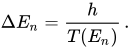
In quantum mechanics, this emission must be in quanta of light, of frequencies consisting of integer multiples of 1/T, so that classical mechanics is an approximate description at large quantum numbers. This means that the energy level corresponding to a classical orbit of period 1/T must have nearby energy levels which differ in energy by h/T, and they should be equally spaced near that level,

Bohr worried whether the energy spacing 1/T should be best calculated with the period of the energy state , or , or some average—in hindsight, this model is only the leading semiclassical approximation.

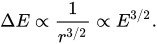
Bohr considered circular orbits. Classically, these orbits must decay to smaller circles when photons are emitted. The level spacing between circular orbits can be calculated with the correspondence formula. For a Hydrogen atom, the classical orbits have a period T determined by Kepler's third law to scale as r3/2. The energy scales as 1/r, so the level spacing formula amounts to

It is possible to determine the energy levels by recursively stepping down orbit by orbit, but there is a shortcut.

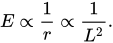
The angular momentum L of the circular orbit scales as r. The energy in terms of the angular momentum is then

Assuming, with Bohr, that quantized values of L are equally spaced, the spacing between neighboring energies is

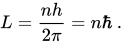
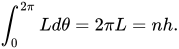
This is as desired for equally spaced angular momenta. If one kept track of the constants, the spacing would be ħ, so the angular momentum should be an integer multiple of ħ,

This is how Bohr arrived at his model. Since only the level spacing is determined heuristically by the correspondence principle, one could always add a small fixed offset to the quantum number— L could just as well have been (n+.338) ħ.

Bohr used his physical intuition to decide which quantities were best to quantize. It is a testimony to his skill that he was able to get so much from what is only the leading order approximation. A less heuristic treatment accounts for needed offsets in the ground state L2, cf. Wigner–Weyl transform.

One-dimensional potential

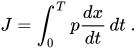
Bohr's correspondence condition can be solved for the level energies in a general one-dimensional potential. Define a quantity J(E) which is a function only of the energy, and has the property that

This is the analogue of the angular momentum in the case of the circular orbits. The orbits selected by the correspondence principle are the ones that obey J = nh for n integer, since

This quantity J is canonically conjugate to a variable θ which, by the Hamilton equations of motion changes with time as the gradient of energy with J. Since this is equal to the inverse period at all times, the variable θ increases steadily from 0 to 1 over one period.

The angle variable comes back to itself after 1 unit of increase, so the geometry of phase space in J,θ coordinates is that of a half-cylinder, capped off at J = 0, which is the motionless orbit at the lowest value of the energy. These coordinates are just as canonical as x,p, but the orbits are now lines of constant J instead of nested ovoids in x-p space.

The area enclosed by an orbit is invariant under canonical transformations, so it is the same in x-p space as in J-θ. But in the J-θ coordinates, this area is the area of a cylinder of unit circumference between 0 and J, or just J. So J is equal to the area enclosed by the orbit in x-p coordinates too,

The quantization rule is that the action variable J is an integer multiple of h.

Multiperiodic motion: Bohr–Sommerfeld quantization

Bohr's correspondence principle provided a way to find the semiclassical quantization rule for a one degree of freedom system. It was an argument for the old quantum condition mostly independent from the one developed by Wien and Einstein, which focused on adiabatic invariance. But both pointed to the same quantity, the action.

Bohr was reluctant to generalize the rule to systems with many degrees of freedom. This step was taken by Sommerfeld, who proposed the general quantization rule for an integrable system,

Each action variable is a separate integer, a separate quantum number.

This condition reproduces the circular orbit condition for two dimensional motion: let r,θ be polar coordinates for a central potential. Then θ is already an angle variable, and the canonical momentum conjugate is L, the angular momentum. So the quantum condition for L reproduces Bohr's rule:

This allowed Sommerfeld to generalize Bohr's theory of circular orbits to elliptical orbits, showing that the energy levels are the same. He also found some general properties of quantum angular momentum which seemed paradoxical at the time. One of these results was that the z-component of the angular momentum, the classical inclination of an orbit relative to the z-axis, could only take on discrete values, a result which seemed to contradict rotational invariance. This was called space quantization for a while, but this term fell out of favor with the new quantum mechanics since no quantization of space is involved.

In modern quantum mechanics, the principle of superposition makes it clear that rotational invariance is not lost. It is possible to rotate objects with discrete orientations to produce superpositions of other discrete orientations, and this resolves the intuitive paradoxes of the Sommerfeld model.

The quantum harmonic oscillator

Here is a demonstration of how large quantum numbers can give rise to classical (continuous) behavior.

Consider the one-dimensional quantum harmonic oscillator. Quantum mechanics tells us that the total (kinetic and potential) energy of the oscillator, E, has a set of discrete values,

where ω is the angular frequency of the oscillator.

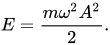
However, in a classical harmonic oscillator such as a lead ball attached to the end of a spring, we do not perceive any discreteness. Instead, the energy of such a macroscopic system appears to vary over a continuum of values. We can verify that our idea of macroscopic systems falls within the correspondence limit. The energy of the classical harmonic oscillator with amplitude A, is

Thus, the quantum number has the value

If we apply typical "human-scale" values m = 1kg, ω = 1 rad/s, and A = 1 m, then n ≈ 4.74×1033. This is a very large number, so the system is indeed in the correspondence limit.

It is simple to see why we perceive a continuum of energy in this limit. With ω = 1 rad/s, the difference between each energy level is ħω ≈ 1.05 × 10⁻³⁴J, well below what we normally resolve for macroscopic systems. One then describes this system through an emergent classical limit.

Relativistic kinetic energy

Here we show that the expression of kinetic energy from special relativity becomes arbitrarily close to the classical expression, for speeds that are much slower than the speed of light, v ≪ c.

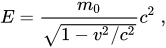
Albert Einstein's mass-energy equation

where the velocity, v is the velocity of the body relative to the observer, is the rest mass (the observed mass of the body at zero velocity relative to the observer), and c is the speed of light.

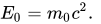
When the velocity v vanishes, the energy expressed above is not zero, and represents the rest energy,

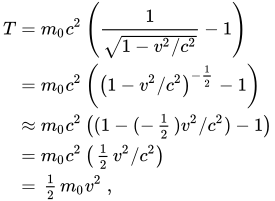
When the body is in motion relative to the observer, the total energy exceeds the rest energy by an amount that is, by definition, the kinetic energy,

Using the approximation

for , we get, when speeds are much slower than that of light, or v ≪ c,
which is the Newtonian expression for kinetic energy.

Human extinction

From Wikipedia, the free encyclopedia https://en.wikipedia.org/wiki/Human_ext...