SQUIDs are sensitive enough to measure fields as low as 5×10⁻¹⁴T with a few days of averaged measurements. Their noise levels are as low as 3 fT·Hz−1⁄2. For comparison, a typical refrigerator magnet produces 0.01 tesla (10−2 T), and some processes in animals produce very small magnetic fields between 10−9 T and 10−6 T. SERF atomic magnetometers, invented in the early 2000s are potentially more sensitive and do not require cryogenicrefrigeration but are orders of magnitude larger in size (~1 cm3) and must be operated in a near-zero magnetic field.
Diagram of a DC SQUID. The current enters and splits into the two paths, each with currents and . The thin barriers on each path are Josephson junctions, which together separate the two superconducting regions. represents the magnetic flux threading the DC SQUID loop.Electrical schematic of a SQUID where is the bias current, is the critical current of the SQUID, is the flux threading the SQUID and is the voltage response to that flux. The X-symbols represent Josephson junctions.Left: Plot of current vs. voltage for a SQUID. Upper and lower curves correspond to and respectively. Right: Periodic voltage response due to flux through a SQUID. The periodicity is equal to one flux quantum, .
The DC SQUID was invented in 1964 by Robert Jaklevic, John J. Lambe, James Mercereau, and Arnold Silver of Ford Research Labs after Brian Josephson postulated the Josephson effect in 1962, and the first Josephson junction was made by John Rowell and Philip Anderson at Bell Labs in 1963. It has two Josephson junctions in parallel in a superconducting loop. It is based on the DC Josephson effect. In the absence of any external magnetic field, the input current
splits into the two branches equally. If a small external magnetic
field is applied to the superconducting loop, a screening current, , begins to circulate the loop that generates the magnetic field canceling the applied external flux, and creates an additional Josephson phase which is proportional to this external magnetic flux. The induced current is in the same direction as in one of the branches of the superconducting loop, and is opposite to in the other branch; the total current becomes in one branch and in the other. As soon as the current in either branch exceeds the critical current, , of the Josephson junction, a voltage appears across the junction.
Now suppose the external flux is further increased until it exceeds , half the magnetic flux quantum.
Since the flux enclosed by the superconducting loop must be an integer
number of flux quanta, instead of screening the flux the SQUID now
energetically prefers to increase it to . The current now flows in the opposite direction, opposing the difference between the admitted flux and the external field of just over . The current decreases as the external field is increased, is zero when the flux is exactly ,
and again reverses direction as the external field is further
increased. Thus, the current changes direction periodically, every time
the flux increases by additional half-integer multiple of , with a change at maximum amperage every half-plus-integer multiple of and at zero amps every integer multiple.
If the input current is more than ,
then the SQUID always operates in the resistive mode. The voltage, in
this case, is thus a function of the applied magnetic field and the
period equal to . Since the current-voltage characteristic of the DC SQUID is hysteretic, a shunt resistance, is connected across the junction to eliminate the hysteresis (in the case of copper oxide based high-temperature superconductors
the junction's own intrinsic resistance is usually sufficient). The
screening current is the applied flux divided by the self-inductance of
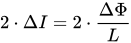
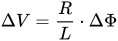
the ring. Thus can be estimated as the function of (flux to voltage converter) as follows:
, where is the self inductance of the superconducting ring
The discussion in this Section assumed perfect flux quantization in
the loop. However, this is only true for big loops with a large
self-inductance. According to the relations, given above, this implies
also small current and voltage variations. In practice the
self-inductance of the loop is not so large. The general case can be evaluated by introducing a parameter
with the critical current of the SQUID. Usually is of order one.
RF SQUID
A prototype SQUID
The RF SQUID was invented in 1965 by Robert Jaklevic, John J. Lambe, Arnold Silver, and James Edward Zimmerman at Ford.
It is based on the AC Josephson effect and uses only one Josephson
junction. It is less sensitive compared to DC SQUID but is cheaper and
easier to manufacture in smaller quantities. Most fundamental
measurements in biomagnetism, even of extremely small signals, have been made using RF SQUIDS.
The RF SQUID is inductively coupled to a resonant tank circuit.
Depending on the external magnetic field, as the SQUID operates in the
resistive mode, the effective inductance of the tank circuit changes,
thus changing the resonant frequency of the tank circuit. These
frequency measurements can be easily taken, and thus the losses which
appear as the voltage across the load resistor in the circuit are a
periodic function of the applied magnetic flux with a period of . For a precise mathematical description refer to the original paper by Erné et al.
Materials used
The traditional superconducting materials for SQUIDs are pure niobium or a lead alloy with 10% gold or indium,
as pure lead is unstable when its temperature is repeatedly changed. To
maintain superconductivity, the entire device needs to operate within a
few degrees of absolute zero, cooled with liquid helium.
High-temperature SQUID sensors were developed in the late 1980's. They are made of high-temperature superconductors, particularly YBCO, and are cooled by liquid nitrogen
which is cheaper and more easily handled than liquid helium. They are
less sensitive than conventional low temperature SQUIDs but good enough
for many applications.
In 2006, A proof of concept was shown for CNT-SQUID sensors built with an aluminium loop and a single walled carbon nanotube Josephson junction. The sensors are a few 100 nm in size and operate at 1K or below. Such sensors allow to count spins.
The extreme sensitivity of SQUIDs makes them ideal for studies in biology. Magnetoencephalography (MEG), for example, uses measurements from an array of SQUIDs to make inferences about neural
activity inside brains. Because SQUIDs can operate at acquisition rates
much higher than the highest temporal frequency of interest in the
signals emitted by the brain (kHz), MEG achieves good temporal
resolution. Another area where SQUIDs are used is magnetogastrography, which is concerned with recording the weak magnetic fields of the stomach. A novel application of SQUIDs is the magnetic marker monitoring method, which is used to trace the path of orally applied drugs. In the clinical environment SQUIDs are used in cardiology for magnetic field imaging (MFI), which detects the magnetic field of the heart for diagnosis and risk stratification.
Probably the most common commercial use of SQUIDs is in magnetic property measurement systems (MPMS). These are turn-key
systems, made by several manufacturers, that measure the magnetic
properties of a material sample. This is typically done over a
temperature range from that of 300 mK to roughly 400 K. With the decreasing size of SQUID sensors since the last decade, such sensor can equip the tip of an AFM probe. Such device allows simultaneous measurement of roughness of the surface of a sample and the local magnetic flux.
For example, SQUIDs are being used as detectors to perform magnetic resonance imaging
(MRI). While high-field MRI uses precession fields of one to several
teslas, SQUID-detected MRI uses measurement fields that lie in the
microtesla range. In a conventional MRI system, the signal scales as the
square of the measurement frequency (and hence precession field): one
power of frequency comes from the thermal polarization of the spins at
ambient temperature, while the second power of field comes from the fact
that the induced voltage in the pickup coil is proportional to the
frequency of the precessing magnetization. In the case of untuned SQUID
detection of prepolarized spins, however, the NMR signal strength is
independent of precession field, allowing MRI signal detection in
extremely weak fields, on the order of Earth's magnetic field.
SQUID-detected MRI has advantages over high-field MRI systems, such as
the low cost required to build such a system, and its compactness. The
principle has been demonstrated by imaging human extremities, and its
future application may include tumor screening.
Another application is the scanning SQUID microscope, which uses a SQUID immersed in liquid helium as the probe. The use of SQUIDs in oilprospecting, mineral exploration, earthquake prediction and geothermal energy
surveying is becoming more widespread as superconductor technology
develops; they are also used as precision movement sensors in a variety
of scientific applications, such as the detection of gravitational waves.
A SQUID is the sensor in each of the four gyroscopes employed on Gravity Probe B in order to test the limits of the theory of general relativity.
Advanced SQUIDS called near quantum-limited SQUID amplifiers form the basis of the Axion Dark Matter Experiment (ADMX) at the University of Washington. Axions are a prime candidate for cold dark matter.
SQUIDs are used in superparamagnetic relaxometry
(SPMR), a technology that utilizes the high magnetic field sensitivity
of SQUID sensors and the superparamagnetic properties of magnetite nanoparticles.
These nanoparticles are paramagnetic; they have no magnetic moment
until exposed to an external field where they become ferromagnetic.
After removal of the magnetizing field, the nanoparticles decay from a
ferromagnetic state to a paramagnetic state, with a time constant that
depends upon the particle size and whether they are bound to an external
surface. Measurement of the decaying magnetic field by SQUID sensors is
used to detect and localize the nanoparticles. Applications for SPMR
may include cancer detection.
Between 1940 and 1996, the U.S. federal government spent at least US$10.9 trillion in present-day terms on nuclear weapons, including platforms development (aircraft, rockets and facilities), command and control, maintenance, waste management and administrative costs.
It is estimated that the United States produced more than 70,000
nuclear warheads since 1945, more than all other nuclear weapon states
combined. Until November 1962, the vast majority of U.S. nuclear tests were above ground. After the acceptance of the Partial Nuclear Test Ban Treaty, all testing was relegated underground, in order to prevent the dispersion of nuclear fallout.
By 1998, at least US$759 million had been paid to the Marshall Islanders in compensation for their exposure to U.S. nuclear testing.
By March 2021 over US$2.5 billion in compensation had been paid to U.S.
citizens exposed to nuclear hazards as a result of the U.S. nuclear
weapons program.
In 2019, the U.S. and Russia possessed a comparable number of
nuclear warheads; together, these two nations possess more than 90% of
the world's nuclear weapons stockpile.
As of 2020, the United States had a stockpile of 3,750 active and
inactive nuclear warheads plus approximately 2,000 warheads retired and
awaiting dismantlement. Of the stockpiled warheads, the U.S. stated in its March 2019 New START declaration that 1,365 were deployed on 656 ICBMs, SLBMs, and strategic bombers.
By investing heavily in breeding plutonium in early nuclear reactors and in the electromagnetic and gaseous diffusion enrichment processes for the production of uranium-235, the United States was able to develop three usable weapons by mid-1945. The Trinity test was a plutonium implosion-design weapon tested on 16 July 1945, with around a 20 kiloton yield.
Faced with a planned invasion of the Japanese home islands scheduled to begin on 1 November 1945 and with Japan not surrendering, President Harry S. Truman ordered the atomic raids on Japan. On 6 August 1945, the U.S. detonated a uranium-gun design bomb, Little Boy, over the Japanese city of Hiroshima with an energy of about 15 kilotons of TNT, killing approximately 70,000 people, among them 20,000 Japanese combatants and 20,000 Korean slave laborers, and destroying nearly 50,000 buildings (including the 2nd General Army and Fifth Divisionheadquarters). Three days later, on 9 August, the U.S. attacked Nagasaki using a plutonium implosion-design bomb, Fat Man,
with the explosion equivalent to about 20 kilotons of TNT, destroying
60% of the city and killing approximately 35,000 people, among them
23,200–28,200 Japanese munitions workers, 2,000 Korean slave laborers,
and 150 Japanese combatants.
On 15 August 1947, the Manhattan Project was abolished.
During the Cold War
Protest in Bonn against the deployment of Pershing II missiles in West Germany, 1981
The American atomic stockpile was small and grew slowly in the
immediate aftermath of World War II, and the size of that stockpile was a
closely guarded secret.
However, there were forces that pushed the United States towards
greatly increasing the size of the stockpile. Some of these were
international in origin and focused on the increasing tensions of the Cold War, including the loss of China, the Soviet Union becoming an atomic power, and the onset of the Korean War. And some of the forces were domestic – both the Truman administration and the Eisenhower administration wanted to rein in military spending and avoid budget deficits and inflation. It was the perception that nuclear weapons gave more "bang for the buck" and thus were the most cost-efficient way to respond to the security threat the Soviet Union represented.
As a result, beginning in 1950 the AEC embarked on a massive
expansion of its production facilities, an effort that would eventually
be one of the largest U.S. government construction projects ever to take
place outside of wartime. And this production would soon include the far more powerful hydrogen bomb, which the United States had decided to move forward with after an intense debate during 1949–50. as well as much smaller tactical atomic weapons for battlefield use.
By 1990, the United States had produced more than 70,000 nuclear
warheads, in over 65 different varieties, ranging in yield from around
.01 kilotons (such as the man-portable Davy Crockett shell) to the 25 megaton B41 bomb. Between 1940 and 1996, the U.S. spent at least $10.9 trillion in present-day terms
on nuclear weapons development. Over half was spent on building
delivery mechanisms for the weapon. $681 billion in present-day terms
was spent on nuclear waste management and environmental remediation.
Throughout the Cold War, the U.S. and USSR threatened with
all-out nuclear attack in case of war, regardless of whether it was a
conventional or a nuclear clash. U.S. nuclear doctrine called for mutually assured destruction
(MAD), which entailed a massive nuclear attack against strategic
targets and major populations centers of the Soviet Union and its
allies. The term "mutual assured destruction" was coined in 1962 by
American strategist Donald Brennan. MAD was implemented by deploying nuclear weapons simultaneously on three different types of weapons platforms.
Post–Cold War
After the 1989 end of the Cold War and the 1991 dissolution of the Soviet Union,
the U.S. nuclear program was heavily curtailed; halting its program of
nuclear testing, ceasing its production of new nuclear weapons, and
reducing its stockpile by half by the mid-1990s under President Bill Clinton.
Many former nuclear facilities were closed, and their sites became
targets of extensive environmental remediation. Efforts were redirected
from weapons production to stockpile stewardship;,attempting
to predict the behavior of aging weapons without using full-scale
nuclear testing. Increased funding was directed to anti-nuclear proliferation
programs, such as helping the states of the former Soviet Union to
eliminate their former nuclear sites and to assist Russia in their
efforts to inventory and secure their inherited nuclear stockpile. By
February 2006, over $1.2 billion had been paid under the Radiation Exposure Compensation Act
of 1990 to U.S. citizens exposed to nuclear hazards as a result of the
U.S. nuclear weapons program, and by 1998 at least $759 million had been
paid to the Marshall Islanders in compensation for their exposure to
U.S. nuclear testing. Over $15 million was paid to the Japanese government following the exposure of its citizens and food supply to nuclear fallout from the 1954 "Bravo" test. In 1998, the country spent an estimated $35.1 billion on its nuclear weapons and weapons-related programs.
Large stockpile with global range (dark blue)
In the 2013 book Plutopia: Nuclear Families, Atomic Cities, and the Great Soviet and American Plutonium Disasters (Oxford), Kate Brown
explores the health of affected citizens in the United States, and the
"slow-motion disasters" that still threaten the environments where the
plants are located. According to Brown, the plants at Hanford, over a
period of four decades, released millions of curies of radioactive
isotopes into the surrounding environment. Brown says that most of this radioactive contamination
over the years at Hanford were part of normal operations, but
unforeseen accidents did occur and plant management kept this secret, as
the pollution continued unabated. Even today, as pollution threats to
health and the environment persist, the government keeps knowledge about
the associated risks from the public.
During the presidency of George W. Bush, and especially after the 11 September terroristattacks of 2001, rumors circulated in major news sources that the U.S. was considering designing new nuclear weapons ("bunker-busting nukes")
and resuming nuclear testing for reasons of stockpile stewardship.
Republicans argued that small nuclear weapons appear more likely to be
used than large nuclear weapons, and thus small nuclear weapons pose a
more credible threat that has more of a deterrent effect against hostile
behavior. Democrats counterargued that allowing the weapons could
trigger an arms race. In 2003, the Senate Armed Services Committee voted to repeal the 1993 Spratt-Furse
ban on the development of small nuclear weapons. This change was part
of the 2004 fiscal year defense authorization. The Bush administration
wanted the repeal so that they could develop weapons to address the
threat from North Korea. "Low-yield weapons" (those with one-third the
force of the bomb that was dropped on Hiroshima in 1945) were permitted
to be developed.
The Bush administration was unsuccessful in its goal to develop a
guided low-yield nuclear weapon, however, in 2010 President Barack Obama
began funding and development for what would become the B61-12, a smart
guided low-yield nuclear bomb developed off of the B61 “dumb bomb”.
Statements by the U.S. government in 2004 indicated that they
planned to decrease the arsenal to around 5,500 total warheads by 2012. Much of that reduction was already accomplished by January 2008.
According to the Pentagon's June 2019 Doctrine for Joint Nuclear Operations,
"Integration of nuclear weapons employment with conventional and
special operations forces is essential to the success of any mission or
operation."
Between 16 July 1945 and 23 September 1992, the United States maintained a program of vigorous nuclear testing,
with the exception of a moratorium between November 1958 and September
1961. By official count, a total of 1,054 nuclear tests and two nuclear
attacks were conducted, with over 100 of them taking place at sites in
the Pacific Ocean, over 900 of them at the Nevada Test Site, and ten on miscellaneous sites in the United States (Alaska, Colorado, Mississippi, and New Mexico).
Until November 1962, the vast majority of the U.S. tests were
atmospheric (that is, above-ground); after the acceptance of the Partial
Test Ban Treaty all testing was relegated underground, in order to
prevent the dispersion of nuclear fallout.
The U.S. program of atmospheric nuclear testing exposed a number
of the population to the hazards of fallout. Estimating exact numbers,
and the exact consequences, of people exposed has been medically very
difficult, with the exception of the high exposures of Marshall
Islanders and Japanese fishers in the case of the Castle Bravo
incident in 1954. A number of groups of U.S. citizens—especially
farmers and inhabitants of cities downwind of the Nevada Test Site and
U.S. military workers at various tests—have sued for compensation and
recognition of their exposure, many successfully. The passage of the Radiation Exposure Compensation
Act of 1990 allowed for a systematic filing of compensation claims in
relation to testing as well as those employed at nuclear weapons
facilities. By June 2009 over $1.4 billion total has been given in
compensation, with over $660 million going to "downwinders".
A few notable U.S. nuclear tests include:
Trinity test on 16 July 1945, was the world's first test of a nuclear weapon (yield of around 20 kt).
Operation Crossroads series in July 1946, was the first postwar test series and one of the largest military operations in U.S. history.
Operation Greenhouse shots of May 1951 included the first boosted fission weapon test ("Item") and a scientific test that proved the feasibility of thermonuclear weapons ("George").
Ivy Mike shot of 1 November 1952, was the first full test of a Teller-Ulam design "staged" hydrogen bomb, with a yield of 10 megatons. It was not a deployable weapon, however—with its full cryogenic equipment it weighed some 82 tons.
Castle Bravo
shot of 1 March 1954, was the first test of a deployable (solid fuel)
thermonuclear weapon, and also (accidentally) the largest weapon ever
tested by the United States (15 megatons). It was also the single
largest U.S. radiological accident in connection with nuclear testing.
The unanticipated yield, and a change in the weather, resulted in
nuclear fallout spreading eastward onto the inhabited Rongelap and Rongerik atolls, which were soon evacuated. Many of the Marshall Islanders have since suffered from birth defects and have received some compensation from the federal government. A Japanese fishing boat, Daigo Fukuryū Maru, also came into contact with the fallout, which caused many of the crew to grow ill; one eventually died.
Shot Argus I of Operation Argus, on 27 August 1958, was the first detonation of a nuclear weapon in outer space when a 1.7-kiloton warhead was detonated at an altitude of 200 kilometres (120 mi) during a series of high altitude nuclear explosions.
Shot Frigate Bird of Operation Dominic I on 6 May 1962, was the only U.S. test of an operational submarine-launched ballistic missile (SLBM) with a live nuclear warhead (yield of 600 kilotons), at Christmas Island.
In general, missile systems were tested without live warheads and
warheads were tested separately for safety concerns. In the early 1960s,
however, there mounted technical questions about how the systems would
behave under combat conditions (when they were "mated", in military
parlance), and this test was meant to dispel these concerns. However,
the warhead had to be somewhat modified before its use, and the missile
was a SLBM (and not an ICBM), so by itself it did not satisfy all concerns.
Shot Sedan of Operation Storax
on 6 July 1962 (yield of 104 kilotons), was an attempt to show the
feasibility of using nuclear weapons for "civilian" and "peaceful"
purposes as part of Operation Plowshare. In this instance, a 1,280-foot (390 m) diameter 320-foot (98 m) deep crater was created at the Nevada Test Site.
Early weapons models, such as the "Fat Man" bomb, were extremely large and difficult to use.From left are the Peacekeeper, the Minuteman III and the Minuteman I
The original Little Boy and Fat Man weapons, developed by the United States during the Manhattan Project,
were relatively large (Fat Man had a diameter of 5 feet (1.5 m)) and
heavy (around 5 tons each) and required specially modified bomber planes
to be adapted for their bombing missions against Japan. Each modified
bomber could only carry one such weapon and only within a limited range.
After these initial weapons were developed, a considerable amount of
money and research was conducted towards the goal of standardizing
nuclear warheads so that they did not require highly specialized experts
to assemble them before use, as in the case with the idiosyncratic wartime devices, and miniaturization of the warheads for use in more variable delivery systems.
Through the aid of brainpower acquired through Operation Paperclip at the tail end of the European theater of World War II, the United States was able to embark on an ambitious program in rocketry. One of the first products of this was the development of rockets capable of holding nuclear warheads. The MGR-1 Honest John
was the first such weapon, developed in 1953 as a surface-to-surface
missile with a 15-mile (24 km) maximum range. Because of their limited
range, their potential use was heavily constrained (they could not, for
example, threaten Moscow with an immediate strike).
The MGR-1 Honest John was the first nuclear-armed rocket developed by the U.S.The B-36 Peacemaker in flight
Development of long-range bombers, such as the B-29 Superfortress during World War II, was continued during the Cold War period. In 1946, the Convair B-36 Peacemaker became the first purpose-built nuclear bomber; it served with the USAF until 1959. The Boeing B-52 Stratofortress
was able by the mid-1950s to carry a wide arsenal of nuclear bombs,
each with different capabilities and potential use situations. Starting
in 1946, the U.S. based its initial deterrence force on the Strategic Air Command,
which, by the late 1950s, maintained a number of nuclear-armed bombers
in the sky at all times, prepared to receive orders to attack the USSR
whenever needed. This system was, however, tremendously expensive, both
in terms of natural and human resources, and raised the possibility of
an accidental nuclear war.
During the 1950s and 1960s, elaborate computerized early warning systems such as Defense Support Program were developed to detect incoming Soviet attacks and to coordinate response strategies. During this same period, intercontinental ballistic missile
(ICBM) systems were developed that could deliver a nuclear payload
across vast distances, allowing the U.S. to house nuclear forces capable
of hitting the Soviet Union in the American Midwest. Shorter-range weapons, including small tactical weapons, were fielded in Europe as well, including nuclear artillery and man-portable Special Atomic Demolition Munition. The development of submarine-launched ballistic missile systems allowed for hidden nuclear submarines
to covertly launch missiles at distant targets as well, making it
virtually impossible for the Soviet Union to successfully launch a first strike attack against the United States without receiving a deadly response.
Improvements in warhead miniaturization in the 1970s and 1980s
allowed for the development of MIRVs—missiles which could carry multiple
warheads, each of which could be separately targeted. The question of
whether these missiles should be based on constantly rotating train
tracks (to avoid being easily targeted by opposing Soviet missiles) or
based in heavily fortified silos (to possibly withstand a Soviet attack)
was a major political controversy in the 1980s (eventually the silo
deployment method was chosen). MIRVed
systems enabled the U.S. to render Soviet missile defenses economically
unfeasible, as each offensive missile would require between three and
ten defensive missiles to counter.
Additional developments in weapons delivery included cruise missile
systems, which allowed a plane to fire a long-distance, low-flying
nuclear-armed missile towards a target from a relatively comfortable
distance.
The current delivery systems of the U.S. make virtually any part of
the Earth's surface within the reach of its nuclear arsenal. Though its
land-based missile systems have a maximum range of 10,000 kilometres
(6,200 mi) (less than worldwide), its submarine-based forces extend its
reach from a coastline 12,000 kilometres (7,500 mi) inland.
Additionally, in-flight refueling of long-range bombers and the use of aircraft carriers extends the possible range virtually indefinitely.
Since World War II, the President of the United States has had sole authority to launch U.S. nuclear weapons, whether as a first strike or nuclear retaliation. This arrangement was seen as necessary during the Cold War to present a credible nuclear deterrent;
if an attack was detected, the United States would have only minutes to
launch a counterstrike before its nuclear capability was severely
damaged, or national leaders killed. If the President has been killed,
command authority follows the presidential line of succession.
Changes to this policy have been proposed, but currently the only way
to countermand such an order before the strike was launched would be for
the Vice President and the majority of the Cabinet to relieve the
President under Section 4 of the Twenty-fifth Amendment to the United States Constitution.
Regardless of whether the United States is actually under attack
by a nuclear-capable adversary, the President alone has the authority to
order nuclear strikes. The President and the Secretary of Defense form the National Command Authority, but the Secretary of Defense has no authority to refuse or disobey such an order. The President's decision must be transmitted to the National Military Command Center, which will then issue the coded orders to nuclear-capable forces.
When President Reagan was shot in 1981, there was confusion about where the "nuclear football" was, and who was in charge.
In 1975, a launch crew member, Harold Hering,
was dismissed from the Air Force for asking how he could know whether
the order to launch his missiles came from a sane president. It has been claimed that the system is not foolproof.
Starting with President Eisenhower,
authority to launch a full-scale nuclear attack has been delegated to
theater commanders and other specific commanders if they believe it is
warranted by circumstances, and are out of communication with the
president or the president had been incapacitated. For example, during the Cuban Missile Crisis, on 24 October 1962, General Thomas Power, commander of the Strategic Air Command (SAC), took the country to DEFCON 2, the very precipice of full-scale nuclear war, launching the SAC bombers of the US with nuclear weapons ready to strike.
Moreover, some of these commanders subdelegated to lower commanders the
authority to launch nuclear weapons under similar circumstance. In
fact, the nuclear weapons were not placed under locks (i.e., permissive action links)
until decades later, and so pilots or individual submarine commanders
had the power to launch nuclear weapons entirely on their own, without
higher authority.
The Castle Bravofallout
plume spread dangerous levels of radioactive material over an area over
100 miles (160 km) long, including inhabited islands, in the largest
single U.S. nuclear accident.
The United States nuclear program since its inception has experienced
accidents of varying forms, ranging from single-casualty research
experiments (such as that of Louis Slotin during the Manhattan Project), to the nuclear fallout
dispersion of the Castle Bravo shot in 1954, to accidents such as
crashes of aircraft carrying nuclear weapons, the dropping of nuclear
weapons from aircraft, losses of nuclear submarines, and explosions of
nuclear-armed missiles (broken arrows).
How close any of these accidents came to being major nuclear disasters
is a matter of technical and scholarly debate and interpretation.
The nuclear testing program resulted in a number of cases of
fallout dispersion onto populated areas. The most significant of these
was the Castle Bravo test, which spread radioactive ash over an area of over 100 square miles (260 km2), including a number of populated islands. The populations of the islands were evacuated but not before suffering radiation burns. They would later suffer long-term effects, such as birth defects and increased cancer risk. There are ongoing concerns around deterioration of the nuclear waste site on Runit Island and a potential radioactive spill.
There were also instances during the nuclear testing program in which
soldiers were exposed to overly high levels of radiation, which grew
into a major scandal in the 1970s and 1980s, as many soldiers later
suffered from what were claimed to be diseases caused by their
exposures.
Many of the former nuclear facilities produced significant
environmental damages during their years of activity, and since the
1990s have been Superfund sites of cleanup and environmental remediation. Hanford is currently the most contaminated nuclear site in the United States and is the focus of the nation's largest environmental cleanup. Radioactive materials are known to be leaking from Hanford into the environment. The Radiation Exposure Compensation Act
of 1990 allows for U.S. citizens exposed to radiation or other health
risks through the U.S. nuclear program to file for compensation and
damages.
In 1972, three hijackers took control of a domestic passenger flight along the east coast of the U.S. and threatened to crash the plane into a U.S. nuclear weapons plant in Oak Ridge, Tennessee. The plane got as close as 8,000 feet above the site before the hijackers' demands were met.
Various acts of civil disobedience since 1980 by the peace group Plowshares
have shown how nuclear weapons facilities can be penetrated, and the
group's actions represent extraordinary breaches of security at nuclear weapons plants in the United States. The National Nuclear Security Administration has acknowledged the seriousness of the 2012 Plowshares action. Non-proliferation
policy experts have questioned "the use of private contractors to
provide security at facilities that manufacture and store the
government's most dangerous military material". Nuclear weapons materials on the black market are a global concern,and there is concern about the possible detonation of a small, crude nuclear weapon by a militant group in a major city, with significant loss of life and property.
Stuxnet is a computer worm discovered in June 2010 that is believed to have been created by the United States and Israel to attack Iran's nuclear fuel enrichment facilities.
The initial U.S. nuclear program was run by the National Bureau of Standards starting in 1939 under the edict of PresidentFranklin Delano Roosevelt. Its primary purpose was to delegate research and dispense funds. In 1940 the National Defense Research Committee (NDRC) was established, coordinating work under the Committee on Uranium among its other wartime efforts. In June 1941, the Office of Scientific Research and Development
(OSRD) was established, with the NDRC as one of its subordinate
agencies, which enlarged and renamed the Uranium Committee as the Section on Uranium. In 1941, NDRC research was placed under direct control of Vannevar Bush as the OSRD S-1 Section, which attempted to increase the pace of weapons research. In June 1942, the U.S. Army Corps of Engineers took over the project to develop atomic weapons, while the OSRD retained responsibility for scientific research.
This was the beginning of the Manhattan Project,
run as the Manhattan Engineering District (MED), an agency under
military control that was in charge of developing the first atomic
weapons. After World War II, the MED maintained control over the U.S. arsenal and production facilities and coordinated the Operation Crossroads tests. In 1946 after a long and protracted debate, the Atomic Energy Act of 1946 was passed, creating the Atomic Energy Commission
(AEC) as a civilian agency that would be in charge of the production of
nuclear weapons and research facilities, funded through Congress, with
oversight provided by the Joint Committee on Atomic Energy.
The AEC was given vast powers of control over secrecy, research, and
money, and could seize lands with suspected uranium deposits. Along with
its duties towards the production and regulation of nuclear weapons, it
was also in charge of stimulating development and regulating civilian
nuclear power. The full transference of activities was finalized in
January 1947.
In 1975, following the "energy crisis" of the early 1970s and
public and congressional discontent with the AEC (in part because of the
impossibility to be both a producer and a regulator), it was
disassembled into component parts as the Energy Research and Development
Administration (ERDA), which assumed most of the AEC's former
production, coordination, and research roles, and the Nuclear Regulatory Commission, which assumed its civilian regulation activities.
In general, these agencies served to coordinate research and
build sites. They generally operated their sites through contractors,
however, both private and public (for example, Union Carbide, a private company, ran Oak Ridge National Laboratory for many decades; the University of California, a public educational institution, has run the Los Alamos and Lawrence Livermore laboratories since their inception, and will jointly manage Los Alamos with the private company Bechtel
as of its next contract). Funding was received both through these
agencies directly, but also from additional outside agencies, such as
the Department of Defense. Each branch of the military also maintained
its own nuclear-related research agencies (generally related to delivery
systems).
Weapons production complex
This
table is not comprehensive, as numerous facilities throughout the
United States have contributed to its nuclear weapons program. It
includes the major sites related to the U.S. weapons program (past and
present), their basic site functions, and their current status of
activity. Not listed are the many bases and facilities at which nuclear
weapons have been deployed. In addition to deploying weapons on its own
soil, during the Cold War, the United States also stationed nuclear weapons in 27 foreign countries and territories, including Okinawa (which was US-controlled until 1971,) Japan (during the occupation immediately following World War II), Greenland, Germany, Taiwan, and French Morocco then independent Morocco.
A sign pointing to an old fallout shelter in New York City.The Atoms for Peace program distributed nuclear technology, materials, and know-how to many less technologically advanced countries.
Early on in the development of its nuclear weapons, the United States
relied in part on information-sharing with both the United Kingdom and
Canada, as codified in the Quebec Agreement
of 1943. These three parties agreed not to share nuclear weapons
information with other countries without the consent of the others, an
early attempt at nonproliferation. After the development of the first nuclear weapons during World War II,
though, there was much debate within the political circles and public
sphere of the United States about whether or not the country should
attempt to maintain a monopoly on nuclear technology,
or whether it should undertake a program of information sharing with
other nations (especially its former ally and likely competitor, the Soviet Union), or submit control of its weapons to some sort of international organization (such as the United Nations) who would use them to attempt to maintain world peace. Though fear of a nuclear arms race
spurred many politicians and scientists to advocate some degree of
international control or sharing of nuclear weapons and information,
many politicians and members of the military believed that it was better
in the short term to maintain high standards of nuclear secrecy
and to forestall a Soviet bomb as long as possible (and they did not
believe the USSR would actually submit to international controls in good
faith).
Since this path was chosen, the United States was, in its early days, essentially an advocate for the prevention of nuclear proliferation,
though primarily for the reason of self-preservation. A few years after
the USSR detonated its first weapon in 1949, though, the U.S. under
President Dwight D. Eisenhower sought to encourage a program of sharing nuclear information related to civilian nuclear power and nuclear physics in general. The Atoms for Peace program, begun in 1953, was also in part political: the U.S. was better poised to commit various scarce resources, such as enriched uranium,
towards this peaceful effort, and to request a similar contribution
from the Soviet Union, who had far fewer resources along these lines;
thus the program had a strategic justification as well, as was later
revealed by internal memos. This overall goal of promoting civilian use
of nuclear energy in other countries, while also preventing weapons
dissemination, has been labeled by many critics as contradictory and
having led to lax standards for a number of decades which allowed a
number of other nations, such as China and India, to profit from dual-use technology (purchased from nations other than the U.S.).
The Cooperative Threat Reduction program of the Defense Threat Reduction Agency
was established after the breakup of the Soviet Union in 1991 to aid
former Soviet bloc countries in the inventory and destruction of their
sites for developing nuclear, chemical, and biological weapons, and
their methods of delivering them (ICBM silos, long-range bombers, etc.).
Over $4.4 billion has been spent on this endeavor to prevent purposeful
or accidental proliferation of weapons from the former Soviet arsenal.
After India and Pakistan tested nuclear weapons in 1998, President Bill Clinton imposed economic sanctions
on the countries. In 1999, however, the sanctions against India were
lifted; those against Pakistan were kept in place as a result of the
military government that had taken over. Shortly after the September 11
attacks in 2001, President George W. Bush
lifted the sanctions against Pakistan as well, in order to get the
Pakistani government's help as a conduit for US and NATO forces for operations in Afghanistan.
The U.S. government has been vocal against the proliferation of such weapons in the countries of Iran and North Korea. The 2003 invasion of Iraq by the U.S. was done, in part, on indications that Weapons of mass destruction were being stockpiled (later, stockpiles of previously undeclared nerve agent and mustard gas shells were located in Iraq), and the Bush administration said that its policies on proliferation were responsible for the Libyangovernment's agreement to abandon its nuclear ambitions.
However, a year after the war began, the Senate's report on pre-war
intelligence on Iraq, no stockpiles of weapons of mass destruction or
active programs of mass destruction were found in Iraq.
Nuclear disarmament in international law
The United States is one of the five nuclear weapons states with a declared nuclear arsenal under the Treaty on the Non-Proliferation of Nuclear Weapons
(NPT), of which it was an original drafter and signatory on 1 July 1968
(ratified 5 March 1970). All signatories of the NPT agreed to refrain
from aiding in nuclear weapons proliferation to other states.
Further under Article VI of the NPT, all signatories, including
the US, agreed to negotiate in good faith to stop the nuclear arms race
and to negotiate for complete elimination of nuclear weapons. "Each of
the Parties to the Treaty undertakes to pursue negotiations in good
faith on effective measures relating to cessation of the nuclear arms
race at an early date and to nuclear disarmament, and on a treaty on
general and complete disarmament." The International Court of Justice (ICJ), the preeminent judicial tribunal of international law, in its advisory opinion on the Legality of the Threat or Use of Nuclear Weapons, issued 8 July 1996, unanimously interprets the text of Article VI as implying that:
There exists an obligation to pursue in good faith and
bring to a conclusion negotiations leading to nuclear disarmament in all
its aspects under strict and effective international control.
The International Atomic Energy Agency
(IAEA) in 2005 proposed a comprehensive ban on fissile material that
would greatly limit the production of weapons of mass destruction. One
hundred forty seven countries voted for this proposal but the United
States voted against. The US government has also resisted the Treaty on the Prohibition of Nuclear Weapons, a binding agreement for negotiations for the total elimination of nuclear weapons, supported by more than 120 nations.
In 1958, the United States Air Force had considered a plan to drop nuclear bombs on China during a confrontation over Taiwan but it was overruled, previously secret documents showed after they were declassified due to the Freedom of Information Act in April 2008. The plan included an initial plan to drop 10–15 kiloton bombs on airfields in Amoy (now called Xiamen) in the event of a Chinese blockade against Taiwan's Offshore Islands.
Occupational illness
The
Energy Employees Occupational Illness Compensation Program (EEOICP)
began on 31 July 2001. The program provides compensation and health
benefits to Department of Energy nuclear weapons workers (employees,
former employees, contractors and subcontractors) as well as
compensation to certain survivors if the worker is already deceased.
By 14 August 2010, the program had already identified 45,799 civilians
who lost their health (including 18,942 who developed cancer) due to
exposure to radiation and toxic substances while producing nuclear
weapons for the United States.
U.S. nuclear warhead stockpile, 1945–2002.A graph showing the amount of nuclear weapons stockpiled by either country during the nuclear race.U.S. ground-based nuclear weapons (all LGM-30 Minuteman
missiles) are deployed in three areas, spanning five states. These
locations were chosen to be far away from the coasts, to maximize
warning of an incoming attack from submarines; far away from populated
areas, since the silos would likely be targeted in a nuclear war; and
relatively close to the Soviet Union via the polar route.
The United States is one of the five recognized nuclear powers by the signatories of the Treaty on the Non-Proliferation of Nuclear Weapons (NPT). As of 2017, the US has an estimated 4,018 nuclear weapons in either deployment or storage.
This figure compares to a peak of 31,225 total warheads in 1967 and
22,217 in 1989, and does not include "several thousand" warheads that
have been retired and scheduled for dismantlement. The Pantex Plant near Amarillo, Texas, is the only location in the United States where weapons from the aging nuclear arsenal can be refurbished or dismantled.
In 2009 and 2010, the Obama administration
declared policies that would invalidate the Bush-era policy for use of
nuclear weapons and its motions to develop new ones. First, in a
prominent 2009 speech, U.S. President Barack Obama outlined a goal of "a world without nuclear weapons". To that goal, U.S. President Barack Obama and Russian President Dmitry Medvedev signed a new START treaty on 8 April 2010, to reduce the number of active nuclear weapons from 2,200 to 1,550. That same week Obama also revised U.S. policy on the use of nuclear weapons in a Nuclear Posture Review required of all presidents, declaring for the first time that the U.S. would not use nuclear weapons against non-nuclear, NPT-compliant states. The policy also renounces development of any new nuclear weapons.
However, within the same Nuclear Posture Review of April of 2010, there
was a stated need to develop new “low yield” nuclear weapons. This
resulted in the development of the B61 Mod 12.
Despite President Obama's goal of a nuclear-free world and reversal of
former President Bush’s nuclear policies, his presidency cut fewer
warheads from the stockpile any previous post-Cold War presidency.
Following a renewal of tension after the Russo-Ukrainian War started in 2014, the Obama administration announced plans to continue to renovate the US nuclear weapons facilities and platforms with a budgeted spend of about a trillion dollars over 30 years. Under these news plans, the US government would fund research and development of new nuclear cruise missiles. The Trump and Biden administrations continued with these plans.
In the early 1980s, the revival of the nuclear arms race triggered large protests about nuclear weapons. On 12 June 1982, one million people demonstrated in New York City's Central Park against nuclear weapons and for an end to the cold wararms race. It was the largest anti-nuclear protest and the largest political demonstration in American history. International Day of Nuclear Disarmament protests were held on 20 June 1983 at 50 sites across the United States. There were many Nevada Desert Experience protests and peace camps at the Nevada Test Site during the 1980s and 1990s.
There have also been protests by anti-nuclear groups at the Y-12 Nuclear Weapons Plant, the Idaho National Laboratory, Yucca Mountain nuclear waste repository proposal, the Hanford Site, the Nevada Test Site, Lawrence Livermore National Laboratory, and transportation of nuclear waste from the Los Alamos National Laboratory.
On 1 May 2005, 40,000 anti-nuclear/anti-war protesters marched past the United Nations in New York, 60 years after the atomic bombings of Hiroshima and Nagasaki. This was the largest anti-nuclear rally in the U.S. for several decades.
In May 2010, some 25,000 people, including members of peace
organizations and 1945 atomic bomb survivors, marched from downtown New
York to the United Nations headquarters, calling for the elimination of
nuclear weapons.
Some scientists and engineers have opposed nuclear weapons, including Paul M. Doty, Hermann Joseph Muller, Linus Pauling, Eugene Rabinowitch, M.V. Ramana and Frank N. von Hippel. In recent years, many elder statesmen have also advocated nuclear disarmament. Sam Nunn, William Perry, Henry Kissinger, and George Shultz—have
called upon governments to embrace the vision of a world free of
nuclear weapons, and in various op-ed columns have proposed an ambitious
program of urgent steps to that end. The four have created the Nuclear
Security Project to advance this agenda. Organizations such as Global Zero,
an international non-partisan group of 300 world leaders dedicated to
achieving nuclear disarmament, have also been established.
United States strategic nuclear weapons arsenal
New START Treaty Aggregate Numbers of Strategic Offensive Arms, 14 June 2023
Category of Data
United States of America
Deployed ICBMs, Deployed SLBMs,
and Deployed Heavy Bombers
665
Warheads on Deployed ICBMs, on Deployed SLBMs,
and Nuclear Warheads Counted for Deployed Heavy Bombers
1,389
Deployed and Non-deployed Launchers of ICBMs,
Deployed and Non-deployed Launchers of SLBMs,
and Deployed and Non-deployed Heavy Bombers
800
Total
2,854
Notes:
Each heavy bomber is counted as one warhead (The New START Treaty)
The nuclear weapon delivery capability has been removed from B-1heavy bombers.






.svg)


_002.jpg)


