Glyphosate-based herbicides are herbicides made of a glyphosatesalt usually combined with other ingredients needed to stabilize the formula and allow penetration into plants. Roundup was the first glyphosate-based herbicide, developed by Monsanto in the 1970s. It is used most heavily on corn, soy, and cotton crops that have been genetically modified to be resistant to the herbicide.
Some products include two active ingredients, such as Enlist Duo which includes 2,4-D
as well as glyphosate. As of 2010, more than 750 glyphosate products
were on the market. The names of inert ingredients used in glyphosate
formulations are usually not listed on the product labels.
Glyphosate and glyphosate-based herbicides have low acute toxicity in mammals.
They likewise have not been shown to pose a significant risk to human
health during normal use, although human deaths have been reported from
deliberate ingestion of concentrated RoundUp. It is difficult to determine how much surfactants contribute to the overall toxicity of each formulation. Glyphosate formulations containing the surfactant polyethoxylated tallow amine
(POEA) are sometimes used terrestrially, but are not approved for
aquatic use in the US due to their toxicity to aquatic organisms.
There have been multiple lawsuits against Monsanto asserting that exposure to glyphosate herbicides is carcinogenic
and that the company did not adequately disclose the risk to consumers.
In 2018 a California jury awarded US$289 million in damages (later cut
to US$78 million on appeal then reduced to $21 million after another appeal) to a groundskeeper who argued that Monsanto failed to adequately warn consumers of cancer risks posed by the herbicides.
Background
The glyphosate-based herbicide RoundUp (styled: Roundup) was developed in the 1970s by Monsanto. Glyphosate was first registered for use in the U.S. in 1974. Glyphosate-based herbicides were initially used in a similar way to paraquat and diquat,
as non-selective herbicides. Attempts were made to apply them to row
crops, but problems with crop damage kept glyphosate-based herbicides
from being widely used for this purpose. In the US, use of glyphosate
experienced rapid growth following the commercial introduction of a glyphosate-resistant soybean in 1996. Between 1990 and 1996 sales of RoundUp increased around 20% per year. As of 2015 it is used in over 160 countries.
RoundUp is used most heavily on corn, soy, and cotton crops that have
been genetically modified to withstand the chemical, but since 2012
glyphosate was used in California to treat other crops like almond, peach, cantaloupe, onion, cherry, sweet corn, and citrus.
Bayer, which acquired Monsanto in 2018,
is the largest producer of glyphosate-based herbicides, but
formulations from other manufacturers are available that use different
inert ingredients. Other glyphosate-based formulations include Bronco,
Glifonox, KleenUp, Ranger Pro (styled: Ranger PRO), Rodeo, and Weedoff. Other manufacturers include Anhui Huaxing Chemical Industry Company, BASF, Dow AgroSciences, DuPont, Jiangsu Good Harvest-Weien Agrochemical Company, Nantong Jiangshan Agrochemical & Chemicals Co., Nufarm, SinoHarvest, Syngenta, and Zhejiang Xinan Chemical Industrial Group Company. As of 2010, more than 750 glyphosate products were on the market.
Inert ingredients
Surfactants, solvents, and preservatives are inert ingredients, or adjuvants, that are commonly added to glyphosate-based herbicide formulations.
Some products contain all the necessary adjuvants, including
surfactant; some contain no adjuvant system, while other products
contain only a limited amount of adjuvant. Some formulations require the
addition of surfactants to the spray tank before application. The names of inert ingredients used in glyphosate formulations are usually not listed on the product labels.
POEA is a surfactant added to Roundup and other herbicides as a wetting agent. POEA is not a single surfactant, but a complex mixture. The composition of each POEA surfactant is a proprietary trade secret. Monsanto's RoundUp, for example, contains a proprietary POEA surfactant called MON 0818 at a 15% concentration.
Regulatory history
European Union
As part of the process to renew glyphosate's license under EU regulations, a 2013 systematic review by the German Federal Institute for Risk Assessment (Bfr) of epidemiological studies of workers exposed to glyphosate formulations found no significant risk, stating that "the available data are contradictory and far from being convincing". In 2015, as part of the ongoing renewal process, the European Food Safety Authority
(EFSA) published a final risk assessment on 12 November 2015 stating
that glyphosate met EU-level regulatory standards. Despite classifying
glyphosate as non-carcinogenic, this report also acknowledged that some
of the co-formulants added to glyphosate based pesticides "appeared to
have toxic effects higher than the glyphosate itself", noting POEA in
particular. The conclusion of the final EFSA assessment was that the
active ingredient glyphosate met EU-level regulatory standards, but
individual formulations would have to be evaluated by member states.
There was insufficient support among the Member States for a 2016 European Commission
proposal to renew the approval of glyphosate. Because the 2015 EFSA and
IARC assessments had reached contradictory conclusions regarding the
potential carcinogenicity of glyphosate, the European Chemicals Agency (ECHA) was asked to assess the hazard
properties of the substance. Though no majority of Member States voted
either for or against the renewal proposal, in July 2016 they voted to
amend the conditions of glyphosate's existing approval. The new
conditions require Member States to minimize the pre-harvest use of
glyphosate products, as well as use in certain public places.
Formulations that include the surfactant POEA were banned. These
conditions were later included in the implementing act for the 5-year renewal that was approved on 12 December 2017.
United States
In 2014 the EPA approved Enlist Duo, which was developed by Dow AgroSciences. This herbicide combined two active ingredients: 2,4-D and glyphosate. Enlist Duo is intended for use with genetically modified crops that have also been developed by the Dow Chemical subsidiary. The initial approval was limited to the states of Illinois, Indiana, Iowa, Ohio, South Dakota, and Wisconsin. During the course of litigation in 2015, the EPA found out that Dow had told the United States Patent and Trademark Office
that Enlist Duo offers "synergistic herbicidal weed control", and
requested additional clarification about the "synergistic effects" and
sought to reverse its approval pending a full review of the new
information provided by Dow. In 2016, the 9th Circuit rejected the EPA's petition to vacate its approval of the herbicide.
Since some glyphosate herbicide formulations contain an inert ingredient that may be toxic to fish and amphibians, only formulations labeled for aquatic use are recommended when water contamination is possible.
Aquatic formulations using the isopropylamine salt of glyphosate
include Glypro (also called Rodeo, Aquapro, and Accord Concentrate) and Shore-Klear.
Refuge is also approved for aquatic applications; the active ingredient
in this formulation is the potassium salt of glyphosate.
There are a few aquatic formulations that already include a surfactant
that are registered for aquatic applications including GlyphoMate41 and
Shore-Klear Plus, but most aquatic formulations do not include
surfactant. The composition of surfactants is proprietary and
non-disclosed, but low-toxicity surfactants that are labeled for aquatic
use are available.
Legal
On 10 August 2018, Dewayne "Lee" Johnson, who has non-Hodgkin's lymphoma, was awarded $289 million in damages in the case Johnson v. Monsanto Co. (later cut to $78 million on appeal then reduced to $21 million after another appeal) after a jury in San Francisco found that Monsanto had failed to adequately warn consumers of cancer risks posed by the herbicide.
Johnson had routinely used two different glyphosate formulations in his
work as a groundskeeper, RoundUp and another Monsanto product called
Ranger Pro.
The jury's verdict addressed the question of whether Monsanto knowingly
failed to warn consumers that RoundUp could be harmful, but not whether
RoundUp causes cancer. Court documents from the case show the company's efforts to influence scientific research via ghostwriting. After the IARC classified glyphosate as a "probably carcinogenic to humans" in 2015, over 300 federal lawsuits have been filed that were consolidated into a multidistrict litigation called In re: RoundUp Products Liability.
In March 2019, a man was awarded $80 million in a lawsuit claiming Roundup was a substantial factor in his cancer, resulting in Costco stores discontinuing sales. In July 2019, U.S. District Judge Vince Chhabria reduced the settlement to $26 million.
Chhabria stated that a punative award was appropriate because the
evidence "easily supported a conclusion that Monsanto was more concerned
with tamping down safety inquiries and manipulating public opinion than
it was with ensuring its product is safe." Chhabria stated that there
is evidence is on both sides concerning whether glyphosate causes cancer
and that the behavior of Monsanto showed "a lack of concern about the
risk that its product might be carcinogenic."
On 13 May 2019 a jury in California ordered Bayer to pay a couple
$2 billion in damages after finding that the company had failed to
adequately inform consumers of the possible carcinogenicity of Roundup.
On July 26, 2019, an Alameda County judge cut the settlement to $86.7
million, stating that the judgement by the jury exceeded legal
precedent.
In June 2020, Bayer agreed to settle over a hundred thousand
Roundup lawsuits, agreeing to pay $8.8 to $9.6 billion to settle those
claims, and $1.5 billion for any future claims. The settlement does not
include three cases that have already gone to jury trials and are being
appealed.
The lethal dose of different glyphosate-based formulations varies,
especially with respect to the surfactants used. Formulations intended
for terrestrial use that include the surfactant polyethoxylated tallow
amine (POEA) can be more toxic than other formulations for aquatic
species.
Due to the variety in available formulations, including five different
glyphosate salts and different combinations of inert ingredients, it is
difficult to determine how much surfactants contribute to the overall
toxicity of each formulation.
Independent scientific reviews and regulatory agencies have regularly
concluded that glyphosate-based herbicides do not lead to a significant
risk for human or environmental health when the product label is
properly followed.
Human
The acute oral toxicity for mammals is low, but death has been reported after deliberate overdose of concentrated formulations. The surfactants in glyphosate formulations can increase the relative acute toxicity of the formulation. Surfactants generally do not, however, cause synergistic effects (as opposed to additive effects) that increase the acute toxicity of glyphosate within a formulation. The surfactant POEA is not considered an acute toxicity hazard, and has an oral toxicity similar to vitamin A and less toxic than aspirin.
Deliberate ingestion of Roundup ranging from 85 to 200 mL (of 41%
solution) has resulted in death within hours of ingestion, although it
has also been ingested in quantities as large as 500 mL with only mild
or moderate symptoms.
Consumption of over 85 mL of concentrated product causes serious
symptoms, including burns due to corrosive effects as well as kidney and
liver damage.
Forest visitors and nearby residents could be exposed to
herbicide drift, vegetation with herbicide residues, and to accidental
spraying. They also could eat food or drink water containing herbicide
residues.
In a 2017 risk assessment, the European Chemicals Agency (ECHA)
wrote: "There is very limited information on skin irritation in humans.
Where skin irritation has been reported, it is unclear whether it is
related to glyphosate or co-formulants in glyphosate-containing
herbicide formulations." The ECHA concluded that available human data
was insufficient to support classification for skin corrosion or
irritation.
Inhalation is typically less harmful, though mist particles can result in irritation within the mouth or nostrils. Minor conjunctivitis can occur from eye exposure, and damage to the cornea can develop if the eye is not thoroughly rinsed after exposure.
Aquatic
Glyphosate
products for aquatic use generally do not use surfactants, and
formulations with POEA are not approved for aquatic use due to aquatic
organism toxicity.
Due to the presence of POEA, glyphosate formulations only allowed for
terrestrial use are more toxic for amphibians and fish than glyphosate
alone.
Terrestrial glyphosate formulations that include the surfactants POEA
and MON 0818 (75% POEA) may have negative impacts on various aquatic
organisms like protozoa, mussels, crustaceans, frogs and fish. Aquatic organism exposure risk to terrestrial formulations with POEA may occur due to drift, agricultural runoff or temporary water pockets.
While laboratory studies can show effects of glyphosate formulations on
aquatic organisms, similar observations rarely occur in the field when
instructions on the herbicide label are followed.
Studies in a variety of amphibians have shown the toxicity of
GBFs containing POEA to amphibian larvae. These effects include
interference with gill morphology and mortality from either the loss of
osmotic stability or asphyxiation. At sub-lethal concentrations,
exposure to POEA or glyphosate/POEA formulations has been associated
with delayed development, accelerated development, reduced size at metamorphosis,
developmental malformations of the tail, mouth, eye and head,
histological indications of intersex and symptoms of oxidative stress. Glyphosate-based formulations can cause oxidative stress in bullfrog tadpoles.
The use of glyphosate-based pesticides are not considered the major
cause of amphibian decline, the bulk of which occurred prior to
widespread use of glyphosate or in pristine tropical areas with minimal
glyphosate exposure.
Mammals
Pure
chemical grade glyphosate is slightly toxic to birds and is virtually
nontoxic to fish, aquatic invertebrates and honeybees. However,
commercial herbicide formulations consist of combinations of glyphosate
salts, adjuvants and surfactants, and are not tested as such prior to
regulatory approval. Due to the presence of a toxic inert ingredient,
some glyphosate end-use products must be labeled, "Toxic to fish," if
they may be applied directly to aquatic environments.
In mammals, most glyphosate is excreted, unchanged, in urine and feces.
In rats, Glyphosate was not broken down given in oral doses, and it did
not bioaccumulate.
Sub-lethal effects
Most
regulatory studies require only short-term exposure to high levels of
the regulated substance, and do not investigate the effects of long-term
exposure to sub-lethal levels. There is now increasing concern that
chronic exposure to sub-lethal levels of glyphosate based herbicides may
be having severe effects on ecosystem, animal and human
health, especially when considering the possibility of synergistic
effects with other chemicals also present in the environment.
Laboratory animal research reveals potential impacts on reproduction, carcinogenesis and even multigenerational and transgenerational effects, due to epigenetic changes. Trangenerational studies
showed dramatic effects on fertility, neurological development,
prostate disease, obesity, kidney disease, ovarian disease, and
parturition (birth) abnormalities in the grand offspring (F2) and
great-grand-offspring (F3) of mothers exposed to glyphosate.
Biomonitoring studies suggest that humans in a non-agricultural setting may be exposed to glyphosate through drinking water
and by eating products derived from crops contaminated with this
herbicide, especially as glyphosate has been shown to accumulate in
plant tissues to levels much higher than present in the environment. Significant glyphosate residues have been detected in multiple crops, including honey, corn, wheat and soy products.
A 2018 study in central Indiana found that > 90% of pregnant
women had detectable urinary glyphosate levels and that these levels
correlated significantly with shortened pregnancy lengths.
Glyphosate exposure has also been implicated as a contributing
factor in the development of chronic kidney disease in agricultural
workers.
Carcinogenicity of active ingredient
There
is limited evidence human cancer risk might increase as a result of
occupational exposure to large amounts of glyphosate, such as
agricultural work, but no good evidence of such a risk from home use,
such as in domestic gardening.
The consensus among national pesticide regulatory agencies and
scientific organizations is that labeled uses of glyphosate have
demonstrated no evidence of human carcinogenicity. Organizations such as the Joint FAO/WHO Meeting on Pesticide Residues, European Commission, Canadian Pest Management Regulatory Agency, and the German Federal Institute for Risk Assessment have concluded that there is no evidence that glyphosate poses a carcinogenic or genotoxic risk to humans. The final assessment of the Australian Pesticides and Veterinary Medicines Authority in 2017 was that "glyphosate does not pose a carcinogenic risk to humans". In a draft document the EPA has classified glyphosate as "not likely to be carcinogenic to humans." One international scientific organization, the International Agency for Research on Cancer
(IARC), affiliated with the WHO, has made claims of carcinogenicity in
research reviews; in 2015 the IARC declared glyphosate "probably
carcinogenic to humans."
Environmental impact
Due
to the widespread cultivation of crop species designed to withstand
herbicide application, a move towards no-till agriculture, and weeds
developing glyphosate resistance, increasing amounts of glyphosate-based
herbicides are now required for weed control globally.
This widespread and increasing use is leading to the detection of
glyphosate in surface waters, sediment and soil across South America, North America, Europe, Asia and Africa,
sometimes at levels above regulatory limits. However, regulatory limits
vary immensely across jurisdictions. For example, maximum allowable
drinking water levels in Europe are set at 100 ng/L
while the Environmental Protection Agency in the USA allows up to
700 ug/L glyphosate in American drinking water, while in many countries
allowable levels of glyphosate in the environment and drinking water are
not regulated at all.
In crops and other plants, there is evidence that glyphosate
exposure can lead to increased susceptibility to disease, especially
fungal root rot, and changes in mineral nutrition.
On a wider front, there is the added concern that the widespread
agricultural use of glyphosate may be contributing to antibiotic
resistance and changes in soil and other microbiomes, as this herbicide
is known to act as an antibiotic and affects microbial and fungal
communities.
As mentioned before, glyphosate-based herbicides can be harmful to freshwater and marine aquatic life, affecting invertebrates, amphibians and fish
especially in their juvenile life stages. Lately, research has focused
on what happens when organisms are exposed to low levels of herbicide
over longer time periods, at levels detected during environmental monitoring.
The results suggest a level of concern is warranted - exposure to
environmentally realistic levels of glyphosate based herbicides (10 ug/L
to 20 ug/L) have been shown to negatively affect blood parameters of
the mussel Mytilus galloprovincialis and the clam Ruditapes philippinarum, as well as decreasing reproduction and growth of the estuarine crab Neohelice granulata.
Glyphosate based herbicides may be leading to overgrowth of blue-green algae in freshwater bodies, while levels as low as 1 ug/L can lead to total loss of recruitment in the canopy forming marine macroalga, Carpodesmia crinita
potentially leading to population collapse. Glyphosate exposure can
also alter the structure of natural freshwater bacterial and zooplankton
communities. Researchers found that for zooplankton, aquatic
concentrations of 0.1 mg/L glyphosate were sufficient to cause diversity
loss. These effects on organisms at the base of the food chain may have long term unintended effects.
Glyphosate is also being detected in wildlife, with long term
effects unknown. For example a study published in 2021 detected
glyphosate in 55% of sampled Florida manatees’ plasma, with blood levels
increasing significantly from 2009 until 2019. In the same study,
glyphosate was ubiquitous in surface water samples.
Supply chain issues
Between January and November 2021, the price of glyphosate rose 25 percent due to the effects of the 2021–2022 global supply chain crisis and COVID-19. In February 2022, Bayer AG announced they would be declaring a force majeure
following a mechanical failure and production shutdown at a key
supplier. Shortages were expected to lead to increased costs for cotton, soybean and corn producers.
The metabolic pathway of glycolysis converts glucose to pyruvate via a series of intermediate metabolites. Each chemical modification is performed by a different enzyme. Steps 1 and 3 consume ATP and steps 7 and 10 produce ATP. Since steps 6–10 occur twice per glucose molecule, this leads to a net production of ATP.
Summary of the 10 reactions of the glycolysis pathway
The wide occurrence of glycolysis in other species indicates that it is an ancient metabolic pathway. Indeed, the reactions that make up glycolysis and its parallel pathway, the pentose phosphate pathway, can occur in the oxygen-free conditions of the Archean oceans, also in the absence of enzymes, catalyzed by metal ions, meaning this is a plausible prebiotic pathway for abiogenesis.
The most common type of glycolysis is the Embden–Meyerhof–Parnas (EMP) pathway, which was discovered by Gustav Embden, Otto Meyerhof, and Jakub Karol Parnas. Glycolysis also refers to other pathways, such as the Entner–Doudoroff pathway
and various heterofermentative and homofermentative pathways. However,
the discussion here will be limited to the Embden–Meyerhof–Parnas
pathway.
The glycolysis pathway can be separated into two phases:
Investment phase – wherein ATP is consumed
Yield phase – wherein more ATP is produced than originally consumed
The use of symbols in this equation makes it appear unbalanced with
respect to oxygen atoms, hydrogen atoms, and charges. Atom balance is
maintained by the two phosphate (Pi) groups:
Each exists in the form of a hydrogen phosphate anion ([HPO4]2−), dissociating to contribute 2H+ overall
Each liberates an oxygen atom when it binds to an adenosine diphosphate (ADP) molecule, contributing 2O overall
Charges are balanced by the difference between ADP and ATP. In the
cellular environment, all three hydroxyl groups of ADP dissociate into
−O− and H+, giving ADP3−, and this ion tends to exist in an ionic bond with Mg2+, giving ADPMg−. ATP behaves identically except that it has four hydroxyl groups, giving ATPMg2−.
When these differences along with the true charges on the two
phosphate groups are considered together, the net charges of −4 on each
side are balanced.
In high-oxygen (aerobic) conditions, eukaryotic cells can continue from glycolysis to metabolise the pyruvate through the citric acid cycle or the electron transport chain to produce significantly more ATP.
Importantly, under low-oxygen (anaerobic) conditions, glycolysis
is the only biochemical pathway in eukaryotes that can generate ATP,
and, for many anaerobic respiring organisms the most important producer
of ATP. Therefore, many organisms have evolved fermentation pathways to recycle NAD+ to continue glycolysis to produce ATP for survival. These pathways include ethanol fermentation and lactic acid fermentation.
History
The modern understanding of the pathway of glycolysis took almost 100 years to fully learn. The combined results of many smaller experiments were required to understand the entire pathway.
The first steps in understanding glycolysis began in the 19th
century. For economic reasons, the French wine industry sought to
investigate why wine sometimes turned distasteful, instead of fermenting
into alcohol. The French scientist Louis Pasteur researched this issue during the 1850s. His experiments showed that alcohol fermentation occurs by the action of living microorganisms, yeasts, and that glucose consumption decreased under aerobic conditions (the Pasteur effect).
Eduard Buchner discovered cell-free fermentation.
The component steps of glycolysis were first analysed by the non-cellular fermentation experiments of Eduard Buchner during the 1890s. Buchner demonstrated that the conversion of glucose to ethanol was
possible using a non-living extract of yeast, due to the action of enzymes in the extract.
This experiment not only revolutionized biochemistry, but also allowed
later scientists to analyze this pathway in a more controlled laboratory
setting. In a series of experiments (1905–1911), scientists Arthur Harden and William Young discovered more pieces of glycolysis.
They discovered the regulatory effects of ATP on glucose consumption
during alcohol fermentation. They also shed light on the role of one
compound as a glycolysis intermediate: fructose 1,6-bisphosphate.
The elucidation of fructose 1,6-bisphosphate was accomplished by measuring CO2 levels when yeast juice was incubated with glucose. CO2
production increased rapidly then slowed down. Harden and Young noted
that this process would restart if an inorganic phosphate (Pi) was added
to the mixture. Harden and Young deduced that this process produced
organic phosphate esters, and further experiments allowed them to
extract fructose diphosphate (F-1,6-DP).
Arthur Harden and William Young
along with Nick Sheppard determined, in a second experiment, that a
heat-sensitive high-molecular-weight subcellular fraction (the enzymes)
and a heat-insensitive low-molecular-weight cytoplasm fraction (ADP, ATP
and NAD+ and other cofactors)
are required together for fermentation to proceed. This experiment
begun by observing that dialyzed (purified) yeast juice could not
ferment or even create a sugar phosphate. This mixture was rescued with
the addition of undialyzed yeast extract that had been boiled. Boiling
the yeast extract renders all proteins inactive (as it denatures them).
The ability of boiled extract plus dialyzed juice to complete
fermentation suggests that the cofactors were non-protein in character.
Otto Meyerhof, one of the main scientists involved in completing the puzzle of glycolysis
In the 1920s Otto Meyerhof
was able to link together some of the many individual pieces of
glycolysis discovered by Buchner, Harden, and Young. Meyerhof and his
team were able to extract different glycolytic enzymes from muscle tissue, and combine them to artificially create the pathway from glycogen to lactic acid.
In one paper, Meyerhof and scientist Renate Junowicz-Kockolaty
investigated the reaction that splits fructose 1,6-diphosphate into the
two triose phosphates. Previous work proposed that the split occurred
via 1,3-diphosphoglyceraldehyde plus an oxidizing enzyme and cozymase.
Meyerhoff and Junowicz found that the equilibrium constant for the
isomerase and aldoses reaction were not affected by inorganic phosphates
or any other cozymase or oxidizing enzymes. They further removed
diphosphoglyceraldehyde as a possible intermediate in glycolysis.
With all of these pieces available by the 1930s, Gustav Embden proposed a detailed, step-by-step outline of that pathway we now know as glycolysis.
The biggest difficulties in determining the intricacies of the pathway
were due to the very short lifetime and low steady-state concentrations
of the intermediates of the fast glycolytic reactions. By the 1940s,
Meyerhof, Embden and many other biochemists had finally completed the
puzzle of glycolysis.
The understanding of the isolated pathway has been expanded in the
subsequent decades, to include further details of its regulation and
integration with other metabolic pathways.
The
first five steps of Glycolysis are regarded as the preparatory (or
investment) phase, since they consume energy to convert the glucose into
two three-carbon sugar phosphates (G3P).
Once glucose enters the cell, the first step is phosphorylation of glucose by a family of enzymes called hexokinases
to form glucose 6-phosphate (G6P). This reaction consumes ATP, but it
acts to keep the glucose concentration inside the cell low, promoting
continuous transport of blood glucose into the cell through the plasma
membrane transporters. In addition, phosphorylation blocks the glucose
from leaking out – the cell lacks transporters for G6P, and free
diffusion out of the cell is prevented due to the charged nature of G6P.
Glucose may alternatively be formed from the phosphorolysis or hydrolysis of intracellular starch or glycogen.
In animals, an isozyme of hexokinase called glucokinase is also used in the liver, which has a much lower affinity for glucose (Km
in the vicinity of normal glycemia), and differs in regulatory
properties. The different substrate affinity and alternate regulation of
this enzyme are a reflection of the role of the liver in maintaining
blood sugar levels.
The change in structure is an isomerization, in which the G6P has
been converted to F6P. The reaction requires an enzyme, phosphoglucose
isomerase, to proceed. This reaction is freely reversible under normal
cell conditions. However, it is often driven forward because of a low
concentration of F6P, which is constantly consumed during the next step
of glycolysis. Under conditions of high F6P concentration, this reaction
readily runs in reverse. This phenomenon can be explained through Le Chatelier's Principle. Isomerization to a keto sugar is necessary for carbanion stabilization in the fourth reaction step (below).
The energy expenditure of another ATP in this step is justified in 2
ways: The glycolytic process (up to this step) becomes irreversible, and
the energy supplied destabilizes the molecule. Because the reaction
catalyzed by phosphofructokinase 1
(PFK-1) is coupled to the hydrolysis of ATP (an energetically favorable
step) it is, in essence, irreversible, and a different pathway must be
used to do the reverse conversion during gluconeogenesis. This makes the reaction a key regulatory point (see below).
Furthermore, the second phosphorylation event is necessary to
allow the formation of two charged groups (rather than only one) in the
subsequent step of glycolysis, ensuring the prevention of free diffusion
of substrates out of the cell.
The same reaction can also be catalyzed by pyrophosphate-dependent phosphofructokinase (PFP or PPi-PFK),
which is found in most plants, some bacteria, archea, and protists, but
not in animals. This enzyme uses pyrophosphate (PPi) as a phosphate
donor instead of ATP. It is a reversible reaction, increasing the
flexibility of glycolytic metabolism. A rarer ADP-dependent PFK enzyme variant has been identified in archaean species.
Destabilizing the molecule in the previous reaction allows the hexose ring to be split by aldolase into two triose sugars: dihydroxyacetone phosphate (a ketose), and glyceraldehyde 3-phosphate
(an aldose). There are two classes of aldolases: class I aldolases,
present in animals and plants, and class II aldolases, present in fungi
and bacteria; the two classes use different mechanisms in cleaving the
ketose ring.
Electrons delocalized in the carbon-carbon bond cleavage
associate with the alcohol group. The resulting carbanion is stabilized
by the structure of the carbanion itself via resonance charge
distribution and by the presence of a charged ion prosthetic group.
Triosephosphate isomerase rapidly interconverts dihydroxyacetone phosphate with glyceraldehyde 3-phosphate (GADP)
that proceeds further into glycolysis. This is advantageous, as it
directs dihydroxyacetone phosphate down the same pathway as
glyceraldehyde 3-phosphate, simplifying regulation.
Pay-off phase
The
second half of glycolysis is known as the pay-off phase, characterised
by a net gain of the energy-rich molecules ATP and NADH.
Since glucose leads to two triose sugars in the preparatory phase, each
reaction in the pay-off phase occurs twice per glucose molecule. This
yields 2 NADH molecules and 4 ATP molecules, leading to a net gain of 2
NADH molecules and 2 ATP molecules from the glycolytic pathway per
glucose.
The hydrogen is used to reduce two molecules of NAD+, a hydrogen carrier, to give NADH + H+ for each triose.
Hydrogen atom balance and charge balance are both maintained because the phosphate (Pi) group actually exists in the form of a hydrogen phosphate anion (HPO2−4), which dissociates to contribute the extra H+ ion and gives a net charge of -3 on both sides.
Here, arsenate ([AsO4]3−),
an anion akin to inorganic phosphate may replace phosphate as a
substrate to form 1-arseno-3-phosphoglycerate. This, however, is
unstable and readily hydrolyzes to form 3-phosphoglycerate, the intermediate in the next step of the pathway. As a consequence of bypassing this step, the molecule of ATP generated from 1-3 bisphosphoglycerate in the next reaction will not be made, even though the reaction proceeds. As a result, arsenate is an uncoupler of glycolysis.
This step is the enzymatic transfer of a phosphate group from 1,3-bisphosphoglycerate to ADP by phosphoglycerate kinase, forming ATP and 3-phosphoglycerate.
At this step, glycolysis has reached the break-even point: 2 molecules
of ATP were consumed, and 2 new molecules have now been synthesized.
This step, one of the two substrate-level phosphorylation
steps, requires ADP; thus, when the cell has plenty of ATP (and little
ADP), this reaction does not occur. Because ATP decays relatively
quickly when it is not metabolized, this is an important regulatory
point in the glycolytic pathway.
ADP actually exists as ADPMg−, and ATP as ATPMg2−, balancing the charges at −5 both sides.
Cofactors: 2 Mg2+, one "conformational" ion to
coordinate with the carboxylate group of the substrate, and one
"catalytic" ion that participates in the dehydration.
A final substrate-level phosphorylation now forms a molecule of pyruvate and a molecule of ATP by means of the enzyme pyruvate kinase. This serves as an additional regulatory step, similar to the phosphoglycerate kinase step.
Cofactors: Mg2+
Biochemical logic
The
existence of more than one point of regulation indicates that
intermediates between those points enter and leave the glycolysis
pathway by other processes. For example, in the first regulated step, hexokinase
converts glucose into glucose-6-phosphate. Instead of continuing
through the glycolysis pathway, this intermediate can be converted into
glucose storage molecules, such as glycogen or starch.
The reverse reaction, breaking down, e.g., glycogen, produces mainly
glucose-6-phosphate; very little free glucose is formed in the reaction.
The glucose-6-phosphate so produced can enter glycolysis after the first control point.
In the second regulated step (the third step of glycolysis), phosphofructokinase
converts fructose-6-phosphate into fructose-1,6-bisphosphate, which
then is converted into glyceraldehyde-3-phosphate and dihydroxyacetone
phosphate. The dihydroxyacetone phosphate can be removed from
glycolysis by conversion into glycerol-3-phosphate, which can be used to
form triglycerides. Conversely, triglycerides can be broken down into fatty acids and glycerol; the latter, in turn, can be converted into dihydroxyacetone phosphate, which can enter glycolysis after the second control point.
The change in free energy, ΔG, for each step in the glycolysis pathway can be calculated using ΔG = ΔG°′ + RTln Q, where Q is the reaction quotient. This requires knowing the concentrations of the metabolites. All of these values are available for erythrocytes, with the exception of the concentrations of NAD+ and NADH. The ratio of NAD+ to NADH in the cytoplasm is approximately 1000, which makes the oxidation of glyceraldehyde-3-phosphate (step 6) more favourable.
Using the measured concentrations of each step, and the standard
free energy changes, the actual free energy change can be calculated.
(Neglecting this is very common—the delta G of ATP hydrolysis in cells
is not the standard free energy change of ATP hydrolysis quoted in
textbooks).
From measuring the physiological concentrations of metabolites in an
erythrocyte it seems that about seven of the steps in glycolysis are in
equilibrium for that cell type. Three of the steps—the ones with large
negative free energy changes—are not in equilibrium and are referred to
as irreversible; such steps are often subject to regulation.
Step 5 in the figure is shown behind the other steps, because
that step is a side-reaction that can decrease or increase the
concentration of the intermediate glyceraldehyde-3-phosphate. That
compound is converted to dihydroxyacetone phosphate by the enzyme triose
phosphate isomerase, which is a catalytically perfect enzyme; its rate is so fast that the reaction can be assumed to be in equilibrium. The fact that ΔG is not zero indicates that the actual concentrations in the erythrocyte are not accurately known.
Regulation
The enzymes that catalyse glycolysis are regulated via a range of biological mechanisms in order to control overall flux though the pathway. This is vital for both homeostatsis in a static environment, and metabolic adaptation to a changing environment or need. The details of regulation for some enzymes are highly conserved between species, whereas others vary widely.
Allosteric inhibition and activation by metabolites: In particular end-product inhibition of regulated enzymes by metabolites such as ATP serves as negative feedback regulation of the pathway.
Allosteric inhibition and activation by Protein-protein interactions (PPI). Indeed, some proteins interact with and regulate multiple glycolytic enzymes.
Post-translational modification (PTM). In particular, phosphorylation and dephosphorylation is a key mechanism of regulation of pyruvate kinase in the liver.
In animals, regulation of blood glucose levels by the pancreas in conjunction with the liver is a vital part of homeostasis. The beta cells in the pancreatic islets are sensitive to the blood glucose concentration. A rise in the blood glucose concentration causes them to release insulin into the blood, which has an effect particularly on the liver, but also on fat and muscle
cells, causing these tissues to remove glucose from the blood. When the
blood sugar falls the pancreatic beta cells cease insulin production,
but, instead, stimulate the neighboring pancreatic alpha cells to release glucagon into the blood. This, in turn, causes the liver to release glucose into the blood by breaking down stored glycogen,
and by means of gluconeogenesis. If the fall in the blood glucose level
is particularly rapid or severe, other glucose sensors cause the
release of epinephrine from the adrenal glands into the blood. This has the same action as glucagon on glucose metabolism, but its effect is more pronounced. In the liver glucagon and epinephrine cause the phosphorylation of the key, regulated enzymes of glycolysis, fatty acid synthesis, cholesterol synthesis, gluconeogenesis, and glycogenolysis. Insulin has the opposite effect on these enzymes.
The phosphorylation and dephosphorylation of these enzymes (ultimately
in response to the glucose level in the blood) is the dominant manner by
which these pathways are controlled in the liver, fat, and muscle
cells. Thus the phosphorylation of phosphofructokinase inhibits glycolysis, whereas its dephosphorylation through the action of insulin stimulates glycolysis.
Regulated Enzymes in Glycolysis
The three regulatory enzymes are hexokinase (or glucokinase in the liver), phosphofructokinase, and pyruvate kinase. The flux
through the glycolytic pathway is adjusted in response to conditions
both inside and outside the cell. The internal factors that regulate
glycolysis do so primarily to provide ATP in adequate quantities for the cell's needs. The external factors act primarily on the liver, fat tissue, and muscles, which can remove large quantities of glucose from the blood after meals (thus preventing hyperglycemia
by storing the excess glucose as fat or glycogen, depending on the
tissue type). The liver is also capable of releasing glucose into the
blood between meals, during fasting, and exercise thus preventing hypoglycemia by means of glycogenolysis and gluconeogenesis. These latter reactions coincide with the halting of glycolysis in the liver.
In addition hexokinase and glucokinase
act independently of the hormonal effects as controls at the entry
points of glucose into the cells of different tissues. Hexokinase
responds to the glucose-6-phosphate
(G6P) level in the cell, or, in the case of glucokinase, to the blood
sugar level in the blood to impart entirely intracellular controls of
the glycolytic pathway in different tissues (see below).
When glucose has been converted into G6P by hexokinase or glucokinase, it can either be converted to glucose-1-phosphate (G1P) for conversion to glycogen, or it is alternatively converted by glycolysis to pyruvate, which enters the mitochondrion where it is converted into acetyl-CoA and then into citrate. Excess citrate is exported from the mitochondrion back into the cytosol, where ATP citrate lyase regenerates acetyl-CoA and oxaloacetate (OAA). The acetyl-CoA is then used for fatty acid synthesis and cholesterol synthesis,
two important ways of utilizing excess glucose when its concentration
is high in blood. The regulated enzymes catalyzing these reactions
perform these functions when they have been dephosphorylated through the
action of insulin on the liver cells. Between meals, during fasting, exercise
or hypoglycemia, glucagon and epinephrine are released into the blood.
This causes liver glycogen to be converted back to G6P, and then
converted to glucose by the liver-specific enzyme glucose 6-phosphatase
and released into the blood. Glucagon and epinephrine also stimulate
gluconeogenesis, which converts non-carbohydrate substrates into G6P,
which joins the G6P derived from glycogen, or substitutes for it when
the liver glycogen store have been depleted. This is critical for brain
function, since the brain utilizes glucose as an energy source under
most conditions. The simultaneously phosphorylation of, particularly, phosphofructokinase,
but also, to a certain extent pyruvate kinase, prevents glycolysis
occurring at the same time as gluconeogenesis and glycogenolysis.
All cells contain the enzyme hexokinase, which catalyzes the conversion of glucose that has entered the cell into glucose-6-phosphate
(G6P). Since the cell membrane is impervious to G6P, hexokinase
essentially acts to transport glucose into the cells from which it can
then no longer escape. Hexokinase is inhibited by high levels of G6P in
the cell. Thus the rate of entry of glucose into cells partially
depends on how fast G6P can be disposed of by glycolysis, and by glycogen synthesis (in the cells which store glycogen, namely liver and muscles).
Glucokinase,
unlike hexokinase, is not inhibited by G6P. It occurs in liver cells,
and will only phosphorylate the glucose entering the cell to form G6P,
when the glucose in the blood is abundant. This being the first step in
the glycolytic pathway in the liver, it therefore imparts an additional
layer of control of the glycolytic pathway in this organ.
Phosphofructokinase
is an important control point in the glycolytic pathway, since it is
one of the irreversible steps and has key allosteric effectors, AMP and fructose 2,6-bisphosphate (F2,6BP).
F2,6BP is a very potent activator of phosphofructokinase (PFK-1)
that is synthesized when F6P is phosphorylated by a second
phosphofructokinase (PFK2). In the liver, when blood sugar is low and glucagon elevates cAMP, PFK2 is phosphorylated by protein kinase A. The phosphorylation inactivates PFK2, and another domain on this protein becomes active as fructose bisphosphatase-2, which converts F2,6BP back to F6P. Both glucagon and epinephrine cause high levels of cAMP in the liver. The result of lower levels of liver F2,6BP is a decrease in activity of phosphofructokinase and an increase in activity of fructose 1,6-bisphosphatase,
so that gluconeogenesis (in essence, "glycolysis in reverse") is
favored. This is consistent with the role of the liver in such
situations, since the response of the liver to these hormones is to
release glucose to the blood.
ATP
competes with AMP for the allosteric effector site on the PFK enzyme.
ATP concentrations in cells are much higher than those of AMP, typically
100-fold higher,
but the concentration of ATP does not change more than about 10% under
physiological conditions, whereas a 10% drop in ATP results in a 6-fold
increase in AMP. Thus, the relevance of ATP as an allosteric effector is questionable. An increase in AMP is a consequence of a decrease in energy charge in the cell.
Citrate inhibits phosphofructokinase when tested in vitro by enhancing the inhibitory effect of ATP. However, it is doubtful that this is a meaningful effect in vivo, because citrate in the cytosol is utilized mainly for conversion to acetyl-CoA for fatty acid and cholesterol synthesis.
TIGAR, a p53 induced enzyme, is responsible for the regulation of phosphofructokinase and acts to protect against oxidative stress.
TIGAR is a single enzyme with dual function that regulates F2,6BP. It
can behave as a phosphatase (fructuose-2,6-bisphosphatase) which cleaves
the phosphate at carbon-2 producing F6P. It can also behave as a kinase
(PFK2) adding a phosphate onto carbon-2 of F6P which produces F2,6BP.
In humans, the TIGAR protein is encoded by C12orf5 gene. The
TIGAR enzyme will hinder the forward progression of glycolysis, by
creating a build up of fructose-6-phosphate (F6P) which is isomerized
into glucose-6-phosphate (G6P). The accumulation of G6P will shunt
carbons into the pentose phosphate pathway.
The final step of glycolysis is catalysed by pyruvate kinase to form
pyruvate and another ATP. It is regulated by a range of different
transcriptional, covalent and non-covalent regulation mechanisms, which
can vary widely in different tissues. For example, in the liver, pyruvate kinase is regulated based on glucose availability. During fasting (no glucose available), glucagon activates protein kinase A which phosphorylates pyruvate kinase to inhibit it. An increase in blood sugar leads to secretion of insulin, which activates protein phosphatase 1, leading to dephosphorylation and re-activation of pyruvate kinase. These controls prevent pyruvate kinase from being active at the same time as the enzymes that catalyze the reverse reaction (pyruvate carboxylase and phosphoenolpyruvate carboxykinase), preventing a futile cycle.
Conversely, the isoform of pyruvate kinasein found in muscle is not
affected by protein kinase A (which is activated by adrenaline in that
tissue), so that glycolysis remains active in muscles even during
fasting.
If glycolysis were to continue indefinitely, all of the NAD+
would be used up, and glycolysis would stop. To allow glycolysis to
continue, organisms must be able to oxidize NADH back to NAD+. How this is performed depends on which external electron acceptor is available.
Anoxic regeneration of NAD+
One method of doing this is to simply have the pyruvate do the oxidation; in this process, pyruvate is converted to lactate (the conjugate base of lactic acid) in a process called lactic acid fermentation:
Pyruvate + NADH + H+ → Lactate + NAD+
This process occurs in the bacteria involved in making yogurt
(the lactic acid causes the milk to curdle). This process also occurs
in animals under hypoxic (or partially anaerobic) conditions, found, for
example, in overworked muscles that are starved of oxygen. In many
tissues, this is a cellular last resort for energy; most animal tissue
cannot tolerate anaerobic conditions for an extended period of time.
Some organisms, such as yeast, convert NADH back to NAD+ in a process called ethanol fermentation. In this process, the pyruvate is converted first to acetaldehyde and carbon dioxide, and then to ethanol.
Lactic acid fermentation and ethanol fermentation can occur in
the absence of oxygen. This anaerobic fermentation allows many
single-cell organisms to use glycolysis as their only energy source.
Anoxic regeneration of NAD+ is only an effective means
of energy production during short, intense exercise in vertebrates, for
a period ranging from 10 seconds to 2 minutes during a maximal effort
in humans. (At lower exercise intensities it can sustain muscle activity
in diving animals, such as seals, whales and other aquatic vertebrates, for very much longer periods of time.) Under these conditions NAD+
is replenished by NADH donating its electrons to pyruvate to form
lactate. This produces 2 ATP molecules per glucose molecule, or about 5%
of glucose's energy potential (38 ATP molecules in bacteria). But the
speed at which ATP is produced in this manner is about 100 times that of
oxidative phosphorylation. The pH in the cytoplasm quickly drops when
hydrogen ions accumulate in the muscle, eventually inhibiting the
enzymes involved in glycolysis.
The burning sensation in muscles during hard exercise can be
attributed to the release of hydrogen ions during the shift to glucose
fermentation from glucose oxidation to carbon dioxide and water, when
aerobic metabolism can no longer keep pace with the energy demands of
the muscles. These hydrogen ions form a part of lactic acid. The body
falls back on this less efficient but faster method of producing ATP
under low oxygen conditions. This is thought to have been the primary
means of energy production in earlier organisms before oxygen reached
high concentrations in the atmosphere between 2000 and 2500 million
years ago, and thus would represent a more ancient form of energy
production than the aerobic replenishment of NAD+ in cells.
The liver in mammals gets rid of this excess lactate by transforming it back into pyruvate under aerobic conditions; see Cori cycle.
Fermentation of pyruvate to lactate is sometimes also called
"anaerobic glycolysis", however, glycolysis ends with the production of
pyruvate regardless of the presence or absence of oxygen.
In the above two examples of fermentation, NADH is oxidized by
transferring two electrons to pyruvate. However, anaerobic bacteria use
a wide variety of compounds as the terminal electron acceptors in cellular respiration:
nitrogenous compounds, such as nitrates and nitrites; sulfur compounds,
such as sulfates, sulfites, sulfur dioxide, and elemental sulfur;
carbon dioxide; iron compounds; manganese compounds; cobalt compounds;
and uranium compounds.
Aerobic regeneration of NAD+ and further catabolism of pyruvate
Firstly, the NADH + H+ generated by glycolysis has to be transferred to the mitochondrion to be oxidized, and thus to regenerate the NAD+ necessary for glycolysis to continue. However the inner mitochondrial membrane is impermeable to NADH and NAD+.[45] Use is therefore made of two "shuttles" to transport the electrons from NADH across the mitochondrial membrane. They are the malate-aspartate shuttle and the glycerol phosphate shuttle. In the former the electrons from NADH are transferred to cytosolic oxaloacetate to form malate. The malate then traverses the inner mitochondrial membrane into the mitochondrial matrix, where it is reoxidized by NAD+
forming intra-mitochondrial oxaloacetate and NADH. The oxaloacetate is
then re-cycled to the cytosol via its conversion to aspartate which is
readily transported out of the mitochondrion. In the glycerol phosphate
shuttle electrons from cytosolic NADH are transferred to dihydroxyacetone to form glycerol-3-phosphate
which readily traverses the outer mitochondrial membrane.
Glycerol-3-phosphate is then reoxidized to dihydroxyacetone, donating
its electrons to FAD instead of NAD+. This reaction takes place on the inner mitochondrial membrane, allowing FADH2 to donate its electrons directly to coenzyme Q (ubiquinone) which is part of the electron transport chain which ultimately transfers electrons to molecular oxygen O2, with the formation of water, and the release of energy eventually captured in the form of ATP.
The resulting acetyl-CoA enters the citric acid cycle
(or Krebs Cycle), where the acetyl group of the acetyl-CoA is converted
into carbon dioxide by two decarboxylation reactions with the formation
of yet more intra-mitochondrial NADH + H+.
The intra-mitochondrial NADH + H+ is oxidized to NAD+ by the electron transport chain,
using oxygen as the final electron acceptor to form water. The energy
released during this process is used to create a hydrogen ion (or
proton) gradient across the inner membrane of the mitochondrion.
Finally, the proton gradient is used to produce about 2.5 ATP for every NADH + H+ oxidized in a process called oxidative phosphorylation.
Conversion of carbohydrates into fatty acids and cholesterol
The pyruvate produced by glycolysis is an important intermediary in the conversion of carbohydrates into fatty acids and cholesterol. This occurs via the conversion of pyruvate into acetyl-CoA in the mitochondrion.
However, this acetyl CoA needs to be transported into cytosol where the
synthesis of fatty acids and cholesterol occurs. This cannot occur
directly. To obtain cytosolic acetyl-CoA, citrate (produced by the condensation of acetyl CoA with oxaloacetate) is removed from the citric acid cycle and carried across the inner mitochondrial membrane into the cytosol. There it is cleaved by ATP citrate lyase
into acetyl-CoA and oxaloacetate. The oxaloacetate is returned to
mitochondrion as malate (and then back into oxaloacetate to transfer
more acetyl-CoA out of the mitochondrion). The cytosolic acetyl-CoA can
be carboxylated by acetyl-CoA carboxylase into malonyl CoA, the first committed step in the synthesis of fatty acids, or it can be combined with acetoacetyl-CoA to form 3-hydroxy-3-methylglutaryl-CoA (HMG-CoA) which is the rate limiting step controlling the synthesis of cholesterol. Cholesterol can be used as is, as a structural component of cellular membranes, or it can be used to synthesize the steroid hormones, bile salts, and vitamin D.
Conversion of pyruvate into oxaloacetate for the citric acid cycle
Pyruvate molecules produced by glycolysis are actively transported across the inner mitochondrial membrane, and into the matrix where they can either be oxidized and combined with coenzyme A to form CO2, acetyl-CoA, and NADH, or they can be carboxylated (by pyruvate carboxylase) to form oxaloacetate. This latter reaction "fills up" the amount of oxaloacetate in the citric acid cycle, and is therefore an anaplerotic reaction
(from the Greek meaning to "fill up"), increasing the cycle's capacity
to metabolize acetyl-CoA when the tissue's energy needs (e.g. in heart and skeletal muscle) are suddenly increased by activity.
In the citric acid cycle
all the intermediates (e.g. citrate, iso-citrate, alpha-ketoglutarate,
succinate, fumarate, malate and oxaloacetate) are regenerated during
each turn of the cycle. Adding more of any of these intermediates to the
mitochondrion therefore means that that additional amount is retained
within the cycle, increasing all the other intermediates as one is
converted into the other. Hence the addition of oxaloacetate greatly
increases the amounts of all the citric acid intermediates, thereby
increasing the cycle's capacity to metabolize acetyl CoA, converting its
acetate component into CO2 and water, with the release of enough energy to form 11 ATP and 1 GTP molecule for each additional molecule of acetyl CoA that combines with oxaloacetate in the cycle.
This article concentrates on the catabolic
role of glycolysis with regard to converting potential chemical energy
to usable chemical energy during the oxidation of glucose to pyruvate.
Many of the metabolites in the glycolytic pathway are also used by anabolic
pathways, and, as a consequence, flux through the pathway is critical
to maintain a supply of carbon skeletons for biosynthesis.
The following metabolic pathways are all strongly reliant on glycolysis as a source of metabolites: and many more.
Although gluconeogenesis
and glycolysis share many intermediates the one is not functionally a
branch or tributary of the other. There are two regulatory steps in both
pathways which, when active in the one pathway, are automatically
inactive in the other. The two processes can therefore not be
simultaneously active.
Indeed, if both sets of reactions were highly active at the same time
the net result would be the hydrolysis of four high energy phosphate
bonds (two ATP and two GTP) per reaction cycle.
NAD+ is the oxidizing agent in glycolysis, as it is in most other energy yielding metabolic reactions (e.g. beta-oxidation of fatty acids, and during the citric acid cycle). The NADH thus produced is primarily used to ultimately transfer electrons to O2 to produce water, or, when O2 is not available, to produce compounds such as lactate or ethanol (see Anoxic regeneration of NAD+ above). NADH is rarely used for synthetic processes, the notable exception being gluconeogenesis. During fatty acid and cholesterol synthesis the reducing agent is NADPH.
This difference exemplifies a general principle that NADPH is consumed
during biosynthetic reactions, whereas NADH is generated in
energy-yielding reactions. The source of the NADPH is two-fold. When malate is oxidatively decarboxylated by "NADP+-linked malic enzyme" pyruvate, CO2 and NADPH are formed. NADPH is also formed by the pentose phosphate pathway which converts glucose into ribose, which can be used in synthesis of nucleotides and nucleic acids, or it can be catabolized to pyruvate.
Glycolysis in disease
Diabetes
Cellular
uptake of glucose occurs in response to insulin signals, and glucose is
subsequently broken down through glycolysis, lowering blood sugar
levels. However, insulin resistance or low insulin levels seen in
diabetes result in hyperglycemia, where glucose levels in the blood rise
and glucose is not properly taken up by cells. Hepatocytes further
contribute to this hyperglycemia through gluconeogenesis.
Glycolysis in hepatocytes controls hepatic glucose production, and when
glucose is overproduced by the liver without having a means of being
broken down by the body, hyperglycemia results.
Genetic diseases
Glycolytic
mutations are generally rare due to importance of the metabolic
pathway; the majority of occurring mutations result in an inability of
the cell to respire, and therefore cause the death of the cell at an
early stage. However, some mutations (glycogen storage diseases and other inborn errors of carbohydrate metabolism) are seen with one notable example being pyruvate kinase deficiency, leading to chronic hemolytic anemia.
Malignant tumor cells perform glycolysis at a rate that is ten times faster than their noncancerous tissue counterparts.
During their genesis, limited capillary support often results in
hypoxia (decreased O2 supply) within the tumor cells. Thus, these cells
rely on anaerobic metabolic processes such as glycolysis for ATP
(adenosine triphosphate). Some tumor cells overexpress specific
glycolytic enzymes which result in higher rates of glycolysis.
Often these enzymes are Isoenzymes, of traditional glycolysis enzymes,
that vary in their susceptibility to traditional feedback inhibition.
The increase in glycolytic activity ultimately counteracts the effects
of hypoxia by generating sufficient ATP from this anaerobic pathway. This phenomenon was first described in 1930 by Otto Warburg and is referred to as the Warburg effect. The Warburg hypothesis
claims that cancer is primarily caused by dysfunctionality in
mitochondrial metabolism, rather than because of the uncontrolled growth
of cells.
A number of theories have been advanced to explain the Warburg effect.
One such theory suggests that the increased glycolysis is a normal
protective process of the body and that malignant change could be
primarily caused by energy metabolism.
There is ongoing research to affect mitochondrial metabolism and
treat cancer by reducing glycolysis and thus starving cancerous cells in
various new ways, including a ketogenic diet.
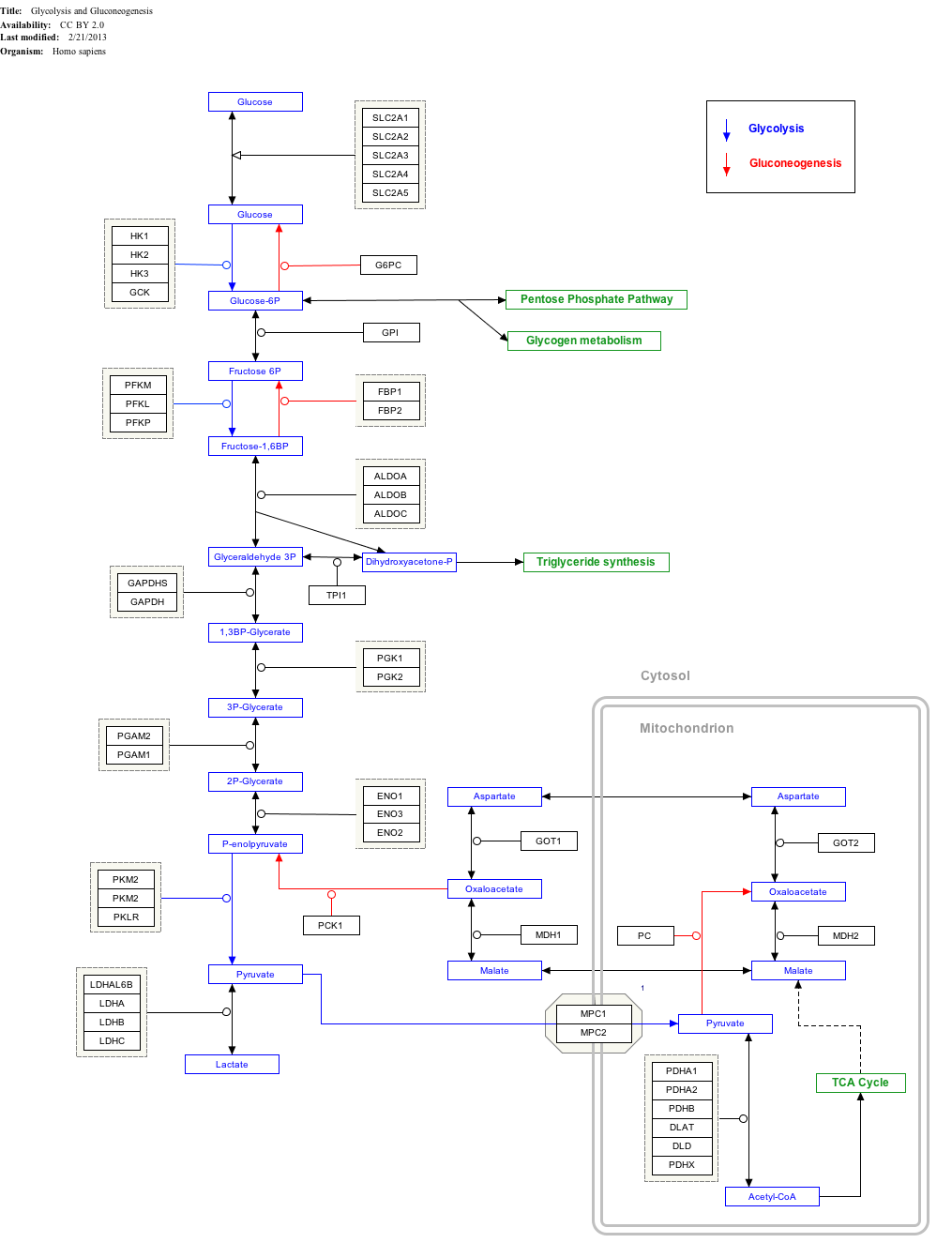
Interactive pathway map
The diagram below shows human protein names. Names in other organisms may be different and the number of isozymes (such as HK1, HK2, ...) is likely to be different too.
Click on genes, proteins and metabolites below to link to respective articles.
Some
of the metabolites in glycolysis have alternative names and
nomenclature. In part, this is because some of them are common to other
pathways, such as the Calvin cycle.
Structure of glycolysis components in Fischer projections and polygonal model
The
intermediates of glycolysis depicted in Fischer projections show the
chemical changing step by step. Such image can be compared to polygonal
model representation.
Glycolysis
- Structure of anaerobic glycolysis components showed using Fischer
projections, left, and polygonal model, right. The compounds correspond
to glucose (GLU), glucose 6-phosphate (G6P), fructose 6-phosphate
(F6P), fructose 1,6-bisphosphate ( F16BP), dihydroxyacetone phosphate
(DHAP), glyceraldehyde 3-phosphate(GA3P), 1,3-bisphosphoglycerate
(13BPG), 3-phosphoglycerate (3PG), 2-phosphoglycerate (2PG),
phosphoenolpyruvate (PEP), pyruvate (PIR), and lactate (LAC). The
enzymes which participate of this pathway are indicated by underlined
numbers, and correspond to hexokinase (1), glucose-6-phosphate isomerase (2), phosphofructokinase-1 (3), fructose-bisphosphate aldolase (4), triosephosphate isomerase (5), glyceraldehyde-3-phosphate dehydrogenase (5), phosphoglycerate kinase (7), phosphoglycerate mutase (8), phosphopyruvate hydratase (enolase) (9), pyruvate kinase (10), and lactate dehydrogenase (11). The participant coenzymes (NAD+, NADH + H+, ATP and ADP), inorganic phosphate, H2O and CO2
were omitted in these representations. The phosphorylation reactions
from ATP, as well the ADP phosphorylation reactions in later steps of
glycolysis are shown as ~P respectively entering or going out the
pathway. The oxireduction reactions using NAD+ or NADH are observed as hydrogens "2H" going out or entering the pathway.