Search This Blog

Saturday, December 14, 2024

Policy coherence for development

Policy coherence for development (PCD) is an approach and policy tool for integrating the economic, social, environmental and governance dimensions of sustainable development at all stages of domestic and international policy making. It is the aim of PCD to make foreign relations to be as ecologically, economically and socially coherent as possible and thereby to make international co-operation for international development more effective.

Policy Coherence for Development Flow Chart

Commitments on achieving greater policy coherence to promote development have also been promoted by the Organisation for Economic Co-operation and Development (OECD) (which has a specific department, Policy Coherence for Development Unit) as well as in the 2011 Busan Partnership for Effective Development Cooperation, the UN Millennium Declaration and the 2010 UN Millennium Development Goals Summit. In an era when development assistance is likely to come under more pressure, Policy Coherence for Development (PCD) should become more important. An example of such recognition is the target of the United Nations Sustainable Development Goal 17 which aims to enhance policy coherence for sustainable development as part of the 2030 Agenda.

PCD operates in a multi-polar global economy in which all countries are playing a role in driving global growth and enabling sustainable development. A rapidly changing global economic landscape means every country is facing more complex and interlinked economic, social and environmental challenges. A better understanding of the linkages of the emerging global trends and their implications is critical for countries as they craft strategies for sustainable development.

Principles

Policy coherence for development (PCD) refers to the integration of economic, social and environmental dimensions of sustainable development and is aimed at enhancing coherence between domestic policies and foreign, international cooperation or development policies. Related terms which describe similar concepts are for example policy coordination, environmental policy integration and environmental mainstreaming.

Under the principles of PCD, potential conflicts of objectives and interests between international co-operation and other sectoral policies of the various federal departments should be identified and resolved as far as possible. These may be in the following policy areas: Migration policy, agricultural policy, environmental policy, health policy, financial sector policy, security policy, education, research and cultural policy.

Researchers explain that policy coherence can be understood as "consistency across the policy cycle: setting and prioritizing objectives, policy instruments and implementation and monitoring, analysis and reporting on policy outcomes. For example, setting and prioritizing objectives should avoid unintended negative impacts on other sectors or the international norms and goals to which a country has committed".

A key assumption underlying the concept of policy coherence for development is that ineffective, inequitable and unsustainable development interventions are, in part, the consequence of fragmented, siloed, and therefore incoherent institutional and policy design. By and large, coherence is understood as “a function of how rules, policies, and arrangements across dimensions of global [national and sub-national] governance are coordinated”.

This suggests another assumption: that changing institutional rules, procedures, and structures can create 'win-win' opportunities to serve a common goal—a theme that dominates discussions about coherence. However, scholars have pointed out that the design logic informing the pursuit of policy coherence neglects that substantively, policy coherence is shaped by choices and preferences over what gets prioritised. Therefore, efforts to improve institutional arrangements for policy coherence would do little for sustainable development if the meaning of sustainable development itself remains undefined or evasive of systemic causes of incoherence.

History

The Organisation for Economic Co-operation and Development (OECD) first coined the term PCD, which many international organisations such as the European Union have taken up as a key tool in achieving global goals.

The origins of the concept go back to successful European NGO campaigns of the 1990s that put a spotlight on 'dumping' of European products in developing countries, and which in 1992 led to an article in the Treaty on European Community that required EU policy makers to take account of developing country interests when drawing up new policies. Depending on the translation, this Treaty article was referred to as promoting coherence (e.g. German version) or consistency (e.g. English version). Later that same decade the OECD added 'for development' so as to clarify that 'PCD' was about ensuring that policies do not harm and where possible contribute to international development objectives. Examples of PCD definitions clarifying this impact focus can be found in the 2005 European Consensus on Development and the 2008 outcome document of the UN MDG summit, both of which link to the MDGs.

The concept of policy coherence for development (PCD) first emerged in discussions among international aid donors in the early 1990s. The term Policy Coherence for Development (PCD) originally emerged from the realisation that non-aid policies of donors affect developing countries and should not distract but rather be supportive of international development goals. The PCD concept initially emphasised the responsibility of developed countries to take into account the effect on developing countries when formulating domestic policies across different sectors (trade, finance, migration, security, technology, science). It thus originates from a north-south paradigm with responsibilities for better PCD placed on developed countries to the benefit of developing countries. As the concept evolved, PCD has been understood to go beyond a 'do no harm' approach, also with a requirement to seek synergies between development co-operation and other policies as well as to correct existing incoherencies. The debates taking place in the EU and the OECD on promoting PCD have also fostered the understanding that PCD should be enhanced at different levels. These were commonly referred to as internal, intra-governmental, inter-governmental, multilateral, multi stakeholder and developing country coherence.

Over the decades, the commitment to policy coherence has received wide-ranging and sustained political endorsements. In global goal-setting, the policy coherence goalpost has broadened from a predominant focus on North-South development cooperation framed around poverty alleviation to universal sustainable development “in ways that balance economic, social and environmental goals; consider domestic and international effects of policies; and support long-term sustainability”. Amongst most OECD donors, this shift is conveyed in the change of nomenclature from Policy Coherence for Development to Policy Coherence for Sustainable Development.

Applications by donor

European Union

The European Union has translated this idea into a legal commitment as most recently stated in the Treaty of Lisbon in 2009 and has highlighted the concept in political declarations and communications, including the position on the post-2015 agenda ‘A decent life for all’. The OECD expressed political will to ensure PCD as noted its 2008 Ministerial Declaration and in the following 2010 Council Recommendations on PCD. The OECD Strategy for Development also assigns key importance to PCD. Both OECD and EU have put in place systems and tools define overall ambition and targets, facilitate decision-making and monitor progress, which include institutional mechanisms, monitoring tools, e.g. peer reviews, indicators and reporting, as well as policy tool-kits presented as practical measures to achieve progress. Some OECD Member states, for example Finland, the Netherlands, have currently developed and piloted self-assessment PCD toolkits. Finland and Switzerland are also testing developing country-level impact assessments in the area of food security.

The European Centre for Development Policy Management (ECDPM) a think tank focused on development co-operation that is based in Maastricht, The Netherlands, argue that Policy Coherence for Development (PCD) is fundamentally a matter of politics. A key dilemma for the countries is how to develop and sustain a level of political interest in and support for PCD, how to put PCD on the political agenda, and to retain momentum and make commitments towards promoting PCD meaningful at both the national and EU level. Although the potential benefits of effective PCD remain unquestioned, ECDPM argues that political leadership, sponsorship and focus have waned in recent years in the several countries, even if many of these are considered global leaders in PCD.

A recent report from the European Commission states that the European Union has made good progress on Policy Coherence for Development (PCD) at both European and Member State level, a fact recognised by the OECD in the most recent (2012) OECD DAC peer review. It argues that the EU has cemented its position as a global leader in implementing PCD commitments in policy-making. It does however acknowledge that there is still room for progress in terms of using mechanisms such as impact assessments, evaluation and/or measuring, monitoring progress and reporting on implementation. The Commission argues that the EU remains the lead actor for PCD internationally, ahead of its main partners, with the highest levels of political and legal commitment. More recently, PCD issues have benefited from sustained high-level political attention in the EU and featured more prominently on the agenda of the EU Foreign Affairs Council.

The Netherlands

The Netherlands has been highly influential in the development of PCD, and is one of the frontrunners in applying PCD at the national level. This country uses PCD in its whole-of-government approach, with different ministries and departments jointly implementing PCD activities. The government of the Netherlands believes in the mutually beneficial relationship between trade and development cooperation, and this lies at the core of its PCD approach. Furthermore, the Dutch PCD approach acknowledged already since at least 2002 that developing countries are all different, and that policies should be adapted to specific localities, individuals or cultural groups.

The Dutch PCD approach aims to integrate sustainability with the other objectives of sustainable development, for example in the area of climate action: “Climate action is integrated into development activities, in particular in the areas of energy, water and food security. In this way it is achieved that climate action and development action do not undermine each other but reinforce each other”.

United States

Policy coherence for development is among the many criteria for the OECD Development Assistance Committee Peer Review Process. The 2011 DAC Peer Review of the United States stated that "The OECD/DAC describes progress towards policy coherence for development (PCD) as involving three building blocks: (i) a political commitment that clearly specifies policy objectives; (ii) policy co-ordination mechanisms that can resolve conflicts or inconsistencies between policies and maximise synergies; and (iii) monitoring, analysis and reporting systems to provide the evidence base for accountability and for well- informed policy making and politics (OECD, 2008a). The 2006 peer review encouraged the US government to develop a more explicit policy on the role of policy coherence for development and to put in place the resources needed to carry out analysis and effectively manage the policy coherence agenda. Five years on, the US has achieved mixed progress in implementing these recommendations and the three PCD pillars"

The OECD argue that national security strategy cannot substitute for a policy coherence for development agenda. After the passing of the FY14 State and Foreign Operations Appropriations bill in 2013, Kate Almquist Knopf, a former assistant administrator for USAID, blogged that "There is a fundamental mismatch between the United States’ foreign aid architecture, resources, and objectives" and that the bill was a "stinging reminder of the low esteem in which many members of Congress hold global development and the US Agency for International Development (USAID), the primary federal agency charged with delivering US foreign assistance worldwide." She called for the USAID administrator to be a standing member of the National Security Council, and the US Secretary of State could return actual budget and planning authority to USAID by restoring the USAID administrator as the dual-hatted director of US foreign assistance.

Applications by sector

Food security

Food security is a major development challenge and to address this, the EU amongst others has effectively put global food security high among its development priorities for the years to come. However, while the European Union is the world's major development actor on food security, as ECDPM argues some of its other policies are still contested as harmful to global food security and agricultural development.

An analysis of EU policy-making processes related to agriculture, fisheries, energy and trade shows that some tangible efforts have been made to strengthen policy coherence 'for food security'. However, these are tentative steps. Other concerns and interests dominate the debates and shape the outcomes, while global food security considerations play a very marginal to no role, or the food security rationale used is at odds with the logic of the EU's own food security policy framework.

Sustainable Development Goals (2015-2030)

The target of the United Nations Sustainable Development Goal 17 aims to enhance policy coherence for sustainable development as part of the 2030 Agenda. Target 17.14 is formulated as: "Enhance policy coherence for sustainable development." This target has one Indicator: Indicator 17.14.1 is the "Number of countries with mechanisms in place to enhance policy coherence of sustainable development".

United Nations Summit on the Millennium Development Goals

Amid international reflection on the form and content of a post-2015 framework, among many other issues, PCD was highlighted as being a key component of the 'beyond-aid' debate. The post-2015 agenda discussions emphasised the need for a universal development agenda that is relevant to the needs of all countries and which is based on shared responsibilities. This is against the background of a changing global development landscape and shared development and 'global public goods' challenges, such as climate change, widening income inequalities, resource scarcity and environmental degradation. The original PCD concept focusing on 'beyond-aid' policies of OECD DAC donor countries does not easily fit such a new 'universal' logic. For this reason, the OECD has reconceptualised PCD and now promotes a wider universal approach and definition of PCD in the context of the post-2015 agenda.

The Eighth Millennium Development Goal (MDG8) was designed "to create an environment – at the national and global levels alike – conducive to development and to the elimination of poverty." The OECD argue that progress in achieving the MDG8 has been limited and in fact the MDG8 downplayed the importance of domestic policies and domestic resource mobilisation in financing the MDGs and fostering development. They also argue that discussions on PCD have mainly taken place among donors, having focused on coherence between aid and non-aid policies and on a sector-by-sector basis. This has meant focusing on issues with important cross-border dimensions, such as trade, agriculture, investment, health and migration, amongst others, but without giving attention to the multi-dimensionality of development challenges. At the same time, an approach to "naming and shaming" has succeeded only in highlighting the failures and negative effects of non-aid policies. This has been counterproductive for engaging other policy communities and key actors beyond those in development.

A paper by ECDPM argues that the various of the ideas and principles of PCD can be mainstreamed in the post-2015 framework without using strong PCD jargon. These include i) targets for Means of Implementation in thematic areas that effectively require strengthened PCD efforts, ii) targets in relation to capacity building for more integrated and evidence-based policy-making and iii) efforts to build a strong accountability framework. The paper further concludes that independent from whether a universal PCD concept will explicitly be part of the language of a new framework, real progress on PCD will have to remain a major, if not the most, important component of OECD and EU MS action in achievement of post-2015 commitments.

Measurements

The Policy Coherence for Sustainable Development Index (PCSDI) is an index elaborated by the Non Governmental Organisation Coordinator in cooperation with the Spanish Network for Development Studies REEDES. PCSDI analyses both the policies that make a positive contribution to sustainable development in a country and those that impact negatively, not only on that country, but also on third countries or on the whole planet.

In 2019 PCSDI 148 countries are ranked from 26.76 (the worst, India) to 79.02 (the best, Denmark). The PCSDI has 5 components: economic, social, environmental, global and productive.

Critique

In 2013, the high-profile development blogger Owen Barder wrote a critique of the concept of 'Policy Coherence for Development' entitled 'Policy Coherence Is a Hobgoblin'. He argued that "The term PCD has given us an industry of reports and conferences focussing on whether countries have policies which are consistent with each other, and institutions thought likely to make them so, instead of focusing on whether and how those policies are individually supportive of, or inimical to, development." He argued that the PCD concept has "perhaps subconsciously, altered the country’s policy objectives away from impact to consistency."

Global Footprint Network


From Wikipedia, the free encyclopedia
National ecological surplus or deficit, measured as a country's biocapacity per person (in global hectares) minus its ecological footprint per person (also in global hectares). Data from 2013.
  x ≤ -9
  -9 < x ≤ -8
  -8 < x ≤ -7
  -7 < x ≤ -6
  -6 < x ≤ -5
  -5 < x ≤ -4
  -4 < x ≤ -3
  -3 < x ≤ -2
  -2 < x ≤ -1
  -1 < x < 0
  0 ≤ x < 2
  2 ≤ x < 4
  4 ≤ x < 6
  6 ≤ x < 8
  8 ≤ x
  Data unavailable

The Global Footprint Network was founded in 2003 and is an independent think tank originally based in the United States, Belgium and Switzerland. It was established as a charitable not-for-profit organization in each of those three countries. Its aim is to develop and promote tools for advancing sustainability, including the ecological footprint and biocapacity, which measure the amount of resources we use and how much we have. These tools aim at bringing ecological limits to the center of decision-making.

Work

Global Footprint Network's goal is to create a future where all humans can live well, within the means of one planet Earth. The organization is headquartered in Oakland, California. The Network brings together over 70 partner organizations, including WWF International, ICLEI, Bank Sarasin, The Pictet Group, the New Economics Foundation, Pronatura México, and the Environment Agency Abu Dhabi.

National Footprint and Biocapacity Accounts

Every year, Global Footprint Network produced a new edition of its National Footprint and Biocapacity Accounts, which calculate Ecological Footprint and biocapacity of more than 200 countries and territories from 1961 to the present. Based on up to 15,000 data points per country per year, these data have been used to influence policy in more than a dozen countries, including Ecuador, France, Germany, Japan, Korea, the Philippines, Russia, Switzerland, and the United Arab Emirates. Since 2019, the National Footprint and Biocapacity Accounts are produced in collaboration between Global Footprint Network, York University, and Footprint Data Foundation.

The 2022 Edition of the National Footprint and Biocapacity Accounts cover 1961-2018 (latest UN data available), and incorporate data from the Food and Agriculture Organization, the UN Comtrade database, the International Energy Agency, and over 20 other sources.

Ecological Footprint Explorer

In April 2017, Global Footprint Network launched the Ecological Footprint Explorer, an open data platform for the National Footprint and Biocapacity Accounts. The website provides ecological footprint results for over 200 countries and territories, and encourages researchers, analysts, and decision-makers to visualize and download data.

Earth Overshoot Day

Previously known as Ecological Debt Day, Earth Overshoot Day is the day when humanity has exhausted nature's budget for the year. For the rest of the year, society operates in ecological overshoot by drawing down local resource stocks and accumulating carbon dioxide in the atmosphere. The first Earth Overshoot Day was December 19, 1987. In 2014, Earth Overshoot Day was August 19. The Earth Overshoot Day in 2015 was on August 13 and on August 8 in 2016. In 2017, Earth Overshoot Day landed on August 2, and in 2020 on August 22.

Founding

In 2003, Mathis Wackernagel, PhD, and Susan Burns founded Global Footprint Network, an international think-tank headquartered in Oakland, California, with offices in Geneva and Brussels. Wackernagel received an honorary doctorate in December 2007 from the University of Bern in Switzerland.

Leadership

  • Co-founder & President: Dr. Mathis Wackernagel
  • Co-founder: Susan Burns
  • Chief Executive Officer: Laurel Hanscom
  • Chief Science Officer: Dr. David Lin
  • Director, Marketing & Communications: Amanda Diep
  • Director, Mediterranean and MENA Regions: Dr. Alessandro Galli
  • Board Chair: Keith Tuffley
  • Honorary Chair: Swiss entrepreneur and investor André Hoffmann

Awards and honours

  • World Sustainability Award 2018
  • International Association for Impact Assessment's Global Environment Award 2015
  • RECYCLAPOLIS National Sustainability Award 2015
  • ISSP Sustainability Hall of Fame Inductees Susan Burns and Mathis Wackernagel 2014
  • Prix Nature Swisscanto 2013
  • Global Footprint Network was recognized as one of the top 100 NGOs worldwide by the Global Journal in 2012 and 2013
  • Blue Planet Prize 2012
  • Boulding Award 2012
  • Binding Prize 2012
  • Ecological overshoot

    From Wikipedia, the free encyclopedia
    https://en.wikipedia.org/wiki/Ecological_overshoot
    Ecological overshoot expressed in terms of how many Earths equivalent of natural resources are consumed by humanity each year.

    Ecological overshoot is the phenomenon which occurs when the demands made on a natural ecosystem exceed its regenerative capacity. Global ecological overshoot occurs when the demands made by humanity exceed what the biosphere of Earth can provide through its capacity for renewal.

    Record of global ecological overshoot

    To determine whether ecological overshoot is happening requires the collection of global and nation-specific data regarding the availability of natural resources, the capability of the ecosystems to renew any natural resources that were consumed, and the rate at which the resources are being consumed, usually assessed for each calendar year.

    This data collection, and analysis is typically done by scientific and conservation organisations, such as the Global Footprint Network, which aggregates data to assess the ecological footprint of each country and the global community.

    These ecological resource accounts reveal that the global community has been exceeding the regenerative capacity of the Earth since 1970, which was the year when the consumption capacity of humanity first exceeded the biocapacity the Earth. Each year since 1970 humanity has witnessed global ecological overshoot.

    Earth Overshoot Day

    This problem is highlighted each year on Earth Overshoot Day, an illustrative calendar date obtained through calculation, on which day humanity's resource consumption for the year is considered to have exceeded the Earth’s capacity to regenerate those resources for that year.

    Global ecological debt

    This ecological debt is often referred to as our global 'ecological overshoot'. The data from the Global Footprint Network has been used to create the graph below, it shows that since the 1970s the global population is increasingly compromising the Earth's ecosystem. The red section of the graph indicates that the global population have been accruing a global ecological overshoot since 1970. This means that the rate at which we are using natural resources exceeds the time required by the ecosystems to regenerate the resources and absorb the waste products that are involved.

    The continued over-exploitation of natural resources results in ever more severe damage to global ecosystems over time, this has destabilised many micro ecosystems causing increasing extinction rates and the macro ecosystems are coming under increasing pressure. In this way humans are currently exceeding the carrying capacity of Earth as we increase the ecological overshoot each year. The IPAT equation attempts to quantify the environmental impact ("I") of the human population ("P"), their affluence ("A") and technology ("T"). Furthermore the Jevons paradox warns us that increasing our efficiency using technology will usually result in increased ecological damage.

    Causes

    The majority of the world currently follow an economic paradigm that seeks to grow all three of the IPAT parameters: population size, affluence and use of technology. These behaviour patterns are causing escalating environmental damage and there is evidence for growing risk of ecological collapse.

    The outcomes from various possible human behaviour scenarios have been explored in a demographic model developed by Prof Chris Bystroff. According to the Bystroff predictions, continuing with the growth economic paradigm will result in a rapid decrease in population numbers halving global population by 2040. The Bystroff predictions are echoed in further research by Dr William E. Rees, who originally developed the concept of Ecological Footprint. This research states that to reduce ecological overshoot it is necessary to reduce economic consumption drastically to stop growing the economy and to repay the accrued ecological debt by restoration and rewilding back to the one planet level or less. A recent review of the World 3 demographic model by KPMG also concludes that humans need to rethink their pursuit of economic growth or anticipate collapse by 2040. For countries that have already achieved social affluence, although their social performance and resource utilization levels are high, the ecological overshoot brought about by these developments is still maintaining a continuously increasing trend. On the other hand, many low-income countries tried increasing their per capita wealth through economic activities to improve their social shortfalls. However, their social development is slower than the resulting increase in ecological overshoot. In this case, the ecological environment will be more overwhelmed.

    It is important to bear in mind that the data collected by the Global Footprint Network (GFN) makes the assumption that the whole biocapacity of the Earth is entirely at the disposal of humanity. However it is evident that we need biodiversity in order to survive, therefore unless we reserve some of the global biocapacity for other species we cannot survive. Several organisations argue that to reinstate biodiversity to levels comparable to those preceding the high extinction rates associated with the ongoing Holocene extinction event, at least 50% of the Earths biocapacity would need to be protected as nature reserve areas which are kept free from human intervention. This suggestion was presented in the book titled Half Earth. Global Footprint Network data shows that for over 50 years humanity has been stressing the ecosystems on the planet beyond their ability to recover.

    A crisis of human behaviour (the Human Behavioural Crisis) has been highlighted as the driver of anthropogenic ecological overshoot in a peer-reviewed World Scientists' Warning paper led by Joseph J. Merz and co-authored by William E. Rees, Phoebe Barnard et al.

    Effects

    The most well known symptom of ecological overshoot is the rising extinction rate. Pandemics of zoonotic diseases, like COVID-19 also become increasingly likely with overpopulation and global travel because we encroach on wildlife habitats and accelerate the spread. Biocapacity is measured by calculating the amount of biologically productive land and sea area available to provide the resources a population consumes and to absorb its wastes, given the prevailing technology and management practices. Countries differ in the productivity of their ecosystems, and this is reflected in the National Footprint and Biocapacity Accounts kept by York University, FoDaFo and Global Footprint Network. A country has an ecological reserve if its Ecological footprint is smaller than its biocapacity; otherwise it is operating with an ecological overshoot. The former are often referred to as ecological creditors, and the latter as ecological debtors. Today, most countries, and the world as a whole, are in ecological overshoot. Over 85% of the world population lives in countries operating with an ecological overshoot.

    Solving the problem of Ecological Overshoot

    The pursuit of growth economics relies on continual increase in our numbers and our consumption. Several economists have been challenging the wisdom of this prevailing discipline for many years. Those suggesting a new economic paradigm can be considered collectively as advocates for degrowth.

    Novel ecosystem

    From Wikipedia, the free encyclopedia
    https://en.wikipedia.org/wiki/Novel_ecosystem

    Novel ecosystems are human-built, modified, or engineered niches of the Anthropocene. They exist in places that have been altered in structure and function by human agency. Novel ecosystems are part of the human environment and niche (including urban, suburban, and rural), they lack natural analogs, and they have extended an influence that has converted more than three-quarters of wild Earth . These anthropogenic biomes include technoecosystems that are fuelled by powerful energy sources (fossil and nuclear) including ecosystems populated with technodiversity, such as roads and unique combinations of soils called technosols. Vegetation associations on old buildings or along field boundary stone walls in old agricultural landscapes are examples of sites where research into novel ecosystem ecology is developing.

    Overview

    Human society has transformed the planet to such an extent that we may have ushered in a new epoch known as the anthropocene. The ecological niche of the anthropocene contains entirely novel ecosystems that include technosols, technodiversity, anthromes, and the technosphere. These terms describe the human ecological phenomena marking this unique turn in the evolution of Earth's history. The total human ecosystem (or anthrome) describes the relationship of the industrial technosphere to the ecosphere.

    Technoecosystems interface with natural life-supporting ecosystems in competitive and parasitic ways. Odum (2001) attributes this term to a 1982 publication by Zev Naveh: "Current urban-industrial society not only impacts natural life-support ecosystems, but also has created entirely new arrangements that we can call techno-ecosystems, a term believed to be first suggested by Zev Neveh (1982). These new systems involve new, powerful energy sources (fossil and atomic fuels), technology, money, and cities that have little or no parallels in nature." The term technoecosystem, however, appears earliest in print in a 1976 technical report and also appears in a book chapter (see in Lamberton and Thomas (1982) written by Kenneth E. Boulding).

    Novel Ecosystems

    A novel ecosystem is one that has been heavily influenced by humans but is not under human management. A working tree plantation doesn't qualify; one abandoned decades ago would.

    Marris 2009

    Novel ecosystems "differ in composition and/or function from present and past systems". Novel ecosystems are the hallmark of the recently proposed anthropocene epoch. They have no natural analogs due to human alterations on global climate systems, invasive species, a global mass extinction, and disruption of the global nitrogen cycle. Novel ecosystems are creating many different kinds of dilemmas for terrestrial and marine conservation biologists. On a more local scale, abandoned lots, agricultural land, old buildings, field boundary stone walls or residential gardens provide study sites on the history and dynamics of ecology in novel ecosystems.

    Anthropogenic biomes

    Anthropogenic biomes tell a completely different story, one of “human systems, with natural ecosystems embedded within them”. This is no minor change in the story we tell our children and each other. Yet it is necessary for sustainable management of the biosphere in the 21st century.

    Ellis (2008) identifies twenty-one different kinds of anthropogenic biomes that sort into the following groups: 1) dense settlements, 2) villages, 3) croplands, 4) rangeland, 5) forested, and 6) wildlands. These anthropogenic biomes (or anthromes for short) create the technosphere that surrounds us and are populated with diverse technologies (or technodiversity for short). Within these anthromes the human species (one species out of billions) appropriates 23.8% of the global net primary production. "This is a remarkable impact on the biosphere caused by just one species."

    Noosphere

    Noosphere (sometimes noösphere) is the "sphere of human thought". The word is derived from the Greek νοῦς (nous "mind") + σφαῖρα (sphaira "sphere"), in lexical analogy to "atmosphere" and "biosphere". Introduced by Pierre Teilhard de Chardin 1922 in his Cosmogenesis. Another possibility is the first use of the term by Édouard Le Roy, who together with Chardin was listening to lectures of Vladimir Vernadsky at Sorbonne. In 1936 Vernadsky presented on the idea of the Noosphere in a letter to Boris Leonidovich Lichkov (though, he states that the concept derives from Le Roy).

    Technosphere

    The technosphere is the part of the environment on Earth where technodiversity extends its influence into the biosphere. "For the development of suitable restoration strategies, a clear distinction has to be made between different functional classes of natural and cultural solar-powered biosphere and fossil-powered technosphere landscapes, according to their inputs and throughputs of energy and materials, their organisms, their control by natural or human information, their internal self-organization and their regenerative capacities." The weight of Earth's technosphere has been suggested to be 30 trillion tons, a mass greater than 50 kilos for every square metre of the planet's surface.

    Technoecosystems

    The concept of technoecosystems has been pioneered by ecologists Howard T. Odum and Zev Naveh. Technoecosystems interfere with and compete against natural systems. They have advanced technology (or technodiversity) money-based market economies and have a large ecological footprints. Technoecosystems have far greater energy requirements than natural ecosystems, excessive water consumption, and release toxic and eutrophicating chemicals. Other ecologists have defined the extensive global network of road systems as a type of technoecosystem.

    Technoecotypes

    "Bio-agro- and techno-ecotopes are spatially integrated in larger, regional landscape units, but they are not structurally and functionally integrated in the ecosphere. Because of the adverse impacts of the latter and the great human pressures on bio-ecotopes, they are even antagonistically related and therefore cannot function together as a coherent, sustainable ecological system."

    Technosols

    Technosols are a new form of ground group in the World Reference Base for Soil Resources (WRB). Technosols are "mainly characterised by anthropogenic parent material of organic and mineral nature and which origin can be either natural or technogenic."

    Technodiversity

    Technodiversity refers to the varied diversity of technological artifacts that exist in technoecosystems.


    Friday, December 13, 2024

    Individual

    From Wikipedia, the free encyclopedia

    Etymology

    From the 15th century and earlier (and also today within the fields of statistics and metaphysics) individual meant "indivisible", typically describing any numerically singular thing, but sometimes meaning "a person". From the 17th century on, an individual has indicated separateness, as in individualism.

    Biology

    In biology, the question of the individual is related to the definition of an organism, which is an important question in biology and the philosophy of biology, despite there having been little work devoted explicitly to this question. An individual organism is not the only kind of individual that is considered as a "unit of selection". Genes, genomes, or groups may function as individual units.

    Asexual reproduction occurs in some colonial organisms so that the individuals are genetically identical. Such a colony is called a genet, and an individual in such a population is referred to as a ramet. The colony, rather than the individual, functions as a unit of selection. In other colonial organisms, individuals may be closely related to one another but may differ as a result of sexual reproduction.

    Law

    Although individuality and individualism are commonly considered to mature with age/time and experience/wealth, a sane adult human being is usually considered by the state as an "individual person" in law, even if the person denies individual culpability ("I followed instructions").

    An individual person is accountable for their actions/decisions/instructions, subject to prosecution in both national and international law, from the time that they have reached the age of majority, often though not always more or less coinciding with the granting of voting rights, responsibility for paying tax, military duties, and the individual right to bear arms (protected only under certain constitutions).

    Philosophy

    Individuals may stand out from the crowd, or may blend in with it.

    Buddhism

    In Buddhism, the concept of the individual lies in anatman, or "no-self." According to anatman, the individual is really a series of interconnected processes that, working together, give the appearance of being a single, separated whole. In this way, anatman, together with anicca, resembles a kind of bundle theory. Instead of an atomic, indivisible self distinct from reality, the individual in Buddhism is understood as an interrelated part of an ever-changing, impermanent universe (see Interdependence, Nondualism, Reciprocity).

    Empiricism

    Empiricists such as Ibn Tufail in early 12th century Islamic Spain and John Locke in late 17th century England viewed the individual as a tabula rasa ("blank slate"), shaped from birth by experience and education. This ties into the idea of the liberty and rights of the individual, society as a social contract between rational individuals, and the beginnings of individualism as a doctrine.

    Hegel

    Georg Wilhelm Friedrich Hegel regarded history as the gradual evolution of the Mind as it tests its own concepts against the external world. Each time the mind applies its concepts to the world, the concept is revealed to be only partly true, within a certain context; thus the mind continually revises these incomplete concepts so as to reflect a fuller reality (commonly known as the process of thesis, antithesis, and synthesis). The individual comes to rise above their own particular viewpoint, and grasps that they are a part of a greater whole insofar as they are bound to family, a social context, and/or a political order.

    Existentialism

    With the rise of existentialism, Søren Kierkegaard rejected Hegel's notion of the individual as subordinated to the forces of history. Instead, he elevated the individual's subjectivity and capacity to choose their own fate. Later Existentialists built upon this notion. Friedrich Nietzsche, for example, examines the individual's need to define his/her own self and circumstances in his concept of the will to power and the heroic ideal of the Übermensch. The individual is also central to Sartre's philosophy, which emphasizes individual authenticity, responsibility, and free will. In both Sartre and Nietzsche (and in Nikolai Berdyaev), the individual is called upon to create their own values, rather than rely on external, socially imposed codes of morality.

    Objectivism

    Ayn Rand's Objectivism regards every human as an independent, sovereign entity that possesses an inalienable right to their own life, a right derived from their nature as a rational being. Individualism and Objectivism hold that a civilized society, or any form of association, cooperation or peaceful coexistence among humans, can be achieved only on the basis of the recognition of individual rights — and that a group, as such, has no rights other than the individual rights of its members. The principle of individual rights is the only moral base of all groups or associations. Since only an individual man or woman can possess rights, the expression "individual rights" is a redundancy (which one has to use for purposes of clarification in today's intellectual chaos), but the expression "collective rights" is a contradiction in terms. Individual rights are not subject to a public vote; a majority has no right to vote away the rights of a minority; the political function of rights is precisely to protect minorities from oppression by majorities (and the smallest minority on earth is the individual).

    Gravity train

    From Wikipedia, the free encyclopedia
    https://en.wikipedia.org/wiki/Gravity_train
    Ceres gravity train concept. Mining the asteroid belt could use gravity trains to haul raw material to a central refining point and launch point / space elevator

    A gravity train is a theoretical means of transportation for purposes of commuting between two points on the surface of a sphere, by following a straight tunnel connecting the two points through the interior of the sphere.

    In a large body such as a planet, this train could be left to accelerate using just the force of gravity, since during the first half of the trip (from the point of departure until the middle), the downward pull towards the center of gravity would pull it towards the destination. During the second half of the trip, the acceleration would be in the opposite direction relative to the trajectory, but, ignoring the effects of friction, the speed acquired before would overcome this deceleration, and as a result, the train's speed would reach zero at approximately the moment the train reached its destination.

    Origin of the concept

    In the 17th century, British scientist Robert Hooke presented the idea of an object accelerating inside a planet in a letter to Isaac Newton. A gravity train project was seriously presented to the French Academy of Sciences in the 19th century. The same idea was proposed, without calculation, by Lewis Carroll in 1893 in Sylvie and Bruno Concluded. The idea was rediscovered in the 1960s when physicist Paul Cooper published a paper in the American Journal of Physics suggesting that gravity trains be considered for a future transportation project.

    Mathematical considerations

    Under the assumption of a spherical planet with uniform density, and ignoring relativistic effects as well as friction, a gravity train has the following properties:

    • The duration of a trip depends only on the density of the planet and the gravitational constant, but not on the diameter of the planet.
    • The maximum speed is reached at the middle point of the trajectory.

    For gravity trains between points which are not the antipodes of each other, the following hold:

    • The shortest time tunnel through a homogeneous earth is a hypocycloid; in the special case of two antipodal points, the hypocycloid degenerates to a straight line.
    • All straight-line gravity trains on a given planet take exactly the same amount of time to complete a journey (that is, no matter where on the surface the two endpoints of its trajectory are located).

    On the planet Earth specifically, since a gravity train's movement is the projection of a very-low-orbit satellite's movement onto a line, it has the following parameters:

    • The travel time equals 2530.30 seconds (nearly 42.2 minutes, half the period of a low Earth orbit satellite), assuming Earth were a perfect sphere of uniform density.
    • By taking into account the realistic density distribution inside the Earth, as known from the preliminary reference Earth model, the expected fall-through time is reduced from 42 to 38 minutes.

    To put some numbers in perspective, the deepest current bore hole is the Kola Superdeep Borehole with a true depth of 12,262 meters; covering the distance between London and Paris (350 km) via a hypocycloidical path would require the creation of a hole 111,408 metres deep. Not only is such a depth nine times as great, but it would also necessitate a tunnel that passes through the Earth's mantle.

    Mathematical derivation

    Using the approximations that the Earth is perfectly spherical and of uniform density , and the fact that within a uniform hollow sphere there is no gravity, the gravitational acceleration experienced by a body within the Earth is proportional to the ratio of the distance from the center to the Earth's radius . This is because underground at distance from the center is like being on the surface of a planet of radius , within a hollow sphere which contributes nothing.

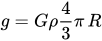
    On the surface, , so the gravitational acceleration is . Hence, the gravitational acceleration at is

    Diametric path to antipodes

    In the case of a straight line through the center of the Earth, the acceleration of the body is equal to that of gravity: it is falling freely straight down. We start falling at the surface, so at time (treating acceleration and velocity as positive downwards):

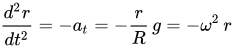
    Differentiating twice:

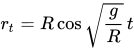
    where . This class of problems, where there is a restoring force proportional to the displacement away from zero, has general solutions of the form , and describes simple harmonic motion such as in a spring or pendulum.

    In this case so that , we begin at the surface at time zero, and oscillate back and forth forever.

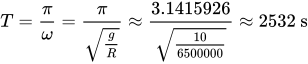
    The travel time to the antipodes is half of one cycle of this oscillator, that is the time for the argument to to sweep out radians. Using simple approximations of that time is

    Straight path between two arbitrary points

    Path of gravity train

    For the more general case of the straight line path between any two points on the surface of a sphere we calculate the acceleration of the body as it moves frictionlessly along its straight path.

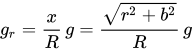
    The body travels along AOB, O being the midpoint of the path, and the closest point to the center of the Earth on this path. At distance along this path, the force of gravity depends on distance to the center of the Earth as above. Using the shorthand for length OC:

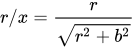
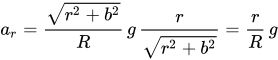
    The resulting acceleration on the body, because is it on a frictionless inclined surface, is :

    Diagram of forces on a gravity train on non-diametrical straight line path

    But is , so substituting:

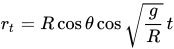
    which is exactly the same for this new , distance along AOB away from O, as for the in the diametric case along ACD. So the remaining analysis is the same, accommodating the initial condition that the maximal is the complete equation of motion is

    The time constant is the same as in the diametric case so the journey time is still 42 minutes; it's just that all the distances and speeds are scaled by the constant .

    Dependence on radius of planet

    The time constant depends only on so if we expand that we get

    which depends only on the gravitational constant and the density of the planet. The size of the planet is immaterial; the journey time is the same if the density is the same.

    In fiction

    In the 2012 movie Total Recall, a gravity train called "The Fall" goes through the center of the Earth to commute between Western Europe and Australia.

    Modal realism

    From Wikipedia, the free encyclopedia https://en.wikipedia.org/wiki/Modal_realism   ...