Fiscal policy is any changes the government makes to the national budget to influence a nation's economy. "An essential purpose of this Financial Report is to help American
citizens understand the current fiscal policy and the importance and
magnitude of policy reforms essential to make it sustainable. A
sustainable fiscal policy is explained as the debt held by the public to
Gross Domestic Product which is either stable or declining over the
long term" (Bureau of the fiscal service). The approach to economic
policy in the United States was rather laissez-faire
until the Great Depression. The government tried to stay away from
economic matters as much as possible and hoped that a balanced budget
would be maintained. Prior to the Great Depression, the economy did have economic downturns
and some were quite severe. However, the economy tended to
self-correct so the laissez faire approach to the economy tended to
work.
President Franklin D. Roosevelt first instituted fiscal policies in the United States in The New Deal.
The first experiments did not prove to be very effective, but that was
in part because the Great Depression had already lowered the
expectations of business so drastically.
History
The Great Depression
Crowd gathering outside of a New York City stock exchange during the Great Depression
The Great Depression struck countries in the late 1920s and continued
throughout the entire 1930's. It affected some countries more than
others, and the effects in the US were detrimental. In 1933, 25 percent
of all workers were unemployed in America. Many families starved or lost their homes. Some tried traveling to the West to find work, also to no avail.
The Great Depression showed the American population that there
was a growing need for the government to manage economic affairs. The
size of the federal government began rapidly expanding in the 1930s,
growing from 553,000 paid civilian employees in the late 1920s to
953,891 employees in 1939. The budget grew substantially as well. In
1939, federal receipts of the administrative budget were 5.50 percent of
Gross National Product, GNP,
while federal expenditures were 9.77 percent of GNP. These numbers were
up significantly from 1930, when federal receipts averaged 3.80 percent
of GNP while expenditures averaged 3.04 percent of GNP.
Another contributor to changing the role of government in the
1930s was President Franklin Delano Roosevelt. FDR was important because
of his creation of the New Deal, which was a program that would offer
relief, recovery, and reform to the American nation. In terms of relief, new organizations, such as the Works Progress Administration,
saved many U.S. lives. The reform aspect was indeed the most
influential in the New Deal, for it forever changed the role of
government in the U.S. economy. In essence, it was the beginning of
fiscal policy. It was the first time that the government took an active
role in attempting to secure American individuals from unseen drastic
changes in the market.
Although the relief and reform aspects of the New Deal proved to
be effective for Americans, recovery was an issue that did not. Unemployment rates remained very high throughout the 1930s. It was still difficult for Americans to find jobs. This problem
diminished when the government called for many industries to convert to
military production in the early 1940s in order to prepare for World War II.
World War II and effects
World
War II forced the government to run huge deficits, or spend more than
they were economically generating, in order to keep up with all of the
production the US military needed. By running deficits, the economy
recovered, and America rebounded from its drought of unemployment. The military strategy of full employment had a huge benefit: the
government's massive deficits were used to pay for the war, and ended
the Great Depression. This phenomenon set the standard and showed just how necessary it was
for the government to play an active role in fiscal policy.
The Employment Act of 1946
was enacted by the government to keep the economy from plunging back
into a post-war depression. The act declared the continuing policy and
responsibility of the federal government to use all reasonable means to
promote maximum (not full) employment, production, and purchasing power. In addition to focusing on keeping unemployment rates low, the act called for the creation of the Council of Economic Advisors. This council had the task of assisting the president in appointing members to the Joint Economic Committee in the United States Congress and continuing to develop the role of fiscal policy in the United States.
Modern fiscal policy
The United States
government has tended to spend more money than it takes in, indicated
by a national debt that was close to $1 billion at the beginning of the
20th century. The budget for most of the 20th century followed a pattern
of deficits during wartime and economic crises, and surpluses during periods of peacetime economic expansion.
In 1971, at Bretton Woods, the US went off the gold standard allowing the dollar to float. Shortly after that, the price of oil was pegged to gold rather than the dollar by OPEC. The 70s were marked by oil shocks, recessions and inflation in the US. From fiscal years
1970 to 1997; although the country was nominally at peace during most
of this time, the federal budget deficit accelerated, topping out (in
absolute terms) at $290 billion for 1992.
U.S. deficits and surpluses 1966-2026 by percentage of GDP, from CBO Updated Budget Projections March 2016
In
contrast, from FY 1997–2001, gross revenues exceeded expenditures and a
surplus resulted. However, it has been argued that this 'balanced
budget' only constituted a surplus in the public debt (or on-budget), in
which the Treasury Department borrowed increased tax revenue from
intragovernmental debt holdings (namely the Social Security Trust Fund),
thus adding more interest on Treasury bonds. In effect, the four year
'surplus' was only in public debt holdings, while the National Debt
Outstanding increased every fiscal year (the lowest deficit in FY 2000
was $17.9 Billion). However, after a combination of the dot-com bubble burst, the September 11 attacks, a dramatic increase in government spending (primarily in defense for military operations in Afghanistan and Iraq)
and a $1.35 trillion tax cut, the budget returned to a deficit basis.
The budget went from a $236 billion surplus in fiscal year 2000 to a
$413 billion deficit in fiscal year 2004. In fiscal year 2005, the
deficit began to shrink due to a sharp increase in tax revenue. By 2007,
the deficit was reduced to $161 billion; less than half of what it was
in 2004 and the budget appeared well on its way to balance once again.
Fiscal policy is the application of taxation and government
spending to influence economic performance. The main aim of adopting
fiscal policy instruments is to promote sustainable growth
in the economy and reduce the poverty levels within the community. In
the past, fiscal policy instruments were used solve the economic crisis
such as the great recession and during the financial crisis. They are
effective in jump-starting growth, supporting the financial systems, and
mitigating the economic crisis on the vulnerable groups especially the
low-income earners and the poor. The most commonly applied fiscal policy
instruments are government spending and taxes. The government increases
or reduces its budget allocation on public expenditure to ensure vital
goods and services are provided to the citizens. For instance,
expenditure on infrastructural projects not only increases access to
more roads but also creates jobs to the public and also increases the
amount money in circulation thereby spurring economic growth. On the
other hand, reduction of income and value added taxes increase the
amount of disposable income that individuals direct to consumption and
investment expenditures. Increasing income taxes reduce disposable
income while it increases the tax base for public spending.
Fiscal policy instruments are effective in poverty reduction and
promotion of the community living standards. Increasing public
expenditure ensures that vital public goods and services are availed to
the public. Moreover, it helps in creation of employment opportunities,
triggering economic growth, and ensuring sustainable growth
and development. Tax reduction and cash transfers’ helps in increasing
disposable income and transferring resources from the rich to the poor
in the community. Fiscal policy instruments can be used to achieve
balanced growth in an economy.
Federal policies are system of laws, course of actions, regulatory
measures, and priorities set by the Federal government in guiding
decisions on issues relating to public interest. In most cases, public
policy decisions are carried out by the group of people who represent
the public, different interests, and beliefs. The policies define all
the actions that the Federal government take in order to address issues
like security, education, unemployment, poverty reduction among others.
Federal policies assist the Federal government in conducting national
affairs responsibly. For instance, they inform the government on where
to prioritize their funding and support in order to achieve the
macroeconomic objectives. For instance, the government is charged with
the responsibility of providing education, security, and healthcare.
Increased funding on these key priority areas helps in improving public
access to the services thereby improving the standards of living of the
citizens. Assuring access to the services and sustaining their provision
helps in poverty reduction.
Policies like unemployment insurance ensures that citizens are insured
and unemployment benefits given to eligible workers who have lost their
jobs out of their control. Policies helps in cushioning the public
against the eventualities in the labor market that may be due to
competition or economic performance hence adversely affecting the
average citizens. Federal policies cuts across all sectors in the
economy and seeks to link the operations of the Federal government and
State governments in achieving sustained growth and development, poverty
reduction, provision of basic goods and services to the citizens.
In late 2007 to early 2008, the economy would enter a particularly bad recession as a result of high oil and food prices, and a substantial credit crisis leading to the bankruptcy and eventual federal take over of certain large and well established mortgage providers. In an attempt to fix these economic problems, the United States federal government passed a series of costly economic stimulus and bailout
packages. As a result of this, in fiscal year 2008, the deficit would
increase to $455 billion and is projected to continue to increase
dramatically for years to come due in part to both the severity of the
current recession and the high-spending fiscal policy the federal
government has adopted to help combat the nation's economic woes. As a result, the federal budget deficit increased to $1.2 trillion in
fiscal year 2009, or 9.8% of the gross domestic product (GDP). Over
subsequent years both the economy and the deficit recovered to some
extent, and the government enacted several laws with significant budget
impact, including the Affordable Care Act in 2010, the Budget Control Act in 2011, and the American Taxpayer Relief Act in 2012. The Congressional Budget Office
projected a $534 billion deficit in fiscal year 2016, or 2.9 percent of
GDP. If current policy remains unchanged, the CBO projects the deficit
will increase to 4.9 percent of GDP by 2026, or a cumulative total of
$9.3 trillion over the period. As a percentage of the GDP, within the context of the national economy
as a whole, the highest deficit was run during fiscal year 1946 at
nearly 30% of GDP, but that rebounded to a surplus by 1947. By contrast,
deficits during the 1980s reached 5–6% of GDP and the deficit for 2005
was 2.6% of GDP, close to the post-World War II average. In 2009, the
deficit was 9.8% of GDP, the highest since World War II.
In classical economics, Say's law, or the law of markets,
is the claim that the production of a product creates demand for
another product by providing something of value which can be exchanged
for that other product. So, production is the source of demand. It is
named after Jean-Baptiste Say. In his principal work, A Treatise on Political Economy
"A product is no sooner created, than it, from that instant, affords a
market for other products to the full extent of its own value." And also, "As each of us can only purchase the productions of others
with his/her own productions – as the value we can buy is equal to the
value we can produce, the more men can produce, the more they will
purchase."
Some maintain that Say further argued that this law of markets implies that a general glut (a widespread excess of supply over demand) cannot occur. If there is a surplus of one good, there must be unmet demand for another: "If certain goods remain unsold, it is because other goods are not produced." However, according to Petur Jonsson, Say does not claim a general glut
cannot occur and in fact acknowledges that they can occur. Say's law has been one of the principal doctrines used to support the laissez-faire belief that a capitalist economy will naturally tend toward full employment and prosperity without government intervention.
Over the years, at least two objections to Say's law have been raised:
General gluts do occur, particularly during recessions and depressions.
Economic agents may collectively choose to increase the amount of savings they hold, thereby reducing demand but not supply.
Say's law was generally accepted throughout the 19th century, though modified to incorporate the idea of a "boom-and-bust" cycle. During the worldwide Great Depression of the 1930s, the theories of Keynesian economics disputed Say's conclusions.
Scholars disagree on the question of whether it was Say who first stated the principle, but by convention, Say's law has been another name for the law of markets ever since John Maynard Keynes used the term in the 1930s.
History
Say's formulation
Say
argued that economic agents offer goods and services for sale so that
they can spend the money they expect to obtain. Therefore, the fact that
a quantity of goods and services is offered for sale is evidence of an
equal quantity of demand. Essentially Say's argument was that money is
just a medium, people pay for goods and services with other goods and
services. This claim is often summarized as "supply creates its own demand", although that phrase does not appear in Say's writings.
Explaining his point at length, Say wrote:
It is worthwhile to remark that a product is no sooner
created than it, from that instant, affords a market for other products
to the full extent of its own value. When the producer has put the
finishing hand to his product, he is most anxious to sell it
immediately, lest its value should diminish in his hands. Nor is he less
anxious to dispose of the money he may get for it; for the value of
money is also perishable. But the only way of getting rid of money is in
the purchase of some product or other. Thus the mere circumstance of
creation of one product immediately opens a vent for other products.
Say further argued that because production necessarily creates
demand, a "general glut" of unsold goods of all kinds is impossible. If
there is an excess supply of one good, there must be a shortage of
another: "The superabundance of goods of one description arises from the
deficiency of goods of another description."
To further clarify, he wrote: "Sales cannot be said to be dull
because money is scarce, but because other products are so. ... To use a
more hackneyed phrase, people have bought less, because they have made
less profit."
Say's law should therefore be formulated as: Supply of X creates
demand for Y, subject to people being interested in buying X. The
producer of X is able to buy Y, if his products are demanded.
Say rejected the possibility that money obtained from the sale of
goods could remain unspent, thereby reducing demand below supply. He
viewed money only as a temporary medium of exchange.
Money performs but a momentary function in this double
exchange; and when the transaction is finally closed, it will always be
found, that one kind of commodity has been exchanged for another.
Early opinions
Early writers on political economy held a variety of opinions on what we now call Say's law. James Mill and David Ricardo both supported the law in full. Thomas Malthus and John Stuart Mill questioned the doctrine that general gluts cannot occur.
James Mill and David Ricardo restated and developed Say's law.
Mill wrote, "The production of commodities creates, and is the one and
universal cause which creates, a market for the commodities produced." Ricardo wrote, "Demand depends only on supply."
Thomas Malthus, on the other hand, rejected Say's law because he saw evidence of general gluts.
We hear of glutted markets, falling prices, and cotton
goods selling at Kamschatka lower than the costs of production. It may
be said, perhaps, that the cotton trade happens to be glutted; and it is
a tenet of the new doctrine on profits and demand, that if one trade be
overstocked with capital, it is a certain sign that some other trade is
understocked. But where, I would ask, is there any considerable trade
that is confessedly under-stocked, and where high profits have been long
pleading in vain for additional capital?
John Stuart Mill also recognized general gluts. He argued that during
a general glut, there is insufficient demand for all non-monetary
commodities and excess demand for money.
When there is a general anxiety to sell, and a general
disinclination to buy, commodities of all kinds remain for a long time
unsold, and those which find an immediate market, do so at a very low
price... At periods such as we have described... persons in general...
liked better to possess money than any other commodity. Money,
consequently, was in request, and all other commodities were in
comparative disrepute... As there may be a temporary excess of any one
article considered separately, so may there of commodities generally,
not in consequence of over-production, but of a want of commercial
confidence.
Mill rescued the claim that there cannot be a simultaneous glut of all commodities by including money as one of the commodities.
In order to render the argument for the impossibility of
an excess of all commodities applicable... money must itself be
considered as a commodity. It must, undoubtedly, be admitted that there
cannot be an excess of all other commodities, and an excess of money at
the same time.
Contemporary economist Brad DeLong
believes that Mill's argument refutes the assertions that a general
glut cannot occur, and that a market economy naturally tends towards an
equilibrium in which general gluts do not occur. What remains of Say's law, after Mill's modification, are a few less controversial assertions:
In the long run, the ability to produce does not outstrip the desire to consume.
In a monetary economy, a general glut occurs not because sellers
produce more commodities of every kind than buyers wish to purchase, but
because buyers increase their desire to hold money.
Say himself never used many of the later, short definitions of Say's
law, and thus the law actually developed through the work of many of his
contemporaries and successors. The work of James Mill, David Ricardo, John Stuart Mill, and others evolved Say's law into what is sometimes called law of markets, which was a key element of the framework of macroeconomics from the mid-19th century until the 1930s.
The Great Depression
The Great Depression posed a challenge to Say's law. In the United States, unemployment rose to 25%. The quarter of the labor force that was unemployed constituted a supply
of labor for which the demand predicted by Say's law did not exist.
John Maynard Keynes argued in 1936 that Say's law is simply not
true, and that demand, rather than supply, is the key variable that
determines the overall level of economic activity. According to Keynes,
demand depends on the propensity of individuals to consume and on the
propensity of businesses to invest, both of which vary throughout the
business cycle. There is no reason to expect enough aggregate demand to
produce full employment.
Today
Steven Kates, although a proponent of Say's law, writes:
Before the Keynesian Revolution, [the] denial of the
validity of Say's Law placed an economist amongst the crackpots, people
with no idea whatsoever about how an economy works. That the vast
majority of the economics profession today would have been classified as
crackpots in the 1930s and before is just how it is.
Keynesian economists, such as Paul Krugman, stress the role of money in negating Say's law: Money that is hoarded (held as cash or analogous financial instruments) is not spent on products. To increase monetary holdings, someone may sell products or labor
without immediately spending the proceeds. This can be a general
phenomenon: from time to time, in response to changing economic
circumstances, households and businesses in aggregate seek to increase
net savings and thus decrease net debt. To increase net savings requires
earning more than is spent—contrary to Say's law, which postulates that
supply (sales, earning income) equals demand (purchases, requiring
spending). Keynesian economists argue that the failure of Say's law,
through an increased demand for monetary holdings, can result in a
general glut due to falling demand for goods and services.
Many economists today maintain that supply does not create its
own demand, but instead, especially during recessions, demand creates
its own supply. Krugman writes:
Not only doesn't supply create its own demand; experience
since 2008 suggests, if anything, that the reverse is largely true --
specifically, that inadequate demand destroys supply. Economies with
persistently weak demand seem to suffer large declines in potential as
well as actual output.
Olivier Blanchard and Larry Summers, observing persistently high and
increasing unemployment rates in Europe in the 1970s and 1980s, argued
that adverse demand shocks can lead to persistently high unemployment,
therefore persistently reducing the supply of goods and services. Antonio Fatás and Larry Summers argued that shortfalls in demand,
resulting both from the global economic downturn of 2008 and 2009 and
from subsequent attempts by governments to reduce government spending,
have had large negative effects on both actual and potential world
economic output.
A minority of economists still support Say's law. Some proponents
of real business cycle theory maintain that high unemployment is due to
a reduced labor supply rather than reduced demand. In other words,
people choose to work less when economic conditions are poor, so that involuntary unemployment does not actually exist.
While economists have abandoned Say's law as a true law that must
always hold, most still consider Say's law to be a useful rule of thumb
which the economy will tend towards in the long run, so long as it is
allowed to adjust to shocks such as financial crises without being
exposed to any further such shocks. The applicability of Say's law in theoretical long-run conditions is one motivation behind the study of general equilibrium theory in economics, which studies economies in the context where Say's law holds true.
Consequences
A
number of laissez-faire consequences have been drawn from
interpretations of Say's law. However, Say himself advocated public
works to remedy unemployment and criticized Ricardo for neglecting the
possibility of hoarding if there was a lack of investment opportunities.
Recession and unemployment
Say argued against claims that businesses suffer because people do
not have enough money. He argued that the power to purchase can only be
increased through more production.
James Mill used Say's law against those who sought to give the
economy a boost via unproductive consumption. In his view, consumption
destroys wealth, in contrast to production, which is the source of
economic growth. The demand for a product determines the price of the
product.
According to Keynes (see more below), if Say's law is correct, widespread involuntary unemployment
(caused by inadequate demand) cannot occur. Classical economists in the
context of Say's law explain unemployment as arising from insufficient
demand for specialized labour—that is, the supply of viable labour
exceeds demand in some segments of the economy.
When more goods are produced by firms than are demanded in
certain sectors, the suppliers in those sectors lose revenue as result.
This loss of revenue, which would in turn have been used to purchase
other goods from other firms, lowers demand for the products of firms in
other sectors, causing an overall general reduction in output and thus
lowering the demand for labour. This results in what contemporary
macroeconomics call structural unemployment,
the presumed mismatch between the overall demand for labour in jobs
offered and the individual job skills and location of labour. This
differs from the Keynesian concept of cyclical unemployment, which is presumed to arise because of inadequate aggregate demand.
Such economic losses and unemployment were seen by some economists, such as Marx and Keynes
himself, as an intrinsic property of the capitalist system. The
division of labor leads to a situation where one always has to
anticipate what others will be willing to buy, and this leads to
miscalculations.
Assumptions and criticisms
Say's law did not posit that (as per the Keynesian formulation) "supply creates its own demand".
Nor was it based on the idea that everything that is saved will be
exchanged. Rather, Say sought to refute the idea that production and
employment were limited by low consumption.
Thus Say's law, in its original concept, was not intrinsically linked nor logically reliant on the neutrality of money (as has been alleged by those who wish to disagree with it),
because the key proposition of the law is that no matter how much
people save, production is still a possibility, as it is the
prerequisite for the attainment of any additional consumption goods.
Say's law states that in a market economy, goods and services are
produced for exchange with other goods and services—"employment
multipliers" therefore arise from production and not exchange alone—and
that in the process a sufficient level of real income is created to
purchase the economy's entire output, due to the truism that the means
of consumption are limited ex vi termini by the level of
production. That is, with regard to the exchange of products within a
division of labour, the total supply of goods and services in a market
economy will equal the total demand derived from consumption during any
given time period. In modern terms, "general gluts cannot exist", although there may be local imbalances, with gluts in some markets balanced out by shortages in others.
Nevertheless, for some neoclassical economists, Say's law implies that economy is always at its full employment level. This is not necessarily what Say proposed.
In the Keynesian interpretation, the assumptions of Say's law are:
a barter model of money ("products are paid for with products");
flexible prices—that is, all prices can rapidly adjust upwards or downwards; and
no government intervention.
Under these assumptions, Say's law implies that there cannot be a
general glut, so that a persistent state cannot exist in which demand is
generally less than productive capacity and high unemployment results.
Keynesians therefore argued that the Great Depression demonstrated that Say's law is incorrect. Keynes, in his General Theory, argued that a country could go into a recession because of "lack of aggregate demand".
Because historically there have been many persistent economic crises, one may reject one or more of the assumptions of Say's law, its reasoning, or its conclusions. Taking the assumptions in turn:
Circuitists and some post-Keynesians dispute the barter model of money, arguing that money is fundamentally different from commodities and that credit bubbles can and do cause depressions. Notably, the debt owed does not change because the economy has changed.
Keynes argued that prices are not flexible; for example, workers may not take pay cuts if the result is starvation.
Laissez-faire economists argue that government intervention is the cause of economic crises, and
that left to its devices, the market will adjust efficiently.
As for the implication that dislocations cannot cause persistent unemployment, some theories of economic cycles
accept Say's law and seek to explain high unemployment in other ways,
considering depressed demand for labour as a form of local dislocation.
For example, advocates of Real Business Cycle Theory argue that real shocks cause recessions and that the market responds efficiently to these real economic shocks.
Krugman dismisses Say's law as, "at best, a useless tautology
when individuals have the option of accumulating money rather than
purchasing real goods and services".
Role of money
It
is not easy to say what exactly Say's law says about the role of money
apart from the claim that recession is not caused by lack of money. The
phrase "products are paid for with products" is taken to mean that Say
has a barter model of money; contrast with circuitist and post-Keynesian monetary theory.
One can read Say as stating simply that money is completely neutral,
although he did not state this explicitly, and in fact did not concern
himself with this subject. Say's central notion concerning money was
that if one has money, it is irrational to hoard it.[citation needed]
The assumption that hoarding is irrational was attacked by underconsumptionist economists, such as John M. Robertson, in his 1892 book, The Fallacy of Saving: where he called Say's law:
[A] tenacious fallacy, consequent
on the inveterate evasion of the plain fact that men want for their
goods, not merely some other goods to consume, but further, some credit
or abstract claim to future wealth, goods, or services. This all want as
a surplus or bonus, and this surplus cannot be represented for all in
present goods.
Here Robertson identifies his critique as based on Say's theory of
money: people wish to accumulate a "claim to future wealth", not simply
present goods, and thus the hoarding of wealth may be rational.
For Say, as for other classical economists, it is possible for
there to be a glut (excess supply, market surplus) for one product
alongside a shortage (excess demand) of others. But there is no "general glut" in Say's view, since the gluts and shortages cancel out for the economy as a whole. But what if the excess demand is for money,
because people are hoarding it? This creates an excess supply for all
products, a general glut. Say's answer is simple: there is no reason to
engage in hoarding money. According to Say, the only reason to have
money is to buy products. It would not be a mistake, in his view, to
treat the economy as if it were a barter economy. To quote Say:
Nor is [an individual] less anxious to dispose of the
money he may get ... But the only way of getting rid of money is in the
purchase of some product or other.
In Keynesian terms, followers of Say's law would argue that on the aggregate level, there is only a transactions demand for money. That is, there is no precautionary, finance, or speculative demand for money. Money is held for spending, and increases in money supplies lead to increased spending.
Some classical economists did see that a loss of confidence in
business or a collapse of credit will increase the demand for money,
which will decrease the demand for goods. This view was expressed both
by Robert Torrens and John Stuart Mill. This would lead demand and supply to move out of phase and lead to an
economic downturn in the same way that miscalculation in productions
would, as described by William H. Beveridge in 1909.
However, in classical economics, there was no reason for such a collapse to persist. In this view, persistent depressions, such as that of the 1930s, are impossible in a free market organized according to laissez-faire principles. The flexibility of markets under laissez faire
allows prices, wages, and interest rates to adjust so as to abolish all
excess supplies and demands; however, since all economies are a mixture
of regulation and free-market elements, laissez-faire principles (which
require a free market environment) cannot adjust effectively to excess
supply and demand.
As a theoretical point of departure
The whole of neoclassical equilibrium analysis implies that Say's law
in the first place functioned to bring a market into this state: that
is, Say's law is the mechanism through which markets equilibrate
uniquely. Equilibrium analysis and its derivatives of optimization and
efficiency in exchange live or die with Say's law. This is one of the
major, fundamental points of contention between the neoclassical
tradition, Keynes, and Marxians. Ultimately, from Say's law they deduced
vastly different conclusions regarding the functioning of capitalist
production.
The former, not to be confused with "new Keynesian" and the many offsprings and syntheses of the General Theory,
take the fact that a commodity–commodity economy is substantially
altered once it becomes a commodity–money–commodity economy, or once
money becomes not only a facilitator of exchange (its only function in
marginalist theory) but also a store of value and a means of payment.
What this means is that money can be (and must be) hoarded: it may not
re-enter the circulatory process for some time, and thus a general glut
is not only possible but, to the extent that money is not rapidly turned
over, probable.
A response to this in defense of Say's law (echoing the debates between Ricardo and Malthus,
in which the former denied the possibility of a general glut on its
grounds) is that consumption that is abstained from through hoarding is
simply transferred to a different consumer—overwhelmingly to factor
(investment) markets, which, through financial institutions, function
through the rate of interest.
Keynes' innovation in this regard was twofold: First, he was to
turn the mechanism that regulates savings and investment, the rate of
interest, into a shell of its former self (relegating it to the price of money)
by showing that supply and investment were not independent of one
another and thus could not be related uniquely in terms of the balancing
of disutility and utility. Second, after Say's law was dealt with and
shown to be theoretically inconsistent, there was a gap to be filled. If
Say's law was the logic by which we thought financial markets came to a
unique position in the long run, and if Say's law were to be discarded,
what were the real "rules of the game" of the financial markets? How
did they function and remain stable?
To this Keynes responded with his famous notion of "animal
spirits": markets are ruled by speculative behavior, influenced not only
by one's own personal equation but also by one's perceptions of the
speculative behavior of others. In turn, others' behavior is motivated
by their perceptions of others' behavior, and so on. Without Say's law
keeping them in balance, financial markets are thus inherently unstable.
Through this identification, Keynes deduced the consequences for the
macroeconomy of long-run equilibrium being attained not at only one
unique position that represented a "Pareto Optima" (a special case), but
through a possible range of many equilibria that could significantly
under-employ human and natural resources (the general case).
For the Marxian critique, which is more fundamental, one must start at Marx's initial distinction between use value and exchange value—use
value being the use somebody has for a commodity, and exchange value
being what an item is traded for on a market. In Marx's theory, there is
a gap between the creation of surplus value
in production and the realization of that surplus value via a sale. To
realize a sale, a commodity must have a use value for someone, so that
they purchase the commodity and complete the cycle M–C–M'.
Capitalism, which is interested in value (money as wealth), must create
use value. The capitalist has no control over whether or not the value
contained in the product is realized through the market mechanism. This
gap between production and realization creates the possibility for
capitalist crisis, but only if the value of any item is realised through
the difference between its cost and final price. As the realization of
capital is only possible through a market, Marx criticized other
economists, such as David Ricardo, who argued that capital is realized via production. Thus, in Marx's theory, there can be generaloverproductive crises within capitalism.
Given these concepts and their implications, Say's law does not
hold in the Marxian framework. Moreover, the theoretical core of the
Marxian framework contrasts with that of the neoclassical and Austrian
traditions.
Conceptually, the distinction between Keynes and Marx is that for
Keynes the theory is but a special case of his general theory, whereas
for Marx it never existed at all.
Modern interpretations
A modern way of expressing Say's law is that there can never be a general glut.
Instead of there being an excess supply (glut or surplus) of goods in
general, there may be an excess supply of one or more goods, but only
when balanced by an excess demand (shortage) of yet other goods. Thus,
there may be a glut of labor ("cyclical" unemployment),
but this is balanced by an excess demand for produced goods. Modern
advocates of Say's law see market forces as working quickly, via price
adjustments, to abolish both gluts and shortages. The exception is when
governments or other non-market forces prevent price adjustments.
According to Keynes, the implication of Say's law is that a free-market economy is always at what Keynesian economists call full employment (see also Walras' law). Thus, Say's law is part of the general world view of laissez-faire
economics—that is, that free markets can solve the economy's problems
automatically. (These problems are recessions, stagnation, depression,
and involuntary unemployment.)
Some proponents of Say's law argue that such intervention is always counterproductive. Consider Keynesian-type
policies aimed at stimulating the economy. Increased government
purchases of goods (or lowered taxes) merely "crowd out" the production
and purchase of goods by the private sector. Contradicting this view, Arthur Cecil Pigou,
a self-proclaimed follower of Say's law, wrote a letter in 1932 signed
by five other economists (among them Keynes) calling for more public
spending to alleviate high levels of unemployment.
Keynes versus Say
Keynes summarized Say's law as "supply creates its own demand",
or the assumption "that the whole of the costs of production must
necessarily be spent in the aggregate, directly or indirectly, on
purchasing the product" (from chapter 2 of his General Theory). See the article on The General Theory of Employment, Interest and Money for a summary of Keynes's view.
Although hoarding of money was not a direct cause of unemployment
in Keynes's theory, his concept of saving was unclear and some readers
have filled the gap by assigning to hoarding the role Keynes gave to
saving. An early example was Jacob Viner, who in his 1936 review of the General Theory
said of hoarding that Keynes' attaches great importance to it as a
barrier to "full" employment' (p152) while denying (pp158f) that it was
capable of having that effect.
The theory that hoarding is a cause of unemployment has been the subject of discussion. Some classical economists suggested that hoarding (increases in money-equivalent holdings) would
always be balanced by dis-hoarding. This requires equality of saving (abstention from purchase of goods) and investment
(the purchase of capital goods). However, Keynes and others argued that
hoarding decisions are made by different people and for different
reasons than are decisions to dis-hoard, so that hoarding and
dis-hoarding are unlikely to be equal at all times, as indeed they are
not. Decreasing demand (consumption) does not necessarily stimulate
capital spending (investment).
Some have argued that financial markets, and especially interest rates,
could adjust to keep hoarding and dis-hoarding equal, so that Say's law
could be maintained, or that prices could simply fall, to prevent a
decrease in production. But Keynes argued that to play this role,
interest rates would have to fall rapidly, and that there are limits on
how quickly and how low they can fall (as in the liquidity trap,
where interest rates approach zero and cannot fall further). To Keynes,
in the short run, interest rates are determined more by the supply and
demand for money than by saving and investment. Before interest rates
can adjust sufficiently, excessive hoarding causes the vicious circle of
falling aggregate production (recession). The recession itself lowers
incomes so that hoarding (and saving) and dis-hoarding (and real
investment) can reach a state of balance below full employment.
Worse, a recession would hurt private real investment—by hurting profitability and business confidence—through what is called the accelerator effect.
This means that the balance between hoarding and dis-hoarding would be
pushed even further below the full-employment level of production.
Keynes treats a fall in marginal efficiency of capital and an
increase in the degree of liquidity preference (demand for money) as
sparks leading to an insufficiency of effective demand. A decrease in
MEC causes a reduction in investment, which reduces aggregate
expenditure and income. A decline in the interest rate would offset the
decline in investment, and stimulate propensity to consume.
The General Theory of Employment, Interest and Money is a book by English economist John Maynard Keynes published in February 1936. It caused a profound shift in economic thought, giving macroeconomics a central place in economic theory and contributing much of its terminology – the "Keynesian Revolution".
It had equally powerful consequences in economic policy, being
interpreted as providing theoretical support for government spending in
general, and for budgetary deficits, monetary intervention and
counter-cyclical policies in particular. It is pervaded with an air of
mistrust for the rationality of free-market decision-making.
The central argument of The General Theory is that the level of employment is determined not by the price of labour, as in classical economics, but by the level of aggregate demand.
If the total demand for goods at full employment is less than the total
output, then the economy has to contract until equality is achieved.
Keynes thus denied that full employment was the natural result of competitive markets in equilibrium.
In this he challenged the conventional ('classical') economic wisdom of his day. In a letter to his friend George Bernard Shaw on New Year's Day, 1935, he wrote:
I believe myself to be writing a book on economic theory
which will largely revolutionize – not I suppose, at once but in the
course of the next ten years – the way the world thinks about its
economic problems. I can't expect you, or anyone else, to believe this
at the present stage. But for myself I don't merely hope what I say, –
in my own mind, I'm quite sure.
The first chapter of The General Theory (only half a page long) has a similarly radical tone:
I have called this book the General Theory of Employment, Interest and Money, placing the emphasis on the prefix general.
The object of such a title is to contrast the character of my arguments
and conclusions with those of the classical theory of the subject, upon
which I was brought up and which dominates the economic thought, both
practical and theoretical, of the governing and academic classes of this
generation, as it has for a hundred years past. I shall argue that the
postulates of the classical theory are applicable to a special case only
and not to the general case, the situation which it assumes being a
limiting point of the possible positions of equilibrium. Moreover, the
characteristics of the special case assumed by the classical theory
happen not to be those of the economic society in which we actually
live, with the result that its teaching is misleading and disastrous if
we attempt to apply it to the facts of experience.
Summary of the General Theory
Keynes's
main theory (including its dynamic elements) is presented in Chapters
2–15, 18, and 22, which are summarised here. A shorter account will be
found in the article on Keynesian economics. The remaining chapters of Keynes's book contain amplifications of various sorts and are described later in this article.
Book I: Introduction
The first book of The General Theory of Employment, Interest and Money is a repudiation of Say's law.
The classical view for which Keynes made Say a mouthpiece held that the
value of wages was equal to the value of the goods produced, and that
the wages were inevitably put back into the economy sustaining demand at
the level of current production. Hence, starting from full employment,
there cannot be a glut of industrial output leading to a loss of jobs.
As Keynes put it on p. 18, "supply creates its own demand".
Stickiness of wages in money terms
Say's
law depends on the operation of a market economy. If there is
unemployment (and if there are no distortions preventing the employment
market from adjusting to it) then there will be workers willing to offer
their labour at less than the current wage levels, leading to downward
pressure on wages and increased offers of jobs.
The classics held that full employment was the equilibrium
condition of an undistorted labour market, but they and Keynes agreed in
the existence of distortions impeding transition to equilibrium. The
classical position had generally been to view the distortions as the
culprit and to argue that their removal was the main tool for eliminating
unemployment. Keynes on the other hand viewed the market distortions as
part of the economic fabric and advocated different policy measures
which (as a separate consideration) had social consequences which he
personally found congenial and which he expected his readers to see in
the same light.
The distortions which have prevented wage levels from adapting
downwards have lain in employment contracts being expressed in monetary
terms; in various forms of legislation such as the minimum wage and in
state-supplied benefits; in the unwillingness of workers to accept
reductions in their income; and in their ability through unionisation to
resist the market forces exerting downward pressure on them.
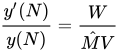
Keynes accepted the classical relation between wages and the marginal productivity of labour, referring to it on page 5 as the "first postulate of classical economics" and summarising it as saying that "The wage is equal to the marginal product of labour".
The first postulate can be expressed in the equation y'(N) = W/p,
where y(N) is the real output when employment is N, and W and p are the
wage rate and price rate in money terms (and hence W/p is the wage rate
in real terms). A system can be analysed on the assumption that W is
fixed (i.e. that wages are fixed in money terms) or that W/p is fixed
(i.e. that they are fixed in real terms) or that N is fixed (e.g. if
wages adapt to ensure full employment). All three assumptions had at
times been made by classical economists, but under the assumption of
wages fixed in money terms the 'first postulate' becomes an equation in
two variables (N and p), and the consequences of this had not been taken
into account by the classical school.
Keynes proposed a 'second postulate of classical economics'
asserting that the wage is equal to the marginal disutility of labour.
This is an instance of wages being fixed in real terms. He attributes
the second postulate to the classics subject to the qualification that
unemployment may result from wages being fixed by legislation,
collective bargaining, or 'mere human obstinacy' (p. 6), all of which
are likely to fix wages in money terms.
Outline of Keynes's theory
Keynes's
economic theory is based on the interaction between demands for saving,
investment, and liquidity (i.e. money). Saving and investment are
necessarily equal, but different factors influence decisions concerning
them. The desire to save, in Keynes's analysis, is mostly a function of
income: the wealthier people are, the more wealth they will seek to put
aside. The profitability of investment, on the other hand, is
determined by the relation between the return available to capital and
the interest rate. The economy needs to find its way to an equilibrium
in which no more money is being saved than will be invested, and this
can be accomplished by contraction of income and a consequent reduction
in the level of employment.
In the classical scheme it is the interest rate rather than
income which adjusts to maintain equilibrium between saving and
investment; but Keynes asserts that the rate of interest already
performs another function in the economy, that of equating demand and
supply of money, and that it cannot adjust to maintain two separate
equilibria. In his view it is the monetary role which wins out. This is
why Keynes's theory is a theory of money as much as of employment: the
monetary economy of interest and liquidity interacts with the real
economy of production, investment and consumption.
Keynes sought to allow for the lack of downwards flexibility of wages
by constructing an economic model in which the money supply and wage
rates were externally determined (the latter in money terms), and in
which the main variables were fixed by the equilibrium conditions of
various markets in the presence of these facts.
Many of the quantities of interest, such as income and consumption, are monetary. Keynes often expresses such quantities in wage units
(Chapter 4): to be precise, a value in wage units is equal to its price
in money terms divided by W, the wage (in money units) per man-hour of
labour. Therefore it is a unit expressed in hours of labour. Keynes
generally writes a subscript w on quantities expressed in wage units,
but in this account we omit the w. When, occasionally, we use real terms
for a value which Keynes expresses in wage units we write it in lower
case (e.g. y rather than Y).
As a result of Keynes's choice of units, the assumption of sticky
wages, though important to the argument, is largely invisible in the
reasoning. If we want to know how a change in the wage rate would
influence the economy, Keynes tells us on p. 266 that the effect is the
same as that of an opposite change in the money supply.
Expectations as determining output and employment
The key notion of expectations is introduced in Chapter 5.Short-term expectations
are 'concerned with the price which a manufacturer can expect to get
for his "finished" output at the time when he commits himself (sic) to
starting the process which will produce it'. Long-term expectation
'is concerned with what the entrepreneur can hope to earn in the shape
of future returns if he (sic) purchases (or perhaps manufactures)
"finished" output as an addition to his capital equipment.'
Keynes note that:'It is sensible for producers to base their
expectations on the assumption that the most recently realized results
will continue, except in so far as there are definite reasons for
expecting a change.' However (see Chapter 12) long-term expectations are
liable to sudden revision. Thus the factor of long-term expectations
cannot be even approximately eliminated or replaced by realized
results.'
Briefly, short-run expectations are typically 'mathematical' in character, long-run expectations less so.
The identity of saving and investment
The
relationship between saving and investment, and the factors influencing
their demands, play an important role in Keynes's model. Saving and
investment are considered to be necessarily equal for reasons set out in
Chapter 6 which looks at economic aggregates from the viewpoint of
manufacturers. The discussion is intricate, considering matters such as
the depreciation of machinery, but is summarised on p. 63:
Provided it is agreed that income is equal to the value
of current output, that current investment is equal to the value of that
part of current output which is not consumed, and that saving is equal
to the excess of income over consumption... the equality of saving and
investment necessarily follows.
This statement incorporates Keynes's definition of saving, which is the normal one.
Book III: The propensity to consume
Keynes's propensities to consume and to save as functions of income Y
Book III of the General Theory is given over to the propensity
to consume, which is introduced in Chapter 8 as the desired level of
expenditure on consumption (for an individual or aggregated over an
economy). The demand for consumer goods depends chiefly on the income Y
and may be written functionally as C(Y). Saving is that part of income
which is not consumed, so the propensity to save S(Y) is equal to
Y–C(Y). Keynes discusses the possible influence of the interest rate r
on the relative attractiveness of saving and consumption, but regards it
as 'complex and uncertain' and leaves it out as a parameter.
His seemingly innocent definitions embody an assumption whose consequences will be considered later.
Since Y is measured in wage units, the proportion of income saved is
considered to be unaffected by the change in real income resulting from a
change in the price level while wages stay fixed. Keynes acknowledges
that this is undesirable in Point (1) of Section II.
In Chapter 9 he provides a homiletic enumeration of the motives
to consume or not to do so, finding them to lie in social and
psychological considerations which can be expected to be relatively
stable, but which may be influenced by objective factors such as
'changes in expectations of the relation between the present and the
future level of income' (p. 95).
The marginal propensity to consume and the multiplier
The marginal propensity to consume,
C'(Y), is the gradient of the purple curve, and the marginal propensity
to save S'(Y) is equal to 1–C'(Y). Keynes states as a 'fundamental
psychological law' (p. 96) that the marginal propensity to consume will
be positive and less than unity.
Chapter 10 introduces the famous 'multiplier' through an example:
if the marginal propensity to consume is 90%, then 'the multiplier k is
10; and the total employment caused by (e.g.) increased public works
will be ten times the employment caused by the public works themselves'
(pp. 116f). Formally Keynes writes the multiplier as k=1/S'(Y). It
follows from his 'fundamental psychological law' that k will be greater
than 1.
Keynes's account is not clear until his economic system has been fully set out (see below). In Chapter 10 he describes his multiplier as being related to the one introduced by R. F. Kahn in 1931. The mechanism of Kahn's multiplier
lies in an infinite series of transactions, each conceived of as
creating employment: if you spend a certain amount of money, then the
recipient will spend a proportion of what he or she receives, the second
recipient will spend a further proportion again, and so forth. Keynes's
account of his own mechanism (in the second para of p. 117) makes no
reference to infinite series. By the end of the chapter on the
multiplier, he uses his much quoted "digging holes" metaphor, against laissez-faire.
In his provocation Keynes argues that "If the Treasury were to fill old
bottles with banknotes, bury them at suitable depths in disused
coalmines which are then filled up to the surface with town rubbish, and
leave it to private enterprise on well-tried principles of
laissez-faire to dig the banknotes up again" (...), there need be no
more unemployment and, with the help of the repercussions, the real
income of the community, and its capital wealth also, would probably
become a good deal greater than it actually is. It would, indeed, be
more sensible to build houses and the like; but if there are political
and practical difficulties in the way of this, the above would be better
than nothing".
Book IV: The inducement to invest
The rate of investment
Keynes's schedule of the marginal efficiency of capital
Book
IV discusses the inducement to invest, with the key ideas being
presented in Chapter 11. The 'marginal efficiency of capital' is defined
as the annual revenue which is expected to be yielded by an extra
increment of capital as a proportion of its cost. The 'schedule of the
marginal efficiency of capital' is the function which, for any rate of
interest r, gives us the level of investment which will take place if
all opportunities are accepted whose return is at least r. By
construction this depends on r alone and is a decreasing function of its
argument; it is illustrated in the diagram, and we shall write it as
I (r).
This schedule is a characteristic of the current industrial
process which Irving Fisher described as representing the 'investment
opportunity side of interest theory'; and in fact the condition that it should equal S(Y,r) is the equation which determines the interest rate from income in classical theory. Keynes is seeking to reverse the direction of causality (and omitting r as an argument to S()).
He interprets the schedule as expressing the demand for
investment at any given value of r, giving it an alternative name: "We
shall call this the investment demand-schedule..." (p. 136). He also
refers to it as the 'demand curve for capital' (p. 178).
For fixed industrial conditions, we conclude that 'the amount of
investment... depends on the rate of interest' as John Hicks put it in 'Mr. Keynes and the "Classics"'.
Long-term expectations
In Chapter 12, Keynes writes:
It would be foolish, in forming our expectations, to
attach great weight to matters which are very uncertain. [Footnote: By
“very uncertain’ I do not mean the same thing as improbable”. Cf. my Treatise on Probability,
chap. 6, on “The Weight of Arguments”.] It is reasonable, therefore, to
be guided to a considerable degree by the facts about which we feel
somewhat confident, even though they may be less decisively relevant to
the issue than other facts about which our knowledge is vague and
scanty. For this reason the facts of the existing situation enter, in a
sense disproportionately, into the formation of our long-term
expectations; our usual practice being to take the existing situation
and to project it into the future, modified only to the extent that we
have more or less definite reasons for expecting a change.
He goes on thus: ‘In practice we have tacitly agreed, as a rule, to fall back on what is, in truth, a convention
’. He notes that ‘our existing knowledge does not provide a sufficient
basis for a calculated mathematical expectation.’ ‘Nevertheless the
above conventional method of calculation will be compatible with a
considerable measure of continuity and stability in our affairs, so long as we can rely on the maintenance of the convention.’
He notes a practical problem: ‘Speculators may do no harm as
bubbles on a steady stream of enterprise. But the position is serious
when enterprise becomes the bubble on a whirlpool of speculation.’ He
suggests that: ‘The introduction of a substantial Government transfer
tax on all transactions might prove the most serviceable reform
available, with a view to mitigating the predominance of speculation
over enterprise in the United States.’
To account for the apparent ‘foolishness’ on which economic progress seemed to rely, Keynes suggests that:
Most, probably, of our decisions to do something
positive, the full consequences of which will be drawn out over many
days to come, can only be taken as a result of animal spirits –
of a spontaneous urge to action rather than inaction, and not as the
outcome of a weighted average of quantitative benefits multiplied by
quantitative probabilities.
Interest and liquidity preference
Keynes
proposes two theories of liquidity preference (i.e. the demand for
money): the first as a theory of interest in Chapter 13 and the second
as a correction in Chapter 15. His arguments offer ample scope for
criticism, but his final conclusion is that liquidity preference is a
function mainly of income and the interest rate. The influence of income
(which really represents a composite of income and wealth) is common
ground with the classical tradition and is embodied in the Quantity Theory; the influence of interest had also been noted earlier, in particular by Frederick Lavington (see Hicks's Mr Keynes and the "Classics").
Thus Keynes's final conclusion may be acceptable to readers who
question the arguments along the way. However he shows a persistent
tendency to think in terms of the Chapter 13 theory while nominally
accepting the Chapter 15 correction.
Chapter 13 presents the first theory in rather metaphysical terms. Keynes argues that:
It should be obvious that the rate of interest cannot be a
return to saving or waiting as such. For if a man hoards his savings in
cash, he earns no interest, though he saves just as much as before. On
the contrary, the mere definition of the rate of interest tells us in so
many words that the rate of interest is the reward for parting with
liquidity for a specified period.
To which Jacob Viner retorted that:
By analogous reasoning he could deny that wages are the
reward for labor, or that profit is the reward for risk-taking, because
labor is sometimes done without anticipation or realization of a return,
and men who assume financial risks have been known to incur losses as a
result instead of profits.
Keynes goes on to claim that the demand for money is a function of the interest rate alone on the grounds that:
The rate of interest is... the "price" which equilibrates
the desire to hold wealth in the form of cash with the available
quantity of cash.
Frank Knight commented that this seems to assume that demand is simply an inverse function of price. The upshot from these reasonings is that:
Liquidity-preference is a potentiality or functional
tendency, which fixes the quantity of money which the public will hold
when the rate of interest is given; so that if r is the rate of
interest, M the quantity of money and L the function of
liquidity-preference, we have M = L(r). This is where, and how, the
quantity of money enters into the economic scheme.
And specifically it determines the rate of interest, which therefore
cannot be determined by the traditional factors of 'productivity and
thrift'.
Chapter 15 looks in more detail at the three motives Keynes
ascribes for the holding of money: the 'transactions motive', the
'precautionary motive', and the 'speculative motive'. He considers that
demand arising from the first two motives 'mainly depends on the level
of income' (p. 199), while the interest rate is 'likely to be a minor
factor' (p. 196).
Keynes treats the speculative demand for money as a function of r
alone without justifying its independence of income. He says that...
what matters is not the absolute level of r but the degree of its divergence from what is considered a fairly safe level...
but gives reasons to suppose that demand will nonetheless tend to
decrease as r increases. He thus writes liquidity preference in the form
L1(Y)+L2(r) where L1 is the sum of transaction and precautionary demands and L2
measures speculative demand. The structure of Keynes's expression plays
no part in his subsequent theory, so it does no harm to follow Hicks by
writing liquidity preference simply as L(Y,r).
'The quantity of money as determined by the action of the central
bank' is taken as given (i.e. exogenous – p. 247) and constant (because
hoarding is ruled out on page 174 by the fact that the necessary
expansion of the money supply cannot be 'determined by the public').
Keynes does not put a subscript 'w' on L or M, implying that we
should think of them in money terms. This suggestion is reinforced by
his wording on page 172 where he says "Unless we measure
liquidity-preference in terms of wage-units (which is convenient in some
contexts)... ". But seventy pages later there is a fairly clear
statement that liquidity preference and the quantity of money are indeed
"measured in terms of wage-units" (p. 246).
The Keynesian economic system
Keynes's economic model
In
Chapter 14 Keynes contrasts the classical theory of interest with his
own, and in making the comparison he shows how his system can be applied
to explain all the principal economic unknowns from the facts he takes
as given. The two topics can be treated together because they are
different ways of analysing the same equation.
Keynes's presentation is informal. To make it more precise we
will identify a set of 4 variables – saving, investment, the rate of
interest, and the national income – and a parallel set of 4 equations
which jointly determine them. The graph illustrates the reasoning. The
red S lines are shown as increasing functions of r in obedience to
classical theory; for Keynes they should be horizontal.
Graphical representation of Keynes's economic model, based on his own diagram at page 180 of the General Theory
The
first equation asserts that the reigning rate of interest r̂ is
determined from the amount of money in circulation M̂ through the
liquidity preference function and the assumption that L(r̂)=M̂.
The second equation fixes the level of investment Î given the
rate of interest through the schedule of the marginal efficiency of
capital as I(r̂).
The third equation tells us that saving is equal to investment:
S(Y)=Î. The final equation tells us that the income Ŷ is the value of Y
corresponding to the implied level of saving.
All this makes a satisfying theoretical system.
Three comments can be made concerning the argument. Firstly, no
use is made of the 'first postulate of classical economics', which can
be called on later to set the price level. Secondly, Hicks (in 'Mr
Keynes and the "Classics"') presents his version of Keynes's system with
a single variable representing both saving and investment; so his
exposition has three equations in three unknowns.
And finally, since Keynes's discussion takes place in Chapter 14,
it precedes the modification which makes liquidity preference depend on
income as well as on the rate of interest. Once this modification has
been made the unknowns can no longer be recovered sequentially.
Keynesian economic intervention
The
state of the economy, according to Keynes, is determined by four
parameters: the money supply, the demand functions for consumption (or
equivalently for saving) and for liquidity, and the schedule of the
marginal efficiency of capital determined by 'the existing quantity of
equipment' and 'the state of long-term expectation' (p. 246). Adjusting
the money supply is the domain of monetary policy.
The effect of a change in the quantity of money is considered at
p. 298. The change is effected in the first place in money units.
According to Keynes's account on p. 295, wages will not change if there
is any unemployment, with the result that the money supply will change
to the same extent in wage units.
We can then analyse its effect from the diagram, in which we see
that an increase in M̂ shifts r̂ to the left, pushing Î upwards and
leading to an increase in total income (and employment) whose size
depends on the gradients of all 3 demand functions. If we look at the
change in income as a function of the upwards shift of the schedule of
the marginal efficiency of capital (blue curve), we see that as the
level of investment is increased by one unit, the income must adjust so
that the level of saving (red curve) is one unit greater, and hence the
increase in income must be
1/S'(Y) units, i.e. k units. This is the explanation of Keynes's
multiplier.
It does not necessarily follow that individual decisions to
invest will have a similar effect, since decisions to invest above the
level suggested by the schedule of the marginal efficiency of capital
are not the same thing as an increase in the schedule.
The equations of Keynesian and classical economics
Keynes's
initial statement of his economic model (in Chapter 14) is based on his
Chapter 13 theory of liquidity preference. His restatement in Chapter
18 doesn't take full account of his Chapter 15 revision, treating it as a
source of 'repercussions' rather than as an integral component. It was
left to John Hicks to give a satisfactory presentation. Equilibrium between supply and demand of money depends on two variables
– interest rate and income – and these are the same two variables as
are related by the equation between the propensity to save and the
schedule of the marginal efficiency of capital. It follows that neither
equation can be solved in isolation and that they need to be considered
simultaneously.
The 'first postulate' of classical economics was also accepted as
valid by Keynes, though not used in the first four books of the General Theory.
The Keynesian system can thus be represented by three equations in
three variables as shown below, roughly following Hicks. Three analogous
equations can be given for classical economics. As presented below they
are in forms given by Keynes himself (the practice of writing r as an
argument to V derives from his Treatise on money).
Here y is written as a function of N, the number of workers employed;
p is the price (in money terms) of a unit of real output; V(r) is the
velocity of money; and W is the wage rate in money terms. N, p and r are
the 3 variables we need to recover. In the Keynesian system income is
measured in wage units and is therefore not a function of the level of
employment alone since it will also vary with prices. The first
postulate assumes that prices can be represented by a single variable.
Strictly it should be modified to take account of the distinction
between marginal wage cost and marginal prime cost.
The classics took the second equation as determining the rate of
interest, the third as determining the price level, and the first as
determining employment. Keynes believed that the last two equations
could be solved together for Y and r, which is not possible in the
classical system. He accordingly concentrated on these two equations, treating income as
'almost the same thing' as employment on p. 247. Here we see the benefit
he has gained by simplifying the form of the consumption function. If
he had written it (slightly more accurately) as C(Y,p/W), then he would
have needed to bring in the first equation to get a solution.
The classical theory of employment for wages fixed in money terms (The three curves have different vertical scales.)
If
we wish to examine the classical system our task is made easier if we
assume that the effect of the interest rate on the velocity of
circulation is small enough to be ignored. This allows us to treat V as
constant and solve the first and third equations (the 'first postulate'
and the quantity theory) together, leaving the second equation to
determine the interest rate from the result. We then find that the level of employment is given by the formula
.
The graph shows the numerator and denominator of the left-hand
side as blue and green curves; their ratio – the pink curve – will be a
decreasing function of N even if we don't assume diminishing marginal
returns. The level of employment N̂ is given by the horizontal position
at which the pink curve has a value of , and this is evidently a decreasing function of W.
Chapter 3: The principle of effective demand
The
theoretical system we have described is developed over chapters 4–18,
and is anticipated by a chapter which interprets Keynesian unemployment
in terms of 'aggregate demand'.
The aggregate supply Z is the total value of output when N
workers are employed, written functionally as φ(N). The aggregate
demand D is manufacturers' expected proceeds, written as f(N). In
equilibrium Z=D. D can be decomposed as D1+D2 where D1 is the propensity to consume, which may be written C(Y) or χ(N). D2 is explained as 'the volume of investment', and the equilibrium condition determining the level of employment is that D1+D2 should equal Z as functions of N. D2 can be identified with I (r).
The meaning of this is that in equilibrium the total demand for
goods must equal total income. Total demand for goods is the sum of
demand for consumption goods and demand for investment goods. Hence
Y = C(Y) + S(Y) = C(Y) + I (r); and this equation determines a unique
value of Y given r.
Chapter 5: Expectation as determining output and employment
Chapter
5 makes some common-sense observations on the role of expectation in
economics. Short-term expectations govern the level of production chosen
by an entrepreneur while long-term expectations govern decisions to
adjust the level of capitalisation. Keynes describes the process by
which the level of employment adapts to a change in long-term
expectations and remarks that:
The level of employment at any time depends... not merely
on the existing state of expectation but on the states of expectation
which have existed over a certain past period. Nevertheless past
expectations, which have not yet worked themselves out, are embodied in
to-day's capital equipment... and only influence [the entrepreneur's]
decisions in so far as they are so embodied.
Chapter 11: Expectation as influencing the schedule of the marginal efficiency of capital
The
main role of expectation in Keynes's theory lies in the schedule of the
marginal efficiency of capital which, as we have seen, is defined in
Chapter 11 in terms of expected returns. Keynes differs here from Fisher whom he largely follows, but who defined the 'rate of return over cost'
in terms of an actual revenue stream rather than its expectation. The
step Keynes took here has a particular significance in his theory.
Chapters 14, 18: The schedule of the marginal efficiency of capital as influencing employment
Keynes
differed from his classical predecessors in assigning a role to the
schedule of the marginal efficiency of capital in determining the level
of employment. Its effect is mentioned in his presentations of his
theory in Chapters 14 and 18 (see above).
Chapter 12 discusses the psychology of speculation and enterprise.
Most, probably, of our decisions to do something positive
... can only be taken as a result of animal spirits .. Thus if the
animal spirits are dimmed and spontaneous optimism falters, leaving us
to depend on nothing but a mathematical expectation, enterprise will
fade and die.
Keynes's picture of the psychology of speculators is less indulgent.
In point of fact, all sorts of considerations enter into
the market valuation which are in no way relevant to the prospective
yield... The recurrence of a bank-holiday may raise the market valuation
of the British railway system by several million pounds.
(Work in behavioural economics has since empirically supported
Keynes' assertion; businesses which are extremely seasonal do indeed see
notably higher valuations in the season in question, even if their
results are consistent in that quarter from year to year).
Keynes considers speculators to be concerned...
...not with what an investment is really worth to a man
who buys it 'for keeps', but with what the market will value it at,
under the influence of mass psychology, three months or a year hence...
This battle of wits to anticipate the basis of conventional
valuation a few months hence, rather than the prospective yield of an
investment over a long term of years, does not even require gulls
amongst the public to feed the maws of the professional;– it can be
played by professionals amongst themselves. Nor is it necessary that
anyone should keep his simple faith in the conventional basis of
valuation having any genuine long-term validity. For it is, so to speak,
a game of Snap, of Old Maid, of Musical Chairs – a pastime in which he
is victor who says Snap neither too soon nor too late, who passed the
Old Maid to his neighbour before the game is over, who secures a chair
for himself when the music stops. These games can be played with zest
and enjoyment, though all the players know that it is the Old Maid which
is circulating, or that when the music stops some of the players will
find themselves unseated.
Or, to change the metaphor slightly, professional investment may be
likened to those newspaper competitions in which the competitors have to
pick out the six prettiest faces from a hundred photographs, the prize
being awarded to the competitor whose choice most nearly corresponds to
the average preferences of the competitors as a whole; so that each
competitor has to pick, not those faces which he himself finds
prettiest, but those which he thinks likeliest to catch the fancy of the
other competitors, all of whom are looking at the problem from the same
point of view. It is not a case of choosing those which, to the best of
one's judgment, are really the prettiest, nor even those which average
opinion genuinely thinks the prettiest. We have reached the third degree
where we devote our intelligences to anticipating what average opinion
expects the average opinion to be. And there are some, I believe, who
practise the fourth, fifth and higher degrees.
Chapter 21: Wage behaviour
Keynes's
theory of the trade cycle is a theory of the slow oscillation of money
income which requires it to be possible for income to move upwards or
downwards. If he had assumed that wages were constant, then upward
motion of income would have been impossible at full employment, and he
would have needed some mechanism to frustrate upward pressure if it
arose in such circumstances.
His task is made easier by a less restrictive (but nonetheless crude) assumption concerning wage behaviour:
let us simplify our assumptions still further, and
assume... that the factors of production... are content with the same
money-wage so long as there is a surplus of them unemployed... ; whilst
as soon as full employment is reached, it will thenceforward be the
wage-unit and prices which will increase in exact proportion to the
increase in effective demand.
Chapter 22: The trade cycle
Keynes's theory of the trade cycle
is based on 'a cyclical change in the marginal efficiency of capital'
induced by 'the uncontrollable and disobedient psychology of the
business world' (pp. 313, 317).
The marginal efficiency of capital depends... on current
expectations... But, as we have seen, the basis for such expectations is
very precarious. Being based on shifting and unreliable evidence, they
are subject to sudden and violent changes.
Optimism leads to a rise in the marginal efficiency of capital and
increased investment, reflected – through the multiplier – in an even
greater increase in income until 'disillusion falls upon an
over-optimistic and over-bought market' which consequently falls with
'sudden and even catastrophic force' (p. 316).
There are reasons, given firstly by the length of life of
durable assets... and secondly by the carrying-costs of surplus stocks,
why the duration of the downward movement should have an order of
magnitude... between, let us say, three and five years.
And a half cycle of 5 years tallies with Jevons's sunspot cycle length of 11 years.
Income fluctuates cyclically in Keynes's theory, with the effect
being borne by prices if income increases during a period of full
employment, and by employment in other circumstances.
Wage behaviour and the Phillips curve
Keynes's
assumption about wage behaviour has been the subject of much criticism.
It is likely that wage rates adapt partially to depression conditions,
with the consequence that effects on employment are weaker than his
model implies, but not that they disappear.
Lerner pointed out in the 40s that it was optimistic to hope that
the workforce would be content with fixed wages in the presence of
rising prices, and proposed a modification to Keynes's model. After this
a succession of more elaborate models were constructed, many associated
with the Phillips curve.
Keynes's optimistic prediction that an increase in money supply would be taken up by an increase in employment led to Jacob Viner's
pessimistic prediction that "in a world organized in accordance with
Keynes' specifications there would be a constant race between the
printing press and the business agents of the trade unions".
Models of wage pressure on the economy needed frequent correction
and the standing of Keynesian theory suffered. Geoff Tily wrote
ruefully:
Finally, the most destructive step of all was Samuelson's and [Robert] Solow's
incorporation of the Phillips curve into 'Keynesian' theory in a manner
which traduced not only Phillips but also Keynes's careful work in the General Theory,
Chapter 21, substituting for its subtlety an immutable relationship
between inflation and employment. The 1970s combination of inflation and
stagnating economic activity was at odds with this relationship, and
therefore 'Keynesianism', and by association Keynes were rejected.
Monetarism was merely waiting in the wings for this to happen.
Keynes's assumption of wage behaviour was not an integral part of his
theory – very little in his book depends on it – and was avowedly a
simplification: in fact it was the simplest assumption he could make
without imposing an unnatural cap on money income.
The writing of the General Theory
Keynes drew a lot of help from his students in his progress from the Treatise on Money (1930) to the General Theory (1936). The Cambridge Circus, a discussion group founded immediately after the publication of the earlier work, reported to Keynes through Richard Kahn, and drew his attention to a supposed fallacy in the Treatise where Keynes had written:
Thus profits, as a source of capital increment for
entrepreneurs, are a widow's cruse which remains undepleted however much
of them may be devoted to riotous living.
The Circus disbanded in May 1931, but three of its member – Kahn, Austin and Joan Robinson
– continued to meet in the Robinsons' house in Trumpington St.
(Cambridge), forwarding comments to Keynes. This led to a 'Manifesto' of
1932 whose ideas were taken up by Keynes in his lectures. Kahn and Joan Robinson were well versed in marginalist theory which
Keynes did not fully understand at the time (or possibly ever), pushing him towards adopting elements of it in the General Theory. During 1934 and 1935 Keynes submitted drafts to Kahn, Robinson and Roy Harrod for comment.
There has been uncertainty ever since over the extent of the collaboration, Schumpeter describing Kahn's "share in the historic achievement" as not having "fallen very far short of co-authorship" while Kahn denied the attribution.
Keynes's method of writing was unusual:
Keynes drafted rapidly in pencil, reclining in an
armchair. The pencil draft he sent straight to the printers. They
supplied him with a considerable number of galley proofs, which he would
then distribute to his advisers and critics for comment and amendment.
As he published on his own account, Macmillan & Co., the
'publishers' (in reality they were distributors), could not object to
the expense of Keynes' method of operating. They came out of Keynes'
profit (Macmillan & Co. merely received a commission). Keynes'
object was to simplify the process of circulating drafts; and eventually
to secure good sales by fixing the retail price lower than would
Macmillan & Co.
The advantages of self-publication can be seen from Étienne Mantoux's review:
When he published The General Theory of Employment, Interest and Money
last year at the sensational price of 5 shillings, J. M. Keynes perhaps
meant to express a wish for the broadest and earliest possible
dissemination of his new ideas.
Chronology
Keynes's work on the General Theory began as soon as his Treatise on Money had been published in 1930. He was already dissatisfied with what he had written and wanted to extend the scope of his theory to output and employment. By September 1932 he was able to write to his mother: 'I have written nearly a third of my new book on monetary theory'.
In autumn 1932 he delivered lectures at Cambridge under the title
'the monetary theory of production' whose content was close to the Treatise
except in giving prominence to a liquidity preference theory of
interest. There was no consumption function and no theory of effective
demand. Wage rates were discussed in a criticism of Pigou.
In autumn 1933 Keynes's lectures were much closer to the General Theory,
including the consumption function, effective demand, and a statement
of 'the inability of workers to bargain for a market-clearing real wage
in a monetary economy'. All that was missing was a theory of investment.
By spring 1934 Chapter 12 was in its final form.
His lectures in autumn of that year bore the title 'the general theory of employment'. In these lectures Keynes presented the marginal efficiency of capital
in much the same form as it took in Chapter 11, his 'basic chapter' as
Kahn called it. He gave a talk on the same subject to economists at Oxford in February 1935.
This was the final building block of the General Theory. The book was finished in December 1935 and published in February 1936.
Observations on its readability
Many economists found General Theory difficult to read, with Étienne Mantoux calling it obscure, Frank Knight calling it difficult to follow, Michel DeVroey commenting that "many passages of his book were almost indecipherable", and Paul Samuelson calling the analysis "unpalatable" and incomprehensible. However Raúl Rojas dissents, saying that "obscure neo-classical reinterpretations" are "completely pointless since Keynes' book is so readable".
Reception
Keynes did not set out a detailed policy program in The General Theory, but he went on in practice to place great emphasis on the reduction of long-term interest rates and the reform of the international monetary system as structural measures needed to encourage both investment and consumption by the private sector. Paul Samuelson
said that the General Theory "caught most economists under the age of
35 with the unexpected virulence of a disease first attacking and
decimating an isolated tribe of South Sea islanders."
Praise
Many of the innovations introduced by The General Theory continue to be central to modern macroeconomics. For instance, the idea that recessions reflect inadequate aggregate demand and that Say's law (in Keynes's formulation, that "supply creates its own demand")
does not hold in a monetary economy. President Richard Nixon famously
said in 1971 (ironically, shortly before Keynesian economics fell out of
fashion) that "We are all Keynesians now", a phrase often repeated by Nobel laureate Paul Krugman (but originating with anti-Keynesian economist Milton Friedman, said in a way different from Krugman's interpretation). Nevertheless, starting with Axel Leijonhufvud, this view of Keynesian economics came under increasing challenge and scrutiny and has now divided into two main camps.
Prior to the financial crises of 2007-9, the majority new
consensus view, still found in most current text-books and taught in all
universities, was New Keynesian economics, which (in contrast to Keynes) accepts the neoclassical concept of long-run equilibrium but allows a role for aggregate demand
in the short run. New Keynesian economists pride themselves on
providing microeconomic foundations for the sticky prices and wages
assumed by Old Keynesian economics. They do not regard The General Theory itself as helpful to further research. The minority view is represented by post-Keynesian economists, all of whom accept Keynes's fundamental critique of the neoclassical concept of long-run equilibrium, and some of whom think The General Theory has yet to be properly understood and repays further study.
In 2011, the book was placed on Time's top 100 non-fiction books written in English since 1923, almost 400 universities are teaching a revised curriculum that takes instability seriously and Keynes's notion of uncertainty has become more familiar as 'radical uncertainty'.
Criticisms
From the outset there has been controversy over what Keynes really
meant. Many early reviews were highly critical. The success of what came
to be known as "neoclassical synthesis" Keynesian economics owed a great deal to the Harvard economist Alvin Hansen and MIT economist Paul Samuelson as well as to the Oxford economist John Hicks. Hansen and Samuelson offered a lucid explanation of Keynes's theory of aggregate demand with their elegant 45° Keynesian cross diagram while Hicks created the IS-LM diagram. Both of these diagrams can still be found in textbooks. Post-Keynesians
argue that the neoclassical Keynesian model is completely distorting
and misinterpreting Keynes' original meaning, at least in so far as it
largely rests on an assumed long-term equilibrium.
Just as the reception of The General Theory was encouraged by the 1930s experience of mass unemployment, its fall from favour was associated with the 'stagflation' of the 1970s. Although few modern economists would disagree with the need for at least some intervention, policies such as labour market flexibility are underpinned by the neoclassical notion of equilibrium in the long run. Although Keynes explicitly addresses inflation, The General Theory
does not treat it as an essentially monetary phenomenon or suggest that
control of the money supply or interest rates is the key remedy for
inflation, unlike neoclassical theory.
Lastly, Keynes' economic theory was criticized by Marxian economists,
who said that Keynes ideas, while well intentioned, cannot work in the
long run due to the contradictions in capitalism. A couple of these
contradictions to which Marxians point are the idea of full employment,
which is seen as impossible under private capitalism; and the idea that
government can encourage capital investment through government spending,
when in reality government spending could be a net loss on profits.


.jpg)