From Wikipedia, the free encyclopedia
In Greek mythology, Medusa (; Μέδουσα "guardian, protectress") also called Gorgo, was one of the three monstrous Gorgons,
generally described as winged human females with living venomous snakes
in place of hair. It is in the Roman poet Ovid’s Metamorphoses that her
story is most deeply elaborated. She was lovely, according to the
poem—until she was raped in Athena’s temple by Poseidon. Athena then
punished her for this violation, by turning her into the monstrous,
stony-glanced creature that we know. Thus those who gazed into her eyes
would turn to stone. Most sources describe her as the daughter of Phorcys and Ceto, although the author Hyginus makes her the daughter of Gorgon and Ceto. According to Hesiod and Aeschylus, she lived and died on an island named Sarpedon, somewhere near Cisthene. The 2nd-century BC novelist Dionysios Skytobrachion puts her somewhere in Libya, where Herodotus had said the Berbers originated her myth, as part of their religion. She remained a priestess to Athena after her death and was risen with fresh hair.
Medusa was raped by Poseidon then beheaded by the hero Perseus, who thereafter used her head, which retained its ability to turn onlookers to stone, as a weapon until he gave it to the goddess Athena to place on her shield. In classical antiquity the image of the head of Medusa appeared in the evil-averting device known as the Gorgoneion.
Classical mythology
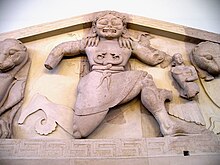
The three Gorgon sisters—Medusa, Stheno, and Euryale—were all children of the ancient marine deities Phorcys (or "Phorkys") and his sister Ceto (or "Keto"), chthonic monsters from an archaic world. Their genealogy is shared with other sisters, the Graeae, as in Aeschylus's Prometheus Bound, which places both trinities of sisters far off "on Kisthene's dreadful plain":
Near them their sisters three, the Gorgons, winged
With snakes for hair—hatred of mortal man—
While ancient Greek vase-painters and relief carvers imagined Medusa
and her sisters as having monstrous form, sculptors and vase-painters of
the fifth century began to envisage her as being beautiful as well as
terrifying. In an ode written in 490 BC Pindar already speaks of "fair-cheeked Medusa".
In a late version of the Medusa myth, related by the Roman poet Ovid (Metamorphoses 4.770), Medusa was originally a ravishingly beautiful maiden, "the jealous aspiration of many suitors," but because Poseidon raped Medusa in Athena's
temple, Athena transformed Medusa's beautiful hair to serpents and made
her face so terrible to behold that the mere sight of it would turn
onlookers to stone. In Ovid's telling, Perseus describes Medusa's punishment by Minerva (Athena) as just and well earned.
In most versions of the story, she was beheaded by the hero Perseus, who was sent to fetch her head by King Polydectes of Seriphus
because Polydectes wanted to marry Perseus's mother. The gods were well
aware of this, and Perseus received help. He received a mirrored shield
from Athena, gold, winged sandals from Hermes, a sword from Hephaestus and Hades's helm of invisibility.
Since Medusa was the only one of the three Gorgons who was mortal,
Perseus was able to slay her while looking at the reflection from the
mirrored shield he received from Athena. During that time, Medusa was
pregnant by Poseidon. When Perseus beheaded her, Pegasus, a winged horse, and Chrysaor, a giant wielding a golden sword, sprang from her body.
Jane Ellen Harrison
argues that "her potency only begins when her head is severed, and that
potency resides in the head; she is in a word a mask with a body later
appended... the basis of the Gorgoneion is a cultus object, a ritual mask misunderstood."
In the Odyssey xi, Homer does not specifically mention the Gorgon Medusa:
Lest for my daring Persephone the dread,
From Hades should send up an awful monster's grisly head.
The Medusa's head central to a mosaic floor in a
tepidarium of the Roman era. Museum of Sousse, Tunisia
Harrison's translation states "the Gorgon was made out of the terror, not the terror out of the Gorgon."
According to Ovid, in northwest Africa, Perseus flew past the Titan Atlas, who stood holding the sky aloft, and transformed him into stone when he tried to attack him. In a similar manner, the corals of the Red Sea
were said to have been formed of Medusa's blood spilled onto seaweed
when Perseus laid down the petrifying head beside the shore during his
short stay in Ethiopia where he saved and wed his future wife, the lovely princess Andromeda who was the most beautiful woman in the world at that time. Furthermore, the poisonous vipers of the Sahara, in the Argonautica 4.1515, Ovid's Metamorphoses 4.770 and Lucan's Pharsalia 9.820, were said to have grown from spilt drops of her blood. The blood of Medusa also spawned the Amphisbaena (a horned dragon-like creature with a snake-headed tail).
Perseus then flew to Seriphos, where his mother was being forced
into marriage with the king, Polydectes, who was turned into stone by
the head. Then Perseus gave the Gorgon's head to Athena, who placed it
on her shield, the Aegis.
Some classical references refer to three Gorgons; Harrison
considered that the tripling of Medusa into a trio of sisters was a
secondary feature in the myth:
The triple form is not primitive,
it is merely an instance of a general tendency... which makes of each
woman goddess a trinity, which has given us the Horae, the Charites, the Semnai,
and a host of other triple groups. It is immediately obvious that the
Gorgons are not really three but one + two. The two unslain sisters are
mere appendages due to custom; the real Gorgon is Medusa.
Modern interpretations
A Roman cameo of the 2nd or 3rd century
Historical
A
number of early classics scholars interpreted the myth of Medusa as a
quasi-historical – "based on or reconstructed from an event, custom,
style, etc., in the past", or "sublimated" memory of an actual invasion.
According to Joseph Campbell:
The legend of Perseus beheading
Medusa means, specifically, that "the Hellenes overran the goddess's
chief shrines" and "stripped her priestesses of their Gorgon masks", the
latter being apotropaic faces worn to frighten away the profane.
That is to say, there occurred in the early thirteenth century B.C. an
actual historic rupture, a sort of sociological trauma, which has been
registered in this myth, much as what Freud terms the latent content of a
neurosis is registered in the manifest content of a dream: registered
yet hidden, registered in the unconscious yet unknown or misconstrued by
the conscious mind.
Psychoanalysis
In 1940, Sigmund Freud's "Das Medusenhaupt (Medusa's Head)"
was published posthumously. In Freud's interpretation: "To decapitate =
to castrate. The terror of Medusa is thus a terror of castration that
is linked to the sight of something. Numerous analyses have made us
familiar with the occasion for this: it occurs when a boy, who has
hitherto been unwilling to believe the threat of castration, catches
sight of the female genitals, probably those of an adult, surrounded by
hair, and essentially those of his mother."
In this perspective the "ravishingly beautiful" Medusa (see above) is
the mother remembered in innocence; before the mythic truth of
castration dawns on the subject. Classic Medusa, in contrast, is an
Oedipal/libidinous symptom. Looking at forbidden mother (in her
hair-covered genitals, so to speak) stiffens the subject in illicit
desire and freezes him in terror of the Father's retribution. There are
no recorded instances of Medusa turning a woman to stone.
Archetypal literary criticism continues to find psychoanalysis
useful. Beth Seelig analyzes Medusa's punishment from the aspect of the
crime of having been raped rather than having willingly consented in
Athena's temple as an outcome of the goddess' unresolved conflicts with
her own father, Zeus.
Feminism
#Me(dusa)too, oil on canvas, Judy Takács, 2018
In the 20th century, feminists reassessed Medusa's appearances in literature and in modern culture, including the use of Medusa as a logo by fashion company Versace.
The name "Medusa" itself is often used in ways not directly connected
to the mythological figure but to suggest the gorgon's abilities or to connote malevolence; despite her origins as a beauty, the name in common usage "came to mean monster." The book Female Rage: Unlocking Its Secrets, Claiming Its Power
by Mary Valentis and Anne Devane notes that "When we asked women what
female rage looks like to them, it was always Medusa, the snaky-haired
monster of myth, who came to mind ... In one interview after another we
were told that Medusa is 'the most horrific woman in the world' ...
[though] none of the women we interviewed could remember the details of
the myth."
Medusa's visage has since been adopted by many women as a symbol
of female rage; one of the first publications to express this idea was a
feminist journal called Women: A Journal of Liberation in their
issue one, volume six for 1978. The cover featured the image of the
Gorgon Medusa by Froggi Lupton, which the editors on the inside cover
explained "can be a map to guide us through our terrors, through the
depths of our anger into the sources of our power as women."
In issue three, Fall 1986 for the magazine Woman of Power an article called Gorgons: A Face for Contemporary Women's Rage,
appeared, written by Emily Erwin Culpepper, who wrote that "The Amazon
Gorgon face is female fury personified. The Gorgon/Medusa image has been
rapidly adopted by large numbers of feminists who recognize her as one
face of our own rage." Griselda Pollock analyses the passage from horrorism to compassion in the figure of the Medusa through Adriana Cavarero's philosophy and Bracha Ettinger's art and Matrixial theory.
Elana Dykewomon's 1976 collection of lesbian stories and poems, They Will Know Me by My Teeth,
features a drawing of a Gorgon on its cover. Its purpose was to act as a
guardian for female power, keeping the book solely in the hands of
women. Stephen Wilk, author of Medusa: Solving the Mystery of the Gorgon,
questioned Medusa's enduring status among the feminist movement. He
believes that one reason for her longevity may be her role as a
protector, fearsome and enraged. "Only the Gorgon has the savage,
threatening appearance to serve as an immediately recognized symbol of
rage and a protector of women's secrets," wrote Wilk.
Even in contemporary pop culture, Medusa has become largely
synonymous with feminine rage. Through many of her iterations, Medusa
pushes back against a story that seeks to place the male, Perseus, at
its center, blameless and heroic. Author Sibylle Baumbach described
Medusa as a “multimodal image of intoxication, petrifaction, and luring
attractiveness," citing her seductive contemporary representation, as
well as her dimensionality, as the reason for her longevity.
Elizabeth Johnston's November 2016 Atlantic essay called Medusa the
original 'Nasty Woman.' Johnston goes on to say that as Medusa has been
repeatedly compared to Clinton during the 2016 presidential election,
she proves her merit as an icon, finding relevance even in modern
politics. "Medusa has since haunted Western imagination, materializing
whenever male authority feels threatened by female agency," writes
Johnston.
Beyond that, Medusa's story is, Johnston argues, a rape narrative. A
story of victim blaming, one that she says sounds all too familiar in a
current American context.
Medusa is widely known as a
monstrous creature with snakes in her hair whose gaze turns men to
stone. Through the lens of theology, film, art, and feminist literature,
my students and I map how her meaning has shifted over time and across
cultures. In so doing, we unravel a familiar narrative thread: In
Western culture, strong women have historically been imagined as threats
requiring male conquest and control, and Medusa herself has long been
the go-to figure for those seeking to demonize female authority.
The Medusa story has also been interpreted in contemporary art as a
classic case of rape-victim blaming, by the Goddess Athena. Inspired by
the #metoo movement, contemporary figurative artist Judy Takács returns Medusa's beauty along with a hashtag stigmata in her portrait, #Me(dusa)too.
Feminist theorist Hélène Cixous
famously tackled the myth in her essay "The Laugh of the Medusa." She
argues that men's retelling of the narrative turned Medusa into a
monster because they feared female desire. "The Laugh of the Medusa" is
largely a call to arms, urging women to reclaim their identity through
writing as she rejects the patriarchal society of Western culture.
Cixous calls writing "an act which will not only 'realize' the
decensored relation of woman to her sexuality, to her womanly being,
giving her access to her native strength; it will give her back her
goods, her pleasures, her organs, her immense bodily territories which
have been kept under seal." She claims "we must kill the false woman who
is preventing the live one from breathing. Inscribe the breath of the
whole woman." Cixous wants to destroy the phallogocentric system, and to empower women's bodies and language.
"You only have to look at the Medusa straight on to see her," writes
Cixous. "And she's not deadly. She's beautiful and she's laughing."
Nihilism
Medusa has sometimes appeared as representing notions of scientific determinism and nihilism, especially in contrast with romantic idealism.
In this interpretation of Medusa, attempts to avoid looking into her
eyes represent avoiding the ostensibly depressing reality that the
universe is meaningless. Jack London uses Medusa in this way in his novel The Mutiny of the Elsinore:
I cannot help remembering a remark of De Casseres.
It was over the wine in Mouquin's. Said he: "The profoundest instinct
in man is to war against the truth; that is, against the Real. He shuns
facts from his infancy. His life is a perpetual evasion. Miracle,
chimera and to-morrow keep him alive. He lives on fiction and myth. It
is the Lie that makes him free. Animals alone are given the privilege of
lifting the veil of Isis;
men dare not. The animal, awake, has no fictional escape from the Real
because he has no imagination. Man, awake, is compelled to seek a
perpetual escape into Hope, Belief, Fable, Art, God, Socialism,
Immortality, Alcohol, Love. From Medusa-Truth he makes an appeal to Maya-Lie."
Art
Medusa has been depicted in several works of art, including:
Medusa remained a common theme in art in the nineteenth century, when her myth was retold in Thomas Bulfinch's Mythology. Edward Burne-Jones' Perseus Cycle of paintings and a drawing by Aubrey Beardsley gave way to the twentieth century works of Paul Klee, John Singer Sargent, Pablo Picasso, Pierre et Gilles, and Auguste Rodin's bronze sculpture The Gates of Hell.
Film
The most influential depiction of Medusa in film is arguably the stop motion animation created by Ray Harryhausen for Clash of the Titans
(1981). As well has having snakes for hair, she was given a
serpent-like body and rattlesnake-like tail. The model was one
Harryhausen’s most complex and in 2020 it was voted third favourite
among his many creations.
Flags and emblems
The head of Medusa is featured on some regional symbols. One example is that of the flag and emblem of Sicily, together with the three legged trinacria. The inclusion of Medusa in the center implies the protection of the goddess Athena, who wore the Gorgon's likeness on her aegis, as said above. Another example is the coat of arms of Dohalice village in the Czech Republic.


too,_oil_on_canvas,_Judy_Tak%C3%A1cs,_2018.jpg)

_2013_February.jpg)


.jpg)


