Search This Blog

Monday, September 21, 2020

Talisman

From Wikipedia, the free encyclopedia
 
The Talisman of Charlemagne, also a reliquary, said to have been found on his body when his tomb was opened

A talisman is an object that someone believes holds magical properties that provide particular power, energy, and specific benefits to the possessor. According to the organization Hermetic Order of the Golden Dawn, a talisman is defined as "a magical figure charged with the force which it is intended to represent."

Etymology

Christian talisman (Breverl), 18th century

The word talisman comes from French talisman, via Arabic tilism (طلسم, plural طلاسم talassim), which comes from the ancient Greek telesma (τέλεσμα), meaning "completion, religious rite, payment", ultimately from the verb teleō (τελέω), "I complete, perform a rite".

Preparation of talismans

Traditional magical schools advise that a talisman should be created by the person who plans to use it. It is also said that the person who makes the talisman must be well-versed in the symbolism of elemental and planetary forces. For example, several known medieval talismans featured geomantic signs and symbols in relation to planets symbols, which are also frequently used in geomantic divination and Alchemy.

Other features with magical associations—such as colors, scents, symbology, patterns, and Kabbalistic figures—can be integrated into the creation of a talisman in addition to the chosen planetary or elemental symbolism. However, these must be used in harmony with the elemental or planetary force chosen so as to amplify the intended power of the talisman. It is also possible to add a personal touch to the talisman by incorporating a verse, inscription, or pattern that is of particular meaning to the maker. These inscriptions can be sigils (magical emblems), bible verses, or sonnets, but they too must be in harmony with the talisman's original purpose.

Use of talismans in medieval medicine

Lea Olsan writes of the use of amulets and talismans as prescribed by medical practitioners in the medieval period. She notes that the use of such charms and prayers was "rarely a treatment of choice"  because such treatments could not be properly justified in the realm of Galen medical teachings. Their use, however, was typically considered acceptable; references to amulets were common in medieval medical literature.

For example, one well-known medieval physician, Gilbertus, writes of the necessity of using a talisman to ensure conception of a child. He describes the process of producing this kind of talisman as "...writing words, some uninterruptible, some biblical, on a parchment to be hung around the neck of the man or woman during intercourse."

Examples

Zulfiqar

Zulfiqar, the magical sword of Ali, was frequently depicted on Ottoman flags, especially as used by the Janissary cavalry, in the 16th and 17th centuries.

This version of the complete prayer of Zulfiqar is also frequently invoked in talismans of the Qizilbash warriors:

شاه مردان،

شیر یزدان،

قدرت خدا،

لا فتى إلا علي،

لا سيف إلا ذو الفقار،

''Shah-e-Mardan,

Sher-e-Yazdan,

Qudrat-e-Khuda,

Lafata illa Ali;

La Saifa illa Zulfiqar.''


"Leader of men-at-arms,
The lion of Yazdan (a name of God in Persian language ),
Might by the most high (God),
There is none like Ali;
No sword like Zulfiqar.

A record of Live like Ali, die like Hussein as part of a longer talismanic inscription was published by Tewfik Canaan in The Decipherment of Persian and sometimes Arabic Talismans (1938).

Seal of Solomon

Seal of Solomon

The Seal of Solomon, also known as the interlaced triangle, is another ancient talisman and amulet that has been commonly used in several religions. Reputed to be the emblem by which King Solomon ruled the Genii, it could not have originated with him. Its use has been traced in different cultures long before the Jewish Dispensation. As a talisman it was believed to be all-powerful, the ideal symbol of the absolute, and was worn for protection against all fatalities, threats, and trouble, and to protect its wearer from all evil. In its constitution, the triangle with its apex upwards represents good, and with the inverted triangle, evil.

The triangle with its apex up was typical of the Trinity, figures that occur in several religions. In India, China and Japan, its three angles represent Brahma, Vishnu, and Shiva, the Creator, Preserver, and Destroyer or Re-generator. In ancient Egypt, it represented the deities Osiris, Isis and Horus. In Christianity, it represented the Holy Trinity. As a whole it stands for the elements of fire and spirit, composed of the three virtues (love, truth, and wisdom). The triangle with its apex downward symbolized the element of water, and typified the material world, or the three enemies of the soul: the world, the flesh, and the Devil, and the cardinal sins, envy, hatred and malice. Therefore, the two triangles interlaced represent the victory of spirit over matter. The early cultures that contributed to Western civilization believed that the Seal of Solomon was an all-powerful talisman and amulet, especially when used with either a Cross of Tau, the Hebrew Yodh, or the Egyptian Crux Ansata in the center.

Talismanic Scroll

Talismanic Scroll

This object, a Talismanic Scroll dating from the 11th-century was discovered in Egypt and produced in the Fatimid Islamic Caliphate (909-1171 C.E.). It resides in the collection of the Metropolitan Museum of Art (New York, NY) along with a number of other Medieval Islamic amulets and talismans that were donated to the museum by the Abemayor family in 1978. About 9 inches by 3 inches in size, the miniature paper scroll contains a combination of prayers and Quranic verses, and was created for placement in an amulet box. This block print bears Kufic, the oldest calligraphic Arabic script, as well as Solomon's Seal, a star with six points that has been identified in a large number of Islamic art pieces of the period. 

Swastika

The swastika, one of the oldest and most widespread talismans known, can be traced to the Stone Age, and has been found incised on stone implements of this era. It can be found in all parts of the Old and New Worlds, and on the most prehistoric ruins and remnants. In spite of the assertion by some writers that it was used by the Egyptians, there is little evidence to suggest they used it and it has not been found among their remains.

Both forms, with arms turned to the left and to the right, seem equally common. On the stone walls of the Buddhist caves of India, which feature many of the symbols, arms are often turned both ways in the same inscription.

Uraniborg

The Renaissance scientific building Uraniborg has been interpreted as an astrological talisman to support the work and health of scholars working inside it, designed using Marsilio Ficino's theorized mechanism for astrological influence. Length ratios that the designer, the astrologer and alchemist Tycho Brahe, worked into the building and its gardens match those that Heinrich Cornelius Agrippa associated with Jupiter and the sun. This choice would have counteracted the believed tendency of scholars to be phlegmatic, melancholy and overly influenced by the planet Saturn.

Sunday, September 20, 2020

Apotropaic magic

From Wikipedia, the free encyclopedia

Apotropaic magic (from Greek αποτρέπειν "to ward off" from από- "away" and τρέπειν "to turn") is a type of magic intended to turn away harm or evil influences, as in deflecting misfortune or averting the evil eye. Apotropaic observances may also be practiced out of vague superstition or out of tradition, as in good luck charms (perhaps some token on a charm bracelet), amulets, or gestures such as crossed fingers or knocking on wood. The Greeks made offerings to the "averting gods" (ἀποτρόπαιοι θεοί, apotropaioi theoi), chthonic deities and heroes who grant safety and deflect evil.

Symbols

Egypt

An ancient Egyptian apotropaic wand shows a procession of protective deities. It was used in birth rituals, perhaps to draw a magic circle around the mother and child.

Apotropaic magical rituals were practiced throughout the ancient Near East and Egypt. Fearsome deities were invoked via ritual in order to protect individuals by warding away evil spirits. In ancient Egypt, these household rituals (performed in the home, not in state-run temples) were embodied by the deity who personified magic itself, Heka. The two gods most frequently invoked in these rituals were the hippopotamus-formed fertility goddess, Taweret, and the lion-demon, Bes (who developed from the early apotropaic dwarf demon-god, Aha, literally "fighter").

Objects were often used in these rituals in order to facilitate communication with the gods. One of the most commonly found magical objects, the ivory apotropaic wand (birth tusk), gained widespread popularity in the Middle Kingdom (ca. 1550 – 1069 BCE). These wands were used to protect expectant mothers and children from malevolent forces, and were adorned with processions of apotropaic solar deities.

Likewise, protective amulets bearing the likenesses of gods and goddesses like Taweret were commonly worn. Water came to be used frequently in ritual as well, wherein libation vessels in the shape of Taweret were used to pour healing water over an individual. In much later periods (when Egypt came under the Greek Ptolemies), stele featuring the god Horus were used in similar rituals; water would be poured over the stele and—after ritually acquiring healing powers—was collected in a basin for an afflicted person to drink.

Ancient Greece

The Gorgon, flanked by lionesses and showing her belt clasp of serpents; the pediment of the 580 BCE temple of Artemis in Corfu. Archaeological Museum of Corfu.
 
Chalcidian black-figured eye-cup, circa 530 BCE. Staatliche Antikensammlungen

Among the ancient Greeks, the most widely used image intended to avert evil was that of the Gorgon, the head of which now may be called the Gorgoneion, which features wild eyes, fangs, and protruding tongue. The full figure of the Gorgon holds the apex of the oldest remaining Greek temple where she is flanked by two lionesses. The Gorgon head was mounted on the aegis and shield of Athena.

Evil eye

Eyes were often painted to ward off the evil eye. An exaggerated apotropaic eye or a pair of eyes were painted on Greek drinking vessels called kylikes (eye-cups) from the 6th century BCE. The exaggerated eyes may have been intended to prevent evil spirits from entering the mouth while drinking. Fishing boats in some parts of the Mediterranean region still have stylised eyes painted on the bows. The defunct Turkish budget airline, Fly Air, adopted the symbol nazar boncuğu (nazar bonjuk) on the vertical stabilizer (fin) of its aeroplanes. The apotropaic Yiddish expression, קיין עין הרע‎, kain ein horeh, 'no evil eye' (in modern Hebrew, בלי עין הרע‎, bli ein ha'ra), is somewhat equivalent to the expression, "knock on wood."

Grotesquerie

A 12th-century sheela na gig on the church at Kilpeck, Herefordshire

People believed that the doorways and windows of buildings were particularly vulnerable to the entry or passage of evil. On churches and castles, gargoyles or other grotesque faces and figures such as sheela na gigs and hunky punks were carved to frighten away witches and other malign influences. Figures may also have been carved at fireplaces or chimneys; in some cases, simple geometric or letter carvings were used for these. When a wooden post was used to support a chimney opening, this was often an easier material for amateur carving. To discourage witchcraft, rowan wood may have been chosen for the post or mantel.

Similarly the grotesque faces carved into pumpkin lanterns (and their earlier counterparts, made from turnips, swedes or beets) at Halloween are meant to avert evil: this season was Samhain, the Celtic new year. As a "time between times", it was believed to be a period when souls of the dead and other dangerous spirits walked the earth. Many European peoples had such associations with the period following the harvest in the fall.

Other

Mirrors and other shiny objects were believed to deflect the evil eye. Traditional English "Plough Jags" (performers of a regional variant of the mummers play) sometimes decorated their costumes (particularly their hats) with shiny items, to the extent of borrowing silver plate for the purpose. "Witch balls" are shiny blown glass ornaments, like Christmas baubles, that were hung in windows.

Geto-Dacian apotropaic eyes on the Helmet of Iron Gates (4th century BCE)

Items and symbols such as crosses, crucifixes, silver bullets, wild roses and garlic were believed to ward off or destroy vampires.

In Ireland and Great Britain, magpies are traditionally thought to bring bad luck. Many people repeated various rhymes or salutations to placate them.

A worn-out man's buckle shoe from the 18th century was found in the wainscoting of the Combination Room, St John's College, Cambridge. This was placed in the wall "as an apotropaic item intended to ward off evil and bad luck." The discovery was interesting, because this kind of magic is a silent tradition in England. After the repairs were done to the wall, the shoe was re-interred along with some current coins, a custom when dealing with finds like this. Replacing the shoe and concealing it respects the original desire of the owner.

In Ancient Greece, phalloi were believed to have apotropaic qualities. Often stone reliefs would be placed above doorways, and three-dimensional versions were erected across the Greek world. Most notable of these were the urban monuments found on the island of Delos. Grotesque, satyr-like bearded faces, sometimes with the pointed cap of the workman, were carved over the doors of ovens and kilns, to protect the work from fire and mishap.

Apotropaic marking, Niemelä Tenant Farm, now at Seurasaari Open Air Museum, Finland

A similar use of phallic representations to ward off the evil eye remains popular in modern Bhutan. It is associated with the 500-year-old Buddhist tradition of Drukpa Kunley. It is paralleled by other South Asian uses of the lingam symbol.

In Roman art, apotropaic imagery was a common theme. Envy was thought to bring bad luck to the person envied. To avoid envy, Romans sought to incite laughter in their guests by using humorous images. Images such as large phalluses, deformities like hunchbacks, or Pygmies and other non-Roman subjects were common. Romans saw deformity as comical and believed that such images could be used to deflect the evil eye.

In Europe, apotropaic figureheads carved onto the prow of sailing ships are considered to have been a replacement for the sacrifice of a thrall during the Age of Invasions by Saxon and Viking sailors, to avoid bad luck on the voyage. Dredging of the Thames under London Bridge led to the discovery of a large number of bent and broken knives, daggers, swords and coins, from the modern period and dating back to Celtic times. This custom seems to have been to avoid bad luck, particularly when setting off on a voyage. Similarly, the burial of an old boot or shoe by the lintel of the back door of a house seems to have had a similar intention.

Apotropaic marks such as the initials of the Virgin Mary were scratched near the openings of buildings in England to ward off witches.

Good luck tokens and charms

Amulets for specific purposes on sale at a Shinto shrine in Japan

It is difficult to differentiate between items supposed to avert evil and items intended to attract good fortune, but generally a talisman brings good luck[citation needed] whereas an amulet wards off or protects against and is therefore apotropaic.

A tree covered with nazars against the evil eye

In Western culture, a horseshoe was often nailed up over, or close by, doorways (see Oakham's horseshoes). Model horseshoes (of card or plastic) are given as good-luck tokens, particularly at weddings, and small paper horseshoes feature in confetti. Irish Travelers and Roma often sell white heather to "bring good luck". (Sometimes white sea-lavender, a species of Limonium, is sold instead.)[citation needed]

In Ireland, St Brigid's crosses, woven from rush, were kept indoors (in houses and animal houses) to keep away illness for the year.

In some Native American cultures, a dreamcatcher made of yarn like a web is placed above a bed or sleeping area to protect sleeping children from nightmares.

Apotropaic names

Ashkenazi Jews' apotropaic names were often given not at birth but during serious illness. An example is Nekras (Некрас, "not handsome" in Russian), with the hope the child would be handsome, and Yiddish names Alter and Alte ("old").

Among Serbian names are many apotropaic names (zaštitna imena, "protective names"), such as Vuk (and its many derivatives) and Staniša.

Some traditional Taiwanese names referenced domestic animals such as "buffalo" (水牛) and "dog" (狗, 犬), or humble elements of the landscape like "soil" and "water" (土, 水). They conveyed contentment with a peaceful and low-profile life.

Medusa

From Wikipedia, the free encyclopedia
 
Medusa
Gorgona pushkin.jpg
Classical Greek depiction of Medusa from the fourth century BC
Personal information
ParentsPhorcys and Ceto
SiblingsThe Hesperides, Sthenno, Euryale, The Graea, Thoosa, Scylla, and Ladon
ChildrenPegasus and Chrysaor

In Greek mythology, Medusa (/mɪˈdjzə, -sə/; Μέδουσα "guardian, protectress") also called Gorgo, was one of the three monstrous Gorgons, generally described as winged human females with living venomous snakes in place of hair. It is in the Roman poet Ovid’s Metamorphoses that her story is most deeply elaborated. She was lovely, according to the poem—until she was raped in Athena’s temple by Poseidon. Athena then punished her for this violation, by turning her into the monstrous, stony-glanced creature that we know. Thus those who gazed into her eyes would turn to stone. Most sources describe her as the daughter of Phorcys and Ceto, although the author Hyginus makes her the daughter of Gorgon and Ceto. According to Hesiod and Aeschylus, she lived and died on an island named Sarpedon, somewhere near Cisthene. The 2nd-century BC novelist Dionysios Skytobrachion puts her somewhere in Libya, where Herodotus had said the Berbers originated her myth, as part of their religion. She remained a priestess to Athena after her death and was risen with fresh hair.

Medusa was raped by Poseidon then beheaded by the hero Perseus, who thereafter used her head, which retained its ability to turn onlookers to stone, as a weapon until he gave it to the goddess Athena to place on her shield. In classical antiquity the image of the head of Medusa appeared in the evil-averting device known as the Gorgoneion.

Classical mythology
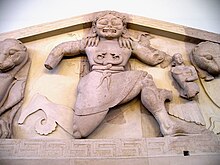
An archaic Medusa wearing the belt of the intertwined snakes, a fertility symbol, as depicted on the west pediment of the Temple of Artemis

The three Gorgon sisters—Medusa, Stheno, and Euryale—were all children of the ancient marine deities Phorcys (or "Phorkys") and his sister Ceto (or "Keto"), chthonic monsters from an archaic world. Their genealogy is shared with other sisters, the Graeae, as in Aeschylus's Prometheus Bound, which places both trinities of sisters far off "on Kisthene's dreadful plain":

Near them their sisters three, the Gorgons, winged
With snakes for hair—hatred of mortal man—

A medieval Byzantine depiction of Medusa from the Basilica Cistern.

While ancient Greek vase-painters and relief carvers imagined Medusa and her sisters as having monstrous form, sculptors and vase-painters of the fifth century began to envisage her as being beautiful as well as terrifying. In an ode written in 490 BC Pindar already speaks of "fair-cheeked Medusa".

In a late version of the Medusa myth, related by the Roman poet Ovid (Metamorphoses 4.770), Medusa was originally a ravishingly beautiful maiden, "the jealous aspiration of many suitors," but because Poseidon raped Medusa in Athena's temple, Athena transformed Medusa's beautiful hair to serpents and made her face so terrible to behold that the mere sight of it would turn onlookers to stone. In Ovid's telling, Perseus describes Medusa's punishment by Minerva (Athena) as just and well earned.

Coins of the reign of Seleucus I Nicator of Syria (312–280 BC)

In most versions of the story, she was beheaded by the hero Perseus, who was sent to fetch her head by King Polydectes of Seriphus because Polydectes wanted to marry Perseus's mother. The gods were well aware of this, and Perseus received help. He received a mirrored shield from Athena, gold, winged sandals from Hermes, a sword from Hephaestus and Hades's helm of invisibility. Since Medusa was the only one of the three Gorgons who was mortal, Perseus was able to slay her while looking at the reflection from the mirrored shield he received from Athena. During that time, Medusa was pregnant by Poseidon. When Perseus beheaded her, Pegasus, a winged horse, and Chrysaor, a giant wielding a golden sword, sprang from her body.

Jane Ellen Harrison argues that "her potency only begins when her head is severed, and that potency resides in the head; she is in a word a mask with a body later appended... the basis of the Gorgoneion is a cultus object, a ritual mask misunderstood."

In the Odyssey xi, Homer does not specifically mention the Gorgon Medusa:

Lest for my daring Persephone the dread,
From Hades should send up an awful monster's grisly head.

The Medusa's head central to a mosaic floor in a tepidarium of the Roman era. Museum of Sousse, Tunisia

Harrison's translation states "the Gorgon was made out of the terror, not the terror out of the Gorgon."

According to Ovid, in northwest Africa, Perseus flew past the Titan Atlas, who stood holding the sky aloft, and transformed him into stone when he tried to attack him. In a similar manner, the corals of the Red Sea were said to have been formed of Medusa's blood spilled onto seaweed when Perseus laid down the petrifying head beside the shore during his short stay in Ethiopia where he saved and wed his future wife, the lovely princess Andromeda who was the most beautiful woman in the world at that time. Furthermore, the poisonous vipers of the Sahara, in the Argonautica 4.1515, Ovid's Metamorphoses 4.770 and Lucan's Pharsalia 9.820, were said to have grown from spilt drops of her blood. The blood of Medusa also spawned the Amphisbaena (a horned dragon-like creature with a snake-headed tail).

Perseus then flew to Seriphos, where his mother was being forced into marriage with the king, Polydectes, who was turned into stone by the head. Then Perseus gave the Gorgon's head to Athena, who placed it on her shield, the Aegis.

Some classical references refer to three Gorgons; Harrison considered that the tripling of Medusa into a trio of sisters was a secondary feature in the myth:

The triple form is not primitive, it is merely an instance of a general tendency... which makes of each woman goddess a trinity, which has given us the Horae, the Charites, the Semnai, and a host of other triple groups. It is immediately obvious that the Gorgons are not really three but one + two. The two unslain sisters are mere appendages due to custom; the real Gorgon is Medusa.

Modern interpretations

A Roman cameo of the 2nd or 3rd century

Historical

A number of early classics scholars interpreted the myth of Medusa as a quasi-historical – "based on or reconstructed from an event, custom, style, etc., in the past", or "sublimated" memory of an actual invasion.

According to Joseph Campbell:

The legend of Perseus beheading Medusa means, specifically, that "the Hellenes overran the goddess's chief shrines" and "stripped her priestesses of their Gorgon masks", the latter being apotropaic faces worn to frighten away the profane. That is to say, there occurred in the early thirteenth century B.C. an actual historic rupture, a sort of sociological trauma, which has been registered in this myth, much as what Freud terms the latent content of a neurosis is registered in the manifest content of a dream: registered yet hidden, registered in the unconscious yet unknown or misconstrued by the conscious mind.

Psychoanalysis

Medusa by Arnold Böcklin, circa 1878

In 1940, Sigmund Freud's "Das Medusenhaupt (Medusa's Head)" was published posthumously. In Freud's interpretation: "To decapitate = to castrate. The terror of Medusa is thus a terror of castration that is linked to the sight of something. Numerous analyses have made us familiar with the occasion for this: it occurs when a boy, who has hitherto been unwilling to believe the threat of castration, catches sight of the female genitals, probably those of an adult, surrounded by hair, and essentially those of his mother." In this perspective the "ravishingly beautiful" Medusa (see above) is the mother remembered in innocence; before the mythic truth of castration dawns on the subject. Classic Medusa, in contrast, is an Oedipal/libidinous symptom. Looking at forbidden mother (in her hair-covered genitals, so to speak) stiffens the subject in illicit desire and freezes him in terror of the Father's retribution. There are no recorded instances of Medusa turning a woman to stone.

Archetypal literary criticism continues to find psychoanalysis useful. Beth Seelig analyzes Medusa's punishment from the aspect of the crime of having been raped rather than having willingly consented in Athena's temple as an outcome of the goddess' unresolved conflicts with her own father, Zeus.

Feminism

#Me(dusa)too, oil on canvas, Judy Takács, 2018

In the 20th century, feminists reassessed Medusa's appearances in literature and in modern culture, including the use of Medusa as a logo by fashion company Versace. The name "Medusa" itself is often used in ways not directly connected to the mythological figure but to suggest the gorgon's abilities or to connote malevolence; despite her origins as a beauty, the name in common usage "came to mean monster." The book Female Rage: Unlocking Its Secrets, Claiming Its Power by Mary Valentis and Anne Devane notes that "When we asked women what female rage looks like to them, it was always Medusa, the snaky-haired monster of myth, who came to mind ... In one interview after another we were told that Medusa is 'the most horrific woman in the world' ... [though] none of the women we interviewed could remember the details of the myth."

Medusa's visage has since been adopted by many women as a symbol of female rage; one of the first publications to express this idea was a feminist journal called Women: A Journal of Liberation in their issue one, volume six for 1978. The cover featured the image of the Gorgon Medusa by Froggi Lupton, which the editors on the inside cover explained "can be a map to guide us through our terrors, through the depths of our anger into the sources of our power as women."

In issue three, Fall 1986 for the magazine Woman of Power an article called Gorgons: A Face for Contemporary Women's Rage, appeared, written by Emily Erwin Culpepper, who wrote that "The Amazon Gorgon face is female fury personified. The Gorgon/Medusa image has been rapidly adopted by large numbers of feminists who recognize her as one face of our own rage." Griselda Pollock analyses the passage from horrorism to compassion in the figure of the Medusa through Adriana Cavarero's philosophy and Bracha Ettinger's art and Matrixial theory.

Elana Dykewomon's 1976 collection of lesbian stories and poems, They Will Know Me by My Teeth, features a drawing of a Gorgon on its cover. Its purpose was to act as a guardian for female power, keeping the book solely in the hands of women. Stephen Wilk, author of Medusa: Solving the Mystery of the Gorgon, questioned Medusa's enduring status among the feminist movement. He believes that one reason for her longevity may be her role as a protector, fearsome and enraged. "Only the Gorgon has the savage, threatening appearance to serve as an immediately recognized symbol of rage and a protector of women's secrets," wrote Wilk.

Even in contemporary pop culture, Medusa has become largely synonymous with feminine rage. Through many of her iterations, Medusa pushes back against a story that seeks to place the male, Perseus, at its center, blameless and heroic. Author Sibylle Baumbach described Medusa as a “multimodal image of intoxication, petrifaction, and luring attractiveness," citing her seductive contemporary representation, as well as her dimensionality, as the reason for her longevity. Elizabeth Johnston's November 2016 Atlantic essay called Medusa the original 'Nasty Woman.' Johnston goes on to say that as Medusa has been repeatedly compared to Clinton during the 2016 presidential election, she proves her merit as an icon, finding relevance even in modern politics. "Medusa has since haunted Western imagination, materializing whenever male authority feels threatened by female agency," writes Johnston. Beyond that, Medusa's story is, Johnston argues, a rape narrative. A story of victim blaming, one that she says sounds all too familiar in a current American context.

Medusa is widely known as a monstrous creature with snakes in her hair whose gaze turns men to stone. Through the lens of theology, film, art, and feminist literature, my students and I map how her meaning has shifted over time and across cultures. In so doing, we unravel a familiar narrative thread: In Western culture, strong women have historically been imagined as threats requiring male conquest and control, and Medusa herself has long been the go-to figure for those seeking to demonize female authority.

The Medusa story has also been interpreted in contemporary art as a classic case of rape-victim blaming, by the Goddess Athena. Inspired by the #metoo movement, contemporary figurative artist Judy Takács returns Medusa's beauty along with a hashtag stigmata in her portrait, #Me(dusa)too.

Feminist theorist Hélène Cixous famously tackled the myth in her essay "The Laugh of the Medusa." She argues that men's retelling of the narrative turned Medusa into a monster because they feared female desire. "The Laugh of the Medusa" is largely a call to arms, urging women to reclaim their identity through writing as she rejects the patriarchal society of Western culture. Cixous calls writing "an act which will not only 'realize' the decensored relation of woman to her sexuality, to her womanly being, giving her access to her native strength; it will give her back her goods, her pleasures, her organs, her immense bodily territories which have been kept under seal." She claims "we must kill the false woman who is preventing the live one from breathing. Inscribe the breath of the whole woman." Cixous wants to destroy the phallogocentric system, and to empower women's bodies and language. "You only have to look at the Medusa straight on to see her," writes Cixous. "And she's not deadly. She's beautiful and she's laughing."

Nihilism

An embossed plaque in the Art Nouveau style from 1911

Medusa has sometimes appeared as representing notions of scientific determinism and nihilism, especially in contrast with romantic idealism. In this interpretation of Medusa, attempts to avoid looking into her eyes represent avoiding the ostensibly depressing reality that the universe is meaningless. Jack London uses Medusa in this way in his novel The Mutiny of the Elsinore:

I cannot help remembering a remark of De Casseres. It was over the wine in Mouquin's. Said he: "The profoundest instinct in man is to war against the truth; that is, against the Real. He shuns facts from his infancy. His life is a perpetual evasion. Miracle, chimera and to-morrow keep him alive. He lives on fiction and myth. It is the Lie that makes him free. Animals alone are given the privilege of lifting the veil of Isis; men dare not. The animal, awake, has no fictional escape from the Real because he has no imagination. Man, awake, is compelled to seek a perpetual escape into Hope, Belief, Fable, Art, God, Socialism, Immortality, Alcohol, Love. From Medusa-Truth he makes an appeal to Maya-Lie."

— Jack London, The Mutiny of the Elsinore

Art

Medusa, by Caravaggio (1595)

Medusa has been depicted in several works of art, including:

Medusa remained a common theme in art in the nineteenth century, when her myth was retold in Thomas Bulfinch's Mythology. Edward Burne-Jones' Perseus Cycle of paintings and a drawing by Aubrey Beardsley gave way to the twentieth century works of Paul Klee, John Singer Sargent, Pablo Picasso, Pierre et Gilles, and Auguste Rodin's bronze sculpture The Gates of Hell.

Film

The most influential depiction of Medusa in film is arguably the stop motion animation created by Ray Harryhausen for Clash of the Titans (1981). As well has having snakes for hair, she was given a serpent-like body and rattlesnake-like tail. The model was one Harryhausen’s most complex and in 2020 it was voted third favourite among his many creations.

Flags and emblems

The head of Medusa is featured on some regional symbols. One example is that of the flag and emblem of Sicily, together with the three legged trinacria. The inclusion of Medusa in the center implies the protection of the goddess Athena, who wore the Gorgon's likeness on her aegis, as said above. Another example is the coat of arms of Dohalice village in the Czech Republic.

Arachne

From Wikipedia, the free encyclopedia
 
Minerva and Arachne, René-Antoine Houasse, 1706

Arachne (/əˈrækn/; from Ancient Greek: ᾰ̓ρᾰ́χνη, romanizedarákhnē, lit. 'spider', cognate with Latin araneus) is the protagonist of a tale in Roman mythology known primarily from the version told by the Roman poet Ovid (43 BCE–17 CE), which is the earliest extant source for the story. In Book Six of his epic poem Metamorphoses, Ovid recounts how the talented mortal Arachne, daughter of Idmon, challenged Athena, goddess of wisdom and crafts, to a weaving contest. When Athena could find no flaws in the tapestry Arachne had woven for the contest, the goddess became enraged and beat the girl with her shuttle. After Arachne hanged herself out of shame, she was transformed into a spider. The myth both provides an aetiology of spiders' web-spinning abilities and is a cautionary tale warning mortals not to place themselves on an equal level with the gods.

Biography

According to the myth as recounted by Ovid, Arachne was a Lydian maiden who was the daughter of Idmon of Colophon, who was a famous dyer in purple. She was credited to have invented linen cloth and nets while her son Closter introduced the use of spindle in the manufacture of wool. She was said to have been a native of Hypæpæ, near Colophon in Asia Minor.

Mythology

Athena and Arachne (Antonio Tempesta)

In Metamorphoses the Roman poet Ovid writes that Arachne was a shepherd's daughter who began weaving at an early age. She became a great weaver, boasted that her skill was greater than Athena's, and refused to acknowledge that her skill came, at least in part, from the goddess. Athena took offense and set up a contest between them. Presenting herself as an old lady, she approached the boasting girl and warned: "You can never compare to any of the gods. Plead for forgiveness and Athena might spare your soul."

"Ha! I only speak the truth and if Athena thinks otherwise then let her come down and challenge me herself," Arachne replied. Athena removed her disguise and appeared in shimmering glory, clad in a sparkling white chiton. The two began weaving straight away. Athena's weaving represented four separate contests between mortals and the gods in which the gods punished mortals for setting themselves as equals of the gods. Arachne's weaving depicted ways that the gods, particularly Zeus, had misled and abused mortals, tricking and seducing many women. When Athena saw that Arachne had not only insulted the gods but done so with a work far more beautiful than Athena's own, she was enraged. She ripped Arachne's work to shreds and hit her on the head three times. Terrified and ashamed, Arachne hanged herself. Then Athena said, "Live on then, and yet hang, condemned one, but, lest you are careless in the future, this same condition is declared, in punishment, against your descendants, to the last generation!" After saying this she sprinkled her with the juice of Hecate's herb, and immediately at the touch of this dark poison, Arachne's hair fell out. With it went her nose and ears, her head shrank to the smallest size, and her whole body became tiny. Her slender fingers stuck to her sides as legs, the rest is belly, from which she still spins a thread, and, as a spider, weaves her ancient web."

The myth of Arachne can also be seen as an attempt to show relation between art and tyrannical power in Ovid's time. He wrote under the emperor Augustus and was exiled by him. At the time weaving was a common metaphor for poetry, therefore Arachne's artistry and Athena's censorship to it may offer a provocative allegory of the writer's role under an autocratic regime.

Influence

The taxonomical class name Arachnida and the name for spiders in many romance languages are both derived from arachne.

The metamorphosis of Arachne in Ovid's telling furnished material for an episode in Edmund Spenser's mock-heroic Muiopotmos, 257–352. Spenser's adaptation, which "rereads an Ovidian story in terms of the Elizabethan world" is designed to provide a rationale for the hatred of Arachne's descendant Aragnoll for the butterfly-hero Clarion.

Dante Alighieri uses Arachne in Canto XVII of Inferno, the first part of The Divine Comedy, to describe the horrible monster Geryon. "His back and all his belly and both flanks were painted arabesques and curlicues: the Turks and Tartars never made a fabric with richer colors intricately woven, nor were such complex webs spun by Arachne."

The tale of Arachne inspired one of Velázquez' most factual paintings: Las Hilanderas ("The Spinners, or The fable of Arachne", in the Prado), in which the painter represents the two important moments of the myth. In the front, the contest of Arachne and the goddess (the young and the old weaver), in the back, an Abduction of Europa that is a copy of Titian's version (or maybe of Rubens' copy of Titian). In front of it appears Minerva (Athena) at the moment she punishes Arachne. It transforms the myth into a reflection about creation and imitation, god and man, master and pupil (and therefore about the nature of art).

It has also been suggested that Jeremias Gotthelf's nineteenth century novella, The Black Spider, was heavily influenced by the Arachne story from Ovid's Metamorphoses. In the novella, a woman is turned into a venomous spider having reneged on a deal with the devil.

In popular culture

Pendule with Arachne and Athena in Meissen porcelain, attributed to Johann Gottlieb Kirchner and George Fritzsche (1727)
 
Arachne, Predator and Prey, oil on canvas, Judy Takacs, 2019

Arachne has had a considerable degree of influence on modern popular culture. She frequently appears in modern fantasy books, movies, and television series in the form of a monstrous spider. In Hercules: The Legendary Journeys, she is pictured as a grotesque, half-woman, half-spider monster who nests on people to produce killer spiders. She is the central character in the 2011 novel The Spider Goddess by Tara Moss. In Class of the Titans, Arachne is changed into a giant spider and makes a deal with Cronus to become human again. Cronus does not hold up the end of his bargain though and betrays her after getting her to trap the heroes for him. After being berated by Atlanta, Athena turns Arachne back into a human, and she is allowed to live at the Olympus High School, weaving for the gods.

In the 13th episode from season 6 of Supernatural, "Unforgiven", the monster of the week is an Arachne, depicted as a humanoid monster with spider-like attributes and abilities, including the ability to weave strong webs and a venomous bite that can turn other humans into Arachnes. They can be killed only by decapitation and, before one appeared in Bristol, Rhode Island, hadn't been seen in two thousand years. While soulless, Sam Winchester hunted one, but was unaware that it had turned its victims into Arachnes as well. One of the turned victims comes back for revenge and Sam is forced to kill him.

Arachne is also featured in the Percy Jackson and Heroes of Olympus series. All of Athena's children, including Annabeth Chase, are arachnophobic because of Arachne's dispute with Athena. Arachne appears towards the end of The Mark of Athena as a large spider while still maintaining human features. She is defeated by Annabeth because of her pride and eventually they are both sent falling into Tartarus, where Percy Jackson kills Arachne.

In the novel The Last Unicorn written by Peter S. Beagle, a plain brown spider is bewitched into believing she is Arachne until the witch who enchanted her is killed. She is mentioned to be one of the creatures in Mommy Fortuna's Midnight Carnival. The book describes Arachne as "the greatest weaver in the world—her fate's the proof of it. She had the bad luck to defeat the goddess Athena in a weaving contest. Athena was a sore loser, and Arachne is now a spider, creating only for Mommy Fortuna's Midnight Carnival, by special arrangement. Warp of snow and woof of flame, and never any two the same. Arachne."

In Marvel Comics, Arachne is the name used by the second Spider-Woman (Julia Carpenter, currently the new Madame Web) to distinguish herself from Jessica Drew, the original Spider-Woman. In Volume 3 of Monster Musume, an Arachne (a human female from the hips upward and the body/legs of a spider) named Rachnera Arachnera is introduced; she goes on to become a member of the "Monster Girl" household in Volume 4. Arachne Gorgon is a powerful witch and one of the main antagonists of Soul Eater. She was responsible for crafting the first demon weapons, an act that Death fiercely opposed, forcing her to bide her time and remain in hiding for 800 years. She returns to lead the risen Arachnaphobia, her personal army against Death.

The story of Arachne has also been adapted for many plays. She is the inspiration for a character featured in the Broadway musical Spider-Man: Turn Off the Dark. Arachne: Spider Girl! is a play for children based on the myth by Ursula Dubosarsky, first published in the NSW School Magazine.

Gustave Doré's illustration of Arachne's punishment in Purgatory for Dante's Purgatorio has had a surprising number of pop culture appearances. It is one of the many recurring images used by the rock band, The Mars Volta; it has been used in the cover of their Live EP, as a backdrop for their live shows, and a favorite accessory for guitarist and composer Omar Rodríguez-López in the form of a belt buckle. Eminem's 2013 music video for the song "Rap God" features imagery from Dante's Purgatorio, including the illustration of Arachne. (This is most likely a metaphor for the rappers who try to compete with the self-proclaimed "Rap God").

On Episode 245 of the Comedy Bang! Bang! Podcast, Comedian Neil Campbell references Arachne and Athena's rivalry during a freestyle rap battle. In the popular MOBA game, Smite, Arachne is listed as a playable deity in the Greek pantheon.

In a short story "More Spinned Against" John Wyndham tells of how Arachne finds herself in the clutches of a spider-obsessed collector and of the deal she makes with the collector's wife Lydia.

The story of Arachne has been revisited in contemporary art by figurative artist, Judy Takács. Takács views the story and reimagines the characters through a feminist lens, with her triptych, Arachne, Predator and Prey.

Modal realism

From Wikipedia, the free encyclopedia https://en.wikipedia.org/wiki/Modal_realism   ...