Search This Blog

Saturday, January 27, 2024

Wave power

From Wikipedia, the free encyclopedia

Wave power is the capture of energy of wind waves to do useful work – for example, electricity generation, water desalination, or pumping water. A machine that exploits wave power is a wave energy converter (WEC).

Waves are generated primarily by wind passing over the sea's surface and also by tidal forces, temperature variations, and other factors. As long as the waves propagate slower than the wind speed just above, energy is transferred from the wind to the waves. Air pressure differences between the windward and leeward sides of a wave crest and surface friction from the wind cause shear stress and wave growth.

Wave power as a descriptive term is different than tidal power, which seeks to primarily capture the energy of the current caused by the gravitational pull of the Sun and Moon. However, wave power and tidal power are not fundamentally distinct and have significant cross-over in technology and implementation. Other forces can create currents, including breaking waves, wind, the Coriolis effect, cabbeling, and temperature and salinity differences.

As of 2022, wave power is not widely employed for commercial applications, after a long series of trial projects. Attempts to use this energy began in 1890 or earlier, mainly due to its high power density. Just below the ocean's water surface the wave energy flow, in time-average, is typically five times denser than the wind energy flow 20 m above the sea surface, and 10 to 30 times denser than the solar energy flow.

In 2000 the world's first commercial wave power device, the Islay LIMPET was installed on the coast of Islay in Scotland and connected to the UK national grid. In 2008, the first experimental multi-generator wave farm was opened in Portugal at the Aguçadoura wave park. Both projects have since ended.

Wave energy converters can be classified based on their working principle as either:

  • oscillating water columns (with air turbine)
  • oscillating bodies (with hydroelectric motor, hydraulic turbine, linear electrical generator)
  • overtopping devices (with low-head hydraulic turbine)

History

The first known patent to extract energy from ocean waves was in 1799, filed in Paris by Pierre-Simon Girard and his son. An early device was constructed around 1910 by Bochaux-Praceique to power his house in Royan, France. It appears that this was the first oscillating water-column type of wave-energy device. From 1855 to 1973 there were 340 patents filed in the UK alone.

Modern pursuit of wave energy was pioneered by Yoshio Masuda's 1940s experiments. He tested various concepts, constructing hundreds of units used to power navigation lights. Among these was the concept of extracting power from the angular motion at the joints of an articulated raft, which Masuda proposed in the 1950s.

The oil crisis in 1973 renewed interest in wave energy. Substantial wave-energy development programmes were launched by governments in several countries, in particular in the UK, Norway and Sweden. Researchers re-examined waves' potential to extract energy, notably Stephen Salter, Johannes Falnes, Kjell Budal, Michael E. McCormick, David Evans, Michael French, Nick Newman, and C. C. Mei.

Salter's 1974 invention became known as Salter's duck or nodding duck, officially the Edinburgh Duck. In small-scale tests, the Duck's curved cam-like body can stop 90% of wave motion and can convert 90% of that to electricity, giving 81% efficiency. In the 1980s, several other first-generation prototypes were tested, but as oil prices ebbed, wave-energy funding shrank. Climate change later reenergized the field.

The world's first wave energy test facility was established in Orkney, Scotland in 2003 to kick-start the development of a wave and tidal energy industry. The European Marine Energy Centre(EMEC) has supported the deployment of more wave and tidal energy devices than any other single site. Subsequent to its establishment test facilities occurred also in many other countries around the world, providing services and infrastructure for device testing.

The £10 million Saltire prize challenge was to be awarded to the first to be able to generate 100 GWh from wave power over a continuous two-year period by 2017 (about 5.7 MW average). The prize was never awarded. A 2017 study by Strathclyde University and Imperial College focused on the failure to develop "market ready" wave energy devices – despite a UK government investment of over £200 million over 15 years.

Public bodies have continued and in many countries stepped up the research and development funding for wave energy during the 2010s. This includes both EU, US and UK where the annual allocation has typically been in the range 5-50 million USD. Combined with private funding, this has led to a large number of ongoing wave energy projects.

Physical concepts

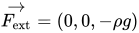
Like most fluid motion, the interaction between ocean waves and energy converters is a high-order nonlinear phenomenon. It is described using the incompressible Navier-Stokes equations

where is the fluid velocity, is the pressure, the density, the viscosity, and the net external force on each fluid particle (typically gravity). Under typical conditions, however, the movement of waves is described by Airy wave theory, which posits that

  • fluid motion is roughly irrotational,
  • pressure is approximately constant at the water surface, and
  • the seabed depth is approximately constant.

In situations relevant for energy harvesting from ocean waves these assumptions are usually valid.

Airy equations

The first condition implies that the motion can be described by a velocity potential :

which must satisfy the Laplace equation,
In an ideal flow, the viscosity is negligible and the only external force acting on the fluid is the earth gravity . In those circumstances, the Navier-Stokes equations reduces to
which integrates (spatially) to the Bernoulli conservation law:

Linear potential flow theory

Motion of a particle in an ocean wave.

A = At deep water. The circular motion magnitude of fluid particles decreases exponentially with increasing depth below the surface.
B = At shallow water (ocean floor is now at B). The elliptical movement of a fluid particle flattens with decreasing depth.
1 = Propagation direction.
2 = Wave crest.
3 = Wave trough.

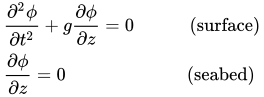
When considering small amplitude waves and motions, the quadratic term can be neglected, giving the linear Bernoulli equation,

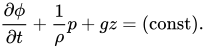
and third Airy assumptions then imply
These constraints entirely determine sinusoidal wave solutions of the form
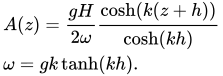
where determines the wavenumber of the solution and and are determined by the boundary constraints (and ). Specifically,
The surface elevation can then be simply derived as
a plane wave progressing along the x-axis direction.

Consequences

Oscillatory motion is highest at the surface and diminishes exponentially with depth. However, for standing waves (clapotis) near a reflecting coast, wave energy is also present as pressure oscillations at great depth, producing microseisms. Pressure fluctuations at greater depth are too small to be interesting for wave power conversion.

The behavior of Airy waves offers two interesting regimes: water deeper than half the wavelength, as is common in the sea and ocean, and shallow water, with wavelengths larger than about twenty times the water depth. Deep waves are dispersionful: Waves of long wavelengths propagate faster and tend to outpace those with shorter wavelengths. Deep-water group velocity is half the phase velocity. Shallow water waves are dispersionless: group velocity is equal to phase velocity, and wavetrains propagate undisturbed.

The following table summarizes the behavior of waves in the various regimes:

Wave power formula

Photograph of the elliptical trajectories of water particles under a – progressive and periodic – surface gravity wave in a wave flume. The wave conditions are: mean water depth d = 2.50 ft (0.76 m), wave height H = 0.339 ft (0.103 m), wavelength λ = 6.42 ft (1.96 m), period T = 1.12 s.

In deep water where the water depth is larger than half the wavelength, the wave energy flux is

with P the wave energy flux per unit of wave-crest length, Hm0 the significant wave height, Te the wave energy period, ρ the water density and g the acceleration by gravity. The above formula states that wave power is proportional to the wave energy period and to the square of the wave height. When the significant wave height is given in metres, and the wave period in seconds, the result is the wave power in kilowatts (kW) per metre of wavefront length.

For example, consider moderate ocean swells, in deep water, a few km off a coastline, with a wave height of 3 m and a wave energy period of 8 s. Solving for power produces

or 36 kilowatts of power potential per meter of wave crest.

In major storms, the largest offshore sea states have significant wave height of about 15 meters and energy period of about 15 seconds. According to the above formula, such waves carry about 1.7 MW of power across each meter of wavefront.

An effective wave power device captures a significant portion of the wave energy flux. As a result, wave heights diminish in the region behind the device.

Energy and energy flux

In a sea state, the mean energy density per unit area of gravity waves on the water surface is proportional to the wave height squared, according to linear wave theory:
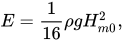
 

where E is the mean wave energy density per unit horizontal area (J/m2), the sum of kinetic and potential energy density per unit horizontal area. The potential energy density is equal to the kinetic energy, both contributing half to the wave energy density E, as can be expected from the equipartition theorem.

The waves propagate on the surface, where crests travel with the phase velocity while the energy is transported horizontally with the group velocity. The mean transport rate of the wave energy through a vertical plane of unit width, parallel to a wave crest, is the energy flux (or wave power, not to be confused with the output produced by a device), and is equal to:

with cg the group velocity (m/s).

Due to the dispersion relation for waves under gravity, the group velocity depends on the wavelength λ, or equivalently, on the wave period T.

Wave height is determined by wind speed, the length of time the wind has been blowing, fetch (the distance over which the wind excites the waves) and by the bathymetry (which can focus or disperse the energy of the waves). A given wind speed has a matching practical limit over which time or distance do not increase wave size. At this limit the waves are said to be "fully developed". In general, larger waves are more powerful but wave power is also determined by wavelength, water density, water depth and acceleration of gravity.

Wave energy converters

Wave energy converters (WECs) are generally categorized by the method, by location and by the power take-off system. Locations are shoreline, nearshore and offshore. Types of power take-off include: hydraulic ram, elastomeric hose pump, pump-to-shore, hydroelectric turbine, air turbine, and linear electrical generator.

Different conversion routes from wave energy to useful energy in terms or electricity or direct use.

The four most common approaches are:

  • point absorber buoys
  • surface attenuators
  • oscillating water columns
  • overtopping devices
Generic wave energy concepts: 1. Point absorber, 2. Attenuator, 3. Oscillating wave surge converter, 4. Oscillating water column, 5. Overtopping device, 6. Submerged pressure differential, 7. Floating in-air converters.

Point absorber buoy

This device floats on the surface, held in place by cables connected to the seabed. The point-absorber has a device width much smaller than the incoming wavelength λ. Energy is absorbed by radiating a wave with destructive interference to the incoming waves. Buoys use the swells' rise and fall to generate electricity directly via linear generators, generators driven by mechanical linear-to-rotary converters, or hydraulic pumps. Energy extracted from waves may affect the shoreline, implying that sites should remain well offshore.

Surface attenuator

These devices use multiple floating segments connected to one another. They are oriented perpendicular to incoming waves. A flexing motion is created by swells, and that motion drives hydraulic pumps to generate electricity.

Oscillating wave surge converter

These devices typically have one end fixed to a structure or the seabed while the other end is free to move. Energy is collected from the relative motion of the body compared to the fixed point. Converters often come in the form of floats, flaps, or membranes. Some designs incorporate parabolic reflectors to focus energy at the point of capture. These systems capture energy from the rise and fall of waves.

Oscillating water column

Oscillating water column devices can be located onshore or offshore. Swells compress air in an internal chamber, forcing air through a turbine to create electricity. Significant noise is produced as air flows through the turbines, potentially affecting nearby birds and marine organisms. Marine life could possibly become trapped or entangled within the air chamber. It draws energy from the entire water column.

Overtopping device

Overtopping devices are long structures that use wave velocity to fill a reservoir to a greater water level than the surrounding ocean. The potential energy in the reservoir height is captured with low-head turbines. Devices can be on- or offshore.

Submerged pressure differential

Submerged pressure differential based converters use flexible (typically reinforced rubber) membranes to extract wave energy. These converters use the difference in pressure at different locations below a wave to produce a pressure difference within a closed power take-off hydraulic system. This pressure difference is usually used to produce flow, which drives a turbine and electrical generator. Submerged pressure differential converters typically use flexible membranes as the working surface between the water and the power take-off. Membranes are pliant and low mass, which can strengthen coupling with the wave's energy. Their pliancy allows large changes in the geometry of the working surface, which can be used to tune the converter for specific wave conditions and to protect it from excessive loads in extreme conditions.

A submerged converter may be positioned either on the seafloor or in midwater. In both cases, the converter is protected from water impact loads which can occur at the free surface. Wave loads also diminish in non-linear proportion to the distance below the free surface. This means that by optimizing depth, protection from extreme loads and access to wave energy can be balanced.

Floating in-air converters

Wave Power Station using a pneumatic Chamber
Simplified design of Wave Power Station

Floating in-air converters potentially offer increased reliability because the device is located above the water, which also eases inspection and maintenance. Examples of different concepts of floating in-air converters include:

  • roll damping energy extraction systems with turbines in compartments containing sloshing water
  • horizontal axis pendulum systems
  • vertical axis pendulum systems

Environmental effects

Common environmental concerns associated with marine energy include:

Potential

Wave energy's worldwide theoretical potential has been estimated to be greater than 2 TW. Locations with the most potential for wave power include the western seaboard of Europe, the northern coast of the UK, and the Pacific coastlines of North and South America, Southern Africa, Australia, and New Zealand. The north and south temperate zones have the best sites for capturing wave power. The prevailing westerlies in these zones blow strongest in winter.

World wave energy resource map

The National Renewable Energy Laboratory (NREL) estimated the theoretical wave energy potential for various countries. It estimated that the US' potential was equivalent to 1170 TWh per year or almost 1/3 of the country's electricity consumption. The Alaska coastline accounted for ~50% of the total.

Note that the technical and economical potential will be lower than the given values for the theoretical potential.

Environmental impacts must be addressed. Socio-economic challenges include the displacement of commercial and recreational fishermen, and may present navigation hazards. Supporting infrastructure, such as grid connections, must be provided. Commercial WECs have not always been successful. In 2019, for example, Seabased Industries AB in Sweden was liquidated due to "extensive challenges in recent years, both practical and financial".

Current wave power generation technology is subject to many technical limitations. These limitations stem from the complex and dynamic nature of ocean waves, which require robust and efficient technology to capture the energy. Challenges include designing and building wave energy devices that can withstand the corrosive effects of saltwater, harsh weather conditions, and extreme wave forces. Additionally, optimizing the performance and efficiency of wave energy converters, such as oscillating water column (OWC) devices, point absorbers, and overtopping devices, requires overcoming engineering complexities related to the dynamic and variable nature of waves. Furthermore, developing effective mooring and anchoring systems to keep wave energy devices in place in the harsh ocean environment, and developing reliable and efficient power take-off mechanisms to convert the captured wave energy into electricity, are also technical challenges in wave power generation. As the wave energy dissipation by a submerged flexible mound breakwater is greater than that of a rigid submerged structure, greater wave energy dissipation is expected due to highly deformed shape of the structure.

Wave farms

A wave farm (wave power farm or wave energy park) is a group of colocated wave energy devices. The devices interact hydrodynamically and electrically, according to the number of machines, spacing and layout, wave climate, coastal and benthic geometry, and control strategies. The design process is a multi-optimization problem seeking high power production, low costs and limited power fluctuations.

Gallery of wave energy installations

Patents

A UK-based company has developed a Waveline Magnet that can achieve a levelized cost of electricity of £0.01/kWh with minimal levels of maintenance.

Sea breeze

From Wikipedia, the free encyclopedia
Sea breeze moving across the water (towards the viewer) in Hobart, Tasmania, Australia
Lake - Sea breeze and atmospheric depth

A sea breeze or onshore breeze is any wind that blows from a large body of water toward or onto a landmass. By contrast, a land breeze or offshore breeze is any wind that blows from a landmass toward or onto a large body of water. The term offshore wind may refer to any wind over open water. Sea breezes and land breezes are both important factors in coastal regions' prevailing winds.

Sea breeze and land breeze develop due to differences in air pressure created by the differing heat capacities of water and dry land. As such, Sea breezes and land breezes are more localised than prevailing winds. Since land heats up much faster than water under solar radiation, a sea breeze is a common occurrence along coasts after sunrise. On the other hand, dry land also cools faster than water without solar radiation, so the wind instead flows from the land towards the sea when the sea breeze dissipates after sunset.

The land breeze at nighttime is usually shallower than the sea breeze in daytime. Unlike the daytime sea breeze, which is driven by convection, the nighttime land breeze is driven by convergence.

Cause

Sea breeze

The sea has a greater heat capacity than land, so the surface of the sea warms up more slowly than the surface of the land. As the temperature of the surface of the land rises, the land heats the air above it by convection. The hypsometric equation states that the hydrostatic pressure depends on the temperature. Thus, the hydrostatic pressure over the land decreases less at higher altitude. As the air above the coast has a relatively higher pressure, it starts moving towards the sea at high altitude. This creates an inverse airflow near the ground. The strength of the sea breeze is directly proportional to the temperature difference between the land and the sea. If a strong offshore wind is present (that is, a wind greater than 8 knots (15 km/h)) and opposing the direction of a possible sea breeze, the sea breeze is not likely to develop.

Land breeze

At night, the land cools off faster than the ocean due to differences in their heat capacity, which forces the dying of the daytime sea breeze as the temperature of the land approaches that of the ocean. If the land becomes cooler than the adjacent sea surface temperature, the air pressure over the water will be lower than that of the land, setting up a land breeze blowing from the land to the sea, as long as the environmental surface wind pattern is not strong enough to oppose it.

Effects

Sea breeze

Schematic cross section through a sea-breeze front. If the air inland is moist, cumulus often marks the front.

A sea-breeze front is a weather front created by a sea breeze, also known as a convergence zone. The cold air from the sea meets the warmer air from the land and creates a boundary like a shallow cold front. When powerful this front creates cumulus clouds, and if the air is humid and unstable, the front can sometimes trigger thunderstorms. If the flow aloft is aligned with the direction of the sea breeze, places experiencing the sea breeze frontal passage will have benign, or fair, weather for the remainder of the day. At the front warm air continues to flow upward and cold air continually moves in to replace it and so the front moves progressively inland. Its speed depends on whether it is assisted or hampered by the prevailing wind, and the strength of the thermal contrast between land and sea. At night, the sea breeze usually changes to a land breeze, due to a reversal of the same mechanisms.

Sea breezes in Florida

Sea breeze convergence in Cuba is very similar to that in Florida. The northern sea breeze meets the southern sea breeze, creating a sharp convergence line in the cumulus field.

Thunderstorms caused by powerful sea breeze fronts frequently occur in Florida, a peninsula bounded on the east and west by the Atlantic Ocean and Gulf of Mexico, respectively. During the wet season, which typically lasts from June through September/October, any direction that the winds are blowing would always be off the water, thus making Florida the place most often struck by lightning in the United States, and one of the most on Earth. These storms can also produce significant hail due to the tremendous updraft it causes in the atmosphere especially during times when the upper atmosphere is cooler such as during the spring or fall.

On calm summer afternoons with little prevailing wind, sea breezes from both coasts may collide in the middle, creating especially severe storms down the center of the state. These thunderstorms can drift towards either the west or east coast depending on the relative strengths of the sea breezes, and sometimes survive to move out over the water at night, creating spectacular cloud-to-cloud lightning shows for hours after sunset. Due to its large size Lake Okeechobee may also contribute to this activity by creating its own lake breeze which collides with the east and west coast sea breezes.

In Cuba similar sea breeze collisions with the northern and southern coasts sometimes lead to storms.

Land breeze

Land breeze, which consists of cool air coming from the land, pushes the warmer air upwards over the sea. If there is sufficient moisture and instability available, the land breeze can cause showers, or even thunderstorms, over the water. Overnight thunderstorm development offshore due to the land breeze can be a good predictor for the activity on land the following day, as long as there are no expected changes to the weather pattern over the following 12–24 hours. This is mainly because the strength of the land breeze is weaker than the sea breeze. The land breeze will die once the land warms up again the next morning.

Utilisation

Wind farms are often situated near a coast to take advantage of the normal daily fluctuations of wind speed resulting from sea or land breezes. While many onshore wind farms and offshore wind farms do not rely on these winds, a nearshore wind farm is a type of offshore wind farm located on shallow coastal waters to take advantage of both sea and land breezes. For practical reasons, other offshore wind farms are situated further out to sea and rely on prevailing winds rather than sea breezes.

Wind farm

From Wikipedia, the free encyclopedia
The San Gorgonio Pass wind farm in California, United States.
The Gansu Wind Farm in China is the largest wind farm in the world, with a target capacity of 20,000 MW by 2020.

A wind farm or wind park, also called a wind power station or wind power plant, is a group of wind turbines in the same location used to produce electricity. Wind farms vary in size from a small number of turbines to several hundred wind turbines covering an extensive area. Wind farms can be either onshore or offshore.

Many of the largest operational onshore wind farms are located in China, India, and the United States. For example, the largest wind farm in the world, Gansu Wind Farm in China had a capacity of over 6,000 MW by 2012, with a goal of 20,000 MW by 2020. As of December 2020, the 1218 MW Hornsea Wind Farm in the UK is the largest offshore wind farm in the world. Individual wind turbine designs continue to increase in power, resulting in fewer turbines being needed for the same total output.

Because they require no fuel, wind farms have less impact on the environment than many other forms of power generation and are often referred to as a good source of green energy. Wind farms have, however, been criticised for their visual impact and impact on the landscape. Typically they need to be spread over more land than other power stations and need to be built in wild and rural areas, which can lead to "industrialization of the countryside", habitat loss, and a drop in tourism. Some critics claim that wind farms have adverse health effects, but most researchers consider these claims to be pseudoscience (see wind turbine syndrome). Wind farms can interfere with radar, although in most cases, according to the US Department of Energy, "siting and other mitigations have resolved conflicts and allowed wind projects to co-exist effectively with radar".

Siting considerations

Location is critical to the overall success of a wind farm. Additional conditions contributing to a successful wind farm location include: wind conditions, access to electric transmission, physical access, and local electricity prices.

Wind conditions

Map of available wind power over the United States. Colour codes indicate wind power density class

The faster the average wind speed, the more electricity the wind turbine will generate, so faster winds are generally economically better for wind farm developments. The balancing factor is that strong gusts and high turbulence require stronger more expensive turbines, otherwise there is a risk of damage. The average power in the wind is not proportional to the average wind speed. For this reason, the ideal wind conditions would be strong but consistent winds with low turbulence coming from a single direction.

Mountain passes are ideal locations for wind farms under these conditions. Mountain passes channel wind, blocked by mountains, through a tunnel like pass towards areas of lower pressure and flatter land. Passes used for wind farms like the San Gorgonio Pass and Altamont Pass are known for their abundant wind resource capacity and capability for large-scale wind farms. These types of passes were the first places in the 1980s to have heavily invested large-scale wind farms after approval for wind energy development by the U.S. Bureau of Land Management. From these wind farms, developers learned a lot about turbulence and crowding effects of large-scale wind projects, which were previously unresearched, in the U.S. due to the lack of operational wind farms large enough to conduct these types of studies.

Usually sites are screened on the basis of a wind atlas, and validated with on-site wind measurements via long term or permanent meteorological-tower data using anemometers and wind vanes. Meteorological wind data alone is usually not sufficient for accurate siting of a large wind power project. Collection of site specific data for wind speed and direction is crucial to determining site potential in order to finance the project. Local winds are often monitored for a year or more, detailed wind maps are constructed, along with rigorous grid capability studies conducted, before any wind generators are installed.

The wind blows faster at higher altitudes because of the reduced influence of drag. The increase in velocity with altitude is most dramatic near the surface and is affected by topography, surface roughness, and upwind obstacles such as trees or buildings. At altitudes of thousands of feet/hundreds of metres above sea level, the power in the wind decreases proportional to the decrease in air density.

Electricity grid considerations

Part of the Biglow Canyon Wind Farm, Oregon, United States with a turbine under construction

Often in heavily saturated energy markets, the first step in site selection for large-scale wind projects, before wind resource data collection, is finding areas with adequate available transfer capability (ATC). ATC is the measure of the remaining capacity in a transmission system available for further integration of two interconnected areas without significant upgrades to existing transmission lines and substations. Significant equipment upgrades have substantial costs, potentially undermining the viability of a project within a location, regardless of wind resource availability. Once a list of capable areas is constructed, the list is refined based on long term wind measurements, among other environmental or technical limiting factors such as proximity to load and land procurement.

Many independent system operators (ISOs) in the United States such as the California ISO and Midcontinent ISO use interconnection request queues to allow developers to propose a new generation for a specific given area and grid interconnection. These request queues have both deposit costs at the time of request and ongoing costs for the studies the ISO will make for up to years after the request was submitted to ascertain the viability of the interconnection due to factors such as ATC. Larger corporations who can afford to bid the most queues will most likely have market power as to which sites with the most resource and opportunity get to be developed upon. After the deadline to request a place in the queue has passed, many firms will withdraw their requests after gauging the competition in order to make back some of the deposit for each request that is determined too risky in comparison to other larger firms' requests.

Design

Turbine spacing

A major factor in wind-farm design is the spacing between the turbines, both laterally and axially (with respect to the prevailing winds). The closer the turbines are together, the more the upwind turbines block wind from their rear neighbors (wake effect). However, spacing turbines far apart increases the costs of roads and cables, and raises the amount of land needed to install a specific capacity of turbines. As a result of these factors, turbine spacing varies by site. Generally speaking, manufacturers require a minimum of 3.5 times the turbine's rotor diameter of clear space between each adjacent turbine's respective spatial envelope.

Closer spacing is possible depending on the turbine model, the conditions at the site, and how the site will be operated. Airflows slow down as they approach an obstacle, known as the 'blockage effect', reducing available wind power by 2% for the turbines in front of other turbines.

Onshore

An aerial view of Whitelee Wind Farm, the largest onshore wind farm in the UK and second-largest in Europe
Roscoe Wind Farm An onshore wind farm in West Texas

The capacity of the world's first wind farm was 0.6 MW, produced by 20 wind turbines rated at 30 kilowatts each, installed on the shoulder of Crotched Mountain in southern New Hampshire in December 1980.

Onshore turbine installations in hilly or mountainous regions tend to be on ridges generally three kilometres or more inland from the nearest shoreline. This is done to exploit the topographic acceleration as the wind accelerates over a ridge. The additional wind speeds gained in this way can increase energy produced because more wind goes through the turbines. The exact position of each turbine matters, because a difference of 30 metre could potentially double output. This careful placement is referred to as 'micro-siting'.

Offshore

Offshore wind turbines near Copenhagen, Denmark.

Europe is the leader in offshore wind energy, with the first offshore wind farm (Vindeby) being installed in Denmark in 1991. As of 2010, there are 39 offshore wind farms in waters off Belgium, Denmark, Finland, Germany, Ireland, the Netherlands, Norway, Sweden and the United Kingdom, with a combined operating capacity of 2,396 MW. More than 100 GW (or 100,000 MW) of offshore projects are proposed or under development in Europe. The European Wind Energy Association has set a target of 40 GW installed by 2020 and 150 GW by 2030.

As of 2017, The Walney Wind Farm in the United Kingdom is the largest offshore wind farm in the world at 659 MW, followed by the London Array (630 MW) also in the UK.

Offshore wind turbines are less obtrusive than turbines on land, as their apparent size and noise is mitigated by distance. Because water has less surface roughness than land (especially deeper water), the average wind speed is usually considerably higher over open water. Capacity factors (utilisation rates) are considerably higher than for onshore locations.

The province of Ontario in Canada is pursuing several proposed locations in the Great Lakes, including the suspended Trillium Power Wind 1 approximately 20 km from shore and over 400 MW in size. Other Canadian projects include one on the Pacific west coast. In 2010, there were no offshore wind farms in the United States, but projects were under development in wind-rich areas of the East Coast, Great Lakes, and Pacific coast; and in late 2016 the Block Island Wind Farm was commissioned.

Offshore windfarms, including floating windfarms, provide a small but growing fraction of total windfarm power generation. Such power generation capacity must grow substantially to help meet the IEA's Net Zero by 2050 pathway to combat climate change.

Installation and service / maintenance of off-shore wind farms are a specific challenge for technology and economic operation of a wind farm. As of 2015, there are 20 jackup vessels for lifting components, but few can lift sizes above 5MW. Service vessels have to be operated nearly 24/7 (availability higher than 80% of time) to get sufficient amortisation from the wind turbines. Therefore, special fast service vehicles for installation (like Wind Turbine Shuttle) as well as for maintenance (including heave compensation and heave compensated working platforms to allow the service staff to enter the wind turbine also at difficult weather conditions) are required. So-called inertial and optical based Ship Stabilization and Motion Control systems (iSSMC) are used for that.

The world's 10 largest offshore wind farms
Wind farm Capacity
(MW)
Country Turbines & model Commissioned
Hornsea Wind Farm 1218 United Kingdom 174 x Siemens Gamesa SWT-7.0-154 2019
Walney Wind Farm 1026 United Kingdom
2018
Triton Knoll Wind Farm 857 United Kingdom 90 × Vestas V164 9.5 MW 2021
Jiangsu Qidong 802 China 134 × (seven different models from four domestic manufacturers) 2021
Borssele I & II 752 Netherlands 94 × Siemens Gamesa 8MW 2020
Borssele III & IV 731.5 Netherlands 77 × Vestas V164 9.5MW 2021
East Anglia Array 714 United Kingdom 102 × Siemens Gamesa 7MW 2020
London Array 630 United Kingdom 175 × Siemens Gamesa SWT-3.6-120 2013
Kriegers Flak 605 Denmark 72 × Siemens Gamesa SWT-8.4-167 2021
Gemini Wind Farm 600 Netherlands 150 × Siemens Gamesa SWT-4.0 2017

Experimental and proposed wind farms

Experimental wind farms consisting of a single wind turbine for testing purposes have been built. One such installation is Østerild Wind Turbine Test Field.

Airborne wind farms have been envisaged. Such wind farms are a group of airborne wind energy systems located close to each other connected to the grid at the same point.

Wind farms consisting of diverse wind turbines have been proposed in order to efficiently use wider ranges of wind speeds. Such wind farms are proposed to be projected under two criteria: maximization of the energy produced by the farm and minimization of its costs.

By region

Australia

The Australian Canunda Wind Farm, South Australia at sunrise

The Australian Greens have been significant supporters of Australian wind farms, however the party's previous leader Bob Brown and former leader Richard Di Natale have now both expressed concerns about environmental aspects of wind turbines, particularly the potential danger they impose for birds.

Brazil

In July 2022 Brazil reached 22 GW of installed wind power in about 750 wind farms.  In 2021 Brazil was the 7th country in the world in terms of installed wind power (21 GW), and the 4th largest producer of wind energy in the world (72 TWh), behind only China, USA and Germany. The largest wind farm in the country is the Complexo eólico Lagoa dos Ventos in the State of Piauí, onshore with a current capacity of 1,000 MW being expanded to 1,500 MW.

Canada

China

The Pubnico Wind Farm taken from Beach Point, Lower East Pubnico, Nova Scotia

In just five years, China leapfrogged the rest of the world in wind energy production, going from 2,599 MW of capacity in 2006 to 62,733 MW at the end of 2011. However, the rapid growth outpaced China's infrastructure and new construction slowed significantly in 2012.

At the end of 2009, wind power in China accounted for 25.1 gigawatts (GW) of electricity generating capacity, and China has identified wind power as a key growth component of the country's economy. With its large land mass and long coastline, China has exceptional wind resources. Researchers from Harvard and Tsinghua University have found that China could meet all of their electricity demands from wind power by 2030.

Wind farm in Xinjiang, China

By the end of 2008, at least 15 Chinese companies were commercially producing wind turbines and several dozen more were producing components. Turbine sizes of 1.5 MW to 3 MW became common. Leading wind power companies in China were Goldwind, Dongfang Electric, and Sinovel along with most major foreign wind turbine manufacturers. China also increased production of small-scale wind turbines to about 80,000 turbines (80 MW) in 2008. Through all these developments, the Chinese wind industry appeared unaffected by the financial crisis of 2007–2008, according to industry observers.

According to the Global Wind Energy Council, the development of wind energy in China, in terms of scale and rhythm, is absolutely unparalleled in the world. The National People's Congress permanent committee passed a law that requires the Chinese energy companies to purchase all the electricity produced by the renewable energy sector.

Europe

In 2011 the European Union had a total installed wind capacity of 93,957 MW. Germany had the third-largest capacity in the world (after China and the United States), with an installed capacity of 29,060 MW at the end of 2011. Spain had 21,674 MW, and Italy and France each had between 6,000 and 7,000 MW. By January 2014, the UK installed capacity was 10,495 MW. But energy production can be different from capacity – in 2010, Spain had the highest European wind power production with 43 TWh compared to Germany's 35 TWh. Europe's largest windfarm is the 'London Array', an off-shore wind farm in the Thames Estuary in the United Kingdom, with a current capacity of 630 MW (the world's largest off-shore wind farm). Other large wind farms in Europe include Fântânele-Cogealac Wind Farm near Constanța, Romania with 600 MW capacity, and Whitelee Wind Farm near Glasgow, Scotland which has a total capacity of 539 MW.

A wind farm in a mountainous area in Galicia, Spain

An important limiting factor of wind power is variable power generated by wind farms. In most locations the wind blows only part of the time, which means that there has to be back-up capacity of dispatchable generation capacity to cover periods that the wind is not blowing. To address this issue it has been proposed to create a "supergrid" to connect national grids together across western Europe, ranging from Denmark across the southern North Sea to England and the Celtic Sea to Ireland, and further south to France and Spain especially in Higueruela which was for some time the biggest wind farm in the world. The idea is that by the time a low pressure area has moved away from Denmark to the Baltic Sea the next low appears off the coast of Ireland. Therefore, while it is true that the wind is not blowing everywhere all of the time, it will always be blowing somewhere.

In July 2022, it became operative Seagreen, the world's deepest fixed-bottom wind farm. Located 26 miles off the Angus coastline, in Scotland, it has 114 turbines that generate 1.1 gigawatts (GW) of electricity.

India

A wind farm overlooking Bada Bagh, India

India has the fifth largest installed wind power capacity in the world. As of 31 March 2014, the installed capacity of wind power was 21136.3 MW mainly spread across Tamil Nadu state (7253 MW).Wind power accounts nearly 8.5% of India's total installed power generation capacity, and it generates 1.6% of the country's power.

Japan

Turbines at the Nunobiki Plateau Wind Farm, one of the largest wind farms in Japan with 33 turbines

In Japan's electricity sector, wind power generates a small proportion of the country's electricity. It has been estimated that Japan has the potential for 144 gigawatts (GW) for onshore wind and 608 GW of offshore wind capacity. As of 2020, the country had a total installed capacity of 4.2 GW.

As of 2018, government targets for wind power deployment were relatively low when compared to other countries, at 1.7% of electricity production by 2030.

In December 2020, the Japanese government announced plans to install up to 45 GW of offshore wind power by 2040.

Jordan

The Tafila Wind Farm in Jordan, is the first large scale wind farm in the region.

The 117 MW Tafila Wind Farm in Jordan was inaugurated in December 2015, and is the first large scale wind farm project in the region.

Morocco

Morocco has undertaken a vast wind energy program, to support the development of renewable energy and energy efficiency in the country. The Moroccan Integrated Wind Energy Project, spanning over a period of 10 years with a total investment estimated at $3.25 billion, will enable the country to bring the installed capacity, from wind energy, from 280 MW in 2010 to 2000 MW in 2020.

Pakistan

Jhimpir Wind Farm, Pakistan

Pakistan has wind corridors in Jhimpir, Gharo and Keti Bundar in Sindh province and is currently developing wind power plants in Jhimpir and Mirpur Sakro (District Thatta). The government of Pakistan decided to develop wind power energy sources due to problems supplying energy to the southern coastal regions of Sindh and Balochistan. The Zorlu Energy Putin Power Plant is the first wind power plant in Pakistan. The wind farm is being developed in Jhimpir, by Zorlu Energy Pakistan the local subsidiary of a Turkish company. The total cost of project is $136 million.[3] Completed in 2012, it has a total capacity of around 56MW. Fauji Fertilizer Company Energy Limited, has built a 49.5 MW wind Energy Farm at Jhimpir. Contract of supply of mechanical design was awarded to Nordex and Descon Engineering Limited. Nordex a German wind turbine manufacturer. In the end of 2011 49.6 MW will be completed. Pakistani Govt. also has issued LOI of 100 MW Wind power plant to FFCEL. Pakistani Govt. has plans to achieve electric power up to 2500 MW by the end of 2015 from wind energy to bring down energy shortage.

Currently four wind farms are operational (Fauji Fertilizer 49.5 MW (subsidiary of Fauji Foundation), Three Gorges 49.5 MW, Zorlu Energy Pakistan 56 MW, Sapphire Wind Power Co Ltd 52.6 MW) and six are under construction phase ( Master Wind Energy Ltd 52.6 MW, Sachal Energy Development Ltd 49.5 MW, Yunus Energy Ltd 49.5 MW, Gul Energy 49.5 MW, Metro Energy 49.5 MW, Tapal Energy ) and expected to achieve COD in 2017.

In Gharo wind corridor, two wind farms (Foundation Energy 1 & II each 49.5 MW) are operational while two wind farms Tenaga Generasi Ltd 49.5 MW and HydroChina Dawood Power Pvt Ltd 49.5 are under construction and expected to achieve COD in 2017.

According to a USAID report, Pakistan has the potential of producing 150,000 megawatts of wind energy, of which only the Sindh corridor can produce 40,000 megawatts.

Philippines

The Philippines has the first windfarm in Southeast Asia. Located Northern part of the countries' biggest island Luzon, alongside the seashore of Bangui, Ilocos Norte.

The wind farm uses 20 units of 70-metre (230 ft) high Vestas V82 1.65 MW wind turbines, arranged on a single row stretching along a nine-kilometer shoreline off Bangui Bay, facing the West Philippine Sea.

Phase I of the NorthWind power project in Bangui Bay consists of 15 wind turbines, each capable of producing electricity up to a maximum capacity of 1.65 MW, for a total of 24.75 MW. The 15 on-shore turbines are spaced 326 metres (1,070 ft) apart, each 70 metres (230 ft) high, with 41 metres (135 ft) long blades, with a rotor diameter of 82 metres (269 ft) and a wind swept area of 5,281 square metres (56,840 sq ft). Phase II was completed in August 2008, and added 5 more wind turbines with the same capacity, and brought the total capacity to 33 MW. All 20 turbines describes a graceful arc reflecting the shoreline of Bangui Bay, facing the West Philippine Sea.

Adjacent municipalities of Burgos and Pagudpud followed with 50 and 27 wind turbines with a capacity of 3 MW each for a Total of 150 MW and 81 MW respectively.

Two other wind farms were built outside of Ilocos Norte, the Pililla Wind Farm in Rizal and the Mindoro Wind Farm near Puerto Galera in Oriental Mindoro.

Sri Lanka

Sri Lanka has received funding from the Asian Development Bank amounting to $300 million to invest in renewable energies. From this funding as well as $80 million from the Sri Lankan Government and $60 million from France's Agence Française de Développement, Sri Lanka is building two 100MW wind farms from 2017 due to be completed by late 2020 in Northern Sri Lanka.

South Africa

Gouda Wind Facility, South Africa.

As of September 2015 a number of sizable wind farms have been constructed in South Africa mostly in the Western Cape region. These include the 100 MW Sere Wind Farm and the 138 MW Gouda Wind Facility.

Most future wind farms in South Africa are earmarked for locations along the Eastern Cape coastline. Eskom has constructed one small scale prototype windfarm at Klipheuwel in the Western Cape and another demonstrator site is near Darling with phase 1 completed. The first commercial wind farm, Coega Wind Farm in Port Elisabeth, was developed by the Belgian company Electrawinds.

United States

San Gorgonio Pass wind farm, California

U.S. wind power installed capacity in September 2019 exceeded 100,125 MW and supplies 6.94% of the nation's electricity. The majority of wind farms in the United States are located in the Central Plains, with slow expansion into other regions of the country.

New installations place the U.S. on a trajectory to generate 20% of the nation's electricity by 2030 from wind energy. Growth in 2008 channeled some $17 billion into the economy, positioning wind power as one of the leading sources of new power generation in the country, along with natural gas. Wind projects completed in 2008 accounted for about 42% of the entire new power-producing capacity added in the U.S. during the year.

Northern Iowa wind farm

Texas, with 27,036 MW of capacity, has the most installed wind power capacity of any U.S. state, followed by Iowa with 8,965 MW and Oklahoma with 8,072 MW. Iowa is the leading state in terms of wind energy accounting for nearly 40% of total energy production in 2019. The Alta Wind Energy Center (1,020 MW) in California is the nation's largest wind farm in terms of capacity. Altamont Pass Wind Farm is the largest wind farm in the U.S. in terms of the number of individual turbines.

At the end of 2019, about 114,000 people were employed in the U.S. wind industry, and GE Energy was the largest domestic wind turbine manufacturer. In 2018, US wind power provided enough electricity to power approximately 25 million homes, avoiding the emissions of 200 million tons of carbon.

Impact on environment and landscape

Greenhouse gas emissions per energy source. Wind energy is one of the sources with the least greenhouse gas emissions.
Livestock grazing near a wind turbine.

The environmental impact of electricity generation from wind power is minor when compared to that of fossil fuel power. Wind turbines have some of the lowest global warming potential per unit of electricity generated: far less greenhouse gas is emitted than for the average unit of electricity, so wind power helps limit climate change. Wind power consumes no fuel, and emits no air pollution, unlike fossil fuel power sources. The energy consumed to manufacture and transport the materials used to build a wind power plant is equal to the new energy produced by the plant within a few months.

Onshore (on-land) wind farms can have a significant visual impact and impact on the landscape. Due to a very low surface power density and spacing requirements, wind farms typically need to be spread over more land than other power stations. Their network of turbines, access roads, transmission lines, and substations can result in "energy sprawl"; although land between the turbines and roads can still be used for agriculture.

Conflicts arise especially in scenic and culturally-important landscapes. Siting restrictions (such as setbacks) may be implemented to limit the impact. The land between the turbines and access roads can still be used for farming and grazing. They can lead to "industrialization of the countryside". Some wind farms are opposed for potentially spoiling protected scenic areas, archaeological landscapes and heritage sites. A report by the Mountaineering Council of Scotland concluded that wind farms harmed tourism in areas known for natural landscapes and panoramic views.

Habitat loss and fragmentation are the greatest potential impacts on wildlife of onshore wind farms, but they are small and can be mitigated if proper monitoring and mitigation strategies are implemented. The worldwide ecological impact is minimal. Thousands of birds and bats, including rare species, have been killed by wind turbine blades, as around other manmade structures, though wind turbines are responsible for far fewer bird deaths than fossil-fuel infrastructure. This can be mitigated with proper wildlife monitoring.

Many wind turbine blades are made of fiberglass and some only had a lifetime of 10 to 20 years. Previously, there was no market for recycling these old blades, and they were commonly disposed of in landfills. Because blades are hollow, they take up a large volume compared to their mass. Since 2019, some landfill operators have begun requiring blades to be crushed before being landfilled. Blades manufactured in the 2020s are more likely to be designed to be completely recyclable.

Wind turbines also generate noise. At a distance of 300 metres (980 ft) this may be around 45 dB, which is slightly louder than a refrigerator. At 1.5 km (1 mi) distance they become inaudible. There are anecdotal reports of negative health effects on people who live very close to wind turbines. Peer-reviewed research has generally not supported these claims. Pile-driving to construct non-floating wind farms is noisy underwater, but in operation offshore wind is much quieter than ships.

Health impact

There have been multiple scientific, peer-reviewed studies into wind farm noise, which have concluded that infrasound from wind farms is not a hazard to human health and there is no verifiable evidence for 'Wind Turbine Syndrome' causing Vibroacoustic disease, although some suggest further research might still be useful.

In a 2009 report about "Rural Wind Farms", a Standing Committee of the Parliament of New South Wales, Australia, recommended a minimum setback of two kilometres between wind turbines and neighboring houses (which can be waived by the affected neighbor) as a precautionary approach.

A 2014 paper suggests that the 'Wind Turbine Syndrome' is mainly caused by the nocebo effect and other psychological mechanisms. Australian science magazine Cosmos states that although the symptoms are real for those who suffer from the condition, doctors need to first eliminate known causes (such as pre-existing cancers or thyroid disease) before reaching definitive conclusions with the caveat that new technologies often bring new, previously unknown health risks.

Effect on power grid

Utility-scale wind farms must have access to transmission lines to transport energy. The wind farm developer may be obliged to install extra equipment or control systems in the wind farm to meet the technical standards set by the operator of a transmission line.

The intermittent nature of wind power can pose complications for maintaining a stable power grid when wind farms provide a large percentage of electricity in any one region.

However wind farms are more resistant to military attack than thermal power plants as many missiles are needed to destroy them not just one.

Ground radar interference

Wind farm interference (in yellow circle) on radar map

Wind farms can interfere with ground radar systems used for military, weather and air traffic control. The large, rapidly moving blades of the turbines can return signals to the radar that can be mistaken as an aircraft or weather pattern. Actual aircraft and weather patterns around wind farms can be accurately detected, as there is no fundamental physical constraint preventing that. But aging radar infrastructure is significantly challenged with the task. The US military is using wind turbines on some bases, including Barstow near the radar test facility.

Effects

The level of interference is a function of the signal processors used within the radar, the speed of the aircraft and the relative orientation of wind turbines/aircraft with respect to the radar. An aircraft flying above the wind farm's turning blades could become impossible to detect because the blade tips can be moving at nearly aircraft velocity. Studies are currently being performed to determine the level of this interference and will be used in future site planning. Issues include masking (shadowing), clutter (noise), and signal alteration. Radar issues have stalled as much as 10,000 MW of projects in USA.

Some very long range radars are not affected by wind farms.

Mitigation

Permanent problem solving include a non-initiation window to hide the turbines while still tracking aircraft over the wind farm, and a similar method mitigates the false returns. England's Newcastle Airport is using a short-term mitigation; to "blank" the turbines on the radar map with a software patch. Wind turbine blades using stealth technology are being developed to mitigate radar reflection problems for aviation. As well as stealth windfarms, the future development of infill radar systems could filter out the turbine interference.

A mobile radar system, the Lockheed Martin TPS-77, can distinguish between aircraft and wind turbines, and more than 170 TPS-77 radars are in use around the world.

Federal Aviation Administration advises aircraft without position-reporting technologies such as transponders to avoid flight within 1 nautical mile (1.9 km; 1.2 mi) at all altitudes from wind turbine farms.

Radio reception interference

There are also reports of negative effects on radio and television reception in wind farm communities. Potential solutions include predictive interference modelling as a component of site selection.

Impact on agriculture

A 2010 study found that in the immediate vicinity of wind farms, the climate is cooler during the day and slightly warmer during the night than the surrounding areas due to the turbulence generated by the blades.

In another study an analysis carried out on corn and soybean crops in the central areas of the United States noted that the microclimate generated by wind turbines improves crops as it prevents the late spring and early autumn frosts, and also reduces the action of pathogenic fungi that grow on the leaves. Even at the height of summer heat, the lowering of 2.5–3 degrees above the crops due to turbulence caused by the blades can make a difference for the cultivation of corn.

Quantum computing

From Wikipedia, the free encyclopedia https://en.wikipedia.org/wiki/Quantum_computing   ...