Search This Blog

Saturday, May 27, 2023

War of aggression

From Wikipedia, the free encyclopedia

A war of aggression, sometimes also war of conquest, is a military conflict waged without the justification of self-defense, usually for territorial gain and subjugation.

Wars without international legality (i.e. not out of self-defense nor sanctioned by the United Nations Security Council) can be considered wars of aggression; however, this alone usually does not constitute the definition of a war of aggression; certain wars may be unlawful but not aggressive (a war to settle a boundary dispute where the initiator has a reasonable claim, and limited aims, is one example).

In the judgment of the International Military Tribunal at Nuremberg, which followed World War II, "War is essentially an evil thing. Its consequences are not confined to the belligerent states alone, but affect the whole world. To initiate a war of aggression, therefore, is not only an international crime; it is the supreme international crime differing only from other war crimes in that it contains within itself the accumulated evil of the whole." Article 39 of the United Nations Charter provides that the UN Security Council shall determine the existence of any act of aggression and "shall make recommendations, or decide what measures shall be taken in accordance with Articles 41 and 42, to maintain or restore international peace and security".

The Rome Statute of the International Criminal Court refers to the crime of aggression as one of the "most serious crimes of concern to the international community", and provides that the crime falls within the jurisdiction of the International Criminal Court (ICC). However, the Rome Statute stipulates that the ICC may not exercise its jurisdiction over the crime of aggression until such time as the states parties agree on a definition of the crime and set out the conditions under which it may be prosecuted. At the Kampala Review Conference on 11 June 2010, a total of 111 State Parties to the Court agreed by consensus to adopt a resolution accepting the definition of the crime and the conditions for the exercise of jurisdiction over this crime. The relevant amendments to the Statute entered into force on July 17, 2018 after being ratified by 35 States Parties.

Possibly the first trial for waging aggressive war is that of the Sicilian king Conradin in 1268.

Definitions

The origin of the concept, the author Peter Maguire argues, emerged from the debate on Article 231 of the Treaty of Versailles of 1919: "Germany accepts the responsibility of Germany and her allies for causing all the loss and damage to which the Allied and Associated Governments and their nationals have been subjected as a consequence of the war imposed upon them by the aggression of Germany and her allies." Maguire argues:

Originally President Wilson resisted the effort to brand Germany with war guilt, but French and British leaders forced him to compromise. Naming Germany an 'aggressor' introduced the concept into positive international law.

The Convention for the Definition of Aggression

Two Conventions for the Definition of Aggression were signed in London on 3 and 4 July 1933. The first was signed by Czechoslovakia, Romania, the Soviet Union, Turkey and Yugoslavia, and came into effect on 17 February 1934, when it was ratified by all of them but Turkey. The second was signed by Afghanistan (ratified 20 October 1933), Estonia (4 December), Latvia (4 December), Persia (16 November), Poland (16 October), Romania (16 October), the Soviet Union (16 October) and Turkey, which ratified both treaties on 23 March 1934. Finland acceded to the second convention on 31 January 1934. The second convention was the first to be registered with the League of Nations Treaty Series on 29 March 1934, while the first was registered on 26 April. As Lithuania refused to sign any treaty including Poland, it signed the definition of aggression in a separate pact with the Soviet Union on 5 July 1933, also in London, and exchanged ratifications on 14 December. It was registered in the Treaty Series on 16 April 1934.

The signatories of both treaties were also signatories of the Kellogg–Briand Pact prohibiting aggression, and were seeking an agreed definition of the latter. Czechoslovakia, Romania and Yugoslavia were members of the Little Entente, and their signatures alarmed Bulgaria, since the definition of aggression clearly covered its support of the Internal Macedonian Revolutionary Organization. Both treaties base their definition on the "Politis Report" of the Committee of Security Questions made 24 March 1933 to the Conference for the Reduction and Limitation of Armaments, in answer to a proposal of the Soviet delegation. The Greek politician Nikolaos Politis was behind the inclusion of "support for armed bands" as a form of aggression. Ratifications for both treaties were deposited in Moscow, as the convention was primarily the work of Maxim Litvinov, the Soviet signatory. The convention defined an act of aggression as follows:

  • Declaration of war upon another State.
  • Invasion by its armed forces, with or without a declaration of war, of the territory of another State.
  • Attack by its land, naval or air forces, with or without a declaration of war, on the territory, vessels or aircraft of another State.
  • Naval blockade of the coasts or ports of another State.
  • Provision of support to armed bands formed in its territory which have invaded the territory of another State, or refusal, notwithstanding the request of the invaded State, to take, in its own territory, all the measures in its power to deprive those bands of all assistance or protection.

The League prerogative under that convention to expel a League member found guilty of aggression was used by the League Assembly only once, against the Soviet government itself, on December 14, 1939, following the Soviet invasion of Finland.

The Nuremberg Principles

In 1945, the London Charter of the International Military Tribunal defined three categories of crimes, including crimes against peace. This definition was first used by Finland to prosecute the political leadership in the war-responsibility trials in Finland. The principles were later known as the Nuremberg Principles.

In 1950, the Nuremberg Tribunal defined Crimes against Peace, in Principle VI, specifically Principle VI(a), submitted to the United Nations General Assembly, as:

  1. Planning, preparation, initiation or waging of a war of aggression or a war in violation of international treaties, agreements or assurances;
  2. Participation in a common plan or conspiracy for the accomplishment of any of the acts mentioned under (i).

See: Nuremberg Trials: "The legal basis for the jurisdiction of the court was that defined by the Instrument of Surrender of Germany, political authority for Germany had been transferred to the Allied Control Council, which having sovereign power over Germany could choose to punish violations of international law and the laws of war. Because the court was limited to violations of the laws of war, it did not have jurisdiction over crimes that took place before the outbreak of war on September 1, 1939."

For committing this crime, the Nuremberg Tribunal sentenced a number of persons responsible for starting World War II. One consequence of this is that nations who are starting an armed conflict must now argue that they are either exercising the right of self-defense, the right of collective defense, or – it seems – the enforcement of the criminal law of jus cogens. It has made formal declaration of war uncommon after 1945.

Reading the Tribunal's final judgment in court, British alternate judge Norman Birkett said:

The charges in the Indictment that the defendants planned and waged aggressive wars are charges of the utmost gravity. War is essentially an evil thing. Its consequences are not confined to the belligerent states alone, but affect the whole world. To initiate a war of aggression, therefore, is not only an international crime; it is the supreme international crime differing only from other war crimes in that it contains within itself the accumulated evil of the whole.

Associate Supreme Court Justice William O. Douglas charged that the Allies were guilty of "substituting power for principle" at Nuremberg: "I thought at the time and still think that the Nuremberg trials were unprincipled. Law was created ex post facto to suit the passion and clamor of the time."

The United Nations Charter

The relevant provisions of the Charter of the United Nations mentioned in the RSICC article 5.2 were framed to include the Nuremberg Principles. The specific principle is Principle VI.a "Crimes against peace", which was based on the provisions of the London Charter of the International Military Tribunal that was issued in 1945 and formed the basis for the post World War II war crime trials. The Charter's provisions based on the Nuremberg Principle VI.a are:

  • Article 1:
    • The Purposes of the United Nations are:
      1. To maintain international peace and security, and to that end: to take effective collective measures for the prevention and removal of threats to the peace, and for the suppression of acts of aggression or other breaches of the peace, and to bring about by peaceful means, and in conformity with the principles of justice and international law, adjustment or settlement of international disputes or situations which might lead to a breach of the peace;
      2. To develop friendly relations among nations based on respect for the principle of equal rights and self-determination of peoples, and to take other appropriate measures to strengthen universal peace;
  • Article 2, paragraph 4
    • All Members shall refrain in their international relations from the threat or use of force against the territorial integrity or political independence of any state, or in any other manner inconsistent with the Purposes of the United Nations.
  • Article 33
    • The parties to any dispute, the continuance of which is likely to endanger the maintenance of international peace and security, shall, first of all, seek a solution by negotiation, enquiry, mediation, conciliation, arbitration, judicial settlement, resort to regional agencies or arrangements, or other peaceful means of their own choice.
    • The Security Council shall, when it deems necessary, call upon the parties to settle their dispute by such means.
  • Article 39
    • The Security Council shall determine the existence of any threat to the peace, breach of the peace, or act of aggression and shall make recommendations, or decide what measures shall be taken in accordance with Articles 41 and 42, to maintain or restore international peace and security.

The Inter-American Treaty of Reciprocal Assistance (Rio Pact)

The Inter-American Treaty of Reciprocal Assistance, signed in Rio de Janeiro on September 2, 1947, included a clear definition of aggression. Article 9 stated:

In addition to other acts which the Organ of Consultation may characterize as aggression, the following shall be considered as such:

  1. Unprovoked armed attack by a State against the territory, the people, or the land, sea or air forces of another State;
  2. Invasion, by the armed forces of a State, of the territory of an American State, through the trespassing of boundaries demarcated in accordance with a treaty, judicial decision, or arbitral award, or, in the absence of frontiers thus demarcated, invasion affecting a region which is under the effective jurisdiction of another State.

Further discussions on defining aggression

The discussions on definition of aggression under the UN began in 1950, following the outbreak of the Korean War. As the western governments, headed by Washington, were in favor of defining the governments of North Korea and the People's Republic of China as aggressor states, the Soviet government proposed to formulate a new UN resolution defining aggression and based on the 1933 convention. As a result, on November 17, 1950, the General Assembly passed resolution 378, which referred the issue to be defined by the International Law Commission. The commission deliberated over this issue in its 1951 session and due to large disagreements among its members, decided "that the only practical course was to aim at a general and abstract definition (of aggression)". However, a tentative definition of aggression was adopted by the commission on June 4, 1951, which stated:

Aggression is the use of force by a State or Government against another State or Government, in any manner, whatever the weapons used and whether openly or otherwise, for any reason or for any purpose other than individual or collective self-defence or in pursuance of a decision or recommendation by a competent organ of the United Nations.

General Assembly Resolution 3314

On December 14, 1974, the United Nations General Assembly adopted Resolution 3314, which defined the crime of aggression. This definition is not binding as such under international law, though it may reflect customary international law.

This definition makes a distinction between aggression (which "gives rise to international responsibility") and war of aggression (which is "a crime against international peace"). Acts of aggression are defined as armed invasions or attacks, bombardments, blockades, armed violations of territory, permitting other states to use one's own territory to perpetrate acts of aggression and the employment of armed irregulars or mercenaries to carry out acts of aggression. A war of aggression is a series of acts committed with a sustained intent. The definition's distinction between an act of aggression and a war of aggression make it clear that not every act of aggression would constitute a crime against peace; only war of aggression does. States would nonetheless be held responsible for acts of aggression.

The wording of the definition has been criticised by many commentators. Its clauses on the use of armed irregulars are notably vague, as it is unclear what level of "involvement" would entail state responsibility. It is also highly state-centric, in that it deems states to be the only actors liable for acts of aggression. Domestic or transnational insurgent groups, such as those that took part in the Sierra Leone Civil War and the Yugoslav Wars, were key players in their respective conflicts despite being non-state parties; they would not have come within the scope of the definition.

The Definition of Aggression also does not cover acts by international organisations. The two key military alliances at the time of the definition's adoption, NATO and the Warsaw Pact, were non-state parties and thus were outside the scope of the definition. Moreover, the definition does not deal with the responsibilities of individuals for acts of aggression. It is widely perceived as an insufficient basis on which to ground individual criminal prosecutions.

While this Definition of Aggression has often been cited by opponents of conflicts such as the 1999 Kosovo War and the 2003 Iraq War, it has no binding force in international law. The doctrine of Nulla poena sine lege means that, in the absence of binding international law on the subject of aggression, no penalty exists for committing acts in contravention of the definition. It is only recently that heads of state have been indicted over acts committed in wartime, in the cases of Slobodan Milošević of Serbia and Charles Taylor of Liberia. However, both were charged with war crimes, i.e., violations of the laws of war, rather than with the broader offence of "a crime against international peace" as envisaged by the Definition of Aggression.

The definition is not binding on the Security Council. The United Nations Charter empowers the General Assembly to make recommendations to the United Nations Security Council but the Assembly may not dictate to the Council. The resolution accompanying the definition states that it is intended to provide guidance to the Security Council to aid it "in determining, in accordance with the Charter, the existence of an act of aggression". The Security Council may apply or disregard this guidance as it sees fit. Legal commentators argue that the Definition of Aggression has had "no visible impact" on the deliberations of the Security Council.

Rome Statute of the International Criminal Court

The Rome Statute of the International Criminal Court lists the crime of aggression as one of the most serious crimes of concern to the international community, and provides that the crime falls within the jurisdiction of the International Criminal Court (ICC). However, Article 5.2 of the Rome Statute states that "The Court shall exercise jurisdiction over the crime of aggression once a provision is adopted in accordance with articles 121 and 123 defining the crime and setting out the conditions under which the Court shall exercise jurisdiction with respect to this crime. Such a provision shall be consistent with the relevant provisions of the Charter of the United Nations." The Assembly of States Parties of the ICC adopted such a definition in 2010 at the Review Conference in Kampala, Uganda.

Preemptive war

From Wikipedia, the free encyclopedia
https://en.wikipedia.org/wiki/Preemptive_war

A preemptive war is a war that is commenced in an attempt to repel or defeat a perceived imminent offensive or invasion, or to gain a strategic advantage in an impending (allegedly unavoidable) war shortly before that attack materializes. It is a war that preemptively 'breaks the peace'.

The term 'preemptive war' is sometimes confused with the term 'preventive war'. The difference is that a preventive war is launched to destroy the potential threat of the targeted party, when an attack by that party is not imminent or known to be planned. A preemptive war is launched in anticipation of immediate aggression by another party. Most contemporary scholarship equates preventive war with aggression, and therefore argues that it is illegitimate. The waging of a preemptive war has less stigma attached than does the waging of a preventive war.

The initiation of armed conflict: that is being the first to 'break the peace' when no 'armed attack' has yet occurred, is not permitted by the UN Charter, unless authorized by the UN Security Council as an enforcement action. Some authors have claimed that when a presumed adversary first appears to be beginning confirmable preparations for a possible future attack, but has not yet actually attacked, that the attack has in fact 'already begun', however this opinion has not been upheld by the UN.

Theory and practice

Prior to World War I

As early as 1625, Dutch jurist Hugo Grotius characterized a state's right of self-defense to include the right to forestall an attack forcibly. In 1685, the Scottish government conducted a preemptive military strike against Clan Campbell. In 1837, a certain legal precedent regarding preemptive wars was established in the Caroline affair, during which an Anglo-Canadian force from Upper Canada crossed the Niagara River into the United States and captured and burnt the Caroline, a ship owned by Reformist rebels. During the affair, shots were exchanged and an American citizen was killed by a Canadian sheriff. The United States rejected the legal ground of the Caroline case. In 1842, US Secretary of State Daniel Webster said that the necessity for forcible reaction must be "instant, overwhelming, leaving no choice of means, and no moment for deliberation." That formulation is part of the Caroline test, which "is broadly cited as enshrining the appropriate customary law standard."

World War I (1914–1918)

The Austro-Hungarian Chief of the General Staff, Franz Conrad von Hötzendorf, argued for a preemptive war against Serbia in 1913. Serbia had the image of an aggressive and expansionist power and was seen as a threat to Austria-Hungary in Bosnia and Herzegovina. The assassination of Archduke Franz Ferdinand (June 1914) was used as an excuse for Austria-Hungary to attack Serbia, leading to World War I.

During the course of the destructive and costly World War I, for the first time in history, the concept of "the war to end war" began to be seriously considered. As a further expression of that hope, upon the conclusion of the war, the League of Nations was formed. Its primary aim was to prevent war, as all signatories to the League of Nations Covenant were required to agree to desist from the initiation of all wars, preemptive or otherwise. All of the victorious nations emerging out of World War I eventually signed the agreement, with the notable exception of the United States.

League of Nations period (1919–1939)

Japanese experts inspect the scene of the "railway sabotage" at Mukden of the South Manchurian Railway.

In the 1920s, the League peaceably settled numerous international disputes and was generally perceived as succeeding in its primary purpose. It was only in the 1930s that its effectiveness in preventing wars began to come into question. Such questions began to arise when it first became apparent in 1931 that it was incapable of halting aggression by Imperial Japan in Manchuria. In the Mukden Incident, Japan claimed to be fighting a "defensive war" in Manchuria, attempting to "preempt" supposedly-aggressive Chinese intentions towards the Japanese. According to the Japanese, the Republic of China had started the war by blowing up a South Manchurian Railway line near Mukden and that since the Chinese were the aggressors, the Japanese were merely "defending themselves."' A predominance of evidence has since indicated that the railway had actually been blown up by Japanese operatives.

Gliwice Radio Tower today. It was the scene of the Gleiwitz incident in September 1939

In 1933, the impotency of the League became more pronounced when notices were provided by Japan and Nazi Germany that they would be terminating their memberships in the League. Fascist Italy shortly followed suit by exiting the League in 1937. Soon, Italy and Germany also began engaging in militaristic campaigns designed to either enlarge their borders or to expand their sphere of military control, and the League was shown to be powerless to stop them. The perceived impotency of the League was a contributing factor to the full outbreak of World War II in 1939. The start of World War II is generally dated from the event of Germany's invasion of Poland. It is noteworthy that Germany claimed at the time that its invasion of Poland was in fact a "defensive war," as it had allegedly been invaded by a group of Polish saboteurs, signaling a potentially-larger invasion of Germany by Poland that was soon to be under way. Thus, Germany was left with no option but to preemptive invade Poland to halt the alleged Polish plans to invade Germany. It was later discovered that Germany had fabricated the evidence for the alleged Polish saboteurs as a part of the Gleiwitz incident.

World War II period (1939–1945)

Once again, during the course of the even more widespread and lethal World War II, the hope of somehow definitively ending all war, including preemptive war, was seriously discussed. That dialogue ultimately resulted in the establishment of the successor organization to the League, the United Nations (UN). As with the League, the primary aim and hope of the UN was to prevent all wars, including preemptive wars. Unlike the League, the UN had the United States as a member.

In analyzing the many components of World War II, which one might consider as separate individual wars, the various attacks on previously-neutral countries, and the attacks against Iran and Norway might be considered to have been preemptive wars.

As for the 1940 German invasion of Norway, during the 1946 Nuremberg trials, the German defense argued that Germany had been "compelled to attack Norway by the need to forestall an Allied invasion and that her action was therefore preemptive." The German defence referred to Plan R 4 and its predecessors. Norway was vital to Germany as a transport route for iron ore from Sweden, a supply that Britain was determined to stop. One adopted British plan was to go through Norway and occupy cities in Sweden. An Allied invasion was ordered on March 12, and the Germans intercepted radio traffic setting March 14 as deadline for the preparation. Peace in Finland interrupted the Allied plans, but Hitler became rightly convinced that the Allies would try again and ordered Operation Weseruebung.

The new Allied plans were Wilfred and Plan R 4 to provoke a German reaction by laying mines in Norwegian waters, and once Germany showed signs of taking action, Allied forces would occupy Narvik, Trondheim and Bergen and launch a raid on Stavanger to destroy Sola airfield. However, "the mines were not laid until the morning of 8 April, by which time the German ships were advancing up the Norwegian coast." However, the Nuremberg trials determined that no Allied invasion was imminent and therefore rejected Germany's argument of being entitled to attack Norway.

In the case of Iran, in which Soviet and British forces preemptively invaded this country, see Anglo-Soviet invasion of Iran.

1967 Arab–Israeli War (Six Day War)

Israeli Air Force personnel inspect the wreckage of an Egyptian aircraft shot down over Sinai during the Six-Day War.

Israel incorporates preemptive war in its strategic doctrine to maintain a credible deterrent posture, based on its lack of strategic depth. The Six-Day War, which began when Israel launched a successful attack on Egypt on June 5, 1967, has been widely described as a preemptive war and is, according to the United States State Department, "perhaps the most cited example [of preemption]." Others have alternatively referred to it as a preventive war. Some have referred to the war as an act of "interceptive self-defense." According to that view, no single Egyptian step may have qualified as an armed attack, but Egypt's collective actions made it clear that it was bent on armed attack against Israel. One academic has claimed that Israel's attack was not permissible under the Caroline test; he claims that there was no overwhelming threat to Israel's survival.

2003 U.S.-Iraq War

The doctrine of preemption gained renewed interest following the US invasion of Iraq. The George W. Bush administration claimed that it was necessary to intervene to prevent Saddam Hussein from deploying weapons of mass destruction (WMD). At the time, US decision-makers claimed that Saddam's weapons of mass destruction might be given to terrorist groups and that the nation's security was at a great risk. Congress passed its joint resolution in October 2002, authorizing the US president to use military force against Saddam's regime. However, The Iraq Intelligence Commission confirmed in its 2005 report that no nuclear weapons or biological weapons capability existed. Many critics have questioned the true intention of the administration for invading Iraq, based on possibility of retaliation on the terrorist attacks on September 11, 2001.

Arguments for preemptive war during Bush administration

Sofaer's four elements

The scholar Abraham David Sofaer identified four key elements for justification of preemption:

  1. The nature and magnitude of the threat involved;
  2. The likelihood that the threat will be realized unless preemptive action is taken;
  3. The availability and exhaustion of alternatives to using force;
  4. Whether using preemptive force is consistent with the terms and purposes of the UN Charter and other applicable international agreements.
Walzer's three elements

Professor Mark R. Amstutz, citing Michael Walzer, adopted a similar but slightly-varied set of criteria and noted three factors to evaluate the justification of a preemptive strike.

  1. The existence of an intention to injure;
  2. The undertaking of military preparations that increase the level of danger; and
  3. The need to act immediately because of a higher degree of risk.
Counter proliferation self-help paradigm
Israeli Air Force F-16A Netz 107 with 6.5 aerial victory marks and Osirak bombing mark

The proliferation of weapons of mass destruction by rogue nations gave rise to a certain argument by scholars on preemption. They argued that the threat need not be "imminent" in the classic sense and that the illicit acquisition of the weapons, with their capacity to unleash massive destruction, by rogue states, created the requisite threat to peace and stability as to have justified the use of preemptive force. NATO's Deputy Assistant Secretary General for WMD, Guy Roberts, cited the 1962 Cuban Missile Crisis, the 1998 US attack on a Sudanese pharmaceutical plant, (identified by US intelligence to have been a chemical weapons facility) and the 1981 Israeli attack on Iraq's nuclear facility at Osirak as examples of the counterproliferation self-help paradigm. Regarding the Osirak attack, Roberts noted that at the time, few legal scholars argued in support of the Israeli attack, but he noted further that "subsequent events demonstrated the perspicacity of the Israelis, and some scholars have re-visited that attack arguing that it was justified under anticipatory self-defense." After the US invasion of Iraq in 2003, US forces captured a number of documents detailing conversations that Saddam had with his inner sanctum. The archive of documents and recorded meetings confirm that Saddam Hussein was indeed aiming to strike at Israel. In a 1982 conversation Hussein stated, "Once Iraq walks out victorious, there will not be any Israel." Of Israel's anti-Iraqi endeavors he noted, "Technically, they [the Israelis] are right in all of their attempts to harm Iraq."

Post–Bush administration period (2009–present)

After the departure of the Bush administration, the Obama administration adopted and continued many policies of the Bush Doctrine.

Intention

The intention with a preemptive strike is to gain the advantage of initiative and to harm the enemy at a moment of minimal protection, for instance, while vulnerable during transport or mobilization.

In his "Rationalist Explanations for War," James Fearon attributes the use of preemptive strikes by rational states to both offensive advantages and commitment problems between states. When a nation possesses a first strike advantage and believes itself to have a high probability of winning a war, there is a narrower de facto bargaining range between it and an opposing country for peaceful settlements. In extreme cases, if the probability of winning minus the probable costs of war is high enough, no self-enforcing peaceful outcome exists. In his discussion of preventative war arising from a commitment problem, Fearon builds an infinite-horizon model expected payoffs from period t on are (pt/(l - δ)) - Ca for state A and ((1 -pt)/(l - δ)) - Cb for state B, where Ca and Cb are costs incurred the respective states and δ is the state discount of the future period payoffs.

The model shows that a peaceful settlement can be reached at any period that both states prefer, but strategic issues arise when there is no credible third-party guaranteer of the two states committing to a peaceful foreign policy. If there is going to be a shift in the military power between states in the future, and no credible restraint is placed on the rising military power not to exploit its future advantage, it is rational for the state with declining military power to use a preventative attack while it has a higher chance of winning the war. Fearon points out that the declining state attacks are caused not by fear of a future attack but because the future peace settlement would be worse for it than in the current period. The lack of trust that leads to a declining power's preemptive strike stems not from uncertainty about intentions of different nations but from "the situation, the structure of preferences and opportunities, that gives one party incentive to renege" on its peaceful cooperation and exploit its increased military potential in the future to win a more profitable peace settlement for itself. Thus, Fearon shows that preemptive military action is taken by nations when there is an unfavorable shift in military potential in the future that leads to a shrinking bargain range for a peaceful settlement in the current period but with no credible commitment by the other party to avoid exploiting its improved military potential in the future.

Legality

Article 2, Section 4 of the UN Charter is generally considered to be jus cogens (literally "compelling law" but in practice "higher international law") and prohibits all UN members from exercising "the threat or use of force against the territorial integrity or political independence of any state". However, in the modern framework of the UN Charter, it is the phrase "armed attack occurs" in Article 51 that draws the line between legitimate and illegitimate military force. Some scholars believe it is reasonable to assume that if no armed attack has yet occurred that no automatic justification for preemptive 'self-defense' has yet been made 'legal' under the UN Charter. In order to be justified as an act of self-defense, two conditions must be fulfilled which are widely regarded as necessary for its justification. The first of these is that actor must have believed that the threat is real, as opposed to (merely) perceived. The second condition is that the force used in self-defense must be proportional to the harm which the actor is threatened.

Spiral galaxy

From Wikipedia, the free encyclopedia

An example of a spiral galaxy, the Pinwheel Galaxy (also known as Messier 101 or NGC 5457)

Spiral galaxies form a class of galaxy originally described by Edwin Hubble in his 1936 work The Realm of the Nebulae and, as such, form part of the Hubble sequence. Most spiral galaxies consist of a flat, rotating disk containing stars, gas and dust, and a central concentration of stars known as the bulge. These are often surrounded by a much fainter halo of stars, many of which reside in globular clusters.

Spiral galaxies are named by their spiral structures that extend from the center into the galactic disc. The spiral arms are sites of ongoing star formation and are brighter than the surrounding disc because of the young, hot OB stars that inhabit them.

Roughly two-thirds of all spirals are observed to have an additional component in the form of a bar-like structure, extending from the central bulge, at the ends of which the spiral arms begin. The proportion of barred spirals relative to barless spirals has likely changed over the history of the universe, with only about 10% containing bars about 8 billion years ago, to roughly a quarter 2.5 billion years ago, until present, where over two-thirds of the galaxies in the visible universe (Hubble volume) have bars.

The Milky Way is a barred spiral, although the bar itself is difficult to observe from Earth's current position within the galactic disc. The most convincing evidence for the stars forming a bar in the galactic center comes from several recent surveys, including the Spitzer Space Telescope.

Together with irregular galaxies, spiral galaxies make up approximately 60% of galaxies in today's universe. They are mostly found in low-density regions and are rare in the centers of galaxy clusters.

Structure

Tuning-fork-style diagram of the Hubble sequence

Spiral galaxies may consist of several distinct components:

The relative importance, in terms of mass, brightness and size, of the different components varies from galaxy to galaxy.

Spiral arms

Spiral arms are regions of stars that extend from the center of barred and unbarred spiral galaxies. These long, thin regions resemble a spiral and thus give spiral galaxies their name. Naturally, different classifications of spiral galaxies have distinct arm-structures. Sc and SBc galaxies, for instance, have very "loose" arms, whereas Sa and SBa galaxies have tightly wrapped arms (with reference to the Hubble sequence). Either way, spiral arms contain many young, blue stars (due to the high mass density and the high rate of star formation), which make the arms so bright.

Bulge

A bulge is a large, tightly packed group of stars. The term refers to the central group of stars found in most spiral galaxies, often defined as the excess of stellar light above the inward extrapolation of the outer (exponential) disk light.

NGC 1300 in infrared light.

Using the Hubble classification, the bulge of Sa galaxies is usually composed of Population II stars, which are old, red stars with low metal content. Further, the bulge of Sa and SBa galaxies tends to be large. In contrast, the bulges of Sc and SBc galaxies are much smaller and are composed of young, blue Population I stars. Some bulges have similar properties to those of elliptical galaxies (scaled down to lower mass and luminosity); others simply appear as higher density centers of disks, with properties similar to disk galaxies.

Many bulges are thought to host a supermassive black hole at their centers. In our own galaxy, for instance, the object called Sagittarius A* is believed to be a supermassive black hole. There are many lines of evidence for the existence of black holes in spiral galaxy centers, including the presence of active nuclei in some spiral galaxies, and dynamical measurements that find large compact central masses in galaxies such as Messier 106.

Bar

Spiral galaxy NGC 2008

Bar-shaped elongations of stars are observed in roughly two-thirds of all spiral galaxies. Their presence may be either strong or weak. In edge-on spiral (and lenticular) galaxies, the presence of the bar can sometimes be discerned by the out-of-plane X-shaped or (peanut shell)-shaped structures which typically have a maximum visibility at half the length of the in-plane bar.

Spheroid

Spiral galaxy NGC 1345

The bulk of the stars in a spiral galaxy are located either close to a single plane (the galactic plane) in more or less conventional circular orbits around the center of the galaxy (the Galactic Center), or in a spheroidal galactic bulge around the galactic core.

However, some stars inhabit a spheroidal halo or galactic spheroid, a type of galactic halo. The orbital behaviour of these stars is disputed, but they may exhibit retrograde and/or highly inclined orbits, or not move in regular orbits at all. Halo stars may be acquired from small galaxies which fall into and merge with the spiral galaxy—for example, the Sagittarius Dwarf Spheroidal Galaxy is in the process of merging with the Milky Way and observations show that some stars in the halo of the Milky Way have been acquired from it.

NGC 428 is a barred spiral galaxy, located approximately 48 million light-years away from Earth in the constellation of Cetus.

Unlike the galactic disc, the halo seems to be free of dust, and in further contrast, stars in the galactic halo are of Population II, much older and with much lower metallicity than their Population I cousins in the galactic disc (but similar to those in the galactic bulge). The galactic halo also contains many globular clusters.

The motion of halo stars does bring them through the disc on occasion, and a number of small red dwarfs close to the Sun are thought to belong to the galactic halo, for example Kapteyn's Star and Groombridge 1830. Due to their irregular movement around the center of the galaxy, these stars often display unusually high proper motion.

Oldest spiral galaxy

The oldest spiral galaxy on file is BX442. At eleven billion years old, it is more than two billion years older than any previous discovery. Researchers believe the galaxy's shape is caused by the gravitational influence of a companion dwarf galaxy. Computer models based on that assumption indicate that BX442's spiral structure will last about 100 million years.

Related

In June 2019, citizen scientists through Galaxy Zoo reported that the usual Hubble classification, particularly concerning spiral galaxies, may not be supported, and may need updating.

Origin of the spiral structure

Spiral galaxy NGC 6384 taken by Hubble Space Telescope.
 
The spiral galaxy NGC 1084, home of five supernovae.

The pioneer of studies of the rotation of the Galaxy and the formation of the spiral arms was Bertil Lindblad in 1925. He realized that the idea of stars arranged permanently in a spiral shape was untenable. Since the angular speed of rotation of the galactic disk varies with distance from the centre of the galaxy (via a standard solar system type of gravitational model), a radial arm (like a spoke) would quickly become curved as the galaxy rotates. The arm would, after a few galactic rotations, become increasingly curved and wind around the galaxy ever tighter. This is called the winding problem. Measurements in the late 1960s showed that the orbital velocity of stars in spiral galaxies with respect to their distance from the galactic center is indeed higher than expected from Newtonian dynamics but still cannot explain the stability of the spiral structure.

Since the 1970s, there have been two leading hypotheses or models for the spiral structures of galaxies:

  • star formation caused by density waves in the galactic disk of the galaxy.
  • the stochastic self-propagating star formation model (SSPSF model) – star formation caused by shock waves in the interstellar medium. The shock waves are caused by the stellar winds and supernovae from recent previous star formation, leading to self-propagating and self-sustaining star formation. Spiral structure then arises from differential rotation of the galaxy's disk.

These different hypotheses are not mutually exclusive, as they may explain different types of spiral arms.

Density wave model

Bertil Lindblad proposed that the arms represent regions of enhanced density (density waves) that rotate more slowly than the galaxy's stars and gas. As gas enters a density wave, it gets squeezed and makes new stars, some of which are short-lived blue stars that light the arms.

Historical theory of Lin and Shu

Exaggerated diagram illustrating Lin and Shu's explanation of spiral arms in terms of slightly elliptical orbits.

The first acceptable theory for the spiral structure was devised by C. C. Lin and Frank Shu in 1964, attempting to explain the large-scale structure of spirals in terms of a small-amplitude wave propagating with fixed angular velocity, that revolves around the galaxy at a speed different from that of the galaxy's gas and stars. They suggested that the spiral arms were manifestations of spiral density waves – they assumed that the stars travel in slightly elliptical orbits, and that the orientations of their orbits is correlated i.e. the ellipses vary in their orientation (one to another) in a smooth way with increasing distance from the galactic center. This is illustrated in the diagram to the right. It is clear that the elliptical orbits come close together in certain areas to give the effect of arms. Stars therefore do not remain forever in the position that we now see them in, but pass through the arms as they travel in their orbits.

Star formation caused by density waves

The following hypotheses exist for star formation caused by density waves:

  • As gas clouds move into the density wave, the local mass density increases. Since the criteria for cloud collapse (the Jeans instability) depends on density, a higher density makes it more likely for clouds to collapse and form stars.
  • As the compression wave goes through, it triggers star formation on the leading edge of the spiral arms.
  • As clouds get swept up by the spiral arms, they collide with one another and drive shock waves through the gas, which in turn causes the gas to collapse and form stars.
The bright galaxy NGC 3810 demonstrates classical spiral structure in this very detailed image from Hubble. Credit: ESA/Hubble and NASA.

More young stars in spiral arms

Spiral arms appear visually brighter because they contain both young stars and more massive and luminous stars than the rest of the galaxy. As massive stars evolve far more quickly, their demise tends to leave a darker background of fainter stars immediately behind the density waves. This make the density waves much more prominent.

Spiral arms simply appear to pass through the older established stars as they travel in their galactic orbits, so they also do not necessarily follow the arms. As stars move through an arm, the space velocity of each stellar system is modified by the gravitational force of the local higher density. Also the newly created stars do not remain forever fixed in the position within the spiral arms, where the average space velocity returns to normal after the stars depart on the other side of the arm.

Gravitationally aligned orbits

Charles Francis and Erik Anderson showed from observations of motions of over 20,000 local stars (within 300 parsecs) that stars do move along spiral arms, and described how mutual gravity between stars causes orbits to align on logarithmic spirals. When the theory is applied to gas, collisions between gas clouds generate the molecular clouds in which new stars form, and evolution towards grand-design bisymmetric spirals is explained.

Distribution of stars in spirals

The similar distribution of stars in spirals

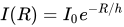
The stars in spirals are distributed in thin disks radial with intensity profiles such that

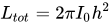
with being the disk scale-length; is the central value; it is useful to define: as the size of the stellar disk, whose luminosity is

.

The spiral galaxies light profiles, in terms of the coordinate , do not depend on galaxy luminosity.

Spiral nebula

Spiral galaxy, LEDA 2046648, is about one billion light-years away.

Before it was understood that spiral galaxies existed outside of our Milky Way galaxy, they were often referred to as spiral nebulae. The question of whether such objects were separate galaxies independent of the Milky Way, or a type of nebula existing within our own galaxy, was the subject of the Great Debate of 1920, between Heber Curtis of Lick Observatory and Harlow Shapley of Mount Wilson Observatory. Beginning in 1923, Edwin Hubble observed Cepheid variables in several spiral nebulae, including the so-called "Andromeda Nebula", proving that they are, in fact, entire galaxies outside our own. The term spiral nebula has since fallen out of use. Another similar spiral galaxy, well outside of the Milky Way galaxy, is LEDA 2046648, detected by the James Webb Space Telescope at the beginning of 2023, and which is estimated to be about one billion light-years away.

Milky Way

Milky Way Galaxy's spiral arms and barred core – based on WISE data

The Milky Way was once considered an ordinary spiral galaxy. Astronomers first began to suspect that the Milky Way is a barred spiral galaxy in the 1960s. Their suspicions were confirmed by Spitzer Space Telescope observations in 2005, which showed that the Milky Way's central bar is larger than what was previously suspected.

Dense plasma focus

From Wikipedia, the free encyclopedia

A dense plasma focus (DPF) is a type of plasma generating system originally developed as a fusion power device starting in the early 1960s. The system demonstrated scaling laws that suggested it would not be useful in the commercial power role, and since the 1980s it has been used primarily as a fusion teaching system, and as a source of neutrons and X-rays.

The original concept was developed in 1954 by N.V. Filippov, who noticed the effect while working on early pinch machines in the USSR. A major research program on DPF was carried out in the USSR through the late 1950s, and continues to this day. A different version of the same basic concept was independently discovered in the US by J.W. Mather in the early 1960s. This version saw some development in the 1970s, and variations continue to be developed.

The basic design derives from the z-pinch concept. Both the DPF and pinch use large electrical currents run through a gas to cause it to ionize into a plasma and then pinch down on itself to increase the density and temperature of the plasma. The DPF differs largely in form; most devices use two concentric cylinders and form the pinch at the end of the central cylinder. In contrast, z-pinch systems generally use a single cylinder, sometimes a torus, and pinch the plasma into the center.

The plasma focus is similar to the high-intensity plasma gun device (HIPGD) (or just plasma gun), which ejects plasma in the form of a plasmoid, without pinching it. A comprehensive review of the dense plasma focus and its diverse applications has been made by Krishnan in 2012.

Pinch concept

Pinch-based devices are the earliest systems to be seriously developed for fusion research, starting with very small machines built in London in 1948. These normally took one of two forms; linear pinch machines are straight tubes with electrodes at both ends to apply the current into the plasma, whereas toroidal pinch machines are donut-shaped machines with large magnets wrapped around them that supply the current via magnetic induction.

In both types of machines, a large burst of current is applied to a dilute gas inside the tube. This current initially ionizes the gas into a plasma. Once the ionization is complete, which occurs in microseconds, the plasma begins to conduct a current. Due to the Lorentz force, this current creates a magnetic field that causes the plasma to "pinch" itself down into a filament, similar to a lightning bolt. This process increases the density of the plasma very rapidly, causing its temperature to increase.

Early devices quickly demonstrated a problem with the stability of this process. As the current began to flow in the plasma, magnetic effects known as the "sausage" and "kink" appeared that caused the plasma to become unstable and eventually hit the sides of the container. When this occurred, the hot plasma would cause atoms of the metal or glass to spall off and enter the fuel, rapidly cooling the plasma. Unless the plasma could be made stable, this loss process would make fusion impossible.

In the mid-1950s, two possible solutions appeared. In the fast-pinch concept, a linear device would undergo the pinch so quickly that the plasma as a whole would not move, instead only the outermost layer would begin to pinch, creating a shock wave that would continue the process after the current was removed. In the stabilized pinch, new magnetic fields would be added that would mix with the current's field and create a more stable configuration. In testing, neither of these systems worked, and the pinch route to fusion was largely abandoned by the early 1960s.

DPF concept

During experiments on a linear pinch machine, Filippov noticed that certain arrangements of the electrodes and tube would cause the plasma to form into new shapes. This led to the DPF concept.

In a typical DPF machine, there are two cylindrical electrodes. The inner one, often solid, is physically separated from the outer by an insulating disk at one end of the device. It is left open at the other end. The end result is something like a coffee mug with a half hot dog standing on its end in the middle of the mug.

When current is applied, it begins to arc at the path of least resistance, at the end near the insulator disk. This causes the gas in the area to rapidly ionize, and current begins to flow through it to the outer electrode. The current creates a magnetic field that begins to push the plasma down the tube towards the open end. It reaches the end in microseconds.

When it reaches the end, it continues moving for a short time, but the endpoints of the current sheet remain attached to the end of the cylinders. This causes the plasma sheet to bow out into a shape not unlike an umbrella or the cap of a mushroom.

At this point further movement stops, and the continuing current instead begins to pinch the section near the central electrode. Eventually this causes the former ring-shaped area to compress down into a vertical post extending off the end of the inner electrode. In this area the density is greatly increased.

The whole process proceeds at many times the speed of sound in the ambient gas. As the current sheath continues to move axially, the portion in contact with the anode slides across the face of the anode, axisymmetrically. When the imploding front of the shock wave coalesces onto the axis, a reflected shock front emanates from the axis until it meets the driving current sheath which then forms the axisymmetric boundary of the pinched, or focused, hot plasma column.

The dense plasma column (akin to the Z-pinch) rapidly pinches and undergoes instabilities and breaks up. The intense electromagnetic radiation and particle bursts, collectively referred to as multi-radiation occur during the dense plasma and breakup phases. These critical phases last typically tens of nanoseconds for a small (kJ, 100 kA) focus machine to around a microsecond for a large (MJ, several MA) focus machine.

The process, including axial and radial phases, may last, for the Mather DPF machine, a few microseconds (for a small focus) to 10 microseconds for a larger focus machine. A Filippov focus machine has a very short axial phase compared to a Mather focus.

Applications

When operated using deuterium, intense bursts of X-rays and charged particles are emitted, as are nuclear fusion byproducts including neutrons. There is ongoing research that demonstrates potential applications as a soft X-ray source for next-generation microelectronics lithography, surface micromachining, pulsed X-ray and neutron source for medical and security inspection applications and materials modification, among others.

For nuclear weapons applications, dense plasma focus devices can be used as an external neutron source. Other applications include simulation of nuclear explosions (for testing of the electronic equipment) and a short and intense neutron source useful for non-contact discovery or inspection of nuclear materials (uranium, plutonium).

Characteristics

An important characteristic of the dense plasma focus is that the energy density of the focused plasma is practically a constant over the whole range of machines, from sub-kilojoule machines to megajoule machines, when these machines are tuned for optimal operation. This means that a small table-top-sized plasma focus machine produces essentially the same plasma characteristics (temperature and density) as the largest plasma focus. Of course the larger machine will produce the larger volume of focused plasma with a corresponding longer lifetime and more radiation yield.

Even the smallest plasma focus has essentially the same dynamic characteristics as larger machines, producing the same plasma characteristics and the same radiation products. This is due to the scalability of plasma phenomena.

See also plasmoid, the self-contained magnetic plasma ball that may be produced by a dense plasma focus.

Design parameters

The fact that the plasma energy density is constant throughout the range of plasma focus devices, from big to small, is related to the value of a design parameter that needs to be kept at a certain value if the plasma focus is to operate efficiently.

The critical 'speed' design parameter for neutron-producing devices is , where is the current, is the anode radius, and is the gas density or pressure.

For example, for neutron-optimised operation in deuterium the value of this critical parameter, experimentally observed over a range of machines from kilojoules to hundreds of kilojoules, is: 9 kA/(mm·Torr0.5), or 780 kA/(m·Pa0.5), with a remarkably small deviation of 10% over such a large range of sizes of machines.

Thus if we have a peak current of 180 kA we require an anode radius of 10 mm with a deuterium fill pressure of 4 Torr (530 Pa). The length of the anode has then to be matched to the risetime of the capacitor current in order to allow an average axial transit speed of the current sheath of just over 50 mm/μs. Thus a capacitor risetime of 3 μs requires a matched anode length of 160 mm.

The above example of peak current of 180 kA rising in 3 μs, anode radius and length of respectively 10 and 160 mm are close to the design parameters of the UNU/ICTP PFF (United Nations University/International Centre for Theoretical Physics Plasma Fusion Facility). This small table-top device was designed as a low-cost integrated experimental system for training and transfer to initiate/strengthen experimental plasma research in developing countries.

It can be noted that the square of the drive parameter is a measure of the "plasma energy density".

On the other hand, another proposed, so called "energy density parameter" , where E is the energy stored in the capacitor bank and a is the anode radius, for neutron-optimised operation in deuterium the value of this critical parameter, experimentally observed over a range of machines from tens of joules to hundreds of kilojoules, is in the order of J/m3. For example, for a capacitor bank of 3kJ, the anode radius is in the order of 12mm. This parameter has a range of 3.6x10^9 to 7.6x10^11 for the machines surveyed by Soto. The wide range of this parameter is because it is a "storage energy density" which translates into plasma energy density with different efficiency depending on the widely differing performance of different machines. Thus to result in the necessary plasma energy density (which is found to be a near constant for optimized neutron production) requires widely differing initial storage density.

Current research

A network of ten identical DPF machines operates in eight countries around the world. This network produces research papers on topics including machine optimization & diagnostics (soft x-rays, neutrons, electron and ion beams), applications (microlithography, micromachining, materials modification and fabrication, imaging & medical, astrophysical simulation) as well as modeling & computation. The network was organized by Sing Lee in 1986 and is coordinated by the Asian African Association for Plasma Training, AAAPT. A simulation package, the Lee Model, has been developed for this network but is applicable to all plasma focus devices. The code typically produces excellent agreement between computed and measured results, and is available for downloading as a Universal Plasma Focus Laboratory Facility. The Institute for Plasma Focus Studies IPFS was founded on 25 February 2008 to promote correct and innovative use of the Lee Model code and to encourage the application of plasma focus numerical experiments. IPFS research has already extended numerically-derived neutron scaling laws to multi-megajoule experiments. These await verification. Numerical experiments with the code have also resulted in the compilation of a global scaling law indicating that the well-known neutron saturation effect is better correlated to a scaling deterioration mechanism. This is due to the increasing dominance of the axial phase dynamic resistance as capacitor bank impedance decreases with increasing bank energy (capacitance). In principle, the resistive saturation could be overcome by operating the pulse power system at a higher voltage.

The International Centre for Dense Magnetised Plasmas (ICDMP) in Warsaw Poland, operates several plasma focus machines for an international research and training programme. Among these machines is one with energy capacity of 1 MJ making it one of the largest plasma focus devices in the world.

In Argentina there is an Inter-institutional Program for Plasma Focus Research since 1996, coordinated by a National Laboratory of Dense Magnetized Plasmas (www.pladema.net) in Tandil, Buenos Aires. The Program also cooperates with the Chilean Nuclear Energy Commission, and networks the Argentine National Energy Commission, the Scientific Council of Buenos Aires, the University of Center, the University of Mar del Plata, The University of Rosario, and the Institute of Plasma Physics of the University of Buenos Aires. The program operates six Plasma Focus Devices, developing applications, in particular ultra-short tomography and substance detection by neutron pulsed interrogation. PLADEMA also contributed during the last decade with several mathematical models of Plasma Focus. The thermodynamic model was able to develop for the first time design maps combining geometrical and operational parameters, showing that there is always an optimum gun length and charging pressure which maximize the neutron emission. Currently there is a complete finite-elements code validated against numerous experiments, which can be used confidently as a design tool for Plasma Focus.

In Chile, at the Chilean Nuclear Energy Commission the plasma focus experiments have been extended to sub-kilojoules devices and the scales rules have been stretched up to region less than one joule. Their studies have contributes to know that is possible to scale the plasma focus in a wide range of energies and sizes keeping the same value of ion density, magnetic field, plasma sheath velocity, Alfvén speed and the quantity of energy per particle. Therefore, fusion reactions are even possible to be obtained in ultraminiature devices (driven by generators of 0.1J for example), as they are in the bigger devices (driven by generators of 1MJ). However, the stability of the plasma pinch highly depends on the size and energy of the device. A rich plasma phenomenology it has been observed in the table-top plasma focus devices developed at the Chilean Nuclear Energy Commission: filamentary structures, toroidal singularities, plasma bursts and plasma jets generations. In addition, possible applications are explored using these kind of small plasma devices: development of portable generator as non-radioactive sources of neutrons and x-rays for field applications, pulsed radiation applied to biological studies, plasma focus as neutron source for nuclear fusion-fission hybrid reactors, and the use of plasma focus devices as plasma accelerators for studies of materials under intense fusion-relevant pulses. In addition, Chilean Nuclear Energy Commission currently operates the facility SPEED-2, the largest Plasma Focus facility of the southern hemisphere.

Since the beginning of 2009, a number of new plasma focus machines have been/are being commissioned including the INTI Plasma Focus in Malaysia, the NX3 in Singapore, the first plasma focus to be commissioned in a US university in recent times, the KSU Plasma Focus at Kansas State University which recorded its first fusion neutron emitting pinch on New Year's Eve 2009 and the IR-MPF-100 plasma focus (115kJ) in Iran.

Fusion power

Several groups proposed that fusion power based on the DPF could be economically viable, possibly even with low-neutron fuel cycles like p-B11. The feasibility of net power from p-B11 in the DPF requires that the bremsstrahlung losses be reduced by quantum mechanical effects induced by an extremely strong magnetic field "frozen into the plasma". The high magnetic field also results in a high rate of emission of cyclotron radiation, but at the densities envisioned, where the plasma frequency is larger than the cyclotron frequency, most of this power will be reabsorbed before being lost from the plasma. Another advantage claimed is the capability of direct conversion of the energy of the fusion products into electricity, with an efficiency potentially above 70%.

Lawrenceville Plasma Physics

Experiments and computer simulations to investigate the capability of DPF for fusion power are underway at Lawrenceville Plasma Physics (LPP) under the direction of Eric Lerner, who explained his "Focus Fusion" approach in a 2007 Google Tech Talk. On November 14, 2008, Lerner received funding for continued research, to test the scientific feasibility of Focus Fusion.

On October 15, 2009, the DPF device "Focus Fusion-1" achieved its first pinch. On January 28, 2011, LPP published initial results including experimental shots with considerably higher fusion yields than the historical DPF trend. In March, 2012, the company announced that it had achieved temperatures of 1.8 billion degrees, beating the old record of 1.1 billion that had survived since 1978. In 2016 the company announced that it had achieved a fusion yield of 0.25 joules. In 2017 the company reduced impurities by mass by 3x and ion numbers by 10x. Fusion yield increased by 50%. Fusion yield doubled compared to other plasma focus devices with the same 60 kJ energy input. In addition, mean ion energy increased to a record of 240 ± 20 keV for any confined fusion plasma. A deuterium-nitrogen mix and corona-discharge pre-ionization reduced the fusion yield standard deviation by 4x to about 15%.

In 2019, the team conducted a series of experiments replacing tungsten electrodes with beryllium electrodes (termed Focus Fusion 2B). After 44 shots, the electrode formed a much thinner 10 nm oxide layer with correspondingly fewer impurities and less electrode erosion than with tungsten electrodes. Fusion yield reached 0.1 joule. Yield generally increased and impurities decreased with an increasing number of shots.

Youngest Toba eruption

From Wikipedia, the free encyclopedia https://en.wikipedia.org/wiki/Youngest_Toba_eruption   ...