From Wikipedia, the free encyclopedia
In astronomy, the main sequence is a continuous and distinctive band of stars that appears on plots of stellar color versus brightness. These color-magnitude plots are known as Hertzsprung–Russell diagrams after their co-developers, Ejnar Hertzsprung and Henry Norris Russell. Stars on this band are known as main-sequence stars or dwarf stars. These are the most numerous true stars in the universe and include the Sun.
After condensation and ignition of a star, it generates thermal energy in its dense core region through nuclear fusion of hydrogen into helium.
During this stage of the star's lifetime, it is located on the main
sequence at a position determined primarily by its mass but also based
on its chemical composition and age. The cores of main-sequence stars
are in hydrostatic equilibrium, where outward thermal pressure from the hot core is balanced by the inward pressure of gravitational collapse
from the overlying layers. The strong dependence of the rate of energy
generation on temperature and pressure helps to sustain this balance.
Energy generated at the core makes its way to the surface and is
radiated away at the photosphere. The energy is carried by either radiation or convection, with the latter occurring in regions with steeper temperature gradients, higher opacity, or both.
The main sequence is sometimes divided into upper and lower
parts, based on the dominant process that a star uses to generate
energy. The Sun, along with main sequence stars below about 1.5 times
the mass of the Sun (1.5 M☉), primarily fuse hydrogen atoms together in a series of stages to form helium, a sequence called the proton–proton chain. Above this mass, in the upper main sequence, the nuclear fusion process mainly uses atoms of carbon, nitrogen, and oxygen as intermediaries in the CNO cycle
that produces helium from hydrogen atoms. Main-sequence stars with more
than two solar masses undergo convection in their core regions, which
acts to stir up the newly created helium and maintain the proportion of
fuel needed for fusion to occur. Below this mass, stars have cores that
are entirely radiative with convective zones near the surface. With
decreasing stellar mass, the proportion of the star forming a convective
envelope steadily increases. Main-sequence stars below 0.4 M☉
undergo convection throughout their mass. When core convection does not
occur, a helium-rich core develops surrounded by an outer layer of
hydrogen.
The more massive a star is, the shorter its lifespan on the main
sequence. After the hydrogen fuel at the core has been consumed, the
star evolves away from the main sequence on the HR diagram, into a supergiant, red giant, or directly to a white dwarf.
History
In the early part of the 20th century, information about the types and distances of stars became more readily available. The spectra of stars were shown to have distinctive features, which allowed them to be categorized. Annie Jump Cannon and Edward C. Pickering at Harvard College Observatory developed a method of categorization that became known as the Harvard Classification Scheme, published in the Harvard Annals in 1901.
In Potsdam in 1906, the Danish astronomer Ejnar Hertzsprung
noticed that the reddest stars—classified as K and M in the Harvard
scheme—could be divided into two distinct groups. These stars are either
much brighter than the Sun or much fainter. To distinguish these
groups, he called them "giant" and "dwarf" stars. The following year he
began studying star clusters;
large groupings of stars that are co-located at approximately the same
distance. For these stars, he published the first plots of color versus luminosity. These plots showed a prominent and continuous sequence of stars, which he named the Main Sequence.
At Princeton University, Henry Norris Russell
was following a similar course of research. He was studying the
relationship between the spectral classification of stars and their
actual brightness as corrected for distance—their absolute magnitude. For this purpose, he used a set of stars that had reliable parallaxes
and many of which had been categorized at Harvard. When he plotted the
spectral types of these stars against their absolute magnitude, he found
that dwarf stars followed a distinct relationship. This allowed the
real brightness of a dwarf star to be predicted with reasonable
accuracy.
Of the red stars observed by Hertzsprung, the dwarf stars also
followed the spectra-luminosity relationship discovered by Russell.
However, giant stars are much brighter than dwarfs and so do not follow
the same relationship. Russell proposed that "giant stars must have low
density or great surface brightness, and the reverse is true of dwarf
stars". The same curve also showed that there were very few faint white
stars.
In 1933, Bengt Strömgren introduced the term Hertzsprung–Russell diagram to denote a luminosity-spectral class diagram. This name reflected the parallel development of this technique by both Hertzsprung and Russell earlier in the century.
As evolutionary models of stars were developed during the 1930s,
it was shown that, for stars of uniform chemical composition, a
relationship exists between a star's mass and its luminosity and radius.
That is, for a given mass and composition, there is a unique solution
for determining the star's radius and luminosity. This became known as
the Vogt–Russell theorem; named after Heinrich Vogt
and Henry Norris Russell. By this theorem, when a star's chemical
composition and its position on the main sequence are known, so too are
the star's mass and radius. (However, it was subsequently discovered
that the theorem breaks down somewhat for stars of the non-uniform
composition.)
A refined scheme for stellar classification was published in 1943 by William Wilson Morgan and Philip Childs Keenan.
The MK classification assigned each star a spectral type—based on the
Harvard classification—and a luminosity class. The Harvard
classification had been developed by assigning a different letter to
each star based on the strength of the hydrogen spectral line before the
relationship between spectra and temperature was known. When ordered
by temperature and when duplicate classes were removed, the spectral types
of stars followed, in order of decreasing temperature with colors
ranging from blue to red, the sequence O, B, A, F, G, K, and M. (A
popular mnemonic
for memorizing this sequence of stellar classes is "Oh Be A Fine
Girl/Guy, Kiss Me".) The luminosity class ranged from I to V, in order
of decreasing luminosity. Stars of luminosity class V belonged to the
main sequence.
In April 2018, astronomers reported the detection of the most distant "ordinary" (i.e., main sequence) star, named Icarus (formally, MACS J1149 Lensed Star 1), at 9 billion light-years away from Earth.
Formation and evolution
Hot and brilliant
O-type main-sequence stars
in star-forming regions. These are all regions of star formation that
contain many hot young stars including several bright stars of spectral
type O.
When a protostar is formed from the collapse of a giant molecular cloud of gas and dust in the local interstellar medium,
the initial composition is homogeneous throughout, consisting of about
70% hydrogen, 28% helium, and trace amounts of other elements, by mass.
The initial mass of the star depends on the local conditions within the
cloud. (The mass distribution of newly formed stars is described
empirically by the initial mass function.) During the initial collapse, this pre-main-sequence star
generates energy through gravitational contraction. Once sufficiently
dense, stars begin converting hydrogen into helium and giving off energy
through an exothermic nuclear fusion process.
When nuclear fusion of hydrogen becomes the dominant energy
production process and the excess energy gained from gravitational
contraction has been lost, the star lies along a curve on the Hertzsprung–Russell diagram
(or HR diagram) called the standard main sequence. Astronomers will
sometimes refer to this stage as "zero-age main sequence", or ZAMS.
The ZAMS curve can be calculated using computer models of stellar
properties at the point when stars begin hydrogen fusion. From this
point, the brightness and surface temperature of stars typically
increase with age.
A star remains near its initial position on the main sequence
until a significant amount of hydrogen in the core has been consumed,
then begins to evolve into a more luminous star. (On the HR diagram, the
evolving star moves up and to the right of the main sequence.) Thus the
main sequence represents the primary hydrogen-burning stage of a star's
lifetime.
Properties
The majority of stars on a typical HR diagram lie along the main-sequence curve. This line is pronounced because both the spectral type and the luminosity depends only on a star's mass, at least to zeroth-order approximation, as long as it is fusing hydrogen at its core—and that is what almost all stars spend most of their "active" lives doing.
The temperature of a star determines its spectral type via its effect on the physical properties of plasma in its photosphere.
A star's energy emission as a function of wavelength is influenced by
both its temperature and composition. A key indicator of this energy
distribution is given by the color index, B − V, which measures the star's magnitude in blue (B) and green-yellow (V) light by means of filters. This difference in magnitude provides a measure of a star's temperature.
Dwarf terminology
Main-sequence stars are called dwarf stars, but this terminology is partly historical and can be somewhat confusing. For the cooler stars, dwarfs such as red dwarfs, orange dwarfs, and yellow dwarfs
are indeed much smaller and dimmer than other stars of those colors.
However, for hotter blue and white stars, the difference in size and
brightness between so-called "dwarf" stars that are on the main sequence
and so-called "giant" stars that are not, becomes smaller. For the
hottest stars the difference is not directly observable and for these
stars, the terms "dwarf" and "giant" refer to differences in spectral lines
which indicate whether a star is on or off the main sequence.
Nevertheless, very hot main-sequence stars are still sometimes called
dwarfs, even though they have roughly the same size and brightness as
the "giant" stars of that temperature.
The common use of "dwarf" to mean the main sequence is confusing
in another way because there are dwarf stars that are not main-sequence
stars. For example, a white dwarf
is the dead core left over after a star has shed its outer layers, and
is much smaller than a main-sequence star, roughly the size of Earth. These represent the final evolutionary stage of many main-sequence stars.
Parameters
Comparison of main sequence stars of each spectral class
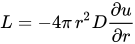
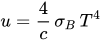
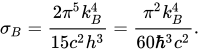
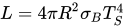
By treating the star as an idealized energy radiator known as a black body, the luminosity L and radius R can be related to the effective temperature Teff by the Stefan–Boltzmann law:
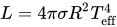
where σ is the Stefan–Boltzmann constant.
As the position of a star on the HR diagram shows its approximate
luminosity, this relation can be used to estimate its radius.
The mass, radius, and luminosity of a star are closely
interlinked, and their respective values can be approximated by three
relations. First is the Stefan–Boltzmann law, which relates the
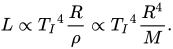
luminosity L, the radius R and the surface temperature Teff. Second is the mass–luminosity relation, which relates the luminosity L and the mass M. Finally, the relationship between M and R is close to linear. The ratio of M to R increases by a factor of only three over 2.5 orders of magnitude of M. This relation is roughly proportional to the star's inner temperature TI,
and its extremely slow increase reflects the fact that the rate of
energy generation in the core strongly depends on this temperature,
whereas it has to fit the mass-luminosity relation. Thus, a too-high or
too-low temperature will result in stellar instability.
A better approximation is to take ε = L/M, the energy generation rate per unit mass, as ε is proportional to TI15, where TI is the core temperature. This is suitable for stars at least as massive as the Sun, exhibiting the CNO cycle, and gives the better fit R ∝ M0.78.
Sample parameters
The table below shows typical values for stars along the main sequence. The values of luminosity (L), radius (R), and mass (M)
are relative to the Sun—a dwarf star with a spectral classification of
G2 V. The actual values for a star may vary by as much as 20–30% from
the values listed below.
Table of main-sequence stellar parameters
Stellar
class
|
Radius,
R/R☉
|
Mass,
M/M☉
|
Luminosity,
L/L☉
|
Temp.
(K)
|
Examples
|
| O2 |
12 |
100 |
800,000 |
50,000
|
BI 253
|
| O6 |
9.8 |
35 |
180,000 |
38,000
|
Theta1 Orionis C
|
| B0 |
7.4 |
18 |
20,000 |
30,000
|
Phi1 Orionis
|
| B5 |
3.8 |
6.5 |
800 |
16,400
|
Pi Andromedae A
|
| A0 |
2.5 |
3.2 |
80 |
10,800
|
Alpha Coronae Borealis A
|
| A5 |
1.7 |
2.1 |
20 |
8,620
|
Beta Pictoris
|
| F0 |
1.3 |
1.7 |
6 |
7,240
|
Gamma Virginis
|
| F5 |
1.2 |
1.3 |
2.5 |
6,540
|
Eta Arietis
|
| G0 |
1.05 |
1.10 |
1.26 |
5,920
|
Beta Comae Berenices
|
| G2
|
1
|
1
|
1
|
5,780
|
Sun
|
| G5 |
0.93 |
0.93 |
0.79 |
5,610
|
Alpha Mensae
|
| K0 |
0.85 |
0.78 |
0.40 |
5,240
|
70 Ophiuchi A
|
| K5 |
0.74 |
0.69 |
0.16 |
4,410
|
61 Cygni A
|
| M0 |
0.51 |
0.60 |
0.072 |
3,800
|
Lacaille 8760
|
| M5 |
0.18 |
0.15 |
0.0027 |
3,120
|
EZ Aquarii A
|
| M8 |
0.11 |
0.08 |
0.0004 |
2,650
|
Van Biesbroeck's star
|
| L1 |
0.09 |
0.07 |
0.00017 |
2,200
|
2MASS J0523−1403
|
Energy generation
Logarithm of the relative energy output (ε) of
proton–proton (PP),
CNO and
triple-α
fusion processes at different temperatures (T). The dashed line shows
the combined energy generation of the PP and CNO processes within a
star. At the Sun's core temperature, the PP process is more efficient.
All main-sequence stars have a core region where energy is generated
by nuclear fusion. The temperature and density of this core are at the
levels necessary to sustain the energy production that will support the
remainder of the star. A reduction of energy production would cause the
overlaying mass to compress the core, resulting in an increase in the
fusion rate because of higher temperature and pressure. Likewise, an
increase in energy production would cause the star to expand, lowering
the pressure at the core. Thus the star forms a self-regulating system
in hydrostatic equilibrium that is stable over the course of its main-sequence lifetime.
Main-sequence stars employ two types of hydrogen fusion
processes, and the rate of energy generation from each type depends on
the temperature in the core region. Astronomers divide the main sequence
into upper and lower parts, based on which of the two is the dominant
fusion process. In the lower main sequence, energy is primarily
generated as the result of the proton–proton chain, which directly fuses hydrogen together in a series of stages to produce helium. Stars in the upper main sequence have sufficiently high core temperatures to efficiently use the CNO cycle (see chart). This process uses atoms of carbon, nitrogen, and oxygen as intermediaries in the process of fusing hydrogen into helium.
At a stellar core temperature of 18 million Kelvin,
the PP process and CNO cycle are equally efficient, and each type
generates half of the star's net luminosity. As this is the core
temperature of a star with about 1.5 M☉, the upper
main sequence consists of stars above this mass. Thus, roughly
speaking, stars of spectral class F or cooler belong to the lower main
sequence, while A-type stars or hotter are upper main-sequence stars.
The transition in primary energy production from one form to the other
spans a range difference of less than a single solar mass. In the Sun, a
one solar-mass star, only 1.5% of the energy is generated by the CNO
cycle. By contrast, stars with 1.8 M☉ or above generate almost their entire energy output through the CNO cycle.
The observed upper limit for a main-sequence star is 120–200 M☉.
The theoretical explanation for this limit is that stars above this
mass can not radiate energy fast enough to remain stable, so any
additional mass will be ejected in a series of pulsations until the star
reaches a stable limit. The lower limit for sustained proton-proton nuclear fusion is about 0.08 M☉ or 80 times the mass of Jupiter. Below this threshold are sub-stellar objects that can not sustain hydrogen fusion, known as brown dwarfs.
Structure
This diagram shows a cross-section of a Sun-like star, showing the internal structure.
Because there is a temperature difference between the core and the surface, or photosphere, energy is transported outward. The two modes for transporting this energy are radiation and convection. A radiation zone,
where energy is transported by radiation, is stable against convection
and there is very little mixing of the plasma. By contrast, in a convection zone
the energy is transported by bulk movement of plasma, with hotter
material rising and cooler material descending. Convection is a more
efficient mode for carrying energy than radiation, but it will only
occur under conditions that create a steep temperature gradient.
In massive stars (above 10 M☉)
the rate of energy generation by the CNO cycle is very sensitive to
temperature, so the fusion is highly concentrated at the core.
Consequently, there is a high temperature gradient in the core region,
which results in a convection zone for more efficient energy transport.
This mixing of material around the core removes the helium ash from the
hydrogen-burning region, allowing more of the hydrogen in the star to
be consumed during the main-sequence lifetime. The outer regions of a
massive star transport energy by radiation, with little or no
convection.
Intermediate-mass stars such as Sirius may transport energy primarily by radiation, with a small core convection region.
Medium-sized, low-mass stars like the Sun have a core region that is
stable against convection, with a convection zone near the surface that
mixes the outer layers. This results in a steady buildup of a
helium-rich core, surrounded by a hydrogen-rich outer region. By
contrast, cool, very low-mass stars (below 0.4 M☉) are convective throughout.
Thus the helium produced at the core is distributed across the star,
producing a relatively uniform atmosphere and a proportionately longer
main-sequence lifespan.
Luminosity-color variation
The
Sun is the most familiar example of a main-sequence star
As non-fusing helium ash accumulates in the core of a main-sequence
star, the reduction in the abundance of hydrogen per unit mass results
in a gradual lowering of the fusion rate within that mass. Since it is
the outflow of fusion-supplied energy that supports the higher layers of
the star, the core is compressed, producing higher temperatures and
pressures. Both factors increase the rate of fusion thus moving the
equilibrium towards a smaller, denser, hotter core producing more energy
whose increased outflow pushes the higher layers further out. Thus
there is a steady increase in the luminosity and radius of the star over
time. For example, the luminosity of the early Sun was only about 70% of its current value.
As a star ages this luminosity increase changes its position on the HR
diagram. This effect results in a broadening of the main sequence band
because stars are observed at random stages in their lifetime. That is,
the main sequence band develops a thickness on the HR diagram; it is not
simply a narrow line.
Other factors that broaden the main sequence band on the HR
diagram include uncertainty in the distance to stars and the presence of
unresolved binary stars
that can alter the observed stellar parameters. However, even perfect
observation would show a fuzzy main sequence because mass is not the
only parameter that affects a star's color and luminosity. Variations in
chemical composition caused by the initial abundances, the star's evolutionary status, interaction with a close companion, rapid rotation, or a magnetic field can all slightly change a main-sequence star's HR diagram position, to name just a few factors. As an example, there are metal-poor stars
(with a very low abundance of elements with higher atomic numbers than
helium) that lie just below the main sequence and are known as subdwarfs.
These stars are fusing hydrogen in their cores and so they mark the
lower edge of the main sequence fuzziness caused by variance in chemical
composition.
A nearly vertical region of the HR diagram, known as the instability strip, is occupied by pulsating variable stars known as Cepheid variables.
These stars vary in magnitude at regular intervals, giving them a
pulsating appearance. The strip intersects the upper part of the main
sequence in the region of class A and F stars, which are
between one and two solar masses. Pulsating stars in this part of the
instability strip intersecting the upper part of the main sequence are
called Delta Scuti variables. Main-sequence stars in this region experience only small changes in magnitude, so this variation is difficult to detect. Other classes of unstable main-sequence stars, like Beta Cephei variables, are unrelated to this instability strip.
Lifetime
This
plot gives an example of the mass-luminosity relationship for zero-age
main-sequence stars. The mass and luminosity are relative to the
present-day Sun.
The total amount of energy that a star can generate through nuclear
fusion of hydrogen is limited by the amount of hydrogen fuel that can be
consumed at the core. For a star in equilibrium, the thermal energy
generated at the core must be at least equal to the energy radiated at
the surface. Since the luminosity gives the amount of energy radiated
per unit time, the total life span can be estimated, to first approximation, as the total energy produced divided by the star's luminosity.
For a star with at least 0.5 M☉, when the hydrogen supply in its core is exhausted and it expands to become a red giant, it can start to fuse helium atoms to form carbon.
The energy output of the helium fusion process per unit mass is only
about a tenth the energy output of the hydrogen process, and the
luminosity of the star increases.
This results in a much shorter length of time in this stage compared to
the main-sequence lifetime. (For example, the Sun is predicted to spend
130 million years burning helium, compared to about 12 billion years burning hydrogen.) Thus, about 90% of the observed stars above 0.5 M☉ will be on the main sequence. On average, main-sequence stars are known to follow an empirical mass–luminosity relationship. The luminosity (L) of the star is roughly proportional to the total mass (M) as the following power law:

This relationship applies to main-sequence stars in the range 0.1–50 M☉.
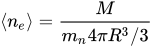
The amount of fuel available for nuclear fusion is proportional
to the mass of the star. Thus, the lifetime of a star on the main
sequence can be estimated by comparing it to solar evolutionary models.
The Sun has been a main-sequence star for about 4.5 billion years and it will become a red giant in 6.5 billion years, for a total main-sequence lifetime of roughly 1010 years. Hence:
![{\displaystyle \tau _{\text{MS}}\approx 10^{10}{\text{years}}\left[{\frac {M}{M_{\bigodot }}}\right]\left[{\frac {L_{\bigodot }}{L}}\right]=10^{10}{\text{years}}\left[{\frac {M}{M_{\bigodot }}}\right]^{-2.5}}](https://wikimedia.org/api/rest_v1/media/math/render/svg/3712d23010eb29f6e900c55e7101048e76a4651d)
where M and L are the mass and luminosity of the star, respectively,  is a solar mass,
  is the solar luminosity and
  is the star's estimated main-sequence lifetime.
Although more massive stars have more fuel to burn and might
intuitively be expected to last longer, they also radiate a
proportionately greater amount with increased mass. This is required by
the stellar equation of state; for a massive star to maintain
equilibrium, the outward pressure of radiated energy generated in the
core not only must but will rise to match the titanic inward
gravitational pressure of its envelope. Thus, the most massive stars
may remain on the main sequence for only a few million years, while
stars with less than a tenth of a solar mass may last for over a
trillion years.
The exact mass-luminosity relationship depends on how efficiently
energy can be transported from the core to the surface. A higher opacity
has an insulating effect that retains more energy at the core, so the
star does not need to produce as much energy to remain in hydrostatic equilibrium. By contrast, a lower opacity means energy escapes more rapidly and the star must burn more fuel to remain in equilibrium. A sufficiently high opacity can result in energy transport via convection, which changes the conditions needed to remain in equilibrium.
In high-mass main-sequence stars, the opacity is dominated by electron scattering, which is nearly constant with increasing temperature. Thus the luminosity only increases as the cube of the star's mass. For stars below 10 M☉,
the opacity becomes dependent on temperature, resulting in the
luminosity varying approximately as the fourth power of the star's mass. For very low-mass stars, molecules in the atmosphere also contribute to the opacity. Below about 0.5 M☉,
the luminosity of the star varies as the mass to the power of 2.3,
producing a flattening of the slope on a graph of mass versus
luminosity. Even these refinements are only an approximation, however,
and the mass-luminosity relation can vary depending on a star's
composition.
Evolutionary tracks
Evolutionary track of a star like the sun
When a main-sequence star has consumed the hydrogen at its core, the
loss of energy generation causes its gravitational collapse to resume
and the star evolves off the main sequence. The path which the star
follows across the HR diagram is called an evolutionary track.
H–R diagram for two open clusters:
NGC 188 (blue) is older and shows a lower turn off from the main sequence than
M67 (yellow). The dots outside the two sequences are mostly foreground and background stars with no relation to the clusters.
Stars with less than 0.23 M☉ are predicted to directly become white dwarfs
when energy generation by nuclear fusion of hydrogen at their core
comes to a halt, but stars in this mass range have main-sequence
lifetimes longer than the current age of the universe, so no stars are
old enough for this to have occurred.
In stars more massive than 0.23 M☉, the
hydrogen surrounding the helium core reaches sufficient temperature and
pressure to undergo fusion, forming a hydrogen-burning shell and causing
the outer layers of the star to expand and cool. The stage as these
stars move away from the main sequence is known as the subgiant branch; it is relatively brief and appears as a gap in the evolutionary track since few stars are observed at that point.
When the helium core of low-mass stars becomes degenerate, or the
outer layers of intermediate-mass stars cool sufficiently to become
opaque, their hydrogen shells increase in temperature and the stars
start to become more luminous. This is known as the red-giant branch;
it is a relatively long-lived stage and it appears prominently in H–R
diagrams. These stars will eventually end their lives as white dwarfs.
The most massive stars do not become red giants; instead, their
cores quickly become hot enough to fuse helium and eventually heavier
elements and they are known as supergiants.
They follow approximately horizontal evolutionary tracks from the main
sequence across the top of the H–R diagram. Supergiants are relatively
rare and do not show prominently on most H–R diagrams. Their cores will
eventually collapse, usually leading to a supernova and leaving behind either a neutron star or black hole.
When a cluster of stars
is formed at about the same time, the main-sequence lifespan of these
stars will depend on their individual masses. The most massive stars
will leave the main sequence first, followed in sequence by stars of
ever lower masses. The position where stars in the cluster are leaving
the main sequence is known as the turnoff point. By knowing the main-sequence lifespan of stars at this point, it becomes possible to estimate the age of the cluster.