Search This Blog

Thursday, December 14, 2023

Buffer solution

From Wikipedia, the free encyclopedia
https://en.wikipedia.org/wiki/Buffer_solution
 
A buffer solution is a solution where the pH does not change significantly even on dilution or even if an acid or base is added at constant temperature. Its pH changes very little when a small amount of strong acid or base is added to it. Buffer solutions are used as a means of keeping pH at a nearly constant value in a wide variety of chemical applications. In nature, there are many living systems that use buffering for pH regulation. For example, the bicarbonate buffering system is used to regulate the pH of blood, and bicarbonate also acts as a buffer in the ocean.

Principles of buffering

Figure 1. Simulated titration of an acidified solution of a weak acid (pKa = 4.7) with alkali

Buffer solutions resist pH change because of a chemical equilibrium between the weak acid HA and its conjugate base A:

HA ⇌ H+ + A

When some strong acid is added to an equilibrium mixture of the weak acid and its conjugate base, hydrogen ions (H+) are added, and the equilibrium is shifted to the left, in accordance with Le Chatelier's principle. Because of this, the hydrogen ion concentration increases by less than the amount expected for the quantity of strong acid added. Similarly, if strong alkali is added to the mixture, the hydrogen ion concentration decreases by less than the amount expected for the quantity of alkali added. In Figure 1, the effect is illustrated by the simulated titration of a weak acid with pKa = 4.7. The relative concentration of undissociated acid is shown in blue, and of its conjugate base in red. The pH changes relatively slowly in the buffer region, pH = pKa ± 1, centered at pH = 4.7, where [HA] = [A]. The hydrogen ion concentration decreases by less than the amount expected because most of the added hydroxide ion is consumed in the reaction

OH + HA → H2O + A

and only a little is consumed in the neutralization reaction (which is the reaction that results in an increase in pH)

OH + H+ → H2O.

Once the acid is more than 95% deprotonated, the pH rises rapidly because most of the added alkali is consumed in the neutralization reaction.

Buffer capacity

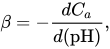
Buffer capacity is a quantitative measure of the resistance to change of pH of a solution containing a buffering agent with respect to a change of acid or alkali concentration. It can be defined as follows:

where is an infinitesimal amount of added base, or
where is an infinitesimal amount of added acid. pH is defined as −log10[H+], and d(pH) is an infinitesimal change in pH.

With either definition the buffer capacity for a weak acid HA with dissociation constant Ka can be expressed as

where [H+] is the concentration of hydrogen ions, and is the total concentration of added acid. Kw is the equilibrium constant for self-ionization of water, equal to 1.0×10⁻¹⁴. Note that in solution H+ exists as the hydronium ion H3O+, and further aquation of the hydronium ion has negligible effect on the dissociation equilibrium, except at very high acid concentration.

Figure 2. Buffer capacity β for a 0.1 M solution of a weak acid with a pKa = 7

This equation shows that there are three regions of raised buffer capacity (see figure 2).

  • In the central region of the curve (coloured green on the plot), the second term is dominant, and
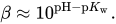
    Buffer capacity rises to a local maximum at pH = pKa. The height of this peak depends on the value of pKa. Buffer capacity is negligible when the concentration [HA] of buffering agent is very small and increases with increasing concentration of the buffering agent. Some authors show only this region in graphs of buffer capacity.
    Buffer capacity falls to 33% of the maximum value at pH = pKa ± 1, to 10% at pH = pKa ± 1.5 and to 1% at pH = pKa ± 2. For this reason the most useful range is approximately pKa ± 1. When choosing a buffer for use at a specific pH, it should have a pKa value as close as possible to that pH.
  • With strongly acidic solutions, pH less than about 2 (coloured red on the plot), the first term in the equation dominates, and buffer capacity rises exponentially with decreasing pH:
    This results from the fact that the second and third terms become negligible at very low pH. This term is independent of the presence or absence of a buffering agent.
  • With strongly alkaline solutions, pH more than about 12 (coloured blue on the plot), the third term in the equation dominates, and buffer capacity rises exponentially with increasing pH:
    This results from the fact that the first and second terms become negligible at very high pH. This term is also independent of the presence or absence of a buffering agent.

Applications of buffers

The pH of a solution containing a buffering agent can only vary within a narrow range, regardless of what else may be present in the solution. In biological systems this is an essential condition for enzymes to function correctly. For example, in human blood a mixture of carbonic acid (H
2
CO
3
) and bicarbonate (HCO
3
) is present in the plasma fraction; this constitutes the major mechanism for maintaining the pH of blood between 7.35 and 7.45. Outside this narrow range (7.40 ± 0.05 pH unit), acidosis and alkalosis metabolic conditions rapidly develop, ultimately leading to death if the correct buffering capacity is not rapidly restored.

If the pH value of a solution rises or falls too much, the effectiveness of an enzyme decreases in a process, known as denaturation, which is usually irreversible. The majority of biological samples that are used in research are kept in a buffer solution, often phosphate buffered saline (PBS) at pH 7.4.

In industry, buffering agents are used in fermentation processes and in setting the correct conditions for dyes used in colouring fabrics. They are also used in chemical analysis and calibration of pH meters.

Simple buffering agents

Buffering agent pKa Useful pH range
Citric acid 3.13, 4.76, 6.40 2.1–7.4
Acetic acid 4.8 3.8–5.8
KH2PO4 7.2 6.2–8.2
CHES 9.3 8.3–10.3
Borate 9.24 8.25–10.25

For buffers in acid regions, the pH may be adjusted to a desired value by adding a strong acid such as hydrochloric acid to the particular buffering agent. For alkaline buffers, a strong base such as sodium hydroxide may be added. Alternatively, a buffer mixture can be made from a mixture of an acid and its conjugate base. For example, an acetate buffer can be made from a mixture of acetic acid and sodium acetate. Similarly, an alkaline buffer can be made from a mixture of the base and its conjugate acid.

"Universal" buffer mixtures

By combining substances with pKa values differing by only two or less and adjusting the pH, a wide range of buffers can be obtained. Citric acid is a useful component of a buffer mixture because it has three pKa values, separated by less than two. The buffer range can be extended by adding other buffering agents. The following mixtures (McIlvaine's buffer solutions) have a buffer range of pH 3 to 8.

0.2 M Na2HPO4 (mL) 0.1 M citric acid (mL) pH
20.55 79.45 3.0
38.55 61.45 4.0
51.50 48.50 5.0
63.15 36.85 6.0
82.35 17.65 7.0
97.25 2.75 8.0

A mixture containing citric acid, monopotassium phosphate, boric acid, and diethyl barbituric acid can be made to cover the pH range 2.6 to 12.

Other universal buffers are the Carmody buffer and the Britton–Robinson buffer, developed in 1931.

Common buffer compounds used in biology

For effective range see Buffer capacity, above. Also see Good's buffers for the historic design principles and favourable properties of these buffer substances in biochemical applications.

Common name (chemical name) Structure pKa,
25 °C
Temp. effect,
dpH/dT (K−1)
Mol.
weight
TAPS,
([tris(hydroxymethyl)methylamino]propanesulfonic acid)
8.43 −0.018 243.3
Bicine,
(2-(bis(2-hydroxyethyl)amino)acetic acid)
8.35 −0.018 163.2
Tris,
(tris(hydroxymethyl)aminomethane, or
2-amino-2-(hydroxymethyl)propane-1,3-diol)
8.07[a] −0.028 121.14
Tricine,
(N-[tris(hydroxymethyl)methyl]glycine)
8.05 −0.021 179.2
TAPSO,
(3-[N-tris(hydroxymethyl)methylamino]-2-hydroxypropanesulfonic acid)
7.635
259.3
HEPES,
(4-(2-hydroxyethyl)-1-piperazineethanesulfonic acid)
7.48 −0.014 238.3
TES,
(2-[[1,3-dihydroxy-2-(hydroxymethyl)propan-2-yl]amino]ethanesulfonic acid)
7.40 −0.020 229.20
MOPS,
(3-(N-morpholino)propanesulfonic acid)
7.20 −0.015 209.3
PIPES,
(piperazine-N,N′-bis(2-ethanesulfonic acid))
6.76 −0.008 302.4
Cacodylate,
(dimethylarsenic acid)
6.27
138.0
MES,
(2-(N-morpholino)ethanesulfonic acid)
6.15 −0.011 195.2

  1. Tris is a base, the pKa = 8.07 refers to its conjugate acid.

Calculating buffer pH

Monoprotic acids

First write down the equilibrium expression

HA ⇌ A + H+

This shows that when the acid dissociates, equal amounts of hydrogen ion and anion are produced. The equilibrium concentrations of these three components can be calculated in an ICE table (ICE standing for "initial, change, equilibrium").

ICE table for a monoprotic acid

[HA] [A] [H+]
I C0 0 y
C x x x
E C0x x x + y

The first row, labelled I, lists the initial conditions: the concentration of acid is C0, initially undissociated, so the concentrations of A and H+ would be zero; y is the initial concentration of added strong acid, such as hydrochloric acid. If strong alkali, such as sodium hydroxide, is added, then y will have a negative sign because alkali removes hydrogen ions from the solution. The second row, labelled C for "change", specifies the changes that occur when the acid dissociates. The acid concentration decreases by an amount −x, and the concentrations of A and H+ both increase by an amount +x. This follows from the equilibrium expression. The third row, labelled E for "equilibrium", adds together the first two rows and shows the concentrations at equilibrium.

To find x, use the formula for the equilibrium constant in terms of concentrations:

Substitute the concentrations with the values found in the last row of the ICE table:
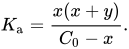
Simplify to

With specific values for C0, Ka and y, this equation can be solved for x. Assuming that pH = −log10[H+], the pH can be calculated as pH = −log10(x + y).

Polyprotic acids

This image plots the relative percentages of the protonation species of citric acid as a function of p H. Citric acid has three ionizable hydrogen atoms and thus three p K A values. Below the lowest p K A, the triply protonated species prevails; between the lowest and middle p K A, the doubly protonated form prevails; between the middle and highest p K A, the singly protonated form prevails; and above the highest p K A, the unprotonated form of citric acid is predominant.
% species formation calculated for a 10-millimolar solution of citric acid

Polyprotic acids are acids that can lose more than one proton. The constant for dissociation of the first proton may be denoted as Ka1, and the constants for dissociation of successive protons as Ka2, etc. Citric acid is an example of a polyprotic acid H3A, as it can lose three protons.

Stepwise dissociation constants
Equilibrium Citric acid
H3A ⇌ H2A + H+ pKa1 = 3.13
H2A ⇌ HA2− + H+ pKa2 = 4.76
HA2− ⇌ A3− + H+ pKa3 = 6.40

When the difference between successive pKa values is less than about 3, there is overlap between the pH range of existence of the species in equilibrium. The smaller the difference, the more the overlap. In the case of citric acid, the overlap is extensive and solutions of citric acid are buffered over the whole range of pH 2.5 to 7.5.

Calculation of the pH with a polyprotic acid requires a speciation calculation to be performed. In the case of citric acid, this entails the solution of the two equations of mass balance:

CA is the analytical concentration of the acid, CH is the analytical concentration of added hydrogen ions, βq are the cumulative association constants. Kw is the constant for self-ionization of water. There are two non-linear simultaneous equations in two unknown quantities [A3−] and [H+]. Many computer programs are available to do this calculation. The speciation diagram for citric acid was produced with the program HySS.

N.B. The numbering of cumulative, overall constants is the reverse of the numbering of the stepwise, dissociation constants.

Relationship between cumulative association constant (β) values and stepwise dissociation constant (K) values for a tribasic acid.
Equilibrium Relationship
A3− + H+ ⇌ AH2+ Log β1= pka3
A3− + 2H+ ⇌ AH2+ Log β2 =pka2 + pka3
A3− + 3H+⇌ AH3 Log β3 = pka1 + pka2 + pka3

Cumulative association constants are used in general-purpose computer programs such as the one used to obtain the speciation diagram above.

Acid–base titration

From Wikipedia, the free encyclopedia

An acid–base titration is a method of quantitative analysis for determining the concentration of Brønsted-Lowry acid or base (titrate) by neutralizing it using a solution of known concentration (titrant). A pH indicator is used to monitor the progress of the acid–base reaction and a titration curve can be constructed.

This differs from other modern modes of titrations, such as oxidation-reduction titrations, precipitation titrations, & complexometric titrations. Although these types of titrations are also used to determine unknown amounts of substances, these substances vary from ions to metals.

Acid-base titration finds extensive applications in various scientific fields, such as pharmaceuticals, environmental monitoring, and quality control in industries. This method's precision and simplicity makes it an important tool in quantitative chemical analysis, contributing significantly to the general understanding of solution chemistry.

History

Svante Arrhenius.

The history of acid-base titration dates back to the late 19th century when advancements in analytical chemistry fostered the development of systematic techniques for quantitative analysis. The origins of titration methods can be linked to the work of chemists such as Karl Friedrich Mohr in the mid-1800s. His contributions laid the groundwork for understanding titrations involving acids and bases.

Theoretical progress came with the research of Swedish chemist Svante Arrhenius, who in the late 19th century, introduced the Arrhenius theory, providing a theoretical framework for acid-base reactions. This theoretical foundation, along with ongoing experimental refinements, contributed to the evolution of acid-base titration as a precise and widely applicable analytical method.

Over time, the method has undergone further refinements and adaptations, establishing itself as an essential tool in laboratories across various scientific disciplines.

Alkalimetry and acidimetry

Alkalimetry and acidimetry are types of volumetric analyses in which the fundamental reaction is a neutralization reaction. They involve the controlled addition of either an acid or a base (titrant) of known concentration to the solution of the unknown concentration (titrate) until the reaction reaches its stoichiometric equivalence point. At this point, the moles of acid and base are equal, resulting in a neutral solution:

Titration of a standard solution using methyl orange indicator. Titrate is in Erlenmeyer flask, titrant is in burette.

acid + base → salt + water

For example:

HCl + NaOH → NaCl + H2O

Acidimetry is the specialized analytical use of acid-base titration to determine the concentration of a basic (alkaline) substance using standard acid. This can be used for weak bases and strong bases. An example of an acidimetric titration involving a strong base is as follows:

Ba(OH)2 + 2 H+ → Ba2+ + 2 H2O

In this case, the strong base (Ba(OH)2) is neutralized by the acid until all of the base has reacted. This allows the viewer to calculate the concentration of the base from the volume of the standard acid that is used.

Alkalimetry follows uses same concept of specialized analytic acid-base titration, but to determine the concentration of an acidic substance using standard base. An example of an alkalimetric titration involving a strong acid is as follows:

H2SO4 + 2 OH → SO42- + 2 H2O

In this case, the strong acid (H2SO4) is neutralized by the base until all of the acid has reacted. This allows the viewer to calculate the concentration of the acid from the volume of the standard base that is used.

The standard solution (titrant) is stored in the burette, while the solution of unknown concentration (analyte/titrate) is placed in the Erlenmeyer flask below it with an indicator.

Indicator choice

A suitable pH indicator must be chosen in order to detect the end point of the titration. The colour change or other effect should occur close to the equivalence point of the reaction so that the experimenter can accurately determine when that point is reached. The pH of the equivalence point can be estimated using the following rules:

  • A strong acid will react with a strong base to form a neutral (pH = 7) solution.
  • A strong acid will react with a weak base to form an acidic (pH < 7) solution.
  • A weak acid will react with a strong base to form a basic (pH > 7) solution.

These indicators are essential tools in chemistry and biology, aiding in the determination of a solution's acidity or alkalinity through the observation of colour transitions. The table below serves as a reference guide for these indicator choices, offering insights into the pH ranges and colour transformations associated with specific indicators:

Titration Indicator Table
Indicator Name Indicator Colour Transition Interval (pH range) Color after High pH Conditions
Methyl Orange Orange/Red 3.1 - 4.4 Yellow
Methyl Red Red 4.4 - 6.3 Yellow
Congo Red Blue 3.0 - 5.2 Red
Phenolphthalein Colourless 8.3 - 10.0 Pink
Thymolphthalein Colourless 9.3 - 10.5 Blue
Bromophenol Blue Yellow 3.0 - 4.6 Blue
Bromocresol Green Yellow 3.8 - 5.6 Blue
Thymol Blue Red 1.2 - 2.8; 8.0 - 9.6 Blue
Cresol Red Yellow 7.2 - 8.8 Violet
Neutral Red Red 6.8 - 8.0 Yellow
Three different points in an acid-base titration using phenolphthalein as the indicator.

Phenolphthalein is widely recognized as one of the most commonly used acid-base indicators in chemistry. Its popularity is because of its effectiveness in a broad pH range and its distinct colour transitions. Its sharp and easily detectable colour changes makes phenolphthalein a valuable tool for determining the endpoint of acid-base titrations, as a precise pH change signifies the completion of the reaction.

When a weak acid reacts with a weak base, the equivalence point solution will be basic if the base is stronger and acidic if the acid is stronger. If both are of equal strength, then the equivalence pH will be neutral. However, weak acids are not often titrated against weak bases because the colour change shown with the indicator is often quick, and therefore very difficult for the observer to see the change of colour.

The point at which the indicator changes colour is called the endpoint. A suitable indicator should be chosen, preferably one that will experience a change in colour (an endpoint) close to the equivalence point of the reaction.

In addition to the wide variety of indicator solutions, pH papers, crafted from paper or plastic infused with combinations of these indicators, serve as a practical alternative. The pH of a solution can be estimated by immersing a strip of pH paper into it and matching the observed colour to the reference standards provided on the container.

Overshot titration

An overshot titration using phenolphthalein indicator.

Overshot titrations are a common phenomenon, and refer to a situation where the volume of titrant added during a chemical titration exceeds the amount required to reach the equivalence point. This excess titrant leads to an outcome where the solution becomes slightly more alkaline or over-acidified.

Overshooting the equivalence point can occur due to various factors, such as errors in burette readings, imperfect reaction stoichiometry, or issues with endpoint detection. The consequences of overshot titrations can affect the accuracy of the analytical results, particularly in quantitative analysis.

Researchers and analysts often employ corrective measures, such as back-titration and using more precise titration techniques, to mitigate the impact of overshooting and obtain reliable and precise measurements. Understanding the causes, consequences, and solutions related to overshot titrations is crucial in achieving accurate and reproducible results in the field of chemistry.

Mathematical analysis: titration of weak acid

Titration of a weak acid with a strong base showing pH level, volume of titrant, and different points throughout the titration process.

For calculating concentrations, ICE tables are required. ICE stands for initial, changes, and equilibrium.

The pH of a weak acid solution being titrated with a strong base solution can be found at different points along the way. These points fall into one of four categories:

  1. initial pH
  2. pH before the equivalence point
  3. pH at the equivalence point
  4. pH after the equivalence point

1. The initial pH is approximated for a weak acid solution in water using the equation:

where is the initial concentration of the hydronium ion.

2. The pH before the equivalence point depends on the amount of weak acid remaining and the amount of conjugate base formed. The pH can be calculated approximately by the Henderson–Hasselbalch equation:[1] where Ka is the acid dissociation constant.

3. The pH at the equivalence point depends on how much the weak acid is consumed to be converted into its conjugate base. Note that when an acid neutralizes a base, the pH may or may not be neutral (pH = 7). The pH depends on the strengths of the acid and base. In the case of a weak acid and strong base titration, the pH is greater than 7 at the equivalence point. Thus pH can be calculated using the following formula: Where is the concentration of the hydroxide ion. The concentration of the hydroxide ion is calculated from the concentration of the hydronium ion and using the following relationship:

Where Kb is the base dissociation constant, Kw is the water dissociation constant.

4. The pH after the equivalence point depends on the concentration of the conjugate base of the weak acid and the strong base of the titrant. However, the base of the titrant is stronger than the conjugate base of the acid. Therefore, the pH in this region is controlled by the strong base. As such the pH can be found using the following:

where is the concentration of the strong base that is added, is the volume of base added until the equilibrium, is the concentration of the strong acid that is added, and is the initial volume of the acid.

Single formula

More accurately, a single formula that describes the titration of a weak acid with a strong base from start to finish is given below:

where " φ = fraction of completion of the titration (φ < 1 is before the equivalence point, φ = 1 is the equivalence point, and φ > 1 is after the equivalence point)

Monoprotic acid titration curve. Highlighted pink region depicts equivalence point.
= the concentrations of the acid and base respectively
= the volumes of the acid and base respectively

Graphical methods

Identifying the pH associated with any stage in the titration process is relatively simple for monoprotic acids and bases. A monoprotic acid is an acid that donates one proton. A monoprotic base is a base that accepts one proton. A monoprotic acid or base only has one equivalence point on a titration curve.

Diprotic acid titration curve. Highlighted pink regions depict equivalence points.

A diprotic acid donates two protons and a diprotic base accepts two protons. The titration curve for a diprotic solution has two equivalence points.

A polyprotic substance has multiple equivalence points.

All titration reactions contain small buffer regions that appear horizontal on the graph. These regions contain comparable concentrations of acid and base, preventing sudden changes in pH when additional acid or base is added.

Pharmaceutical applications

A chemist performing an acid-base titration in lab.

In the pharmaceutical industry, acid-base titration serves as a fundamental analytical technique with diverse applications. One primary use involves the determination of the concentration of Active Pharmaceutical Ingredients (APIs) in drug formulations, ensuring product quality and compliance with regulatory standards.

Acid-base titration is particularly valuable in quantifying acidic or basic functional groups with pharmaceutical compounds. Additionally, the method is employed for the analysis of additives or ingredients, making it easier to adjust and control how a product is made. Quality control laboratories utilize acid-base titration to assess the purity of raw materials and to monitor various stages of drug manufacturing processes.

The technique's reliability and simplicity make it an integral tool in pharmaceutical research and development, contributing to the production of safe and effective medications.

Environmental monitoring applications

Analysis of soil fertility using acid-base titration.

Acid-base titration plays a crucial role in environmental monitoring by providing a quantitative analytical method for assessing the acidity or alkalinity of water samples. The measurement of parameters such as pH, total alkalinity, and acidity is essential in evaluating the environmental impact of industrial discharges, agricultural runoff, and other sources of water contamination.

Acid-base titration allows for the determination of the buffering capacity of natural water systems, aiding in the assessment of their ability to resist changes in pH. Monitoring pH levels is important for preserving aquatic ecosystems and ensuring compliance with environmental regulations.

Acid-base titration is also utilized in the analysis of acid rain effects on soil and water bodies, contributing to the overall understanding and management of environmental quality. The method's prevision and reliability make it a valuable tool in safeguarding ecosystems and assessing the impact of human activities on natural water resources.

Ion


From Wikipedia, the free encyclopedia
https://en.wikipedia.org/wiki/Ion
Electron transfer between lithium (Li) and fluorine (F). Forming an ionic bond, Li and F become Li+ and F ions.

An ion (/ˈ.ɒn, -ən/) is an atom or molecule with a net electrical charge. The charge of an electron is considered to be negative by convention and this charge is equal and opposite to the charge of a proton, which is considered to be positive by convention. The net charge of an ion is not zero because its total number of electrons is unequal to its total number of protons.

A cation is a positively charged ion with fewer electrons than protons while an anion is a negatively charged ion with more electrons than protons. Opposite electric charges are pulled towards one another by electrostatic force, so cations and anions attract each other and readily form ionic compounds.

Ions consisting of only a single atom are termed atomic or monatomic ions, while two or more atoms form molecular ions or polyatomic ions. In the case of physical ionization in a fluid (gas or liquid), "ion pairs" are created by spontaneous molecule collisions, where each generated pair consists of a free electron and a positive ion. Ions are also created by chemical interactions, such as the dissolution of a salt in liquids, or by other means, such as passing a direct current through a conducting solution, dissolving an anode via ionization.

History of discovery

The word ion was coined from Greek neuter present participle of ienai (Greek: ἰέναι), meaning "to go". A cation is something that moves down (Greek: κάτω pronounced kato, meaning "down") and an anion is something that moves up (Greek: ano ἄνω, meaning "up"). They are so called because ions move toward the electrode of opposite charge. This term was introduced (after a suggestion by the English polymath William Whewell) by English physicist and chemist Michael Faraday in 1834 for the then-unknown species that goes from one electrode to the other through an aqueous medium. Faraday did not know the nature of these species, but he knew that since metals dissolved into and entered a solution at one electrode and new metal came forth from a solution at the other electrode; that some kind of substance has moved through the solution in a current. This conveys matter from one place to the other. In correspondence with Faraday, Whewell also coined the words anode and cathode, as well as anion and cation as ions that are attracted to the respective electrodes.

Svante Arrhenius put forth, in his 1884 dissertation, the explanation of the fact that solid crystalline salts dissociate into paired charged particles when dissolved, for which he would win the 1903 Nobel Prize in Chemistry. Arrhenius' explanation was that in forming a solution, the salt dissociates into Faraday's ions, he proposed that ions formed even in the absence of an electric current.

Characteristics

Ions in their gas-like state are highly reactive and will rapidly interact with ions of opposite charge to give neutral molecules or ionic salts. Ions are also produced in the liquid or solid state when salts interact with solvents (for example, water) to produce solvated ions, which are more stable, for reasons involving a combination of energy and entropy changes as the ions move away from each other to interact with the liquid. These stabilized species are more commonly found in the environment at low temperatures. A common example is the ions present in seawater, which are derived from dissolved salts.

As charged objects, ions are attracted to opposite electric charges (positive to negative, and vice versa) and repelled by like charges. When they move, their trajectories can be deflected by a magnetic field.

Electrons, due to their smaller mass and thus larger space-filling properties as matter waves, determine the size of atoms and molecules that possess any electrons at all. Thus, anions (negatively charged ions) are larger than the parent molecule or atom, as the excess electron(s) repel each other and add to the physical size of the ion, because its size is determined by its electron cloud. Cations are smaller than the corresponding parent atom or molecule due to the smaller size of the electron cloud. One particular cation (that of hydrogen) contains no electrons, and thus consists of a single proton – much smaller than the parent hydrogen atom.

Anions and cations

Hydrogen atom (center) contains a single proton and a single electron. Removal of the electron gives a cation (left), whereas the addition of an electron gives an anion (right). The hydrogen anion, with its loosely held two-electron cloud, has a larger radius than the neutral atom, which in turn is much larger than the bare proton of the cation. Hydrogen forms the only charge-+1 cation that has no electrons, but even cations that (unlike hydrogen) retain one or more electrons are still smaller than the neutral atoms or molecules from which they are derived.

Anion (−) and cation (+) indicate the net electric charge on an ion. An ion that has more electrons than protons, giving it a net negative charge, is named an anion, and a minus indication "Anion (−)" indicates the negative charge. With a cation it is just the opposite: it has less electrons than protons, giving it a net positive charge, hence the indication "Cation (+)".

Since the electric charge on a proton is equal in magnitude to the charge on an electron, the net electric charge on an ion is equal to the number of protons in the ion minus the number of electrons.

An anion (−) (/ˈænˌ.ən/ ANN-eye-ən, from the Greek word ἄνω (ánō), meaning "up") is an ion with more electrons than protons, giving it a net negative charge (since electrons are negatively charged and protons are positively charged).

A cation (+) (/ˈkætˌ.ən/ KAT-eye-ən, from the Greek word κάτω (káto), meaning "down") is an ion with fewer electrons than protons, giving it a positive charge.

There are additional names used for ions with multiple charges. For example, an ion with a −2 charge is known as a dianion and an ion with a +2 charge is known as a dication. A zwitterion is a neutral molecule with positive and negative charges at different locations within that molecule.

Cations and anions are measured by their ionic radius and they differ in relative size: "Cations are small, most of them less than 10−10 m (10−8 cm) in radius. But most anions are large, as is the most common Earth anion, oxygen. From this fact it is apparent that most of the space of a crystal is occupied by the anion and that the cations fit into the spaces between them."

The terms anion and cation (for ions that respectively travel to the anode and cathode during electrolysis) were introduced by Michael Faraday in 1834 following his consultation with William Whewell.

Natural occurrences

Ions are ubiquitous in nature and are responsible for diverse phenomena from the luminescence of the Sun to the existence of the Earth's ionosphere. Atoms in their ionic state may have a different color from neutral atoms, and thus light absorption by metal ions gives the color of gemstones. In both inorganic and organic chemistry (including biochemistry), the interaction of water and ions is extremely important; an example is energy that drives the breakdown of adenosine triphosphate (ATP).

Related technology

Ions can be non-chemically prepared using various ion sources, usually involving high voltage or temperature. These are used in a multitude of devices such as mass spectrometers, optical emission spectrometers, particle accelerators, ion implanters, and ion engines.

As reactive charged particles, they are also used in air purification by disrupting microbes, and in household items such as smoke detectors.

As signalling and metabolism in organisms are controlled by a precise ionic gradient across membranes, the disruption of this gradient contributes to cell death. This is a common mechanism exploited by natural and artificial biocides, including the ion channels gramicidin and amphotericin (a fungicide).

Inorganic dissolved ions are a component of total dissolved solids, a widely known indicator of water quality.

Detection of ionizing radiation

Schematic of an ion chamber, showing drift of ions. Electrons drift faster than positive ions due to their much smaller mass.
Avalanche effect between two electrodes. The original ionization event liberates one electron, and each subsequent collision liberates a further electron, so two electrons emerge from each collision: the ionizing electron and the liberated electron.

The ionizing effect of radiation on a gas is extensively used for the detection of radiation such as alpha, beta, gamma, and X-rays. The original ionization event in these instruments results in the formation of an "ion pair"; a positive ion and a free electron, by ion impact by the radiation on the gas molecules. The ionization chamber is the simplest of these detectors, and collects all the charges created by direct ionization within the gas through the application of an electric field.

The Geiger–Müller tube and the proportional counter both use a phenomenon known as a Townsend avalanche to multiply the effect of the original ionizing event by means of a cascade effect whereby the free electrons are given sufficient energy by the electric field to release further electrons by ion impact.

Chemistry

Denoting the charged state

Equivalent notations for an iron atom (Fe) that lost two electrons, referred to as ferrous.

When writing the chemical formula for an ion, its net charge is written in superscript immediately after the chemical structure for the molecule/atom. The net charge is written with the magnitude before the sign; that is, a doubly charged cation is indicated as 2+ instead of +2. However, the magnitude of the charge is omitted for singly charged molecules/atoms; for example, the sodium cation is indicated as Na+ and not Na1+.

An alternative (and acceptable) way of showing a molecule/atom with multiple charges is by drawing out the signs multiple times, this is often seen with transition metals. Chemists sometimes circle the sign; this is merely ornamental and does not alter the chemical meaning. All three representations of Fe2+, Fe++, and Fe⊕⊕ shown in the figure, are thus equivalent.

Mixed Roman numerals and charge notations for the uranyl ion. The oxidation state of the metal is shown as superscripted Roman numerals, whereas the charge of the entire complex is shown by the angle symbol together with the magnitude and sign of the net charge.

Monatomic ions are sometimes also denoted with Roman numerals, particularly in spectroscopy; for example, the Fe2+ (positively doubly charged) example seen above is referred to as Fe(III), FeIII or Fe III (Fe I for a neutral Fe atom, Fe II for a singly ionized Fe ion). The Roman numeral designates the formal oxidation state of an element, whereas the superscripted Indo-Arabic numerals denote the net charge. The two notations are, therefore, exchangeable for monatomic ions, but the Roman numerals cannot be applied to polyatomic ions. However, it is possible to mix the notations for the individual metal centre with a polyatomic complex, as shown by the uranyl ion example.

Sub-classes

If an ion contains unpaired electrons, it is called a radical ion. Just like uncharged radicals, radical ions are very reactive. Polyatomic ions containing oxygen, such as carbonate and sulfate, are called oxyanions. Molecular ions that contain at least one carbon to hydrogen bond are called organic ions. If the charge in an organic ion is formally centred on a carbon, it is termed a carbocation (if positively charged) or carbanion (if negatively charged).

Formation

Formation of monatomic ions

Monatomic ions are formed by the gain or loss of electrons to the valence shell (the outer-most electron shell) in an atom. The inner shells of an atom are filled with electrons that are tightly bound to the positively charged atomic nucleus, and so do not participate in this kind of chemical interaction. The process of gaining or losing electrons from a neutral atom or molecule is called ionization.

Atoms can be ionized by bombardment with radiation, but the more usual process of ionization encountered in chemistry is the transfer of electrons between atoms or molecules. This transfer is usually driven by the attaining of stable ("closed shell") electronic configurations. Atoms will gain or lose electrons depending on which action takes the least energy.

For example, a sodium atom, Na, has a single electron in its valence shell, surrounding 2 stable, filled inner shells of 2 and 8 electrons. Since these filled shells are very stable, a sodium atom tends to lose its extra electron and attain this stable configuration, becoming a sodium cation in the process

On the other hand, a chlorine atom, Cl, has 7 electrons in its valence shell, which is one short of the stable, filled shell with 8 electrons. Thus, a chlorine atom tends to gain an extra electron and attain a stable 8-electron configuration, becoming a chloride anion in the process:

This driving force is what causes sodium and chlorine to undergo a chemical reaction, wherein the "extra" electron is transferred from sodium to chlorine, forming sodium cations and chloride anions. Being oppositely charged, these cations and anions form ionic bonds and combine to form sodium chloride, NaCl, more commonly known as table salt.

Formation of polyatomic and molecular ions

An electrostatic potential map of the nitrate ion (2NO3). The 3-dimensional shell represents a single arbitrary isopotential.

Polyatomic and molecular ions are often formed by the gaining or losing of elemental ions such as a proton, H+, in neutral molecules. For example, when ammonia, NH3, accepts a proton, H+—a process called protonation—it forms the ammonium ion, NH+4. Ammonia and ammonium have the same number of electrons in essentially the same electronic configuration, but ammonium has an extra proton that gives it a net positive charge.

Ammonia can also lose an electron to gain a positive charge, forming the ion NH+3. However, this ion is unstable, because it has an incomplete valence shell around the nitrogen atom, making it a very reactive radical ion.

Due to the instability of radical ions, polyatomic and molecular ions are usually formed by gaining or losing elemental ions such as H+, rather than gaining or losing electrons. This allows the molecule to preserve its stable electronic configuration while acquiring an electrical charge.

Ionization potential

The energy required to detach an electron in its lowest energy state from an atom or molecule of a gas with less net electric charge is called the ionization potential, or ionization energy. The nth ionization energy of an atom is the energy required to detach its nth electron after the first n − 1 electrons have already been detached.

Each successive ionization energy is markedly greater than the last. Particularly great increases occur after any given block of atomic orbitals is exhausted of electrons. For this reason, ions tend to form in ways that leave them with full orbital blocks. For example, sodium has one valence electron in its outermost shell, so in ionized form it is commonly found with one lost electron, as Na+. On the other side of the periodic table, chlorine has seven valence electrons, so in ionized form it is commonly found with one gained electron, as Cl. Caesium has the lowest measured ionization energy of all the elements and helium has the greatest. In general, the ionization energy of metals is much lower than the ionization energy of nonmetals, which is why, in general, metals will lose electrons to form positively charged ions and nonmetals will gain electrons to form negatively charged ions.

Ionic bonding

Ionic bonding is a kind of chemical bonding that arises from the mutual attraction of oppositely charged ions. Ions of like charge repel each other, and ions of opposite charge attract each other. Therefore, ions do not usually exist on their own, but will bind with ions of opposite charge to form a crystal lattice. The resulting compound is called an ionic compound, and is said to be held together by ionic bonding. In ionic compounds there arise characteristic distances between ion neighbours from which the spatial extension and the ionic radius of individual ions may be derived.

The most common type of ionic bonding is seen in compounds of metals and nonmetals (except noble gases, which rarely form chemical compounds). Metals are characterized by having a small number of electrons in excess of a stable, closed-shell electronic configuration. As such, they have the tendency to lose these extra electrons in order to attain a stable configuration. This property is known as electropositivity. Non-metals, on the other hand, are characterized by having an electron configuration just a few electrons short of a stable configuration. As such, they have the tendency to gain more electrons in order to achieve a stable configuration. This tendency is known as electronegativity. When a highly electropositive metal is combined with a highly electronegative nonmetal, the extra electrons from the metal atoms are transferred to the electron-deficient nonmetal atoms. This reaction produces metal cations and nonmetal anions, which are attracted to each other to form a salt.

Modal realism

From Wikipedia, the free encyclopedia https://en.wikipedia.org/wiki/Modal_realism   ...