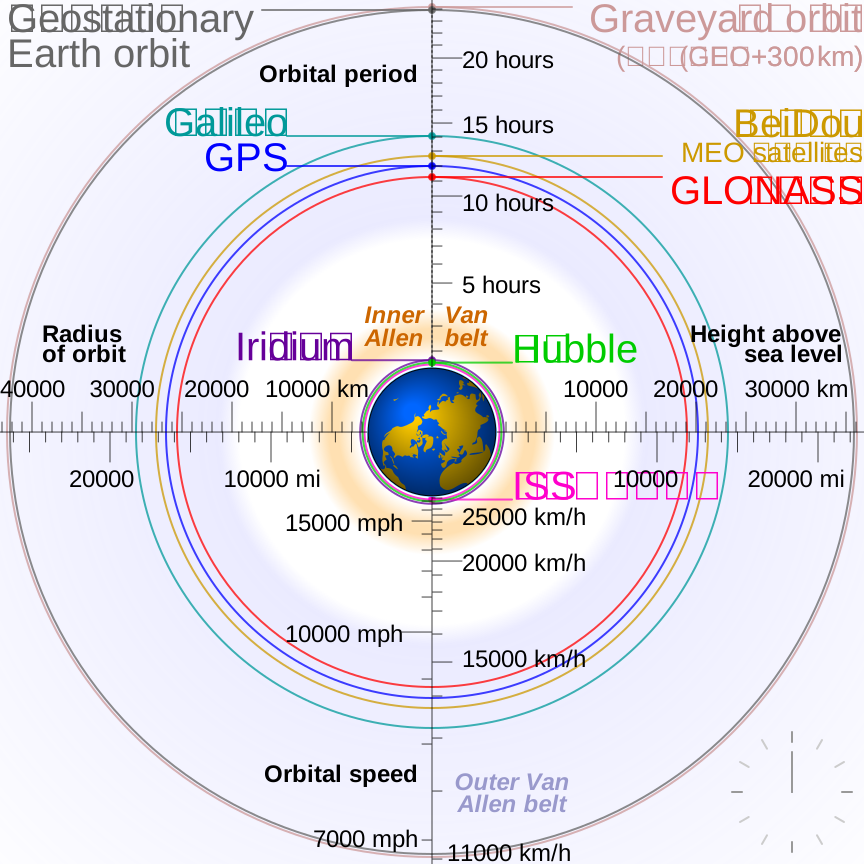
Van Allen radiation belt is a zone of energeticcharged particles, most of which originate from the solar wind, that are captured by and held around a planet by that planet's magnetosphere. Earth has two such belts, and sometimes others may be temporarily created. The belts are named after James Van Allen, who is often credited with their discovery.
Earth's two main belts extend from an altitude of about 640 to 58,000 km (400 to 36,040 mi) above the surface, in which region radiation levels vary. The belts are in the inner region of Earth's magnetic field. They trap energetic electrons and protons. Other nuclei, such as alpha particles, are less prevalent. Most of the particles that form the belts are thought to come from the solar wind while others arrive as cosmic rays. By trapping the solar wind, the magnetic field deflects those energetic particles and protects the atmosphere from destruction.
The belts endanger satellites,
which must have their sensitive components protected with adequate
shielding if they spend significant time near that zone. Apollo
Astronauts going through the Van Allen Belts received a very low and
unharmful dose of radiation.
In 2013, the Van Allen Probes detected a transient, third radiation belt, which persisted for four weeks.
The term Van Allen belts refers specifically to the
radiation belts surrounding Earth; however, similar radiation belts have
been discovered around other planets.
The Sun does not support long-term radiation belts, as it lacks a
stable, global dipole field. The Earth's atmosphere limits the belts'
particles to regions above 200–1,000 km, (124–620 miles) while the belts do not extend past 8 Earth radiiRE. The belts are confined to a volume which extends about 65° on either side of the celestial equator.
Research
Jupiter's variable radiation belts
The NASA Van Allen Probes mission aims at understanding (to the point of predictability) how populations of relativistic electrons and ions in space form or change in response to changes in solar activity and the solar wind.
NASA Institute for Advanced Concepts–funded studies have proposed magnetic scoops to collect antimatter that naturally occurs in the Van Allen belts of Earth, although only about 10 micrograms of antiprotons are estimated to exist in the entire belt.
The Van Allen Probes mission successfully launched on August 30,
2012. The primary mission was scheduled to last two years with
expendables expected to last four. The probes were deactivated in 2019
after running out of fuel and are expected to deorbit during the 2030s. NASA's Goddard Space Flight Center manages the Living With a Star program—of which the Van Allen Probes were a project, along with Solar Dynamics Observatory (SDO). The Applied Physics Laboratory was responsible for the implementation and instrument management for the Van Allen Probes.
Radiation belts exist around other planets and moons in the solar
system that have magnetic fields powerful enough to sustain them. To
date, most of these radiation belts have been poorly mapped. The Voyager
Program (namely Voyager 2) only nominally confirmed the existence of similar belts around Uranus and Neptune.
Geomagnetic storms
can cause electron density to increase or decrease relatively quickly
(i.e., approximately one day or less). Longer-timescale processes
determine the overall configuration of the belts. After electron
injection increases electron density, electron density is often observed
to decay exponentially. Those decay time constants are called
"lifetimes." Measurements from the Van Allen Probe B's Magnetic Electron
Ion Spectrometer (MagEIS) show long electron lifetimes (i.e., longer
than 100 days) in the inner belt; short electron lifetimes of around one
or two days are observed in the "slot" between the belts; and
energy-dependent electron lifetimes of roughly five to 20 days are found
in the outer belt.
Inner belt
Cutaway drawing
of two radiation belts around Earth: the inner belt (red) dominated by
protons and the outer one (blue) by electrons. Image Credit: NASA
The inner Van Allen Belt extends typically from an altitude of 0.2 to 2 Earth radii (L values of 1.2 to 3) or 1,000 km (620 mi) to 12,000 km (7,500 mi) above the Earth. In certain cases, when solar activity is stronger or in geographical areas such as the South Atlantic Anomaly, the inner boundary may decline to roughly 200 km above the Earth's surface. The inner belt contains high concentrations of electrons in the range of hundreds of keV
and energetic protons with energies exceeding 100 MeV—trapped by the
relatively strong magnetic fields in the region (as compared to the
outer belt).
It is thought that proton energies exceeding 50 MeV in the lower belts at lower altitudes are the result of the beta decay of neutrons
created by cosmic ray collisions with nuclei of the upper atmosphere.
The source of lower energy protons is believed to be proton diffusion,
due to changes in the magnetic field during geomagnetic storms.
Due to the slight offset of the belts from Earth's geometric
center, the inner Van Allen belt makes its closest approach to the
surface at the South Atlantic Anomaly.
In March 2014, a pattern resembling "zebra stripes" was observed
in the radiation belts by the Radiation Belt Storm Probes Ion
Composition Experiment (RBSPICE) onboard Van Allen Probes.
The initial theory proposed in 2014 was that—due to the tilt in Earth's
magnetic field axis—the planet's rotation generated an oscillating,
weak electric field that permeates through the entire inner radiation
belt. A 2016 study instead concluded that the zebra stripes were an imprint of ionospheric winds on radiation belts.
Outer belt
Laboratory simulation of the Van Allen belt's influence on the Solar Wind; these aurora-like Birkeland currents were created by the scientist Kristian Birkeland in his terrella, a magnetized anode globe in an evacuated chamber
The outer belt consists mainly of high-energy (0.1–10 MeV)
electrons trapped by the Earth's magnetosphere. It is more variable
than the inner belt, as it is more easily influenced by solar activity.
It is almost toroidal in shape, beginning at an altitude of 3 Earth radii and extending to 10 Earth radii (RE)—13,000 to 60,000 kilometres (8,100 to 37,300 mi) above the Earth's surface. Its greatest intensity is usually around 4 to 5 RE. The outer electron radiation belt is mostly produced by inward radial diffusion and local acceleration due to transfer of energy from whistler-mode plasma waves to radiation belt electrons. Radiation belt electrons are also constantly removed by collisions with Earth's atmosphere, losses to the magnetopause, and their outward radial diffusion. The gyroradii
of energetic protons would be large enough to bring them into contact
with the Earth's atmosphere. Within this belt, the electrons have a high
flux and at the outer edge (close to the magnetopause), where geomagnetic field lines open into the geomagnetic "tail",
the flux of energetic electrons can drop to the low interplanetary
levels within about 100 km (62 mi)—a decrease by a factor of 1,000.
In 2014, it was discovered that the inner edge of the outer belt
is characterized by a very sharp transition, below which highly
relativistic electrons (> 5MeV) cannot penetrate. The reason for this shield-like behavior is not well understood.
The trapped particle population of the outer belt is varied,
containing electrons and various ions. Most of the ions are in the form
of energetic protons, but a certain percentage are alpha particles and O+ oxygen ions—similar to those in the ionosphere but much more energetic. This mixture of ions suggests that ring current particles probably originate from more than one source.
The outer belt is larger than the inner belt, and its particle
population fluctuates widely. Energetic (radiation) particle fluxes can
increase and decrease dramatically in response to geomagnetic storms,
which are themselves triggered by magnetic field and plasma
disturbances produced by the Sun. The increases are due to storm-related
injections and acceleration of particles from the tail of the
magnetosphere. Another cause of variability of the outer belt particle
populations is the wave-particle interactions with various plasma waves in a broad range of frequencies.
On February 28, 2013, a third radiation belt—consisting of high-energy ultrarelativistic
charged particles—was reported to be discovered. In a news conference
by NASA's Van Allen Probe team, it was stated that this third belt is a
product of coronal mass ejection
from the Sun. It has been represented as a separate creation which
splits the Outer Belt, like a knife, on its outer side, and exists
separately as a storage container of particles for a month's time,
before merging once again with the Outer Belt.
The unusual stability of this third, transient belt has been
explained as due to a 'trapping' by the Earth's magnetic field of
ultrarelativistic particles as they are lost from the second,
traditional outer belt. While the outer zone, which forms and disappears
over a day, is highly variable due to interactions with the atmosphere,
the ultrarelativistic particles of the third belt are thought not to
scatter into the atmosphere, as they are too energetic to interact with
atmospheric waves at low latitudes.
This absence of scattering and the trapping allows them to persist for a
long time, finally only being destroyed by an unusual event, such as
the shock wave from the Sun.
Flux values
In the belts, at a given point, the flux of particles of a given energy decreases sharply with energy.
At the magnetic equator, electrons of energies exceeding 5000 keV (resp. 5 MeV) have omnidirectional fluxes ranging from 1.2×10⁶ (resp. 3.7×10⁴) up to 9.4×10⁹ (resp. 2×10⁷) particles per square centimeter per second.
The proton belts contain protons with kinetic energies ranging from about 100 keV, which can penetrate 0.6 µm of lead, to over 400 MeV, which can penetrate 143 mm of lead.
Most published flux values for the inner and outer belts may not
show the maximum probable flux densities that are possible in the belts.
There is a reason for this discrepancy: the flux density and the
location of the peak flux is variable, depending primarily on solar
activity, and the number of spacecraft with instruments observing the
belt in real time has been limited. The Earth has not experienced a
solar storm of Carrington event intensity and duration, while spacecraft with the proper instruments have been available to observe the event.
Radiation levels in the belts would be dangerous to humans if
they were exposed for an extended period of time. The Apollo missions
minimised hazards for astronauts by sending spacecraft at high speeds
through the thinner areas of the upper belts, bypassing inner belts
completely, except for the Apollo 14 mission where the spacecraft
traveled through the heart of the trapped radiation belts.
Flux values, normal solar conditions
AP8 MIN omnidirectional proton flux ≥ 100 keV
AP8 MIN omnidirectional proton flux ≥ 1 MeV
AP8 MIN omnidirectional proton flux ≥ 400 MeV
Antimatter confinement
In 2011, a study confirmed earlier speculation that the Van Allen belt could confine antiparticles. The Payload for Antimatter Matter Exploration and Light-nuclei Astrophysics (PAMELA) experiment detected levels of antiprotons orders of magnitude higher than are expected from normal particle decays while passing through the South Atlantic Anomaly.
This suggests the Van Allen belts confine a significant flux of
antiprotons produced by the interaction of the Earth's upper atmosphere
with cosmic rays. The energy of the antiprotons has been measured in the range from 60 to 750 MeV.
Research funded by the NASA Institute for Advanced Concepts
concluded that harnessing these antiprotons for spacecraft propulsion
would be feasible. Researchers believed that this approach would have
advantages over antiproton generation at CERN because collecting the
particles in situ eliminates transportation losses and costs. Jupiter
and Saturn are also possible sources, but the Earth belt is the most
productive. Jupiter is less productive than might be expected due to
magnetic shielding from cosmic rays of much of its atmosphere. In 2019, CMS announced that the construction of a device that would be capable of collecting these particles has already begun.
NASA will use this device to collect these particles and transport them
to institutes all around the world for further examination. These
so-called "antimatter containers" could be used for industrial purposes
as well in the future.
Spacecraft travelling beyond low Earth orbit enter the zone of radiation of the Van Allen belts. Beyond the belts, they face additional hazards from cosmic rays and solar particle events.
A region between the inner and outer Van Allen belts lies at 2 to 4
Earth radii and is sometimes referred to as the "safe zone".
Solar cells, integrated circuits, and sensors can be damaged by radiation. Geomagnetic storms occasionally damage electronic components on spacecraft. Miniaturization and digitization of electronics and logic circuits have made satellites more vulnerable to radiation, as the total electric charge
in these circuits is now small enough so as to be comparable with the
charge of incoming ions. Electronics on satellites must be hardened against radiation to operate reliably. The Hubble Space Telescope, among other satellites, often has its sensors turned off when passing through regions of intense radiation. A satellite shielded by 3 mm of aluminium in an elliptic orbit (200 by 20,000 miles (320 by 32,190 km)) passing the radiation belts will receive about 2,500 rem (25 Sv)
per year. (For comparison, a full-body dose of 5 Sv is deadly.) Almost
all radiation will be received while passing the inner belt.
The Apollo missions
marked the first event where humans traveled through the Van Allen
belts, which was one of several radiation hazards known by mission
planners. The astronauts had low exposure in the Van Allen belts due to the short period of time spent flying through them.
Astronauts' overall exposure was actually dominated by solar
particles once outside Earth's magnetic field. The total radiation
received by the astronauts varied from mission-to-mission but was
measured to be between 0.16 and 1.14 rads (1.6 and 11.4 mGy), much less than the standard of 5 rem (50 mSv) per year set by the United States Atomic Energy Commission for people who work with radioactivity.
Causes
It is
generally understood that the inner and outer Van Allen belts result
from different processes. The inner belt is mainly composed of energetic
protons produced from the decay of so-called "albedo" neutrons, which are themselves the result of cosmic ray
collisions in the upper atmosphere. The outer Van Allen belt consists
mainly of electrons. They are injected from the geomagnetic tail
following geomagnetic storms, and are subsequently energized through wave-particle interactions.
In the inner belt, particles that originate from the Sun are
trapped in the Earth's magnetic field. Particles spiral along the
magnetic lines of flux as they move "latitudinally" along those lines.
As particles move toward the poles, the magnetic field line density
increases, and their "latitudinal" velocity is slowed and can be
reversed, deflecting the particles back towards the equatorial region,
causing them to bounce back and forth between the Earth's poles.
In addition to both spiralling around and moving along the flux lines,
the electrons drift slowly in an eastward direction, while the protons
drift westward.
The gap between the inner and outer Van Allen belts is sometimes called the "safe zone" or "safe slot", and is the location of medium Earth orbits. The gap is caused by the VLF radio waves, which scatter particles in pitch angle,
which adds new ions to the atmosphere. Solar outbursts can also dump
particles into the gap, but those drain out in a matter of days. The VLF
radio waves were previously thought to be generated by turbulence in
the radiation belts, but recent work by J.L. Green of the Goddard Space Flight Center compared maps of lightning activity collected by the Microlab 1 spacecraft with data on radio waves in the radiation-belt gap from the IMAGE
spacecraft; the results suggest that the radio waves are actually
generated by lightning within Earth's atmosphere. The generated radio
waves strike the ionosphere at the correct angle to pass through only at
high latitudes, where the lower ends of the gap approach the upper
atmosphere. These results are still being debated in the scientific
community.
Proposed removal
Draining
the charged particles from the Van Allen belts would open up new orbits
for satellites and make travel safer for astronauts.
High Voltage Orbiting Long Tether, or HiVOLT, is a concept proposed by Russian physicist V. V. Danilov and further refined by Robert P. Hoyt and Robert L. Forward for draining and removing the radiation fields of the Van Allen radiation belts that surround the Earth.
Another proposal for draining the Van Allen belts involves
beaming very-low-frequency (VLF) radio waves from the ground into the
Van Allen belts.
Draining radiation belts around other planets has also been proposed, for example, before exploring Europa, which orbits within Jupiter's radiation belt.
As of 2014, it remains uncertain if there are any negative unintended consequences to removing these radiation belts.
A nuclear meltdown (core meltdown, core melt accident, meltdown or partial core melt) is a severe nuclear reactor accident that results in core damage from overheating. The term nuclear meltdown is not officially defined by the International Atomic Energy Agency or by the United States Nuclear Regulatory Commission. It has been defined to mean the accidental melting of the core of a nuclear reactor, however, and is in common usage a reference to the core's either complete or partial collapse.
A core meltdown accident occurs when the heat generated by a
nuclear reactor exceeds the heat removed by the cooling systems to the
point where at least one nuclear fuel element exceeds its melting point. This differs from a fuel element failure, which is not caused by high temperatures. A meltdown may be caused by a loss of coolant, loss of coolant pressure, or low coolant flow rate or be the result of a criticality excursion
in which the reactor is operated at a power level that exceeds its
design limits. Alternatively, an external fire may endanger the core,
leading to a meltdown.
Nuclear power plants generate electricity by heating fluid via a nuclear reaction to run a generator.
If the heat from that reaction is not removed adequately, the fuel
assemblies in a reactor core can melt. A core damage incident can occur
even after a reactor is shut down because the fuel continues to produce decay heat.
A core damage accident is caused by the loss of sufficient
cooling for the nuclear fuel within the reactor core. The reason may be
one of several factors, including a loss-of-pressure-control accident, a loss-of-coolant accident (LOCA), an uncontrolled power excursion or, in reactors without a pressure vessel,
a fire within the reactor core. Failures in control systems may cause a
series of events resulting in loss of cooling. Contemporary safety
principles of
defense in depth ensure that multiple layers of safety systems are always present to make such accidents unlikely.
The containment building is the last of several safeguards that
prevent the release of radioactivity to the environment. Many commercial
reactors are contained within a 1.2-to-2.4-metre (3.9 to 7.9 ft) thick
pre-stressed, steel-reinforced, air-tight concrete structure that can
withstand hurricane-force winds and severe earthquakes.
In a loss-of-coolant accident, either the physical loss of coolant (which is typically deionized water, an inert gas, NaK, or liquid sodium)
or the loss of a method to ensure a sufficient flow rate of the coolant
occurs. A loss-of-coolant accident and a loss-of-pressure-control
accident are closely related in some reactors. In a pressurized water
reactor, a LOCA can also cause a "steam bubble" to form in the core due
to excessive heating of stalled coolant or by the subsequent
loss-of-pressure-control accident caused by a rapid loss of coolant. In a
loss-of-forced-circulation accident, a gas cooled reactor's circulators
(generally motor or steam driven turbines) fail to circulate the gas
coolant within the core, and heat transfer is impeded by this loss of
forced circulation, though natural circulation through convection will
keep the fuel cool as long as the reactor is not depressurized.
In a loss-of-pressure-control accident, the pressure of the confined
coolant falls below specification without the means to restore it. In
some cases, this may reduce the heat transfer efficiency (when using an inert gas
as a coolant), and in others may form an insulating "bubble" of steam
surrounding the fuel assemblies (for pressurized water reactors). In the
latter case, due to localized heating of the "steam bubble" due to
decay heat, the pressure required to collapse the "steam bubble" may
exceed reactor design specifications until the reactor has had time to
cool down. (This event is less likely to occur in boiling water reactors, where the core may be deliberately depressurized so that the emergency core cooling system
may be turned on). In a depressurization fault, a gas-cooled reactor
loses gas pressure within the core, reducing heat transfer efficiency
and posing a challenge to the cooling of fuel; as long as at least one
gas circulator is available, however, the fuel will be kept cool.
In an uncontrolled power excursion accident, a sudden power spike in
the reactor exceeds reactor design specifications due to a sudden
increase in reactor reactivity.
An uncontrolled power excursion occurs due to significantly altering a
parameter that affects the neutron multiplication rate of a chain
reaction (examples include ejecting a control rod or significantly
altering the nuclear characteristics of the moderator, such as by rapid
cooling). In extreme cases, the reactor may proceed to a condition known
as prompt critical. This is especially a problem in reactors that have a positive void coefficient
of reactivity, a positive temperature coefficient, are overmoderated,
or can trap excess quantities of deleterious fission products within
their fuel or moderators. Many of these characteristics are present in
the RBMK design, and the Chernobyl disaster
was caused by such deficiencies as well as by severe operator
negligence. Western light-water reactors are not subject to very large
uncontrolled power excursions because loss of coolant decreases, rather
than increases, core reactivity (a negative void coefficient of
reactivity); "transients," as the minor power fluctuations within
Western light-water reactors are called, are limited to momentary
increases in reactivity that will rapidly decrease with time
(approximately 200%–250% of maximum neutronic power for a few seconds in
the event of a complete rapid shutdown failure combined with a
transient).
Core-based fires endanger the core and can cause the fuel assemblies
to melt. A fire may be caused by air entering a graphite moderated
reactor, or a liquid-sodium cooled reactor. Graphite is also subject to
accumulation of Wigner energy, which can overheat the graphite (as happened at the Windscale fire).
Light-water reactors do not have flammable cores or moderators and are
not subject to core fires. Gas-cooled civilian reactors, such as the Magnox, UNGG, and AGCR type reactors, keep their cores blanketed with non-reactive carbon dioxide gas, which cannot support fire. Modern gas-cooled civilian reactors use helium, which cannot burn, and have fuel that can withstand high temperatures without melting (such as the High Temperature Gas Cooled Reactor and the Pebble Bed Modular Reactor).
Byzantine faults and cascading failures
within instrumentation and control systems may cause severe problems in
reactor operation, potentially leading to core damage if not mitigated.
For example, the Browns Ferry fire damaged control cables and required the plant operators to manually activate cooling systems. The Three Mile Island accident
was caused by a stuck-open pilot-operated pressure relief valve
combined with a deceptive water level gauge that misled reactor
operators, which resulted in core damage.
Coating of previously molten material on bypass region interior surfaces
Upper grid damage
Before the core of a light-water nuclear reactor can be damaged, two precursor events must have already occurred:
A limiting fault (or a set of compounded emergency conditions)
that leads to the failure of heat removal within the core (the loss of
cooling). Low water level uncovers the core, allowing it to heat up.
Failure of the emergency core cooling system
(ECCS). The ECCS is designed to rapidly cool the core and make it safe
in the event of the maximum fault (the design basis accident) that
nuclear regulators and plant engineers could imagine. There are at least
two copies of the ECCS built for every reactor. Each division (copy) of
the ECCS is capable, by itself, of responding to the design basis
accident. The latest reactors have as many as four divisions of the
ECCS. This is the principle of redundancy, or duplication. As long as at
least one ECCS division functions, no core damage can occur. Each of
the several divisions of the ECCS has several internal "trains" of
components. Thus the ECCS divisions themselves have internal redundancy –
and can withstand failures of components within them.
The Three Mile Island accident was a compounded group of emergencies
that led to core damage. What led to this was an erroneous decision by
operators to shut down the ECCS during an emergency condition due to
gauge readings that were either incorrect or misinterpreted; this caused
another emergency condition that, several hours after the fact, led to
core exposure and a core damage incident. If the ECCS had been allowed
to function, it would have prevented both exposure and core damage.
During the Fukushima incident the emergency cooling system had also been manually shut down several minutes after it started.
If such a limiting fault were to occur, and a complete failure of all ECCS divisions were to occur, both Kuan, et al and Haskin, et al describe six stages between the start of the limiting fault (the loss of cooling) and the potential escape of molten corium into the containment (a so-called "full meltdown"):
Uncovering of the Core – In the event of a transient, upset, emergency, or limiting fault, LWRs are designed to automatically SCRAM
(a SCRAM being the immediate and full insertion of all control rods)
and spin up the ECCS. This greatly reduces reactor thermal power (but
does not remove it completely); this delays core becoming uncovered,
which is defined as the point when the fuel rods are no longer covered
by coolant and can begin to heat up. As Kuan states: "In a small-break
LOCA with no emergency core coolant injection, core uncovery [sic]
generally begins approximately an hour after the initiation of the
break. If the reactor coolant pumps are not running, the upper part of
the core will be exposed to a steam environment and heatup of the core
will begin. However, if the coolant pumps are running, the core will be
cooled by a two-phase mixture of steam and water, and heatup of the fuel
rods will be delayed until almost all of the water in the two-phase
mixture is vaporized. The TMI-2 accident showed that operation of
reactor coolant pumps may be sustained for up to approximately two hours
to deliver a two phase mixture that can prevent core heatup."
Pre-damage heat up – "In the absence of a two-phase mixture
going through the core or of water addition to the core to compensate
water boiloff, the fuel rods in a steam environment will heat up at a
rate between 0.3 °C/s (0.5 °F/s) and 1 °C/s (1.8 °F/s) (3)."
Fuel ballooning and bursting – "In less than half an hour,
the peak core temperature would reach 1,100 K (830 °C). At this
temperature, the zircaloy cladding of the fuel rods may balloon and
burst. This is the first stage of core damage. Cladding ballooning may
block a substantial portion of the flow area of the core and restrict
the flow of coolant. However, complete blockage of the core is unlikely
because not all fuel rods balloon at the same axial location. In this
case, sufficient water addition can cool the core and stop core damage
progression."
Rapid oxidation – "The next stage of core damage, beginning at approximately 1,500 K (1,230 °C), is the rapid oxidation of the Zircaloy
by steam. In the oxidation process, hydrogen is produced and a large
amount of heat is released. Above 1,500 K (1,230 °C), the power from
oxidation exceeds that from decay heat (4,5) unless the oxidation rate
is limited by the supply of either zircaloy or steam."
Debris bed formation – "When the temperature in the core
reaches about 1,700 K (1,430 °C), molten control materials (1,6) will
flow to and solidify in the space between the lower parts of the fuel
rods where the temperature is comparatively low. Above 1,700 K
(1,430 °C), the core temperature may escalate in a few minutes to the
melting point of zircaloy [2,150 K (1,880 °C)] due to increased
oxidation rate. When the oxidized cladding breaks, the molten zircaloy,
along with dissolved UO2 (1,7) would flow downward and freeze
in the cooler, lower region of the core. Together with solidified
control materials from earlier down-flows, the relocated zircaloy and UO2 would form the lower crust of a developing cohesive debris bed."
(Corium) Relocation to the lower plenum – "In scenarios of
small-break LOCAs, there is generally a pool of water in the lower
plenum of the vessel at the time of core relocation. The release of
molten core materials into the water always generates large amounts of
steam. If the molten stream of core materials breaks up rapidly in
water, there is also a possibility of a steam explosion. During
relocation, any unoxidized zirconium in the molten material may also be
oxidized by steam, and in the process hydrogen is produced.
Recriticality also may be a concern if the control materials are left
behind in the core and the relocated material breaks up in unborated
water in the lower plenum."
At the point at which the corium relocates to the lower plenum, Haskin, et al relate that the possibility exists for an incident called a fuel–coolant interaction (FCI) to substantially stress or breach the primary pressure boundary when the corium relocates to the lower plenum of the reactor pressure vessel ("RPV").
This is because the lower plenum of the RPV may have a substantial
quantity of water - the reactor coolant - in it, and, assuming the
primary system has not been depressurized, the water will likely be in
the liquid phase,
and consequently dense, and at a vastly lower temperature than the
corium. Since corium is a liquid metal-ceramic eutectic at temperatures
of 2,200 to 3,200 K (1,930 to 2,930 °C), its fall into liquid water at
550 to 600 K (277 to 327 °C) may cause an extremely rapid evolution of steam that could cause a sudden extreme overpressure and consequent gross structural failure of the primary system or RPV. Though most modern studies hold that it is physically infeasible, or at least extraordinarily unlikely, Haskin, et al state that there exists a remote possibility of an extremely violent FCI leading to something referred to as an alpha-mode failure,
or the gross failure of the RPV itself, and subsequent ejection of the
upper plenum of the RPV as a missile against the inside of the
containment, which would likely lead to the failure of the containment
and release of the fission products of the core to the outside
environment without any substantial decay having taken place.
The American Nuclear Society
has commented on the TMI-2 accident, that despite melting of about
one-third of the fuel, the reactor vessel itself maintained its
integrity and contained the damaged fuel.
Breach of the primary pressure boundary
There are several possibilities as to how the primary pressure boundary could be breached by corium.
Steam explosion
As previously described, FCI could lead to an overpressure event
leading to RPV fail, and thus, primary pressure boundary fail. Haskin et al
report that in the event of a steam explosion, failure of the lower
plenum is far more likely than ejection of the upper plenum in the alpha
mode. In the event of lower plenum failure, debris at varied
temperatures can be expected to be projected into the cavity below the
core. The containment may be subject to overpressure, though this is not
likely to fail the containment. The alpha-mode failure will lead to the
consequences previously discussed.
Pressurized melt ejection (PME)
It is quite possible, especially in pressurized water reactors, that
the primary loop will remain pressurized following corium relocation to
the lower plenum. As such, pressure stresses on the RPV will be present
in addition to the weight stress that the molten corium places on the
lower plenum of the RPV; when the metal of the RPV weakens sufficiently
due to the heat of the molten corium, it is likely that the liquid
corium will be discharged under pressure out of the bottom of the RPV in
a pressurized stream, together with entrained gases. This mode of
corium ejection may lead to direct containment heating (DCH).
Severe accident ex-vessel interactions and challenges to containment
Haskin et al
identify six modes by which the containment could be credibly
challenged; some of these modes are not applicable to core melt
accidents.
Overpressure
Dynamic pressure (shockwaves)
Internal missiles
External missiles (not applicable to core melt accidents)
Meltthrough
Bypass
Standard failure modes
If the melted core penetrates the pressure vessel, there are theories and speculations as to what may then occur.
In modern Russian plants, there is a "core catching device" in
the bottom of the containment building. The melted core is supposed to
hit a thick layer of a "sacrificial metal" that would melt, dilute the
core and increase the heat conductivity, and finally the diluted core
can be cooled down by water circulating in the floor. There has never
been any full-scale testing of this device, however.
In Western plants there is an airtight containment building.
Though radiation would be at a high level within the containment, doses
outside of it would be lower. Containment buildings are designed for the
orderly release of pressure without releasing radionuclides, through a
pressure release valve and filters. Hydrogen/oxygen recombiners also are
installed within the containment to prevent gas explosions.
In a melting event, one spot or area on the RPV will become
hotter than other areas, and will eventually melt. When it melts, corium
will pour into the cavity under the reactor. Though the cavity is
designed to remain dry, several NUREG-class documents advise operators
to flood the cavity in the event of a fuel melt incident. This water
will become steam and pressurize the containment. Automatic water sprays
will pump large quantities of water into the steamy environment to keep
the pressure down. Catalytic recombiners will rapidly convert the
hydrogen and oxygen back into water. One positive effect of the corium
falling into water is that it is cooled and returns to a solid state.
Extensive water spray systems within the containment along with
the ECCS, when it is reactivated, will allow operators to spray water
within the containment to cool the core on the floor and reduce it to a
low temperature.
These procedures are intended to prevent release of
radioactivity. In the Three Mile Island event in 1979, a theoretical
person standing at the plant property line during the entire event would
have received a dose of approximately 2 millisieverts (200 millirem),
between a chest X-ray's and a CT scan's worth of radiation. This was due
to outgassing by an uncontrolled system that, today, would have been
backfitted with activated carbon and HEPA filters to prevent
radionuclide release.
In the Fukushima incident, however, this design failed. Despite
the efforts of the operators at the Fukushima Daiichi nuclear power
plant to maintain control, the reactor cores in units 1–3 overheated,
the nuclear fuel melted and the three containment vessels were breached.
Hydrogen was released from the reactor pressure vessels, leading to
explosions inside the reactor buildings in units 1, 3 and 4 that damaged
structures and equipment and injured personnel. Radionuclides were
released from the plant to the atmosphere and were deposited on land and
on the ocean. There were also direct releases into the sea.
As the natural decay heat of the corium eventually reduces to an
equilibrium with convection and conduction to the containment walls, it
becomes cool enough for water spray systems to be shut down and the
reactor to be put into safe storage. The containment can be sealed with
release of extremely limited offsite radioactivity and release of
pressure. After perhaps a decade for fission products to decay, the
containment can be reopened for decontamination and demolition.
Another scenario sees a buildup of potentially explosive hydrogen, but passive autocatalytic recombiners
inside the containment are designed to prevent this. In Fukushima, the
containments were filled with inert nitrogen, which prevented hydrogen
from burning; the hydrogen leaked from the containment to the reactor
building, however, where it mixed with air and exploded.
During the 1979 Three Mile Island accident, a hydrogen bubble formed in
the pressure vessel dome. There were initial concerns that the hydrogen
might ignite and damage the pressure vessel or even the containment
building; but it was soon realized that lack of oxygen prevented burning
or explosion.
Speculative failure modes
One
scenario consists of the reactor pressure vessel failing all at once,
with the entire mass of corium dropping into a pool of water (for
example, coolant or moderator) and causing extremely rapid generation of
steam. The pressure rise within the containment could threaten
integrity if rupture disks could not relieve the stress. Exposed
flammable substances could burn, but there are few, if any, flammable
substances within the containment.
Another theory, called an "alpha mode" failure by the 1975 Rasmussen (WASH-1400)
study, asserted steam could produce enough pressure to blow the head
off the reactor pressure vessel (RPV). The containment could be
threatened if the RPV head collided with it. (The WASH-1400 report was
replaced by better-based newer studies, and now the Nuclear Regulatory Commission has disavowed them all and is preparing the overarching State-of-the-Art Reactor Consequence Analyses [SOARCA] study - see the Disclaimer in NUREG-1150.)
By 1970, there were doubts about the ability of the emergency
cooling systems of a nuclear reactor to prevent a loss-of-coolant
accident and the consequent meltdown of the fuel core; the subject
proved popular in the technical and the popular presses. In 1971, in the article Thoughts on Nuclear Plumbing, former Manhattan Projectnuclear physicistRalph Lapp
used the term "China syndrome" to describe a possible burn through of
the containment structures, and the subsequent escape of radioactive
material(s) into the atmosphere and environment. The hypothesis derived
from a 1967 report by a group of nuclear physicists, headed by W. K. Ergen.
Some fear that a molten reactor core could penetrate the reactor
pressure vessel and containment structure and burn downwards to the
level of the groundwater.
It has not been determined to what extent a molten mass can melt
through a structure (although that was tested in the loss-of-fluid-test
reactor described in Test Area North's fact sheet).
The Three Mile Island accident provided real-life experience with an
actual molten core: the corium failed to melt through the reactor
pressure vessel after over six hours of exposure due to dilution of the
melt by the control rods and other reactor internals, validating the
emphasis on defense in depth against core damage incidents.
Other reactor types
Other
types of reactors have different capabilities and safety profiles than
the LWR does. Advanced varieties of several of these reactors have the
potential to be inherently safe.
CANDU reactors
CANDU
reactors, Canadian-invented deuterium-uranium design, are designed with
at least one, and generally two, large low-temperature and low-pressure
water reservoirs around their fuel/coolant channels. The first is the
bulk heavy-water moderator (a separate system from the coolant), and the
second is the light-water-filled shield tank (or calandria
vault). These backup heat sinks are sufficient to prevent either the
fuel meltdown in the first place (using the moderator heat sink), or the
breaching of the core vessel should the moderator eventually boil off
(using the shield tank heat sink).
Other failure modes aside from fuel melt will probably occur in a CANDU
rather than a meltdown, such as deformation of the calandria into a
non-critical configuration. All CANDU reactors are located within
standard Western containments as well.
Gas-cooled reactors
One type of Western reactor, known as the advanced gas-cooled reactor
(or AGR), built by the United Kingdom, is not very vulnerable to
loss-of-cooling accidents or to core damage except in the most extreme
of circumstances. By virtue of the relatively inert coolant (carbon
dioxide), the large volume and high pressure of the coolant, and the
relatively high heat transfer efficiency of the reactor, the time frame
for core damage in the event of a limiting fault is measured in days.
Restoration of some means of coolant flow will prevent core damage from
occurring.
Other types of highly advanced gas cooled reactors, generally
known as high-temperature gas-cooled reactors (HTGRs) such as the
Japanese High Temperature Test Reactor and the United States' Very High Temperature Reactor,
are inherently safe, meaning that meltdown or other forms of core
damage are physically impossible, due to the structure of the core,
which consists of hexagonal prismatic blocks of silicon carbide
reinforced graphite infused with TRISO or QUADRISO
pellets of uranium, thorium, or mixed oxide buried underground in a
helium-filled steel pressure vessel within a concrete containment.
Though this type of reactor is not susceptible to meltdown, additional
capabilities of heat removal are provided by using regular atmospheric
airflow as a means of backup heat removal, by having it pass through a heat exchanger and rising into the atmosphere due to convection, achieving full residual heat removal. The VHTR is scheduled to be prototyped and tested at Idaho National Laboratory within the next decade (as of 2009) as the design selected for the Next Generation Nuclear Plant by the US Department of Energy. This reactor will use a gas as a coolant, which can then be used for process heat (such as in hydrogen production) or for the driving of gas turbines and the generation of electricity.
A similar highly advanced gas cooled reactor originally designed by West Germany (the AVR reactor) and now developed by South Africa is known as the Pebble Bed Modular Reactor. It is an inherently safe
design, meaning that core damage is physically impossible, due to the
design of the fuel (spherical graphite "pebbles" arranged in a bed
within a metal RPV and filled with TRISO (or QUADRISO) pellets of
uranium, thorium, or mixed oxide within). A prototype of a very similar
type of reactor has been built by the Chinese, HTR-10,
and has worked beyond researchers' expectations, leading the Chinese to
announce plans to build a pair of follow-on, full-scale 250 MWe,
inherently safe, power production reactors based on the same concept.
(See Nuclear power in the People's Republic of China for more information.)
Lead and lead-bismuth-cooled reactors
Recently heavy liquid metal, such as lead or lead-bismuth, has been proposed as a reactor coolant.
Because of the similar densities of the fuel and the HLM, an inherent
passive safety self-removal feedback mechanism due to buoyancy forces is
developed, which propels the packed bed away from the wall when certain
threshold of temperature is attained and the bed becomes lighter than
the surrounding coolant, thus preventing temperatures that can
jeopardize the vessel’s structural integrity and also reducing the
recriticality potential by limiting the allowable bed depth.
Experimental or conceptual designs
Some design concepts for nuclear reactors emphasize resistance to meltdown and operating safety.
The PIUS (process inherent ultimate safety)
designs, originally engineered by the Swedes in the late 1970s and
early 1980s, are LWRs that by virtue of their design are resistant to
core damage. No units have ever been built.
Power reactors, including the Deployable Electrical Energy Reactor, a larger-scale mobile version of the TRIGA for power generation in disaster areas and on military missions, and the TRIGA
Power System, a small power plant and heat source for small and remote
community use, have been put forward by interested engineers, and share
the safety characteristics of the TRIGA due to the uranium zirconium hydride fuel used.
The Hydrogen Moderated Self-regulating Nuclear Power Module, a reactor that uses uranium hydride
as a moderator and fuel, similar in chemistry and safety to the TRIGA,
also possesses these extreme safety and stability characteristics, and
has attracted a good deal of interest in recent times.
The liquid fluoride thorium reactor
is designed to naturally have its core in a molten state, as a eutectic
mix of thorium and fluorine salts. As such, a molten core is reflective
of the normal and safe state of operation of this reactor type. In the
event the core overheats, a metal plug will melt, and the molten salt
core will drain into tanks where it will cool in a non-critical
configuration. Since the core is liquid, and already melted, it cannot
be damaged.
Advanced liquid metal reactors, such as the U.S. Integral Fast Reactor and the RussianBN-350, BN-600, and BN-800,
all have a coolant with very high heat capacity, sodium metal. As such,
they can withstand a loss of cooling without SCRAM and a loss of heat
sink without SCRAM, qualifying them as inherently safe.
Soviet Union–designed reactors
RBMKs
Soviet-designed RBMK reactors (Reaktor Bolshoy Moshchnosti Kanalnyy),
found only in Russia and other post-Soviet states and now shut down
everywhere except Russia, do not have containment buildings, are
naturally unstable (tending to dangerous power fluctuations), and have
emergency cooling systems (ECCS) considered grossly inadequate by
Western safety standards. The reactor involved in the Chernobyl disaster was an RBMK.
RBMK emergency core cooling systems
only have one division and little redundancy within that division.
Though the large core of the RBMK is less energy-dense than the smaller
Western LWR core, it is harder to cool. The RBMK is moderated by graphite. In the presence of both steam and oxygen at high temperatures, graphite forms synthesis gas and with the water gas shift reaction,
the resultant hydrogen burns explosively. If oxygen contacts hot
graphite, it will burn. Control rods used to be tipped with graphite, a
material that slows neutrons and thus speeds up the chain reaction.
Water is used as a coolant, but not a moderator. If the water boils
away, cooling is lost, but moderation continues. This is termed a
positive void coefficient of reactivity.
The RBMK tends towards dangerous power fluctuations. Control rods
can become stuck if the reactor suddenly heats up and they are moving.
Xenon-135, a neutron absorbent fission product, has a tendency to build
up in the core and burn off unpredictably in the event of low power
operation. This can lead to inaccurate neutronic and thermal power
ratings.
The RBMK does not have any containment above the core. The only
substantial solid barrier above the fuel is the upper part of the core,
called the upper biological shield, which is a piece of concrete
interpenetrated with control rods and with access holes for refueling
while online. Other parts of the RBMK were shielded better than the core
itself. Rapid shutdown (SCRAM) takes 10 to 15 seconds. Western reactors take 1 - 2.5 seconds.
Western aid has been given to provide certain real-time safety
monitoring capacities to the operating staff. Whether this extends to
automatic initiation of emergency cooling is not known. Training has
been provided in safety assessment from Western sources, and Russian
reactors have evolved in response to the weaknesses that were in the
RBMK. Nonetheless, numerous RBMKs still operate.
Though it might be possible to stop a loss-of-coolant event prior
to core damage occurring, any core damage incidents will probably allow
massive release of radioactive materials.
Upon entering the EU in 2004, Lithuania was required to phase out its two RBMKs at IgnalinaNPP,
deemed totally incompatible with European nuclear safety standards. The
country planned to replace them with safer reactors at Visaginas Nuclear Power Plant.
MKER
The MKER
is a modern Russian-engineered channel type reactor that is a distant
descendant of the RBMK, designed to optimize the benefits and fix the
serious flaws of the original.
Several unique features of the MKER's design make it a credible
and interesting option. The reactor remains online during refueling,
ensuring outages only occasionally for maintenance, with uptime up to
97-99%. The moderator design allows the use of less-enriched fuels, with
a high burnup rate. Neutronics characteristics have been optimized for
civilian use, for superior fuel fertilization and recycling; and
graphite moderation achieves better neutronics than is possible with
light water moderation. The lower power density of the core greatly
enhances thermal regulation.
An array of improvements make the MKER's safety comparable to
Western Generation III reactors: improved quality of parts, advanced
computer controls, comprehensive passive emergency core cooling system,
and very strong containment structure, along with a negative void
coefficient and a fast-acting rapid shutdown system. The passive
emergency cooling system uses reliable natural phenomena to cool the
core, rather than depending on motor-driven pumps. The containment
structure is designed to withstand severe stress and pressure. In the
event of a pipe break of a cooling-water channel, the channel can be
isolated from the water supply, preventing a general failure.
The greatly enhanced safety and unique benefits of the MKER
design enhance its competitiveness in countries considering full
fuel-cycle options for nuclear development.
VVER
The VVER
is a pressurized light-water reactor that is far more stable and safe
than the RBMK. This is because it uses light water as a moderator
(rather than graphite), has well-understood operating characteristics,
and has a negative void coefficient of reactivity. In addition, some
have been built with more than marginal containments, some have quality
ECCS systems, and some have been upgraded to international standards of
control and instrumentation. Present generations of VVERs (starting from
the VVER-1000) are built to Western-equivalent levels of
instrumentation, control, and containment systems.
Even with these positive developments, however, certain older
VVER models raise a high level of concern, especially the VVER-440 V230.
The VVER-440 V230 has no containment building, but only has a
structure capable of confining steam surrounding the RPV. This is a
volume of thin steel, perhaps 1–2 inches (2.5–5.1 cm) in thickness,
grossly insufficient by Western standards.
Has no ECCS. Can survive at most one 4 in (10 cm) pipe break (there are many pipes greater than that size within the design).
Has six steam generator loops, adding unnecessary complexity.
Apparently steam generator loops can be isolated, however, in
the event that a break occurs in one of these loops. The plant can
remain operating with one isolated loop—a feature found in few Western
reactors.
The interior of the pressure vessel is plain alloy steel, exposed to
water. This can lead to rust, if the reactor is exposed to water. One
point of distinction in which the VVER surpasses the West is the reactor
water cleanup facility—built, no doubt, to deal with the enormous
volume of rust within the primary coolant loop—the product of the slow
corrosion of the RPV.
This model is viewed as having inadequate process control systems.
Bulgaria had a number of VVER-440 V230 models, but they opted to
shut them down upon joining the EU rather than backfit them, and are
instead building new VVER-1000 models. Many non-EU states maintain V230
models, including Russia and the CIS. Many of these states, rather than
abandon the reactors entirely, have opted to install an ECCS, develop
standard procedures, and install proper instrumentation and control
systems. Though confinements cannot be transformed into containments,
the risk of a limiting fault resulting in core damage can be greatly
reduced.
The VVER-440 V213 model was built to the first set of Soviet
nuclear safety standards. It possesses a modest containment building,
and the ECCS systems, though not completely to Western standards, are
reasonably comprehensive. Many VVER-440 V213 models operated by former
Soviet bloc countries have been upgraded to fully automated
Western-style instrumentation and control systems, improving safety to
Western levels for accident prevention—but not for accident containment,
which is of a modest level compared to Western plants. These reactors
are regarded as "safe enough" by Western standards to continue operation
without major modifications, though most owners have performed major
modifications to bring them up to generally equivalent levels of nuclear
safety.
During the 1970s, Finland built two VVER-440 V213 models to
Western standards with a large-volume full containment and world-class
instrumentation, control standards and an ECCS with multiple redundant
and diversified components. In addition, passive safety features such as
900-tonne ice condensers have been installed, making these two units
safety-wise the most advanced VVER-440s in the world.
The VVER-1000 type has a definitely adequate Western-style
containment, the ECCS is sufficient by Western standards, and
instrumentation and control has been markedly improved to Western
1970s-era levels.
In the Chernobyl disaster, the melted fuel became non-critical as a result of flowing away from the graphitemoderator
(aided by the dispersion of large portions of the fuel by two large
explosions); it took considerable time to cool, however. The molten core
of Chernobyl (that part that was not blown outside the reactor or did
not vaporize in the fire) flowed in a channel created by the heat of the
corium and froze before penetrating the bottommost floor of the basement. In the basement of the reactor at Chernobyl, a large "elephant's foot"
of congealed core material was found, one example of the freely flowing
corium. Time delay, and prevention of direct emission to the atmosphere
(i.e., containment), would have reduced the radiological release. If the basement of the reactor building had been penetrated, the groundwater would have been severely contaminated, and its flow could have carried the contamination far afield.
The Chernobyl reactor was a RBMK type. The disaster
was caused by a power excursion that led to a steam explosion, meltdown
and extensive offsite consequences. Operator error and a faulty
shutdown system led to a sudden, massive spike in the neutron multiplication rate, a sudden decrease in the neutron period, and a consequent increase in neutron population; thus, core heat flux increased rapidly beyond the design limits of the reactor. This caused the watercoolant
to flash to steam, causing a sudden overpressure within the reactor
core (the first of the two major explosions that occurred), leading to
granulation of the upper portion of the core and the ejection of the
upper biological shield atop the core along with core debris from the
reactor building in a widely dispersed pattern. The lower portion of the
reactor remained somewhat intact; the graphite neutron moderator was exposed to oxygen-containing
air; heat from the power excursion in addition to residual heat flux
from the remaining fuel rods left without coolant induced oxidation in the moderator and in the opened fuel rods; this in turn evolved more heat and contributed to the melting of more of the fuel rods and the outgassing
of the fission products contained therein. The melted core material
initially flowed into a more compact configuration, allowing it to reach
prompt criticality (the same mechanism by which a fission weapon
explodes, although with far lower efficiency and orders of magnitude
lower yield) and resulting in a second, larger thermal explosion which
partly disassembled the fissile mass and terminated the chain reaction.
The liquefied remains of the melted fuel rods (less those dispersed in
the two explosions), pulverized concrete and any other objects in the
path flowed through a drainage pipe into the basement of the reactor
building and solidified in a mass, though the primary threat to the
public safety was the dispersed core ejecta, vaporized and gaseous fission products and fuel, and the gases evolved from the oxidation of the moderator.
Although the Chernobyl accident had dire off-site effects, much
of the radioactivity remained within the building. If the building were
to fail and dust were to be released into the environment, the release
of a given mass of fission products that have aged for over thirty years
would have a smaller effect than the release of the same mass of
fission products (in the same chemical and physical form) that had only
undergone a short cooling time (such as one hour) after the nuclear
reaction had terminated. If a nuclear reaction were to occur again
within the Chernobyl plant (for instance if rainwater were to collect
and act as a moderator), however, then the new fission products would
have a higher specific activity and thus pose a greater threat if they
were released. To prevent a post-accident nuclear reaction, steps have
been taken, such as adding neutron poisons to key parts of the basement.
Effects
The
effects of a nuclear meltdown depend on the safety features designed
into a reactor. A modern reactor is designed both to make a meltdown
unlikely, and to contain one should it occur.
In a modern reactor, a nuclear meltdown, whether partial or
total, should be contained inside the reactor's containment structure.
Thus (assuming that no other major disasters occur) while the meltdown
will severely damage the reactor itself, possibly contaminating the
whole structure with highly radioactive material, a meltdown alone
should not lead to significant radioactivity release or danger to the
public.
A nuclear meltdown may be part of a chain of disasters. For example, in the Chernobyl accident,
by the time the core melted, there had already been a large steam
explosion and graphite fire, and a major release of radioactive
contamination. Prior to a meltdown, operators may reduce pressure in the
reactor by releasing radioactive steam to the environment. This would
allow fresh cooling water to be injected with the intent of preventing a
meltdown.
Reactor design
Although
pressurized water reactors are more susceptible to nuclear meltdown in
the absence of active safety measures, this is not a universal feature
of civilian nuclear reactors. Much of the research in civilian nuclear
reactors is for designs with passive nuclear safety features that may be less susceptible to meltdown, even if all emergency systems failed. For example, pebble bed reactors are designed so that complete loss of coolant for an indefinite period does not result in the reactor overheating. The General ElectricESBWR and WestinghouseAP1000
have passively activated safety systems. The CANDU reactor has two
low-temperature and low-pressure water systems surrounding the fuel
(i.e. moderator and shield tank) that act as back-up heat sinks and
preclude meltdowns and core-breaching scenarios.
Liquid fueled reactors can be stopped by draining the fuel into
tankage, which not only prevents further fission but draws decay heat
away statically, and by drawing off the fission products (which are the
source of post-shutdown heating) incrementally. The ideal is to have
reactors that fail-safe through physics rather than through redundant
safety systems or human intervention.
Certain fast breeder
reactor designs may be more susceptible to meltdown than other reactor
types, due to their larger quantity of fissile material and the higher neutron flux inside the reactor core. Other reactor designs, such as Integral Fast Reactor model EBR II,
had been explicitly engineered to be meltdown-immune. It was tested in
April 1986, just before the Chernobyl failure, to simulate loss of
coolant pumping power, by switching off the power to the primary pumps.
As designed, it shut itself down, in about 300 seconds, as soon as the
temperature rose to a point designed as higher than proper operation
would require. This was well below the boiling point of the
unpressurised liquid metal coolant, which had entirely sufficient
cooling ability to deal with the heat of fission product radioactivity,
by simple convection.
The second test, deliberate shut-off of the secondary coolant loop that
supplies the generators, caused the primary circuit to undergo the same
safe shutdown. This test simulated the case of a water-cooled reactor
losing its steam turbine circuit, perhaps by a leak.
Core damage events
This is a list of the major reactor failures in which damage of the reactor core played a role:
The Westinghouse TR-2 suffered partial core damage in 1960 when a likely fuel cladding defect caused one fuel element (out of over 200) to overheat and melt.
BORAX-I
was a test reactor designed to explore criticality excursions and
observe if a reactor would self limit. In the final test, it was
deliberately destroyed and revealed that the reactor reached much higher
temperatures than were predicted at the time.
The reactor at EBR-I suffered a partial meltdown during a coolant flow test on 29 November 1955.
The Sodium Reactor Experiment in Santa Susana Field Laboratory
was an experimental nuclear reactor that operated from 1957 to 1964 and
was the first commercial power plant in the world to experience a core
meltdown in July 1959.
Stationary Low-Power Reactor Number One
(SL-1) was a United States Army experimental nuclear power reactor that
underwent a criticality excursion, a steam explosion, and a meltdown on
3 January 1961, killing three operators.
The SNAP8ER reactor at the Santa Susana Field Laboratory experienced damage to 80% of its fuel in an accident in 1964.
The partial meltdown at the Fermi 1
experimental fast breeder reactor, in 1966, required the reactor to be
repaired, though it never achieved full operation afterward.
The SNAP8DR reactor at the Santa Susana Field Laboratory experienced
damage to approximately a third of its fuel in an accident in 1969.
The Three Mile Island accident, in 1979, referred to in the press as a "partial core melt", led to the total dismantlement and the permanent shutdown of reactor 2. Unit 1 continued to operate until 2019.
The China syndrome (loss-of-coolant accident) is a nuclear reactor
operations accident characterized by the severe meltdown of the core
components of the reactor, which then burn through the containment
vessel and the housing building, then (figuratively) through the crust and body of the Earth until reaching the opposite end, presumed to be in "China". (the antipodes of the continental US are, in fact, located in the Indian Ocean, not China)
The phrasing is metaphorical; there is no way a core could penetrate
the several-kilometer thickness of the Earth's crust, and even if it did
melt to the center of the Earth, it would not travel back upwards
against the pull of gravity. Moreover, any tunnel behind the material
would be closed by immense lithostatic pressure.
History
The system design of the nuclear power plants built in the late 1960s raised the concern that a severe reactor accident could release large quantities of radioactive materials into the atmosphere and environment. By 1970, there were doubts about the ability of the emergency core cooling system to cope with the effects of a loss of coolant accident and the consequent meltdown of the fuel core. In 1971, in the article Thoughts on Nuclear Plumbing,
former Manhattan Project (1942–1946) nuclear physicist Ralph Lapp used
the term "China syndrome" to describe a possible burn-through, after a
loss of coolant accident, of the nuclear fuel rods and core components
melting the containment structures, and the subsequent escape of radioactive
material(s) into the atmosphere and environment; the hypothesis derived
from a 1967 report by a group of nuclear physicists, headed by W. K.
Ergen. In the event, Lapp’s hypothetical nuclear accident was cinematically adapted as The China Syndrome (1979).
The real scare, however, came from a quote in the 1979 film The China Syndrome,
which stated, "It melts right down through the bottom of the
plant—theoretically to China, but of course, as soon as it hits ground
water, it blasts into the atmosphere and sends out clouds of
radioactivity. The number of people killed would depend on which way the
wind was blowing, rendering an area the size of Pennsylvania
permanently uninhabitable." The actual threat of this was tested just 12
days after the release of the film when a meltdown at Pennsylvania's
Three Mile Island Plant 2 (TMI-2) created a molten core that moved 15 millimetres (0.59 inches) toward "China" before the core froze at the bottom of the reactor pressure vessel.
Thus, the TMI-2 reactor fuel and fission products breached the fuel
rods, but the melted core itself did not break the containment of the
reactor vessel.
A similar concern arose during the Chernobyl disaster. After the reactor was destroyed, a liquid corium
mass from the melting core began to breach the concrete floor of the
reactor vessel, which was situated above the bubbler pool (a large water
reservoir for emergency pumps and to contain any steam pipe rupture). A
steam explosion from the hot corium making contact with the water would
have released more radioactive materials into the air. Due to damages
from the accident, three station workers manually operated the valves
necessary to drain this pool, and later images of the corium mass in the bubbler pool's basement reinforced the prudence of their action.


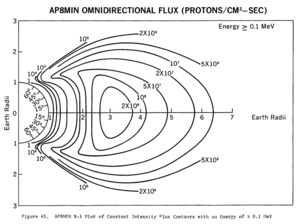 AP8 MIN omnidirectional proton flux ≥ 100 keV
 AP8 MIN omnidirectional proton flux ≥ 1 MeV
 AP8 MIN omnidirectional proton flux ≥ 400 MeV