Search This Blog

Wednesday, April 17, 2024

Hedonism

From Wikipedia, the free encyclopedia
 
A cosmological argument, in natural theology, is an argument which claims that the existence of God can be inferred from facts concerning causation, explanation, change, motion, contingency, dependency, or finitude with respect to the universe or some totality of objects. A cosmological argument can also sometimes be referred to as an argument from universal causation, an argument from first cause, the causal argument, or prime mover argument. Whichever term is employed, there are two basic variants of the argument, each with subtle yet important distinctions: in esse (essentiality), and in fieri (becoming).

The basic premises of all of these arguments involve the concept of causation. The conclusion of these arguments is that there exists a first cause, subsequently analysed to be God. The history of this argument goes back to Aristotle or earlier, was developed in Neoplatonism and early Christianity and later in medieval Islamic theology during the 9th to 12th centuries, and was re-introduced to medieval Christian theology in the 13th century by Thomas Aquinas. The cosmological argument is closely related to the principle of sufficient reason as addressed by Gottfried Leibniz and Samuel Clarke, itself a modern exposition of the claim that "nothing comes from nothing" attributed to Parmenides.

Contemporary defenders of cosmological arguments include William Lane Craig, Robert Koons, and Alexander Pruss.

History

Plato and Aristotle, depicted here in Raphael's The School of Athens, both developed first cause arguments.

Plato (c. 427–347 BC) and Aristotle (c. 384–322 BC) both posited first cause arguments, though each had certain notable caveats.[7] In The Laws (Book X), Plato posited that all movement in the world and the Cosmos was "imparted motion". This required a "self-originated motion" to set it in motion and to maintain it. In Timaeus, Plato posited a "demiurge" of supreme wisdom and intelligence as the creator of the Cosmos.

Aristotle argued against the idea of a first cause, often confused with the idea of a "prime mover" or "unmoved mover" (πρῶτον κινοῦν ἀκίνητον or primus motor) in his Physics and Metaphysics. Aristotle argued in favor of the idea of several unmoved movers, one powering each celestial sphere, which he believed lived beyond the sphere of the fixed stars, and explained why motion in the universe (which he believed was eternal) had continued for an infinite period of time. Aristotle argued the atomist's assertion of a non-eternal universe would require a first uncaused cause – in his terminology, an efficient first cause – an idea he considered a nonsensical flaw in the reasoning of the atomists.

Like Plato, Aristotle believed in an eternal cosmos with no beginning and no end (which in turn follows Parmenides' famous statement that "nothing comes from nothing"). In what he called "first philosophy" or metaphysics, Aristotle did intend a theological correspondence between the prime mover and a deity; functionally, however, he provided an explanation for the apparent motion of the "fixed stars" (now understood as the daily rotation of the Earth). According to his theses, immaterial unmoved movers are eternal unchangeable beings that constantly think about thinking, but being immaterial, they are incapable of interacting with the cosmos and have no knowledge of what transpires therein. From an "aspiration or desire", the celestial spheres, imitate that purely intellectual activity as best they can, by uniform circular motion. The unmoved movers inspiring the planetary spheres are no different in kind from the prime mover, they merely suffer a dependency of relation to the prime mover. Correspondingly, the motions of the planets are subordinate to the motion inspired by the prime mover in the sphere of fixed stars. Aristotle's natural theology admitted no creation or capriciousness from the immortal pantheon, but maintained a defense against dangerous charges of impiety.

Plotinus, a third-century Platonist, taught that the One transcendent absolute caused the universe to exist simply as a consequence of its existence (creatio ex deo). His disciple Proclus stated "The One is God".

Centuries later, the Islamic philosopher Avicenna (c. 980–1037) inquired into the question of being, in which he distinguished between essence (māhiyya) and existence (wuǧūd). He argued that the fact of existence could not be inferred from or accounted for by the essence of existing things, and that form and matter by themselves could not originate and interact with the movement of the Universe or the progressive actualization of existing things. Thus, he reasoned that existence must be due to an agent cause that necessitates, imparts, gives, or adds existence to an essence. To do so, the cause must coexist with its effect and be an existing thing.

Steven Duncan writes that it "was first formulated by a Greek-speaking Syriac Christian neo-Platonist, John Philoponus, who claims to find a contradiction between the Greek pagan insistence on the eternity of the world and the Aristotelian rejection of the existence of any actual infinite". Referring to the argument as the "'Kalam' cosmological argument", Duncan asserts that it "received its fullest articulation at the hands of [medieval] Muslim and Jewish exponents of Kalam ("the use of reason by believers to justify the basic metaphysical presuppositions of the faith").

Thomas Aquinas (c. 1225–1274) adapted and enhanced the argument he found in his reading of Aristotle, Avicenna (the Proof of the Truthful), and Maimonides to form one of the most influential versions of the cosmological argument. His conception of first cause was the idea that the Universe must be caused by something that is itself uncaused, which he claimed is that which we call God:

The second way is from the nature of the efficient cause. In the world of sense we find there is an order of efficient causes. There is no case known (neither is it, indeed, possible) in which a thing is found to be the efficient cause of itself; for so it would be prior to itself, which is impossible. Now in efficient causes it is not possible to go on to infinity, because in all efficient causes following in order, the first is the cause of the intermediate cause, and the intermediate is the cause of the ultimate cause, whether the intermediate cause be several, or only one. Now to take away the cause is to take away the effect. Therefore, if there be no first cause among efficient causes, there will be no ultimate, nor any intermediate cause. But if in efficient causes it is possible to go on to infinity, there will be no first efficient cause, neither will there be an ultimate effect, nor any intermediate efficient causes; all of which is plainly false. Therefore it is necessary to admit a first efficient cause, to which everyone gives the name of God.

Importantly, Aquinas' Five Ways, given the second question of his Summa Theologica, are not the entirety of Aquinas' demonstration that the Christian God exists. The Five Ways form only the beginning of Aquinas' Treatise on the Divine Nature.

Versions of the argument

Argument from contingency

In the scholastic era, Aquinas formulated the "argument from contingency", following Aristotle in claiming that there must be something to explain why the Universe exists. Since the Universe could, under different circumstances, conceivably not exist (contingency), its existence must have a cause – not merely another contingent thing, but something that exists by necessity (something that must exist in order for anything else to exist). In other words, even if the Universe has always existed, it still owes its existence to an uncaused cause, Aquinas further said: "... and this we understand to be God."

Aquinas's argument from contingency allows for the possibility of a Universe that has no beginning in time. It is a form of argument from universal causation. Aquinas observed that, in nature, there were things with contingent existences. Since it is possible for such things not to exist, there must be some time at which these things did not in fact exist. Thus, according to Aquinas, there must have been a time when nothing existed. If this is so, there would exist nothing that could bring anything into existence. Contingent beings, therefore, are insufficient to account for the existence of contingent beings: there must exist a necessary being whose non-existence is an impossibility, and from which the existence of all contingent beings is ultimately derived.

Aquinas' argument from contingency may also be formulated like this: if each contingently existing being considers himself Bn, then, because he exists contingently, he depends for his existence on a prior being Bn-1. Now, Bn-1 likewise, if it is contingent, depends on Bn-2. Nevertheless, this series cannot go on until Infinity. At a certain time, we will arrive at a B1, the First Being in existence, and since there is no "zeroth" Being or B0, B1 exists Necessarily, i.e. is not a contingent being. This was Aquinas' Third Way, under Question 2, Article 3 in the Summa Theologica

The German philosopher Gottfried Leibniz made a similar argument with his principle of sufficient reason in 1714. "There can be found no fact that is true or existent, or any true proposition," he wrote, "without there being a sufficient reason for its being so and not otherwise, although we cannot know these reasons in most cases." He formulated the cosmological argument succinctly: "Why is there something rather than nothing? The sufficient reason ... is found in a substance which ... is a necessary being bearing the reason for its existence within itself."

Leibniz's argument from contingency is one of the most popular cosmological arguments in philosophy of religion. It attempts to prove the existence of a necessary being and infer that this being is God. Alexander Pruss formulates the argument as follows:

  1. Every contingent fact has an explanation.
  2. There is a contingent fact that includes all other contingent facts.
  3. Therefore, there is an explanation of this fact.
  4. This explanation must involve a necessary being.
  5. This necessary being is God.

Premise 1 is a form of the principle of sufficient reason stating that all contingently true sentences (i.e. contingent facts) have a sufficient explanation as to why they are the case. Premise 2 refers to what is known as the Big Conjunctive Contingent Fact (abbreviated BCCF), and the BCCF is generally taken to be the logical conjunction of all contingent facts.[24] It can be thought about as the sum total of all contingent reality. Premise 3 then concludes that the BCCF has an explanation, as every contingency does (in virtue of the PSR). It follows that this explanation is non-contingent (i.e. necessary); no contingency can explain the BCCF, because every contingent fact is a part of the BCCF. Statement 5, which is either seen as a premise or a conclusion, infers that the necessary being which explains the totality of contingent facts is God. Several philosophers of religion, such as Joshua Rasmussen and T. Ryan Byerly, have argued for the inference from (4) to (5).

In esse and in fieri

The difference between the arguments from causation in fieri and in esse is a fairly important one. In fieri is generally translated as "becoming", while in esse is generally translated as "in essence". In fieri, the process of becoming, is similar to building a house. Once it is built, the builder walks away, and it stands on its own accord; compare the watchmaker analogy. (It may require occasional maintenance, but that is beyond the scope of the first cause argument.)

In esse (essence) is more akin to the light from a candle or the liquid in a vessel. George Hayward Joyce, SJ, explained that, "where the light of the candle is dependent on the candle's continued existence, not only does a candle produce light in a room in the first instance, but its continued presence is necessary if the illumination is to continue. If it is removed, the light ceases. Again, a liquid receives its shape from the vessel in which it is contained; but were the pressure of the containing sides withdrawn, it would not retain its form for an instant." This form of the argument is far more difficult to separate from a purely first cause argument than is the example of the house's maintenance above, because here the first cause is insufficient without the candle's or vessel's continued existence.

The philosopher Robert Koons has stated a new variant on the cosmological argument. He says that to deny causation is to deny all empirical ideas – for example, if we know our own hand, we know it because of the chain of causes including light being reflected upon one's eyes, stimulating the retina and sending a message through the optic nerve into your brain. He summarised the purpose of the argument as "that if you don't buy into theistic metaphysics, you're undermining empirical science. The two grew up together historically and are culturally and philosophically inter-dependent ... If you say I just don't buy this causality principle – that's going to be a big big problem for empirical science." This in fieri version of the argument therefore does not intend to prove God, but only to disprove objections involving science, and the idea that contemporary knowledge disproves the cosmological argument.

Kalām cosmological argument

William Lane Craig, who was principally responsible for re-popularizing this argument in Western philosophy, presents it in the following general form:

  1. Whatever begins to exist has a cause of its existence.
  2. The universe began to exist.
  3. Therefore, the universe has a cause of its existence.

Craig analyses this cause in The Blackwell Companion to Natural Theology and says that this cause must be uncaused, beginningless, changeless, timeless, spaceless, extraordinarily powerful, and personal.

Metaphysical argument for the existence of God

Duns Scotus, the influential Medieval Christian theologian, created a metaphysical argument for the existence of God. Though it was inspired by Aquinas' argument from motion, he, like other philosophers and theologians, believed that his statement for God's existence could be considered separate to Aquinas'. His explanation for God's existence is long, and can be summarised as follows:

  1. Something can be produced.
  2. It is produced by itself, by nothing, or by another.
  3. Not by nothing, because nothing causes nothing.
  4. Not by itself, because an effect never causes itself.
  5. Therefore, by another A.
  6. If A is first then we have reached the conclusion.
  7. If A is not first, then we return to 2).
  8. From 3) and 4), we produce another- B. The ascending series is either infinite or finite.
  9. An infinite series is not possible.
  10. Therefore, God exists.

Scotus deals immediately with two objections he can see: first, that there cannot be a first, and second, that the argument falls apart when 1) is questioned. He states that infinite regress is impossible, because it provokes unanswerable questions, like, in modern English, "What is infinity minus infinity?" The second he states can be answered if the question is rephrased using modal logic, meaning that the first statement is instead "It is possible that something can be produced."

Cosmological argument and infinite regress

Depending on its formulation, the cosmological argument is an example of a positive infinite regress argument. An infinite regress is an infinite series of entities governed by a recursive principle that determines how each entity in the series depends on or is produced by its predecessor. An infinite regress argument is an argument against a theory based on the fact that this theory leads to an infinite regress. A positive infinite regress argument employs the regress in question to argue in support of a theory by showing that its alternative involves a vicious regress. The regress relevant for the cosmological argument is the regress of causes: an event occurred because it was caused by another event that occurred before it, which was itself caused by a previous event, and so on. For an infinite regress argument to be successful, it has to demonstrate not just that the theory in question entails an infinite regress but also that this regress is vicious. Once the viciousness of the regress of causes is established, the cosmological argument can proceed to its positive conclusion by holding that it is necessary to posit a first cause in order to avoid it.

A regress can be vicious due to metaphysical impossibility, implausibility or explanatory failure. It is sometimes held that the regress of causes is vicious because it is metaphysically impossible, i.e. that it involves an outright contradiction. But it is difficult to see where this contradiction lies unless an additional assumption is accepted: that actual infinity is impossible. But this position is opposed to infinity in general, not just specifically to the regress of causes. A more promising view is that the regress of causes is to be rejected because it is implausible. Such an argument can be based on empirical observation, e.g. that, to the best of our knowledge, our universe had a beginning in the form of the Big Bang (albeit the possibility that it existed for eternity before the Big Bang is also not strictly excluded on physics grounds alone). But it can also be based on more abstract principles, like Ockham's razor (parsimony), which posits that we should avoid ontological extravagance by not multiplying entities without necessity. A third option is to see the regress of causes as vicious due to explanatory failure, i.e. that it does not solve the problem it was formulated to solve or that it assumes already in disguised form what it was supposed to explain. According to this position, we seek to explain one event in the present by citing an earlier event that caused it. But this explanation is incomplete unless we can come to understand why this earlier event occurred, which is itself explained by its own cause and so on. At each step, the occurrence of an event has to be assumed. So it fails to explain why anything at all occurs, why there is a chain of causes to begin with.

Objections and counterarguments

What caused the first cause?

One objection to the argument asks why a first cause is unique in that it does not require any causes. Proponents argue that the first cause is exempt from having a cause, as this is part of what it is to be the first cause, while opponents argue that this is special pleading or otherwise untrue. Critics often press that arguing for the first cause's exemption raises the question of why the first cause is indeed exempt, whereas defenders maintain that this question has been answered by the various arguments, emphasizing that none of the major cosmological arguments rests on the premise that everything has a cause, and so the question does not address the actual premises of an argument and rests on a misunderstanding of them.

William Lane Craig, who popularized and is notable for defending the Kalam cosmological argument, argues that the infinite is impossible, whichever perspective the viewer takes, and so there must always have been one unmoved thing to begin the universe. He uses Hilbert's paradox of the Grand Hotel and the question "What is infinity minus infinity?" to illustrate the idea that the infinite is metaphysically, mathematically, and even conceptually impossible. Other reasons include the fact that it is impossible to count down from infinity, and that, had the universe existed for an infinite amount of time, every possible event, including the final end of the universe, would already have occurred. He therefore states his argument in three points: firstly, everything that begins to exist has a cause of its existence; secondly, the universe began to exist; so, thirdly, therefore, the universe has a cause of its existence. Craig argues in the Blackwell Companion to Natural Theology that there cannot be an infinite regress of causes and thus there must be a first uncaused cause, even if one posits a plurality of causes of the universe. He argues Occam's razor may be employed to remove unneeded further causes of the universe to leave a single uncaused cause.

Secondly, it is argued that the premise of causality has been arrived at via a posteriori (inductive) reasoning, which is dependent on experience. David Hume highlighted this problem of induction and argued that causal relations were not true a priori. However, as to whether inductive or deductive reasoning is more valuable remains a matter of debate, with the general conclusion being that neither is prominent. Opponents of the argument tend to argue that it is unwise to draw conclusions from an extrapolation of causality beyond experience. Andrew Loke replies that, according to the Kalam cosmological argument, only things which begin to exist require a cause. On the other hand, something that is without beginning has always existed and therefore does not require a cause. The Kalam and the Thomistic cosmological argument posit that there cannot be an actual infinite regress of causes, therefore there must be an uncaused first cause that is beginningless and does not require a cause.

Not evidence for a theistic God

According to this objection, the basic cosmological argument merely establishes that a first cause exists, not that it has the attributes of a theistic god, such as omniscience, omnipotence, and omnibenevolence. This is why the argument is often expanded to assert that at least some of these attributes are necessarily true, for instance in the modern Kalam argument given above.

Defenders of the cosmological arguments also reply that theologians of note are aware of the need to additionally prove other attributes of the first cause beyond that one exists. One notable example of this is found in Aquinas' Summa Theologiae in which much of the first part (Prima Pars) is devoted to establishing the attributes of this first cause, such as its uniqueness, perfection, and intelligence. Thus defenders of cosmological arguments would reply that while it is true that the cosmological argument only establishes a first cause, this is merely the first step which then allows for the demonstration of the other theistic attributes.

Existence of causal loops

A causal loop is a form of predestination paradox arising where traveling backwards in time is deemed a possibility. A sufficiently powerful entity in such a world would have the capacity to travel backwards in time to a point before its own existence, and to then create itself, thereby initiating everything which follows from it.

The usual reason given to refute the possibility of a causal loop is that it requires that the loop as a whole be its own cause. Richard Hanley argues that causal loops are not logically, physically, or epistemically impossible: "[In timed systems,] the only possibly objectionable feature that all causal loops share is that coincidence is required to explain them." However, Andrew Loke argues that causal loop of the type that is supposed to avoid a first cause suffers from the problem of vicious circularity and thus it would not work.

Existence of infinite causal chains

David Hume and later Paul Edwards have invoked a similar principle in their criticisms of the cosmological argument. William L. Rowe has called this the Hume-Edwards principle:

If the existence of every member of a set is explained, the existence of that set is thereby explained.

Nevertheless, David White argues that the notion of an infinite causal regress providing a proper explanation is fallacious. Furthermore, in Hume's Dialogues Concerning Natural Religion, the character Demea states that even if the succession of causes is infinite, the whole chain still requires a cause. To explain this, suppose there exists a causal chain of infinite contingent beings. If one asks the question, "Why are there any contingent beings at all?", it does not help to be told that "There are contingent beings because other contingent beings caused them." That answer would just presuppose additional contingent beings. An adequate explanation of why some contingent beings exist would invoke a different sort of being, a necessary being that is not contingent. A response might suppose each individual is contingent but the infinite chain as a whole is not, or the whole infinite causal chain is its own cause.

Severinsen argues that there is an "infinite" and complex causal structure. White tried to introduce an argument "without appeal to the principle of sufficient reason and without denying the possibility of an infinite causal regress". A number of other arguments have been offered to demonstrate that an actual infinite regress cannot exist, viz. the argument for the impossibility of concrete actual infinities, the argument for the impossibility of traversing an actual infinite, the argument from the lack of capacity to begin to exist, and various arguments from paradoxes.

Other defenders of cosmological arguments such as Ed Feser argue that the type of series in which causes are hierarchically dependent (essentially ordered or per se series) one on the other, cannot regress to infinity, even if it may be possible for causal series which are extended backward through time (accidentally ordered or per accidens series) to regress infinitely. The rationale for this is that in a hierarchical per se causal series, each member cannot so much as act without the concurrent actualization or causation of more fundamental members of the series; thus an infinite hierarchical series would mean that the entire series is composed of members none of which can act of itself, which is impossible. An example of such a series would be the composition of water, which depends on the simultaneous composition of hydrogen and oxygen atoms, which in turn depend on the simultaneous composition of protons, neutrons, and electrons, etc. into deeper levels of the hierarchy of physical reality. This is contrasted with an accidentally ordered or linear series - parents causing their children to begin to exist, who in turn cause their children to begin to exist - in which one member in the series may continue to act even if whatever caused it has ceased to exist, and so there is seemingly no issue if this type of series regresses infinitely; the impossibility of the infinite regress in an essentially ordered causal series would suffice for at least some varieties of cosmological arguments. Further discussion on this point can be found under essential and accidental causal chains.

Big Bang cosmology

Some cosmologists and physicists argue that a challenge to the cosmological argument is the nature of time: "One finds that time just disappears from the Wheeler–DeWitt equation" (Carlo Rovelli). The Big Bang theory states that it is the point in which all dimensions came into existence, the start of both space and time. Then, the question "What was there before the Universe?" makes no sense; the concept of "before" becomes meaningless when considering a situation without time. This has been put forward by J. Richard Gott III, James E. Gunn, David N. Schramm, and Beatrice Tinsley, who said that asking what occurred before the Big Bang is like asking what is north of the North Pole. However, some cosmologists and physicists do attempt to investigate causes for the Big Bang, using such scenarios as the collision of membranes.

Philosopher Edward Feser argues that most of the classical philosophers' cosmological arguments for the existence of God do not depend on the Big Bang or whether the universe had a beginning. The question is not about what got things started, or how long they have been going, but rather what keeps them going.

Islamic world contributions to Medieval Europe

From Wikipedia, the free encyclopedia
A Christian and a Muslim playing chess, illustration from the Book of Games of Alfonso X (c. 1285).

During the High Middle Ages, the Islamic world was at its cultural peak, supplying information and ideas to Europe, via Al-Andalus, Sicily and the Crusader kingdoms in the Levant. These included Latin translations of the Greek Classics and of Arabic texts in astronomy, mathematics, science, and medicine. Translation of Arabic philosophical texts into Latin "led to the transformation of almost all philosophical disciplines in the medieval Latin world", with a particularly strong influence of Muslim philosophers being felt in natural philosophy, psychology and metaphysics. Other contributions included technological and scientific innovations via the Silk Road, including Chinese inventions such as paper, compass and gunpowder.

The Islamic world also influenced other aspects of medieval European culture, partly by original innovations made during the Islamic Golden Age, including various fields such as the arts, agriculture, alchemy, music, pottery, etc.

Many Arabic loanwords in Western European languages, including English, mostly via Old French, date from this period. This includes traditional star names such as Aldebaran, scientific terms like alchemy (whence also chemistry), algebra, algorithm, etc. and names of commodities such as sugar, camphor, cotton, coffee, etc.

Transmission routes

The Tabula Rogeriana, drawn by Al-Idrisi for Roger II of Sicily in 1154, was one of the most advanced world maps of its era.

Europe and the Islamic lands had multiple points of contact during the Middle Ages. The main points of transmission of Islamic knowledge to Europe lay in Sicily and in Spain, particularly in Toledo (with Gerard of Cremone, 1114–1187, following the conquest of the city by Spanish Christians in 1085). In Sicily, following the Islamic conquest of the island in 965 and its reconquest by the Normans in 1091, a syncretistic Norman–Arab–Byzantine culture developed, exemplified by rulers such as King Roger II, who had Islamic soldiers, poets and scientists at his court. The Moroccan Muhammad al-Idrisi wrote The Book of Pleasant Journeys into Faraway Lands or Tabula Rogeriana, one of the greatest geographical treatises of the Middle Ages, for Roger.

The Crusades also intensified exchanges between Europe and the Levant, with the Italian maritime republics taking a major role in these exchanges. In the Levant, in such cities as Antioch, Arab and Latin cultures intermixed intensively.

During the 11th and 12th centuries, many Christian scholars traveled to Muslim lands to learn sciences. Notable examples include Leonardo Fibonacci (c. 1170 –c. 1250), Adelard of Bath (c. 1080–c. 1152) and Constantine the African (1017–1087). (inaccurate: None of the three mentioned actually "traveled to Muslim lands to learn sciences", Constantine may possibly have been born there in Arab lands, Fibonacci found himself there for family reasons, while Adelard probably learnt Arabic in Christian lands). From the 11th to the 14th centuries, numerous European students attended Muslim centers of higher learning (which the author calls "universities") to study medicine, philosophy, mathematics, cosmography and other subjects.

Aristotelianism and other philosophies

A medieval Arabic representation of Aristotle teaching a student.

In the Middle East, many classical Greek texts, especially the works of Aristotle, were translated into Syriac during the 6th and 7th centuries by Nestorian, Melkite or Jacobite monks living in Palestine, or by Greek exiles from Athens or Edessa who visited Islamic centres of higher learning. The Islamic world then kept, translated, and developed many of these texts, especially in centers of learning such as Baghdad, where a "House of Wisdom" with thousands of manuscripts existed as early as 832. These texts were in turn translated into Latin by scholars such as Michael Scot (who made translations of Historia Animalium and On the Soul as well as of Averroes's commentaries) during the Middle Ages. Eastern Christians played an important role in exploiting this knowledge, especially through the Christian Aristotelian School of Baghdad in the 11th and 12th centuries.

Later Latin translations of these texts originated in multiple places. Toledo, Spain (with Gerard of Cremona's Almagest) and Sicily became the main points of transmission of knowledge from the Islamic world to Europe. Burgundio of Pisa (died 1193) discovered lost texts of Aristotle in Antioch and translated them into Latin.

From Islamic Spain, the Arabic philosophical literature was translated into Hebrew, Latin, and Ladino. The Jewish philosopher Moses Maimonides, Muslim sociologist-historian Ibn Khaldun, Carthage citizen Constantine the African who translated Greek medical texts, and Al-Khwarizmi's collation of mathematical techniques were important figures of the Golden Age.

Averroes was influential in the rise of secular thought in Western Europe.

Avicennism and Averroism are terms for the revival of the Peripatetic school in medieval Europe due to the influence of Avicenna and Averroes, respectively. Avicenna was an important commentator on the works of Aristotle, modifying it with his own original thinking in some areas, notably logic. The main significance of Latin Avicennism lies in the interpretation of Avicennian doctrines such as the nature of the soul and his existence-essence distinction, along with the debates and censure that they raised in scholastic Europe. This was particularly the case in Paris, where so-called Arabic culture was proscribed in 1210, though the influence of his psychology and theory of knowledge upon William of Auvergne and Albertus Magnus have been noted.

The effects of Avicennism were later submerged by the much more influential Averroism, the Aristotelianism of Averroes, one of the most influential Muslim philosophers in the West. Averroes disagreed with Avicenna's interpretations of Aristotle in areas such as the unity of the intellect, and it was his interpretation of Aristotle which had the most influence in medieval Europe. Dante Aligheri argues along Averroist lines for a secularist theory of the state in De Monarchia. Averroes also developed the concept of "existence precedes essence".

Imaginary debate between Averroes and Porphyry. Monfredo de Monte Imperiali Liber de herbis, 14th century.

Al-Ghazali also had an important influence on medieval Christian philosophy along with Jewish thinkers like Maimonides.

George Makdisi (1989) has suggested that two particular aspects of Renaissance humanism have their roots in the medieval Islamic world, the "art of dictation, called in Latin, ars dictaminis," and "the humanist attitude toward classical language". He notes that dictation was a necessary part of Arabic scholarship (where the vowel sounds need to be added correctly based on the spoken word), and argues that the medieval Italian use of the term "ars dictaminis" makes best sense in this context. He also believes that the medieval humanist favouring of classical Latin over medieval Latin makes most sense in the context of a reaction to Arabic scholarship, with its study of the classical Arabic of the Koran in preference to medieval Arabic.

Sciences

A page from Frederick Rosen's 1831 edition of Al-Khwarizmi's Algebra alongside the corresponding English translation.

During the Islamic Golden Age, certain advances were made in scientific fields, notably in mathematics and astronomy (algebra, spherical trigonometry), and in chemistry, etc. which were later also transmitted to the West.

Stefan of Pise translated into Latin around 1127 an Arab manual of medical theory. The method of algorism for performing arithmetic with the Hindu–Arabic numeral system was developed by the Persian al-Khwarizmi in the 9th century, and introduced in Europe by Leonardo Fibonacci (1170–1250). A translation by Robert of Chester of the Algebra by al-Kharizmi is known as early as 1145. Ibn al-Haytham (Alhazen, 980–1037) compiled treatises on optical sciences, which were used as references by Newton and Descartes. Medical sciences were also highly developed in Islam as testified by the Crusaders, who relied on Arab doctors on numerous occasions. Joinville reports he was saved in 1250 by a "Saracen" doctor.

Surgical operation, 15th-century Turkish manuscript

Contributing to the growth of European science was the major search by European scholars such as Gerard of Cremona for new learning. These scholars were interested in ancient Greek philosophical and scientific texts (notably the Almagest) which were not obtainable in Latin in Western Europe, but which had survived and been translated into Arabic in the Muslim world. Gerard was said to have made his way to Toledo in Spain and learnt Arabic specifically because of his "love of the Almagest". While there he took advantage of the "abundance of books in Arabic on every subject". Islamic Spain and Sicily were particularly productive areas because of the proximity of multi-lingual scholars. These scholars translated many scientific and philosophical texts from Arabic into Latin. Gerard personally translated 87 books from Arabic into Latin, including the Almagest, and also Muhammad ibn Mūsā al-Khwārizmī's On Algebra and Almucabala, Jabir ibn Aflah's Elementa astronomica, al-Kindi's On Optics, Ahmad ibn Muhammad ibn Kathīr al-Farghānī's On Elements of Astronomy on the Celestial Motions, al-Farabi's On the Classification of the Sciences, the chemical and medical works of Rhazes, the works of Thabit ibn Qurra and Hunayn ibn Ishaq, and the works of Arzachel, Jabir ibn Aflah, the Banū Mūsā, Abū Kāmil Shujā ibn Aslam, Abu al-Qasim al-Zahrawi (Abulcasis), and Ibn al-Haytham (including the Book of Optics).

Alchemy

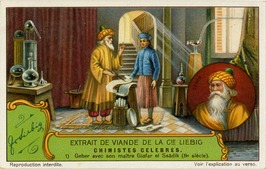
Jabir ibn Hayyan depicted in Liebig's Extract of Meat Company trading card "Chimistes Celebres", 1929.

Western alchemy was directly dependent upon Arabic sources. Latin translations of Arabic alchemical works such as those attributed to Khalid ibn Yazid (Latin: Calid), Jabir ibn Hayyan (Latin: Geber), Abu Bakr al-Razi (Latin: Rhazes) and Ibn Umayl (Latin: Senior Zadith) were standard texts for European alchemists. Some important texts translated from the Arabic include the Liber de compositione alchemiae ("Book on the Composition of Alchemy") attributed to Khalid ibn Yazid and translated by Robert of Chester in 1144, the Liber de septuaginta ("Book of Seventy") attributed to Jabir ibn Hayyan and translated by Gerard of Cremona (before 1187), Abu Bakr al-Razi's Liber secretorum Bubacaris, and Ibn Umayl's Tabula chemica.

Many texts were also translated from anonymous Arabic sources and then falsely attributed to various authors, as for example the De aluminibus et salibus ("On Alums and Salts"), an 11th- or 12th-century text attributed in some manuscripts to Hermes Trismegistus or Abu Bakr al-Razi. Other texts were directly written in Latin but still attributed to Arabic authors, such as the influential Summa perfectionis ("The Sum of Perfection") and other 13th-/14th-century works by pseudo-Geber. Although these were original and often innovative texts, their anonymous authors probably knew Arabic and were still intimately familiar with Arabic sources.

Several technical Arabic words from Arabic alchemical works, such as alkali, found their way into European languages and became part of scientific vocabulary.

Astronomy, mathematics and physics

A German manuscript page teaching use of Arabic numerals (Hans Talhoffer, 1459)

The translation of Al-Khwarizmi's work greatly influenced mathematics in Europe. As Professor Victor J. Katz writes: "Most early algebra works in Europe in fact recognized that the first algebra works in that continent were translations of the work of al-Khwärizmï and other Islamic authors. There was also some awareness that much of plane and spherical trigonometry could be attributed to Islamic authors". The words algorithm, deriving from Al-Khwarizmi's Latinized name Algorismi, and algebra, deriving from the title of his AD 820 book Hisab al-jabr w’al-muqabala, Kitab al-Jabr wa-l-Muqabala are themselves Arabic loanwords. This and other Arabic astronomical and mathematical works, such as those by al-Battani and Muhammad al-Fazari's Great Sindhind (based on the Surya Siddhanta and the works of Brahmagupta). were translated into Latin during the 12th century.

A European and an Arab practicing geometry together. 15th-century manuscript
Astrolabe quadrant, England, 1388

Al-Khazini's Zij as-Sanjari (1115–1116) was translated into Greek by Gregory Chioniades in the 13th century and was studied in the Byzantine Empire. The astronomical modifications to the Ptolemaic model made by al-Battani and Averroes led to non-Ptolemaic models produced by Mo'ayyeduddin Urdi (Urdi lemma), Nasīr al-Dīn al-Tūsī (Tusi-couple) and Ibn al-Shatir, which were later adapted into the Copernican heliocentric model. Abū al-Rayhān al-Bīrūnī's Ta'rikh al-Hind and Kitab al-qanun al-Mas’udi were translated into Latin as Indica and Canon Mas’udicus respectively.

Fibonacci presented the first complete European account of Arabic numerals and the Hindu–Arabic numeral system in his Liber Abaci (1202).

Al-Jayyani's The book of unknown arcs of a sphere (a treatise on spherical trigonometry) had a "strong influence on European mathematics". Regiomantus' On Triangles (c. 1463) certainly took his material on spherical trigonometry (without acknowledgment) from Arab sources. Much of the material was taken from the 12th-century work of Jabir ibn Aflah, as noted in the 16th century by Gerolamo Cardano.

A short verse used by Fulbert of Chartres (952-970 –1028) to help remember some of the brightest stars in the sky gives us the earliest known use of Arabic loanwords in a Latin text: "Aldebaran stands out in Taurus, Menke and Rigel in Gemini, and Frons and bright Calbalazet in Leo. Scorpio, you have Galbalagrab; and you, Capricorn, Deneb. You, Batanalhaut, are alone enough for Pisces."

Ibn al-Haytham (Alhazen) wrote the Book of Optics (1021), in which he developed a theory of vision and light which built on the work of the Roman writer Ptolemy (but which rejected Ptolemy's theory that light was emitted by the eye, insisting instead that light rays entered the eye), and was the most significant advance in this field until Kepler. The Book of Optics was an important stepping stone in the history of the scientific method and history of optics. The Latin translation of the Book of Optics influenced the works of many later European scientists, including Roger Bacon and Johannes Kepler. The book also influenced other aspects of European culture. In religion, for example, John Wycliffe, the intellectual progenitor of the Protestant Reformation, referred to Alhazen in discussing the seven deadly sins in terms of the distortions in the seven types of mirrors analyzed in De aspectibus. In literature, Alhazen's Book of Optics is praised in Guillaume de Lorris' Roman de la Rose. In art, the Book of Optics laid the foundations for the linear perspective technique and may have influenced the use of optical aids in Renaissance art (see Hockney-Falco thesis). These same techniques were later employed in the maps made by European cartographers such as Paolo Toscanelli during the Age of Exploration.

The theory of motion developed by Avicenna from Aristotelian physics may have influenced Jean Buridan's theory of impetus (the ancestor of the inertia and momentum concepts). The work of Galileo Galilei on classical mechanics (superseding Aristotelian physics) was also influenced by earlier medieval physics writers, including Avempace.

Other notable works include those of Nur Ed-Din Al Betrugi, notably On the Motions of the Heavens, Abu Ma'shar al-Balkhi's Introduction to Astrology, Abū Kāmil Shujā ibn Aslam's Algebra, and De Proprietatibus Elementorum, an Arabic work on geology written by a pseudo-Aristotle.

Medicine

European depiction of the Persian doctor al-Razi, in Gerard of Cremona's Receuil des traités de médecine (1250–1260). Gerard de Cremona translated numerous works by Muslim scholars, such as al-Razi and Ibn Sina.
Syrian medicinal jars c. 1300, excavated in Fenchurch Street, London. Museum of London

One of the most important medical works to be translated was Avicenna's The Canon of Medicine (1025), which was translated into Latin and then disseminated in manuscript and printed form throughout Europe. It remained a standard medical textbook in Europe until the early modern period, and during the 15th and 16th centuries alone, The Canon of Medicine was published more than thirty-five times. Avicenna noted the contagious nature of some infectious diseases (which he attributed to "traces" left in the air by a sick person), and discussed how to effectively test new medicines. He also wrote The Book of Healing, a more general encyclopedia of science and philosophy, which became another popular textbook in Europe. Muhammad ibn Zakarīya Rāzi wrote the Comprehensive Book of Medicine, with its careful description of and distinction between measles and smallpox, which was also influential in Europe. Abu al-Qasim al-Zahrawi wrote Kitab al-Tasrif, an encyclopedia of medicine which was particularly famed for its section on surgery. It included descriptions and diagrams of over 200 surgical instruments, many of which he developed. The surgery section was translated into Latin by Gerard of Cremona in the 12th century, and used in European medical schools for centuries, still being reprinted in the 1770s.

Facade of a meeting between a Muslim scholar and a Frankish lord

Other medical Arabic works translated into Latin during the medieval period include the works of Razi and Avicenna (including The Book of Healing and The Canon of Medicine), and Ali ibn Abbas al-Majusi's medical encyclopedia, The Complete Book of the Medical Art. Mark of Toledo in the early 13th century translated the Qur'an as well as various medical works.

Technology and culture

19th-century depiction of the Zisa, Palermo, showing Arab-Norman art and architecture combining Occidental features (such as the Classical pillars and friezes) with Islamic decorations and calligraphy.

Agriculture and textiles

Various fruits and vegetables were introduced to Europe in this period via the Middle East and North Africa, some from as far as China and India, including the artichoke, spinach, and aubergine.

Arts

Islamic decorative arts were highly valued imports to Europe throughout the Middle Ages. Largely because of accidents of survival, most surviving examples are those that were in the possession of the church. In the early period textiles were especially important, used for church vestments, shrouds, hangings and clothing for the elite. Islamic pottery of everyday quality was still preferred to European wares. Because decoration was mostly ornamental, or small hunting scenes and the like, and inscriptions were not understood, Islamic objects did not offend Christian sensibilities. Medieval art in Sicily is interesting stylistically because of the mixture of Norman, Arab and Byzantine influences in areas such as mosaics and metal inlays, sculpture, and bronze-working.

Writing

Pseudo-Kufic script in the Virgin Mary's halo, detail of Adoration of the Magi (1423) by Gentile da Fabriano. The script is further divided by rosettes like those on Mamluk dishes.

The Arabic Kufic script was often imitated for decorative effect in the West during the Middle Ages and the Renaissance, to produce what is known as pseudo-Kufic: "Imitations of Arabic in European art are often described as pseudo-Kufic, borrowing the term for an Arabic script that emphasizes straight and angular strokes, and is most commonly used in Islamic architectural decoration". Numerous cases of pseudo-Kufic are known from European art from around the 10th to the 15th century; usually the characters are meaningless, though sometimes a text has been copied. Pseudo-Kufic would be used as writing or as decorative elements in textiles, religious halos or frames. Many are visible in the paintings of Giotto. The exact reason for the incorporation of pseudo-Kufic in early Renaissance painting is unclear. It seems that Westerners mistakenly associated 13th- and 14th-century Middle-Eastern scripts as being identical with the scripts current during Jesus's time, and thus found natural to represent early Christians in association with them: "In Renaissance art, pseudo-Kufic script was used to decorate the costumes of Old Testament heroes like David". Another reason might be that artist wished to express a cultural universality for the Christian faith, by blending together various written languages, at a time when the church had strong international ambitions.

Carpets

The Somerset House Conference (1604) artist unknown, shows English and Spanish diplomats gathered around a table covered by an Oriental carpet.

Carpets of Middle-Eastern origin, either from the Ottoman Empire, the Levant or the Mamluk state of Egypt or Northern Africa, were a significant sign of wealth and luxury in Europe, as demonstrated by their frequent occurrence as important decorative features in paintings from the 13th century and continuing into the Baroque period. Such carpets, together with Pseudo-Kufic script offer an interesting example of the integration of Eastern elements into European painting, most particularly those depicting religious subjects.

Music

A number of musical instruments used in European music were influenced by Arabic musical instruments, including the rebec (an ancestor of the violin) from the rebab and the naker from naqareh The oud is cited as one of several precursors to the modern guitar.

Muslim and Christian playing lutes, in a miniature from the Cantigas de Santa Maria by King Alfonso X

Some scholars believe that the troubadors may have had Arabian origins, with Magda Bogin stating that the Arab poetic and musical tradition was one of several influences on European "courtly love poetry". Évariste Lévi-Provençal and other scholars stated that three lines of a poem by William IX of Aquitaine were in some form of Arabic, indicating a potential Andalusian origin for his works. The scholars attempted to translate the lines in question and produced various different translations; the medievalist Istvan Frank contended that the lines were not Arabic at all, but instead the result of the rewriting of the original by a later scribe.

The theory that the troubadour tradition was created by William after his experiences with Moorish arts while fighting with the Reconquista in Spain has been championed by Ramón Menéndez Pidal and Idries Shah, though George T. Beech states that there is only one documented battle that William fought in Spain, and it occurred towards the end of his life. However, Beech adds that William and his father did have Spanish individuals within their extended family, and that while there is no evidence he himself knew Arabic, he may have been friendly with some European Christians who could speak the language. Others state that the notion that William created the concept of troubadours is itself incorrect, and that his "songs represent not the beginnings of a tradition but summits of achievement in that tradition."

Technology

Syrian or Egyptian pieces of Islamic glass with Arabic inscriptions, excavated in London. Museum of London.
Early-16th century Andalusian dish with pseudo-Arabic script around the edge, excavated in London. Museum of London.

A number of technologies in the Islamic world were adopted in European medieval technology. These included various crops; various astronomical instruments, including the Greek astrolabe which Arab astronomers developed and refined into such instruments as the Quadrans Vetus, a universal horary quadrant which could be used for any latitude, and the Saphaea, a universal astrolabe invented by Abū Ishāq Ibrāhīm al-Zarqālī; the astronomical sextant; various surgical instruments, including refinements on older forms and completely new inventions; and advanced gearing in waterclocks and automata. Distillation was known to the Greeks and Romans, but was rediscovered in medieval Europe through the Arabs. The word alcohol (to describe the liquid produced by distillation) comes from Arabic al-kuhl. The word alembic (via the Greek Ambix) comes from Arabic al-anbiq. Islamic examples of complex water clocks and automata are believed to have strongly influenced the European craftsmen who produced the first mechanical clocks in the 13th century.

The importation of both the ancient and new technology from the Middle East and the Orient to Renaissance Europe represented “one of the largest technology transfers in world history.”

The Aldrevandini Beaker, enamelled glass from Venice, a Roman technique probably learned from Islamic glass. c. 1330.

In an influential 1974 paper, historian Andrew Watson suggested that there had been an Arab Agricultural Revolution between 700 and 1100, which had diffused a large number of crops and technologies from Spain into medieval Europe, where farming was mostly restricted to wheat strains obtained much earlier via central Asia. Watson listed eighteen crops, including sorghum from Africa, citrus fruits from China, and numerous crops from India such as mangos, rice, cotton and sugar cane, which were distributed throughout Islamic lands that, according to Watson, had previously not grown them. Watson argued that these introductions, along with an increased mechanization of agriculture, led to major changes in economy, population distribution, vegetation cover, agricultural production and income, population levels, urban growth, the distribution of the labour force, linked industries, cooking, diet and clothing in the Islamic world. Also transmitted via Muslim influence, a silk industry flourished, flax was cultivated and linen exported, and esparto grass, which grew wild in the more arid parts, was collected and turned into various articles. However Michael Decker has challenged significant parts of Watson's thesis, including whether all these crops were introduced to Europe during this period. Decker used literary and archaeological evidence to suggest that four of the listed crops (i.e. durum wheat, Asiatic rice, sorghum and cotton) were common centuries before the Islamic period, that the crops which were new were not as important as Watson had suggested, and generally arguing that Islamic agricultural practices in areas such as irrigation were more of an evolution from those of the ancient world than the revolution suggested by Watson.

The production of sugar from sugar cane, water clocks, pulp and paper, silk, and various advances in making perfume, were transferred from the Islamic world to medieval Europe. Fulling mills and advances in mill technology may have also been transmitted from the Islamic world to medieval Europe, along with the large-scale use of inventions like the suction pump, noria and chain pumps for irrigation purposes. According to Watson, "The Islamic contribution was less in the invention of new devices than in the application on a much wider scale of devices which in pre-Islamic times had been used only over limited areas and to a limited extent." These innovations made it possible for some industrial operations that were previously served by manual labour or draught animals to be driven by machinery in medieval Europe.

The spinning wheel was invented in the Islamic world by 1030. It later spread to China by 1090, and then spread from the Islamic world to Europe and India by the 13th century. The spinning wheel was fundamental to the cotton textile industry prior to the Industrial Revolution. It was a precursor to the spinning jenny, which was widely used during the Industrial Revolution. The spinning jenny was essentially an adaptation of the spinning wheel.

Coinage

Tarì gold coin of Roger II of Sicily, with Arabic inscriptions, minted in Palermo. British Museum.

While the earliest coins were minted and widely circulated in Europe, and Ancient Rome, Islamic coinage had some influence on Medieval European minting. The 8th-century English king Offa of Mercia minted a near-copy of Abbasid dinars struck in 774 by Caliph Al-Mansur with "Offa Rex" centered on the reverse. The moneyer visibly had little understanding of Arabic, as the Arabic text contains a number of errors.

A gold dinar of the English king Offa of Mercia, a copy of the dinars of the Abbasid Caliphate (774). It combines the Latin legend OFFA REX with Arabic legends. British Museum.
Crusader coins of the Kingdom of Jerusalem. Left: Denier in European style with Holy Sepulchre. Middle: One of the first Kingdom of Jerusalem gold coins, copying Islamic dinars. Right: Gold coin after 1250, with Christian symbols following Papal complaints. British Museum.

In Sicily, Malta and Southern Italy from about 913 tarì gold coins of Islamic origin were minted in great number by the Normans, Hohenstaufens and the early Angevins rulers. When the Normans invaded Sicily in the 12th century, they issued tarì coins bearing legends in Arabic and Latin. The tarìs were so widespread that imitations were made in southern Italy (Amalfi and Salerno) which only used illegible "pseudo-Kufic" imitations of Arabic.

According to Janet Abu-Lughod:

The preferred specie for international transactions before the 13th century, in Europe as well as the Middle East and even India, were the gold coins struck by Byzantium and then Egypt. It was not until after the 13th century that some Italian cities (Florence and Genoa) began to mint their own gold coins, but these were used to supplement rather than supplant the Middle Eastern coins already in circulation.

Literature

It was first suggested by Miguel Asín Palacios in 1919 that Dante Alighieri's Divine Comedy, considered the greatest epic of Italian literature, derived many features of and episodes about the hereafter directly or indirectly from Arabic works on Islamic eschatology, such as the Hadith and the spiritual writings of Ibn Arabi. The Kitab al-Miraj, concerning Muhammad's ascension to Heaven, was translated into Latin in 1264 or shortly before as Liber scalae Machometi, "The Book of Muhammad's Ladder". Dante was certainly aware of Muslim philosophy, naming Avicenna and Averroes last in his list of non-Christian philosophers in Limbo, alongside the great Greek and Latin philosophers. How strong the similarities are to Kitab al-Miraj remains a matter of scholarly debate however, with no clear evidence that Dante was in fact influenced.

Human extinction

From Wikipedia, the free encyclopedia https://en.wikipedia.org/wiki/Human_ext...