Search This Blog

Thursday, August 21, 2025

Molecular orbital

From Wikipedia, the free encyclopedia
Complete acetylene (H–C≡C–H) molecular orbital set. The left column shows MO's which are occupied in the ground state, with the lowest-energy orbital at the top. The white and grey line visible in some MO's is the molecular axis passing through the nuclei. The orbital wave functions are positive in the red regions and negative in the blue. The right column shows virtual MO's which are empty in the ground state, but may be occupied in excited states.

In chemistry, a molecular orbital is a mathematical function describing the location and wave-like behavior of an electron in a molecule. This function can be used to calculate chemical and physical properties such as the probability of finding an electron in any specific region. The terms atomic orbital and molecular orbital were introduced by Robert S. Mulliken in 1932 to mean one-electron orbital wave functions. At an elementary level, they are used to describe the region of space in which a function has a significant amplitude.

In an isolated atom, the orbital electrons' location is determined by functions called atomic orbitals. When multiple atoms combine chemically into a molecule by forming a valence chemical bond, the electrons' locations are determined by the molecule as a whole, so the atomic orbitals combine to form molecular orbitals. The electrons from the constituent atoms occupy the molecular orbitals. Mathematically, molecular orbitals are an approximate solution to the Schrödinger equation for the electrons in the field of the molecule's atomic nuclei. They are usually constructed by combining atomic orbitals or hybrid orbitals from each atom of the molecule, or other molecular orbitals from groups of atoms. They can be quantitatively calculated using the Hartree–Fock or self-consistent field (SCF) methods.

Molecular orbitals are of three types: bonding orbitals which have an energy lower than the energy of the atomic orbitals which formed them, and thus promote the chemical bonds which hold the molecule together; antibonding orbitals which have an energy higher than the energy of their constituent atomic orbitals, and so oppose the bonding of the molecule, and non-bonding orbitals which have the same energy as their constituent atomic orbitals and thus have no effect on the bonding of the molecule.

Overview

A molecular orbital (MO) can be used to represent the regions in a molecule where an electron occupying that orbital is likely to be found. Molecular orbitals are approximate solutions to the Schrödinger equation for the electrons in the electric field of the molecule's atomic nuclei. However calculating the orbitals directly from this equation is far too intractable a problem. Instead they are obtained from the combination of atomic orbitals, which predict the location of an electron in an atom. A molecular orbital can specify the electron configuration of a molecule: the spatial distribution and energy of one (or one pair of) electron(s). Most commonly a MO is represented as a linear combination of atomic orbitals (the LCAO-MO method), especially in qualitative or very approximate usage. They are invaluable in providing a simple model of bonding in molecules, understood through molecular orbital theory. Most present-day methods in computational chemistry begin by calculating the MOs of the system. A molecular orbital describes the behavior of one electron in the electric field generated by the nuclei and some average distribution of the other electrons. In the case of two electrons occupying the same orbital, the Pauli principle demands that they have opposite spin. Necessarily this is an approximation, and highly accurate descriptions of the molecular electronic wave function do not have orbitals (see configuration interaction).

Molecular orbitals are, in general, delocalized throughout the entire molecule. Moreover, if the molecule has symmetry elements, its nondegenerate molecular orbitals are either symmetric or antisymmetric with respect to any of these symmetries. In other words, the application of a symmetry operation S (e.g., a reflection, rotation, or inversion) to molecular orbital ψ results in the molecular orbital being unchanged or reversing its mathematical sign: Sψ = ±ψ. In planar molecules, for example, molecular orbitals are either symmetric (sigma) or antisymmetric (pi) with respect to reflection in the molecular plane. If molecules with degenerate orbital energies are also considered, a more general statement that molecular orbitals form bases for the irreducible representations of the molecule's symmetry group holds. The symmetry properties of molecular orbitals means that delocalization is an inherent feature of molecular orbital theory and makes it fundamentally different from (and complementary to) valence bond theory, in which bonds are viewed as localized electron pairs, with allowance for resonance to account for delocalization.

In contrast to these symmetry-adapted canonical molecular orbitals, localized molecular orbitals can be formed by applying certain mathematical transformations to the canonical orbitals. The advantage of this approach is that the orbitals will correspond more closely to the "bonds" of a molecule as depicted by a Lewis structure. As a disadvantage, the energy levels of these localized orbitals no longer have physical meaning. (The discussion in the rest of this article will focus on canonical molecular orbitals. For further discussions on localized molecular orbitals, see: natural bond orbital and sigma-pi and equivalent-orbital models.)

Formation of molecular orbitals

Molecular orbitals arise from allowed interactions between atomic orbitals, which are allowed if the symmetries (determined from group theory) of the atomic orbitals are compatible with each other. Efficiency of atomic orbital interactions is determined from the overlap (a measure of how well two orbitals constructively interact with one another) between two atomic orbitals, which is significant if the atomic orbitals are close in energy. Finally, the number of molecular orbitals formed must be equal to the number of atomic orbitals in the atoms being combined to form the molecule.

Qualitative discussion

For an imprecise, but qualitatively useful, discussion of the molecular structure, the molecular orbitals can be obtained from the "Linear combination of atomic orbitals molecular orbital method" ansatz. Here, the molecular orbitals are expressed as linear combinations of atomic orbitals.

Linear combinations of atomic orbitals (LCAO)

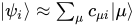
Molecular orbitals were first introduced by Friedrich Hund and Robert S. Mulliken in 1927 and 1928. The linear combination of atomic orbitals or "LCAO" approximation for molecular orbitals was introduced in 1929 by Sir John Lennard-Jones. His ground-breaking paper showed how to derive the electronic structure of the fluorine and oxygen molecules from quantum principles. This qualitative approach to molecular orbital theory is part of the start of modern quantum chemistry. Linear combinations of atomic orbitals (LCAO) can be used to estimate the molecular orbitals that are formed upon bonding between the molecule's constituent atoms. Similar to an atomic orbital, a Schrödinger equation, which describes the behavior of an electron, can be constructed for a molecular orbital as well. Linear combinations of atomic orbitals, or the sums and differences of the atomic wavefunctions, provide approximate solutions to the Hartree–Fock equations which correspond to the independent-particle approximation of the molecular Schrödinger equation. For simple diatomic molecules, the wavefunctions obtained are represented mathematically by the equations


where and are the molecular wavefunctions for the bonding and antibonding molecular orbitals, respectively, and are the atomic wavefunctions from atoms a and b, respectively, and and are adjustable coefficients. These coefficients can be positive or negative, depending on the energies and symmetries of the individual atomic orbitals. As the two atoms become closer together, their atomic orbitals overlap to produce areas of high electron density, and, as a consequence, molecular orbitals are formed between the two atoms. The atoms are held together by the electrostatic attraction between the positively charged nuclei and the negatively charged electrons occupying bonding molecular orbitals.

Bonding, antibonding, and nonbonding MOs

When atomic orbitals interact, the resulting molecular orbital can be of three types: bonding, antibonding, or nonbonding.

Bonding MOs:

  • Bonding interactions between atomic orbitals are constructive (in-phase) interactions.
  • Bonding MOs are lower in energy than the atomic orbitals that combine to produce them.

Antibonding MOs:

  • Antibonding interactions between atomic orbitals are destructive (out-of-phase) interactions, with a nodal plane where the wavefunction of the antibonding orbital is zero between the two interacting atoms
  • Antibonding MOs are higher in energy than the atomic orbitals that combine to produce them.

Nonbonding MOs:

  • Nonbonding MOs are the result of no interaction between atomic orbitals because of lack of compatible symmetries.
  • Nonbonding MOs will have the same energy as the atomic orbitals of one of the atoms in the molecule.

Sigma and pi labels for MOs

The type of interaction between atomic orbitals can be further categorized by the molecular-orbital symmetry labels σ (sigma), π (pi), δ (delta), φ (phi), γ (gamma) etc. These are the Greek letters corresponding to the atomic orbitals s, p, d, f and g respectively. The number of nodal planes containing the internuclear axis between the atoms concerned is zero for σ MOs, one for π, two for δ, three for φ and four for γ.

σ symmetry

A MO with σ symmetry results from the interaction of either two atomic s-orbitals or two atomic pz-orbitals. An MO will have σ-symmetry if the orbital is symmetric with respect to the axis joining the two nuclear centers, the internuclear axis. This means that rotation of the MO about the internuclear axis does not result in a phase change. A σ* orbital, sigma antibonding orbital, also maintains the same phase when rotated about the internuclear axis. The σ* orbital has a nodal plane that is between the nuclei and perpendicular to the internuclear axis.

π symmetry

A MO with π symmetry results from the interaction of either two atomic px orbitals or py orbitals. An MO will have π symmetry if the orbital is asymmetric with respect to rotation about the internuclear axis. This means that rotation of the MO about the internuclear axis will result in a phase change. There is one nodal plane containing the internuclear axis, if real orbitals are considered.

A π* orbital, pi antibonding orbital, will also produce a phase change when rotated about the internuclear axis. The π* orbital also has a second nodal plane between the nuclei.

δ symmetry

A MO with δ symmetry results from the interaction of two atomic dxy or dx2-y2 orbitals. Because these molecular orbitals involve low-energy d atomic orbitals, they are seen in transition-metal complexes. A δ bonding orbital has two nodal planes containing the internuclear axis, and a δ* antibonding orbital also has a third nodal plane between the nuclei.

φ symmetry

Suitably aligned f atomic orbitals overlap to form phi molecular orbital (a phi bond)

Theoretical chemists have conjectured that higher-order bonds, such as phi bonds corresponding to overlap of f atomic orbitals, are possible. There is no known example of a molecule purported to contain a phi bond.

Gerade and ungerade symmetry

For molecules that possess a center of inversion (centrosymmetric molecules) there are additional labels of symmetry that can be applied to molecular orbitals. Centrosymmetric molecules include:

Non-centrosymmetric molecules include:

If inversion through the center of symmetry in a molecule results in the same phases for the molecular orbital, then the MO is said to have gerade (g) symmetry, from the German word for even. If inversion through the center of symmetry in a molecule results in a phase change for the molecular orbital, then the MO is said to have ungerade (u) symmetry, from the German word for odd. For a bonding MO with σ-symmetry, the orbital is σg (s' + s'' is symmetric), while an antibonding MO with σ-symmetry the orbital is σu, because inversion of s' – s'' is antisymmetric. For a bonding MO with π-symmetry the orbital is πu because inversion through the center of symmetry for would produce a sign change (the two p atomic orbitals are in phase with each other but the two lobes have opposite signs), while an antibonding MO with π-symmetry is πg because inversion through the center of symmetry for would not produce a sign change (the two p orbitals are antisymmetric by phase).

MO diagrams

The qualitative approach of MO analysis uses a molecular orbital diagram to visualize bonding interactions in a molecule. In this type of diagram, the molecular orbitals are represented by horizontal lines; the higher a line the higher the energy of the orbital, and degenerate orbitals are placed on the same level with a space between them. Then, the electrons to be placed in the molecular orbitals are slotted in one by one, keeping in mind the Pauli exclusion principle and Hund's rule of maximum multiplicity (only 2 electrons, having opposite spins, per orbital; place as many unpaired electrons on one energy level as possible before starting to pair them). For more complicated molecules, the wave mechanics approach loses utility in a qualitative understanding of bonding (although is still necessary for a quantitative approach). Some properties:

  • A basis set of orbitals includes those atomic orbitals that are available for molecular orbital interactions, which may be bonding or antibonding
  • The number of molecular orbitals is equal to the number of atomic orbitals included in the linear expansion or the basis set
  • If the molecule has some symmetry, the degenerate atomic orbitals (with the same atomic energy) are grouped in linear combinations (called symmetry-adapted atomic orbitals (SO)), which belong to the representation of the symmetry group, so the wave functions that describe the group are known as symmetry-adapted linear combinations (SALC).
  • The number of molecular orbitals belonging to one group representation is equal to the number of symmetry-adapted atomic orbitals belonging to this representation
  • Within a particular representation, the symmetry-adapted atomic orbitals mix more if their atomic energy levels are closer.

The general procedure for constructing a molecular orbital diagram for a reasonably simple molecule can be summarized as follows:

1. Assign a point group to the molecule.

2. Look up the shapes of the SALCs.

3. Arrange the SALCs of each molecular fragment in order of energy, noting first whether they stem from s, p, or d orbitals (and put them in the order s < p < d), and then their number of internuclear nodes.

4. Combine SALCs of the same symmetry type from the two fragments, and from N SALCs form N molecular orbitals.

5. Estimate the relative energies of the molecular orbitals from considerations of overlap and relative energies of the parent orbitals, and draw the levels on a molecular orbital energy level diagram (showing the origin of the orbitals).

6. Confirm, correct, and revise this qualitative order by carrying out a molecular orbital calculation by using commercial software.

Bonding in molecular orbitals

Orbital degeneracy

Molecular orbitals are said to be degenerate if they have the same energy. For example, in the homonuclear diatomic molecules of the first ten elements, the molecular orbitals derived from the px and the py atomic orbitals result in two degenerate bonding orbitals (of low energy) and two degenerate antibonding orbitals (of high energy).

Ionic bonds

In an ionic bond, oppositely charged ions are bonded by electrostatic attraction. It is possible to describe ionic bonds with molecular orbital theory by treating them as extremely polar bonds. Their bonding orbitals are very close in energy to the atomic orbitals of the anion. They are also very similar in character to the anion's atomic orbitals, which means the electrons are completely shifted to the anion. In computer diagrams, the orbitals are centered on the anion's core.

Bond order

The bond order, or number of bonds, of a molecule can be determined by combining the number of electrons in bonding and antibonding molecular orbitals. A pair of electrons in a bonding orbital creates a bond, whereas a pair of electrons in an antibonding orbital negates a bond. For example, N2, with eight electrons in bonding orbitals and two electrons in antibonding orbitals, has a bond order of three, which constitutes a triple bond.

Bond strength is proportional to bond order—a greater amount of bonding produces a more stable bond—and bond length is inversely proportional to it—a stronger bond is shorter.

There are rare exceptions to the requirement of molecule having a positive bond order. Although Be2 has a bond order of 0 according to MO analysis, there is experimental evidence of a highly unstable Be2 molecule having a bond length of 245 pm and bond energy of 10 kJ/mol.

HOMO and LUMO

The highest occupied molecular orbital and lowest unoccupied molecular orbital are often referred to as the HOMO and LUMO, respectively. The difference of the energies of the HOMO and LUMO is called the HOMO-LUMO gap. This notion is often the matter of confusion in literature and should be considered with caution. Its value is usually located between the fundamental gap (difference between ionization potential and electron affinity) and the optical gap. In addition, HOMO-LUMO gap can be related to a bulk material band gap or transport gap, which is usually much smaller than fundamental gap.

Examples

Homonuclear diatomics

Homonuclear diatomic MOs contain equal contributions from each atomic orbital in the basis set. This is shown in the homonuclear diatomic MO diagrams for H2, He2, and Li2, all of which containing symmetric orbitals.

H2

Electron wavefunctions for the 1s orbital of a lone hydrogen atom (left and right) and the corresponding bonding (bottom) and antibonding (top) molecular orbitals of the H2 molecule. The real part of the wavefunction is the blue curve, and the imaginary part is the red curve. The red dots mark the locations of the nuclei. The electron wavefunction oscillates according to the Schrödinger wave equation, and orbitals are its standing waves. The standing wave frequency is proportional to the orbital's kinetic energy. (This plot is a one-dimensional slice through the three-dimensional system.)

As a simple MO example, consider the electrons in a hydrogen molecule, H2 (see molecular orbital diagram), with the two atoms labelled H' and H". The lowest-energy atomic orbitals, 1s' and 1s", do not transform according to the symmetries of the molecule. However, the following symmetry adapted atomic orbitals do:

1s' – 1s" Antisymmetric combination: negated by reflection, unchanged by other operations
1s' + 1s" Symmetric combination: unchanged by all symmetry operations

The symmetric combination (called a bonding orbital) is lower in energy than the basis orbitals, and the antisymmetric combination (called an antibonding orbital) is higher. Because the H2 molecule has two electrons, they can both go in the bonding orbital, making the system lower in energy (hence more stable) than two free hydrogen atoms. This is called a covalent bond. The bond order is equal to the number of bonding electrons minus the number of antibonding electrons, divided by 2. In this example, there are 2 electrons in the bonding orbital and none in the antibonding orbital; the bond order is 1, and there is a single bond between the two hydrogen atoms.

He2

On the other hand, consider the hypothetical molecule of He2 with the atoms labeled He' and He". As with H2, the lowest energy atomic orbitals are the 1s' and 1s", and do not transform according to the symmetries of the molecule, while the symmetry adapted atomic orbitals do. The symmetric combination—the bonding orbital—is lower in energy than the basis orbitals, and the antisymmetric combination—the antibonding orbital—is higher. Unlike H2, with two valence electrons, He2 has four in its neutral ground state. Two electrons fill the lower-energy bonding orbital, σg(1s), while the remaining two fill the higher-energy antibonding orbital, σu*(1s). Thus, the resulting electron density around the molecule does not support the formation of a bond between the two atoms; without a stable bond holding the atoms together, the molecule would not be expected to exist. Another way of looking at it is that there are two bonding electrons and two antibonding electrons; therefore, the bond order is 0 and no bond exists (the molecule has one bound state supported by the Van der Waals potential).

Li2

Dilithium Li2 is formed from the overlap of the 1s and 2s atomic orbitals (the basis set) of two Li atoms. Each Li atom contributes three electrons for bonding interactions, and the six electrons fill the three MOs of lowest energy, σg(1s), σu*(1s), and σg(2s). Using the equation for bond order, it is found that dilithium has a bond order of one, a single bond.[22]

Noble gases

Considering a hypothetical molecule of He2, since the basis set of atomic orbitals is the same as in the case of H2, we find that both the bonding and antibonding orbitals are filled, so there is no energy advantage to the pair. HeH would have a slight energy advantage, but not as much as H2 + 2 He, so the molecule is very unstable and exists only briefly before decomposing into hydrogen and helium. In general, we find that atoms such as He that have full energy shells rarely bond with other atoms. Except for short-lived Van der Waals complexes, there are very few noble gas compounds known.

Heteronuclear diatomics

While MOs for homonuclear diatomic molecules contain equal contributions from each interacting atomic orbital, MOs for heteronuclear diatomics contain different atomic orbital contributions. Orbital interactions to produce bonding or antibonding orbitals in heteronuclear diatomics occur if there is sufficient overlap between atomic orbitals as determined by their symmetries and similarity in orbital energies.

HF

In hydrogen fluoride HF overlap between the H 1s and F 2s orbitals is allowed by symmetry but the difference in energy between the two atomic orbitals prevents them from interacting to create a molecular orbital. Overlap between the H 1s and F 2pz orbitals is also symmetry allowed, and these two atomic orbitals have a small energy separation. Thus, they interact, leading to creation of σ and σ* MOs and a molecule with a bond order of 1. Since HF is a non-centrosymmetric molecule, the symmetry labels g and u do not apply to its molecular orbitals.

Quantitative approach

To obtain quantitative values for the molecular energy levels, one needs to have molecular orbitals that are such that the configuration interaction (CI) expansion converges fast towards the full CI limit. The most common method to obtain such functions is the Hartree–Fock method, which expresses the molecular orbitals as eigenfunctions of the Fock operator. One usually solves this problem by expanding the molecular orbitals as linear combinations of Gaussian functions centered on the atomic nuclei (see linear combination of atomic orbitals and basis set (chemistry)). The equation for the coefficients of these linear combinations is a generalized eigenvalue equation known as the Roothaan equations, which are in fact a particular representation of the Hartree–Fock equation. There are a number of programs in which quantum chemical calculations of MOs can be performed, including Spartan.

Simple accounts often suggest that experimental molecular orbital energies can be obtained by the methods of ultra-violet photoelectron spectroscopy for valence orbitals and X-ray photoelectron spectroscopy for core orbitals. This, however, is incorrect as these experiments measure the ionization energy, the difference in energy between the molecule and one of the ions resulting from the removal of one electron. Ionization energies are linked approximately to orbital energies by Koopmans' theorem. While the agreement between these two values can be close for some molecules, it can be very poor in other cases.

Basis set (chemistry)

From Wikipedia, the free encyclopedia

In theoretical and computational chemistry, a basis set is a set of functions (called basis functions) that is used to represent the electronic wave function in the Hartree–Fock method or density-functional theory in order to turn the partial differential equations of the model into algebraic equations suitable for efficient implementation on a computer.

The use of basis sets is equivalent to the use of an approximate resolution of the identity: the orbitals are expanded within the basis set as a linear combination of the basis functions , where the expansion coefficients are given by .

The basis set can either be composed of atomic orbitals (yielding the linear combination of atomic orbitals approach), which is the usual choice within the quantum chemistry community; plane waves which are typically used within the solid state community, or real-space approaches. Several types of atomic orbitals can be used: Gaussian-type orbitals, Slater-type orbitals, or numerical atomic orbitals. Out of the three, Gaussian-type orbitals are by far the most often used, as they allow efficient implementations of post-Hartree–Fock methods.

Introduction

In modern computational chemistry, quantum chemical calculations are performed using a finite set of basis functions. When the finite basis is expanded towards an (infinite) complete set of functions, calculations using such a basis set are said to approach the complete basis set (CBS) limit. In this context, basis function and atomic orbital are sometimes used interchangeably, although the basis functions are usually not true atomic orbitals.

Within the basis set, the wavefunction is represented as a vector, the components of which correspond to coefficients of the basis functions in the linear expansion. In such a basis, one-electron operators correspond to matrices (a.k.a. rank two tensors), whereas two-electron operators are rank four tensors.

When molecular calculations are performed, it is common to use a basis composed of atomic orbitals, centered at each nucleus within the molecule (linear combination of atomic orbitals ansatz). The physically best motivated basis set are Slater-type orbitals (STOs), which are solutions to the Schrödinger equation of hydrogen-like atoms, and decay exponentially far away from the nucleus. It can be shown that the molecular orbitals of Hartree–Fock and density-functional theory also exhibit exponential decay. Furthermore, S-type STOs also satisfy Kato's cusp condition at the nucleus, meaning that they are able to accurately describe electron density near the nucleus. However, hydrogen-like atoms lack many-electron interactions, thus the orbitals do not accurately describe electron state correlations.

Unfortunately, calculating integrals with STOs is computationally difficult and it was later realized by Frank Boys that STOs could be approximated as linear combinations of Gaussian-type orbitals (GTOs) instead. Because the product of two GTOs can be written as a linear combination of GTOs, integrals with Gaussian basis functions can be written in closed form, which leads to huge computational savings (see John Pople).

Dozens of Gaussian-type orbital basis sets have been published in the literature. Basis sets typically come in hierarchies of increasing size, giving a controlled way to obtain more accurate solutions, however at a higher cost.

The smallest basis sets are called minimal basis sets. A minimal basis set is one in which, on each atom in the molecule, a single basis function is used for each orbital in a Hartree–Fock calculation on the free atom. For atoms such as lithium, basis functions of p type are also added to the basis functions that correspond to the 1s and 2s orbitals of the free atom, because lithium also has a 1s2p bound state. For example, each atom in the second period of the periodic system (Li – Ne) would have a basis set of five functions (two s functions and three p functions).

A d-polarization function added to a p orbital

A minimal basis set may already be exact for the gas-phase atom at the self-consistent field level of theory. In the next level, additional functions are added to describe polarization of the electron density of the atom in molecules. These are called polarization functions. For example, while the minimal basis set for hydrogen is one function approximating the 1s atomic orbital, a simple polarized basis set typically has two s- and one p-function (which consists of three basis functions: px, py and pz). This adds flexibility to the basis set, effectively allowing molecular orbitals involving the hydrogen atom to be more asymmetric about the hydrogen nucleus. This is very important for modeling chemical bonding, because the bonds are often polarized. Similarly, d-type functions can be added to a basis set with valence p orbitals, and f-functions to a basis set with d-type orbitals, and so on.

Another common addition to basis sets is the addition of diffuse functions. These are extended Gaussian basis functions with a small exponent, which give flexibility to the "tail" portion of the atomic orbitals, far away from the nucleus. Diffuse basis functions are important for describing anions or dipole moments, but they can also be important for accurate modeling of intra- and inter-molecular bonding.

STO hierarchy

The most common minimal basis set is STO-nG, where n is an integer. The STO-nG basis sets are derived from a minimal Slater-type orbital basis set, with n representing the number of Gaussian primitive functions used to represent each Slater-type orbital. Minimal basis sets typically give rough results that are insufficient for research-quality publication, but are much cheaper than their larger counterparts. Commonly used minimal basis sets of this type are:

  • STO-3G
  • STO-4G
  • STO-6G
  • STO-3G* – Polarized version of STO-3G

There are several other minimum basis sets that have been used such as the MidiX basis sets.

Split-valence basis sets

During most molecular bonding, it is the valence electrons which principally take part in the bonding. In recognition of this fact, it is common to represent valence orbitals by more than one basis function (each of which can in turn be composed of a fixed linear combination of primitive Gaussian functions). Basis sets in which there are multiple basis functions corresponding to each valence atomic orbital are called valence double, triple, quadruple-zeta, and so on, basis sets (zeta, ζ, was commonly used to represent the exponent of an STO basis function). Since the different orbitals of the split have different spatial extents, the combination allows the electron density to adjust its spatial extent appropriate to the particular molecular environment. In contrast, minimal basis sets lack the flexibility to adjust to different molecular environments.

Pople basis sets

The notation for the split-valence basis sets arising from the group of John Pople is typically X-YZg. In this case, X represents the number of primitive Gaussians comprising each core atomic orbital basis function. The Y and Z indicate that the valence orbitals are composed of two basis functions each, the first one composed of a linear combination of Y primitive Gaussian functions, the other composed of a linear combination of Z primitive Gaussian functions. In this case, the presence of two numbers after the hyphens implies that this basis set is a split-valence double-zeta basis set. Split-valence triple- and quadruple-zeta basis sets are also used, denoted as X-YZWg, X-YZWVg, etc.

Polarization functions are denoted by two different notations. The original Pople notation added "*" to indicate that all "heavy" atoms (everything but H and He) have a small set of polarization functions added to the basis (in the case of carbon, a set of 3d orbital functions). The "**" notation indicates that all "light" atoms also receive polarization functions (this adds a set of 2p orbitals to the basis for each hydrogen atom). Eventually it became desirable to add more polarization to the basis sets, and a new notation was developed in which the number and types of polarization functions are given explicitly in parentheses in the order (heavy,light) but with the principal quantum numbers of the orbitals implicit. For example, the * notation becomes (d) and the ** notation is now given as (d,p). If instead 3d and 4f functions were added to each heavy atom and 2p, 3p, 3d functions were added to each light atom, the notation would become (df,2pd).

In all cases, diffuse functions are indicated by either adding a + before the letter G (diffuse functions on heavy atoms only) or ++ (diffuse functions are added to all atoms).

Here is a list of commonly used split-valence basis sets of this type:

  • 3-21G
  • 3-21G* – Polarization functions on heavy atoms
  • 3-21G** – Polarization functions on heavy atoms and hydrogen
  • 3-21+G – Diffuse functions on heavy atoms
  • 3-21++G – Diffuse functions on heavy atoms and hydrogen
  • 3-21+G* – Polarization and diffuse functions on heavy atoms only
  • 3-21+G** – Polarization functions on heavy atoms and hydrogen, as well as diffuse functions on heavy atoms
  • 4-21G
  • 4-31G
  • 6-21G
  • 6-31G
  • 6-31G*
  • 6-31+G*
  • 6-31G(3df,3pd) – 3 sets of d functions and 1 set of f functions on heavy atoms and 3 sets of p functions and 1 set of d functions on hydrogen
  • 6-311G
  • 6-311G*
  • 6-311+G*
  • 6-311+G(2df,2p)

In summary; the 6-31G* basis set (defined for the atoms H through Zn) is a split-valence double-zeta polarized basis set that adds to the 6-31G set five d-type Cartesian-Gaussian polarization functions on each of the atoms Li through Ca and ten f-type Cartesian Gaussian polarization functions on each of the atoms Sc through Zn.

The Pople basis sets were originally developed for use in Hartree-Fock calculations. Since then, correlation-consistent or polarization-consistent basis sets (see below) have been developed which are usually more appropriate for correlated wave function calculations. For Hartree–Fock or density functional theory, however, Pople basis sets are more efficient (per unit basis function) as compared to other alternatives, provided that the electronic structure program can take advantage of combined sp shells, and are still widely used for molecular structure determination of large molecules and as components of quantum chemistry composite methods.

Correlation-consistent basis sets

Some of the most widely used basis sets are those developed by Dunning and coworkers, since they are designed for converging post-Hartree–Fock calculations systematically to the complete basis set limit using empirical extrapolation techniques.

For first- and second-row atoms, the basis sets are cc-pVNZ where N = D,T,Q,5,6,... (D = double, T = triple, etc.). The 'cc-p', stands for 'correlation-consistent polarized' and the 'V' indicates that only basis sets for the valence orbitals are of multiple-zeta quality. (Like the Pople basis sets, the core orbitals are of single-zeta quality.) They include successively larger shells of polarization (correlating) functions (d, f, g, etc.). More recently these 'correlation-consistent polarized' basis sets have become widely used and are the current state of the art for correlated or post-Hartree–Fock calculations. The aug- prefix is added if diffuse functions are included in the basis. Examples of these are:

  • cc-pVDZ – Double-zeta
  • cc-pVTZ – Triple-zeta
  • cc-pVQZ – Quadruple-zeta
  • cc-pV5Z – Quintuple-zeta, etc.
  • aug-cc-pVDZ, etc. – Augmented versions of the preceding basis sets with added diffuse functions.
  • cc-pCVDZ – Double-zeta with core correlation

For period-3 atoms (Al–Ar), additional functions have turned out to be necessary; these are the cc-pV(N+d)Z basis sets. Even larger atoms may employ pseudopotential basis sets, cc-pVNZ-PP, or relativistic-contracted Douglas-Kroll basis sets, cc-pVNZ-DK.

While the usual Dunning basis sets are for valence-only calculations, the sets can be augmented with further functions that describe core electron correlation. These core-valence sets (cc-pCVXZ) can be used to approach the exact solution to the all-electron problem, and they are necessary for accurate geometric and nuclear property calculations.

Weighted core-valence sets (cc-pwCVXZ) have also been recently suggested. The weighted sets aim to capture core-valence correlation, while neglecting most of core-core correlation, in order to yield accurate geometries with smaller cost than the cc-pCVXZ sets.

Diffuse functions can also be added for describing anions and long-range interactions such as Van der Waals forces, or to perform electronic excited-state calculations, electric field property calculations. A recipe for constructing additional augmented functions exists; as many as five augmented functions have been used in second hyperpolarizability calculations in the literature. Because of the rigorous construction of these basis sets, extrapolation can be done for almost any energetic property. However, care must be taken when extrapolating energy differences as the individual energy components converge at different rates: the Hartree–Fock energy converges exponentially, whereas the correlation energy converges only polynomially.


H-He Li-Ne Na-Ar
cc-pVDZ [2s1p] → 5 func. [3s2p1d] → 14 func. [4s3p1d] → 18 func.
cc-pVTZ [3s2p1d] → 14 func. [4s3p2d1f] → 30 func. [5s4p2d1f] → 34 func.
cc-pVQZ [4s3p2d1f] → 30 func. [5s4p3d2f1g] → 55 func. [6s5p3d2f1g] → 59 func.
aug-cc-pVDZ [3s2p] → 9 func. [4s3p2d] → 23 func. [5s4p2d] → 27 func.
aug-cc-pVTZ [4s3p2d] → 23 func. [5s4p3d2f] → 46 func. [6s5p3d2f] → 50 func.
aug-cc-pVQZ [5s4p3d2f] → 46 func. [6s5p4d3f2g] → 80 func. [7s6p4d3f2g] → 84 func.

To understand how to get the number of functions, consider the cc-pVDZ basis set for H: There are two s (L = 0) orbitals and one p (L = 1) orbital that has 3 components along the z-axis (mL = −1,0,1) corresponding to px, py and pz. Thus, there are five spatial orbitals in total. Note that each orbital can hold two electrons of opposite spin.

As another example, Ar [1s, 2s, 2p, 3s, 3p] has 3 s orbitals (L = 0) and 2 sets of p orbitals (L = 1). Using cc-pVDZ, orbitals are [1s, 2s, 2p, 3s, 3s, 3p, 3p, 3d'] (where ' represents the added in polarisation orbitals), with 4 s orbitals (4 basis functions), 3 sets of p orbitals (3 × 3 = 9 basis functions), and 1 set of d orbitals (5 basis functions). Adding up the basis functions gives a total of 18 functions for Ar with the cc-pVDZ basis-set.

Polarization-consistent basis sets

Density-functional theory has recently become widely used in computational chemistry. However, the correlation-consistent basis sets described above are suboptimal for density-functional theory, because the correlation-consistent sets have been designed for post-Hartree–Fock, while density-functional theory exhibits much more rapid basis set convergence than wave function methods.

Adopting a similar methodology to the correlation-consistent series, Frank Jensen introduced polarization-consistent (pc-n) basis sets as a way to quickly converge density functional theory calculations to the complete basis set limit. Like the Dunning sets, the pc-n sets can be combined with basis set extrapolation techniques to obtain CBS values.

The pc-n sets can be augmented with diffuse functions to obtain augpc-n sets.

Karlsruhe basis sets

Some of the various valence adaptations of Karlsruhe basis sets are briefly described below.

  • def2-SV(P) – Split valence with polarization functions on heavy atoms (not hydrogen)
  • def2-SVP – Split valence polarization
  • def2-SVPD – Split valence polarization with diffuse functions
  • def2-TZVP – Valence triple-zeta polarization
  • def2-TZVPD – Valence triple-zeta polarization with diffuse functions
  • def2-TZVPP – Valence triple-zeta with two sets of polarization functions
  • def2-TZVPPD – Valence triple-zeta with two sets of polarization functions and a set of diffuse functions
  • def2-QZVP – Valence quadruple-zeta polarization
  • def2-QZVPD – Valence quadruple-zeta polarization with diffuse functions
  • def2-QZVPP – Valence quadruple-zeta with two sets of polarization functions
  • def2-QZVPPD – Valence quadruple-zeta with two sets of polarization functions and a set of diffuse functions

Completeness-optimized basis sets

Gaussian-type orbital basis sets are typically optimized to reproduce the lowest possible energy for the systems used to train the basis set. However, the convergence of the energy does not imply convergence of other properties, such as nuclear magnetic shieldings, the dipole moment, or the electron momentum density, which probe different aspects of the electronic wave function.

Manninen and Vaara have proposed completeness-optimized basis sets, where the exponents are obtained by maximization of the one-electron completeness profile instead of minimization of the energy. Completeness-optimized basis sets are a way to easily approach the complete basis set limit of any property at any level of theory, and the procedure is simple to automatize.

Completeness-optimized basis sets are tailored to a specific property. This way, the flexibility of the basis set can be focused on the computational demands of the chosen property, typically yielding much faster convergence to the complete basis set limit than is achievable with energy-optimized basis sets.

Even-tempered basis sets

s-type Gaussian functions using six different exponent values obtained from an even-tempered scheme starting with α = 0.1 and β = sqrt(10). Plot generated with Gnuplot.

In 1974 Bardo and Ruedenberg  proposed a simple scheme to generate the exponents of a basis set that spans the Hilbert space evenly  by following a geometric progression of the form: for each angular momentum , where is the number of primitives functions. Here, only the two parameters and must be optimized, significantly reducing the dimension of the search space or even avoiding the exponent optimization problem. In order to properly describe electronic delocalized states, a previously optimized standard basis set can be complemented with additional delocalized Gaussian functions with small exponent values, generated by the even-tempered scheme. This approach has also been employed to generate basis sets for other types of quantum particles rather than electrons, like quantum nuclei, negative muons or positrons.

Plane-wave basis sets

In addition to localized basis sets, plane-wave basis sets can also be used in quantum-chemical simulations. Typically, the choice of the plane wave basis set is based on a cutoff energy. The plane waves in the simulation cell that fit below the energy criterion are then included in the calculation. These basis sets are popular in calculations involving three-dimensional periodic boundary conditions.

The main advantage of a plane-wave basis is that it is guaranteed to converge in a smooth, monotonic manner to the target wavefunction. In contrast, when localized basis sets are used, monotonic convergence to the basis set limit may be difficult due to problems with over-completeness: in a large basis set, functions on different atoms start to look alike, and many eigenvalues of the overlap matrix approach zero.

In addition, certain integrals and operations are much easier to program and carry out with plane-wave basis functions than with their localized counterparts. For example, the kinetic energy operator is diagonal in the reciprocal space. Integrals over real-space operators can be efficiently carried out using fast Fourier transforms. The properties of the Fourier Transform allow a vector representing the gradient of the total energy with respect to the plane-wave coefficients to be calculated with a computational effort that scales as NPW*ln(NPW) where NPW is the number of plane-waves. When this property is combined with separable pseudopotentials of the Kleinman-Bylander type and pre-conditioned conjugate gradient solution techniques, the dynamic simulation of periodic problems containing hundreds of atoms becomes possible.

In practice, plane-wave basis sets are often used in combination with an 'effective core potential' or pseudopotential, so that the plane waves are only used to describe the valence charge density. This is because core electrons tend to be concentrated very close to the atomic nuclei, resulting in large wavefunction and density gradients near the nuclei which are not easily described by a plane-wave basis set unless a very high energy cutoff, and therefore small wavelength, is used. This combined method of a plane-wave basis set with a core pseudopotential is often abbreviated as a PSPW calculation.

Furthermore, as all functions in the basis are mutually orthogonal and are not associated with any particular atom, plane-wave basis sets do not exhibit basis-set superposition error. However, the plane-wave basis set is dependent on the size of the simulation cell, complicating cell size optimization.

Due to the assumption of periodic boundary conditions, plane-wave basis sets are less well suited to gas-phase calculations than localized basis sets. Large regions of vacuum need to be added on all sides of the gas-phase molecule in order to avoid interactions with the molecule and its periodic copies. However, the plane waves use a similar accuracy to describe the vacuum region as the region where the molecule is, meaning that obtaining the truly noninteracting limit may be computationally costly.

Linearized augmented-plane-wave basis sets

A combination of some of the properties of localized basis sets and plane-wave approaches is achieved by linearized augmented-plane-wave (LAPW) basis sets. These are based on a partitioning of space into nonoverlapping spheres around each atom and an interstitial region in between the spheres. An LAPW basis function is a plane wave in the interstitial region, which is augmented by numerical atomic functions in each sphere. The numerical atomic functions hereby provide a linearized representation of wave functions for arbitrary energies around automatically determined energy parameters.

Similarly to plane-wave basis sets an LAPW basis set is mainly determined by a cutoff parameter for the plane-wave representation in the interstitial region. In the spheres the variational degrees of freedom can be extended by adding local orbitals to the basis set. This allows representations of wavefunctions beyond the linearized description.

The plane waves in the interstitial region imply three-dimensional periodic boundary conditions, though it is possible to introduce additional augmentation regions to reduce this to one or two dimensions, e.g., for the description of chain-like structures or thin films. The atomic-like representation in the spheres allows to treat each atom with its potential singularity at the nucleus and to not rely on a pseudopotential approximation.

The disadvantage of LAPW basis sets is its complex definition, which comes with many parameters that have to be controlled either by the user or an automatic recipe. Another consequence of the form of the basis set are complex mathematical expressions, e.g., for the calculation of a Hamiltonian matrix or atomic forces.

Real-space basis sets

Real-space approaches offer powerful methods to solve electronic structure problems thanks to their controllable accuracy. Real-space basis sets can be thought to arise from the theory of interpolation, as the central idea is to represent the (unknown) orbitals in terms of some set of interpolation functions.

Various methods have been proposed for constructing the solution in real space, including finite elements, basis splines, Lagrange sinc-functions, and waveletsFinite difference algorithms are also often included in this category, even though precisely speaking, they do not form a proper basis set and are not variational unlike e.g. finite element methods.

A common feature of all real-space methods is that the accuracy of the numerical basis set is improvable, so that the complete basis set limit can be reached in a systematical manner. Moreover, in the case of wavelets and finite elements, it is easy to use different levels of accuracy in different parts of the system, so that more points are used close to the nuclei where the wave function undergoes rapid changes and where most of the total energies lie, whereas a coarser representation is sufficient far away from nuclei; this feature is extremely important as it can be used to make all-electron calculations tractable.

For example, in finite element methods (FEMs), the wave function is represented as a linear combination of a set of piecewise polynomials. Lagrange interpolating polynomials (LIPs) are a commonly used basis for FEM calculations. The local interpolation error in LIP basis of order is of the form . The complete basis set can thereby be reached either by going to smaller and smaller elements (i.e. dividing space in smaller and smaller subdivisions; -adaptive FEM), by switching to the use of higher and higher order polynomials (-adaptive FEM), or by a combination of both strategies (-adaptive FEM). The use of high-order LIPs has been shown to be highly beneficial for accuracy.

Gland

From Wikipedia, the free encyclopedia

Gland
Human submandibular gland. At the right is a group of mucous acini, at the left a group of serous acini.

A gland is a cell or an organ in an animal's body that produces and secretes different substances that the organism needs, either into the bloodstream or into a body cavity or outer surface. A gland may also function to remove unwanted substances such as urine from the body.

There are two types of gland, each with a different method of secretion. Endocrine glands are ductless and secrete their products, hormones, directly into interstitial spaces to be taken up into the bloodstream. Exocrine glands secrete their products through a duct into a body cavity or outer surface.

Glands are mostly composed of epithelial tissue, and typically have a supporting framework of connective tissue, and a capsule.

Structure

Development

This image shows some of the various possible glandular arrangements. These are the simple tubular, simple branched tubular, simple coiled tubular, simple acinar, and simple branched acinar glands.
This image shows some of the various possible glandular arrangements. These are the compound tubular, compound acinar, and compound tubulo-acinar glands.

Every gland is formed by an ingrowth from an epithelial surface. This ingrowth may in the beginning possess a tubular structure, but in other instances glands may start as a solid column of cells which subsequently becomes tubulated.

As growth proceeds, the column of cells may split or give off offshoots, in which case a compound gland is formed. In many glands, the number of branches is limited, in others (salivary, pancreas) a very large structure is finally formed by repeated growth and sub-division. As a rule, the branches do not unite with one another. One exception to this rule is the liver; this occurs when a reticulated compound gland is produced. In compound glands the more typical or secretory epithelium is found forming the terminal portion of each branch, and the uniting portions form ducts and are lined with a less modified type of epithelial cell.

Glands are classified according to their shape.

  • If the gland retains its shape as a tube throughout it is termed a tubular gland.
  • In the second main variety of gland the secretory portion is enlarged and the lumens variously increased in size. These are termed alveolar or saccular glands.

Types of glands

Glands are divided based on their function into two groups:

This diagram shows the differences between endocrine and exocrine glands. The major difference is that exocrine glands secrete substances out of the body and endocrine glands secrete substances into capillaries and blood vessels.

Endocrine glands

Endocrine glands secrete substances that circulate through the bloodstream. The glands secrete their products through basal lamina into the bloodstream. Basal lamina typically can be seen as a layer around the glands to which more than a million tiny blood vessels are attached. These glands often secrete hormones which play an important role in maintaining homeostasis. The pineal gland, thymus gland, pituitary gland, thyroid gland, and the two adrenal glands are all endocrine glands.

Exocrine glands

Exocrine glands secrete their products through a duct onto an outer or inner surface of the body, such as the skin or the gastrointestinal tract. Secretion is directly onto the apical surface. The glands in this group can be divided into three groups:

  • Merocrine glands – cells secrete their substances by exocytosis. (e.g. mucous and serous glands; also called "eccrine", e.g. major sweat glands of humans, goblet cells, salivary gland, tear gland and intestinal glands)
  • Apocrine glands – a portion of the secreting cell's body is lost during secretion. The term Apocrine gland is often used to refer to the apocrine sweat glands, however it is thought that apocrine sweat glands may not be true apocrine glands as they may not use the apocrine method of secretion. (e.g. mammary gland, sweat gland of arm pit, pubic region, skin around anus, lips and nipples)
  • Holocrine glands – the entire cell disintegrates to secrete its substances. (e.g. sebaceous glands: meibomian and zeis glands)

Exocrine glands can further be categorized by their product:

Molecular machine

From Wikipedia, the free encyclopedia https://en.wikipedia.org/wiki/Mol...