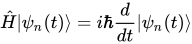
Atomic physics is the field of physics that studies atoms as an isolated system of electrons and an atomic nucleus. Atomic physics typically refers to the study of atomic structure and the interaction between atoms. It is primarily concerned with the way in which electrons are arranged around the nucleus and
the processes by which these arrangements change. This comprises ions, neutral atoms and, unless otherwise stated, it can be assumed that the term atom includes ions.
The term atomic physics can be associated with nuclear power and nuclear weapons, due to the synonymous use of atomic and nuclear in standard English. Physicists distinguish between atomic physics—which deals with the atom as a system consisting of a nucleus and electrons—and nuclear physics, which studies nuclear reactions and special properties of atomic nuclei.
As with many scientific fields, strict delineation can be highly
contrived and atomic physics is often considered in the wider context of
atomic, molecular, and optical physics. Physics research groups are usually so classified.
Isolated atoms
Atomic
physics primarily considers atoms in isolation. Atomic models will
consist of a single nucleus that may be surrounded by one or more bound
electrons. It is not concerned with the formation of molecules (although much of the physics is identical), nor does it examine atoms in a solid state as condensed matter. It is concerned with processes such as ionization and excitation by photons or collisions with atomic particles.
While modelling atoms in isolation may not seem realistic, if one considers atoms in a gas or plasma
then the time-scales for atom-atom interactions are huge in comparison
to the atomic processes that are generally considered. This means that
the individual atoms can be treated as if each were in isolation, as the
vast majority of the time they are. By this consideration, atomic
physics provides the underlying theory in plasma physics and atmospheric physics, even though both deal with very large numbers of atoms.
Electronic configuration
Electrons form notional shells around the nucleus. These are normally in a ground state but can be excited by the absorption of energy from light (photons), magnetic fields, or interaction with a colliding particle (typically ions or other electrons).
In
the Bohr model, the transition of an electron with n=3 to the shell n=2
is shown, where a photon is emitted. An electron from shell (n=2) must
have been removed beforehand by ionization
Electrons that populate a shell are said to be in a bound state. The energy necessary to remove an electron from its shell (taking it to infinity) is called the binding energy. Any quantity of energy absorbed by the electron in excess of this amount is converted to kinetic energy according to the conservation of energy. The atom is said to have undergone the process of ionization.
If the electron absorbs a quantity of energy less than the
binding energy, it will be transferred to an excited state. After a
certain time, the electron in an excited state will "jump" (undergo a
transition) to a lower state. In a neutral atom, the system will emit a
photon of the difference in energy, since energy is conserved.
If an inner electron has absorbed more than the binding energy
(so that the atom ionizes), then a more outer electron may undergo a
transition to fill the inner orbital. In this case, a visible photon or a
characteristic X-ray is emitted, or a phenomenon known as the Auger effect
may take place, where the released energy is transferred to another
bound electron, causing it to go into the continuum. The Auger effect
allows one to multiply ionize an atom with a single photon.
There are rather strict selection rules
as to the electronic configurations that can be reached by excitation
by light –however, there are no such rules for excitation by collision
processes.
Bohr model of the atom
The Bohr model, proposed by Niels Bohr in 1913,
is a revolutionary theory describing the structure of the hydrogen
atom. It introduced the idea of quantized orbits for electrons,
combining classical and quantum physics.
Key Postulates of the Bohr Model
Electrons Move in Circular Orbits
Electrons revolve around the nucleus in fixed, circular paths called orbits or energy levels.
These orbits are stable and do not radiate energy.
Quantization of Angular Momentum:
The angular momentum of an electron is quantized and given by: where:
: electron mass
: velocity of the electron
: radius of the orbit
: reduced Planck constant ()
: principal quantum number, representing the orbit
Energy Levels
Each orbit has a specific energy. The total energy of an electron in the th orbit is: where is the ground-state energy of the hydrogen atom.
Emission or Absorption of Energy
Electrons can transition between orbits by absorbing or emitting energy equal to the difference between the energy levels: where:
One of the earliest steps towards atomic physics was the recognition that matter was composed
of atoms. It forms a part of the texts written in 6th century BC to 2nd century BC, such as those of Democritus or Vaiśeṣika Sūtra written by Kaṇāda. This theory was later developed in the modern sense of the basic unit of a chemical element by the British chemist and physicist John Dalton in the 18th century. At this stage, it was not clear what atoms were, although they could be
described and classified by their properties (in bulk). The invention
of the periodic system of elements by Dmitri Mendeleev was another great step forward.
The true beginning of atomic physics is marked by the discovery of spectral lines and attempts to describe the phenomenon, most notably by Joseph von Fraunhofer. The study of these lines led to the Bohr atom model and to the birth of quantum mechanics.
In seeking to explain atomic spectra, an entirely new mathematical
model of matter was revealed. As far as atoms and their electron shells
were concerned, not only did this yield a better overall description,
i.e. the atomic orbital model, but it also provided a new theoretical basis for chemistry
(quantum chemistry) and spectroscopy.
Since the Second World War,
both theoretical and experimental fields have advanced at a rapid pace.
This can be attributed to progress in computing technology, which has
allowed larger and more sophisticated models of atomic structure and
associated collision processes. Similar technological advances in accelerators, detectors, magnetic field generation and lasers have greatly assisted experimental work.
Beyond the well-known phenomena which can be described with regular quantum mechanics chaotic processes can occur which need different descriptions.
Tests of general relativity serve to establish observational evidence for the theory of general relativity. The first three tests, proposed by Albert Einstein in 1915, concerned the "anomalous" precession of the perihelion of Mercury, the bending of light in gravitational fields, and the gravitational redshift. The precession of Mercury was already known; experiments showing light bending in accordance with the predictions of general relativity
were performed in 1919, with increasingly precise measurements made in
subsequent tests; and scientists claimed to have measured the
gravitational redshift in 1925, although measurements sensitive enough
to actually confirm the theory were not made until 1954. A more accurate
program starting in 1959 tested general relativity in the weak
gravitational field limit, severely limiting possible deviations from
the theory.
In the 1970s, scientists began to make additional tests, starting with Irwin Shapiro's measurement of the relativistic time delay in radar signal travel time near the Sun. Beginning in 1974, Hulse, Taylor and others studied the behaviour of binary pulsars
experiencing much stronger gravitational fields than those found in the
Solar System. Both in the weak field limit (as in the Solar System) and
with the stronger fields present in systems of binary pulsars the
predictions of general relativity have been extremely well tested.
In February 2016, the Advanced LIGO team announced that they had directly detected gravitational waves from a black hole merger. This discovery, along with additional detections announced in June 2016 and June 2017, tested general relativity in the very strong field limit, observing to date no deviations from theory.
Classical tests
Albert Einstein proposed three tests of general relativity, subsequently called the "classical tests" of general relativity, in 1916:
In the letter to The Times
(of London) on November 28, 1919, he described the theory of relativity
and thanked his English colleagues for their understanding and testing
of his work. He also mentioned three classical tests with comments:
"The chief attraction of the theory lies in its logical
completeness. If a single one of the conclusions drawn from it proves
wrong, it must be given up; to modify it without destroying the whole
structure seems to be impossible."
Transit of Mercury on November 8, 2006 with sunspots #921, 922, and 923The perihelion precession of Mercury
Under Newtonian physics, an object in an (isolated) two-body system, consisting of the object orbiting a spherical mass, would trace out an ellipse with the center of mass of the system at a focus of the ellipse. The point of closest approach, called the periapsis (or when the central body is the Sun, perihelion),
is fixed. Hence the major axis of the ellipse remains fixed in space.
Both objects orbit around the center of mass of this system, so they
each have their own ellipse. However, a number of effects in the Solar
System cause the perihelia of planets to precess (rotate) around the Sun
in the plane of their orbits, or equivalently, cause the major axis to
rotate about the center of mass, hence changing its orientation in
space. The principal cause is the presence of other planets which perturb one another's orbit. Another (much less significant) effect is solar oblateness.
Mercury
deviates from the precession predicted from these Newtonian effects.
This anomalous rate of precession of the perihelion of Mercury's orbit
was first recognized in 1859 as a problem in celestial mechanics, by Urbain Le Verrier.
His re-analysis of available timed observations of transits of Mercury
over the Sun's disk from 1697 to 1848 showed that the actual rate of the
precession disagreed from that predicted from Newton's theory by 38″ (arcseconds) per tropical century (later re-estimated at 43″ by Simon Newcomb in 1882). A number of ad hoc
and ultimately unsuccessful solutions were proposed, but they tended to
introduce more problems. Le Verrier suggested that another hypothetical
planet might exist to account for Mercury's behavior. The previously successful search for Neptune based on its perturbations
of the orbit of Uranus led astronomers to place some faith in this
possible explanation, and the hypothetical planet was even named Vulcan. Finally, in 1908, W. W. Campbell, Director of the Lick Observatory, after the comprehensive photographic observations by Lick astronomer, Charles D. Perrine,
at three solar eclipse expeditions, stated, "In my opinion, Dr.
Perrine's work at the three eclipses of 1901, 1905, and 1908 brings the
observational side of the famous intramercurial-planet problem
definitely to a close." Subsequently, no evidence of Vulcan was found and Einstein's 1915
general theory accounted for Mercury's anomalous precession. Einstein
wrote to Michele Besso, "Perihelion motions explained quantitatively ... you will be astonished".
In general relativity, this remaining precession,
or change of orientation of the orbital ellipse within its orbital
plane, is explained by gravitation being mediated by the curvature of
spacetime. Einstein showed that general relativity agrees closely with the observed amount of perihelion shift. This was a
powerful factor motivating the adoption of general relativity.
Although earlier measurements of planetary orbits were made using
conventional telescopes, more accurate measurements are now made with radar. The total observed precession of Mercury is (574.10 ± 0.65)″ per century relative to the inertial ICRF. This precession can be attributed to the following causes:
Sources of the precession of perihelion for Mercury
The correction by (42.980±0.001)″/cy is the prediction of post-Newtonian theory with parameters. Thus the effect can be fully explained by general relativity. More
recent calculations based on more precise measurements have not
materially changed the situation.
In general relativity the perihelion shift σ, expressed in radians per revolution, is approximately given by:
The other planets experience perihelion shifts as well, but,
since they are farther from the Sun and have longer periods, their
shifts are lower, and could not be observed accurately until long after
Mercury's. For example, the perihelion shift of Earth's orbit due to
general relativity is theoretically 3.83868″ per century and
experimentally (3.8387±0.0004)″/cy, Venus's is 8.62473″/cy and (8.6247 ± 0.0005)″/cy and Mars' is (1.351±0.001)″/cy. Both values have now been measured, with results in good agreement with theory. The periapsis shift has also now been measured for binary pulsar systems, with PSR 1913+16 amounting to 4.2° per year. These observations are consistent with general relativity.[17]
It is also possible to measure periapsis shift in binary star systems
which do not contain ultra-dense stars, but it is more difficult to
model the classical effects precisely – for example, the alignment of
the stars' spin to their orbital plane needs to be known and is hard to
measure directly. A few systems, such as DI Herculis, have been measured as test cases for general relativity.
Henry Cavendish in 1784 (in an unpublished manuscript) and Johann Georg von Soldner in 1801 (published in 1804) had pointed out that Newtonian gravity predicts that starlight will bend around a massive object. The same value as Soldner's was calculated by Einstein in 1911 based on
the equivalence principle alone. However, Einstein noted in 1915 in the
process of completing general relativity, that his 1911 result (and
thus Soldner's 1801 result) is only half of the correct value. Einstein
became the first to calculate the correct value for light bending: 1.75 arcseconds for light that grazes the Sun.
The first observation of light deflection was performed by noting the change in position of stars as they passed near the Sun on the celestial sphere. The observations were performed by Arthur Eddington and his collaborators (see Eddington experiment) during the total solar eclipse of May 29, 1919 when the stars near the Sun (at that time in the constellation Taurus) could be observed. Observations were made simultaneously in the cities of Sobral, Ceará, Brazil and in São Tomé and Príncipe on the west coast of Africa. The result was considered spectacular news and made the front page of
most major newspapers. It made Einstein and his theory of general
relativity world-famous. When asked by his assistant what his reaction
would have been if general relativity had not been confirmed by
Eddington and Dyson in 1919, Einstein famously made the quip: "Then I
would feel sorry for the dear Lord. The theory is correct anyway."
The early accuracy, however, was poor and there was doubt that
the small number of measured star locations and instrument questions
could produce a reliable result. The results were argued by some to have been plagued by systematic error and possibly confirmation bias, although modern reanalysis of the dataset suggests that Eddington's analysis was accurate. The measurement was repeated by a team from the Lick Observatory led by the Director W. W. Campbell in the 1922 eclipse as observed in remote Australian station of Wallal, with results based on hundreds of star positions that agreed with the 1919 results and has been repeated several times since, most notably in 1953 by Yerkes Observatory astronomers and in 1973 by a team from the University of Texas. Considerable uncertainty remained in these measurements for almost fifty years, until observations started being made at radio frequencies.The deflection of starlight by the nearby white dwarf star Stein 2051 B has also been measured.
The gravitational redshift of a light wave as it moves upwards against a gravitational field (caused by the yellow star below).
Einstein predicted the gravitational redshift of light from the equivalence principle in 1907, and it was predicted that this effect might be measured in the spectral lines of a white dwarf star, which has a very high gravitational field. Initial attempts to measure the gravitational redshift of the spectrum of Sirius-B were done by Walter Sydney Adams
in 1925, but the result was criticized as being unusable due to the
contamination from light from the (much brighter) primary star, Sirius. The first accurate measurement of the gravitational redshift of a white
dwarf was done by Popper in 1954, measuring a 21 km/s gravitational
redshift of 40 Eridani B.
The redshift of Sirius B was finally measured by Greenstein et al. in 1971, obtaining the value for the gravitational redshift of 89±16 km/s, with more accurate measurements by the Hubble Space Telescope showing 80.4±4.8 km/s.
The general theory of relativity incorporates Einstein's special theory of relativity, and hence tests of special relativity are also testing aspects of general relativity. As a consequence of the equivalence principle, Lorentz invariance
holds locally in non-rotating, freely falling reference frames.
Experiments related to Lorentz invariance special relativity (that is,
when gravitational effects can be neglected) are described in tests of special relativity.
Modern tests
The modern era of testing general relativity was ushered in largely at the impetus of Dicke and Schiff who laid out a framework for testing general relativity. They emphasized the importance not only of the classical tests, but of
null experiments, testing for effects which in principle could occur in a
theory of gravitation, but do not occur in general relativity. Other
important theoretical developments included the inception of alternative theories to general relativity, in particular, scalar–tensor theories such as the Brans–Dicke theory;[42] the parameterized post-Newtonian formalism in which deviations from general relativity can be quantified; and the framework of the equivalence principle.
Early
tests of general relativity were hampered by the lack of viable
competitors to the theory: it was not clear what sorts of tests would
distinguish it from its competitors. General relativity was the only
known relativistic theory of gravity compatible with special relativity
and observations. This changed in 1960 with the introduction of Brans–Dicke theory which provided an alternative theory also in agreement with experimental observations. Ultimately, this led to the development of the parametrized post-Newtonian formalism by Nordtvedt and Will,
which parametrizes, in terms of ten adjustable parameters, all the
possible departures from Newton's law of universal gravitation to first
order in the velocity of moving objects (i.e. to first order in , where v is the velocity of an object and c
is the speed of light). This approximation allows the possible
deviations from general relativity, for slowly moving objects in weak
gravitational fields, to be systematically analyzed. Much effort has
been put into constraining the post-Newtonian parameters, and deviations
from general relativity are at present severely limited.
The experiments testing gravitational lensing and light time
delay limits the same post-Newtonian parameter, the so-called Eddington
parameter γ, which is a straightforward parametrization of the amount of
deflection of light by a gravitational source. It is equal to one for
general relativity, and takes different values in other theories (such
as Brans–Dicke theory). It is the best constrained of the ten
post-Newtonian parameters, but there are other experiments designed to
constrain the others. Precise observations of the perihelion shift of
Mercury constrain other parameters, as do tests of the strong
equivalence principle.
One of the goals of the BepiColombo
mission to Mercury, is to test the general relativity theory by
measuring the parameters gamma and beta of the parametrized
post-Newtonian formalism with high accuracy. The experiment is part of the Mercury Orbiter Radio science Experiment (MORE). The spacecraft was launched in October 2018 and is expected to enter orbit around Mercury in November 2026.
Gravitational lensing
One of the most important tests is gravitational lensing.
It has been observed in distant astrophysical sources, but these are
poorly controlled and it is uncertain how they constrain general
relativity. The most precise tests are analogous to Eddington's 1919
experiment: they measure the deflection of radiation from a distant
source by the Sun. The sources that can be most precisely analyzed are
distant radio sources. In particular, some quasars
are very strong radio sources. The directional resolution of any
telescope is in principle limited by diffraction; for radio telescopes
this is also the practical limit. An important improvement in obtaining
positional high accuracies (from milli-arcsecond to micro-arcsecond) was
obtained by combining radio telescopes across Earth. The technique is
called very long baseline interferometry
(VLBI). With this technique radio observations couple the phase
information of the radio signal observed in telescopes separated over
large distances. Recently, these telescopes have measured the deflection
of radio waves by the Sun to extremely high precision, confirming the
amount of deflection predicted by general relativity aspect to the 0.03%
level. At this level of precision systematic effects have to be carefully
taken into account to determine the precise location of the telescopes
on Earth. Some important effects are Earth's nutation,
rotation, atmospheric refraction, tectonic displacement and tidal
waves. Another important effect is refraction of the radio waves by the solar corona. Fortunately, this effect has a characteristic spectrum,
whereas gravitational distortion is independent of wavelength. Thus,
careful analysis, using measurements at several frequencies, can
subtract this source of error.
The entire sky is slightly distorted due to the gravitational
deflection of light caused by the Sun (the anti-Sun direction excepted).
This effect has been observed by the European Space Agency astrometric satellite Hipparcos. It measured the positions of about 105 stars. During the full mission about 3.5×10⁶
relative positions have been determined, each to an accuracy of
typically 3 milliarcseconds (the accuracy for an 8–9 magnitude star).
Since the gravitation deflection perpendicular to the Earth–Sun
direction is already 4.07 milliarcseconds, corrections are needed for
practically all stars. Without systematic effects, the error in an
individual observation of 3 milliarcseconds, could be reduced by the
square root of the number of positions, leading to a precision of 0.0016
milliarcseconds. Systematic effects, however, limit the accuracy of the
determination to 0.3% (Froeschlé, 1997).
Launched in 2013, the Gaia spacecraft will conduct a census of one billion stars in the Milky Way
and measure their positions to an accuracy of 24 microarcseconds. Thus
it will also provide stringent new tests of gravitational deflection of
light caused by the Sun which was predicted by General relativity.
Irwin I. Shapiro
proposed another test, beyond the classical tests, which could be
performed within the Solar System. It is sometimes called the fourth
"classical" test of general relativity. He predicted a relativistic time delay (Shapiro delay) in the round-trip travel time for radar signals reflecting off other planets. The mere curvature of the path of a photon
passing near the Sun is too small to have an observable delaying effect
(when the round-trip time is compared to the time taken if the photon
had followed a straight path), but general relativity predicts a time
delay that becomes progressively larger when the photon passes nearer to
the Sun due to the time dilation in the gravitational potential
of the Sun. Observing radar reflections from Mercury and Venus just
before and after they are eclipsed by the Sun agrees with general
relativity theory at the 5% level.
More recently, the Cassini probe has undertaken a similar experiment which gave agreement with general relativity at the 0.002% level. However, the following detailed studies revealed that the measured value of the PPN parameter gamma is affected by a gravitomagnetic effect caused by the orbital motion of Sun around the barycenter of the solar system. The gravitomagnetic effect in the Cassini
radioscience experiment was implicitly postulated by B. Bertotti as
having a pure general relativistic origin but its theoretical value has
never been tested in the experiment which effectively makes the
experimental uncertainty in the measured value of gamma actually larger
(by a factor of 10) than 0.002% claimed by B. Bertotti and co-authors in
Nature.
Very Long Baseline Interferometry has measured velocity-dependent (gravitomagnetic) corrections to the Shapiro time delay in the field of moving Jupiter and Saturn.
The equivalence principle, in its simplest form, asserts that the
trajectories of falling bodies in a gravitational field should be
independent of their mass and internal structure, provided they are
small enough not to disturb the environment or be affected by tidal forces. This idea has been tested to extremely high precision by Eötvös torsion balance experiments,
which look for a differential acceleration between two test masses.
Constraints on this, and on the existence of a composition-dependent
fifth force or gravitational Yukawa interaction are very strong, and are discussed under fifth force and weak equivalence principle.
A version of the equivalence principle, called the strong equivalence principle,
asserts that self-gravitation falling bodies, such as stars, planets or
black holes (which are all held together by their gravitational
attraction) should follow the same trajectories in a gravitational
field, provided the same conditions are satisfied. This is called the Nordtvedt effect and is most precisely tested by the Lunar Laser Ranging Experiment. Since 1969, it has continuously measured the distance from several
rangefinding stations on Earth to reflectors on the Moon to
approximately centimeter accuracy. These have provided a strong constraint on several of the other post-Newtonian parameters.
Another part of the strong equivalence principle is the
requirement that Newton's gravitational constant be constant in time,
and have the same value everywhere in the universe. There are many
independent observations limiting the possible variation of Newton's gravitational constant, but one of the best comes from lunar rangefinding which suggests that
the gravitational constant does not change by more than one part in 1011 per year. The constancy of the other constants is discussed in the Einstein equivalence principle section of the equivalence principle article.
The first of the classical tests discussed above, the gravitational redshift, is a simple consequence of the Einstein equivalence principle
and was predicted by Einstein in 1907. As such, it is not a test of
general relativity in the same way as the post-Newtonian tests, because
any theory of gravity obeying the equivalence principle should also
incorporate the gravitational redshift. Nonetheless, confirming the
existence of the effect was an important substantiation of relativistic
gravity, since the absence of gravitational redshift would have strongly
contradicted relativity. The first observation of the gravitational
redshift was the measurement of the shift in the spectral lines from the
white dwarf star Sirius
B by Adams in 1925, discussed above, and follow-on measurements of
other white dwarfs. Because of the difficulty of the astrophysical
measurement, however, experimental verification using a known
terrestrial source was preferable.
Experimental verification of gravitational redshift using
terrestrial sources took several decades, because it is difficult to
find clocks (to measure time dilation)
or sources of electromagnetic radiation (to measure redshift) with a
frequency that is known well enough that the effect can be accurately
measured. It was confirmed experimentally for the first time in 1959
using measurements of the change in wavelength of gamma-ray photons
generated with the Mössbauer effect, which generates radiation with a very narrow line width. The Pound–Rebka experiment measured the relative redshift of two sources situated at the top and bottom of Harvard University's Jefferson tower. The result was in excellent agreement with general relativity. This was
one of the first precision experiments testing general relativity. The
experiment was later improved to better than the 1% level by Pound and
Snider.
The blueshift of a falling photon can be found by assuming it has an equivalent mass based on its frequency E = hf (where h is the Planck constant) along with E = mc2,
a result of special relativity. Such simple derivations ignore the fact
that in general relativity the experiment compares clock rates, rather
than energies. In other words, the "higher energy" of the photon after
it falls can be equivalently ascribed to the slower running of clocks
deeper in the gravitational potential well. To fully validate general
relativity, it is important to also show that the rate of arrival of the
photons is greater than the rate at which they are emitted. A very
accurate gravitational redshift experiment, which deals with this issue,
was performed in 1976, where a hydrogenmaser
clock on a rocket was launched to a height of 10,000 km, and its rate
compared with an identical clock on the ground. It tested the
gravitational redshift to 0.007%.
Although the Global Positioning System
(GPS) is not designed as a test of fundamental physics, it must account
for the gravitational redshift in its timing system, and physicists
have analyzed timing data from the GPS to confirm other tests. When the
first satellite was launched, some engineers resisted the prediction
that a noticeable gravitational time dilation would occur, so the first
satellite was launched without the clock adjustment that was later built
into subsequent satellites. It showed the predicted shift of 38
microseconds per day. This rate of discrepancy is sufficient to
substantially impair function of GPS within hours if not accounted for.
An excellent account of the role played by general relativity in the
design of GPS can be found in Ashby 2003.
Other precision tests of general relativity, not discussed here, are the Gravity Probe A
satellite, launched in 1976, which showed gravity and velocity affect
the ability to synchronize the rates of clocks orbiting a central mass
and the Hafele–Keating experiment, which used atomic clocks in circumnavigating aircraft to test general relativity and special relativity together.
Tests of the Lense–Thirring precession, consisting of small secular precessions
of the orbit of a test particle in motion around a central rotating
mass, for example, a planet or a star, have been performed with the LAGEOS satellites, but many aspects of them remain controversial. The same effect may have been detected in the data of the Mars Global Surveyor (MGS) spacecraft, a former probe in orbit around Mars; also such a test raised a debate. First attempts to detect the Sun's Lense–Thirring effect on the perihelia of the inner planets have been recently reported as well. Frame dragging would cause the orbital plane of stars orbiting near a supermassive black hole to precess about the black hole spin axis. This effect should be detectable within the next few years via astrometric monitoring of stars at the center of the Milky Way galaxy. By comparing the rate of orbital precession of two stars on different orbits, it is possible in principle to test the no-hair theorems of general relativity.
The Gravity Probe B satellite, launched in 2004 and operated until 2005, detected frame-dragging and the geodetic effect.
The experiment used four quartz spheres the size of ping pong balls
coated with a superconductor. Data analysis continued through 2011 due
to high noise levels and difficulties in modelling the noise accurately
so that a useful signal could be found. Principal investigators at Stanford University reported on May 4, 2011, that they had accurately measured the frame dragging effect relative to the distant star IM Pegasi, and the calculations proved to be in line with the prediction of Einstein's theory. The results, published in Physical Review Letters measured the geodetic effect
with an error of about 0.2 percent. The results reported the frame
dragging effect (caused by Earth's rotation) added up to 37
milliarcseconds with an error of about 19 percent. Investigator Francis Everitt explained that a milliarcsecond "is the width of a human hair seen at the distance of 10 miles".
In January 2012, LARES satellite was launched on a Vega rocket to measure Lense–Thirring effect with an accuracy of about 1%, according to its proponents. This evaluation of the actual accuracy obtainable is a subject of debate.
Tests of the gravitational potential at small distances
It
is possible to test whether the gravitational potential continues with
the inverse square law at very small distances. Tests so far have
focused on a divergence from GR in the form of a Yukawa potential, but no evidence for a potential of this kind has been found. The Yukawa potential with has been ruled out down to λ = 5.6×10⁻⁵ m.
Mössbauer rotor experiment
It was conceived as a means to measure the time dilation effect on Earth after being motivated by Einstein's equivalence principle that implies a rotating observer will be subject to the same transformations as an observer in a gravitational field. Mössbauer rotor experiments hence permit a precise terrestrial test of the relativistic Doppler effect. From a radioactive source fixed at the center of a spinning disc or rod, gamma rays
travel to an absorber at the rim (in some variations of the experiment
this scheme was reversed) and an unabsorbed number of them pass through
depending on the rotational speed to arrive at a stationary counter (i.e., detector of gamma quanta resting in the lab frame). In lieu with the Clock hypothesis, Einstein's general relativity
predicts that the moving absorber's clock at the rim should retard by a
specific amount due to time dilation on account of centrifugal binding
alone compared to a rest frame absorber. So the transmission of gamma
photons through the absorber should increase during rotation, which can
be subsequently measured by the stationary counter beyond the absorber.
This prediction was actually observed using the Mössbauer effect,
since the equivalence principle, as originally suggested by Einstein,
implicitly allows the association of the time dilation due to rotation
(calculated as a result of the change in the detector's count rate) with
gravitational time dilation. Such experiments were pioneered by Hay et al. (1960), Champeney et al. (1965), and Kündig (1963), and all of them had declared confirmation of the prediction of Einstein's theory of relativity.
Be that as it may, an early 21st Century re-examination of these
endeavors called into question the validity of the past obtained results
claiming to have verified time dilation as predicted by Einstein's
relativity theory, whereby novel experimentations were carried out that uncovered an extra energy shift between emitted and absorbed radiation next to the classical relativistic dilation of time. This discovery was first explained as discrediting general relativity
and successfully confirming at the laboratory scale the predictions of
an alternative theory of gravity developed by T. Yarman and his
colleagues. Against this development, a contentious attempt was made to explain the
disclosed extra energy shift as arising from a so-far unknown and
allegedly missed clock synchronization effect, which was unusually awarded a prize in 2018 by the Gravity Research Foundation for having secured a new proof of general relativity. However, at the same time period, it was revealed that said author committed several mathematical errors in his calculations, and the supposed contribution of the so-called clock synchronization to the measured time dilation is in fact practically null. As a consequence, a general relativistic explanation for the outcomes of Mössbauer rotor experiments remains open.
Strong field tests
The very strong gravitational fields that are present close to black holes, especially those supermassive black holes which are thought to power active galactic nuclei and the more active quasars,
belong to a field of intense active research. Observations of these
quasars and active galactic nuclei are difficult, and interpretation of
the observations is heavily dependent upon astrophysical models other
than general relativity or competing fundamental theories of gravitation, but they are qualitatively consistent with the black hole concept as modeled in general relativity.
Pulsars are rapidly rotating neutron stars
which emit regular radio pulses as they rotate. As such they act as
clocks which allow very precise monitoring of their orbital motions.
Observations of pulsars in orbit around other stars have all
demonstrated substantial periapsis
precessions that cannot be accounted for classically but can be
accounted for by using general relativity. For example, the Hulse–Taylor
binary pulsarPSR B1913+16
(a pair of neutron stars in which one is detected as a pulsar) has an
observed precession of over 4° of arc per year (periastron shift per
orbit only about 10−6). This precession has been used to compute the masses of the components.
Similarly to the way in which atoms and molecules emit electromagnetic radiation, a gravitating mass that is in quadrupole type or higher order vibration, or is asymmetric and in rotation, can emit gravitational waves. These gravitational waves are predicted to travel at the speed of light.
For example, planets orbiting the Sun constantly lose energy via
gravitational radiation, but this effect is so small that it is unlikely
it will be observed in the near future (Earth radiates about 200 watts
of gravitational radiation).
The radiation of gravitational waves has been inferred from the Hulse–Taylor binary (and other binary pulsars). Precise timing of the pulses shows that the stars orbit only approximately according to Kepler's Laws: over time they gradually spiral towards each other, demonstrating an energy loss in close agreement with the predicted energy radiated by gravitational waves. For their discovery of the first binary pulsar and measuring its orbital decay due to gravitational-wave emission, Hulse and Taylor won the 1993 Nobel Prize in Physics.
A "double pulsar" discovered in 2003, PSR J0737-3039, has a periastron precession of 16.90° per year; unlike the Hulse–Taylor binary, both neutron stars
are detected as pulsars, allowing precision timing of both members of
the system. Due to this, the tight orbit, the fact that the system is
almost edge-on, and the very low transverse velocity of the system as
seen from Earth, J0737−3039 provides by far the best system for
strong-field tests of general relativity known so far. Several distinct
relativistic effects are observed, including orbital decay as in the
Hulse–Taylor system. After observing the system for two and a half
years, four independent tests of general relativity were possible, the
most precise (the Shapiro delay) confirming the general relativity
prediction within 0.05% (nevertheless the periastron shift per orbit is only about 0.0013% of a
circle and thus it is not a higher-order relativity test).
In 2013, an international team of astronomers reported new data from observing a pulsar-white dwarf system PSR J0348+0432,
in which they have been able to measure a change in the orbital period
of 8 millionths of a second per year, and confirmed GR predictions in a
regime of extreme gravitational fields never probed before; but there are still some competing theories that would agree with these data.
General relativity predicts gravitational waves, as does any
theory of gravitation in which changes in the gravitational field
propagate at a finite speed. Then, the LIGO response function could discriminate among the various theories. Since gravitational waves can be directly detected, it is possible to use them to learn about the Universe. This is gravitational-wave astronomy.
Gravitational-wave astronomy can test general relativity by verifying
that the observed waves are of the form predicted (for example, that
they only have two transverse polarizations), and by checking that black holes are the objects described by solutions of the Einstein field equations.
Gravitational-wave astronomy can also test Maxwell-Einstein field
equations. This version of the field equations predicts that spinning
magnetars (i.e., neutron stars with extremely strong magnetic dipole
field) should emit gravitational waves.
"These amazing observations are the confirmation of a lot of
theoretical work, including Einstein's general theory of relativity,
which predicts gravitational waves", said Stephen Hawking.
Direct observation of black holes
A bright ring of material surrounding a dark center that marks the shadow of the M87's supermassive black hole. The image also provided a key confirmation of General relativity.
The galaxy M87 was the subject of observation by the Event Horizon Telescope (EHT) in 2017; the 10 April 2019 issue of Astrophysical Journal Letters (vol. 875, No. 1) was dedicated to the EHT results, publishing six open-access papers. The event horizon
of the black hole at the center of M87 was directly imaged at the
wavelength of radio waves by the EHT; the image was revealed in a press
conference on 10 April 2019, the first image of a black hole's event
horizon. In May 2022, the EHT provided the first image of the super massive black
hole Sagittarius A* in the center of our own Milky Way galaxy.
Gravitational redshift and orbit precession of star in strong gravity field
Gravitational redshift in light from the S2 star orbiting the supermassive black hole Sagittarius A* in the center of the Milky Way has been measured with the Very Large Telescope using GRAVITY, NACO and SIFONI instruments.[121][122]
Additionally, there has now been detection of the Schwarzschild
precession in the orbit of the star S2 near the Galactic centre massive
black hole.[123]
Strong equivalence principle
The
strong equivalence principle of general relativity requires
universality of free fall to apply even to bodies with strong
self-gravity. Direct tests of this principle using Solar System bodies
are limited by the weak self-gravity of the bodies, and tests using
pulsar–white-dwarf binaries have been limited by the weak gravitational
pull of the Milky Way. With the discovery of a triple star system called
PSR J0337+1715,
located about 4,200 light-years from Earth, the strong equivalence
principle can be tested with a high accuracy. This system contains a neutron star in a 1.6-day orbit with a white dwarf
star, and the pair in a 327-day orbit with another white dwarf further
away. This system permits a test that compares how the gravitational
pull of the outer white dwarf affects the pulsar, which has strong
self-gravity, and the inner white dwarf. The result shows that the
accelerations of the pulsar and its nearby white-dwarf companion differ
fractionally by no more than 2.6×10⁻⁶ (95% confidence level).
X-ray spectroscopy
This technique is based on the idea that photon trajectories are modified in the presence of a gravitational body. A very common astrophysical system in the universe is a black hole surrounded by an accretion disk.
The radiation from the general neighborhood, including the accretion
disk, is affected by the nature of the central black hole. Assuming
Einstein's theory is correct, astrophysical black holes are described by
the Kerr metric. (A consequence of the no-hair theorems.) Thus, by analyzing the radiation from such systems, it is possible to test Einstein's theory.
Most of the radiation from these black hole – accretion disk systems (e.g., black hole binaries and active galactic nuclei)
arrives in the form of X-rays. When modeled, the radiation is
decomposed into several components. Tests of Einstein's theory are
possible with the thermal spectrum (only for black hole binaries) and
the reflection spectrum (for both black hole binaries and active
galactic nuclei). The former is not expected to provide strong
constraints, while the latter is much more promising. In both cases, systematic uncertainties might make such tests more challenging.
Cosmological tests
Tests of general relativity on the largest scales are not nearly so stringent as Solar System tests. The earliest such test was the prediction and discovery of the expansion of the universe. In 1922, Alexander Friedmann found that the Einstein equations have non-stationary solutions (even in the presence of the cosmological constant). In 1927, Georges Lemaître
showed that static solutions of the Einstein equations, which are
possible in the presence of the cosmological constant, are unstable, and
therefore the static universe envisioned by Einstein could not exist
(it must either expand or contract). Lemaître made an explicit prediction that the universe should expand. He also derived a redshift-distance relationship, which is now known as the Hubble Law. Later, in 1931, Einstein himself agreed with the results of Friedmann and Lemaître. The expansion of the universe discovered by Edwin Hubble in 1929 was then considered by many (and continues to be considered by some now) as a direct confirmation of general relativity. In the 1930s, largely due to the work of E. A. Milne,
it was realised that the linear relationship between redshift and
distance derives from the general assumption of uniformity and isotropy
rather than specifically from general relativity. However the prediction of a non-static universe was non-trivial, indeed
dramatic, and primarily motivated by general relativity.
In August 2017, the findings of tests conducted by astronomers using the European Southern Observatory's Very Large Telescope
(VLT), among other instruments, were released, and positively
demonstrated gravitational effects predicted by Albert Einstein. One of
these tests observed the orbit of the stars circling around Sagittarius A*,
a black hole about 4 million times as massive as the sun. Einstein's
theory suggested that large objects bend the space around them, causing
other objects to diverge from the straight lines they would otherwise
follow. Although previous studies have validated Einstein's theory, this
was the first time his theory had been tested on such a gigantic
object. The findings were published in The Astrophysical Journal.
Gravitational lensing
Astronomers
using the Hubble Space Telescope and the Very Large Telescope have made
precise tests of general relativity on galactic scales. The nearby
galaxy ESO 325-G004 acts as a strong gravitational lens, distorting light from a distant galaxy behind it to create an Einstein ring
around its centre. By comparing the mass of ESO 325-G004 (from
measurements of the motions of stars inside this galaxy) with the
curvature of space around it, astronomers found that gravity behaves as
predicted by general relativity on these astronomical length-scales.