Search This Blog

Monday, November 17, 2025

Intentional community

From Wikipedia, the free encyclopedia
https://en.wikipedia.org/wiki/Intentional_community
Members of the Anabaptist Christian Bruderhof Communities live, eat, work and worship communally.
Young musicians living in a shared community in Amsterdam
Traditional ashram
Ecovillage "Velyka Rodyna" in Troshcha (Ukrainian: Троща).

An intentional community is a voluntary residential community designed to foster a high degree of social cohesion and teamwork. Such communities typically promote shared values or beliefs, or pursue a common vision, which may be political, religious, utopian or spiritual, or are simply focused on the practical benefits of cooperation and mutual support. While some groups emphasise shared ideologies, others are centred on enhancing social connections, sharing resources, and creating meaningful relationships.

Some see intentional communities as alternative lifestyles. Others see them as impractical social experiments. Some see them as a natural human response to the isolation and fragmentation of modern housing, offering a return to the social bonds and collaborative spirit found in traditional village life. Others see them as ways to address problems that are seen as plaguing modern cities, such as alcohol abuse, poverty, unemployment and crime, especially when used in conjunction with emigration from industrialized countries and colonization of new lands.

The multitude of intentional communities includes collective households, cohousing communities, coliving, ecovillages, monasteries, survivalist retreats, kibbutzim, Hutterite colonies, ashrams, and housing cooperatives.

As well, planned developments such as some company towns that provided comfortable workers' housing and aspirations of a stable sober workforce, could be considered intentional communities and sometimes even spark from an aspiration for a utopia.

History

Ashrams are likely the earliest intentional communities, founded around 1500 BCE. Buddhist monasteries appeared around 500 BCE. Pythagoras founded an intellectual vegetarian commune in about 525 BCE in southern Italy. Hundreds of modern intentional communities were formed across Europe, North and South America, Australia, and New Zealand out of the intellectual foment of utopianism. Intentional communities exhibit the utopian ambition to create a better, more sustainable world for living.

Synonyms and definitions

Additional terms referring to an intentional community can be alternative lifestyle, intentional society, cooperative community, withdrawn community, enacted community, socialist colony, communistic society, collective settlement, communal society, commune, mutualistic community, communitarian experiment, experimental community, utopian experiment, practical utopia, and utopian society.

The term utopian community as a synonym for an intentional community might be considered to be of pejorative nature and many intentional communities do not consider themselves to be utopian. Also the alternative term commune is considered to be non-neutral or even linked to leftist politics or hippies.

Definitions of "intentional community"
Authorship Year Definition
B. Shenker 1986 "An intentional community is a relatively small group of people who have created a whole way of life for the attainment of a certain set of goals."
D. E. Pitzer 1989 Intentional communities are "small, voluntary social units partly isolated from the general society in which members share an economic union and lifestyle in an attempt to implement, at least in part, their ideal ideological, religious, political, social, economic, and educational systems".
G. Kozeny 1996 "An 'intentional community' is a group of people who have chosen to live together with a common purpose, working cooperatively to create a lifestyle that reflects their shared core values. The people may live together on a piece of rural land, in a suburban home, or in an urban neighborhood, and they may share a single residence or live in a cluster of dwellings."
W. J. Metcalf 2004 An intentional community is "[f]ive or more people, drawn from more than one family or kinship group, who have voluntarily come together for the purpose of ameliorating perceived social problems and inadequacies. They seek to live beyond the bounds of mainstream society by adopting a consciously devised and usually well thought-out social and cultural alternative. In the pursuit of their goals, they share significant aspects of their lives together. Participants are characterized by a "we-consciousness," seeing themselves as a continuing group, separate from and in many ways better than the society from which they emerged."

Variety

The purposes of intentional communities vary and may be political, spiritual, economic, or environmental. In addition to spiritual communities, secular communities also exist. One common practice, particularly in spiritual communities, is communal mealsEgalitarian values can be combined with other values, and an egalitarian community is a specific kind of intentional community in which members have equal access to resources and decision-making" and more broadly as "a fair society where all individuals possess equal rights and opportunities, supported by affirmative action". Benjamin Zablocki categorized communities this way:

Membership

Members of Christian intentional communities want to emulate the practices of the earliest believers. Using the biblical book of Acts (and, often, the Sermon on the Mount) as a model, members of these communities strive to demonstrate their faith in a corporate context, and to live out the teachings of the New Testament, practicing compassion and hospitality. Communities such as the Simple Way, the Bruderhof and Rutba House would fall into this category. Despite strict membership criteria, these communities are open to visitors and not reclusive to the extent of some other intentional communities.

A survey in the 1995 edition of the "Communities Directory", published by the Fellowship for Intentional Community (FIC), reported that 54 percent of the communities choosing to list themselves were rural, 28 percent were urban, 10 percent had both rural and urban sites, and 8 percent did not specify.

Governance

The most common form of governance in intentional communities is democratic (64 percent), with decisions made by some form of consensus decision-making or voting. A hierarchical or authoritarian structure governs 9 percent of communities, 11 percent are a combination of democratic and hierarchical structure, and 16 percent do not specify.

Communes' core principles

The central characteristics of communes, or core principles that define communes, have been expressed in various forms over the years. The Suffolk-born radical John Goodwyn Barmby (1820-1881), subsequently a Unitarian minister, invented the term "communitarian" in 1840.

At the start of the 1970s, The New Communes author Ron E. Roberts classified communes as a subclass of a larger category of utopias. He listed three main characteristics:

  • First, egalitarianism – communes specifically rejected hierarchy or graduations of social status as being necessary to social order.
  • Second, human scale – members of some communes saw the scale of society as it was then organized as being too industrialized (or factory sized) and therefore unsympathetic to human dimensions.
  • Third, communes were consciously anti-bureaucratic.

Twenty-five years later, Dr. Bill Metcalf, in his edited book Shared Visions, Shared Lives, defined communes as having the following core principles:

Sharing everyday life and facilities, a commune is an idealized form of family, being a new sort of "primary group" (generally with fewer than 20 people, although there are examples of much larger communes). Commune members have emotional bonds to the whole group rather than to any sub-group, and the commune is experienced with emotions that go beyond just social collectivity.

With the simple definition of a commune as an intentional community with 100% income sharing, the online directory of the Fellowship for Intentional Community (FIC) lists 222 communes worldwide (28 January 2019). Some of these are religious institutions such as abbeys and monasteries. Others are based in anthroposophic philosophy, including Camphill villages that provide support for the education, employment, and daily lives of adults and children with developmental disabilities, mental health problems or other special needs.

Many cultures naturally practice communal or tribal living, and would not designate their way of life as a planned "commune" per se, though their living situation may have many characteristics of a commune.

By country

Australia

In Australia, many intentional communities started with the hippie movement and those searching for social alternatives to the nuclear family. One of the oldest continuously running communities is called "Moora Moora Co-operative Community" with about 47 members (Oct 2021). Located at the top of Mount Toolebewong, 65 km east of Melbourne, Victoria at an altitude of 600–800 m, this community has been entirely off the electricity grid since its inception in 1974. Founding members still resident include Peter and Sandra Cock.

Canada

Intentional communities were established in Canada as early as the first part of the nineteenth century, and some are in operation in Canada at the present time. An Ontario Quaker sect, The Children of Peace, formed a utopian farm settlement at the community of Hope (now Sharon) in East Gwillimbury, York Region, which operated from 1812 to 1889. Other utopian communities were established at Maxwell near Sarnia, and in BC at Holberg (a Owenite settlement founded in 1829), Ruskin and Sointula on Malcolm Island (a well-known historical Canadian utopian settlement).

As well, other settlements were established on temperance, Henry George, Tolstoyan, Doukhobor, Orthodox Mennonite and Hutterite principles.

Canadian utopias also made an appearance on the written page. In the 1897 novel In the New Capital by Edmontonian/Torontonian John Galbraith, the main character time-travels from 1897 to 1999 when a new Ottawa is operating under utopian socialist/single tax/temperance laws. Prairie activist E.A. Partridge discussed the possibilities of a western Canadian utopian co-operative commonwealth called "Coalsamao" in his 1925 book A war on poverty: the one war that can end war. One historian described the 1933 Regina Manifesto as at least partly a utopian document.

Several intentional settlements exist today in Canada.

Germany

A building on the Rhön Bruderhof

The first wave of utopian communities in Germany began during a period of rapid urbanization between 1890 and 1930. At least about 100 intentional communities are known to have started, but data is unreliable. The communities often pursued nudism, vegetarian and organic agriculture, as well as anabaptism, theosophy, anarchism, socialism, eugenics or other religious and political ideologies. Historically, German emigrants were also influential in the creation of intentional communities in other countries, such as the Bruderhof in the United States of America and Kibbutzim in Israel. In the 1960s, there was a resurgence of communities calling themselves communes, starting with the Kommune 1 in Berlin, without knowledge of or influence by previous movements. A large number of contemporary intentional communities define themselves as communes, and there is a network of political communes called "Kommuja" with about 40 member groups (May 2023).

In the German commune book, Das KommuneBuch, communes are defined by Elisabeth Voß as communities which:

  • Live and work together
  • Have a communal economy, i.e., common finances and common property (land, buildings, means of production)
  • Have communal decision making – usually consensus decision making
  • Try to reduce hierarchy and hierarchical structures
  • Have communalization of housework, childcare and other communal tasks
  • Have equality between women and men
  • Have low ecological footprints through sharing and saving resources

Israel

The communal dining hall in Kibbutz Merom Golan, ca. 1968–1972

Kibbutzim in Israel, (sing., kibbutz) are examples of officially organized communes, the first of which were based on agriculture. Other Israeli communities are Kvutza, Yishuv Kehilati, Moshavim and Kfar No'ar. Today, there are dozens of urban communes growing in the cities of Israel, often called urban kibbutzim. The urban kibbutzim are smaller and more anarchist. Most of the urban communes in Israel emphasize social change, education, and local involvement in the cities where they live. Some of the urban communes have members who are graduates of zionist-socialist youth movements, like HaNoar HaOved VeHaLomed, HaMahanot HaOlim and Hashomer Hatsair.

Ireland

In 1831 John Vandeleur (a landlord) established a commune on his Ralahine Estate at Newmarket-on-Fergus, County Clare. Vandeleur asked Edward Thomas Craig, an English socialist, to formulate rules and regulations for the commune. It was set up with a population of 22 adult single men, 7 married women and their 7 husbands, 5 single women, 4 orphan boys and 5 children under the age of 9 years. No money was employed, only credit notes could be used in the commune shop. All occupants were committed to a life with no alcohol, tobacco, snuff or gambling. All were required to work for 12 hours a day during the summer and from dawn to dusk in winter. The social experiment prospered for a time, and 29 new members joined.

However, in 1833 the experiment collapsed due to the gambling debts of John Vandeleur. The members of the commune met for the last time on 23 November 1833 and placed on record a declaration of "the contentment, peace and happiness they had experienced for two years under the arrangements introduced by Mr. Vandeleur and Mr. Craig and which through no fault of the Association was now at an end".

Russia

In imperial Russia, the vast majority of Russian peasants held their land in communal ownership within a mir community, which acted as a village government and a cooperative. The very widespread and influential pre-Soviet Russian tradition of monastic communities of both sexes could also be considered a form of communal living. After the end of communism in Russia, monastic communities have again become more common, populous and, to a lesser degree, more influential in Russian society. Various patterns of Russian behavior — toloka (толока), pomochi (помочи), artel (артель) — are also based on communal ("мирские") traditions.

In the years immediately following the revolutions of 1917 Tolstoyan communities proliferated in Russia, but they were eventually wiped out or stripped of their independence due to collectivisation and ideological purges in the late 1920s. Colonies, such as the Life and Labor Commune, relocated to Siberia to avoid being liquidated. Several Tolstoyan leaders, including Yakov Dragunovsky (1886-1937), were put on trial and then sent to the Gulag prison camps.

Some Tolstoyans emigrated to Canada.

South Africa

In 1991, Afrikaners in South Africa founded the controversial Afrikaner-only town of Orania, with the goal of creating a stronghold for the Afrikaner minority group, the Afrikaans language and the Afrikaner culture. By 2022, the population was 2,500. The town was experiencing rapid growth and the population had climbed by 55% from 2018. They favour a model of strict Afrikaner self-sufficiency and have their own currency, bank and local government, and only employ Afrikaners.

United Kingdom

The wind turbines at Findhorn make the Ecovillage a net exporter of electricity.

A 19th century advocate and practitioner of communal living was the utopian socialist John Goodwyn Barmby, who founded a Communist Church before becoming a Unitarian minister.

The Simon Community in London is an example of social cooperation, made to ease homelessness within London. It provides food and religion and is staffed by homeless people and volunteers. Mildly nomadic, they run street "cafés" which distribute food to their known members and to the general public.

The Bruderhof has three locations in the UK. In Glandwr, near Crymych, Pembrokeshire, a co-op called Lammas Ecovillage focuses on planning and sustainable development. Granted planning permission by the Welsh Government in 2009, it has since created 9 holdings and is a central communal hub for its community. In Scotland, the Findhorn Foundation founded by Peter and Eileen Caddy and Dorothy Maclean in 1962 is prominent for its educational centre and experimental architectural community project based at The Park, in Moray, Scotland, near the village of Findhorn.

The Findhorn Ecovillage community at The Park, Findhorn, a village in Moray, Scotland, and at Cluny Hill in Forres, now houses more than 400 people.

Historic agricultural examples include the Diggers settlement on St George's Hill, Surrey during the English Civil War and the Clousden Hill Free Communist and Co-operative Colony near Newcastle upon Tyne during the 1890s.

United States

A variety of alternative living arrangements, based on aspirations for better living and relief from burden of consumerism and insobriety, dot U.S. history, as demonstrated by attempts, at the large and small scale, to establish intentional communities during the long course of that country's history. Even the many company towns in the U.S. in the early 1900s could be considered part of this story. These historic utopian communities predated and led to the rise of the communes of the hippie movement—the "back-to-the-land" ventures of the 1960s and 1970s.

A commune that played a large role in the hippie movement was Kaliflower. This utopian living cooperative started in San Francisco in 1967 with the values of free love and anti-capitalism. Two other prominent communes in northern California at the time were Wheeler's Ranch and Morning Star Ranch.

Andrew Jacobs of The New York Times wrote in 2006 that "after decades of contraction, the American commune movement has been expanding since the mid-1990s, spurred by the growth of settlements that seek to marry the utopian-minded commune of the 1960s with the American predilection for privacy and capital appreciation". The Fellowship for Intentional Community (FIC) is one of the main sources for listings of and more information about communes in the United States.

Although many American communes are short-lived, some have been in operation for over 50 years. The Bruderhof was established in the US in 1954, Twin Oaks in 1967 and Koinonia Farm in 1942. Twin Oaks is a rare example of a non-religious commune surviving for longer than 30 years. A newer intentional community is Synchronicity LA, founded in 2008.

Geodynamics

From Wikipedia, the free encyclopedia
 

Geodynamics is a subfield of geophysics dealing with dynamics of the Earth. It applies physics, chemistry and mathematics to the understanding of how mantle convection leads to plate tectonics and geologic phenomena such as seafloor spreading, mountain building, volcanoes, earthquakes, or faulting. It also attempts to probe the internal activity by measuring magnetic fields, gravity, and seismic waves, as well as the mineralogy of rocks and their isotopic composition. Methods of geodynamics are also applied to exploration of other planets.

Overview

Geodynamics is generally concerned with processes that move materials throughout the Earth. In the Earth's interior, movement happens when rocks melt or deform and flow in response to a stress field. This deformation may be brittle, elastic, or plastic, depending on the magnitude of the stress and the material's physical properties, especially the stress relaxation time scale. Rocks are structurally and compositionally heterogeneous and are subjected to variable stresses, so it is common to see different types of deformation in close spatial and temporal proximity. When working with geological timescales and lengths, it is convenient to use the continuous medium approximation and equilibrium stress fields to consider the average response to average stress.

Experts in geodynamics commonly use data from geodetic GPS, InSAR, and seismology, along with numerical models, to study the evolution of the Earth's lithosphere, mantle and core.

Work performed by geodynamicists may include:

Deformation of rocks

Rocks and other geological materials experience strain according to three distinct modes, elastic, plastic, and brittle depending on the properties of the material and the magnitude of the stress field. Stress is defined as the average force per unit area exerted on each part of the rock. Pressure is the part of stress that changes the volume of a solid; shear stress changes the shape. If there is no shear, the fluid is in hydrostatic equilibrium. Since, over long periods, rocks readily deform under pressure, the Earth is in hydrostatic equilibrium to a good approximation. The pressure on rock depends only on the weight of the rock above, and this depends on gravity and the density of the rock. In a body like the Moon, the density is almost constant, so a pressure profile is readily calculated. In the Earth, the compression of rocks with depth is significant, and an equation of state is needed to calculate changes in density of rock even when it is of uniform composition.

Elastic

Elastic deformation is always reversible, which means that if the stress field associated with elastic deformation is removed, the material will return to its previous state. Materials only behave elastically when the relative arrangement along the axis being considered of material components (e.g. atoms or crystals) remains unchanged. This means that the magnitude of the stress cannot exceed the yield strength of a material, and the time scale of the stress cannot approach the relaxation time of the material. If stress exceeds the yield strength of a material, bonds begin to break (and reform), which can lead to ductile or brittle deformation.

Ductile

Ductile or plastic deformation happens when the temperature of a system is high enough so that a significant fraction of the material microstates (figure 1) are unbound, which means that a large fraction of the chemical bonds are in the process of being broken and reformed. During ductile deformation, this process of atomic rearrangement redistributes stress and strain towards equilibrium faster than they can accumulate. Examples include bending of the lithosphere under volcanic islands or sedimentary basins, and bending at oceanic trenches. Ductile deformation happens when transport processes such as diffusion and advection that rely on chemical bonds to be broken and reformed redistribute strain about as fast as it accumulates.

Brittle

When strain localizes faster than these relaxation processes can redistribute it, brittle deformation occurs. The mechanism for brittle deformation involves a positive feedback between the accumulation or propagation of defects especially those produced by strain in areas of high strain, and the localization of strain along these dislocations and fractures. In other words, any fracture, however small, tends to focus strain at its leading edge, which causes the fracture to extend.

In general, the mode of deformation is controlled not only by the amount of stress, but also by the distribution of strain and strain associated features. Whichever mode of deformation ultimately occurs is the result of a competition between processes that tend to localize strain, such as fracture propagation, and relaxational processes, such as annealing, that tend to delocalize strain.

Deformation structures

Structural geologists study the results of deformation, using observations of rock, especially the mode and geometry of deformation to reconstruct the stress field that affected the rock over time. Structural geology is an important complement to geodynamics because it provides the most direct source of data about the movements of the Earth. Different modes of deformation result in distinct geological structures, e.g. brittle fracture in rocks or ductile folding.

Thermodynamics

The physical characteristics of rocks that control the rate and mode of strain, such as yield strength or viscosity, depend on the thermodynamic state of the rock and composition. The most important thermodynamic variables in this case are temperature and pressure. Both of these increase with depth, so to a first approximation the mode of deformation can be understood in terms of depth. Within the upper lithosphere, brittle deformation is common because under low pressure rocks have relatively low brittle strength, while at the same time low temperature reduces the likelihood of ductile flow. After the brittle-ductile transition zone, ductile deformation becomes dominant. Elastic deformation happens when the time scale of stress is shorter than the relaxation time for the material. Seismic waves are a common example of this type of deformation. At temperatures high enough to melt rocks, the ductile shear strength approaches zero, which is why shear mode elastic deformation (S-Waves) will not propagate through melts.

Forces

The main motive force behind stress in the Earth is provided by thermal energy from radioisotope decay, friction, and residual heat. Cooling at the surface and heat production within the Earth create a metastable thermal gradient from the hot core to the relatively cool lithosphere. This thermal energy is converted into mechanical energy by thermal expansion. Deeper and hotter rocks often have higher thermal expansion and lower density relative to overlying rocks. Conversely, rock that is cooled at the surface can become less buoyant than the rock below it. Eventually this can lead to a Rayleigh-Taylor instability (Figure 2), or interpenetration of rock on different sides of the buoyancy contrast.

Figure 2 shows a Rayleigh-Taylor instability in 2D using the Shan-Chen model. The red fluid is initially located in a layer on top of the blue fluid, and is less buoyant than the blue fluid. After some time, a Rayleigh-Taylor instability occurs, and the red fluid penetrates the blue one.

Negative thermal buoyancy of the oceanic plates is the primary cause of subduction and plate tectonics, while positive thermal buoyancy may lead to mantle plumes, which could explain intraplate volcanism. The relative importance of heat production vs. heat loss for buoyant convection throughout the whole Earth remains uncertain and understanding the details of buoyant convection is a key focus of geodynamics.

Methods

Geodynamics is a broad field which combines observations from many different types of geological study into a broad picture of the dynamics of Earth. Close to the surface of the Earth, data includes field observations, geodesy, radiometric dating, petrology, mineralogy, drilling boreholes and remote sensing techniques. However, beyond a few kilometers depth, most of these kinds of observations become impractical. Geologists studying the geodynamics of the mantle and core must rely entirely on remote sensing, especially seismology, and experimentally recreating the conditions found in the Earth in high pressure high temperature experiments.(see also Adams–Williamson equation).

Numerical modeling

Because of the complexity of geological systems, computer modeling is used to test theoretical predictions about geodynamics using data from these sources.

There are two main ways of geodynamic numerical modeling.

  1. Modelling to reproduce a specific observation: This approach aims to answer what causes a specific state of a particular system.
  2. Modelling to produce basic fluid dynamics: This approach aims to answer how a specific system works in general.

Basic fluid dynamics modelling can further be subdivided into instantaneous studies, which aim to reproduce the instantaneous flow in a system due to a given buoyancy distribution, and time-dependent studies, which either aim to reproduce a possible evolution of a given initial condition over time or a statistical (quasi) steady-state of a given system.

Geodesy

From Wikipedia, the free encyclopedia
 
A modern instrument for geodetic measurements using satellites

Geodesy or geodetics is the science of measuring and representing the geometry, gravity, and spatial orientation of the Earth in temporally varying 3D. It is called planetary geodesy when studying other astronomical bodies, such as planets or circumplanetary systems.

Geodynamical phenomena, including crustal motion, tides, and polar motion, can be studied by designing global and national control networks, applying space geodesy and terrestrial geodetic techniques, and relying on datums and coordinate systems.

Geodetic job titles include geodesist and geodetic surveyor.

History

Geodesy began in pre-scientific antiquity, so the very word geodesy comes from the Ancient Greek word γεωδαισία or geodaisia (literally, "division of Earth").

Early ideas about the figure of the Earth held the Earth to be flat and the heavens a physical dome spanning over it. Two early arguments for a spherical Earth were that lunar eclipses appear to an observer as circular shadows and that Polaris appears lower and lower in the sky to a traveler headed South.

Definition

Geodesy refers to the science of measuring and representing geospatial information, while geomatics encompasses practical applications of geodesy on local and regional scales, including surveying.

Geodesy originated as the science of measuring and understanding Earth's geometric shape, orientation in space, and gravitational field; it is now also applied to other astronomical bodies in the Solar System.

To a large extent, Earth's shape is the result of rotation, which causes its equatorial bulge, and the competition of geological processes such as the collision of plates, as well as of volcanism, resisted by Earth's gravitational field. This applies to the solid surface, the liquid surface (dynamic sea surface topography), and Earth's atmosphere. For this reason, the study of Earth's gravitational field is called physical geodesy.

Geoid and reference ellipsoid

Geoid, an approximation for the shape of the Earth; shown here with vertical exaggeration (10000 vertical scaling factor).
Ellipsoid - a mathematical representation of the Earth. When mapping in geodetic coordinates, a latitude circle forms a truncated cone.
Equatorial (a), polar (b) and mean Earth radii as defined in the 1984 World Geodetic System

The geoid essentially is the figure of Earth abstracted from its topographical features. It is an idealized equilibrium surface of seawater, the mean sea level surface in the absence of currents and air pressure variations, and continued under the continental masses. Unlike a reference ellipsoid, the geoid is irregular and too complicated to serve as the computational surface for solving geometrical problems like point positioning. The geometrical separation between the geoid and a reference ellipsoid is called geoidal undulation, and it varies globally between ±110 m based on the GRS 80 ellipsoid.

A reference ellipsoid, customarily chosen to be the same size (volume) as the geoid, is described by its semi-major axis (equatorial radius) a and flattening f. The quantity f = ab/a, where b is the semi-minor axis (polar radius), is purely geometrical. The mechanical ellipticity of Earth (dynamical flattening, symbol J2) can be determined to high precision by observation of satellite orbit perturbations. Its relationship with geometrical flattening is indirect and depends on the internal density distribution or, in simplest terms, the degree of central concentration of mass.

The 1980 Geodetic Reference System (GRS 80), adopted at the XVII General Assembly of the International Union of Geodesy and Geophysics (IUGG), posited a 6,378,137 m semi-major axis and a 1:298.257 flattening. GRS 80 essentially constitutes the basis for geodetic positioning by the Global Positioning System (GPS) and is thus also in widespread use outside the geodetic community. Numerous systems used for mapping and charting are becoming obsolete as countries increasingly move to global, geocentric reference systems utilizing the GRS 80 reference ellipsoid.

The geoid is a "realizable" surface, meaning it can be consistently located on Earth by suitable simple measurements from physical objects like a tide gauge. The geoid can, therefore, be considered a physical ("real") surface. The reference ellipsoid, however, has many possible instantiations and is not readily realizable, so it is an abstract surface. The third primary surface of geodetic interest — the topographic surface of Earth — is also realizable.

Coordinate systems in space

Datum shift between NAD27 and NAD83, in metres

The locations of points in 3D space most conveniently are described by three cartesian or rectangular coordinates, X, Y, and Z. Since the advent of satellite positioning, such coordinate systems are typically geocentric, with the Z-axis aligned to Earth's (conventional or instantaneous) rotation axis.

Before the era of satellite geodesy, the coordinate systems associated with a geodetic datum attempted to be geocentric, but with the origin differing from the geocenter by hundreds of meters due to regional deviations in the direction of the plumbline (vertical). These regional geodetic datums, such as ED 50 (European Datum 1950) or NAD 27 (North American Datum 1927), have ellipsoids associated with them that are regional "best fits" to the geoids within their areas of validity, minimizing the deflections of the vertical over these areas.

It is only because GPS satellites orbit about the geocenter that this point becomes naturally the origin of a coordinate system defined by satellite geodetic means, as the satellite positions in space themselves get computed within such a system.

Geocentric coordinate systems used in geodesy can be divided naturally into two classes:

  1. The inertial reference systems, where the coordinate axes retain their orientation relative to the fixed stars or, equivalently, to the rotation axes of ideal gyroscopes. The X-axis points to the vernal equinox.
  2. The co-rotating reference systems (also ECEF or "Earth Centred, Earth Fixed"), in which the axes are "attached" to the solid body of Earth. The X-axis lies within the Greenwich observatory's meridian plane.

The coordinate transformation between these two systems to good approximation is described by (apparent) sidereal time, which accounts for variations in Earth's axial rotation (length-of-day variations). A more accurate description also accounts for polar motion as a phenomenon closely monitored by geodesists.

Coordinate systems in the plane

2D grid for elliptical coordinates
A Munich archive with lithography plates of maps of Bavaria

In geodetic applications like surveying and mapping, two general types of coordinate systems in the plane are in use:

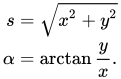
  1. Plano-polar, with points in the plane defined by their distance, s, from a specified point along a ray having a direction α from a baseline or axis.
  2. Rectangular, with points defined by distances from two mutually perpendicular axes, x and y. Contrary to the mathematical convention, in geodetic practice, the x-axis points North and the y-axis East.

One can intuitively use rectangular coordinates in the plane for one's current location, in which case the x-axis will point to the local north. More formally, such coordinates can be obtained from 3D coordinates using the artifice of a map projection. It is impossible to map the curved surface of Earth onto a flat map surface without deformation. The compromise most often chosen — called a conformal projection — preserves angles and length ratios so that small circles get mapped as small circles and small squares as squares.

An example of such a projection is UTM (Universal Transverse Mercator). Within the map plane, we have rectangular coordinates x and y. In this case, the north direction used for reference is the map north, not the local north. The difference between the two is called meridian convergence.

It is easy enough to "translate" between polar and rectangular coordinates in the plane: let, as above, direction and distance be α and s respectively; then we have:

The reverse transformation is given by:

Heights

Height measurement using satellite altimetry

In geodesy, point or terrain heights are "above sea level" as an irregular, physically defined surface. Height systems in use are:

  1. Orthometric heights
  2. Dynamic heights
  3. Geopotential heights
  4. Normal heights

Each system has its advantages and disadvantages. Both orthometric and normal heights are expressed in metres above sea level, whereas geopotential numbers are measures of potential energy (unit: m2 s−2) and not metric. The reference surface is the geoid, an equigeopotential surface approximating the mean sea level as described above. For normal heights, the reference surface is the so-called quasi-geoid, which has a few-metre separation from the geoid due to the density assumption in its continuation under the continental masses.

One can relate these heights through the geoid undulation concept to ellipsoidal heights (also known as geodetic heights), representing the height of a point above the reference ellipsoid. Satellite positioning receivers typically provide ellipsoidal heights unless fitted with special conversion software based on a model of the geoid.

Geodetic datums

Because coordinates and heights of geodetic points always get obtained within a system that itself was constructed based on real-world observations, geodesists introduced the concept of a "geodetic datum" (plural datums): a physical (real-world) realization of a coordinate system used for describing point locations. This realization follows from choosing (therefore conventional) coordinate values for one or more datum points. In the case of height data, it suffices to choose one datum point — the reference benchmark, typically a tide gauge at the shore. Thus we have vertical datums, such as the NAVD 88 (North American Vertical Datum 1988), NAP (Normaal Amsterdams Peil), the Kronstadt datum, the Trieste datum, and numerous others.

In both mathematics and geodesy, a coordinate system is a "coordinate system" per ISO terminology, whereas the International Earth Rotation and Reference Systems Service (IERS) uses the term "reference system" for the same. When coordinates are realized by choosing datum points and fixing a geodetic datum, ISO speaks of a "coordinate reference system", whereas IERS uses a "reference frame" for the same. The ISO term for a datum transformation again is a "coordinate transformation".

Positioning

GPS Block IIA satellite orbits over the Earth.
Geodetic control mark
Navigation device, Apollo program

General geopositioning, or simply positioning, is the determination of the location of points on Earth, by myriad techniques. Geodetic positioning employs geodetic methods to determine a set of precise geodetic coordinates of a point on land, at sea, or in space. It may be done within a coordinate system (point positioning or absolute positioning) or relative to another point (relative positioning). One computes the position of a point in space from measurements linking terrestrial or extraterrestrial points of known location ("known points") with terrestrial ones of unknown location ("unknown points"). The computation may involve transformations between or among astronomical and terrestrial coordinate systems. Known points used in point positioning can be GNSS continuously operating reference stations or triangulation points of a higher-order network.

Traditionally, geodesists built a hierarchy of networks to allow point positioning within a country. The highest in this hierarchy were triangulation networks, densified into the networks of traverses (polygons) into which local mapping and surveying measurements, usually collected using a measuring tape, a corner prism, and the red-and-white poles, are tied.

Commonly used nowadays is GPS, except for specialized measurements (e.g., in underground or high-precision engineering). The higher-order networks are measured with static GPS, using differential measurement to determine vectors between terrestrial points. These vectors then get adjusted in a traditional network fashion. A global polyhedron of permanently operating GPS stations under the auspices of the IERS is the basis for defining a single global, geocentric reference frame that serves as the "zero-order" (global) reference to which national measurements are attached.

Real-time kinematic positioning (RTK GPS) is employed frequently in survey mapping. In that measurement technique, unknown points can get quickly tied into nearby terrestrial known points.

One purpose of point positioning is the provision of known points for mapping measurements, also known as (horizontal and vertical) control. There can be thousands of those geodetically determined points in a country, usually documented by national mapping agencies. Surveyors involved in real estate and insurance will use these to tie their local measurements.

Geodetic problems

In geometrical geodesy, there are two main problems:

  • First geodetic problem (also known as direct or forward geodetic problem): given the coordinates of a point and the directional (azimuth) and distance to a second point, determine the coordinates of that second point.
  • Second geodetic problem (also known as inverse or reverse geodetic problem): given the coordinates of two points, determine the azimuth and length of the (straight, curved, or geodesic) line connecting those points.

The solutions to both problems in plane geometry reduce to simple trigonometry and are valid for small areas on Earth's surface; on a sphere, solutions become significantly more complex as, for example, in the inverse problem, the azimuths differ going between the two end points along the arc of the connecting great circle.

The general solution is called the geodesic for the surface considered, and the differential equations for the geodesic are solvable numerically. On the ellipsoid of revolution, geodesics are expressible in terms of elliptic integrals, which are usually evaluated in terms of a series expansion — see, for example, Vincenty's formulae.

Observational concepts

Axial tilt (or Obliquity), rotation axis, plane of orbit, celestial equator and ecliptic. Earth is shown as viewed from the Sun; the orbit direction is counter-clockwise (to the left).
Global gravity anomaly animation over oceans from the NASA's GRACE (Gravity Recovery and Climate Experiment)

As defined in geodesy (and also astronomy), some basic observational concepts like angles and coordinates include (most commonly from the viewpoint of a local observer):

  • Plumbline or vertical: (the line along) the direction of local gravity.
  • Zenith: the (direction to the) intersection of the upwards-extending gravity vector at a point and the celestial sphere.
  • Nadir: the (direction to the) antipodal point where the downward-extending gravity vector intersects the (obscured) celestial sphere.
  • Celestial horizon: a plane perpendicular to the gravity vector at a point.
  • Azimuth: the direction angle within the plane of the horizon, typically counted clockwise from the north (in geodesy and astronomy) or the south (in France).
  • Elevation: the angular height of an object above the horizon; alternatively: zenith distance equal to 90 degrees minus elevation.
  • Local topocentric coordinates: azimuth (direction angle within the plane of the horizon), elevation angle (or zenith angle), distance.
  • North celestial pole: the extension of Earth's (precessing and nutating) instantaneous spin axis extended northward to intersect the celestial sphere. (Similarly for the south celestial pole.)
  • Celestial equator: the (instantaneous) intersection of Earth's equatorial plane with the celestial sphere.
  • Meridian plane: any plane perpendicular to the celestial equator and containing the celestial poles.
  • Local meridian: the plane which contains the direction to the zenith and the celestial pole.

Measurements

Variations in the gravity field of the Moon, from NASA
Gravity measurement devices, pendulum (left) and absolute gravimeter (right)
A relative gravimeter

The reference surface (level) used to determine height differences and height reference systems is known as mean sea level. The traditional spirit level directly produces such (for practical purposes most useful) heights above sea level; the more economical use of GPS instruments for height determination requires precise knowledge of the figure of the geoid, as GPS only gives heights above the GRS80 reference ellipsoid. As geoid determination improves, one may expect that the use of GPS in height determination shall increase, too.

The theodolite is an instrument used to measure horizontal and vertical (relative to the local vertical) angles to target points. In addition, the tachymeter determines, electronically or electro-optically, the distance to a target and is highly automated or even robotic in operations. Widely used for the same purpose is the method of free station position.

Commonly for local detail surveys, tachymeters are employed, although the old-fashioned rectangular technique using an angle prism and steel tape is still an inexpensive alternative. As mentioned, also there are quick and relatively accurate real-time kinematic (RTK) GPS techniques. Data collected are tagged and recorded digitally for entry into Geographic Information System (GIS) databases.

Geodetic GNSS (most commonly GPS) receivers directly produce 3D coordinates in a geocentric coordinate frame. One such frame is WGS84, as well as frames by the International Earth Rotation and Reference Systems Service (IERS). GNSS receivers have almost completely replaced terrestrial instruments for large-scale base network surveys.

To monitor the Earth's rotation irregularities and plate tectonic motions and for planet-wide geodetic surveys, methods of very-long-baseline interferometry (VLBI) measuring distances to quasars, lunar laser ranging (LLR) measuring distances to prisms on the Moon, and satellite laser ranging (SLR) measuring distances to prisms on artificial satellites, are employed.

Gravity is measured using gravimeters, of which there are two kinds. First are absolute gravimeters, based on measuring the acceleration of free fall (e.g., of a reflecting prism in a vacuum tube). They are used to establish vertical geospatial control or in the field. Second, relative gravimeters are spring-based and more common. They are used in gravity surveys over large areas — to establish the figure of the geoid over these areas. The most accurate relative gravimeters are called superconducting gravimeters, which are sensitive to one-thousandth of one-billionth of Earth-surface gravity. Twenty-some superconducting gravimeters are used worldwide in studying Earth's tides, rotation, interior, oceanic and atmospheric loading, as well as in verifying the Newtonian constant of gravitation.

In the future, gravity and altitude might become measurable using the special-relativistic concept of time dilation as gauged by optical clocks.

Units and measures on the ellipsoid

The definition of latitude (φ) and longitude (λ) on an ellipsoid of revolution (or spheroid). The graticule spacing is 10 degrees. The latitude is defined as the angle between the normal to the ellipsoid and the equatorial plane.

Geographical latitude and longitude are stated in the units degree, minute of arc, and second of arc. They are angles, not metric measures, and describe the direction of the local normal to the reference ellipsoid of revolution. This direction is approximately the same as the direction of the plumbline, i.e., local gravity, which is also the normal to the geoid surface. For this reason, astronomical position determination – measuring the direction of the plumbline by astronomical means – works reasonably well when one also uses an ellipsoidal model of the figure of the Earth.

One geographical mile, defined as one minute of arc on the equator, equals 1,855.32571922 m. One nautical mile is one minute of astronomical latitude. The radius of curvature of the ellipsoid varies with latitude, being the longest at the pole and the shortest at the equator same as with the nautical mile.

A metre was originally defined as the 10-millionth part of the length from the equator to the North Pole along the meridian through Paris (the target was not quite reached in actual implementation, as it is off by 200 ppm in the current definitions). This situation means that one kilometre roughly equals (1/40,000) * 360 * 60 meridional minutes of arc, or 0.54 nautical miles. (This is not exactly so as the two units had been defined on different bases, so the international nautical mile is 1,852 m exactly, which corresponds to rounding the quotient from 1,000/0.54 m to four digits).

Temporal changes

Global plate tectonic movement using GPS
How very-long-baseline interferometry (VLBI) works

Various techniques are used in geodesy to study temporally changing surfaces, bodies of mass, physical fields, and dynamical systems. Points on Earth's surface change their location due to a variety of mechanisms:

  • Continental plate motion, plate tectonics
  • The episodic motion of tectonic origin, especially close to fault lines
  • Periodic effects due to tides and tidal loading
  • Postglacial land uplift due to isostatic adjustment
  • Mass variations due to hydrological changes, including the atmosphere, cryosphere, land hydrology, and oceans
  • Sub-daily polar motion
  • Length-of-day variability
  • Earth's center-of-mass (geocenter) variations
  • Anthropogenic movements such as reservoir construction or petroleum or water extraction

Geodynamics is the discipline that studies deformations and motions of Earth's crust and its solidity as a whole. Often the study of Earth's irregular rotation is included in the above definition. Geodynamical studies require terrestrial reference frames realized by the stations belonging to the Global Geodetic Observing System (GGOS[15]).

Techniques for studying geodynamic phenomena on global scales include:

Notable geodesists

Speculative evolution

From Wikipedia, the free encyclopedia https://en.wikipedia.org/wiki/Speculative_evolution   ...