Supercritical adsorption also referred to as the adsorption of supercritical fluids,
is the adsorption at above-critical temperatures. There are different
tacit understandings of supercritical fluids. For example, “a fluid is
considered to be ‘supercritical’ when its temperature and pressure
exceed the temperature and pressure at the critical point”. In the
studies of supercritical extraction, however, “supercritical fluid” is
applied for a narrow temperature region of 1-1.2 or to +10 K, which is called the supercritical region. ( is the critical temperature)
History
Observations of supercritical adsorption reported before 1930 was
covered in studies by McBain and Britton. All of the important articles
on this subject published between 1930 and 1966 have been reviewed by
Menon. During the last 20 years, a growing interest in supercritical
adsorption research under the impetus of the quest for clean alternative fuels has been observed. Considerable progress has been made in both adsorption measurement techniques and molecular simulation of adsorption on computers, rendering new insights into the nature of supercritical adsorption.
Properties
According to the adsorption behavior, the adsorption of gases on
solids can be classified into three temperature ranges relative to :
1.Subcritical region (T<)
2.Near-critical region (<T<+10)
3. The region T>+10
Isotherms
in the first region will show the feature of subcritical adsorption.
Isotherms in the second region will show the feature of mechanism
transition. Isotherms in the third region will show the feature of
supercritical adsorption. The transition will take a continuous way if
the isotherms in both sides of the critical temperature belong to the
same type, such as adsorption on microporousactivated carbon.
However, discontinuous transition could be observed on isotherms in the
second region if there is a transformation of isotherm types, such as
adsorption on mesoporoussilica gel.
The decisive factor in such a classification of adsorption is merely
temperature, irrespective of pressure. This is because a fluid cannot
undergo a transition to a liquid phase at above-critical temperature,
regardless of the pressure applied. This fundamental law determines the
different adsorption mechanism for the subcritical and supercritical
regions. For the subcritical region, the highest equilibrium pressure of
adsorption is the saturation pressure of adsorbate. Beyond
condensation happens. Adsorbate in the adsorbed phase is largely in
liquid state, based on which different adsorption and thermodynamic
theories as well as their applications were developed. For supercritical
region, condensation cannot happen, no matter how great the pressure is.
Acquisition of supercritical adsorption isotherms
An adsorption isotherm depicts the relation between the quantity
adsorbate and the bulk phase pressure (or density) at equilibrium for a
constant temperature. It is a dataset of specified adsorption
equilibrium. Such equilibrium data are required for optimal design of
process relying on adsorption and are considered fundamental information
for theoretical studies.
Measurement of gas-solid adsorption equilibria
Volumetric method
Figure 1 Schematic structure of a volumetric setup
Volumetric method was used in the early days of adsorption studies by
Langmuir, Dubinin and others. It basically comprises a gas expansion
process from a storage vessel (reference cell) to an adsorption chamber
including adsorbent (adsorption cell) through a controlling valve C, as
schematically shown in Figure 1. The reference cell with volume is kept at a constant temperature . The value of
includes the volume of the tube between the reference cell and valve C.
The adsorption cell is kept at the specified equilibrium temperature . The volume of the connecting tube between the adsorption cell and valve is divided into two parts: one part with volume with same temperature as the reference cell. The other part is buried in an atmosphere of temperature . Its volume is added to the volume of adsorption cell .
Figure 2 Adsorption/desorption isotherms of on activated carbonFigure 3 Adsorption isotherms of on activated carbonFigure 4 Adsorption isotherms of on activated carbonFigure 5 Adsorption isotherms of on silica gel on activated carbonFigure 6 Adsorption isotherms of on silica gel on activated carbon
The amount adsorbed can be calculated from the pressure readings
before and after opening valve C based on the p-V-T relationship of real
gases. A dry and degassed adsorbent sample of known weight was enclosed
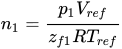
in the adsorption cell. An amount of gas is let into to maintain a pressure . The moles of gas confined in are calculated as:
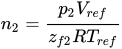
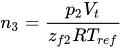
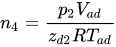
The pressure drops to after opening valve C. The amount of gas maintained in , , and are respectively:
The amount adsorbed or the excess adsorption N is then obtained:
where and are the moles of the gas remaining in and
before opening valve C. All of the compressibility factor values are
calculated by a proper equation of state, which can generate appropriate
z values for temperatures not close to the critical zone.
The main advantages of this method are simplicity in procedure,
commercial availability of instruments, and the large ranges of pressure
and temperature in which this method can be realized. The disadvantage
of volumetric measurements is the considerable amount of adsorbent
sample needed to overcome adsorption effects on the walls of the
vessels. However, this may be a positive aspect if the sample is
adequate. A larger amount of sample results in considerable adsorption
and usually provides a larger void space in the adsorption cell,
rendering the effect of uncertainty in “dead space” to a minimum.
Gravimetric method
In gravimetric method, the weight change of the adsorbent sample in
the gravity field due to adsorption from the gas phase is recorded.
Various types of sensitive microbalance
have been developed for this purpose. A continuous-flow gravimetric
technique coupled with wavelet rectification allows for higher
precision, especially in the near-critical region.
Major advantages of gravimetric method include sensitivity,
accuracy, and the possibility of checking the state of activation of an
adsorbent sample. However, consideration must be given to buoyancy
correction in gravimetric measurement. A counterpart is used for this
purpose. The solid sample is placed in a sample holder on one arm of the
microbalance while the counterpart is loaded on the other arm. Care
must be taken to keep the volume of the sample and the counterpart as
close as possible to reduce the buoyancy effect. The system is vacuumed
and the balance is zeroed before starting experiments. Buoyancy is
measured by introducing helium and pressurizing up to the highest
pressure of the experiment. It is assumed that helium does not adsorb
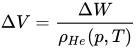
and any weight change (ΔW) is due to buoyancy. Knowing the density of
helium (), one can determine the difference in volume (ΔV) between the sample and the counterpart:
The measured weight can be corrected for the buoyancy effect at a specified temperature and pressure:
is the weight reading before correction.
Generating isotherms by molecular simulation of adsorption
Monte Carlo and molecular dynamic approaches became useful tools for
theoretical calculations aiming at predictions of adsorption equilibria
and diffusivities in small pores of various simple geometries. The
interactions between adsorbate molecules are represented by the
Lenard-Jones potential:
where r is the interparticle distance, is the point at which the potential is zero, and is the well depth.
Experimental isotherms of the supercritical region
Li Zhou and coworkers used a volumetric apparatus to measure the
adsorption equilibria of hydrogen and methane on activated carbon
(Figure 2, 3). They also measure the adsorption equilibria of nitrogen
on microporous activated carbon (Figure 4) and on a mesoporous silica
gel (Figure 5) for both subcritical and supercritical region. Figure 6
shows the isotherms of methane on silica gel.
Future problems
Adsorption of fluid at above-critical temperatures and elevated
pressures is a field growing importance in both science and engineering.
It is the physicochemical basis of many engineering processes and
potential industrial applications. For example, separation or
purification of light hydrocarbons, storage of fuel gases in microporous
solids, adsorption from supercritical gases in extraction processes and
chromatography. Besides, knowledge of gas/solid interface phenomenon at
high pressures is fundamental to heterogeneous catalysis. However, the limited number of reliable high-pressure adsorption data hampered the progress of the theoretical study.
At least two problems have to be solved before a consistent
system of theories for supercritical adsorption becomes sophisticated:
first, how to set up a thermodynamically standard state
for the supercritical adsorbed phase, so that the adsorption potential
for supercritical adsorption can be evaluated? Second, how to determine
the total amount in the adsorbed phase based on experimentally measured
equilibrium data. Determination of the absolute adsorption is needed for
establishing thermodynamic theory because as a reflection of
statistical behavior of molecules, thermodynamic rules must rely on the
total, not part of, material confined in the system studied.
From recent studies of supercritical adsorption, there seems to
be an end in the high-pressure direction for supercritical adsorption.
However, adsorbed-phase density is the decisive factor for the existence
of this end. The state of adsorbate at the “end” provides the standard
state of the supercritical adsorbed phase just like the saturated
liquid, which is the end state of adsorbate in the subcritical
adsorption. So the “end state” has to be precisely defined. To establish
a definite relationship for the adsorbed phase density at the end
state, abundant and reliable experimental data are still required.
A supercritical fluid (SCF) is a substance at a temperature and pressure above its critical point, where distinct liquid and gas phases do not exist, but below the pressure required to compress it into a solid. It can effuse through porous solids like a gas, overcoming the mass transfer limitations that slow liquid transport through such materials. SCFs are superior to gases in their ability to dissolve materials like liquids or solids. Near the critical point, small changes in pressure or temperature result in large changes in density, allowing many properties of a supercritical fluid to be "fine-tuned".
Supercritical fluids generally have properties between those of a gas
and a liquid. In Table 1, the critical properties are shown for some
substances that are commonly used as supercritical fluids.
Also, there is no surface tension
in a supercritical fluid, as there is no liquid/gas phase boundary. By
changing the pressure and temperature of the fluid, the properties can
be "tuned" to be more liquid-like or more gas-like. One of the most
important properties is the solubility of material in the fluid.
Solubility in a supercritical fluid tends to increase with density of
the fluid (at constant temperature). Since density increases with
pressure, solubility tends to increase with pressure. The relationship
with temperature is a little more complicated. At constant density,
solubility will increase with temperature. However, close to the
critical point, the density can drop sharply with a slight increase in
temperature. Therefore, close to the critical temperature, solubility
often drops with increasing temperature, then rises again.
Mixtures
Typically, supercritical fluids are completely miscible
with each other, so that a binary mixture forms a single gaseous phase
if the critical point of the mixture is exceeded. However, exceptions
are known in systems where one component is much more volatile than the
other, which in some cases form two immiscible gas phases at high
pressure and temperatures above the component critical points. This
behavior has been found in systems such as N2-NH3, NH3-CH4, SO2-N2 and n-butane-H2O.
The critical point of a binary mixture can be estimated as the arithmetic mean of the critical temperatures and pressures of the two components,
Figures 1 and 2 show two-dimensional projections of a phase diagram. In the pressure-temperature phase diagram (Fig. 1) the boiling curve separates the gas
and liquid region and ends in the critical point, where the liquid and
gas phases disappear to become a single supercritical phase.
The appearance of a single phase can also be observed in the
density-pressure phase diagram for carbon dioxide (Fig. 2). At well
below the critical temperature, e.g., 280 K, as the pressure increases,
the gas compresses and eventually (at just over 40 bar)
condenses into a much denser liquid, resulting in the discontinuity in
the line (vertical dotted line). The system consists of 2 phases in equilibrium,
a dense liquid and a low density gas. As the critical temperature is
approached (300 K), the density of the gas at equilibrium becomes
higher, and that of the liquid lower. At the critical point (304.1 K
(31.0 °C; 87.7 °F) and 7.38 MPa (73.8 bar)), there is no difference in
density, and the two phases become one fluid phase. Thus, above the
critical temperature a gas cannot be liquefied by pressure. At slightly
above the critical temperature (310 K), in the vicinity of the critical
pressure, the line is almost vertical. A small increase in pressure
causes a large increase in the density of the supercritical phase. Many
other physical properties also show large gradients with pressure near
the critical point, e.g. viscosity, the relative permittivity
and the solvent strength, which are all closely related to the density.
At higher temperatures, the fluid starts to behave more like an ideal
gas, with a more linear density/pressure relationship, as can be seen in
Figure 2. For carbon dioxide at 400 K, the density increases almost
linearly with pressure.
Many pressurized gases are actually supercritical fluids. For
example, nitrogen has a critical point of 126.2 K (−147.0 °C; −232.5 °F)
and 3.4 MPa (34 bar). Therefore, nitrogen (or compressed air) in a gas
cylinder above this pressure is actually a supercritical fluid. These
are more often known as permanent gases. At room temperature, they are
well above their critical temperature, and therefore behave as a nearly
ideal gas, similar to CO2 at 400 K above. However, they
cannot be liquified by mechanical pressure unless cooled below their
critical temperature, requiring gravitational pressure such as within gas giants to produce a liquid or solid at high temperatures. Above the critical temperature, elevated pressures can increase the
density enough that the SCF exhibits liquid-like density and behaviour.
At very high pressures, an SCF can be compressed into a solid because
the melting curve extends to the right of the critical point in the P/T
phase diagram. While the pressure required to compress supercritical CO2 into a solid can be, depending on the temperature, as low as 570 MPa, that required to solidify supercritical water is 14,000 MPa.
The Fisher–Widom line, the Widom line, or the Frenkel line are thermodynamic concepts that allow to distinguish liquid-like and gas-like states within the supercritical fluid.
History
In 1822, Baron Charles Cagniard de la Tour discovered the critical point of a substance in his famous cannon barrel experiments. Listening to discontinuities in the sound of a rolling flint
ball in a sealed cannon filled with fluids at various temperatures, he
observed the critical temperature. Above this temperature, the densities
of the liquid and gas phases become equal and the distinction between them disappears, resulting in a single supercritical fluid phase.
In recent years, a significant effort has been devoted to
investigation of various properties of supercritical fluids.
Supercritical fluids have found application in a variety of fields,
ranging from the extraction of floral fragrance from flowers to
applications in food science such as creating decaffeinated coffee,
functional food ingredients, pharmaceuticals, cosmetics, polymers,
powders, bio- and functional materials, nano-systems, natural products,
biotechnology, fossil and bio-fuels, microelectronics, energy and
environment. Much of the excitement and interest of the past decade is
due to the enormous progress made in increasing the power of relevant
experimental tools. The development of new experimental methods and
improvement of existing ones continues to play an important role in this
field, with recent research focusing on dynamic properties of fluids.
Hydrothermal circulation occurs within the Earth's crust wherever fluid becomes heated and begins to convect.
These fluids are thought to reach supercritical conditions under a
number of different settings, such as in the formation of porphyry
copper deposits or high temperature circulation of seawater in the sea
floor. At mid-ocean ridges, this circulation is most evident by the
appearance of hydrothermal vents known as "black smokers". These are
large (metres high) chimneys of sulfide and sulfate minerals which vent
fluids up to 400 °C. The fluids appear like great black billowing clouds
of smoke due to the precipitation of dissolved metals in the fluid. It
is likely that at that depth many of these vent sites reach
supercritical conditions, but most cool sufficiently by the time they
reach the sea floor to be subcritical. One particular vent site, Turtle
Pits, has displayed a brief period of supercriticality at the vent site.
A further site, Beebe, in the Cayman Trough, is thought to display sustained supercriticality at the vent orifice.
Planetary atmospheres
The atmosphere of Venus
is 96.5% carbon dioxide and 3.5% nitrogen. The surface pressure is 9.3
megapascals (1,350 psi) and the surface temperature is 735 K (462 °C;
863 °F), above the critical points of both major constituents and making
the surface atmosphere a supercritical fluid.
The interior atmospheres of the Solar System's four giant planets
are composed mainly of hydrogen and helium at temperatures well above
their critical points. The gaseous outer atmospheres of the gas giantsJupiter and Saturn transition smoothly into the dense liquid interior, while the nature of the transition zones of the ice giantsNeptune and Uranus is unknown. Theoretical models of extrasolar planetGliese 876 d have posited an ocean of pressurized, supercritical fluid water with a sheet of solid high pressure water ice at the bottom.
The advantages of supercritical fluid extraction (compared with
liquid extraction) are that it is relatively rapid because of the low
viscosities and high diffusivities associated with supercritical fluids.
Alternative solvents to supercritical fluids may be poisonous,
flammable or an environmental hazard to a much larger extent than water
or carbon dioxide are. The extraction can be selective to some extent by
controlling the density of the medium, and the extracted material is
easily recovered by simply depressurizing, allowing the supercritical
fluid to return to gas phase and evaporate leaving little or no solvent
residues. Carbon dioxide is the most common supercritical solvent. It is
used on a large scale for the decaffeination of green coffee beans, the extraction of hops for beer production, and the production of essential oils and pharmaceutical products from plants. A few laboratorytest methods include the use of supercritical fluid extraction as an extraction method instead of using traditional solvents.
Supercritical fluid decomposition
Supercritical water can be used to decompose biomass via supercritical water gasification of biomass. This type of biomass gasification
can be used to produce hydrocarbon fuels for use in an efficient
combustion device or to produce hydrogen for use in a fuel cell. In the
latter case, hydrogen yield can be much higher than the hydrogen content
of the biomass due to steam reforming where water is a
hydrogen-providing participant in the overall reaction.
Dry-cleaning
Supercritical carbon dioxide (SCD) can be used instead of PERC (perchloroethylene) or other undesirable solvents for dry-cleaning. Supercritical carbon dioxide sometimes intercalates
into buttons, and, when the SCD is depressurized, the buttons pop, or
break apart. Detergents that are soluble in carbon dioxide improve the
solvating power of the solvent. CO2-based dry cleaning equipment uses liquid CO2, not supercritical CO2, to avoid damage to the buttons.
Supercritical fluid chromatography
Supercritical fluid chromatography (SFC) can be used on an analytical scale, where it combines many of the advantages of high performance liquid chromatography (HPLC) and gas chromatography (GC). It can be used with non-volatile and thermally labile analytes (unlike GC) and can be used with the universal flame ionization detector
(unlike HPLC), as well as producing narrower peaks due to rapid
diffusion. In practice, the advantages offered by SFC have not been
sufficient to displace the widely used HPLC and GC, except in a few
cases such as chiral separations and analysis of high-molecular-weight hydrocarbons. For manufacturing, efficient preparative simulated moving bed units are available. The purity of the final products is very high, but the cost makes it
suitable only for very high-value materials such as pharmaceuticals.
Chemical reactions
Changing the conditions of the reaction solvent can allow separation
of phases for product removal, or single phase for reaction. Rapid
diffusion accelerates diffusion controlled reactions. Temperature and
pressure can tune the reaction down preferred pathways, e.g., to improve
yield of a particular chiralisomer. There are also significant environmental benefits over conventional
organic solvents. Industrial syntheses that are performed at
supercritical conditions include those of polyethylene from supercritical ethene, isopropyl alcohol from supercritical propene, 2-butanol from supercritical butene, and ammonia from a supercritical mix of nitrogen and hydrogen. Other reactions were, in the past, performed industrially in supercritical conditions, including the synthesis of methanol and thermal (non-catalytic) oil cracking. Because of the development of effective catalysts, the required temperatures of those two processes have been reduced and are no longer supercritical.
Impregnation and dyeing
Impregnation is, in essence, the converse of extraction. A substance
is dissolved in the supercritical fluid, the solution flowed past a
solid substrate, and is deposited on or dissolves in the substrate.
Dyeing, which is readily carried out on polymer fibres such as polyester
using disperse (non-ionic) dyes,
is a special case of this. Carbon dioxide also dissolves in many
polymers, considerably swelling and plasticising them and further
accelerating the diffusion process.
The formation of small particles of a substance with a narrow size
distribution is an important process in the pharmaceutical and other
industries. Supercritical fluids provide a number of ways of achieving
this by rapidly exceeding the saturation point
of a solute by dilution, depressurization or a combination of these.
These processes occur faster in supercritical fluids than in liquids,
promoting nucleation or spinodal decomposition over crystal growth
and yielding very small and regularly sized particles. Recent
supercritical fluids have shown the capability to reduce particles up to
a range of 5–2000 nm.
Generation of pharmaceutical cocrystals
Supercritical fluids act as a new medium for the generation of novel
crystalline forms of APIs (Active Pharmaceutical Ingredients) named as
pharmaceutical cocrystals. Supercritical fluid technology offers a new
platform that allows a single-step generation of particles that are
difficult or even impossible to obtain by traditional techniques. The
generation of pure and dried new cocrystals (crystalline molecular
complexes comprising the API and one or more conformers in the crystal
lattice) can be achieved due to unique properties of SCFs by using
different supercritical fluid properties: supercritical CO2 solvent power, anti-solvent effect and its atomization enhancement.
Supercritical drying
is a method of removing solvent without surface tension effects. As a
liquid dries, the surface tension drags on small structures within a
solid, causing distortion and shrinkage. Under supercritical conditions
there is no surface tension, and the supercritical fluid can be removed
without distortion. Supercritical drying is used in the manufacturing
process of aerogels and drying of delicate materials such as archaeological samples and biological samples for electron microscopy.
Supercritical water electrolysis
Electrolysis of water
in a supercritical state reduces the overpotentials found in other
electrolysers, thereby improving the electrical efficiency of the
production of oxygen and hydrogen.
Increased temperature reduces thermodynamic barriers and
increases kinetics. No bubbles of oxygen or hydrogen are formed on the
electrodes, therefore no insulating layer is formed between catalyst and
water, reducing the ohmic losses. The gas-like properties provide
rapid mass transfer.
Supercritical water oxidation
Supercritical water oxidation
uses supercritical water as a medium in which to oxidize hazardous
waste, eliminating production of toxic combustion products that burning
can produce.
The waste product to be oxidised is dissolved in the
supercritical water along with molecular oxygen (or an oxidising agent
that gives up oxygen upon decomposition, e.g. hydrogen peroxide) at which point the oxidation reaction occurs.
Supercritical water hydrolysis
Supercritical hydrolysis
is a method of converting all biomass polysaccharides as well the
associated lignin into low molecular compounds by contacting with water
alone under supercritical conditions. The supercritical water, acts as a
solvent, a supplier of bond-breaking thermal energy, a heat transfer
agent and as a source of hydrogen atoms. All polysaccharides are
converted into simple sugars in near-quantitative yield in a second or
less. The aliphatic inter-ring linkages of lignin are also readily
cleaved into free radicals that are stabilized by hydrogen originating
from the water. The aromatic rings of the lignin are unaffected under
short reaction times so that the lignin-derived products are low
molecular weight mixed phenols. To take advantage of the very short
reaction times needed for cleavage a continuous reaction system must be
devised. The amount of water heated to a supercritical state is thereby
minimized.
Supercritical water gasification
Supercritical water gasification
is a process of exploiting the beneficial effect of supercritical water
to convert aqueous biomass streams into clean water and gases like H2, CH4, CO2, CO etc.
Supercritical desalination
The solubility of dissolved ions drops precipitously once a fluid
becomes supercritical. This effect can be used to precipitate salts from
high salinity desalination streams, with solubility of different salts
decreasing rapidly as water approaches supercritical temperatures.
Complex cycle design can enable selective precipitation and improved
heat recovery. Some very saline water sources like produced water also
have high hydrocarbon content, which can be oxidized by supercritical
desalination.
Supercritical fluid in power generation
The efficiency of a heat engine is ultimately dependent on the temperature difference between heat source and sink (Carnot cycle). To improve efficiency of power stations the operating temperature must be raised. Using water as the working fluid, this takes it into supercritical conditions. Efficiencies can be raised from about 39% for subcritical operation to about 45% using current technology. Many coal-fired supercritical steam generators are operational all over the world. Supercritical carbon dioxide
is also proposed as a working fluid, which would have the advantage of
lower critical pressure than water, but issues with corrosion are not
yet fully solved. One proposed application is the Allam cycle.
Supercritical water reactors (SCWRs) are proposed advanced nuclear systems that offer similar thermal efficiency gains.
Biodiesel production
Conversion of vegetable oil to biodiesel is via a transesterification reaction, where a triglyceride is converted to the methyl esters (of the fatty acids) plus glycerol. This is usually done using methanol and caustic
or acid catalysts, but can be achieved using supercritical methanol
without a catalyst. The method of using supercritical methanol for
biodiesel production was first studied by Saka and his coworkers. This
has the advantage of allowing a greater range and water content of
feedstocks (in particular, used cooking oil), the product does not need
to be washed to remove catalyst, and is easier to design as a continuous
process.
Enhanced oil recovery and carbon capture and storage
Supercritical carbon dioxide is used to enhance oil recovery in mature oil fields. At the same time, there is the possibility of using "clean coal technology" to combine enhanced recovery methods with carbon sequestration. The CO2 is separated from other flue gases,
compressed to the supercritical state, and injected into geological
storage, possibly into existing oil fields to improve yields.
At present, only schemes isolating fossil CO2 from natural gas actually use carbon storage, (e.g., Sleipner gas field), but there are many plans for future CCS schemes involving pre- or post-combustion CO2. There is also the possibility to reduce the amount of CO2 in the atmosphere by using biomass to generate power and sequestering the CO2 produced.
The use of supercritical carbon dioxide, instead of water, has been examined as a geothermal working fluid.
Refrigeration
Supercritical carbon dioxide is also emerging as a useful high-temperature refrigerant, being used in new, CFC/HFC-free domestic heat pumps making use of the transcritical cycle. These systems are undergoing continuous development with supercritical
carbon dioxide heat pumps already being successfully marketed in Asia.
The EcoCute systems from Japan are some of the first commercially
successful high-temperature domestic water heat pumps.
Supercritical fluid deposition
Supercritical fluids can be used to deposit functional nanostructured
films and nanometer-size particles of metals onto surfaces. The high
diffusivities and concentrations of precursor in the fluid as compared
to the vacuum systems used in chemical vapour deposition allow deposition to occur in a surface reaction rate limited regime, providing stable and uniform interfacial growth. This is crucial in developing more powerful electronic components, and
metal particles deposited in this way are also powerful catalysts for
chemical synthesis and electrochemical reactions. Additionally, due to
the high rates of precursor transport in solution, it is possible to
coat high surface area particles which under chemical vapour deposition
would exhibit depletion near the outlet of the system and also be
likely to result in unstable interfacial growth features such as dendrites. The result is very thin and uniform films deposited at rates much faster than atomic layer deposition, the best other tool for particle coating at this size scale.
Antimicrobial properties
CO2 at high pressures has antimicrobial properties. While its effectiveness has been shown for various applications, the
mechanisms of inactivation have not been fully understood although they
have been investigated for more than 60 years.








![{\displaystyle V(r)=4\epsilon _{ff}\left[\left({\frac {\sigma _{ff}}{r}}\right)^{12}-\left({\frac {\sigma _{ff}}{r}}\right)^{6}\right]}](https://wikimedia.org/api/rest_v1/media/math/render/svg/a5efab3352aa458cba10f0432a38ac48a306019c)


