Search This Blog

Sunday, November 2, 2025

Conservation psychology

From Wikipedia, the free encyclopedia

Conservation psychology is the scientific study of the reciprocal relationships between humans and the rest of nature, with a particular focus on how to encourage conservation of the natural world. Rather than a specialty area within psychology itself, it is a growing field for scientists, researchers, and practitioners of all disciplines to come together and better understand the Earth and what can be done to preserve it. This network seeks to understand why humans hurt or help the environment and what can be done to change such behavior. The term "conservation psychology" refers to any fields of psychology that have understandable knowledge about the environment and the effects humans have on the natural world. Conservation psychologists use their abilities in "greening" psychology and make society ecologically sustainable. The science of conservation psychology is oriented toward environmental sustainability, which includes concerns like the conservation of resources, conservation of ecosystems, and quality of life issues for humans and other species.

One common issue is a lack of understanding of the distinction between conservation psychology and the more-established field of environmental psychology, which is the study of transactions between individuals and all their physical settings, including how people change both the built and the natural environments and how those environments change them. Environmental psychology began in the late 1960s (the first formal program with that name was established at the City University of New York in 1968), and is the term most commonly used around the world. Its definition as including human transactions with both the natural and built environments goes back to its beginnings, as exemplified in these quotes from three 1974 textbooks: "Environmental psychology is the study of the interrelationship between behavior and the built and natural environment" and "...the natural environment is studied as both a problem area, with respect to environmental degradation, and as a setting for certain recreational and psychological needs", and a third that included a chapter entitled The Natural Environment and Behavior.

Conservation psychology, proposed more recently in 2003 and mainly identified with a group of US academics with ties to zoos and environmental studies departments, began with a primary focus on the relations between humans and animals. Introduced in ecology, policy, and biology journals, some have suggested that it should be expanded to try to understand why humans feel the need to help or hurt the environment, along with how to promote conservation efforts.

Pioneers in this field

Who is involved

Psychologists from all fields including philosophy, biology, sociology, industrial and organizational, health, and consumer psychology, along with many other subfields like environmental education and conservation biology come together to put their knowledge to practice in educating others to work together and encourage a congruous relationship between humans and the environment around them. These psychologists work together with places such as zoos and aquariums. Zoos and aquariums may seem to only be places of recreation and fun but are actually trying hard to put positive messages out and to educate the public on the homes and needs of the animals that live there. They are trying to find ways to interact and teach the public the consequences of their day to day actions to the animals and the environment rather than simply viewing the animals. Psychologists and sociologists have been visiting workshops and think tanks at the zoos to evaluate if the animals are being viewed and shown to the best of their ability while still giving informative knowledge to the public.

Research to consider

What characterizes conservation psychology research is that in addition to descriptive and theoretical analyses, studies will explore how to cause the kinds of changes that lessen the impact of human behavior on the natural environment, and that lead to more sustainable and harmonious relationships. Some of the research being done with respect to conservation is estimating exactly how much land and water resources are being used by each human at this point along with projected future growth. Also important to consider is the partitioning of land for this future growth. Additionally, conservation efforts look at the positive and negative consequences for the biodiversity of plant and animal life after humans have used the land to their advantage. In addition to creating better conceptual models, more applied research is needed to: 1) identify the most promising strategies for fostering ways of caring about nature, 2) find ways to reframe debates and strategically communicate to the existing values that people have, 3) identify the most promising strategies for shifting the societal discourse about human–nature relationships, and 4) measure the success of these applications with respect to the conservation psychology mission. The ultimate success of conservation psychology will be based on whether its research resulted in programs and applications that made a difference with respect to environmental sustainability. We need to be able to measure the effectiveness of the programs in terms of their impact on behavior formation or behavior change, using tools developed by conservation psychologists.

Present research and future planning

Conservation psychology research has broken down the four most important tenets of promoting positive conservation attitudes into "the four 'I's". These include: Information, Identity, Institutions, and Incentives. Research has been done in all four categories.

Information

Studies have shown that the way in which crises are presented is a key predictor for how people will react to them. When people hear that they personally can help to alleviate a crisis through their conservation efforts, just by simple actions with their personal energy use, they are more likely to conserve. However, if people are told that the other people around them are overusing energy, it increases selfish behavior and causes people to actually consume more. Other studies show that when people believe in the efficacy of collective action, awareness of the predicament climate change places on society can lead to pro-environmental behaviour. Furthermore, when adequate support is provided for climate related emotions to be reflected on and processed, this leads to an increase in resilience and community engagement.

Teaching people about the benefits of conservation, including easy ways to help conserve, is an effective way to inform about and promote more environmentally friendly behavior. Additionally, research has shown that making sure people understand more about the boundaries of land they can help preserve actually improves positive attitudes towards conservation. When people know more about local regions they can help protect, they will care more. Knowing more about the regions includes knowing the extent of the biodiversity in that region, and being sure that the ecosystem will remain healthy and protected. Cost analysis is another important factor. People do not want to take risks on valuable lands, which in places like California, could be worth billions.

Identity

In general, people like to fit in and identify with their peer social groups. Studies have shown people identify more intimately with close friends and family, which is why conservation campaigns try to directly address the most people. The "think of the children" argument for conservation follows this logic by offering a group everyone can relate to and feel close to. Studies have also shown that this need to fit in among peer social groups can be reinforced positively or negatively: giving positive feedback on energy bills for conserving in their homes encourages people to continue lower energy use. Examples of negative reinforcement include the use of negative press against companies infamous for heavy pollution.

Another interesting line of research looks at how people identify positively or negatively with certain issues. One relevant idea is the notion of "consistency attitudes". Studies have shown that people tend to take a good association they have, and then use this to make positive or negative links with other, related things. For example, if someone thinks it is a good idea to protect old Pacific forests, this will positively form a link to also want to protect smaller forests and even grasslands. This same line of thinking can cause someone who supports the protection of old Pacific forests to start thinking negatively about the creation of more logging roads. Other studies on consistency attitudes have shown that, with one particular issue, people like to align their preferences with each other. This has been shown repeatedly while looking at political ideologies and racial attitudes, and studies have shown that this can also include environmental issues. Finally, other studies have shown that how people identify an ecosystem geographically can affect their concern for it. For instance, when people think of saving the rainforests, they often think of this as a global problem and support it more readily. However, lesser known but still significant local ecosystems remain ignored and unprotected.

Institutions

Another approach that has been considered is the use of organized institutions and government as the leaders for promoting conservation. However, these leaders can only be effective if they are trusted. Studies from previous crises where conserving resources was extremely necessary showed that people were more likely to obey energy restrictions and follow certain leaders when they felt they could trust the people directing them.[11] That is, people are more likely to obey restrictions when they believe that they are being encouraged to act a certain way out of necessity and that they are not being misled.

Incentives

Incentivizing conservation through rewards and fines is another approach. Studies have shown that people who identify more with their community need less incentives to conserve than those who do not identify strongly with their surrounding community. For corporations, monetary incentives have been shown to work for companies showing some effort to make their buildings and practices more "green". Studies have also shown that doing something as simple as putting a water meter in homes has helped incentivize conservation by letting people track their energy consumption levels. Finally, studies have shown that when giving fines, it is better to start with very small and then raise it for repeated violations. If the fines are too high, the issue becomes too economic, and people start to mistrust the authorities enforcing the fines.

Main concepts

Conservation psychology assesses as a whole four different concepts. At the country's first Conservation Psychology conference these four things were discussed. The first is the main original topic of the field, and the other three are topics with a previous history in environmental psychology.

The first topic being discussed is the connection of humans and animals. The Multi-Institutional Research Project (MIRP) works diligently on finding ways to develop a compassionate stance towards animals in the public eye. Many different questions were assessed to find answers to questions concerning ways to help develop loving attitudes for animals and the earth. With these questions and answers, effective educational and interpretive programs were made that would help review the progress.

The second concept that was discussed at the conference concerned connections of humans and places. A new language of conservation will be supported if there are abundant opportunities for meaningful interactions with the natural world in both urban and rural settings. Unfortunately, as biodiversity is lost, every generation has fewer chances to experience nature. It is estimated that more than 80% of the world's population currently lives under light-polluted skies.

Light pollution, along with urbanization, adds to the rising alienation between people and nature, which has been defined as "the extinction of experience". This rising distance is affecting public support for conservation efforts by preventing people from connecting with, understanding, and developing ties to the natural environment as well as the related cultural heritage. For example the Milky Way, which is a common theme in many founding myths, is currently hidden from one-third of the global population.

Miller (2005) contends that designing urban landscapes that encourage "meaningful interactions with the natural world" can help address this growing distance between humans and the skies. Giving individuals access to the Milky Way and letting them experience the natural cycles of sunshine and moonlight, to which they are genetically preadapted to synchronize their physiology and behavior, may be the most meaningful way to help them re-establish a connection with nature.

There were many questions asked concerning how humans in their everyday lives could be persuaded or educated well enough to make them want to join in programs or activities that help maintain biodiversity in their proximity. Local public and private organizations were asked to come together to help find ways to protect and manage local land, plants, and animals. Other discussions came to whether people on an individual or community level would voluntarily choose to become involved in maintaining and protecting their local biodiversity. These plus many other important questions were contemplated. Techniques in marketing are a key tool in helping people connect to their environment. If an identity could be connected from the environment to towns becoming more urbanized, maybe those living there would be more prone to keep it intact.

The third discussion covered the aspects of producing people who act environmentally friendly. Collectively, any activities that support sustainability, either by reducing harmful behaviors or by adopting helpful ones, can be called conservation behaviors. Achieving more sustainable relationships with nature will basically require that large numbers of people change their reproductive and consumptive behaviors. Any action, small or large, that helps the environment in any way is a good beginning to a future of generations who only practice environmentally friendly behavior. This may seem to be a far-fetched idea but with any help at all in educating those who do not know the repercussions of their actions could help achieve this. Approaches to encouraging a change in behavior were thought about carefully. Many do not want to change their way of life. A more simplistic lifestyle rather than their materialistic, current lives hurt their environment around them rather than help, but could people willingly change? To take public transportation rather than drive a car, recycling, turning off lights when they are not needed, all these things are very simple yet a nuisance to actually follow through with. Would restructuring tax-code help people to want to change their attitudes? Any concept to reach the goal of helping people act ecologically aware was discussed and approached. Some empirical evidence shows that simply "being the change you want to see in the world" can influence others to behave in more environmentally friendly ways as well.

The fourth and final point at the first Conservation Psychology convention was the discussion of the values people have to their environment. Understanding our relationship to the natural world well enough so that we have a language to celebrate and defend that relationship is another research area for conservation psychology. According to the biophilia hypothesis, the human species evolved in the company of other life forms, and we continue to rely physically, emotionally, and intellectually on the quality and richness of our affiliations with natural diversity. A healthy and diverse natural environment is considered an essential condition for human lives of satisfaction and fulfillment. Where did they get these values and are they ingrained to the point they cannot be changed? How can environmentally educated people convey value-based communication to a community, a nation, or even on a global level? National policy for this model is something that is desired but under such a strong political scrutiny this could be very challenging. Advocates for biodiversity and different programs came together to try to find methods of changing Americans' values concerning their environment and different methods to express and measure them.

Connection of conservation in biology and psychology

Conservation biology was originally conceptualized as a crisis-oriented discipline, with the goal of providing principles and tools for preserving biodiversity. This is a branch of biology that is concerned with preserving genetic variation in plants and animals. This scientific field evolved to study the complex problems surrounding habitat destruction and species protection. The objectives of conservation biologists are to understand how humans affect biodiversity and to provide potential solutions that benefit both humans and non-human species. It is understood in this field that there are underlying fields of biology that could readily help to have a better understanding and contribute to conservation of biodiversity. Biological knowledge alone is not sufficient to solve conservation problems, and the role of the social sciences in solving these problems has become increasingly important. With the knowledge of conservation biology combined with other fields, much was thought to be gained. Psychology is defined as the scientific study of human thought, feeling, and behavior. Psychology was one of the fields that could take its concepts and apply them to conservation. It was also always understood that in the field of psychology there could be much aid to be given, the field only had to be developed. Psychology can help in providing insight into moral reasoning and moral functioning, which lie in the heart of human–nature relationships.

Matter wave

From Wikipedia, the free encyclopedia

Matter waves are a central part of the theory of quantum mechanics, being half of wave–particle duality. At all scales where measurements have been practical, matter exhibits wave-like behavior. For example, a beam of electrons can be diffracted just like a beam of light or a water wave.

The concept that matter behaves like a wave was proposed by French physicist Louis de Broglie (/dəˈbrɔɪ/) in 1924, and so matter waves are also known as de Broglie waves.

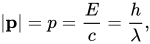
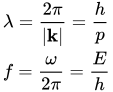
The de Broglie wavelength is the wavelength, λ, associated with a particle with momentum p through the Planck constant, h:

Wave-like behavior of matter has been experimentally demonstrated, first for electrons in 1927 (independently by Davisson and Germer and George Thomson) and later for other elementary particles, neutral atoms and molecules.

Matter waves have more complex velocity relations than solid objects and they also differ from electromagnetic waves (light). Collective matter waves are used to model phenomena in solid state physics; standing matter waves are used in molecular chemistry.

Matter wave concepts are widely used in the study of materials where different wavelength and interaction characteristics of electrons, neutrons, and atoms are leveraged for advanced microscopy and diffraction technologies.

History

Background

At the end of the 19th century, light was thought to consist of waves of electromagnetic fields which propagated according to Maxwell's equations, while matter was thought to consist of localized particles (see history of wave and particle duality). In 1900, this division was questioned when, investigating the theory of black-body radiation, Max Planck proposed that the thermal energy of oscillating atoms is divided into discrete portions, or quanta. Extending Planck's investigation in several ways, including its connection with the photoelectric effect, Albert Einstein proposed in 1905 that light is also propagated and absorbed in quanta, now called photons. These quanta would have an energy given by the Planck–Einstein relation: and a momentum vector where ν (lowercase Greek letter nu) and λ (lowercase Greek letter lambda) denote the frequency and wavelength of the light, c the speed of light, and h the Planck constant. In the modern convention, frequency is symbolized by f as is done in the rest of this article. Einstein's postulate was verified experimentally by K. T. Compton and O. W. Richardson and by A. L. Hughes in 1912 then more carefully including a measurement of the Planck constant in 1916 by Robert Millikan.

De Broglie hypothesis

Propagation of de Broglie waves in one dimension – real part of the complex amplitude is blue, imaginary part is green. The probability (shown as the color opacity) of finding the particle at a given point x is spread out like a waveform; there is no definite position of the particle. As the amplitude increases above zero the slope decreases, so the amplitude diminishes again, and vice versa. The result is an alternating amplitude: a wave. Top: plane wave. Bottom: wave packet.

When I conceived the first basic ideas of wave mechanics in 1923–1924, I was guided by the aim to perform a real physical synthesis, valid for all particles, of the coexistence of the wave and of the corpuscular aspects that Einstein had introduced for photons in his theory of light quanta in 1905.

— de Broglie

De Broglie, in his 1924 PhD thesis, proposed that just as light has both wave-like and particle-like properties, electrons also have wave-like properties. His thesis started from the hypothesis, "that to each portion of energy with a proper mass m0 one may associate a periodic phenomenon of the frequency ν0, such that one finds: 0 = m0c2. The frequency ν0 is to be measured, of course, in the rest frame of the energy packet. This hypothesis is the basis of our theory." (This frequency is also known as Compton frequency.)

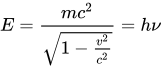
To find the wavelength equivalent to a moving body, de Broglie set the total energy from special relativity for that body equal to :

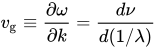
(Modern physics no longer uses this form of the total energy; the energy–momentum relation has proven more useful.) De Broglie identified the velocity of the particle, , with the wave group velocity in free space:

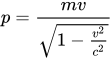
(The modern definition of group velocity uses angular frequency ω and wave number k). By applying the differentials to the energy equation and identifying the relativistic momentum:

then integrating, de Broglie arrived at his formula for the relationship between the wavelength, λ, associated with an electron and the modulus of its momentum, p, through the Planck constant, h

Schrödinger's (matter) wave equation

Following up on de Broglie's ideas, physicist Peter Debye made an offhand comment that if particles behaved as waves, they should satisfy some sort of wave equation. Inspired by Debye's remark, Erwin Schrödinger decided to find a proper three-dimensional wave equation for the electron. He was guided by William Rowan Hamilton's analogy between mechanics and optics (see Hamilton's optico-mechanical analogy), encoded in the observation that the zero-wavelength limit of optics resembles a mechanical system – the trajectories of light rays become sharp tracks that obey Fermat's principle, an analog of the principle of least action.

In 1926, Schrödinger published the wave equation that now bears his name – the matter wave analogue of Maxwell's equations – and used it to derive the energy spectrum of hydrogen. Frequencies of solutions of the non-relativistic Schrödinger equation differ from de Broglie waves by the Compton frequency since the energy corresponding to the rest mass of a particle is not part of the non-relativistic Schrödinger equation. The Schrödinger equation describes the time evolution of a wavefunction, a function that assigns a complex number to each point in space. Schrödinger tried to interpret the modulus squared of the wavefunction as a charge density. This approach was, however, unsuccessful. Max Born proposed that the modulus squared of the wavefunction is instead a probability density, a successful proposal now known as the Born rule.

Position space probability density of an initially Gaussian state moving in one dimension at minimally uncertain, constant momentum in free space

The following year, 1927, C. G. Darwin (grandson of the famous biologist Charles Darwin) explored Schrödinger's equation in several idealized scenarios. For an unbound electron in free space he worked out the propagation of the wave, assuming an initial Gaussian wave packet. Darwin showed that at time later the position of the packet traveling at velocity would be where is the uncertainty in the initial position. This position uncertainty creates uncertainty in velocity (the extra second term in the square root) consistent with Heisenberg's uncertainty relation. The wave packet spreads out as shown in the figure.

Experimental confirmation

In 1927, matter waves were first experimentally confirmed to occur in George Paget Thomson and Alexander Reid's diffraction experiment and the Davisson–Germer experiment, both for electrons.

Original electron diffraction camera made and used by Nobel laureate G P Thomson and his student Alexander Reid in 1925
Example original electron diffraction photograph from the laboratory of G. P. Thomson, recorded 1925–1927

The de Broglie hypothesis and the existence of matter waves has been confirmed for other elementary particles, neutral atoms and even molecules have been shown to be wave-like.

The first electron wave interference patterns directly demonstrating wave–particle duality used electron biprisms (essentially a wire placed in an electron microscope) and measured single electrons building up the diffraction pattern. A close copy of the famous double-slit experiment using electrons through physical apertures gave the movie shown.

Matter wave double slit diffraction pattern building up electron by electron. Each white dot represents a single electron hitting a detector; with a statistically large number of electrons interference fringes appear.

Electrons

In 1927 at Bell Labs, Clinton Davisson and Lester Germer fired slow-moving electrons at a crystalline nickel target. The diffracted electron intensity was measured, and was determined to have a similar angular dependence to diffraction patterns predicted by Bragg for x-rays. At the same time George Paget Thomson and Alexander Reid at the University of Aberdeen were independently firing electrons at thin celluloid foils and later metal films, observing rings which can be similarly interpreted. (Alexander Reid, who was Thomson's graduate student, performed the first experiments but he died soon after in a motorcycle accident and is rarely mentioned.) Before the acceptance of the de Broglie hypothesis, diffraction was a property that was thought to be exhibited only by waves. Therefore, the presence of any diffraction effects by matter demonstrated the wave-like nature of matter. The matter wave interpretation was placed onto a solid foundation in 1928 by Hans Bethe, who solved the Schrödinger equation, showing how this could explain the experimental results. His approach is similar to what is used in modern electron diffraction approaches.

This was a pivotal result in the development of quantum mechanics. Just as the photoelectric effect demonstrated the particle nature of light, these experiments showed the wave nature of matter.

Neutrons

Neutrons, produced in nuclear reactors with kinetic energy of around 1 MeV, thermalize to around 0.025 eV as they scatter from light atoms. The resulting de Broglie wavelength (around 180 pm) matches interatomic spacing and neutrons scatter strongly from hydrogen atoms. Consequently, neutron matter waves are used in crystallography, especially for biological materials. Neutrons were discovered in the early 1930s, and their diffraction was observed in 1936. In 1944, Ernest O. Wollan, with a background in X-ray scattering from his PhD work under Arthur Compton, recognized the potential for applying thermal neutrons from the newly operational X-10 nuclear reactor to crystallography. Joined by Clifford G. Shull, they developed neutron diffraction throughout the 1940s. In the 1970s, a neutron interferometer demonstrated the action of gravity in relation to wave–particle duality. The double-slit experiment was performed using neutrons in 1988.

Atoms

Interference of atom matter waves was first observed by Immanuel Estermann and Otto Stern in 1930, when a Na beam was diffracted off a surface of NaCl. The short de Broglie wavelength of atoms prevented progress for many years until two technological breakthroughs revived interest: microlithography allowing precise small devices and laser cooling allowing atoms to be slowed, increasing their de Broglie wavelength. The double-slit experiment on atoms was performed in 1991.

Advances in laser cooling allowed cooling of neutral atoms down to nanokelvin temperatures. At these temperatures, the de Broglie wavelengths come into the micrometre range. Using Bragg diffraction of atoms and a Ramsey interferometry technique, the de Broglie wavelength of cold sodium atoms was explicitly measured and found to be consistent with the temperature measured by a different method.

Molecules

Recent experiments confirm the relations for molecules and even macromolecules that otherwise might be supposed too large to undergo quantum mechanical effects. In 1999, a research team in Vienna demonstrated diffraction for molecules as large as fullerenes. The researchers calculated a de Broglie wavelength of the most probable C60 velocity as 2.5 pm. More recent experiments prove the quantum nature of molecules made of 810 atoms and with a mass of 10,123 Da. As of 2019, this has been pushed to molecules of 25,000 Da.

In these experiments the build-up of such interference patterns could be recorded in real time and with single molecule sensitivity. Large molecules are already so complex that they give experimental access to some aspects of the quantum-classical interface, i.e., to certain decoherence mechanisms.

Others

Matter waves have been detected in van der Waals moleculesrho mesons, and Bose-Einstein condensate.

Traveling matter waves

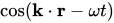
Waves have more complicated concepts for velocity than solid objects. The simplest approach is to focus on the description in terms of plane matter waves for a free particle, that is a wave function described by where is a position in real space, is the wave vector in units of inverse meters, ω is the angular frequency with units of inverse time and is time. (Here the physics definition for the wave vector is used, which is times the wave vector used in crystallography, see wavevector.) The de Broglie equations relate the wavelength λ to the modulus of the momentum , and frequency f to the total energy E of a free particle as written above: where h is the Planck constant. The equations can also be written as Here, ħ = h/2π is the reduced Planck constant. The second equation is also referred to as the Planck–Einstein relation.

Group velocity

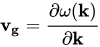
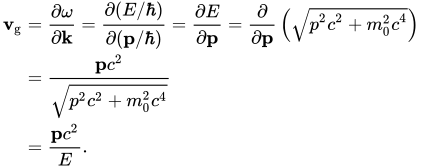
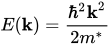
In the de Broglie hypothesis, the velocity of a particle equals the group velocity of the matter wave. In isotropic media or a vacuum the group velocity of a wave is defined by: The relationship between the angular frequency and wavevector is called the dispersion relationship. For the non-relativistic case this is: where is the rest mass. Applying the derivative gives the (non-relativistic) matter wave group velocity: For comparison, the group velocity of light, with a dispersion , is the speed of light .

As an alternative, using the relativistic dispersion relationship for matter waves then This relativistic form relates to the phase velocity as discussed below.

For non-isotropic media we use the Energy–momentum form instead:

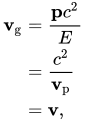
But (see below), since the phase velocity is , then where is the velocity of the center of mass of the particle, identical to the group velocity.

Phase velocity

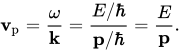
The phase velocity in isotropic media is defined as: Using the relativistic group velocity above: This shows that as reported by R.W. Ditchburn in 1948 and J. L. Synge in 1952. Electromagnetic waves also obey , as both and . Since for matter waves, , it follows that , but only the group velocity carries information. The superluminal phase velocity therefore does not violate special relativity, as it does not carry information.

For non-isotropic media, then

Using the relativistic relations for energy and momentum yields The variable can either be interpreted as the speed of the particle or the group velocity of the corresponding matter wave—the two are the same. Since the particle speed for any particle that has nonzero mass (according to special relativity), the phase velocity of matter waves always exceeds c, i.e., which approaches c when the particle speed is relativistic. The superluminal phase velocity does not violate special relativity, similar to the case above for non-isotropic media. See the article on Dispersion (optics) for further details.

Special relativity

Using two formulas from special relativity, one for the relativistic mass energy and one for the relativistic momentum allows the equations for de Broglie wavelength and frequency to be written as where is the velocity, the Lorentz factor, and the speed of light in vacuum. This shows that as the velocity of a particle approaches zero (rest) the de Broglie wavelength approaches infinity.

Four-vectors

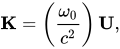
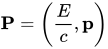
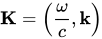
Using four-vectors, the de Broglie relations form a single equation: which is frame-independent. Likewise, the relation between group/particle velocity and phase velocity is given in frame-independent form by: where

General matter waves

The preceding sections refer specifically to free particles for which the wavefunctions are plane waves. There are significant numbers of other matter waves, which can be broadly split into three classes: single-particle matter waves, collective matter waves and standing waves.

Single-particle matter waves

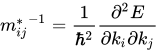
The more general description of matter waves corresponding to a single particle type (e.g. a single electron or neutron only) would have a form similar to where now there is an additional spatial term in the front, and the energy has been written more generally as a function of the wave vector. The various terms given before still apply, although the energy is no longer always proportional to the wave vector squared. A common approach is to define an effective mass which in general is a tensor given by so that in the simple case where all directions are the same the form is similar to that of a free wave above.In general the group velocity would be replaced by the probability current  where is the del or gradient operator. The momentum would then be described using the kinetic momentum operator The wavelength is still described as the inverse of the modulus of the wavevector, although measurement is more complex. There are many cases where this approach is used to describe single-particle matter waves:

Collective matter waves

Other classes of matter waves involve more than one particle, so are called collective waves and are often quasiparticles. Many of these occur in solids – see Ashcroft and Mermin. Examples include:

  • In solids, an electron quasiparticle is an electron where interactions with other electrons in the solid have been included. An electron quasiparticle has the same charge and spin as a "normal" (elementary particle) electron and, like a normal electron, it is a fermion. However, its effective mass can differ substantially from that of a normal electron. Its electric field is also modified, as a result of electric field screening.
  • A hole is a quasiparticle which can be thought of as a vacancy of an electron in a state; it is most commonly used in the context of empty states in the valence band of a semiconductor. A hole has the opposite charge of an electron.
  • A polaron is a quasiparticle where an electron interacts with the polarization of nearby atoms.
  • An exciton is an electron and hole pair which are bound together.
  • A Cooper pair is two electrons bound together so they behave as a single matter wave.

Standing matter waves

Some trajectories of a particle in a box according to Newton's laws of classical mechanics (A), and matter waves (B–F). In (B–F), the horizontal axis is position, and the vertical axis is the real part (blue) and imaginary part (red) of the wavefunction. The states (B,C,D) are energy eigenstates, but (E,F) are not.

The third class are matter waves which have a wavevector, a wavelength and vary with time, but have a zero group velocity or probability flux. The simplest of these, similar to the notation above would be These occur as part of the particle in a box, and other cases such as in a ring. This can, and arguably should be, extended to many other cases. For instance, in early work de Broglie used the concept that an electron matter wave must be continuous in a ring to connect to the Bohr–Sommerfeld condition in the early approaches to quantum mechanics. In that sense atomic orbitals around atoms, and also molecular orbitals are electron matter waves.

Matter waves vs. electromagnetic waves (light)

Schrödinger applied Hamilton's optico-mechanical analogy to develop his wave mechanics for subatomic particles. Consequently, wave solutions to the Schrödinger equation share many properties with results of light wave optics. In particular, Kirchhoff's diffraction formula works well for electron optics and for atomic optics. The approximation works well as long as the electric fields change more slowly than the de Broglie wavelength. Macroscopic apparatus fulfill this condition; slow electrons moving in solids do not.

Beyond the equations of motion, other aspects of matter wave optics differ from the corresponding light optics cases.

Sensitivity of matter waves to environmental condition. Many examples of electromagnetic (light) diffraction occur in air under many environmental conditions. Obviously visible light interacts weakly with air molecules. By contrast, strongly interacting particles like slow electrons and molecules require vacuum: the matter wave properties rapidly fade when they are exposed to even low pressures of gas. With special apparatus, high velocity electrons can be used to study liquids and gases. Neutrons, an important exception, interact primarily by collisions with nuclei, and thus travel several hundred feet in air.

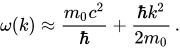
Dispersion. Light waves of all frequencies travel at the same speed of light while matter wave velocity varies strongly with frequency. The relationship between frequency (proportional to energy) and wavenumber or velocity (proportional to momentum) is called a dispersion relation. Light waves in a vacuum have linear dispersion relation between frequency: . For matter waves the relation is non-linear: This non-relativistic matter wave dispersion relation says the frequency in vacuum varies with wavenumber () in two parts: a constant part due to the de Broglie frequency of the rest mass () and a quadratic part due to kinetic energy. The quadratic term causes rapid spreading of wave packets of matter waves.

Coherence The visibility of diffraction features using an optical theory approach depends on the beam coherence, which at the quantum level is equivalent to a density matrix approach. As with light, transverse coherence (across the direction of propagation) can be increased by collimation. Electron optical systems use stabilized high voltage to give a narrow energy spread in combination with collimating (parallelizing) lenses and pointed filament sources to achieve good coherence. Because light at all frequencies travels the same velocity, longitudinal and temporal coherence are linked; in matter waves these are independent. For example, for atoms, velocity (energy) selection controls longitudinal coherence and pulsing or chopping controls temporal coherence.

Optically shaped matter waves Optical manipulation of matter plays a critical role in matter wave optics: "Light waves can act as refractive, reflective, and absorptive structures for matter waves, just as glass interacts with light waves." Laser light momentum transfer can cool matter particles and alter the internal excitation state of atoms.

Multi-particle experiments While single-particle free-space optical and matter wave equations are identical, multiparticle systems like coincidence experiments are not.

Applications of matter waves

The following subsections provide links to pages describing applications of matter waves as probes of materials or of fundamental quantum properties. In most cases these involve some method of producing travelling matter waves which initially have the simple form , then using these to probe materials.

As shown in the table below, matter wave mass ranges over 6 orders of magnitude and energy over 9 orders but the wavelengths are all in the picometre range, comparable to atomic spacings. (Atomic diameters range from 62 to 520 pm, and the typical length of a carbon–carbon single bond is 154 pm.) Reaching longer wavelengths requires special techniques like laser cooling to reach lower energies; shorter wavelengths make diffraction effects more difficult to discern. Therefore, many applications focus on material structures, in parallel with applications of electromagnetic waves, especially X-rays. Unlike light, matter wave particles may have mass, electric charge, magnetic moments, and internal structure, presenting new challenges and opportunities.

Various matter wave wavelengths
matter mass kinetic energy wavelength reference
Electron 1/1823 Da 54 eV 167 pm Davisson–Germer experiment
Electron 1/1823 Da 5×10⁴ eV pm Tonomura et al.
He atom, H2 molecule Da
50 pm Estermann and Stern
Neutron Da 0.025 eV 181 pm Wollan and Shull
Sodium atom 23 Da
20 pm Moskowitz et al.
Helium Da 0.065 eV 56 pm Grisenti et al.
Na2 23 Da 0.00017 eV 459 pm Chapman et al.
C60 fullerene 720 Da 0.2 eV pm Arndt et al.
C70 fullerene 841 Da 0.2 eV pm Brezger et al.
polypeptide, Gramicidin A 1860 Da
360 fm Shayeghi et al.
functionalized oligoporphyrins 25000 Da 17 eV 53 fm Fein et al.

Electrons

Electron diffraction patterns emerge when energetic electrons reflect or penetrate ordered solids; analysis of the patterns leads to models of the atomic arrangement in the solids.

They are used for imaging from the micron to atomic scale using electron microscopes, in transmission, using scanning, and for surfaces at low energies.

The measurements of the energy they lose in electron energy loss spectroscopy provides information about the chemistry and electronic structure of materials. Beams of electrons also lead to characteristic X-rays in energy dispersive spectroscopy which can produce information about chemical content at the nanoscale.

Quantum tunneling explains how electrons escape from metals in an electrostatic field at energies less than classical predictions allow: the matter wave penetrates of the work function barrier in the metal.

Scanning tunneling microscope leverages quantum tunneling to image the top atomic layer of solid surfaces.

Electron holography, the electron matter wave analog of optical holography, probes the electric and magnetic fields in thin films.

Neutrons

Neutron diffraction complements x-ray diffraction through the different scattering cross sections and sensitivity to magnetism.

Small-angle neutron scattering provides way to obtain structure of disordered systems that is sensitivity to light elements, isotopes and magnetic moments.

Neutron reflectometry is a neutron diffraction technique for measuring the structure of thin films.

Neutral atoms

Atom interferometers, similar to optical interferometers, measure the difference in phase between atomic matter waves along different paths.

Atom optics mimic many light optic devices, including mirrors, atom focusing zone plates.

Scanning helium microscopy uses He atom waves to image solid structures non-destructively.

Quantum reflection uses matter wave behavior to explain grazing angle atomic reflection, the basis of some atomic mirrors.

Quantum decoherence measurements rely on Rb atom wave interference.

Molecules

Quantum superposition revealed by interference of matter waves from large molecules probes the limits of wave–particle duality and quantum macroscopicity.

Matter-wave interfererometers generate nanostructures on molecular beams that can be read with nanometer accuracy and therefore be used for highly sensitive force measurements, from which one can deduce a plethora of properties of individualized complex molecules.

Epigenetics of anxiety and stress–related disorders

From Wikipedia, the free encyclopedia https://en.wikipedia.org/wiki/Epigenetics_of_anxiety_and_st...