Figure 1: Tidal interaction between the spiral galaxyNGC 169 and a smaller companion
The tidal force or tide-generating force is the difference in gravitational attraction between different points in a gravitational field, causing bodies to be pulled unevenly and as a result are being stretched towards the attraction. It is the differential force of gravity, the net between gravitational forces, the derivative of gravitational potential, the gradient of gravitational fields. Therefore tidal forces are a residual force,
a secondary effect of gravity, highlighting its spatial elements,
making the closer near-side more attracted than the more distant
far-side.
This produces a range of tidal phenomena,
such as ocean tides. Earth's tides are mainly produced by the relative
close gravitational field of the Moon
and to a lesser extent by the stronger, but further away gravitational
field of the Sun. The ocean on the side of Earth facing the Moon is
being pulled by the gravity of the Moon away from Earth's crust,
while on the other side of Earth there the crust is being pulled away
from the ocean, resulting in Earth being stretched, bulging on both
sides, and having opposite high-tides. Tidal forces viewed from Earth, that is from a rotating reference frame, appear as centripetal and centrifugal forces, but are not caused by the rotation.
In celestial mechanics, the expression tidal force
can refer to a situation in which a body or material (for example,
tidal water) is mainly under the gravitational influence of a second
body (for example, the Earth), but is also perturbed by the
gravitational effects of a third body (for example, the Moon). The
perturbing force is sometimes in such cases called a tidal force (for example, the perturbing force on the Moon):
it is the difference between the force exerted by the third body on the
second and the force exerted by the third body on the first.
Explanation
Figure 2: Shown in red, the Moon's gravity residual field at the surface of the Earth is known (along with another and weaker differential effect due to the Sun) as the tide generating force.
This is the primary mechanism driving tidal action, explaining two
simultaneous tidal bulges. Earth's rotation accounts further for the
occurrence of two high tides per day on the same location. In this
figure, the Earth is the central black circle while the Moon is far off
to the right. It shows both the tidal field (thick red arrows) and the
gravity field (thin blue arrows) exerted on Earth's surface and center
(label O) by the Moon (label S). The outward direction of the arrows on the right and left of the Earth indicates that where the Moon is at zenith or at nadir.
When a body (body 1) is acted on by the gravity of another body (body
2), the field can vary significantly on body 1 between the side of the
body facing body 2 and the side facing away from body 2. Figure 2 shows
the differential force of gravity on a spherical body (body 1) exerted
by another body (body 2).
These tidal forces cause strains on both bodies and may distort them or even, in extreme cases, break one or the other apart. The Roche limit
is the distance from a planet at which tidal effects would cause an
object to disintegrate because the differential force of gravity from
the planet overcomes the attraction of the parts of the object for one
another. These strains would not occur if the gravitational field were uniform, because a uniform field only causes the entire body to accelerate together in the same direction and at the same rate.
Size and distance
The
relationship of an astronomical body's size, to its distance from
another body, strongly influences the magnitude of tidal force. The tidal force acting on an astronomical body, such as the Earth, is
directly proportional to the diameter of the Earth and inversely
proportional to the cube of the distance from another body producing a
gravitational attraction, such as the Moon or the Sun. Tidal action on
bath tubs, swimming pools, lakes, and other small bodies of water is
negligible.
Figure 3: Graph showing how gravitational attraction drops off with increasing distance from a body
Figure 3 is a graph showing how gravitational force declines with
distance. In this graph, the attractive force decreases in proportion to
the square of the distance (Y = 1/X2), while the slope (Y′ = −2/X3) is inversely proportional to the cube of the distance.
The tidal force corresponds to the difference in Y between two
points on the graph, with one point on the near side of the body, and
the other point on the far side. The tidal force becomes larger, when
the two points are either farther apart, or when they are more to the
left on the graph, meaning closer to the attracting body.
For example, even though the Sun has a stronger overall
gravitational pull on Earth, the Moon creates a larger tidal bulge
because the Moon is closer. This difference is due to the way gravity
weakens with distance: the Moon's closer proximity creates a steeper
decline in its gravitational pull as you move across Earth (compared to
the Sun's very gradual decline from its vast distance). This steeper
gradient in the Moon's pull results in a larger difference in force
between the near and far sides of Earth, which is what creates the
bigger tidal bulge.
Gravitational attraction is inversely proportional to the square
of the distance from the source. The attraction will be stronger on the
side of a body facing the source, and weaker on the side away from the
source. The tidal force is proportional to the difference.
Sun, Earth, and Moon
The
Sun is about 20 million times the Moon's mass, and acts on the Earth
over a distance about 400 times larger than that of the Moon. Because of
the cubic dependence on distance, this results in the solar tidal force
on the Earth being about half that of the lunar tidal force.
Figure 4: Saturn's
rings are inside the orbits of its principal moons. Tidal forces oppose
gravitational coalescence of the material in the rings to form moons.
In the case of an infinitesimally small elastic sphere, the effect of
a tidal force is to distort the shape of the body without any change in
volume. The sphere becomes an ellipsoid with two bulges, pointing towards and away from the other body. Larger objects distort into an ovoid,
and are slightly compressed, which is what happens to the Earth's
oceans under the action of the Moon. All parts of the Earth are subject
to the Moon's gravitational forces, causing the water in the oceans to
redistribute, forming bulges on the sides near the Moon and far from the
Moon.
When a body rotates while subject to tidal forces, internal
friction results in the gradual dissipation of its rotational kinetic
energy as heat. In the case for the Earth, and Earth's Moon, the loss of
rotational kinetic energy results in a gain of about 2 milliseconds per
century. If the body is close enough to its primary, this can result in
a rotation which is tidally locked to the orbital motion, as in the case of the Earth's moon. Tidal heating produces dramatic volcanic effects on Jupiter's moon Io. Stresses caused by tidal forces also cause a regular monthly pattern of moonquakes on Earth's Moon.
Tidal forces contribute to ocean currents, which moderate global
temperatures by transporting heat energy toward the poles. It has been
suggested that variations in tidal forces correlate with cool periods in
the global temperature record at 6- to 10-year intervals, and that harmonic beat
variations in tidal forcing may contribute to millennial climate
changes. No strong link to millennial climate changes has been found to
date.
Figure 5: Comet Shoemaker-Levy 9 in 1994 after breaking up under the influence of Jupiter's tidal forces during a previous pass in 1992.
By generating conducting fluids within the interior of the Earth, tidal forces also affect the Earth's magnetic field.
Formulation
Figure 7: Tidal force is responsible for the merge of galactic pair MRK 1034.Figure
8: Graphic of tidal forces. The top picture shows the gravity field of a
body to the right (not shown); the lower shows their residual gravity
once the field at the centre of the sphere is subtracted; this is the
tidal force. For visualization purposes, the top arrows may be assumed
as equal to 1 N, 2 N, and 3 N (from left to right); the resulting bottom
arrows would equal, respectively, −1 N (negative, thus 180-degree
rotated), 0 N (invisible), and 1 N. See Figure 2 for a more detailed
version
For a given (externally generated) gravitational field, the tidal acceleration at a point with respect to a body is obtained by vector subtraction
of the gravitational acceleration at the center of the body (due to the
given externally generated field) from the gravitational acceleration
(due to the same field) at the given point. Correspondingly, the term tidal force
is used to describe the forces due to tidal acceleration. Note that for
these purposes the only gravitational field considered is the external
one; the gravitational field of the body (as shown in the graphic) is
not relevant. (In other words, the comparison is with the conditions at
the given point as they would be if there were no externally generated
field acting unequally at the given point and at the center of the
reference body. The externally generated field is usually that produced
by a perturbing third body, often the Sun or the Moon in the frequent
example-cases of points on or above the Earth's surface in a geocentric
reference frame.)
Tidal acceleration does not require rotation or orbiting bodies; for example, the body may be freefalling in a straight line under the influence of a gravitational field while still being influenced by (changing) tidal acceleration.
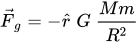
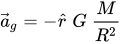
where is a unit vector pointing from the body M to the body m (here, acceleration from m towards M has negative sign).
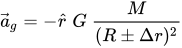
Consider now the acceleration due to the sphere of mass M experienced by a particle in the vicinity of the body of mass m. With R as the distance from the center of M to the center of m, let ∆r be the (relatively small) distance of the particle from the center of the body of mass m. For simplicity, distances are first considered only in the direction pointing towards or away from the sphere of mass M. If the body of mass m is itself a sphere of radius ∆r, then the new particle considered may be located on its surface, at a distance (R ± ∆r) from the centre of the sphere of mass M, and ∆r may be taken as positive where the particle's distance from M is greater than R. Leaving aside whatever gravitational acceleration may be experienced by the particle towards m on account of m's own mass, we have the acceleration on the particle due to gravitational force towards M as:
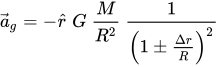
Pulling out the R2 term from the denominator gives:
The first term is the gravitational acceleration due to M at the center of the reference body , i.e., at the point where is zero. This term does not affect the observed acceleration of particles on the surface of m because with respect to M, m
(and everything on its surface) is in free fall. When the force on the
far particle is subtracted from the force on the near particle, this
first term cancels, as do all other even-order terms. The remaining
(residual) terms represent the difference mentioned above and are tidal
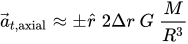
force (acceleration) terms. When ∆r is small compared to R, the terms after the first residual term are very small and can be neglected, giving the approximate tidal acceleration for the distances ∆r considered, along the axis joining the centers of m and M:
When calculated in this way for the case where ∆r is a distance along the axis joining the centers of m and M, is directed outwards from to the center of m (where ∆r is zero).
Tidal accelerations can also be calculated away from the axis connecting the bodies m and M, requiring a vector calculation. In the plane perpendicular to that axis, the tidal acceleration is directed inwards (towards the center where ∆r is zero), and its magnitude is in linear approximation as in Figure 2.
The tidal accelerations at the surfaces of planets in the Solar
System are generally very small. For example, the lunar tidal
acceleration at the Earth's surface along the Moon–Earth axis is about 1.1×10⁻⁷g, while the solar tidal acceleration at the Earth's surface along the Sun–Earth axis is about 0.52×10⁻⁷g, where g is the gravitational acceleration at the Earth's surface. Hence the tide-raising force (acceleration) due to the Sun is about 45% of that due to the Moon. The solar tidal acceleration at the Earth's surface was first given by Newton in the Principia.
Firefighters are exposed to risks of fire and building collapse during their work.
Risk is the possibility of something bad happening, comprising a level of uncertainty about the effects and implications of an activity, particularly negative and undesirable consequences.
Harbor sign warning visitors that use of the walkway is "at your own risk"
The Oxford English Dictionary (OED) cites the earliest use of the word in English (in the spelling of risque from its French original, 'risque') as of 1621, and the spelling as risk from 1655. While including several other definitions, the OED 3rd edition defines risk
as "(Exposure to) the possibility of loss, injury, or other adverse or
unwelcome circumstance; a chance or situation involving such a
possibility". The Cambridge Advanced Learner's Dictionary defines risk as "the possibility of something bad happening". Some have argued that the definition of risk is subjective and context-specific. The International Organization for Standardization (ISO) 31073 defines risk as:
effect of uncertainty on objectives
Note 1: An effect is a deviation from the expected. It can be
positive, negative or both, and can address, create or result in
opportunities and threats.
Note 2: Objectives can have different aspects and categories, and can be applied at different levels.
Note 3: Risk is usually expressed in terms of risk sources, potential events, their consequences and their likelihood.
Other general definitions include:
"Source of harm". The earliest use of the word "risk" was as a synonym for the much older word "hazard", meaning a potential source of harm. This definition comes from Blount's "Glossographia" (1661) and was the main definition in the OED 1st (1914) and 2nd (1989) editions. Modern equivalents refer to "unwanted events" or "something bad that might happen".
"Chance of harm". This definition comes from Johnson's "Dictionary
of the English Language" (1755), and has been widely paraphrased,
including "possibility of loss" or "probability of unwanted events".
"Uncertain events affecting objectives". This definition was adopted by the Association for Project Management (1997). With slight rewording it became the definition in ISO Guide 73.
"Uncertainty of outcome". This definition was adopted by the UK Cabinet Office (2002) to encourage innovation to improve public services. It allowed "risk"
to describe either "positive opportunity or negative threat of actions
and events".
"Potential returns from an event ['a thing that happens or takes
place'], where the returns are any changes, effects, consequences, and
so on, of the event". This definition from Newsome (2014) expands the
neutrality of 'risk' akin to the UK Cabinet Office (2002) and Knight
(1921).
"Human interaction with uncertainty". This definition comes from Cline (2015) in the context of adventure education.
Versus uncertainty
In his seminal 1921 work Risk, Uncertainty, and Profit, Frank Knight established the distinction between risk and uncertainty.
... Uncertainty must be taken in a
sense radically distinct from the familiar notion of Risk, from which it
has never been properly separated. The term "risk," as loosely used in
everyday speech and in economic discussion, really covers two things
which, functionally at least, in their causal relations to the phenomena
of economic organization, are categorically different. ... The
essential fact is that "risk" means in some cases a quantity susceptible
of measurement, while at other times it is something distinctly not of
this character; and there are far-reaching and crucial differences in
the bearings of the phenomenon depending on which of the two is really
present and operating. ... It will appear that a measurable uncertainty,
or "risk" proper, as we shall use the term, is so far different from an
unmeasurable one that it is not in effect an uncertainty at all. We ...
accordingly restrict the term "uncertainty" to cases of the
non-quantitive type.
Thus, Knightian uncertainty is immeasurable, not possible to calculate, while in the Knightian sense risk is measurable.
Any event that could result in the compromise of organizational
assets i.e. the unauthorized use, loss, damage, disclosure or
modification of organizational assets for the profit, personal interest
or political interests of individuals, groups or other entities
is the number of scenarios chosen to describe the risk
Risks expressed in this way can be shown in a risk register or a risk matrix. They may be quantitative or qualitative, and can include positive as well as negative consequences.
An updated version recommends the following general description of risk:
where:
is an event that might occur
is the consequences of the event
is an assessment of uncertainties
is a knowledge-based probability of the event
is the background knowledge that U and P are based on
Probability distributions
If all the consequences are expressed in the same units (or can be converted into a consistent loss function), the risk can be expressed as a probability density function describing the uncertainty about outcome:
This can also be expressed as a cumulative distribution function (CDF) (or S curve). One way of highlighting the tail of this distribution is by showing the probability of exceeding given losses, known as a complementary cumulative distribution function,
plotted on logarithmic scales. For example, frequency-number diagrams
show the annual frequency of exceeding given numbers of fatalities. Another way of summarizing the size of the distribution's tail is the
loss with a certain probability of exceedance, that is, the value at risk.
Expected values
Risk is often measured as the expected value of the loss. This combines the probabilities and consequences into a single value. See also expected utility. The simplest case is a binary possibility of Accident or No accident. The associated formula for calculating risk is then:
In a situation with several possible accident scenarios, total risk
is the sum of the risks for each scenario, provided that the outcomes
are comparable:
In statistical decision theory, the risk function is defined as the expected value of a given loss function as a function of the decision rule used to make decisions in the face of uncertainty.
A disadvantage of defining risk as the product of impact and
probability is that it presumes, unrealistically, that decision-makers
are risk-neutral. A risk-neutral person's utility is proportional to the expected value
of the payoff. For example, a risk-neutral person would consider 20%
chance of winning $1 million exactly as desirable as getting a certain
$200,000. However, most decision-makers are not actually risk-neutral
and would not consider these equivalent choices. Pascal's mugging
is a philosophical thought experiment that demonstrates issues in
assessing risk solely by the expected value of loss or return.
Outcome frequencies
Risks of discrete events such as accidents are often measured as outcome frequencies,
or expected rates of specific loss events per unit time. When small,
frequencies are numerically similar to probabilities, but have
dimensions of 1/t and can sum to more than 1. Typical outcomes expressed this way include:
Individual risk - the frequency of a given level of harm to an individual. It often refers to the expected annual probability of death, and is then comparable to the mortality rate.
Group (or societal risk) – the relationship between the frequency and the number of people suffering harm.
Frequencies of property damage or total loss.
Frequencies of environmental damage such as oil spills.
Financial risk
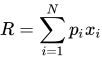
In finance, volatility is the degree of variation of a trading price over time, usually measured by the standard deviation of logarithmic returns. Modern portfolio theory measures risk using the variance (or standard deviation) of asset prices. The risk is then:
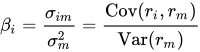
The beta coefficient measures the volatility of an individual asset to overall market changes. This is the asset's contribution to systematic risk, which cannot be eliminated by portfolio diversification. It is the covariance between the asset's return ri and the market return rm, expressed as a fraction of the market variance:
Let be a d-dimensional market representing the price processes of the risky assets, the risk-free bond and the underlying probability space. Then a measure is a risk-neutral measure if
Benoit Mandelbrot
distinguished between "mild" and "wild" risk and argued that risk
assessment and analysis must be fundamentally different for the two
types of risk. Mild risk follows normal or near-normal probability distributions, is subject to regression to the mean and the law of large numbers, and is therefore relatively predictable. Wild risk follows fat-tailed distributions, e.g., Pareto or power-law distributions,
is subject to regression to the tail (infinite mean or variance,
rendering the law of large numbers invalid or ineffective), and is
therefore difficult or impossible to predict. A common error in risk
assessment and analysis is to underestimate the wildness of risk,
assuming risk to be mild when in fact it is wild, which must be avoided
if risk assessment and analysis are to be valid and reliable, according
to Mandelbrot.
Estimation
Proxy or analogue data from other contexts, presumed to be similar in some aspects of risk.
Risk management is the set of actions that organisations take to avoid and mitigate downside risks, taking into account factors such as the possibility of upside risk opportunities, innovation, the environment, safety, scientific evidence, culture, politics, and law. Risk management operates at the strategic, operational, and individual level, and may form part of an overarching governance, risk, and compliance strategy. It comprises the assessment of risk as regards an organisation's objectives and strategies, as well as risk mitigation options, such as risk transformation, risk transfer, risk avoidance, risk reduction, and risk retention.
Assessment
Risk assessment
is a systematic approach to recognising and characterising risks, and
evaluating their significance, in order to support decisions about how
to manage them. ISO 31000 defines it in terms of its components as "the overall process of risk identification, risk analysis and risk evaluation":
Risk identification is "the process of finding, recognizing and
recording risks". It "involves the identification of risk sources,
events, their causes and their potential consequences." ISO 31000 describes it as the first step in a risk assessment process, preceding risk analysis and risk evaluation. In safety contexts, where risk sources are known as hazards, this step is known as "hazard identification".
The ISO defines risk analysis as "the process to comprehend the nature of risk and to determine the level of risk". In the ISO 31000 risk assessment process, risk analysis follows risk identification and precedes risk evaluation. Risk analysis often uses data on the probabilities and consequences of previous events.
Risk evaluation involves comparing estimated levels of risk against
risk criteria to determine the significance of the risk and make
decisions about risk treatment actions. In most activities, risks can be reduced by adding further controls or
other treatment options, but typically this increases cost or
inconvenience. It is rarely possible to eliminate risks altogether
without discontinuing the activity. Sometimes it is desirable to
increase risks to secure valued benefits. Risk criteria are intended to
guide decisions on these issues.
For example, the tolerability of risk framework, developed by the UK Health and Safety Executive, divides risks into three bands:
Unacceptable risks – only permitted in exceptional circumstances.
Tolerable risks – to be kept as low as reasonably practicable (ALARP), taking into account the costs and benefits of further risk reduction.
Broadly acceptable risks – not normally requiring further reduction.
Attitude, appetite and tolerance
The terms risk appetite,
attitude, and tolerance are often used similarly to describe an
organisation's or individual's attitude towards risk-taking. One's
attitude may be described as risk-averse, risk-neutral, or risk-seeking.
Mitigation
Risk transformation describes the process of not only mitigating risks but also employing risk factors into advantages.
Risk transfer is the shifting of risks from one party to another, typically an insurer.
Psychology of risk
Risk perception
Risk perception
is the subjective judgement that people make about the characteristics
and severity of a risk. At its most basic, the perception of risk is an
intuitive form of risk analysis.
Adults have an intuitive understanding of risk, which may not be exclusive to humans. Many ancient societies believed in divinely determined fates,
and attempts to influence the gods can be seen as early forms of risk
management. Early uses of the word 'risk' coincided with an erosion of
belief in divinely ordained fate. Notwithstanding, intuitive perceptions of risk are often inaccurate owing to reliance on psychological heuristics, which are subject to systematic cognitive biases. In particular, the accuracy of risk perception can be adversely affected by the affect heuristic, which relies on emotion to make decisions.
The availability heuristic
is the process of judging the probability of an event by the ease with
which instances come to mind. In general, rare but dramatic causes of
death are over-estimated while common unspectacular causes are
under-estimated; an "availability cascade"
is a self-reinforcing cycle in which public concern about relatively
minor events is amplified by media coverage until the issue becomes
politically important. Despite the difficulty of thinking statistically, people are typically subject to the overconfidence effect in their judgements, tending to overestimate their understanding of the world and underestimate the role of chance, with even experts subject to this effect. Other biases that affect the perception of risk include ambiguity aversion.
Paul Slovic's "psychometric
paradigm" assumes that risk is subjectively defined by individuals,
influenced by factors such as lack of control, catastrophic potential,
and severity of consequences, such that risk perception can be
psychometrically measured by surveys. Slovic argues that intuitive emotional reactions are the predominant
method by which humans evaluate risk, and that a purely statistical
approach to disasters lacks emotion and thus fails to convey the true
meaning of disasters and fails to motivate proper action to prevent
them. This theory has received support from retrospective studies and evolutionary psychology. Hazards with high perceived risk are therefore, in general, seen as less acceptable and more in need of reduction.
Cultural theory of risk
views risk perception as a collective phenomenon by which different
cultures select some risks for attention and ignore others, with the aim
of maintaining their particular way of life. Hence risk perception varies according to the preoccupations of the
culture. The theory outlines two categories, the degree of binding to
social groups, the degree of social regulation. Cultural theory can be used to explain why it can be difficult for
people with different world-views to agree about whether a hazard is
acceptable, and why risk assessments may be more persuasive for some
people than others. However, there is little quantitative evidence that
shows cultural biases are strongly predictive of risk perception.
In decision theory, regret (and anticipation of regret) can play a significant part in decision-making, distinct from risk aversion. Framing is also a fundamental problem with all forms of risk assessment. In particular, because of bounded rationality,
the risk of extreme events is discounted because the probability is too
low to evaluate intuitively. As an example, one of the leading causes
of death is road accidents caused by drunk driving
– partly because any given driver frames the problem by largely or
totally ignoring the risk of a serious or fatal accident. The right prefrontal cortex has been shown to take a more global perspective, while greater left prefrontal activity relates to local or focal processing. Reference class forecasting is a forecasting method by which biases associated with risks can be mitigated.
Risk taking
Psychologists
have run randomised experiments with a treatment and control group to
ascertain the effect of different psychological factors that may be
associated with risk taking, finding that positive and negative feedback about past risk taking can
affect future risk taking. For example, one experiment showed that
belief in competence correlated with risk-taking behavior. Risk compensation is a theory that suggests that people typically adjust their behavior
in response to the perceived level of risk, becoming more careful where
they sense greater risk and less careful if they feel more protected. People also show risk aversion, such that they reject fair risky offers because of the perception of loss. Further, intuitive responses have been found to be less risk-averse than subsequent reflective response.
Sex differences
Sex differences in financial decision making are relevant and
significant. Numerous studies have found that women tend to be
financially more risk-averse than men and hold safer portfolios. Scholarly research has documented systematic differences in financial
decisions such as buying investments versus insurance, donating to
ingroups versus outgroups (such as terrorism victims in Iraq versus the
United States), spending in stores, and the endowment effect-or asking price for goods people have.
Philosophy of risk
Peter
L. Bernstein (2012) showed that people used risk estimates before
statistics and probability calculations were developed. Instead of
relying on numbers, people used narratives and letters. Captains and merchants shared voyage stories at coffeehouses, comparing
notes about hazards on new routes and seasonal patterns. Through a web
of correspondents, letters became increasingly important as people could
update their beliefs about weather, wars, or piracy over long
distances. These qualitative data helped investors and underwriters
judge how dicey a proposed voyage felt.
This kind of evidence has led philosophers to think there is more
to (objective) risk than the likelihood of an undesirable outcome.
Ebert et al. (2020) suggest distinguishing risk monists from risk
pluralists:
risk monists argue that there is just one correct way to understand
risk. Tversky and Kahneman can be considered monists in this sense;
probability judgments that diverged from the probability calculus were
deemed wrong or biased. By contrast, pluralists claim that there are different, valid notions
of risk. On this view, people who lived before statistics were developed
may have been doing something legitimate when they estimated risks—even
if those estimates conflict with a statistical notion. Without
statistics, what else could they have done?
According to the modal account of risk, a situation is risky when nearby possible worlds—differing only slightly from the actual one—contain serious harm. Risk tracks the closeness of such bad outcomes rather than their
probability; hence a low-chance disaster may still count as high risk if
only a small change would have led to it. On the normic account of
risk, a situation is risky when the bad outcome would be normal or
unsurprising. Risk is assessed through system functions and norms rather than bare
probability. A harm counts as high risk when it would occur in the most
normal continuations of the present setup; the less departure from
normality needed for the harm, the greater the risk. Especially in
domains where we lack predictive power, such approaches allow us to
consider risk without relying on unknown probabilities, as illustrated
by the normic account of suicide risk.
Society and culture
Risk and autonomy
The
experience of many people who rely on human services for support is
that 'risk' is often used as a reason to prevent them from gaining
further independence or fully accessing the community, and that these
services are often unnecessarily risk averse. "People's autonomy used to be compromised by institution walls, now
it's too often our risk management practices", according to John O'Brien. Michael Fischer and Ewan Ferlie (2013) find that contradictions between
formal risk controls and the role of subjective factors in human
services (such as the role of emotions and ideology) can undermine
service values, so producing tensions and even intractable and 'heated'
conflict.
Anthony Giddens and Ulrich Beck argued that whilst humans have always been subjected to a level of risk – such as natural disasters – these have usually been perceived as produced by non-human forces. Modern societies, however, are exposed to risks such as pollution, that are the result of the modernization process itself. Giddens defines these two types of risks as external risks and manufactured risks. The term Risk society
was coined in the 1980s and its popularity during the 1990s was both as
a consequence of its links to trends in thinking about wider modernity,
and also to its links to popular discourse, in particular the growing
environmental concerns during the period.