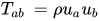
The Einstein field equations relate the Einstein tensor to the
stress–energy tensor, which represents the distribution of energy,
momentum and stress in the spacetime manifold. The Einstein tensor is
built up from the metric tensor and its partial derivatives; thus, given
the stress–energy tensor, the Einstein field equations are a system of
ten partial differential equations in which the metric tensor can be solved for.
Solving the equations
It is important to realize that the Einstein field equations alone
are not enough to determine the evolution of a gravitational system in
many cases. They depend on the stress–energy tensor,
which depends on the dynamics of matter and energy (such as
trajectories of moving particles), which in turn depends on the
gravitational field. If one is only interested in the weak field limit
of the theory, the dynamics of matter can be computed using special
relativity methods and/or Newtonian laws of gravity and the resulting
stress–energy tensor can then be plugged into the Einstein field
equations. But if one requires an exact solution or a solution
describing strong fields, the evolution of both the metric and the
stress–energy tensor must be solved for at once.
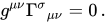
To obtain solutions, the relevant equations are the above quoted EFE (in either form) plus the continuity equation (to determine the evolution of the stress–energy tensor):
These amount to only 14 equations (10 from the field equations and 4
from the continuity equation) and are by themselves insufficient for
determining the 20 unknowns (10 metric components and 10 stress–energy
tensor components). The equations of state
are missing. In the most general case, it's easy to see that at least 6
more equations are required, possibly more if there are internal
degrees of freedom (such as temperature) which may vary throughout
spacetime.
In practice, it is usually possible to simplify the problem by
replacing the full set of equations of state with a simple
approximation. Some common approximations are:
For a perfect fluid, another equation of state relating density and pressure
must be added. This equation will often depend on temperature, so a
heat transfer equation is required or the postulate that heat transfer
can be neglected.
Next, notice that only 10 of the original 14 equations are independent, because the continuity equation is a consequence of Einstein's equations. This reflects the fact that the system is gauge invariant
(in general, absent some symmetry, any choice of a curvilinear
coordinate net on the same system would correspond to a numerically
different solution.) A "gauge fixing" is needed, i.e. we need to impose 4
(arbitrary) constraints on the coordinate system in order to obtain
unequivocal results. These constraints are known as coordinate conditions.
A popular choice of gauge is the so-called "De Donder gauge", also known as the harmoniccondition or harmonic gauge
In numerical relativity, the preferred gauge is the so-called "3+1 decomposition", based on the ADM formalism. In this decomposition, metric is written in the form
, where
and
are functions of spacetime coordinates and can be chosen arbitrarily in
each point. The remaining physical degrees of freedom are contained in , which represents the Riemannian metric on 3-hypersurfaces with constant . For example, a naive choice of , , would correspond to a so-called synchronous
coordinate system: one where t-coordinate coincides with proper time
for any comoving observer (particle that moves along a fixed trajectory.)
Once equations of state are chosen and the gauge is fixed, the
complete set of equations can be solved. Unfortunately, even in the
simplest case of gravitational field in the vacuum (vanishing
stress–energy tensor), the problem is too complex to be exactly
solvable. To get physical results, we can either turn to numerical methods, try to find exact solutions by imposing symmetries, or try middle-ground approaches such as perturbation methods or linear approximations of the Einstein tensor.
An illustration of the Schwarzschild metric, which describes spacetime around a spherical, uncharged, and nonrotating object with mass
A major area of research is the discovery of exact solutions
to the Einstein field equations. Solving these equations amounts to
calculating a precise value for the metric tensor (which defines the
curvature and geometry of spacetime) under certain physical conditions.
There is no formal definition for what constitutes such solutions, but
most scientists agree that they should be expressable using elementary functions or linear differential equations. Some of the most notable solutions of the equations include:
The Schwarzschild solution, which describes spacetime surrounding a spherically symmetric non-rotating uncharged massive object. For compact enough objects, this solution generated a black hole with a central singularity. At points far away from the central mass, the accelerations predicted
by the Schwarzschild solution are nearly identical to those predicted by
Newton's theory of gravity.
The Reissner–Nordström solution,
which analyzes a non-rotating spherically symmetric object with charge
and was independently discovered by several different researchers
between 1916 and 1921. In some cases, this solution can predict the existence of black holes with double event horizons.
The Kerr solution,
which generalizes the Schwarzchild solution to rotating massive
objects. Because of the difficulty of factoring in the effects of
rotation into the Einstein field equations, this solution was not
discovered until 1963.
The Kerr–Newman solution
for charged, rotating massive objects. This solution was derived in
1964, using the same technique of complex coordinate transformation that
was used for the Kerr solution.
Today, there remain many important situations in which the Einstein
field equations have not been solved. Chief among these is the two-body problem,
which concerns the geometry of spacetime around two mutually
interacting massive objects, such as the Sun and the Earth, or the two
stars in a binary star system. The situation gets even more complicated when considering the interactions of three or more massive bodies (the "n-body problem". However, it is still possible to construct an approximate solution to the field equations in the n-body problem by using the technique of post-Newtonian expansion. In general, the extreme nonlinearity of the Einstein field equations
makes it difficult to solve them in all but the most specific cases.
The solutions that are not exact are called non-exact solutions.
Such solutions mainly arise due to the difficulty of solving the EFE in
closed form and often take the form of approximations to ideal system.
For most physical scenarios, it is impossible to find an exact solution,
so approximations are made. In such cases, non-exact solutions can
still be used for modeling realistic cosmological systems. Additionally,
many non-exact solutions may be devoid of physical content, but serve
as useful counterexamples to theoretical conjectures.
Non-exact solutions are often found using numerical methods or perturbation theory. Common perturbative approaches include taking a Post-Newtonian expansion, which begins with a Newtonian baseline and add corrections to account for relativistic effects. Numerical methods for solving the coupled differential equations include spectral methods
in which the functions are expanded in sets of orthogonal polynomials
or functions, finite-difference methods, and finite element methods. Computer simulations are also often used to find non-exact solutions,
especially in strong field scenarios such as massive stars or black holes, and can help detect critical behaviors and unexpected phenomena. Using computer simulations to find these solutions is a technique called numerical relativity.
Applications
There are practical as well as theoretical reasons for studying solutions of the Einstein field equations.
From a purely mathematical viewpoint, it is interesting to know
the set of solutions of the Einstein field equations. Some of these
solutions are parametrised by one or more parameters. From a physical
standpoint, knowing the solutions of the Einstein Field Equations allows
highly-precise modelling of astrophysical phenomena, including black
holes, neutron stars, and stellar systems. Predictions can be made
analytically about the system analyzed; such predictions include the perihelion precession of Mercury, the existence of a co-rotating region inside spinning black holes, and the orbits of objects around massive bodies.
To be diagnosed with aphasia, a person's ability to produce and/or comprehend written and/or spokenlanguage must be significantly impaired. In the case of progressive aphasia, this impairment progresses slowly with time.
The difficulties of people with aphasia can range from occasional
trouble finding words, to losing the ability to speak, read, or write;
intelligence, however, is unaffected. Expressive language and receptive language can both be affected as well. Aphasia also affects visual language such as sign language. In contrast, the use of formulaic expressions in everyday communication is often preserved. For example, while a person with aphasia, particularly expressive aphasia (Broca's
aphasia), may not be able to ask a loved one when their birthday is,
they may still be able to sing "Happy Birthday". One prevalent deficit
in all aphasias is anomia, in which the affected individual has difficulty finding the correct word.
With aphasia, one or more modes of communication in the brain
have been damaged and are therefore functioning incorrectly. Aphasia is not caused by damage to the brain resulting in motor or sensory deficits, thus producing abnormal speech — that is, aphasia is not related to the mechanics of speech,
but rather the individual's language cognition. However, it is possible
for a person to have both problems, e.g. in the case of a hemorrhage
damaging a large area of the brain. An individual's language abilities
incorporate the socially shared set of rules, as well as the thought
processes that go behind communication (as it affects both verbal and
nonverbal language). Aphasia is not a result of other peripheral motor
or sensory difficulty, such as paralysis affecting the speech muscles, or a general hearing impairment.
Neurodevelopmental forms of auditory processing disorder
(APD) are differentiable from aphasia in that aphasia is by definition
caused by acquired brain injury, but acquired epileptic aphasia has been
viewed as a form of APD.
Signs and symptoms
People with aphasia may experience any of the following behaviors due
to an acquired brain injury, although some of these symptoms may be due
to related or concomitant problems, such as dysarthria or apraxia,
and not primarily due to aphasia. Aphasia symptoms can vary based on
the location of damage in the brain. Signs and symptoms may or may not
be present in individuals with aphasia and may vary in severity and
level of disruption to communication. Often those with aphasia may have a difficulty with naming objects, so they might use words such as thing or point at the objects. When asked to name a pencil they may say it is a "thing used to write".
Given the previously stated signs and symptoms, the following
behaviors are often seen in people with aphasia as a result of attempted
compensation for incurred speech and language deficits:
Self-repairs: Further disruptions in fluent speech as a result of mis-attempts to repair erred speech production.
Struggle in non-fluent aphasias: A severe increase in expelled
effort to speak after a life where talking and communicating was an
ability that came so easily can cause visible frustration.
Preserved and automatic language: A behavior in which some language
or language sequences that were used frequently prior to onset are still
produced with more ease than other language post onset.
Subcortical
Subcortical aphasia's characteristics and symptoms depend upon
the site and size of subcortical lesion. Possible sites of lesions
include the thalamus, internal capsule, and basal ganglia.
Cognitive deficits
While aphasia has traditionally been described in terms of language
deficits, there is increasing evidence that many people with aphasia
commonly experience co-occurring non-linguistic cognitive deficits in areas such as attention, memory, executive functions and learning. By some accounts, cognitive deficits, such as attention and working
memory constitute the underlying cause of language impairment in people
with aphasia. Others suggest that cognitive deficits often co-occur, but are
comparable to cognitive deficits in stroke patients without aphasia and
reflect general brain dysfunction following injury. Whilst it has been shown that cognitive neural networks support language reorganisation after stroke, The degree to which deficits in attention and other cognitive domains underlie language deficits in aphasia is still unclear.
In particular, people with aphasia often demonstrate short-term and working memory deficits. These deficits can occur in both the verbal domain as well as the visuospatial domain. Furthermore, these deficits are often associated with performance on
language specific tasks such as naming, lexical processing, and sentence
comprehension, and discourse production. Other studies have found that most, but not all people with aphasia
demonstrate performance deficits on tasks of attention, and their
performance on these tasks correlate with language performance and
cognitive ability in other domains. Even patients with mild aphasia, who score near the ceiling on tests of
language often demonstrate slower response times and interference
effects in non-verbal attention abilities.
In addition to deficits in short-term memory, working memory, and
attention, people with aphasia can also demonstrate deficits in
executive function. For instance, people with aphasia may demonstrate deficits in initiation, planning, self-monitoring, and cognitive flexibility. Other studies have found that people with aphasia demonstrate reduced
speed and efficiency during completion of executive function
assessments.
Regardless of their role in the underlying nature of aphasia,
cognitive deficits have a clear role in the study and rehabilitation of
aphasia. For instance, the severity of cognitive deficits in people with
aphasia has been associated with lower quality of life, even more so
than the severity of language deficits. Furthermore, cognitive deficits may influence the learning process of rehabilitation and language treatment outcomes in aphasia. Non-linguistic cognitive deficits have also been the target of
interventions directed at improving language ability, though outcomes
are not definitive. While some studies have demonstrated language improvement secondary to cognitively-focused treatment, others have found little evidence that the treatment of cognitive
deficits in people with aphasia has an influence on language outcomes.
One important caveat in the measurement and treatment of
cognitive deficits in people with aphasia is the degree to which
assessments of cognition rely on language abilities for successful
performance. Most studies have attempted to circumvent this challenge by utilizing
non-verbal cognitive assessments to evaluate cognitive ability in people
with aphasia. However, the degree to which these tasks are truly
"non-verbal" and not mediated by language is unclear. For instance, Wall et al. found that language and non-linguistic performance was related, except
when non-linguistic performance was measured by "real life" cognitive
tasks.
Causes
Aphasia is most often caused by stroke, where about a quarter of patients who experience an acute stroke develop aphasia. However, any disease or damage to the parts of the brain that control
language can cause aphasia. Some of these can include brain tumors,
traumatic brain injury, epilepsy and progressive neurological disorders. In rare cases, aphasia may also result from herpesviral encephalitis. The herpes simplex virus affects the frontal and temporal lobes, subcortical structures, and the hippocampal tissue, which can trigger aphasia. In acute disorders, such as head injury or stroke, aphasia usually develops quickly. When caused by brain tumor, infection, or dementia, it develops more slowly.
Substantial damage to tissue anywhere within the region shown in
blue (on the figure in the infobox above) can potentially result in
aphasia. Aphasia can also sometimes be caused by damage to subcortical
structures deep within the left hemisphere, including the thalamus, the internal and external capsules, and the caudate nucleus of the basal ganglia. The area and extent of brain damage or atrophy will determine the type of aphasia and its symptoms. A very small number of people can experience aphasia after damage to the right hemisphere
only. It has been suggested that these individuals may have had an
unusual brain organization prior to their illness or injury, with
perhaps greater overall reliance on the right hemisphere for language
skills than in the general population.
Primary progressive aphasia
(PPA), while its name can be misleading, is actually a form of dementia
that has some symptoms closely related to several forms of aphasia. It
is characterized by a gradual loss in language functioning while other
cognitive domains are mostly preserved, such as memory and personality.
PPA usually initiates with sudden word-finding difficulties in an
individual and progresses to a reduced ability to formulate
grammatically correct sentences (syntax) and impaired comprehension. The
etiology of PPA is not due to a stroke, traumatic brain injury (TBI),
or infectious disease; it is still uncertain what initiates the onset of
PPA in those affected by it.
Epilepsy can also include transient aphasia as a prodromal or episodic symptom. However, the repeated seizure activity within language regions may also
lead to chronic, and progressive aphasia. Aphasia is also listed as a
rare side-effect of the fentanyl patch, an opioid used to control chronic pain.
Diagnosis
Neuroimaging methods
Magnetic resonance imaging (MRI) and functional magnetic resonance imaging
(fMRI) are the most common neuroimaging tools used in identifying
aphasia and studying the extent of damage in the loss of language
abilities. This is done by doing MRI scans and locating the extent of
lesions or damage within brain tissue, particularly within areas of the
left frontal and temporal regions- where a lot of language related areas
lie. In fMRI studies a language related task is often completed and
then the BOLD image is analyzed. If there are lower than normal BOLD
responses that indicate a lessening of blood flow to the affected area
and can show quantitatively that the cognitive task is not being
completed.
There are limitations to the use of fMRI in aphasic patients
particularly. Because a high percentage of aphasic patients develop it
because of stroke there can be infarct
present which is the total loss of blood flow. This can be due to the
thinning of blood vessels or the complete blockage of it. This is
important in fMRI as it relies on the BOLD response (the oxygen levels
of the blood vessels), and this can create a false hyporesponse upon
fMRI study. Due to the limitations of fMRI such as a lower spatial resolution, it
can show that some areas of the brain are not active during a task when
they in reality are. Additionally, with stroke
being the cause of many cases of aphasia the extent of damage to brain
tissue can be difficult to quantify therefore the effects of stroke
brain damage on the functionality of the patient can vary.
Neural substrates of aphasia subtypes
MRI is often used to predict or confirm the subtype of aphasia
present. Researchers compared three subtypes of aphasia —
nonfluent-variant primary progressive aphasia (nfPPA), logopenic-variant
primary progressive aphasia (lvPPA), and semantic-variant primary
progressive aphasia (svPPA), with primary progressive aphasia (PPA) and Alzheimer's disease. This was done by analyzing the MRIs of patients with each of the subsets of PPA. Images which compare subtypes of aphasia as well as for finding the
extent of lesions are generated by overlapping images of different
participant's brains (if applicable) and isolating areas of lesions or
damage using third-party software such as MRIcron. MRI has also been
used to study the relationship between the type of aphasia developed and
the age of the person with aphasia. It was found that patients with
fluent aphasia are on average older than people with non-fluent aphasia.
It was also found that among patients with lesions confined to the
anterior portion of the brain an unexpected portion of them presented
with fluent aphasia and were remarkably older than those with non-fluent
aphasia. This effect was not found when the posterior portion of the
brain was studied.
Associated conditions
In a study on the features associated with different disease trajectories in Alzheimer's disease
(AD)-related primary progressive aphasia (PPA), it was found that
metabolic patterns via PET SPM analysis can help predict progression of
total loss of speech and functional autonomy in AD and PPA patients.
This was done by comparing an MRI or CT image of the brain and presence
of a radioactive biomarker with normal levels in patients without
Alzheimer's Disease. Apraxia is another disorder often correlated with aphasia. This is due
to a subset of apraxia which affects speech. Specifically, this subset
affects the movement of muscles associated with speech production, apraxia and aphasia are often correlated due to the proximity of neural substrates associated with each of the disorders. Researchers concluded that there were 2 areas of lesion overlap between
patients with apraxia and aphasia, the anterior temporal lobe and the
left inferior parietal lobe.
Treatment and neuroimaging
Evidence for positive treatment outcomes can also be quantified using
neuroimaging tools. The use of fMRI and an automatic classifier can
help predict language recovery outcomes in stroke patients with 86%
accuracy when coupled with age and language test scores. The stimuli
tested were sentences both correct and incorrect and the subject had to
press a button whenever the sentence was incorrect. The fMRI data
collected focused on responses in regions of interest identified by
healthy subjects. Recovery from aphasia can also be quantified using diffusion tensor
imaging. The accurate fasciculus (AF) connects the right and left
superior temporal lobe, premotor regions/posterior inferior frontal
gyrus. and the primary motor cortex. In a study which enrolled patients
in a speech therapy program, an increase in AF fibers and volume was
found in patients after 6-weeks in the program which correlated with
long-term improvement in those patients. The results of the experiment are pictured in Figure 2. This implies that DTI can be used to quantify the improvement in patients after speech and language treatment programs are applied.
Classification
Aphasia is best thought of as a collection of different disorders,
rather than a single problem. Each individual with aphasia will present
with their own particular combination of language strengths and
weaknesses. Consequently, it is a major challenge just to document the
various difficulties that can occur in different people, let alone
decide how they might best be treated. Most classifications of the
aphasias tend to divide the various symptoms into broad classes. A
common approach is to distinguish between the fluent aphasias (where
speech remains fluent, but content may be lacking, and the person may
have difficulties understanding others), and the nonfluent aphasias
(where speech is very halting and effortful, and may consist of just one
or two words at a time).
However, no such broad-based grouping has proven fully adequate,
or reliable. There is wide variation among people even within the same
broad grouping, and aphasias can be highly selective. For instance,
people with naming deficits (anomic aphasia) might show an inability
only for naming buildings, or people, or colors. Unfortunately, assessments that characterize aphasia in these groupings
have persisted. This is not helpful to people living with aphasia, and
provides inaccurate descriptions of an individual pattern of
difficulties.
There are typical difficulties with speech and language that come
with normal aging as well. As we age, language can become more
difficult to process, resulting in a slowing of verbal comprehension,
reading abilities and more likely word finding difficulties. With each
of these, though, unlike some aphasias, functionality within daily life
remains intact.
Boston classification
Major characteristics of different types of aphasia according to the Boston classification
Individuals with receptive aphasia (Wernicke's
aphasia), also referred to as fluent aphasia, may speak in long
sentences that have no meaning, add unnecessary words, and even create
new "words" (neologisms).
For example, someone with receptive aphasia may say, "delicious taco",
meaning "The dog needs to go out so I will take him for a walk". They
have poor auditory and reading comprehension, and fluent, but
nonsensical, oral and written expression. Individuals with receptive
aphasia usually have great difficulty understanding the speech of both
themselves and others and are, therefore, often unaware of their
mistakes. Receptive language deficits usually arise from lesions in the
posterior portion of the left hemisphere at or near Wernicke's area. It is often the result of trauma to the temporal region of the brain, specifically damage to Wernicke's area. Trauma can be the result from an array of problems, however it is most commonly seen as a result of stroke
Individuals with expressive aphasia (Broca's
aphasia) frequently speak short, meaningful phrases that are produced
with great effort. It is thus characterized as a nonfluent aphasia.
Affected people often omit small words such as "is", "and", and "the".
For example, a person with expressive aphasia may say, "walk dog", which
could mean "I will take the dog for a walk", "you take the dog for a
walk" or even "the dog walked out of the yard." Individuals with
expressive aphasia are able to understand the speech of others to
varying degrees. Because of this, they are often aware of their
difficulties and can become easily frustrated by their speaking
problems. While Broca's aphasia may appear to be solely an issue with language
production, evidence suggests that it may be rooted in an inability to
process syntactical information. Individuals with expressive aphasia may have a speech automatism (also
called recurring or recurrent utterance). These speech automatisms can
be repeated lexical speech automatisms; e.g., modalisations ('I
can't ..., I can't ...'), expletives/swearwords, numbers ('one two, one
two') or non-lexical utterances made up of repeated, legal, but
meaningless, consonant-vowel syllables (e.g.., /tan tan/, /bi bi/). In
severe cases, the individual may be able to utter only the same speech
automatism each time they attempt speech.
Individuals with anomic aphasia
have difficulty with naming. People with this aphasia may have
difficulties naming certain words, linked by their grammatical type (e.g., difficulty naming verbs and not nouns) or by their semantic category (e.g.,
difficulty naming words relating to photography, but nothing else) or a
more general naming difficulty. People tend to produce grammatic, yet
empty, speech. Auditory comprehension tends to be preserved. Anomic aphasia is the aphasial presentation of tumors in the language
zone; it is the aphasial presentation of Alzheimer's disease. Anomic aphasia is the mildest form of aphasia, indicating a likely possibility for better recovery.
Individuals with transcortical sensory aphasia, in principle the
most general and potentially among the most complex forms of aphasia,
may have similar deficits as in receptive aphasia, but their repetition
ability may remain intact.
Global aphasia is considered a severe impairment in many language
aspects since it impacts expressive and receptive language, reading, and
writing. Despite these many deficits, there is evidence that has shown individuals benefited from speech language therapy. Even though individuals with global aphasia will not become competent
speakers, listeners, writers, or readers, goals can be created to
improve the individual's quality of life. Individuals with global aphasia usually respond well to treatment that
includes personally relevant information, which is also important to
consider for therapy.
Individuals with conduction aphasia have deficits in the connections
between the speech-comprehension and speech-production areas. This
might be caused by damage to the arcuate fasciculus, the structure that transmits information between Wernicke's area and Broca's area. Similar symptoms, however, can be present after damage to the insula or to the auditory cortex.
Auditory comprehension is near normal, and oral expression is fluent
with occasional paraphasic errors. Paraphasic errors include
phonemic/literal or semantic/verbal. Repetition ability is poor.
Conduction and transcortical aphasias are caused by damage to the white
matter tracts. These aphasias spare the cortex of the language centers,
but instead create a disconnection between them. Conduction aphasia is
caused by damage to the arcuate fasciculus. The arcuate fasciculus is a
white matter tract that connects Broca's and Wernicke's areas. People
with conduction aphasia typically have good language comprehension, but
poor speech repetition and mild difficulty with word retrieval and
speech production. People with conduction aphasia are typically aware of
their errors. Two forms of conduction aphasia have been described: reproduction conduction aphasia (repetition of a single relatively unfamiliar multisyllabic word) and repetition conduction aphasia (repetition of unconnected short familiar words.
Transcortical aphasias include transcortical motor aphasia,
transcortical sensory aphasia, and mixed transcortical aphasia. People
with transcortical motor aphasia typically have intact comprehension and
awareness of their errors, but poor word finding and speech production.
People with transcortical sensory and mixed transcortical aphasia have
poor comprehension and unawareness of their errors. Despite poor comprehension and more severe deficits in some
transcortical aphasias, small studies have indicated that full recovery
is possible for all types of transcortical aphasia.
Classical-localizationist approaches
Cortex
Localizationist approaches aim to classify the aphasias according to
their major presenting characteristics and the regions of the brain that
most probably gave rise to them. Inspired by the early work of nineteenth-century neurologists Paul Broca and Carl Wernicke, these approaches identify two major subtypes of aphasia and several more minor subtypes:
Expressive aphasia
(also known as "motor aphasia" or "Broca's aphasia"), which is
characterized by halted, fragmented, effortful speech, but
well-preserved comprehension relative to expression. Damage is typically in the anterior portion of the left hemisphere, most notably Broca's area. Individuals with Broca's aphasia often have right-sided weakness
or paralysis of the arm and leg, because the left frontal lobe is also
important for body movement, particularly on the right side.
Receptive aphasia
(also known as "sensory aphasia" or "Wernicke's aphasia"), which is
characterized by fluent speech, but marked difficulties understanding
words and sentences. Although fluent, the speech may lack in key
substantive words (nouns, verbs, adjectives), and may contain incorrect
words or even nonsense words. This subtype has been associated with
damage to the posterior left temporal cortex, most notably Wernicke's
area. These individuals usually have no body weakness, because their
brain injury is not near the parts of the brain that control movement.
Conduction aphasia,
where speech remains fluent, and comprehension is preserved, but the
person may have disproportionate difficulty repeating words or
sentences. Damage typically involves the arcuate fasciculus and the left parietal region.
Recent classification schemes adopting this approach, such as the Boston-Neoclassical Model, also group these classical aphasia subtypes into two larger classes:
the nonfluent aphasias (which encompasses Broca's aphasia and
transcortical motor aphasia) and the fluent aphasias (which encompasses
Wernicke's aphasia, conduction aphasia and transcortical sensory
aphasia). These schemes also identify several further aphasia subtypes,
including: anomic aphasia, which is characterized by a selective difficulty finding the names for things; and global aphasia, where both expression and comprehension of speech are severely compromised.
Many localizationist approaches also recognize the existence of
additional, more "pure" forms of language disorder that may affect only a
single language skill. For example, in pure alexia, a person may be able to write, but not read, and in pure word deafness, they may be able to produce speech and to read, but not understand speech when it is spoken to them.
Cognitive neuropsychological approaches
Although localizationist approaches provide a useful way of
classifying the different patterns of language difficulty into broad
groups, one problem is that most individuals do not fit neatly into one
category or another. Another problem is that the categories, particularly the major ones
such as Broca's and Wernicke's aphasia, still remain quite broad and do
not meaningfully reflect a person's difficulties. Consequently, even
amongst those who meet the criteria for classification into a subtype,
there can be enormous variability in the types of difficulties they
experience.
Instead of categorizing every individual into a specific subtype,
cognitive neuropsychological approaches aim to identify the key
language skills or "modules" that are not functioning properly in each
individual. A person could potentially have difficulty with just one
module, or with a number of modules. This type of approach requires a
framework or theory as to what skills/modules are needed to perform
different kinds of language tasks. For example, the model of Max Coltheart identifies a module that recognizes phonemes
as they are spoken, which is essential for any task involving
recognition of words. Similarly, there is a module that stores phonemes
that the person is planning to produce in speech, and this module is
critical for any task involving the production of long words or long
strings of speech. Once a theoretical framework has been established,
the functioning of each module can then be assessed using a specific
test or set of tests. In the clinical setting, use of this model usually
involves conducting a battery of assessments, each of which tests one or a number of these modules. Once a diagnosis
is reached as to the skills/modules where the most significant
impairment lies, therapy can proceed to treat these skills.
Progressive aphasias
Primary progressive aphasia (PPA) is a neurodegenerative focal dementia that can be associated with progressive illnesses or dementia, such as frontotemporal dementia / Pick ComplexMotor neuron disease, Progressive supranuclear palsy, and Alzheimer's disease,
which is the gradual process of progressively losing the ability to
think. Gradual loss of language function occurs in the context of
relatively well-preserved memory, visual processing, and personality
until the advanced stages. Symptoms usually begin with word-finding
problems (naming) and progress to impaired grammar (syntax) and
comprehension (sentence processing and semantics). The loss of language
before the loss of memory differentiates PPA from typical dementias.
People with PPA may have difficulties comprehending what others are
saying. They can also have difficulty trying to find the right words to
make a sentence. There are three classifications of Primary Progressive Aphasia : Progressive nonfluent aphasia (PNFA), Semantic Dementia (SD), and Logopenic progressive aphasia (LPA).
Progressive Jargon Aphasia is a fluent or receptive aphasia in which the person's speech is
incomprehensible, but appears to make sense to them. Speech is fluent
and effortless with intact syntax and grammar, but the person has problems with the selection of nouns.
Either they will replace the desired word with another that sounds or
looks like the original one or has some other connection or they will
replace it with sounds. As such, people with jargon aphasia often use neologisms, and may perseverate
if they try to replace the words they cannot find with sounds.
Substitutions commonly involve picking another (actual) word starting
with the same sound (e.g., clocktower – colander), picking another
semantically related to the first (e.g., letter – scroll), or picking
one phonetically similar to the intended one (e.g., lane – late).
Deaf aphasia
There have been many instances showing that there is a form of
aphasia among deaf individuals. Sign languages are, after all, forms of
language that have been shown to use the same areas of the brain as
verbal forms of language. Mirror neurons become activated when an animal
is acting in a particular way or watching another individual act in the
same manner. These mirror neurons are important in giving an individual
the ability to mimic movements of hands. Broca's area of speech
production has been shown to contain several of these mirror neurons
resulting in significant similarities of brain activity between sign
language and vocal speech communication. People use facial movements to
create, what other people perceive, to be faces of emotions. While
combining these facial movements with speech, a more full form of
language is created which enables the species to interact with a much
more complex and detailed form of communication. Sign language also uses
these facial movements and emotions along with the primary hand
movement way of communicating. These facial movement forms of
communication come from the same areas of the brain. When dealing with
damages to certain areas of the brain, vocal forms of communication are
in jeopardy of severe forms of aphasia. Since these same areas of the
brain are being used for sign language, these same, at least very
similar, forms of aphasia can show in the Deaf community. Individuals
can show a form of Wernicke's aphasia with sign language and they show
deficits in their abilities in being able to produce any form of
expressions. Broca's aphasia shows up in some people, as well. These
individuals find tremendous difficulty in being able to actually sign
the linguistic concepts they are trying to express.
Severity
The severity of the type of aphasia varies depending on the size of
the stroke. However, there is much variance between how often one type
of severity occurs in certain types of aphasia. For instance, any type
of aphasia can range from mild to profound. Regardless of the severity
of aphasia, people can make improvements due to spontaneous recovery and
treatment in the acute stages of recovery. Additionally, while most studies propose that the greatest outcomes
occur in people with severe aphasia when treatment is provided in the
acute stages of recovery, Robey (1998) also found that those with severe
aphasia are capable of making strong language gains in the chronic
stage of recovery as well. This finding implies that persons with aphasia have the potential to
have functional outcomes regardless of how severe their aphasia may be. While there is no distinct pattern of the outcomes of aphasia based on
severity alone, global aphasia typically makes functional language
gains, but may be gradual since global aphasia affects many language
areas.
Prevention
Aphasia is largely caused by unavoidable instances. However, some
precautions can be taken to decrease risk for experiencing one of the
two major causes of aphasia: stroke and traumatic brain injury (TBI). To
decrease the probability of having an ischemic or hemorrhagic stroke,
one should take the following precautions:
Exercising regularly
Eating a healthy diet, avoiding cholesterol in particular
Keeping alcohol consumption low and avoiding tobacco use
Controlling blood pressure
Going to the emergency room immediately if you begin to experience
unilateral extremity (especially leg) swelling, warmth, redness, and/or
tenderness as these are symptoms of a deep vein thrombosis which can
lead to a stroke
To prevent aphasia due to traumatic injury, one should take
precautionary measures when engaging in dangerous activities such as:
Wearing a helmet when operating a bicycle, motor cycle, ATV, or
any other moving vehicle that could potentially be involved in an
accident
Wearing a seatbelt when driving or riding in a car
Wearing proper protective gear when playing contact sports,
especially American football, rugby, and hockey, or refraining from such
activities
Minimizing anticoagulant use (including aspirin) if at all possible as they increase the risk of hemorrhage after a head injury
Additionally, one should always seek medical attention after
sustaining head trauma due to a fall or accident. The sooner that one
receives medical attention for a traumatic brain injury, the less likely
one is to experience long-term or severe effects.
Management
Most acute cases of aphasia recover some or most skills by participating in speech and language therapy.
Recovery and improvement can continue for years after the stroke. After
the onset of aphasia, there is approximately a six-month period of
spontaneous recovery; during this time, the brain is attempting to
recover and repair the damaged neurons. Improvement varies widely,
depending on the aphasia's cause, type, and severity. Recovery also
depends on the person's age, health, motivation, handedness, and educational level.
Speech and language therapy that is higher intensity, higher dose
or provided over a long duration of time leads to significantly better
functional communication, but people might be more likely to drop out of
high intensity treatment (up to 15 hours per week). A total of 20–50 hours of speech and language therapy is necessary for
the best recovery. The most improvement happens when 2–5 hours of
therapy is provided each week over 4–5 days. Recovery is further
improved when besides the therapy people practice tasks at home. Speech and language therapy is also effective if it is delivered online through video or by a family member who has been trained by a professional therapist.
Recovery with therapy is also dependent on the recency of stroke
and the age of the person. Receiving therapy within a month after the
stroke leads to the greatest improvements. Three or six months after the
stroke more therapy will be needed, but symptoms can still be improved.
People with aphasia who are younger than 55 years are the most likely
to improve, but people older than 75 years can still get better with
therapy.
There is no one treatment proven to be effective for all types of
aphasias. The reason that there is no universal treatment for aphasia
is because of the nature of the disorder and the various ways it is
presented. Aphasia is rarely exhibited identically, implying that
treatment needs to be catered specifically to the individual. Studies
have shown that, although there is no consistency on treatment
methodology in literature, there is a strong indication that treatment,
in general, has positive outcomes. Therapy for aphasia ranges from increasing functional communication to
improving speech accuracy, depending on the person's severity, needs and
support of family and friends. Group therapy allows individuals to work on their pragmatic and
communication skills with other individuals with aphasia, which are
skills that may not often be addressed in individual one-on-one therapy
sessions. It can also help increase confidence and social skills in a
comfortable setting.
Evidence does not support the use of transcranial direct current stimulation
(tDCS) for improving aphasia after stroke. Moderate quality evidence
does indicate naming performance improvements for nouns, but not verbs
using tDCS.
Specific treatment techniques include the following:
Copy and recall therapy (CART) – repetition and recall of
targeted words within therapy may strengthen orthographic
representations and improve single word reading, writing, and naming
Visual communication therapy (VIC) – the use of index cards with symbols to represent various components of speech
Visual action therapy (VAT) – typically treats individuals with
global aphasia to train the use of hand gestures for specific items
Functional communication treatment (FCT) – focuses on improving
activities specific to functional tasks, social interaction, and
self-expression
Promoting aphasic's communicative effectiveness (PACE) – a means of
encouraging normal interaction between people with aphasia and
clinicians. In this kind of therapy, the focus is on pragmatic
communication rather than treatment itself. People are asked to
communicate a given message to their therapists by means of drawing,
making hand gestures or even pointing to an object
Melodic intonation therapy (MIT) – aims to use the intact
melodic/prosodic processing skills of the right hemisphere to help cue
retrieval of words and expressive language
Centeredness Theory Interview (CTI) – Uses client centered goal
formation into the nature of current patient interactions as well as
future / desired interactions to improve subjective well-being,
cognition and communication.
Other – i.e., drawing as a way of communicating, trained conversation partners
Semantic feature analysis (SFA) – a type of aphasia treatment that
targets word-finding deficits is based on the theory that neural
connections can be strengthened by using related words and phrases that
are similar to the target word, to eventually activate the target word
in the brain. SFA can be implemented in multiple forms such as verbally,
written, using picture cards, etc. The SLP provides prompting questions
to the individual with aphasia in order for the person to name the
picture provided. Studies show that SFA is an effective intervention for improving confrontational naming.
Melodic intonation therapy is used to treat non-fluent aphasia and has proved to be effective in some cases. However, there is still no evidence from randomized controlled trials
confirming the efficacy of MIT in chronic aphasia. MIT is used to help
people with aphasia vocalize themselves through speech song, which is
then transferred as a spoken word. Good candidates for this therapy
include people who have had left hemisphere strokes, non-fluent aphasias
such as Broca's, good auditory comprehension, poor repetition and
articulation, and good emotional stability and memory. An alternative explanation is that the efficacy of MIT depends on
neural circuits involved in the processing of rhythmicity and formulaic expressions
(examples taken from the MIT manual: "I am fine," "how are you?" or
"thank you"); while rhythmic features associated with melodic intonation
may engage primarily left-hemisphere subcortical areas of the brain,
the use of formulaic expressions is known to be supported by
right-hemisphere cortical and bilateral subcortical neural networks.
Systematic reviews support the effectiveness and importance of partner training. According to the National Institute on Deafness and Other Communication
Disorders (NIDCD), involving family with the treatment of an aphasic
loved one is ideal for all involved, because while it will no doubt
assist in their recovery, it will also make it easier for members of the
family to learn how best to communicate with them.
When a person's speech is insufficient, different kinds of augmentative and alternative communication
could be considered such as alphabet boards, pictorial communication
books, specialized software for computers or apps for tablets or
smartphones.
When addressing Wernicke's aphasia, according to Bakheit et al.
(2007), the lack of awareness of the language impairments, a common
characteristic of Wernicke's aphasia, may affect the rate and extent of
therapy outcomes. Robey (1998) determined that at least 2 hours of treatment per week is recommended for making significant language gains. Spontaneous recovery may cause some language gains, but without
speech-language therapy, the outcomes can be half as strong as those
with therapy.
When addressing Broca's aphasia, better outcomes occur when the
person participates in therapy, and treatment is more effective than no
treatment for people in the acute period. Two or more hours of therapy per week in acute and post-acute stages produced the greatest results. High-intensity therapy was most effective, and low-intensity therapy was almost equivalent to no therapy.
People with global aphasia are sometimes referred to as having
irreversible aphasic syndrome, often making limited gains in auditory
comprehension, and recovering no functional language modality with
therapy. With this said, people with global aphasia may retain gestural
communication skills that may enable success when communicating with
conversational partners within familiar conditions. Process-oriented
treatment options are limited, and people may not become competent
language users as readers, listeners, writers, or speakers no matter how
extensive therapy is. However, people's daily routines and quality of life can be enhanced with reasonable and modest goals. After the first month, there is limited to no healing to language
abilities of most people. There is a grim prognosis, leaving 83% who
were globally aphasic after the first month that will remain globally
aphasic at the first year. Some people are so severely impaired that
their existing process-oriented treatment approaches offer no signs of
progress, and therefore cannot justify the cost of therapy.
Perhaps due to the relative rareness of conduction aphasia, few
studies have specifically studied the effectiveness of therapy for
people with this type of aphasia. From the studies performed, results
showed that therapy can help to improve specific language outcomes. One
intervention that has had positive results is auditory repetition
training. Kohn et al. (1990) reported that drilled auditory repetition
training related to improvements in spontaneous speech, Francis et al.
(2003) reported improvements in sentence comprehension, and
Kalinyak-Fliszar et al. (2011) reported improvements in auditory-visual
short-term memory.
Individualized service delivery
Intensity of treatment should be individualized based on the recency
of stroke, therapy goals, and other specific characteristics such as
age, size of lesion, overall health status, and motivation. Each individual reacts differently to treatment intensity and is able to tolerate treatment at different times post-stroke. Intensity of treatment after a stroke should be dependent on the person's motivation, stamina, and tolerance for therapy.
Outcomes
If the symptoms of aphasia last longer than two or three months after
a stroke, a complete recovery is unlikely. However, it is important to
note that some people continue to improve over a period of years and
even decades. Improvement is a slow process that usually involves both
helping the individual and family understand the nature of aphasia and
learning compensatory strategies for communicating.
After a traumatic brain injury (TBI) or cerebrovascular accident
(CVA), the brain undergoes several healing and re-organization
processes, which may result in improved language function. This is
referred to as spontaneous recovery. Spontaneous recovery is the natural
recovery the brain makes without treatment, and the brain begins to
reorganize and change in order to recover. There are several factors that contribute to a person's chance of
recovery caused by stroke, including stroke size and location. Age, sex, and education have not been found to be very predictive. There is also research pointing to damage in the left hemisphere healing more effectively than the right.
Specific to aphasia, spontaneous recovery varies among affected
people and may not look the same in everyone, making it difficult to
predict recovery.
Though some cases of Wernicke's aphasia have shown greater
improvements than more mild forms of aphasia, people with Wernicke's
aphasia may not reach as high a level of speech abilities as those with
mild forms of aphasia.
Prevalence
Aphasia affects about two million people in the U.S. and 250,000 people in Great Britain. Nearly 180,000 people acquire the disorder every year in the U.S., 170,000 due to stroke. Any person of any age can develop aphasia, given that it is often
caused by a traumatic injury. However, people who are middle aged and
older are the most likely to acquire aphasia, as the other etiologies
are more likely at older ages. For example, approximately 75% of all strokes occur in individuals over the age of 65. Strokes account for most documented cases of aphasia: 25% to 40% of people who survive a stroke develop aphasia as a result
of damage to the language-processing regions of the brain.
During the second half of the 19th century, aphasia was a major
focus for scientists and philosophers who were working in the beginning
stages of the field of psychology. In medical research, speechlessness was described as an incorrect
prognosis, and there was no assumption that underlying language
complications existed. Broca and his colleagues were some of the first to write about aphasia,
but Wernicke was the first credited to have written extensively about
aphasia being a disorder that contained comprehension difficulties. Despite claims of who reported on aphasia first, it was F.J. Gall that
gave the first full description of aphasia after studying wounds to the
brain, as well as his observation of speech difficulties resulting from
vascular lesions. A recent book on the entire history of aphasia is available (Reference: Tesak, J. & Code, C. (2008) Milestones in the History of Aphasia: Theories and Protagonists. Hove, East Sussex: Psychology Press).
Etymology
Aphasia is from Greeka- ("without", negative prefix) + phásis (φάσις, "speech").
The word aphasia comes from the word ἀφασία aphasia, in Ancient Greek, which means "speechlessness", derived from ἄφατος aphatos, "speechless" from ἀ- a-, "not, un" and φημί phemi, "I speak".
Further research
Research is currently being done using functional magnetic resonance
imaging (fMRI) to witness the difference in how language is processed in
normal brains vs aphasic brains. This will help researchers to
understand exactly what the brain must go through in order to recover
from Traumatic Brain Injury (TBI) and how different areas of the brain
respond after such an injury.
Another intriguing approach being tested is that of drug therapy.
Research is in progress that will hopefully uncover whether or not
certain drugs might be used in addition to speech-language therapy in
order to facilitate recovery of proper language function. It is possible
that the best treatment for aphasia might involve combining drug
treatment with therapy, instead of relying on one over the other.
One other method being researched as a potential therapeutic
combination with speech-language therapy is brain stimulation. One
particular method, Transcranial Magnetic Stimulation (TMS), alters brain
activity in whatever area it happens to stimulate, which has recently
led scientists to wonder if this shift in brain function caused by TMS
might help people re-learn language. Another type of external brain stimulation is transcranial Direct
Current Stimulation (tDCS), but existing research has not shown it to be
useful for improving aphasia after a stroke.