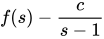
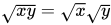
An imaginary number is the product of a real number and the imaginary uniti, which is defined by its property i2 = −1. The square of an imaginary number bi is −b2. For example, 5i is an imaginary number, and its square is −25. The number zero is considered to be both real and imaginary.
Originally coined in the 17th century by René Descartes as a derogatory term and regarded as fictitious or useless, the concept gained wide acceptance following the work of Leonhard Euler in the 18th century, and Augustin-Louis Cauchy and Carl Friedrich Gauss in the early 19th century.
An imaginary number bi can be added to a real number a to form a complex number of the form a + bi, where the real numbers a and b are called, respectively, the real part and the imaginary part of the complex number. Imaginary numbers are often called purely imaginary to distinguish them from complex numbers more generally; the set of all imaginary numbers is sometimes denoted , where denotes the set of real numbers.
An illustration of the complex plane. The imaginary numbers are on the vertical coordinate axis.
Although the Greek mathematician and engineerHeron of Alexandria is noted as the first to present a calculation involving the square root of a negative number, it was Rafael Bombelli who first set down the rules for multiplication of complex numbers in 1572. The concept had appeared in print earlier, such as in work by Gerolamo Cardano.
At the time, imaginary numbers and negative numbers were poorly
understood and were regarded by some as fictitious or useless, much as
zero once was. Many other mathematicians were slow to adopt the use of
imaginary numbers, including René Descartes, who wrote about them in his La Géométrie in which he coined the term imaginary and meant it to be derogatory. The use of imaginary numbers was not widely accepted until the work of Leonhard Euler (1707–1783) and Carl Friedrich Gauss (1777–1855). The geometric significance of complex numbers as points in a plane was first described by Caspar Wessel (1745–1818).
In 1843, William Rowan Hamilton extended the idea of an axis of imaginary numbers in the plane to a four-dimensional space of quaternion imaginaries in which three of the dimensions are analogous to the imaginary numbers in the complex field.
Geometrically, imaginary numbers are found on the vertical axis of the complex number plane, which allows them to be presented perpendicular to the real axis. One way of viewing imaginary numbers is to consider a standard number line positively increasing in magnitude to the right and negatively increasing in magnitude to the left. At 0 on the x-axis, a y-axis
can be drawn with "positive" direction going up; "positive" imaginary
numbers then increase in magnitude upwards, and "negative" imaginary
numbers increase in magnitude downwards. This vertical axis is often
called the "imaginary axis".
In this representation, multiplication by i corresponds to a counterclockwise rotation of 90 degrees about the origin, which is a quarter of a circle. Multiplication by −i corresponds to a clockwise rotation of 90 degrees about the origin. Similarly, multiplying by a purely imaginary number bi, with b a real number, both causes a counterclockwise rotation about the origin by 90 degrees and scales the answer by a factor of b. When b < 0, this can instead be described as a clockwise rotation by 90 degrees and a scaling by |b|.
The English term enlightenment is the Western translation of various Buddhist terms, most notably bodhi and vimutti. The abstract noun bodhi (/ˈboʊdi/; Sanskrit: बोधि; Pali: bodhi) means the knowledge or wisdom, or awakened intellect, of a Buddha.[web 1] The verbal root budh- means "to awaken", and its literal meaning is closer to awakening. Although the term buddhi is also used in other Indian philosophies and traditions, its most common usage is in the context of Buddhism. Vimutti is the freedom from or release of the fetters and hindrances.
The term enlightenment was popularised in the Western world through the 19th-century translations of British philologist Max Müller. It has the Western connotation of general insight into transcendental
truth or reality. The term is also being used to translate several
other Buddhist terms and concepts, which are used to denote (initial)
insight (prajna (Sanskrit), wu (Chinese), kensho and satori (Japanese)); knowledge (vidya); the "blowing out" (nirvana) of disturbing emotions and desires; and the attainment of supreme Buddhahood (samyak sam bodhi), as exemplified by Gautama Buddha.
What exactly constituted the Buddha's awakening is unknown. It
may have involved the knowledge that liberation was attained by the
combination of mindfulness and dhyāna, applied to the understanding of the arising and ceasing of craving. The relation between dhyana and insight is a core problem in the study of Buddhism, and is one of the fundamentals of Buddhist practice.
Etymology
Bodhi, Sanskritबोधि, "awakening", "perfect knowledge", "perfect knowledge or wisdom (by which a man becomes a बुद्ध [Buddha] or जिन [jina, arahant; "victorious", "victor"], the illuminated or enlightened intellect (of a Buddha or जिन)".
The word Bodhi is an abstract noun, formed from the verbal root *budh-, Sanskrit बुध, "to awaken, to know", "to wake, wake up, be awake", "to recover consciousness (after a swoon)", "to observe, heed, attend to".
It corresponds to the verbs bujjhati (Pāli) and bodhati, बोदति, "become or be aware of, perceive, learn, know, understand, awake" or budhyate (Sanskrit).
The feminine Sanskrit noun of *budh- is बुद्धि, buddhi, "prescience, intuition, perception, point of view".
Translation
Robert S. Cohen notes that the majority of English books on Buddhism use the term "enlightenment" to translate the term bodhi. The root budh, from which both bodhi and Buddha are derived, means "to wake up" or "to recover consciousness". Cohen notes that bodhi is not the result of an illumination, but of a path of realization, or coming to understanding. The term "enlightenment" is event-oriented, whereas the term "awakening" is process-oriented. The western use of the term "enlighten" has Christian roots, as in
Calvin's "It is God alone who enlightens our minds to perceive his
truths".
Early 19th-century bodhi was translated as "intelligence". The term "enlighten" was first being used in 1835, in an English translation of a French article, while the first recorded use of the term 'enlightenment' is credited (by the Oxford English Dictionary) to the Journal of the Asiatic Society of Bengal (February 1836). In 1857 The Times used the term "the Enlightened" for the Buddha in a short article, which was reprinted the following year by Max Müller. Thereafter, the use of the term subsided, but reappeared with the publication of Max Müller's Chips from a german Workshop, which included a reprint from the Times article. The book was translated in 1969 into German, using the term "der Erleuchtete". Max Müller was an essentialist, who believed in a natural religion, and saw religion as an inherent capacity of human beings. "Enlightenment" was a means to capture natural religious truths, as distinguished from mere mythology. This perspective was influenced by Kantian thought, particularly Kant's definition of the Enlightenment
as the free, unimpeded use of reason. Müller's translation echoed this
idea, portraying Buddhism as a rational and enlightened religion that
aligns with the natural religious truths inherent to human beings.
By the mid-1870s it had become commonplace to call the Buddha
"enlightened", and by the end of the 1880s the terms "enlightened" and
"enlightenment" dominated the English literature.
Related terms
Insight
Bodhi
While the Buddhist tradition regards bodhi as referring to full and complete liberation (samyaksambudh), it also has the more modest meaning of knowing that the path that is being followed leads to the desired goal. According to Johannes Bronkhorst, Tillman Vetter, and K.R. Norman, bodhi was at first not specified. K.R. Norman:
It is not at all clear what gaining bodhi means. We are accustomed to the translation "enlightenment" for bodhi, but this is misleading ... It is not clear what the buddha was awakened to, or at what particular point the awakening came.
According to Norman, bodhi may basically have meant the knowledge that nibbana was attained, due to the practice of dhyana. Originally only "prajna" may have been mentioned, and Tillman Vetter even concludes that originally dhyana itself was
deemed liberating, with the stilling of pleasure or pain in the fourth
jhana, not the gaining of some perfect wisdom or insight. Gombrich also argues that the emphasis on insight is a later development.
In Theravada Buddhism, bodhi refers to the realisation of the four stages of enlightenment and becoming an Arahant. In Theravada Buddhism, bodhi is equal to supreme insight, and the realisation of the four noble truths, which leads to deliverance. According to Nyanatiloka,
(Through Bodhi) one awakens from the slumber or stupor (inflicted upon the mind) by the defilements (kilesa, q.v.) and comprehends the Four Noble Truths (sacca, q.v.).
This equation of bodhi with the four noble truths is a later
development, in response to developments within Indian religious
thought, where "liberating insight" was deemed essential for Liberation.The four noble truths as the liberating insight of the Buddha eventually were superseded by Pratītyasamutpāda, the twelvefold chain of causation, and still later by anatta, the emptiness of the self.
In Theravada Buddhism pannā (Pali) means "understanding", "wisdom", "insight". "Insight" is equivalent to vipassana, insight into the three marks of existence, namely anicca, dukkha and anatta. Insight leads to the four stages of enlightenment and Nirvana.
In Mahayana Buddhism Prajna (Sanskrit) means "insight" or "wisdom", and entails insight into sunyata. The attainment of this insight is often seen as the attainment of "enlightenment".
Wu, kensho and satori
Wu is the Chinese term for initial insight. Kensho and satori are Japanese terms used in Zen traditions. Kensho means "seeing into one's true nature". Ken means "seeing", sho means "nature", "essence", c.q Buddha-nature. Satori (Japanese) is often used interchangeably with kensho, but refers to the experience of kensho. The Rinzai tradition sees kensho as essential to the attainment of Buddhahood, but considers further practice essential to attain Buddhahood.
East-Asian (Chinese) Buddhism emphasizes insight into
Buddha-nature. This term is derived from Indian tathagata-garbha
thought, "the womb of the thus-gone" (the Buddha), the inherent
potential of every sentient being to become a Buddha. This idea was integrated with the Yogacara-idea of the ālaya vijñāna, and further developed in Chinese Buddhism, which integrated Indian Buddhism with native Chinese thought. Buddha-nature came to mean both the potential of awakening and
the whole of reality, a dynamic interpenetration of absolute and
relative. In this awakening it is realized that observer and observed
are not distinct entities, but mutually co-dependent.
Knowledge
The term vidhya is being used in contrast to avidhya, ignorance or the lack of knowledge, which binds us to samsara. The Mahasaccaka Sutta describes the three knowledges which the Buddha attained:
According to Bronkhorst, the first two knowledges are later
additions, while insight into the four truths represents a later
development, in response to concurring religious traditions, in which
"liberating insight" came to be stressed over the practice of dhyana.
Freedom
Vimukthi, also called moksha, means "freedom", "release", "deliverance". Sometimes a distinction is being made between ceto-vimukthi, "liberation of the mind", and panna-vimukthi, "liberation by understanding". The Buddhist tradition recognises two kinds of ceto-vimukthi, one temporarily and one permanent, the last being equivalent to panna-vimukthi.
Yogacara uses the term āśraya parāvŗtti, "revolution of the basis",
... a sudden revulsion, turning, or re-turning of the ālaya vijñāna
back into its original state of purity [...] the Mind returns to its
original condition of non-attachment, non-discrimination and
non-duality".
Nirvana
Nirvana is the "blowing out" of disturbing emotions, which is the same as liberation. The usage of the term "enlightenment" to translate "nirvana" was
popularized in the 19th century, in part, due to the efforts of Max
Müller, who used the term consistently in his translations.
Arhat (Pali: arahant), those who reach Nirvana by following the teachings of the Buddha. Sometimes the term Śrāvakabuddha (Pali: sāvakabuddha) is used to designate this kind of awakened person;
Pratyekabuddhas (Pali: paccekabuddha), those who reach Nirvana through self-realisation, without the aid of spiritual guides and teachers, but do not teach the Dharma;
Samyaksambuddha (Pali: samma sambuddha), often simply referred to as Buddha, one who has reached Nirvana by one's own efforts and wisdom and teaches it skillfully to others.
Siddhartha Gautama, known as the Buddha, is said to have achieved full awakening, known as samyaksaṃbodhi (Sanskrit; Pāli: sammāsaṃbodhi), "perfect Buddhahood", or anuttarā-samyak-saṃbodhi, "highest perfect awakening". Specifically, anuttarā-samyak-saṃbodhi,
literally meaning unsurpassed, complete and perfect enlightenment, is
often used to distinguish the enlightenment of a Buddha from that of an
Arhat.
The term Buddha and the way to Buddhahood is understood somewhat differently in the various Buddhist traditions. An equivalent term for Buddha is Tathāgata, "the thus-gone".
The awakening of the Buddha
Canonical accounts
In the suttapitaka, the Buddhist canon as preserved in the Theravada tradition, a couple of texts can be found in which the Buddha's attainment of liberation forms part of the narrative.
The Ariyapariyesana Sutta (Majjhima Nikaya 26) describes how the Buddha was dissatisfied with the teachings of Āḷāra Kālāma and Uddaka Rāmaputta,
wandered further through Magadhan country, and then found "an agreeable
piece of ground" which served for striving. The sutta then only says
that he attained Nibbana.
In the Vanapattha Sutta (Majjhima Nikaya 17) the Buddha describes life in the jungle, and the attainment of awakening. The Mahasaccaka Sutta
(Majjhima Nikaya 36) describes his ascetic practices, which he
abandoned. Thereafter he remembered a spontaneous state of jhana, and
set out for jhana-practice. Both suttas narrate how, after destroying
the disturbances of the mind, and attaining concentration of the mind, he attained three knowledges (vidhya):
Insight into the Four Noble Truths is here called awakening. The monk (bhikkhu) has "...attained the unattained supreme security from bondage." Awakening is also described as synonymous with Nirvana, the extinction of the passions whereby suffering is ended and no more rebirths take place. The insight arises that this liberation is certain: "Knowledge arose in
me, and insight: my freedom is certain, this is my last birth, now
there is no rebirth."
Critical assessment
Schmithausen notes that the mention of the four noble truths as constituting
"liberating insight", which is attained after mastering the Rupa Jhanas,
is a later addition to texts such as Majjhima Nikaya 36. Bronkhorst notices that
...the accounts which include the
Four Noble Truths had a completely different conception of the process
of liberation than the one which includes the Four Dhyanas and the
destruction of the intoxicants.
It calls in question the reliability of these accounts, and the relation between dhyana and insight, which is a core problem in the study of early Buddhism. Originally the term prajna
may have been used, which came to be replaced by the four truths in
those texts where "liberating insight" was preceded by the four jhanas. Bronkhorst also notices that the conception of what exactly this
"liberating insight" was developed throughout time. Whereas originally
it may not have been specified, later on the four truths served as such,
to be superseded by pratityasamutpada, and still later, in the Hinayana schools, by the doctrine of the non-existence of a substantial self or person. And Schmithausen notices that still other descriptions of this "liberating insight" exist in the Buddhist canon:
"that the five Skandhas are impermanent, disagreeable, and neither the Self nor belonging to oneself"; "the contemplation of the arising and disappearance (udayabbaya) of the five Skandhas"; "the realisation of the Skandhas as empty (rittaka), vain (tucchaka) and without any pith or substance (asaraka).
An example of this substitution, and its consequences, is Majjhima
Nikaya 36:42–43, which gives an account of the awakening of the Buddha.
Understanding of bodhi and Buddhahood
The term bodhi acquired a variety of meanings and connotations during
the development of Buddhist thoughts in the various schools.
In early Buddhism, bodhi carried a meaning synonymous to nirvana, using only a few different metaphors to describe the insight, which implied the extinction of lobha (greed), dosa (hate) and moha (delusion).
In Theravada Buddhism, bodhi and nirvana carry the same meaning: that of being freed from greed, hate and delusion. Bodhi, specifically, refers to the realisation of the four stages of enlightenment and becoming an Arahant. It is equal to supreme insight, the realisation of the four noble truths, which leads to deliverance. Reaching full awakening is equivalent in meaning to reaching Nirvāṇa. Attaining Nirvāṇa is the ultimate goal of Theravada and other śrāvaka traditions. It involves the abandonment of the ten fetters and the cessation of dukkha or suffering. Full awakening is reached in four stages. According to Nyanatiloka,
(Through Bodhi) one awakens from the slumber or stupor (inflicted upon the mind) by the defilements (kilesa, q.v.) and comprehends the Four Noble Truths (sacca', q.v.).
Since the 1980s, western Theravada-oriented teachers have started to question the primacy of insight. According to Thanissaro Bhikkhu, jhana and vipassana (insight) form an integrated practice. Polak and Arbel, following scholars like Vetter and Bronkhorst, argue that right effort, c.q. the four right efforts (sense restraint, preventing the arising of unwholesome states, and the generation of wholesome states), mindfulness, and dhyana form an integrated practice, in which dhyana is the actualisation of insight, leading to an awakened awareness which is "non-reactive and lucid".
In Mahayana-thought, bodhi is the realisation of the inseparability of samsara and nirvana, and the unity of subject and object. Similar to prajna, the realizing of the Buddha-nature, bodhi realizes sunyata and suchness. In time, the Buddha's awakening came to be understood as an immediate
full awakening and liberation, instead of the insight into and certainty
about the way to follow to reach enlightenment. In some Zen traditions,
however, this perfection came to be relativized again; according to one
contemporary Zen master, "Shakyamuni buddha and Bodhidharma are still
practicing."
Within the various Mahayana-schools exist various further explanations and interpretations. In Mahāyāna Buddhism, the Bodhisattva
is the ideal. The ultimate goal is not only of one's own liberation in
Buddhahood, but the liberation of all living beings. The cosmology of
Mahayana Buddhism regards a wide range of buddhas and bodhisattvas, who
assist humans on their way to liberation.
Nichiren Buddhism,
a branch of Mahayana Buddhism, regards Buddhahood as a state of perfect
freedom, in which one is awakened to the eternal and ultimate truth
that is the reality of all things. This supreme state of life is
characterized by boundless wisdom and infinite compassion. The Lotus
Sutra reveals that Buddhahood is a potential in the lives of all beings.
Buddha-nature
In the Tathagatagarbha and Buddha-nature doctrines, bodhi becomes equivalent to the universal, natural and pure state of the mind:
Bodhi is the final goal of a Bodhisattva's career [...] Bodhi
is pure universal and immediate knowledge, which extends over all time,
all universes, all beings and elements, conditioned and unconditioned.
It is absolute and identical with Reality and thus it is Tathata. Bodhi
is immaculate and non-conceptual, and it, being not an outer object,
cannot be understood by discursive thought. It has neither beginning,
nor middle nor end and it is indivisible. It is non-dual (advayam) [...] The only possible way to comprehend it is through samadhi by the yogin.
According to these doctrines, bodhi eternally exists within one's
mind, although requiring the mind's defilements to be removed. This
vision is expounded in texts such as the Shurangama Sutra and the Uttaratantra.
In Shingon Buddhism
as well, the state of Bodhi is regarded as naturally inherent in the
mind. Bodhi is the mind's natural and pure state, where no distinction
is being made between a perceiving subject and perceived objects. This
is also the understanding of Bodhi found in Yogacara Buddhism.
To achieve this vision of non-duality, it is necessary to recognise one's own mind:
... it means that you are to know
the inherent natural state of the mind by eliminating the split into a
perceiving subject and perceived objects which normally occurs in the
world and is wrongly thought to be real. This also corresponds to the
Yogacara definition ... that emptiness (sunyata) is the absence of this imaginary split
Vajrayana
During the development of Mahayana Buddhism, the various strands of
thought on Bodhi were continuously being elaborated. Attempts were made
to harmonize the various terms.
The Vajrayana Buddhist commentator Buddhaguhya treats various terms as synonyms:
For example, he defines emptiness (sunyata) as suchness (tathata) and says that suchness is the intrinsic nature (svabhava) of the mind which is Enlightenment (bodhi-citta). Moreover, he frequently uses the terms suchness (tathata) and Suchness-Awareness (tathata-jnana) interchangeably. But since Awareness (jnana) is non-dual, Suchness-Awareness is not so much the Awareness of Suchness, but the Awareness which is
Suchness. In other words, the term Suchness-Awareness is functionally
equivalent to Enlightenment. Finally, it must not be forgotten that this
Suchness-Awareness or Perfect Enlightenment is Mahavairocana
[the Primal Buddha, uncreated and forever existent]. In other words, the
mind in its intrinsic nature is Mahavairocana, whom one "becomes" (or
vice versa) when one is perfectly enlightened.
Bodhi Day
Sakyamuni's enlightenment is celebrated on Bodhi Day.
In Sri Lanka and Japan, different days are used for this celebration.
According to the Theravada tradition in Sri Lanka, Sakyamuni reached
Buddhahood at the full moon in May. This is celebrated at Vesākha Pūjā, the full moon in May, known as Sambuddhatva jayanthi (or Sambuddha jayanthi).[web 12]
Secular Bodhi day is celebrated on December 8 in Japan, while China,
South Korea and Vietnam, Bodhi Day is observed on the eighth day of the
12th lunar month.
For example, through the Laplace transform, the equation of the simple harmonic oscillator (Hooke's law) is converted into the algebraic equation which incorporates the initial conditions and , and can be solved for the unknown function .
Once solved, the inverse Laplace transform can be used to transform it
to the original domain. This is often aided by referencing tables such
as that given below.
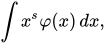
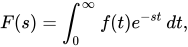
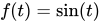
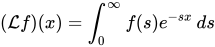
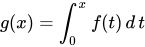
The Laplace transform is defined (for suitable functions ) by the integral
where is a complex number.
The Laplace transform is related to many other transforms. It is essentially the same as the Mellin transform and is closely related to the Fourier transform. Unlike for the Fourier transform, the Laplace transform of a function is often an analytic function, meaning that it can be expressed as a power series that converges locally, the coefficients of which represent the moments of the original function. Moreover, the techniques of complex analysis, especially contour integrals, can be used for simplifying calculations.
Laplace's use of generating functions was similar to what is now known as the z-transform, and he gave little attention to the continuous variable case which was discussed by Niels Henrik Abel.
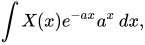
From 1744, Leonhard Euler investigated integrals of the form
as solutions of differential equations, introducing in particular the gamma function. Joseph-Louis Lagrange was an admirer of Euler and, in his work on integrating probability density functions, investigated expressions of the form
which resembles a Laplace transform.
These types of integrals seem first to have attracted Laplace's
attention in 1782, where he was following in the spirit of Euler in
using the integrals themselves as solutions of equations. However, in 1785, Laplace took the critical step forward when, rather
than simply looking for a solution in the form of an integral, he
started to apply the transforms in the sense that was later to become
popular. He used an integral of the form
akin to a Mellin transform, to transform the whole of a difference equation,
in order to look for solutions of the transformed equation. He then
went on to apply the Laplace transform in the same way and started to
derive some of its properties, beginning to appreciate its potential
power.
Laplace also recognised that Joseph Fourier's method of Fourier series for solving the diffusion equation could only apply to a limited region of space, because those solutions were periodic. In 1809, Laplace applied his transform to find solutions that diffused indefinitely in space. In 1821, Cauchy developed an operational calculus for the Laplace transform that could be used to study linear differential equations
in much the same way the transform is now used in basic engineering.
This method was popularized, and perhaps rediscovered, by Oliver Heaviside around the turn of the century.
In 1929, Vannevar Bush and Norbert Wiener published Operational Circuit Analysis
as a text for engineering analysis of electrical circuits, applying
both Fourier transforms and operational calculus, and in which they
included one of the first predecessors of the modern table of Laplace
transforms.
In 1934, Raymond Paley and Norbert Wiener published the important work Fourier transforms in the complex domain, about what is now called the Laplace transform (see below). Also during the 30s, the Laplace transform was instrumental in Godfrey Harold Hardy and John Edensor Littlewood's study of tauberian theorems, and this application was later expounded on by Widder (1941), who developed other aspects of the theory such as a new method for inversion. Edward Charles Titchmarsh wrote the influential Introduction to the theory of the Fourier integral (1937).
The current widespread use of the transform (mainly in engineering) came about during and soon after World War II, replacing the earlier Heaviside operational calculus. The advantages of the Laplace transform had been emphasized by Gustav Doetsch.[20]
Formal definition
for various complex frequencies in the s-domain , which can be expressed as . The axis at contains pure cosines. Positive contains damped cosines. Negative contains exponentially growing cosines.
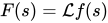
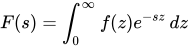
The Laplace transform of a functionf(t), defined for all real numberst ≥ 0, is the function F(s), which is a unilateral transform defined by
(Eq. 1)
where s is a complex frequency-domain parameter
with real numbers σ and ω.
An alternate notation for the Laplace transform is instead of F. Thus in functional notation. This is often written, especially in engineering settings, as , with the understanding that the dummy variable does not appear in the function .
The meaning of the integral depends on types of functions of
interest. A necessary condition for existence of the integral is that f must be locally integrable on [0, ∞). For locally integrable functions that decay at infinity or are of exponential type (), the integral can be understood to be a (proper) Lebesgue integral. However, for many applications it is necessary to regard it as a conditionally convergentimproper integral at ∞. Still more generally, the integral can be understood in a weak sense, and this is dealt with below.
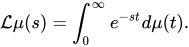
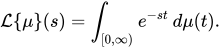
One can define the Laplace transform of a finite Borel measureμ by the Lebesgue integral:
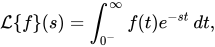
An important special case is where μ is a probability measure, for example, the Dirac delta function. In operational calculus, the Laplace transform of a measure is often treated as though the measure came from a probability density function f. In that case, to avoid potential confusion, one often writes
where the lower limit of 0− is shorthand notation for
This limit emphasizes that any point mass located at 0
is entirely captured by the Laplace transform. Although with the
Lebesgue integral, it is not necessary to take such a limit, it does
appear more naturally in connection with the Laplace–Stieltjes transform.
When one says "the Laplace transform" without qualification, the
unilateral or one-sided transform is usually intended. The Laplace
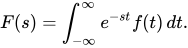
transform can be alternatively defined as the bilateral Laplace transform, or two-sided Laplace transform,
by extending the limits of integration to be the entire real axis. If
that is done, the common unilateral transform becomes a special case of
the bilateral transform, where the definition of the function being
transformed includes being multiplied by the Heaviside step function.
The bilateral Laplace transform F(s) is defined as follows:
(Eq. 2)
An alternate notation for the bilateral Laplace transform is , instead of F.
Two integrable functions have the same Laplace transform only if they differ on a set of Lebesgue measure
zero. This means that, on the range of the transform, there is an
inverse transform. In fact, besides integrable functions, the Laplace
transform is a one-to-one mapping
from one function space into another in many other function spaces as
well, although there is usually no easy characterization of the range.
Typical function spaces in which this is true include the spaces of bounded continuous functions, the space L∞(0, ∞), or more generally tempered distributions on (0, ∞). The Laplace transform is also defined and injective for suitable spaces of tempered distributions.
In these cases, the image of the Laplace transform lives in a space of analytic functions in the region of convergence. The inverse Laplace transform is given by the following complex integral, which is known by various names (the Bromwich integral, the Fourier–Mellin integral, and Mellin's inverse formula):
(Eq. 3)
where γ is a real number so that the contour path of integration is in the region of convergence of F(s). In most applications, the contour can be closed, allowing the use of the residue theorem. An alternative formula for the inverse Laplace transform is given by Post's inversion formula. The limit here is interpreted in the weak-* topology.
In practice, it is typically more convenient to decompose a
Laplace transform into known transforms of functions obtained from a
table and construct the inverse by inspection.
Of particular use is the ability to recover the cumulative distribution function of a continuous random variable X by means of the Laplace transform as follows:
Algebraic construction
The Laplace transform can be alternatively defined in a purely algebraic manner by applying a field of fractions construction to the convolution ring of functions on the positive half-line. The resulting space of abstract operators
is exactly equivalent to Laplace space, but in this construction the
forward and reverse transforms never need to be explicitly defined
(avoiding the related difficulties with proving convergence).
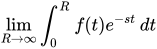
If f is a locally integrable function (or more generally a Borel measure locally of bounded variation), then the Laplace transform F(s) of f converges provided that the limit
exists.
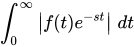
The Laplace transform converges absolutely if the integral
exists as a proper Lebesgue integral. The Laplace transform is usually understood as conditionally convergent, meaning that it converges in the former but not in the latter sense.
The set of values for which F(s) converges absolutely is either of the form Re(s) > a or Re(s) ≥ a, where a is an extended real constant with −∞ ≤ a ≤ ∞ (a consequence of the dominated convergence theorem). The constant a is known as the abscissa of absolute convergence, and depends on the growth behavior of f(t). Analogously, the two-sided transform converges absolutely in a strip of the form a < Re(s) < b, and possibly including the lines Re(s) = a or Re(s) = b. The subset of values of s
for which the Laplace transform converges absolutely is called the
region of absolute convergence, or the domain of absolute convergence.
In the two-sided case, it is sometimes called the strip of absolute
convergence. The Laplace transform is analytic in the region of absolute
convergence: this is a consequence of Fubini's theorem and Morera's theorem.
Similarly, the set of values for which F(s) converges (conditionally or absolutely) is known as the region of conditional convergence, or simply the region of convergence (ROC). If the Laplace transform converges (conditionally) at s = s0, then it automatically converges for all s with Re(s) > Re(s0). Therefore, the region of convergence is a half-plane of the form Re(s) > a, possibly including some points of the boundary line Re(s) = a.
In the region of convergence Re(s) > Re(s0), the Laplace transform of f can be expressed by integrating by parts as the integral
That is, F(s) can
effectively be expressed, in the region of convergence, as the
absolutely convergent Laplace transform of some other function. In
particular, it is analytic. In its most general form, the Laplace
transform gives a one-to-one correspondence between the holomorphic
functions which, for some , are defined on and are bounded there in absolute value by a polynomial, and the distributions on the real line supported on which become tempered distributions after multiplied by for some .
There are several Paley–Wiener theorems concerning the relationship between the decay properties of f, and the properties of the Laplace transform within the region of convergence.
In engineering applications, a function corresponding to a linear time-invariant (LTI) system is stable
if every bounded input produces a bounded output. This is equivalent to
the absolute convergence of the Laplace transform of the impulse
response function in the region Re(s) ≥ 0.
As a result, LTI systems are stable, provided that the poles of the
Laplace transform of the impulse response function have negative real
part.
This ROC is used in knowing about the causality and stability of a system.
Properties and theorems
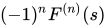
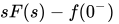
The Laplace transform's key property is that it converts differentiation and integration in the time domain into multiplication and division by s in the Laplace domain. Thus, the Laplace variable s is also known as an operator variable in the Laplace domain: either the derivative operator or (for s−1) the integration operator.
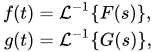
Given the functions f(t) and g(t), and their respective Laplace transforms F(s) and G(s),
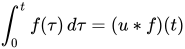
the following table is a list of properties of unilateral Laplace transform:
f is assumed to be a differentiable function, and its derivative is assumed to be of exponential type. This can then be obtained by integration by parts
Second derivative
f is assumed twice
differentiable and the second derivative to be of exponential type.
Follows by applying the Differentiation property to f′(t).
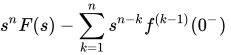
General derivative
f is assumed to be n-times differentiable, with nth derivative of exponential type. Follows by mathematical induction.
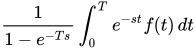
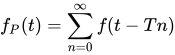
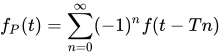
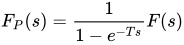
f(t) is a periodic function of period T so that f(t) = f(t + T), for all t ≥ 0. This is the result of the time shifting property and the geometric series.
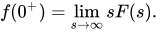
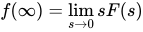
The final value theorem is useful because it gives the long-term behaviour without having to perform partial fraction decompositions (or other difficult algebra). If F(s) has a pole in the right-hand plane or poles on the imaginary axis (e.g., if or ), then the behaviour of this formula is undefined.
Relation to power series
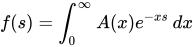
The Laplace transform can be viewed as a continuous analogue of a power series. If a(n) is a discrete function of a positive integer n, then the power series associated to a(n) is the series
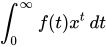
where x is a real variable (see Z-transform). Replacing summation over n with integration over t, a continuous version of the power series becomes
where the discrete function a(n) is replaced by the continuous one f(t).
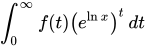
Changing the base of the power from x to e gives
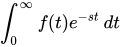
For this to converge for, say, all bounded functions f, it is necessary to require that ln x < 0. Making the substitution −s = ln x gives just the Laplace transform:
In other words, the Laplace transform is a continuous analog of a power series, in which the discrete parameter n is replaced by the continuous parameter t, and x is replaced by e−s.
Analogously to a power series, if , then the power series converges to an analytic function in , if , the Laplace transform converges to an analytic function for .
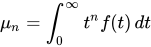
The quantities
are the moments of the function f. If the first n moments of f converge absolutely, then by repeated differentiation under the integral,
This is of special significance in probability theory, where the moments of a random variable X are given by the expectation values . Then, the relation holds
Transform of a function's derivative
It is often convenient to use the differentiation property of the
Laplace transform to find the transform of a function's derivative. This
can be derived from the basic expression for a Laplace transform as
follows:
yielding
and in the bilateral case,
The general result
where denotes the nth derivative of f, can then be established with an inductive argument.
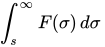
Evaluating integrals over the positive real axis
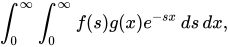
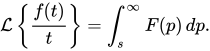
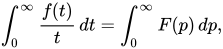
A useful property of the Laplace transform is the following:
under suitable assumptions on the behaviour of and in a right neighbourhood of and on the decay rate of and in a left neighbourhood of . The above formula is a variation of integration by parts, with the operators
and being replaced by and . Let us prove the equivalent formulation:
By plugging in the left-hand side turns into:
but assuming Fubini's theorem holds, by reversing the order of integration we get the wanted right-hand side.
This method can be used to compute integrals that would otherwise
be difficult to compute using elementary methods of real calculus. For
example,
Relationship to other transforms
Laplace–Stieltjes transform
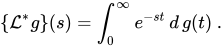
The (unilateral) Laplace–Stieltjes transform of a function g : ℝ → ℝ is defined by the Lebesgue–Stieltjes integral
then the Laplace–Stieltjes transform of g and the Laplace transform of f coincide. In general, the Laplace–Stieltjes transform is the Laplace transform of the Stieltjes measure associated to g.
So in practice, the only distinction between the two transforms is that
the Laplace transform is thought of as operating on the density
function of the measure, whereas the Laplace–Stieltjes transform is
thought of as operating on its cumulative distribution function.
Let be a complex-valued Lebesgue integrable function supported on , and let be its Laplace transform. Then, within the region of convergence, we have
which is the Fourier transform of the function .
Indeed, the Fourier transform
is a special case (under certain conditions) of the bilateral Laplace
transform. The main difference is that the Fourier transform of a
function is a complex function of a real variable (frequency ), the Laplace transform of a function is a complex function of a complex variable (damping factor and frequency ). The Laplace transform is usually restricted to transformation of functions of t with t ≥ 0. A consequence of this restriction is that the Laplace transform of a function is a holomorphic function of the variable s. Unlike the Fourier transform, the Laplace transform of a distribution is generally a well-behaved
function. Techniques of complex variables can also be used to directly
study Laplace transforms. As a holomorphic function, the Laplace
transform has a power series representation. This power series expresses a function as a linear superposition of moments of the function. This perspective has applications in probability theory.
Formally, the Fourier transform is equivalent to evaluating the bilateral Laplace transform with imaginary argument s = iωwhen the condition explained below is fulfilled,
This convention of the Fourier transform ( in Fourier transform § Other conventions) requires a factor of 1/2π on the inverse Fourier transform. This relationship between the Laplace and Fourier transforms is often used to determine the frequency spectrum of a signal or dynamical system.
The above relation is valid as stated if and only if the region of convergence (ROC) of F(s) contains the imaginary axis, σ = 0.
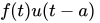
For example, the function f(t) = cos(ω0t) has a Laplace transform F(s) = s/(s2 + ω02) whose ROC is Re(s) > 0. As s = iω0 is a pole of F(s), substituting s = iω in F(s) does not yield the Fourier transform of f(t)u(t), which contains terms proportional to the Dirac delta functionsδ(ω ± ω0).
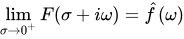
However, a relation of the form
holds under much weaker conditions. For instance, this holds for the above example provided that the limit is understood as a weak limit of measures (see vague topology).
General conditions relating the limit of the Laplace transform of a
function on the boundary to the Fourier transform take the form of Paley–Wiener theorems.
The unilateral or one-sided Z-transform is the Laplace transform of an ideally sampled signal with the substitution of
where T = 1/fs is the sampling interval (in units of time e.g., seconds) and fs is the sampling rate (in samples per second or hertz).
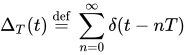
Let
be a sampling impulse train (also called a Dirac comb) and
be the sampled representation of the continuous-time x(t)
The Laplace transform of the sampled signal xq(t) is
This is the precise definition of the unilateral Z-transform of the discrete function x[n]
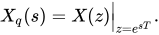
with the substitution of z → esT.
Comparing the last two equations, we find the relationship
between the unilateral Z-transform and the Laplace transform of the
sampled signal,
The similarity between the Z- and Laplace transforms is expanded upon in the theory of time scale calculus.
Borel transform
The integral form of the Borel transform
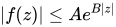
is a special case of the Laplace transform for f an entire function of exponential type, meaning that
for some constants A and B.
The generalized Borel transform allows a different weighting function
to be used, rather than the exponential function, to transform functions
not of exponential type. Nachbin's theorem gives necessary and sufficient conditions for the Borel transform to be well defined.
Fundamental relationships
Since an ordinary Laplace transform can be written as a special case
of a two-sided transform, and since the two-sided transform can be
written as the sum of two one-sided transforms, the theory of the
Laplace-, Fourier-, Mellin-, and Z-transforms are at bottom the same
subject. However, a different point of view and different characteristic
problems are associated with each of these four major integral
transforms.
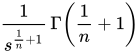
The following table provides Laplace transforms for many common functions of a single variable. For definitions and explanations, see the Explanatory Notes at the end of the table.
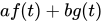
Because the Laplace transform is a linear operator,
The Laplace transform of a sum is the sum of Laplace transforms of each term.
The Laplace transform of a multiple of a function is that multiple times the Laplace transformation of that function.
Using this linearity, and various trigonometric, hyperbolic,
and complex number (etc.) properties and/or identities, some Laplace
transforms can be obtained from others more quickly than by using the
definition directly.
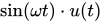
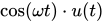
The unilateral Laplace transform takes as input a function whose time domain is the non-negative reals, which is why all of the time domain functions in the table below are multiples of the Heaviside step function, u(t).
The entries of the table that involve a time delay τ are required to be causal (meaning that τ > 0). A causal system is a system where the impulse responseh(t) is zero for all time t prior to t = 0. In general, the region of convergence for causal systems is not the same as that of anticausal systems.
The Laplace transform is often used in circuit analysis by conversions to the s-domain of circuit elements. Circuit elements can be transformed into impedances, very similar to phasor impedances.
Here is a summary of equivalents:
Note that the resistor is exactly the same in the time domain and the s-domain.
The sources are put in if there are initial conditions on the circuit
elements. For example, if a capacitor has an initial voltage across it,
or if the inductor has an initial current through it, the sources
inserted in the s-domain account for that.
The equivalents for current and voltage sources are derived from the transformations in the table above.
Examples and applications
The Laplace transform is used frequently in engineering and physics; the output of a linear time-invariant system
can be calculated by convolving its unit impulse response with the
input signal. Performing this calculation in Laplace space turns the
convolution into a multiplication; the latter being easier to solve
because of its algebraic form. For more information, see control theory.
The Laplace transform is invertible on a large class of functions.
Given a mathematical or functional description of an input or output to a
system,
the Laplace transform provides an alternative functional description
that often simplifies the process of analyzing the behavior of the
system, or in synthesizing a new system based on a set of
specifications.
The Laplace transform can also be used to solve differential equations and is used extensively in mechanical engineering and electrical engineering.
The Laplace transform reduces a linear differential equation to an
algebraic equation, which can then be solved by the formal rules of
algebra. The original differential equation can then be solved by
applying the inverse Laplace transform. English electrical engineer Oliver Heaviside
first proposed a similar scheme, although without using the Laplace
transform; and the resulting operational calculus is credited as the
Heaviside calculus.
Evaluating improper integrals
Let . Then (see the table above)
From which one gets:
In the limit , one gets
provided that the interchange of limits can be justified. This is often possible as a consequence of the final value theorem. Even when the interchange cannot be justified the calculation can be suggestive. For example, with a ≠ 0 ≠ b, proceeding formally one has
Complex impedance of a capacitor
In the theory of electrical circuits, the current flow in a capacitor is proportional to the capacitance and rate of change in the electrical potential (with equations as for the SI unit system). Symbolically, this is expressed by the differential equation
where C is the capacitance of the capacitor, i = i(t) is the electric current through the capacitor as a function of time, and v = v(t) is the voltage across the terminals of the capacitor, also as a function of time.
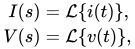
Taking the Laplace transform of this equation, we obtain
where
and
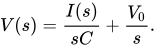
Solving for V(s) we have
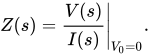
The definition of the complex impedance Z (in ohms) is the ratio of the complex voltage V divided by the complex current I while holding the initial state V0 at zero:
Using this definition and the previous equation, we find:
which is the correct expression for the complex impedance of a
capacitor. In addition, the Laplace transform has large applications in
control theory.
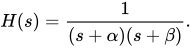
The impulse response is the inverse Laplace transform of this transfer function:
Partial fraction expansion
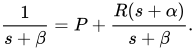
To evaluate this inverse transform, we begin by expanding H(s) using the method of partial fraction expansion,
The unknown constants P and R are the residues located at the corresponding poles of the transfer function. Each residue represents the relative contribution of that singularity to the transfer function's overall shape.
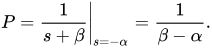
By the residue theorem, the inverse Laplace transform depends only upon the poles and their residues. To find the residue P, we multiply both sides of the equation by s + α to get
Then by letting s = −α, the contribution from R vanishes and all that is left is
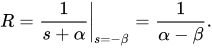
Similarly, the residue R is given by
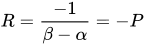
Note that
and so the substitution of R and P into the expanded expression for H(s) gives
Finally, using the linearity property and the known transform for exponential decay (see Item #3 in the Table of Laplace Transforms, above), we can take the inverse Laplace transform of H(s) to obtain
which is the impulse response of the system.
Convolution
The same result can be achieved using the convolution property as if the system is a series of filters with transfer functions 1/(s + α) and 1/(s + β). That is, the inverse of
is
Phase delay
Time function
Laplace transform
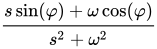
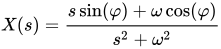
Starting with the Laplace transform,
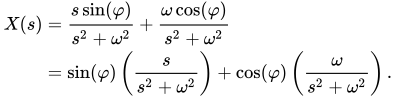
we find the inverse by first rearranging terms in the fraction:
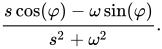
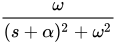
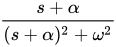
We are now able to take the inverse Laplace transform of our terms:
This is just the sine of the sum of the arguments, yielding:
We can apply similar logic to find that
Statistical mechanics
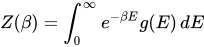
In statistical mechanics, the Laplace transform of the density of states defines the partition function. That is, the canonical partition function is given by
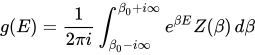
and the inverse is given by
Spatial (not time) structure from astronomical spectrum
The wide and general applicability of the Laplace transform and its
inverse is illustrated by an application in astronomy which provides
some information on the spatial distribution of matter of an astronomical source of radiofrequencythermal radiation too distant to resolve as more than a point, given its flux densityspectrum, rather than relating the time domain with the spectrum (frequency domain).
Assuming certain properties of the object, e.g. spherical shape
and constant temperature, calculations based on carrying out an inverse
Laplace transformation on the spectrum of the object can produce the
only possible model of the distribution of matter in it (density as a function of distance from the center) consistent with the spectrum. When independent information on the structure of an object is
available, the inverse Laplace transform method has been found to be in
good agreement.
Birth and death processes
Consider a random walk, with steps occurring with probabilities . Suppose also that the time step is a Poisson process, with parameter . Then the probability of the walk being at the lattice point at time is
This leads to a system of integral equations
(or equivalently a system of differential equations). However, because
it is a system of convolution equations, the Laplace transform converts
it into a system of linear equations for
namely:
which may now be solved by standard methods.
Tauberian theory
The Laplace transform of the measure on is given by
It is intuitively clear that, for small , the exponentially decaying integrand will become more sensitive to the concentration of the measure on larger subsets of the domain. To make this more precise, introduce the distribution function:
Formally, we expect a limit of the following kind:
Tauberian theorems are theorems relating the asymptotics of the Laplace transform, as , to those of the distribution of as . They are thus of importance in asymptotic formulae of probability and statistics, where often the spectral side has asymptotics that are simpler to infer.
Let be a non-negative, monotonic nondecreasing function of , defined for . Suppose that
converges for to the function and that, for some non-negative number ,
has an extension as a continuous function for .
Then the limit as goes to infinity of is equal to .


.svg)















![{\displaystyle {\mathcal {L}}\{f\}(s)=\operatorname {E} \left[e^{-sX}\right],}](https://wikimedia.org/api/rest_v1/media/math/render/svg/3da28029aa437333b370a72f00e2745d1f8e8c73)
![{\displaystyle \operatorname {E} [r]}](https://wikimedia.org/api/rest_v1/media/math/render/svg/715165949e716ef97cb5b61ba0982325cef86a1b)

![{\displaystyle F_{X}(x)={\mathcal {L}}^{-1}\left\{{\frac {1}{s}}\operatorname {E} \left[e^{-sX}\right]\right\}(x)={\mathcal {L}}^{-1}\left\{{\frac {1}{s}}{\mathcal {L}}\{f\}(s)\right\}(x).}](https://wikimedia.org/api/rest_v1/media/math/render/svg/0c9728fa6f7b7c0cf6c7fd18917b64a4bbea2c7f)































![{\displaystyle \mu _{n}=\operatorname {E} [X^{n}]}](https://wikimedia.org/api/rest_v1/media/math/render/svg/1a470b23edb981c95e00f5690370662b6b102341)
.}](https://wikimedia.org/api/rest_v1/media/math/render/svg/aebff76a8e2a99d41a4d654999b7309d1a2f5916)
![{\displaystyle {\begin{aligned}{\mathcal {L}}\left\{f(t)\right\}&=\int _{0^{-}}^{\infty }e^{-st}f(t)\,dt\\[6pt]&=\left[{\frac {f(t)e^{-st}}{-s}}\right]_{0^{-}}^{\infty }-\int _{0^{-}}^{\infty }{\frac {e^{-st}}{-s}}f'(t)\,dt\quad {\text{(by parts)}}\\[6pt]&=\left[-{\frac {f(0^{-})}{-s}}\right]+{\frac {1}{s}}{\mathcal {L}}\left\{f'(t)\right\},\end{aligned}}}](https://wikimedia.org/api/rest_v1/media/math/render/svg/574460c0fe29a550c4b4a66b9aa82601ea9f956b)











![{\displaystyle {\begin{aligned}{\hat {f}}(\omega )&={\mathcal {F}}\{f(t)\}\\[4pt]&={\mathcal {L}}\{f(t)\}|_{s=i\omega }=F(s)|_{s=i\omega }\\[4pt]&=\int _{-\infty }^{\infty }e^{-i\omega t}f(t)\,dt~.\end{aligned}}}](https://wikimedia.org/api/rest_v1/media/math/render/svg/44fd8f6a7374f8e3ae9b00c7ca0107108784f9cd)



![{\displaystyle {\begin{aligned}x_{q}(t)&{\stackrel {\mathrm {def} }{{}={}}}x(t)\Delta _{T}(t)=x(t)\sum _{n=0}^{\infty }\delta (t-nT)\\&=\sum _{n=0}^{\infty }x(nT)\delta (t-nT)=\sum _{n=0}^{\infty }x[n]\delta (t-nT)\end{aligned}}}](https://wikimedia.org/api/rest_v1/media/math/render/svg/c334ec8f4011a84a4a305f1ac7894fb6e1038cf0)
![{\displaystyle x[n]{\stackrel {\mathrm {def} }{{}={}}}x(nT)~.}](https://wikimedia.org/api/rest_v1/media/math/render/svg/f2b6eaf257e418b217759fe3b9b982993004af01)
![{\displaystyle {\begin{aligned}X_{q}(s)&=\int _{0^{-}}^{\infty }x_{q}(t)e^{-st}\,dt\\&=\int _{0^{-}}^{\infty }\sum _{n=0}^{\infty }x[n]\delta (t-nT)e^{-st}\,dt\\&=\sum _{n=0}^{\infty }x[n]\int _{0^{-}}^{\infty }\delta (t-nT)e^{-st}\,dt\\&=\sum _{n=0}^{\infty }x[n]e^{-nsT}~.\end{aligned}}}](https://wikimedia.org/api/rest_v1/media/math/render/svg/1ee1fc990806a1d664c96eb253f19ff2def0f986)
![{\displaystyle X(z)=\sum _{n=0}^{\infty }x[n]z^{-n}}](https://wikimedia.org/api/rest_v1/media/math/render/svg/fbf7e6d1a9bf26a3017c79040c80295cb1f2eaa1)










![{\displaystyle {\sqrt[{n}]{t}}\cdot u(t)}](https://wikimedia.org/api/rest_v1/media/math/render/svg/d4345a4c33a88daeb8ec5a3002d02d62f66ff3fb)


















![{\displaystyle -{1 \over s}\left[\ln(s)+\gamma \right]}](https://wikimedia.org/api/rest_v1/media/math/render/svg/11e5254f2039e5373fac5178eb8da59890d0979f)

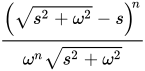





![{\displaystyle {\begin{aligned}\int _{0}^{\infty }{\frac {\cos(at)-\cos(bt)}{t}}\,dt&=\int _{0}^{\infty }\left({\frac {p}{p^{2}+a^{2}}}-{\frac {p}{p^{2}+b^{2}}}\right)\,dp\\[6pt]&=\left[{\frac {1}{2}}\ln {\frac {p^{2}+a^{2}}{p^{2}+b^{2}}}\right]_{0}^{\infty }={\frac {1}{2}}\ln {\frac {b^{2}}{a^{2}}}=\ln \left|{\frac {b}{a}}\right|.\end{aligned}}}](https://wikimedia.org/api/rest_v1/media/math/render/svg/150eb829ed85ccdec437af079d262fc08428699c)