The same sequence of symbols may represent different numbers in
different numeral systems. For example, "11" represents the number eleven in the decimal or base-10 numeral system (today, the most common system globally), the number three in the binary or base-2 numeral system (used in modern computers), and the number two in the unary numeral system (used in tallying scores).
The number the numeral represents is called its value. Additionally, not all number systems can represent the same set of numbers; for example, Roman, Greek, and Egyptian numerals don't have an official representation of the number zero.
Numeral systems are sometimes called number systems, but that name is ambiguous, as it could refer to different systems of numbers, such as the system of real numbers, the system of complex numbers, various hypercomplex number systems, the system of p-adic numbers, etc. Such systems are, however, not the topic of this article.
Early numeral systems varied across civilizations, with the
Babylonians using a base-60 system, the Egyptians developing
hieroglyphic numerals, and the Chinese employing rod numerals. The
Mayans independently created a vigesimal (base-20) system that included a
symbol for zero.
Indian mathematicians, such as Brahmagupta in the 7th century, played a
crucial role in formalizing arithmetic rules and the concept of zero,
which was later refined by scholars like Al-Khwarizmi in the Islamic
world. As these numeral systems evolved, the efficiency of positional
notation and the inclusion of zero helped shape modern numerical
representation, influencing global commerce, science, and technology.
The first true written positional numeral system is considered to be the Hindu–Arabic numeral system. This system was established by the 7th century in India, but was not yet in its modern form because the use of the digit zero
had not yet been widely accepted. Instead of a zero sometimes the digits
were marked with dots to indicate their significance, or a space was
used as a placeholder. The first widely acknowledged use of zero was in
876. The original numerals were very similar to the modern ones, even down to the glyphs used to represent digits.
The digits of the Maya numeral system
By the 13th century, Western Arabic numerals were accepted in European mathematical circles (Fibonacci used them in his Liber Abaci).
Initially met with resistance, Hindu–Arabic numerals gained wider
acceptance in Europe due to their efficiency in arithmetic operations,
particularly in banking and trade. The invention of the printing press
in the 15th century helped standardize their use, as printed
mathematical texts favored this system over Roman numerals. They began
to enter common use in the 15th century. By the 17th century, the system had become dominant in scientific
works, influencing mathematical advancements by figures like Isaac
Newton and René Descartes. In the 19th and 20th centuries, the
widespread adoption of Arabic numerals facilitated global finance,
engineering, and technological developments, forming the foundation for
modern computing and digital data representation. By the end of the
20th century virtually all non-computerized calculations in the world
were done with Arabic numerals, which have replaced native numeral
systems in most cultures.
Other historical numeral systems using digits
The exact age of the Maya numerals is unclear, but it is possible that it is older than the Hindu–Arabic system. The system was vigesimal (base 20), so it has twenty digits. The Mayas used a shell symbol to represent zero. Numerals were written vertically, with the ones place at the bottom. The Mayas had no equivalent of the modern decimal separator, so their system could not represent fractions.
The Thai numeral system is identical to the Hindu–Arabic numeral system except for the symbols used to represent digits. The use of these digits is less common in Thailand than it once was, but they are still used alongside Arabic numerals.
The rod numerals, the written forms of counting rods once used by Chinese and Japanese
mathematicians, are a decimal positional system used for performing
decimal calculations. Rods were placed on a counting board and slid
forwards or backwards to change the decimal place. The Sūnzĭ Suànjīng,
a mathematical treatise dated to between the 3rd and 5th centuries AD,
provides detailed instructions for the system, which is thought to have
been in use since at least the 4th century BC. Zero was not initially treated as a number, but as a vacant position. Later sources introduced conventions for the expression of zero and negative numbers. The use of a round symbol 〇 for zero is first attested in the Mathematical Treatise in Nine Sections of 1247 AD. The origin of this symbol is unknown; it may have been produced by modifying a square symbol. The Suzhou numerals, a descendant of rod numerals, are still used today for some commercial purposes.
The most commonly used system of numerals is decimal. Indian mathematicians are credited with developing the integer version, the Hindu–Arabic numeral system. Aryabhata of Kusumapura developed the place-value notation in the 5th century and a century later Brahmagupta
introduced the symbol for zero. The system slowly spread to other
surrounding regions like Arabia due to their commercial and military
activities with India. Middle-Eastern mathematicians extended the system
to include negative powers of 10, or fractions, as recorded in a
treatise by Syrian mathematician Abu'l-Hasan al-Uqlidisi in 952–953, and the decimal point notation was introduced by Sind ibn Ali,
who also wrote the earliest treatise on Arabic numerals. The
Hindu–Arabic numeral system then spread to Europe due to merchants
trading, and the digits used in Europe are called Arabic numerals, as they learned them from the Arabs.
The simplest numeral system is the unary numeral system, in which every natural number is represented by a corresponding number of symbols. If the symbol / is chosen, for example, then the number seven would be represented by ///////. Tally marks
represent one such system still in common use. The unary system is
typically reserved for small numbers, although it plays an important
role in theoretical computer science. Elias gamma coding, which is commonly used in data compression, expresses arbitrarily sized numbers by using unary to indicate the length of a binary numeral.
The unary notation can be abbreviated by introducing different symbols for certain new values. Very commonly, these values are powers of 10; so for instance, if / stands for one, −
for ten and + for 100, then the number 304 can be compactly represented
as +++ //// and the number 123 as + − − /// without using a zero. This is called sign-value notation. The ancient Egyptian numeral system was of this type, and the Roman numeral system was a modification of this idea.
Other systems employ special abbreviations for repetitions of
symbols; for example, using the first nine letters of the alphabet for
these abbreviations, with A standing for "one occurrence", B "two
occurrences", and so on, one could then write C+ D/ for the number 304;
the number of these abbreviations is sometimes called the base of the
system. This system is used when writing Chinese numerals
and other East Asian numerals based on Chinese. The number system of
the English language is of this type, such as "three hundred [and]
four", as are those of other spoken languages, regardless of what
written systems they have adopted. Many languages use mixtures of bases,
and other features, for instance 79 in French is soixante dix-neuf (60 + 10 + 9) and in Welsh is pedwar ar bymtheg a thrigain (4 + (5 + 10) + (3 × 20)) or the somewhat archaic pedwar ugain namyn un (4 × 20 − 1). In English, "four score less one", as in the famous Gettysburg Address representing "87 years ago" as "four score and seven years ago".
A positional system, also known as place-value notation, is classified by its base or radix, which is the number of symbols called digits
used by the system. In base 10, ten different digits 0, ..., 9 are used
and the position of a digit is used to signify the power of ten that
the digit is to be multiplied with, as in 304 = 3×100 + 0×10 + 4×1 or more precisely 3×10² + 0×101 + 4×100.
Zero, which is not used in the other systems, is used in this system,
in order to be able to "skip" a power. The Hindu–Arabic numeral system,
which originated in India and is now used throughout the world, is a
positional base 10 system.
Arithmetic is much easier in positional systems than in the earlier additive ones; furthermore,
additive systems need a large number of different symbols for the
different powers of 10; a positional system needs ten different symbols,
if it uses base 10.
The positional decimal system is universally used in human writing. The base 1000 is also used in many systems by grouping the digits and
considering a sequence of three decimal digits as a single digit. This
is the meaning of the common notation 1,000,234,567 used for very large
numbers.
In certain biological systems, the unary coding system is employed. Unary numerals used in the neural circuits responsible for birdsong production. The nucleus in the brain of the songbirds that plays a part in both the learning and the production of bird song is the high vocal center
(HVC). The command signals for different notes in the birdsong emanate
from different points in the HVC. This coding works as space coding
which is a strategy for biological circuits due to its inherent
simplicity and robustness.
The numerals used when writing numbers with digits or symbols can be divided into two types that might be called the arithmetic numerals (0, 1, 2, 3, 4, 5, 6, 7, 8, 9) and the geometric
numerals (1, 10, 100, 1000, 10000 ...), respectively. The sign-value
systems use only the geometric numerals and the positional systems use
only the arithmetic numerals. A sign-value system does not use
arithmetic numerals because they are made by repetition—except for the Ionic system—and
a positional system does not use geometric numerals because they are
made by position. The spoken language uses both arithmetic and geometric
numerals.
In some areas of computer science, a modified base k positional system is used, called bijective numeration, with digits 1, 2, ..., k (k ≥ 1), and zero being represented by an empty string. This establishes a bijection
between the set of all such digit-strings and the set of non-negative
integers, avoiding the non-uniqueness caused by leading zeros. Bijective
base-k numeration is also called k-adic notation, not to be confused with p-adic numbers. Bijective base 1 is the same as unary.
In a positional base b numeral system (with b a natural number greater than 1 known as the radix or base of the system), b basic symbols (or digits) corresponding to the first b
natural numbers including zero are used. To generate the rest of the
numerals, the position of the symbol in the figure is used. The symbol
in the last position has its own value, and as it moves to the left its
value is multiplied by b.
For example, in the decimal system (base 10), the numeral 4327 means (4×10³) + (3×10²) + (2×101) + (7×100), noting that 100 = 1.
In general, if b is the base, one writes a number in the numeral system of base b by expressing it in the form anbn + an − 1bn − 1 + an − 2bn − 2 + ... + a0b0 and writing the enumerated digits anan − 1an − 2 ... a0 in descending order. The digits are natural numbers between 0 and b − 1, inclusive.
If a text (such as this one) discusses multiple bases, and if
ambiguity exists, the base (itself represented in base 10) is added in
subscript to the right of the number, like this: numberbase. Unless specified by context, numbers without subscript are considered to be decimal.
By using a dot to divide the digits into two groups, one can also
write fractions in the positional system. For example, the base 2
numeral 10.11 denotes 1×21 + 0×20 + 1×2−1 + 1×2−2 = 2.75.
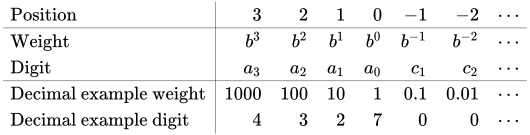
In general, numbers in the base b system are of the form:
The numbers bk and b−k are the weights of the corresponding digits. The position k is the logarithm of the corresponding weight w, that is . The highest used position is close to the order of magnitude of the number.
The number of tally marks required in the unary numeral system for describing the weight would have been w. In the positional system, the number of digits required to describe it is only , for k ≥ 0. For example, to describe the weight 1000 then four digits are needed because . The number of digits required to describe the position is (in positions 1, 10, 100,... only for simplicity in the decimal example).
A number has a terminating or repeating expansion if and only if it is rational; this does not depend on the base. A number that terminates in one base may repeat in another (thus 0.310 = 0.0100110011001...2).
An irrational number stays aperiodic (with an infinite number of
non-repeating digits) in all integral bases. Thus, for example in
base 2, π = 3.1415926...10 can be written as the aperiodic 11.001001000011111...2.
Putting overscores, n, or dots, ṅ, above the common digits is a convention used to represent repeating rational expansions. Thus:
14/11 = 1.272727272727... = 1.27 or 321.3217878787878... = 321.32178.
If b = p is a prime number, one can define base-p numerals whose expansion to the left never stops; these are called the p-adic numbers.
It is also possible to define a variation of base b in which digits may be positive or negative; this is called a signed-digit representation.
This is used in Punycode,
one aspect of which is the representation of a sequence of non-negative
integers of arbitrary size in the form of a sequence without
delimiters, of "digits" from a collection of 36: a–z and 0–9,
representing 0–25 and 26–35 respectively. There are also so-called
threshold values () which are fixed for every position in the number. A digit (in a given position in the number) that is lower than its corresponding threshold value
means that it is the most-significant digit, hence in the string this
is the end of the number, and the next symbol (if present) is the
least-significant digit of the next number.
For example, if the threshold value for the first digit is b (i.e. 1) then a
(i.e. 0) marks the end of the number (it has just one digit), so in
numbers of more than one digit, first-digit range is only b–9 (i.e.
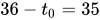
1–35), therefore the weight b1 is 35 instead of 36. More generally, if tn is the threshold for the n-th digit, it is easy to show that .
Suppose the threshold values for the second and third digits are c
(i.e. 2), then the second-digit range is a–b (i.e. 0–1) with the second
digit being most significant, while the range is c–9 (i.e. 2–35) in the
presence of a third digit. Generally, for any n, the weight of the (n + 1)-th digit is the weight of the previous one times (36 − threshold of the n-th digit). So the weight of the second symbol is . And the weight of the third symbol is .
So we have the following sequence of the numbers with at most 3 digits:
a (0), ba (1), ca (2), ..., 9a (35), bb (36), cb (37), ..., 9b (70), bca (71), ..., 99a (1260), bcb (1261), ..., 99b (2450).
Unlike a regular n-based numeral system, there are numbers like 9b where 9 and b each represent 35; yet the representation is unique because ac and aca are not allowed – the first a would terminate each of these numbers.
The flexibility in choosing threshold values allows optimization
for number of digits depending on the frequency of occurrence of numbers
of various sizes.
The case with all threshold values equal to 1 corresponds to bijective numeration, where the zeros correspond to separators of numbers with digits which are non-zero.
Nathan C. Funk and Christina J. Woolner categorize these
approaches into three models. The first is “peace through religion
alone”. This proposes to attain world peace through devotion to a given
religion. Opponents claim that advocates generally want to attain peace
through their particular religion only and have little tolerance
of other ideologies.
The second model, a response to the first, is “peace without religion”.
Critics claim that it is overly simplistic and fails to address other
causes of conflict as well as the peace potential of religion. It is
also said that this model excludes the many contributions of religious
people in the development of peace. Another critique claims that both
approaches require bringing everyone into their own ideology.
The third and final approach is known as “peace with religion”.
This approach focuses on the importance of coexistence and interfaith
dialogue. Gerrie ter Haar suggests that religion is neither inherently good nor bad for peace, and that its influence is undeniable. Peace with religion, then, emphasises promoting the common principles present in every major religion.
A major component of religion and peacebuilding is faith-based non-governmental organizations
(NGOs). Douglas Johnston points out that faith-based NGOs offer two
distinct advantages. The first is that since faith-based NGOs are very
often locally based, they have immediate influence within that
community. He argues that “it is important to promote indigenous
ownership of conflict prevention and peacebuilding initiatives as early
in the process as possible.” The second advantage Johnston presents is
that faith-based NGOs carry moral authority that contributes to the receptivity of negotiations and policies for peace.
Numbers 25:12: "Behold I give him my covenant of peace"
Isaiah 57:19: Peace, peace to the distant and the close"
Psalms 11:5: The LORD examines the righteous, but the wicked, those who love violence, he hates with a passion.
Psalms 34:15: "Turn away from evil and do good; seek peace and pursue it"
Ecclesiastes 9:17–18:"
The quiet words of the wise are more to be heeded than the shouts of a
ruler of fools. Wisdom is better than weapons of war, but one sinner
destroys much good.
Isaiah 11:6–9:The
wolf will live with the lamb, the leopard will lie down with the goat,
the calf and the lion and the yearling together;and a little child will
lead them. The cow will feed with the bear, their young will lie down
together, and the lion will eat straw like the ox. The infant will play
near the hole of the cobra, and the young child put his hand into the
viper's nest. They will neither harm nor destroy on all my holy
mountain, for the earth will be full of the knowledge of the Lord as the
waters cover the sea.
Isaiah 2:4 & Micah 4:3 They will beat their swords into plowshares and their spears into pruning hooks. Nation will not take up sword against nation, nor will they train for war anymore.
Project Ploughshares is a Canadian non-government organization concerned with the prevention of war, the disarmament of weapons, and peacebuilding. Though it is an agency of the Canadian Council of Churches
and is sponsored by the nine national churches of Canada, Project
Ploughshares is run by and for people of a variety of different faith
backgrounds. Project Ploughshares works with various NGOs operating
abroad to develop research and complete analyses of government policies. In the past, Project Ploughshares' work has included meeting with prime
ministers to discuss nuclear disarmament, establishing and coordinating
an agency for disarmament and security of the Horn in Africa, working
with the UN and NATO on policy-making, and publishing research papers,
one of which was endorsed by over 40 000 Canadians and had a serious
influence over Canada's decision not to declare war on Iraq.
Project Ploughshares takes its name from Isaiah 2:4 where it is
written "God shall judge between the nations, and shall decide for many
peoples; and they shall beat their swords into ploughshares, and spears into pruning hooks; nation shall not lift up sword against nation; neither shall they learn war any more."
Today the Pax Christi network membership is made up of 18
national sections and 115 Member Organizations working in over 50
countries,
focusing on five main issues: human rights, human security, disarmament and demilitarisation, just world order, and religion and peace.
The Baháʼí Faith and peacebuilding
The Baháʼí Faith requires believers to avoid prejudice in daily life, to be friendly to people of all religions, social statuses, nationalities or various cultural
traditions. At the nation's level, it calls for negotiation and
dialogue between country leaders, to promote the process of world peace.
For world peace, the Baháʼí Faith has the notion of "the Lesser Peace"
and "the Great Peace". The previous one is considered the level of
political peace, that a peace treaty is signed, and wars are eliminated;
the latter refers to God's
kingdom on earth, the world reaches its unity and in cooperation, all
world's people uses an auxiliary language, a unified currency system,
achieves economic justice, a world tribunal is available, and massive
disarmament of all countries.
Bahá'u'lláh,
the founder of the Baháʼí Faith, discouraged all forms of violence,
including religious violence, writing that his aim was to: ``quench the
flame of hate and enmity" and that the ``religion of God is for love and
unity; make it not the cause of enmity or dissension." He warned of the dangers of religious fanaticism describing it as a ``world devouring fire", prohibited holy war, and condemned the shedding of blood, the burning of books, the shunning
of the followers of other religions and the extermination of
communities and groups. Bahá'u'lláh
promoted the concept of the oneness of the world and human beings
describing the Earth as "but one country, and mankind its citizens". Bahá'u'lláh
identified the elimination of disunity as a necessary pre-requisite to
peace. "The well-being of mankind, its peace and security, are
unattainable unless and until its unity is firmly established."
In 1985, as a contribution to the 1986 International Year of Peace, the international governing body of the Baháʼí Faith, the Universal House of Justice,
released a major statement on the promotion of peace, that was
distributed worldwide by the Baháʼí community. The statement sets out an
analysis and strategy for creation of a more peaceful world. It
identifies the following barriers to peace: racism, economic injustice,
uncontrolled nationalism, religious strife, inequality between man and
women, an absence of universal education, and the need for an
international auxiliary language. The statement concludes with a call
for establishment of the "oneness of humanity", a call which implies "no
less than the reconstruction and the demilitarization of the whole
civilized world — a world organically unified in all the essential
aspects of its life, its political machinery, its spiritual aspiration,
its trade and finance, its script and language, and yet infinite in the
diversity of the national characteristics of its federated units."
Buddhism and peacebuilding
Buddhist scripture
Hatred does not cease by hatred, but only by love. This is the eternal rule.Nhat Hanh at Hue City airport on his 2007 trip to Vietnam (aged 80)
Engaged Buddhism is a term coined in the 1960s by Vietnamese monk Thich Nhat Hanh to describe a more socially active form of Buddhism. Originating during the Indochina Wars with Nhat Hanh and the Unified Buddhist Church,
adherents of Engaged Buddhism became participants in the war, not
against the Americans or the Vietnamese, but against the violence
itself, which they saw as unnecessary. They attempted to draw attention
to the injustices of the war by placing themselves directly between the
lines of battle and even engaging in self immolation.
Engaged Buddhism represents a socially aware non-violent movement
within the larger Buddhist community. Inspired by the Buddhist
tradition of the Peace Wheel and the teachings of non-violence of Siddhartha Gautama, Engaged Buddhism has since spread to other conflicts in other countries, with groups in Tibet, struggling for self-determination; in Burma and Cambodia, advocating for human rights; in Sri Lanka, promoting the Sarvodaya Shramadana Movement; and in India, working with untouchables. The group has also since opened up churches in the Western world.
In the mid-1960s, Nhất Hạnh co-founded the School of Youth for Social Services and created the Order of Interbeing. He was exiled from South Vietnam in 1966 after expressing opposition to the war and refusing to take sides. In 1967, Martin Luther King, Jr. nominated him for a Nobel Peace Prize.Nhất Hạnh established dozens of monasteries and practice centers and spent many years living at the Plum Village Monastery, which he founded in 1982 in southwest France near Thénac, traveling internationally to give retreats and talks. Nhất Hạnh
promoted deep listening as a nonviolent solution to conflict and sought
to raise awareness of the interconnectedness of environments that
sustain and promote peace. He coined the term "engaged Buddhism" in his book Vietnam: Lotus in a Sea of Fire.
After a 39-year exile, Nhất Hạnh was permitted to visit Vietnam in 2005. In 2018, he returned to Vietnam to his "root temple", Từ Hiếu Temple, near Huế, where he lived until his death in 2022, at the age of 95.
Early life
Nhất Hạnh was born Nguyễn Xuân Bảo on 11 October 1926, in the ancient capital of Huế in central Vietnam. He is 15th generation Nguyễn Đình; the poet Nguyễn Đình Chiểu, author of Lục Vân Tiên, was his ancestor. His father, Nguyễn Đình Phúc, from Thành Trung village in Thừa Thiên, Huế, was an official with the French administration. His mother, Trần Thị Dĩ, was a homemaker from Gio Linh district. Nhất Hạnh was the fifth of their six children. Until he was age five, he lived with his large extended family at his grandmother's home. He recalled feeling joy at age seven or eight after he saw a drawing of a peaceful Buddha, sitting on the grass. On a school trip, he visited a mountain where a hermit lived who was
said to sit quietly day and night to become peaceful like the Buddha.
They explored the area, and he found a natural well, which he drank from
and felt completely satisfied. It was this experience that led him to
want to become a Buddhist monk. At age 12, he expressed an interest in training to become a monk, which
his parents, cautious at first, eventually let him pursue at age 16.
Names applied to him
Nhất Hạnh had many names in his lifetime. As a boy, he received a
formal family name (Nguyễn Đình Lang) to register for school, but was
known by his nickname (Bé Em). He received a spiritual name (Điệu Sung)
as an aspirant for the monkhood; a lineage name (Trừng Quang) when he
formally became a lay Buddhist; and a Dharma name (Phùng Xuân) when he was ordained as a monk. He took the Dharma title Nhất Hạnh when he moved to Saigon in 1949.
The Vietnamese nameThích (釋) is from "Thích Ca" or "Thích Già" (釋迦, "of the Shakya clan"). All Buddhist monastics in East Asian Buddhism
adopt this name as their surname, implying that their first family is
the Buddhist community. In many Buddhist traditions, a person can
receive a progression of names. The lineage name is given first when a
person takes refuge in the Three Jewels.
Nhất Hạnh's lineage name is Trừng Quang (澄光, "Clear, Reflective
Light"). The second is a dharma name, given when a person takes vows or
is ordained as a monastic. Nhất Hạnh's dharma name is Phùng Xuân (逢春,
"Meeting Spring") and his dharma title is Nhất Hạnh.
Neither Nhất (一) nor Hạnh (行), which approximate the roles of middle name and given name, was part of his name at birth. Nhất means "one", implying "first-class", or "of best quality"; Hạnh means "action", implying "right conduct",
"good nature", or "virtue". He translated his Dharma names as "One"
(Nhất) and "Action" (Hạnh). Vietnamese names follow this convention,
placing the family name first, then the middle name, which often refers
to the person's position in the family or generation, followed by the
given name.
Nhất Hạnh's followers called him Thầy ("master; teacher"), or Thầy Nhất Hạnh. Any Vietnamese monk in the Mahayana tradition can be addressed as "thầy", with monks addressed as thầy tu ("monk") and nuns addressed as sư cô ("sister") or sư bà ("elder sister"). He is also known as Thiền Sư Nhất Hạnh ("Zen Master Nhất Hạnh").
Education
Buddha hall of the Từ Hiếu Temple
At age 16, Nhất Hạnh entered the monastery at Từ Hiếu Temple, where his primary teacher was Zen Master
Thanh Quý Chân Thật, who was from the 43rd generation of the Lâm Tế Zen
school and the ninth generation of the Liễu Quán school. He studied as a novice for three years and received training in Vietnamese traditions of Mahayana and Theravada Buddhism. He also learned Chinese, English, and French. Nhất Hạnh attended Báo Quốc Buddhist Academy. Dissatisfied with the academy, which he found lacking in philosophy, literature, and foreign languages, Nhất Hạnh left in 1950 and took up residence in the Ấn Quang Pagoda in Saigon, where he was ordained as a monk in 1951. He supported himself by selling books and poetry while attending Saigon University, where he studied literature, philosophy, psychology, and science and received a degree in French and Vietnamese Literature.
In 1955, Nhất Hạnh returned to Huế and served as the editor of Phật Giáo Việt Nam (Vietnamese Buddhism), the official publication of the General Association of Vietnamese Buddhists (Tổng Hội Phật Giáo Việt Nam)
for two years before the publication was suspended as higher-ranking
monks disapproved of his writing. He believed that this was due to his
opinion that South Vietnam's various Buddhist organisations should
unite. In 1956, while he was away teaching in Đà Lạt,
his name was expunged from the records of Ấn Quang, effectively
disowning him from the temple. In late 1957, Nhất Hạnh decided to go on
retreat, and established a monastic "community of resistance" named
Phương Bôi, in Đại Lao Forest near Đà Lạt. During this period, he taught
at a nearby high school and continued to write, promoting the idea of a
humanistic, unified Buddhism.
From 1959 to 1961, Nhất Hạnh taught several short courses on Buddhism at various Saigon temples, including the large Xá Lợi Pagoda,
where his class was cancelled mid-session and he was removed due to
disapproval of his teachings. Facing further opposition from Vietnamese
religious and secular authorities, Nhất Hạnh accepted a Fulbright Fellowship in 1960 to study comparative religion at Princeton University. He studied at the Princeton Theological Seminary in 1961. In 1962 he was appointed lecturer in Buddhism at Columbia University and also taught as a lecturer at Cornell University. By then he had gained fluency in French, Classical Chinese, Sanskrit, Pali and English, in addition to his native Vietnamese.
Career
Activism in Vietnam 1963–1966
In 1963, after the military overthrow of the minority Catholic regime of President Ngo Dinh Diem, Nhất Hạnh returned to South Vietnam on 16 December 1963, at the request of Thich Tri Quang, the monk most prominent in protesting the religious discrimination of Diem, to help restructure the administration of Vietnamese Buddhism. As a result of a congress, the General Association of Buddhists and other groups merged to form the Unified Buddhist Church of Vietnam (UBCV) in January 1964, and Nhất Hạnh proposed that the executive publicly call for an end to the Vietnam War,
help establish an institute for the study of Buddhism to train future
leaders, and create a centre to train pacifist social workers based on
Buddhist teaching.
In 1964, two of Nhất Hạnh's students founded La Boi Press with a
grant from Mrs. Ngo Van Hieu. Within two years, the press published 12
books, but by 1966, the publishers risked arrest and jail because the
word "peace" was taken to mean communism. Nhất Hạnh also edited the weekly journal Hải Triều Âm (Sound of the Rising Tide),
the UBCV's official publication. He continually advocated peace and
reconciliation, notably calling in September 1964, soon after the Gulf of Tonkin incident, for a peace settlement, and referring to the Viet Cong as brothers. The South Vietnamese government subsequently closed the journal.
On 1 May 1966, at Từ Hiếu Temple, Nhất Hạnh received the "lamp
transmission" from Zen Master Chân Thật, making him a dharmacharya
(teacher) and the spiritual head of Từ Hiếu and associated monasteries.
Vạn Hạnh Buddhist University
On 13 March 1964, Nhất Hạnh and the monks at An Quang Pagoda founded the Institute of Higher Buddhist Studies (Học Viện Phật Giáo Việt Nam), with the UBCV's support and endorsement. Renamed Vạn Hạnh
Buddhist University, it was a private institution that taught Buddhist
studies, Vietnamese culture, and languages, in Saigon. Nhất Hạnh taught Buddhist psychology and prajnaparamita literature there, and helped finance the university by fundraising from supporters.
In 1964, Nhất Hạnh co-founded the School of Youth for Social Service (SYSS), a neutral corps of
Buddhist peace workers who went into rural areas to establish schools,
build healthcare clinics, and help rebuild villages. The SYSS consisted of 10,000 volunteers and social workers who aided
war-torn villages, rebuilt schools and established medical centers. He left for the U.S. shortly afterwards and was not allowed to return, leaving Sister Chân Không
in charge of the SYSS. Chân Không was central to the foundation and
many of the activities of the SYSS, which organized medical, educational
and agricultural facilities in rural Vietnam during the war. Nhất Hạnh was initially given substantial autonomy to run the SYSS,
which was initially part of Vạn Hạnh University. In April 1966, the Vạn
Hạnh Students' Union under the presidency of Phượng issued a "Call for
Peace". Vice Chancellor Thích Minh Châu dissolved the students' union
and removed the SYSS from the university's auspices.
Nhất Hạnh created the Order of Interbeing (Vietnamese: Tiếp Hiện), a monastic and lay group, between 1964 and 1966. He headed this group, basing it on the philosophical concept of interbeing and teaching it through the Five Mindfulness Trainings and the Fourteen Mindfulness Trainings. The trainings were a modern adaptation of the traditional bodhisattva vows designed to support efforts to promote peace and rebuild war-torn villages. Nhất Hạnh established the Order of Interbeing from a selection of six
SYSS board members, three men and three women, who took a vow to
practice the Fourteen Precepts of Engaged Buddhism. He added a seventh member in 1981.
In 1967, Nhat Chi Mai,
one of the first six Order of Interbeing members, set fire to herself
and burned to death in front of the Tu Nghiem Pagoda in Saigon as a
peace protest after calling for an end to the Vietnam War. On several occasions, Nhất Hạnh explained to Westerners that Thích Quảng Đức
and other Vietnamese Buddhist monks who self-immolated during the
Vietnam war did not perform acts of suicide; rather, their acts were, in
his words, aimed "at moving the hearts of the oppressors, and at
calling the attention of the world to the suffering endured then by the
Vietnamese."
The Order of Interbeing expanded into an international community
of laypeople and monastics focused on "mindfulness practice, ethical
behavior, and compassionate action in society." By 2017, the group had grown to include thousands known to recite the Fourteen Precepts.
During the Vietnam War
Vạn Hạnh University was taken over by one of the chancellors, who
wished to sever ties with Nhất Hạnh and the SYSS, accusing Chân Không of
being a communist. Thereafter the SYSS struggled to raise funds and
faced attacks on its members. It persisted in its relief efforts without
taking sides in the conflict.
Nhất Hạnh returned to the U.S. in 1966 to lead a symposium in Vietnamese Buddhism at Cornell University and continue his work for peace. He was invited by Professor George McTurnan Kahin,
also of Cornell and a U.S. government foreign policy consultant, to
participate on a forum on U.S. policy in Vietnam. On 1 June, Nhất Hạnh
released a five-point proposal addressed to the U.S. government,
recommending that (1) the U.S. make a clear statement of its desire to
help the Vietnamese people form a government "truly responsive to
Vietnamese aspirations"; (2) the U.S. and South Vietnam cease air
strikes throughout Vietnam; (3) all anti-communist military operations
be purely defensive; (4) the U.S. demonstrate a willingness to withdraw
within a few months; and (5) the U.S. offer to pay for reconstruction. In 1967 he wrote Vietnam — The Lotus in the Sea of Fire, about his proposals. The South Vietnamese military junta responded by accusing him of treason and being a communist.
While in the U.S., Nhất Hạnh visited Gethsemani Abbey to speak with the Trappist monk Thomas Merton. When the South Vietnamese regime threatened to block Nhất Hạnh's
reentry to the country, Merton wrote an essay of solidarity, "Nhat Hanh
is my Brother". Between June and October 1963, Nhất Hạnh conducted numerous interviews
with newspapers and television networks to rally support for the peace
movement. During this time, he also undertook a widely publicized five-day fast.
Additionally, he translated reports of human rights violations from
Vietnamese into English and compiled them into a document he presented
to the United Nations. In 1964, after the publication of his poem "whoever is listening, be my witness: I cannot accept this war...", the American press called Nhất Hạnh an "antiwar poet" and a "pro-Communist propagandist". In 1965 he wrote Martin Luther King Jr. a letter titled "In Search of the Enemy of Man". During his 1966 stay in the U.S., Nhất Hạnh met King and urged him to publicly denounce the Vietnam War. In 1967, due in large part to Nhất Hạnh, King gave the speech "Beyond Vietnam: A Time to Break Silence" at Riverside Church in New York City, his first to publicly question U.S. involvement in Vietnam. Later that year, King nominated Nhất Hạnh for the 1967 Nobel Peace Prize.
In his nomination, King said, "I do not personally know of anyone more
worthy of the Nobel Peace Prize than this gentle monk from Vietnam. His
ideas for peace, if applied, would build a monument to ecumenism, to
world brotherhood, to humanity". King also called Nhất Hạnh "an apostle of peace and nonviolence". King named the candidate he had chosen to nominate with a "strong
request" to the prize committee, in sharp violation of Nobel traditions
and protocol. The committee did not make an award that year.
Refuge in France
Nhất Hạnh moved to Paris in 1966 and became the chair of the Vietnamese Buddhist Peace Delegation, a group involved with the Paris Peace Accords, which ultimately ended American involvement in the Vietnam War. For refusing to take sides in the war, Nhất Hạnh was exiled by both the North and South Vietnamese governments. He received asylum in France and moved to the Paris suburbs, living with other Vietnamese refugees.
In 1969, Nhất Hạnh established the Unified Buddhist Church (Église Bouddhique Unifiée) in France (not a part of the Unified Buddhist Church of Vietnam). In 1975, he formed the Sweet Potatoes Meditation Centre at Fontvannes, in the Foret d'Othe, near Troyes in Aube province southeast of Paris. For the next seven years, he focused on writing, and completed The Miracle of Mindfulness, The Moon Bamboo, and The Sun My Heart.
Nhất Hạnh began teaching mindfulness in the mid-1970s with his books, particularly The Miracle of Mindfulness (1975), serving as the main vehicle for his early teachings. In an interview for On Being, he said that The Miracle of Mindfulness
was "written for our social workers, first, in Vietnam, because they
were living in a situation where the danger of dying was there every
day. So out of compassion, out of a willingness to help them to continue
their work, The Miracle of Mindfulness was written as a practice
manual. And after that, many friends in the West, they think that it is
helpful for them, so we allow it to be translated into English." The book was originally titled The Miracle of Being Awake, as in 1975 "mindfulness" was barely recognized in English. Its focus on integrating mindfulness into daily life, rather than
confining it to meditation, emphasized that living mindfully could
foster personal growth, enlightenment, and even global peace.
Campaign to help boat people and expulsion from Singapore
When the North Vietnamese army took control of the south in 1975, Nhất Hạnh was denied permission to return to Vietnam, and the communist government banned his publications. He soon began to lead efforts to help rescue Vietnamese boat people in the Gulf of Siam, eventually stopping under pressure from the governments of Thailand and Singapore.
Recounting his experience years later, Nhất Hạnh said he was in
Singapore attending a conference on religion and peace when he
discovered the plight of the suffering of the boat people:
So
many boat people were dying in the ocean, and Singapore had a very
harsh policy on the boat people… The policy of Singapore at that time
was to reject the boat people; Malaysia, also. They preferred to have
the boat people die in the ocean rather than to bring them to land and
make them into prisoners. Every time there was a boat with the boat
people [that came] to the shore, they tried to push them [back] out into
the sea in order [for them] to die. They didn't want to host [them].
And those fishermen who had compassion, who were able to save the boat
people from drowning in the sea, were punished. They had to pay a very
huge sum of money so that next time they won't have the courage to save
the boat people.
He stayed on in Singapore to
organise a secret rescue operation. Aided by concerned individuals from
France, the Netherlands, and other European countries, he hired a boat
to bring food, water and medicine to refugees in the sea. Sympathetic
fishermen who had rescued boat people would call up his team, and they
shuttled the refugees to the French embassy in the middle of the night
and helped them climb into the compound, before they were discovered by
staff in the morning and handed over to the police where they were
placed in the relative safety of detention. Please Call Me by My True Names, Nhất Hạnh's best-known poem, was written in 1978 during his efforts to assist the boat people.
When the Singapore government discovered the clandestine network,
the police surrounded its office and impounded the passports of both
Nhất Hạnh and Chân Không, giving them 24 hours to leave the country. It
was only with the intervention of the then-French ambassador to
Singapore Jacques Gasseau that they were given 10 days to wind down
their rescue operations.
By 1982, Sweet Potatoes was too small to accommodate the growing number of people who wanted to visit for retreats. In 1982, Nhất Hạnh and Chân Không established the Plum Village Monastery, a vihara in the Dordogne near Bordeaux in southern France. Plum Village is the largest Buddhist monastery in Europe and America, with over 200 monastics and over 10,000 visitors a year.
The Plum Village Community of Engaged Buddhism (formerly the Unified Buddhist Church) and its sister organization in
France, the Congrégation Bouddhique Zen Village des Pruniers, are the
legally recognized governing bodies of Plum Village in France.
By 2019, Nhất Hạnh had built a network of monasteries and retreat centres in several countries, including France, the U.S., Australia, Thailand, Vietnam, and Hong Kong. Additional practice centres and associated organizations Nhất Hạnh and the Order of Interbeing established in the US include Blue Cliff Monastery in Pine Bush, New York; the Community of Mindful Living in Berkeley, California; Parallax Press; Deer Park Monastery (Tu Viện Lộc Uyển), established in 2000 in Escondido, California; Magnolia Grove Monastery (Đạo Tràng Mộc Lan) in Batesville, Mississippi; and the European Institute of Applied Buddhism in Waldbröl, Germany. (The Maple Forest Monastery (Tu Viện Rừng Phong) and Green Mountain Dharma Center (Ðạo Tràng Thanh Sơn) in Vermont
closed in 2007 and moved to the Blue Cliff Monastery in Pine Bush.) The
monasteries, open to the public during much of the year, provide
ongoing retreats for laypeople, while the Order of Interbeing holds
retreats for specific groups of laypeople, such as families, teenagers,
military veterans, the entertainment industry, members of Congress, law
enforcement officers and people of colour.
According to the Thích Nhất Hạnh Foundation, the charitable
organization that serves as the Plum Village Community of Engaged
Buddhism's fundraising arm, as of 2017 the monastic order Nhất Hạnh
established comprises over 750 monastics in 9 monasteries worldwide.
Nhất Hạnh established two monasteries in Vietnam, at the original Từ Hiếu Temple near Huế and at Prajna Temple in the central highlands.
Writings
Nhất Hạnh has published over 130 books, including more than 100 in
English, which as of January 2019 had sold over five million copies
worldwide. His books, which cover topics including spiritual guides and Buddhist
texts, teachings on mindfulness, poetry, story collections, a biography
of the Buddha, and scholarly essays on Zen practice, have been translated into more than 40 languages as of January 2022. In 1986 Nhất Hạnh founded Parallax Press, a nonprofitbook publisher and part of the Plum Village Community of Engaged Buddhism.
During his long exile, Nhất Hạnh's books were often smuggled into Vietnam, where they had been banned.
Later activism
In 2014, major Jewish, Muslim, Hindu, Buddhist, Anglican, Catholic
and Orthodox Christian leaders met to sign a shared commitment against
modern-day slavery; the declaration they signed called for the
elimination of slavery and human trafficking by 2020. Nhất Hạnh was
represented by Chân Không.
Nhất Hạnh's relationship with the government of Vietnam varied over
the years. He stayed away from politics, but did not support the South
Vietnamese government's policies of Catholicization. He questioned
American involvement, putting him at odds with the Saigon leadership,which banned him from returning to South Vietnam while he was abroad in 1966.
His relationship with the communist government ruling Vietnam was
tense due to its anti-religious stance. The communist government viewed
him with skepticism, distrusted his work with the overseas Vietnamese population, and restricted his praying requiem on several occasions.
In 2005, after lengthy negotiations, the Vietnamese government
allowed Nhất Hạnh to return for a visit. He was also allowed to teach
there, publish four of his books in Vietnamese, and travel the country
with monastic and lay members of his Order, including a return to his
root temple, Tu Hieu Temple in Huế. Nhất Hạnh arrived on 12 January after 39 years in exile. The trip was not without controversy. Thich Vien Dinh, writing on behalf of the banned Unified Buddhist Church of Vietnam
(UBCV), called for Nhất Hạnh to make a statement against the Vietnamese
government's poor record on religious freedom. Vien Dinh feared that
the government would use the trip as propaganda, suggesting that
religious freedom is improving there, while abuses continue.
Thích Nhất Hạnh during his 2007 trip to Vietnam
Despite the controversy, Nhất Hạnh returned to Vietnam in 2007, while the heads of the UBCV, Thich Huyen Quang and Thich Quang Do,
remained under house arrest. The UBCV called his visit a betrayal,
symbolizing his willingness to work with his co-religionists'
oppressors. Võ Văn Ái, a UBCV spokesman, said, "I believe Thích Nhất
Hạnh's trip is manipulated by the Hanoi government to hide its
repression of the Unified Buddhist Church and create a false impression
of religious freedom in Vietnam." The Plum Village website listed three goals for his 2007 trip to
Vietnam: to support new monastics in his Order; to organize and conduct
"Great Chanting Ceremonies" intended to help heal remaining wounds from
the Vietnam War; and to lead retreats for monastics and laypeople. The
chanting ceremonies were originally called "Grand Requiem for Praying Equally for All to Untie the Knots of Unjust Suffering",
but Vietnamese officials objected, calling it unacceptable for the
government to "equally" pray for South Vietnamese and U.S. soldiers.
Nhất Hạnh agreed to change the name to "Grand Requiem For Praying". During the 2007 visit, Nhất Hạnh suggested ending government control of religion to President Nguyen Minh Triet. A provincial police officer later spoke to a reporter about this incident, accusing Nhất Hạnh of breaking Vietnamese law. The officer said, "[Nhất Hạnh] should focus on Buddhism and keep out of politics."
During the 2005 visit, Nhất Hạnh 's followers were invited by Abbot Duc Nghi, a member of the official Buddhist Sangha of Vietnam, to occupy Bat Nha monastery and continue their practice there. Nhất Hạnh's followers say that during a sacred ceremony at Plum Village Monastery in 2006, Nghi received a transmission from Nhất Hạnh and agreed to let them occupy Bat Nha. Nhất Hạnh's followers spent $1 million developing the monastery, building a meditation hall for 1,800 people. The government support initially given to his supporters is now believed to have been a ploy to get Vietnam off the US State Department's Religious Freedomblacklist, improve chances of entry into the World Trade Organization, and increase foreign investment. During this time, thousands of people came to the center to practice,
and Nhất Hạnh ordained more than 500 monks and nuns at the monastery.
In 2008, during an interview in Italian television, Nhất Hạnh made some statements regarding the Dalai Lama
that his followers claim upset Chinese officials, who in turn put
pressure on the Vietnamese government. The chairman of Vietnam's
national Committee on Religious Affairs sent a letter that accused Nhat
Hanh's organization of publishing false information about Vietnam on its
website. It was written that the posted information misrepresented
Vietnam's policies on religion and could undermine national unity. The
chairman requested that Nhất Hạnh's followers leave Bat Nha. The letter
also stated that Abbot Duc Nghi wanted them to leave. "Duc Nghi is breaking a vow that he made to us... We have videotapes of
him inviting us to turn the monastery into a place for worship in the
Plum Village tradition, even after he dies — life after life. Nobody can
go against that wish," said Brother Phap Kham. In September and October 2009, a standoff developed, which ended when
authorities cut the power, and followed up with police raids augmented
by mobs assembled through gang contacts. The attackers used sticks and
hammers to break in and dragged off hundreds of monks and nuns."Senior monks were dragged like animals out of their rooms, then left
sitting in the rain until police dragged them to the taxis where 'black
society' bad guys pushed them into cars," a villager said in a phone
interview. Two senior monks had their IDs taken and were put under house arrest without charges in their home towns. Monastics responded with chanting, but continued to be persecuted by the government.
Nhất Hạnh has also been a leader in the Engaged Buddhism movement (he is credited with coining the term), promoting the individual's active role in creating change. He credited the 13th-century Vietnamese Emperor Trần Nhân Tông
with originating the concept. Trần Nhân Tông abdicated his throne to
become a monk and founded the Vietnamese Buddhist school of the Bamboo
Forest tradition. He also called it Applied Buddhism in later years to emphasize its practical nature.
Mindfulness trainings
Nhất Hạnh rephrased the five precepts
for lay Buddhists as "mindfulness trainings", which were traditionally
written in terms of refraining from negative activities, such as
committing to taking positive action to prevent or minimize others'
negative actions. For example, instead of merely refraining from
stealing, Nhất Hạnh wrote, "prevent others from profiting from human
suffering or the suffering of other species on Earth" by, for example,
taking action against unfair practices or unsafe workplaces.
According to Plum Village, Manifesto 2000, introduced by UNESCO, was largely inspired by their five mindfulness trainings. In keeping with the northern tradition of Bodhisattva precepts, Nhất
Hạnh wrote the fourteen mindfulness trainings for the Order of
Interbeing based on the ten deeds. He also updated the Dharmaguptaka Vinaya for Plum Village monastics while keeping its number of rules, 250 for monks and 348 for nuns.
Interbeing
Nhất Hạnh developed the English term "interbeing" by combining the prefix "inter-" with the verb "to be" to denote the interconnection of all phenomena. This was inspired by the Chinese word 相即 in Master Fa Zang's "Golden Lion Chapter", a Huayan summary of the Avatamsaka Sutra. Some scholars believed it was a presentation of the Prajnaparamita, which "is often said to provide a philosophical foundation" for Zen. Nhất Hạnh was also known for expressing deep teachings through simple
phrases or parables. "The sun my heart", for instance, was an insight of
meditation on the interdependence of all things. He used "no mud no
lotus" to illustrate the interrelationship between awakening and
afflictions, well-being and ill-being. "A cloud never dies", on the
other hand, is a contemplation of phenomena beyond birth and death. To
teach non-duality, he often told the story of his left and right hand.
His meditation on aimlessness (apranihita) was told through the
story of a river. The relationship between waves and water explained the
Dharma Realm of Unobstructed Interpenetration of Truth and Phenomena.
New translations of the Heart Sutra
Nhất Hạnh completed new English and Vietnamese translations of the Heart Sutra in September 2014. In a letter to his students, he said he wrote these new translations because he thought that poor
word choices in the original text had resulted in significant
misunderstandings of these teachings for almost 2,000 years.
Manifestation-Only Teaching
Continuing the Yogācāra
and Dharmalaksana school, Nhất Hạnh composed the "fifty verses on the
nature of consciousness". He preferred calling the teaching
manifestation-only (vijnapti-matrata) rather than consciousness-only
(vijnana-matrata) to avoid misintepretation into a kind of idealism.
Called "the Father of Mindfulness",[4]
Nhất Hạnh has been credited as one of the main figures in bringing
Buddhism to the West, and especially for making mindfulness well known
in the West. According to James Shaheen, the editor of the American Buddhist magazine Tricycle: The Buddhist Review, "In the West, he's an icon. I can't think of a Western Buddhist who does not know of Thich Nhất Hạnh." His 1975 book The Miracle of Mindfulness
was credited with helping to "lay the foundations" for the use of
mindfulness in treating depression through "mindfulness-based cognitive
therapy", influencing the work of University of Washington psychology
professor Marsha M. Linehan, the originator of dialectical behavior therapy (DBT). J. Mark G. Williams
of Oxford University and the Oxford Mindfulness Centre has said, "What
he was able to do was to communicate the essentials of Buddhist wisdom
and make it accessible to people all over the world, and build that
bridge between the modern world of psychological science and the modern
healthcare system and these ancient wisdom practices – and then he
continued to do that in his teaching." One of Nhất Hạnh's students, Jon Kabat-Zinn, developed the mindfulness-based stress reduction course that is available at hospitals and medical centres across the world, and as of 2015, around 80% of medical schools are reported to have offered mindfulness training. As of 2019, it was reported that mindfulness as espoused by Nhất Hạnh had become the theoretical underpinning of a $1.1 billion industry in
the U.S. One survey determined that 35% of employers used mindfulness in
practices in the workplace.
Interfaith dialogue
Nhất Hạnh was known for his involvement in interfaith dialogue, which was not common when he began. He was noted for his friendships with Martin Luther King Jr. and Thomas Merton,
and King wrote in his Nobel nomination for Nhất Hạnh, "His ideas for
peace, if applied, would build a monument to ecumenism, to world
brotherhood, to humanity". Merton wrote an essay for Jubilee
in August 1966 titled "Nhất Hạnh Is My Brother", in which he said, "I
have far more in common with Nhất Hạnh than I have with many Americans,
and I do not hesitate to say it. It is vitally important that such bonds
be admitted. They are the bonds of a new solidarity ... which is
beginning to be evident on all five continents and which cuts across all
political, religious and cultural lines to unite young men and women in
every country in something that is more concrete than an ideal and more
alive than a program." The same year, Nhất Hạnh met with Pope Paul VI and the pair called on Catholics and Buddhists to help bring about world peace, especially relating to the conflict in Vietnam. According to Buddhism scholar Sallie B. King, Nhất Hạnh was "extremely
skilled at expressing their teachings in the language of a kind of
universal spirituality rather than a specifically Buddhist terminology.
The language of this universal spirituality is the same as the basic
values that they see expressed in other religions as well".
Final years
In November 2014, Nhất Hạnh experienced a severe brain hemorrhage and was hospitalized. After months of rehabilitation, he was released from the stroke rehabilitation clinic at Bordeaux Segalen University. In July 2015, he flew to San Francisco to speed his recovery with an aggressive rehabilitation program at UCSF Medical Center. He returned to France in January 2016. After spending 2016 in France, Nhất Hạnh travelled to the Thai Plum Village. He continued to see both Eastern and Western specialists while in Thailand, but was unable to verbally communicate for the remainder of his life.
In November 2018, a press release from the Plum Village community
confirmed that Nhất Hạnh, then 92, had returned to Vietnam a final time
and would live at Từ Hiếu Temple for "his remaining days". In a meeting
with senior disciples, he had "clearly communicated his wish to return
to Vietnam using gestures, nodding and shaking his head in response to
questions". In January 2019, a representative of Plum Village, Sister True Dedication, wrote:
Thầy's health has been remarkably
stable, and he is continuing to receive Eastern treatment and
acupuncture. When there's a break in the rains, Thay comes outside to
enjoy visiting the Root Temple's ponds and stupas, in his wheelchair,
joined by his disciples. Many practitioners, lay and monastic, are
coming to visit Tu Hieu, and there is a beautiful, light atmosphere of
serenity and peace, as the community enjoys practicing together there in
Thay's presence.
While it was clear Nhất Hạnh could no longer speak, Vietnamese
authorities assigned plainclothes police to monitor his activities at
the temple.
Nhất Hạnh died at his residence in Từ Hiếu Temple on 22 January 2022, at age 95, as a result of complications from his stroke seven years earlier. His death was widely mourned by various Buddhist groups in and outside Vietnam. The Dalai Lama, South Korean President Moon Jae-in and the U.S. State Department also issued words of condolence.
His five-day funeral, which began on the day of his death, had a seven-day wake that culminated with his cremation on 29 January. In a 2015 book, Nhất
Hạnh described what he wanted for the disposition of his remains, in
part to illustrate how he believes that he "continues" on in his
teachings:
I have a disciple in Vietnam who
wants to build a stupa for my ashes when I die. He and others want to
put a plaque with the words, "Here lies my beloved teacher." I told them
not to waste the temple land...I suggested that, if they still insist
on building a stupa, they have the plaque say, I am not in here. But in case people don't get it, they could add a second plaque, I am not out there either. If still people don't understand, then you can write on the third and last plaque, I may be found in your way of breathing and walking.
At the conclusion of the 49-day mourning period, Nhất Hạnh's ashes
were portioned and scattered in Từ Hiếu Temple and temples associated
with Plum Village.