Molecular electronics is the study and application of molecular
building blocks for the fabrication of electronic components. It is an
interdisciplinary area that spans physics, chemistry, and materials science. It provides a potential means to extend Moore's Law beyond the foreseen limits of small-scale conventional silicon integrated circuits.
Molecular scale electronics, also called single-molecule electronics, is a branch of nanotechnology that uses single molecules, or nanoscale collections of single molecules, as electronic components.
Because single molecules constitute the smallest stable structures
possible, this miniaturization is the ultimate goal for shrinking electrical circuits.
Conventional electronic devices are traditionally made from bulk
materials. Bulk methods have inherent limits, and are growing
increasingly demanding and costly. Thus, the idea was born that the
components could instead be built up atom by atom in a chemistry lab
(bottom up) as opposed to carving them out of bulk material (top down).
In single-molecule electronics, the bulk material is replaced by single
molecules. The molecules used have properties that resemble traditional
electronic components such as a wire, transistor, or rectifier.
Single-molecule electronics is an emerging field, and entire
electronic circuits consisting exclusively of molecular sized compounds
are still very far from being realized. However, the continuous demand
for more computing power, together with the inherent limits of the
present day lithographic methods make the transition seem unavoidable.
Currently, the focus is on discovering molecules with interesting
properties and on finding ways to obtain reliable and reproducible
contacts between the molecular components and the bulk material of the
electrodes.
Molecular electronics operates at distances less than 100
nanometers. Miniaturization down to single molecules brings the scale
down to a regime where quantum mechanics effects are important. In contrast to the case in conventional electronic components, where electrons can be filled in or drawn out more or less like a continuous flow of electric charge,
the transfer of a single electron alters the system significantly. The
significant amount of energy due to charging has to be taken into
account when making calculations about the electronic properties of the
setup and is highly sensitive to distances to conducting surfaces
nearby.
Graphical representation of a rotaxane, useful as a molecular switch
One of the biggest problems with measuring on single molecules is to
establish reproducible electrical contact with only one molecule and
doing so without shortcutting the electrodes. Because the current photolithographic
technology is unable to produce electrode gaps small enough to contact
both ends of the molecules tested (in the order of nanometers),
alternative strategies are used. These include molecular-sized gaps
called break junctions, in which a thin electrode is stretched until it
breaks. One of the ways to overcome the gap size issue is by trapping
molecular functionalized nanoparticles (internanoparticle spacing is
matchable to the size of molecules), and later target the molecule by
place exchange reaction.
Another method is to use the tip of a scanning tunneling microscope (STM) to contact molecules adhered at the other end to a metal substrate. Another popular way to anchor molecules to the electrodes is to make use of sulfur's high chemical affinity to gold; though useful, the anchoring is non-specific and thus anchors the molecules randomly to all gold surfaces, and the contact resistance
is highly dependent on the precise atomic geometry around the site of
anchoring and thereby inherently compromises the reproducibility of the
connection. To circumvent the latter issue, experiments have shown that fullerenes
could be a good candidate for use instead of sulfur because of the
large conjugated π-system that can electrically contact many more atoms
at once than a single atom of sulfur.
The shift from metal electrodes to semiconductor
electrodes allows for more tailored properties and thus for more
interesting applications. There are some concepts for contacting organic
molecules using semiconductor-only electrodes, for example by using indium arsenidenanowires with an embedded segment of the wider bandgap material indium phosphide used as an electronic barrier to be bridged by molecules.
One of the biggest hindrances for single-molecule electronics to
be commercially exploited is the lack of means to connect a molecular
sized circuit to bulk electrodes in a way that gives reproducible
results. Also problematic is that some measurements on single molecules
are done at cryogenic temperatures, near absolute zero, which is very energy consuming.
History
The first time in history molecular electronics are mentioned was in 1956 by the German physicist Arthur von Hippel, who suggested a bottom-up procedure of developing electronics from
atoms and molecules rather than using prefabricated materials, an idea
he named molecular engineering. However the first breakthrough in the
field is considered by many the article by Aviram and Ratner in 1974. In this article named Molecular Rectifiers, they presented a
theoretical calculation of transport through a modified charge-transfer
molecule with donor acceptor groups that would allow transport only in
one direction, essentially like a semiconductor diode. This was a
breakthrough that inspired many years of research in the field of
molecular electronics.
The biggest advantage of conductive polymers is their processability, mainly by dispersion. Conductive polymers are not plastics,
i.e., they are not thermoformable, yet they are organic polymers, like
(insulating) polymers. They can offer high electrical conductivity but
have different mechanical properties than other commercially used
polymers. The electrical properties can be fine-tuned using the methods
of organic synthesis and of advanced dispersion.
The linear-backbone polymers such as polyacetylene, polypyrrole, and polyaniline are the main classes of conductive polymers. Poly(3-alkylthiophenes) are the archetypical materials for solar cells and transistors.
Conducting polymers have backbones of contiguous sp2 hybridized carbon centers. One valence electron on each center resides in a pz
orbital, which is orthogonal to the other three sigma-bonds. The
electrons in these delocalized orbitals have high mobility when the
material is doped by oxidation, which removes some of these delocalized electrons. Thus the conjugated p-orbitals form a one-dimensional electronic band,
and the electrons within this band become mobile when it is emptied
partly. Despite intensive research, the relationship between morphology,
chain structure, and conductivity is poorly understood yet.
Due to their poor processability, conductive polymers have few
large-scale applications. They have some promise in antistatic materials and have been built into commercial displays and batteries, but have
had limits due to the production costs, material inconsistencies,
toxicity, poor solubility in solvents, and inability to directly melt
process. Nevertheless, conducting polymers are rapidly gaining
attraction in new uses with increasingly processable materials with
better electrical and physical properties and lower costs. With the
availability of stable and reproducible dispersions, poly(3,4-ethylenedioxythiophene) (PEDOT) and polyaniline
have gained some large-scale applications. While PEDOT is mainly used
in antistatic applications and as a transparent conductive layer in the
form of PEDOT and polystyrene sulfonic acid
(PSS, mixed form: PEDOT:PSS) dispersions, polyaniline is widely used to
make printed circuit boards, in the final finish, to protect copper
from corrosion and preventing its solderability. Newer nanostructured forms of conducting polymers provide fresh impetus
to this field, with their higher surface area and better
dispersability.
Recently supramolecular chemistry has been introduced to the
field, which provide new opportunity for developing next generation of
molecular electronics. For example, two orders of magnitude current intensity enhancement was
achieved by inserting cationic molecules into the cavity of
pillar[5]arene.
Scientists may use different timescales when speaking of abrupt events.
For example, the duration of the onset of the Paleocene–Eocene Thermal
Maximum may have been anywhere between a few decades and several
thousand years. In comparison, climate models predict that under ongoing greenhouse gas emissions, the Earth's near surface temperature could depart from the usual range of variability in the last 150 years as early as 2047.
Definitions
Abrupt climate change can be defined in terms of physics or in
terms of impacts: "In terms of physics, it is a transition of the
climate system into a different mode on a time scale that is faster than
the responsible forcing. In terms of impacts, an abrupt change is one
that takes place so rapidly and unexpectedly that human or natural
systems have difficulty adapting to it. These definitions are
complementary: the former gives some insight into how abrupt climate
change comes about; the latter explains why there is so much research
devoted to it."
Timescales
Timescales of events described as abrupt may vary
dramatically. Changes recorded in the climate of Greenland at the end
of the Younger Dryas, as measured by ice-cores, imply a sudden warming
of +10 °C (+18 °F) within a timescale of a few years. Other abrupt changes are the +4 °C (+7.2 °F) on Greenland 11,270 years ago or the abrupt +6 °C (11 °F) warming 22,000 years ago on Antarctica.
By contrast, the Paleocene–Eocene Thermal Maximum may have
initiated anywhere between a few decades and several thousand years.
Finally, Earth System's models project that under ongoing greenhouse gas emissions as early as 2047, the Earth's near surface temperature could depart from the range of variability in the last 150 years.
Several periods of abrupt climate change have been identified in the paleoclimatic record. Notable examples include:
About 25 climate shifts, called Dansgaard–Oeschger cycles, which have been identified in the ice core record during the glacial period over the past 100,000 years.
The Younger Dryas
event, notably its sudden end. It is the most recent of the
Dansgaard–Oeschger cycles and began 12,800 years ago and moved back into
a warm-and-wet climate regime about 11,600 years ago."Abrupt Climate Change - What scientific evidence do we have that abrupt climate change has happened before?". ocp.ldeo.columbia.edu.
It has been suggested that "the extreme rapidity of these changes in a
variable that directly represents regional climate implies that the
events at the end of the last glaciation may have been responses to some
kind of threshold or trigger in the North Atlantic climate system." A model for this event based on disruption to the thermohaline circulation has been supported by other studies.
The Permian–Triassic Extinction Event, in which up to 95% of all
species became extinct, has been hypothesized to be related to a rapid
change in global climate.Life on land took 30 million years to recover.
The Carboniferous Rainforest Collapse
occurred 300 million years ago, at which time tropical rainforests were
devastated by climate change. The cooler, drier climate had a severe
effect on the biodiversity of amphibians, the primary form of vertebrate
life on land.
There are also abrupt climate changes associated with the catastrophic draining of glacial lakes. One example of this is the 8.2-kiloyear event, which is associated with the draining of Glacial Lake Agassiz. Another example is the Antarctic Cold Reversal, c. 14,500 years before present (BP), which is believed to have been caused by a meltwater pulse probably from either the Antarctic ice sheet or the Laurentide Ice Sheet. These rapid meltwater release events have been hypothesized as a cause for Dansgaard–Oeschger cycles.
A five-year study led by the Oxford School of Archaeology and additionally conducted by Royal Holloway, University of London, the Oxford University Museum of Natural History, and the National Oceanography Centre Southampton completed in 2013 called "Response of Humans to Abrupt Environmental
Transitions" and referred to as "RESET" aimed to see if the hypothesis
that humans have major development shifts during or immediately after
abrupt climate changes with the aid of knowledge pulled from research on
the palaeoenvironmental conditions, prehistoric archaeological history,
oceanography, and volcanic geology of the last 130,000 years and across
continents. It also aimed to predict possible human behavior in the event of climate change, and the timing of climate change.
A 2017 study concluded that similar conditions to today's Antarctic ozone hole
(atmospheric circulation and hydroclimate changes), ~17,700 years ago,
when stratospheric ozone depletion contributed to abrupt accelerated
Southern Hemisphere deglaciation. The event coincidentally happened with an estimated 192-year series of massive volcanic eruptions, attributed to Mount Takahe in West Antarctica.
Possible precursors
Most abrupt climate shifts are likely due to sudden circulation
shifts, analogous to a flood cutting a new river channel. The best-known
examples are the several dozen shutdowns of the North Atlantic Ocean's Meridional Overturning Circulation during the last ice age, affecting climate worldwide.
There have also been two occasions when the Atlantic's Meridional Overturning Circulation lost a crucial safety factor. The Greenland Sea flushing at 75 °N shut down in 1978, recovering over the next decade. Then the second-largest flushing site, the Labrador Sea, shut down in 1997 for ten years. While shutdowns overlapping in time have not been seen during the 50
years of observation, previous total shutdowns had severe worldwide
climate consequences.
It has been postulated that teleconnections – oceanic and atmospheric
processes on different timescales – connect both hemispheres during
abrupt climate change.
Climate feedback effects
The dark ocean surface reflects only 6 percent of incoming solar radiation; sea ice reflects 50 to 70 percent.
One source of abrupt climate change effects is a feedback process, in which a warming event causes a change that adds to further warming. The same can apply to cooling. Examples of such feedback processes are:
Ice–albedo feedback in which the advance or retreat of ice cover alters the albedo ("whiteness") of the earth and its ability to absorb the sun's energy.
Soil carbon feedback is the release of carbon from soils in response to global warming.
The probability of abrupt change for some climate related feedbacks may be low. Factors that may increase the probability of abrupt climate change
include higher magnitudes of global warming, warming that occurs more
rapidly and warming that is sustained over longer time periods.
Tipping points in the climate system
Possible tipping elements in the climate system include regional effects of climate change, some of which had abrupt onset and may therefore be regarded as abrupt climate change. Scientists have stated, "Our synthesis of present knowledge suggests
that a variety of tipping elements could reach their critical point
within this century under anthropogenic climate change".
In climate science, a tipping point is a critical threshold that, when crossed, leads to large, accelerating and often irreversible changes in the climate system. If tipping points are crossed, they are likely to have severe impacts on human society and may accelerate global warming. Tipping behavior is found across the climate system, for example in ice sheets, mountain glaciers, circulation patterns in the ocean, in ecosystems, and the atmosphere. Examples of tipping points include thawing permafrost, which will release methane, a powerful greenhouse gas, or melting ice sheets and glaciers reducing Earth's albedo,
which would warm the planet faster. Thawing permafrost is a threat
multiplier because it holds roughly twice as much carbon as the amount
currently circulating in the atmosphere.
Volcanism
Isostatic rebound
in response to glacier retreat (unloading) and increased local salinity
have been attributed to increased volcanic activity at the onset of the
abrupt Bølling–Allerød warming.
They are associated with the interval of intense volcanic activity,
hinting at an interaction between climate and volcanism: enhanced
short-term melting of glaciers, possibly via albedo changes from
particle fallout on glacier surfaces.
Impacts
A summary of the path of the thermohaline circulation. Blue paths represent deep-water currents, and red paths represent surface currents.The Permian–Triassic extinction event, labelled "P–Tr" here, is the most significant extinction event in this plot for marine genera.
In the past, abrupt climate change has likely caused wide-ranging and severe impacts as follows:
Animation of a standing wave (red) created by the superposition of a left traveling (blue) and right traveling (green) wave
In physics, a standing wave, also known as a stationary wave, is a wave that oscillates in time but whose peak amplitude profile does not move in space. The peak amplitude
of the wave oscillations at any point in space is constant with respect
to time, and the oscillations at different points throughout the wave
are in phase. The locations at which the absolute value of the amplitude is minimum are called nodes, and the locations where the absolute value of the amplitude is maximum are called antinodes.
This phenomenon can occur because the medium is moving in the
direction opposite to the movement of the wave, or it can arise in a
stationary medium as a result of interference between two waves traveling in opposite directions. The most common cause of standing waves is the phenomenon of resonance, in which standing waves occur inside a resonator due to interference between waves reflected back and forth at the resonator's resonant frequency.
Standing waves and hydraulic jumps also form on fast flowing river rapids and tidal currents such as the Saltstraumenmaelstrom. A requirement for this in river currents is a flowing water with shallow depth in which the inertia of the water overcomes its gravity due to the supercritical flow speed (Froude number: 1.7 – 4.5, surpassing 4.5 results in direct standing wave)
and is therefore neither significantly slowed down by the obstacle nor
pushed to the side. Many standing river waves are popular river surfing breaks.
Opposing waves
Standing waves
Standing wave in stationary medium. The red dots represent the wave nodes.
A standing wave (black) depicted as the sum of two propagating waves traveling in opposite directions (red and blue).
Electric force vector (E) and magnetic force vector (H) of a standing wave.
As an example of the second type, a standing wave in a transmission line is a wave in which the distribution of current, voltage, or field strength is formed by the superposition of two waves of the same frequency propagating in opposite directions. The effect is a series of nodes (zero displacement) and anti-nodes (maximum displacement)
at fixed points along the transmission line. Such a standing wave may
be formed when a wave is transmitted into one end of a transmission line
and is reflected from the other end by an impedancemismatch, i.e., discontinuity, such as an open circuit or a short. The failure of the line to transfer power at the standing wave frequency will usually result in attenuation distortion.
In practice, losses in the transmission line and other components
mean that a perfect reflection and a pure standing wave are never
achieved. The result is a partial standing wave, which is a
superposition of a standing wave and a traveling wave. The degree to
which the wave resembles either a pure standing wave or a pure traveling
wave is measured by the standing wave ratio (SWR).
Another example is standing waves in the open ocean
formed by waves with the same wave period moving in opposite
directions. These may form near storm centres, or from reflection of a
swell at the shore, and are the source of microbaroms and microseisms.
Mathematical description
This section considers representative one- and two-dimensional cases
of standing waves. First, an example of an infinite length string shows
how identical waves traveling in opposite directions interfere to
produce standing waves. Next, two finite length string examples with
different boundary conditions
demonstrate how the boundary conditions restrict the frequencies that
can form standing waves. Next, the example of sound waves in a pipe
demonstrates how the same principles can be applied to longitudinal
waves with analogous boundary conditions.
Standing waves can also occur in two- or three-dimensional resonators. With standing waves on two-dimensional membranes such as drumheads,
illustrated in the animations above, the nodes become nodal lines,
lines on the surface at which there is no movement, that separate
regions vibrating with opposite phase. These nodal line patterns are
called Chladni figures. In three-dimensional resonators, such as musical instrument sound boxes and microwave cavity resonators,
there are nodal surfaces. This section includes a two-dimensional
standing wave example with a rectangular boundary to illustrate how to
extend the concept to higher dimensions.
Standing wave on an infinite length string
To begin, consider a string of infinite length along the x-axis that is free to be stretched transversely in the y direction.
For a harmonic wave traveling to the right along the string, the string's displacement in the y direction as a function of position x and time t is
The displacement in the y-direction for an identical harmonic wave traveling to the left is
where
ymax is the amplitude of the displacement of the string for each wave,
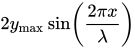
Equation (1) does not describe a traveling wave. At any position x, y(x,t) simply oscillates in time with an amplitude that varies in the x-direction as . The animation at the beginning of this article depicts what is
happening. As the left-traveling blue wave and right-traveling green
wave interfere, they form the standing red wave that does not travel and
instead oscillates in place.
Because the string is of infinite length, it has no boundary condition for its displacement at any point along the x-axis. As a result, a standing wave can form at any frequency.
At locations on the x-axis that are even multiples of a quarter wavelength,
the amplitude is always zero. These locations are called nodes. At locations on the x-axis that are odd multiples of a quarter wavelength
the amplitude is maximal, with a value of twice the amplitude of the
right- and left-traveling waves that interfere to produce this standing
wave pattern. These locations are called anti-nodes. The distance between two consecutive nodes or anti-nodes is half the wavelength, λ/2.
Standing wave on a string with two fixed ends
Next, consider a string with fixed ends at x = 0 and x = L.
The string will have some damping as it is stretched by traveling
waves, but assume the damping is very small. Suppose that at the x = 0
fixed end a sinusoidal force is applied that drives the string up and
down in the y-direction with a small amplitude at some frequency f. In this situation, the driving force produces a right-traveling wave. That wave reflects
off the right fixed end and travels back to the left, reflects again
off the left fixed end and travels back to the right, and so on.
Eventually, a steady state is reached where the string has identical
right- and left-traveling waves as in the infinite-length case and the
power dissipated by damping in the string equals the power supplied by
the driving force so the waves have constant amplitude.
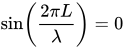
Equation (1) still describes the standing wave pattern that can form on this string, but now Equation (1) is subject to boundary conditions where y = 0 at x = 0 and x = L because the string is fixed at x = L and because we assume the driving force at the fixed x = 0 end has small amplitude. Checking the values of y at the two ends,
This boundary condition is in the form of the Sturm–Liouville formulation. The latter boundary condition is satisfied when . L is given, so the boundary condition restricts the wavelength of the standing waves to
2
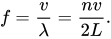
Waves can only form standing waves on this string if they have a wavelength that satisfies this relationship with L. If waves travel with speed v along the string, then equivalently the frequency of the standing waves is restricted to
The standing wave with n = 1 oscillates at the fundamental frequency and has a wavelength that is twice the length of the string. Higher integer values of n correspond to modes of oscillation called harmonics or overtones. Any standing wave on the string will have n + 1 nodes including the fixed ends and n anti-nodes.
To compare this example's nodes to the description of nodes for standing waves in the infinite length string, Equation (2) can be rewritten as
In this variation of the expression for the wavelength, n must be even. Cross multiplying we see that because L is a node, it is an even multiple of a quarter wavelength,
This example demonstrates a type of resonance and the frequencies that produce standing waves can be referred to as resonant frequencies.
Next, consider the same string of length L, but this time it is only fixed at x = 0. At x = L, the string is free to move in the y direction. For example, the string might be tied at x = L
to a ring that can slide freely up and down a pole. The string again
has small damping and is driven by a small driving force at x = 0.
In this case, Equation (1) still describes the standing wave pattern that can form on the string, and the string has the same boundary condition of y = 0 at x = 0. However, at x = L where the string can move freely there should be an anti-node with maximal amplitude of y. Equivalently, this boundary condition of the "free end" can be stated as ∂y/∂x = 0 at x = L, which is in the form of the Sturm–Liouville formulation. The intuition for this boundary condition ∂y/∂x = 0 at x = L is that the motion of the "free end" will follow that of the point to its left.
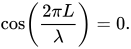
Reviewing Equation (1), for x = L the largest amplitude of y occurs when ∂y/∂x = 0, or
This leads to a different set of wavelengths than in the
two-fixed-ends example. Here, the wavelength of the standing waves is
restricted to
Equivalently, the frequency is restricted to
In this example n only takes odd values. Because L is an anti-node, it is an odd
multiple of a quarter wavelength. Thus the fundamental mode in this
example only has one quarter of a complete sine cycle–zero at x = 0 and the first peak at x = L–the first harmonic has three quarters of a complete sine cycle, and so on.
This example also demonstrates a type of resonance and the frequencies that produce standing waves are called resonant frequencies.
Consider a standing wave in a pipe of length L. The air inside the pipe serves as the medium for longitudinalsound waves
traveling to the right or left through the pipe. While the transverse
waves on the string from the previous examples vary in their
displacement perpendicular to the direction of wave motion, the waves
traveling through the air in the pipe vary in terms of their pressure
and longitudinal displacement along the direction of wave motion. The
wave propagates by alternately compressing and expanding air in segments
of the pipe, which displaces the air slightly from its rest position
and transfers energy to neighboring segments through the forces exerted
by the alternating high and low air pressures. Equations resembling those for the wave on a string can be written for the change in pressure Δp due to a right- or left-traveling wave in the pipe.
where
pmax is the pressure amplitude or the maximum increase or decrease in air pressure due to each wave,
If identical right- and left-traveling waves travel through the pipe, the resulting superposition is described by the sum
This formula for the pressure is of the same form as Equation (1), so a stationary pressure wave forms that is fixed in space and oscillates in time.
If the end of a pipe is closed, the pressure is maximal since the
closed end of the pipe exerts a force that restricts the movement of
air. This corresponds to a pressure anti-node (which is a node for
molecular motions, because the molecules near the closed end cannot
move). If the end of the pipe is open, the pressure variations are very
small, corresponding to a pressure node (which is an anti-node for
molecular motions, because the molecules near the open end can move
freely). The exact location of the pressure node at an open end is actually
slightly beyond the open end of the pipe, so the effective length of the
pipe for the purpose of determining resonant frequencies is slightly
longer than its physical length. This difference in length is ignored in this example. In terms of
reflections, open ends partially reflect waves back into the pipe,
allowing some energy to be released into the outside air. Ideally,
closed ends reflect the entire wave back in the other direction.
First consider a pipe that is open at both ends, for example an open organ pipe or a recorder.
Given that the pressure must be zero at both open ends, the boundary
conditions are analogous to the string with two fixed ends,
which only occurs when the wavelength of standing waves is
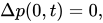
Next, consider a pipe that is open at x = 0 (and therefore has a pressure node) and closed at x = L (and therefore has a pressure anti-node). The closed "free end" boundary condition for the pressure at x = L can be stated as ∂(Δp)/∂x = 0, which is in the form of the Sturm–Liouville formulation. The intuition for this boundary condition ∂(Δp)/∂x = 0 at x = L
is that the pressure of the closed end will follow that of the point to
its left. Examples of this setup include a bottle and a clarinet.
This pipe has boundary conditions analogous to the string with only one
fixed end. Its standing waves have wavelengths restricted to
or equivalently the frequency of standing waves is restricted to
For the case where one end is closed, n only takes odd values just like in the case of the string fixed at only one end.
Molecular representation of a standing wave with n = 2
for a pipe that is closed at both ends. Considering longitudinal
displacement, the molecules at the ends and the molecules in the middle
are not displaced by the wave, representing nodes of longitudinal
displacement. Halfway between the nodes there are longitudinal
displacement anti-nodes where molecules are maximally displaced.
Considering pressure, the molecules are maximally compressed and
expanded at the ends and in the middle, representing pressure
anti-nodes. Halfway between the anti-nodes are pressure nodes where the
molecules are neither compressed nor expanded as they move.
So far, the wave has been written in terms of its pressure as a function of position x
and time. Alternatively, the wave can be written in terms of its
longitudinal displacement of air, where air in a segment of the pipe
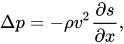
moves back and forth slightly in the x-direction as the pressure varies and waves travel in either or both directions. The change in pressure Δp and longitudinal displacement s are related as
where ρ is the density
of the air. In terms of longitudinal displacement, closed ends of pipes
correspond to nodes since air movement is restricted and open ends
correspond to anti-nodes since the air is free to move. A similar, easier to visualize phenomenon occurs in longitudinal waves propagating along a spring.
We can also consider a pipe that is closed at both ends. In this
case, both ends will be pressure anti-nodes or equivalently both ends
will be displacement nodes. This example is analogous to the case where
both ends are open, except the standing wave pattern has a π⁄2 phase shift along the x-direction
to shift the location of the nodes and anti-nodes. For example, the
longest wavelength that resonates–the fundamental mode–is again twice
the length of the pipe, except that the ends of the pipe have pressure
anti-nodes instead of pressure nodes. Between the ends there is one
pressure node. In the case of two closed ends, the wavelength is again
restricted to
and the frequency is again restricted to
A Rubens tube provides a way to visualize the pressure variations of the standing waves in a tube with two closed ends.
2D standing wave with a rectangular boundary
Next, consider transverse waves that can move along a two dimensional surface within a rectangular boundary of length Lx in the x-direction and length Ly in the y-direction.
Examples of this type of wave are water waves in a pool or waves on a
rectangular sheet that has been pulled taut. The waves displace the
surface in the z-direction, with z = 0 defined as the height of the surface when it is still.
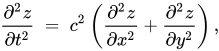
In two dimensions and Cartesian coordinates, the wave equation is
where
z(x,y,t) is the displacement of the surface,
c is the speed of the wave.
To solve this differential equation, let's first solve for its Fourier transform, with
Taking the Fourier transform of the wave equation,
This is an eigenvalue
problem where the frequencies correspond to eigenvalues that then
correspond to frequency-specific modes or eigenfunctions. Specifically,
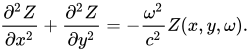
this is a form of the Helmholtz equation and it can be solved using separation of variables. Assume
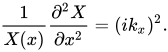
Dividing the Helmholtz equation by Z,
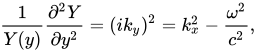
This leads to two coupled ordinary differential equations. The x term equals a constant with respect to x that we can define as
Solving for X(x),
This x-dependence is sinusoidal–recalling Euler's formula–with constants Akx and Bkx determined by the boundary conditions. Likewise, the y term equals a constant with respect to y that we can define as
Multiplying these functions together and applying the inverse Fourier transform, z(x,y,t) is a superposition of modes where each mode is the product of sinusoidal functions for x, y, and t,
The constants that determine the exact sinusoidal functions depend on
the boundary conditions and initial conditions. To see how the boundary
conditions apply, consider an example like the sheet that has been
pulled taut where z(x,y,t) must be zero all around the rectangular boundary. For the x dependence, z(x,y,t) must vary in a way that it can be zero at both x = 0 and x = Lx for all values of y and t.
As in the one dimensional example of the string fixed at both ends, the
sinusoidal function that satisfies this boundary condition is
with kx restricted to
Likewise, the y dependence of z(x,y,t) must be zero at both y = 0 and y = Ly, which is satisfied by
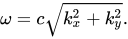
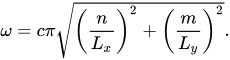
Restricting the wave numbers to these values also restricts the frequencies that resonate to
If the initial conditions for z(x,y,0) and its time derivative ż(x,y,0) are chosen so the t-dependence is a cosine function, then standing waves for this system take the form
So, standing waves inside this fixed rectangular boundary oscillate
in time at certain resonant frequencies parameterized by the integers n and m. As they oscillate in time, they do not travel and their spatial variation is sinusoidal in both the x- and y-directions such that they satisfy the boundary conditions. The fundamental mode, n = 1 and m = 1, has a single antinode in the middle of the rectangle. Varying n and m gives complicated but predictable two-dimensional patterns of nodes and antinodes inside the rectangle.
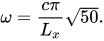
From the dispersion relation, in certain situations different modes–meaning different combinations of n and m–may resonate at the same frequency even though they have different shapes for their x- and y-dependence. For example, if the boundary is square, Lx = Ly, the modes n = 1 and m = 7, n = 7 and m = 1, and n = 5 and m = 5 all resonate at
Recalling that ω determines the eigenvalue in the Helmholtz
equation above, the number of modes corresponding to each frequency
relates to the frequency's multiplicity as an eigenvalue.
If the two oppositely moving traveling waves are not of the same
amplitude, they will not cancel completely at the nodes, the points
where the waves are 180° out of phase, so the amplitude of the standing
wave will not be zero at the nodes, but merely a minimum. Standing wave ratio
(SWR) is the ratio of the amplitude at the antinode (maximum) to the
amplitude at the node (minimum). A pure standing wave will have an
infinite SWR. It will also have a constant phase
at any point in space (but it may undergo a 180° inversion every half
cycle). A finite, non-zero SWR indicates a wave that is partially
stationary and partially travelling. Such waves can be decomposed into a
superposition
of two waves: a travelling wave component and a stationary wave
component. An SWR of one indicates that the wave does not have a
stationary component – it is purely a travelling wave, since the ratio
of amplitudes is equal to 1.
A pure standing wave does not transfer energy from the source to the destination. However, the wave is still subject to losses in the medium. Such
losses will manifest as a finite SWR, indicating a travelling wave
component leaving the source to supply the losses. Even though the SWR
is now finite, it may still be the case that no energy reaches the
destination because the travelling component is purely supplying the
losses. However, in a lossless medium, a finite SWR implies a definite
transfer of energy to the destination.
Examples
One easy example to understand standing waves is two people shaking either end of a jump rope.
If they shake in sync the rope can form a regular pattern of waves
oscillating up and down, with stationary points along the rope where the
rope is almost still (nodes) and points where the arc of the rope is
maximum (antinodes).
Standing waves are also observed in physical media such as strings
and columns of air. Any waves traveling along the medium will reflect
back when they reach the end. This effect is most noticeable in musical
instruments where, at various multiples of a vibrating string or air column's natural frequency, a standing wave is created, allowing harmonics
to be identified. Nodes occur at fixed ends and anti-nodes at open
ends. If fixed at only one end, only odd-numbered harmonics are
available. At the open end of a pipe the anti-node will not be exactly
at the end as it is altered by its contact with the air and so end correction
is used to place it exactly. The density of a string will affect the
frequency at which harmonics will be produced; the greater the density
the lower the frequency needs to be to produce a standing wave of the
same harmonic.
Visible light
Standing waves are also observed in optical media such as optical waveguides and optical cavities. Lasers use optical cavities in the form of a pair of facing mirrors, which constitute a Fabry–Pérot interferometer. The gain medium in the cavity (such as a crystal) emits light coherently, exciting standing waves of light in the cavity. The wavelength of light is very short (in the range of nanometers, 10−9 m) so the standing waves are microscopic in size. One use for standing light waves is to measure small distances, using optical flats.
X-rays
Interference between X-ray beams can form an X-ray standing wave (XSW) field. Because of the short wavelength of X-rays (less than 1 nanometer), this
phenomenon can be exploited for measuring atomic-scale events at
material surfaces. The XSW is generated in the region where an X-ray beam interferes with a diffracted beam from a nearly perfect single crystal surface or a reflection from an X-ray mirror. By tuning the crystal geometry or X-ray wavelength, the XSW can be translated in space, causing a shift in the X-ray fluorescence or photoelectron
yield from the atoms near the surface. This shift can be analyzed to
pinpoint the location of a particular atomic species relative to the
underlying crystal structure or mirror surface. The XSW method has been used to clarify the atomic-scale details of dopants in semiconductors, atomic and molecular adsorption on surfaces, and chemical transformations involved in catalysis.
Mechanical waves
Standing waves can be mechanically induced into a solid medium using
resonance. One easy to understand example is two people shaking either
end of a jump rope. If they shake in sync, the rope will form a regular
pattern with nodes and antinodes and appear to be stationary, hence the
name standing wave. Similarly a cantilever beam can have a standing
wave imposed on it by applying a base excitation. In this case the free
end moves the greatest distance laterally compared to any location along
the beam. Such a device can be used as a sensor to track changes in frequency or phase of the resonance of the fiber. One application is as a measurement device for dimensional metrology.
The Faraday wave
is a non-linear standing wave at the air-liquid interface induced by
hydrodynamic instability. It can be used as a liquid-based template to
assemble microscale materials.
Seiches
A seiche
is an example of a standing wave in an enclosed body of water. It is
characterised by the oscillatory behaviour of the water level at either
end of the body and typically has a nodal point near the middle of the
body where very little change in water level is observed. It should be
distinguished from a simple storm surge
where no oscillation is present. In sizeable lakes, the period of such
oscillations may be between minutes and hours, for example Lake Geneva's longitudinal period is 73 minutes and its transversal seiche has a period of around 10 minutes, while Lake Huron can be seen to have resonances with periods between 1 and 2 hours. See Lake seiches.


.jpg)