Search This Blog

Sunday, April 12, 2026

Orbital decay

From Wikipedia, the free encyclopedia
Altitude of Tiangong-1 during its final year of uncontrolled reentry.

Orbital decay is a gradual decrease of the distance between two orbiting bodies at their closest approach (the periapsis) over many orbital periods. These orbiting bodies can be a planet and its satellite, a star and any object orbiting it, or components of any binary system. If left unchecked, the decay eventually results in termination of the orbit when the smaller object strikes the surface of the primary; or for objects where the primary has an atmosphere, the smaller object burns, explodes, or otherwise breaks up in the larger object's atmosphere; or for objects where the primary is a star, ends with incineration by the star's radiation (such as for comets). Collisions of stellar-mass objects are usually accompanied by effects such as gamma-ray bursts and detectable gravitational waves.

Orbital decay is caused by one or more mechanisms which absorb energy from the orbital motion, such as fluid friction, gravitational anomalies, or electromagnetic effects. For bodies in low Earth orbit, the most significant effect is atmospheric drag.

Due to atmospheric drag, the lowest altitude above the Earth at which an object in a circular orbit can complete at least one full revolution without propulsion is approximately 150 km (93 mi) while the lowest perigee of an elliptical revolution is approximately 90 km (56 mi).

Modeling

Simplified model

A simplified decay model for a near-circular two-body orbit about a central body (or planet) with an atmosphere, in terms of the rate of change of the orbital altitude, is given below.
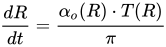
Where R is the distance of the spacecraft from the planet's origin, αo is the sum of all accelerations projected on the along-track direction of the spacecraft (or parallel to the spacecraft velocity vector), and T is the Keplerian period. Note that αo is often a function of R due to variations in atmospheric density in the altitude, and T is a function of R by virtue of Kepler's laws of planetary motion.

If only atmospheric drag is considered, one can approximate drag deceleration αo as a function of orbit radius R using the drag equation below:
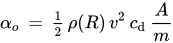
is the mass density of the atmosphere which is a function of the radius R from the origin,
is the orbital velocity,
is the drag reference area,
is the mass of the satellite, and
is the dimensionless drag coefficient related to the satellite geometry, and accounting for skin friction and form drag (~2.2 for cube satellites).

The orbit decay model has been tested against ~1 year of actual GPS measurements of VELOX-C1, where the mean decay measured via GPS was 2.566 km across Dec 2015 to Nov 2016, and the orbit decay model predicted a decay of 2.444 km, which amounted to a 5% deviation.

An open-source Python based software, ORBITM (ORBIT Maintenance and Propulsion Sizing), is available freely on GitHub for Python users using the above model.

Proof of simplified model

By the conservation of mechanical energy, the energy of the orbit is simply the sum of kinetic and gravitational potential energies, in an unperturbed two-body orbit. By substituting the vis-viva equation into the kinetic energy component, the orbital energy of a circular orbit is given by:

Where G is the gravitational constant, ME is the mass of the central body and m is the mass of the orbiting satellite. We take the derivative of the orbital energy with respect to the radius.
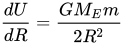
The total decelerating force, which is usually atmospheric drag for low Earth orbits, exerted on a satellite of constant mass m is given by some force F. The rate of loss of orbital energy is simply the rate at the external force does negative work on the satellite as the satellite traverses an infinitesimal circular arc-length ds, spanned by some infinitesimal angle and angular rate ω.

The angular rate ω is also known as the Mean motion, where for a two-body circular orbit of radius R, it is expressed as:

and...

Substituting ω into the rate of change of orbital energy above, and expressing the external drag or decay force in terms of the deceleration αo, the orbital energy rate of change with respect to time can be expressed as:
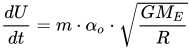
Having an equation for the rate of change of orbital energy with respect to both radial distance and time allows us to find the rate of change of the radial distance with respect to time as per below.
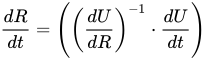
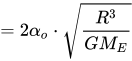
The assumptions used in this derivation above are that the orbit stays very nearly circular throughout the decay process, so that the equations for orbital energy are more or less that of a circular orbit's case. This is often true for orbits that begin as circular, as drag forces are considered "re-circularizing", since drag magnitudes at the periapsis (lower altitude) is expectedly greater than that of the apoapsis, which has the effect of reducing the mean eccentricity.

Sources of decay

Atmospheric drag

Sample orbit lifetime
for a larger satellite
Altitude
(km)
Estimated
decay time
100 2 hours
200 1 week
500 2 years
600 20 years
800 200 years

Atmospheric drag at orbital altitude is caused by frequent collisions of gas molecules with the satellite. It is the major cause of orbital decay for satellites in low Earth orbit. It results in the reduction in the altitude of a satellite's orbit. For the case of Earth, atmospheric drag resulting in satellite re-entry can be described by the following sequence:

lower altitude → denser atmosphere → increased drag → increased heat → usually burns on re-entry

Orbital decay thus involves a positive feedback effect, where the more the orbit decays, the lower its altitude drops, and the lower the altitude, the faster the decay. Decay is also particularly sensitive to external factors of the space environment such as solar activity, which are not very predictable. During solar maxima the Earth's atmosphere causes significant drag up to altitudes much higher than during solar minima.

Atmospheric drag exerts a significant effect at the altitudes of space stations, Space Shuttles and other crewed Earth-orbit spacecraft, and satellites with relatively high "low Earth orbits" such as the Hubble Space Telescope. Space stations typically require a regular altitude boost to counteract orbital decay (see also orbital station-keeping). Uncontrolled orbital decay brought down the Skylab space station, and (relatively) controlled orbital decay was used to de-orbit the Mir space station.

Reboosts for the Hubble Space Telescope are less frequent due to its much higher altitude. However, orbital decay is also a limiting factor to the length of time the Hubble can go without a maintenance rendezvous, the most recent having been performed successfully by STS-125, with Space Shuttle Atlantis in 2009. Newer space telescopes are in much higher orbits, or in some cases in solar orbit, so orbital boosting may not be needed.

Tidal effects

An orbit can also decay by negative tidal acceleration when the orbiting body is below the synchronous orbit. This saps angular momentum from the orbiting body and transfers it to the primary's rotation, lowering the orbit's altitude.

Examples of satellites undergoing tidal orbital decay are Mars' moon Phobos, Neptune's moon Triton, and potentially the exoplanet TrES-3b.

Light and thermal radiation

Small objects in the Solar System also experience an orbital decay due to the forces applied by asymmetric radiation pressure. Ideally, energy absorbed would equal blackbody energy emitted at any given point, resulting in no net force. However, the Yarkovsky effect is the phenomenon that, because absorption and radiation of heat are not instantaneous, objects which are not tidally locked absorb sunlight energy on surfaces exposed to the Sun, but those surfaces do not re-emit much of that energy until after the object has rotated, so that the emission is parallel to the object's orbit. This results in a very small acceleration parallel to the orbital path, yet one which can be significant for small objects over millions of years. The Poynting-Robertson effect is a force opposing the object's velocity caused by asymmetric incidence of light, i.e., aberration of light. For an object with prograde rotation, these two effects will apply opposing, but generally unequal, forces.

Gravitational radiation

Gravitational radiation is another mechanism of orbital decay. It is negligible for orbits of planets and planetary satellites (when considering their orbital motion on time scales of centuries, decades, and less), but is noticeable for systems of compact objects, as seen in observations of neutron star orbits. All orbiting bodies radiate gravitational energy, hence no orbit is indefinitely stable.

Electromagnetic drag

Satellites using an electrodynamic tether, moving through the Earth's magnetic field, create drag force that could eventually deorbit the satellite.

Stellar collision

A stellar collision is the coming together of two binary stars when they lose energy and approach each other. Several things can cause the loss of energy including tidal forces, mass transfer, and gravitational radiation. The stars describe the path of a spiral as they approach each other. This sometimes results in a merger of the two stars or the creation of a black hole. In the latter case, the last several revolutions of the stars around each other take only a few seconds.

Mass concentration

While not a direct cause of orbital decay, uneven mass distributions (known as mascons) of the body being orbited can perturb orbits over time, and extreme distributions can cause orbits to be highly unstable. The resulting unstable orbit can mutate into an orbit where one of the direct causes of orbital decay can take place.

Fatty liver disease

From Wikipedia, the free encyclopedia
 
Fatty liver

Micrograph showing a fatty liver (macrovesicular steatosis), as seen in metabolic dysfunction–associated steatotic liver disease. Trichrome stain.
SpecialtyGastroenterology
SymptomsNone, tiredness, pain in the upper right side of the abdomen
ComplicationsCirrhosis, liver cancer, esophageal varices
TypesMetabolic dysfunction–associated steatotic liver disease (MASLD), alcoholic liver disease (ALD)
CausesAlcohol, diabetes, obesity
Diagnostic methodBased on the medical history supported by blood tests, medical imaging, liver biopsy
Differential diagnosisViral hepatitis, Wilson's disease, primary sclerosing cholangitis
TreatmentAvoiding alcohol, weight loss
PrognosisGood if treated early
FrequencyNAFLD: 30% (Western countries)[2]
ALD: >90% of heavy drinkers[4]

Fatty liver disease (FLD), also known as hepatic steatosis and steatotic liver disease (SLD), is a condition where excess fat builds up in the liver. Often there are no or few symptoms. Occasionally there may be tiredness or pain in the upper right side of the abdomen. Complications may include cirrhosis, liver cancer, and esophageal varices.

The main subtypes of fatty liver disease are metabolic dysfunction–associated steatotic liver disease (MASLD) and alcoholic liver disease (ALD), with the category "metabolic and alcohol associated liver disease" (metALD) describing an overlap of the two.

Until June 2023, MASLD and its more advanced form, metabolic dysfunction associated steatohepatits (MASH), were referred to as non-alcoholic fatty liver disease (NAFLD) and non-alcoholic steatohepatitis (NASH), respectively. The change in terminology was decided in a modified Delphi process led by three large pan-national liver associations (the American Association for the Study of Liver Diseases, the European Association for the Study of the Liver and the Latin American Association for the Study of the Liver).

The primary risks include alcohol, type 2 diabetes, and obesity. Other risk factors include certain medications such as glucocorticoids, and hepatitis C. It is unclear why some people with MASLD develop simple fatty liver and others develop metabolic dysfunction associated steatohepatitis (MASH), which is associated with poorer outcomes. Diagnosis is based on the medical history supported by blood tests, medical imaging, and occasionally liver biopsy.

Treatment of MASLD is generally by dietary changes and exercise to bring about weight loss. In those who are severely affected, liver transplantation may be an option. More than 90% of heavy drinkers develop fatty liver while about 25% develop the more severe alcoholic hepatitis. MASLD affects about 30% of people in Western countries and 10% of people in Asia. MASLD affects about 10% of children in the United States. It occurs more often in older people and males.

Classification

Until 2023, fatty liver disease was classified into:

In 2023, a new nomenclature was chosen, with the classifications including:

Signs and symptoms

Often there are no or few symptoms. Occasionally there may be tiredness or pain in the upper right side of the abdomen.

Complications

Fatty liver can develop into hepatic fibrosis, cirrhosis or liver cancer. For people affected by MASLD, the 10-year survival rate was about 80%. The rate of progression of fibrosis is estimated to be one per 7 years in MASH and one per 14 years in MASLD, with an increasing speed. There is a strong relationship between these pathologies and metabolic illnesses (diabetes type II, metabolic syndrome). These pathologies can also affect non-obese people, who are then at a higher risk.

Less than 10% of people with cirrhotic alcoholic FLD will develop hepatocellular carcinoma, the most common type of primary liver cancer in adults, but up to 45% people with MASH without cirrhosis can develop hepatocellular carcinoma.

The condition is also associated with other diseases that influence fat metabolism.

Causes

Different stages of liver damage

Fatty liver (FL) is commonly associated with metabolic syndrome (diabetes, hypertension, obesity, and dyslipidemia), but can also be due to any one of many causes:

Alcohol
Alcohol use disorder is one of the causes of fatty liver due to production of toxic metabolites like aldehydes during metabolism of alcohol in the liver. This phenomenon most commonly occurs with chronic alcohol use disorder.
Metabolic
abetalipoproteinemia, glycogen storage diseases, Weber–Christian disease, acute fatty liver of pregnancy, lipodystrophy
Nutritional
obesity, malnutrition, total parenteral nutrition, severe weight loss, refeeding syndrome, jejunoileal bypass, gastric bypass, jejunal diverticulosis with bacterial overgrowth
Drugs and toxins
amiodarone, methotrexate, diltiazem, intravenous tetracyclinehighly active antiretroviral therapy, glucocorticoids, tamoxifen, environmental hepatotoxins (e.g., phosphorus, mushroom poisoning)
Other
celiac diseaseinflammatory bowel disease, HIV, hepatitis C (especially genotype 3), and alpha 1-antitrypsin deficiency

Pathology

Micrograph of periportal hepatic steatosis, as may be seen due to steroid use, trichrome stain

The fatty change represents the intracytoplasmatic accumulation of triglycerides (neutral fats). At the beginning, the hepatocytes present small fat vacuoles (liposomes) around the nucleus (microvesicular fatty change). At this stage, liver cells are filled with multiple fat droplets that do not displace the centrally located nucleus. In the last stages, the size of the vacuoles increases, pushing the nucleus to the periphery of the cell, giving a characteristic signet ring appearance (macrovesicular fatty change). These vesicles are well-delineated and optically "empty" because fats dissolve during tissue processing. Large vacuoles may coalesce and produce fatty cysts, which are irreversible lesions. Macrovesicular steatosis is the most common form and is typically associated with alcohol, diabetes, obesity, and corticosteroids. Acute fatty liver of pregnancy and Reye's syndrome are examples of severe liver disease caused by microvesicular fatty change. The diagnosis of steatosis is made when fat in the liver exceeds 5–10% by weight.

Mechanism leading to hepatic steatosis

Defects in fatty acid metabolism are responsible for pathogenesis of FLD, which may be due to imbalance in energy consumption and its combustion, resulting in lipid storage, or can be a consequence of peripheral resistance to insulin, whereby the transport of fatty acids from adipose tissue to the liver is increased. Impairment or inhibition of receptor molecules (PPAR-α, PPAR-γ and SREBP1) that control the enzymes responsible for the oxidation and synthesis of fatty acids appears to contribute to fat deposit. In addition, alcohol use disorder is known to damage mitochondria and other cellular structures, further impairing cellular energy mechanism. On the other hand, non-alcoholic FLD may begin as excess of unmetabolized energy in liver cells. Hepatic steatosis is considered reversible and to some extent nonprogressive if the underlying cause is reduced or removed.

Micrograph of inflamed fatty liver (steatohepatitis)

Severe fatty liver is sometimes go along with inflammation, a situation referred to as steatohepatitis. Progression to alcoholic steatohepatitis (ASH) or metabolic dysfunction associated steatohepatitis (MASH) depends on the persistence or severity of the inciting cause. Pathological lesions in both conditions are similar. However, the extent of inflammatory response varies widely and does not always correlate with degree of fat accumulation. Steatosis (retention of lipid) and onset of steatohepatitis may represent successive stages in FLD progression.

Liver disease with extensive inflammation and a high degree of steatosis often progresses to more severe forms of the disease. Hepatocyte ballooning and necrosis of varying degrees are often present at this stage. Liver cell death and inflammatory responses lead to the activation of hepatic stellate cells, which play a pivotal role in hepatic fibrosis. The extent of fibrosis varies widely. Perisinusoidal fibrosis is most common, especially in adults, and predominates in zone 3 around the terminal hepatic veins.

The progression to cirrhosis may be influenced by the amount of fat and degree of steatohepatitis and by a variety of other sensitizing factors. In alcoholic FLD, the transition to cirrhosis related to continued alcohol consumption is well-documented, but the process involved in non-alcoholic FLD is less clear.

Diagnosis

Liver steatosis (fatty liver disease) as seen on CT
Ultrasound showing diffuse increased echogenicity of the liver
Flow chart for diagnosis


Elevated liver enzyme


Serology to exclude viral hepatitis


Imaging study showing
fatty infiltrate


Alcohol intake


Less than two drinks per day‡
More than two drinks per day‡


Nonalcoholic fatty liver disease likely
Alcoholic liver disease likely

Criteria for nonalcoholic fatty liver disease:
consumption of ethanol less than 20 g/day for women and 30 g/day for men

Most individuals are asymptomatic and are usually discovered incidentally because of abnormal liver function tests or hepatomegaly noted in unrelated medical conditions. Elevated liver enzymes are found in as many as 50% of patients with simple steatosis. The serum alanine transaminase (ALT) level usually is greater than the aspartate transaminase (AST) level in the nonalcoholic variant and the opposite in alcoholic FLD (AST:ALT more than 2:1). Simple blood tests may help to determine the magnitude of the disease by assessing the degree of liver fibrosis. For example, AST-to-platelets ratio index (APRI score) and several other scores, calculated from the results of blood tests, can detect the degree of liver fibrosis and predict the future formation of liver cancer.

Imaging studies are often obtained during the evaluation process. Ultrasonography reveals a "bright" liver with increased echogenicity. Pocket-sized ultrasound devices might be used as point-of-care screening tools to diagnose liver steatosis. Medical imaging can aid in diagnosis of fatty liver; fatty livers have lower density than spleens on computed tomography (CT), and fat appears bright in T1-weighted magnetic resonance images (MRIs).

Histological diagnosis by liver biopsy is the most accurate measure of fibrosis and liver fat progression as of 2018. Conventional imaging methods, such as ultrasound, CT and MRI, are not specific enough to detect fatty liver disease unless fat occupies at least 30% of the liver volume.

More advanced imaging techniques are under investigation for both the diagnosis and monitoring of fatty liver disease patients, including elastography techniques (both ultrasound-based techniques and using magnetic resonance elastography) to measure the stiffness of the liver, which increases due to the accumulation of liver fibrosis. Several studies have also explored the use of quantitative MRI techniques such as proton density fat-fraction mapping and iron-corrected T1 (cT1) mapping techiques.

Treatment

Decreasing caloric intake by at least 30% or by approximately 750–1,000 kcal/day results in improvement in hepatic steatosis. For people with MASLD or MASH, weight loss via a combination of diet and exercise was shown to improve or resolve the disease. In more serious cases, medications that decrease insulin resistance, hyperlipidemia, and those that induce weight loss such as bariatric surgery as well as vitamin E have been shown to improve or resolve liver function.

Bariatric surgery, while not recommended in 2017 as a treatment for FLD alone, has been shown to revert FLD, MASLD, MASH and advanced steatohepatitis in over 90% of people who have undergone this surgery for the treatment of obesity.

In the case of long-term total-parenteral-nutrition-induced fatty liver disease, choline has been shown to alleviate symptoms. This may be due to a deficiency in the methionine cycle.

Epidemiology

NAFLD affects about 30% of people in Western countries and 10% of people in Asia. In the United States, rates are around 35% with about 7% having the severe form NASH. NAFLD affects about 10% of children in the United States. Recently the term Metabolic dysfunction-associated fatty liver disease (MAFLD) has been proposed to replace NAFLD. MAFLD is a more inclusionary diagnostic name as it is based on the detection of fatty liver by histology (biopsy), medical imaging or blood biomarkers but should be accompanied by either overweight/obesity, type 2 diabetes mellitus, or metabolic dysregulation. The new definition no longer excludes alcohol consumption or coexistence of other liver diseases such as viral hepatitis. Using this more inclusive definition, the global prevalence of MAFLD is an astonishingly high 50.7%. Indeed, also using the old NAFLD definition, the disease is observed in up to 80% of obese people, 35% of whom progress to NASH, and in up to 20% of normal weight people, despite no evidence of excessive alcohol consumption. FLD is the most common cause of abnormal liver function tests in the United States. Fatty liver is more prevalent in Hispanic people than white, with black people having the lowest prevalence.

In the study Children of the 90s, 2.5% born in 1991 and 1992 were found by ultrasound at the age of 18 to have non-alcoholic fatty liver disease; five years later transient elastography found over 20% to have the fatty deposits on the liver, indicating non-alcoholic fatty liver disease; half of those were classified as severe. The scans also found that 2.4% had a degree of liver fibrosis, which can lead to cirrhosis.

After the lockdown of the COVID-19 pandemic, a study demonstrated that 48% of patients with liver steatosis gained weight, while 16% had a worsened steatosis grade. Weight gain was associated with poor adherence to the suggested diet, reduced levels of physical activity, and increased prevalence of homozygosity for the PNPLA3 rs738409 single nucleotide polymorphism. PNPLA3 rs738409 is already a known risk factor for NAFLD.

Research

A systematic review and meta-analysis, published in 2024, found that growth hormone therapy may help in the management of fatty liver disease.

In animals

Fatty liver disease can occur in pets such as reptiles (particularly turtles) and birds as well as mammals like cats and dogs. The most common cause is overnutrition. A distinct sign in birds is a misshapen beak. Fatty livers can be induced via gavage in geese or ducks to produce foie gras. Fatty liver can also be induced in ruminants such as sheep by a high-caloric diet.

Cosmogony

From Wikipedia, the free encyclopedia
The Big Bang theory of modern cosmology postulates the universe evolved from a hot dense state.

Cosmogony, also spelled as cosmogeny, or cosmogenesis, is any model concerning the origin of the cosmos or the universe.

Types

While cosmogony generally refers to origin stories, the nature and subject of these stories varies with times and sources. Ancient Greece developed a cosmogony focused on the origin of matter, space, and time with a transition from Chaos to Cosmos. This was a form of "philosophical cosmogony" that is distinct from modern empirical science but which nevertheless dealt with many similar questions. Another type of cosmogony focuses on the formation and evolution of the Solar System. or sometimes the formation of galaxies. The standard cosmological model of the early development of the universe is the Big Bang theory, but it is based on a model known to fail at the very earliest times. Thus modern cosmogony is not generally a consequence of modern cosmology theories.

Scientific cosmogenesis

A Big Bang model for the dynamics of the universe is widely agreed among cosmologists. Like most physical models, Big Bang models describe changes of state. Few physical models are designed to determine initial conditions: initial states are given by experimental measurements or by hypothesis. In cosmology, the initial state would be the origin of the universe. It is considered a valid challenge to address but there are significant disagreements over even the form of acceptable answers.

Initial singularity

Since the Big Bang model describes an expanding and cooling universe, it must have been denser and hotter in the past. Conceptually the model can be extrapolated back to time zero. However, this process cannot be run all the way back to time zero: the standard model assumes a density low enough to avoid quantum effects. As the model is followed to smaller times the density exceeds the validity of general relativity. This point in time is called the Planck time.

General relativity initial state

One approach to the limitations of running Big Bang model back to time zero simply stops extrapolating when the limit of valid general relativity is reached. This model by itself fails in several ways. First, the observable universe is much more homogeneous than an extrapolated Big Bang can account for. This problem is called the horizon problem because events on opposite sides of the horizon could not have mixed in the early universe and thus should not be homogeneous now. Second, the expansion of the universe reduces curvature or equivalently increases flatness. Since the universe now is observed to be close to flat, a universe extrapolated back in time would have to be extremely flat. This almost but not quite zero curvature seems unnatural, an issue called the flatness problem. Third, this extrapolation gives poor results when compared to measurements of large scale structure and of the cosmic microwave background (CMB).

Initial state theories

Several different theories have been proposed as alternative to simple extrapolation of general relativity. The most successful approach is called inflation. In this model the universe goes through a very short phase of intense expansion not predicted by general relativity. The expansion is so immense and fast that all pre-existing particles are diluted and replaced by particles emerging from the field that drove inflation in an process called reheating. An initially homogeneous universe, inflated by an enormous factor explains why we can see homogeneous features across distances which ordinary causality asserts are independent. When combined with the Big Bang and other concepts of cosmology, inflation becomes the consensus or standard model of cosmology, a model which successfully predicts details of large scale structure and the CMB. While inflation has been successful in developing an initial state for Big Bang models, it does not by itself describe the origin of the universe. The rapid expansion erases evidence of physical processes occurring before inflation.

Quantum cosmology

Sean M. Carroll, who specializes in theoretical cosmology and field theory, explains two competing explanations for the origins of the singularity, which is the center of a space in which a characteristic is limitless (one example is the singularity of a black hole, where gravity is the characteristic that becomes limitless — infinite).

When the universe started to expand, the Big Bang occurred, which evidently began the universe. The other explanation, the Hartle–Hawking state, held by proponents such as Stephen Hawking, asserts that time did not exist when it emerged along with the universe. This assertion implies that the universe does not have a beginning, as time did not exist "prior" to the universe. Hence, it is unclear whether properties such as space or time emerged with the singularity and the known universe.

Mythology

The Sumerian tablet containing parts of the Eridu Genesis
The Creation of the Four Elements as published by Holland in 1589 from Ovid's book: Metamorphoses

In mythology, creation or cosmogonic myths are narratives describing the beginning of the universe or cosmos.

Some methods of the creation of the universe in mythology include:

Creation myths may be etiological, attempting to provide explanations for the origin of the universe. For instance, Eridu Genesis, the oldest known creation myth, contains an account of the creation of the world in which the universe was created out of a primeval sea (Abzu). Creation myths vary, but they may share similar deities or symbols. For instance, the ruler of the gods in Greek mythology, Zeus, is similar to the ruler of the gods in Roman mythology, Jupiter. Another example is the ruler of the gods in Tagalog mythology, Bathala, who is similar to various rulers of certain pantheons within Philippine mythology such as the Bisaya's Kaptan.

The representation of the Universe as rooted in Serer religion and Cosmogony

Compared with cosmology

In the humanities, the distinction between cosmogony and cosmology is blurred. For example, in theology, the cosmological argument for the existence of God (pre-cosmic cosmogonic bearer of personhood) is an appeal to ideas concerning the origin of the universe and is thus cosmogonical. Some religious cosmogonies have an impersonal first cause (for example Taoism).

However, in astronomy, cosmogony can be distinguished from cosmology, which studies the universe and its existence, but does not necessarily inquire into its origins. There is therefore a scientific distinction between cosmological and cosmogonical ideas. Physical cosmology is the science that attempts to explain all observations relevant to the development and characteristics of the universe on its largest scale. Some questions regarding the behaviour of the universe have been described by some physicists and cosmologists as being extra-scientific or metaphysical. Attempted solutions to such questions may include the extrapolation of scientific theories to untested regimes (such as the Planck epoch), or the inclusion of philosophical or religious ideas.

Twin paradox

From Wikipedia, the free encyclopedia https://en.wikipedia.org/wiki/Twin_para...
