Search This Blog

Thursday, February 19, 2026

Einstein–Podolsky–Rosen paradox

Albert Einstein

The Einstein–Podolsky–Rosen (EPR) paradox is a thought experiment proposed by physicists Albert Einstein, Boris Podolsky and Nathan Rosen, which argues that the description of physical reality provided by quantum mechanics is incomplete. In a 1935 paper titled "Can Quantum-Mechanical Description of Physical Reality be Considered Complete?", they argued for the existence of "elements of reality" that were not part of quantum theory, and speculated that it should be possible to construct a theory containing these hidden variables. Resolutions of the paradox have important implications for the interpretation of quantum mechanics.

The thought experiment involves a pair of particles prepared in what would later become known as an entangled state. Einstein, Podolsky, and Rosen pointed out that, in this state, if the position of the first particle were measured, the result of measuring the position of the second particle could be predicted. If instead the momentum of the first particle were measured, then the result of measuring the momentum of the second particle could be predicted. They argued that no action taken on the first particle could instantaneously affect the other, since this would involve information being transmitted faster than light, which is impossible according to the theory of relativity. They invoked a principle, later known as the "EPR criterion of reality", which posited that: "If, without in any way disturbing a system, we can predict with certainty (i.e., with probability equal to unity) the value of a physical quantity, then there exists an element of reality corresponding to that quantity." From this, they inferred that the second particle must have a definite value of both position and of momentum prior to either quantity being measured. But quantum mechanics considers these two observables incompatible and thus does not associate simultaneous values for both to any system. Einstein, Podolsky, and Rosen therefore concluded that quantum theory does not provide a complete description of reality.

The "Paradox" paper

The term "Einstein–Podolsky–Rosen paradox" or "EPR" arose from a paper written in 1934 after Einstein joined the Institute for Advanced Study, having fled the rise of Nazi Germany. The original paper purports to describe what must happen to "two systems I and II, which we permit to interact", and after some time "we suppose that there is no longer any interaction between the two parts." The EPR description involves "two particles, A and B, [which] interact briefly and then move off in opposite directions." According to Heisenberg's uncertainty principle, it is impossible to measure both the momentum and the position of particle B exactly; however, it is possible to measure the exact position of particle A. By calculation, therefore, with the exact position of particle A known, the exact position of particle B can be known. Alternatively, the exact momentum of particle A can be measured, so the exact momentum of particle B can be worked out. As Manjit Kumar writes, "EPR argued that they had proved that ... [particle] B can have simultaneously exact values of position and momentum. ... Particle B has a position that is real and a momentum that is real. EPR appeared to have contrived a means to establish the exact values of either the momentum or the position of B due to measurements made on particle A, without the slightest possibility of particle B being physically disturbed."

EPR tried to set up a paradox, “a seemingly absurd or self contradictory statement or proposition that may in fact be true", to question the range of true application of quantum mechanics: quantum theory predicts that both values cannot be known for a particle, and yet the EPR thought experiment purports to show that they must both have determinate values. The EPR paper says: "We are thus forced to conclude that the quantum-mechanical description of physical reality given by wave functions is not complete." The EPR paper ends by saying: "While we have thus shown that the wave function does not provide a complete description of the physical reality, we left open the question of whether or not such a description exists. We believe, however, that such a theory is possible." The 1935 EPR paper condensed the philosophical discussion into a physical argument. The authors claim that given a specific experiment, in which the outcome of a measurement is known before the measurement takes place, there must exist something in the real world, an "element of reality", that determines the measurement outcome. They postulate that these elements of reality are, in modern terminology, local, in the sense that each belongs to a certain point in spacetime. Each element may, again in modern terminology, only be influenced by events that are located in the backward light cone of its point in spacetime (i.e. in the past). These claims are thus founded on assumptions about nature that constitute what is now known as local realism.

Article headline regarding the EPR paradox paper in the May 4, 1935, issue of The New York Times

Though the EPR paper has often been taken as an exact expression of Einstein's views, it was primarily authored by Podolsky, based on discussions at the Institute for Advanced Study with Einstein and Rosen. Einstein later expressed to Erwin Schrödinger that, "it did not come out as well as I had originally wanted; rather, the essential thing was, so to speak, smothered by the formalism." Einstein would later go on to present an individual account of his local realist ideas. Shortly before the EPR paper appeared in the Physical Review, The New York Times ran a news story about it, under the headline "Einstein Attacks Quantum Theory". The story, which quoted Podolsky, irritated Einstein, who wrote to the Times, "Any information upon which the article 'Einstein Attacks Quantum Theory' in your issue of May 4 is based was given to you without authority. It is my invariable practice to discuss scientific matters only in the appropriate forum and I deprecate advance publication of any announcement in regard to such matters in the secular press."

The Times story also sought out comment from physicist Edward Condon, who said, "Of course, a great deal of the argument hinges on just what meaning is to be attached to the word 'reality' in physics." The physicist and historian Max Jammer later noted, "[I]t remains a historical fact that the earliest criticism of the EPR paper – moreover, a criticism that correctly saw in Einstein's conception of physical reality the key problem of the whole issue – appeared in a daily newspaper prior to the publication of the criticized paper itself." The term "paradox" was associated with the paper already in 1935 by Schrodinger and notably again later by David Bohm, Yakir Aharonov and John Stewart Bell.

Bohr's reply

The publication of the paper prompted a response by Niels Bohr, which he published in the same journal (Physical Review), in the same year, using the same title. (This exchange was only one chapter in a prolonged debate between Bohr and Einstein about the nature of quantum reality.) He argued that EPR had reasoned fallaciously. Bohr said measurements of position and of momentum are complementary, meaning the choice to measure one excludes the possibility of measuring the other. Consequently, a fact deduced regarding one arrangement of laboratory apparatus could not be combined with a fact deduced by means of the other, and so, the inference of predetermined position and momentum values for the second particle was not valid. Bohr concluded that EPR's "arguments do not justify their conclusion that the quantum description turns out to be essentially incomplete".

Einstein's own argument

In his own publications and correspondence, Einstein indicated that he was not satisfied with the EPR paper and that Podolsky had authored most of it. He later used a different argument to insist that quantum mechanics is an incomplete theory. He explicitly de-emphasized EPR's attribution of "elements of reality" to the position and momentum of particle B, saying that "I couldn't care less" whether the resulting states of particle B allowed one to predict the position and momentum with certainty.

For Einstein, the crucial part of the argument was the demonstration of nonlocality, that the choice of measurement done in particle A, either position or momentum, would lead to two different quantum states of particle B. He argued that, because of locality, the real state of particle B could not depend on which kind of measurement was done in A and that the quantum states therefore cannot be in one-to-one correspondence with the real states. Einstein struggled unsuccessfully for the rest of his life to find a theory that could better comply with his idea of locality.

Later developments

Bohm's variant

In 1951, David Bohm proposed a variant of the EPR thought experiment in which the measurements have discrete ranges of possible outcomes, unlike the position and momentum measurements considered by EPR. The EPR–Bohm thought experiment can be explained using electron–positron pairs. Suppose we have a source that emits electron–positron pairs, with the electron sent to destination A, where there is an observer named Alice, and the positron sent to destination B, where there is an observer named Bob. According to quantum mechanics, we can arrange our source so that each emitted pair occupies a quantum state called a spin singlet. The particles are thus said to be entangled. This can be viewed as a quantum superposition of two states, which we call state I and state II. In state I, the electron has spin pointing upward along the z-axis (+z) and the positron has spin pointing downward along the z-axis (−z). In state II, the electron has spin −z and the positron has spin +z. Because it is in a superposition of states, it is impossible without measuring to know the definite state of spin of either particle in the spin singlet.

The EPR thought experiment, performed with electron–positron pairs. A source (center) sends particles toward two observers, electrons to Alice (left) and positrons to Bob (right), who can perform spin measurements.

Alice now measures the spin along the z-axis. She can obtain one of two possible outcomes: +z or −z. Suppose she gets +z. Informally speaking, the quantum state of the system collapses into state I. The quantum state determines the probable outcomes of any measurement performed on the system. In this case, if Bob subsequently measures spin along the z-axis, there is 100% probability that he will obtain −z. Similarly, if Alice gets −z, Bob will get +z. There is nothing special about choosing the z-axis: according to quantum mechanics the spin singlet state may equally well be expressed as a superposition of spin states pointing in the x direction.

Whatever axis their spins are measured along, they are always found to be opposite. In quantum mechanics, the x-spin and z-spin are "incompatible observables", meaning the Heisenberg uncertainty principle applies to alternating measurements of them: a quantum state cannot possess a definite value for both of these variables. Suppose Alice measures the z-spin and obtains +z, so that the quantum state collapses into state I. Now, instead of measuring the z-spin as well, Bob measures the x-spin. According to quantum mechanics, when the system is in state I, Bob's x-spin measurement will have a 50% probability of producing +x and a 50% probability of -x. It is impossible to predict which outcome will appear until Bob actually performs the measurement. Therefore, Bob's positron will have a definite spin when measured along the same axis as Alice's electron, but when measured in the perpendicular axis its spin will be uniformly random. It seems as if information has propagated (faster than light) from Alice's apparatus to make Bob's positron assume a definite spin in the appropriate axis.

Bell's theorem

In 1964, John Stewart Bell published a paper investigating the puzzling situation at that time: on one hand, the EPR paradox purportedly showed that quantum mechanics was nonlocal, and suggested that a hidden-variable theory could heal this nonlocality. On the other hand, David Bohm had recently developed the first successful hidden-variable theory, but it had a grossly nonlocal character. Bell set out to investigate whether it was indeed possible to solve the nonlocality problem with hidden variables, and found out that first, the correlations shown in both EPR's and Bohm's versions of the paradox could indeed be explained in a local way with hidden variables, and second, that the correlations shown in his own variant of the paradox couldn't be explained by any local hidden-variable theory. This second result became known as the Bell theorem.

To understand the first result, consider the following toy hidden-variable theory introduced later by J.J. Sakurai: in it, quantum spin-singlet states emitted by the source are actually approximate descriptions for "true" physical states possessing definite values for the z-spin and x-spin. In these "true" states, the positron going to Bob always has spin values opposite to the electron going to Alice, but the values are otherwise completely random. For example, the first pair emitted by the source might be "(+z, −x) to Alice and (−z, +x) to Bob", the next pair "(−z, −x) to Alice and (+z, +x) to Bob", and so forth. Therefore, if Bob's measurement axis is aligned with Alice's, he will necessarily get the opposite of whatever Alice gets; if it is perpendicular, he will get "+" and "−" with equal probability.

Bell showed, however, that such models can only reproduce the singlet correlations when Alice and Bob make measurements on the same axis or on perpendicular axes. As soon as other angles between their axes are allowed, local hidden-variable theories become unable to reproduce the quantum mechanical correlations. This difference, expressed using inequalities known as "Bell inequalities", is in principle experimentally testable. After the publication of Bell's paper, a variety of experiments to test Bell inequalities were carried out, notably by the group of Alain Aspect in the 1980s; all experiments conducted to date have found behavior in line with the predictions of quantum mechanics. The present view of the situation is that quantum mechanics flatly contradicts Einstein's philosophical postulate that any acceptable physical theory must fulfill "local realism". The fact that quantum mechanics violates Bell inequalities indicates that any hidden-variable theory underlying quantum mechanics must be non-local; whether this should be taken to imply that quantum mechanics itself is non-local is a matter of continuing debate.

Steering

Inspired by Schrödinger's treatment of the EPR paradox back in 1935, Howard M. Wiseman et al. formalised it in 2007 as the phenomenon of quantum steering. They defined steering as the situation where Alice's measurements on a part of an entangled state steer Bob's part of the state. That is, Bob's observations cannot be explained by a local hidden state model, where Bob would have a fixed quantum state in his side, which is classically correlated but otherwise independent of Alice's.

Locality

Locality has several different meanings in physics. EPR describe the principle of locality as asserting that physical processes occurring at one place should have no immediate effect on the elements of reality at another location. At first sight, this appears to be a reasonable assumption to make, as it seems to be a consequence of special relativity, which states that energy can never be transmitted faster than the speed of light without violating causality; however, it turns out that the usual rules for combining quantum mechanical and classical descriptions violate EPR's principle of locality without violating special relativity or causality. Causality is preserved because there is no way for Alice to transmit messages (i.e., information) to Bob by manipulating her measurement axis. Whichever axis she uses, she has a 50% probability of obtaining "+" and 50% probability of obtaining "−", completely at random; according to quantum mechanics, it is fundamentally impossible for her to influence what result she gets. Furthermore, Bob is able to perform his measurement only once: there is a fundamental property of quantum mechanics, the no-cloning theorem, which makes it impossible for him to make an arbitrary number of copies of the electron he receives, perform a spin measurement on each, and look at the statistical distribution of the results. Therefore, in the one measurement he is allowed to make, there is a 50% probability of getting "+" and 50% of getting "−", regardless of whether or not his axis is aligned with Alice's.

As a summary, the results of the EPR thought experiment do not contradict the predictions of special relativity. Neither the EPR paradox nor any quantum experiment demonstrates that superluminal signaling is possible; however, the principle of locality appeals powerfully to physical intuition, and Einstein, Podolsky and Rosen were unwilling to abandon it. Einstein derided the quantum mechanical predictions as "spooky action at a distance". The conclusion they drew was that quantum mechanics is not a complete theory.

Mathematical formulation

Bohm's variant of the EPR paradox can be expressed mathematically using the quantum mechanical formulation of spin. Each spin degree of freedom for an electron is associated with a two-dimensional complex vector space V, with each quantum state corresponding to a vector in that space. The operators corresponding to the spin along the x, y, and z direction, denoted Sx, Sy, and Sz respectively, can be represented using the Pauli matrices:   where is the reduced Planck constant (or the Planck constant divided by 2π).

The eigenstates of Sz are represented as and the eigenstates of Sx are represented as

The vector space of the electron-positron pair is , the tensor product of the electron's and positron's vector spaces. The spin singlet state is where the two terms on the right hand side are what we have referred to as state I and state II above.


From the above equations, it can be shown that the spin singlet can also be written as where the terms on the right hand side are what we have referred to as state Ia and state IIa.

To illustrate the paradox, we need to show that after Alice's measurement of Sz (or Sx), Bob's value of Sz (or Sx) is uniquely determined and Bob's value of Sx (or Sz) is uniformly random. This follows from the principles of measurement in quantum mechanics. When Sz is measured, the system state collapses into an eigenvector of Sz. If the measurement result is +z, this means that immediately after measurement the system state collapses to


Similarly, if Alice's measurement result is −z, the state collapses to The left hand side of both equations show that the measurement of Sz on Bob's positron is now determined, it will be −z in the first case or +z in the second case. The right hand side of the equations show that the measurement of Sx on Bob's positron will return, in both cases, +x or −x with probability 1/2 each.

Wednesday, February 18, 2026

Action at a distance

From Wikipedia, the free encyclopedia
https://en.wikipedia.org/wiki/Action_at_a_distance

Action at a distance is the concept in physics that an object's motion can be affected by another object without the two being in physical contact; that is, it is the concept of the non-local interaction of objects that are separated in space. Coulomb's law and Newton's law of universal gravitation are based on action at a distance.

Historically, action at a distance was the earliest scientific model for gravity and electricity and it continues to be useful in many practical cases. In the 19th and 20th centuries, field models arose to explain these phenomena with more precision. The discovery of electrons and of special relativity led to new action at a distance models providing alternative to field theories. Under our modern understanding, the four fundamental interactions (gravity, electromagnetism, the strong interaction and the weak interaction) in all of physics are not described by action at a distance.

Categories of action

In the study of mechanics, action at a distance is one of three fundamental actions on matter that cause motion. The other two are direct impact (elastic or inelastic collisions) and actions in a continuous medium as in fluid mechanics or solid mechanics. Historically, physical explanations for particular phenomena have moved between these three categories over time as new models were developed.

Action-at-a-distance and actions in a continuous medium may be easily distinguished when the medium dynamics are visible, like waves in water or in an elastic solid. In the case of electricity or gravity, no medium is required. In the nineteenth century, criteria like the effect of actions on intervening matter, the observation of a time delay, the apparent storage of energy, or even the possibility of a plausible mechanical model for action transmission were all accepted as evidence against action at a distance. Aether theories were alternative proposals to replace apparent action-at-a-distance in gravity and electromagnetism, in terms of continuous action inside an (invisible) medium called "aether".

Direct impact of macroscopic objects seems visually distinguishable from action at a distance. If however the objects are constructed of atoms, and the volume of those atoms is not defined and atoms interact by electric and magnetic forces, the distinction is less clear.

Roles

The concept of action at a distance acts in multiple roles in physics and it can co-exist with other models according to the needs of each physical problem.

One role is as a summary of physical phenomena, independent of any understanding of the cause of such an action. For example, astronomical tables of planetary positions can be compactly summarized using Newton's law of universal gravitation, which assumes the planets interact without contact or an intervening medium. As a summary of data, the concept does not need to be evaluated as a plausible physical model.

Action at a distance also acts as a model explaining physical phenomena even in the presence of other models. Again in the case of gravity, hypothesizing an instantaneous force between masses allows the return time of comets to be predicted as well as predicting the existence of previously unknown planets, like Neptune. These triumphs of physics predated the alternative more accurate model for gravity based on general relativity by many decades.

Introductory physics textbooks discuss central forces, like gravity, by models based on action-at-distance without discussing the cause of such forces or issues with it until the topics of relativity and fields are discussed. For example, see The Feynman Lectures on Physics on gravity.

History

Early inquiries into motion

Action-at-a-distance as a physical concept requires identifying objects, distances, and their motion. In antiquity, ideas about the natural world were not organized in these terms. Objects in motion were modeled as living beings. Around 1600, the scientific method began to take root. René Descartes held a more fundamental view, developing ideas of matter and action independent of theology. Galileo Galilei wrote about experimental measurements of falling and rolling objects. Johannes Kepler's laws of planetary motion summarized Tycho Brahe's astronomical observations. Many experiments with electrical and magnetic materials led to new ideas about forces. These efforts set the stage for Newton's work on forces and gravity.

Newtonian gravity

In 1687 Isaac Newton published his Principia which combined his laws of motion with a new mathematical analysis able to reproduce Kepler's empirical results. His explanation was in the form of a law of universal gravitation: any two bodies are attracted by a force proportional to their mass and inversely proportional to the square of the distance between them. Thus the motions of planets were predicted by assuming forces working over great distances.

This mathematical expression of the force did not imply a cause. Newton considered action-at-a-distance to be an inadequate model for gravity. Newton, in his words, considered action at a distance to be:

so great an Absurdity that I believe no Man who has in philosophical Matters a competent Faculty of thinking can ever fall into it.

— Isaac Newton, Letters to Bentley, 1692/3

Metaphysical scientists of the early 1700s strongly objected to the unexplained action-at-a-distance in Newton's theory. Gottfried Wilhelm Leibniz complained that the mechanism of gravity was "invisible, intangible, and not mechanical". Moreover, initial comparisons with astronomical data were not favorable. As mathematical techniques improved throughout the 1700s, the theory showed increasing success, predicting the date of the return of Halley's Comet and aiding the discovery of planet Neptune in 1846. These successes and the increasingly empirical focus of science towards the 19th century led to acceptance of Newton's theory of gravity despite distaste for action-at-a-distance.

Electrical action at a distance

Jean-Antoine Nollet reproducing Stephan Gray's "electric boy" experiment, in which a boy hanging from insulating silk ropes is given an electric charge. A group are gathered around. A woman is encouraged to bend forward and poke the boy's nose, to get an electric shock.

Electrical and magnetic phenomena also began to be explored systematically in the early 1600s. In William Gilbert's early theory of "electric effluvia," a kind of electric atmosphere, he rules out action-at-a-distance on the grounds that "no action can be performed by matter save by contact". However subsequent experiments, especially those by Stephen Gray showed electrical effects over distance. Gray developed an experiment call the "electric boy" demonstrating electric transfer without direct contact. Franz Aepinus was the first to show, in 1759, that a theory of action at a distance for electricity provides a simpler replacement for the electric effluvia theory. Despite this success, Aepinus himself considered the nature of the forces to be unexplained: he did "not approve of the doctrine which assumes the possibility of action at a distance", setting the stage for a shift to theories based on aether.

By 1785 Charles-Augustin de Coulomb showed that two electric charges at rest experience a force inversely proportional to the square of the distance between them, a result now called Coulomb's law. The striking similarity to gravity strengthened the case for action at a distance, at least as a mathematical model.

As mathematical methods improved, especially through the work of Pierre-Simon Laplace, Joseph-Louis Lagrange, and Siméon Denis Poisson, more sophisticated mathematical methods began to influence the thinking of scientists. The concept of potential energy applied to small test particles led to the concept of a scalar field, a mathematical model representing the forces throughout space. While this mathematical model is not a mechanical medium, the mental picture of such a field resembles a medium.

Fields as an alternative

Glazed frame, containing "Delineation of Lines of Magnetic Force by Iron filings" prepared by Michael Faraday

Michael Faraday was the first who suggested that action at a distance was inadequate as an account of electric and magnetic forces, even in the form of a (mathematical) potential field. Faraday, an empirical experimentalist, cited three reasons in support of some medium transmitting electrical force: 1) electrostatic induction across an insulator depends on the nature of the insulator, 2) cutting a charged insulator causes opposite charges to appear on each half, and 3) electric discharge sparks are curved at an insulator. From these reasons he concluded that the particles of an insulator must be polarized, with each particle contributing to continuous action. He also experimented with magnets, demonstrating lines of force made visible by iron filings. However, in both cases his field-like model depends on particles that interact through an action-at-a-distance: his mechanical field-like model has no more fundamental physical cause than the long-range central field model.

Faraday's observations, as well as others, led James Clerk Maxwell to a breakthrough formulation in 1865, a set of equations that combined electricity and magnetism, both static and dynamic, and which included electromagnetic radiation – light. Maxwell started with elaborate mechanical models but ultimately produced a purely mathematical treatment using dynamical vector fields. The sense that these fields must be set to vibrate to propagate light set off a search of a medium of propagation; the medium was called the luminiferous aether or the aether.

In 1873 Maxwell addressed action at a distance explicitly. He reviews Faraday's lines of force, carefully pointing out that Faraday himself did not provide a mechanical model of these lines in terms of a medium. Nevertheless the many properties of these lines of force imply these "lines must not be regarded as mere mathematical abstractions". Faraday himself viewed these lines of force as a model, a "valuable aid" to the experimentalist, a means to suggest further experiments.

In distinguishing between different kinds of action Faraday suggested three criteria: 1) do additional material objects alter the action?, 2) does the action take time, and 3) does it depend upon the receiving end? For electricity, Faraday knew that all three criteria were met for electric action, but gravity was thought to only meet the third one. After Maxwell's time a fourth criteria, the transmission of energy, was added, thought to also apply to electricity but not gravity. With the advent of new theories of gravity, the modern account would give gravity all of the criteria except dependence on additional objects.

Fields fade into spacetime

The success of Maxwell's field equations led to numerous efforts in the later decades of the 19th century to represent electrical, magnetic, and gravitational fields, primarily with mechanical models. No model emerged that explained the existing phenomena. In particular no good model for stellar aberration, the shift in the position of stars with the Earth's relative velocity. The best models required the ether to be stationary while the Earth moved, but experimental efforts to measure the effect of Earth's motion through the aether found no effect.

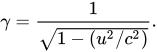
In 1892 Hendrik Lorentz proposed a modified aether based on the emerging microscopic molecular model rather than the strictly macroscopic continuous theory of Maxwell. Lorentz investigated the mutual interaction of a moving solitary electrons within a stationary aether. He rederived Maxwell's equations in this way but, critically, in the process he changed them to represent the wave in the coordinates moving electrons. He showed that the wave equations had the same form if they were transformed using a particular scaling factor, where is the velocity of the moving electrons and is the speed of light. Lorentz noted that if this factor were applied as a length contraction to moving matter in a stationary ether, it would eliminate any effect of motion through the ether, in agreement with experiment.

In 1899, Henri Poincaré questioned the existence of an aether, showing that the principle of relativity prohibits the absolute motion assumed by proponents of the aether model. He named the transformation used by Lorentz the Lorentz transformation but interpreted it as a transformation between two inertial frames with relative velocity . This transformation makes the electromagnetic equations look the same in every uniformly moving inertial frame. Then, in 1905, Albert Einstein demonstrated that the principle of relativity, applied to the simultaneity of time and the constant speed of light, precisely predicts the Lorentz transformation. This theory of special relativity quickly became the modern concept of spacetime.

Thus the aether model, initially so very different from action at a distance, slowly changed to resemble simple empty space.

In 1905, Poincaré proposed gravitational waves, emanating from a body and propagating at the speed of light, as being required by the Lorentz transformations and suggested that, in analogy to an accelerating electrical charge producing electromagnetic waves, accelerated masses in a relativistic field theory of gravity should produce gravitational waves. However, until 1915 gravity stood apart as a force still described by action-at-a-distance. In that year, Einstein showed that a field theory of spacetime, general relativity, consistent with relativity can explain gravity. New effects resulting from this theory were dramatic for cosmology but minor for planetary motion and physics on Earth. Einstein himself noted Newton's "enormous practical success".

Modern action at a distance

In the early decades of the 20th century, Karl SchwarzschildHugo Tetrode, and Adriaan Fokker independently developed non-instantaneous models for action at a distance consistent with special relativity. In 1949 John Archibald Wheeler and Richard Feynman built on these models to develop a new field-free theory of electromagnetism. While Maxwell's field equations are generally successful, the Lorentz model of a moving electron interacting with the field encounters mathematical difficulties: the self-energy of the moving point charge within the field is infinite. The Wheeler–Feynman absorber theory of electromagnetism avoids the self-energy issue. They interpret Abraham–Lorentz force, the apparent force resisting electron acceleration, as a real force returning from all the other existing charges in the universe.

The Wheeler–Feynman theory has inspired new thinking about the arrow of time and about the nature of quantum non-locality. The theory has implications for cosmology; it has been extended to quantum mechanics. A similar approach has been applied to develop an alternative theory of gravity consistent with general relativity. John G. Cramer has extended the Wheeler–Feynman ideas to create the transactional interpretation of quantum mechanics.

"Spooky action at a distance"

Though Albert Einstein played a pivotal role in the development of quantum mechanics, he himself never fully accepted the theory. While he recognized that it made correct predictions, he believed a more fundamental description of nature must be possible. Over the years he presented multiple arguments to this effect, but the one he preferred most dated to a debate with Bohr in 1930. Einstein suggested a thought experiment in which two objects are allowed to interact and then moved apart a great distance from each other. The quantum-mechanical description of the two objects is a mathematical entity known as a wavefunction. If the wavefunction that describes the two objects before their interaction is given, then the Schrödinger equation provides the wavefunction that describes them after their interaction. But because of what would later be called quantum entanglement, measuring one object would lead to an instantaneous change of the wavefunction describing the other object, no matter how far away it is. Moreover, the choice of which measurement to perform upon the first object would affect what wavefunction could result for the second object. Einstein reasoned that no influence could propagate from the first object to the second instantaneously fast. Indeed, he argued, physics depends on being able to tell one thing apart from another, and such instantaneous influences would call that into question. Because the true "physical condition" of the second object could not be immediately altered by an action done to the first, Einstein concluded, the wavefunction could not be that true physical condition, only an incomplete description of it.

In 1947, Einstein expressed his dissatisfaction with quantum theory in a letter to Max Born. "I cannot seriously believe in" quantum mechanics, he wrote, "because the theory cannot be reconciled with the idea that physics should represent a reality in time and space, free from spooky actions at a distance."

In 1964, John Stewart Bell carried the analysis of quantum entanglement much further by proving the first version of Bell's theorem. In the context of Bell's theorem, "local" refers to the principle of locality, the idea that a particle can only be influenced by its immediate surroundings, and that interactions mediated by physical fields cannot propagate faster than the speed of light. "Hidden variables" are supposed properties of quantum particles that are not included in quantum theory but nevertheless affect the outcome of experiments. In the words of Bell, "If [a hidden-variable theory] is local it will not agree with quantum mechanics, and if it agrees with quantum mechanics it will not be local."

In his original paper, Bell deduced that if measurements are performed independently on the two separated particles of an entangled pair, then the assumption that the outcomes depend upon hidden variables within each half implies a mathematical constraint on how the outcomes on the two measurements are correlated. Such a constraint would later be named a Bell inequality. Bell then showed that quantum physics predicts correlations that violate this inequality. Multiple variations on Bell's theorem were put forward in the years following his original paper, using different assumptions and obtaining different Bell (or "Bell-type") inequalities.

The phrase "spooky action at a distance" has been adopted to describe the violation of Bell inequalities. Whether these phenomena involve real action at a distance, or in other words whether the need for nonlocality in hidden-variable models implies true nonlocality in nature, is a subject of debate.

Force in quantum field theory

Quantum field theory does not need action at a distance. At the most fundamental level, only four forces are needed. Each force is described as resulting from the exchange of specific bosons. Two are short range: the strong interaction mediated by mesons and the weak interaction mediated by the weak boson; two are long range: electromagnetism mediated by the photon and gravity hypothesized to be mediated by the graviton. However, the entire concept of force is of secondary concern in advanced modern particle physics. Energy forms the basis of physical models and the word action has shifted away from implying a force to a specific technical meaning, an integral over the difference between potential energy and kinetic energy.

Quantum foundations

From Wikipedia, the free encyclopedia
https://en.wikipedia.org/wiki/Quantum_foundations

Quantum foundations is a discipline of science and philosophy of physics that seeks to understand the most counter-intuitive aspects of quantum theory, reformulate it and even propose new generalizations thereof. Contrary to other physical theories, such as general relativity, the defining axioms of quantum theory are quite ad hoc, with no obvious physical intuition. While they lead to the right experimental predictions, they do not come with a mental picture of the world where they fit.

There exist different approaches to resolve this conceptual gap:

  • First, one can put quantum physics in contraposition with classical physics: by identifying scenarios, such as Bell experiments, where quantum theory radically deviates from classical predictions, one hopes to gain physical insights on the structure of quantum physics.
  • Second, one can attempt to find a re-derivation of the quantum formalism in terms of operational axioms.
  • Third, one can search for a full correspondence between the mathematical elements of the quantum framework and physical phenomena: any such correspondence is called an interpretation.
  • Fourth, one can renounce quantum theory altogether and propose a different model of the world.

Research in quantum foundations is structured along these roads.

Non-classical features of quantum theory

Quantum nonlocality

Two or more separate parties conducting measurements over a quantum state can observe correlations which cannot be explained with any local hidden variable theory. Whether this should be regarded as proving that the physical world itself is "nonlocal" is a topic of debate, but the terminology of "quantum nonlocality" is commonplace. Nonlocality research efforts in quantum foundations focus on determining the exact limits that classical or quantum physics enforces on the correlations observed in a Bell experiment or more complex causal scenarios. This research program has so far provided a generalization of Bell's theorem that allows falsifying all classical theories with a superluminal, yet finite, hidden influence.

Quantum contextuality

Nonlocality can be understood as an instance of quantum contextuality. A situation is contextual when the value of an observable depends on the context in which it is measured (namely, on which other observables are being measured as well). The original definition of measurement contextuality can be extended to state preparations and even general physical transformations.

Epistemic models for the quantum wavefunction

A physical property is epistemic when it represents our knowledge or beliefs on the value of a second, more fundamental feature. The probability of an event to occur is an example of an epistemic property. In contrast, a non-epistemic or ontic variable captures the notion of a "real" property of the system under consideration.

There is ongoing debate on whether the wavefunction represents the epistemic state of a yet to be discovered ontic variable or, on the contrary, it is a fundamental entity. Under some physical assumptions, the Pusey–Barrett–Rudolph (PBR) theorem demonstrates the inconsistency of quantum states as epistemic states, in the sense above. Note that, in QBism and Copenhagen-type views, quantum states are still regarded as epistemic, not with respect to some ontic variable, but to one's expectations about future experimental outcomes. The PBR theorem does not exclude such epistemic views on quantum states.

Axiomatic reconstructions

Some of the counter-intuitive aspects of quantum theory, as well as the difficulty to extend it, follow from the fact that its defining axioms lack a physical motivation. An active area of research in quantum foundations is therefore to find alternative formulations of quantum theory which rely on physically compelling principles. Those efforts come in two flavors, depending on the desired level of description of the theory: the so-called Generalized Probabilistic Theories approach and the Black boxes approach.

The framework of generalized probabilistic theories

Generalized Probabilistic Theories (GPTs) are a general framework to describe the operational features of arbitrary physical theories. Essentially, they provide a statistical description of any experiment combining state preparations, transformations and measurements. The framework of GPTs can accommodate classical and quantum physics, as well as hypothetical non-quantum physical theories which nonetheless possess quantum theory's most remarkable features, such as entanglement or teleportation. Notably, a small set of physically motivated axioms is enough to single out the GPT representation of quantum theory.

L. Hardy introduced the concept of GPT in 2001, in an attempt to re-derive quantum theory from basic physical principles. Although Hardy's work was very influential (see the follow-ups below), one of his axioms was regarded as unsatisfactory: it stipulated that, of all the physical theories compatible with the rest of the axioms, one should choose the simplest one. The work of Dakic and Brukner eliminated this "axiom of simplicity" and provided a reconstruction of quantum theory based on three physical principles. This was followed by the more rigorous reconstruction of Masanes and Müller.

Axioms common to these three reconstructions are:

  • The subspace axiom: systems which can store the same amount of information are physically equivalent.
  • Local tomography: to characterize the state of a composite system it is enough to conduct measurements at each part.
  • Reversibility: for any two extremal states [i.e., states which are not statistical mixtures of other states], there exists a reversible physical transformation that maps one into the other.

An alternative GPT reconstruction proposed by Chiribella, D'Ariano and Perinotti around the same time is also based on the

  • Purification axiom: for any state of a physical system , there exists a bipartite physical system and an extremal state (or purification) such that is the restriction of to system . In addition, any two such purifications of can be mapped into one another via a reversible physical transformation on system .

The use of purification to characterize quantum theory has been criticized on the grounds that it also applies in the Spekkens toy model.

To the success of the GPT approach, it can be countered that all such works just recover finite dimensional quantum theory. In addition, none of the previous axioms can be experimentally falsified unless the measurement apparatuses are assumed to be tomographically complete.

Categorical quantum mechanics or process theories

Categorical Quantum Mechanics (CQM) or Process Theories are a general framework to describe physical theories, with an emphasis on processes and their compositions. It was pioneered by Samson Abramsky and Bob Coecke. Besides its influence in quantum foundations, most notably the use of a diagrammatic formalism, CQM also plays an important role in quantum technologies, most notably in the form of ZX-calculus. It also has been used to model theories outside of physics, for example the DisCoCat compositional natural language meaning model.

The framework of black boxes

In the black box or device-independent framework, an experiment is regarded as a black box where the experimentalist introduces an input (the type of experiment) and obtains an output (the outcome of the experiment). Experiments conducted by two or more parties in separate labs are hence described by their statistical correlations alone.

From Bell's theorem, we know that classical and quantum physics predict different sets of allowed correlations. It is expected, therefore, that far-from-quantum physical theories should predict correlations beyond the quantum set. In fact, there exist instances of theoretical non-quantum correlations which, a priori, do not seem physically implausible. The aim of device-independent reconstructions is to show that all such supra-quantum examples are precluded by a reasonable physical principle.

The physical principles proposed so far include no-signalling, Non-Trivial Communication Complexity, No-Advantage for Nonlocal computation, Information Causality, Macroscopic Locality, and Local Orthogonality. All these principles limit the set of possible correlations in non-trivial ways. Moreover, they are all device-independent: this means that they can be falsified under the assumption that we can decide if two or more events are space-like separated. The drawback of the device-independent approach is that, even when taken together, all the afore-mentioned physical principles do not suffice to single out the set of quantum correlations. In other words: all such reconstructions are partial.

Interpretations of quantum theory

An interpretation of quantum theory is a correspondence between the elements of its mathematical formalism and physical phenomena. For instance, in the pilot wave theory, the quantum wave function is interpreted as a field that guides the particle trajectory and evolves with it via a system of coupled differential equations. Most interpretations of quantum theory stem from the desire to solve the quantum measurement problem.

Extensions of quantum theory

In an attempt to reconcile quantum and classical physics, or to identify non-classical models with a dynamical causal structure, some modifications of quantum theory have been proposed.

Collapse models

Collapse models posit the existence of natural processes which periodically localize the wave-function. Such theories provide an explanation to the nonexistence of superpositions of macroscopic objects, at the cost of abandoning unitarity and exact energy conservation.

Quantum measure theory

In Sorkin's quantum measure theory (QMT), physical systems are not modeled via unitary rays and Hermitian operators, but through a single matrix-like object, the decoherence functional. The entries of the decoherence functional determine the feasibility to experimentally discriminate between two or more different sets of classical histories, as well as the probabilities of each experimental outcome. In some models of QMT the decoherence functional is further constrained to be positive semidefinite (strong positivity). Even under the assumption of strong positivity, there exist models of QMT which generate stronger-than-quantum Bell correlations.

Acausal quantum processes

The formalism of process matrices starts from the observation that, given the structure of quantum states, the set of feasible quantum operations follows from positivity considerations. Namely, for any linear map from states to probabilities one can find a physical system where this map corresponds to a physical measurement. Likewise, any linear transformation that maps composite states to states corresponds to a valid operation in some physical system. In view of this trend, it is reasonable to postulate that any high-order map from quantum instruments (namely, measurement processes) to probabilities should also be physically realizable. Any such map is termed a process matrix. As shown by Oreshkov et al., some process matrices describe situations where the notion of global causality breaks.

The starting point of this claim is the following mental experiment: two parties, Alice and Bob, enter a building and end up in separate rooms. The rooms have ingoing and outgoing channels from which a quantum system periodically enters and leaves the room. While those systems are in the lab, Alice and Bob are able to interact with them in any way; in particular, they can measure some of their properties.

Since Alice and Bob's interactions can be modeled by quantum instruments, the statistics they observe when they apply one instrument or another are given by a process matrix. As it turns out, there exist process matrices which would guarantee that the measurement statistics collected by Alice and Bob is incompatible with Alice interacting with her system at the same time, before or after Bob, or any convex combination of these three situations. Such processes are called acausal.

Neurohacking

From Wikipedia, the free encyclopedia https://en.wikipedia.org/wiki/Neurohacking   ...