Search This Blog

Sunday, November 30, 2025

Statistical mechanics

From Wikipedia, the free encyclopedia

In physics, statistical mechanics is a mathematical framework that applies statistical methods and probability theory to large assemblies of microscopic entities. Sometimes called statistical physics or statistical thermodynamics, its applications include many problems in a wide variety of fields such as biologyneurosciencecomputer scienceinformation theory and sociology. Its main purpose is to clarify the properties of matter in aggregate, in terms of physical laws governing atomic motion.

Statistical mechanics arose out of the development of classical thermodynamics, a field for which it was successful in explaining macroscopic physical properties—such as temperature, pressure, and heat capacity—in terms of microscopic parameters that fluctuate about average values and are characterized by probability distributions.

While classical thermodynamics is primarily concerned with thermodynamic equilibrium, statistical mechanics has been applied in non-equilibrium statistical mechanics to the issues of microscopically modeling the speed of irreversible processes that are driven by imbalances. Examples of such processes include chemical reactions and flows of particles and heat. The fluctuation–dissipation theorem is the basic knowledge obtained from applying non-equilibrium statistical mechanics to study the simplest non-equilibrium situation of a steady state current flow in a system of many particles.

History

Ludwig Boltzmann, who spent much of his life studying statistical mechanics, died in 1906, by his own hand. Paul Ehrenfest, carrying on his work, died similarly in 1933. Now it is our turn to study statistical mechanics.

David L. Goodstein, States of Matter

In 1738, Swiss physicist and mathematician Daniel Bernoulli published Hydrodynamica which laid the basis for the kinetic theory of gases. In this work, Bernoulli posited the argument, still used to this day, that gases consist of great numbers of molecules moving in all directions, that their impact on a surface causes the gas pressure that we feel, and that what we experience as heat is simply the kinetic energy of their motion.

The founding of the field of statistical mechanics is generally credited to three physicists:

In 1859, after reading a paper on the diffusion of molecules by Rudolf Clausius, the Scottish physicist Maxwell formulated the Maxwell distribution of molecular velocities, which gave the proportion of molecules having a certain velocity in a specific range. This was the first-ever statistical law in physics. Maxwell also gave the first mechanical argument that molecular collisions entail an equalization of temperatures and hence a tendency towards equilibrium. Five years later, in 1864, Boltzmann, a young student in Vienna, came across Maxwell's paper and spent much of his life developing the subject further.

Statistical mechanics was initiated in the 1870s with the work of Boltzmann, much of which was collectively published in his 1896 Lectures on Gas Theory. Boltzmann's original papers on the statistical interpretation of thermodynamics, the H-theorem, transport theory, thermal equilibrium, the equation of state of gases, and similar subjects, occupy about 2,000 pages in the proceedings of the Vienna Academy and other societies. Boltzmann introduced the concept of an equilibrium statistical ensemble and also investigated for the first time non-equilibrium statistical mechanics, with his H-theorem.

Cover of Gibbs' text on statistical mechanics

The term "statistical mechanics" was coined by the American mathematical physicist Gibbs in 1884. According to Gibbs, the term "statistical", in the context of mechanics, i.e. statistical mechanics, was first used by Maxwell in 1871:

"In dealing with masses of matter, while we do not perceive the individual molecules, we are compelled to adopt what I have described as the statistical method of calculation, and to abandon the strict dynamical method, in which we follow every motion by the calculus."

— J. Clerk Maxwell

"Probabilistic mechanics" might today seem a more appropriate term, but "statistical mechanics" is firmly entrenched. Shortly before his death, Gibbs published in 1902 Elementary Principles in Statistical Mechanics, a book which formalized statistical mechanics as a fully general approach to address all mechanical systems—macroscopic or microscopic, gaseous or non-gaseous. Gibbs' methods were initially derived in the framework classical mechanics, however they were of such generality that they were found to adapt easily to the later quantum mechanics, and still form the foundation of statistical mechanics to this day.

Principles: mechanics and ensembles

In physics, two types of mechanics are usually examined: classical mechanics and quantum mechanics. For both types of mechanics, the standard mathematical approach is to consider two concepts:

Using these two concepts, the state at any other time, past or future, can in principle be calculated. There is however a disconnect between these laws and everyday life experiences, as we do not find it necessary (nor even theoretically possible) to know exactly at a microscopic level the simultaneous positions and velocities of each molecule while carrying out processes at the human scale (for example, when performing a chemical reaction). Statistical mechanics fills this disconnection between the laws of mechanics and the practical experience of incomplete knowledge, by adding some uncertainty about which state the system is in.

Whereas ordinary mechanics only considers the behaviour of a single state, statistical mechanics introduces the statistical ensemble, which is a large collection of virtual, independent copies of the system in various states. The statistical ensemble is a probability distribution over all possible states of the system. In classical statistical mechanics, the ensemble is a probability distribution over phase points (as opposed to a single phase point in ordinary mechanics), usually represented as a distribution in a phase space with canonical coordinate axes. In quantum statistical mechanics, the ensemble is a probability distribution over pure states and can be compactly summarized as a density matrix.

As is usual for probabilities, the ensemble can be interpreted in different ways:

  • an ensemble can be taken to represent the various possible states that a single system could be in (epistemic probability, a form of knowledge), or
  • the members of the ensemble can be understood as the states of the systems in experiments repeated on independent systems which have been prepared in a similar but imperfectly controlled manner (empirical probability), in the limit of an infinite number of trials.

These two meanings are equivalent for many purposes, and will be used interchangeably in this article.

However the probability is interpreted, each state in the ensemble evolves over time according to the equation of motion. Thus, the ensemble itself (the probability distribution over states) also evolves, as the virtual systems in the ensemble continually leave one state and enter another. The ensemble evolution is given by the Liouville equation (classical mechanics) or the von Neumann equation (quantum mechanics). These equations are simply derived by the application of the mechanical equation of motion separately to each virtual system contained in the ensemble, with the probability of the virtual system being conserved over time as it evolves from state to state.

One special class of ensemble is those ensembles that do not evolve over time. These ensembles are known as equilibrium ensembles and their condition is known as statistical equilibrium. Statistical equilibrium occurs if, for each state in the ensemble, the ensemble also contains all of its future and past states with probabilities equal to the probability of being in that state. (By contrast, mechanical equilibrium is a state with a balance of forces that has ceased to evolve.) The study of equilibrium ensembles of isolated systems is the focus of statistical thermodynamics. Non-equilibrium statistical mechanics addresses the more general case of ensembles that change over time, and/or ensembles of non-isolated systems.

Statistical thermodynamics

The primary goal of statistical thermodynamics (also known as equilibrium statistical mechanics) is to derive the classical thermodynamics of materials in terms of the properties of their constituent particles and the interactions between them. In other words, statistical thermodynamics provides a connection between the macroscopic properties of materials in thermodynamic equilibrium, and the microscopic behaviours and motions occurring inside the material.

Whereas statistical mechanics proper involves dynamics, here the attention is focused on statistical equilibrium (steady state). Statistical equilibrium does not mean that the particles have stopped moving (mechanical equilibrium), rather, only that the ensemble is not evolving.

Fundamental postulate

A sufficient (but not necessary) condition for statistical equilibrium with an isolated system is that the probability distribution is a function only of conserved properties (total energy, total particle numbers, etc.). There are many different equilibrium ensembles that can be considered, and only some of them correspond to thermodynamics. Additional postulates are necessary to motivate why the ensemble for a given system should have one form or another.

A common approach found in many textbooks is to take the equal a priori probability postulate. This postulate states that

For an isolated system with an exactly known energy and exactly known composition, the system can be found with equal probability in any microstate consistent with that knowledge.

The equal a priori probability postulate therefore provides a motivation for the microcanonical ensemble described below. There are various arguments in favour of the equal a priori probability postulate:

  • Ergodic hypothesis: An ergodic system is one that evolves over time to explore "all accessible" states: all those with the same energy and composition. In an ergodic system, the microcanonical ensemble is the only possible equilibrium ensemble with fixed energy. This approach has limited applicability, since most systems are not ergodic.
  • Principle of indifference: In the absence of any further information, we can only assign equal probabilities to each compatible situation.
  • Maximum information entropy: A more elaborate version of the principle of indifference states that the correct ensemble is the ensemble that is compatible with the known information and that has the largest Gibbs entropy (information entropy).

Other fundamental postulates for statistical mechanics have also been proposed. For example, recent studies show that the theory of statistical mechanics can be built without the equal a priori probability postulate. One such formalism is based on the fundamental thermodynamic relation together with the following set of postulates:

  1. The probability density function is proportional to some function of the ensemble parameters and random variables.
  2. Thermodynamic state functions are described by ensemble averages of random variables.
  3. The entropy as defined by Gibbs entropy formula matches with the entropy as defined in classical thermodynamics.

where the third postulate can be replaced by the following:

  1. At infinite temperature, all the microstates have the same probability.

Three thermodynamic ensembles

There are three equilibrium ensembles with a simple form that can be defined for any isolated system bounded inside a finite volume. These are the most often discussed ensembles in statistical thermodynamics. In the macroscopic limit (defined below) they all correspond to classical thermodynamics.

Microcanonical ensemble
describes a system with a precisely given energy and fixed composition (precise number of particles). The microcanonical ensemble contains with equal probability each possible state that is consistent with that energy and composition.
Canonical ensemble
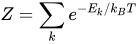
describes a system of fixed composition that is in thermal equilibrium with a heat bath of a precise temperature. The canonical ensemble contains states of varying energy but identical composition; the different states in the ensemble are accorded different probabilities depending on their total energy.
Grand canonical ensemble
describes a system with non-fixed composition (uncertain particle numbers) that is in thermal and chemical equilibrium with a thermodynamic reservoir. The reservoir has a precise temperature, and precise chemical potentials for various types of particle. The grand canonical ensemble contains states of varying energy and varying numbers of particles; the different states in the ensemble are accorded different probabilities depending on their total energy and total particle numbers.

For systems containing many particles (the thermodynamic limit), all three of the ensembles listed above tend to give identical behaviour. It is then simply a matter of mathematical convenience which ensemble is used. The Gibbs theorem about equivalence of ensembles was developed into the theory of concentration of measure phenomenon, which has applications in many areas of science, from functional analysis to methods of artificial intelligence and big data technology.

Important cases where the thermodynamic ensembles do not give identical results include:

  • Microscopic systems.
  • Large systems at a phase transition.
  • Large systems with long-range interactions.

In these cases the correct thermodynamic ensemble must be chosen as there are observable differences between these ensembles not just in the size of fluctuations, but also in average quantities such as the distribution of particles. The correct ensemble is that which corresponds to the way the system has been prepared and characterized—in other words, the ensemble that reflects the knowledge about that system.

Thermodynamic ensembles

Microcanonical Canonical Grand canonical
Fixed variables
Microscopic features Number of microstates Canonical partition function Grand partition function
Macroscopic function Boltzmann entropy Helmholtz free energy Grand potential

Calculation methods

Once the characteristic state function for an ensemble has been calculated for a given system, that system is 'solved' (macroscopic observables can be extracted from the characteristic state function). Calculating the characteristic state function of a thermodynamic ensemble is not necessarily a simple task, however, since it involves considering every possible state of the system. While some hypothetical systems have been exactly solved, the most general (and realistic) case is too complex for an exact solution. Various approaches exist to approximate the true ensemble and allow calculation of average quantities.

Exact

There are some cases which allow exact solutions.

  • For very small microscopic systems, the ensembles can be directly computed by simply enumerating over all possible states of the system (using exact diagonalization in quantum mechanics, or integral over all phase space in classical mechanics).
  • Some large systems consist of many separable microscopic systems, and each of the subsystems can be analysed independently. Notably, idealized gases of non-interacting particles have this property, allowing exact derivations of Maxwell–Boltzmann statistics, Fermi–Dirac statistics, and Bose–Einstein statistics.
  • A few large systems with interaction have been solved. By the use of subtle mathematical techniques, exact solutions have been found for a few toy models. Some examples include the Bethe ansatz, square-lattice Ising model in zero field, hard hexagon model.

Monte Carlo

Although some problems in statistical physics can be solved analytically using approximations and expansions, most current research utilizes the large processing power of modern computers to simulate or approximate solutions. A common approach to statistical problems is to use a Monte Carlo simulation to yield insight into the properties of a complex system. Monte Carlo methods are important in computational physics, physical chemistry, and related fields, and have diverse applications including medical physics, where they are used to model radiation transport for radiation dosimetry calculations.

The Monte Carlo method examines just a few of the possible states of the system, with the states chosen randomly (with a fair weight). As long as these states form a representative sample of the whole set of states of the system, the approximate characteristic function is obtained. As more and more random samples are included, the errors are reduced to an arbitrarily low level.

Other

  • For rarefied non-ideal gases, approaches such as the cluster expansion use perturbation theory to include the effect of weak interactions, leading to a virial expansion.
  • For dense fluids, another approximate approach is based on reduced distribution functions, in particular the radial distribution function.
  • Molecular dynamics computer simulations can be used to calculate microcanonical ensemble averages, in ergodic systems. With the inclusion of a connection to a stochastic heat bath, they can also model canonical and grand canonical conditions.
  • Mixed methods involving non-equilibrium statistical mechanical results (see below) may be useful.

Non-equilibrium statistical mechanics

Many physical phenomena involve quasi-thermodynamic processes out of equilibrium, for example:

All of these processes occur over time with characteristic rates. These rates are important in engineering. The field of non-equilibrium statistical mechanics is concerned with understanding these non-equilibrium processes at the microscopic level. (Statistical thermodynamics can only be used to calculate the final result, after the external imbalances have been removed and the ensemble has settled back down to equilibrium.)

In principle, non-equilibrium statistical mechanics could be mathematically exact: ensembles for an isolated system evolve over time according to deterministic equations such as Liouville's equation or its quantum equivalent, the von Neumann equation. These equations are the result of applying the mechanical equations of motion independently to each state in the ensemble. These ensemble evolution equations inherit much of the complexity of the underlying mechanical motion, and so exact solutions are very difficult to obtain. Moreover, the ensemble evolution equations are fully reversible and do not destroy information (the ensemble's Gibbs entropy is preserved). In order to make headway in modelling irreversible processes, it is necessary to consider additional factors besides probability and reversible mechanics.

Non-equilibrium mechanics is therefore an active area of theoretical research as the range of validity of these additional assumptions continues to be explored. A few approaches are described in the following subsections.

Stochastic methods

One approach to non-equilibrium statistical mechanics is to incorporate stochastic (random) behaviour into the system. Stochastic behaviour destroys information contained in the ensemble. While this is technically inaccurate (aside from hypothetical situations involving black holes, a system cannot in itself cause loss of information), the randomness is added to reflect that information of interest becomes converted over time into subtle correlations within the system, or to correlations between the system and environment. These correlations appear as chaotic or pseudorandom influences on the variables of interest. By replacing these correlations with randomness proper, the calculations can be made much easier.

  • Boltzmann transport equation: An early form of stochastic mechanics appeared even before the term "statistical mechanics" had been coined, in studies of kinetic theory. James Clerk Maxwell had demonstrated that molecular collisions would lead to apparently chaotic motion inside a gas. Ludwig Boltzmann subsequently showed that, by taking this molecular chaos for granted as a complete randomization, the motions of particles in a gas would follow a simple Boltzmann transport equation that would rapidly restore a gas to an equilibrium state (see H-theorem).

    The Boltzmann transport equation and related approaches are important tools in non-equilibrium statistical mechanics due to their extreme simplicity. These approximations work well in systems where the "interesting" information is immediately (after just one collision) scrambled up into subtle correlations, which essentially restricts them to rarefied gases. The Boltzmann transport equation has been found to be very useful in simulations of electron transport in lightly doped semiconductors (in transistors), where the electrons are indeed analogous to a rarefied gas.

    A quantum technique related in theme is the random phase approximation.
  • BBGKY hierarchy: In liquids and dense gases, it is not valid to immediately discard the correlations between particles after one collision. The BBGKY hierarchy (Bogoliubov–Born–Green–Kirkwood–Yvon hierarchy) gives a method for deriving Boltzmann-type equations but also extending them beyond the dilute gas case, to include correlations after a few collisions.
  • Keldysh formalism (a.k.a. NEGF—non-equilibrium Green functions): A quantum approach to including stochastic dynamics is found in the Keldysh formalism. This approach is often used in electronic quantum transport calculations.
  • Stochastic Liouville equation.

Near-equilibrium methods

Another important class of non-equilibrium statistical mechanical models deals with systems that are only very slightly perturbed from equilibrium. With very small perturbations, the response can be analysed in linear response theory. A remarkable result, as formalized by the fluctuation–dissipation theorem, is that the response of a system when near equilibrium is precisely related to the fluctuations that occur when the system is in total equilibrium. Essentially, a system that is slightly away from equilibrium—whether put there by external forces or by fluctuations—relaxes towards equilibrium in the same way, since the system cannot tell the difference or "know" how it came to be away from equilibrium.

This provides an indirect avenue for obtaining numbers such as ohmic conductivity and thermal conductivity by extracting results from equilibrium statistical mechanics. Since equilibrium statistical mechanics is mathematically well defined and (in some cases) more amenable for calculations, the fluctuation–dissipation connection can be a convenient shortcut for calculations in near-equilibrium statistical mechanics.

A few of the theoretical tools used to make this connection include:

Hybrid methods

An advanced approach uses a combination of stochastic methods and linear response theory. As an example, one approach to compute quantum coherence effects (weak localization, conductance fluctuations) in the conductance of an electronic system is the use of the Green–Kubo relations, with the inclusion of stochastic dephasing by interactions between various electrons by use of the Keldysh method.

Applications

The ensemble formalism can be used to analyze general mechanical systems with uncertainty in knowledge about the state of a system. Ensembles are also used in:

Statistical physics explains and quantitatively describes superconductivity, superfluidity, turbulence, collective phenomena in solids and plasma, and the structural features of liquid. It underlies the modern astrophysics and virial theorem. In solid state physics, statistical physics aids the study of liquid crystals, phase transitions, and critical phenomena. Many experimental studies of matter are entirely based on the statistical description of a system. These include the scattering of cold neutrons, X-ray, visible light, and more. Statistical physics also plays a role in materials science, nuclear physics, astrophysics, chemistry, biology and medicine (e.g. study of the spread of infectious diseases).

Analytical and computational techniques derived from statistical physics of disordered systems, can be extended to large-scale problems, including machine learning, e.g., to analyze the weight space of deep neural networks. Statistical physics is thus finding applications in the area of medical diagnostics.

Quantum statistical mechanics

Quantum statistical mechanics is statistical mechanics applied to quantum mechanical systems. In quantum mechanics, a statistical ensemble (probability distribution over possible quantum states) is described by a density operator S, which is a non-negative, self-adjoint, trace-class operator of trace 1 on the Hilbert space H describing the quantum system. This can be shown under various mathematical formalisms for quantum mechanics. One such formalism is provided by quantum logic.

Introduction to the mathematics of general relativity

From Wikipedia, the free encyclopedia

The mathematics of general relativity is complicated. In Newton's theories of motion, an object's length and the rate at which time passes remain constant while the object accelerates, meaning that many problems in Newtonian mechanics may be solved by algebra alone. In relativity, however, an object's length and the rate at which time passes both change appreciably as the object's speed approaches the speed of light, meaning that more variables and more complicated mathematics are required to calculate the object's motion. As a result, relativity requires the use of concepts such as vectors, tensors, pseudotensors and curvilinear coordinates.

For an introduction based on the example of particles following circular orbits about a large mass, nonrelativistic and relativistic treatments are given in, respectively, Newtonian motivations for general relativity and Theoretical motivation for general relativity.

Vectors and tensors

Vectors

Illustration of a typical vector

In mathematics, physics, and engineering, a Euclidean vector (sometimes called a geometric vector or spatial vector, or – as here – simply a vector) is a geometric object that has both a magnitude (or length) and direction. A vector is what is needed to "carry" the point A to the point B; the Latin word vector means "one who carries". The magnitude of the vector is the distance between the two points and the direction refers to the direction of displacement from A to B. Many algebraic operations on real numbers such as addition, subtraction, multiplication, and negation have close analogues for vectors, operations which obey the familiar algebraic laws of commutativity, associativity, and distributivity.

Tensors

Stress is a second-order tensor that represents the response of a material to force applied at an angle. The two directions of the tensor represent the "normal" (at right angles to the surface) force, and "shear" (parallel to the surface) force.

A tensor extends the concept of a vector to additional directions. A scalar, that is, a simple number without a direction, would be shown on a graph as a point, a zero-dimensional object. A vector, which has a magnitude and direction, would appear on a graph as a line, which is a one-dimensional object. A vector is a first-order tensor, since it holds one direction. A second-order tensor has two magnitudes and two directions, and would appear on a graph as two lines similar to the hands of a clock. The "order" of a tensor is the number of directions contained within, which is separate from the dimensions of the individual directions. A second-order tensor in two dimensions might be represented mathematically by a 2-by-2 matrix, and in three dimensions by a 3-by-3 matrix, but in both cases the matrix is "square" for a second-order tensor. A third-order tensor has three magnitudes and directions, and would be represented by a cube of numbers, 3-by-3-by-3 for directions in three dimensions, and so on.

Applications

Vectors are fundamental in the physical sciences. They can be used to represent any quantity that has both a magnitude and direction, such as velocity, the magnitude of which is speed. For example, the velocity 5 meters per second upward could be represented by the vector (0, 5) (in 2 dimensions with the positive y axis as 'up'). Another quantity represented by a vector is force, since it has a magnitude and direction. Vectors also describe many other physical quantities, such as displacement, acceleration, momentum, and angular momentum. Other physical vectors, such as the electric and magnetic field, are represented as a system of vectors at each point of a physical space; that is, a vector field.

Tensors also have extensive applications in physics:

Dimensions

In general relativity, four-dimensional vectors, or four-vectors, are required. These four dimensions are length, height, width and time. A "point" in this context would be an event, as it has both a location and a time. Similar to vectors, tensors in relativity require four dimensions. One example is the Riemann curvature tensor.

Coordinate transformation

In physics, as well as mathematics, a vector is often identified with a tuple, or list of numbers, which depend on a coordinate system or reference frame. If the coordinates are transformed, such as by rotation or stretching the coordinate system, the components of the vector also transform. The vector itself does not change, but the reference frame does. This means that the components of the vector have to change to compensate.

The vector is called covariant or contravariant depending on how the transformation of the vector's components is related to the transformation of coordinates.

  • Contravariant vectors have units of distance (such as a displacement) or distance times some other unit (such as velocity or acceleration) and transform in the opposite way as the coordinate system. For example, in changing units from meters to millimeters the coordinate units get smaller, but the numbers in a vector become larger: 1 m becomes 1000 mm.
  • Covariant vectors, on the other hand, have units of one-over-distance (as in a gradient) and transform in the same way as the coordinate system. For example, in changing from meters to millimeters, the coordinate units become smaller and the number measuring a gradient will also become smaller: 1 Kelvin per m becomes 0.001 Kelvin per mm.

In Einstein notation, contravariant vectors and components of tensors are shown with superscripts, e.g. xi, and covariant vectors and components of tensors with subscripts, e.g. xi. Indices are "raised" or "lowered" by multiplication by an appropriate matrix, often the identity matrix.

Coordinate transformation is important because relativity states that there is not one reference point (or perspective) in the universe that is more favored than another. On earth, we use dimensions like north, east, and elevation, which are used throughout the entire planet. There is no such system for space. Without a clear reference grid, it becomes more accurate to describe the four dimensions as towards/away, left/right, up/down and past/future. As an example event, assume that Earth is a motionless object, and consider the signing of the Declaration of Independence. To a modern observer on Mount Rainier looking east, the event is ahead, to the right, below, and in the past. However, to an observer in medieval England looking north, the event is behind, to the left, neither up nor down, and in the future. The event itself has not changed: the location of the observer has.

Oblique axes

An oblique coordinate system is one in which the axes are not necessarily orthogonal to each other; that is, they meet at angles other than right angles. When using coordinate transformations as described above, the new coordinate system will often appear to have oblique axes compared to the old system.

Nontensors

A nontensor is a tensor-like quantity that behaves like a tensor in the raising and lowering of indices, but that does not transform like a tensor under a coordinate transformation. For example, Christoffel symbols cannot be tensors themselves if the coordinates do not change in a linear way.

In general relativity, one cannot describe the energy and momentum of the gravitational field by an energy–momentum tensor. Instead, one introduces objects that behave as tensors only with respect to restricted coordinate transformations. Strictly speaking, such objects are not tensors at all. A famous example of such a pseudotensor is the Landau–Lifshitz pseudotensor.

Curvilinear coordinates and curved spacetime

High-precision test of general relativity by the Cassini space probe (artist's impression): radio signals sent between the Earth and the probe (green wave) are delayed by the warping of space and time (blue lines) due to the Sun's mass. That is, the Sun's mass causes the regular grid coordinate system (in blue) to distort and have curvature. The radio wave then follows this curvature and moves toward the Sun.

Curvilinear coordinates are coordinates in which the angles between axes can change from point to point. This means that rather than having a grid of straight lines, the grid instead has curvature.

A good example of this is the surface of the Earth. While maps frequently portray north, south, east and west as a simple square grid, that is not in fact the case. Instead, the longitude lines running north and south are curved and meet at the north pole. This is because the Earth is not flat, but instead round.

In general relativity, energy and mass have curvature effects on the four dimensions of the universe (= spacetime). This curvature gives rise to the gravitational force. A common analogy is placing a heavy object on a stretched out rubber sheet, causing the sheet to bend downward. This curves the coordinate system around the object, much like an object in the universe curves the coordinate system it sits in. The mathematics here are conceptually more complex than on Earth, as it results in four dimensions of curved coordinates instead of three as used to describe a curved 2D surface.

Parallel transport

Example: Parallel displacement along a circle of a three-dimensional ball embedded in two dimensions. The circle of radius r is embedded in a two-dimensional space characterized by the coordinates z1 and z2. The circle itself is characterized by coordinates y1 and y2 in the two-dimensional space. The circle itself is one-dimensional and can be characterized by its arc length x. The coordinate y is related to the coordinate x through the relation y1 = r cos x/r and y2 = r sin x/r. This gives y1/x = −sin x/r and y2/x = cos x/r In this case the metric is a scalar and is given by g = cos2 x/r + sin2 x/r = 1. The interval is then ds2 = g dx2 = dx2. The interval is just equal to the arc length as expected.

The interval in a high-dimensional space

In a Euclidean space, the separation between two points is measured by the distance between the two points. The distance is purely spatial, and is always positive. In spacetime, the separation between two events is measured by the invariant interval between the two events, which takes into account not only the spatial separation between the events, but also their separation in time. The interval, s2, between two events is defined as:

     (spacetime interval),

where c is the speed of light, and Δr and Δt denote differences of the space and time coordinates, respectively, between the events. The choice of signs for s2 above follows the space-like convention (−+++). A notation like Δr2 means r)2. The reason s2 and not s is called the interval is that s2 can be positive, zero or negative.

Spacetime intervals may be classified into three distinct types, based on whether the temporal separation (c2Δt2) or the spatial separation (Δr2) of the two events is greater: time-like, light-like or space-like.

Certain types of world lines are called geodesics of the spacetime – straight lines in the case of flat Minkowski spacetime and their closest equivalent in the curved spacetime of general relativity. In the case of purely time-like paths, geodesics are (locally) the paths of greatest separation (spacetime interval) as measured along the path between two events, whereas in Euclidean space and Riemannian manifolds, geodesics are paths of shortest distance between two points. The concept of geodesics becomes central in general relativity, since geodesic motion may be thought of as "pure motion" (inertial motion) in spacetime, that is, free from any external influences.

The covariant derivative

The covariant derivative is a generalization of the directional derivative from vector calculus. As with the directional derivative, the covariant derivative is a rule, which takes as its inputs: (1) a vector, u, (along which the derivative is taken) defined at a point P, and (2) a vector field, v, defined in a neighborhood of P. The output is a vector, also at the point P. The primary difference from the usual directional derivative is that the covariant derivative must, in a certain precise sense, be independent of the manner in which it is expressed in a coordinate system.

Parallel transport

Given the covariant derivative, one can define the parallel transport of a vector v at a point P along a curve γ starting at P. For each point x of γ, the parallel transport of v at x will be a function of x, and can be written as v(x), where v(0) = v. The function v is determined by the requirement that the covariant derivative of v(x) along γ is 0. This is similar to the fact that a constant function is one whose derivative is constantly 0.

Christoffel symbols

The equation for the covariant derivative can be written in terms of Christoffel symbols. The Christoffel symbols find frequent use in Einstein's theory of general relativity, where spacetime is represented by a curved 4-dimensional Lorentz manifold with a Levi-Civita connection. The Einstein field equations – which determine the geometry of spacetime in the presence of matter – contain the Ricci tensor. Since the Ricci tensor is derived from the Riemann curvature tensor, which can be written in terms of Christoffel symbols, a calculation of the Christoffel symbols is essential. Once the geometry is determined, the paths of particles and light beams are calculated by solving the geodesic equations in which the Christoffel symbols explicitly appear.

Geodesics

In general relativity, a geodesic generalizes the notion of a "straight line" to curved spacetime. Importantly, the world line of a particle free from all external, non-gravitational force, is a particular type of geodesic. In other words, a freely moving or falling particle always moves along a geodesic.

In general relativity, gravity can be regarded as not a force but a consequence of a curved spacetime geometry where the source of curvature is the stress–energy tensor (representing matter, for instance). Thus, for example, the path of a planet orbiting around a star is the projection of a geodesic of the curved 4-dimensional spacetime geometry around the star onto 3-dimensional space.

A curve is a geodesic if the tangent vector of the curve at any point is equal to the parallel transport of the tangent vector of the base point.

Curvature tensor

The Riemann curvature tensor Rρσμν tells us, mathematically, how much curvature there is in any given region of space. In flat space this tensor is zero.

Contracting the tensor produces 2 more mathematical objects:

  1. The Ricci tensor: Rσν, comes from the need in Einstein's theory for a curvature tensor with only 2 indices. It is obtained by averaging certain portions of the Riemann curvature tensor.
  2. The scalar curvature: R, the simplest measure of curvature, assigns a single scalar value to each point in a space. It is obtained by averaging the Ricci tensor.

The Riemann curvature tensor can be expressed in terms of the covariant derivative.

The Einstein tensor G is a rank-2 tensor defined over pseudo-Riemannian manifolds. In index-free notation it is defined as

where R is the Ricci tensor, g is the metric tensor and R is the scalar curvature. It is used in the Einstein field equations.

Stress–energy tensor

Contravariant components of the stress–energy tensor

The stress–energy tensor (sometimes stress–energy–momentum tensor or energy–momentum tensor) is a tensor quantity in physics that describes the density and flux of energy and momentum in spacetime, generalizing the stress tensor of Newtonian physics. It is an attribute of matter, radiation, and non-gravitational force fields. The stress–energy tensor is the source of the gravitational field in the Einstein field equations of general relativity, just as mass density is the source of such a field in Newtonian gravity. Because this tensor has 2 indices (see next section) the Riemann curvature tensor has to be contracted into the Ricci tensor, also with 2 indices.

Einstein equation

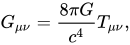
The Einstein field equations (EFE) or Einstein's equations are a set of 10 equations in Albert Einstein's general theory of relativity which describe the fundamental interaction of gravitation as a result of spacetime being curved by matter and energy. First published by Einstein in 1915 as a tensor equation, the EFE equate local spacetime curvature (expressed by the Einstein tensor) with the local energy and momentum within that spacetime (expressed by the stress–energy tensor).

The Einstein field equations can be written as

where Gμν is the Einstein tensor and Tμν is the stress–energy tensor.

This implies that the curvature of space (represented by the Einstein tensor) is directly connected to the presence of matter and energy (represented by the stress–energy tensor).

Schwarzschild solution and black holes

In Einstein's theory of general relativity, the Schwarzschild metric (also Schwarzschild vacuum or Schwarzschild solution), is a solution to the Einstein field equations which describes the gravitational field outside a spherical mass, on the assumption that the electric charge of the mass, the angular momentum of the mass, and the universal cosmological constant are all zero. The solution is a useful approximation for describing slowly rotating astronomical objects such as many stars and planets, including Earth and the Sun. The solution is named after Karl Schwarzschild, who first published the solution in 1916, just before his death.

According to Birkhoff's theorem, the Schwarzschild metric is the most general spherically symmetric, vacuum solution of the Einstein field equations. A Schwarzschild black hole or static black hole is a black hole that has no charge or angular momentum. A Schwarzschild black hole is described by the Schwarzschild metric, and cannot be distinguished from any other Schwarzschild black hole except by its mass.

Secular religion

From Wikipedia, the free encyclopedia

A secular religion is a communal belief system that often rejects or neglects the metaphysical aspects of the supernatural, commonly associated with traditional religion, instead placing typical religious qualities in earthly, or material, entities. Among systems that have been characterized as secular religions are anarchism, communism, fascism, Nazism, Juche, Maoism, Religion of Humanity, the cults of personality, the Cult of Reason and Cult of the Supreme Being.

Contemporary characterizations

The term secular religion is often applied today to communal belief systems—as for example with the view of love as the postmodern secular religion. Paul Vitz applied the term to modern psychology in as much as it fosters a cult of the self, explicitly calling "the self-theory ethic ... this secular religion". Sport has also been considered as a new secular religion, particularly with respect to Olympism. For Pierre de Coubertin, founder of the modern Olympic Games, belief in them as a new secular religion was explicit and lifelong.

Political religion

The theory of political religion concerns governmental ideologies whose cultural and political backing is so strong that they are said to attain power equivalent to those of a state religion, with which they often exhibit significant similarities in both theory and practice. In addition to basic forms of politics, like parliament and elections, it also holds an aspect of "sacralization" related to the institutions contained within the regime and also provides the inner measures traditionally considered to be religious territory, such as ethics, values, symbols, myths, rituals, archetypes and for example a national liturgical calendar.

Political religious organizations, such as the National Socialist and Communist Parties, adhered to the idealization of cultural and political power over the country at large. The church body of the state no longer held control over the practices of religious identity. Because of this, National Socialism was countered by many political and religious organizations as being a political religion, based on the dominance which the National Socialist regime had (Gates and Steane). Political religions generally vie with existing traditional religions, and may try to replace or eradicate them. The term was given new attention by the political scientist Hans Maier.

Totalitarian societies are perhaps more prone to political religion, but various scholars have described features of political religion even in democracies, for instance American civil religion as described by Robert Bellah in 1967.

The term is sometimes treated as synonymous with civil religion, but although some scholars use the terms equivalently, others see a useful distinction, using "civil religion" as something weaker, which functions more as a socially unifying and essentially conservative force, whereas a political religion is radically transformational, even apocalyptic.

Overview

The term political religion is based on the observation that sometimes political ideologies or political systems display features more commonly associated with religion. Scholars who have studied these phenomena include William Connolly in political science, Christoph Deutschmann in sociology, Emilio Gentile in history, Oliver O'Donovan in theology and others in psychology. A political religion often occupies the same ethical, psychological and sociological space as a traditional religion, and as a result it often displaces or co-opts existing religious organizations and beliefs. The most central marker of a political religion involves the sacralization of politics, for example an overwhelming religious feeling when serving one's country, or the devotion towards the Founding Fathers of the United States. Although a political religion may co-opt existing religious structures or symbolism, it does not itself have any independent spiritual or theocratic elements—it is essentially secular, using religious motifs and methods for political purposes, if it does not reject religious faith outright. Typically, a political religion is considered to be secular, but more radical forms of it are also transcendental.

Origin of the theory

The 18th-century philosopher Jean-Jacques Rousseau (1712–1778) argued that all societies need a religion to hold men together. Because Christianity tended to pull men away from earthly matters, Rousseau advocated a "civil religion" that would create the links necessary for political unity around the state. The Swiss Protestant theologian Adolf Keller (1872–1963) argued that Marxism in the Soviet Union had been transformed into a secular religion. Before emigrating to the United States, the German-born political philosopher Eric Voegelin wrote a book entitled The political religions. Other contributions on "political religion" (or associated terms such as "secular religion", "lay religion" or "public religion") were made by Luigi Sturzo (1871–1959), Paul Tillich (1886–1965), Gerhard Leibholz (1901–1982), Waldemar Gurian (1902–1954), Raymond Aron (1905–1983) and Walter Benjamin (1892–1940). Some saw such "religions" as a response to the existential void and nihilism caused by modernity, mass society and the rise of a bureaucratic state, and in political religions "the rebellion against the religion of God" reached its climax. They also described them as "pseudo-religions", "substitute religions", "surrogate religions", "religions manipulated by man" and "anti-religions". Yale political scientist Juan Linz and others have noted that the secularization of the twentieth century had created a void which could be filled by an ideology claiming a hold on ethical and identical matters as well, making the political religions based on totalitarianism, universalism and messianic missions (such as Manifest Destiny) possible.

Suppression of religious beliefs

Political religions sometimes compete with existing religions, and try, if possible, to replace or eradicate them. Loyalty to other entities, such as a church or a deity, are often viewed as interfering with loyalty to the political religion. The authority of religious leaders also presents a threat to the authority of the political religion. As a result, some or all religious sects may be suppressed or banned. An existing sect may be converted into a state religion, but dogma and personnel may be modified to suit the needs of the party or state.

Juan Linz has posited the friendly form of separation of church and state as the counterpole of political religion but describes the hostile form of separation of church and state as moving toward political religion as found in totalitarianism.

Absolute loyalty

Loyalty to the state or political party and acceptance of the government/party ideology are paramount. Dissenters may be expelled, ostracized, discriminated against, imprisoned, "re-educated", or killed. Loyalty oaths or membership in a dominant (or sole) political party may be required for employment, obtaining government services, or simply as routine. Criticism of the government may be a serious crime. Enforcement can range from ostracism by one's neighbours to execution. In a political religion, you are either with the system or against it.

Cult of personality

A political religion often elevates its leaders to near-godlike status. Displays of leaders in the form of posters or statues may be mandated in public areas and even private homes. Children may be required to learn the state's version of the leaders' biographies in school.

Myths of origin

Political religions often rely on a myth of origin that may have some historical basis but is usually idealized and sacralized. Current leaders may be venerated as descendants of the original fathers. There may also be holy places or shrines that relate to the myth of origin.

Historical cases

Revolutionary France

The Festival of the Supreme Being, by Pierre-Antoine Demachy

Revolutionary France was well noted for being the first state to reject religion altogether. Radicals intended to replace Christianity with a new state religion, or a deistic ideology. Maximilien Robespierre rejected atheistic ideologies and intended to create a new religion. Churches were closed, and Catholic Mass was forbidden. The Cult of the Supreme Being was well known for its derided festival, which led to the Thermidorian reaction and the fall of Robespierre.

Fascism

Italian fascism

According to Emilio Gentile, "Fascism was the first and prime instance of a modern political religion." "This religion sacralized the state and assigned it the primary educational task of transforming the mentality, the character, and the customs of Italians. The aim was to create a 'new man', a believer in and an observing member of the cult of Fascism."

"The argument [that fascism was a 'political religion'] tends to involve three main claims: I) that fascism was characterized by a religious form, particularly in terms of language and ritual; II) that fascism was a sacralized form of totalitarianism, which legitimized violence in defence of the nation and regeneration of a fascist 'new man'; and III) that fascism took on many of the functions of religion for a broad swathe of society."

Nazi Germany

"Among committed [Nazi] believers, a mythic world of eternally strong heroes, demons, fire and sword—in a word, the fantasy world of the nursery—displaced reality." Heinrich Himmler was fascinated by the occult, and sought to turn the SS into the basis of an official state cult.

Soviet Union

In 1936 a Protestant priest referred explicitly to communism as a new secular religion. A couple of years later, on the eve of World War II, F. A. Voigt characterised both Marxism and National Socialism as secular religions, akin at a fundamental level in their authoritarianism and messianic beliefs as well as in their eschatological view of human History. Both, he considered, were waging religious war against the liberal enquiring mind of the European heritage.

After the war, the social philosopher Raymond Aron would expand on the exploration of communism in terms of a secular religion; while A. J. P. Taylor, for example, would characterise it as "a great secular religion....the Communist Manifesto must be counted as a holy book in the same class as the Bible".

Klaus-Georg Riegel argued that "Lenin's utopian design of a revolutionary community of virtuosi as a typical political religion of an intelligentsia longing for an inner-worldly salvation, a socialist paradise without exploitation and alienation, to be implanted in the Russian backward society at the outskirts of the industrialised and modernised Western Europe."

Uses of open science

From Wikipedia, the free encyclopedia https://en.wikipedia.org/wiki/Uses_of_open_science   The op...