Fitting of a noisy curve by an asymmetrical peak model with parameters by mimimizing the sum of squared residuals at grid points , using the Gauss–Newton algorithm. Top: Raw data and model. Bottom: Evolution of the normalised sum of the squares of the errors.
The Gauss–Newton algorithm is used to solve non-linear least squares problems, which is equivalent to minimizing a sum of squared function values. It is an extension of Newton's method for finding a minimum of a non-linear function. Since a sum of squares must be nonnegative, the algorithm can be viewed as using Newton's method to iteratively approximate zeroes of the components of the sum, and thus minimizing the sum. In this sense, the algorithm is also an effective method for solving overdetermined systems of equations. It has the advantage that second derivatives, which can be challenging to compute, are not required.
Non-linear least squares problems arise, for instance, in non-linear regression, where parameters in a model are sought such that the model is in good agreement with available observations.
The method is named after the mathematicians Carl Friedrich Gauss and Isaac Newton, and first appeared in Gauss's 1809 work Theoria motus corporum coelestium in sectionibus conicis solem ambientum.
Description
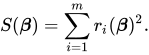
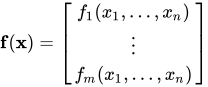
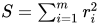
Given functions (often called residuals) of variables with the Gauss–Newton algorithm iteratively finds the value of that minimize the sum of squares[3]
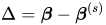
Starting with an initial guess for the minimum, the method proceeds by the iterations
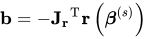
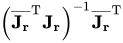
At each iteration, the update can be found by rearranging the previous equation in the following two steps:
With substitutions , , and , this turns into the conventional matrix equation of form , which can then be solved in a variety of methods (see Notes).
If m = n, the iteration simplifies to
which is a direct generalization of Newton's method in one dimension.
In data fitting, where the goal is to find the parameters such that a given model function best fits some data points , the functions are the residuals:
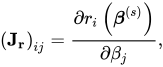
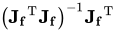
Then, the Gauss–Newton method can be expressed in terms of the Jacobian of the function as
The assumption m ≥ n in the algorithm statement is necessary, as otherwise the matrix is not invertible and the normal equations cannot be solved (at least uniquely).
The Gauss–Newton algorithm can be derived by linearly approximating the vector of functions ri. Using Taylor's theorem, we can write at every iteration:
with . The task of finding minimizing the sum of squares of the right-hand side; i.e.,
is a linear least-squares problem, which can be solved explicitly, yielding the normal equations in the algorithm.
The normal equations are n simultaneous linear equations in the unknown increments . They may be solved in one step, using Cholesky decomposition, or, better, the QR factorization of . For large systems, an iterative method, such as the conjugate gradient method, may be more efficient. If there is a linear dependence between columns of Jr, the iterations will fail, as becomes singular.
When is complex the conjugate form should be used: .
Example
Calculated curve obtained with and (in blue) versus the observed data (in red)
In this example, the Gauss–Newton algorithm will be used to fit a
model to some data by minimizing the sum of squares of errors between
the data and model's predictions.
In a biology experiment studying the relation between substrate concentration [S] and reaction rate in an enzyme-mediated reaction, the data in the following table were obtained.
i
1
2
3
4
5
6
7
[S]
0.038
0.194
0.425
0.626
1.253
2.500
3.740
Rate
0.050
0.127
0.094
0.2122
0.2729
0.2665
0.3317
It is desired to find a curve (model function) of the form
that fits best the data in the least-squares sense, with the parameters and to be determined.
Denote by and the values of [S] and rate respectively, with . Let and . We will find and such that the sum of squares of the residuals
is minimized.
The Jacobian of the vector of residuals with respect to the unknowns is a matrix with the -th row having the entries
Starting with the initial estimates of and , after five iterations of the Gauss–Newton algorithm, the optimal values and
are obtained. The sum of squares of residuals decreased from the
initial value of 1.445 to 0.00784 after the fifth iteration. The plot in
the figure on the right shows the curve determined by the model for the
optimal parameters with the observed data.
Convergence properties
The Gauss-Newton iteration is guaranteed to converge toward a local minimum point under 4 conditions: The functions are twice continuously differentiable in an open convex set , the Jacobian is of full column rank, the initial iterate is near , and the local minimum value is small. The convergence is quadratic if .
It can be shown that the increment Δ is a descent direction for S, and, if the algorithm converges, then the limit is a stationary point of S. For large minimum value , however, convergence is not guaranteed, not even local convergence as in Newton's method, or convergence under the usual Wolfe conditions.
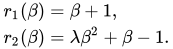
The rate of convergence of the Gauss–Newton algorithm can approach quadratic. The algorithm may converge slowly or not at all if the initial guess is far from the minimum or the matrix is ill-conditioned. For example, consider the problem with equations and variable, given by
For , is a local optimum. If ,
then the problem is in fact linear and the method finds the optimum in
one iteration. If |λ| < 1, then the method converges linearly and the
error decreases asymptotically with a factor |λ| at every iteration.
However, if |λ| > 1, then the method does not even converge locally.
Solving overdetermined systems of equations
The Gauss-Newton iteration
is an effective method for solving overdetermined systems of equations in the form of with
and where is the Moore-Penrose inverse (also known as pseudoinverse) of the Jacobian matrix of .
It can be considered an extension of Newton's method and enjoys the same local quadratic convergence toward isolated regular solutions.
If the solution doesn't exist but the initial iterate is near a point at which the sum of squares reaches a small local minimum, the Gauss-Newton iteration linearly converges to . The point is often called a least squares solution of the overdetermined system.
Derivation from Newton's method
In what follows, the Gauss–Newton algorithm will be derived from Newton's method
for function optimization via an approximation. As a consequence, the
rate of convergence of the Gauss–Newton algorithm can be quadratic under
certain regularity conditions. In general (under weaker conditions),
the convergence rate is linear.
The recurrence relation for Newton's method for minimizing a function S of parameters is
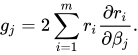
Elements of the Hessian are calculated by differentiating the gradient elements, , with respect to :
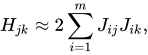
The Gauss–Newton method is obtained by ignoring the second-order
derivative terms (the second term in this expression). That is, the
Hessian is approximated by
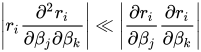
where are entries of the Jacobian Jr. Note that when the exact hessian is evaluated near an exact fit we have near-zero ,
so the second term becomes near-zero as well, which justifies the
approximation. The gradient and the approximate Hessian can be written
in matrix notation as
These expressions are substituted into the recurrence relation above to obtain the operational equations
Convergence of the Gauss–Newton method is not guaranteed in all instances. The approximation
that needs to hold to be able to ignore the second-order
derivative terms may be valid in two cases, for which convergence is to
be expected:
The function values are small in magnitude, at least around the minimum.
The functions are only "mildly" nonlinear, so that is relatively small in magnitude.
Improved versions
With the Gauss–Newton method the sum of squares of the residuals S may not decrease at every iteration. However, since Δ is a descent direction, unless is a stationary point, it holds that for all sufficiently small . Thus, if divergence occurs, one solution is to employ a fraction of the increment vector Δ in the updating formula:
In other words, the increment vector is too long, but it still
points "downhill", so going just a part of the way will decrease the
objective function S. An optimal value for can be found by using a line search algorithm, that is, the magnitude of is determined by finding the value that minimizes S, usually using a direct search method in the interval or a backtracking line search such as Armijo-line search. Typically, should be chosen such that it satisfies the Wolfe conditions or the Goldstein conditions.
In cases where the direction of the shift vector is such that the
optimal fraction α is close to zero, an alternative method for handling
divergence is the use of the Levenberg–Marquardt algorithm, a trust region method. The normal equations are modified in such a way that the increment vector is rotated towards the direction of steepest descent,
where D is a positive diagonal matrix. Note that when D is the identity matrix I and , then , therefore the direction of Δ approaches the direction of the negative gradient .
The so-called Marquardt parameter may also be optimized by a line search, but this is inefficient, as the shift vector must be recalculated every time
is changed. A more efficient strategy is this: When divergence occurs,
increase the Marquardt parameter until there is a decrease in S.
Then retain the value from one iteration to the next, but decrease it if
possible until a cut-off value is reached, when the Marquardt parameter
can be set to zero; the minimization of S then becomes a standard Gauss–Newton minimization.
Large-scale optimization
For large-scale optimization, the Gauss–Newton method is of special
interest because it is often (though certainly not always) true that the
matrix is more sparse than the approximate Hessian .
In such cases, the step calculation itself will typically need to be
done with an approximate iterative method appropriate for large and
sparse problems, such as the conjugate gradient method.
In order to make this kind of approach work, one needs at least an efficient method for computing the product
for some vector p. With sparse matrix storage, it is in general practical to store the rows of
in a compressed form (e.g., without zero entries), making a direct
computation of the above product tricky due to the transposition.
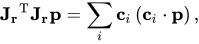
However, if one defines ci as row i of the matrix , the following simple relation holds:
so that every row contributes additively and independently to the
product. In addition to respecting a practical sparse storage
structure, this expression is well suited for parallel computations. Note that every row ci is the gradient of the corresponding residual ri; with this in mind, the formula above emphasizes the fact that residuals contribute to the problem independently of each other.
Related algorithms
In a quasi-Newton method, such as that due to Davidon, Fletcher and Powell or Broyden–Fletcher–Goldfarb–Shanno (BFGS method) an estimate of the full Hessian is built up numerically using first derivatives only so that after n
refinement cycles the method closely approximates to Newton's method in
performance. Note that quasi-Newton methods can minimize general
real-valued functions, whereas Gauss–Newton, Levenberg–Marquardt, etc.
fits only to nonlinear least-squares problems.
Another method for solving minimization problems using only first derivatives is gradient descent.
However, this method does not take into account the second derivatives
even approximately. Consequently, it is highly inefficient for many
functions, especially if the parameters have strong interactions.
Bioethics is both a field of study and professional practice, interested in ethical issues related to health (primarily focused on the human, but also increasingly includes animal ethics), including those emerging from advances in biology, medicine,
and technologies. It proposes the discussion about moral discernment in
society (what decisions are "good" or "bad" and why) and it is often
related to medical policy and practice, but also to broader questions as
environment, well-being and public health. Bioethics is concerned with the ethical questions that arise in the relationships among life sciences, biotechnology, medicine, politics, law, theology and philosophy. It includes the study of values relating to primary care, other branches of medicine ("the ethics of the ordinary"), ethical education in science, animal, and environmental ethics, and public health.
Etymology
The term bioethics (Greekbios, "life"; ethos, "moral nature, behavior") was coined in 1927 by Fritz Jahr in an article about a "bioethical imperative" regarding the use of animals and plants in scientific research. In 1970, the American biochemist and oncologistVan Rensselaer Potter used the term to describe the relationship between the biosphere and a growing human population. Potter's work laid the foundation for global ethics, a discipline centered around the link between biology, ecology, medicine, and human values. Sargent Shriver, the spouse of Eunice Kennedy Shriver,
claimed that he had invented the term "bioethics" in the living room of
his home in Bethesda, Maryland, in 1970. He stated that he thought of
the word after returning from a discussion earlier that evening at Georgetown University,
where he discussed with others a possible Kennedy family sponsorship of
an institute focused around the "application of moral philosophy to
concrete medical dilemmas".
Purpose and scope
The discipline of bioethics has addressed a wide swathe of human
inquiry; ranging from debates over the boundaries of lifestyles (e.g. abortion, euthanasia), surrogacy, the allocation of scarce health care resources (e.g. organ donation, health care rationing),
to the right to refuse medical care for religious or cultural reasons.
Bioethicists disagree among themselves over the precise limits of their
discipline, debating whether the field should concern itself with the
ethical evaluation of all questions involving biology and medicine, or
only a subset of these questions. Some bioethicists would narrow ethical evaluation only to the morality of medical treatments or technological
innovations, and the timing of medical treatment of humans. Others
would increase the scope of moral assessment to encompass the morality
of all moves that would possibly assist or damage organisms successful
of feeling fear.
The scope of bioethics has evolved past mere biotechnology to include topics such as cloning, gene therapy, life extension, human genetic engineering, astroethics and life in space, and manipulation of basic biology through altered DNA, XNA and proteins. These (and other) developments may affect future evolution and require
new principles that address life at its core, such as biotic ethics that
values life itself at its basic biological processes and structures,
and seeks their propagation. Moving beyond the biological, issues raised in public health such as vaccination and resource allocation have also encouraged the development of novel ethics frameworks to address such challenges. A study published in 2022 based on the
corpus of full papers from eight main bioethics journals demonstrated
the heterogeneity of this field by distinguishing 91 topics that have
been discussed in these journals over the past half a century.
One of the first areas addressed by modern bioethicists was human experimentation. According to the Declaration of Helsinki (1964) published by the World Medical Association,
the essential principles in medical research involving human subjects
are autonomy, beneficence, non-maleficence, and justice.
The autonomy of individuals to make decisions while assuming
responsibility for them and respecting the autonomy of others ought to
be respected. For people unable to exercise their autonomy, special
measures ought to be taken to protect their rights and interests.
In US, the National Commission for the Protection of Human Subjects of Biomedical and Behavioral Research
was initially established in 1974 to identify the basic ethical
principles that should underlie the conduct of biomedical and behavioral
research involving human subjects. However, the fundamental principles
announced in the Belmont Report (1979)—namely, respect for persons, beneficence and justice—have influenced the thinking of bioethicists across a wide range of issues. Others have added non-maleficence, human dignity,
and the sanctity of life to this list of cardinal values.
Overall, the Belmont Report has guided lookup in a course centered on
defending prone topics as properly as pushing for transparency between
the researcher and the subject. Research has flourished within the past
40 years and due to the advance in technology, it is thought that human
subjects have outgrown the Belmont Report, and the need for revision is
desired.
Another essential precept of bioethics is its placement of cost
on dialogue and presentation. Numerous dialogue based bioethics
organizations exist in universities throughout the United States to
champion precisely such goals. Examples include the Ohio State Bioethics
Society and the Bioethics Society of Cornell. Professional level versions of these organizations also exist.
Many bioethicists, in particular scientific scholars, accord the
easiest precedence to autonomy. They trust that every affected person
ought to decide which direction of motion they think about most in line
with their beliefs. In other words, the patient should always have the
freedom to choose their own treatment.
Medical ethics
Medical ethics is a utilized department of ethics that analyzes the
exercise of clinical medicinal drug and associated scientific research.
Medical ethics is based on a set of values. These values consist of the
appreciation for autonomy, beneficence, and justice.
Ethics affects medical decisions made by healthcare providers and patients. Medical ethics is the study of moral values and judgments as they apply to medicine.
The four main moral commitments are respect for autonomy, beneficence,
nonmaleficence, and justice. Using these four principles and thinking
about what the physicians' specific concern is for their scope of
practice can help physicians make moral decisions. As a scholarly discipline, medical ethics encompasses its practical
application in clinical settings as well as work on its history,
philosophy, theology, and sociology.
Medical ethics tends to be understood narrowly as applied
professional ethics; whereas bioethics has a more expansive application,
touching upon the philosophy of science and issues of biotechnology.
The two fields often overlap, and the distinction is more so a matter
of style than professional consensus. Medical ethics shares many
principles with other branches of healthcare ethics, such as nursing ethics.
A bioethicist assists the health care and research community in
examining moral issues involved in our understanding of life and death,
and resolving ethical dilemmas in medicine and science. Examples of this
would be the topic of equality in medicine, the intersection of
cultural practices and medical care, ethical distribution of healthcare
resources in pandemics, and issues of bioterrorism.
Medical ethical concerns frequently touch on matters of life and
death. Patient rights, informed consent, confidentiality, competency,
advance directives, carelessness, and many other topics are highlighted
as serious health concerns.
The proper actions to take in light of all the circumstances are
what ethics is all about. It discusses the difference between what is
proper and wrong at a certain moment and a particular society. Medical
ethics is concerned with the duties that doctors, hospitals, and other
healthcare providers have to patients, society, and other health
professionals.
The health profession has a set of ethical standards that are
relevant to various organizations of health workers and medical
facilities. Ethics are never stagnant and always relevant. What is seen
as acceptable ethics now may not be so one hundred years ago. The
hospital administrator is required to have a thorough awareness of their
moral and legal obligations.
Medical sociology
The practice of bioethics in clinical care have been studied by medical sociology. Many scholars consider that bioethics arose in response to a perceived lack of accountability in medical care in the 1970s.
Studying the clinical practice of ethics in medical care, Hauschildt
and Vries found that ethical questions were often reframed as clinical
judgments to allow clinicians to make decisions. Ethicists most often
put key decisions in the hands of physicians rather than patients.
Communication strategies suggested by ethicists act to decrease
patient autonomy. Examples include, clinicians discussing treatment
options with one another prior to talking to patients or their family to
present a united front limited patient autonomy, hiding uncertainty
amongst clinicians. Decisions about overarching goals of treatment were
reframed as technical matters excluding patients and their families.
Palliative care experts were used as intermediaries to guide patients
towards less invasive end-of-live treatment. In their study, Hauschild and Vries found that 76% of ethical consultants were trained as clinicians.
Studying informed consent,
Corrigan found that some social processes resulted in limitations to
patients choice, but also at times patients could find questions
regarding consent to medical trials burdensome.
The most prevalent subject is how social stratification (based on
SES, gender, class, ethnicity, and age) affects patterns of behavior
related to health and sickness, illness risk, disability, and other
outcomes related to health care. The study of health care organization
and provision, which encompasses the evolving organizational structures
of health care organizations and the social psychology of health and
health care, is another important approach. These latter research cover
topics including connections between doctors and patients, coping
mechanisms, and social support. The description of other important
fields of medical sociology study emphasizes how theory and research
have changed in the twenty-first century.
Many religious communities have their histories of inquiry into bioethical issues and have developed rules and guidelines on how to deal with these issues from within the viewpoint of their respective faiths. The Jewish, Christian and Muslim faiths have each developed a considerable body of literature on these matters. In the case of many non-Western cultures, a strict separation of
religion from philosophy does not exist. In many Asian cultures, for
example, there is a lively discussion on bioethical issues. Buddhist
bioethics, in general, is characterized by a naturalistic outlook that
leads to a rationalistic, pragmatic approach. Buddhist bioethicists include Damien Keown. In India, Vandana Shiva is a leading bioethicist speaking from the Hindu tradition.
In Africa, and partly also in Latin America, the debate on
bioethics frequently focuses on its practical relevance in the context
of underdevelopment and geopolitical power relations. In Africa, their bioethical approach is influenced by and similar to
Western bioethics due to the colonization of many African countries. Some African bioethicists are calling for a shift in bioethics that
utilizes indigenous African philosophy rather than western philosophy.
Some African bioethicists also believe that Africans will be more likely
to accept a bioethical approach grounded in their own culture, as well
as empower African people.
Masahiro Morioka
argues that in Japan the bioethics movement was first launched by
disability activists and feminists in the early 1970s, while academic
bioethics began in the mid-1980s. During this period, unique
philosophical discussions on brain death and disability appeared both in
the academy and journalism. In Chinese culture and bioethics, there is not as much of an emphasis
on autonomy as opposed to the heavy emphasis placed on autonomy in
Western bioethics. Community, social values, and family are all heavily
valued in Chinese culture, and contribute to the lack of emphasis on
autonomy in Chinese bioethics. The Chinese believe that the family,
community, and individual are all interdependent of each other, so it is
common for the family unit to collectively make decisions regarding
healthcare and medical decisions for a loved one, instead of an
individual making an independent decision for his or her self.
Some argue that spirituality
and understanding one another as spiritual beings and moral agents is
an important aspect of bioethics, and that spirituality and bioethics
are heavily intertwined with one another. As a healthcare provider, it
is important to know and understand varying world views and religious
beliefs. Having this knowledge and understanding can empower healthcare
providers with the ability to better treat and serve their patients.
Developing a connection and understanding of a patient's moral agent
helps enhance the care provided to the patient. Without this connection
or understanding, patients can be at risk of becoming "faceless units of
work" and being looked at as a "set of medical conditions" as opposed
to the storied and spiritual beings that they are.
Islamic bioethics
Bioethics in the realm of Islam differs from Western bioethics, but
they share some similar perspectives viewpoints as well. Western
bioethics is focused on rights, especially individual rights. Islamic
bioethics focuses more on religious duties and obligations, such as
seeking treatment and preserving life. Islamic bioethics is heavily influenced and connected to the teachings of the Qur'an as well as the teachings of Muhammad.
These influences essentially make it an extension of Shariah or Islamic
Law. In Islamic bioethics, passages from the Qur'an are often used to
validate various medical practices. For example, a passage from the
Qur'an states "whosoever killeth a human being ... it shall be as if he
had killed all humankind, and whosoever saveth the life of one, it shall
be as if he saved the life of all humankind." This excerpt can be used
to encourage using medicine and medical practices to save lives, but can
also be looked at as a protest against euthanasia and assisted suicide.
A high value and worth are placed on human life in Islam, and in turn,
human life is deeply valued in the practice of Islamic bioethics as
well. Muslims believe all human life, even one of poor quality, needs to
be given appreciation and must be cared for and conserved.
The Islamic education on sensible problems associated to
existence in normal and human lifestyles in unique can be sought in
Islamic bioethics. As we will see later, due to the fact of
interconnectedness of the Islamic regulation and the Islamic ethics, the
Islamic bioethics has to reflect on consideration on necessities of the
Islamic regulation (Shari‘ah) in addition to ethical considerations.
To react to new technological and medical advancements, informed
Islamic jurists regularly will hold conferences to discuss new
bioethical issues and come to an agreement on where they stand on the
issue from an Islamic perspective. This allows Islamic bioethics to stay
pliable and responsive to new advancements in medicine. The standpoints taken by Islamic jurists on bioethical issues are not
always unanimous decisions and at times may differ. There is much
diversity among Muslims varying from country to country, and the
different degrees to which they adhere by Shariah. Differences and disagreements in regards to jurisprudence, theology,
and ethics between the two main branches of Islam, Sunni, and Shia, lead
to differences in the methods and ways in which Islamic bioethics is
practiced throughout the Islamic world. An area where there is a lack of consensus is brain death. The
Organization of Islamic Conferences Islamic Fiqh Academy (OIC-IFA) holds
the view that brain death is equivalent to cardiopulmonary death, and
acknowledges brain death in an individual as the individual being
deceased. On the contrary, the Islamic Organization of Medical Sciences
(IOMS) states that brain death is an "intermediate state between life
and death" and does not acknowledge a brain dead individual as being
deceased.
Islamic bioethicists look to the Qur'an and religious leaders
regarding their outlook on reproduction and abortion. It is firmly
believed that the reproduction of a human child can only be proper and
legitimate via marriage. This does not mean that a child can only be
reproduced via sexual intercourse between a married couple, but that the
only proper and legitimate way to have a child is when it is an act
between husband and wife. It is okay for a married couple to have a
child artificially and from techniques using modern biotechnology as
opposed to sexual intercourse, but to do this out of the context of
marriage would be deemed immoral.
Islamic bioethics is strongly against abortion and strictly
prohibits it. The IOMS states that "from the moment a zygote settles
inside a woman's body, it deserves a unanimously recognized degree of
respect." Abortion may only be permitted in unique situations where it
is considered to be the "lesser evil".
Islamic bioethics must take into account both moral concerns and
the requirements of the Islamic law (Shari'ah) due to the
interdependence of Islamic law and Islamic ethics. In order to avoid
making a mistake, everything must be thoroughly examined, first against
moral criteria and then against legal ones.
Despite the fact that Islamic law and morality are completely in
agreement with one another, they may have distinct prescriptions because
of their diverse ends and objectives. One distinction, for instance, is
that Islamic ethics seeks to teach those with higher desires how to
become more perfect and closer to God, but Islamic law seeks to decrease
criteria for perfection or pleasure in both realms that are doable for
the average or even lower than average. However, there may be situations
where something is not against Islamic law but is nonetheless condemned
by Islamic ethics. Or there can be circumstances that, while not
required by Islamic law, are essential from an ethical standpoint. For
instance, while idle conversation is not strictly forbidden by Islamic
law, it is morally unacceptable since it wastes time and is detrimental
to one's spiritual growth.
Islamic bioethics' first influences Islamic bioethics is founded
on the Qur'an, the Sunnah, and reason (al-'aql), much like any other
inquiry into Islam. Sunni Muslims may use terms like ijmaa' (consensus)
and qiyas in place of reason (analogy). Ijmaa' and qiyas as such are not
recognized by Shi'a since they are insufficient proofs on their own.
Christian bioethics
In Christian bioethics it is noted that the Bible, especially the New Testament, teaches about healing by faith. Healing in the Bible is often associated with the ministry of specific individuals including Elijah, Jesus and Paul. Being healed has been described as a privilege of accepting Christ's redemption on the cross. Jesus endorsed the use of the medical assistance of the time (medicines of oil and wine).
The principle of the sacredness of human life is at the basis of Catholic bioethics. On the subject of abortion, for example, Catholics and Orthodox are on very similar positions. Catholic bioethics insists on this concept, without exception, while Anglicans, Waldensians and Lutherans have positions closer to secular ones, for example with regard to the end of life.
In 1936, Ludwig Bieler argued that Jesus was stylized in the New Testament in the image of the "divine man" (Greek: theios aner),
which was widespread in antiquity. It is said that many of the famous
rulers and elders of the time had divine healing powers.
Contemporary bioethical and health care policy issues, including
abortion, the distribution of limited resources, the nature of
appropriate hospital chaplaincy, fetal experimentation, the use of fetal
tissue in treatment, genetic engineering, the use of critical care
units, distinctions between ordinary and extraordinary treatment,
euthanasia, free and informed consent, competency determinations, the
meaning of life, are being examined within the framework of traditional
Christian moral commitments.
Feminist bioethics
Feminist bioethics
critiques the fields of bioethics and medicine for its lack of
inclusion of women's and other marginalized group's perspectives. This lack of perspective from women is thought to create power imbalances that favor men. These power imbalances are theorized to be created from the androcentric nature of medicine. One example of a lack of consideration of women is in clinical drug
trials that exclude women due to hormonal fluctuations and possible
future birth defects. This has led to a gap in the research on how pharmaceuticals can affect women. Feminist bioethicists call for the necessity of feminist approaches to
bioethics because the lack of diverse perspectives in bioethics and
medicine can cause preventable harm to already vulnerable groups.
This study first gained prevalence in the field of reproductive medicine as it was viewed as a "woman's issue". Since then, feminist approaches to bioethics has expanded to include bioethical topics in mental health, disability advocacy, healthcare accessibility, and pharmaceuticals. Lindemann notes the need for the future agenda of feminist approaches
to bioethics to expand further to include healthcare organizational
ethics, genetics, stem cell research, and more.
Notable figures in feminist bioethics include Carol Gilligan, Susan Sherwin, and the creators of the International Journal of Feminist Approaches to Bioethics, Mary C. Rawlinson and Anne Donchin. Sherwin's book No Longer Patient: Feminist Ethics in Health Care
(1992) is credited with being one of the first full-length books
published on the topic of feminist bioethics and points out the
shortcomings in then-current bioethical theories. Sherwin's viewpoint incorporates models of oppression within healthcare
that intend to further marginalize women, people of color, immigrants,
and people with disabilities. Since created in 1992, the International Journal of Feminist Approaches to Bioethics has done much work to legitimize feminist work and theory in bioethics.
In 2001, American professor Mary C. Rawlinson published The Concept of A Feminist Bioethics,
an article criticizing traditional male-centric views on ethics.
Rawlinson points out that traditional philosophical thought centralizes
men and leaves women as an "other" or an accessory to men. As a result,
the philosophy of "feminist bioethics" contradicts bioethics because
women's rights are seen as a separate order from human rights. Finally,
Rawlinson makes several recommendations for how women's experiences and
bodies could reshape fundamental ethical principles, including
acceptance, mutual respect, and the establishment of bodily autonomy for
women.
Environmental bioethics
Bioethics, the ethics of the life sciences in general, expanded from
the encounter between experts in medicine and the laity, to include
organizational and social ethics, environmental ethics. As of 2019 textbooks of green bioethics existed.Particular
emphasis on responsibility toward ecosystems, including resource
conservation, environmental protection, and considerations of
intergenerational justice.
Animal bioethics is the study of animal-human dynamics, and how animals should be treated by humans. In a scientific framework, ethical issues of consideration include animal testing and eponymous taxonomy (the ethics of naming species after people). Biologists W. M. S. Russell and R. L. Burch developed the “3 R’s”,
a set of 3 guidelines outlining recommended procedures to promote
animal respect and reduce the amount of animals used in scientific
research. They include determining alternatives to animal use
(replacement), minimizing the number of animals used (reduction), and
mitigating animal suffering if they are used in research (refinement).
Eponymous taxonomy
Taxonomy is the classification of animals in biological disciplines. Some species such as Aleiodesgaga are named after real people, which can be controversial, as in the case of Anophthalmus hitleri, a species of beetle hunted to endangerment by Nazi memorabilia collectors. Critics of eponymic naming conventions such as Guedes et. al argue that
eponymous taxonomy is a form of scientific colonization because
scientists from colonizing nations often had a stake in naming species
native to countries in the Global South. Supporters of eponymous taxa argue that “famous” taxonomies are
important for conservation efforts, as species of interest would be
brought to public attention.
Ethical issues in gene therapy
Gene therapy involves ethics, because scientists are making changes to genes, the building blocks of the human body. Currently, therapeutic gene therapy is available to treat specific
genetic disorders by editing cells in specific body parts. For example,
gene therapy can treat hematopoietic disease. There is also a controversial gene therapy called "germline gene
therapy", in which genes in a sperm or egg can be edited to prevent
genetic disorder in the future generation.
It is unknown how this type of gene therapy affects long-term human
development. In the United States, federal funding cannot be used to
research germline gene therapy.
The ethical challenges in gene therapy for rare childhood
diseases underscore the complexity of initiating trials, determining
dosage levels, and involving affected families. With over a third of
gene therapies targeting rare, genetic, pediatric-onset, and
life-limiting diseases, fair participant selection and transparent
engagement with patient communities become crucial ethical
considerations. Another concern involves the use of virus-derived vectors for gene
transfer, raising safety and hereditary implications. Additionally, the
ethical dilemma in gene therapy explores the potential harms of human
enhancement, particularly regarding the birth of disabled individuals. Addressing these challenges is vital for responsible development,
application, and equitable access to gene therapies. The experience with
human growth hormone further illustrates the blurred lines between
therapy and enhancement, emphasizing the importance of ethical
considerations in balancing therapeutic benefits and potential
enhancements, especially in the rapidly advancing field of genomic
medicine. As gene therapies progress towards FDA approval, collaboration with
clinical genetics providers becomes essential to navigate the ethical
complexities of this new era in medicine.
Professional practice
Bioethics as a subject of expert exercise (although now not a formal
profession) developed at the beginning in North America in the Nineteen
Eighties and Nineteen Nineties, in the areas of clinical / medical ethics and research ethics.
Slowly internationalizing as a field, since the 2000s professional
bioethics has expanded to include other specialties, such as organizational ethics in health systems, public health ethics, and more recently Ethics of artificial intelligence. Professional ethicists may be called consultants, ethicists, coordinators, or even analysts;
and they may work in healthcare organizations, government agencies, and
in both the public and private sectors. They may also be full-time
employees, unbiased consultants, or have cross-appointments with
educational institutions, such as lookup centres or universities.
Models of bioethics
American ethicists Tom Beauchamp and James Childress developed Principles of Biomedical Ethics, a set of four principles that include autonomy, nonmaleficence (avoiding harm), beneficence (doing good), and justice. Today, the four principles are used by bioethicists to assess ethical
considerations such as childhood vaccinations and patient autonomy. One facet of the principles that Beauchamp and Childress defend is the
idea that a set of universal morals can be created and applied to a
given situation. Critics of this philosophy argue that it is not
possible to assign universal morality to social values.
According to Ihor Boyko's book "Bioethics", there are three models of bioethics in the world:
Model 1 is "liberal" when there are no restrictions.
Model 2 is "utilitarian", when what is prohibited is allowed for one
person or a group of persons, if it is useful and beneficial for the
majority of people.
Model 3 is "personalistic", where the human person is considered an inviolable integrity.
Learned societies and professional associations
The field of bioethics has developed national and international learned societies and professional associations, such as the American Society for Bioethics and Humanities, the Canadian Bioethics Society, the Canadian Association of Research Ethics Boards, the Association of Bioethics Program Directors, the Bangladesh Bioethics Society and the International Association of Bioethics.
Education
Bioethics is taught in courses at the undergraduate and graduate
level in different academic disciplines or programs, such as Philosophy,
Medicine, Law, Social Sciences. It has become a requirement for professional accreditation in many health professional programs (Medicine, Nursing, Rehabilitation), to have obligatory training in ethics (e.g., professional ethics, medical ethics, clinical ethics, nursing ethics). Interest in the field and professional opportunities have led to the development of dedicated programs with concentrations in Bioethics, largely in the United States, Canada (List of Canadian bioethics programs) and Europe, offering undergraduate majors/minors, graduate certificates, and master's and doctoral degrees.
Training in bioethics (usually clinical, medical, or professional ethics) are part of core competency requirements for health professionals in fields such as nursing, medicine or rehabilitation.
For example, every medical school in Canada teaches bioethics so that
students can gain an understanding of biomedical ethics and use the
knowledge gained in their future careers to provide better patient care.
Canadian residency training programs are required to teach bioethics as
it is one of the conditions of accreditation, and is a requirement by
the College of Family Physicians of Canada and by the Royal College of Physicians and Surgeons of Canada.
Criticism
As a field of study, bioethics has also drawn criticism. For instance, Paul Farmer
noted that bioethics tends to focus its attention on problems that
arise from "too much care" for patients in industrialized nations while
giving little or no attention to the ethical problem of too little care
for the poor.
Farmer characterizes the bioethics of handling morally difficult
clinical situations, normally in hospitals in industrialized countries,
as "quandary ethics".
He does not regard quandary ethics and clinical bioethics as
unimportant; he argues, rather, that bioethics must be balanced and give
due weight to the poor.
Additionally, bioethics has been condemned for its lack of
diversity in thought, particularly concerning race. Even as the field
has grown to include the areas of public opinion, policymaking,
and medical decision-making, little to no academic writing has been
authored concerning the intersection between race–especially the
cultural values imbued in that construct–and bioethical literature. John
Hoberman illustrates this in a 2016 critique, in which he points out
that bioethicists have been traditionally resistant to expanding their
discourse to include sociological and historically relevant
applications. Central to this is the notion of white normativity, which establishes the dominance of white hegemonic structures in bioethical academia and tends to reinforce existing biases.
These points and critiques, along with the neglect of women's
perspectives within bioethics, have also been discussed amongst feminist
bioethical scholars.
However, differing views on bioethics' lack of diversity of
thought and social inclusivity have also been advanced. For example, one
historian has argued that the diversity of thought and social
inclusivity are the two essential cornerstones of bioethics, albeit they
have not been fully realized.
In order to practice critical bioethics, bioethicists must base
their investigations in empirical research, refute ideas with facts,
engage in self-reflection, and be skeptical of the assertions made by
other bioethicists, scientists, and doctors. A thorough normative study
of actual moral experience is what is intended.
Issues
Research in bioethics is conducted by a broad and interdisciplinary
community of scholars, and is not restricted only to those researchers
who define themselves as "bioethicists": it includes researchers from
the humanities, social sciences, health sciences and health professions,
law, the fundamental sciences, etc. These researchers may be working in
specialized bioethics centers and institutes
associated with university bioethics training programs; but they may
also be based in disciplinary departments without a specific bioethics
focus. Notable examples of research centers include, amongst others, The Hastings Center, the Kennedy Institute of Ethics, the Yale Interdisciplinary Center for Bioethics, the Centre for Human Bioethics.
Areas of bioethics research that are the subject of published, peer-reviewed bioethical analysis include:
Simulated electron localization function (ELF) map of a furan (C₄H₄O) molecule.
Colour indicates the magnitude of the ELF field, which reflects the
degree of electron localisation at each point in the molecular plane.
Quantum chemistry, also called molecular quantum mechanics, is a branch of physical chemistry focused on the application of quantum mechanics
to chemical systems, particularly towards the quantum-mechanical
calculation of electronic contributions to physical and chemical
properties of molecules, materials, and solutions at the atomic level. These calculations include systematically applied approximations
intended to make calculations computationally feasible while still
capturing as much information about important contributions to the
computed wave functions as well as to observable properties such as structures, spectra, and thermodynamic properties. Quantum chemistry is also concerned with the computation of quantum effects on molecular dynamics and chemical kinetics.
Understanding electronic structure and molecular dynamics through the development of computational solutions to the Schrödinger equation
is a central goal of quantum chemistry. Progress in the field depends
on overcoming several challenges, including the need to increase the
accuracy of the results for small molecular systems, and to also
increase the size of large molecules that can be realistically subjected
to computation, which is limited by scaling considerations — the
computation time increases as a power of the number of atoms.
History
Some view the birth of quantum chemistry as starting with the discovery of the Schrödinger equation and its application to the hydrogen atom. However, a 1927 article of Walter Heitler (1904–1981) and Fritz London, is often recognized as the first milestone in the history of quantum chemistry. This was the first application of quantum mechanics to the diatomic hydrogen molecule, and thus to the phenomenon of the chemical bond. However, prior to this a critical conceptual framework was provided by Gilbert N. Lewis in his 1916 paper The Atom and the Molecule, wherein Lewis developed the first working model of valence electrons. Important contributions were also made by Yoshikatsu Sugiura and S.C. Wang. A series of articles by Linus Pauling, written throughout the 1930s, integrated the work of Heitler, London, Sugiura, Wang, Lewis, and John C. Slater on the concept of valence and its quantum-mechanical basis into a new theoretical framework. Many chemists were introduced to the field of quantum chemistry by Pauling's 1939 text The Nature of the Chemical Bond and the Structure of Molecules and Crystals: An Introduction to Modern Structural Chemistry, wherein he summarized this work (referred to widely now as valence bond theory) and explained quantum mechanics in a way which could be followed by chemists. The text soon became a standard text at many universities. In 1937, Hans Hellmann appears to have been the first to publish a book on quantum chemistry, in the Russian and German languages.
The electronic structure of an atom or molecule is the quantum state of its electrons. The first step in solving a quantum chemical problem is usually solving the Schrödinger equation (or Dirac equation in relativistic quantum chemistry) with the electronic molecular Hamiltonian,
usually making use of the Born–Oppenheimer (B–O) approximation. This is
called determining the electronic structure of the molecule. An exact solution for the non-relativistic Schrödinger equation can
only be obtained for the hydrogen atom (though exact solutions for the
bound state energies of the hydrogen molecular ion within the B-O approximation have been identified in terms of the generalized Lambert W function).
Since all other atomic and molecular systems involve the motions of
three or more "particles", their Schrödinger equations cannot be solved
analytically and so approximate and/or computational solutions must be
sought. The process of seeking computational solutions to these problems
is part of the field known as computational chemistry.
As mentioned above, Heitler and London's method was extended by
Slater and Pauling to become the valence-bond (VB) method. In this
method, attention is primarily devoted to the pairwise interactions
between atoms, and this method therefore correlates closely with
classical chemists' drawings of bonds.
It focuses on how the atomic orbitals of an atom combine to give
individual chemical bonds when a molecule is formed, incorporating the
two key concepts of orbital hybridization and resonance.
A covalent bond is formed when there is an overlap of half-filled
atomic orbitals from two atoms, which together form an electron pair.
The strength and energy of the system is dependent on the amount of
overlap. As the atoms move together, their orbitals start to overlap and
the electrons begin to feel the attraction of both nuclei. There is
also a repulsion that begins to occur, which becomes very strong when
the atoms are too close together. The ideal and most stable length
between the two atoms is the bond distance, which is when the repulsive
and attractive forces balance resulting in the lowest energy
configuration.
Orientation of the orbitals can have a large affect on what bonds
are formed, including if any is formed. When there is a direct overlap
of one atomic orbital from each atom, a sigma (σ) bond is formed. This
can be created from two s-orbitals, an s-orbital and a p-orbital, or two
p-orbitals. A pi (π) bond is formed from a side-to-side overlap of two
p-orbitals. The pi bond only forms if the phases of the overlapping
p-orbitals are the same.
An alternative approach to valence bond theory was developed in 1929 by Friedrich Hund and Robert S. Mulliken, in which electrons are described by mathematical functions delocalized over an entire molecule. The Hund–Mulliken approach or molecular orbital (MO) method is less intuitive to chemists but predicts spectroscopic properties
better than the VB method. As opposed to VB theory, MO theory does not
focus just the overlap of electron density in one area causing a bond
but instead describes the whole molecule as one system. This leads to a
more complex understanding of the system. This approach is the
conceptual basis of the Hartree–Fock method and further post-Hartree–Fock methods.
MO calculations result in orbitals or wavefunctions and energies
for a molecule, which can be filled with electrons from two different
atomic orbitals. These atomic orbitals come from separate atoms
resulting in molecular orbitals being linear combinations of atomic
orbitals.
The Thomas–Fermi model was developed independently by Thomas and Fermi in 1927. This was the first attempt to describe many-electron systems on the basis of electronic density instead of wave functions,
although it was not very successful in the treatment of entire
molecules. The method did provide the basis for what is now known as
density functional theory (DFT). Modern day DFT uses the Kohn–Sham method,
where the density functional is split into four terms; the Kohn–Sham
kinetic energy, an external potential, exchange and correlation
energies. A large part of the focus on developing DFT is on improving
the exchange and correlation terms. Though this method is less developed
than post Hartree–Fock methods, its significantly lower computational
requirements (scaling typically no worse than n3 with respect to n basis functions, for the pure functionals) allow it to tackle larger polyatomic molecules and even macromolecules. This computational affordability and often comparable accuracy to MP2 and CCSD(T) (post-Hartree–Fock methods) has made it one of the most popular methods in computational chemistry.
Chemical dynamics
A further step can consist of solving the Schrödinger equation with the total molecular Hamiltonian in order to study the motion of molecules. Direct solution of the Schrödinger equation is called quantum dynamics, whereas its solution within the semiclassical approximation is called semiclassical dynamics. Purely classical simulations of molecular motion are referred to as molecular dynamics (MD). Another approach to dynamics is a hybrid framework known as mixed quantum-classical dynamics; yet another hybrid framework uses the Feynman path integral formulation to add quantum corrections to molecular dynamics, which is called path integral molecular dynamics. Statistical approaches, using for example classical and quantum Monte Carlo methods, are also possible and are particularly useful for describing equilibrium distributions of states.
In adiabatic dynamics, interatomic interactions are represented by single scalarpotentials called potential energy surfaces. This is the Born–Oppenheimer approximation introduced by Born and Oppenheimer
in 1927. Pioneering applications of this in chemistry were performed by
Rice and Ramsperger in 1927 and Kassel in 1928, and generalized into
the RRKM theory in 1952 by Marcus who took the transition state theory developed by Eyring in 1935 into account. These methods enable simple estimates of unimolecular reaction rates from a few characteristics of the potential surface.
Non-adiabatic dynamics consists of taking the interaction between
several coupled potential energy surfaces (corresponding to different
electronic quantum states of the molecule). The coupling terms are called vibronic couplings. The pioneering work in this field was done by Stueckelberg, Landau, and Zener in the 1930s, in their work on what is now known as the Landau–Zener transition. Their formula allows the transition probability between two adiabatic potential curves in the neighborhood of an avoided crossing to be calculated. Spin-forbidden reactions are one type of non-adiabatic reactions where at least one change in spin state occurs when progressing from reactant to product.
































![{\displaystyle {\text{rate}}={\frac {V_{\text{max}}\cdot [S]}{K_{M}+[S]}}}](https://wikimedia.org/api/rest_v1/media/math/render/svg/5764b67f40bd291ea2632e5d846c91231c32783e)





































.JPG)


