Search This Blog

Sunday, April 5, 2026

Organic electronics

From Wikipedia, the free encyclopedia
Organic CMOS logic circuit. Total thickness is less than 3 μm. Scale bar: 25 mm

Organic electronics is a field of materials science concerning the design, synthesis, characterization, and application of organic molecules or polymers that show desirable electronic properties such as conductivity. Unlike conventional inorganic conductors and semiconductors, organic electronic materials are constructed from organic (carbon-based) molecules or polymers using synthetic strategies developed in the context of organic chemistry and polymer chemistry.

One of the promised benefits of organic electronics is their potential low cost compared to traditional electronics.  The polymeric conductors have attractive properties, which include electrical conductivity (which can be varied by the concentrations of dopants) and comparatively high mechanical flexibility. The challenges in implementing of organic electronic materials are their inferior thermal stability, high cost, and diverse fabrication issues.

History

Electrically conductive polymers

Traditional conductive materials are inorganic, especially metals such as copper and aluminum as well as many alloys.

In 1862 Henry Letheby described polyaniline, which was subsequently shown to be electrically conductive. Work on other polymeric organic materials began in earnest in the 1960s. For example in 1963, a derivative of tetraiodopyrrole was shown to exhibit conductivity of 1 S/cm (S = Siemens). In 1977, it was discovered that oxidation enhanced the conductivity of polyacetylene. The 2000 Nobel Prize in Chemistry was awarded to Alan J. Heeger, Alan G. MacDiarmid, and Hideki Shirakawa jointly for their work on polyacetylene and related conductive polymers. Many families of electrically conducting polymers have been identified including polythiophene, polyphenylene sulfide, and others.

J.E. Lilienfeld first proposed the field-effect transistor in 1930, but the first OFET was not reported until 1987, when Koezuka et al. constructed one using Polythiophene which shows extremely high conductivity. Other conductive polymers have been shown to act as semiconductors, and newly synthesized and characterized compounds are reported weekly in prominent research journals. Many review articles exist documenting the development of these materials.

In 1987, the first organic diode was produced at Eastman Kodak by Ching W. Tang and Steven Van Slyke.

Electrically conductive charge transfer salts

In the 1950s, organic molecules were shown to exhibit electrical conductivity. Specifically, the organic compound pyrene was shown to form semiconducting charge-transfer complex salts with halogens. In 1972, researchers found metallic conductivity (conductivity comparable to a metal) in the charge-transfer complex TTF-TCNQ.

Light and electrical conductivity

André Bernanose was the first person to observe electroluminescence in organic materials. Ching W. Tang and Steven Van Slyke, reported fabrication of the first practical OLED device in 1987. The OLED device incorporated a double-layer structure motif composed of copper phthalocyanine and a derivative of perylenetetracarboxylic dianhydride.

In 1990, a polymer light emitting diodes was demonstrated by Bradley, Burroughes, Friend. Moving from molecular to macromolecular materials solved the problems previously encountered with the long-term stability of the organic films and made high-quality films easy to produce. In the late 1990's, highly efficient electroluminescent dopants were shown to dramatically increase the light-emitting efficiency of OLEDs These results suggested that electroluminescent materials could displace traditional hot-filament lighting. Subsequent research developed multilayer polymers and the new field of plastic electronics and organic light-emitting diodes (OLED) research and device production grew rapidly.

Conductive organic materials

Edge-on view of portion of crystal structure of hexamethylene TTF-TCNQ charge transfer salt, highlighting the segregated stacking. Such molecular semiconductors exhibit anisotropic electrical conductivity.

Organic conductive materials can be grouped into two main classes: polymers and conductive molecular solids and salts. Polycyclic aromatic compounds such as pentacene and rubrene often form semiconducting materials when partially oxidized.

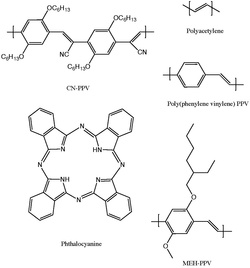
Conductive polymers are often typically intrinsically conductive or at least semiconductors. They sometimes show mechanical properties comparable to those of conventional organic polymers. Both organic synthesis and advanced dispersion techniques can be used to tune the electrical properties of conductive polymers, unlike typical inorganic conductors. Well-studied class of conductive polymers include polyacetylene, polypyrrole, polythiophenes, and polyaniline. Poly(p-phenylene vinylene) and its derivatives are electroluminescent semiconducting polymers. Poly(3-alkythiophenes) have been incorporated into prototypes of solar cells and transistors.

Organic light-emitting diode

An OLED (organic light-emitting diode) consists of a thin film of organic material that emits light under stimulation by an electric current. A typical OLED consists of an anode, a cathode, OLED organic material and a conductive layer.

Br6A, a next generation pure organic light emitting crystal family
Schematic of a bilayer OLED: 1. Cathode (−), 2. Emissive layer, 3. Emission of radiation, 4. Conductive layer, 5. Anode (+)

OLED organic materials can be divided into two major families: small-molecule-based and polymer-based. Small molecule OLEDs (SM-OLEDs) include tris(8-hydroxyquinolinato)aluminium fluorescent and phosphorescent dyes, and conjugated dendrimers. Fluorescent dyes can be selected according to the desired range of emission wavelengths; compounds like perylene and rubrene are often used. Devices based on small molecules are usually fabricated by thermal evaporation under vacuum. While this method enables the formation of well-controlled homogeneous film; is hampered by high cost and limited scalability. Polymer light-emitting diodes (PLEDs) are generally more efficient than SM-OLEDs. Common polymers used in PLEDs include derivatives of poly(p-phenylene vinylene) and polyfluorene. The emitted color is determined by the structure of the polymer. Compared to thermal evaporation, solution-based methods are more suited to creating films with large dimensions.

Organic field-effect transistor

Rubrene-OFET with the highest charge mobility

An organic field-effect transistor (OFET) is a field-effect transistor utilizing organic molecules or polymers as the active semiconducting layer. A field-effect transistor (FET) is any semiconductor material that utilizes electric field to control the shape of a channel of one type of charge carrier, thereby changing its conductivity. Two major classes of FET are n-type and p-type semiconductor, classified according to the charge type carried. In the case of organic FETs (OFETs), p-type OFET compounds are generally more stable than n-type due to the susceptibility of the latter to oxidative damage.

As for OLEDs, some OFETs are molecular and some are polymer-based system. Rubrene-based OFETs show high carrier mobility of 20–40 cm2/(V·s). Another popular OFET material is Pentacene. Due to its low solubility in most organic solvents, it's difficult to fabricate thin film transistors (TFTs) from pentacene itself using conventional spin-cast or, dip coating methods, but this obstacle can be overcome by using the derivative TIPS-pentacene.

Organic electronic devices

Organics-based flexible display
Five structures of organic photovoltaic materials

Organic solar cells could cut the cost of solar power compared with conventional solar-cell manufacturing. Silicon thin-film solar cells on flexible substrates allow a significant cost reduction of large-area photovoltaics for several reasons:

  1. The so-called 'roll-to-roll'-deposition on flexible sheets is much easier to realize in terms of technological effort than deposition on fragile and heavy glass sheets.
  2. Transport and installation of lightweight flexible solar cells also saves cost as compared to cells on glass.

Inexpensive polymeric substrates like polyethylene terephthalate (PET) or polycarbonate (PC) have the potential for further cost reduction in photovoltaics. Protomorphous solar cells prove to be a promising concept for efficient and low-cost photovoltaics on cheap and flexible substrates for large-area production as well as small and mobile applications.

One advantage of printed electronics is that different electrical and electronic components can be printed on top of each other, saving space, increasing reliability, and sometimes achieving complete transparency. One ink must not damage another, and low temperature annealing is vital if low-cost flexible materials such as paper and plastic film are to be used. There is much sophisticated engineering and chemistry involved here, with iTi, Pixdro, Asahi Kasei, Merck & Co.|Merck, BASF, HC Starck, Sunew, Hitachi Chemical, and Frontier Carbon Corporation among the leaders. Electronic devices based on organic compounds are now widely used, with many new products under development. Sony reported the first full-color, video-rate, flexible, plastic display made purely of organic materialstelevision screen based on OLED materials; biodegradable electronics based on organic compound and low-cost organic solar cell are also available.

Fabrication methods

Small molecule semiconductors are often insoluble, necessitating deposition via vacuum sublimation. Devices based on conductive polymers can be prepared by solution processing methods. Both solution processing and vacuum based methods produce amorphous and polycrystalline films with variable degree of disorder. "Wet" coating techniques require polymers to be dissolved in a volatile solvent, filtered and deposited onto a substrate. Common examples of solvent-based coating techniques include drop casting, spin-coating, doctor-blading, inkjet printing and screen printing. Spin-coating is a widely used technique for small area thin film production. It may result in a high degree of material loss. The doctor-blade technique results in a minimal material loss and was primarily developed for large area thin film production. Vacuum based thermal deposition of small molecules requires evaporation of molecules from a hot source. The molecules are then transported through vacuum onto a substrate. The process of condensing these molecules on the substrate surface results in thin film formation. Wet coating techniques can in some cases be applied to small molecules depending on their solubility.

Organic solar cells

Bilayer organic photovoltaic cell

Organic semiconductor diodes convert light into electricity. Figure to the right shows five commonly used organic photovoltaic materials. Electrons in these organic molecules can be delocalized in a delocalized π orbital with a corresponding π* antibonding orbital. The difference in energy between the π orbital, or highest occupied molecular orbital (HOMO), and π* orbital, or lowest unoccupied molecular orbital (LUMO) is called the band gap of organic photovoltaic materials. Typically, the band gap lies in the range of 1-4eV.

The difference in the band gap of organic photovoltaic materials leads to different chemical structures and forms of organic solar cells. Different forms of solar cells includes single-layer organic photovoltaic cells, bilayer organic photovoltaic cells and heterojunction photovoltaic cells. However, all three of these types of solar cells share the approach of sandwiching the organic electronic layer between two metallic conductors, typically indium tin oxide.

Illustration of thin film transistor device

Organic field-effect transistors

An organic field-effect transistor is a three terminal device (source, drain and gate). The charge carriers move between source and drain, and the gate serves to control the path's conductivity. There are mainly two types of organic field-effect transistor, based on the semiconducting layer's charge transport, namely p-type (such as dinaphtho[2,3-b:2′,3′-f]thieno[3,2-b]thiophene, DNTT), and n-type (such phenyl C61 butyric acid methyl ester, PCBM). Certain organic semiconductors can also present both p-type and n-type (i.e., ambipolar) characteristics.

Such technology allows for the fabrication of large-area, flexible, low-cost electronics. One of the main advantages is that being mainly a low temperature process compared to CMOS, different type of materials can be utilized. This makes them in turn great candidates for sensing.

Features

Conductive polymers are lighter, more flexible, and less expensive than inorganic conductors. This makes them a desirable alternative in many applications. It also creates the possibility of new applications that would be impossible using copper or silicon.

Organic electronics not only includes organic semiconductors, but also organic dielectrics, conductors and light emitters.

New applications include smart windows and electronic paper. Conductive polymers are expected to play an important role in the emerging science of molecular computers.

Doomsday Clock

From Wikipedia, the free encyclopedia
https://en.wikipedia.org/wiki/Doomsday_Clock
Doomsday Clock
The Doomsday Clock pictured at its setting of "85 seconds to midnight", last changed on January 27, 2026
FrequencyYearly
InauguratedJune 1947
Most recentJanuary 27, 2026
Organized byBulletin of the Atomic Scientists
Websitethebulletin.org/doomsday-clock Edit this at Wikidata

The Doomsday Clock is a symbol that represents the estimated likelihood of a human-made global catastrophe, in the opinion of the nonprofit organization Bulletin of the Atomic Scientists.

Maintained since 1947, the Clock is a proxy mechanism for threats to humanity from unchecked scientific and technological advances: A hypothetical global catastrophe is represented by midnight on the Clock, with the Bulletin's opinion on how close the world is to "zero" represented by a certain number of minutes or seconds to midnight. This is assessed in January of each year. The main factors influencing the Clock are nuclear warfare, climate change, and artificial intelligence. The Bulletin's Science and Security Board monitors new developments in the life sciences and technology that could inflict irrevocable harm to humanity.

The Clock's original setting in 1947 was seven minutes to midnight. It has since been set backward eight times and forward 19 times. The farthest time from midnight was 17 minutes in 1991, and the closest is 85 seconds in 2026.

The Clock was moved to 150 seconds (2 minutes, 30 seconds) in 2017, then forward to two minutes to midnight in 2018, and left unchanged in 2019. It was moved forward to 100 seconds (1 minute, 40 seconds) in 2020, 90 seconds (1 minute, 30 seconds) in 2023, 89 seconds (1 minute, 29 seconds) in 2025, and 85 seconds (1 minute, 25 seconds) in 2026.

History

Cover of the 1947 Bulletin of the Atomic Scientists issue, featuring the Doomsday Clock at "seven minutes to midnight"

The Doomsday Clock's origin can be traced to the international group of researchers called the Chicago Atomic Scientists, who had participated in the Manhattan Project. After the atomic bombings of Hiroshima and Nagasaki, they began publishing a mimeographed newsletter and then the magazine, Bulletin of the Atomic Scientists, which, since its inception, has depicted the Clock on every cover. The Clock was first represented in 1947, when the Bulletin co-founder Hyman Goldsmith asked artist Martyl Langsdorf (wife of Manhattan Project research associate and Szilárd petition signatory Alexander Langsdorf Jr.) to design a cover for the magazine's June 1947 issue. As Eugene Rabinowitch, another co-founder of the Bulletin, explained later:

The Bulletin's Clock is not a gauge to register the ups and downs of the international power struggle; it is intended to reflect basic changes in the level of continuous danger in which mankind lives in the nuclear age...

Langsdorf chose a clock to reflect the urgency of the problem: like a countdown, the Clock suggests that destruction will naturally occur unless someone takes action to stop it.

In January 2007, designer Michael Bierut, who was on the Bulletin's Governing Board, redesigned the Doomsday Clock to give it a more modern feel. In 2009, the Bulletin ceased its print edition and became one of the first print publications in the U.S. to become entirely digital; the Clock is now found as part of the logo on the Bulletin's website. Information about the Doomsday Clock Symposium, a timeline of the Clock's settings, and multimedia shows about the Clock's history and culture can also be found on the Bulletin's website.

The 5th Doomsday Clock Symposium was held on November 14, 2013, in Washington, D.C.; it was a day-long event that was open to the public and featured panelists discussing various issues on the topic "Communicating Catastrophe". There was also an evening event at the Hirshhorn Museum and Sculpture Garden in conjunction with the Hirshhorn's current exhibit, "Damage Control: Art and Destruction Since 1950". The panel discussions, held at the American Association for the Advancement of Science, were streamed live from the Bulletin's website and can still be viewed there. Reflecting international events dangerous to humankind, the Clock has been adjusted 27 times since its inception in 1947, when it was set to "seven minutes to midnight".

The Doomsday Clock has become a universally recognized metaphor according to The Two-Way, an NPR blog. According to the Bulletin, the Clock attracts more daily visitors to the Bulletin's site than any other feature.

Basis for settings

"Midnight" has a deeper meaning besides the constant threat of war. There are various elements taken into consideration when the scientists from the Bulletin decide what Midnight and "global catastrophe" really mean in a particular year. They might include "politics, energy, weapons, diplomacy, and climate science"; potential sources of threat include nuclear threats, climate change, bioterrorism, and artificial intelligence. Members of the board judge Midnight by discussing how close they think humanity is to the end of civilization. In 1947, at the beginning of the Cold War, the Clock was started at seven minutes to midnight.

Fluctuations and threats

Before January 2020, the two tied-for-lowest points for the Doomsday Clock were in 1953 (when the Clock was set to two minutes until midnight, after the U.S. and the Soviet Union began testing hydrogen bombs) and in 2018, following the failure of world leaders to address tensions relating to nuclear weapons and climate change issues. In other years, the Clock's time has fluctuated from 17 minutes in 1991 to 2 minutes 30 seconds in 2017. Discussing the change in 2017, Lawrence Krauss, one of the scientists from the Bulletin, warned that political leaders must make decisions based on facts, and those facts "must be taken into account if the future of humanity is to be preserved". In an announcement from the Bulletin about the status of the Clock, they went as far to call for action from "wise" public officials and "wise" citizens to make an attempt to steer human life away from catastrophe while humans still can.

On January 24, 2018, scientists moved the clock to two minutes to midnight, based on threats greatest in the nuclear realm. The scientists said, of recent moves by North Korea under Kim Jong-un and the administration of Donald Trump in the U.S.: "Hyperbolic rhetoric and provocative actions by both sides have increased the possibility of nuclear war by accident or miscalculation".

The clock was left unchanged in 2019 due to the twin threats of nuclear weapons and climate change, and the problem of those threats being "exacerbated this past year by the increased use of information warfare to undermine democracy around the world, amplifying risk from these and other threats and putting the future of civilization in extraordinary danger".

On January 23, 2020, the Clock was moved to 100 seconds (1 minute, 40 seconds) before midnight. The Bulletin's executive chairman, Jerry Brown, said "the dangerous rivalry and hostility among the superpowers increases the likelihood of nuclear blunder... Climate change just compounds the crisis". The "100 seconds to midnight" setting remained unchanged in 2021 and 2022.

On January 24, 2023, the Clock was moved to 90 seconds (1 minute, 30 seconds) before midnight, which was largely attributed to the risk of nuclear escalation that arose from the Russian invasion of Ukraine. Other reasons cited included climate change, biological threats such as COVID-19, and risks associated with disinformation and disruptive technologies.

On January 28, 2025, the Clock was moved to 89 seconds (1 minute, 29 seconds) before midnight. In addition to last year's concerns, the increased usage of artificial intelligence in both the battlefield and social media was noted as a new factor.

On January 27, 2026, the Clock was moved to 85 seconds (1 minute, 25 seconds) before midnight, the closest it has ever been set to midnight since its inception in 1947. According to the bulletin, it's all caused as a "failure of leadership". From Alexandra Bell, CEO and president of the scientists "It is a hard truth, but this is our reality" as no significant action was done to push the clock back.

Criticism

In 2016, Anders Sandberg of the Future of Humanity Institute has stated that the "grab bag of threats" currently mixed together by the Clock can induce paralysis. People may be more likely to succeed at smaller, incremental challenges; for example, taking steps to prevent the accidental detonation of nuclear weapons was a small but significant step towards avoiding nuclear war. Alex Barasch in Slate argued that "putting humanity on a permanent, blanket high-alert isn't helpful when it comes to policy or science" and criticized the Bulletin for neither explaining nor attempting to quantify their methodology.

Cognitive psychologist Steven Pinker harshly criticized the Doomsday Clock as a political stunt, pointing to the words of its founder that its purpose was "to preserve civilization by scaring men into rationality". He stated that it is inconsistent and not based on any objective indicators of security, using as an example its being farther from midnight in 1962 during the Cuban Missile Crisis than in the "far calmer 2007". He argued it was another example of humanity's tendency toward historical pessimism, and compared it to other predictions of self-destruction that went unfulfilled.

Writing for the New Statesman, British journalist James Ball questioned the Clock's purpose and noted the Bulletin's lack of objective methodology for setting the Clock. Ball then observes that the organization is no different to other doomsday cults preaching the end of the world except that the Bulletin is secular instead of religious.

Conservative media outlets have often criticized the Bulletin and the Doomsday Clock. Keith Payne wrote 2010 in the National Review that the Clock overestimated the effects of "developments in the areas of nuclear testing and formal arms control". In 2018, Tristin Hopper in the National Post acknowledged that "there are plenty of things to worry about regarding climate change", but states that climate change is not in the same league as total nuclear destruction. In addition, some critics accuse the Bulletin of pushing a political agenda.

Timeline

Doomsday Clock graph, 1947–2023. The lower points on the graph represent a higher probability of technologically or environmentally-induced catastrophe, and the higher points represent a lower probability, in the opinion of the Bulletin.
Timeline of the Doomsday Clock
Year Minutes to midnight Time (24-h) Change (minutes) Reason Clock
1947 7 23:53 0 The initial setting of the Doomsday Clock.
1949 3 23:57 −4 The Soviet Union tests its first atomic bomb, the RDS-1, starting the nuclear arms race.
1953 2 23:58 −1 The United States tests its first thermonuclear device in November 1952 as part of Operation Ivy, before the Soviet Union follows suit with the Joe 4 test in August. This remained the clock's closest approach to midnight (tied in 2018) until 2020.
1960 7 23:53 +5 In response to a perception of increased scientific cooperation and public understanding of the dangers of nuclear weapons (as well as political actions taken to avoid "massive retaliation"), the United States and Soviet Union cooperate and avoid direct confrontation in regional conflicts such as the 1956 Suez Crisis, the 1958 Second Taiwan Strait Crisis, and the 1958 Lebanon crisis. Scientists from various countries help establish the International Geophysical Year, a series of coordinated, worldwide scientific observations between nations allied with both the United States and the Soviet Union, and the Pugwash Conferences on Science and World Affairs, which allow Soviet and American scientists to interact.
1963 12 23:48 +5 The United States and the Soviet Union sign the Partial Test Ban Treaty, limiting atmospheric nuclear testing.
1968 7 23:53 −5 The involvement of the United States in the Vietnam War intensifies, the Indo-Pakistani War of 1965 takes place, and the Six-Day War occurs in 1967. France and China, two nations which have not signed the Partial Test Ban Treaty, acquire and test nuclear weapons (the 1960 Gerboise Bleue and the 1964 596, respectively) to assert themselves as global players in the nuclear arms race.
1969 10 23:50 +3 About 100 nations sign the Nuclear Non-Proliferation Treaty, and the United States also ratifies it.
1972 12 23:48 +2 The United States and the Soviet Union sign the first Strategic Arms Limitation Treaty (SALT I) and the Anti-Ballistic Missile (ABM) Treaty.
1974 9 23:51 −3 India tests a nuclear device (Smiling Buddha), and SALT II talks stall. Both the United States and the Soviet Union modernize multiple independently targetable reentry vehicles (MIRVs).
1980 7 23:53 −2 Unforeseeable end to deadlock in American–Soviet talks as the Soviet–Afghan War begins. As a result of the war, the U.S. Senate refuses to ratify the SALT II agreement.
1981 4 23:56 −3 The Soviet war in Afghanistan toughens the U.S.' nuclear posture. U.S. President Jimmy Carter withdraws the United States from the 1980 Summer Olympic Games in Moscow. The Carter administration considers ways in which the United States could win a nuclear war. Ronald Reagan becomes President of the United States, scraps further arms reduction talks with the Soviet Union, and argues that the only way to end the Cold War is to win it. Tensions between the United States and the Soviet Union contribute to the danger of nuclear annihilation as they each deploy intermediate-range missiles in Europe. The adjustment also accounts for the Iran hostage crisis, the Iran–Iraq War, China's atmospheric nuclear warhead test, the declaration of martial law in Poland, apartheid in South Africa, and human rights abuses across the world.[35][36]
1984 3 23:57 −1 Further escalation of the tensions between the United States and the Soviet Union, with the ongoing Soviet–Afghan War intensifying the Cold War. U.S. Pershing II medium-range ballistic missile and cruise missiles are deployed in Western Europe.[35] Ronald Reagan pushes to win the Cold War by intensifying the arms race between the superpowers. The Soviet Union and its allies (except Romania) boycott the 1984 Olympic Games in Los Angeles, as a response to the U.S.-led boycott in 1980.
1988 6 23:54 +3 In December 1987, the United States and the Soviet Union sign the Intermediate-Range Nuclear Forces Treaty, to eliminate intermediate-range nuclear missiles, and their relations improve.
1990 10 23:50 +4 The fall of the Berlin Wall and the Iron Curtain, along with the reunification of Germany, meaning that the Cold War is nearing its end.
1991 17 23:43 +7 The United States and Soviet Union sign the first Strategic Arms Reduction Treaty (START I), the US announces the removal of many tactical nuclear weapons in September 1991, and the Soviet Union takes similar steps, as well as announcing the complete cessation of all nuclear testing in October 1991. The Bulletin editorial, published November 26, 1991, announces that "the 40-year-long East-West nuclear arms race is over." One month after the Bulletin made this clock adjustment, the Soviet Union dissolves on December 26, 1991. This is the farthest from midnight the Clock has been since its inception.
1995 14 23:46 −3 Global military spending continues at Cold War levels amid concerns about post-Soviet nuclear proliferation of weapons and brainpower.
1998 9 23:51 −5 Both India (Pokhran-II) and Pakistan (Chagai-I) test nuclear weapons in a tit-for-tat show of aggression; the United States and Russia run into difficulties in further reducing stockpiles.
2002 7 23:53 −2 Little progress on global nuclear disarmament. United States rejects a series of arms control treaties and announces its intentions to withdraw from the Anti-Ballistic Missile Treaty, amid concerns about the possibility of a nuclear terrorist attack due to the amount of weapon-grade nuclear materials that are unsecured and unaccounted for worldwide.
2007 5 23:55 −2 North Korea tests a nuclear weapon in October 2006, Iran's nuclear ambitions, a renewed American emphasis on the military utility of nuclear weapons, the failure to adequately secure nuclear materials, and the continued presence of some 26,000 nuclear weapons in the United States and Russia. After assessing the dangers posed to civilization, climate change was added to the prospect of nuclear annihilation as the greatest threats to humanity.
2010 6 23:54 +1 Worldwide cooperation to reduce nuclear arsenals and limit effect of climate change. The New START agreement is ratified by both the United States and Russia, and more negotiations for further reductions in the American and Russian nuclear arsenal are already planned. The 2009 United Nations Climate Change Conference in Copenhagen results in the developing and industrialized countries agreeing to take responsibility for carbon emissions and to limit global temperature rise to 2 degrees Celsius.
2012 5 23:55 −1 Lack of global political action to address global climate change, nuclear weapons stockpiles, the potential for regional nuclear conflict, and nuclear power safety.
2015 3 23:57 −2 Concerns amid continued lack of global political action to address global climate change, the modernization of nuclear weapons in the United States and Russia, and the problem of nuclear waste.
2017 2+12 23:57:30 12
(−30 s)
United States President Donald Trump's comments over nuclear weapons, the threat of a renewed arms race between the U.S. and Russia, and the expressed disbelief in the scientific consensus over climate change by the Trump administration.
2018 2 23:58 12
(−30 s)
Failure of world leaders to deal with looming threats of nuclear war and climate change. This was at the time the clock's third closest approach to midnight, matching that of 1953. In 2019, the Bulletin reaffirmed the "two minutes to midnight" time, citing continuing climate change and Trump administration's abandonment of U.S. efforts to lead the world toward decarbonization; U.S. withdrawal from the Paris Agreement, the Joint Comprehensive Plan of Action, and the Intermediate-Range Nuclear Forces Treaty; U.S. and Russian nuclear modernization efforts; information warfare threats and other dangers from "disruptive technologies" such as synthetic biology, artificial intelligence, and cyberwarfare.
2020 1+23
(100 s)
23:58:20 13
(−20 s)
Failure of world leaders to deal with the increased threats of nuclear war, such as the end of the Intermediate-Range Nuclear Forces Treaty (INF) between the United States and Russia as well as increased tensions between the U.S. and Iran, along with the continued neglect of climate change. Announced in units of seconds, instead of minutes; this was the clock's closest approach to midnight, exceeding that of 1953 and 2018. The Bulletin concluded by stating that the current issues causing the adjustment are "the most dangerous situation that humanity has ever faced". In the annual statements for 2021 and 2022, issued in January of each year, the Bulletin left the "100 seconds to midnight" time setting unchanged.
2023 1+12
(90 s)
23:58:30 16
(−10 s)
Due largely—but not exclusively—to the Russian invasion of Ukraine and the increased risk of nuclear escalation stemming from the conflict. Russia suspended its participation in the last remaining nuclear weapons treaty between it and the United States, New START. Russia also brought its war to the Chernobyl and Zaporizhzhia nuclear reactor sites, violating international protocols and risking widespread release of radioactive materials. North Korea resumed its nuclear rhetoric, launching an intermediate-range ballistic missile test over Japan in October 2022. Continuing threats posed by the climate crisis and the breakdown of global norms and institutions set up to mitigate risks associated with advancing technologies and biological threats such as COVID-19 also contributed to the time setting. This setting remained unchanged the following year.
2025 1+2960
(89 s)
23:58:31 160
(−1 s)
The continuing Russian invasion of Ukraine and the Middle Eastern crisis, increased nuclear proliferation, effects of climate change, biological threats, and advancing technologies.
2026 1+512
(85 s)
23:58:35 115
(−4 s)
Russia's continued war in Ukraine, the U.S. and Israeli bombing of Iran, and border clashes between India and Pakistan. Other cited factors include ongoing tensions in Asia, including on the Korean Peninsula, as well as rising tensions in the Western hemisphere, and the expiration of the New START treaty on February 5, 2026. Rising nuclear proliferation, effects of climate change, biological threats, and advancing technologies have also continued. This is the closest to midnight the Clock has been since its inception.

Many-minds interpretation

From Wikipedia, the free encyclopedia
https://en.wikipedia.org/wiki/Many-minds_interpretation

The many-minds interpretation of quantum mechanics extends the many-worlds interpretation by proposing that the distinction between worlds should be made at the level of the mind of an individual observer. The concept was first introduced in 1970 by H. Dieter Zeh as a variant of the Hugh Everett interpretation in connection with quantum decoherence, and later (in 1981) explicitly called a many or multi-consciousness interpretation. The name many-minds interpretation was first used by David Albert and Barry Loewer in 1988.

History

Interpretations of quantum mechanics

The various interpretations of quantum mechanics typically involve explaining the mathematical formalism of quantum mechanics, or to create a physical picture of the theory. While the mathematical structure has a strong foundation, there is still much debate about the physical and philosophical interpretation of the theory. These interpretations aim to tackle various concepts such as:

  1. Evolution of the state of a quantum system (given by the wavefunction), typically through the use of the Schrödinger equation. This concept is almost universally accepted, and is rarely put to debate.
  2. The measurement problem, which relates to what is called wavefunction collapse – the collapse of a quantum state into a definite measurement (i.e. a specific eigenstate of the wavefunction). The debate on whether this collapse actually occurs is a central problem in interpreting quantum mechanics.

The standard solution to the measurement problem is the "Orthodox" or "Copenhagen" interpretation, which claims that the wave function collapses as the result of a measurement by an observer or apparatus external to the quantum system. An alternative interpretation, the Many-worlds Interpretation, was first described by Hugh Everett in 1957 (where it was called the relative state interpretation, the name Many-worlds was coined by Bryce Seligman DeWitt starting in the 1960s and finalized in the 1970s). His formalism of quantum mechanics denied that a measurement requires a wave collapse, instead suggesting that all that is truly necessary of a measurement is that a quantum connection is formed between the particle, the measuring device, and the observer.

The many-worlds interpretation

In the original relative state formulation, Everett proposed that there is one universal wavefunction that describes the objective reality of the whole universe. He stated that when subsystems interact, the total system becomes a superposition of these subsystems. This includes observers and measurement systems, which become part of one universal state (the wavefunction) that is always described via the Schrödinger Equation (or its relativistic alternative). That is, the states of the subsystems that interacted become "entangled" in such a way that any definition of one must necessarily involve the other. Thus, each subsystem's state can only be described relative to each subsystem with which it interacts (hence the name relative state).

Everett suggested that the universe is actually indeterminate as a whole. For example, consider an observer measuring some particle that starts in an undetermined state, as both spin-up and spin-down, that is – a superposition of both possibilities. When an observer measures that particle's spin, however, it always registers as either up or down. The problem of how to understand this sudden shift from "both up and down" to "either up or down" is called the Measurement problem. According to the many-worlds interpretation, the act of measurement forced a “splitting” of the universe into two states, one spin-up and the other spin-down, and the two branches that extend from those two subsequently independent states. One branch measures up. The other measures down. Looking at the instrument informs the observer which branch he is on, but the system itself is indeterminate at this and, by logical extension, presumably any higher level.

The “worlds” in the many worlds theory is then just the complete measurement history up until and during the measurement in question, where splitting happens. These “worlds” each describe a different state of the universal wave function and cannot communicate. There is no collapse of the wavefunction into one state or another, but rather an observer finds itself in the world leading up to what measurement it has made and is unaware of the other possibilities that are equally real.

The many-minds interpretation

The many-minds interpretation of quantum theory is many-worlds with the distinction between worlds constructed at the level of the individual observer. Rather than the worlds that branch, it is the observer's mind that branches.

The problem with this interpretation is that it implies the observer must be in a superposition with herself, and that seems strange. In their 1988 paper, Albert and Loewer argued that the mind of an observer cannot be in an indefinite state because an observer must answer the question about which state of a system he has observed with complete certainty. If the observer's mind were in a superposition of states, then it could not attain such certainty. To overcome this contradiction, they suggest that a mind must always be in a definite state and only the “bodies” of the minds are in a superposition.

Accordingly, when an observer measures a quantum system and becomes entangled with it, the result is a larger quantum system. In regards to each possibility within this greater wave function, a mental state of the brain corresponds. Ultimately, only one of these mental states is experienced, leading the others to branch off and become inaccessible, albeit real. In this way, every sentient being possesses an infinity of minds, whose prevalence correspond to the amplitude of the wavefunction. As an observer checks a measurement, the probability of realizing a specific measurement directly correlates to the number of minds they have where they see that measurement. It is in this way that the probabilistic nature of quantum measurements are obtained by the Many-minds Interpretation.

Quantum non-locality in the many-minds interpretation

The body remains in an indeterminate state while the minds picks a stochastic result.

Consider an experiment that measures the polarization of two photons. When the photon is created, it has an indeterminate polarization. If a stream of these photons is passed through a polarization filter, 50% of the light is passed through. This corresponds to each photon having a 50% chance of aligning with the filter and thus passing, or being misaligned (by 90 degrees relative to the polarization filter) and being absorbed. Quantum mechanically, this means the photon is in a superposition of states where it is either passed or absorbed. Now, consider the inclusion of another photon and polarization detector. Now, the photons are created in such a way that they are entangled. That is, when one photon takes on a polarization state, the other photon will always behave as if it has the same polarization. For simplicity, take the second filter to either be perfectly aligned with the first, or to be perfectly misaligned (90 degree difference in angle, such that it is absorbed). If the detectors are aligned, both photons are passed (i.e. they are said to agree). If they are misaligned, only the first passes and the second is absorbed (now they disagree). Thus, the entanglement causes perfect correlations between the two measurements – regardless of separation distance, making the interaction non-local. This sort of experiment is further explained in Tim Maudlin's Quantum Non-Locality and Relativity, and can be related to Bell test experiments. Now, consider the analysis of this experiment from the many minds point of view:

No sentient observer

Consider the case where there is no sentient observer, i.e. no mind present to observe the experiment. In this case, the detector will be in an indefinite state. The photon is both passed and absorbed, and will remain in this state. The correlations are withheld in that none of the possible "minds", or wave function states, correspond to non correlated results.

One sentient observer

Now expand the situation to have one sentient being observing the device. Now, they too enter the indefinite state. Their eyes, body, and brain are seeing both spins at the same time. The mind however, stochastically chooses one of the directions, and that is what the mind sees. When this observer views the second detector, their body will see both results. Their mind will choose the result that agrees with the first detector, and the observer will see the expected results. However, the observer's mind seeing one result does not directly affect the distant state – there is just no wave function in which the expected correlations do not exist. The true correlation only happens when they actually view the second detector.

Two sentient observers

When two people look at two different detectors that scan entangled particles, both observers will enter an indefinite state, as with one observer. These results need not agree – the second observer's mind does not have to have results that correlate with the first's. When one observer tells the results to the second observer, their two minds cannot communicate and thus will only interact with the other's body, which is still indefinite. When the second observer responds, his body will respond with whatever result agrees with the first observer's mind. This means that both observer's minds will be in a state of the wavefunction that always get the expected results, but individually their results could be different.

Non-locality of the many-minds interpretation

As we have thus seen, any correlations seen in the wavefunction of each observer's minds are only concrete after interaction between the different polarizers. The correlations on the level of individual minds correspond to the appearance of quantum non-locality (or equivalently, violation of Bell's inequality). So the many world is non-local, or it cannot explain EPR-GHZ correlations.

Support

There is currently no empirical evidence for the many-minds interpretation. However, there are theories that do not discredit the many-minds interpretation. In light of Bell's analysis of the consequences of quantum non-locality, empirical evidence is needed to avoid inventing novel fundamental concepts (hidden variables).[9] Two different solutions of the measurement problem then appear conceivable: consciousness causes collapse or Everett's relative state interpretation. In both cases a (suitably modified) psycho-physical parallelism can be re-established.

If neural processes can be described and analyzed then some experiments could potentially be created to test whether affecting neural processes can have an effect on a quantum system. Speculation about the details of this awareness-local physical system coupling on a purely theoretical basis could occur, however experimentally searching for them through neurological and psychological studies would be ideal.

Objections

Nothing within quantum theory itself requires each possibility within a wave function to complement a mental state. As all physical states (i.e. brain states) are quantum states, their associated mental states should be also. Nonetheless, it is not what one experiences within physical reality. Albert and Loewer argue that the mind must be intrinsically different than the physical reality as described by quantum theory. Thereby, they reject type-identity physicalism in favour of a non-reductive stance. However, Lockwood saves materialism through the notion of supervenience of the mental on the physical.

Nonetheless, the many-minds interpretation does not solve the mindless hulks problem as a problem of supervenience. Mental states do not supervene on brain states as a given brain state is compatible with different configurations of mental states.

Another serious objection is that workers in no collapse interpretations have produced no more than elementary models based on the definite existence of specific measuring devices. They have assumed, for example, that the Hilbert space of the universe splits naturally into a tensor product structure compatible with the measurement under consideration. They have also assumed, even when describing the behaviour of macroscopic objects, that it is appropriate to employ models in which only a few dimensions of Hilbert space are used to describe all the relevant behaviour.

Furthermore, as the many-minds interpretation is corroborated by our experience of physical reality, a notion of many unseen worlds and its compatibility with other physical theories (i.e. the principle of the conservation of mass) is difficult to reconcile. According to Schrödinger's equation, the mass-energy of the combined observed system and measurement apparatus is the same before and after. However, with every measurement process (i.e. splitting), the total mass-energy would seemingly increase.

Peter J. Lewis argues that the many-minds interpretation of quantum mechanics has absurd implications for agents facing life-or-death decisions.

In general, the many-minds theory holds that a conscious being who observes the outcome of a random zero-sum experiment will evolve into two successors in different observer states, each of whom observes one of the possible outcomes. Moreover, the theory advises one to favour choices in such situations in proportion to the probability that they will bring good results to one's various successors. But in a life-or-death case like an observer getting into the box with Schrödinger's cat, the observer will only have one successor, since one of the outcomes will ensure the observers death. So it seems that the many-minds interpretation advises one to get in the box with the cat, since it is certain that one's only successor will emerge unharmed. See also quantum suicide and immortality.

Finally, it supposes that there is some physical distinction between a conscious observer and a non-conscious measuring device, so it seems to require eliminating the strong Church–Turing hypothesis or postulating a physical model for consciousness.

Isomer

From Wikipedia, the free encyclopedia https://en.wikipedia.org/wiki/Isomer In chemistry , isomers are molecule...